

Hertz means cycles per second. It is a unit, not a ranking of spiritual or biological value. A plucked fabric strip can vibrate mechanically; a molecule can have several spectroscopic modes; a garment can absorb and emit electromagnetic radiation across many frequencies. Those are distinct measurements. To compare fabrics, specify the physical quantity, apparatus, sample dimensions, tension, humidity, temperature and uncertainty. The supplied image provides none of these. [E03]
Its claim that contact with linen raises a wearer’s frequency and promotes healing is not established by a documented measurement or clinical study supplied with the image. The numerical claim is retained in the transcription, not adopted as a health instruction. A genuine cultural history of cloth does not need an invented medical mechanism.
What a fabric measurement must record
| Variable | Why the record needs it |
|---|---|
| Fibre and weave | The same fibre can form cloth of different thickness, density and drape. |
| Sample dimensions and conditioning | Area, temperature and moisture alter comparisons. |
| Quantity and instrument | Absorption, drying time and vibration frequency are different properties. |
| Repeat observations and uncertainty | Variation limits the strength of a comparison; it does not establish a medical effect. |
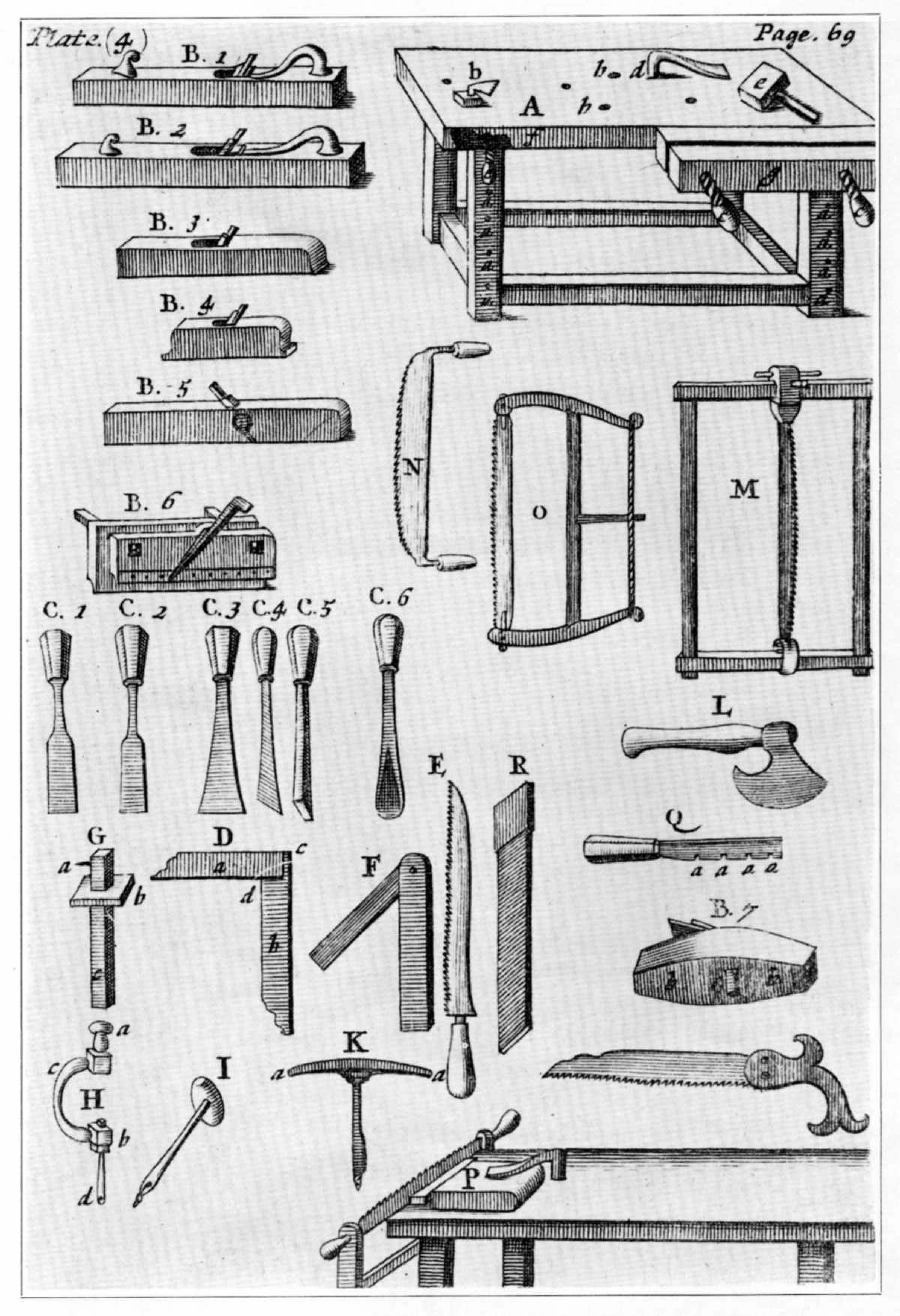
Joseph Moxon’s engraving of the workbench and joiner’s tools, 1703.
Read the object record
An artisan can show an apprentice how to work from a face and an edge. A drawing extends that lesson to someone who cannot visit the shop. The transfer succeeds only when the drawing records which surface controls a measurement and what counts as a finished result.
Practical knowledge from 1600 to 1900
A workshop that can be inspected Practical knowledge becomes more useful when its tools, reference surfaces and checks can be seen. This section follows selected English and American woodworking evidence within 1600-1900. It is one case study, not a claim that other societies lacked sophisticated craft traditions. Joseph Moxon, 1627-1691 Moxon was a printer and globemaker. His Mechanick Exercises made workshop operations readable in words and pictures. The third edition used here appeared in London in 1703, after his death. Plate 4 and the joinery text let us connect named tools with particular tasks. [D326-D328] Preparation comes before fitting Moxon describes working a first surface, checking it, then using it to establish adjoining surfaces. A square needs a reliable face against which to sit. A gauge transfers an offset from an edge. Those dependencies matter more than the attractive appearance of an old bench. [D326]
Read a workshop through its tools
Joseph Moxon, Mechanick Exercises, third edition, London, 1703 · Plate 4 [D326-D327]
Units and terms in this account
BCE Before the Common Era