Reading uses the speech service available on your phone or browser. Some voices need an internet connection.
ElevenLabs · ElevenReader
Copy this reading, then paste it into ElevenReader to choose an ElevenLabs voice. You can also import this page’s link.
The book’s colour key
- People and history
- Measurements and quantities
- Places
- Materials and tools
- Living systems
- Conditional or unresolved claims
Colour identifies a type of information. It does not certify a claim. Named terms and source links provide the context.
A contemporary composition
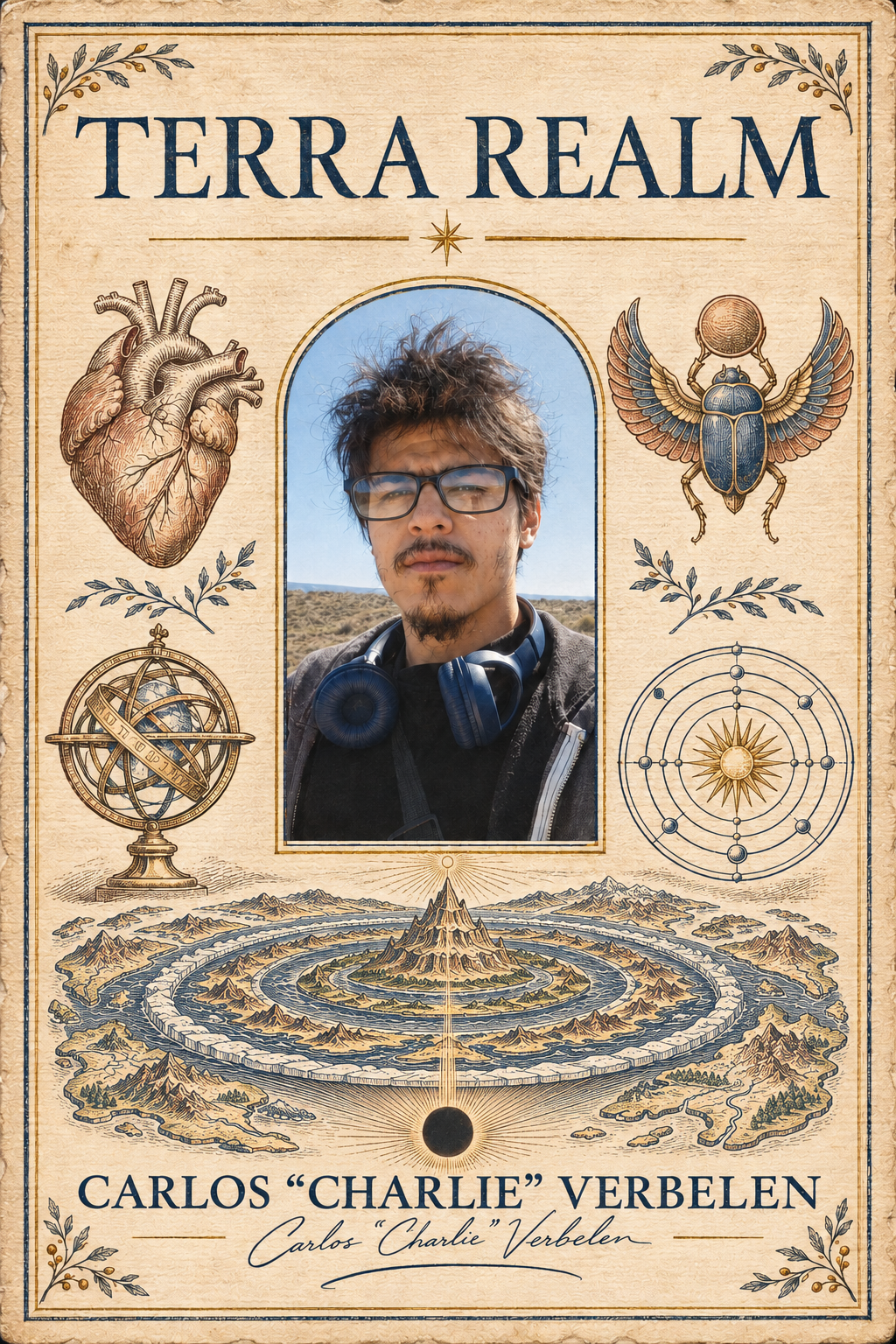
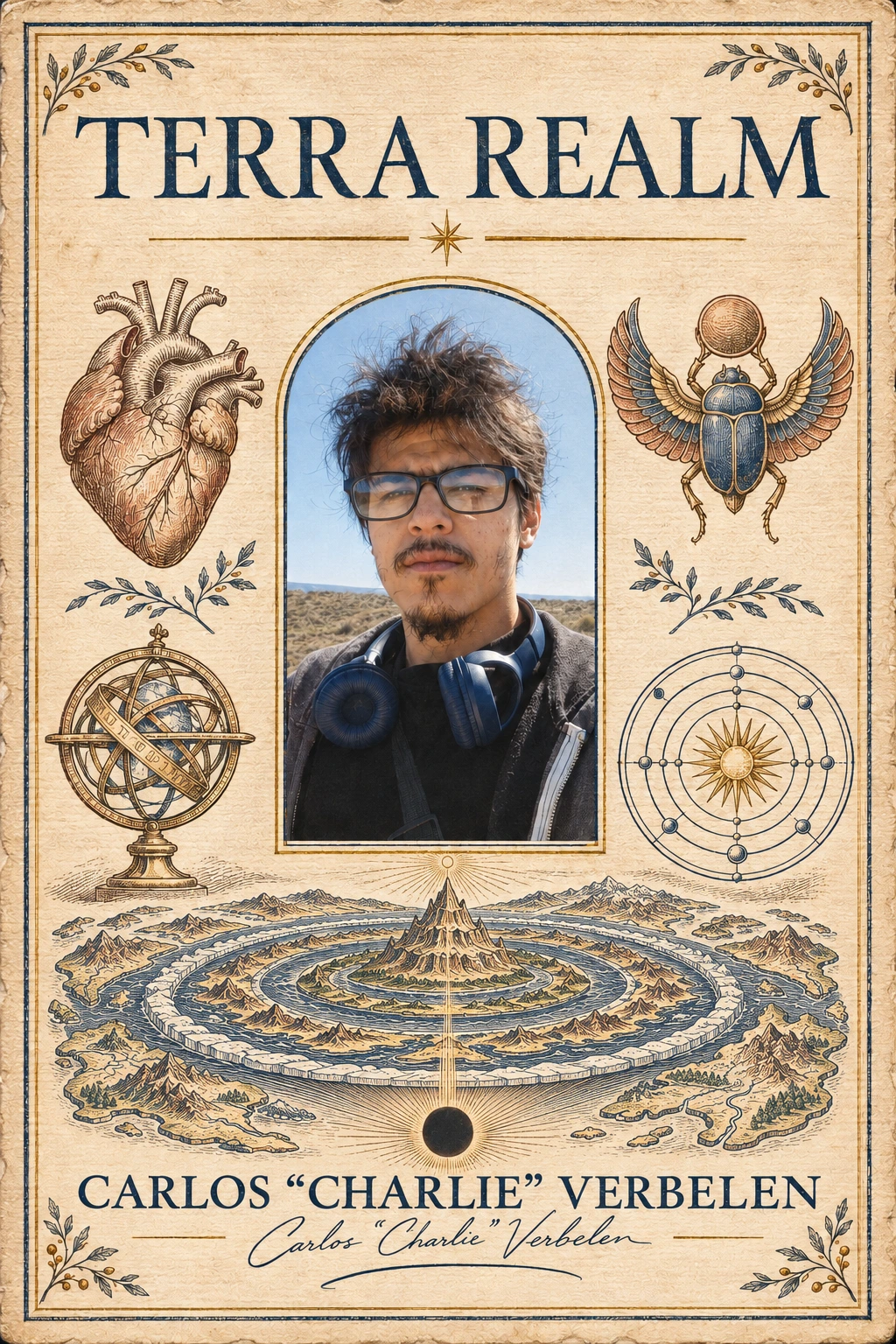
Terra Realm brings together images and reflections by Carlos “Charlie” Verbelen on knowledge, consciousness and cosmology. Its cover places the author's portrait at the centre. The mountain, rings of land and water, and black disc form a symbolic composition chosen for this book.
The imagined outer continents and the disc associated with a holographic sun belong to the author's interpretation. They are not presented as verified territories or an established explanation of solar physics. Keeping this distinction visible allows the image to be examined without turning every motif into a geographical claim.
Reading the cover from the centre outward
The portrait provides the cover's centre of attention. Its arched frame separates the person from the surrounding field of symbols without isolating him from it. To the left are an anatomical heart and an armillary sphere, an arrangement of rings associated with representing celestial relationships. To the right are a winged scarab and an orbital diagram. Their placement gives the composition a balance between bodily, astronomical and symbolic imagery.
Below the portrait, the view changes scale. Rings of land and water gather around a central mountain, with a dark disc beneath them. The author's name and flowing signature return the reader to the human maker of the composition. This sequence, from person to surrounding symbols to imagined world, describes the visible organisation of this particular cover. It does not require assigning every motif a single meaning that the manuscript has not stated.
Meru in a documented object
A fourteenth-century Chinese silk tapestry at The Metropolitan Museum of Art, accession 1989.140, represents Mount Meru within a cosmological mandala. The mountain takes the form of an inverted pyramid topped by a lotus. Near its base, a three-legged bird and a rabbit represent the Sun and Moon.
Surrounding landscapes stand for four continents of Indian cosmology, rendered through Chinese painting conventions. The museum also relates the floral border to imagery of central Tibet. The object preserves a meeting of artistic and religious traditions. Its date identifies the surviving textile, not the beginning of every tradition associated with Meru.
A woven cosmology from Yuan China
The Met object is a silk tapestry, described by the Chinese term kesi, from the fourteenth century during the Yuan dynasty. Its medium matters: the visible diagram belongs to a woven object rather than to a modern printed map. The square cloth contains a circular arrangement, a mountain that widens upward and landscapes placed at the cardinal directions. The floral border and corner vessels form a surrounding frame rather than additional surveyed territories.
The museum identifies several traditions meeting in the same object: Indo-Himalayan cosmological imagery, Chinese conventions for landscape and celestial emblems, and associations with central Tibetan ornament. This gives the comparison historical substance. A mountain at the centre is only the first resemblance to Terra Realm. Materials, date, surrounding imagery and the different purposes of a religious textile and a contemporary book cover explain why the two works should also be read separately.
Traditions retain their differences
The Rubin Museum documents a different arrangement in its Kalachakra cosmology illustration: six continents around Meru's axis and a series of spheres or discs. The diagram connects religious ideas about the universe, time and human experience. It should not be silently merged with the four-continent scheme of the Chinese tapestry.
Comparison requires keeping the date, community, material and purpose with each object. Two images may share a central mountain without expressing the same doctrine. A formal resemblance can begin an investigation, but it does not establish that the works transmit one literal map.
A Tibetan diagram of outer and inner worlds
The Rubin example is a sixteenth-century Tibetan work in pigments on cloth, catalogued as C2009.9. Its presentation includes the front and back. The museum's interpretation relates the outer universe to an inner universe of the human body within Kalachakra thought. Layers associated with wind, fire, water and earth surround the central axis. Other parts of the work relate the arrangement to the body, its channels and cycles of time.
This is more than a decorative inventory of planets and mountains. The relationships between the parts carry the religious teaching, so detaching a single motif can obscure its role. The museum's annotated presentation is useful for following those relationships and locating its named elements. The body's symbolic correspondence with the cosmos belongs to that historical religious framework; it is not a substitute for anatomical or medical evidence about how a body functions.
A diagram can hold several viewpoints at once
The Rubin illustration brings a view from above together with a view from the side. This lets its maker show both the arrangement around Mount Meru and the levels associated with the cosmic axis. A single naturalistic viewpoint could hide one relationship behind another. The combined drawing instead gives each relationship a place on the cloth. Its changes of viewpoint are part of the explanation, just as a plan and a section can describe different aspects of one subject without pretending to be a single photograph.
The same principle helps explain the relationship between outer and inner cosmology. The diagram connects a cosmic arrangement with representations of the body and cycles of time. Position, colour and correspondence organise the teaching. Their significance lies in the relationships the tradition assigns to them, rather than in a claim that the distances on the cloth can be measured as terrestrial distances. In the Met tapestry, the mountain, celestial emblems and surrounding landscapes likewise occupy distinct roles within the composition.
Terra Realm uses its own layered arrangement to place a person among bodily, celestial and imagined geographical forms. The historical comparison becomes richer when it attends to this work of composition: which relationships a picture makes visible, which viewpoints it combines and how its centre connects the surrounding parts. Those questions concern the construction of meaning in a particular image.
Rubin Museum: Kalachakra cosmology · The Met: cosmological mandala with Mount Meru
Read each layer on its own terms
Three kinds of evidence meet here: the author's contemporary composition, historical objects that document religious imagery, and physical or geographical claims requiring independent support. The cover description identifies where its elements appear. Museum records establish the particular historical examples used for comparison.
Terra Realm's original manuscript retains handwriting and overlapping diagrams whose relationships depend on the complete page. A detached background can lose those connections. Reading the images alongside their explanations preserves the author's composition while allowing its symbols to be discussed carefully, without attributing later interpretations to an institution whose catalogue does not make those claims.
The Met: cosmological mandala with Mount Meru · Rubin Museum: Kalachakra cosmology
THE COMPLETE MANUSCRIPT
Terra Realm, page by page
All 120 original manuscript pages follow in order below, with every handwritten layer preserved. Read here or enlarge any page without leaving the book.
The accompanying accounts distinguish the author’s symbolism from historical evidence and scientific claims.
Terra Realm: original manuscript
Terra Realm · Carlos “Charlie” Verbelen. Contemporary symbolic cover: Mount Meru, imagined outer lands and the black solar disc express the author’s cosmological imagery.
Terra Realm: fields and spiritual interpretation
The opening notes introduce the author's unified-field vocabulary: aether, magnetism, dielectricity, light and counterspace. Several quotations and word associations are used to connect that vocabulary with consciousness and spiritual experience.
The main contrast is between visible motion and an invisible source. The author repeatedly interprets outward manifestation and inward return as complementary aspects of one process. This gives the later toroidal drawings their conceptual framework. Physical terminology and spiritual interpretation are interwoven from the opening page. The invisible source becomes a way to discuss consciousness as well as matter, and the outward-and-returning movement becomes a recurring image of manifestation. This vocabulary establishes the manuscript's own model and continues through its later toroidal drawings.
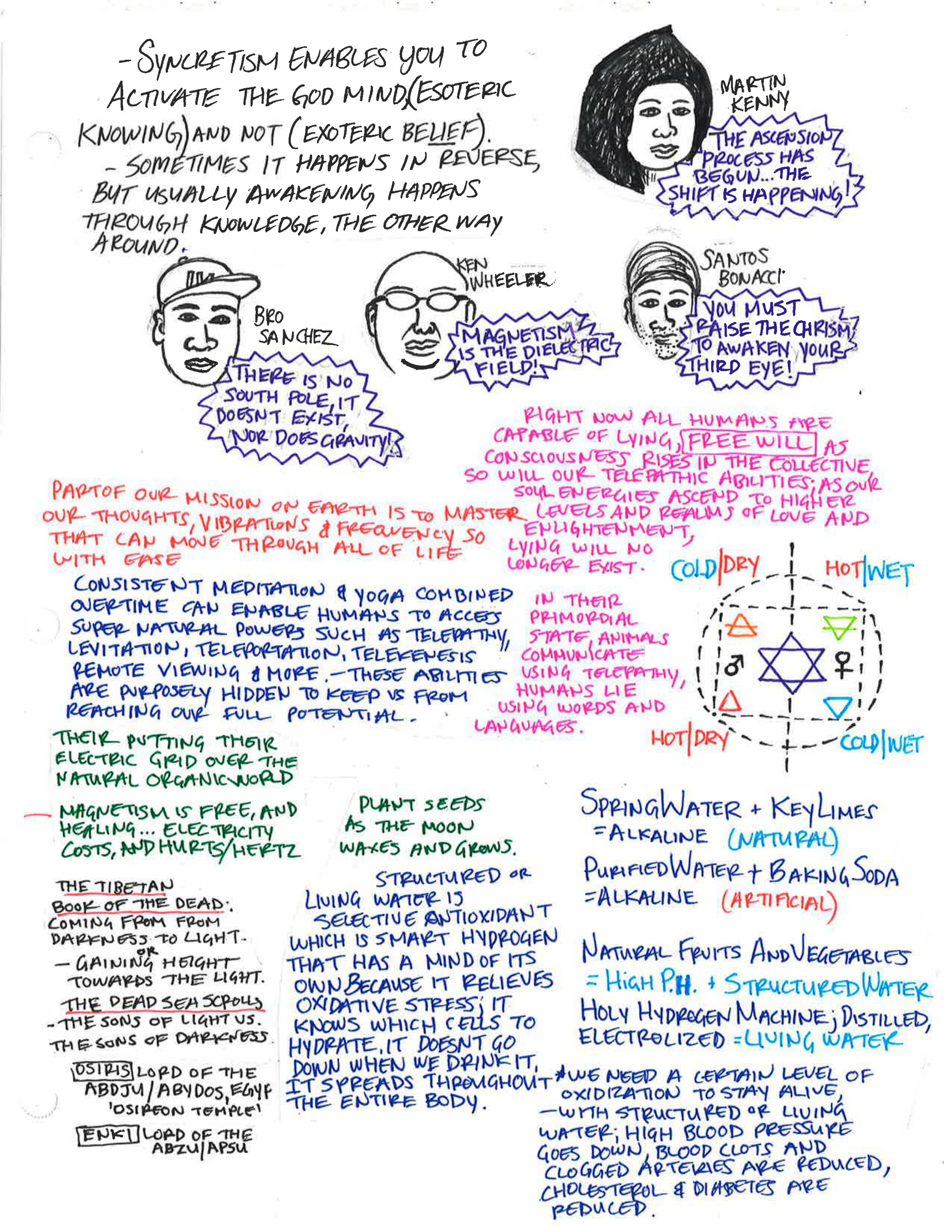
Four portraits gesture while the inner element wheel makes one clockwise turn, followed by a direction arrow. Clockwise is an animation convention; this sheet specifies no rotation direction. In the historical alchemical key, an upward barred triangle denotes air, an upward triangle fire, a downward barred triangle earth, and a downward triangle water. The surrounding handwriting stays fixed and the unchanged still preserves the author’s arrangement.
Interpretive animation of the original image. The full sheet and its writing remain visible; choose Show still image to inspect the unchanged source.
Syncretism & the God Mind
This page introduces syncretism as the author's method of connecting religious, philosophical and scientific ideas. The notes relate knowledge, consciousness and an inner source to examples involving water, growth and bodily experience.
Four portraits gesture while the inner element wheel makes one clockwise turn, followed by a direction arrow. Clockwise is an animation convention; this sheet specifies no rotation direction. In the historical alchemical key, an upward barred triangle denotes air, an upward triangle fire, a downward barred triangle earth, and a downward triangle water. The surrounding handwriting stays fixed and the unchanged still preserves the author’s arrangement.
Interpretive animation of the original image. The full sheet and its writing remain visible; choose Show still image to inspect the unchanged source.
The central claim is that different traditions and natural patterns can be read together as parts of one larger system. Names, quotations and diagrams are brought into the same field to support that synthesis. The proposed synthesis prepares the comparisons among temples, anatomy, myths and geometry that follow. Their association on a page is part of the author's argument. Similar imagery can provide a useful comparison without by itself establishing a shared origin or the same physical mechanism.
The Nile & the Spine
The long river drawing maps Egyptian places and divine names onto a vertical structure. Nearby bodily sketches invite a comparison between the Nile and the human spinal axis.
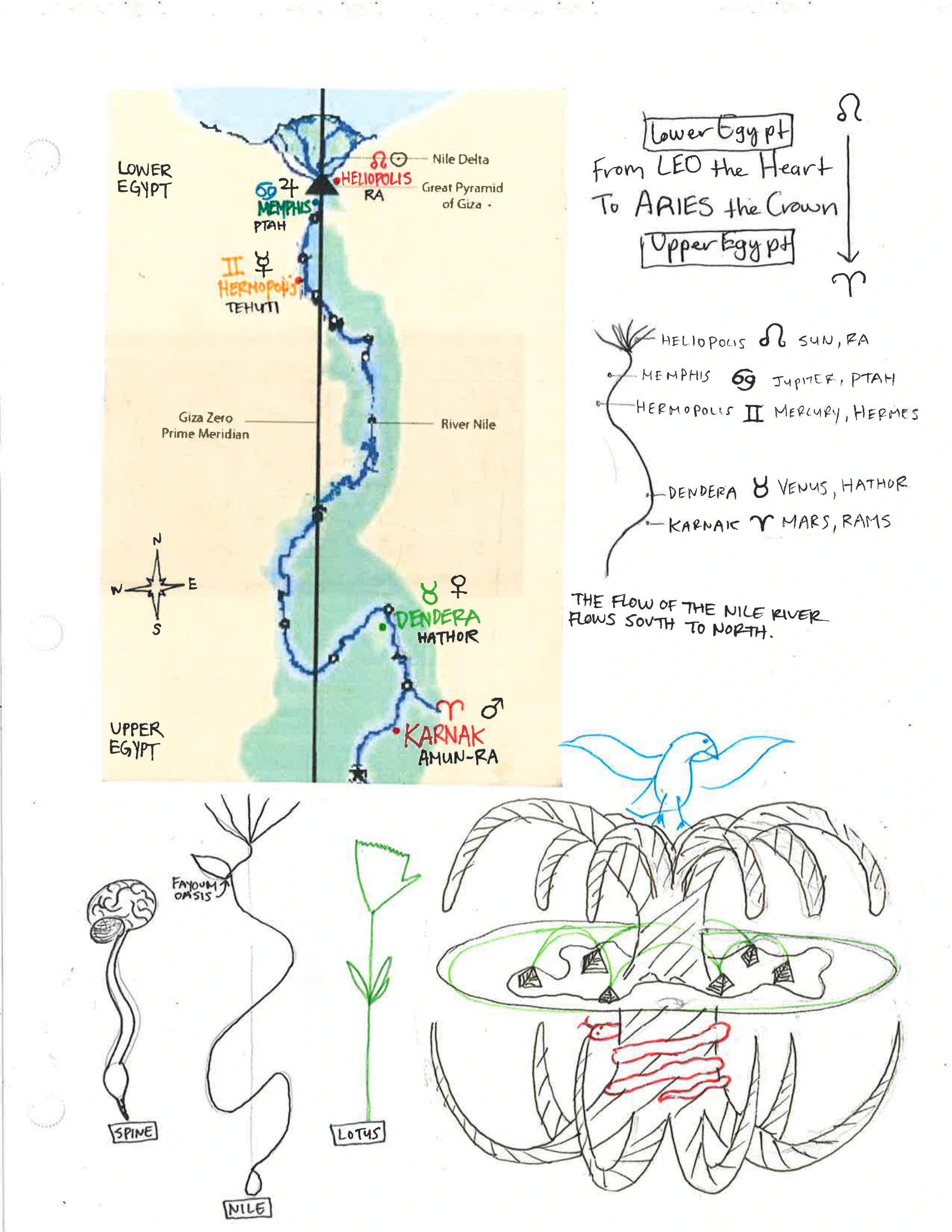
Interpretive animation of the original image. The full sheet and its writing remain visible; choose Show still image to inspect the unchanged source.
The drawing follows a vertical sequence from the lower river or bodily region toward the crown. Paired labels sit on either side of that axis, while the lotus-like forms below introduce growth from a common base. Geography supplies the outward landscape and the spinal comparison supplies an inward route; their alignment is the author's symbolic construction. The author is using geography as an inner map. The Nile remains a river in the original drawing, while the added correspondences interpret its course through the body and spiritual ascent. This outer-landscape/inner-body relationship recurs throughout the manuscript.
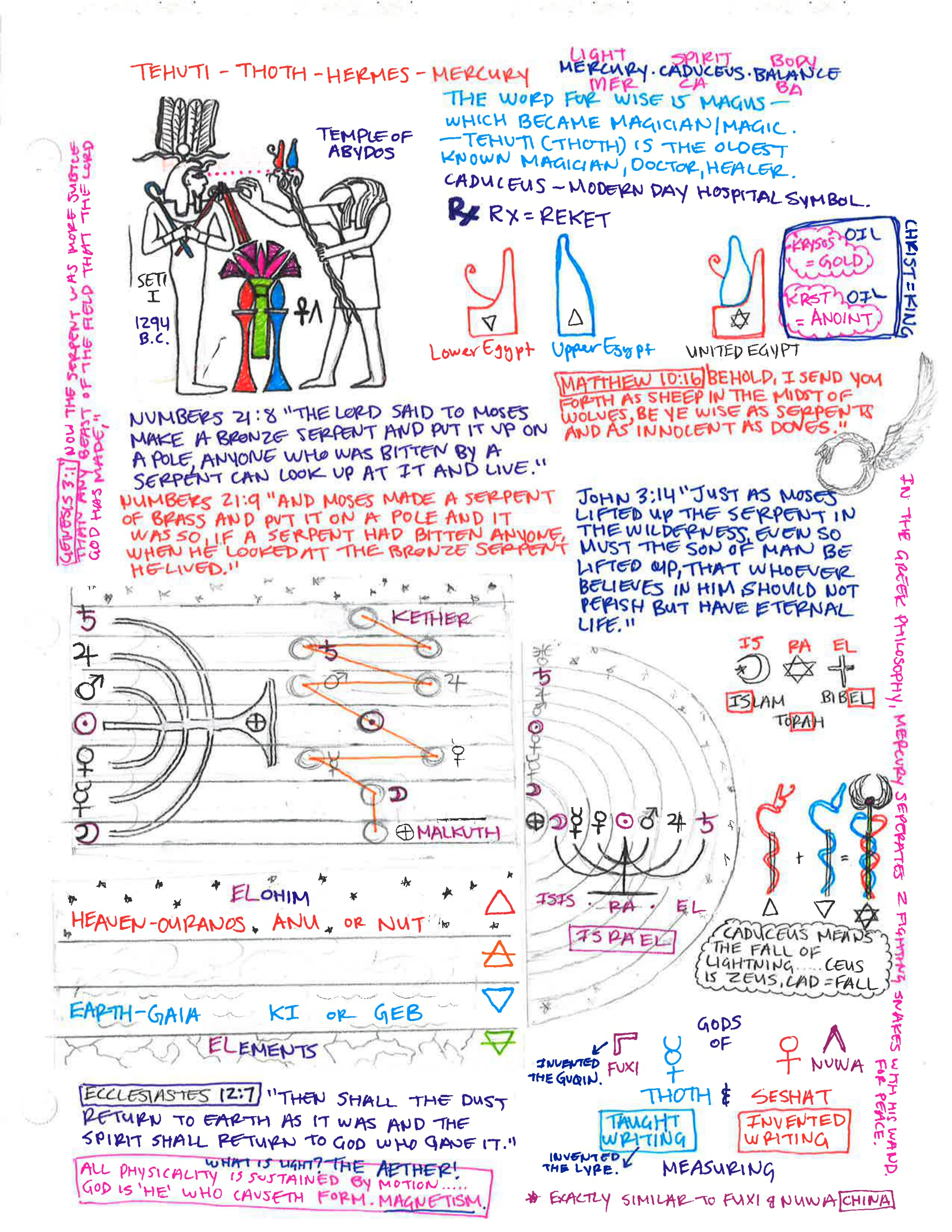
The drawn figures gesture, the crown changes orientation and the linked circles move through the page’s symbolic arrangement. These are animated interpretations of the author’s correspondences; the untouched manuscript remains available.
Interpretive animation of the original image. The full sheet and its writing remain visible; choose Show still image to inspect the unchanged source.
Tehuti, Thoth, Hermes & Mercury
The page groups several names associated in the manuscript with knowledge, communication and mediation. Serpents, staffs, crowns and scriptural passages provide its main visual and textual material.
The drawn figures gesture, the crown changes orientation and the linked circles move through the page’s symbolic arrangement. These are animated interpretations of the author’s correspondences; the untouched manuscript remains available.
Interpretive animation of the original image. The full sheet and its writing remain visible; choose Show still image to inspect the unchanged source.
The central motif is the lifted serpent. The author compares a creature near the ground with an elevated or winged form, turning vertical movement into a symbol of transformation. Egyptian, classical and biblical names enter a comparative argument organized around the staff and serpent. Their grouping leads into the following discussion of radiance, anointing and movement toward the crown. The page connects these subjects through transformation and elevation.
The Seraphim & the Radiant Face
The page connects the serpent narratives in Numbers with Moses' radiant face, anointing and Egyptian crown imagery. The author emphasizes a source that can be associated with both suffering and renewal.
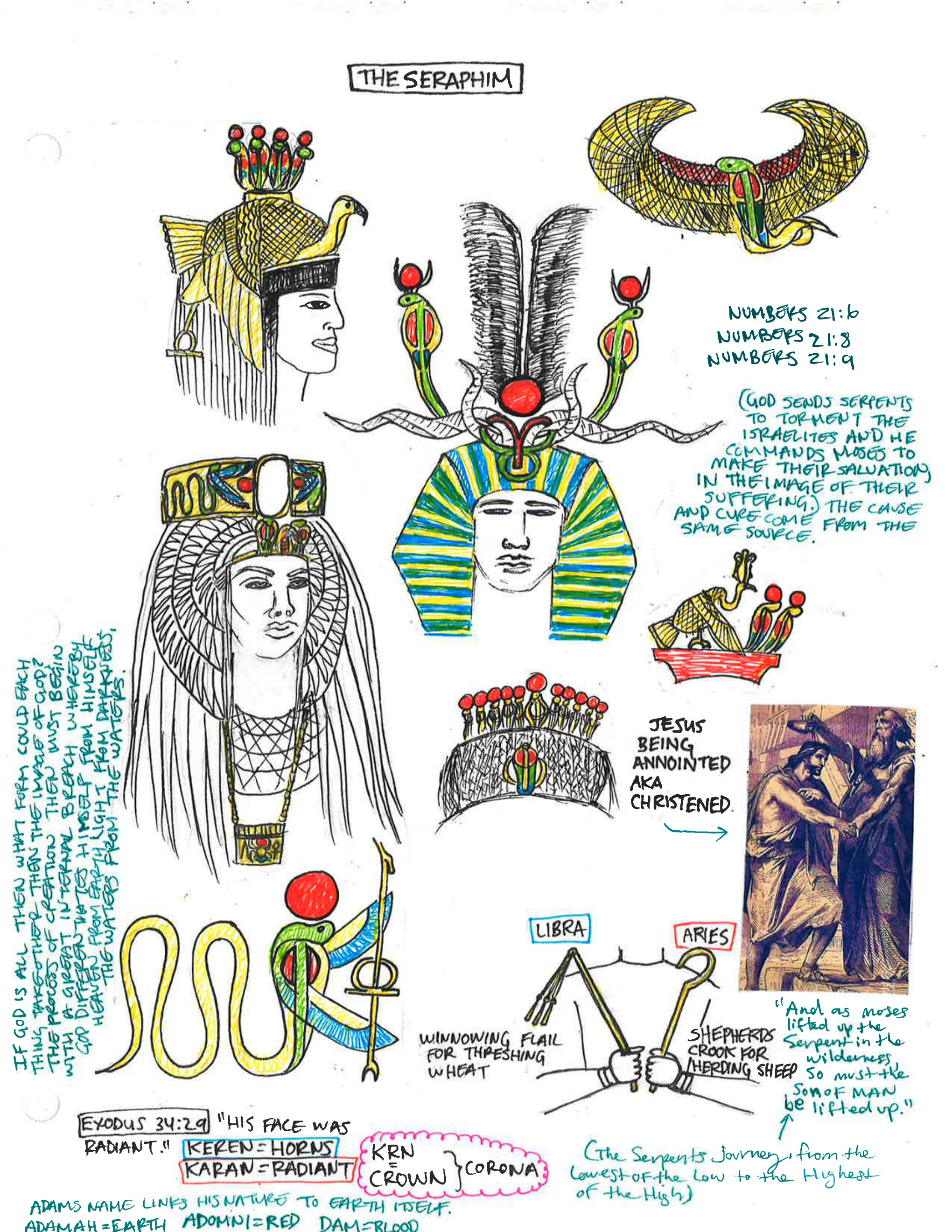
The Egyptian figures become moving characters within an imagined desert setting. The winged serpent opens its wings and the smaller serpent bends along its drawn path. The desert and bodily movement are contemporary additions, while the original page records the author’s symbolic associations.
Interpretive animation of the original image. The full sheet and its writing remain visible; choose Show still image to inspect the unchanged source.
The drawings provide several forms of elevation: a serpent raised on a staff, winged imagery and ornaments worn on the head. The crook and flail add paired implements to the composition. Associations among horns, radiance, crown and blood carry the theme into language. Quotations supply one layer of the argument and the author's links between them supply another. Ascent and illumination hold the composition together.
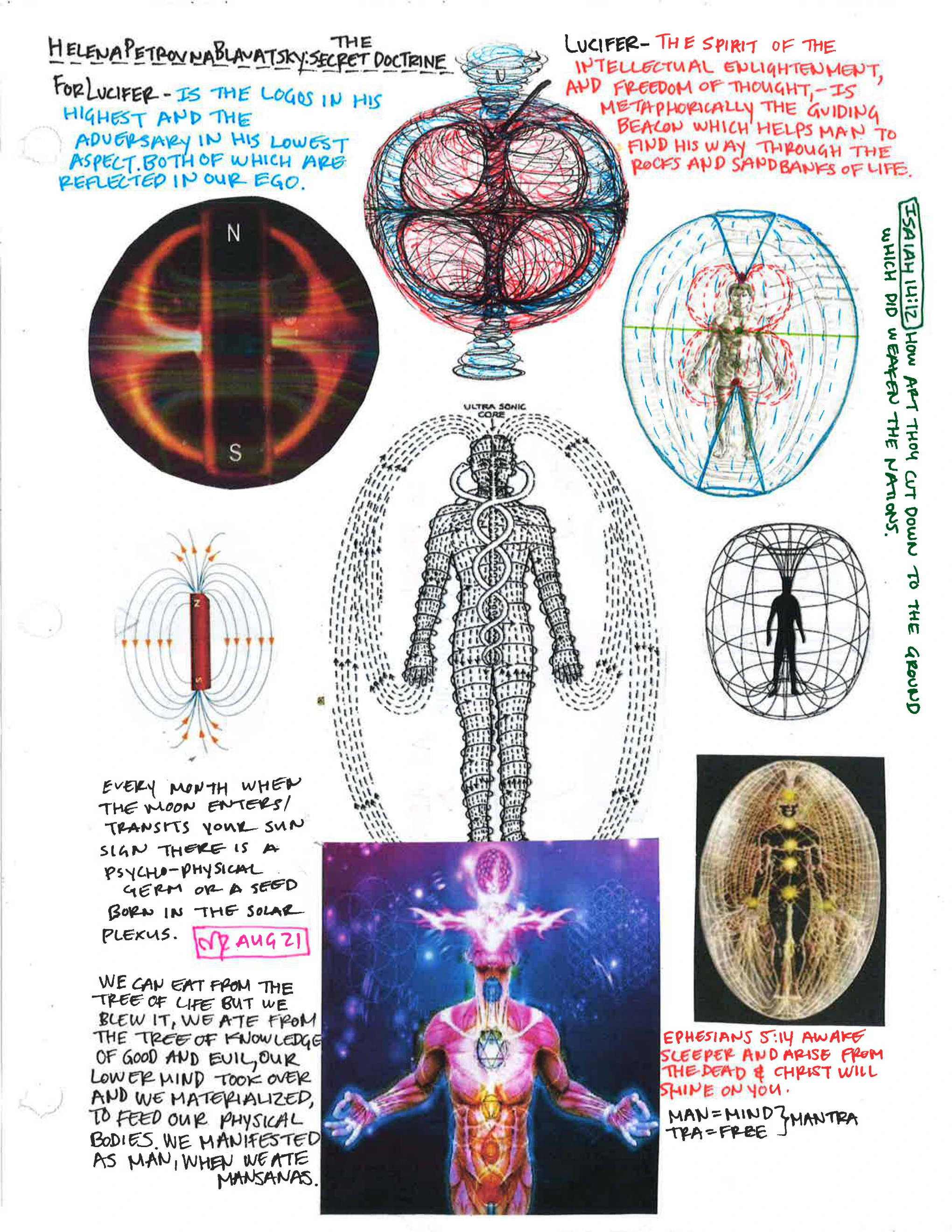
The Secret Doctrine & the Two Trees
Notes attributed to Helena Blavatsky introduce Lucifer through contrasting roles of illumination and opposition. The author places this beside the two trees, awakening and freedom of mind.
The field drawing and monthly-seed note connect that spiritual discussion with the manuscript's bodily and cosmic cycles. The page moves between a philosophical idea and a diagrammatic model rather than staying within one genre. The guiding contrast is between a mind constrained by lower impulses and one moving toward awareness. The two trees provide a narrative image of that contrast, while the field and seed supply the author's proposed inner correspondences.
Metals, Centres & the Double Torus
This reference plate aligns weekday names, planetary signs and metals with bodily centres and their petal counts. A skeleton and double-torus drawing provide two different frameworks for the same vertical arrangement.
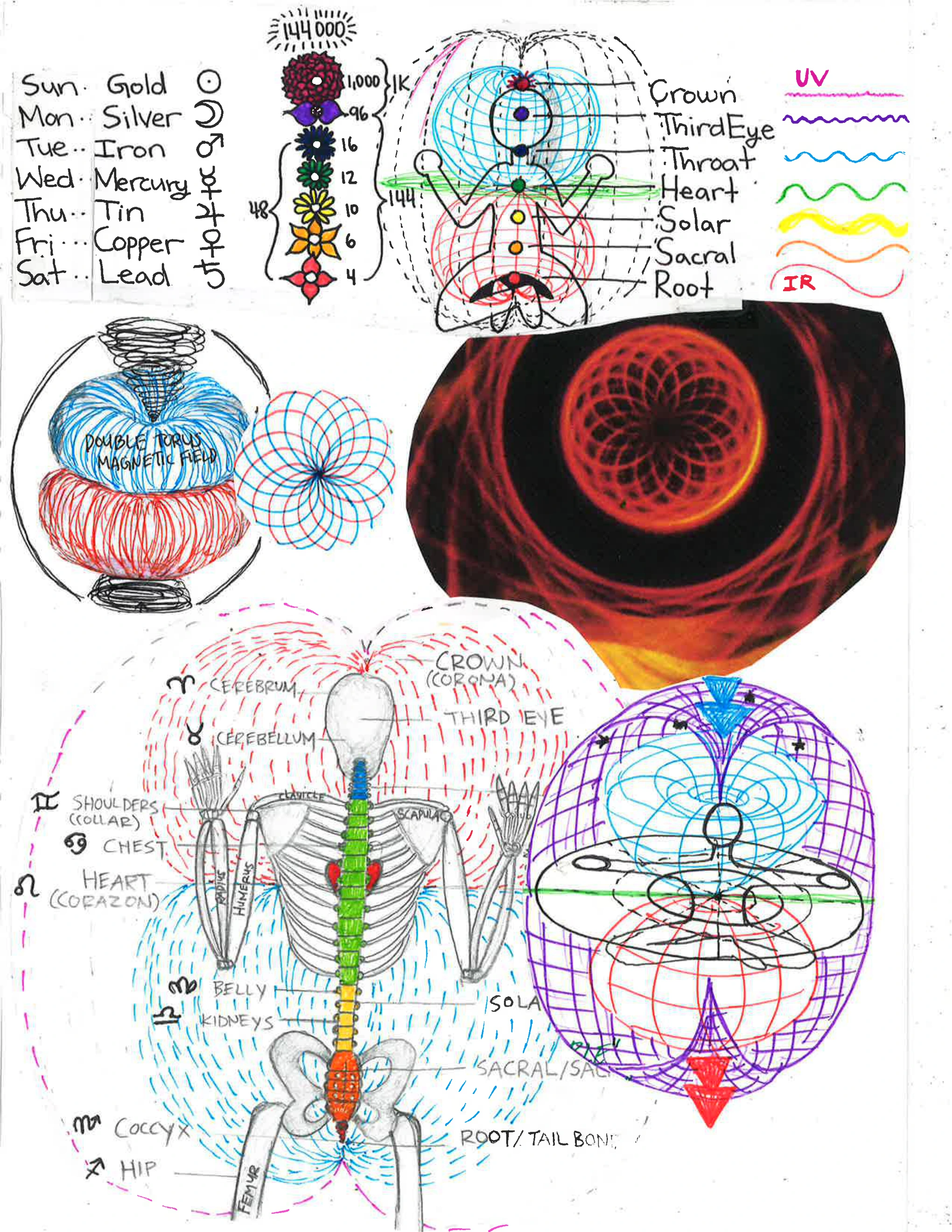
The skeleton transforms into a clothed adult who raises his arms; the seated diagram becomes a living figure. This is an allegorical transformation requested for the animation, not a biological sequence. The original labels and complete still sheet can be inspected separately.
Interpretive animation of the original image. The full sheet and its writing remain visible; choose Show still image to inspect the unchanged source.
A sequence of coloured centres rises from root to crown. Numbers and anatomical labels give positions on the drawn body, while zodiac names add a second, symbolic classification. The illustration combines these systems by proximity and colour; the associations express the manuscript's scheme of correspondence. The double torus is the bridge between the bodily and field imagery. Its central plane and paired volumes repeat the structure developed on later pages. The chart is a map of the author's correspondences, not a clinical anatomical classification.
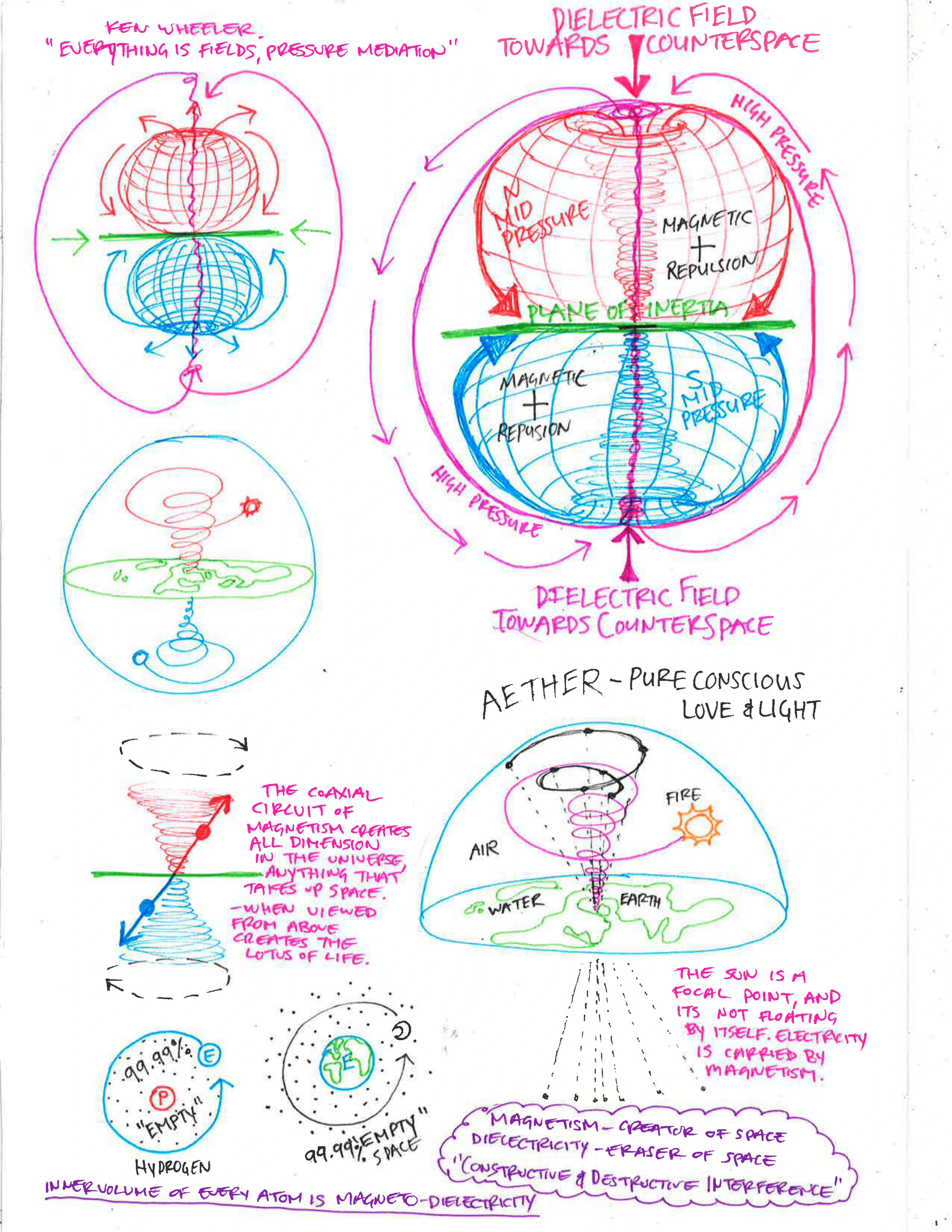
Fields, Pressure & Counterspace
The central diagram labels high pressure, mid pressure, a plane of inertia and a dielectric direction toward counterspace. The author uses these terms to explain paired inward and outward tendencies.
The atom and Earth-Moon sketches compare large apparent volumes with the manuscript's idea of underlying field organization. The Sun is described as a focal point within the same proposed system. Trace the arrows toward the centre and away from it. That simple reading path clarifies the author's distinction between creation of visible space and return toward a source. The explanations belong to the manuscript's alternative model of fields.
Seasons & Solar Paths
Several sketches compare the author's representations of summer, winter and intermediate solar paths. Cardinal directions, seasonal dates and high or low positions provide the key labels.
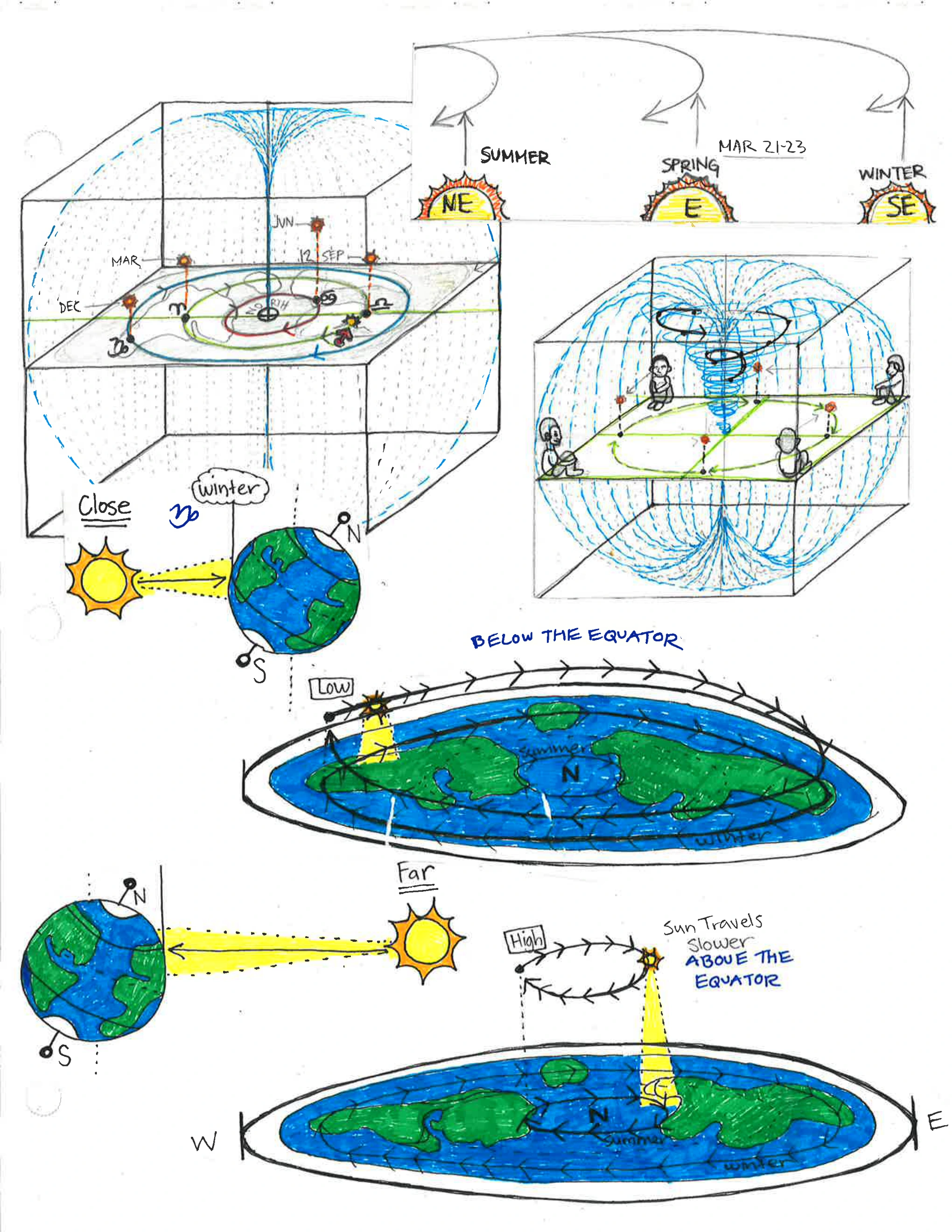
Interpretive animation of the original image. The full sheet and its writing remain visible; choose Show still image to inspect the unchanged source.
The sketches use several different geometries: some enclose the world in a globe-like form, while others arrange it as a plane. Placing them together makes the author's proposed alternatives visible, but the drawings do not supply a common scale or an observational test that would make them interchangeable maps. The larger theme is cyclical change around a centre. The original drawings and dates are retained so the proposed relationships remain inspectable. The reading guide explains their organization without presenting the manuscript's alternative cosmology as an established seasonal mechanism.
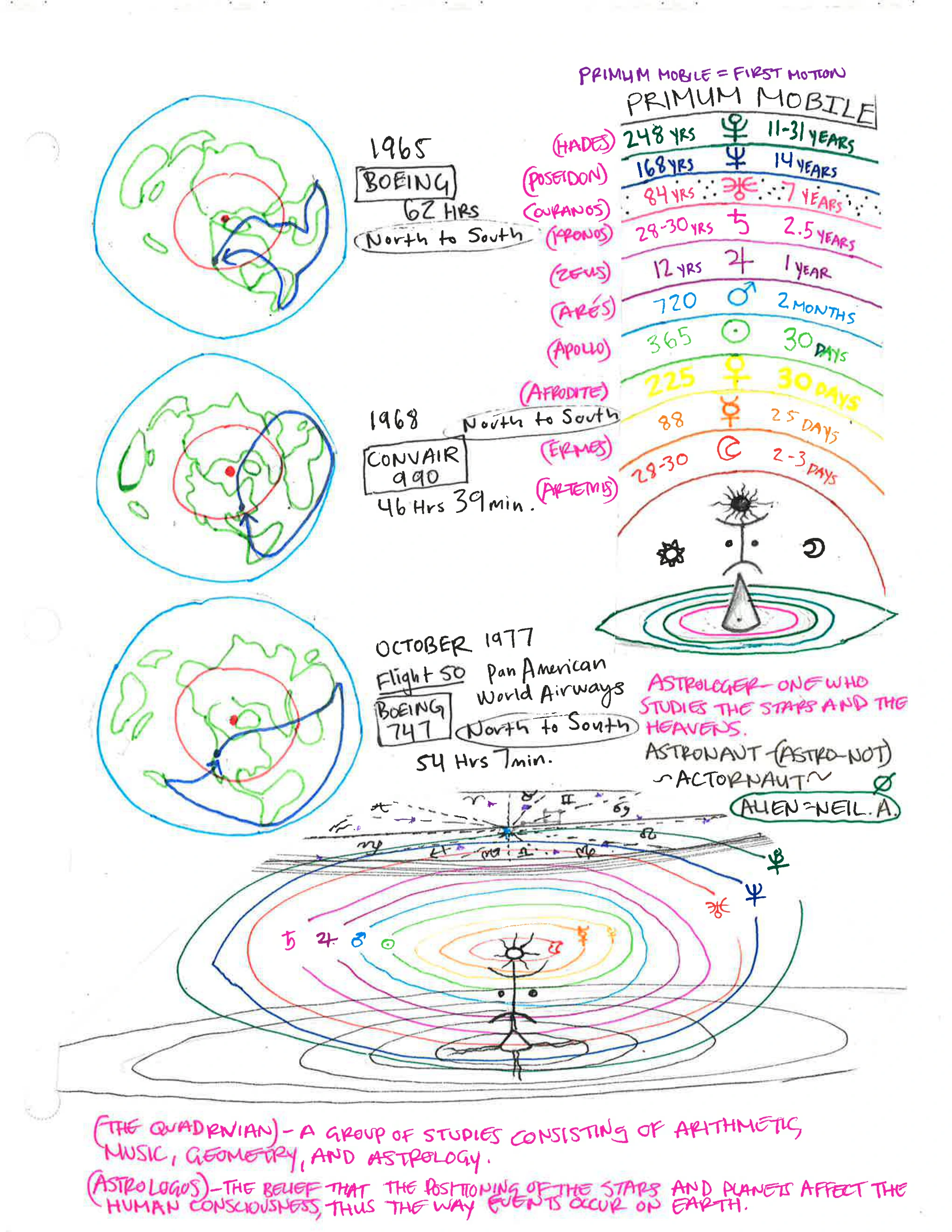
The three globe sketches and the two nested orbital diagrams move together while the flight notes and numerical table stay fixed. The animation separates the page’s drawn route geometry from its symbolic planetary arrangement. The handwritten dates and quantities belong to the source, not to a calculated flight reconstruction.
Interpretive animation of the original image. The full sheet and its writing remain visible; choose Show still image to inspect the unchanged source.
Primum Mobile & Cycles
The page introduces primum mobile as first motion and lists periods associated with named luminaries. The sequence places different time scales within one ordered scheme.
The three globe sketches and the two nested orbital diagrams move together while the flight notes and numerical table stay fixed. The animation separates the page’s drawn route geometry from its symbolic planetary arrangement. The handwritten dates and quantities belong to the source, not to a calculated flight reconstruction.
Interpretive animation of the original image. The full sheet and its writing remain visible; choose Show still image to inspect the unchanged source.
Three flight-route notes add another kind of movement across the world. Definitions and wordplay around astrology, astronaut and the quadrivium connect motion with the author's approach to knowledge. The period list and route drawings organize different kinds of movement and recurrence. Their juxtaposition prepares the transition to rotating-vault and zodiac diagrams. The listed values remain part of the manuscript's own notes rather than a newly calculated timetable.
The Vault & the Zodiac
The manuscript depicts a stationary plane beneath a rotating celestial enclosure. Its notes distinguish the movement of stars from that of the luminaries and introduce retrograde motion within the author's model.
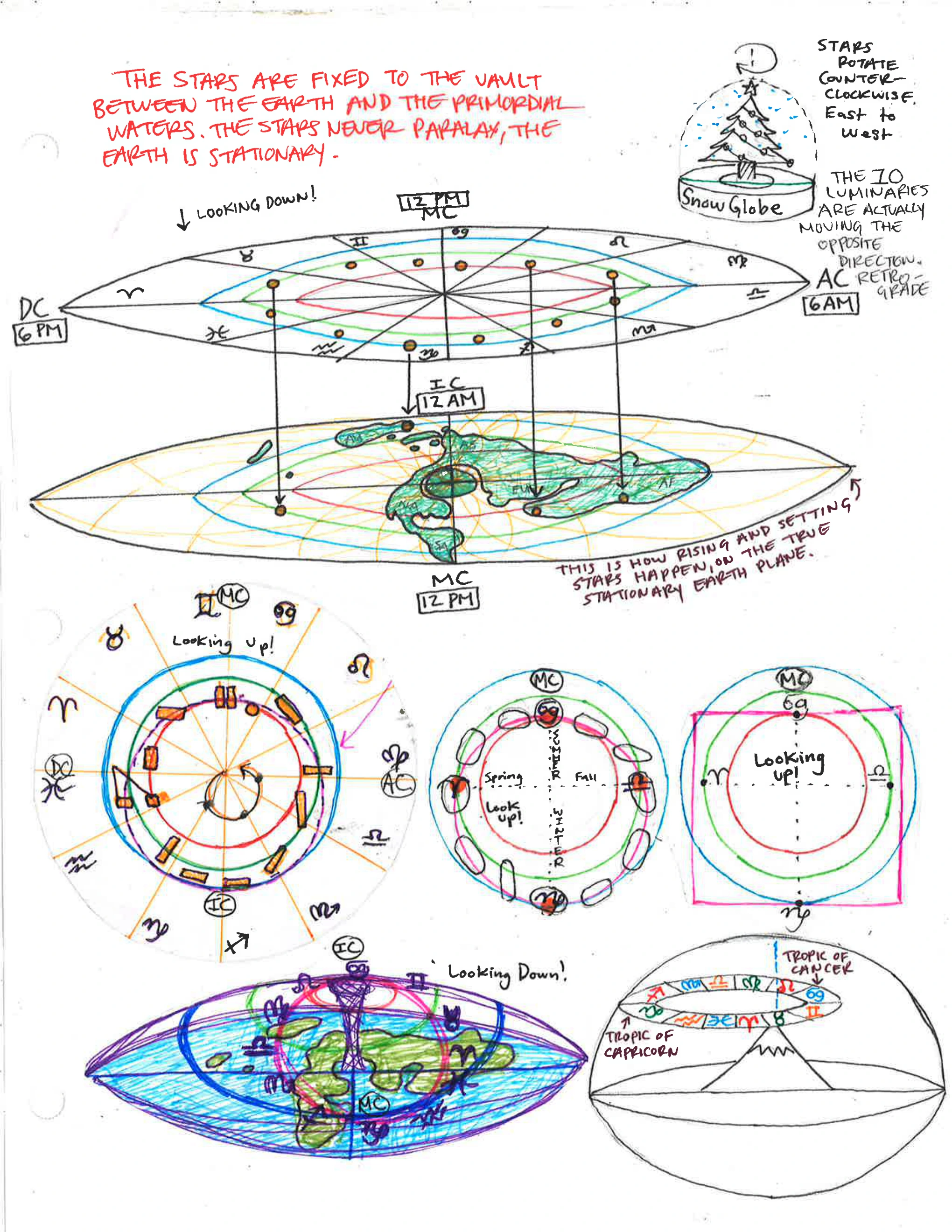
Interpretive animation of the original image. The full sheet and its writing remain visible; choose Show still image to inspect the unchanged source.
The clock-like diagrams use the four axes of an astrological chart. AC is the Ascendant, the rising point at the eastern horizon; DC is the Descendant, its setting counterpart in the west. MC, Medium Coeli or midheaven, and IC, Imum Coeli, mark the other paired axis. The upward and downward viewpoints reverse the apparent orientation of the surrounding circle. Times, seasonal labels and arrows must therefore be read with the viewpoint shown in that particular construction. The drawings present the author's proposed enclosure and its cyclical motions. They document a cosmological model rather than establish the Earth's physical structure. [RD-I-TERRA-AXES]
Units and terms
AC Ascendant, the rising point in this astrological chart · DC Descendant, the setting point in this astrological chart
Realms & Seasonal Turning Points
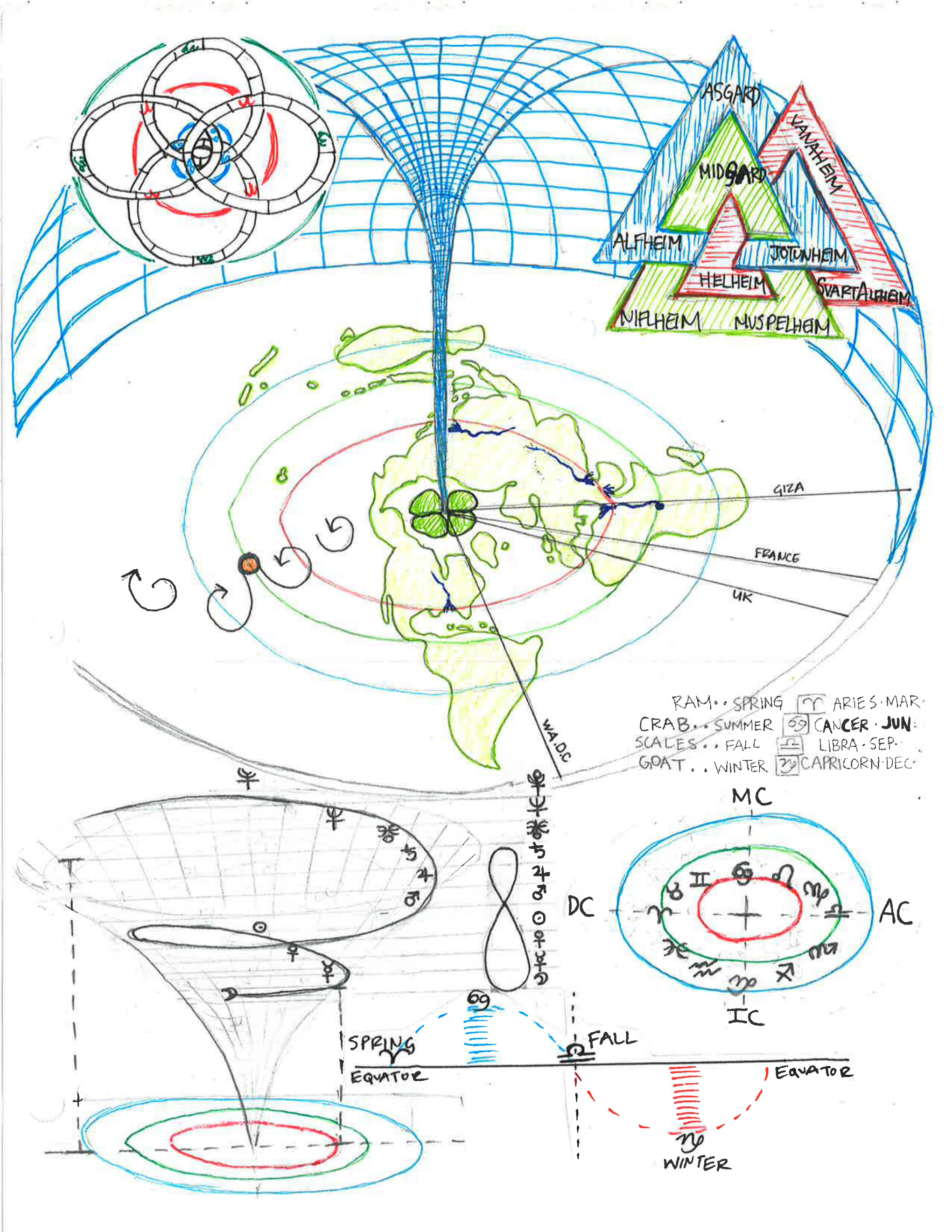
The upper structure lists realms around a layered or circulating form. The lower drawings connect that arrangement with a zodiac clock and four seasonal turning points.
Ram, crab, scales and goat identify Aries, Cancer, Libra and Capricorn in the author's scheme. Geographic labels add Giza and other locations to the same comparative field. The seasonal key assigns recurring positions to the circular drawings. Mythological levels and cyclical time are brought into a common visual vocabulary, connecting the realm diagrams with the succession of seasons.
The Primum Mobile & Cosmic Zones
This landscape plate combines a circular world plane, surrounding zodiac signs and a layered upper model. It labels a crystalline sea, heaven and the primum mobile.
The daily clock marks the main axes, while a separate list gives forward and retrograde periods for the luminaries. The land forms and central north pole anchor the author's arrangement. The central plane, upper enclosure, outer ring and time annotations form related layers of the proposed cosmology. Together they present a detailed statement of the manuscript's world model, with the source's own labels and period values retained.
Units and terms
AC Ascendant, the rising point in this astrological chart · DC Descendant, the setting point in this astrological chart
The Platonic Year & Changes of Consciousness
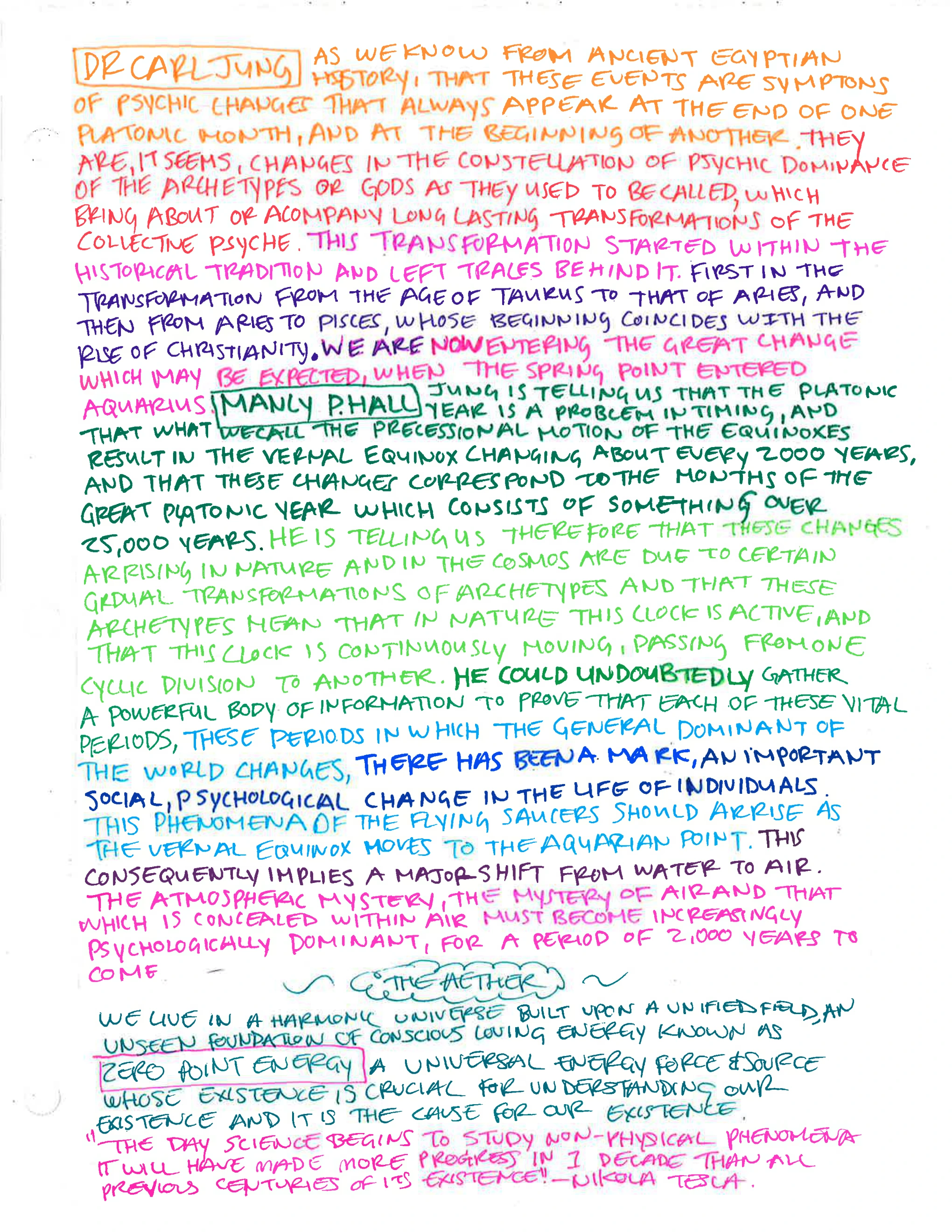
Passages attributed to Carl Jung and Manly P. Hall connect long celestial cycles with changes in collective life. The discussion moves through Taurus, Aries, Pisces and Aquarius as successive symbolic ages.
The author uses these ages to frame historical and psychological transformation. A further passage returns to aether as the shared foundation of consciousness and existence. The astronomical cycle provides a framework for a cultural interpretation of changing awareness. Passage of time and the qualities assigned to an age are distinct parts of the argument. The manuscript connects them through its conception of historical transformation.
Cycles of Consciousness
The page describes the end of the Kali Yuga as a period of declining virtue and rising disorder, then imagines a return toward knowledge and spiritual understanding.
The discussion extends from historical cycles to the relationship between consciousness, solar activity and a shared field. The lower magnet notes return to the physical vocabulary used earlier in the book. A cycle approaching reversal or renewal connects the social interpretation with the field model. One is expressed at the scale of collective life and the other through the author's physical vocabulary. Their association links the ethical discussion with the proposed cosmology.
The Prime Meridian & the World Axis
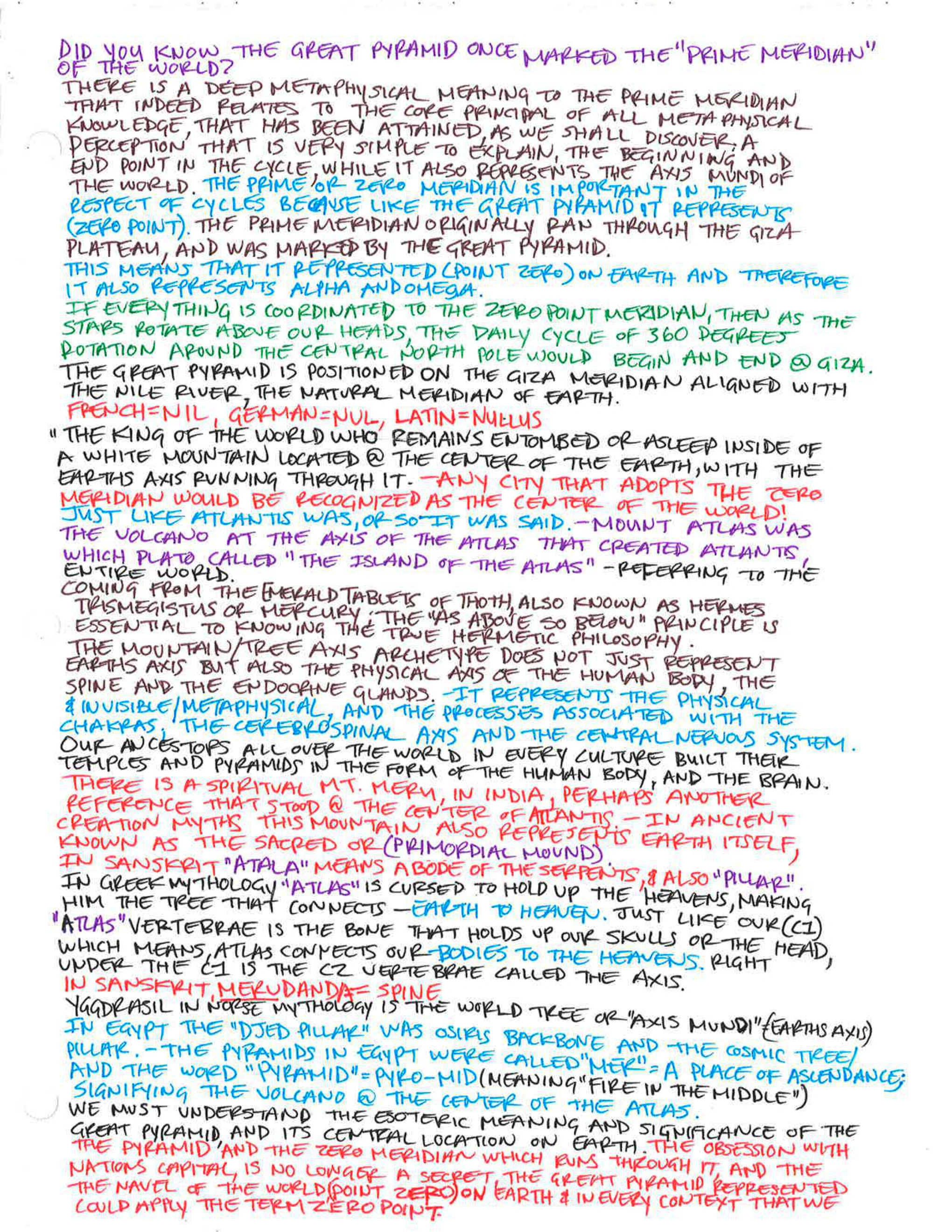
The manuscript gives the Great Pyramid and Giza a symbolic role as a zero point, beginning and ending of a cycle. It relates this to the axis mundi or world axis.
The comparison expands through Atlas, Meru, Yggdrasil, the djed pillar and the human spine. Each supplies a central support or route between levels. The key is the distinction between a reference line and its symbolic meaning. The author's geographic and historical assertions are retained in the original; the explanation traces how those assertions are used to build a larger metaphor of orientation, centre and ascent.
The Pyramid & the Inner Journey
The pyramid's square base, inclined sides and apex become a model of spiritual ascent. The author reads the movement from broad base to single point as a journey from multiplicity toward unity.
Meridians, the missing capstone, meditation and shamanic ascent are brought into the same discussion. Jacob's ladder, a spiral staircase and the world tree provide alternative images of the upward route. Architecture becomes a metaphor for inward experience. The apex represents a point of integration, and the paths toward it give psychological transformation a spatial form. Ladder, staircase and tree offer different images for that ascent.
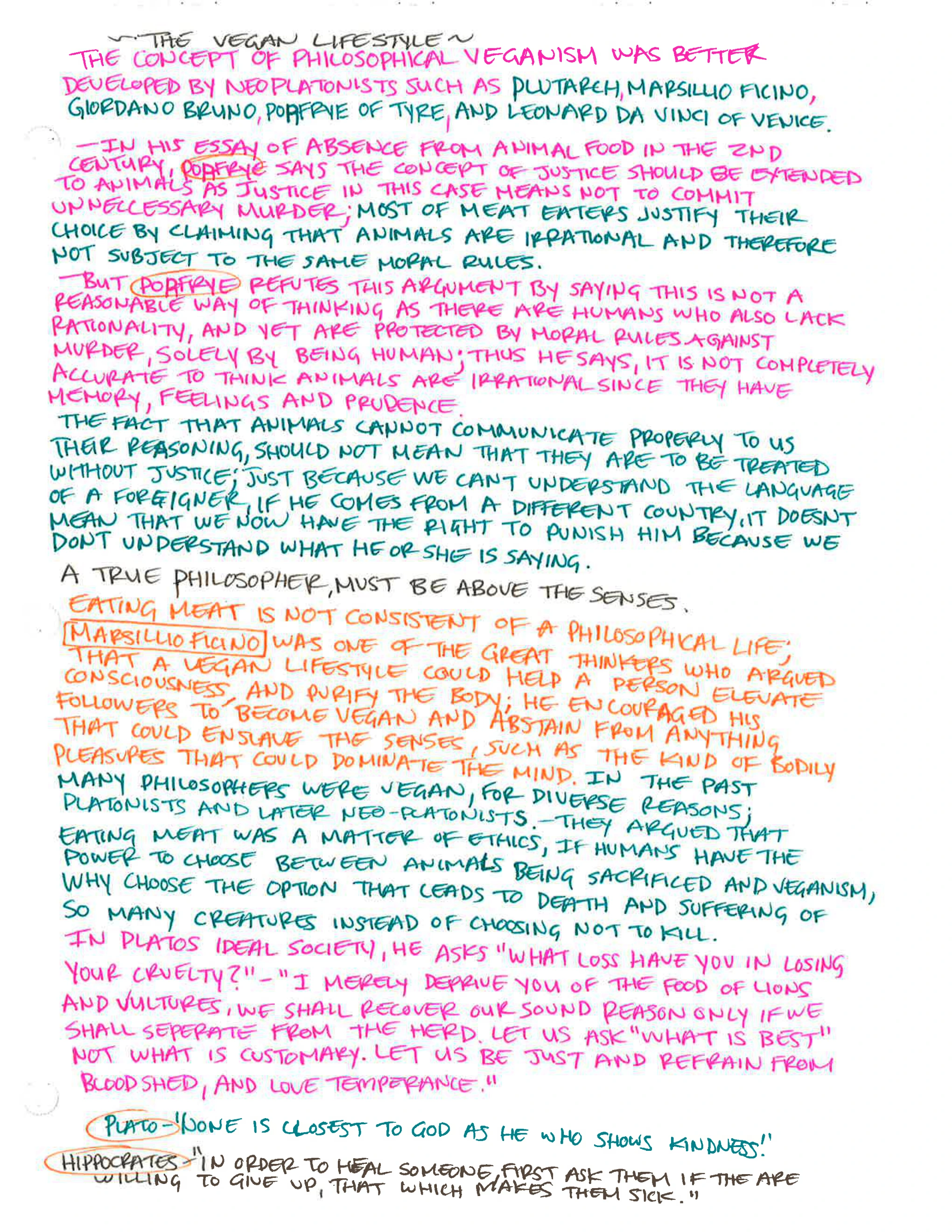
The Ethical Argument for Veganism
The manuscript presents abstaining from animal food as a question of justice, compassion and self-discipline. It attributes related arguments to ancient and Renaissance thinkers.
A central comparison concerns language: inability to understand an animal's communication is not taken as a reason to exclude it from moral consideration. The discussion then asks whether appetite should govern judgment. The ethical argument moves from the status of animals to the responsibilities of people who can choose how to act. Names and quotations serve that philosophical discussion. The central question is whether inability to understand another creature excuses disregard for its experience.
Justice, Appetite & Temperance
This page continues the argument that bodily desire should be governed by principle. It contrasts limited physical needs with a potentially unlimited appetite for consumption.
The author connects the treatment of animals, the scale of food provision and personal discipline. The seven virtues provide a positive framework for the restraint being advocated. The concluding Leonardo da Vinci example presents compassion as an act rather than only an opinion. The page's main question is ethical: what habits follow when a person tries to align daily choices with justice and self-command? Its medical assertions remain in the original source rather than becoming dietary treatment advice.
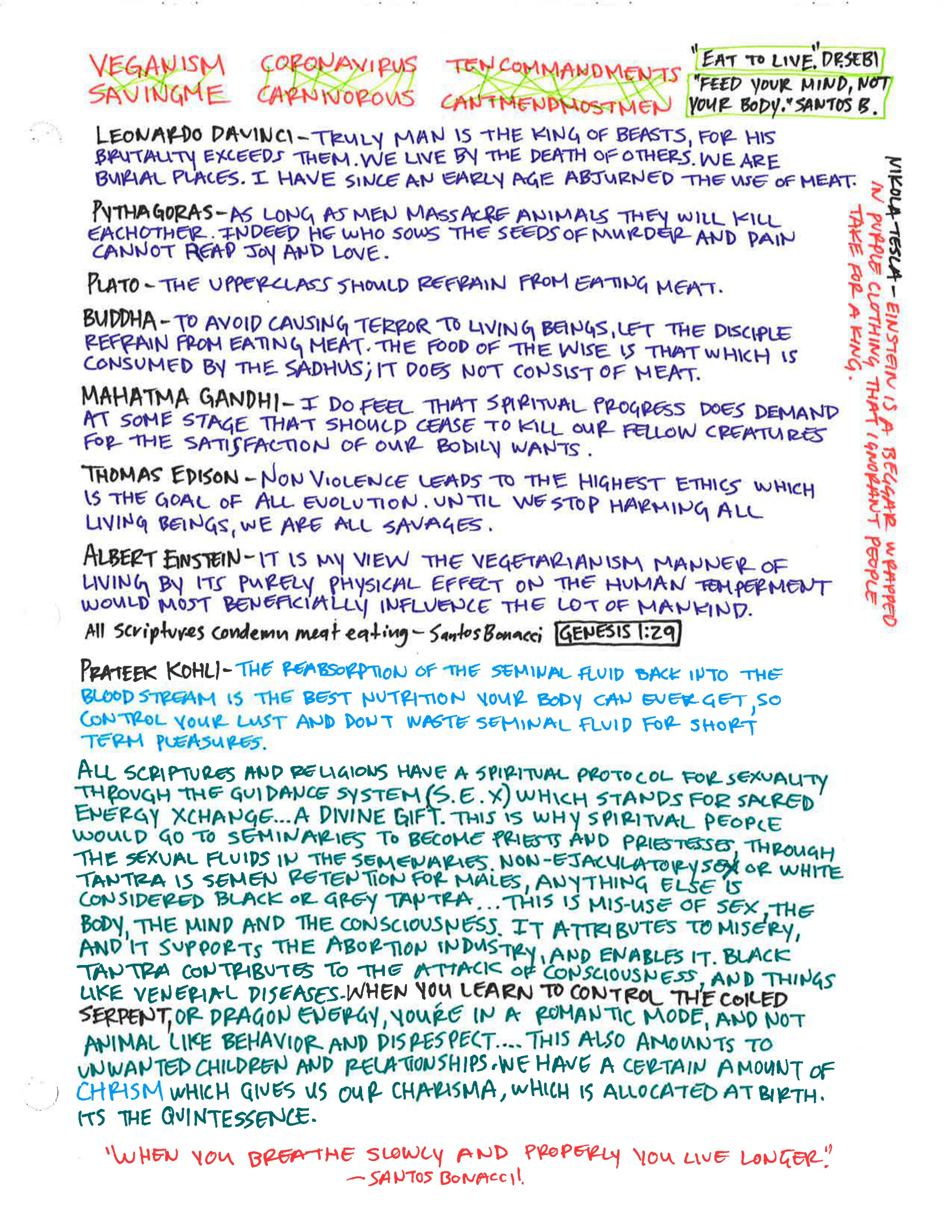
Compassion, Diet & Self-Discipline
This page gathers quotations, wordplay and spiritual arguments around the author's idea of a disciplined life. Its first movement concerns food: the named thinkers are presented as advocates of restraint, compassion for animals and eating to sustain life rather than satisfy appetite.
The discussion of sexuality and the conservation of energy treats bodily habits as expressions of consciousness within the manuscript's spiritual philosophy. Word rearrangements make the argument memorable, while the quoted passages supply its rhetorical support. The connection between conduct and inward change is the author's concern here. The common thread is self-mastery. Food, desire and breath are placed under one ethical question: how can a person act deliberately and reduce harm? The attributions are reproduced as features of the manuscript; this explanatory edition does not independently authenticate them.
Particles, Waves & the Aether
The manuscript introduces quantum mechanics through quantization, measurement and the Einstein-Podolsky-Rosen thought experiment. It then contrasts a particle-based account of light with the author's preferred account of a continuous medium called aether.
The key analogy is a wave travelling through water or air. The author uses it to ask whether light should be understood as an object moving between points or as a disturbance propagating through a medium. References to density, pressure and elasticity develop that comparison. The page changes from describing concepts in physics to arguing for an alternative model. Keep those two roles distinct when reading: the opening establishes the debate, while the later paragraphs state the manuscript's interpretation of it.
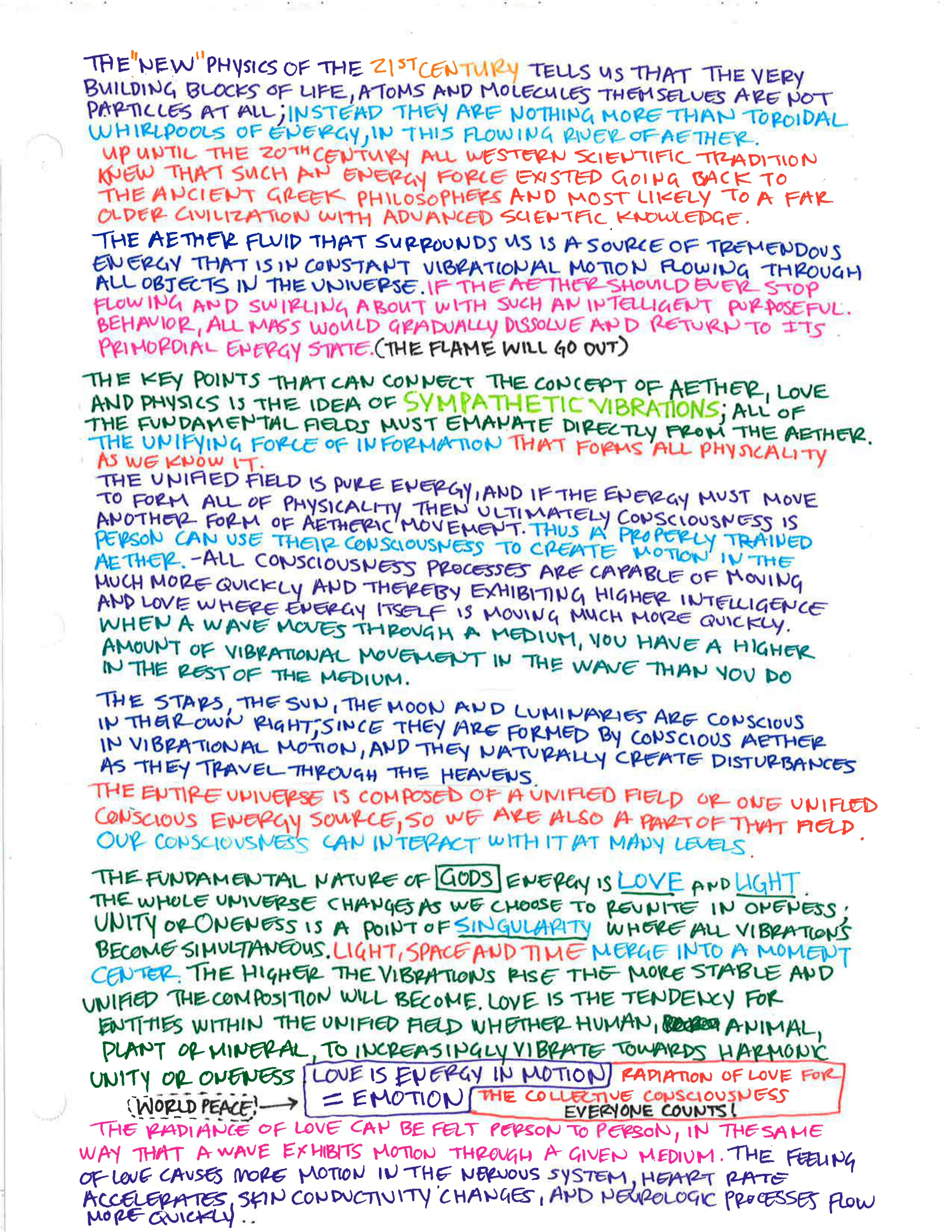
Consciousness, Love & a Unified Field
Here the aether becomes more than a proposed physical medium. The manuscript identifies it with a living source of energy and consciousness, then describes material forms as temporary patterns within that source.
The argument moves from vibration to form, from form to consciousness, and from consciousness to love. Love becomes an organizing relationship between beings rather than simply an individual feeling. Resonance supplies the analogy joining the physical and spiritual vocabulary: separate things are pictured as responding to a common pattern. The intended conclusion is ethical: if everything participates in one field, each person's conduct matters to the whole. The page's references to collective consciousness and world peace extend that idea from the individual to the community.
Experiments & the Question of a Medium
This page discusses Michelson-Morley and Airy's telescope experiment through the manuscript's alternative interpretation of aether and terrestrial motion. It also introduces zero-point energy and the cancellation of measured magnetic effects.
Three issues run through the argument: the quantity an experiment measures, the conclusions that can follow from a null result, and the additional assumptions needed to propose an unobserved medium. The manuscript treats these questions together in its defence of aether. The distinction between measurement and proposed explanation is central to that defence. The author's interpretation should be understood as the position being argued on this page, rather than an experimental result established by the drawings. The final magnet example returns to a recurring motif: a central balance or null point can organize the surrounding motion.
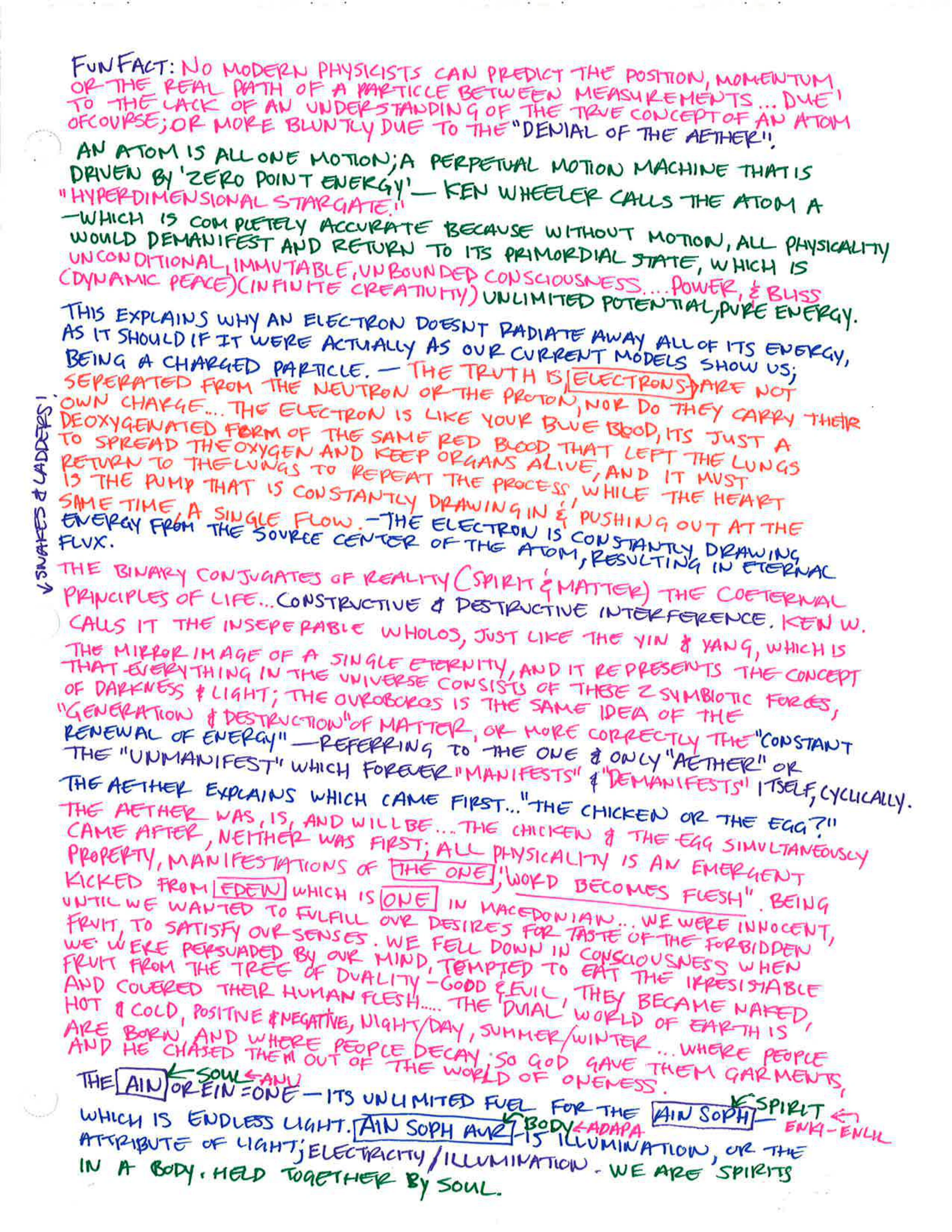
The Atom, the Source & the Garden
The page proposes that an atom is an ongoing circulation sustained by a source, rather than a collection of isolated pieces. Blood circulation is used as an analogy: outward and return paths belong to one connected process.
The argument then shifts into symbolism. Yin and yang, the ouroboros, the chicken-and-egg question and the Garden of Eden all express the relationship between unity and division. The author reads embodiment as a movement from an undivided source into the world of opposites. The final terms Ain, Ain Soph and Ain Soph Awr are placed beside soul, spirit and body. These are correspondences within the manuscript's synthesis. Their role here is to describe successive aspects of manifestation, not to supply a laboratory model of an atom.
Magnetism, Dielectricity & Counterspace
The central distinction is between expansion into visible volume and convergence toward an invisible centre. The manuscript assigns those tendencies to magnetism and dielectricity, using counterspace for the source or centre toward which convergence is directed.
Several familiar technical terms are repurposed within this model: permeability, permittivity, capacitance and resistance appear alongside the torus and hyperboloid. The page's own vocabulary should guide the reading; its use of a term is not automatically identical to its conventional technical definition. The proposed pattern is a pulse or exchange: outward and inward motion, formation and information, visible and invisible. The closing scriptural reference joins that physical imagery to the broader theme that the seen world expresses an unseen source.
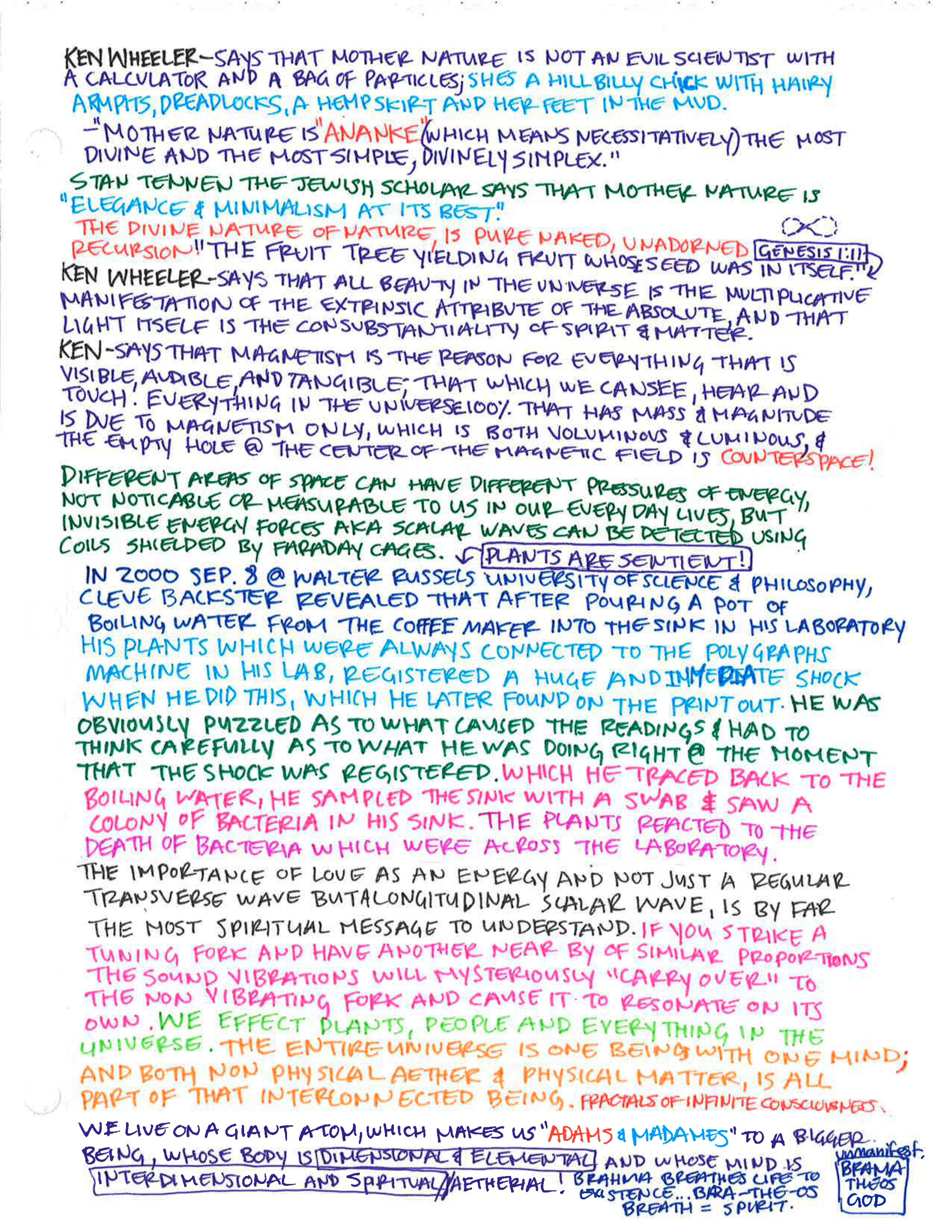
Nature, Simplicity & Living Connection
This page describes nature as economical and self-repeating. Statements attributed to Ken Wheeler and Stan Tenen introduce simplicity, necessity and the idea that a form can contain the pattern of its own renewal.
The plant anecdote attributed to Cleve Backster is used to argue that living things respond across a shared field. It functions as a supporting story within the manuscript. The tuning-fork analogy then explains the intended meaning of sympathetic response: a vibration in one place is pictured as eliciting a corresponding vibration elsewhere. The page ends by comparing the individual with a cell or atom in a larger living whole. Breath, Brahma and manifestation connect this image to the book's recurring movement between the physical body and spiritual cosmology.
The Atom as an Open Process
The author contrasts a closed-system picture of the atom with an open-system picture continually sustained by energy. Hal Puthoff, zero-point energy and Walter Russell are brought into the discussion as reference points for this argument.
The bent-wire example shows the author's distinction between an object and an appearance produced by rapid motion. A wire moving quickly can appear as a surface; similarly, the page asks the reader to imagine solidity arising from a sustained pattern rather than static substance. The diagrams compare outward energy loss with continual replenishment. A candle is the accompanying analogy: its apparently stable flame depends on an ongoing process. This is the explanatory purpose of the drawings, regardless of the manuscript's broader claims about atomic physics.
Units and terms
TEM Transverse electromagnetic, the wave label in this diagram
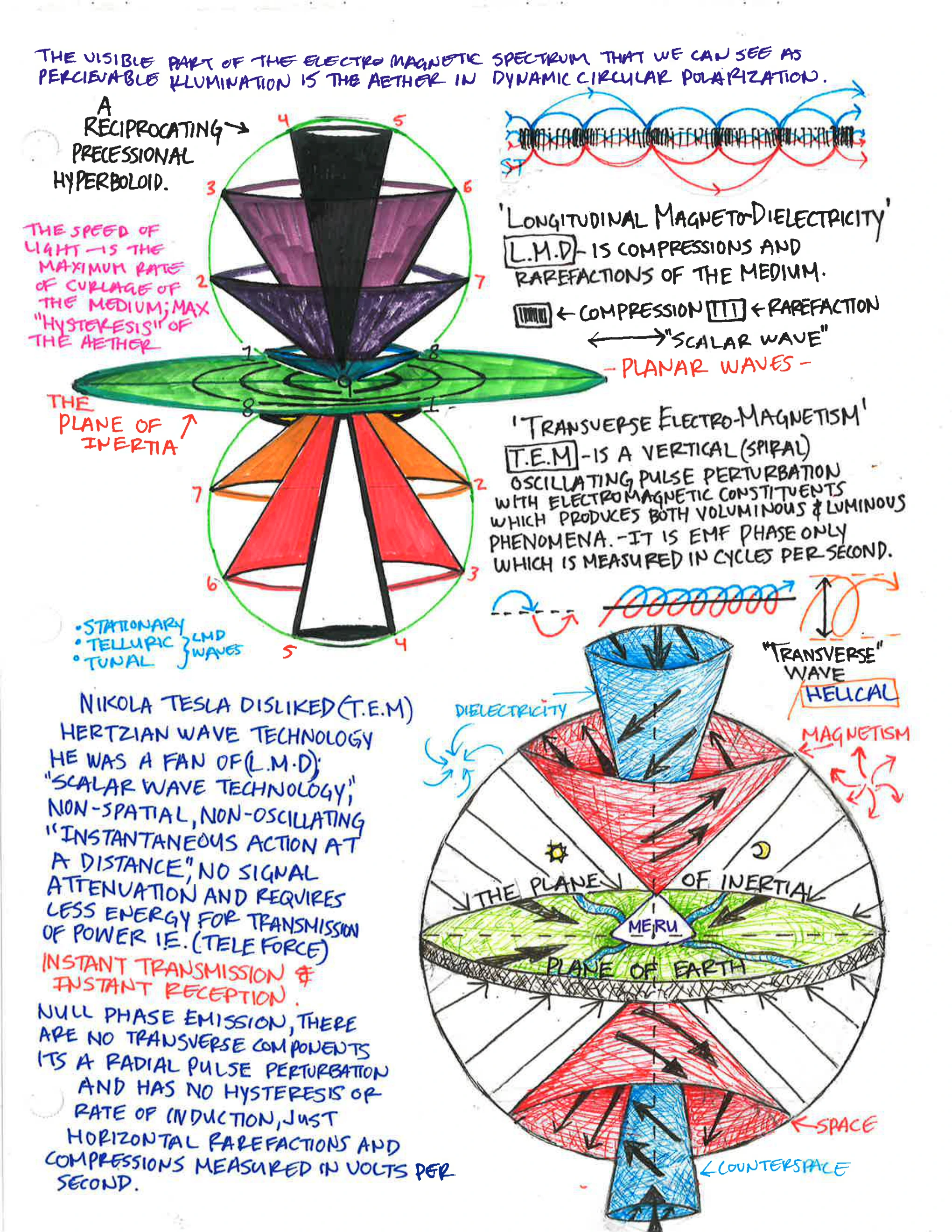
Two Proposed Modes of Transmission
The manuscript contrasts transverse electromagnetic motion with what it calls longitudinal magneto-dielectric motion. Its abbreviations TEM and LMD are the main keys to the page.
The transverse drawing emphasizes an oscillation across the direction of propagation. The longitudinal description emphasizes compression and rarefaction along a direction. The author then associates the latter with Tesla, scalar transmission and counterspace. Arrows, the central plane and helical paths compare different geometries. The author's claims about instantaneous transmission are an interpretation added to those shapes. The lower drawing joins the comparison to Meru, the plane of inertia and the proposed division between space and counterspace.
Here TEM names transverse electromagnetic motion. In established transmission-line theory, this term describes fields transverse to the direction of propagation. The manuscript's LMD label means longitudinal magneto-dielectric in its proposed model. Defining that label does not establish the separate claim of instantaneous transmission. The drawings compare directions and shapes; the existence and performance of a proposed transmission mechanism require evidence beyond that visual analogy. [RD-I-TERRA-TEM]
Spirals & the Golden Angle
This illustrated page brings together the Fibonacci sequence, spirals, opposing rotations and the golden angle. The sequence begins 1, 1, 2, 3, 5, 8, 13, 21 and 34; each new number is obtained by adding the previous two.
The circular construction divides a turn into approximately 137.5 degrees and 222.5 degrees. The plant sketches repeat the smaller angle from one leaf position to the next, connecting numerical proportion with a visual growth pattern. The magnetic sketches and the plant sketches perform different roles. One belongs to the manuscript's field model; the other illustrates arrangement and recurrence. Their placement on the same page invites a comparison of pattern rather than establishing that the underlying mechanisms are identical.
Units and terms
TEM Transverse electromagnetic, the wave label in this diagram
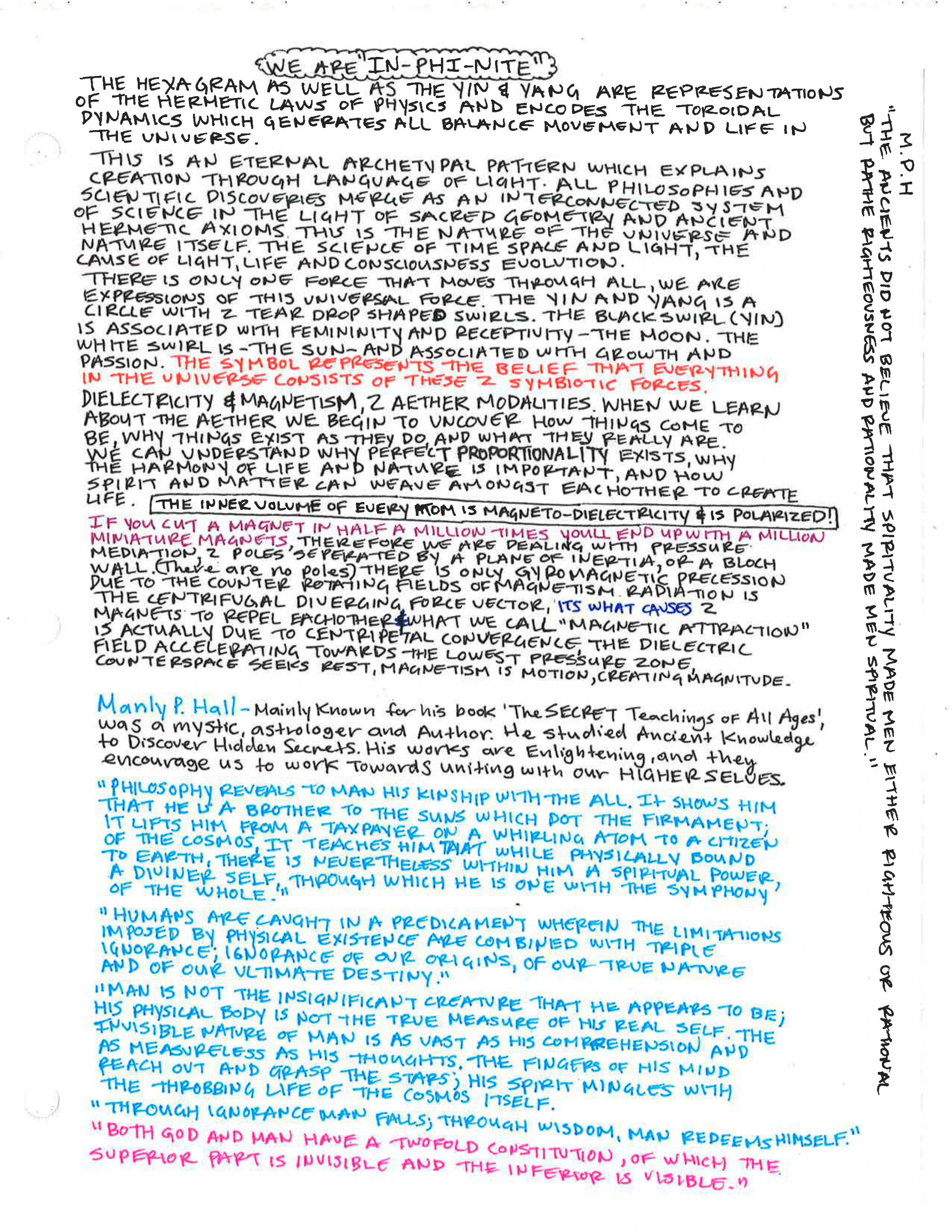
Polarity, Symbols & the Inner Life
The hexagram and yin-yang symbol are read as images of complementary motion. The manuscript connects their paired forms with magnetism and dielectricity, then extends the comparison to spirit and matter.
The centre of the page explains attraction and repulsion through pressure mediation in the author's field model. The important relationship is between the common source and the opposing expressions that arise from it. The passages attributed to Manly P. Hall move from cosmology to human identity. The visible body is presented as only one aspect of a larger self. Philosophy is therefore described as a way of understanding one's relationship to the whole, with ignorance and wisdom serving as the page's concluding opposites.
Proportion, Growth & Repeating Form
The golden rectangle, sunflower, leaf arrangements and human figure all illustrate proportion across changing scales. The page emphasizes a form that can grow while preserving a recognizable relationship between its parts.
The rectangle, spiral, golden-angle circle and stem diagrams show several kinds of proportion. Fibonacci numbers organize the discussion of successive growth, while the lower branching chart makes recurrence visible across repeated levels. Their connection is a repeated rule producing a larger structure, although each construction has its own geometry. The toroidal drawings add the author's interpretation of these patterns as expressions of paired inward and outward motion. The reader can distinguish the mathematical constructions from that proposed field explanation while still following the page's central theme: unity of pattern amid variation of size.
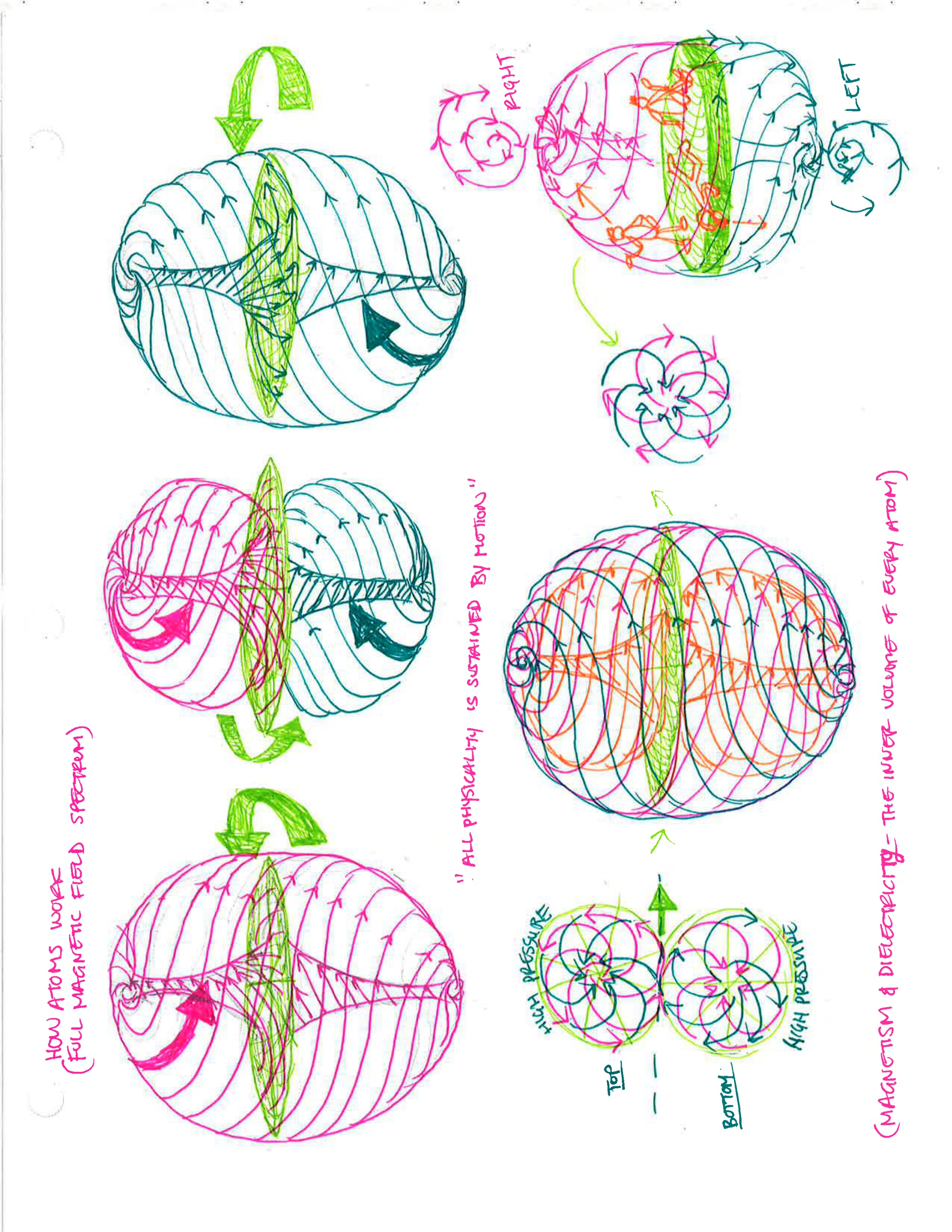
Following the Toroidal Flow
This plate develops the torus through several complementary views. The arrows matter more than the outline: trace a line around the outer volume, toward the central axis and back through the circulating path.
Pink and dark green distinguish the two directions or components of the proposed flow. The green central band marks the dividing plane. Smaller views compare what the pattern looks like from above and below, including regions labelled high pressure. The boxed note develops self-similarity: the author proposes that a part can repeat the pattern of a whole. The plate organizes otherwise different structures through that visual resemblance, while each image retains its own subject and scale.
One Pattern Across Several Images
The chandelier-like form, seated figure and field drawing place a similar central axis inside different subjects. Each has a centre, a transverse plane and looping paths around it.
The hand diagram supplies a directional mnemonic. The thumb marks the axis while the curled fingers suggest rotation. The lower group of geometric and religious symbols extends the comparison into a visual catalogue. The boxed note describes self-similarity: the author proposes that a part can repeat the pattern of the whole. Read across the plate to compare structures, then return to each image's own context. A shared visual resemblance is the organizing device of this page.
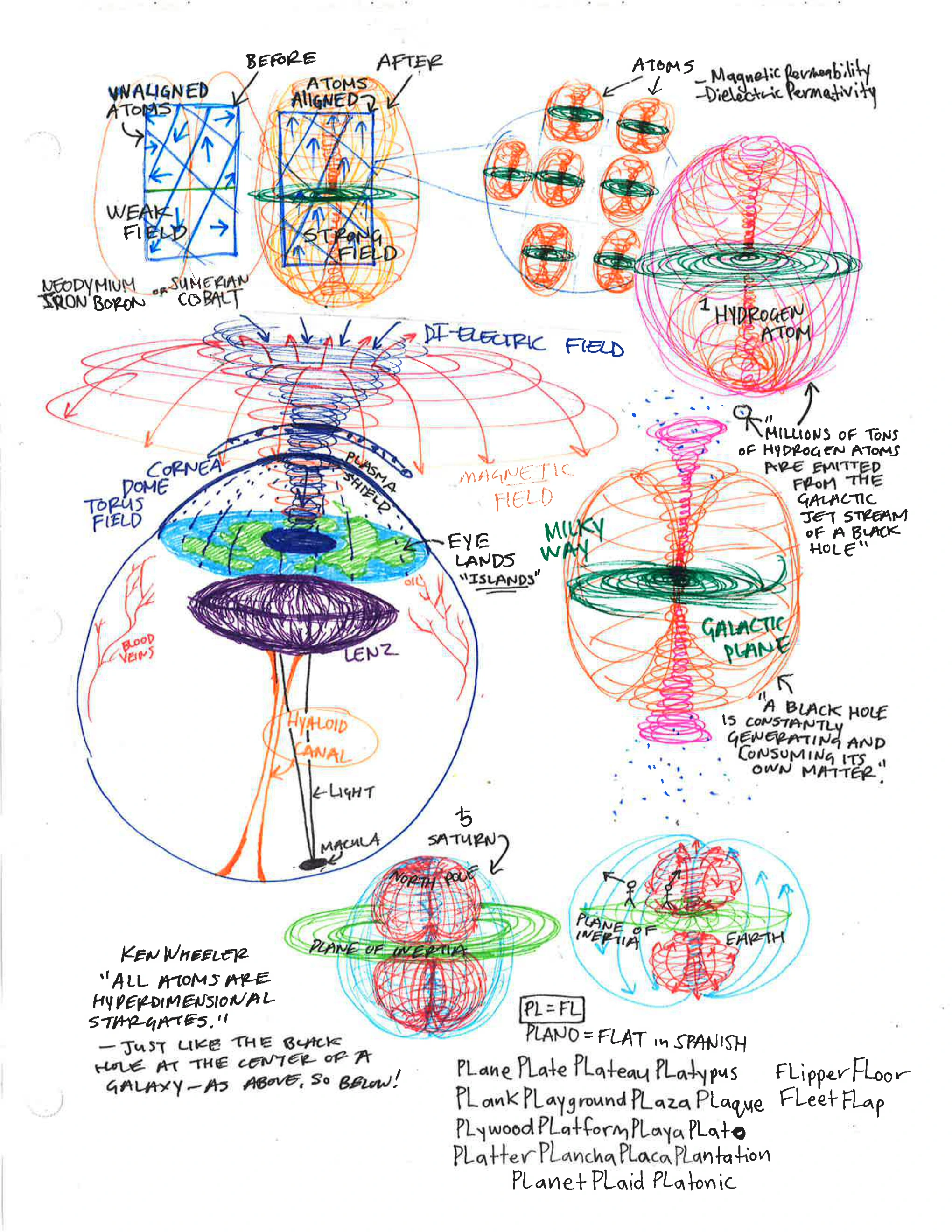
Alignment from Magnets to the Cosmos
The upper-left comparison shows disordered directions before alignment and more coordinated directions afterward. This is the page's starting image for the difference between a weak and strong collective field.
The author repeats the toroidal pattern at the scales of an atom, an eye, a planet and a galaxy. The eye drawing is especially important: its lens, light path and surrounding form become another version of the same visual vocabulary. The lower word list links plane and related spellings to the manuscript's cosmology. These associations work as wordplay within the book. The overall composition asks the reader to compare alignment, an organizing centre and an equatorial plane across otherwise different subjects.
Drawn Flows & Photographic Comparisons
The top of the page shows paired toroidal paths, a central plane and areas labelled high and mid pressure. These provide the conceptual key for the photographic images below.
The four photographs emphasize luminous rings, openings and curved bands. The manuscript places them beside the drawings to suggest a resemblance between a visible pattern and the proposed field geometry. Shape, symmetry and orientation are the common features of the four images. Their arrangement supplies a comparison with the proposed geometry. Experimental conditions and provenance would be needed to identify the physical process behind each photograph; the visible resemblance alone cannot provide them.
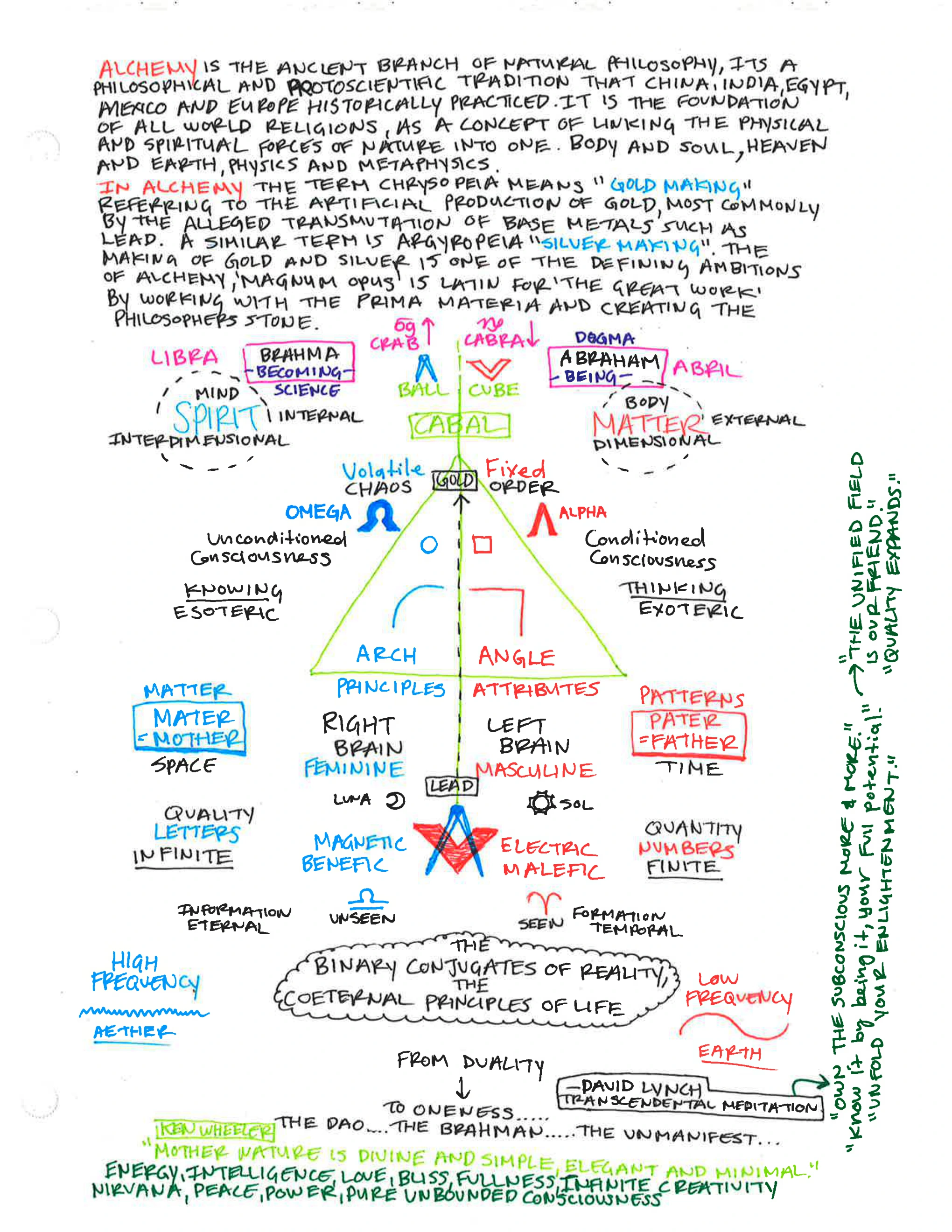
Alchemy & the Union of Opposites
Alchemy is introduced as a tradition concerned with transformation, including the making of gold and silver and the philosophical great work. The diagram then turns these material aims into an inner or spiritual journey.
The two sides pair spirit and matter, inner and outer, knowing and thinking, and feminine and masculine. The triangle's upward direction gathers those opposites toward unity, while gold and lead mark contrasting states in the symbolic process. Horizontal pairs are gathered toward a vertical axis. Integration is the chart's central theme: personal transformation is imagined as a reconciliation of divided tendencies. The correspondence list expresses the author's synthesis of several traditions.
The Phoenix & the Balanced Human
The central figure places opposites within a single body. The left side is associated with cooperation and virtues; the right with conflict, appetite and vices. A staff-like spine and rising serpentine forms connect the lower body to the crown.
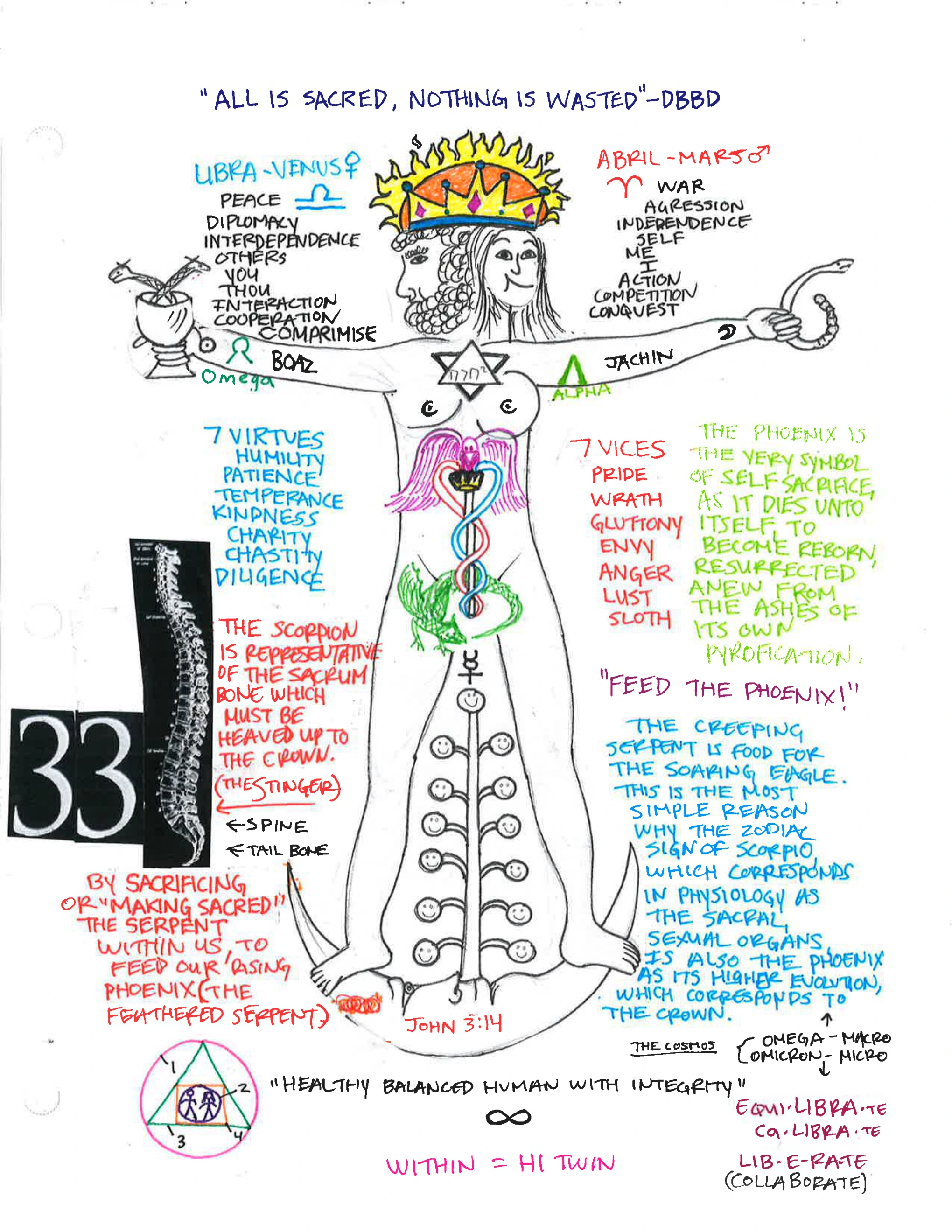
Interpretive animation of the original image. The full sheet and its writing remain visible; choose Show still image to inspect the unchanged source.
The phoenix represents renewal through transformation. The text reads the serpent's ascent as a symbolic movement from instinct toward a more integrated state. The accompanying spinal image and number 33 reinforce the vertical theme. The page's lists do not function as a medical diagram. They form a moral and spiritual map. The intended destination is the balanced human named at the bottom: a person whose different capacities work together rather than pull in opposing directions.
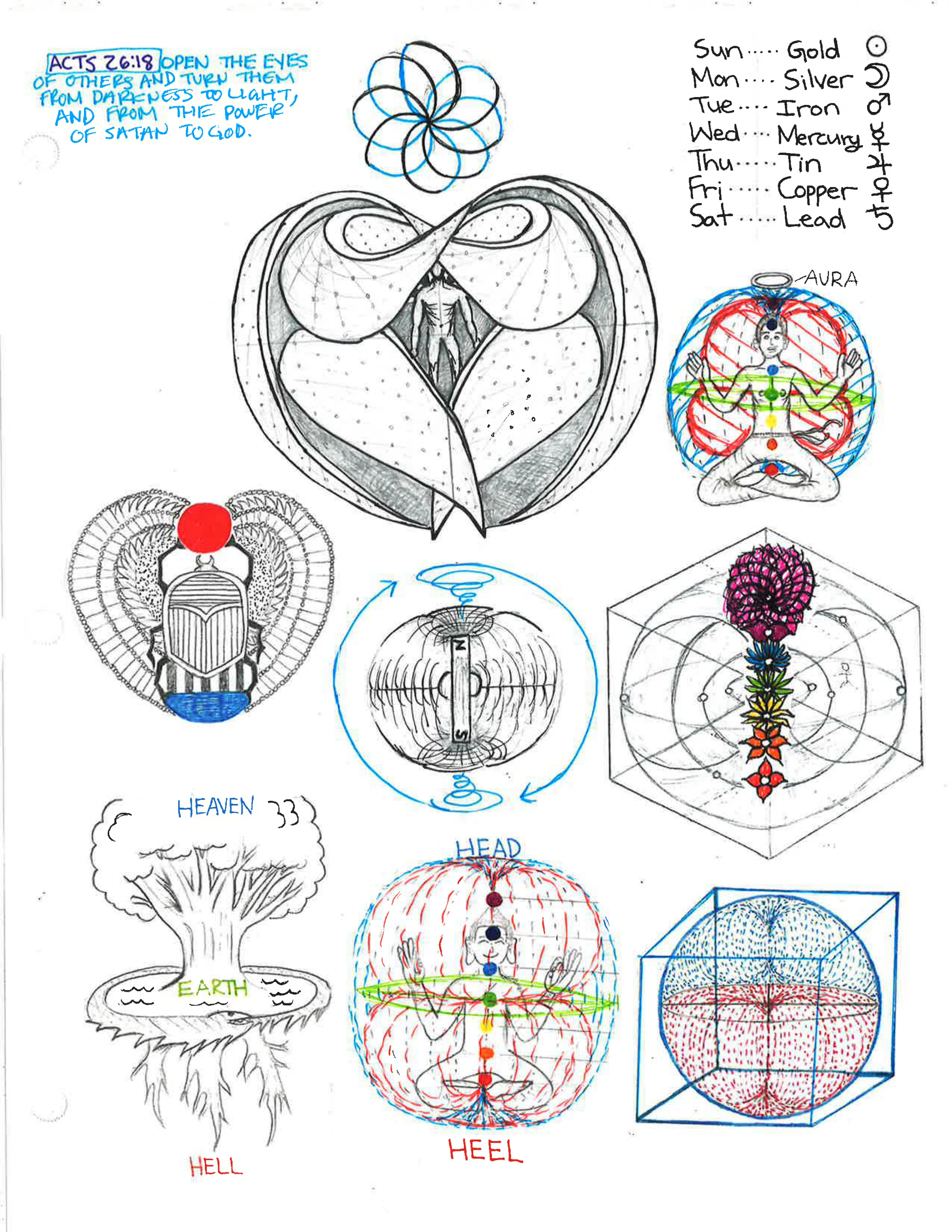
The Body, the Tree & the Field
This plate gathers several versions of the same vertical arrangement: a person inside a surrounding field, a tree spanning upper and lower realms, an Egyptian scarab, and a magnet-like central axis.
Each drawing joins an inner axis to a circulating or enclosing form. In the standing figure, that axis runs through the body; in the tree, it connects roots and branches. The cube and sphere translate the same visual relationship into geometry. The manuscript gathers these different subjects around the contrast between a centre and its surrounding space. The weekday-and-metal list gives the familiar sequence Sun/gold, Moon/silver, Mars/iron, Mercury/mercury, Jupiter/tin, Venus/copper and Saturn/lead. The scriptural note supplies the page's theme of moving from darkness toward light.
From Paired Bowls to Yin and Yang
The large lower drawings show how two opposing curved volumes can be pictured as an interlocking whole. One version reveals the internal grid; another shades the two regions like a yin-yang symbol.
Smaller comparisons include Saturn, paired bowls, a diabolo shape, a Masonic apron and the Vatican pinecone setting. The ferrocell sketch names a glass-and-ferrofluid arrangement used in the manuscript's discussion of visible patterns around magnets. Similar curves and central openings connect cultural symbols with the pictured apparatus. The page uses their resemblance to develop the theme of complementary halves. A symbol's meaning and an apparatus's operation remain different questions even when their outlines are alike.
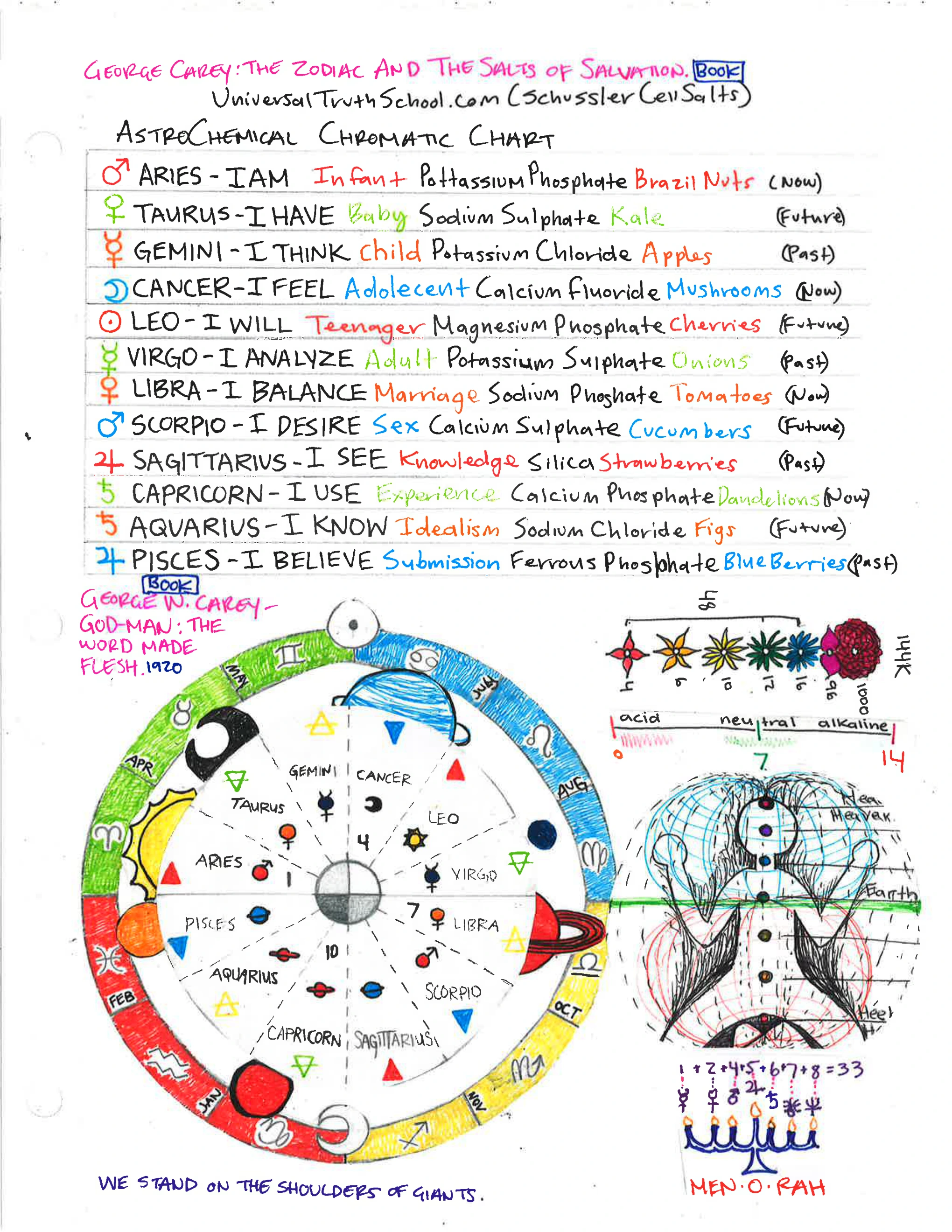
The Zodiac Correspondence Chart
The upper table pairs each zodiac sign with a phrase, a life stage, a cell salt and a food. Aries begins with 'I am'; Pisces closes with 'I believe.' The author cites George Carey and a cell-salt tradition as sources for this arrangement.
Each horizontal row groups correspondences within a twelve-part cycle. The zodiac wheel below adds months, planetary symbols and elements. Smaller figures associate the cycle with bodily centres, petal counts and a seven-branched lamp. The chart therefore combines a twelve-part calendar with other numerical schemes rather than presenting every column as the same classification. This page is a symbolic reference chart within the manuscript, not a dosing or nutrition prescription. Its explanatory function is to show how the author organizes many different categories into one repeated twelve-part structure.
The Heart's Circuit & Its Symbols
The four numbered heart drawings distinguish the right atrium, right ventricle, left atrium and left ventricle. The blue and red arrows show the author's depiction of returning and outgoing routes through the heart, lungs and body.
The upper composite drawing joins the separate routes into one circuit. Its numbers describe an ordered sequence through the pictured chambers and vessels. This sequence is what makes the heart appear as a coordinated circulation rather than four isolated spaces; the spiritual correspondences are added around that anatomical framework. The ankh, djed pillar, was sceptre and scarab belong to a second layer of interpretation. They connect the circulation image with the manuscript's themes of life, stability and paired forces. The page deliberately places anatomical drawing beside symbolic resemblance.
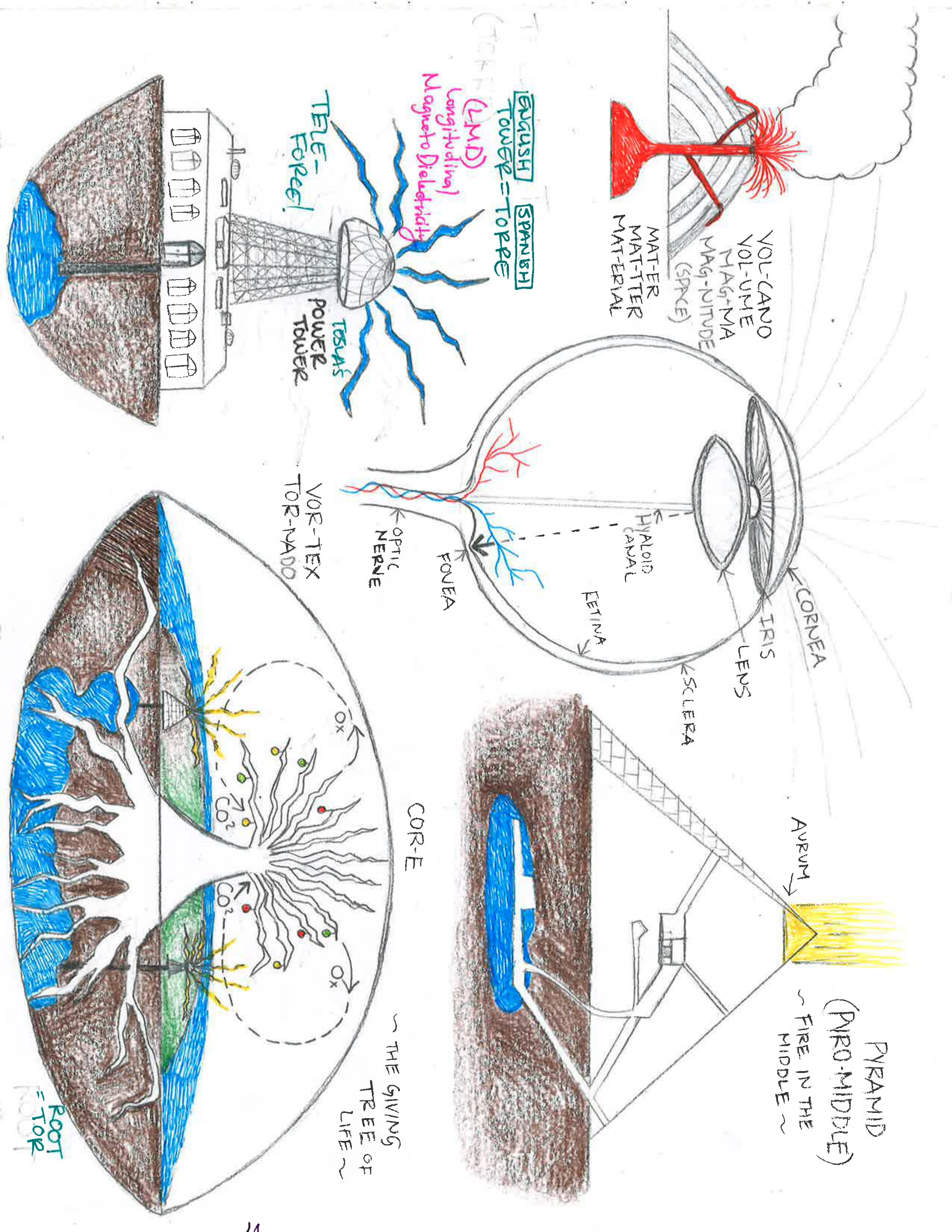
Centres, Channels & Exchange
An eye, a pyramid, a tree, a volcano and Tesla's tower are arranged around a common visual idea: a central passage connects an upper structure with a lower source or reservoir.
The eye drawing connects lens, retina and optic nerve along a path of sight. The tree balances branches above with roots below. Underground chambers and vertical passages recur in the tower and pyramid, while the volcano introduces material emerging through a central opening. These are the specific relationships behind the collage's repeated axis. These drawings are linked by shape and word association, including torus, tower and vortex. The page is best read as the author's comparative plate: it asks what these structures look like when organized around a centre and a flow.
Scripture as an Inner Journey
The page collects passages from Luke, Mark, Acts, Hebrews, Ephesians, Revelation and Genesis. The author's annotations reinterpret their light, fire, throne, ladder and temple imagery through the body and spiritual awakening.
The INRI word expansion introduces purification through fire. Jacob's ladder becomes an image of ascent, while the heavenly throne and surrounding figures are associated with structures in the head. These are interpretive correspondences made by the manuscript. To follow the argument, read each quoted passage first and its nearby annotation second. This keeps the scriptural wording distinct from the author's added anatomical or symbolic reading. The connecting theme is an inward transformation described through ascent and illumination.
Units and terms
INRI Iesus Nazarenus Rex Iudaeorum, Jesus of Nazareth, King of the Jews
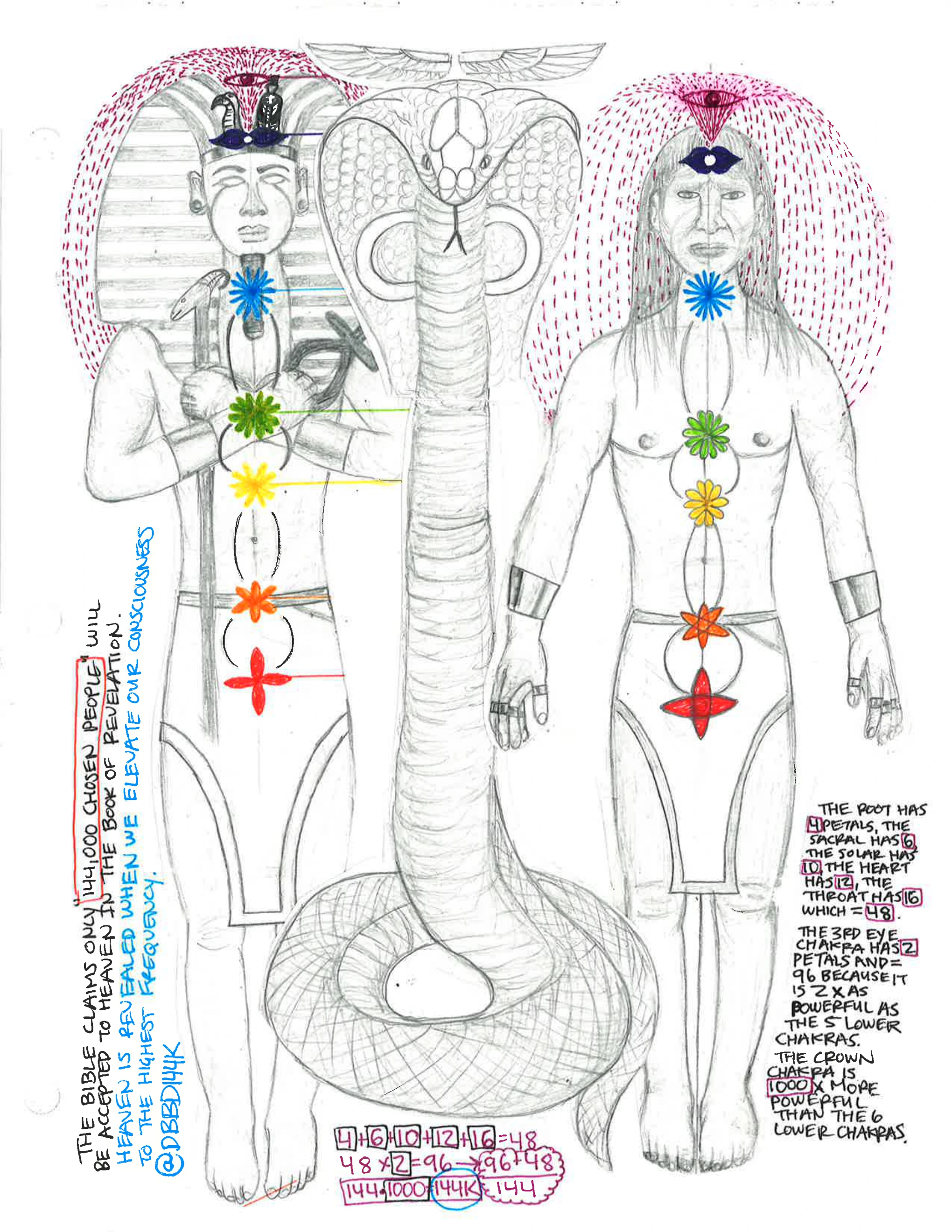
The Spine, the Centres & 144,000
Two standing figures flank a large central spine. Coloured flower-like centres line up vertically on the bodies, while the central drawing emphasizes the route from the pelvis toward the head.
The notes build a numerical chain from petal counts: 4, 6, 10, 12 and 16 total 48; the third-eye and crown numbers are then brought into the calculation leading to 144,000. The original arithmetic and annotations remain visible for comparison. The author interprets a number from Revelation as a symbol of elevated consciousness. This is a numerological reading, and the plate's task is to make that reading visible through bodily levels, repeated colours and an upward axis.
Celestial Layers & Divine Guardians
The upper toroidal form is divided into repeated curved compartments. Its central plane and vertical funnels continue the manuscript's recurring field imagery.
The lower circular chart places earth, elements, luminaries and angelic orders in nested rings. The sequence runs from the centre through successive surrounding levels. The notes distinguish the manuscript's uses of seraphim and cherubim and associate protective serpent-and-bird imagery with Egyptian crowns. The page combines two ways of imagining order: circulation around a centre and hierarchy through concentric layers. Both organize a many-part universe into an intelligible whole, but neither drawing is presented here as a measured map of the heavens.
Units and terms
INRI Iesus Nazarenus Rex Iudaeorum, Jesus of Nazareth, King of the Jews
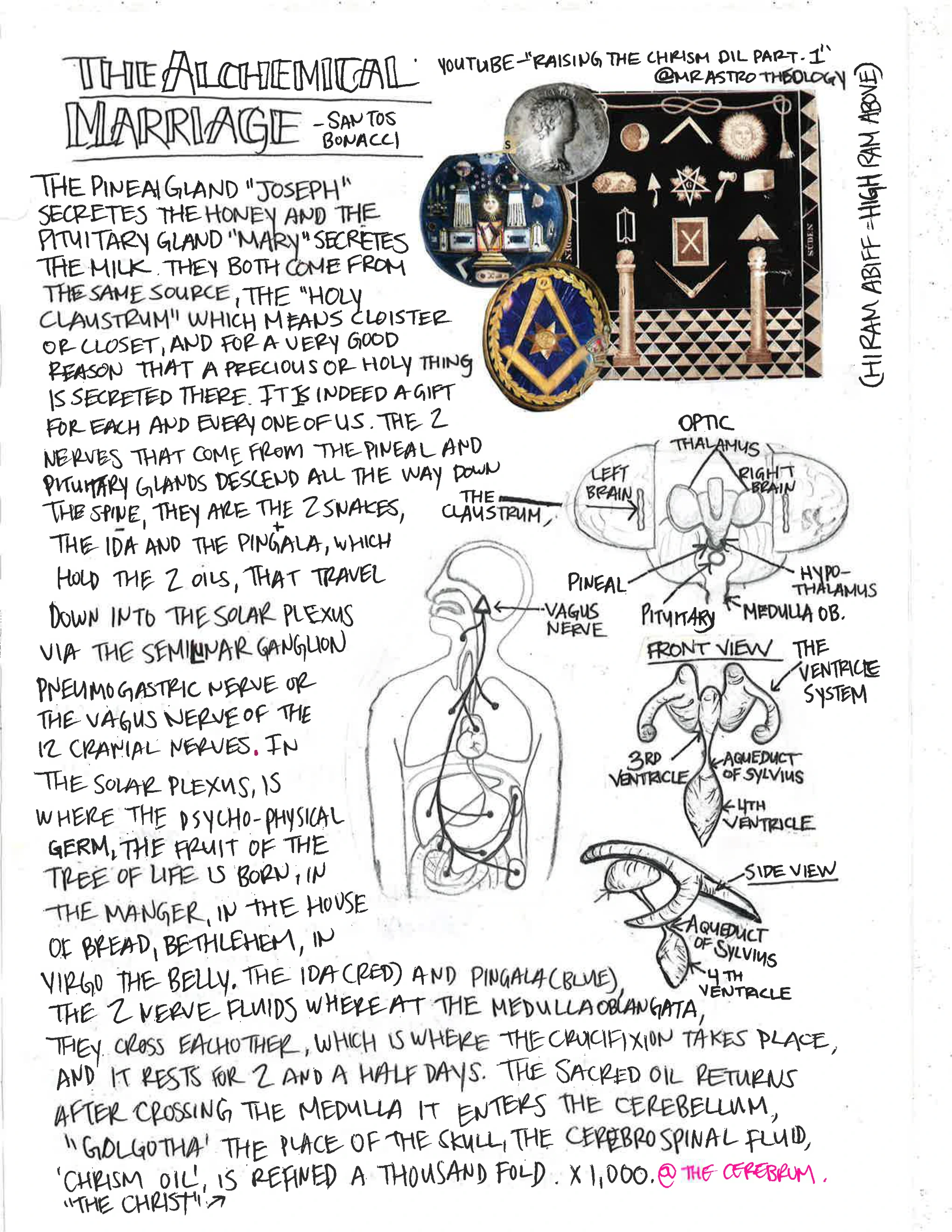
The Alchemical Marriage
This page attributes an interpretation of sacred oil to Santos Bonacci. It links the pineal and pituitary glands with Joseph and Mary, then narrates descent into the body and a return toward the head.
The adjacent drawings label the brain, ventricular system, medulla and vagus nerve. They give the reader locations to compare with the spiritual narrative. Ida and pingala serve as the page's paired symbolic channels. The passage overlays a religious narrative on bodily imagery. Its sacred-oil route, biblical identifications and numerical refinements belong to that esoteric account. The anatomical drawings locate the symbols, but do not establish the proposed spiritual route as a physiological mechanism.
The Skull, the Glands & the Fountain
The head at upper left distributes zodiac signs across facial and cranial regions. Beside it, a branching staff pairs pineal and pituitary imagery with gold/honey and silver/milk, then connects the pair to the Holy Grail and fountain motif.
The body outline locates the glands named in the manuscript: pineal, pituitary, thyroid, thymus, adrenal glands, pancreas, ovaries and testes. The small skull sketches introduce the changing soft-spot region in early development. The lower brain drawing separates thinking, emotional and instinctual layers using a simplified three-part scheme. Across the page, the author's goal is to join bodily structure with a symbolic account of renewal and higher awareness.
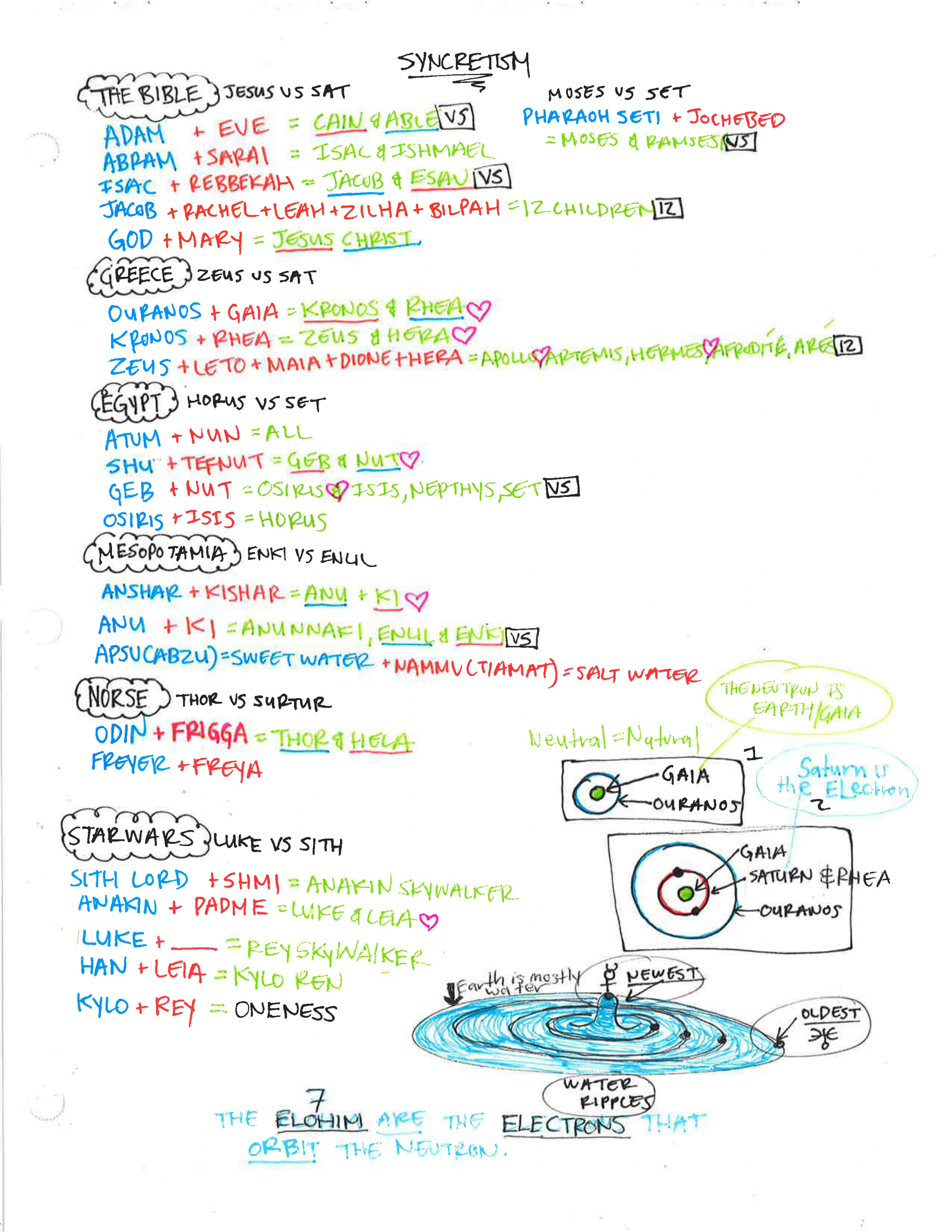
Syncretism Through Family Stories
The page compares biblical, Greek, Egyptian, Mesopotamian, Norse and Star Wars family narratives. Parent pairs, descendants, rival brothers and recurring groups are written in parallel sequences.
The columns arrange each tradition as a chain of relationships, then align selected figures across traditions. Opposing siblings and successive generations are the recurring structures. The modern fictional example extends that method beyond ancient religion, showing that the author is comparing narrative patterns across different kinds of stories. The lower atomic and ripple sketches add another proposed correspondence between a centre and its surrounding members. These genealogies and associations are the manuscript's comparative scheme; similarity of pattern does not by itself establish a shared historical origin.
Stories Written Around the Zodiac
A twelve-part wheel associates zodiac sectors with constellations and surrounding myths. The handwritten notes then connect celestial figures with biblical scenes, seasons and recurring characters.
Each zodiac sector contains constellation names and nearby narrative annotations. The lamb, shepherd, serpent, harp and twins recur among these groupings, alongside images of seasonal descent. The wheel makes a collection of separate comparisons appear as a cycle; the assigned correspondences are part of the author's interpretation of those stories. The page's method is astrotheological: it reads narratives as expressions of celestial cycles. That is the interpretation being presented, rather than a literal astronomical account or proof that every cited story has the same origin.
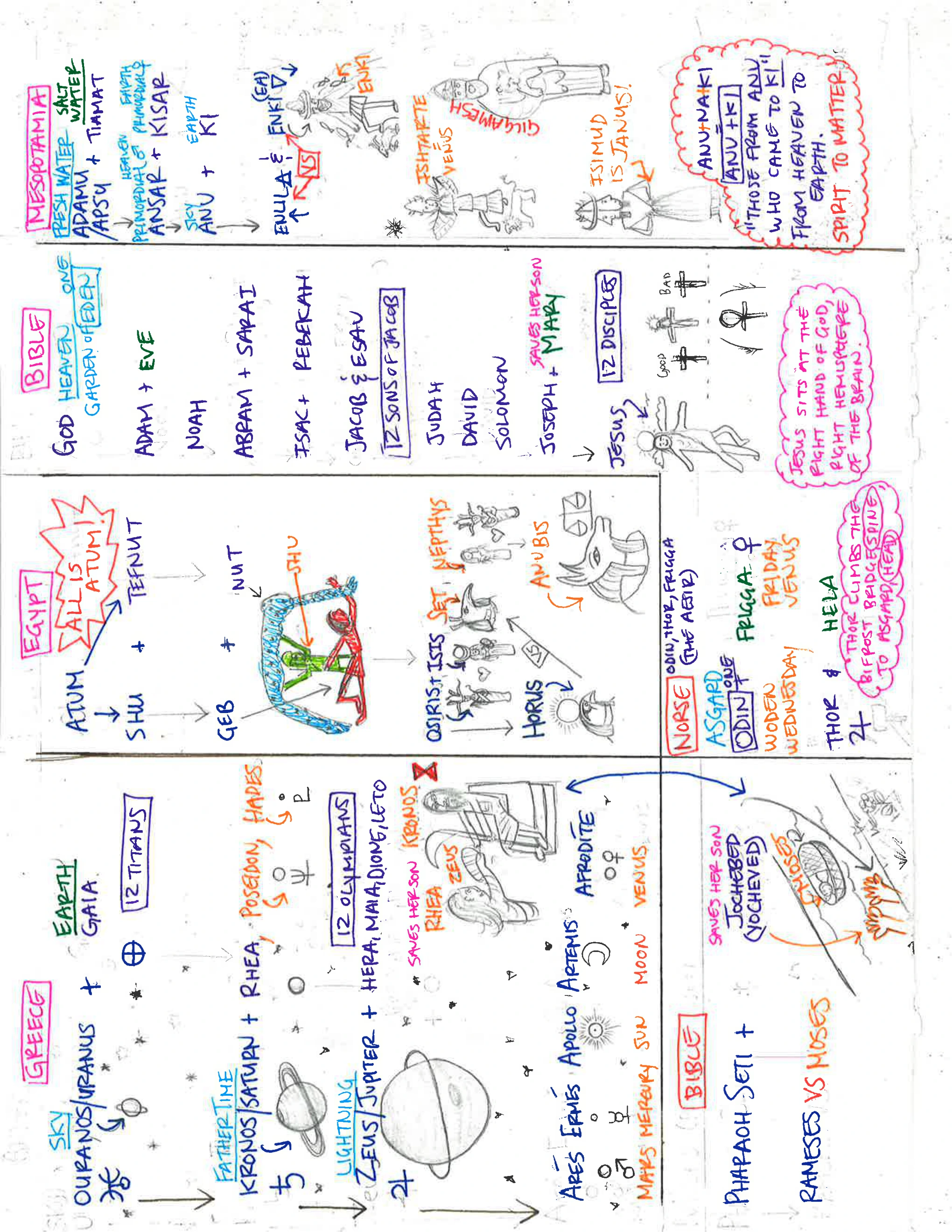
Parallel Mythological Genealogies
This sideways chart places Greece, Egypt, the Bible and Mesopotamia in adjacent columns, with additional Norse and biblical examples below. Each column descends from an earlier pair or source toward later gods, families or heroes.
Arrows provide the reading order. Parentage, succession and opposition are emphasized through repeated shapes and colours. Planetary symbols beside the Greek figures create another bridge between myth and the celestial system used elsewhere in the manuscript. The chart is a comparative study sheet. Its purpose is to make the author's proposed similarities easy to see at once. The edition keeps the whole chart upright and intact so individual names and links can be checked against the original drawing.
Geometry & Levels of Awareness
The top row compares a cylinder, sphere and curved hourglass-like forms. An apple and tree then transfer the same central-axis imagery into living shapes.
The human figures organize coloured centres along the body. One column pairs states such as fear, courage, reason, love and enlightenment with numbers, while other labels associate the centres with sounds. These are the manuscript's spiritual scale and sound correspondences. Progressive integration along an axis joins the geometry to the scale of qualities. The numerical ladder is part of the author's spiritual system. It organizes a movement from basic experience toward unified awareness rather than reporting clinical measurements.
Interpretive animation of the original image. The full sheet and its writing remain visible; choose Show still image to inspect the unchanged source.
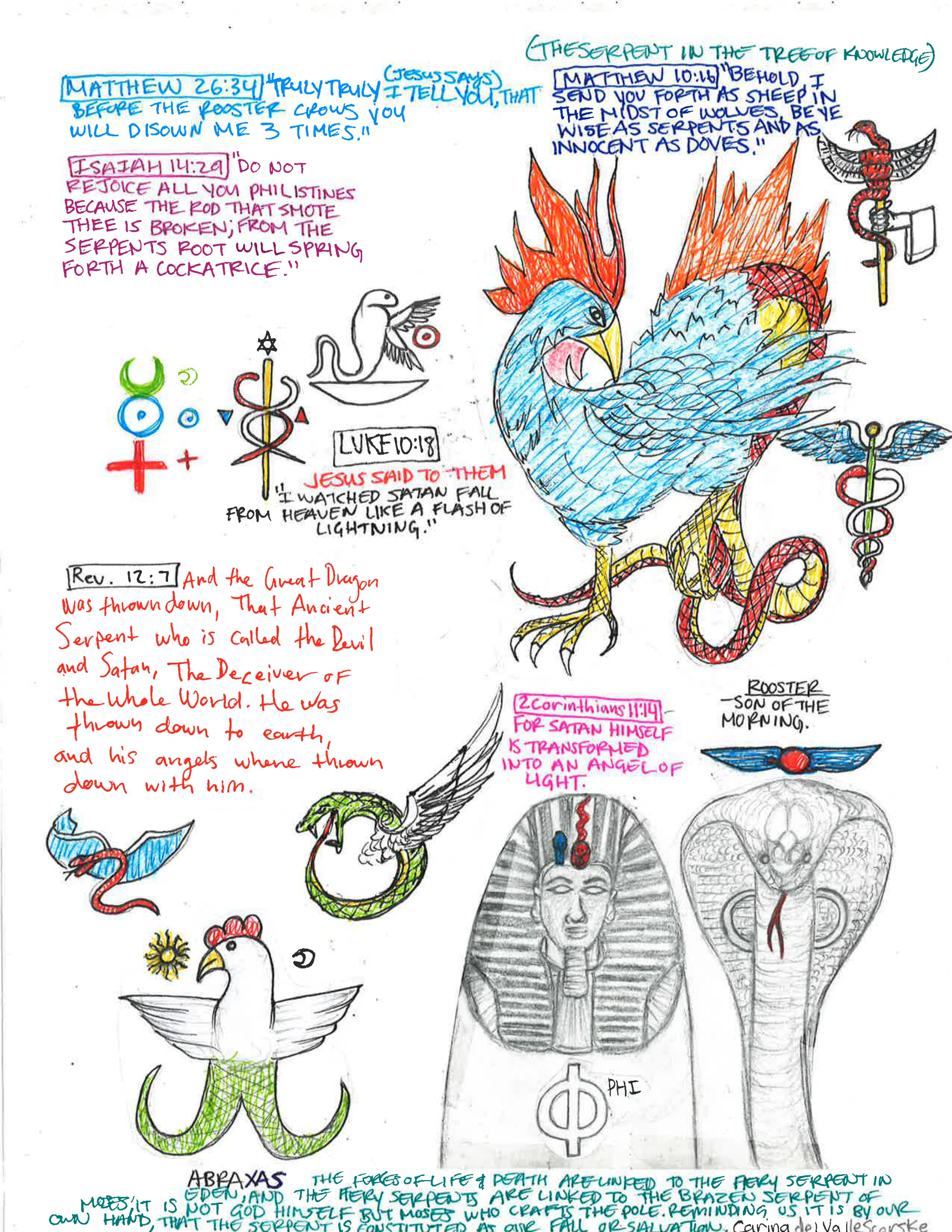
The Winged Serpent & the Phoenix
Birds, serpents, crowns and staffs fill this plate. Its central creature combines a rooster-like head, wings and a serpentine body, bringing the page's separate motifs into one hybrid image.
Interpretive animation of the original image. The full sheet and its writing remain visible; choose Show still image to inspect the unchanged source.
The scriptural passages include the rooster's call, wisdom and innocence, a falling adversary and an angel of light. The author uses them to explore how the same symbol can appear in roles associated with danger or change. Trace the serpent from the ground or staff toward the winged form above. This repeats the book's theme of ascent and renewal. The Egyptian crown, Abraxas figure and brain-like cobra drawing extend the comparison across religious and bodily imagery.
Threefold Unity & Seven Centres
At upper left, the manuscript aligns Isis, Ra and El with Holy Spirit, Son and Father, and with light, spirit and body. Egyptian crowns and grouped figures develop the idea of distinct aspects joined into one order.
The central seven-part column gives a simple sequence: be here, feel, act, love, speak, see and know. Reading upward turns the symbols into an ordered progression of human capacities. The menorah, tree-like diagram, Tarot Chariot and skull imagery continue the theme of coordination. Each has several parts governed by a shared structure. The page's correspondences are symbolic associations within the author's synthesis, not claims that the traditions are interchangeable.
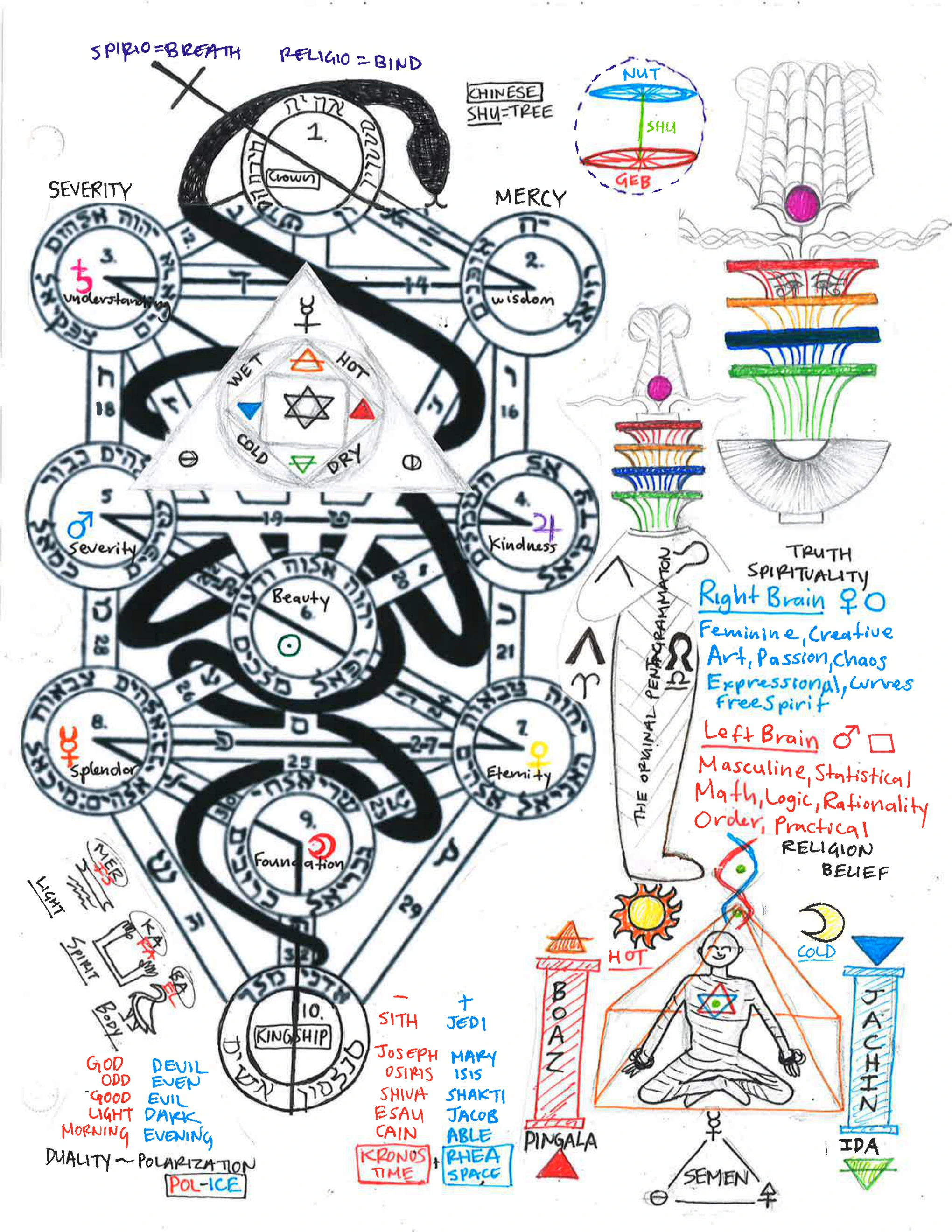
The Tree of Life & Paired Pillars
The large Tree of Life diagram has ten numbered stations linked by paths. A winding serpent crosses the structure, while the two sides are labelled severity and mercy.
Numbered stations establish the central framework. The adjacent pillars and the seated figure between Boaz and Jachin repeat a position held between complementary sides. The composition gives the middle a distinct role: it is the point where the page's opposed qualities are brought into relation. The manuscript also assigns qualities to right and left brain, feminine and masculine, creativity and order. These are symbolic pairings used to explain balance. They should be read as the page's interpretive language rather than a detailed account of how brain functions are distributed.
Four Worlds & the Tree's Central Path
This version of the Tree of Life adds the worlds of emanation, creation, formation and action. The coloured central route descends through the diagram while the three pillars organize its lateral relationships.
At the right, elemental triangles distinguish fire, air, water and earth. Below, the four qualities hot, cold, wet and dry connect those elements to another recurring classification. The small network of minerals, plants, animals and humans broadens the map to forms of life. The page can be read from abstract source to material expression, or upward as a return toward unity. Its many names belong to the manuscript's combined symbolic system. The shared vertical structure is the key that keeps the chart readable.
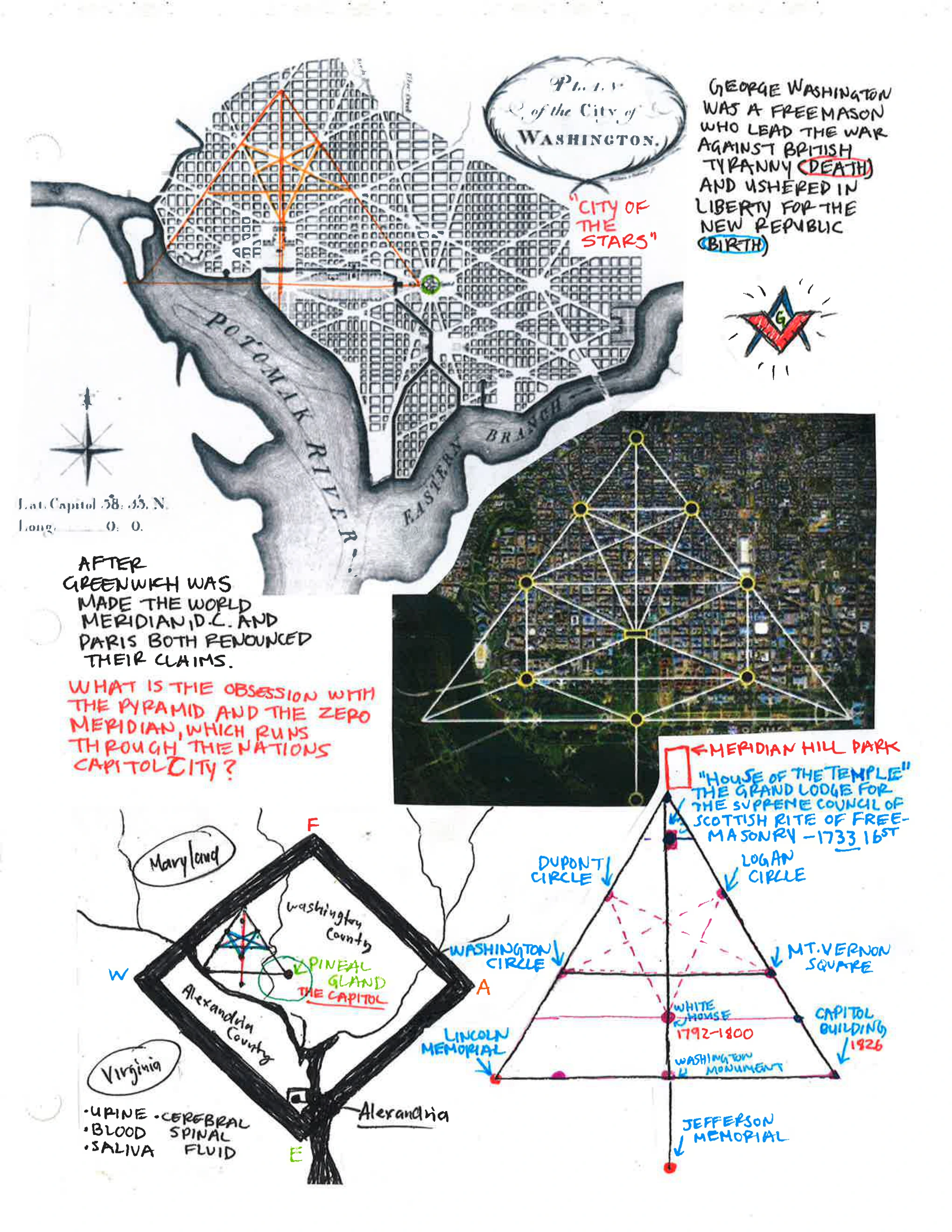
Washington as a Symbolic Map
Historical and modern maps of Washington are overlaid with triangles, a pentagram and a Tree of Life-like network. Monuments, circles, the Capitol and the White House are positioned as points in the author's geometric interpretation.
The streets and landmarks form the underlying map. Coloured lines laid over them create the proposed geometric relationships. The distinction matters because an actual street connection and a line selected to join distant features are different kinds of evidence. The overlay records the author's interpretation of the urban plan. The map, anatomical labels and added symbolic lines remain distinct layers of the composition. Their juxtaposition connects an outer landscape with an inward journey. It shows how the author constructs a correspondence without demonstrating an anatomical identity for an ancient symbol.
The Eye of Horus & the Inner Landscape
The upper images place the Eye of Horus over a brain section and compare a bird shape with parts of the brainstem. Labels identify the thalamus, pineal gland, pituitary and related structures.
The lower half juxtaposes the Jordan River and Dead Sea with the spinal column and pelvis. The manuscript interprets geography as a parallel to an inner bodily journey, continuing the river-and-spine comparison introduced earlier. Read these as visual overlays and esoteric interpretations. The original anatomical labels, map and added symbolic claims are distinct layers. The page's purpose is to invite a comparison between outer landscape and inner experience, rather than demonstrate anatomical identities for ancient symbols.
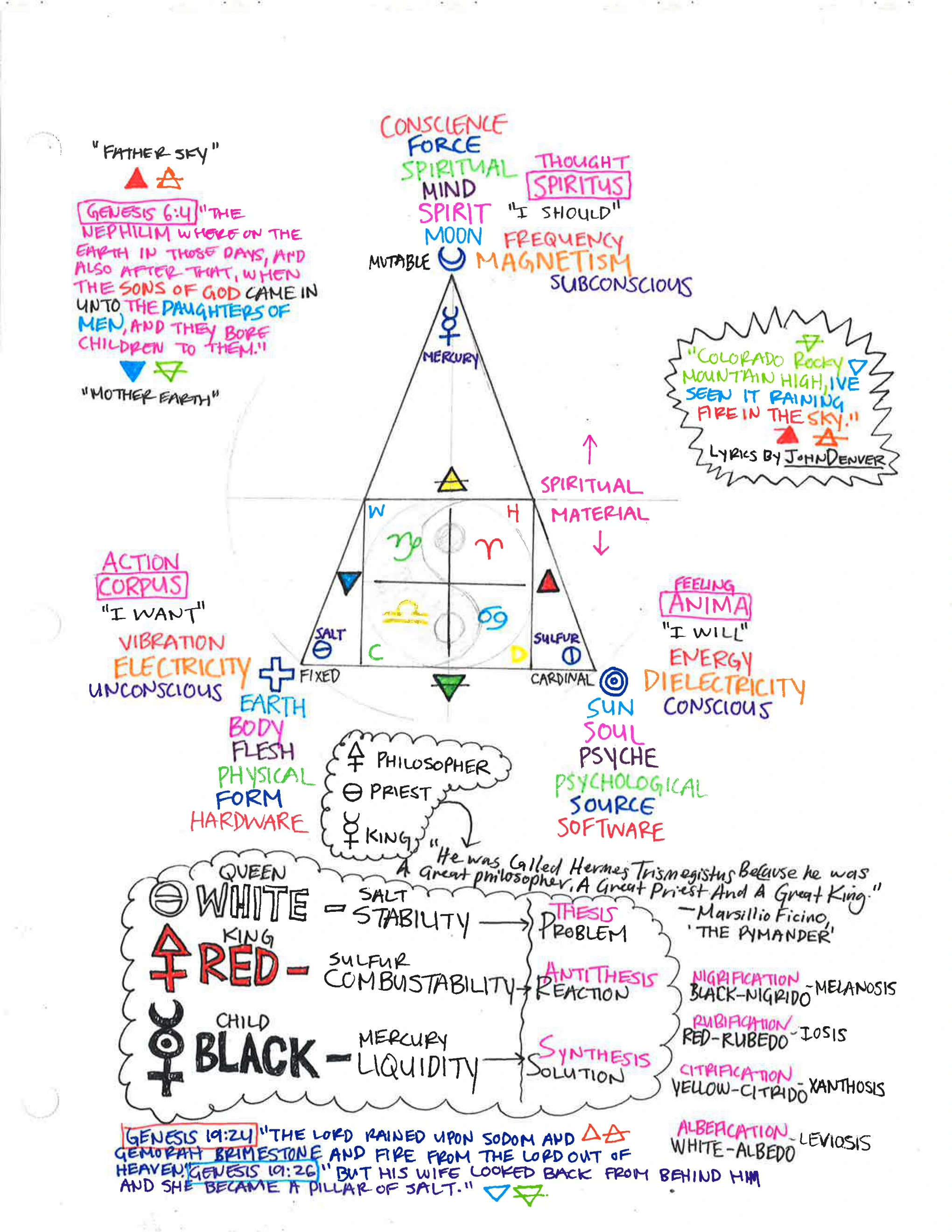
Three Principles of Transformation
A triangle joins thought, action and feeling with the manuscript's terms spirit, body and soul. Mercury, salt and sulphur provide an alchemical set of correspondences for the same three-part arrangement.
The three corners frame a division between spiritual and material qualities. Below them, the white queen, red king and black child give transformation a sequence of symbolic figures. The comparison with thesis, antithesis and synthesis presents the third term as a result of the relationship between the first two. The biblical passages and alchemical colour stages extend the theme of change through combination. The page does not merely contrast two sides; it introduces a third element that mediates between them. That mediating role is the key to its organization.
Yggdrasil & the Nine Realms
The page presents the Norse world tree through several forms: a tree bearing Odin, a circular cosmos with a serpent, a network of realms and a vertically ordered list.
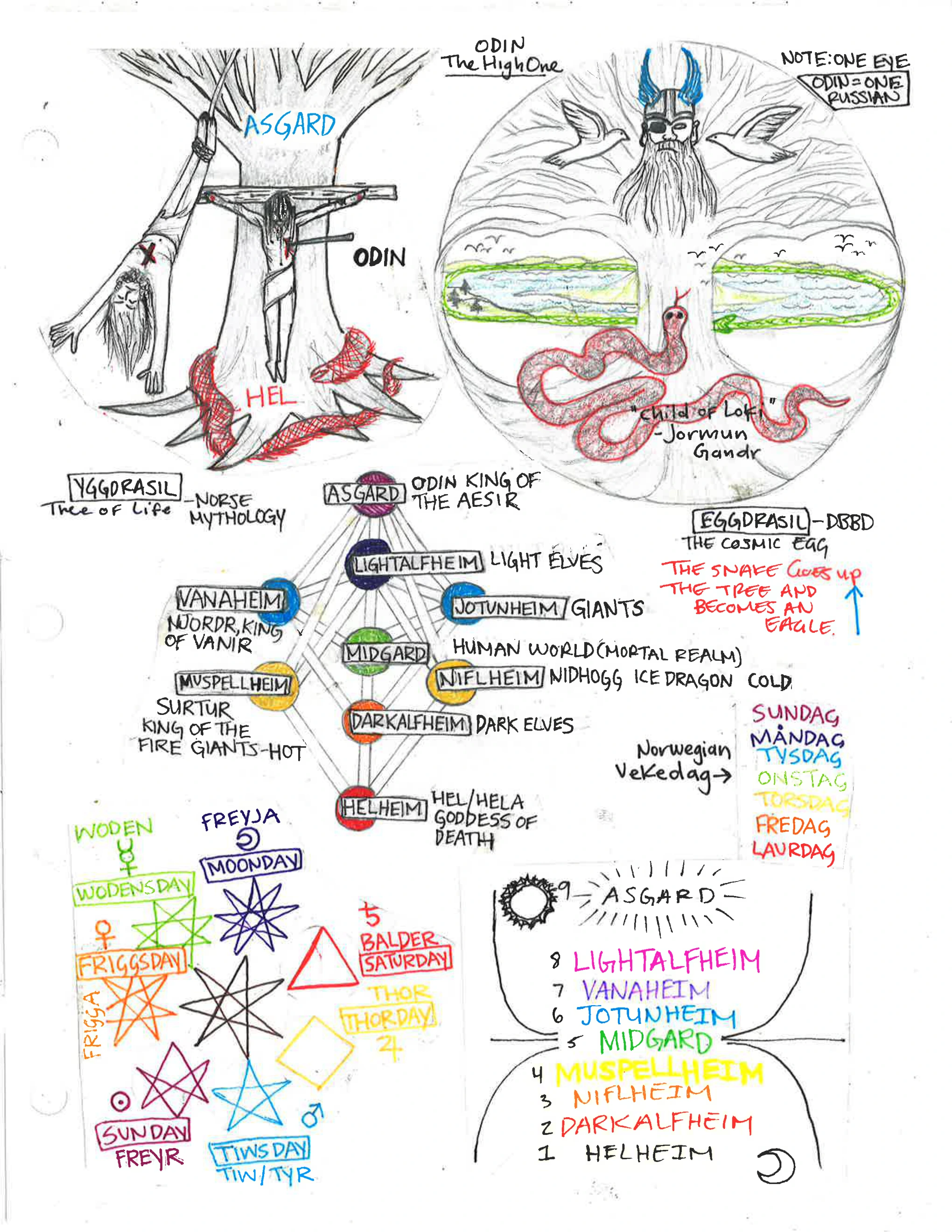
Interpretive animation of the original image. The full sheet and its writing remain visible; choose Show still image to inspect the unchanged source.
Asgard occupies an upper position and Helheim a lower one, with Midgard marking the human realm between them. Connecting lines turn the mythological landscape into a structured network. Height, centrality and adjacency are the means by which the author organizes the relationships shown in this particular diagram. The weekday names and planetary symbols create a second set of correspondences. The serpent ascending toward the bird repeats the book's broader transformation motif. These cross-connections show how Norse material is incorporated into the manuscript's larger symbolic system.
Interpretive animation of the original image. The full sheet and its writing remain visible; choose Show still image to inspect the unchanged source.
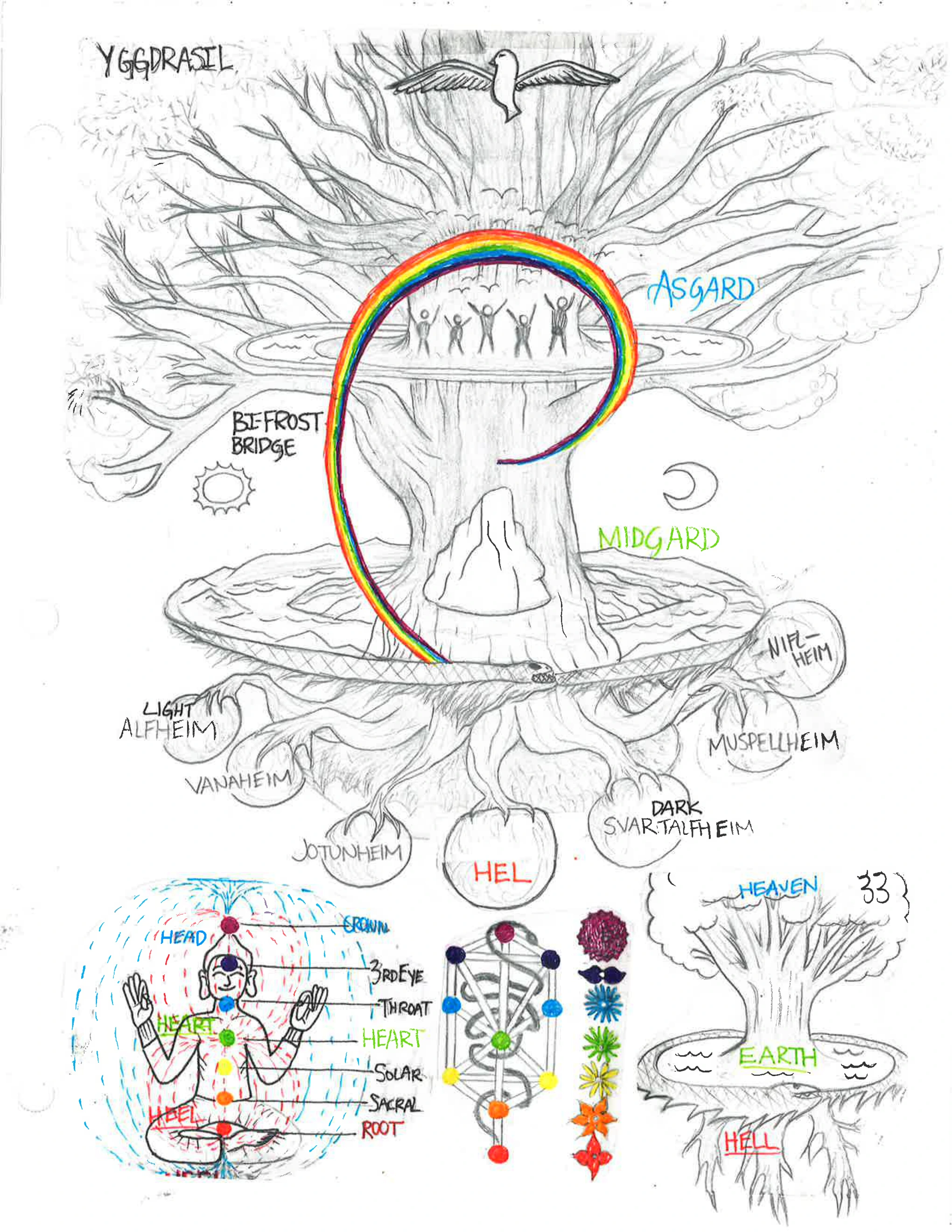
The Rainbow Bridge & the World Tree
The main drawing places Asgard in the branches, Midgard around the trunk and the other named realms among the roots. The coloured Bifrost bridge links the lower and upper regions.
Interpretive animation of the original image. The full sheet and its writing remain visible; choose Show still image to inspect the unchanged source.
The tree's height is the first reading path: roots, inhabited middle and elevated branches. The second path is the rainbow, which makes connection between levels visible. The bird above and serpent below continue the paired imagery of the surrounding pages. At the bottom, a seated figure, a Tree of Life diagram and a simplified heaven-earth-hell tree repeat the same vertical arrangement. The author is comparing maps of the cosmos with maps of inner human experience.
Inner States & Layers of the World
The central drawing places a seated person beneath a layered enclosure. The adjacent list names atmospheric regions, while the other side assigns positive capacities to levels associated with spiritual centres.
A lower list supplies contrasting states such as fear, anger and confusion. The paired statements about sleeping and waking describe the author's distinction between ordinary identification and awakened awareness. Three parallel ladders organize bodily or spiritual centres, qualities of experience and cosmic levels. A field diagram reconnects these sequences to the toroidal model. The arrangement is a correspondence chart, with symbolic placement taking the role that measured altitude would have in an atmospheric diagram.
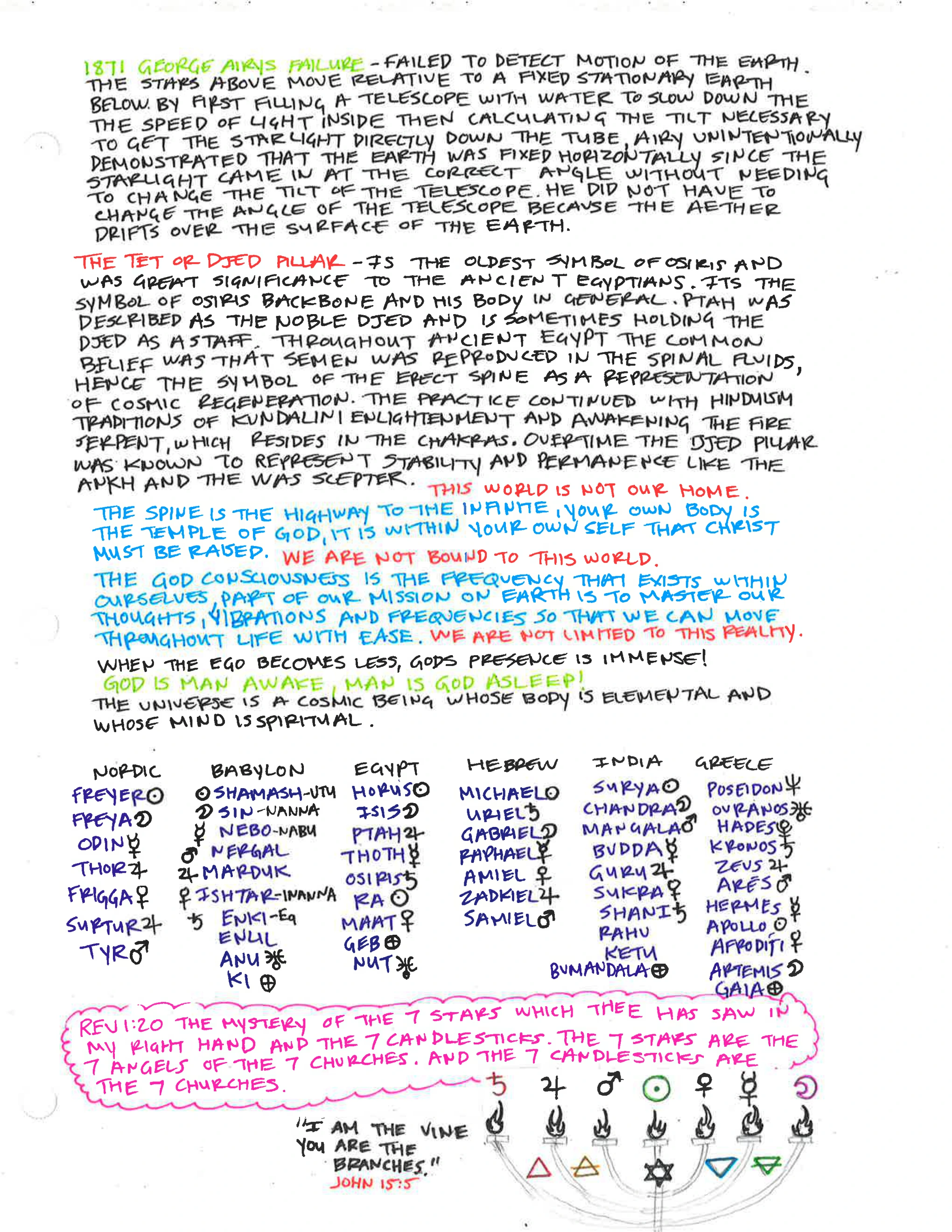
The Djed & the Spiritual Axis
After revisiting the author's interpretation of Airy's experiment, this page develops the djed pillar as a symbol of stability, the backbone and regeneration. The ankh and was sceptre appear as related emblems of life and power.
The coloured central passages describe the spine as a route toward inward transformation. The lower table groups names from Nordic, Babylonian, Egyptian, Hebrew, Indian and Greek traditions beside planetary symbols. Planetary symbols organize the proposed equivalents in the table. The seven-branched lamp gathers the comparison into one image: many names appear within a repeated seven-part order. That structure is the author's organizing principle.
The Manuscript's Healing Claims
This page discusses Alfredo Bowman, known as Dr Sebi, and attributes healing claims to herbs, diet and urine therapy. It also invokes Otto Warburg in an argument about oxygen, acidity and cancer.
The page has three layers: claims attributed to named figures, the author's explanation of disease, and a spiritual appeal to love as a healing force. Separating those layers helps the reader understand the argument without treating every sentence as an established medical finding. The original is preserved for documentary completeness. Its claims about curing AIDS or cancer, consuming urine and replacing treatment are not clinical guidance, and this reading edition does not endorse them as safe or effective care.
Units and terms
AIDS Acquired immunodeficiency syndrome
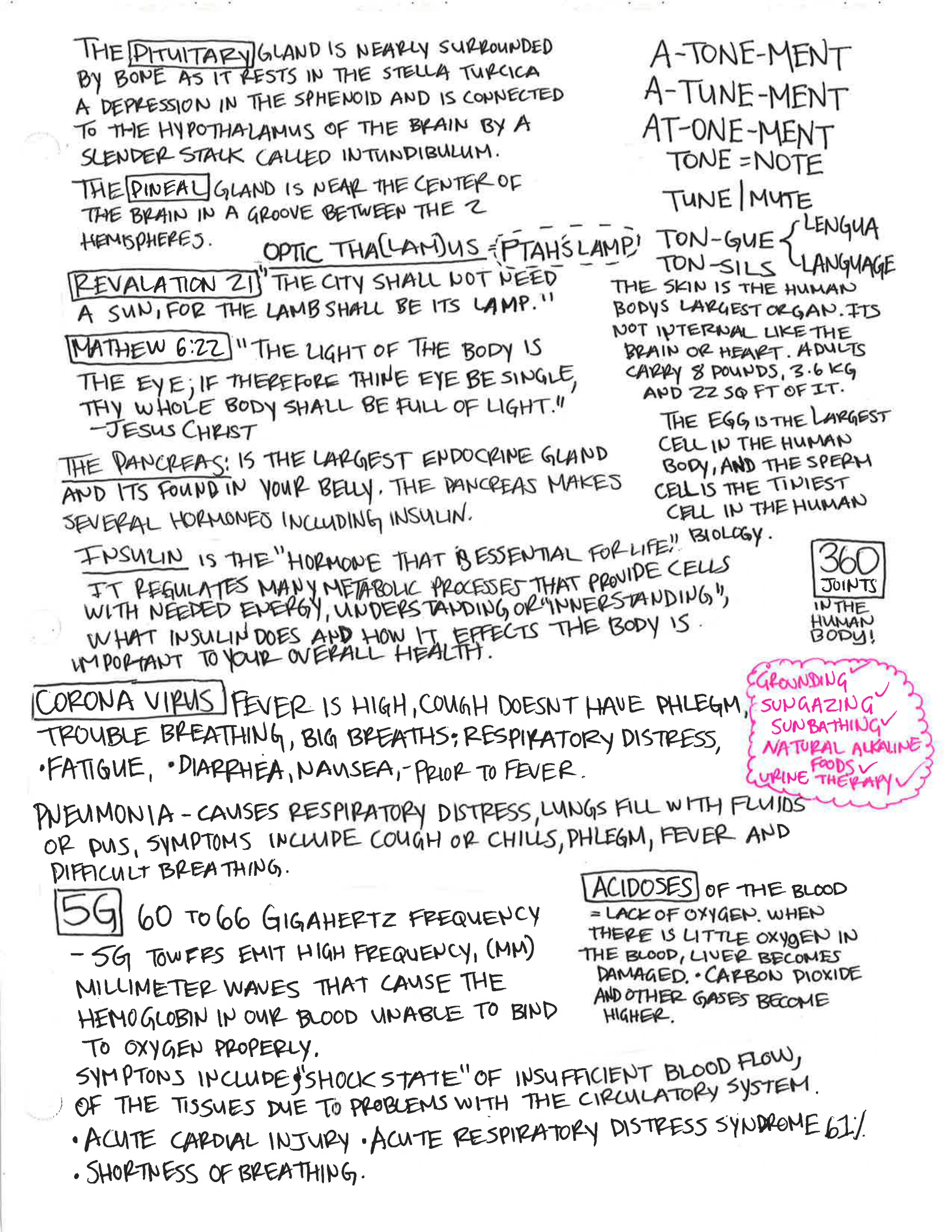
Glands, Language & Health Notes
The upper section describes the locations of the pituitary and pineal glands and discusses the pancreas and insulin. Alongside it, the author uses word divisions such as at-one-ment and a-tune-ment to connect bodily and spiritual themes.
The lower section shifts to respiratory illness, symptoms and a proposed connection with 5G. This change of subject should remain visible: descriptive anatomical notes and claims about disease causation are different kinds of statements. The source page is retained in full, but the health assertions and suggested practices are not presented as instructions for diagnosis or treatment. The explanation identifies how the page is organized without validating its causal claims.
Blood, Glands & Anointing Imagery
The page begins with blood and chlorophyll, then discusses alcohol and several brain structures. The author connects these subjects with renewal and the conservation of bodily energy.
The three wise men become a metaphor for three structures in the head. A long sequence of scriptural passages about oil, lamps, anointing and ascent then develops the same symbolic connection between bodily substance and spiritual awakening. The association runs from life-bearing fluids to oil imagery and then to the inward journey. Anatomical assertions and scriptural interpretation play different roles in that chain. The physiological and therapeutic statements remain claims made in the original source.
Units and terms
AIDS Acquired immunodeficiency syndrome
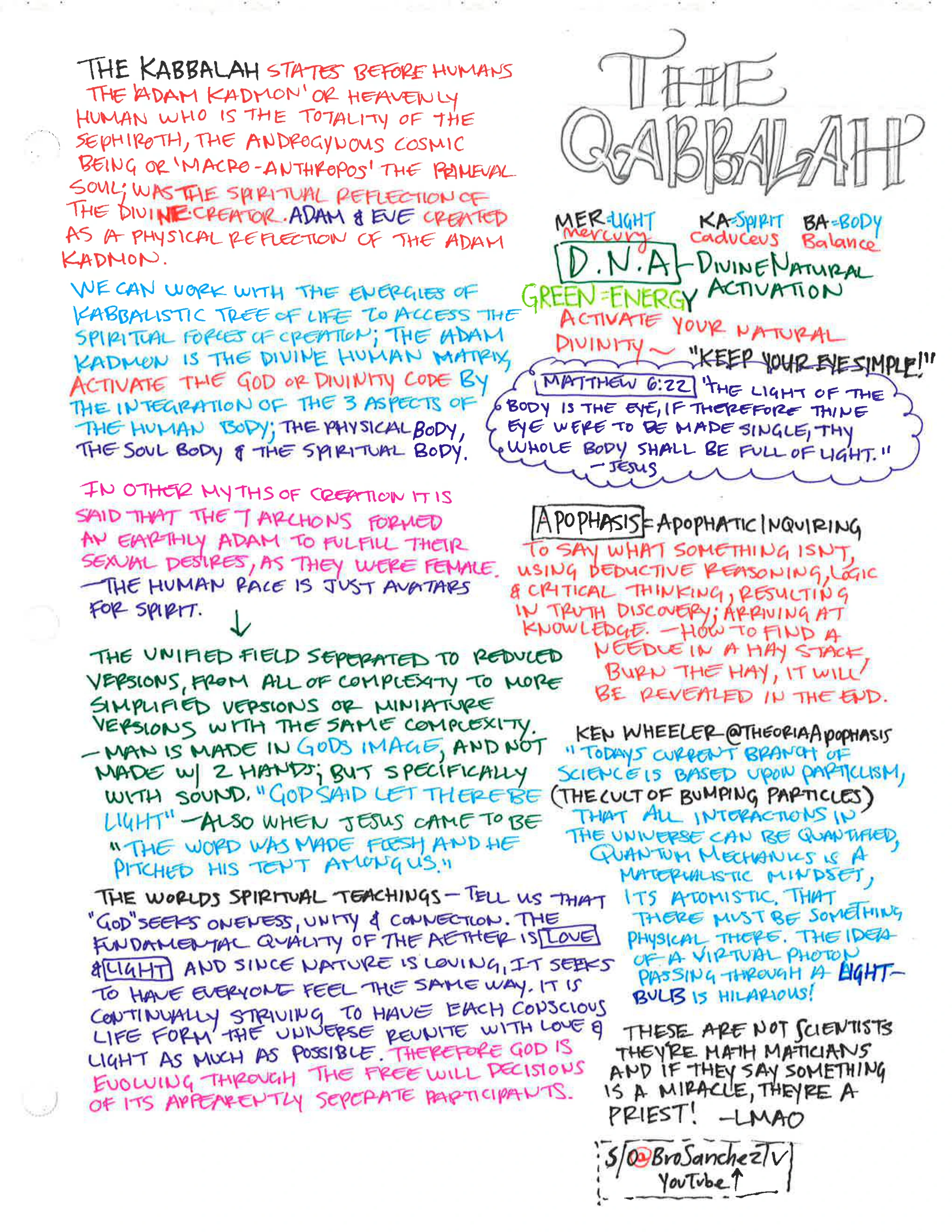
Adam Kadmon & the Method of Negation
The Qabbalah discussion introduces Adam Kadmon as a primordial or archetypal human. The manuscript proposes that physical human life reflects a larger spiritual pattern and that body, soul and spirit can be integrated.
The right-hand column introduces apophasis: approaching understanding by saying what something is not. It then presents a criticism of particle-centred explanations associated with Ken Wheeler. The page joins a view of human identity with a method of inquiry. One asks what the human being reflects; the other asks how to remove mistaken assumptions. The final theme is connection and unity, framed in the manuscript through love, light and the shared field.
Descent into Form & Return to Source
The Tree of Life is arranged between Kether above and Malkuth below. Beside it, four worlds describe a movement from emanation through creation and formation to action or manifestation.
The descending zigzag is called a lightning path. The returning serpent follows a complementary route upward. Together they express a cycle: the source unfolds into differentiated form, and form is imagined as returning toward the source. Metals, angelic orders and scriptural passages add parallel scales beside the main vertical movement. Together they summarize generation, embodiment and return, three themes that recur throughout the manuscript.
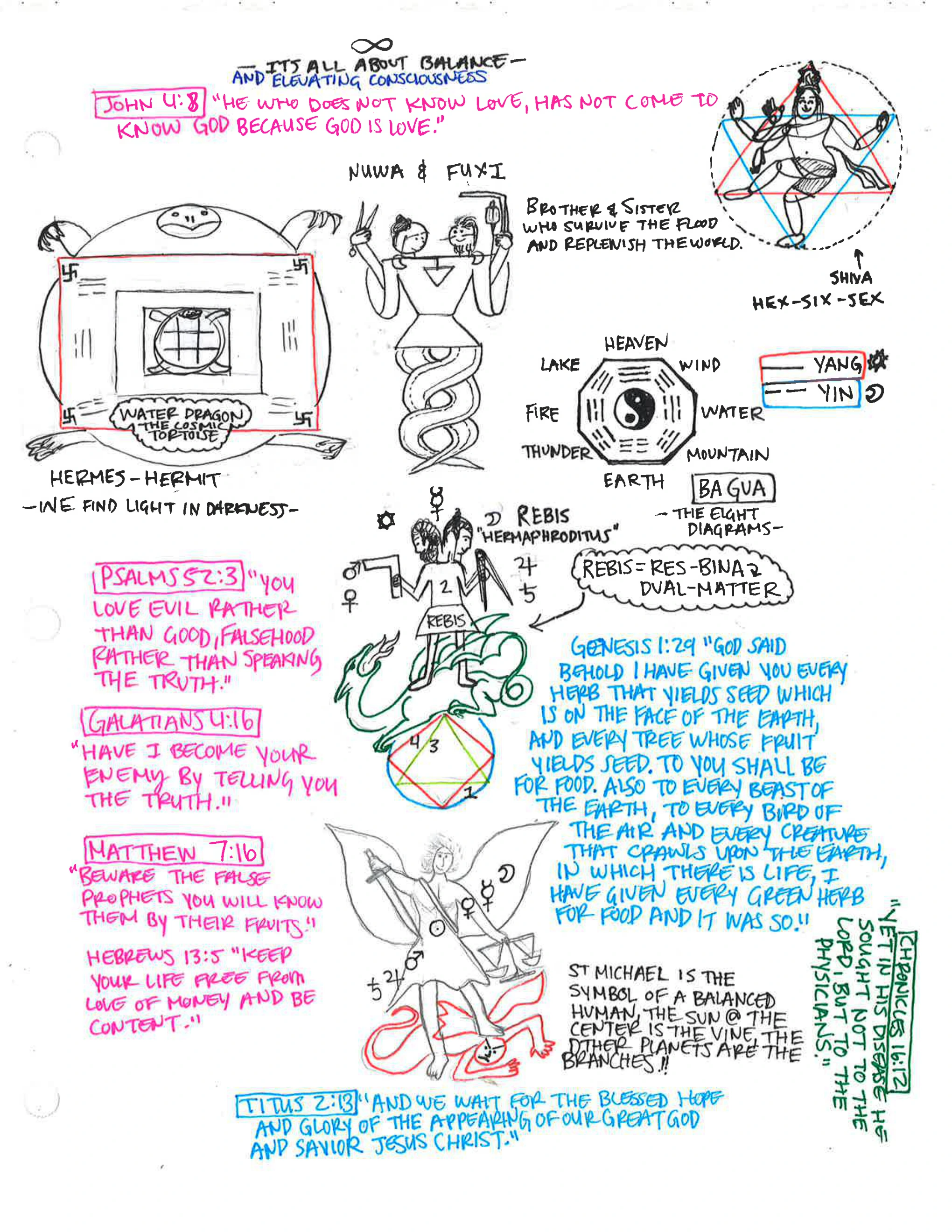
Balance Across Traditions
The page places Nuwa and Fuxi, the bagua, Shiva, the alchemical Rebis and Saint Michael in a shared field of comparisons. Each image joins, balances or governs contrasting forces.
The paired serpentine bodies emphasize interdependence; the bagua organizes change around a centre; the Rebis combines two aspects in one figure. Saint Michael's scales return the discussion to the balanced human. Scriptural passages about truth, contentment, discernment and food surround the drawings. The page's opening statement about balance and elevated consciousness gives the reading key: its many traditions are being used to develop an ethical and spiritual ideal of integration.
Reading the Planetary Glyphs
Three basic shapes lead the page: the crescent, circle and cross. The manuscript associates them with Moon, Sun and Earth, then uses their combinations to interpret the seven planetary and metallic symbols.
The relative placement matters. Jupiter and Saturn are contrasted as mind above or below matter. Mercury combines all three shapes, making it the page's fullest image of spirit, soul and body held together. The lower notes connect salt with contraction, sulphur with expansion and mercury with mediation. This is a symbolic grammar: learn the simple forms first, then see how the compound glyphs express relationships between them.
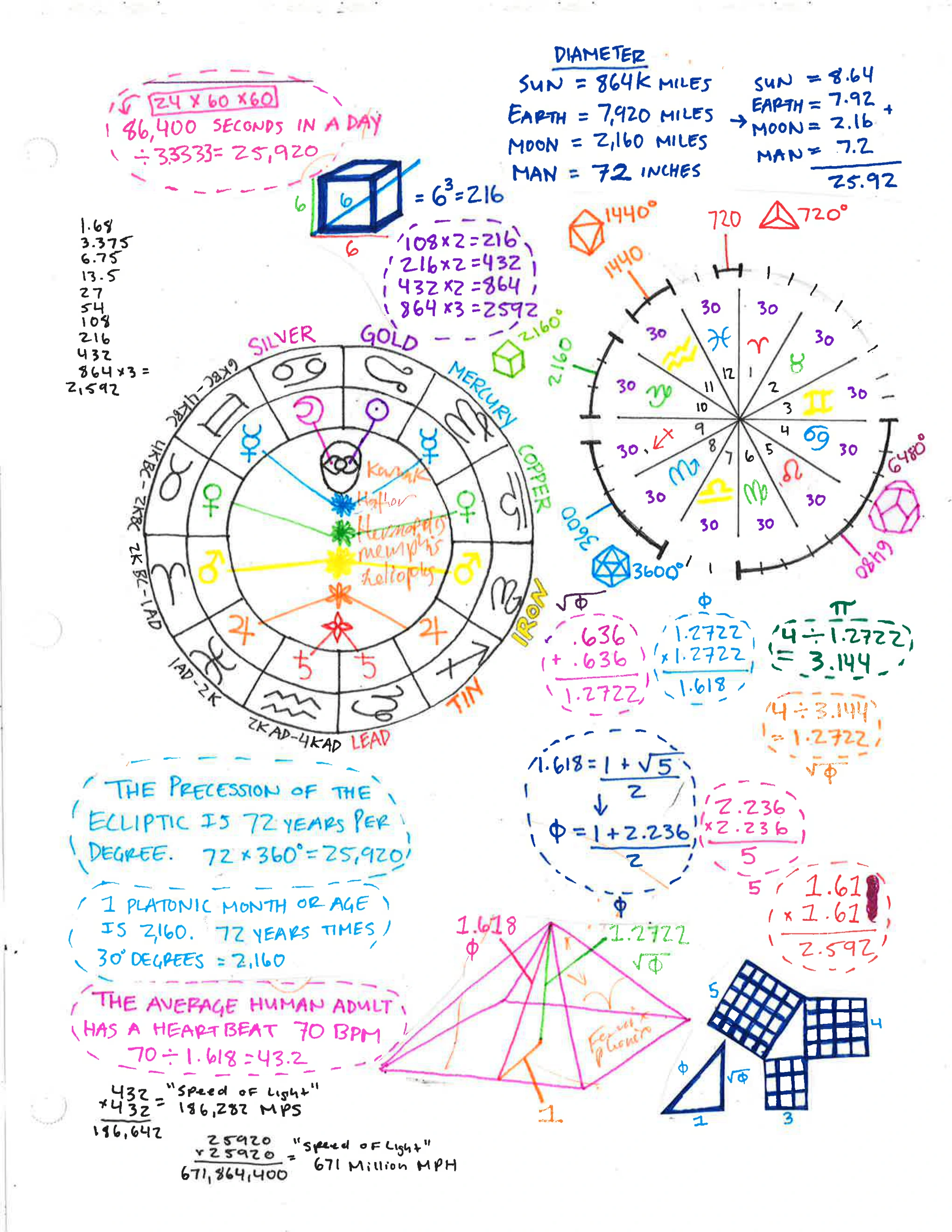
Numbers, Cycles & Correspondences
Time divisions, zodiac sectors, geometrical solids and selected measurements are brought together through repeated numbers. The manuscript emphasizes 72, 216, 432, 864, 2,160 and 25,920.
The zodiac wheels provide the main framework: twelve sectors of 30 degrees make a full circle. Around them, the author compares selected quantities and scales. The lower constructions introduce the golden ratio, a right triangle and a pyramid. The calculations retain their stated units and rounding. Their numerical parallels form a numerological argument: repeated digits serve as symbolic associations. A match in digits across unlike quantities does not itself establish a physical relationship between them.
A Notebook of Influences
This page gathers statements attributed to Walter Russell, Nikola Tesla, Leonardo da Vinci, J. J. Thomson, Michael Faraday and Eric Dollard. It also names books and experiments relevant to the manuscript's field model.
The quotations emphasize waves, energy, independent observation and counterspace. The lower section revisits Michelson-Morley and the double-slit experiment through the author's interpretation. Treat the page as a map of intellectual influences and proposed supporting references. The explanation preserves the distinction between a quotation's role in the manuscript, the accuracy of its attribution and the validity of the claim it is used to support. No independent quotation verification is implied.
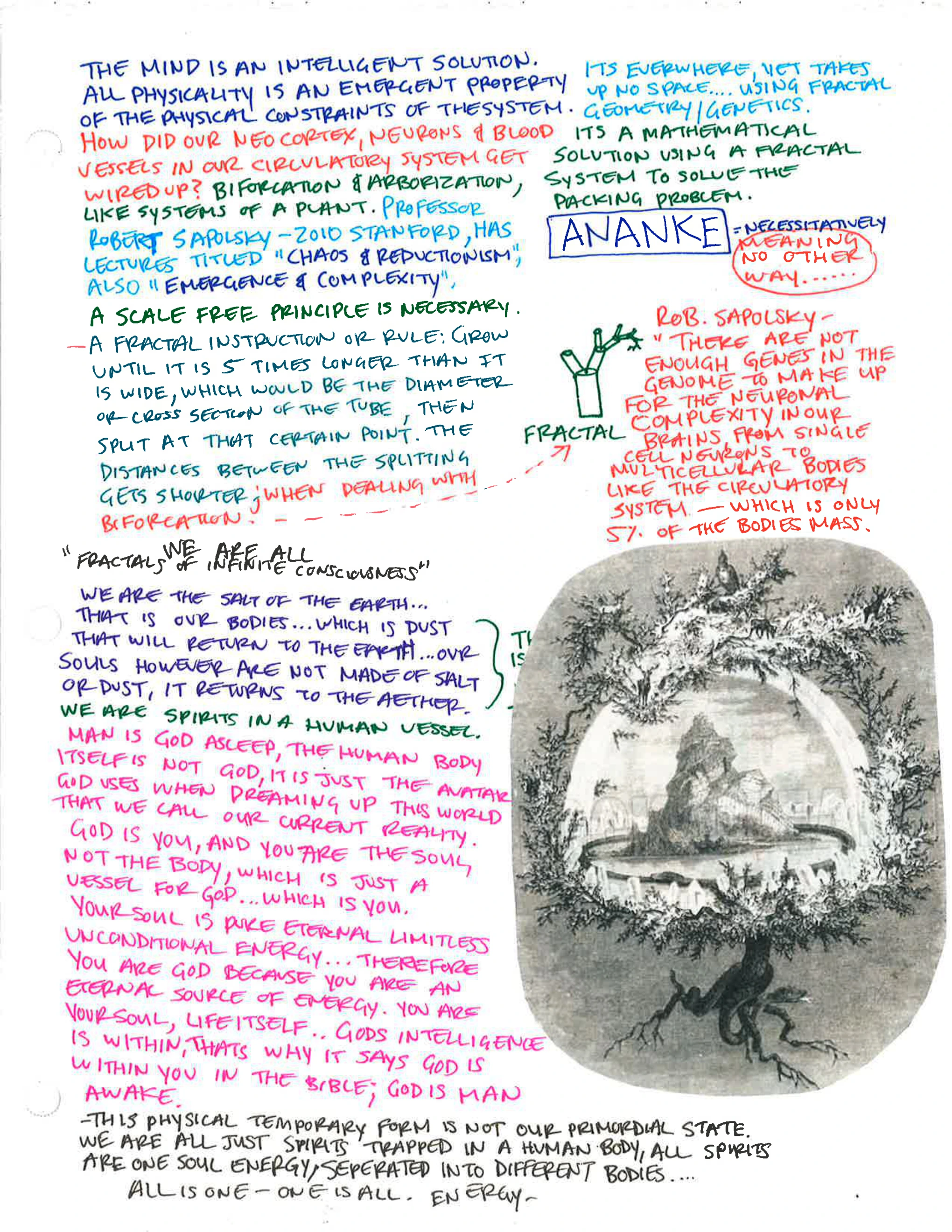
Branching, Fractals & Emergence
The page asks how complex networks can arise from repeated simple rules. Neurons, blood vessels and plant branches are compared through bifurcation and arborization, with Robert Sapolsky named in connection with emergence and complexity.
The small branching sketch is the key visual example: one segment divides, and the process repeats at smaller scales. The discussion of packing describes how extensive networks can occupy limited space. The author then extends self-similarity into a spiritual account of human identity. Physical form is described as a temporary vessel within a larger consciousness. The page moves from a pattern-building explanation to metaphysical interpretation; the tree image links those two parts.
Convergence, Divergence & the Central Vortex
The upper drawings contrast inward convergence with outward divergence, alongside contraction in cold and expansion in heat. The torus and hyperboloid are presented as complementary geometries.
The definitions assign magnetism, dielectricity and electricity different roles in the author's field model. Movement toward the centre, movement away from it, and their combined relation distinguish the terms. The arrows supply the geometry of that argument, while the accompanying prose assigns its physical interpretation. The page extends this model to the world, water cycles, the body and mind. These extensions belong to the manuscript's proposed cosmology. The conceptual lesson is the recurring exchange between an organizing centre and the volume or activity surrounding it.
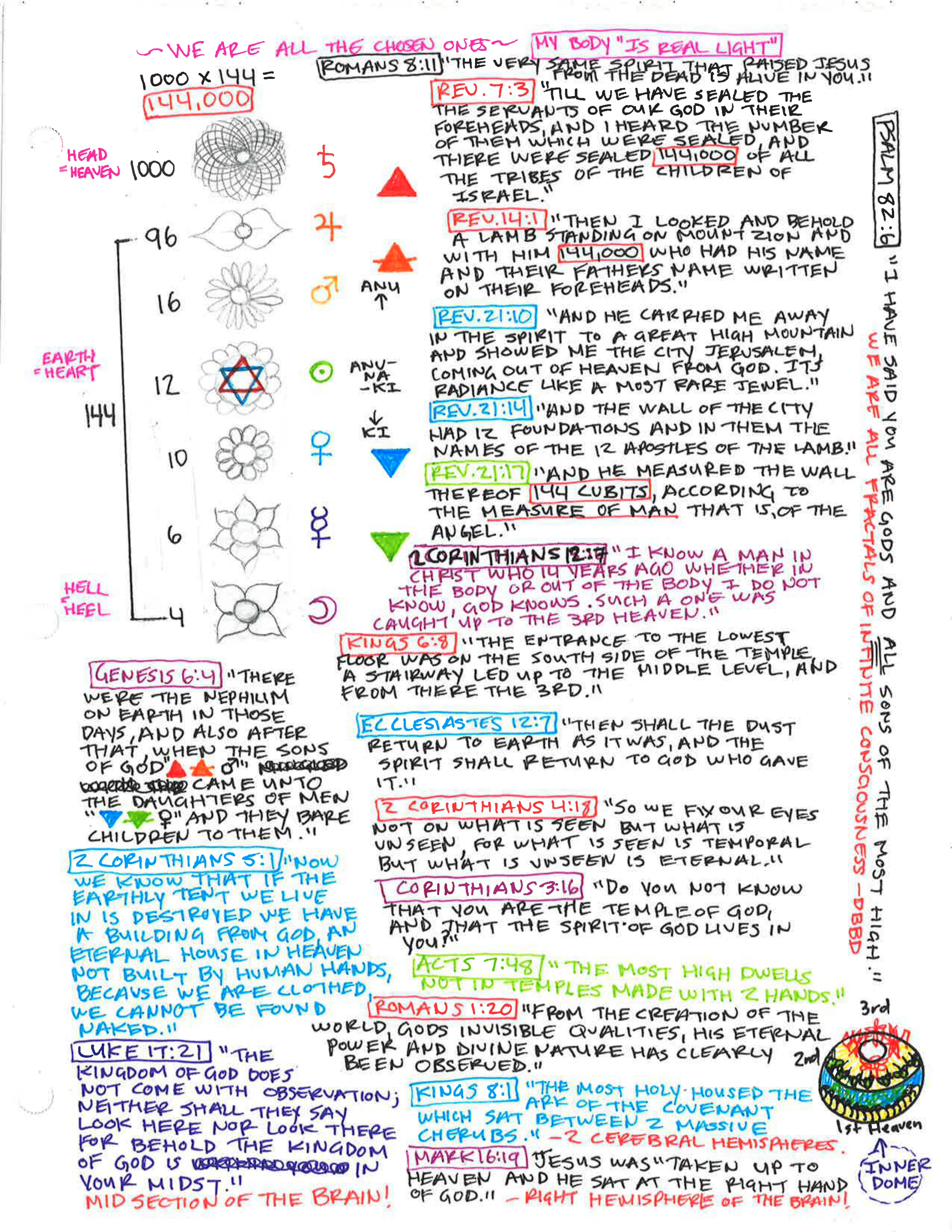
The Inner Temple & 144,000
A column of flower-like centres, planetary signs and elemental symbols sits beside passages from Revelation and other biblical books. The petal numbers are again used to connect 144 with 1,000.
The quoted passages refer to seals, a city, a temple, ascent and the unseen. The author's annotations interpret those images through the body, especially the head and the central structures of the brain. The page is built as a correspondence study: a number or image in a passage is paired with a bodily or symbolic feature. Reading the quoted words separately from the coloured commentary makes the proposed interpretation easier to evaluate.
The Hidden Stone & the Inner Journey
Scriptural passages about being in the world without belonging to it frame a page about inward renewal. Serpent, copper and bronze word associations connect the biblical serpent stories with alchemical symbolism.
The green lion appears beside VITRIOL: Visita Interiora Terrae Rectificando Invenies Occultum Lapidem. The seven initials correspond to the seven Latin words. In English, the phrase means “Visit the interior of the earth; by rectifying, you will find the hidden stone.” The manuscript uses this alchemical motto as an image of inward renewal. This is the author’s symbolic interpretation, not a measured claim about anatomy or matter.
The page combines moral restraint, spiritual identity and transformation of material imagery. Its recurring instruction is to look beneath the surface. The original letter forms and transliterations remain visible so the author's word associations can be examined directly.
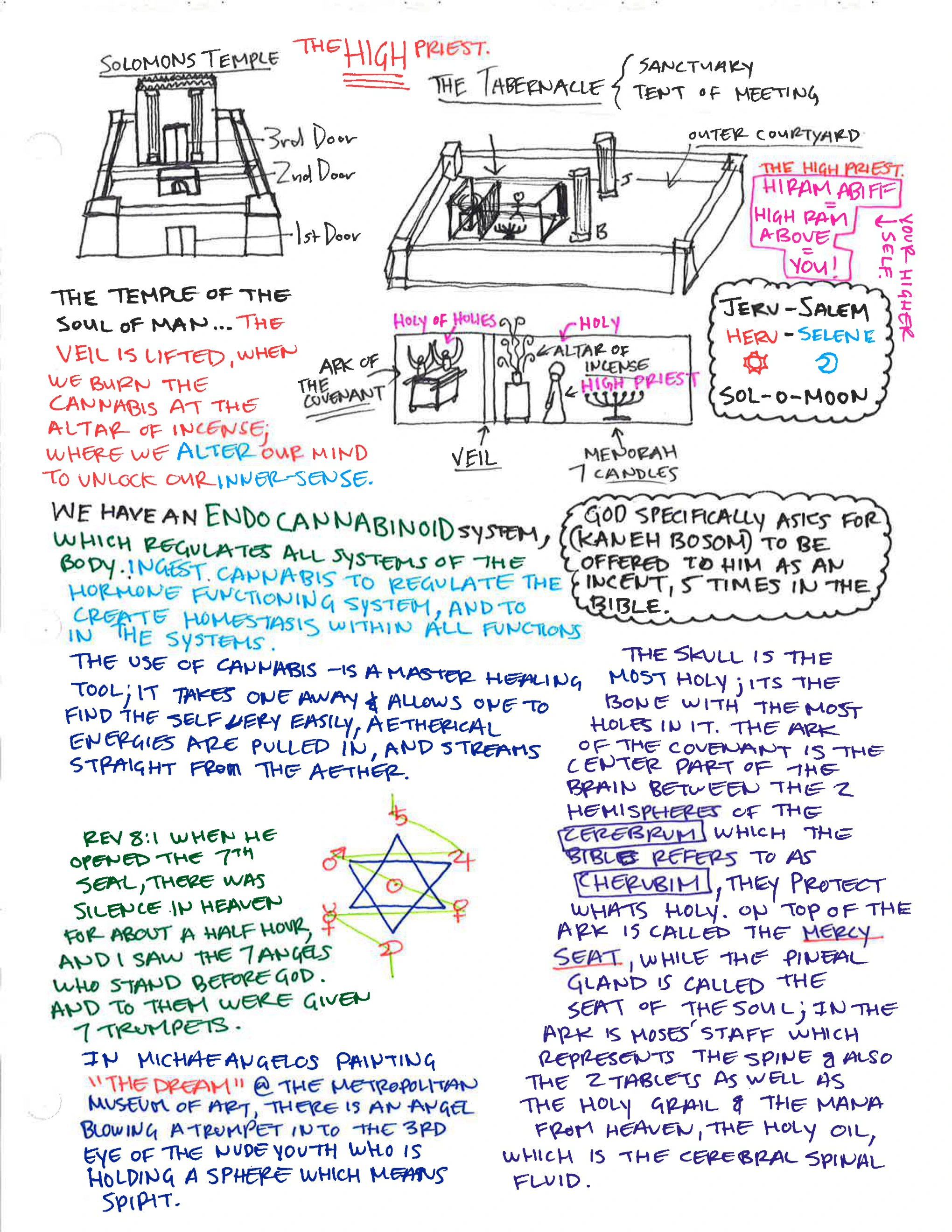
The Tabernacle as a Map of the Self
Temple and tabernacle drawings show successive thresholds, an outer court, a holy area and the Holy of Holies. The author reads the movement through these spaces as an inward progression within the human being.
The ark, lamp, veil and staff are associated with structures or processes in the head and spine. This is the page's main symbolic method: architectural enclosure becomes a metaphor for inner awareness. The human interior is the manuscript's central interpretation of the temple. Architectural parts and bodily correspondences form two connected layers. Several passages have been assembled into a symbolic map, so the result does not represent one historical building plan.
Solomon's Temple & the New Jerusalem
A temple facade, paired pillars, a chequered floor and a model of the temple complex develop the preceding page's architectural symbolism. Matter and spirit are shown as contrasting forms above the columns.
The scriptural notes discuss doors, lampstands, Boaz and Jachin, the ark and the heavenly city. Repeated twelves connect gates, tribes, foundations and apostles, while the final four creatures link back to the fixed signs used elsewhere. The manuscript's central interpretation is that the temple represents the human interior. Read the architectural image first, then follow the added correspondences. The page combines several passages into one symbolic map rather than reproducing a single historical building plan.
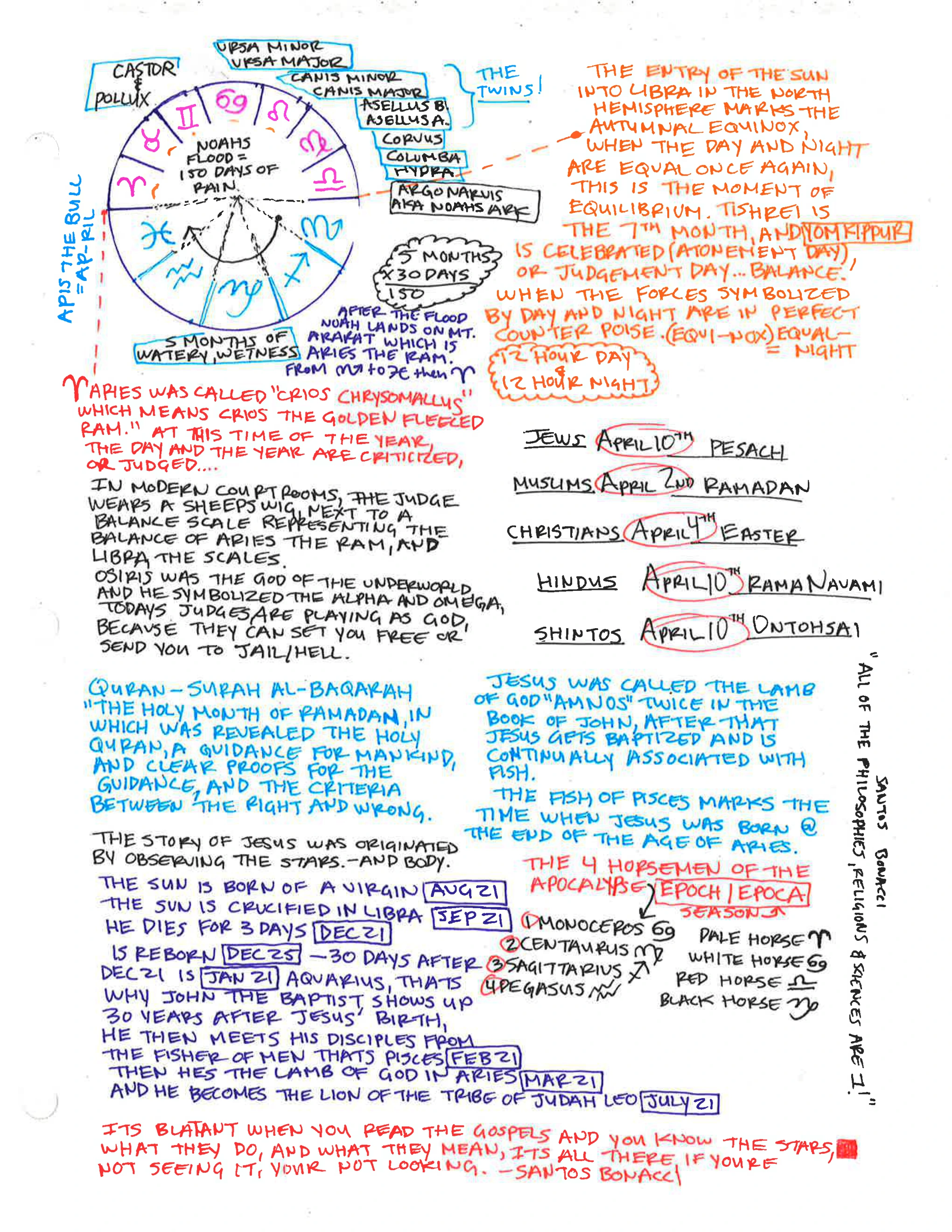
The Year as a Sacred Narrative
The wheel at upper left associates flood imagery with a sequence of zodiac signs and constellations. The surrounding text connects Aries and Libra with judgment, balance and the turning points of the year.
The author then reads the life of Jesus through a solar sequence of birth, baptism, sacrifice and renewal. A list of religious observances is used as another proposed parallel. Its dates belong to the manuscript's notes and should not be treated as a reusable calendar. Emergence, growth, decline and return organize the story as a cycle. The manuscript assigns religious events to these seasonal transitions and uses the repeating sequence as a framework for renewal.
A Zodiac Reading of Mark
The upper list assigns successive portions of Mark's Gospel to the twelve signs. Each entry identifies a scene or theme, such as sowing, feeding, anointing, entry into the temple or crucifixion.
The lower notes add constellations, solstice imagery and Jacob's sons. Together they develop the author's view that a narrative can encode a recurring celestial order. Biblical references identify passages, while the assigned signs state the author's proposed correspondences. This distinction gives the page its function as an interpretive index. Its associations depend on a figurative reading of the narrative.
Interpretive animation of the original image. The full sheet and its writing remain visible; choose Show still image to inspect the unchanged source.
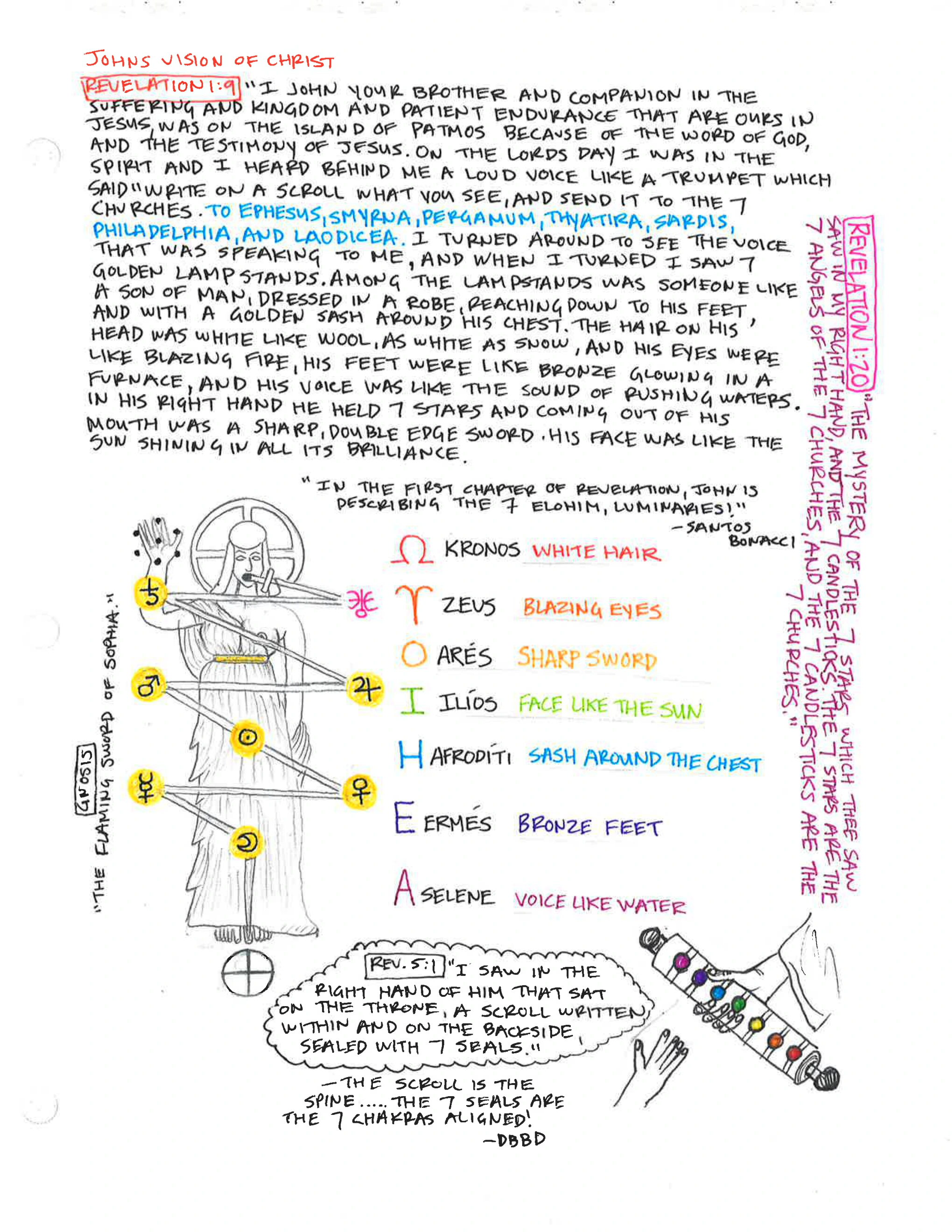
John's Vision & the Sevenfold Pattern
The upper passage describes the vision in Revelation: lampstands, white hair, fiery eyes, bronze feet, stars, a sword and a radiant face. The author then pairs those features with seven planetary figures.
Interpretive animation of the original image. The full sheet and its writing remain visible; choose Show still image to inspect the unchanged source.
The lower figure places symbols along a winding route through the body. Beside it, the named correspondences explain the proposed pairings, including Kronos with white hair and Selene with a voice like water. The sealed scroll at the bottom becomes another image of the spine and its centres. The page's organizing device is the number seven, used to connect the vision's imagery with the manuscript's bodily and planetary systems.
Eden, Nativity & the Seasonal Sky
Religious paintings are placed beside a circular constellation chart. The author relates the expulsion from Eden and the Nativity to the visibility and seasonal placement of celestial figures.
The notes identify pairs of stars, Sirius, Perseus, Virgo and other constellations, then connect them with characters and animals in the paintings. Saturn and Capricorn provide additional images of decline or constraint. The annotations connect details in the paintings with the adjacent celestial chart. These pairings make the author's astrotheological interpretation visible. They are comparisons applied to the artworks rather than evidence that each painted scene was designed as a literal star chart.
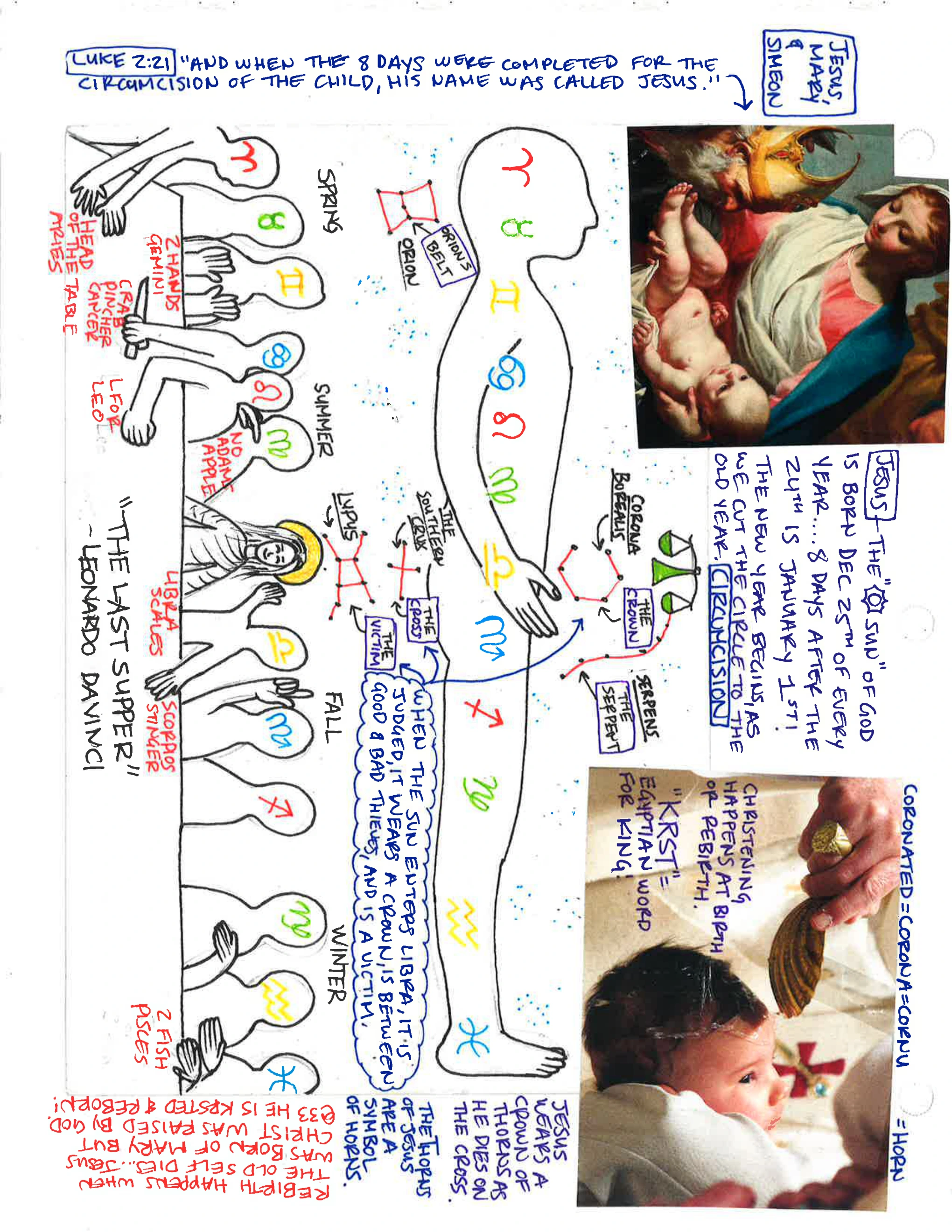
The Zodiac Body & the Last Supper
A long human outline assigns zodiac signs from head to feet. Beneath it, twelve figures are grouped by season around a central Jesus, offering the author's schematic reading of the Last Supper.
The upper images introduce naming, circumcision and anointing. The accompanying notes connect those rituals with a solar cycle and the idea of renewal. In the body diagram, Libra occupies the middle, continuing the motif of balance. The composition has three coordinated sequences: the year, the body and the group of disciples. Reading each from one end to the other reveals how the author uses a twelve-part arrangement to organize different kinds of imagery.
The Equinox, the Obelisk & the Cross
The upper horizon compares summer, equinox and winter sunrise positions. An obelisk on the central axis links that seasonal comparison to architectural symbolism.
The dome-and-shadow sketch is the author's interpretation of a relationship between monuments, conception and a later birth. Below, Revelation's woman, child and dragon imagery is set beside a crucifixion painting. The page connects balance at the equinox with transition and renewal in a sacred narrative. Distinguish the observed idea of changing seasonal direction from the symbolic meanings added to it. The artwork preserves both layers so the reader can follow the author's construction.
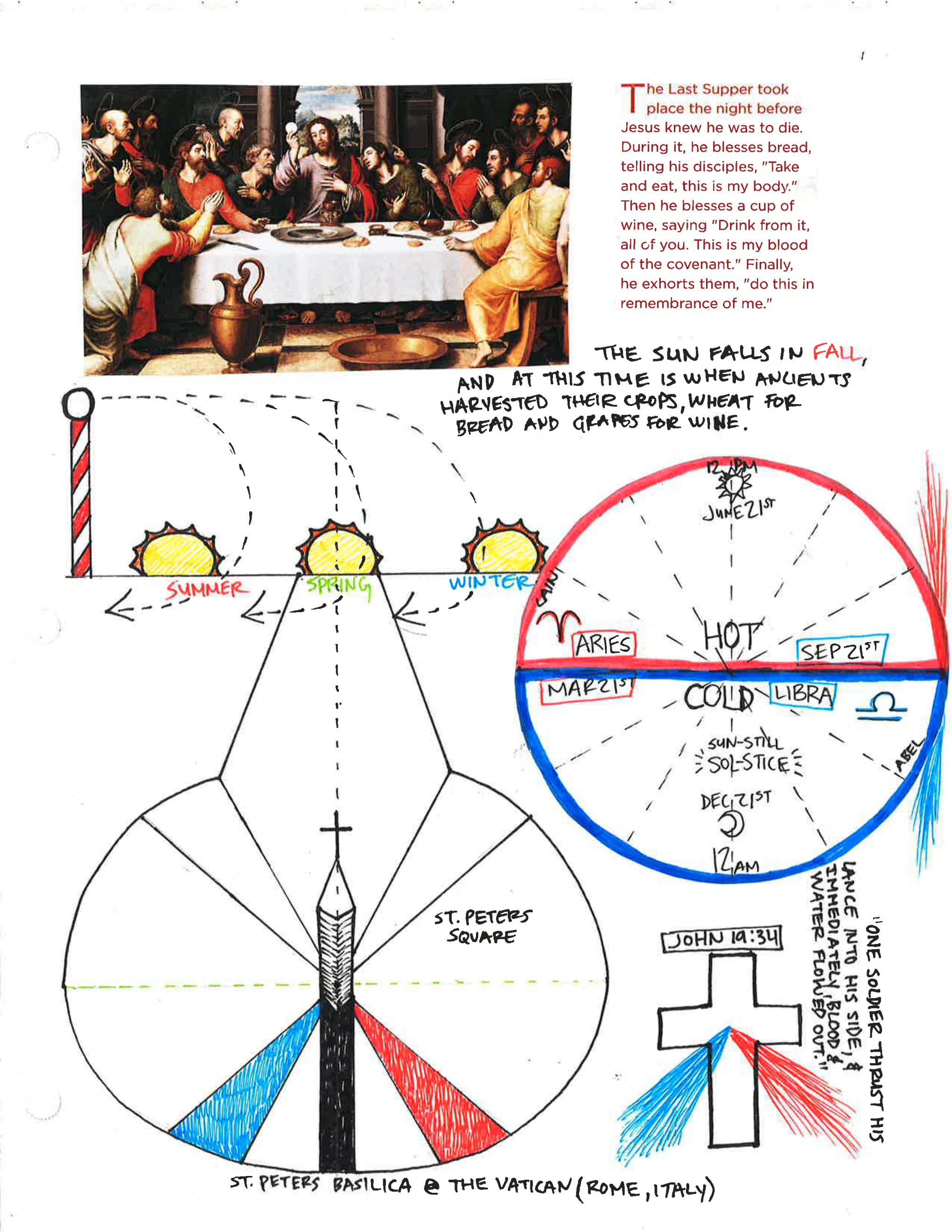
Harvest, Bread, Wine & the Solar Cycle
The Last Supper image introduces bread and wine. The author associates them with the harvest and the seasonal decline of the Sun, then develops the comparison through several diagrams.
The circular chart divides the year into hot and cold halves around the equinox line. The obelisk and St Peter's Square sketch use red and blue areas to emphasize opposed directions or phases. At lower right, the same colours appear in a drawing connected to the crucifixion passage about blood and water. The page's purpose is to link agricultural produce, seasonal change and religious ritual through a shared pattern of giving, decline and renewal.
Pluto & the Theme of Transformation
The manuscript records a sequence of dates for Pluto's movement between Capricorn and Aquarius, then interprets Pluto as a symbol of destruction, regeneration and deep change. Those dates are historical notes from the source, not an updated forecast.
The discussion distinguishes a generational interpretation from an individual one. Capricorn is connected with institutions, standards, authority and material organization; Pluto's movement is then used to frame changes in those areas. The glyph explanation and red-star list add symbolic associations to the discussion of change. The page records an astrological interpretation of transformation and obsolete patterns. Its vocabulary describes that interpretation, rather than establishing a tested prediction.
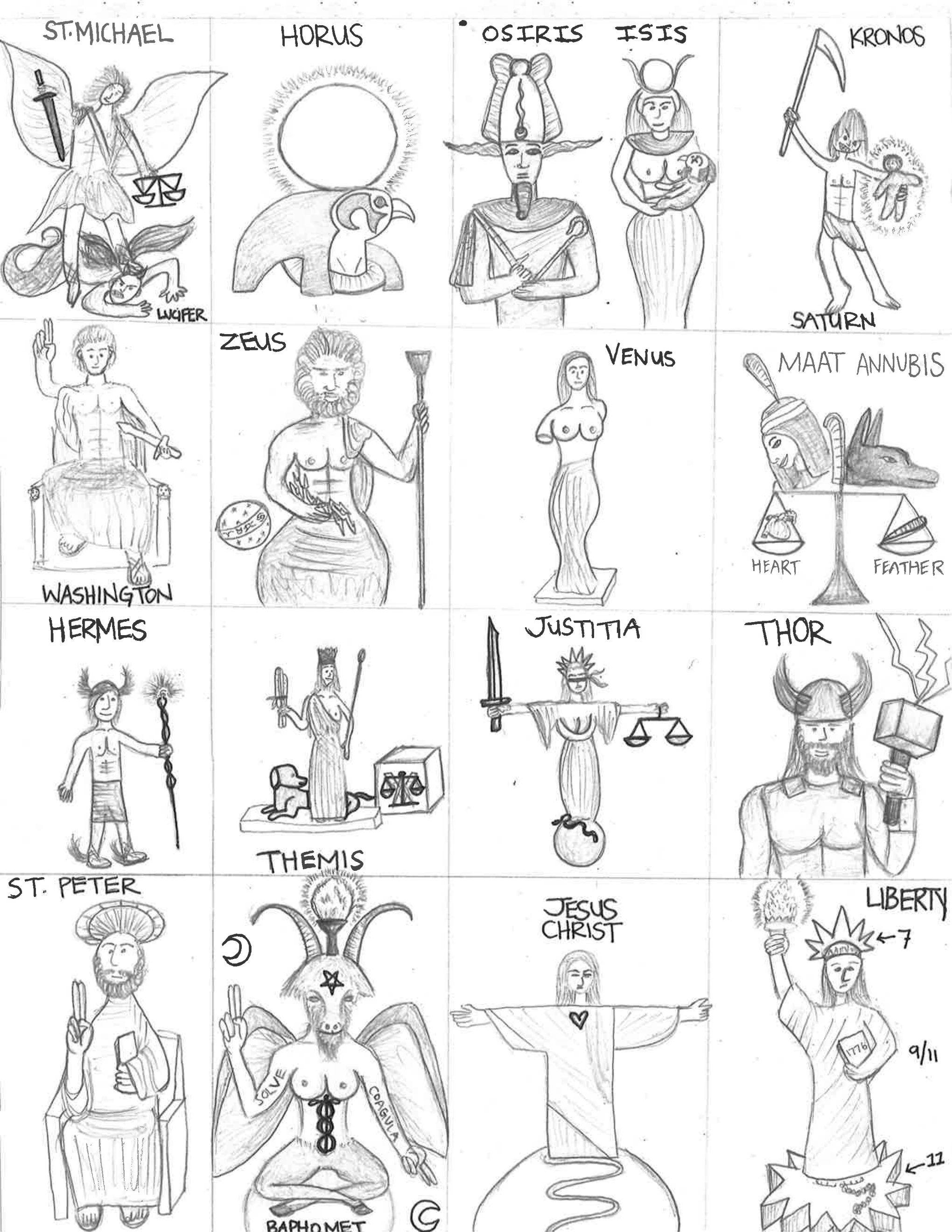
An Illustrated Catalogue of Figures
A four-column grid places religious, mythological and civic figures beside one another. Among them are Saint Michael, Horus, Osiris, Isis, Kronos, Zeus, Venus, Hermes, Thor, Jesus and Liberty.
Scales, swords, sceptres, torches, wings, keys, crowns and lightning distinguish the assembled figures. Repeated attributes give the grid its organization. The author uses those similarities to connect figures from different traditions, although the object held by a figure has to be understood within its own story as well as within the comparison. The plate is a visual reference for motifs encountered throughout the manuscript. It invites recognition and comparison of roles such as judgment, sovereignty, illumination and protection. It should be read as a catalogue of the author's drawings, not as proof that all the figures are the same deity.
Parallel Families & Opposing Figures
Rows of Egyptian, Norse, Greek, Christian and Buddhist figures organize the plate. The author places related family or narrative roles in similar positions and puts several adversarial or destructive figures along the right side.
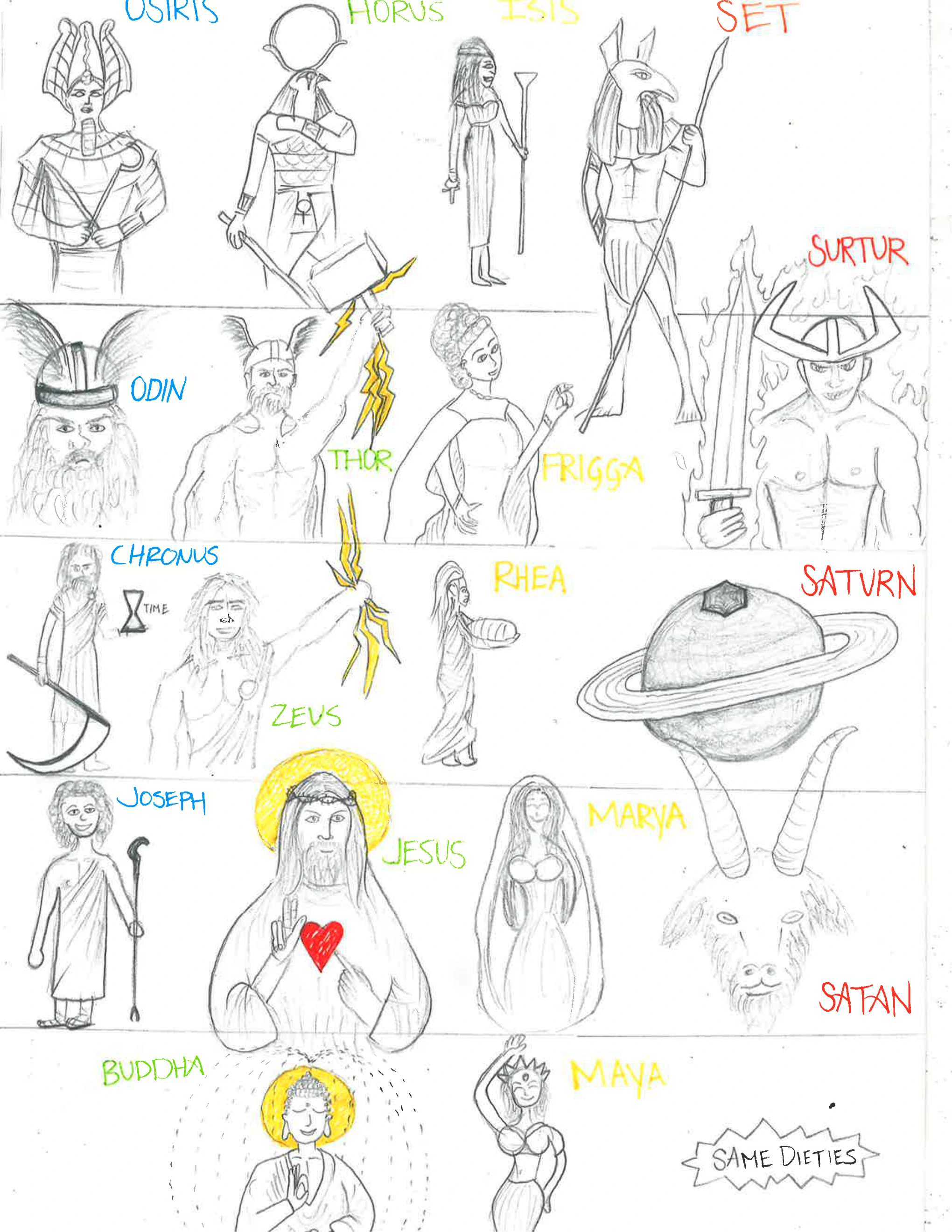
The Egyptian figures move in a desert tableau, Thor lifts his hammer, Zeus raises a lightning bolt, Surtur’s flames move and the painted Saturn rotates. These actions dramatize the attributes shown on the page. The handwritten claim “same deities” remains part of the author’s comparison, not an established historical conclusion.
Interpretive animation of the original image. The full sheet and its writing remain visible; choose Show still image to inspect the unchanged source.
Row labels identify particular groups, and the vertical alignment proposes relationships between their members. Colour separates names; recurring poses and attributes reinforce the visual comparisons. The resulting grid is the author's arrangement of the material, not a surviving historical chart shared by all the traditions represented. The note about sameness states the author's interpretive conclusion. The reading guide presents it as a comparison of mythic roles and visual patterns, retaining the individuality of the traditions rather than treating the alignment itself as historical evidence.
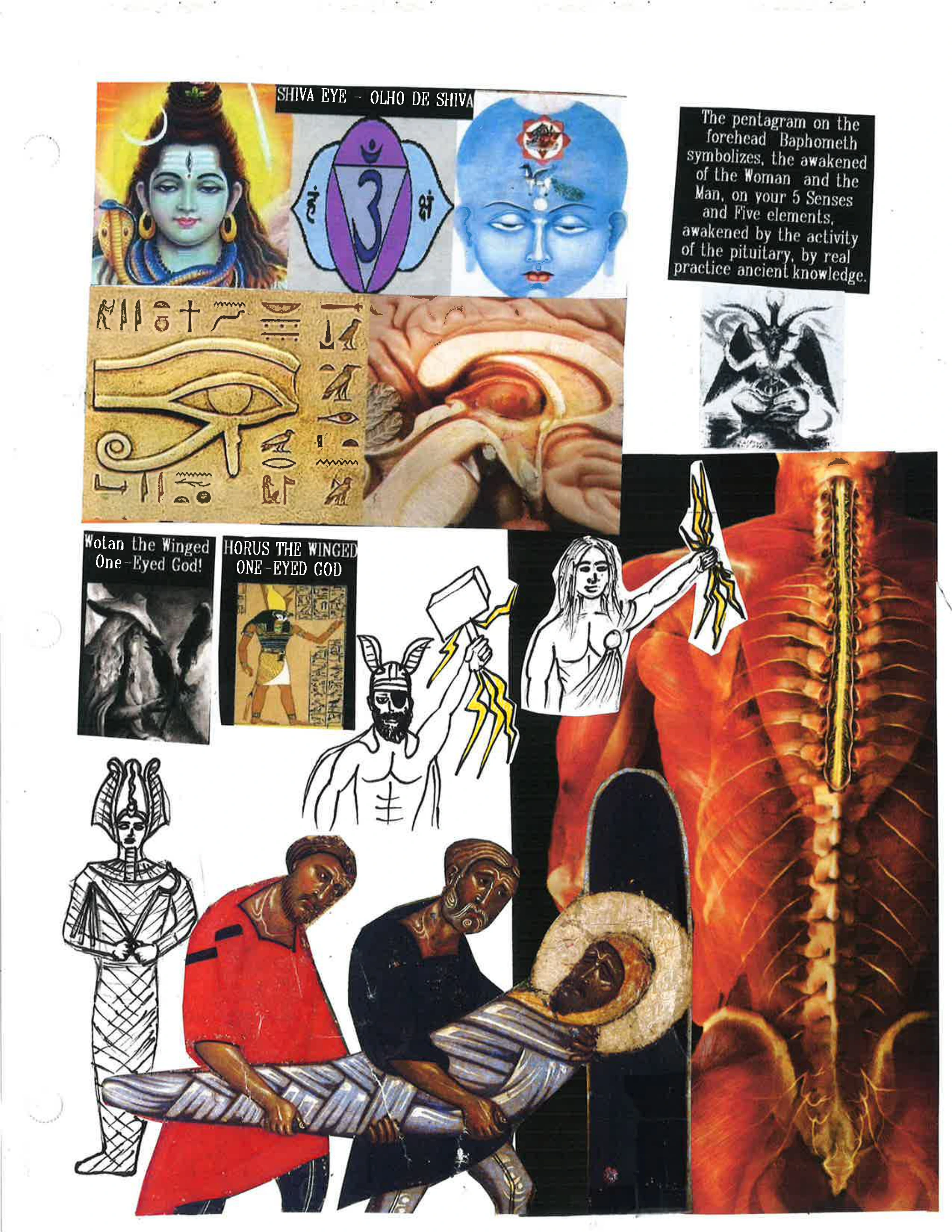
The Inner Eye & the Spinal Axis
This collage brings together Shiva's eye, the Eye of Horus, a brain section, one-eyed divine figures and an anatomical view of the spine. Lightning-bearing figures and an image of a wrapped body complete the comparison.
The upper group concentrates on sight and the centre of the head. The right side shifts attention to the long vertical structure of the body. Together they repeat the manuscript's connection between the inner eye and the spinal route. Juxtaposed shapes and identifying attributes carry the argument. The grouping expresses the manuscript's symbolic account of sight and awakening. It does not demonstrate a physiological mechanism merely by placing the anatomical and religious images together.
The Great Work in Stories & Symbols
The cross at the top combines planetary, elemental and geometrical signs. The notes connect it with Rosicrucian symbolism, atonement and the alchemical transformation of the self.
The lower pairs translate that transformation into familiar stories: caterpillar and butterfly, Pinocchio and a real body, grey and white Gandalf, lead and gold. Arrows turn each pair into a before-and-after sequence. A final pyramid gathers body, mind and soul into an ascending structure. The philosopher's stone becomes a metaphor for the transformed person. Popular-culture examples illustrate that metaphor without serving as historical sources for alchemy.
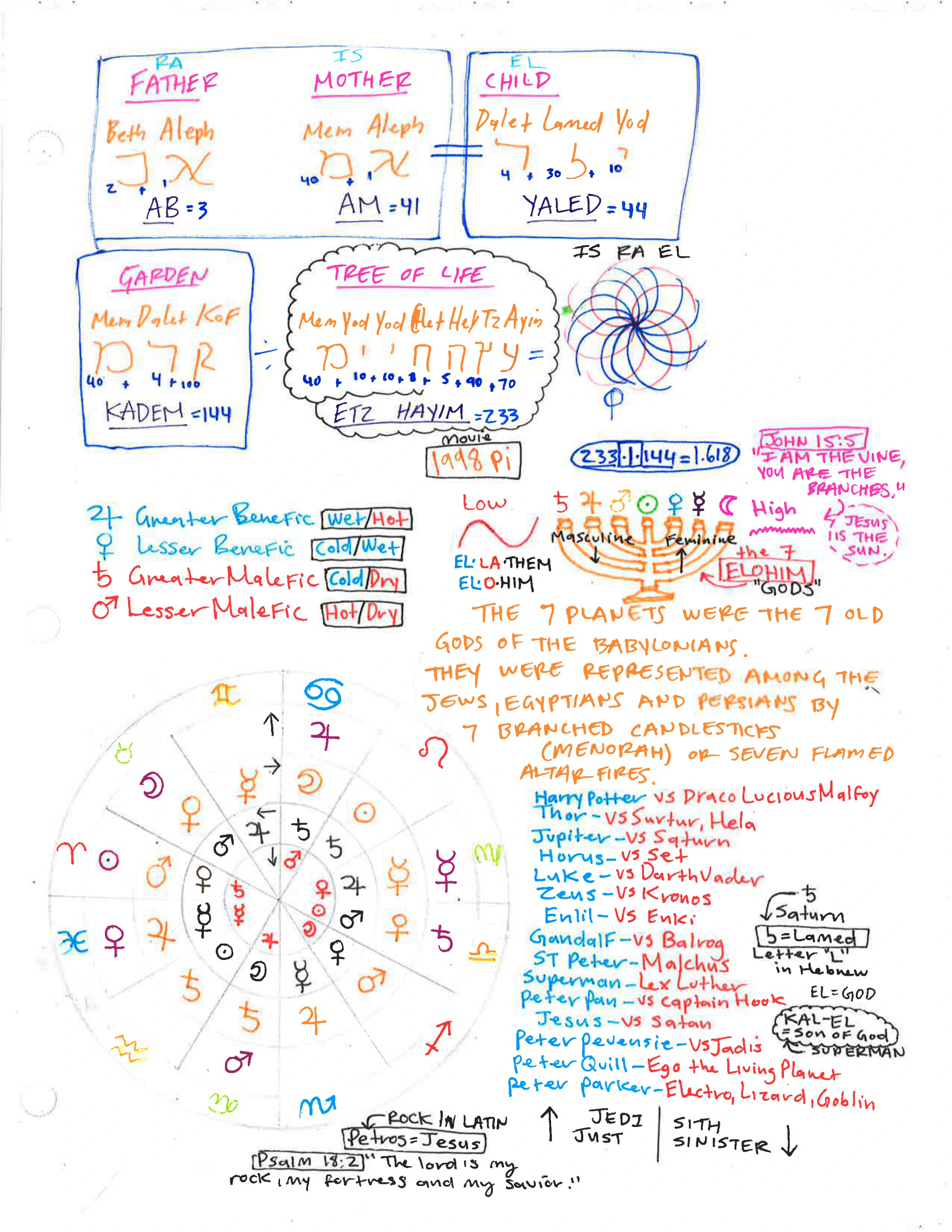
Letters, Numbers & Repeated Story Roles
The upper boxes assign numerical values to selected Hebrew letter sequences associated with father, mother, child, garden and Tree of Life. The manuscript uses their totals to form further numerical comparisons.
The planetary wheel and menorah add a seven-part structure. A list of heroes and adversaries then extends the familiar opposition pattern into mythology, religion and popular fiction. These are three kinds of association: letter-number calculation, planetary symbolism and narrative comparison. Keeping them separate while reading makes the page clearer. Their combination expresses the author's belief in recurring patterns, without making the numerology a linguistic or historical proof.
The Heart as a Circulating Pattern
Several simplified heart drawings use arrows to emphasize return and outward flow. Alongside them, toroidal sketches organize circulation around an axis and central plane.
The author compares this circulation with magnetic and dielectric motion and with paired masculine and feminine qualities. The red and blue routes are visual guides to the proposed relationship, rather than interchangeable labels for every vessel. The meeting and exchange of the two loops gives the circulation its visible structure. A lower paragraph extends the torus across scales and associates human resonance with the Earth. That larger interpretation grows from the author's use of the loop as a recurring model.
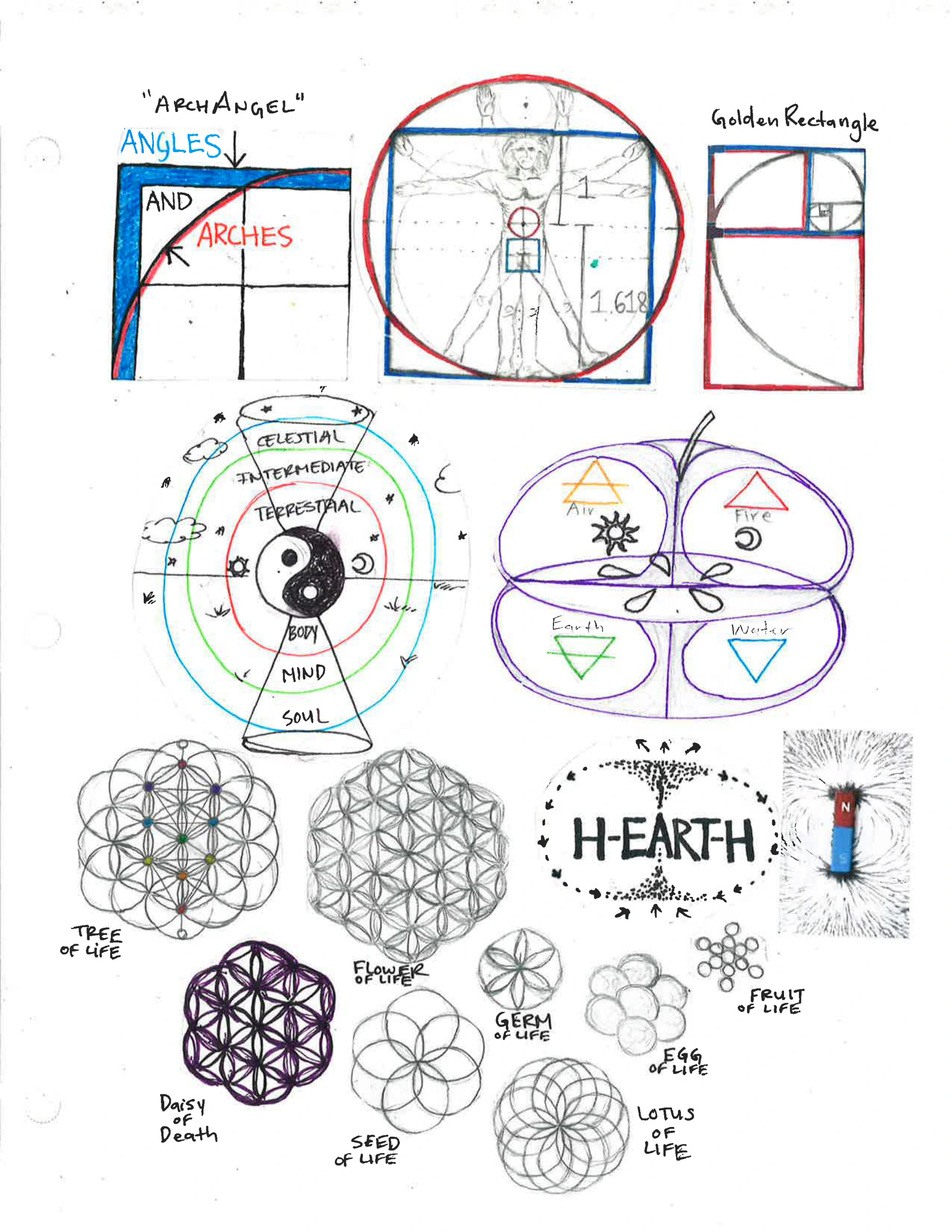
A Catalogue of Sacred Geometry
The upper row compares an arch, an angle, the human figure within circle and square, and a golden rectangle. These forms establish the page's contrast between curved and straight structures.
The middle drawings pair body, mind and soul with terrestrial, intermediate and celestial levels. A divided toroidal form assigns the four elements to its regions. A magnet image supplies another visual comparison of a centre and surrounding pattern. The lower group names seed, flower, fruit, germ, egg and lotus forms. Read these as a vocabulary sheet for the repeated circular constructions in the manuscript. Their names distinguish related diagrams built from overlapping circles.
Paired Forms & Central Openings
This plate places hearts, bowls, toroidal forms, an apple section, a spider marking, a cube and bodily outlines into a chain of visual comparisons. A central opening or paired curvature recurs across the images.
The hourglass-like outline recurs in paired bowls, an apple section and a torus. A cube introduces straight edges within a curved surrounding field. The page is organized through these repeated shapes: the author is drawing a visual analogy between objects whose materials, functions and origins otherwise differ. The seed, flower, fruit, germ, egg and lotus names distinguish related constructions made from overlapping circles. This vocabulary gives the manuscript's recurring circular patterns individual identities within a shared geometric family.
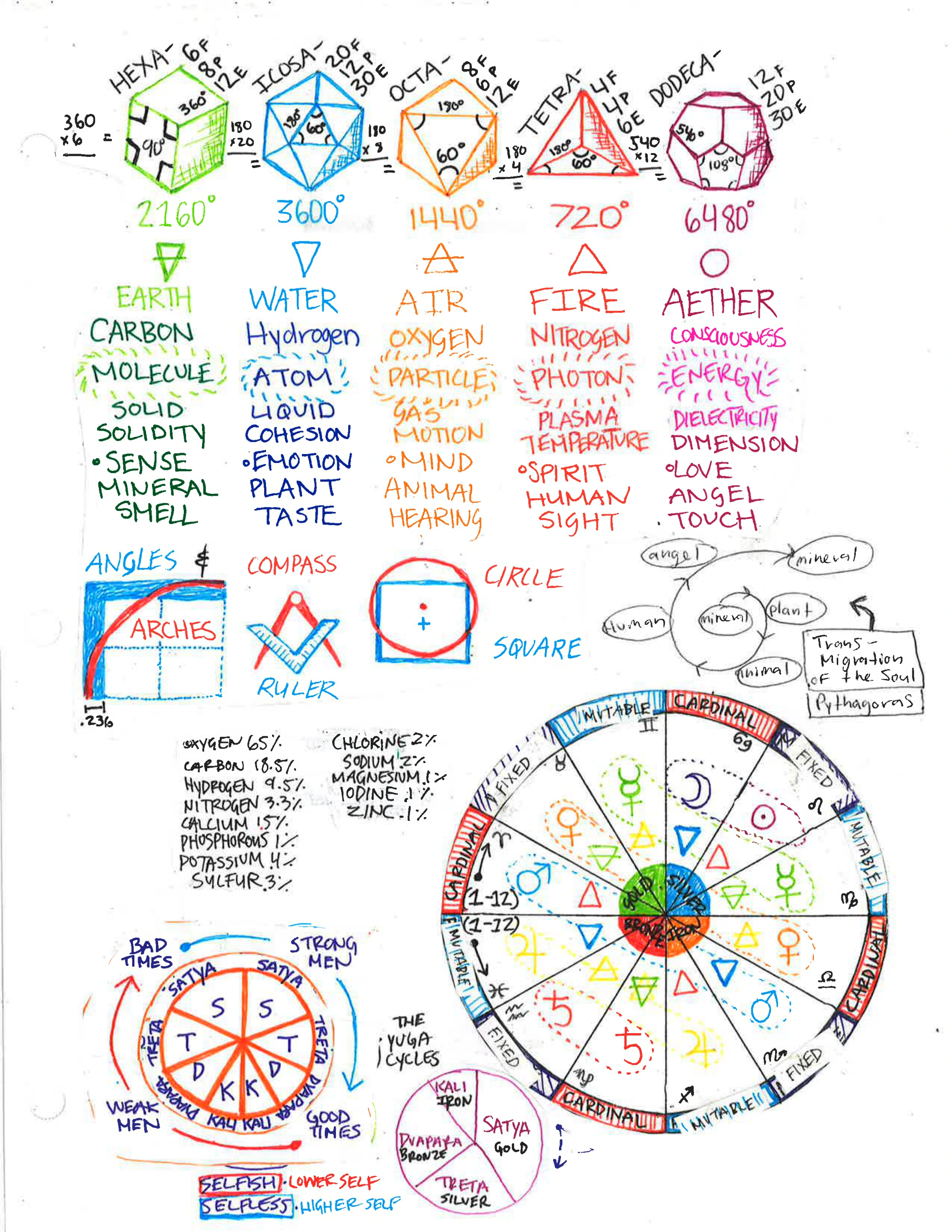
Five Solids, Elements & Cycles
Five polyhedra form the upper row: cube, icosahedron, octahedron, tetrahedron and dodecahedron. Their faces, vertices, edges and angle calculations accompany a set of elemental correspondences.
The columns beneath connect each solid with categories such as matter, sensation, life forms and qualities. These assignments belong to the manuscript's symbolic chart. The lower zodiac wheel organizes another set of elements and modalities into twelve sectors. Yuga diagrams add cyclical time to the classifications of form and quality. Geometric solids, correspondence columns and cycles are arranged as three related ways to organize the material through recurring structures.
The Four Elements & the Centre
The upper wheel places fire, water, air and earth around a centre labelled plasma. The lower drawings repeat this arrangement in a volcano, stepped pyramid and square plan.
The central point or apex receives the emphasis in each version. Water, earth and ascending light are arranged as paths or regions around it. The manuscript's word division of pyramid reinforces its theme of fire in the middle. This plate is a visual synthesis of the author's elemental model. The triangle, square, wheel and volcano are different ways of framing a centre. Their juxtaposition explains the intended symbolism without making them equivalent physical systems.
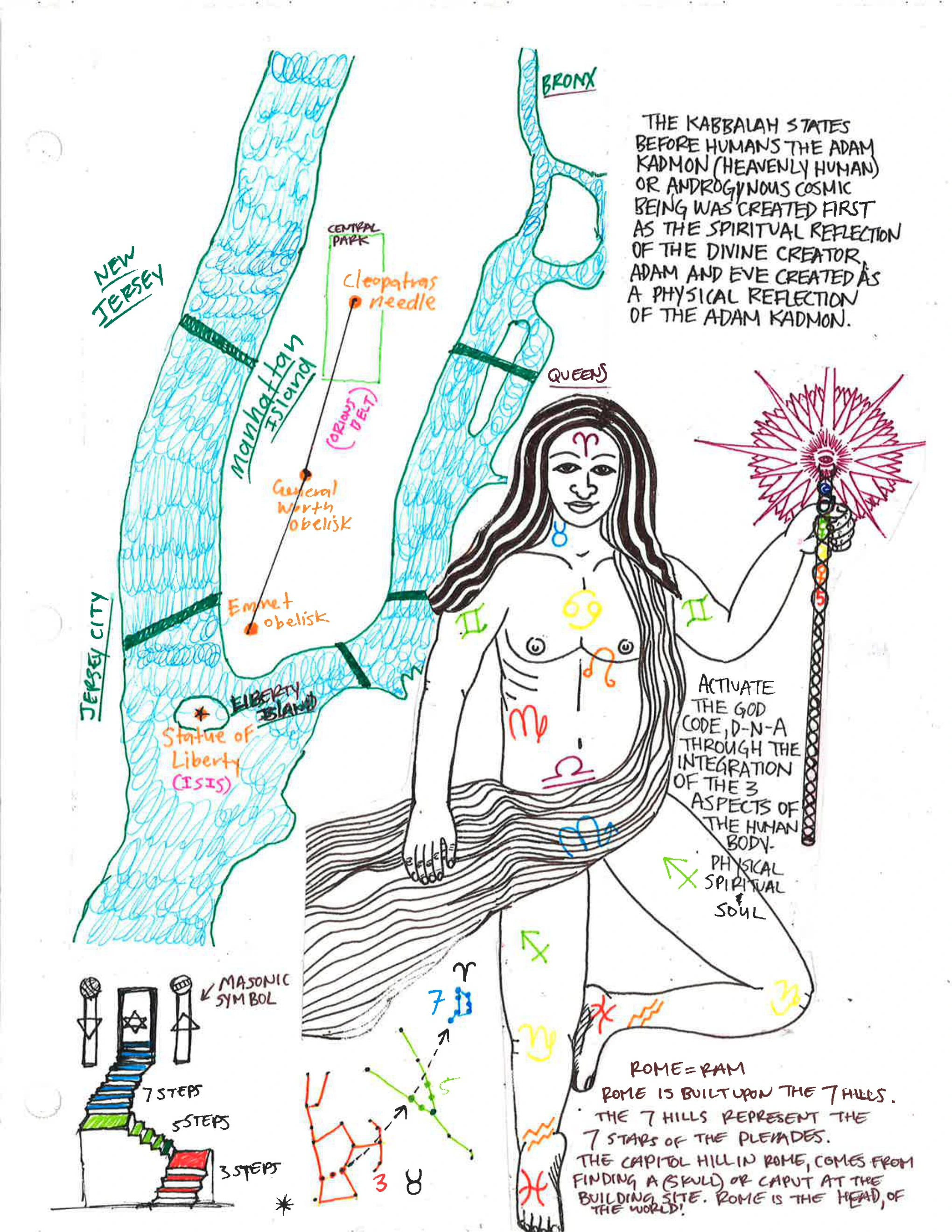
The Zodiac Human & the City
A sketch of Manhattan and its surroundings identifies Central Park, several obelisks and the Statue of Liberty. Beside it, a large human figure distributes zodiac signs along the body.
The text returns to Adam Kadmon and the integration of physical, spiritual and soul aspects. The staff held by the figure, the obelisks and the stepped path all provide vertical images of ascent. The city landmarks are compared with a symbolic human form. Geographic labels identify the locations, while the added correspondences express the author's interpretation. The stair diagram and constellation sketches extend this comparison through number and progression.
The Zodiac Year in Pictures
The twelve signs are drawn as recognizable figures around a brightly coloured wheel. Seasonal groups organize the outer ring: spring, summer, autumn and winter.
The figures proceed around the wheel from Aries, accompanied by signs and months. Planetary symbols and numbers occupy the inner sectors. A smaller wheel reduces the year to seasonal turning points, making the relation between the detailed cycle and its four main divisions visible. The cerebrospinal-fluid images at the bottom connect the annual cycle to the manuscript's recurring inner-body theme. The plate's primary function is a visual index: it gives the reader a memorable picture for each sign and its position within the author's seasonal scheme.
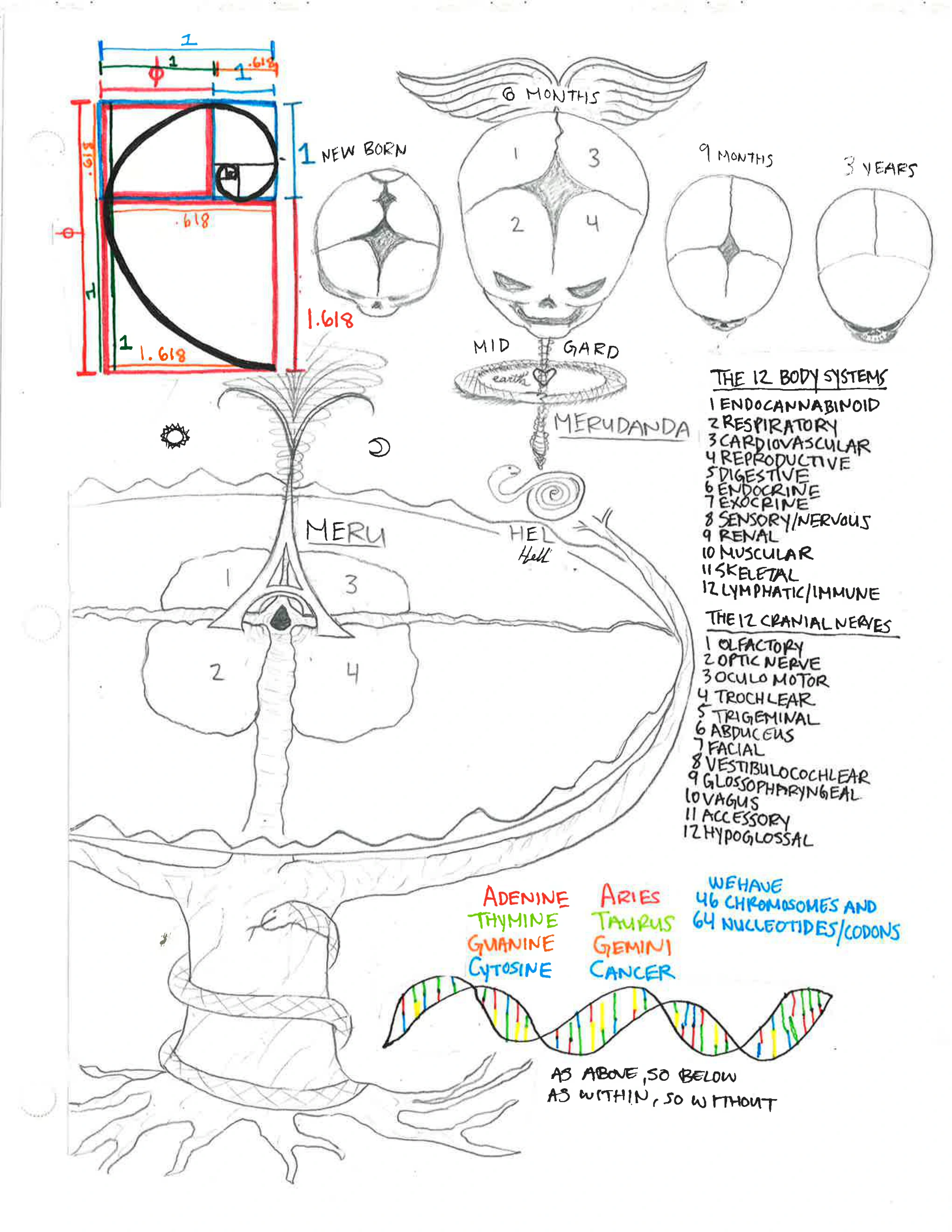
Proportion, Development & the Nervous System
The golden rectangle sits beside drawings of the skull at several early stages. Below, a stylized spinal axis links the head with tree and world-centre imagery.
Two lists name the manuscript's body-system categories and the twelve cranial nerves. A DNA drawing then pairs the four bases with four zodiac signs. These elements combine anatomical reference, proportion and symbolic correspondence. Anatomical lists locate structures, while zodiac pairings add the author's symbolic interpretation. Branching, paired strands and a central axis connect the body's pictured organization with the larger patterns repeated throughout the manuscript.
Transformation in Popular Culture
Goku and Sonic appear beside their golden transformed versions. Seven Dragon Balls and seven Chaos Emeralds supply another repetition of the seven-part pattern familiar from the manuscript's centres and luminaries.
The author reads the change from ordinary to empowered form through the alchemical language of silver and gold, lunar and solar consciousness. The fictional images make that abstract transformation immediately recognizable. The lower notes return to dielectricity, magnetism, rest, motion and synchronized energy. The claims about bodily fluids belong to the manuscript's esoteric interpretation. The page's clearest explanatory role is to show how the author sees an old transformation motif repeated in modern stories.
Units and terms
DNA Deoxyribonucleic acid, the molecule that carries genetic information; the label appears in the supplied collage
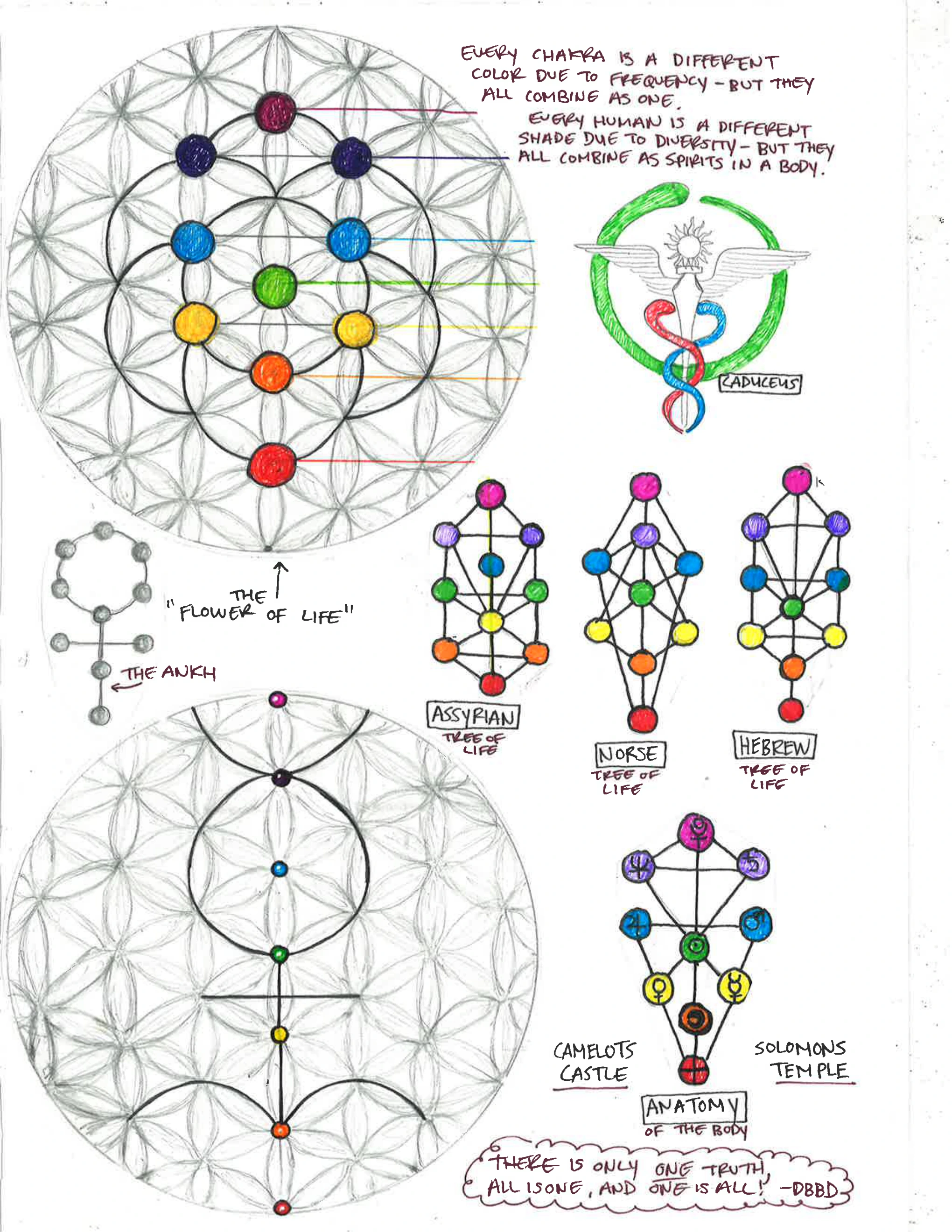
Many Trees, One Organizing Pattern
A Tree of Life structure is overlaid on a large flower-of-life construction. Smaller diagrams labelled Assyrian, Norse and Hebrew present related arrangements, while another is associated with the body.
The large Tree of Life is drawn over a flower-of-life lattice, so two structures occupy the same space: overlapping circles provide the background, while coloured nodes and straight links define the tree. A vertical line holds the middle of the composition and paired side nodes create its lateral balance. Smaller versions labelled Assyrian, Norse and Hebrew repeat selected colours and positions. The diagram associated with anatomy transfers that arrangement to a human outline. These repetitions are the author's method of comparison; the labels alone do not establish that the traditions used an identical diagram or shared a single historical origin. The caduceus gives the same theme another form: paired winding lines surround a central staff. Across the page, the author emphasizes unity through variation. A circle lattice, a branching tree and a bodily emblem can share selected compositional features while retaining different histories and meanings.
Mount Meru & the Layered Cosmos
The large circular image places Mount Meru at a centre surrounded by named regions and seas. Other images add a Babylonian cosmological structure, Yggdrasil, a skull, a spinal staff and Tesla's tower.
The main diagram builds outward from a centre through successive zones. Nearby stepped and layered structures repeat the relationship between central height and surrounding levels. Their arrangement gives the author's cosmological comparison a visible order, with the centre serving as a point of connection between the different forms. The page combines cosmological traditions with bodily and technological imagery. Its purpose is comparative: it develops the manuscript's centre, axis and enclosure motif across different subjects. The original labels remain intact so each source image can still be read in its own terms.
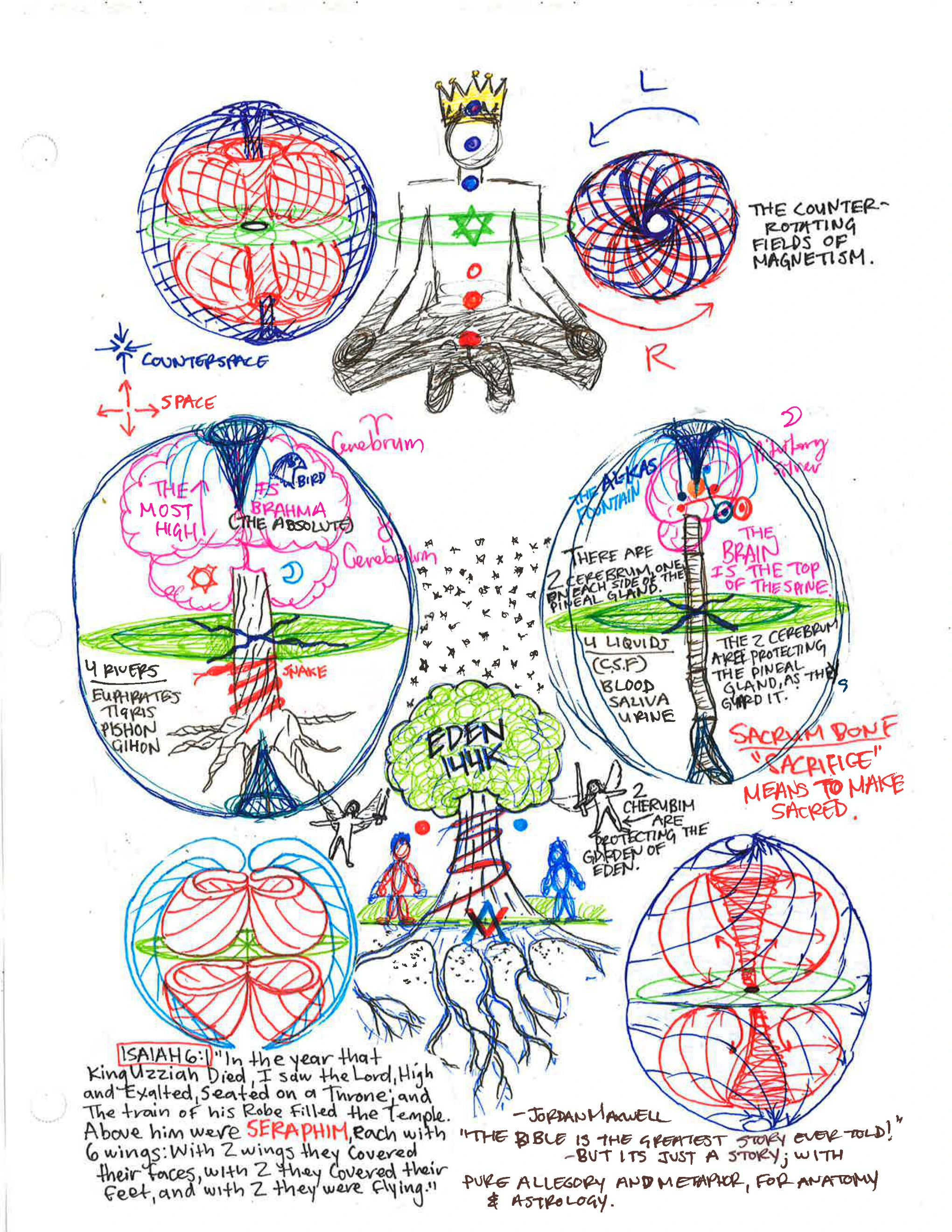
Interpretive animation of the original image. The full sheet and its writing remain visible; choose Show still image to inspect the unchanged source.
Eden as an Inner Landscape
Trees, roots, serpents and toroidal fields surround a seated figure. The larger circular drawings map the brain and spine onto a garden-like inner landscape.
Interpretive animation of the original image. The full sheet and its writing remain visible; choose Show still image to inspect the unchanged source.
The four rivers named in one drawing are compared with bodily fluids in another. Cherubim and the protected centre connect the Garden of Eden narrative with the manuscript's interpretation of structures in the head. The trunk or spine runs from the lower roots to the crown, giving the repeated composition its direction. The accompanying quotation interprets biblical material through anatomy and astrology. That allegorical approach explains the associations made on the page.
The Dome & Paired Field Paths
The upper image combines a domed enclosure, concentric ground paths and a central bird-and-sun emblem. Directions are arranged around a central north in the manuscript's cosmological model.
The lower drawing makes the proposed flows more explicit: red paths are labelled magnetic and blue paths dielectric. Both curve around the central opening and plane. Trace one colour at a time before comparing them. This avoids the visual confusion of the overlapping curves. The plate illustrates the author's model of complementary circulation around a world axis; it is preserved as a conceptual drawing rather than a surveyed map.
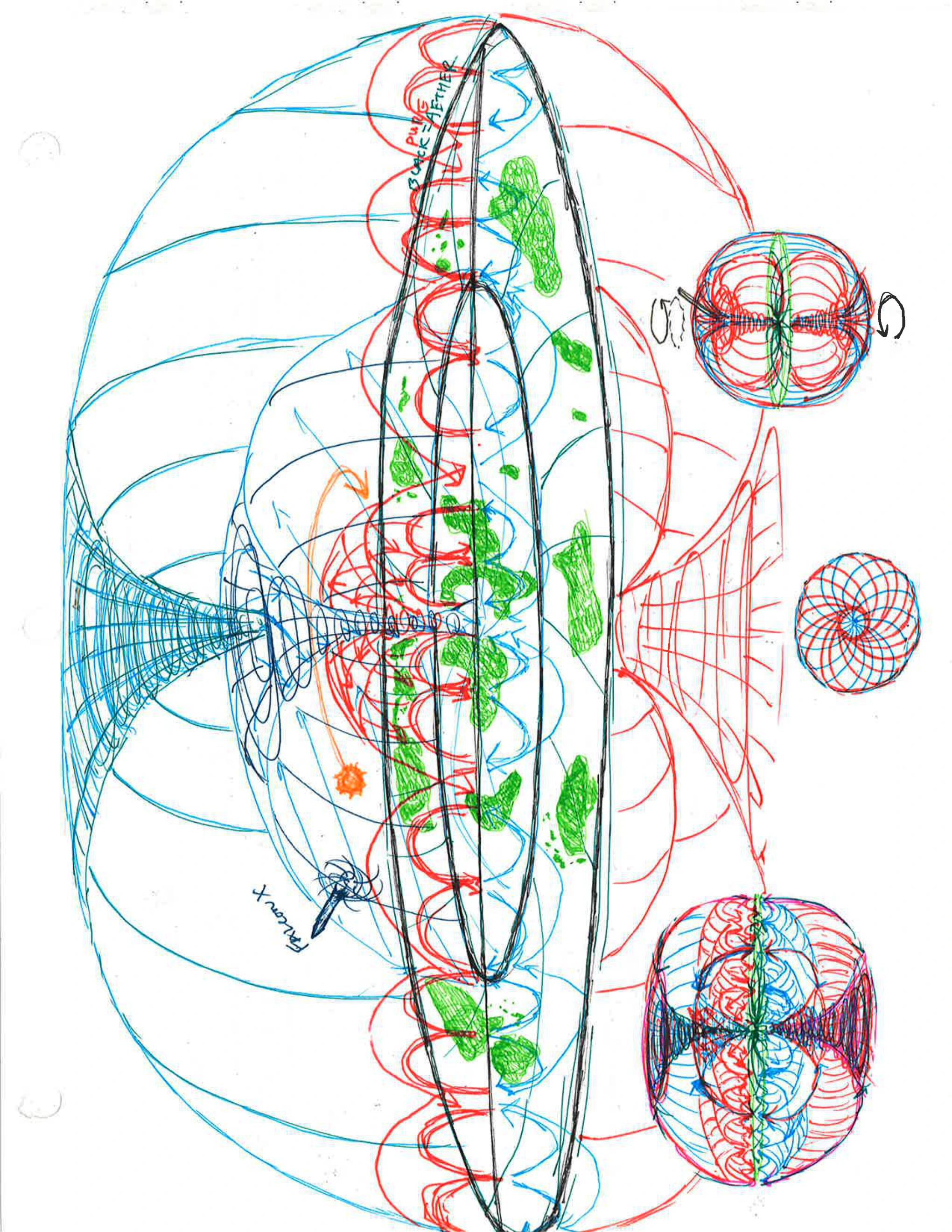
A Cross-Section of the Toroidal World
The large sideways plate shows a broad plane with land-like forms surrounded by red and blue circulating paths. Funnels above and below the centre establish the main axis.
The smaller diagrams along the side isolate the full volume, a rotational view and a more complex nested form. They act as keys to the large drawing by showing the same pattern from different viewpoints. Smaller loops repeat along the central plane within a larger enclosing circulation. The opening and surrounding forms express a nested structure: local patterns are shown as parts of one proposed global arrangement.
The World as an Open Eye
The author places an eye-like dome over a land surface and surrounds it with eyelash-like forms. The labels cornea and iris turn the landscape into an enlarged bodily analogy.
A separate upper disc carries zodiac symbols and rotation arrows. The light source and the smaller Sun-like form introduce a path from illumination above to the centre below. This is a symbolic comparison between seeing and the cosmos. The wordplay connecting islands with eye-lands signals how the author builds the association. The edition keeps that analogy visible while distinguishing it from a literal model of the eye or the Earth's structure.
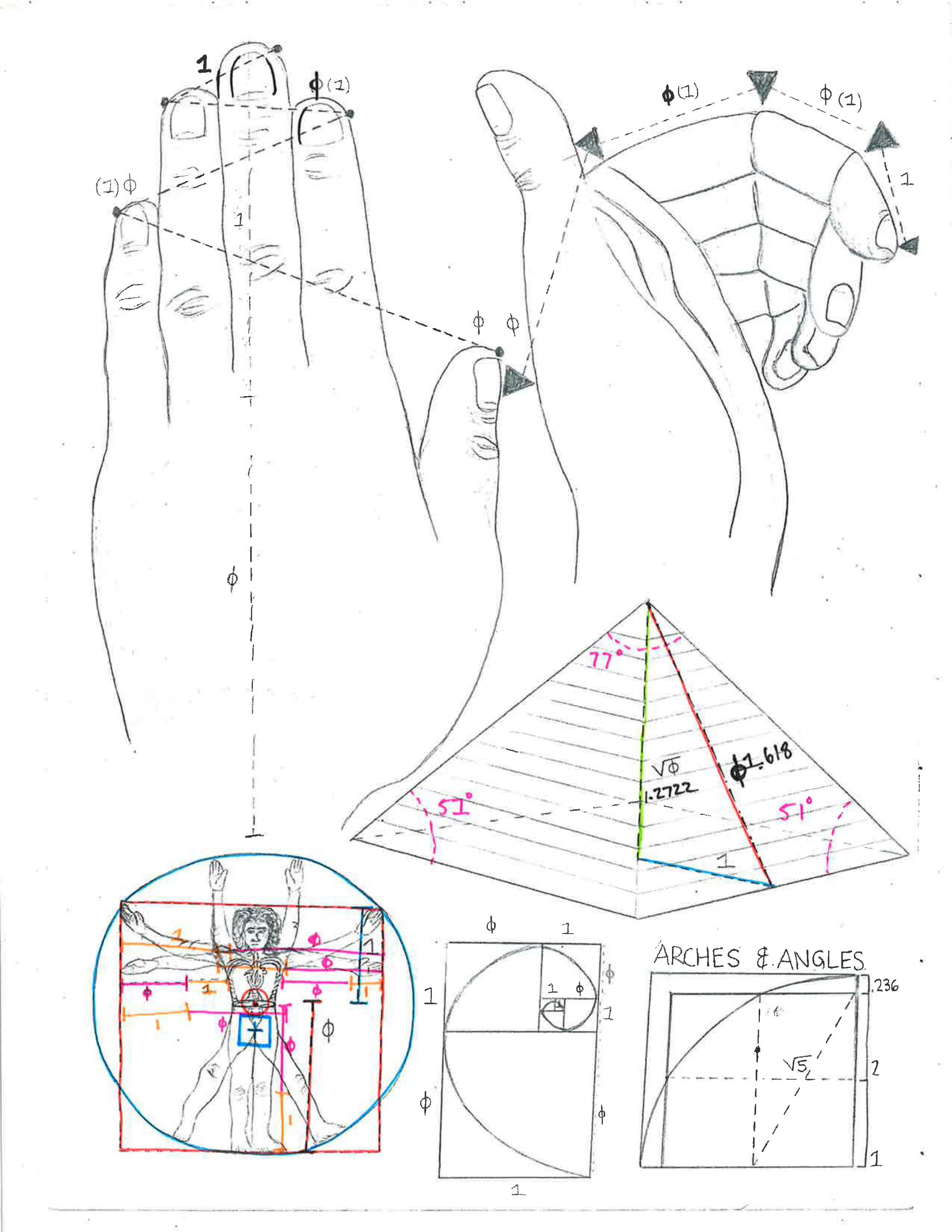
The Hand, the Human Figure & Proportion
The hand drawings mark selected lengths with 1 and phi, comparing finger segments through the golden ratio. The pyramid and human figure extend that proportional theme to larger constructions.
The lower diagrams show a golden rectangle and a rectangle-based geometric construction. They provide a more abstract version of the relationships sketched on the body. Measurement marks give the proposed proportional correspondences explicit positions. The plate compares natural form, human form and geometry through those choices. It does not include a measurement study showing that every pictured body or building follows an identical ratio.
The Lower Centre & the Path of Awareness
The pelvis and sacrum dominate the upper-left drawing. A small Tree of Life diagram beside them contrasts the upper and lower stations through the author's language of consciousness and embodiment.
Two wave-like sketches are labelled fear and love. The manuscript assigns them different frequencies and makes claims about DNA activation. These belong to its spiritual model; the drawing is not a biological measurement or a treatment method. The lower symbols add Odin, a pillar-like form and Anu. Together they return to the central axis and the movement from a limited state toward a more integrated one. The page is best read as a symbolic map of that movement.
Units and terms
DNA Deoxyribonucleic acid, the molecule that carries genetic information; the label appears in the supplied collage
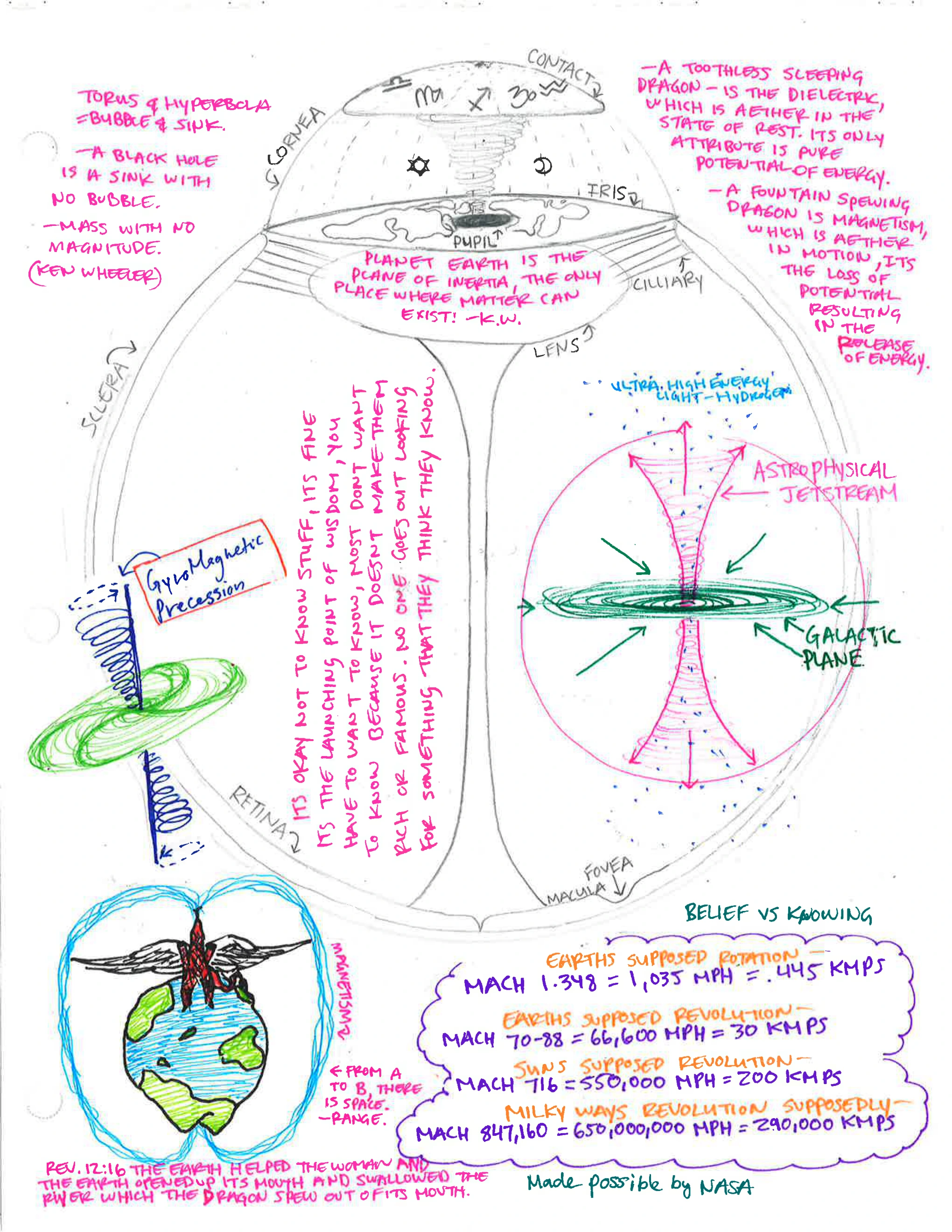
The Eye, the Vortex & the Galactic Plane
The large eye-like enclosure places a world plane at the pupil and a central passage through the surrounding volume. A smaller drawing compares an equatorial galactic plane with two opposing funnels.
The manuscript contrasts a resting source with energy in motion using sleeping-dragon and fountain imagery. The diagrams of precession and paired flows add direction to that comparison. The eye-and-vortex analogy links the separate drawings through a central plane. The lower notes extend that argument into a dispute with conventional accounts of terrestrial and cosmic motion. Those notes state the author's reasoning rather than supplying a new set of observations.
The Cosmic Human & Four Worlds
A standing figure spans four labelled levels: archetypal, spiritual, psychological and physical. Rings around the body turn those levels into a cosmic arrangement, while the feet rest above a landscape of four rivers.
The lower lists distinguish body, spirit and soul through senses, awareness and inner qualities. Planetary periods add a temporal scale beside the vertical structure. The figure bridges successive levels of existence. An upward sequence describes ascent; a downward sequence describes manifestation. The spiritual passage presents these as aspects of a whole person, joined by the central axis.
Units and terms
DNA Deoxyribonucleic acid, the molecule that carries genetic information; the label appears in the supplied collage
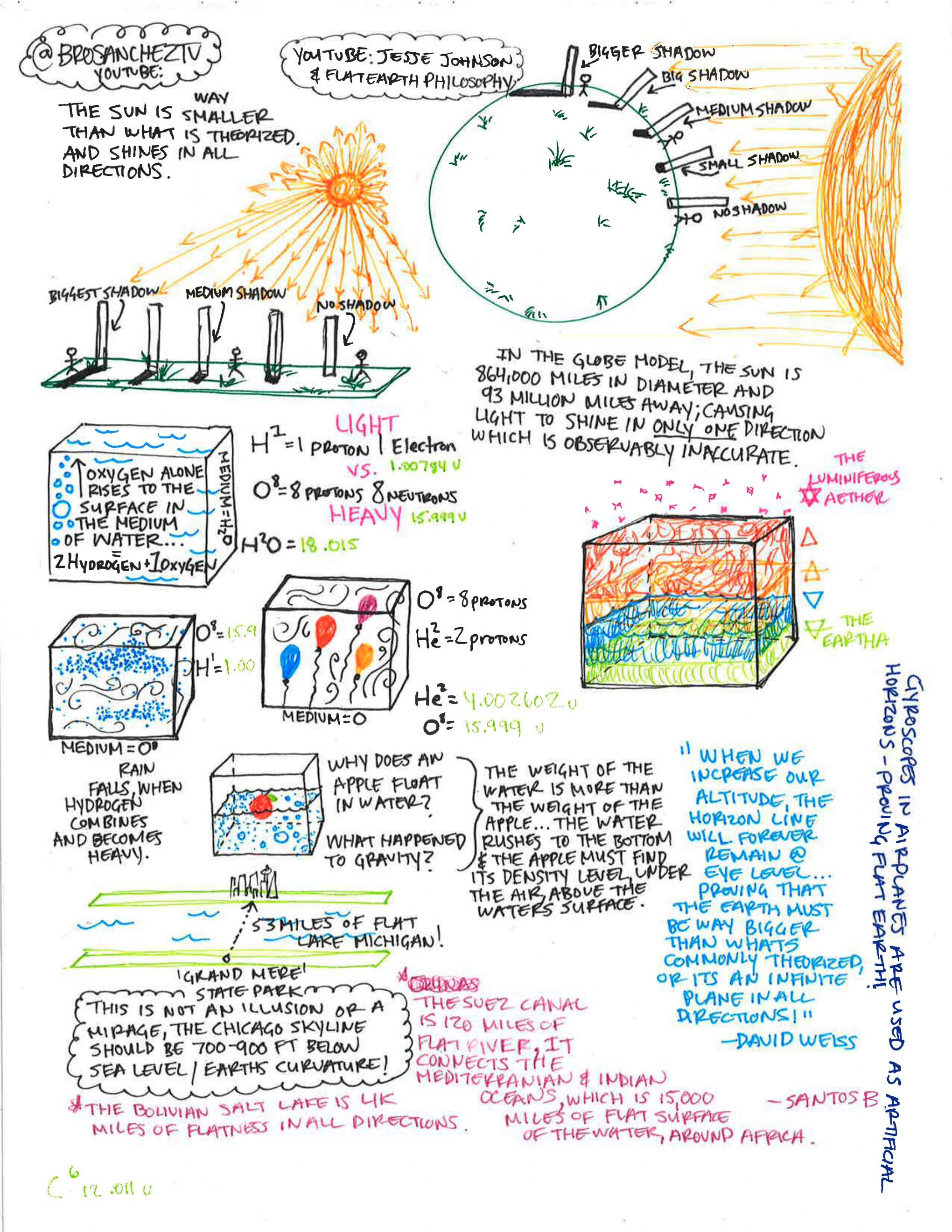
Light, Shadows & the Author's Earth Model
Two diagrams compare shadows under a nearby light above a plane with shadows on a curved surface. The page uses that comparison to argue for the author's alternative model of the Earth and Sun.
Other sketches discuss density, floating objects, gases and water. These are brought into the argument as examples of how a surrounding medium affects the position or behaviour of an object. Horizon and long-distance visibility notes extend the argument about a surrounding medium. The illustrated setups and the conclusions drawn from them are separate parts of the source's reasoning. The page records that reasoning without providing a demonstration that establishes the proposed world model.
The Tokamak & Magnetic Confinement
This page describes a tokamak as a toroidal chamber in which magnetic fields confine a hot plasma. It introduces the challenge of keeping the plasma away from the chamber walls and names several fusion projects.
The central explanatory sequence is fuel, heating, plasma and confinement. The surrounding notes then connect fusion with the manuscript's wider interest in energy, the torus and magnetic organization. Project status, dates and output figures are preserved as historical manuscript notes; they are not updated specifications. The page's place in the book is to introduce a technological use of toroidal geometry alongside the symbolic and cosmological uses explored elsewhere.
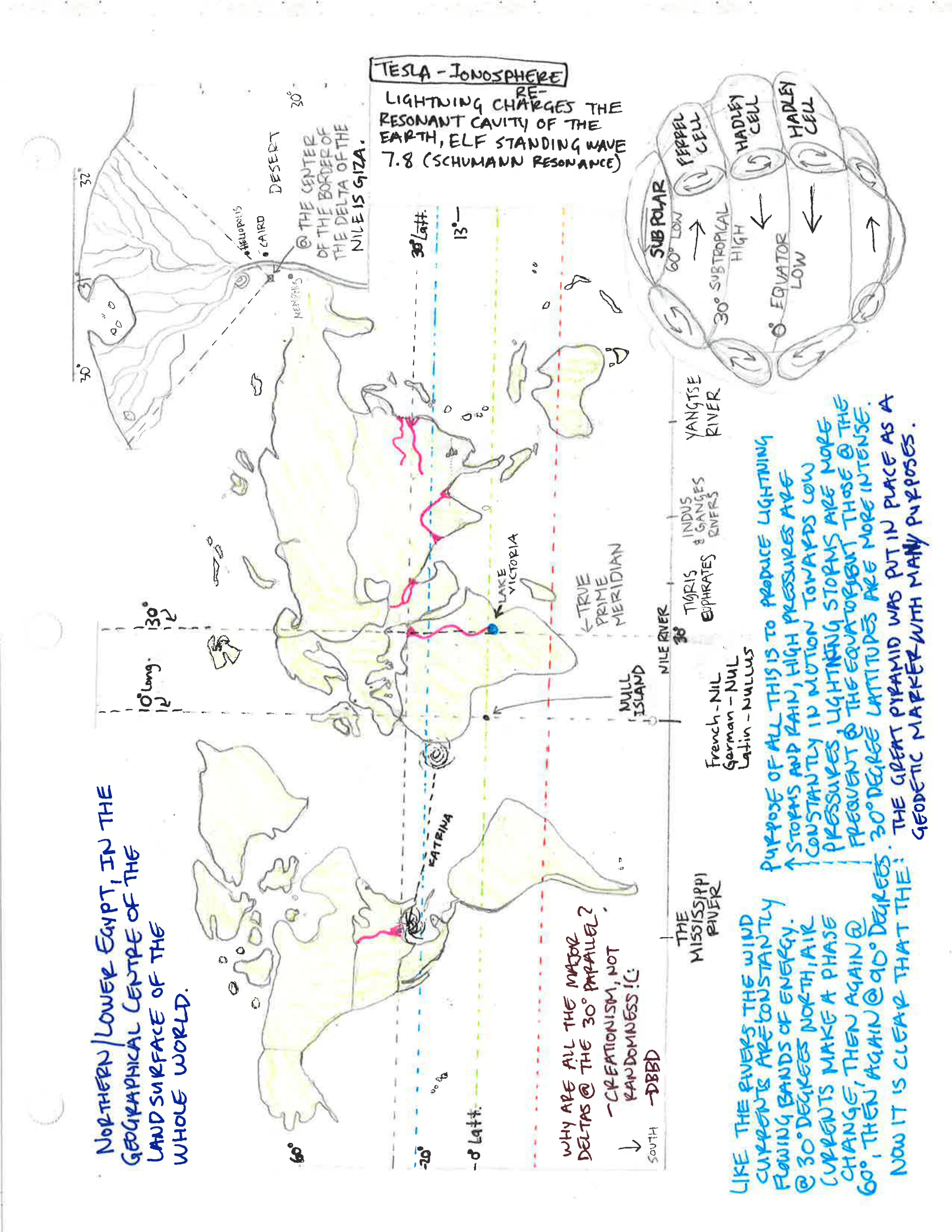
Rivers, Latitude & Circulation
The world map marks major rivers, selected latitude lines, the Nile and a proposed central meridian. A smaller atmospheric drawing shows circulation cells above different latitude bands.
The author connects river systems, lightning, pressure and the Earth-ionosphere system through the idea of continuous circulation. The Nile delta detail gives the map a specific geographical focus. Geographic labels locate the map's features, while the atmospheric sketch and written account assign them an energetic significance. Centre and circulation connect the drawings. The energetic interpretation is an addition to the mapped locations.
The Dendera Zodiac & the Pole
A large drawing of the Dendera zodiac is paired with a reproduction of the relief. Directional axes and coloured curves are added to identify the author's proposed alignments.
The surrounding notes discuss Polaris, Thuban, Draco and a cyclical change of pole star. The author explains that change through the manuscript's central-vortex model. Coloured overlays and directional annotations interpret the historical celestial relief through the manuscript's cosmology. The depicted zodiac and the proposed mechanism are separate layers: one is the object under discussion and the other is the author's account of it.
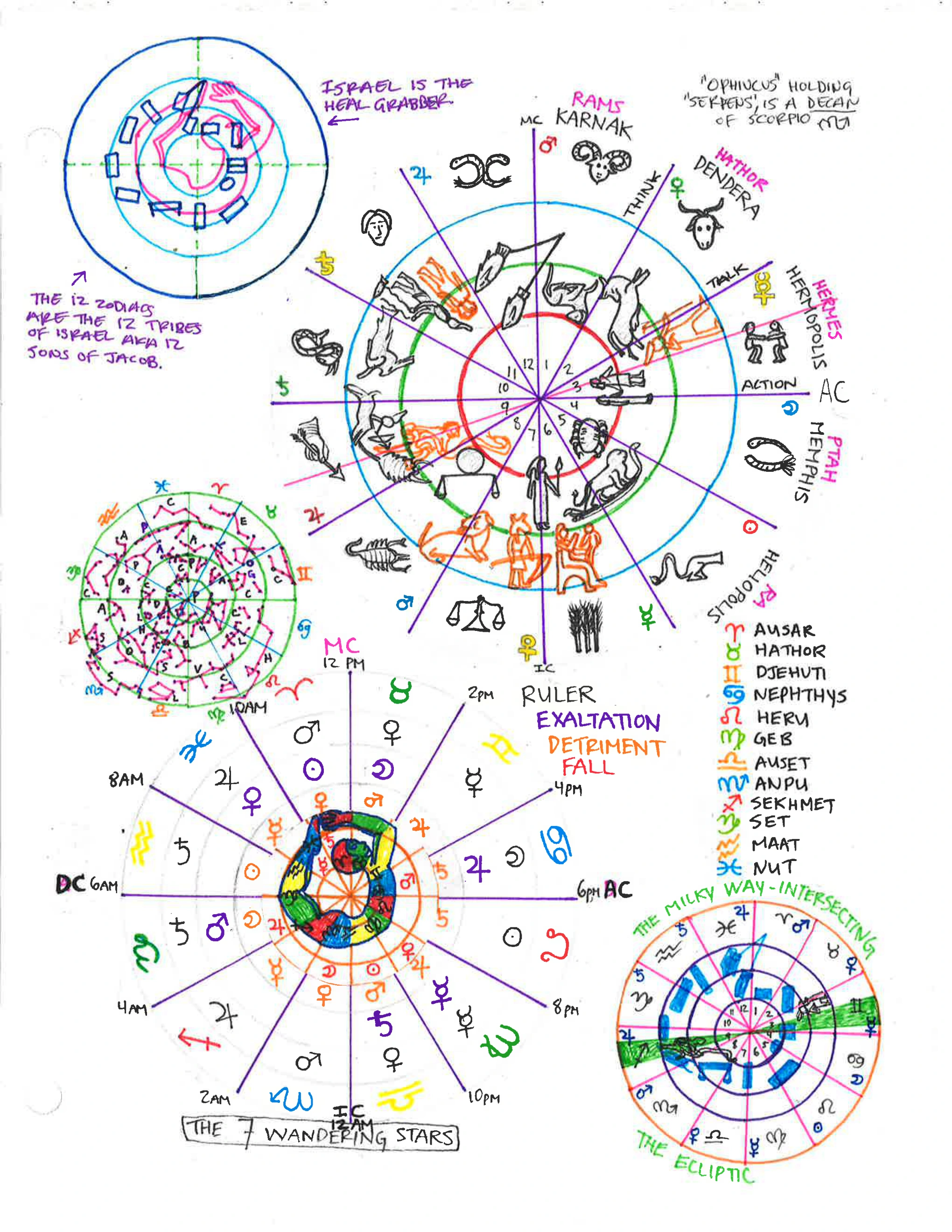
Zodiac Figures, Rulers & the Daily Cycle
Several circular charts arrange zodiac figures, planetary symbols, Egyptian names and times of day. The large upper wheel provides the main visual index.
The lower clock-like chart marks ascendant, descendant, midheaven and lower meridian positions. Its colours distinguish rulership, exaltation, detriment and fall within the manuscript's astrological scheme. Rings and colours separate several systems of correspondence. The smaller drawing of the Milky Way and ecliptic adds another crossing relationship. The page collects these relationships as a reference chart rather than as a single chronological narrative.
The Star Map, the World Tree & the Spine
A celestial map fills the upper half, with Draco emphasized by an added angular outline. Below, Yggdrasil's nine realms are placed beside a labelled spinal column.
The spinal drawing separates cervical, thoracic, lumbar, sacral and coccygeal regions. The tree diagram gives another vertically ordered system. Their juxtaposition continues the manuscript's comparison of cosmic and bodily levels. The note about a monthly seed belongs to the author's esoteric account of lunar cycles. The page's visual argument is broader: stars, mythological realms and the body are all organized around centres, levels and recurring sequences.
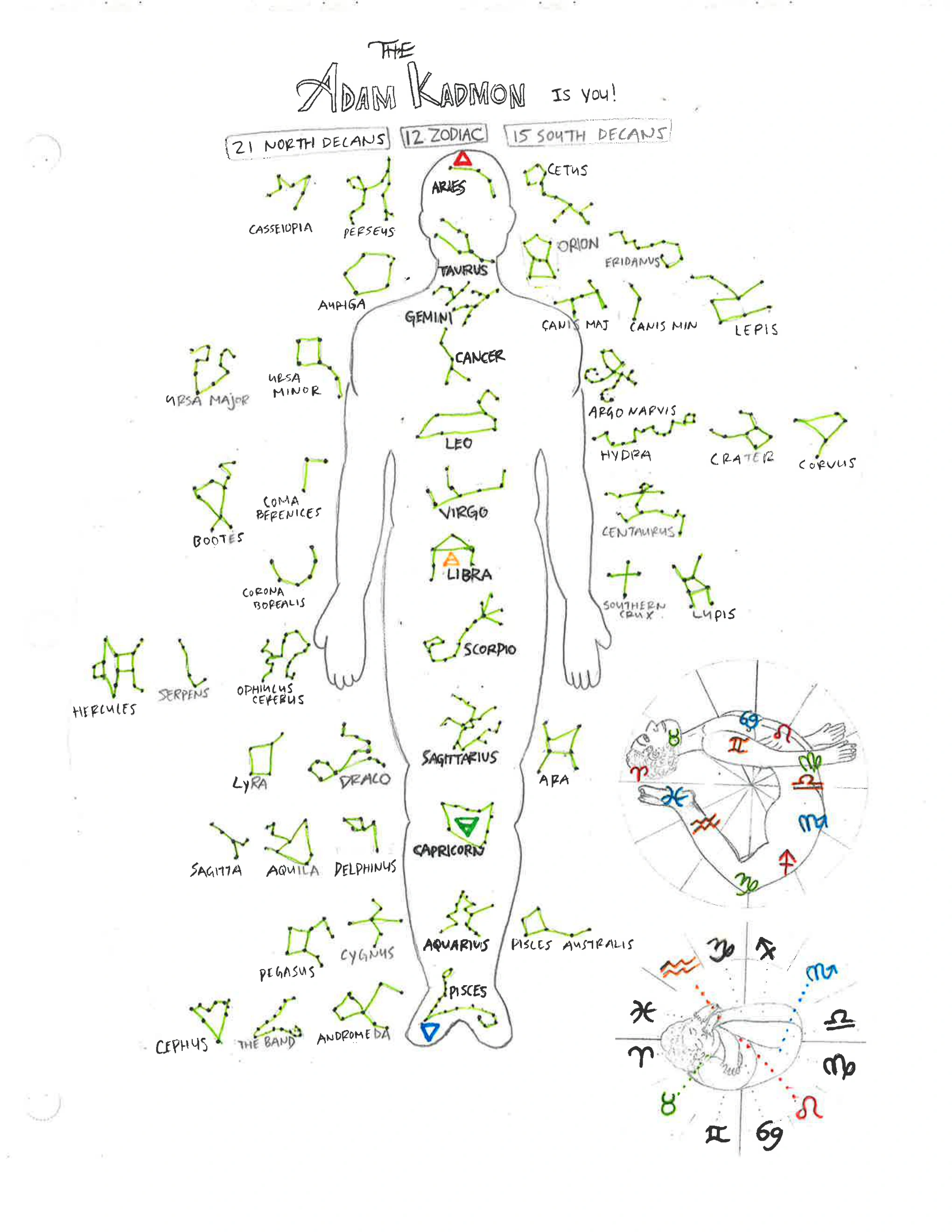
Adam Kadmon as a Constellation Map
A standing human outline carries the twelve zodiac constellations from Aries at the head to Pisces at the feet. Additional northern and southern constellations are placed in columns beside the body.
The headings separate the twelve zodiac figures from the surrounding constellation groups. The central body provides one axis of arrangement, while names and constellation shapes on either side provide another. Smaller diagrams below wrap the body-to-zodiac relationship into a circle, translating the same symbolic correspondence between a linear and a circular form. The title identifies the figure with Adam Kadmon. In the manuscript's symbolic language, the human form becomes a map of the heavens. The plate is an interpretive arrangement rather than a literal projection of all those stars onto the body.
The Zodiac within a Circulating Whole
The central diagram combines a large toroidal volume, opposing arrow fields and a zodiac band. Moon phases and a solar-faced seated figure surround the upper portion.
The lower construction places a reclining human figure inside a zodiac ring above a map-like plane. Ascendant, descendant and meridian labels connect orientation with the larger circulation. Trace the blue and red arrows separately, then locate the central plane where their paths meet. The page gathers the book's major motifs into one plate: the body, the year, paired motion and a shared organizing axis.
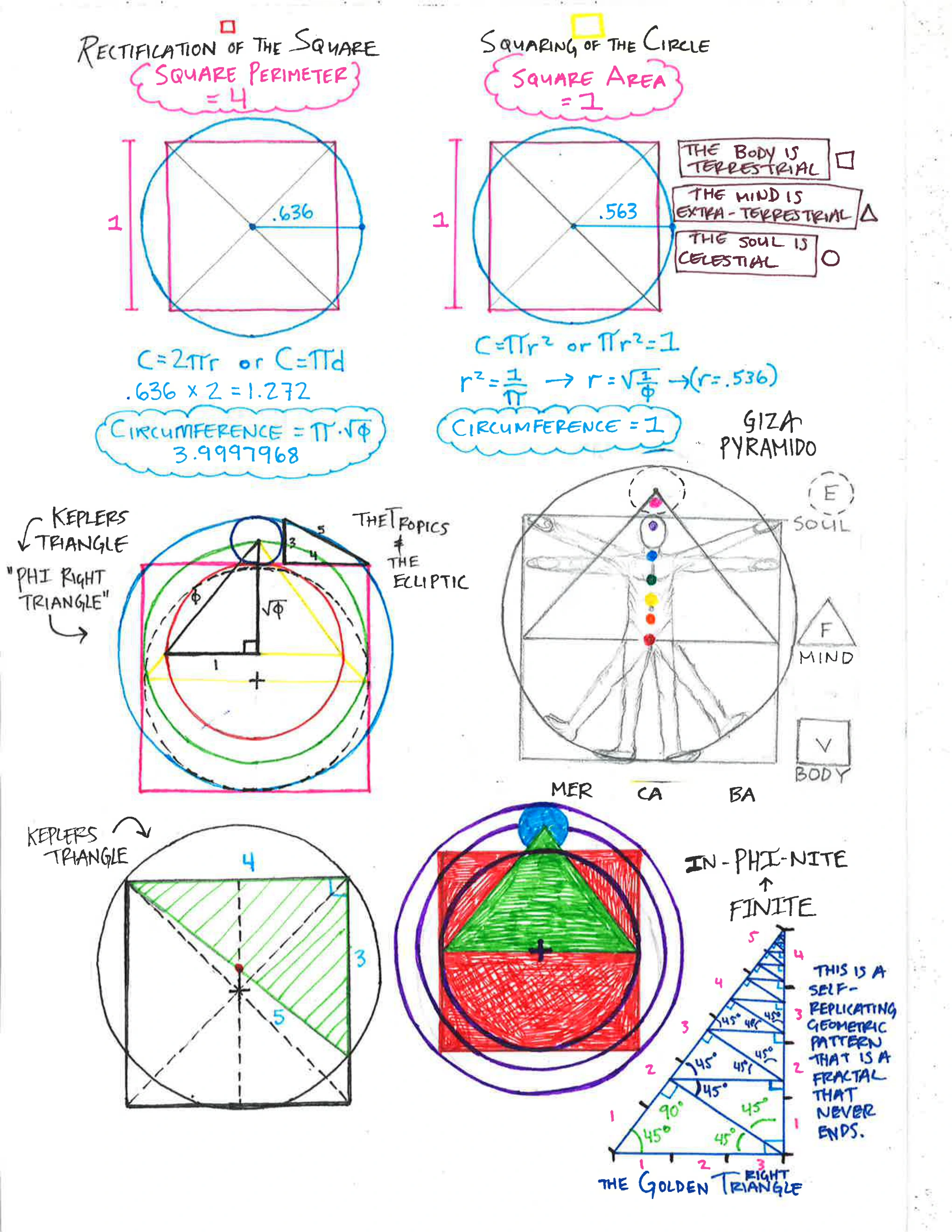
Square, Circle & Proportional Constructions
The upper pair compares two different matching problems: relating a circle's circumference to a square's perimeter, and relating a circle's area to a square's area. These must be kept distinct when reading the handwritten calculations.
The lower diagrams add a phi-based right triangle, a 3-4-5 triangle and a human figure within geometric boundaries. Body, mind and soul are assigned square, triangle and circle symbols.
The Human Figure between Square & Circle
Several versions of the outstretched human figure are overlaid with squares, circles and triangles. The central drawing emphasizes a pyramid-like triangle whose base crosses the body's middle and whose apex reaches upward.
The lower diagrams strip away the body to reveal the geometric construction. Comparing them with the central figure makes the chosen centres, boundaries and proportions easier to see. The final phrases connect this ascent with rebirth, meditation, Jacob's ladder, the Tree of Life and spiritual awakening. The page is a concluding synthesis: different traditions are presented as describing a journey from divided experience toward integration.
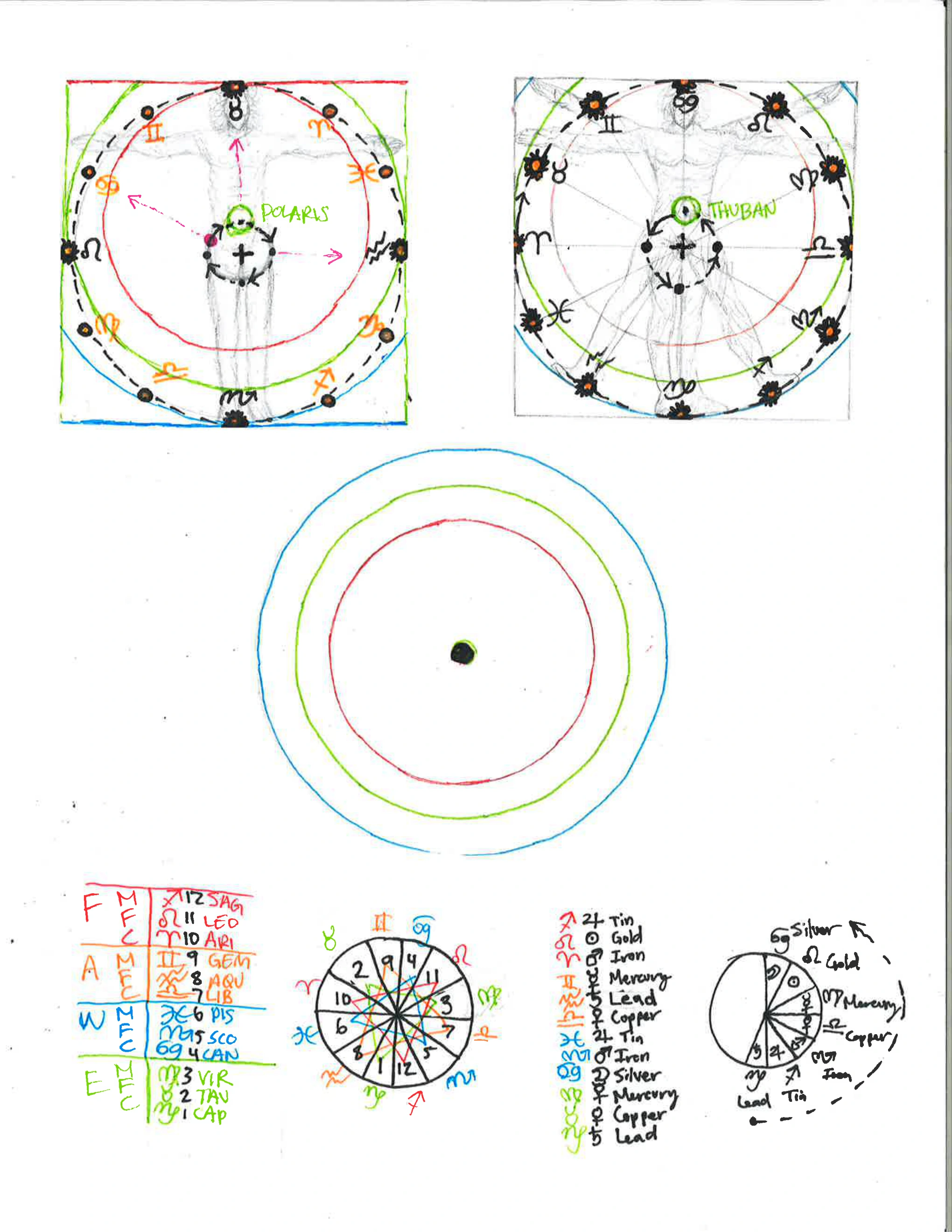
Terra Realm: image-14 explanations
The final page returns to the human figure inside square and circle, now combined with zodiac signs and the named pole stars Polaris and Thuban. Arrows emphasize rotation and cyclical change.
The large concentric circles in the middle simplify that construction to centre and surrounding rings. At the bottom, small wheels and lists collect elemental, numerical, planetary and metallic correspondences. The closing sheet gathers the manuscript's recurring structures into compact forms. Centre, cycle, proportion and correspondence connect its small wheels and lists back to the opening discussion. The repeated diagrams conclude a sustained comparative method rather than introduce one new argument.
Patterns, Symbols & Claims
Twenty supplied plates read beside their images, following the complete Terra Realm manuscript
These collages extend the manuscript’s motifs of centre, polarity, cycle and correspondence. Their juxtapositions offer visual analogies across different subjects. The following accounts distinguish the depicted claim, its documented context and the evidence needed to establish an anatomical, historical or physical relationship.
Select an image
TR-S01 Image index Terra Realm 121 Sources
Four worked visual explanations
Exact number patterns Optic pathways Musical intervals A measured pendulum
Original collages are shown in full as supplied. Existing source crops, small lettering and uncertain attribution are identified in the notes. Reference links provide context; they do not authenticate every component of a montage.
Related records and interpretation
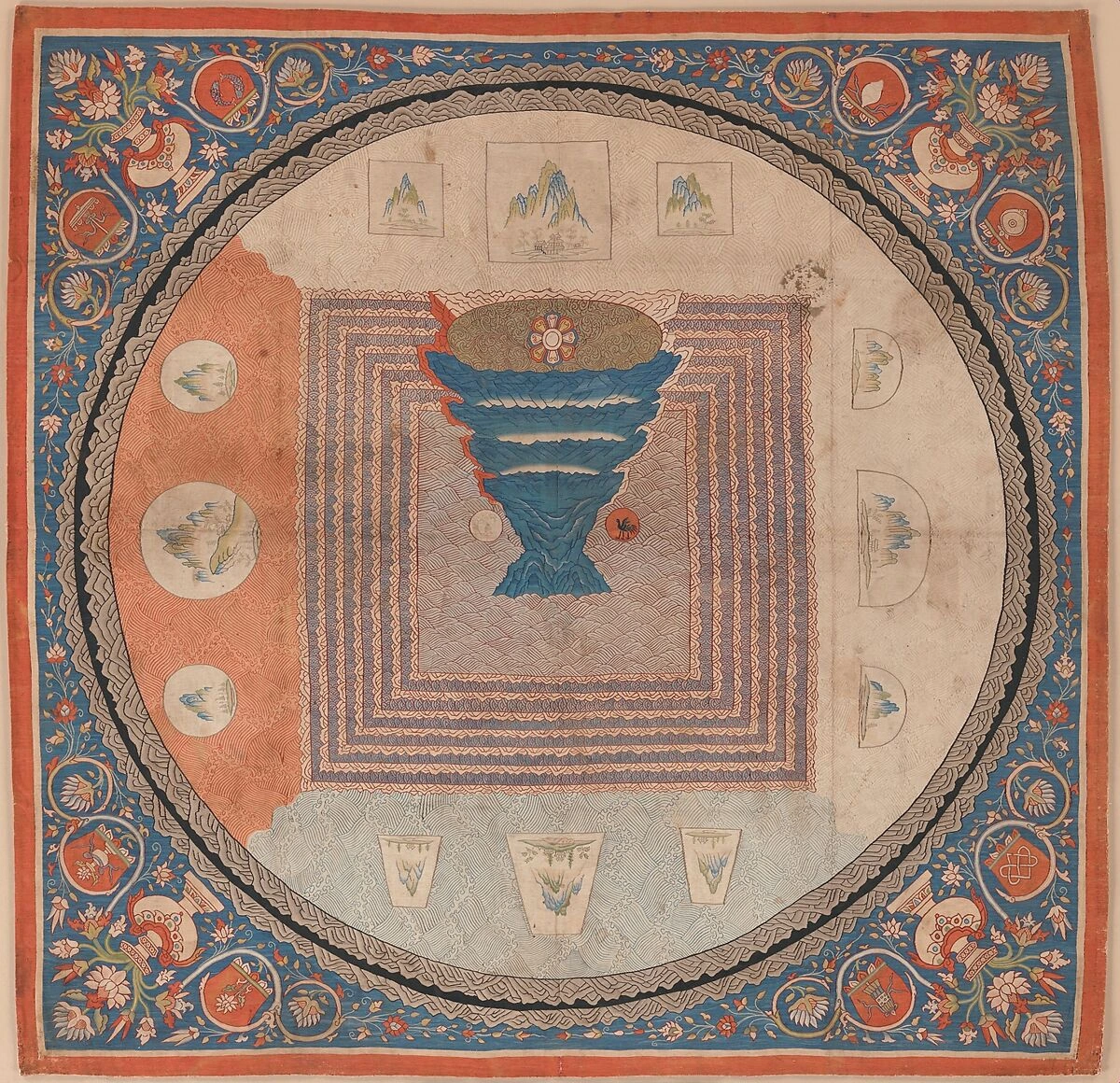
Mount Meru: a world mountain in religious art
Mount Meru is a central world mountain in Hindu, Buddhist and Jain cosmologies. These traditions contain different accounts of its form and surroundings. In Buddhist art, the mountain can organise the heavens, oceans and inhabited realms around a sacred centre. A mandala is a religious diagram; its arrangement belongs to a particular text, ritual and community. [TR-MERU-RUBIN]
Cosmological Mandala with Mount Meru, China, 14th century, Yuan dynasty. Silk tapestry (kesi), 83.8 × 83.8 cm. The Metropolitan Museum of Art, accession 1989.140. Public-domain collection image. [TR-MERU-MET]
This tapestry presents Meru as an inverted pyramid topped by a lotus. A three-legged bird and a rabbit represent the sun and moon. Four landscape scenes stand for continents, rendered in Chinese blue-and-green landscape conventions. The object records the transmission and adaptation of religious imagery; its date identifies the surviving textile, not the beginning of the tradition. [TR-MERU-MET]
Read the particular tradition
| Feature | Meaning in the documented example |
|---|---|
| Central mountain | Meru orders the religious world around a centre. |
| Lotus | A Buddhist symbol of purity in the Met tapestry. |
| Four surrounding landscapes | Continents represented through Chinese landscape painting conventions. |
| Different cosmological schemes | The Rubin Museum’s Kalachakra illustration uses six continents. It should not be silently combined with this four-continent tapestry. [TR-MERU-KALACHAKRA] |
The Rubin Museum dates a gilt-silver mandala offering set from Central Tibet to the mid 20th century. Its base, rings and finial form a ritual representation of a universe with Meru at its centre. This is a documented religious use of the cosmological arrangement. [TR-MERU-OFFERING]
The new Terra Realm cover
The cover combines a world mountain, concentric lands, a polar boundary and a black solar disc in a contemporary composition chosen by the author. The black disc expresses the author’s holographic-sun symbolism. The museum records cited here do not establish a historical doctrine of that black disc or verify continents beyond the pole. Those additions belong to this cover’s interpretation.
Mount Meru, Mount Kailash and the magnetic rock in Gerard Mercator’s polar map should retain their separate identities. Religious associations with a mountain do not make different maps interchangeable. Princeton University Library describes the four islands and central magnetic rock in Mercator’s Arctic map, and later revisions of the coastlines as exploration advanced. That is evidence about European cartographic history, not a measurement of Meru. [TR-MERCATOR]
Units and terms
cm centimetre, 0.01 metre · × multiplied by
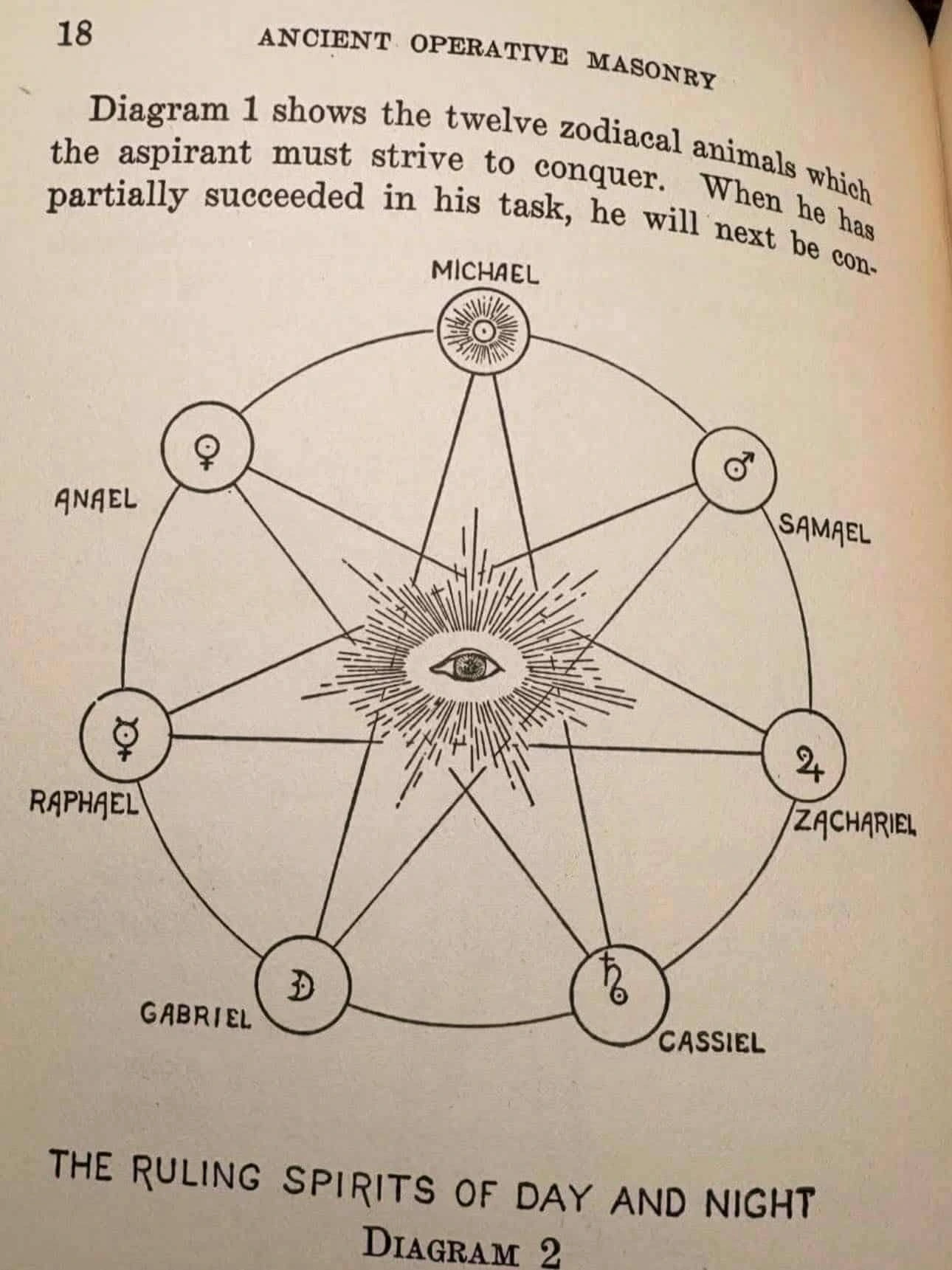
Planetary emblems in Ancient Operative Masonry
The supplied photograph shows page 18 under the running title Ancient Operative Masonry. The Harry Yetter Masonic Research Library catalogues a book of this title by S. R. Parchment, published in San Francisco in 1930 by the San Francisco Center of the Rosicrucian Fellowship. The title and page are visible in the photograph; the photograph alone does not identify its printing or photographer. [TR-PARCHMENT]
Supplied image: Maybe archive, theory (57).jpg. Page 18, diagram 2, “The Ruling Spirits of Day and Night”. Complete supplied photograph, including its partial paragraph; photographer and printing unconfirmed.
Names and symbols visible in the diagram
| Printed name | Emblem | Printed name | Emblem |
|---|---|---|---|
| Michael | Sun | Samael | Mars |
| Zachariel | Jupiter | Cassiel | Saturn |
| Gabriel | Moon | Raphael | Mercury |
| Anael | Venus |
The connecting lines, seven planetary emblems and central eye form an esoteric symbolic arrangement. The table transcribes what is visible without assigning an astronomical mechanism to it. The word “ancient” in a 1930 title is not evidence that every association on this page has been documented continuously since antiquity.
The Maybe archive also contains versions with added coloured lines and weekday labels. Only this unannotated version is placed here. Later marks would be a separate interpretation and should carry their own date and attribution.
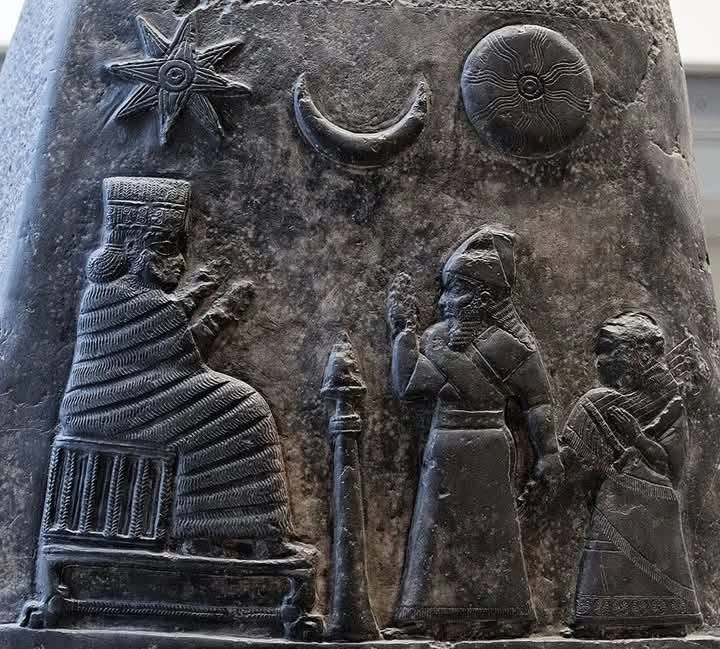
Meli-Shipak: land, divine emblems and an inscription
Supplied detail photograph: Maybe archive, theory (94).jpg. The scene matches the Louvre’s Kudurru du roi Melishipak II, SB 23. The original photographer is unconfirmed. [TR-KUDURRU]
The Louvre identifies the limestone monument as a kudurru of King Meli-Shipak II. In the scene he presents his daughter Hunnubat-Nannaya to the seated goddess Nannaya. Above them are divine emblems: the star of Ishtar, the crescent of Sin and the solar disc of Shamash. [TR-KUDURRU]
| Visible element | Catalogue interpretation |
|---|---|
| Star at upper left | Ishtar |
| Crescent near the centre | Sin, the moon deity |
| Radiating disc at upper right | Shamash, the sun deity |
| Standing king and smaller figure | Meli-Shipak II and his daughter |
| Seated figure | The goddess Nannaya |
The Akkadian inscription commemorates a grant of land to the king’s daughter and repairs to irrigation canals. The complete monument is catalogued at 83 cm high, 42 cm wide and 33 cm thick. It was found at Susa, after having been taken there from Babylonia as booty in the 12th century BCE. [TR-KUDURRU]
These emblems belong to a recorded political and religious setting. The inscription and catalogue establish the identities; resemblance to a later drawing alone does not establish a shared doctrine.
Units and terms
BCE Before the Common Era · cm centimetre, 0.01 metre
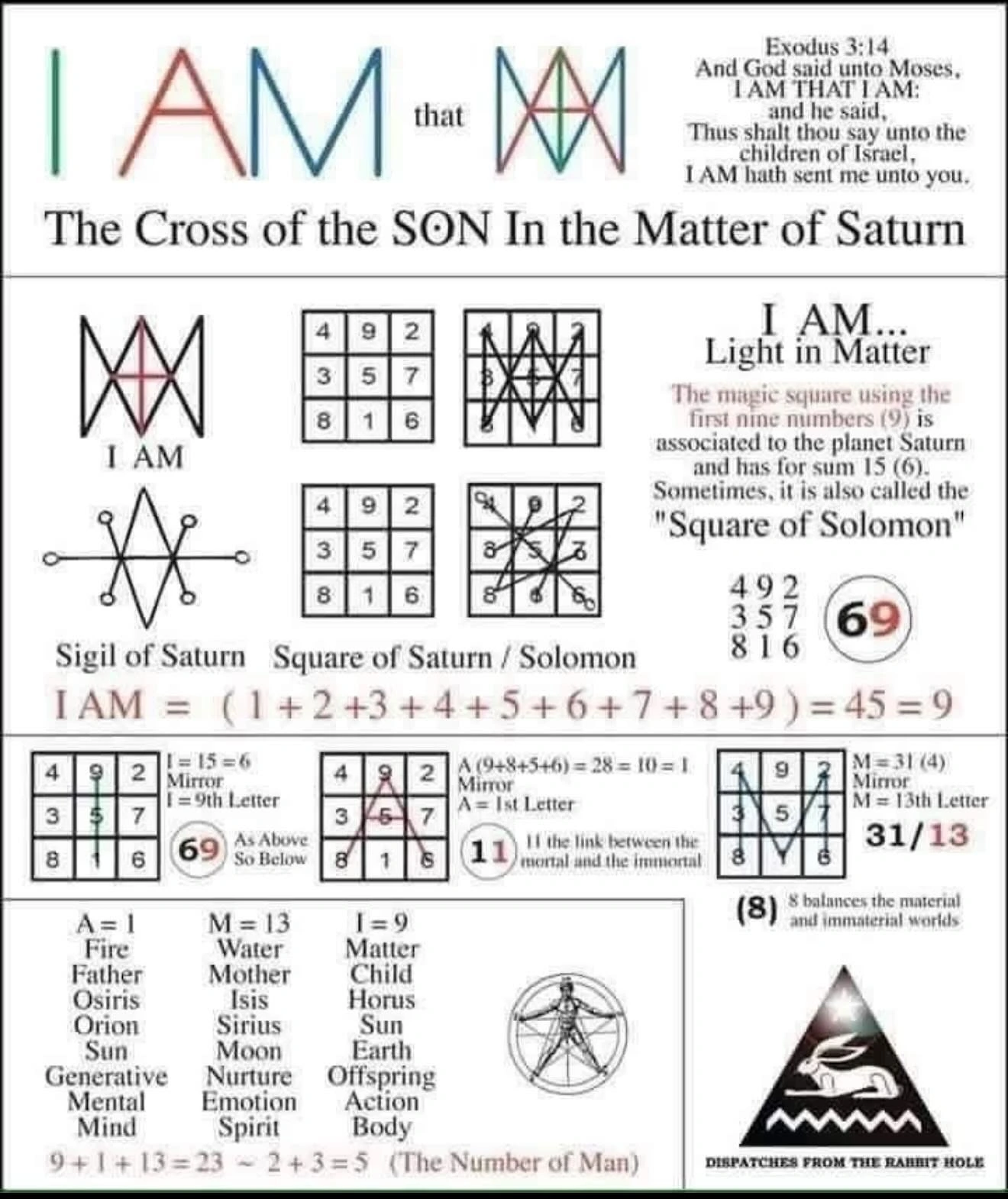
I AM, the Number Square & Saturn
Follow the construction The top line separates the English letters I, A and M, then superimposes their strokes. Below it, the repeated 3 by 3 grid contains 4–9–2, 3–5–7 and 8–1–6. Lines drawn across that grid imitate letters and a planetary seal. The lower table aligns A with fire and father, M with water and mother, and I with matter and child. Egyptian names, stars, body–mind terms and a small human figure broaden that proposed correspondence. These are the collage’s associations, not translations of the symbols.
What the sources establish Exodus 3:14 concerns the divine name in the encounter between Moses and God. Its Hebrew wording is discussed in the USCCB notes; the shapes of modern English capital letters do not explain that Hebrew passage. Agrippa’s Book II, chapter 22, assigns a 3 by 3 number table to Saturn. This documents a historical occult correspondence. It does not establish that Saturn produces the spiritual or physical effects attributed to the square.
USCCB: United States Conference of Catholic Bishops. The institution publishing the cited Bible passage and explanatory notes.
Reading references: TR01 TR02
TR-S02 Image index Terra Realm 121 Next image
Roman Numerals, Hexagrams & Visual Association
Read from top to bottom Overlapping circles, opposing triangles, a letter monogram, a six-pointed star and a wireframe cube form the top row. The large 911 is split into 9 and 11, then rendered IX and XI. Below, those strokes are arranged around a red hexagram between two vertical bars. A square-and-compasses emblem stands between pillars on the left; an animal-headed star, a cube with numbered vertices and a looped serpent occupy other panels. The design moves from similarity of shape to an implied common meaning.
Separate notation from assertion IX means 9 and XI means 11 in Roman notation. Putting the two groups beside one another is a graphic arrangement; it is not a standard conversion of the integer 911, which is CMXI. Two equilateral triangles each have interior angles totalling 180°, giving 360° when the two totals are added. Deleting a zero is not an allowed equality operation. The lower calculation 1 + 2 + … + 36 = 666 is arithmetically correct, but no historical connection follows from selecting that endpoint.
Ask what would establish a connection The Museum of Freemasonry explains the square and compasses through stonemasons’ tools and moral symbolism. A hexagram or cube can occur in several settings. Juxtaposition alone cannot establish that religious communities, Freemasons or historical events share a hidden cause. The captions asserting worship or political continuity require independent, dated evidence, which this montage does not supply. A reliable interpretation identifies the shape and transformation, retains the full calculation, and distinguishes documented uses from the compiler’s inference. Small, blurred passages remain untranscribed rather than reconstructed.
Reading references: TR02 TR04
TR-S03 Image index Terra Realm 121 Next image
Units and terms
BCE Before the Common Era · cm centimetre, 0.01 metre
USCCB United States Conference of Catholic Bishops
° degree, an angle unit · = equals
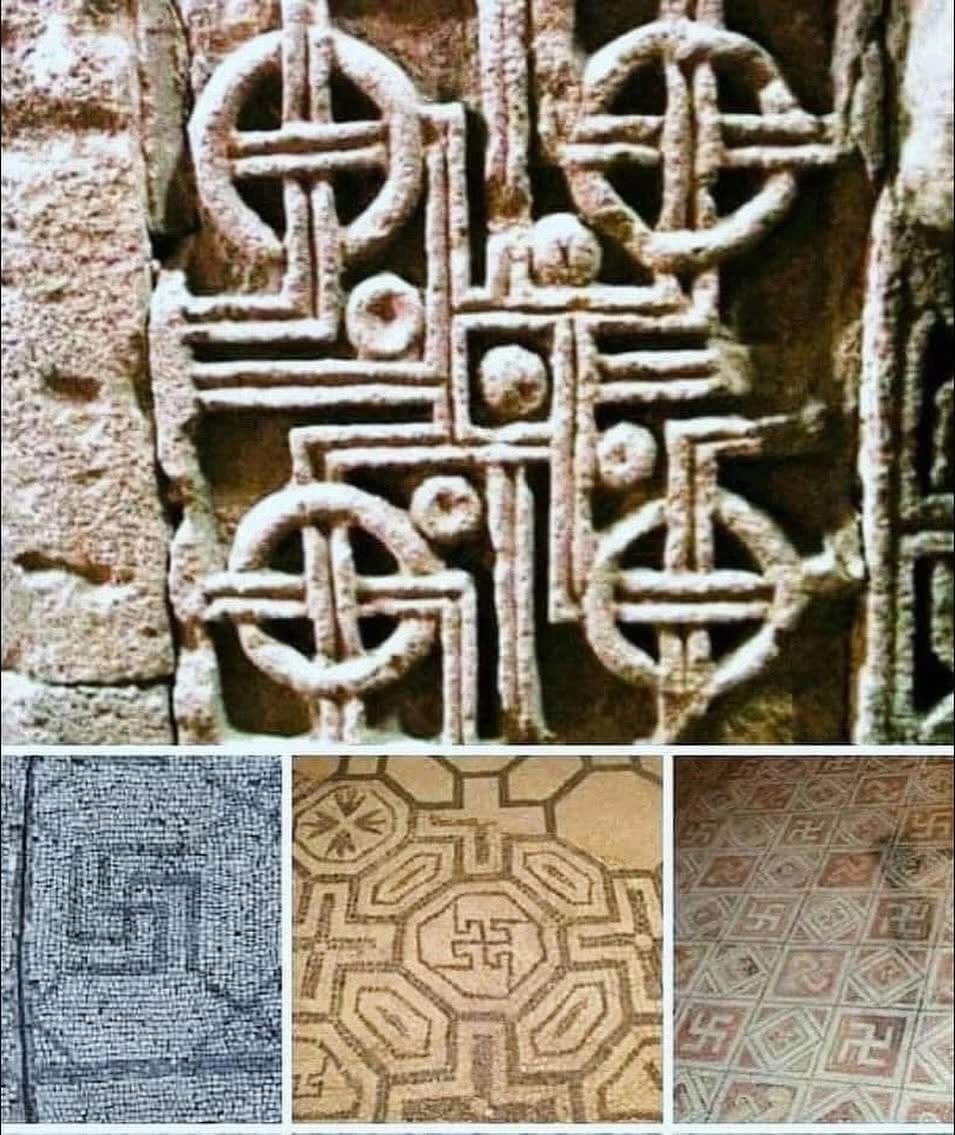
Hooked Crosses, Stonework & Mosaic Patterns
Examine the four panels The large photograph shows a raised stone design with a central angular crossing, small circular bosses and four ringed crosses near its corners. Grooves and relief make the bands appear to weave or turn through the surface. The lower left panel shows a fine tessellated angular pattern. The lower middle places a hooked cross inside an octagonal centre with surrounding interlace. The lower right repeats hooked crosses and other motifs across a patterned floor. Materials, scale and perspective differ between the four views.
Context determines meaning The swastika or hooked-cross motif has a history across many cultures long before its appropriation by Nazism. The United States Holocaust Memorial Museum documents both that earlier history and the Nazi adoption in 1920. Neither the presence of a hooked cross nor its direction alone identifies the maker, date, religion or political intention of an object. The uploaded montage gives no dependable site names, accession numbers, excavation records or dates for these particular photographs. Calling the stonework Celtic, Roman, Hindu or medieval would therefore exceed the available evidence.
Make a useful comparison record For each panel, record what can actually be counted: four arms or another number, straight or curved turns, presence of a border, and whether the pattern repeats. Trace only visible edges; do not complete worn sections as if intact. Keep an unknown object label until an original caption or collection record is found. A future identification should match the whole object and its surrounding details, not one similar symbol. This plate connects to Terra Realm’s recurring fourfold arrangements, but the comparison is formal. It cannot establish one continuous ancient doctrine, nor erase the very different meanings the motif acquired in different historical settings.
Reading references: TR03
TR-S04 Image index Terra Realm 121 Next image
Labyrinth Paths & Paired Opposites
Trace the upper sequence The numbered sketches begin with a small cross and dots, then add successive curved connections. The final drawing has a narrow entrance and a winding route toward an enclosed centre. Some material at the left edge is already missing from the supplied image. Distinguish the black boundary lines from the white passage between them: following a wall produces a different route from walking the passage. The dotted arcs and arrowheads indicate the order of drawing, not measured movement or a magnetic field.
Read the lower transformations A familiar black-and-white taiji form appears in the centre. To the left, curved lobes and dots are arranged into a fourfold figure labelled Fylfot; to the right, multiple taiji-like forms are combined into a larger rotational pattern. The Smithsonian’s bowl F1995.8 provides a documented example of taiji imagery associated with yin and yang. That museum object establishes a historical use of the symbol, not the age or authorship of this particular diagram. The collage proposes a visual relationship by repetition and rotation.
Use geometry without inventing a lineage On a paper copy, start at the labyrinth entrance and draw one continuous line along the passage. Mark any branch, dead end or accidental crossing. The Ashmolean distinguishes the single-path labyrinth on Knossian coins from the complex maze of literary stories. That distinction is useful here, although it does not authenticate the uploaded drawing’s claimed origin. For the lower motifs, rotate a tracing by a quarter-turn and check which parts coincide. A reproducible rotation demonstrates symmetry. It does not prove that Chinese taiji imagery and every hooked-cross tradition developed from one another or describe the same physical mechanism.
Reading references: TR05 TR06 TR03
TR-S05 Image index Terra Realm 121 Next image
Units and terms
° degree, an angle unit · = equals
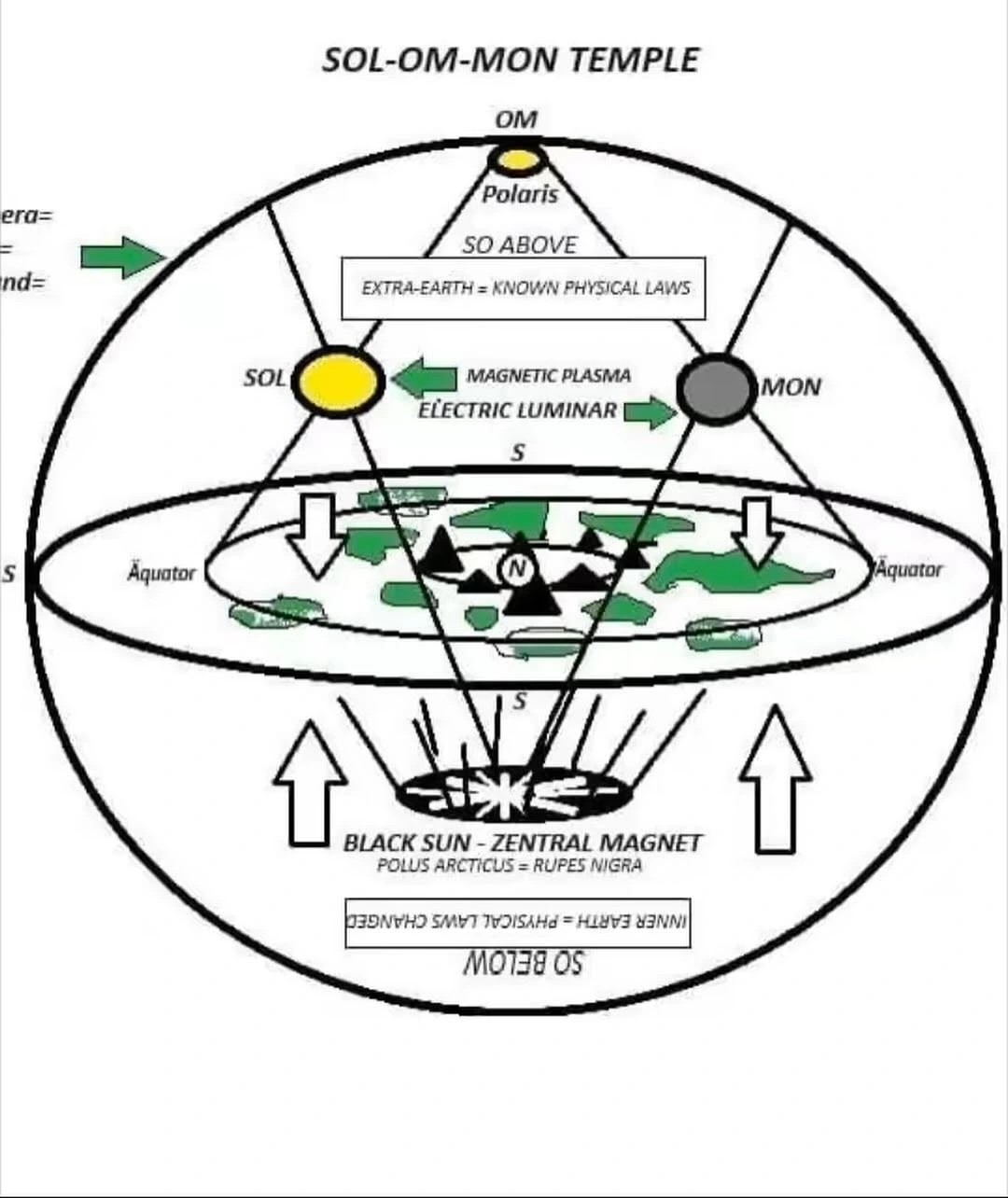
The Dome, the Central Axis & the Black Sun
Map the picture’s own model A circular enclosure contains a horizontal disc with green land shapes. A vertical arrangement places Polaris at the top, a yellow Sun on the left, a grey Moon on the right and a dark central object below. Lines form large triangles through these objects. Green horizontal arrows oppose one another, while white vertical arrows suggest movement toward and away from the disc. The words above and below divide the picture into complementary domains, and the title breaks Solomon into SOL, OM and MON.
Where interpretation begins The diagram treats the world as a temple-like enclosure and assigns symbolic roles to its lights and centre. The lettering is wordplay; the image supplies no linguistic evidence that the biblical name derives from those three pieces. Its statements about altered physical laws below the plane, an inner black sun and a central magnetic structure are claims of the illustrated model. There are no measured distances, coordinates, dates, field strengths or observations with which to calculate its proposed arrangement. Its land outlines are not a surveyed map.
Compare with measured Earth and Moon NOAA describes Earth as an irregular ellipsoid measured by geodesy. A flat disc under a dome is inconsistent with that measured global shape. NASA explains moonlight as reflected sunlight; the Moon is not an independent visible lamp of the kind suggested here. These findings do not determine the personal or spiritual significance a reader may give the artwork. They do determine whether it can function as a navigation or engineering plan. Read it beside Terra Realm as an example of centre–boundary and above–below imagery. Use geodetic coordinates and an identified map projection for an actual journey or site plan; the artwork provides neither.
Reading references: TR07 TR08
TR-S06 Image index Terra Realm 121 Next image
Tools, Planetary Seals & Unsupported Equivalence
Compare the marks carefully On the left, hinged compasses sit above a carpenter’s or mason’s square. The compass legs meet a V-shaped right-angle tool with visible graduation marks. On the right, a line figure has crossing diagonals, a horizontal stroke, small circular terminals and pointed upper and lower ends. The upper labels equate the left side with Freemasonry and the right side with Satanism; the lower right caption instead calls its mark a seal of Saturn. That change of label is part of the argument being made by the compiler.
What each source can support The Museum of Freemasonry identifies the square and compasses as tools adopted for moral teaching, including fairness and moderation. Agrippa’s planetary tables document seals and correspondences assigned to Saturn within Renaissance occult philosophy. These two sources describe different contexts. Neither establishes the montage’s asserted equivalence between a fraternal organisation, a planetary symbol and Satanism. A resemblance between straight strokes is not sufficient evidence of shared religious identity, secret practice or historical descent.
A practical way to test the comparison Make separate outlines of the two marks. Label the actual parts of the left tool: hinge, legs, points and square. On the right, label only intersections and endpoints unless a specific historical diagram confirms another name. Record which features are present in one drawing but absent from the other. Then seek a dated object or text for each use, with its maker or issuing organisation. This turns a suggestive juxtaposition into a question that can be investigated. It also prevents a modern caption from silently becoming evidence about the beliefs of real people. The image remains a comparative symbolic plate, not a verified classification of religions.
Reading references: TR04 TR02
TR-S07 Image index Terra Realm 121 Next image
Units and terms
NOAA National Oceanic and Atmospheric Administration · NASA National Aeronautics and Space Administration
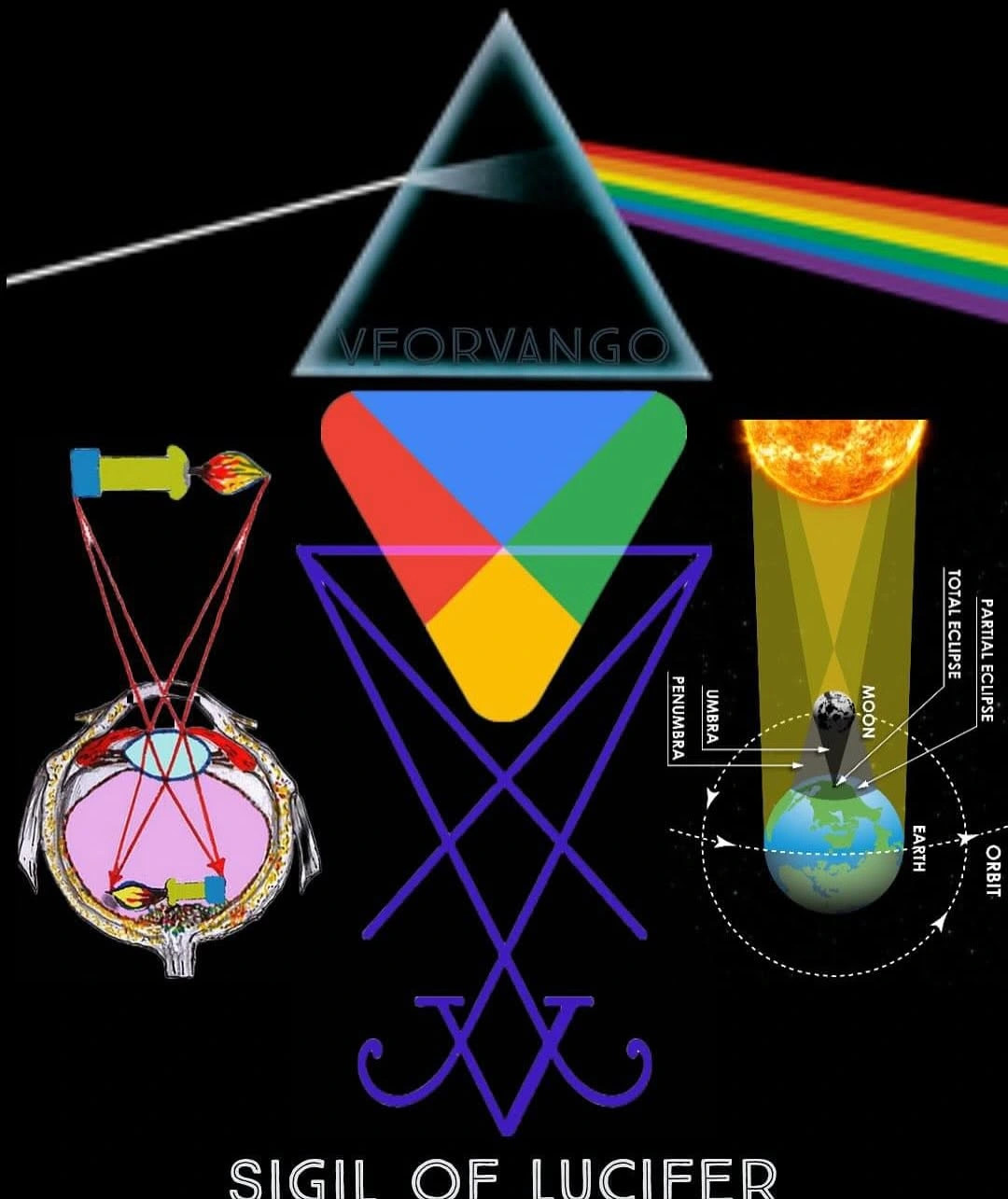
Prism, Retina & Eclipse: Three Different Processes
Locate the four visual arguments At the top, a white ray enters a triangular prism and a band of colours exits. At lower left, rays from a small object cross inside an eye and form an inverted image near the back. At right, Sun, Moon and Earth are aligned with labelled shadow regions. A large angular sigil overlays the centre and lower edge, with a multicoloured triangular motif behind it. The compiler joins these pictures through triangles, crossing lines and the theme of light.
Explain the actual mechanisms A prism separates wavelengths because the refractive index depends on wavelength. The eye uses its cornea and lens to focus light on the retina, where photoreceptors begin conversion to neural signals. In a solar eclipse, the Moon blocks sunlight from reaching part of Earth. The umbra is the full-shadow region; the penumbra produces a partial eclipse. Refraction, image formation and occultation are distinct operations. Their line diagrams use some similar shapes because straight rays and triangular sections are useful ways to draw them.
Read the sigil as the comparison layer. The plate names its central figure as a sigil of Lucifer. The uploaded collage does not establish the historical edition, maker or original use of that particular mark. Its resemblance to rays is an interpretive overlay, not an anatomical structure or a cause of eclipses. None of the illustrated astronomical distances is to scale. The accompanying physical account distinguishes emission, transmission, refraction and obstruction of light.
Reading references: TR09 TR10 TR12
TR-S08 Image index Terra Realm 121 Next image
The Eye-Shaped Enclosure & the Association Collage
Read the composition in regions The crowded left strip combines world diagrams, rings, an eye, overlapping circles, meme captions, photographs of people and a coloured central-axis image labelled Kundalini. The upper right contains a pointed oval enclosing a circle, a downward triangle and a central dot. Below are looping bands around a shared axis. At the bottom, repeated curved bands frame a large eye. The larger right-hand shapes act as visual summaries of motifs scattered through the left-hand mosaic.
Understand the proposed connection The pointed oval can be read here as an eye, enclosure or overlapping-circle region. The neighbouring passage associates a feminine figure with birth, death and initiation, but its beginning, ending and bibliographic reference are cropped. The depicted people and short captions do not authenticate quotations, agreement or authorship. Read each small panel as a separate source fragment. Their placement creates an argument about resemblance and recurrence; it does not supply the chronology or documentary links needed to demonstrate a shared origin.
Keep anatomy and cosmology distinct A real eye has an aperture, refracting structures, a retina and a neural output. A pointed oval alone does not represent those structures. Similarly, the disc-world images are symbolic or speculative maps, not substitutes for geodetic measurements of Earth. The plate is useful for studying how visual emphasis works: compare the scale of the central eye with the much smaller evidence fragments. Transcribe only legible words, distinguish a quotation from a meme overlay, and find the uncropped source before attributing a statement. No biography or portrait identification is assigned from this montage. Its connection to Terra Realm is the repeated image of a centre contained by a boundary.
Reading references: TR10 TR07
TR-S09 Image index Terra Realm 121 Next image
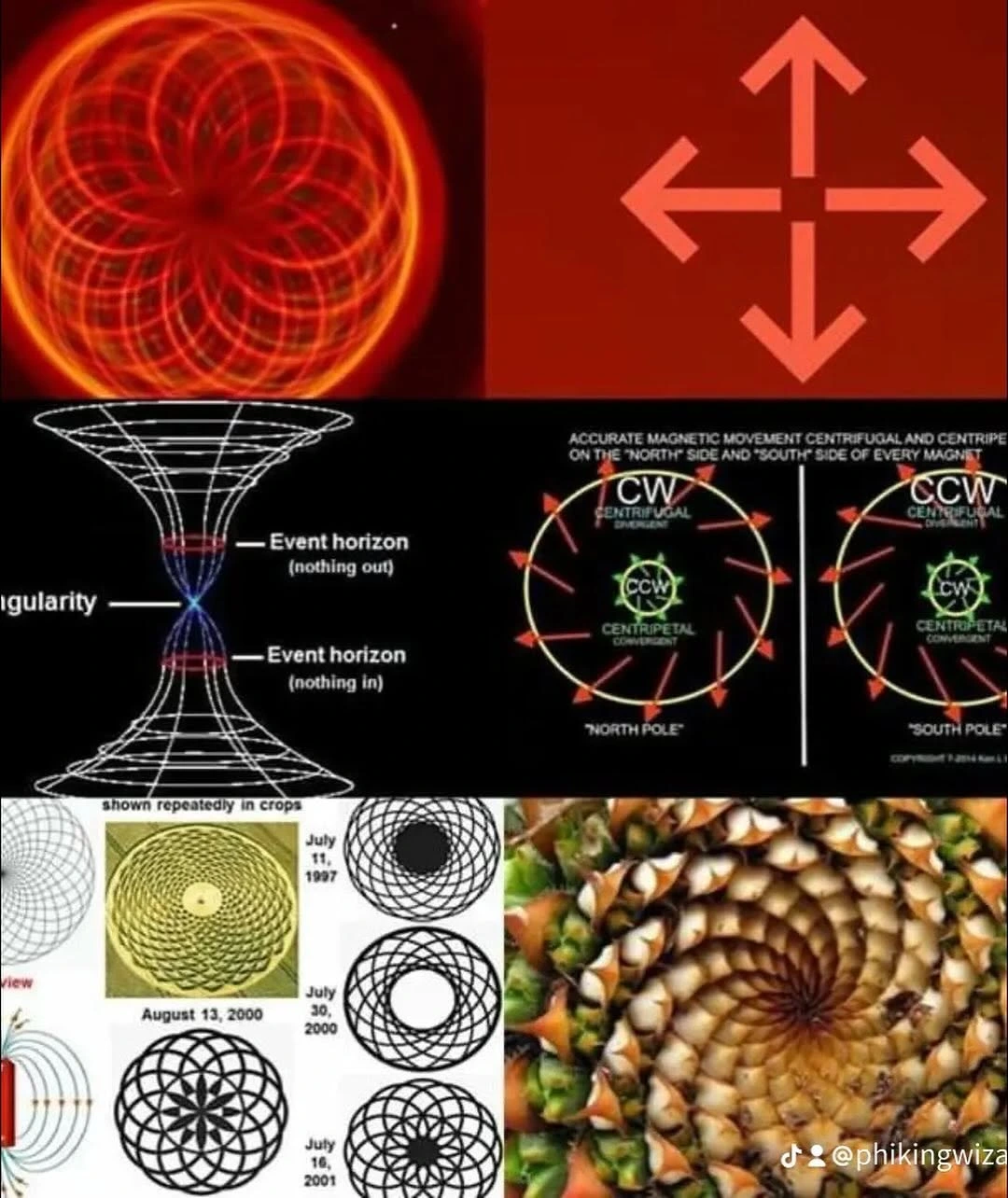
Spirals, Funnels & Patterns in Nature
Inventory the separate panels An orange rosette occupies the upper left and four outward arrows the upper right. A wireframe hourglass below is labelled with horizons and a singularity. Two circular arrow diagrams claim clockwise and counterclockwise motions for magnetic poles. The lower strip places dated crop-pattern pictures beside geometric rosettes and a close view of spirally arranged botanical material. These are different kinds of image: constructed graphics, claimed field diagrams and photographs. Similar curved outlines connect them visually.
Separate form from physical explanation A black-hole event horizon is a boundary beyond which light cannot escape to a distant observer. A double funnel is not an observed tunnel through an ordinary magnet, and the picture provides no evidence for such a connection. Arrow labels alone do not specify field strength, position, time or how a measurement was made. The botanical photograph is too context-poor for a verified species identification. The sunflower study cited here found both Fibonacci and non-Fibonacci structures; it concerns measured sunflower heads and cannot identify or validate every spiral pictured in this collage.
Turn resemblance into a limited test For a rosette, count lobes and check whether a fixed rotation makes the pattern coincide with itself. For a plant photograph, mark visible centres and count spiral families in both directions, preserving ambiguous counts rather than choosing a desired number. Perspective, damage and missing edges can change the count. For a claimed magnetic result, require the magnet geometry, instrument, units, measurement positions and repeat trials. The crop photographs have no verified location or creation history in the supplied file. Their resemblance to a geometric construction is an observation about appearance, not evidence of an unknown maker, energy source or universal field law.
Reading references: TR13 TR14
TR-S10 Image index Terra Realm 121 Next image
The Optic Chiasm & a Superimposed Sigil
Follow the two drawings The left drawing places two eyes above a brain outline. Coloured lines travel through the eyes, converge near a label for the optic chiasm and continue toward the rear of the head. The right drawing is the angular mark captioned as a sigil of Lucifer. The two are aligned to make their diagonals look comparable. The title joins vision to the image’s light-bringer theme. Some words at the top and lower left were already cropped before this file was supplied.
What crosses in the real pathway Light is focused on the retina; it does not continue as a light beam through the optic nerve. Retinal output travels as neural signals. Fibres from the nasal half of each retina cross to the opposite optic tract, while temporal retinal fibres remain on the same side. A photomicrographic study of human chiasms confirms this distinction and shows a more complex arrangement than a neat central X. The cerebral hemispheres themselves do not cross. The schematic is therefore useful only if its coloured paths are identified as selected nerve pathways after the retina.
Use the comparison without changing anatomy On a separate drawing, label left and right from the subject’s perspective, mark the nasal side of each eye and follow those paths across the midline. Follow the temporal paths without crossing them. Keep the lens’s ray crossing separate from the chiasm’s nerve-fibre crossing: they occur in different places and involve different processes. The accompanying vector diagram makes that distinction visible. The uploaded sigil is a symbolic comparison, not an anatomical discovery, and its historical origin is not established by this file. The appropriate connection to Terra Realm is its interest in paired structures and a central crossing, with the anatomical limits made explicit.
Reading references: TR10 TR11
TR-S11 Image index Terra Realm 121 Next image
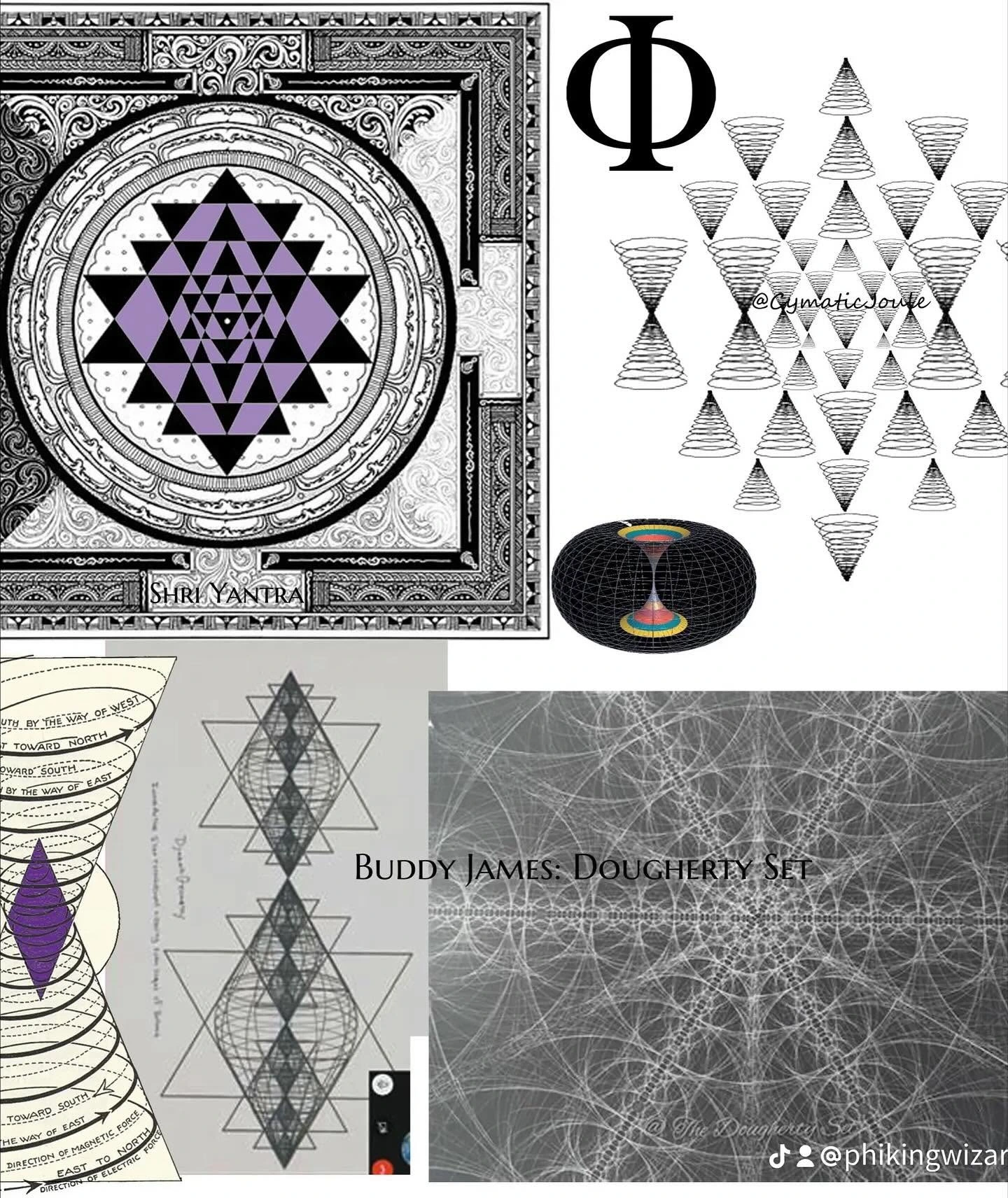
Shri Yantra, Repeated Cones & the Golden-Ratio Sign
Read the upper and lower fields The upper left is labelled Shri Yantra and contains interlocking upward and downward triangles, a central point, circular bands and a square ornamental frame. To the right, repeated conical spirals alternate their orientation beneath a large phi symbol. A small doughnut-like wireframe with an axial funnel sits below them. The lower panels combine a partly cropped spiral text diagram, stacked star-like forms and a dense mesh bearing the title Dougherty Set. The file name contains a comma:
Identify the tradition carefully The Sri or Shri Yantra is a Hindu ritual diagram; a Spanish national museum catalogue describes nine interlocking triangles associated with masculine and feminine symbolism. That contextual identification does not authenticate the date, maker or exact construction of the uploaded image. The phi character is often used for the golden ratio, but placing it beside a shape does not demonstrate that shape’s proportions. The golden ratio is (1 + √5) / 2, approximately 1.618. No scale, construction coordinates or measured ratio accompanies these cones.
Distinguish a diagram from a defined model Trace the large triangles separately before counting the many small regions formed by their intersections. Record the central point, triangle orientations and surrounding enclosures. In the lower panel, a name attached to a mesh is not enough to define a mathematical set: an equation, algorithm and parameter values would be required to reproduce it. Those details and a dependable original publication are absent here. The religious diagram can be discussed as a structure for symbolic attention while the additional cone, torus and fractal-like comparisons remain the compiler’s interpretation. Neither spiritual benefit nor a physical energy output can be inferred from the ornamental complexity.
Reading references: TR15
TR-S12 Image index Terra Realm 121 Next image
Paired Figures, Colour & the Birth-of-Matter Metaphor
Follow the central meeting point Two classical-looking human figures stand on opposite sides of a dotted vertical axis. Their hands approach yellow radiating marks. Both upper symbols appear as plus signs, with red and blue used to distinguish the sides. A vertical list of colours occupies the centre. Below, red and blue coils and widening conical spirals face a shared sphere labelled male and female, with an equator underneath. The image says this is how matter is born. The figures are treated as symbolic representations; no identity or maker is assigned from appearance.
What the visual metaphor proposes The arrangement uses union, polarity, colour and rhythmic movement to suggest generation. The male/female labels belong to that symbolic scheme. They do not classify people as electric charges or establish the mechanism of biological reproduction. Nor are red and blue opposing electric substances. In physics, positive and negative charge describe a measurable property of particles and bodies. Visible colour concerns light and perception. Using the same two colours in both discussions does not make charge, sex and wavelength interchangeable.
Compare with a documented physical process ATLAS reports particle–antiparticle production in high-energy photon interactions using detector measurements. This is a specific experimental phenomenon with energy and momentum constraints, not the meeting of coloured spirals or human hands. The collage supplies no apparatus, energies, units, observations or repeatable test for its larger claim. It can still be read as a metaphor for complementary forces meeting at a centre. When using it in discussion, write two separate statements: the symbolic reading suggested by the composition and the physical process being claimed. Ask what measurement would distinguish that claim from the metaphor. The current image establishes the first, not the second.
Reading references: TR16 TR17
TR-S13 Image index Terra Realm 121 Next image
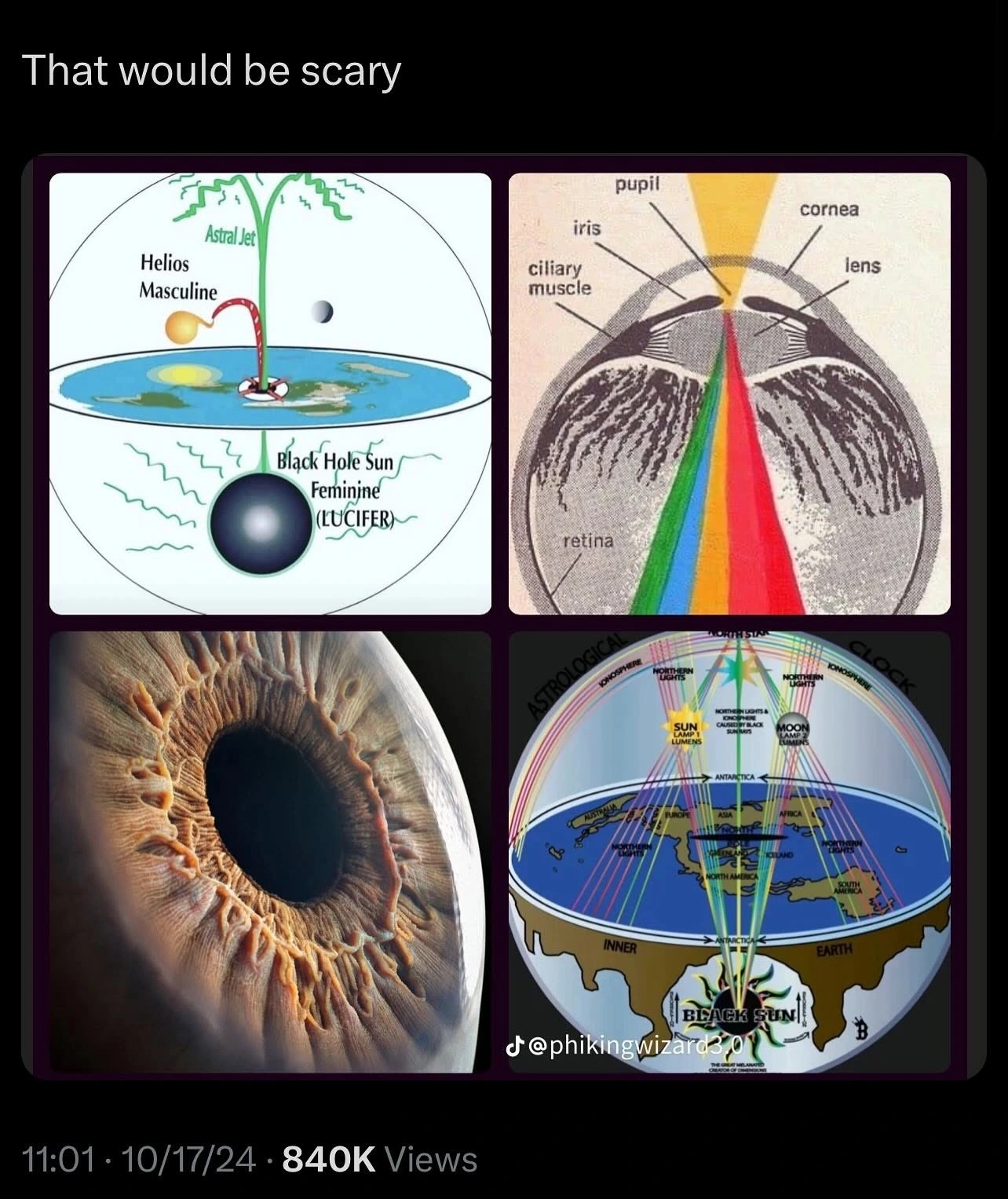
The Pupil, the Iris & the World-as-Eye Analogy
Read each quadrant At upper left, a disc-world diagram places a Sun above and a dark sphere below an axial jet. At upper right, a section of an eye labels pupil, iris, cornea, lens, ciliary muscle and retina. The lower left is a close view of an iris around a dark pupil. The lower right repeats a dome, central axis, celestial lights and a lower black-sun motif. The surrounding social-media frame adds a reaction caption, date and view count. These interface elements describe circulation of the image, not verification of its claims.
Keep the visible parts correctly named The pupil is the opening through which light enters; it is not a black hole. The iris is the coloured tissue around it. The cornea and lens help focus light, and the retina at the back receives it. The close-up shows the front of an eye, not the retina. The coloured fan in the sectional drawing is a simplified graphic and does not mean that a rainbow-shaped structure physically fills the eyeball. The montage invites comparison between a round aperture, surrounding rings and a centrally organised world model.
Reading references: TR10 TR07 TR08
TR-S14 Image index Terra Realm 121 Next image
Arithmetic Signs & Rotated Field-Like Shapes
Read the two layers separately The upper strip is a cropped classroom vocabulary chart for subtraction, multiplication and division, with operator signs and related words. Below it, two red-and-blue wireframe forms are divided vertically into opposite-looking halves. Large black plus-like strokes cover one form; a horizontal bar covers the other. Two lower versions rotate these elements into diagonals. Small circled plus, minus and cross marks sit at the poles. Several panels carry the same social-media handle, which identifies a credited online label rather than a verified original publication.
An operation is not determined by its silhouette Addition, subtraction, multiplication and division act on specified quantities according to stated rules. Turning a plus sign through 45° can make an X-shaped mark, but rotating the drawing does not transform addition into multiplication. A slash may mean division in an equation and a diagonal line in a picture. Likewise, a plus sign can denote a positive electric charge, yet the shape of that sign is a convention rather than the shape of the charge. The image shifts between these meanings without defining the quantities involved.
Reading references: TR17 TR18
TR-S15 Image index Terra Realm 121 Next image
Units and terms
° degree, an angle unit
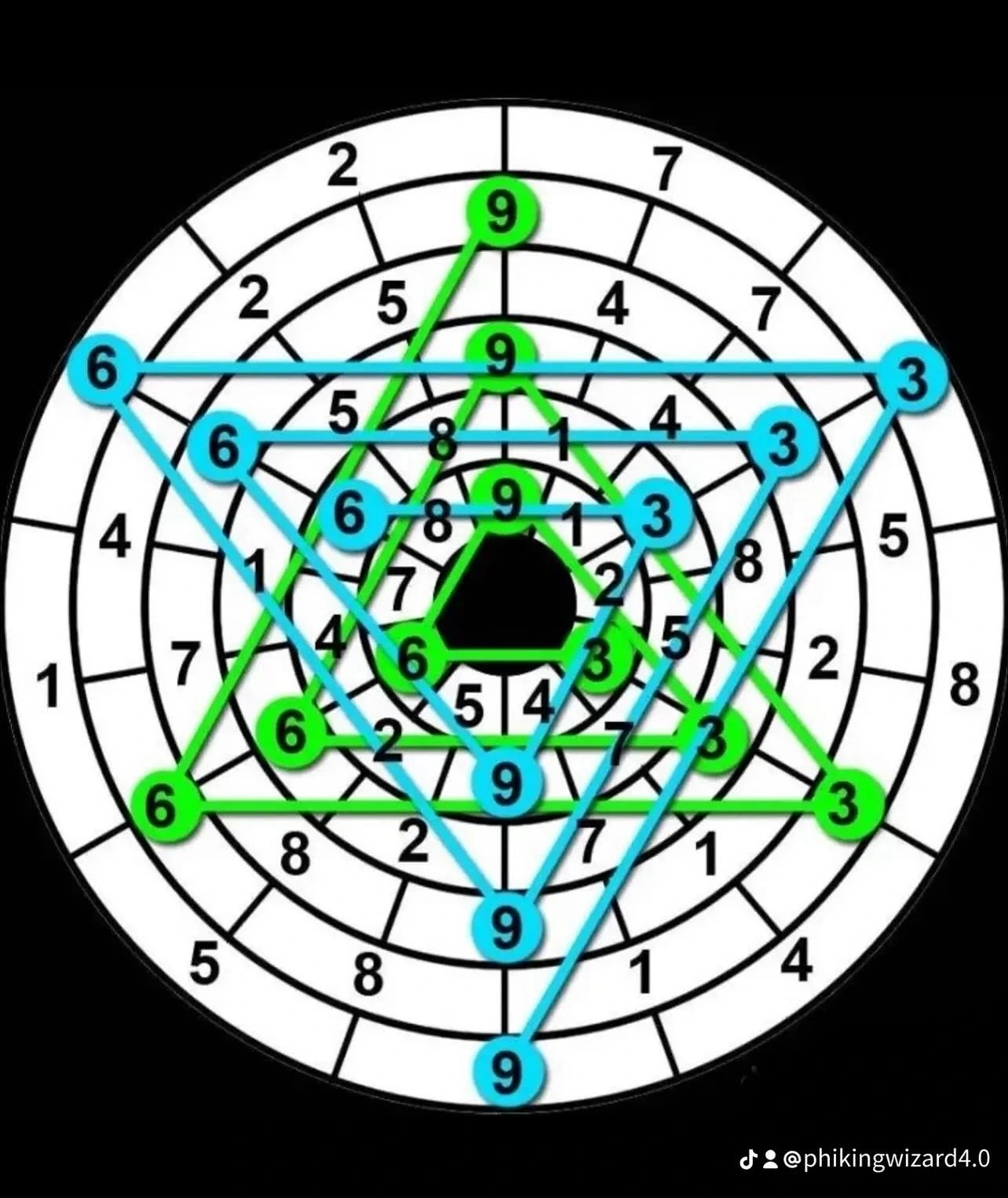
The 3–6–9 Wheel & Decimal Digit Reduction
Trace the coloured framework Concentric numbered rings surround a dark polygonal centre. Green upward-pointing triangles and cyan downward-pointing triangles connect repeated 3, 6 and 9 labels at different radii. Other digits fill sectors between them. The visual emphasis makes the selected three digits appear structurally different from the remaining six. No units, physical apparatus or experimental data are supplied. The diagram is best approached first as an arrangement of numbers and a choice of connecting lines.
Calculate the rule explicitly A decimal digital root repeatedly adds digits until one digit remains: 38 becomes 3 + 8 = 11, then 1 + 1 = 2. For a positive integer n, the result is 1 + ((n − 1) mod 9). Repeated doubling from 1 produces the roots 1, 2, 4, 8, 7, 5 and then 1 again. Starting from 3 alternates 3 and 6; starting from 9 keeps the digital root at 9. Those patterns follow from arithmetic modulo 9. They are not new forces or evidence that three digits govern matter.
Use it, and test its limits Make a two-column record of the unreduced number and its digital root for each doubling. The full numbers continue growing even when their reduced labels repeat. Multiples of 9 have remainder 0 modulo 9, although the positive digital-root convention writes 9; keep those conventions distinct. Digit checks can catch some copying errors, but 18 and 81 both reduce to 9, so a matching root cannot certify a correct calculation. The plate does not explain how every ring was generated, and that missing rule is not invented here. Its useful connection to Terra Realm is cyclic repetition, with the precise mathematical operation made visible.
Arithmetic: see worked number rules
TR-S16 Image index Terra Realm 121 Next image
The Chromatic Wheel: Notes, Intervals & Colour
Read the notes around the rim Starting with A at the top and moving clockwise, the labels proceed A#, B, C, C#, D, D#, E, F, F#, G and G#. They form the twelve pitch classes of a chromatic octave. The interior is a rosette of intersecting coloured arcs. It is not the circle of fifths, which advances by a different musical interval. The uploaded crop slightly cuts the outside of some rim labels. The colours help separate arcs but are not accompanied by measured optical wavelengths or a stated sound-to-colour rule.
Put a measurable scale beside it In twelve-tone equal temperament, each semitone multiplies frequency by 2^(1/12). With the chosen conventional reference A4 = 440 Hz, a note n semitones above A4 has f = 440 × 2^(n/12) Hz. At n = 12, A5 is 880 Hz. At n = 7, E5 is about 659.26 Hz. The note name A on a circle does not specify an octave by itself. The same pitch class can therefore correspond to several frequencies. A tuning system and reference pitch are needed before making a frequency table.
What the rosette can and cannot tell you Use a keyboard or low-volume tone generator to compare adjacent semitones and an octave while checking the selected tuning. Record note, octave, frequency and duration. The internal arcs do not provide enough information to infer chords, loudness, timbre or a composition. Sound in air is a mechanical pressure disturbance; visible light is electromagnetic radiation. A chosen colour mapping can be an artistic or teaching device, but the diagram does not establish a universal correspondence, healing effect or cosmic resonance. The accompanying vector comparison distinguishes chromatic order from fifths and shows why the interval rule matters.
Reading references: TR19 TR20
TR-S17 Image index Terra Realm 121 Next image
Units and terms
° degree, an angle unit
= equals
Hz hertz, cycles per second · = equals · × multiplied by
JPL Jet Propulsion Laboratory, managed by the California Institute of Technology for NASA
Sources for this account
- Antón, Route 71 Trevelin 5 ha antonpatagonia.com
https://antonpatagonia.com/propiedad/chacra-de-5-hectareas-sobre-ruta-71-trevelin/
Source record - Argentina, Sistema Acuífero Guaraní www.argentina.gob.ar
https://www.argentina.gob.ar/jefatura/turismo-y-ambiente/ambiente/recursos-naturales/cuencas-hidricas/sistema-acuifero-guarani
Source record
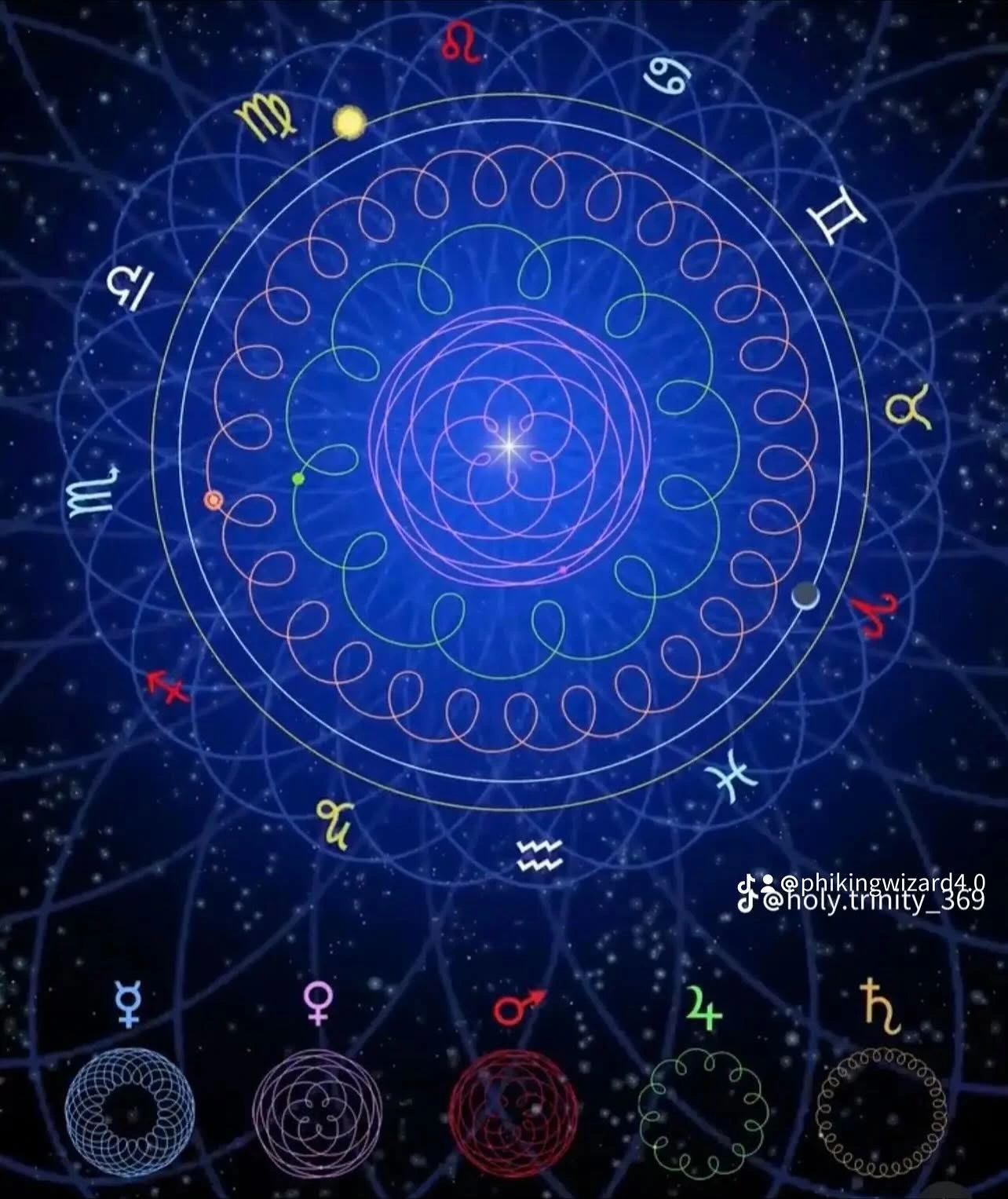
Planetary Loops & the Choice of Viewpoint
Identify the layers Zodiac glyphs ring a luminous centre. Coloured curves make nested loops around it, with small coloured discs marking selected positions. Along the bottom are separate rosettes beneath the familiar symbols for Mercury, Venus, Mars, Jupiter and Saturn. The artwork brings the main curves and the small examples into one visual family. There is no date range, coordinate grid, time interval, viewing position or stated orbital model. It is therefore impossible to recover a unique set of planetary positions from the picture alone.
Why real apparent paths can loop A planet’s apparent path depends on the observer’s location as well as the planet’s motion. Subtracting Earth’s position from another planet’s heliocentric position gives an Earth-relative vector; it does not mean the planet physically follows a little flower-shaped track in space. Real ephemerides also require a reference frame and time definition. JPL Horizons supplies calculated positions with explicit settings and documentation. It is a suitable comparison source once the body, centre, dates and coordinate system have been fixed. The unlabeled curves here are not a substitute for that information.
A reproducible comparison Choose one planet and a fixed span of dates, request the same quantity at equal time intervals, and record the complete Horizons settings with the output. Plot both coordinates using the same distance scale if comparing physical shape. For sky positions, use angular coordinates consistently and state the observer. Connecting widely spaced samples can create artificial corners or erase loops; repeat with a smaller time step to check. Do not compare an angular track to a distance plot as though their outlines must coincide. The plate’s contribution to Terra Realm is its visual vocabulary of cycles and return. Which curves are physically accurate remains unverified until their generating data and assumptions are known.
Reading references: TR21
TR-S18 Image index Terra Realm 121 Next image
Stacked Celestial Rings & the World Axis
Read from the ground upward A bright central beam rises from concentric coloured ground rings through a stack of elliptical patterns. At the right, planetary glyphs accompany the levels: Moon, Mercury, Venus, Sun, Mars, Jupiter and Saturn are visible in ascending order. Higher up, constellation sketches surround a zodiac band and a radiant central mark. A rainbow arch and white interlaced curves cap the scene. The spacing, colours and small triangular ground forms create a sense of layered ascent around one axis.
Understand the diagram’s visual grammar The image uses vertical order to suggest levels, while the ellipses imply circular structures seen obliquely. The beam unifies those levels as an axis, and the lower rings echo the larger enclosure above. This can be read as a symbolic cosmogram of centre, repetition and ascent. The familiar planetary names do not by themselves make it a scale model of the Solar System. The Sun and Moon are included in a traditional seven-body scheme, whereas modern astronomical classification distinguishes a star, planets and a natural satellite.
What is missing for a physical model There are no lengths, orbital inclinations, epochs or speeds. Vertical spacing on the page cannot be converted into planetary distance or altitude, and the coloured rings do not establish atmospheric or geological layers. To compare actual bodies, select a common epoch and frame in an ephemeris, then state whether distance is measured from Earth or the Sun. A separate scale key is required if any distance is compressed. Keep that calculated model distinct from the symbolic stack. This plate extends Terra Realm’s world-axis motif; it is presented as an artwork to interpret, with its physical scale and authorial source unverified.
TR-S19 Image index Terra Realm 121 Next image
Units and terms
JPL Jet Propulsion Laboratory, managed by the California Institute of Technology for NASA
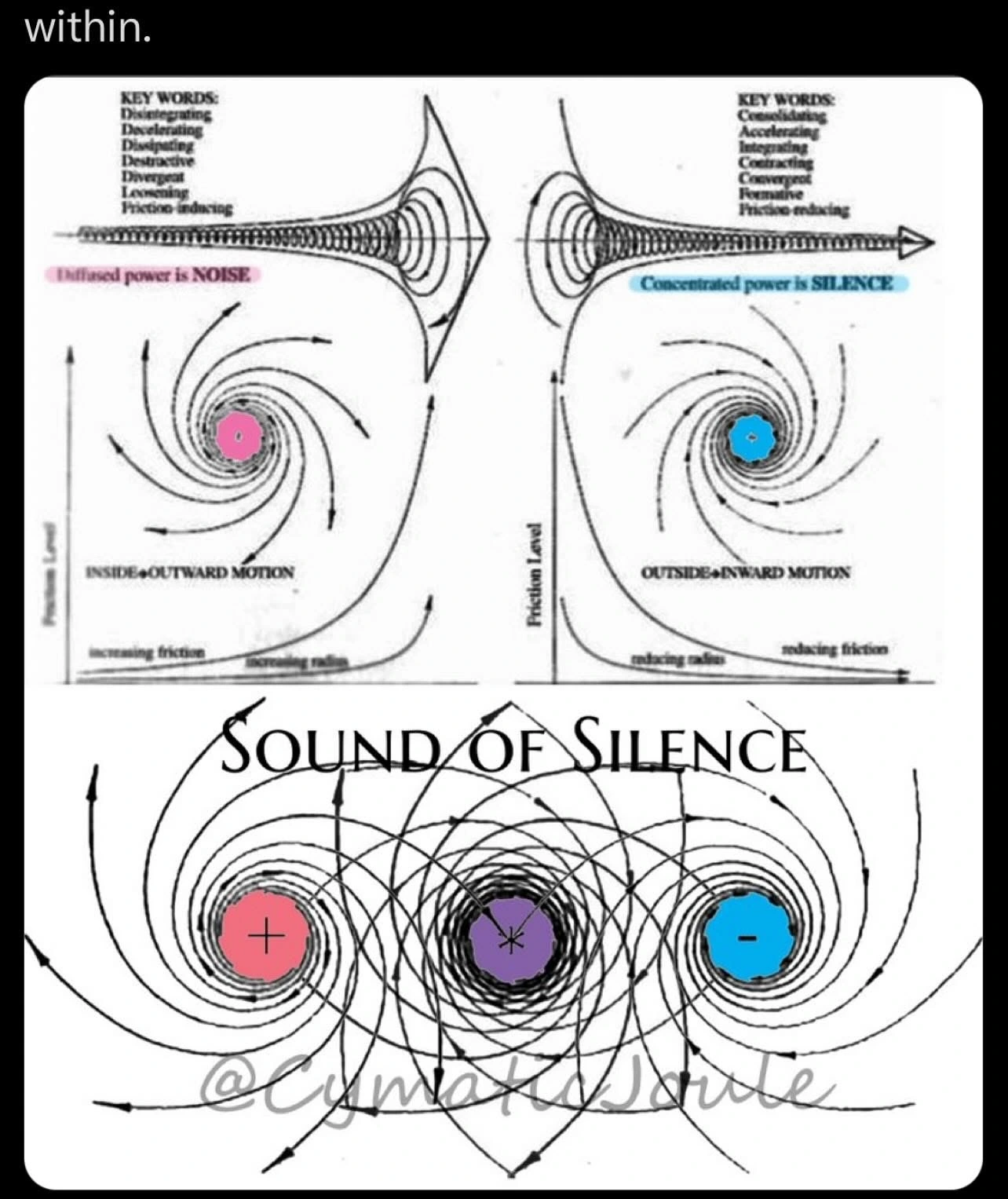
Outward and Inward Spirals: Noise & Silence
Follow the paired columns The upper left pairs an expanding funnel with words about dispersal and destruction; the right pairs a narrowing funnel with words about concentration and generation. The middle row turns those profiles into opposing spirals with arrows. Curves beneath them are labelled with friction and radius. At the bottom, a plus-marked centre, a minus-marked centre and a third central mark sit within overlapping loops under the title Sound of Silence. The design equates outward motion with noise and inward motion with silence.
Explain the claim without adopting its labels Expansion and concentration can describe real processes, but the diagram does not identify what is moving, what exerts a force or what the plotted variables measure. Its friction graphs have no numerical scales, material properties or equations. A spiral arrow can show a direction chosen by the illustrator; it cannot establish a measured relation between friction, radius and sound. The positive and negative signs also shift between electrical-looking symbols and metaphorical opposites without a defined physical quantity.
Use an acoustics comparison instead Sound in air involves changing pressure carried through a material medium. Its presence and level depend on the source, environment and measurement location, not simply on whether a drawn spiral narrows. A useful investigation records the same sound source at stated positions with the same calibrated instrument and settings, while keeping background noise and reflections in view. A phone display without calibration should be treated as a relative indication. Quietness does not demonstrate concentrated free energy, and this image supplies no electrical ratings or circuit. Its artistic connection is the return from many outward motions to a still centre, a recurring theme in the manuscript.
Reading references: TR20 TR18
TR-S20 Image index Terra Realm 121 Next image
The Cosmic Pendulum & a Testable Oscillation
Read the chart from rim to centre Two upper text blocks contrast positive and negative electricity through pressure, contraction and expansion. A central spiral is numbered across its diameter, surrounded by colour words and musical syllables. Lines connect it to a curved row of coloured discs below. The bottom labels pair inhalation with exhalation, contraction with expansion and both with a zero or inertia point. A small dial above repeats the balancing idea.
Place the historical language carefully The title The Cosmic Pendulum is associated with Walter Russell’s The Universal One, catalogued by the Library of Congress as a 1926 publication. The exact edition and later colouring of this uploaded derivative have not been authenticated against a complete original plate. The chart proposes a unified cosmology, using breathing and pendulum motion as analogies for generation and return. Its definitions of positive and negative electricity are not the operational definitions used for electric charge. The words law and periodicity in the artwork do not establish a measured law or a construction specification.
Contrast with a defined pendulum For a small-angle ideal pendulum, T ≈ 2π√(L/g), with length L in metres and gravitational acceleration g in m/s²; T is in seconds. L is measured from pivot to the bob’s centre of mass. A chosen example, L = 0.50 m and g = 9.81 m/s², gives T ≈ 1.42 s. The assumption is a small swing, a light inextensible suspension and negligible damping; this is not a value measured from the collage. Timing several complete cycles tests that model. The cosmic chart supplies no comparable parameters, so it remains a historical symbolic proposal, not a validated universal oscillator.
Reading references: TR22 TR17 TR23
TR-S21 Image index Terra Realm 121 Worked diagrams
Number Patterns You Can Reproduce
Exact row sums, repeating digital roots and the limits of digit checks
Units and terms
m metre, a length unit · m/s² metres per second squared, acceleration · s second, a time unit · = equals · ≈ approximately equal to · × multiplied by
A Chromatic Circle Is Not a Circle of Fifths
Read the illustration’s labels
4
9
2
15
3
5
7
8
1
6
× 2, then
digital root
TR-S22 Image index Terra Realm 121 Sources
Materials and sequence Use squared paper, pencil and a calculator. Copy the nine entries exactly. Add each row, column and diagonal independently. For the second drawing, keep two columns: the full power of two and its reduced digit result. Continue until the six-label cycle returns.
Why the check works In decimal notation, each power of 10 has remainder 1 when divided by 9. A number and its digit sum therefore have the same remainder modulo 9. The repeating labels describe that arithmetic. They do not show the unreduced number repeating.
Limits and useful applications Use the pattern to teach checksums, cyclic order and the distinction between equality and reduction. A changed digit may be detected; rearranged digits may not. Always check the original full-value calculation as well. No physical unit or energy claim belongs to the digit wheel.
Reading references: TR02
Both diagonals also sum to 15.
Total = 45; digit sum = 4 + 5 = 9.
45 and 9 are different numbers.
× 2, then digital root
3 6; 9 reduces to 9 again.
Base 10; positive integers.
The Chiasm Without the Symbolic Overlay
Nasal fibres cross; temporal fibres stay on the same side
Selected retinal pathways
Superior view; anterior at top; subject’s left shown on left
Read the illustration’s labels
midline
LEFT EYE
retina
RIGHT EYE
temporal
nasal
optic chiasm
LEFT OPTIC TRACT
toward relay and visual cortex
RIGHT OPTIC TRACT
Blue: nasal fibres cross.
Gold: temporal fibres stay.
Not all fibres cross.
Signals, not light rays.
TR-S23 Image index Terra Realm 121 Sources
Read the legend before tracing Blue represents selected nasal retinal fibres; gold represents temporal fibres. These colours identify pathways, not the colour of light seen. The pathways shown are a simplified topological explanation, not a surgical map, exact tissue shape or measured cross-section.
Keep the two crossings separate Ray crossing during focusing occurs before the retinal signal. Crossing at the chiasm concerns nerve fibres after the retina. Follow the blue fibres to the opposite optic tract and the gold ones to the same side. The brain hemispheres do not swap positions.
Anatomical limits The human photomicrographic study found distributed crossing regions rather than one neat central X. Only selected routes are drawn here; other projections and detailed relay anatomy are omitted. Use the drawing for pathway concepts, not to diagnose symptoms or infer a medical condition from a symbol.
Reading references: TR11 TR10
midline LEFT EYE
retina
Right eye
retina temporal nasal nasal temporal
optic chiasm
Left optic tract
toward relay and visual cortex
Right optic tract
Blue: nasal fibres cross.
Gold: temporal fibres stay.
Not all fibres cross.
Signals, not light rays.
Units and terms
m metre, a length unit · m/s² metres per second squared, acceleration · s second, a time unit · = equals · ≈ approximately equal to · × multiplied by
= equals · × multiplied by
Hz hertz, cycles per second · = equals
Theosophy And The Subtle Body
Compare one-semitone steps with seven-semitone steps using a stated tuning reference
Read the illustration’s labels
CHROMATIC ORDER
A
A#
B
C
C#
D
D#
E
F
F#
G
G#
+1 semitone
per clockwise step
FIFTHS ORDER
+7 semitones
Chromatic order, clockwise from A: A, A#, B, C, C#, D, D#, E, F, F#, G, G#.
Fifths order, clockwise from A: A, E, B, F#, C#, G#, D#, A#, F, C, G, D.
TR-S24 Image index Terra Realm 121 Sources
Build the comparison Write the twelve pitch classes in semitone order, then number them 0 to 11 from A. For chromatic order, advance one position each time. For fifths order, advance seven and wrap after 11. Both visit all twelve pitch classes, but their neighbour relationships differ.
Listen and record Choose a tuning reference, here A4 = 440 Hz, and use a keyboard or a low-volume tone generator. Compare A4 with E5, then A4 with A5. Record the octave as well as the note name. The calculated values are reference frequencies, not measurements of a particular instrument.
Use the right kind of diagram Pitch-class circles discard octave height. A frequency table restores it. Neither diagram specifies loudness or timbre. Colours in the uploaded rosette are an artistic mapping; a sound-frequency measurement cannot be read as a visible-light wavelength without an explicitly chosen conversion rule.
Reading references: TR19 TR20
A4 440.00 Hz
E5 659.26 Hz
A5 880.00 Hz
f(n) = 440 × 2^(n/12) Hz
n = semitones above A4
12 steps = one octave = 2:1
Equal temperament; A4 = 440 Hz is the selected reference.
From a Cosmic Metaphor to a Measured Period
Pivot-to-centre length, a small swing and timing complete cycles
Read the illustration’s labels
MEASURE FROM PIVOT TO BOB CENTRE
L = 0.50 m
chosen example
10° maximum
weight
Light suspension; compact bob; secure pivot.
Clear swing area. Release without pushing.
CALCULATED SMALL-ANGLE MODEL
angle (degrees) against time (seconds)
-10
0
10
0.00
0.71
1.42
2.13
2.84
T ≈ 1.42 s per complete cycle
g = 9.81 m/s² assumed
T ≈ 2π √(L/g)
TR-S25 Image index Terra Realm 121 Sources
Assemble a simple observation Use a secure support, light non-stretching cord, compact bob, ruler and stopwatch. Measure from pivot to the bob’s centre. Keep the swing area clear. Pull the bob aside by a small angle, here 10° for the drawing, and release without a push.
Count complete cycles Start and stop at the same position and direction of travel. Time 20 full cycles, divide by 20 and repeat. Record the actual length, timing trials and their spread. The graph at left is calculated from chosen values, not observed data and not a prediction for every real apparatus.
Check the failure modes A loose pivot, stretching cord, large swing, air resistance or a bob that is large relative to the length weakens the ideal model. Use the equation only under its stated assumptions. The 0.50 m example gives about 1.42 s per cycle; doubling the length changes period by √2, not by two.
Reading references: TR23
Measure from pivot to bob centre
L = 0.50 m
chosen example
10° maximum
weight
Light suspension; compact bob; secure pivot.
Clear swing area. Release without pushing.
Calculated small-angle model
angle (degrees) against time (seconds)
-10
0.00 0.71 1.42 2.13 2.84
T ≈ 1.42 s per complete cycle
g = 9.81 m/s² assumed
T ≈ 2π √(L/g)
A dated teaching and the printed image used to explain it
Units and terms
Hz hertz, cycles per second · = equals
Hz hertz, cycles per second · = equals · × multiplied by
m metre, a length unit · ° degree, an angle unit · s second, a time unit · m/s² metres per second squared, acceleration · = equals · ≈ approximately equal to
° degree, an angle unit · s second, a time unit · ≈ approximately equal to · m/s² metres per second squared, acceleration · = equals
Sources for this account
- Antón, Route 71 Trevelin 5 ha antonpatagonia.com
https://antonpatagonia.com/propiedad/chacra-de-5-hectareas-sobre-ruta-71-trevelin/
Source record - Argentina, Sistema Acuífero Guaraní www.argentina.gob.ar
https://www.argentina.gob.ar/jefatura/turismo-y-ambiente/ambiente/recursos-naturales/cuencas-hidricas/sistema-acuifero-guarani
Source record
Interpretive animation of the original image. The full sheet and its writing remain visible; choose Show still image to inspect the unchanged source.
The Third Eye In Religious Art
A movement with named authors The Theosophical Society began in New York in 1875 with Helena P. Blavatsky, Henry S. Olcott, William Q. Judge and other founders. Its history includes rival organizations and distinct writers. “Theosophy” therefore does not identify one unchanging diagram or a single ancient anatomical system. [D503]
Interpretive animation of the original image. The full sheet and its writing remain visible; choose Show still image to inspect the unchanged source.
Read the actual plate This is Plate XII from C. W. Leadbeater’s Man Visible and Invisible, the New York edition published by John Lane in 1903. On printed page 98 he connects the blue forms with a nun’s devotional feeling during contemplation. That is his claimed observation. The page does not supply an instrument reading or an independently verified detection. [D505]
How the picture reached the reader The author’s note credits Count Maurice Prozor with drawing and colouring the illustrations, and Gertrude Spink with copying them using an airbrush for photographic reproduction. The object is thus a designed and reproduced colour plate. Its coils, bands and colour choices make Leadbeater’s interpretation visible; they are not photographs of an aura. [D505]
What this record can establish The dated book documents an assertion and its illustration. It does not establish the depicted field’s existence. Keep author, edition, plate and production credit together. That record separates a historical publication from evidence for a physical claim.
PLATE XII 1903 printed image Claimed devotion
1 Repeated bands Claimed pulsation
Blue coils Drawn forms
Outer film A colour boundary 4
Cloud-like wisps Colour interpretation
C. W. Leadbeater, Man Visible and Invisible. John Lane, 1903. Plate XII; explanation on pp. 98-99. Library of Congress scan. A historical illustration of a claim, not a measurement. [D505]
D503 · Society history D505 · Leadbeater, Plate XII Paired reference 424
| Group in this text | Term | Meaning |
|---|---|---|
| Lower four | Rupa / Sthula-Sarira | Physical body |
| Lower four | Prana | Vitality / life principle |
| Lower four | Linga Sharira | Astral double |
| Lower four | Kama rupa | Desire and passion |
| Upper three | Manas | Mind; dual function |
| Upper three | Buddhi | Spiritual soul |
| Upper three | Atma | Spirit |
Keep the classification attached to its source In section VI of The Key to Theosophy, first published in 1889, Blavatsky divides the person into a lower group of four principles and an upper group of three. The table at left follows her sequence on pages 70-71. The consulted transcription reproduces a 1920 edition. Spellings are simplified here for legibility. [D504]
Seven principles are not seven concentric shells Her list includes a physical body, vitality, an astral double, desire, mind, spiritual soul and spirit. These categories do not all describe the same kind of thing. The text treats Manas as having a dual function, drawn toward desire or toward Buddhi. Drawing seven identical rings would erase those distinctions and suggest a spatial measurement that the table never provides. [D504]
Do not merge later pictures into the earlier table Leadbeater’s Plate XII depicts a claimed emotional condition in an astral body. Blavatsky’s table is a classification of principles. Their different authors, dates and purposes matter. A modern diagram assembled from both needs an explicit comparison; it must not be passed off as one original historical chart. [D504, D505]
A usable catalogue entry Record author, edition, term, page and image credit. Distinguish the writer’s meaning from your interpretation. For a measurable claim, require a defined variable, method, units, control and repeatable result. A coloured diagram supplies none of those measurements by itself.
In the drawing: Blavatsky’s classification, with its own terms and limits; THE CLASSIFICATION ON PAGES 70-71 The Key to Theosophy: terms and meanings in this text; a Rupa / Sthula-Sarira Physical body; b Prana Vitality / life principle; c Linga Sharira Astral double; d Kama rupa Desire and passion; e Manas Mind; dual function; f Buddhi Spiritual soul; g Atma Spirit; LOWER GROUP: FOUR UPPER GROUP: THREE; Manas links the two directions in the text: desire and spirit.; The grouping is doctrinal. Positions here are tabular, not bodily.; D504 · Blavatsky, pp. 69-71 D505 · Leadbeater, Plate XII Paired reference 423
Read one identified image before generalizing across traditions
Units and terms
° degree, an angle unit · s second, a time unit · ≈ approximately equal to · m/s² metres per second squared, acceleration · = equals
cm centimetre, 0.01 metre
Sources for this account
- Society history
https://www.theosociety.org/pasadena/ts/tshist.htm
Source record - Blavatsky, pp. 69-71
https://www.gutenberg.org/files/55618/55618-h/55618-h.htm
Source record - Leadbeater, Plate XII
https://archive.org/details/manvisibleinvis00lead
Source record
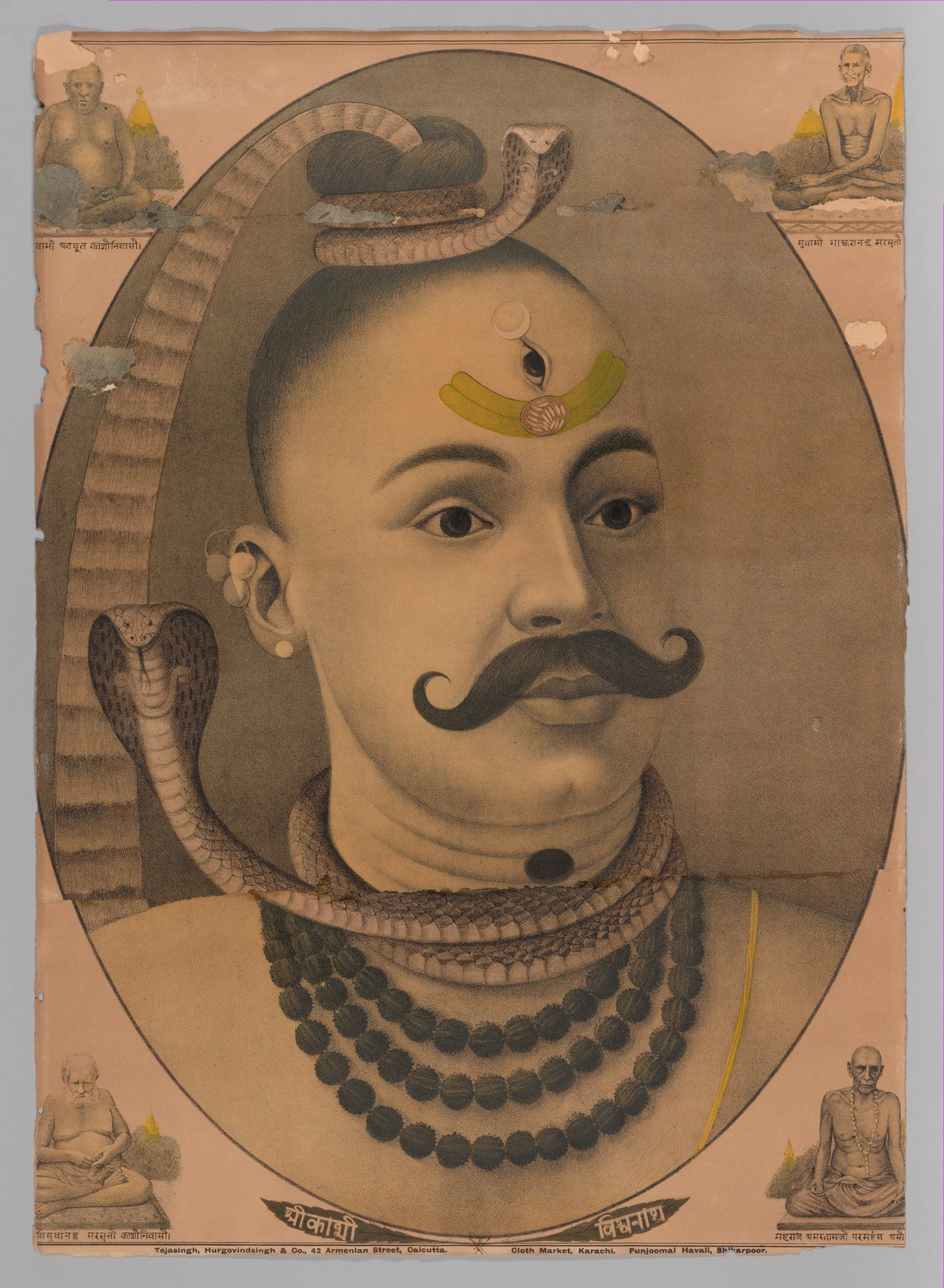
1 Ushnisha Head protuberance
An object that can be checked This Kolkata print, dated about 1880-1900, depicts Shiva as Kashi Vishvanatha. The Met catalogues it as lithograph with watercolor on paper, accession 2016.499.2. Its recorded image size is 50.2 x 35.6 cm. The artist is not identified in the object record used here. [D506]
Several signs on the same forehead The vertical eye and the horizontal forehead bands are separate marks. The museum identifies the bands as tilaka. In Dehejia’s account of Shiva’s attributes, the third eye expresses all-seeing power. Calling every forehead mark a third eye would lose the distinction visible in this very print. [D506, D508]
Follow the image’s own story The museum connects the descending Ganges in the hair with Shiva receiving Ganga, and the throat mark with the poison-swallowing myth. These details belong to a named religious narrative. They are not a diagram of glands, fluid circulation or a hidden physical organ. [D506]
Preserve the object, not just an attractive crop Keep a full reproduction beside any enlarged detail. The edge, lettering, surrounding figures and condition can help a later reader identify the same print. Label a detail as a detail, retain the accession number and cite the collection record. A compelling image becomes useful evidence when another person can recover its context and check your reading.
Vertical eye
Forehead bands Tilaka
Cobra Protective serpent
Throat mark Poison myth
Kolkata, ca. 1880-1900. Lithograph with watercolor. The Met, 2016.499.2. Gift of Mark Baron and Elise Boisanté, 2016. Public-domain image; numbered guides added here. [D506]
D506 · Shiva, Met 2016.499.2 D508 · Dehejia, iconography Paired reference 426
ca., Circa (approximately) Before a date, the abbreviation indicates an estimate of when the object was made or the event occurred. PDF, Portable Document Format A file format used to preserve the layout of a document when it is shared or printed. D + number: Book evidence record The number identifies a source entry in the book’s evidence section. The linked record gives the title, credit or publication details.
Compare the object, the tradition and the claim
The Buddhist comparison This 12th-century Buddha Shakyamuni from Central Tibet is brass with colored pigments, height 39.4 cm, Met 2012.458. The museum identifies the forehead mark as an urna, described in texts as a hair curl. The ushnisha is the head protuberance. [D507]
Keep three categories separate Shiva’s additional eye and this Buddha’s urna belong to different iconographies. Neither object establishes the history of every chakra system, bindi or tilaka. Equating them with an ajna centre requires a particular yogic text and an argument, not merely their shared forehead location. [D506-D508]
Read the gesture with the head The right hand reaches downward toward the earth. The museum connects that gesture to the moment before enlightenment. A hand position, forehead mark and head feature together identify a richer story than a cropped “third eye” alone. The whole object preserves that relationship. [D507]
Why it belongs in a rebuilding library Keep cultural records alongside practical manuals, with their purposes explicit. These images support the study of art and religious history. Claims about a physical organ or treatment require evidence that tests that claim; repeated symbols and visual resemblance do not perform the test.
1 Ushnisha Head protuberance
Urna Forehead mark
Lowered right hand Earth-touching gesture
Buddha Shakyamuni. Central Tibet, 12th century. Brass with colored pigments; height 39.4 cm. The Met, 2012.458. Public-domain image; numbered guides added here. [D507]
Units and terms
cm centimetre, 0.01 metre
Sources for this account
- Shiva, Met 2016.499.2
https://www.metmuseum.org/art/collection/search/722761
Source record - Buddha, Met 2012.458
https://www.metmuseum.org/art/collection/search/78191
Source record - Dehejia, iconography
https://www.metmuseum.org/essays/recognizing-the-gods
Source record
A reading route through the source atlas
D506 · Shiva, Met 2016.499.2 D507 · Buddha, Met 2012.458 D508 · Dehejia, iconography Paired reference 425
A reading route through the source atlas
The atlas follows twentyfour subjects. The source plates preserve the supplied ZeusC marks; historical identifications and unresolved attributions remain distinct. Use the outline to move between chapters, and open the interactive library to search every plate or inspect the original file.
Units and terms
cm centimetre, 0.01 metre
Sources for this account
- Shiva, Met 2016.499.2
https://www.metmuseum.org/art/collection/search/722761
Source record - Buddha, Met 2012.458
https://www.metmuseum.org/art/collection/search/78191
Source record - Dehejia, iconography
https://www.metmuseum.org/essays/recognizing-the-gods
Source record
Images, Beliefs and the Historical Record
Images, Beliefs and the Historical Record
The object before the argument
The opening image in this sequence is a painting, not a map. Its towering central figure, ornamental throne and crowded lower register identify the supplied reproduction as Gustave Moreau’s Jupiter and Semele. That matters because the earlier surrounding paragraph discussed coastlines and printers. A plausible paragraph can still be attached to the wrong object. Here the mistake becomes a useful first lesson: give an image a reliable identity before asking it to support an interpretation. The complete painting appears once in the art chapter; this opening explains how to follow its record.
Several dates belong to one image
The museum dates Moreau’s first sketch to 1889 and the completed painting to 1895; the patron donated it in 1903. None of these dates is the date on which the ZeusC reproduction was assembled. The museum identifies Semele’s fatal encounter with Jupiter in divine splendour and interprets figures around the throne as part of Moreau’s deliberately layered mythology. That is an arthistorical reading of an authored picture. It does not turn the painting into a photograph of a supernatural event. A useful catalogue holds the work’s date, the reproduction’s source and a later caption in separate fields.
Build a small archive that another person can use
Start with one unaltered file and a separate description. Write its visible title, any signature, the collection or publisher, the source address, the date you obtained it and the changes you make. Give an uncertain identity a question mark in the record, not a confident invented name in the picture. If two pages use the same bytes, keep one master and link both discussions to it. If a detail is enlarged, keep its rectangle on a small overview so the reader can return to the whole. A crop is useful when it answers a question; an isolated fragment of type is not a chapter illustration.
Argentina first, then a wider comparison
Apply this habit to a family photograph in Argentina before a famous European painting. A location written on the back, a photographer’s stamp and the testimony of the person who kept it can establish different parts of its history. For a United States collection image, record its catalogue identifier and rights statement. For a European museum work, distinguish the artist from the photographer of the object. Elsewhere, retain the community or institution’s own description alongside a translation. The method travels, but the authority to identify an object stays with evidence about that object.
Images, Beliefs and the Historical Record / working plate
Use a sheet with six ruled columns: object, maker, date, place, source and remaining question. Add a second row for each reproduction or alteration. The aim is not to suppress interpretation. It is to let a later reader recover the path from a material object to a claim. This book’s original images, historical comparisons, new artwork and explanatory diagrams are different kinds of material. Their captions say which kind is being used. A cover creates an invitation; a source plate lets the invitation be checked.
Images, Beliefs and the Historical Record / working plate
A painting, a reproduction, a later claim
Three records belong beside the same image, but they are not interchangeable.
| The composition begins | The painting is completed | A collection history |
|---|---|---|
| Moreau’s first sketch A museum-documented stage | Jupiter and Semele A Symbolist interpretation of myth | The completed work is donated The museum records the object |
Supplied digital reproduction ZeusC mark retained Modern interpretation separately attributed; not evidence of the painter’s intention
Original explanatory drawing · Authorship and sources in the central credits
Words and symbols
- Mandala
- A religious diagram whose arrangement belongs to a particular tradition, text and practice.
- Meru
- A cosmic mountain in several South Asian traditions; its representations vary.
- Kalachakra
- A Buddhist tradition whose name is translated as Wheel of Time.
- 1989.140
- The tapestry's accession number at The Metropolitan Museum of Art.