

Markets, organisations and technology
A share can be listed on Nasdaq or the New York Stock Exchange and still trade somewhere else. Listing identifies the security’s principal exchange relationship; execution identifies where a particular trade happened. A dark pool is an alternative trading system that does not publicly display its orders before execution. Its operator is a broker-dealer subject to securities regulation.
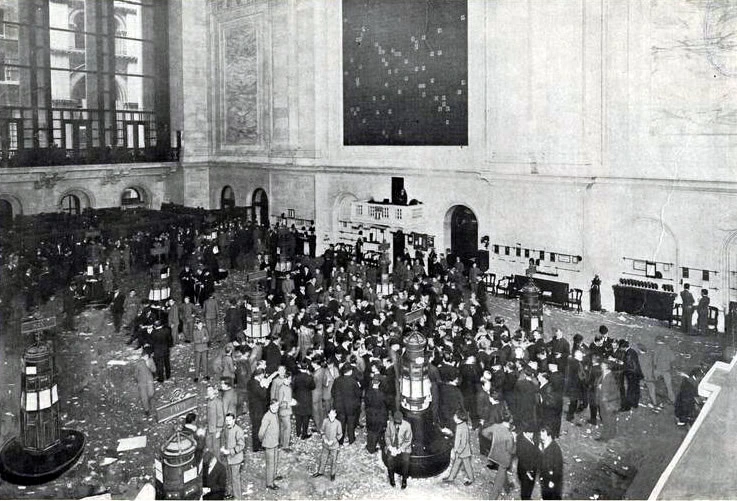
New York Stock Exchange floor, published in 1908; Helen D. van Eaton, via the New York Public Library and Wikimedia Commons. This historical trading floor is not a photograph of a dark pool.
The historical photograph shows people, posts and a shared trading floor. Today, orders can meet through electronic systems in several places. The relevant distinction is what each system displays, who can access it, how it matches orders and how its trades enter the public record. A building’s visibility tells us little about those rules.
Privacy before execution; reporting after execution
Institutions use non-displayed orders to reduce information leakage and the market impact of revealing a large intended trade. A fund selling two million shares does not necessarily crash a stock on an exchange, and a dark pool does not guarantee a fair price or an impact-free execution. Urgency, liquidity, order size and the available counterparties matter.
For listed US equities, off-exchange executions are reported through FINRA facilities and reach the consolidated trade record. That reporting does not reveal every customer’s identity or unexecuted intention. A reported print records an execution, not a hidden investor’s complete portfolio plan.
Many individual investors encounter these systems through a broker’s routing. Some brokers give customers routing choices, while the venue’s access and subscription rules still govern participation. “Most retail investors do not connect directly” is more accurate than “retail traders can never use dark liquidity.”
Read the illustration’s labels
One order, different execution routes
A reporting destination is not an execution venue.
1 Customer order
Quantity + limit / type
2 Broker routing
Duty: best execution
Exchange
Displayed and hidden
order types may exist.
Non-displayed ATS
Subscriber orders
meet under ATS rules.
Non-ATS dealer
Dealer inventory or
onward routing.
Exchange reports
FINRA reporting facility
Receives listed-stock off-exchange trade reports.
Consolidated public trade record
Original route diagram. The reporting route is separate from the execution venue; it is not another purchase of the same shares.
| Route | What happens there | What the name does not tell you |
|---|---|---|
| Registered exchange | Orders execute under exchange rules. Exchanges can also support non-displayed order types. | A listed stock is not confined to its listing exchange. |
| Non-displayed ATS | An alternative trading system matches trading interest without a public displayed order book. | ATS is not a synonym for every off-exchange trade. |
| Non-ATS dealer / wholesaler | A dealer may execute against its own inventory or route an order onward. | A large wholesaler is not automatically a dark-pool venue. |
| Trade reporting facility | Receives reports of off-exchange executions in listed stocks. | The reporting facility is not necessarily where the trade was matched. |
FINRA and the SEC have different roles
FINRA means Financial Industry Regulatory Authority. It is a US self-regulatory organization for member broker-dealers, operating under SEC oversight. The SEC is a federal agency. FINRA does not supervise every trading market in the world, and its US off-exchange data should not be presented as a census of global trading.
An ATS is not a national securities exchange and does not take on an exchange’s self-regulatory role. NMS stock ATSs disclose their operations and conflicts through Form ATS-N. Read the venue’s filing when identifying its order types, subscribers and matching process; a marketing label is not a regulatory classification.
NMS: National Market System. The United States securities-market framework referred to by the ATS disclosure discussion.
Units and terms in this account
US United States · FINRA Financial Industry Regulatory Authority · ATS Alternative trading system
FINRA Financial Industry Regulatory Authority · SEC U.S. Securities and Exchange Commission · US United States · ATS Alternative trading system · NMS National Market System · OTC Over-the-counter · API Application programming interface