

The exploded drawing separates a sink strainer, tailpiece and trap. Understanding how each joint seals prevents several misleading generalisations in the supplied note.
Sink strainer and tubular trap, separated into parts
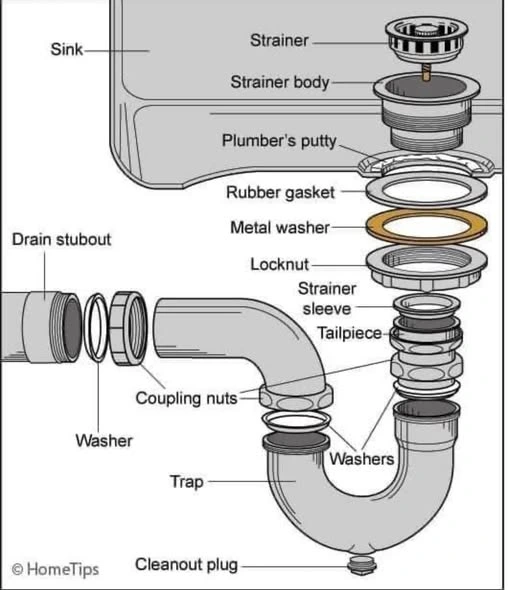
The exploded HomeTips illustration distinguishes the strainer fastening from tubular slip-joint seals. It does not show a complete vent system or establish the slope of the concealed drain.
Follow the drain from the sink
The upper part of the illustration shows the strainer body and the components that fasten it to the sink. The tailpiece carries water down to the trap. Slip nuts and shaped washers join tubular sections, while the outlet leads toward the wall drain.
The strainer-to-sink joint, the connection below the strainer and the tubular slip joints serve different locations and use different sealing arrangements. A gasket or sealant appropriate to one connection is not automatically suitable for another. The drawing does not show the entire building drain or the arrangement hidden beyond the wall. [RD-H-TRAP-OATEY]
The retained water has a purpose
Water left in the curved trap forms a barrier against drain gases. The trap must retain this seal while water flows through the drainage system. Suitable venting helps protect it against pressure changes.
Gurgling or an empty trap can have different causes. The picture alone cannot diagnose them. An air-admittance valve is not a universal substitute for every vent arrangement; its permitted use and position depend on the applicable code and the complete installation. No such complete arrangement is shown here. [RD-H-TRAP-OATEY, RD-H-VENT-IPC]
A washer seal is not a taped thread
In the illustrated tubular slip joints, the nut presses a shaped washer against the mating surfaces. That is the sealing mechanism. Oatey's guidance does not call for thread tape on these slip joints. Adding tape to every threaded-looking connection confuses a washer joint with other kinds of threaded connection.
Excessive tightening can damage a nut, washer or plastic fitting. Parts also need to align without being forced into position. Where metal and plastic meet, the transition must match the fittings and their intended use. The combination is not automatically a case of galvanic corrosion. [RD-H-TRAP-OATEY, RD-H-TRAP-MATERIAL]
Slope belongs to a defined pipe and code
The supplied note quotes a quarter-inch fall per foot as if it covered every drain. Drainage requirements vary with pipe size and jurisdiction. The cited International Plumbing Code is a model-code example, not proof of the rule applicable to this reader's building.
Trap-arm slope, developed length and vent position must be established from the actual installation. A service record identifies the water seal, washer orientation and distinct joints, then records the dimensions, selected components and applicable plumbing requirements. [RD-H-DRAIN-IPC, RD-H-VENT-IPC]
Words, symbols and component names
| Term | Meaning in this chapter |
|---|---|
| P-trap / sifón tipo P | A curved drain assembly retaining a water seal, with an outlet arrangement resembling the letter P in profile. |
| water seal / cierre hidráulico | Retained water that forms a barrier between room air and gases in the drain. |
| slip joint / unión con arandela de compresión | A tubular connection whose nut compresses a washer to make the seal. It is not sealed by adding thread tape to the nut. |
| trap arm / tramo de salida del sifón | The downstream segment connecting the trap toward its vented drainage arrangement; exact limits follow the governing code terminology. |
| AAV | Air-admittance valve. Whether and how it may be used depends on the applicable plumbing code. |
| PVC | Polyvinyl chloride, a plastic material. The particular fitting must still be identified and used with compatible components. |
| PTFE | Polytetrafluoroethylene, a material used in some thread-sealing tapes. It does not replace the washer in a slip joint. |
| slope / pendiente | Vertical fall divided by horizontal length. The required value depends on the pipe and applicable code. |
John Snow's investigation of the 1854 London cholera outbreak connected disease with contaminated water. The distribution of observations mattered more than a clear-looking sample. This is a history of evidence, not a complete modern treatment specification.
D442 · John Snow
D + number: Book evidence record The number identifies a source entry in the book’s evidence section. The linked record gives the title, credit or publication details.
Pump installation reference
Pump Installation Reference
Keep a surface motor out of water The older image appeared to place a surface-style motor in water. That ambiguity is not an installation instruction. Select a pump explicitly rated for surface or submerged service and follow its actual instructions.
Read the illustration’s labels
Soil and rock
Water-bearing formation
Well / monitored point
Measured discharge
Select a rated pump;
separate surface and
submerged service.
A
B
| Key | Small-print annotation |
|---|---|
| A | Analytical drawing. Example quantities are labelled; geometry is not a site survey. |
| B | Concept section only. No well depth, screen size, safe setback or sustainable yield is assigned. |
Specify the duty Record the required flow, static lift, pipe losses, source drawdown and available power. Select from the actual manufacturer curve. Provide intake protection and service access appropriate to that pump.
Component schedule Pump; approved intake or suction assembly; isolation; non-return provision where required; pressure control; dry-run protection; electrical protection; support; drainage and access. Exact assembly follows the selected equipment instructions.
Acceptance record Record model and serial number, measured flow, pressure, supply conditions, leakage, noise and protective-device tests. Do not use a concept picture as a commissioning certificate.
Historical context
In the drawing: Analytical drawing. Example quantities are labelled; geometry is not a site survey.; Soil and rock; Water-bearing formation; Well / monitored point; Measured discharge; Select a rated pump; separate surface and submerged service.; Concept section only. No well depth, screen size, safe setback or sustainable yield is assigned.
D463 · Folsom
Units and terms in this account
PVC Polyvinyl chloride, a plastic used here only where its service conditions permit
= equals · m² square metre, an area unit · mm millimetre, 0.001 metre · L litre, a volume unit · m³ cubic metre, a volume unit · × multiplied by