

Main navigation books and collected sections. The alphabetical index provides the individual people, methods, materials and crops.
 Source page
 Source page
BOOK REFERENCE 919
The Field Herbarium
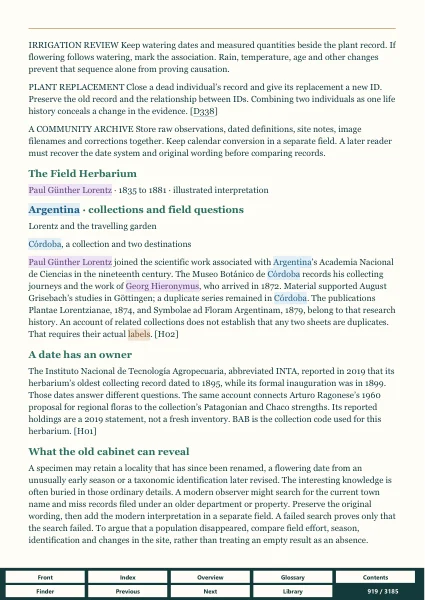
Paul Günther Lorentz joined the scientific work associated with Argentina’s Academia Nacional de Ciencias in the nineteenth century. The Museo Botánico de Córdoba records his collecting journeys and the work of Georg Hieronymus, who arrived in 1872. Material supported August…
Read the account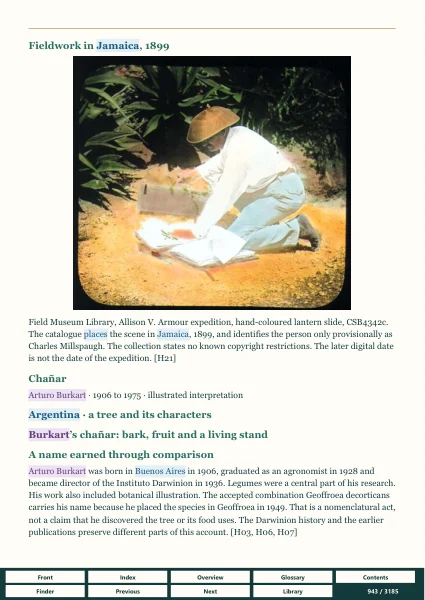 Source page
BOOK REFERENCE 943
Chañar
Arturo Burkart was born in Buenos Aires in 1906, graduated as an agronomist in 1928 and became director of the Instituto Darwinion in 1936. Legumes were a central part of his research. His work also included botanical illustration. The accepted combination Geoffroea…
Read the account Source page
BOOK REFERENCE 974
Chokecherry: the branch, the calendar and the jar
Los Antiguos supplies a useful Argentine comparison precisely because its commercial sweet cherries are not the North American chokecherry. The orchard crop belongs to Prunus avium; this reader’s wild species is Prunus virginiana. A common name connects them in ordinary…
Read the account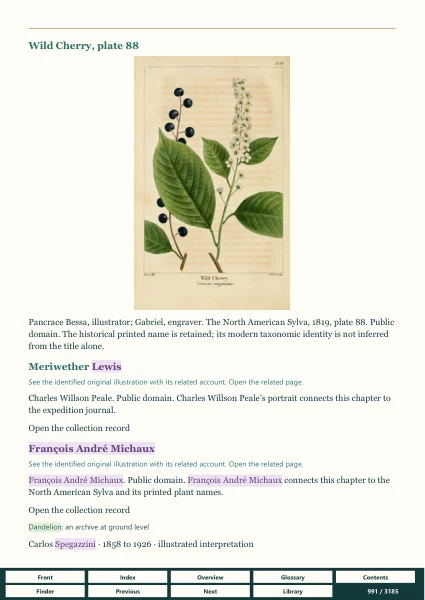 Source page
BOOK REFERENCE 991
Dandelion: an archive at ground level
Carlos Spegazzini arrived in Argentina in 1879 and became closely involved in the scientific life of La Plata. His collections, instruments, books and house were part of the legacy that became an institution. A collection is more than a cabinet of dried plants: it preserves…
Read the account
BOOK REFERENCE 1139
Antarctica: growing the conditions as well as the crop
A vegetable grown through an Antarctic winter carries the work of a whole room: light above the leaf, oxygen around the root, a water supply, mineral nutrients, controlled temperature and people who keep each service working. Fresh leaves can improve a remote station’s meals.…
Read the account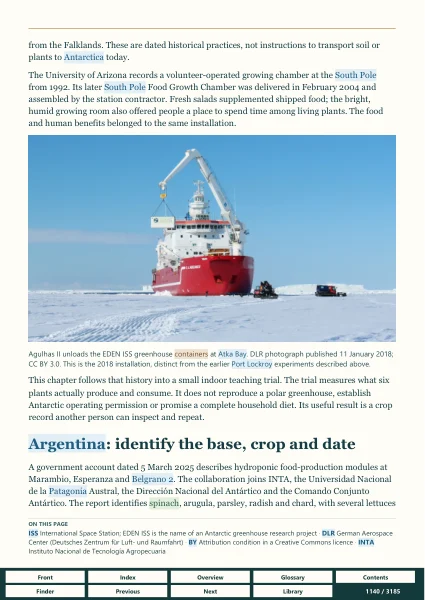 Source page
BOOK REFERENCE 1140
Argentina: identify the base, crop and date
A government account dated 5 March 2025 describes hydroponic food-production modules at Marambio, Esperanza and Belgrano 2. The collaboration joins INTA, the Universidad Nacional de la Patagonia Austral, the Dirección Nacional del Antártico and the Comando Conjunto Antártico.…
Read the account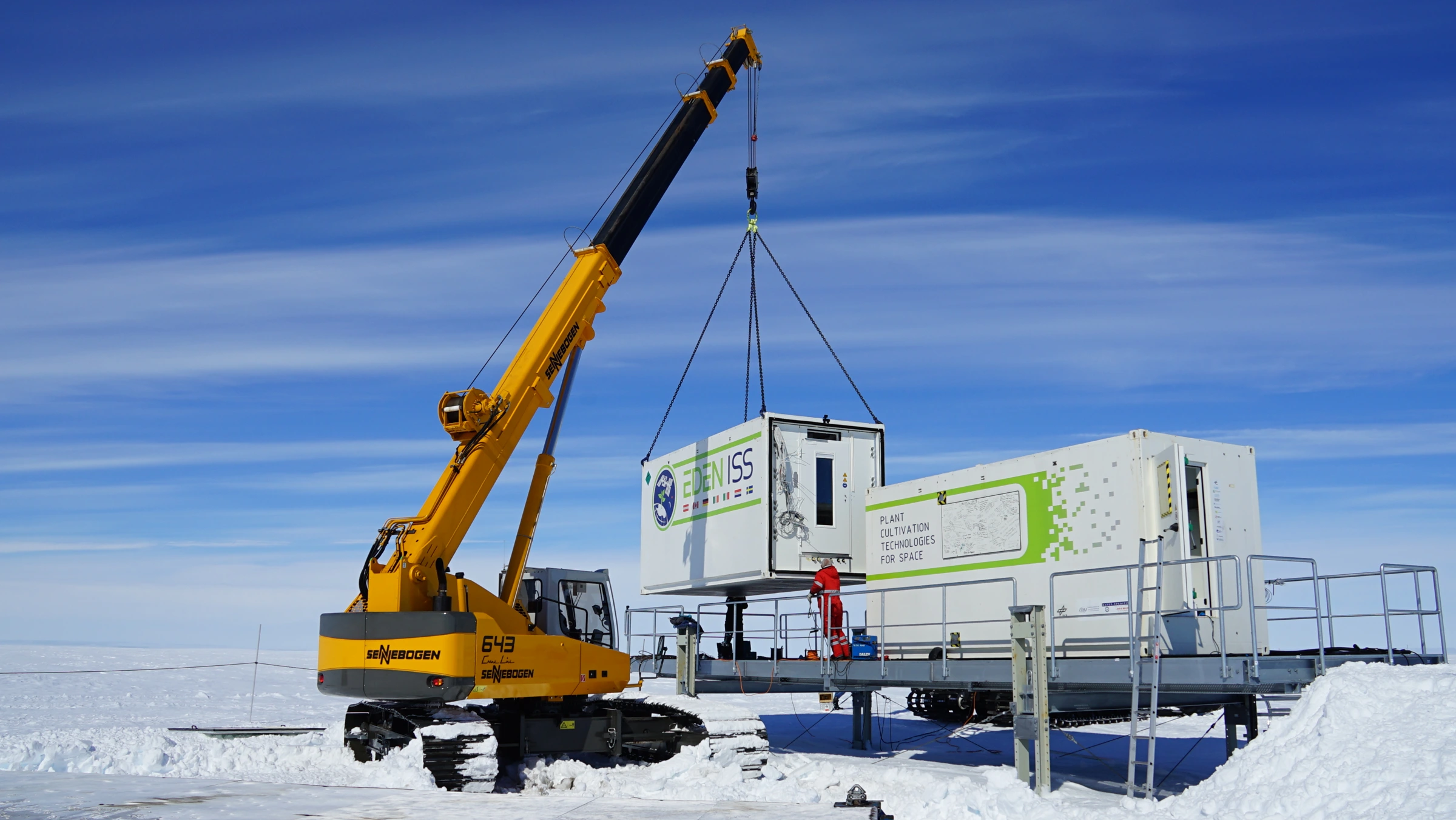
BOOK REFERENCE 1141
The greenhouse arrives as equipment, supplies and work
The EDEN ISS containers travelled by ship and were towed from the landing area to Neumayer Station III before assembly on a raised platform. DLR’s 11 January 2018 account records a roughly 20 km haul from the ship and the installation of racks, nutrient pumps and lighting.…
Read the account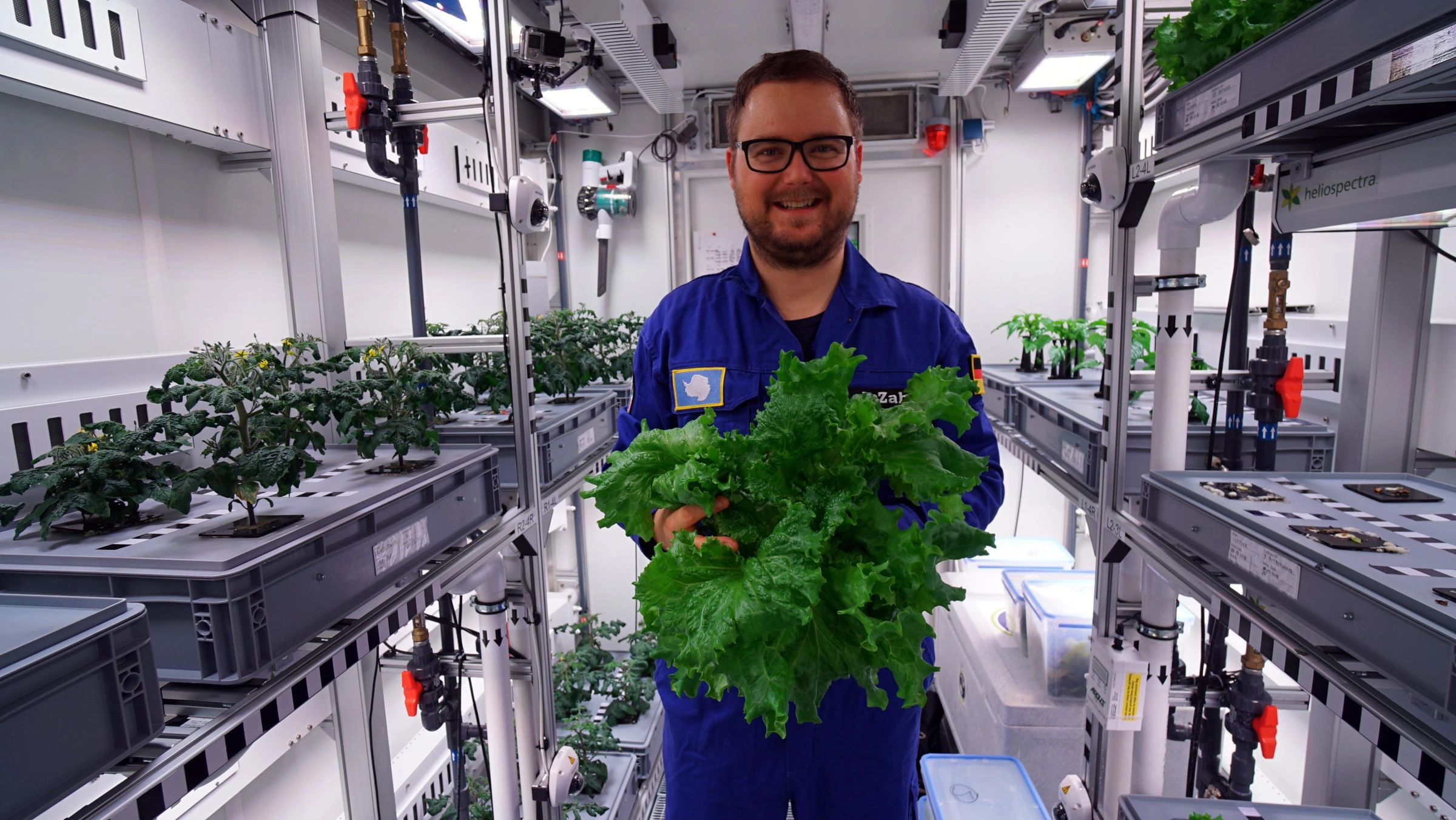
BOOK REFERENCE 1142
EDEN ISS: a harvest with its inputs visible
DLR’s report of 23 August 2019 gives the 2018 EDEN ISS campaign a clear boundary: 268 kg of fresh food from 12.5 m² over nine and a half months. Its named subtotals include 117 kg lettuce, 67 kg cucumbers and 50 kg tomatoes; the remaining harvest included other crops. These…
Read the account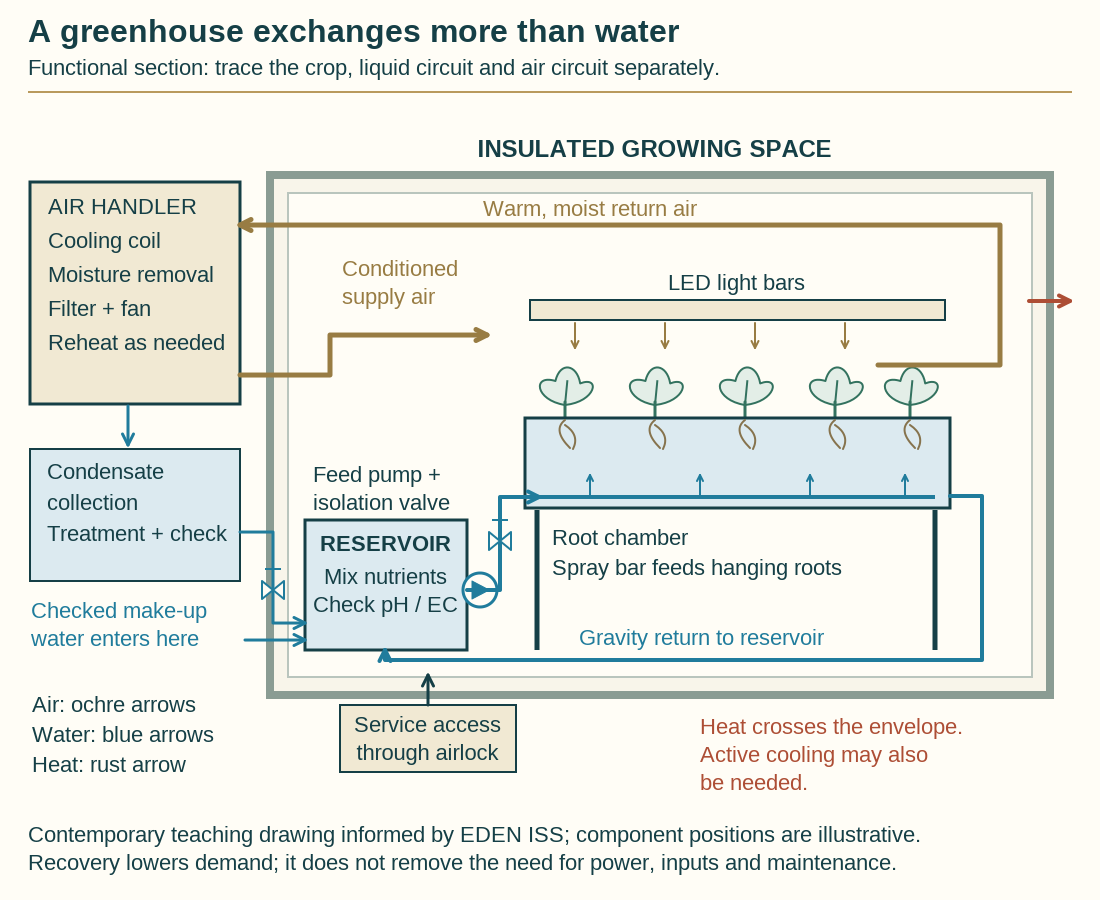
BOOK REFERENCE 1144
Follow each service to the plant
Read the room diagram as a set of dependencies. A green leaf is the visible outcome; several less visible services support it. Give each service an observation and a response. This is an original planning ledger, not a control specification for an Antarctic building.
Read the account Source page
BOOK REFERENCE 1145
Lettuce, spinach and tomato have different jobs
The older regional route names iceberg lettuce, or lechuga capuchina. Keep that named entry distinct from the compact leaf lettuce selected for this trial. Label the seed by its actual type and cultivar; a photograph or a successful leaf harvest does not establish that the…
Read the account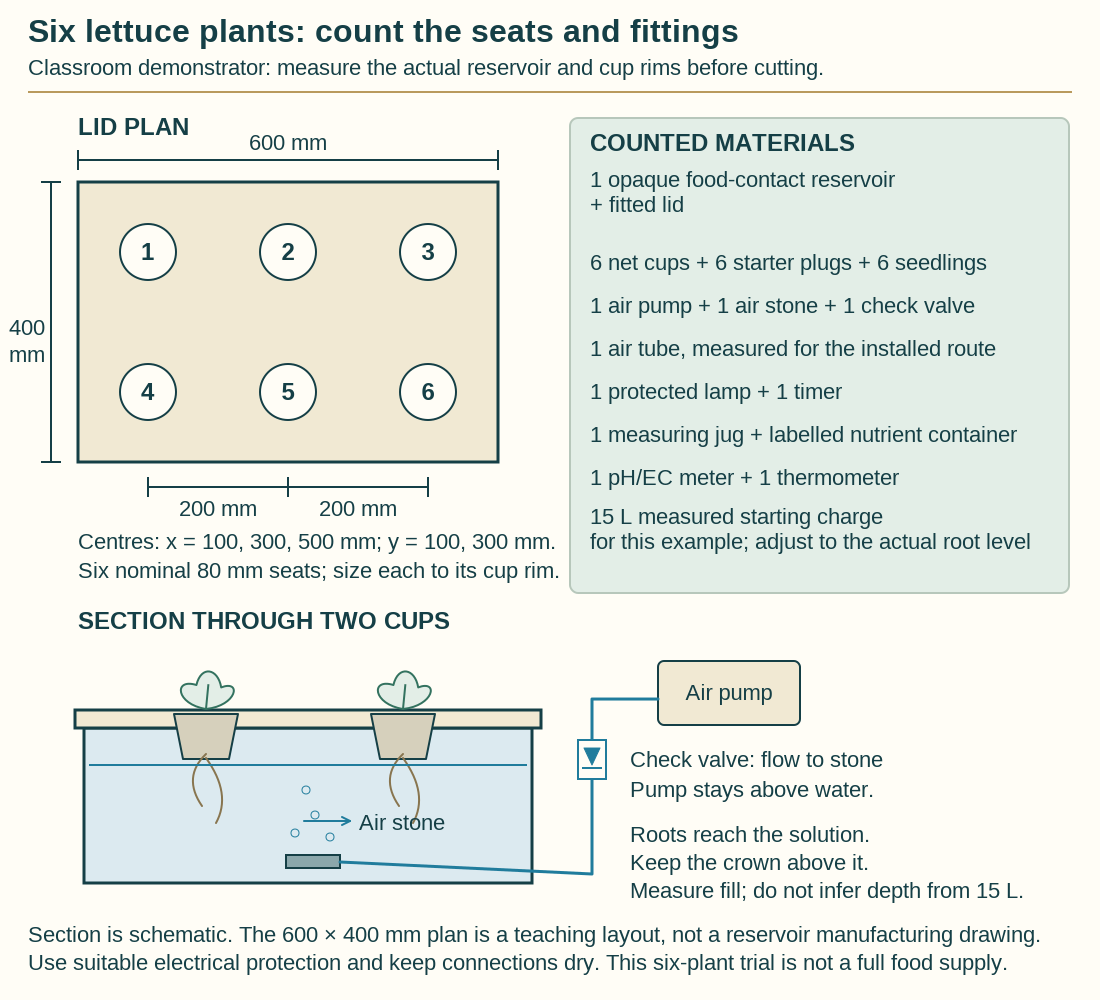
BOOK REFERENCE 1146
A six-plant tray that can be counted
The drawing defines an original classroom layout: a 600 × 400 mm lid with six positions on a 200 mm grid. From the upper-left corner, the centres are at 100, 300 and 500 mm across, with rows 100 and 300 mm down. The nominal 80 mm cup openings must be checked against the…
Read the account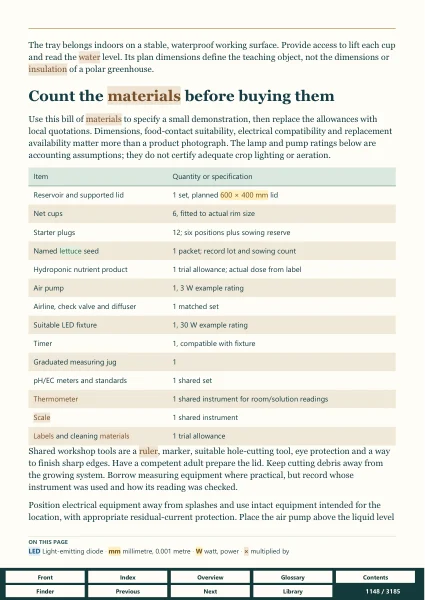 Source page
BOOK REFERENCE 1148
Count the materials before buying them
Use this bill of materials to specify a small demonstration, then replace the allowances with local quotations. Dimensions, food-contact suitability, electrical compatibility and replacement availability matter more than a product photograph. The lamp and pump ratings below…
Read the account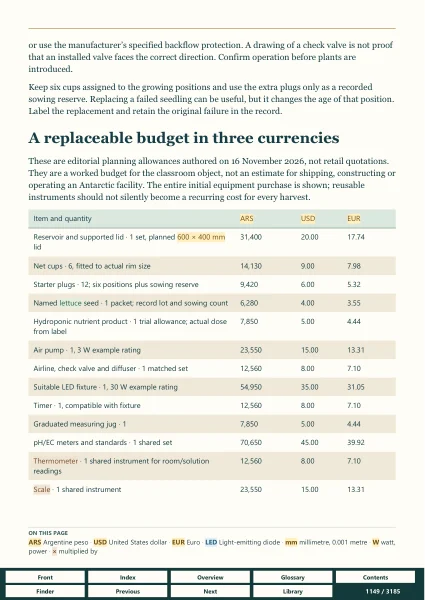 Source page
BOOK REFERENCE 1149
A replaceable budget in three currencies
These are editorial planning allowances authored on 16 November 2026, not retail quotations. They are a worked budget for the classroom object, not an estimate for shipping, constructing or operating an Antarctic facility. The entire initial equipment purchase is shown;…
Read the account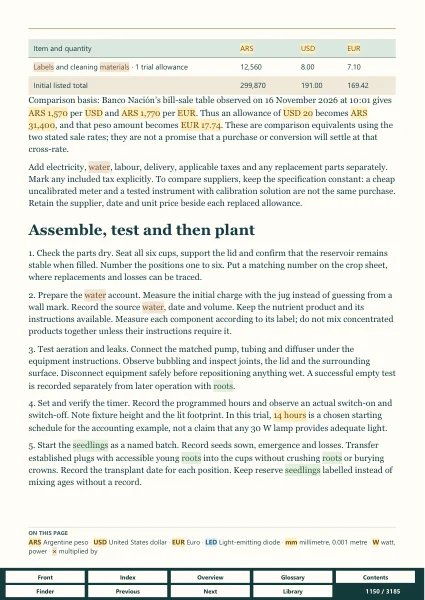 Source page
BOOK REFERENCE 1150
Assemble, test and then plant
1. Check the parts dry. Seat all six cups, support the lid and confirm that the reservoir remains stable when filled. Number the positions one to six. Put a matching number on the crop sheet, where replacements and losses can be traced.
Read the account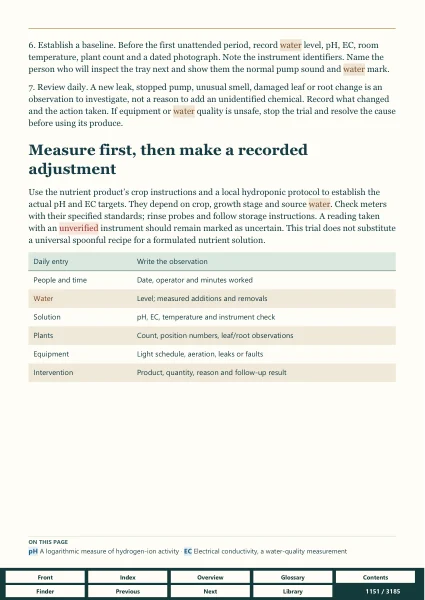 Source page
BOOK REFERENCE 1151
Measure first, then make a recorded adjustment
Use the nutrient product’s crop instructions and a local hydroponic protocol to establish the actual pH and EC targets. They depend on crop, growth stage and source water. Check meters with their specified standards; rinse probes and follow storage instructions. A reading…
Read the account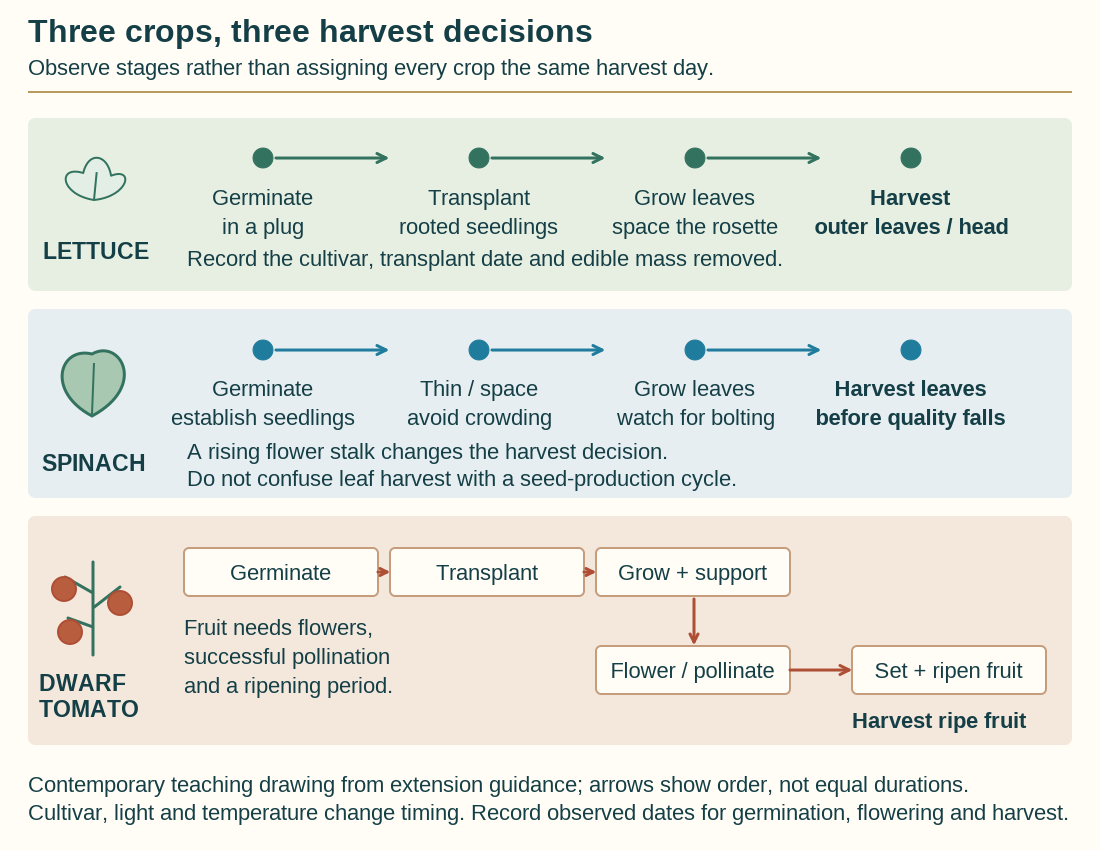
BOOK REFERENCE 1152
Follow a crop stage, not a promised harvest date
Give each sowing batch its own line through the stage diagram. Germination, transplant establishment, leaf growth, flowering and harvest are different observations. Lettuce and spinach may be harvested for leaves; a tomato trial must continue through fruit set and ripening. A…
Read the account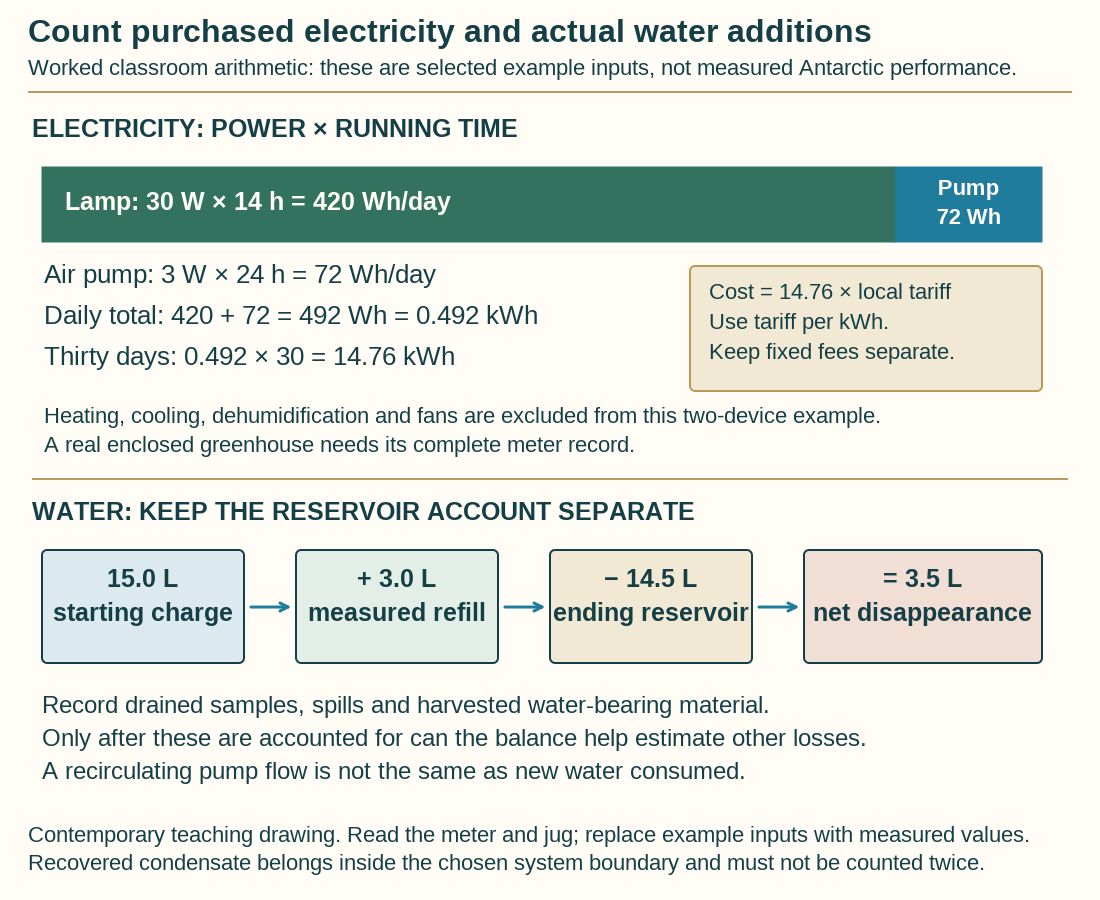
BOOK REFERENCE 1153
Keep water, energy and labour in separate columns
The diagram provides a short daily account and a 30-day electricity total. The worked text below extends the same electrical loads to a separate 42-day trial and closes a different water ledger. These are distinct examples; retain their dates and boundaries rather than…
Read the account
BOOK REFERENCE 1155
Close the crop record before starting the next batch
Choose the harvest container, tare the scale and write the unit before cutting. Record gross harvested mass, rejected material and usable food separately. For a worked example, 1.20 kg collected minus 0.15 kg rejected leaves 1.05 kg usable. The rejected fraction is 12.5% of…
Read the account