

Catchment yield and tank capacity
Check capacity after a real event
Record rain-gauge depth and tank level before and after rain. Note whether the tank overflowed, water was withdrawn or a diverter was active. If it overflowed, the change in stored volume cannot reveal total captured runoff. Repeat on a smaller event that does not fill the tank. Do not estimate a pipe bore or support rating from the picture. The example water mass at 200 L is approximately 200 kg, before the tank and fittings are added; see the inspection sequence on page 374.
Diagram notes
Follow the physical flow
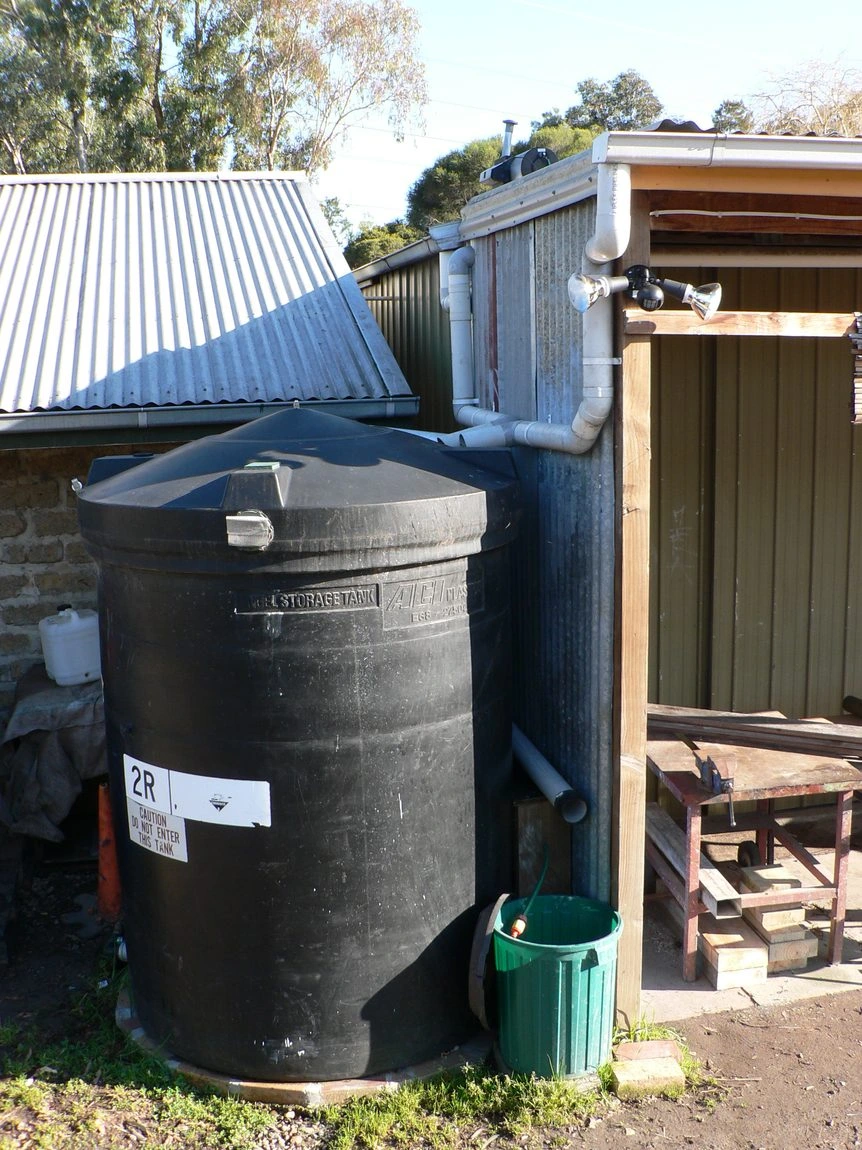
A covered rainwater tank at CERES, Melbourne.
Pengo (catalogue attribution) CC BY-SA 3.0
Top inlet • high overflow • low tap
CERES: Centre for Education and Research in Environmental Strategies The Melbourne environmental education site pictured in the rainwater example.
Collection and rainwater systems
Practical method and reference
Origin and practical purpose
Roof-water collection is a longstanding practice in many climates. The particular system must match roof materials, rainfall, storage, maintenance and intended use. A collection diagram describes hydraulic connections; it does not establish drinking-water quality.
Five applications
1. Garden water: supply permitted non-potable uses.
2. Rainfall accounting: estimate possible collection.
3. Tank sizing: compare inflow with free capacity.
4. Maintenance training: follow water through each fitting.
5. Drought planning: separate stored runoff from drinking supplies.
Ten-step method
1. State the intended use before selecting a roof or tank; distinguish potable and non-potable plumbing.
2. Measure the horizontal catchment area in square metres, not the sloping roof surface guessed from a photograph.
3. Record rainfall depth in millimetres using a local measurement or a clearly identified design source.
4. Inspect roof and gutter materials and contamination risks from a safe location.
5. Specify screening, diversion and maintenance with a qualified local installer; no universal first-flush volume suits every roof.
6. Trace the falling path from gutter to inlet, keeping overflow below any level that could back water into the building.
7. Calculate theoretical volume and state any assumed collection efficiency separately.
8. Measure free tank capacity before the event, allowing for the existing stored volume.
9. Provide a screened overflow route to an appropriate discharge point; keep tank access secure.
10. After rain, compare collected volume with the estimate and inspect leaks, blockages and contamination before use.
Practical method and reference · continued
Rainfall, capture and available storage
Rainwater volume: 20 m² × 10 mm = 200 litres of rain over the catchment. An illustrative 0.80 collection factor gives 160 litres, not a guaranteed yield. If the tank has only 90 litres of free space, at least 70 litres of that estimated inflow cannot be stored. The factor is a planning assumption, not a purity measure or a prescribed roof specification.
Limits and failure checks
Do not connect untreated runoff to drinking-water plumbing. A full 1,000-litre tank contains roughly one tonne of water before adding tank mass; foundation and restraint design need appropriate assessment.
Measuring tap flow
Read the illustration’s labels
Tap flow: volume and elapsed time belong together
Air gap
0.50 L collected
10 seconds
0.50 L ÷ 10 s × 60 s/min = 3.0 L/min
| Quantity | Stated example |
|---|---|
| Collected volume | 0.50 litre |
| Elapsed time | 10 seconds |
| Flow per minute | 0.50 ÷ 10 × 60 = 3.0 litres/minute |
The vessel must catch the whole flow during the timed interval. Record the tap setting and repeat only as needed for a reliable operational measurement. Flow varies with pressure and fixture setting. Conservation decisions must preserve drinking, hygiene and care needs.
Units and terms in this account
m² square metre, an area unit · mm millimetre, 0.001 metre · L litre, a volume unit · kg kilogram, a mass unit
CERES Centre for Education and Research in Environmental Strategies, Melbourne · BY-SA Creative Commons Attribution-ShareAlike
m² square metre, an area unit · mm millimetre, 0.001 metre · = equals · × multiplied by
L litre, a volume unit · s second, a time unit · = equals · × multiplied by · ÷ divided by