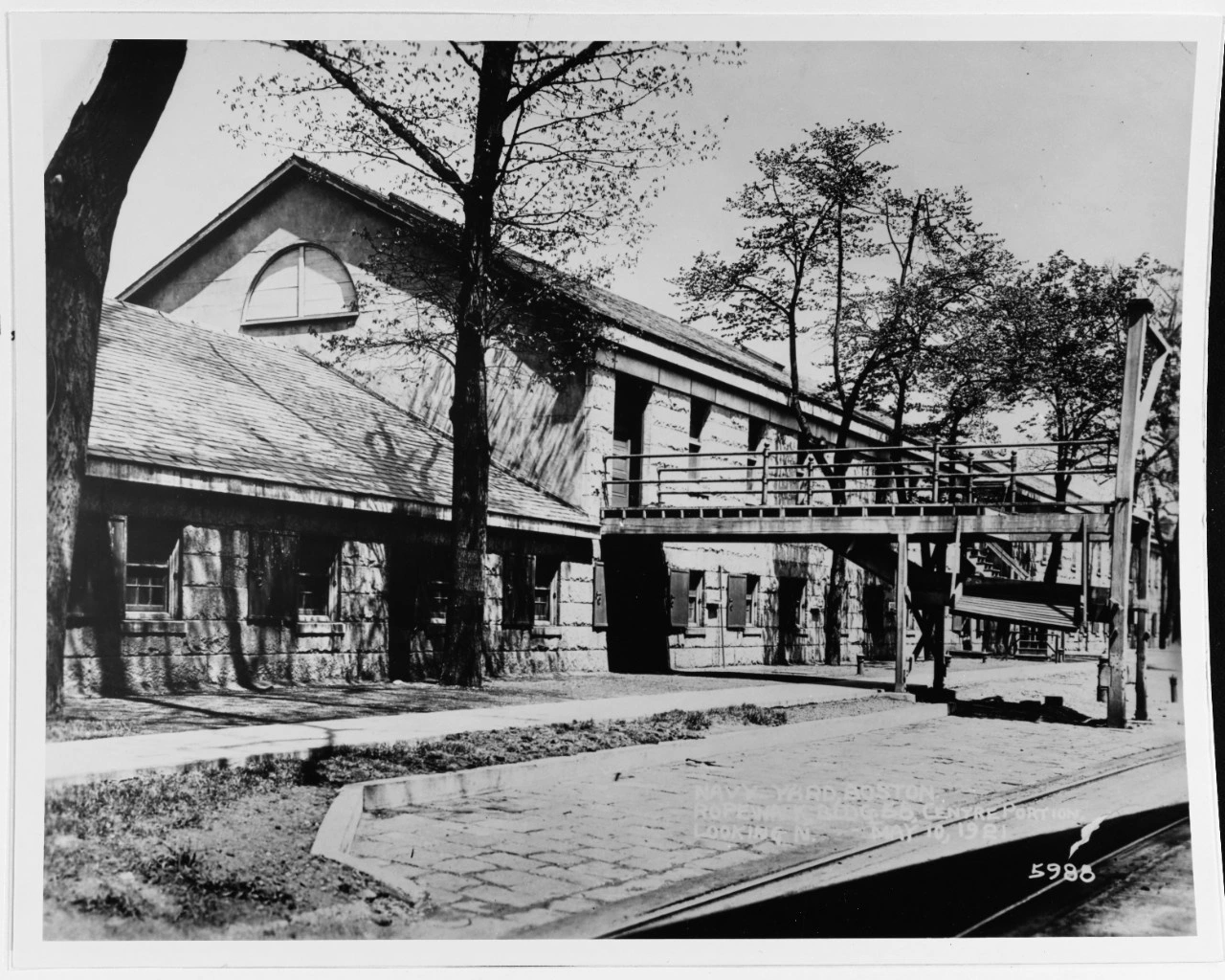
Charlestown Navy Yard Ropewalk, looking north · Naval History and Heritage Command, reproduced by National Park Service · 10 May 1921 · United States Navy historical photograph
The Ropewalk at the Charlestown Navy Yard opened in 1838. The National Park Service identifies architect Alexander Parris and machinery designer Daniel Treadwell. The building extended 1,325 feet so workers could make continuous lengths of rope. A Navy photograph dated 10 May 1921 shows the long exterior looking north. The view is a record of the building at that date. It also helps explain a basic constraint of production. A long finished line begins as still longer yarn laid out along a continuous working path.
The yarns in each strand and the strands in the finished rope follow opposing helical directions. Each helical path is longer than the finished axial length. The shortening depends on the material and the lay. A small specimen does not establish a working-load rating.
National Park Service · Charlestown Navy Yard Ropewalk
Argentina and the United States, followed by Europe and other documented traditions.
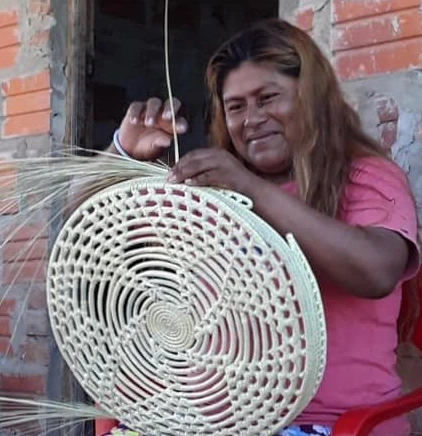
At Estanislao del Campo in Formosa, Pilagá basket maker Micaela Sosa learned from her mother and began making baskets at twelve. In the account published by the Museo de Arte Popular José Hernández, the making of a piece begins well before the first round. Women go out together for the central leaves of the carandillo palm. They separate the leaf material and dry it in the sun. The availability of suitable leaves depends in part on access to land. A notebook that records only weaving time would miss both the journey and the work needed to turn a leaf into material that can be handled.
Museo de Arte Popular José Hernández. Pilagá maker profiled: Micaela Sosa. Photographer unlisted. Date of exposure unrecorded
From carandillo leaf to sewn coil
Central palm leaves supply the strips. Separating and drying the leaf precede the basket work. The museum account distinguishes open twisted work from sewn bundles joined with a greener strand of the same fibre. The weave and the material preparation are separate stages.
Micaela Sosa’s account is recorded by the Museo de Arte Popular José Hernández. [QR-SOSA]
Sources for this account
Micaela Sosa, Pilagá basket maker
Museo de Arte Popular José Hernández, Buenos Aires Ciudad. The maker’s account identifies Estanislao del Campo, Formosa, learning from her mother and starting basket work at twelve. The material account describes the collection and sun-drying of central carandillo leaves. No photograph licence or exposure date is inferred. Access checked 22 November 2026.
Argentina begins this account with the Pilagá maker and carandillo described on the preceding page. A basket carries knowledge of a plant, permission to gather it, preparation, hand tension and a community’s way of teaching. An over-and-under diagram identifies one structural pattern. It does not establish how a particular photographed basket was made.
Two surviving objects, two different records
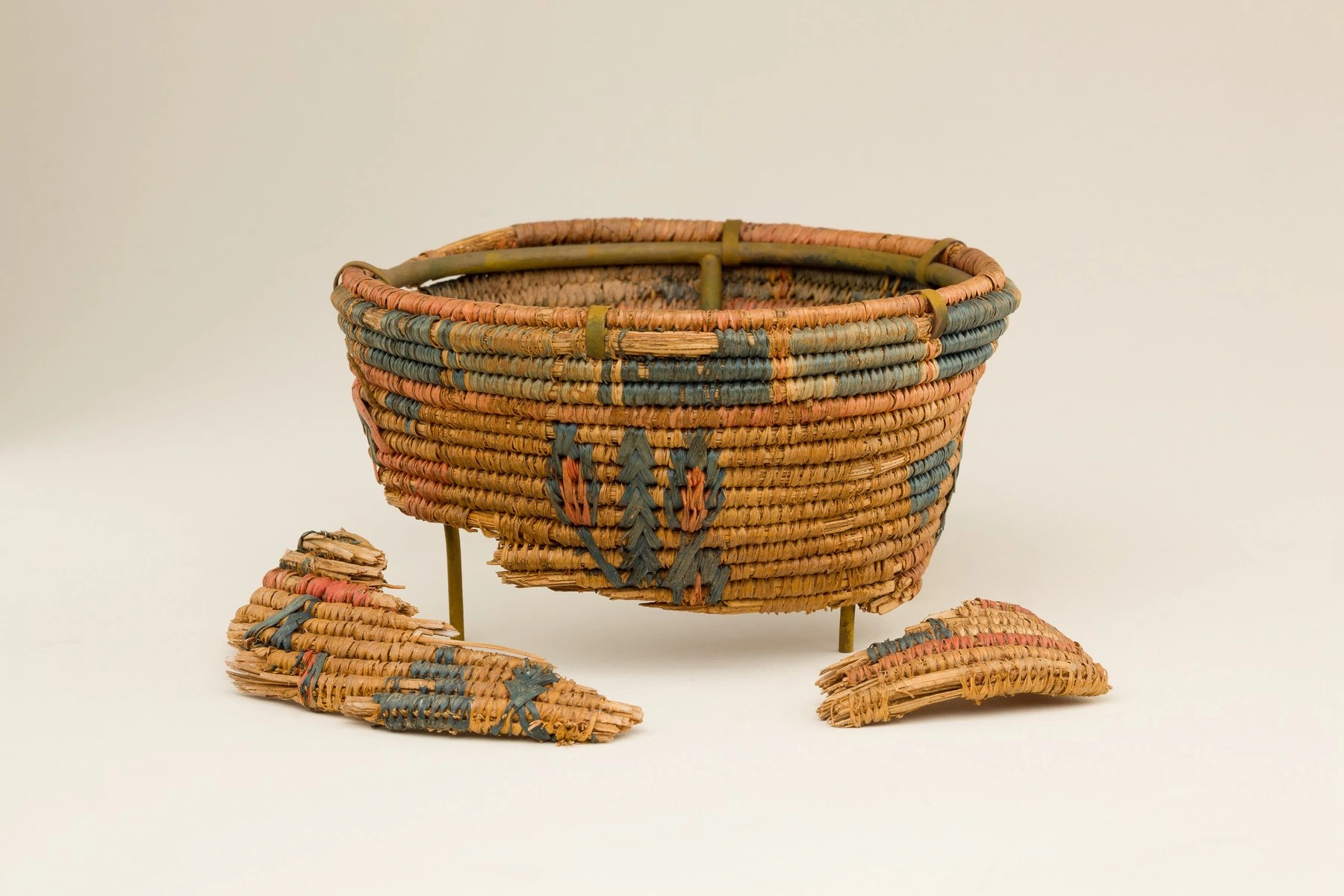
A surviving basket from el-Khokha, Thebes, Egypt. The Metropolitan Museum of Art, 28.3.24; palm and grass; Ramesside period, about 1300-1080 BCE. Museum photograph, public domain. This is a photograph of the surviving object, not a photograph taken in antiquity. [W01]
The Egyptian basket was recovered from the forecourt of tomb 832 during the museum’s 1911-1912 work. Its restored height is 14.5 cm. The record connects plant material, archaeological place and a dated excavation; it does not identify its maker or provide a complete workshop recipe. Read the direction of the visible strands, then mark which parts of the base, rim and repairs are uncertain. Do not fill those gaps by borrowing a method from another culture. [W01]
Basket with cover, about 1840, Maine, United States. The Met, 2011.154.29a,b; ash splint, wood and pigment. The collection tentatively identifies Passamaquoddy manufacture. Maker unrecorded. Museum photograph, public domain. [W02]
The Maine object is a much larger lidded container, catalogued at 36.8 × 61 × 38.1 cm. Its broad wood splints, shaped cover and decorated surface create a different set of questions from the Egyptian object. The question mark in the museum’s cultural attribution matters. A caption must not convert it into certainty.
Ash-basket making also involves preparing material before interlacing; the Hudson Museum’s account places those operations within a living tradition. [W02] [W03]
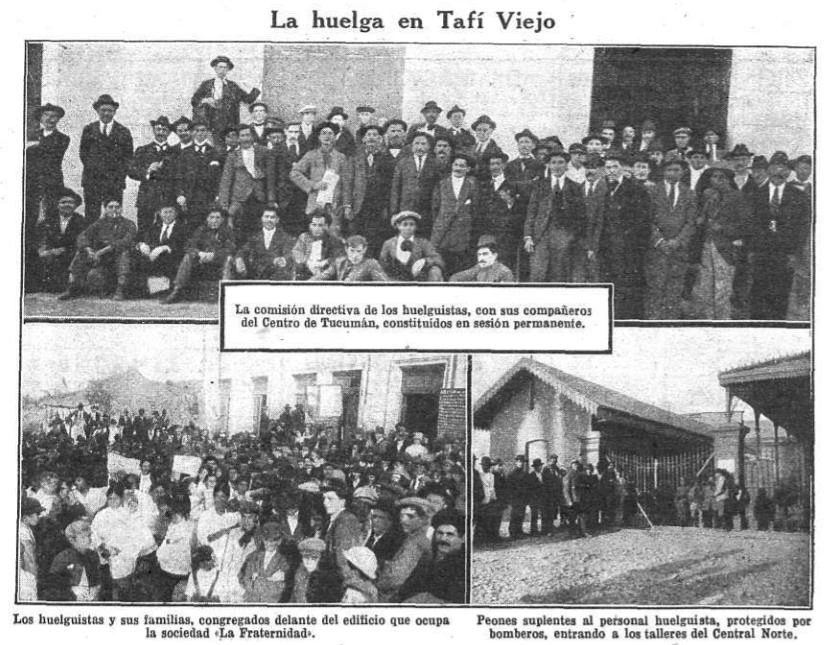
Railway workshop scene reproduced in Caras y Caretas, no. 980, 14 July 1917, p. 62; reproduced and discussed by Silvana Palermo. Individual photographer not identified in the consulted record. Period publication, public domain in the United States; other jurisdictions require their own assessment. [W04]
The 1917 image belongs to the history of railway labour and the strike examined by Palermo. It is not a modern furniture lesson. Look for the space, work positions and material handling it actually records. A photograph cannot tell us the tolerance of a repaired part, the full job sequence or what happened outside its frame. Those details need a drawing, an inspection record or a further historical source. [W04]
Living willow shoots in the Paraná Delta · Instituto Nacional de Tecnología Agropecuaria, Argentina
In the Paraná Delta, fruit harvesting and transport gave basket makers a reason to seek rods that were long, flexible and reasonably uniform. Argentina’s Instituto Nacional de Tecnología Agropecuaria (INTA) traces the expansion of willow basketry there to the fruitgrowing economy of the first half of the twentieth century. A basket had to move fruit from tree to collection point and onward. Rods that broke at a tight bend cost effort already invested in cutting, sorting and weaving. The properties of the plant therefore mattered to growers and carriers as well as to the hands shaping the container.
The institute’s report also describes work on selecting willow material. Its contemporary photograph shows living shoots, an earlier stage than the weaving visible in the book’s inherited basket illustration. Follow one rod through the drawing from the growing stool to the sorting bench. Length determines whether the maker must join a strand partway through a round. Taper changes the diameter presented to the weave. A split or a scar can influence the decision to bend, trim or set a rod aside. The photograph and diagram support this sequence at different scales. The earlier book illustration can show how uprights and horizontal strands meet without establishing the origin of the depicted plant.
INTA · Instituto Nacional de Tecnología Agropecuaria Argentina’s national agricultural technology institute, which reports the willow and chaguar work.
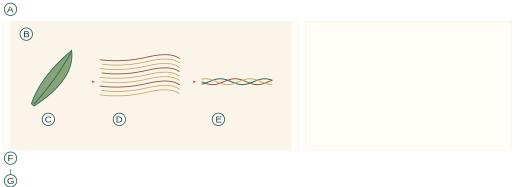
From a chaguar leaf to a length of thread
Read the illustration’s labels
A
B
C
D
E
F
G
Key
Small-print annotation
A
A photograph of fibre separation puts the work before weaving back into the story.
B
Leaf, fibre and twist
C
Leaf
D
Separated fibres
E
Twisted thread
F
DRAWING
G
Separation exposes fibres. Bundling and twist make a working thread with different possibilities from a willow rod.
In the drawing: A photograph of fibre separation puts the work before weaving back into the story.; Leaf, fibre and twist; Leaf Separated fibres Twisted thread; DRAWING Separation exposes fibres. Bundling and twist make a working thread with different possibilities from a willow rod.
In Nicolás Heredia’s photograph from Paraje Pozo del Toba, Chaco, hands separate material from a fresh chaguar leaf. The accompanying Argentine cultural record describes collective gathering, separation of fibres, beating, drying, dyeing and spinning. The moment photographed comes early in a much longer process. A single image of a completed bag could hide these transformations altogether. Distinguish the green leaf, the isolated fibres and the continuous thread produced by joining and twisting them. Each is a different working material with a different length, flexibility and response to tension.
A separate account locates a specific exchange of expertise at Ingeniero Juárez in Formosa. In March 2025, Wichí artisans representing seventeen communities in Formosa, Salta and Chaco attended training on chaguar cultivation. Bringing these sources together requires keeping their identities straight. The location of Heredia’s photograph does not identify its subject as one of those participants. The later record documents who met, where, and the plant resource under discussion. Read the two alongside the Delta willow study. Willow rods become stakes and weavers with much of their stem structure intact. Chaguar passes through a fibre and thread stage, allowing a maker to build a flexible textile by a different sequence of gestures.
Separate material, maker, place and usable volume in the working record.
Read the illustration’s labels
15 cm
10 cm
20 cm
Inside top radius
Inside base radius
Usable depth
About 9.95 L
In the drawing: 15 cm; 10 cm
Invented teaching measurements · circular frustum model
A willow rod keeps its shape as the maker bends it. A chaguar leaf yields fibres that can be spun into thread. The earlier Book IV readings document those materials in the Paraná Delta and the Argentine Chaco. The photograph in this reading comes from the Museo de Arte Popular José Hernández’s feature on Pilagá basket maker Micaela Sosa. Loose strands on the partly worked bodies show a stage of construction. Record the maker’s account before interpreting them as wear or damage.
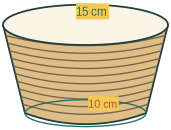
For a capacity trial, measure the inside base, inside opening and usable depth. A circular frustum with a top radius of 15 centimetres, a base radius of 10 centimetres and a depth of 20 centimetres has a calculated volume of about 9,948 cubic centimetres, or 9.95 litres. The new drawing identifies these invented teaching dimensions. Curved walls, handles, uneven contents and space below the rim change the usable capacity. Keep the trial measurement beside the calculation.
A catalogue can preserve the photographer’s name while leaving a maker unidentified.
B
How a binding stitch holds a coil
C
Growing foundation
D
Stitches bridge rounds
E
DRAWING
F
ORIGINAL PICTURE / OPEN TO ENLARGE
G
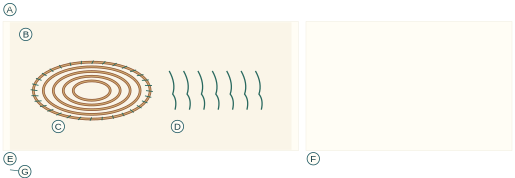
In a coiled structure, a stitch binds the growing foundation to the preceding round.
The basket maker · C. D. Nichols, Reno. Library of Congress
In the drawing: A catalogue can preserve the photographer’s name while leaving a maker unidentified.; How a binding stitch holds a coil; Growing foundation Stitches bridge rounds; DRAWING In a coiled structure, a stitch binds the growing foundation to the preceding round.; ORIGINAL PICTURE / OPEN TO ENLARGE
The Library of Congress holds a photograph titled The basket maker, credited to C. D. Nichols of Reno and copyrighted in 1904. A seated woman works near the entrance of a building with baskets and materials in view. The catalogue connects the subject to the Great Basin. It leaves her personal name unrecorded. A reader can still examine the working posture and arrangement of objects while keeping that limit in the caption. A shared region or a familiarlooking pattern is insufficient evidence to name the person in the photograph.
Another record preserves a different kind of information. The Metropolitan Museum of Art identifies a 1907 basket bowl by the Washoe artist Louisa Keyser. Its catalogue names willow and redbud shoots, bracken root and dye. These records warrant different credits. The second supplies a named maker for a particular surviving object. It does not identify Nichols’s sitter. In the drawing, a plain explanatory coil shows how a foundation can be advanced while successive stitches bind it to the preceding round. It reproduces no artist’s pattern. When a catalogue names several plants, ask what work each material can do in a structure before assigning a particular visible line to a species.
The basket maker in a printed trade
Information from the source panel
Caspar Luyken placed materials, tools and a working maker within one small frame.
single weaver across nine stakes
ine stakes in one developed circuit
RAWING
NLARGED DETAIL / OPEN THE COMPLETE PLATE
ith alternating over-and-under passes, an odd number of stakes changes the hase on the next circuit.
Mandenmaker (Basket maker) · Caspar Luyken, after a drawing by Jan Luyken. Rijksmuseum
In the drawing: Caspar Luyken placed materials, tools and a working maker within one small frame.; A single weaver across nine stakes; Nine stakes in one developed circuit; DRAWING With alternating over‐and‐under passes, an odd number of stakes changes the phase on the next circuit.; ENLARGED DETAIL / OPEN THE COMPLETE PLATE; A single weaver across nine stkes
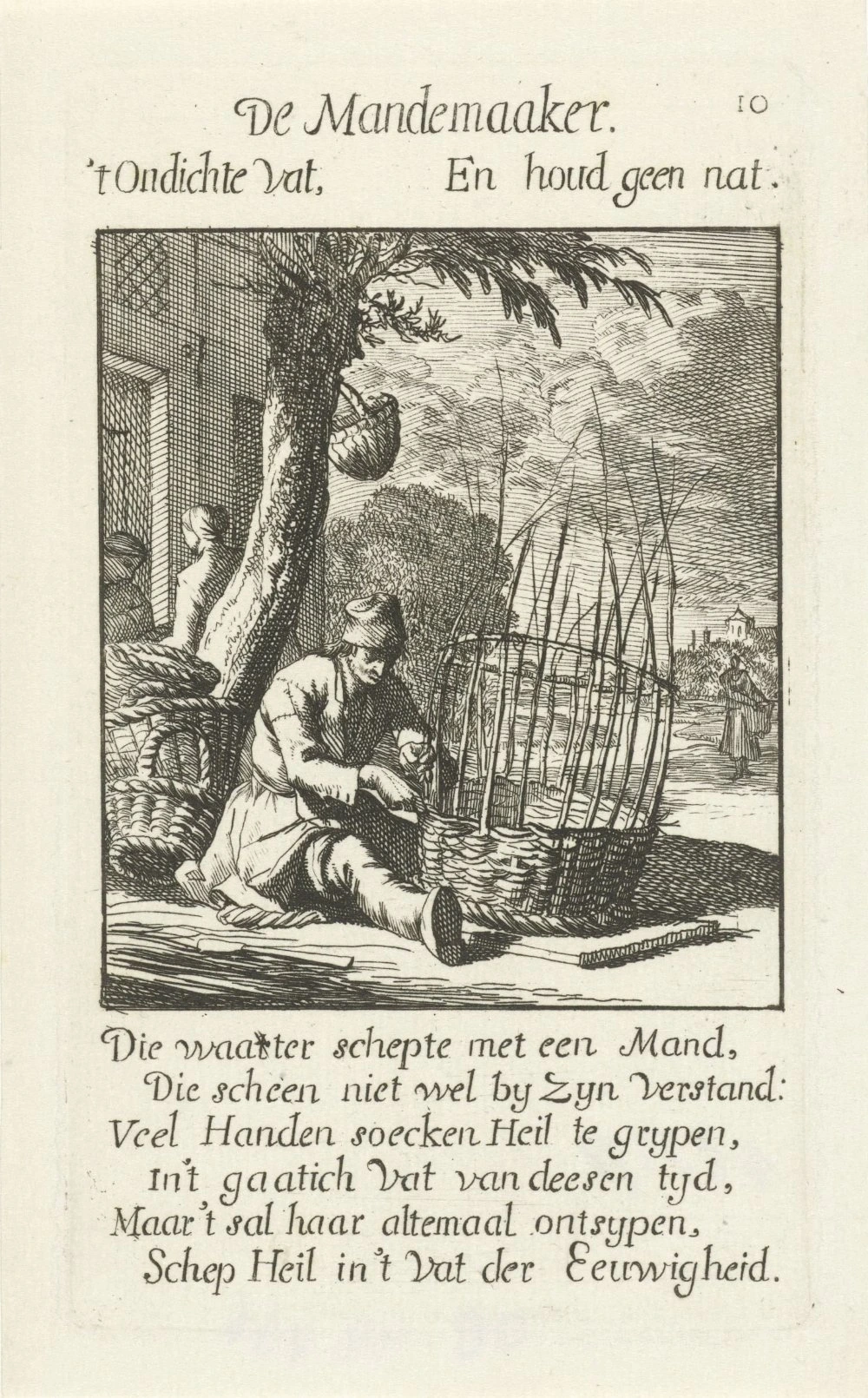
In 1694, Caspar Luyken made an etching of a basket maker in Amsterdam. The Rijksmuseum identifies the print as Mandenmaker. The small image places the working figure beside long upright members and vessels on the ground. The writing and margins belong to the printed object, so the plate in this reader retains them. The image demonstrates what a printmaker chose to make visible to an audience interested in occupations. It leaves the identity of the depicted craft worker, the exact plant species and the actual time needed to finish the vessel unresolved.
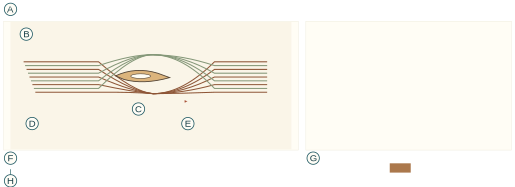
A close look at a finished surface raises a structural question that the small print cannot settle. In a deliberately simple teaching model, a single weaver passes alternately outside and inside a ring of stakes. Count an odd number of stakes and continue the same alternation across the join. At the first stake of the next round the relation reverses. An even number brings the strand back to the same relation unless the maker changes the sequence. The drawing unfolds the circular route so the change becomes easy to see. This is one possible construction principle. The surviving etching remains the evidence for the scene and retains its own separate credit.
mm · Millimetre One thousandth of a metre, used in dimensions and displacement readings.
A loom carries the weft across the warp
Read the illustration’s labels
A
B
C
D
E
F
G
H
Key
Small-print annotation
A
Sakichi Toyoda’s automatic loom places a familiar interlacing action inside a machine.
B
A shuttle crosses the open shed
C
Shuttle travel
D
Warp under tension
E
Shed opens for the weft
F
DRAWING
G
ORIGINAL PICTURE / OPEN TO ENLARGE
H
Warp threads define a shed. A shuttle carries the weft across it before the shed changes.
Demonstrating a Japanese cotton loom · Martin Addison, Science Museum, London
In the drawing: Sakichi Toyoda’s automatic loom places a familiar interlacing action inside a machine.; A shuttle crosses the open shed; Shuttle travel; Warp under tension Shed opens for the weft; DRAWING Warp threads define a shed. A shuttle carries the weft across it before the shed changes.; ORIGINAL PICTURE / OPEN TO ENLARGE
In 1924, Sakichi Toyoda completed the Type G automatic loom. Toyota Industries describes a machine able to change its shuttle without stopping. That improvement becomes easier to understand if the two directions in woven cloth are named first. The warp is the system of lengthwise threads held under tension. The weft crosses it. Separating selected warp threads opens a passage called the shed. A shuttle carrying the weft can cross that opening, after which the arrangement changes for the next pass. The photograph and the drawing are teaching companions. The model history is established by the manufacturer’s record.
Compare the maker holding an individual strand in the Dutch print with a loom that must make a long series of crossings. In both cases, an interlacing sequence has to continue in the intended order. On the machine, the supply of weft becomes an operational problem because a package eventually empties. A mechanism that changes the shuttle without a production stop addresses that interruption. A cutting diagram or a close photograph of one mechanism answers a narrower question than a general history of the machine. The new drawing isolates the shed and the direction of travel. It does not claim to reconstruct the patented shuttlechange mechanism or a particular surviving loom.
A basket in the Metropolitan Museum of Art dates to approximately 1300–1080 before the Common Era, in the Ramesside period of Egypt’s New Kingdom. The museum identifies palm and grass as its materials. Its recorded findspot is the forecourt of a tomb at elKhokha in Thebes, excavated in 1911–12. These particulars give the object a much firmer historical position than a photograph of an anonymous container with no find record. They still leave some questions open. The forecourt establishes where excavators recovered the basket. It cannot, by itself, establish what a particular person carried in it during its working life.
The Metropolitan Museum of Art catalogue gives a restored diameter of 14.5 centimetres and accession 28.3.24. Restored diameter identifies the present reconstruction; it is not evidence of the original container’s full capacity. The archaeological context and catalogue identity are stronger evidence than an imagined account of who carried it.
Instituto Nacional de Tecnología Agropecuaria, Argentina · Published 26 December 2023 The institute published this field image with its report on improvement of basket willow. The date identifies the report. Individual plants in the photograph have no clone identification in the caption. Argentine national portal, Creative Commons Attribution 4.0 except where otherwise indicated. Individual photographer unlisted.
Nicolás Heredia, Paraje Pozo del Toba, Chaco · Date of exposure unrecorded The official cultural record identifies this operation as desfibrilado. The photographed hands and the participating communities in the separate Formosa cultivation report have independent credits. Argentine national portal, Creative Commons Attribution 4.0 except where otherwise indicated. Named photographic credit retained.
C. D. Nichols, Reno. Library of Congress · Copyright 1904 The catalogue links the scene to the Great Basin. The woman remains unnamed. The separate museum record for Louisa Keyser identifies the maker of a different, documented basket. Library of Congress, digital reproduction cph.3c32324. No known restrictions on publication.
Caspar Luyken, after a drawing by Jan Luyken. Rijksmuseum · Amsterdam, 1694 The complete print retains the title, scene and accompanying verse. Jan Luyken is also credited as the writer. The museum records the etched image on a sheet 140 by 82 millimetres. Public domain. Rijksmuseum, inventory RP‐P‐OB‐44.466.
mm · Millimetre One thousandth of a metre, used in dimensions and displacement readings.
Martin Addison, Science Museum, London · 6 August 2007 The original caption identifies a Japanese cotton loom and a member of the museum staff. The comparative chapter cites the Type G history independently. The photograph caption does not establish the demonstrated machine’s exact model. Creative Commons Attribution–ShareAlike 2.0 Generic. Geograph photograph 561411.
Type G · Type G automatic loom Toyoda’s model designation for the automatic loom completed in 1924.
Pages 626–627 follow railway shops in Argentina and the United States, frame geometry, thread pitch, cutting allowances, gauge blocks and textile repairs. The examples connect a recorded material and operation to an inspectable result.
The earlier page as a record
The gallery preserves the complete earlier page with its original folio, picture and notes. Its reading belongs to the history of this book. The revised lessons supply named collections, source links and enlarged drawings at their point of use.
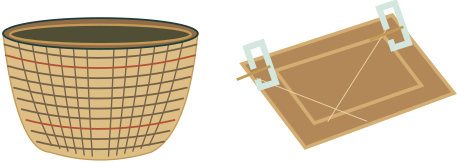
The central leaf is separated into strips. Some strips form a bundle and a narrower working strip secures it.
Look at the photograph of the open circular work. Follow one continuous line until it changes direction or disappears beneath another strand. Then look for the stitches that join adjacent turns. The museum distinguishes an open construction made with a twisted bunch from a sewn construction using a thinner bundle and a greener strand. In the new drawing, bundle and binding have different colours so their jobs stay visible. On a material sample, write down the source with permission, the part of the plant used, and the stage at which the specimen was set aside. Such a sample preserves evidence a finished basket can no longer show.
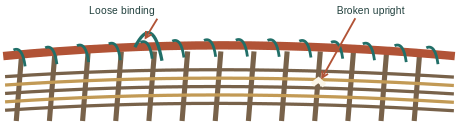
A loose binding and a broken supporting member call for different observations.
Read the rim in sections
Read the illustration’s labels
Loose binding
Broken upright
In the drawing: Loose binding Broken upright
Uprights carry the wall. The binding secures the edge.
A small study sector separates upright, rim and binding. The loose loop and broken upright are two distinct examples.
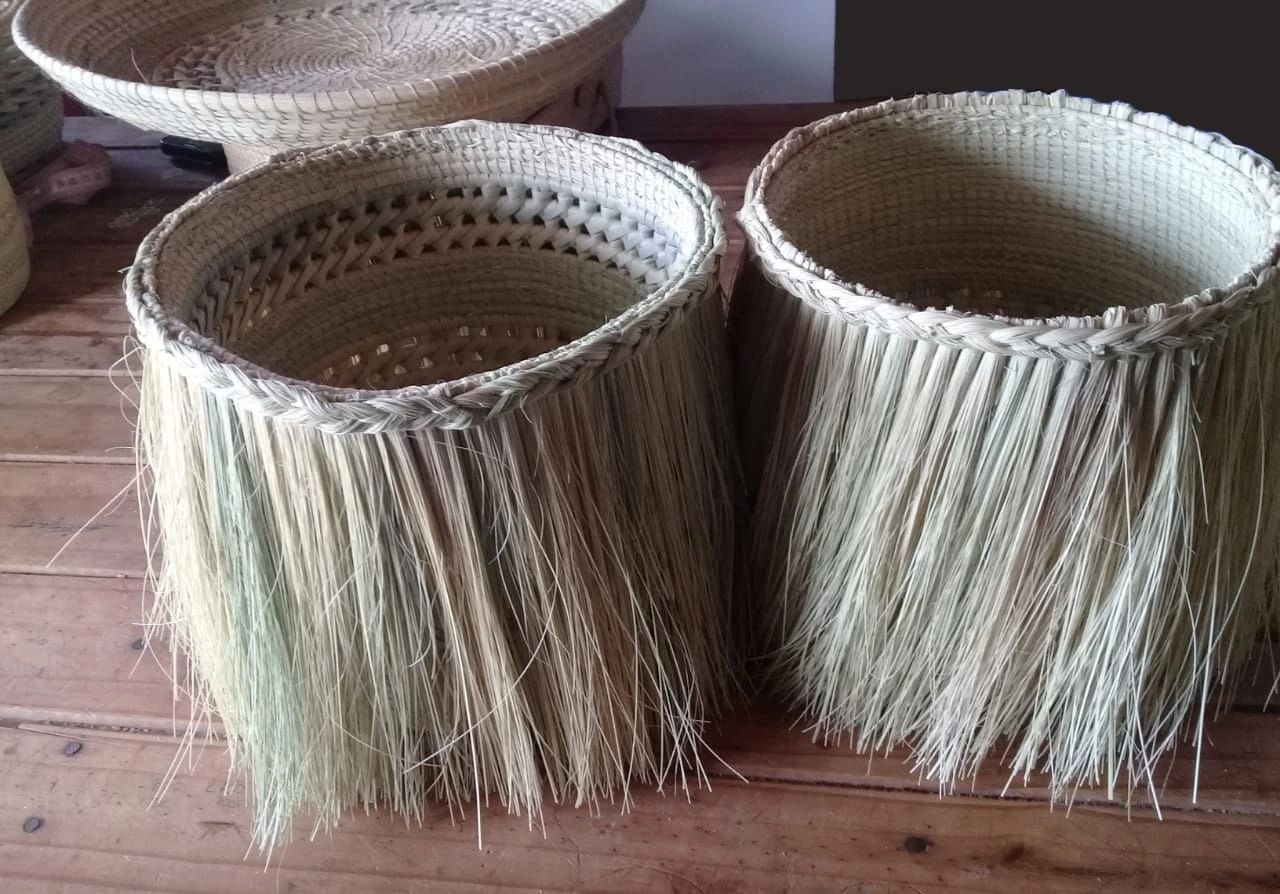
The José Hernández museum’s feature on Sosa includes two partly worked cylindrical forms. The fringe at their sides is evidence of a stage in making. On an object with no process notes, the samelooking free ends might be mistaken for damage. Start with the whole object. Is the rim complete? Are the ends distributed regularly? Does an abrupt break interrupt a strand that continues on either side? Turn the piece slowly and sketch what changes. Details that appear alike in one photograph can belong to different phases in the life of a container.
Museo de Arte Popular José Hernández, Micaela Sosa feature. Photographer unlisted. Date of exposure unrecorded
Two cylindrical forms show uninterrupted woven sides and loose hanging strands. The source does not provide measurements or identify these strands as damage.
Brown ash and a width gauge offered Maine makers a different route from tree to basket.
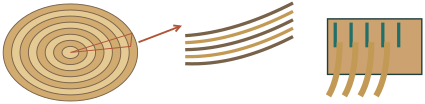
Brown ash, from ring to splint
Growth layers in section Separate the layers Gauge working width
A radial strip is separated along growth layers, then divided to working width. The ring drawing is an explanatory section.
The Hudson Museum at the University of Maine describes how Wabanaki basket makers pound brown ash to separate its annual growth layers into splints. The resulting material can be thinned and passed through a gauge to produce consistent widths. A wooden gauge may have several cutting edges at fixed intervals. Other tools shape a handle or form the wall around a mould. Each tool controls a different property. A strip of constant width can still vary in thickness, and a mould can repeat a profile while a maker varies the pattern or finish.
The Metropolitan Museum of Art records the pictured lidded Maine basket as ash splint, wood and pigment, about 1840. Its attribution to Passamaquoddy makers carries a question mark in the catalogue. Compare that record with the Smithsonian’s May 1995 basket by Peter Neptune, a named Passamaquoddy artist. One object supplies evidence of a construction and an approximate date. The other also preserves an individual maker’s identity. ZeusC sheet 292 reproduces a general newspaper drawing of a tree section. Use it to locate the idea of an annual ring, then return to the Maine sources for the properties of the material used in these baskets.
Ralph T. Coe Collection, gift of the Ralph T. Coe Foundation for the Arts, 2011. The Met. About 1840
Object 2011.154.29a, b. Ash splint, wood and pigment. The collection identifies the cultural attribution as Passamaquoddy with a question mark. No individual maker is recorded.
Opposed twists can hold a sample together. A specimen card makes the comparison repeatable.
Twist, ply and compare lengths
Opposed twist and ply
Trace one coloured bundle across the crossings.
Start · 200 mm
Finish · 176 mm
24 mm shorter, or 12 percent of the starting length
Two bundles turn in one direction. Their paths around one another run in the opposite direction. Mark the original and finished lengths.
Set two equal lengths of clean, expendable fibre on the bench. Mark the start and finish on each before twisting. Twist each bundle in the same direction, then lay them together in the opposite direction. When the ends are released, some of the tendency of each bundle to untwist is taken up in the lay of the two plies. Draw the direction from a stated end. What looks clockwise from one end appears counterclockwise from the other. A short diagram on the specimen card is more useful than an unqualified direction written in words.
For a worked record, suppose the starting gauge length was 200 millimetres and the finished gauge length was 176 millimetres. The shortening is 24 millimetres, or 12 percent of the initial length. Compare a second sample with the same initial marks and record its moisture condition, tools, time and visible waste. This experiment measures shortening in a particular sample. Load capacity and suitability for climbing require separate evidence. The Argentine photograph chosen for this page shows the start of basket work in Sosa’s museum feature. It keeps the material history visible alongside an independently drawn cord experiment. No measurement here is attributed to Sosa or to her work.
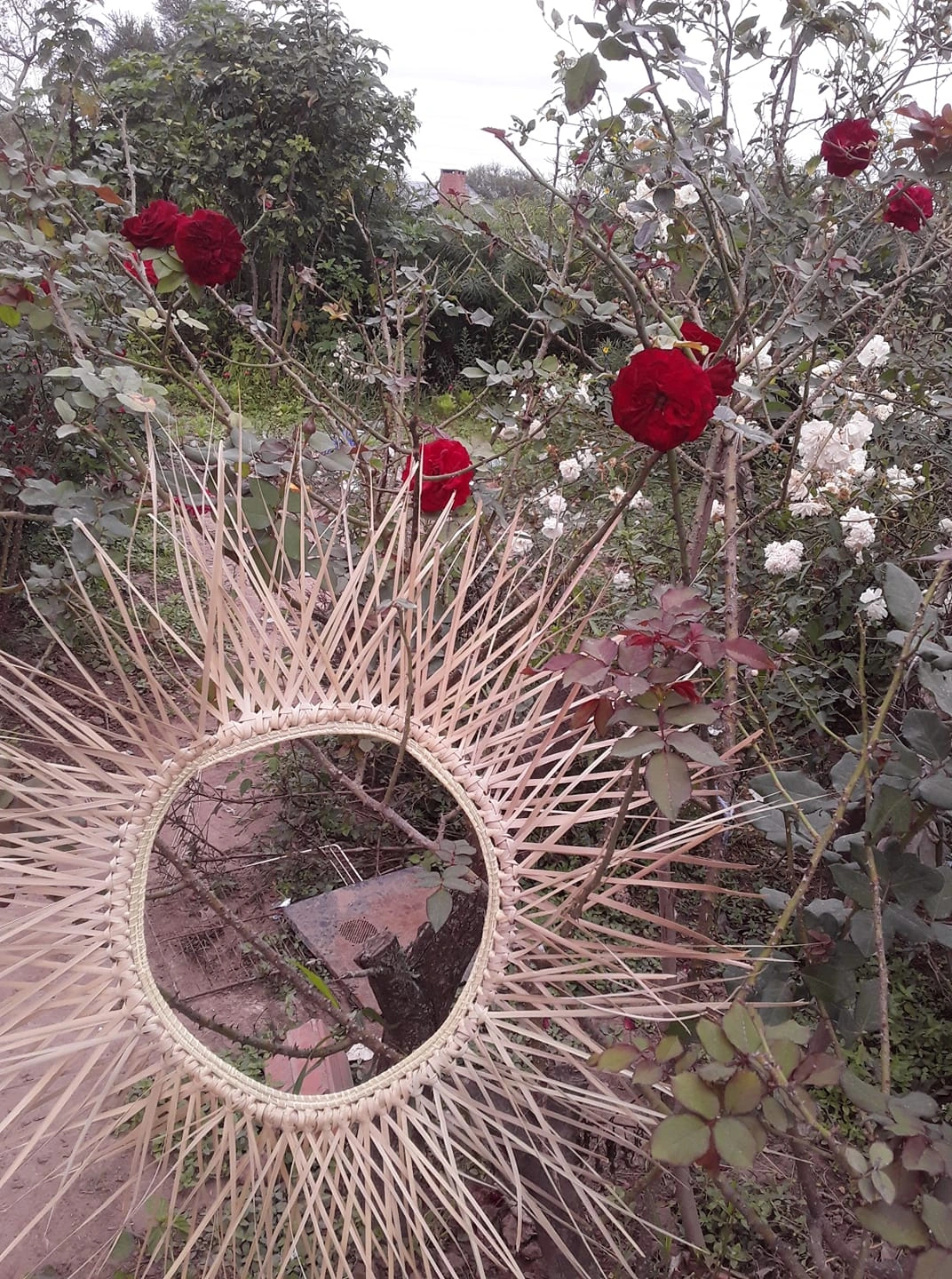
A circular start with radiating strands
The photo shows the early circular form outdoors. It is an image of basket work. The separate cord‐shortening calculation uses invented bench measurements.
Terms in this reading
Information from the source panel
mm · Millimetre. One thousandth of a metre. Drawings identify the endpoints of each measurement.
At Tafí Viejo, the history of a workshop includes the people who learned and practised its trades.
A workpiece moves through the shops
Receive
Mark
Repair
Inspect
Read the illustration’s labels
job record
part identity
bench work
result
In the drawing: job record; part identity; bench work; result
Tafí Viejo · a schematic for reading workshop responsibilities
Receiving a job, marking an item, carrying out work and inspecting the result connect several benches.
The railway workshops at Tafí Viejo required trades that rarely appear in a view of a finished train. Among the facilities described by historian María Beatriz Blanco were carriage carpentry and metal foundries. A vehicle could pass through the hands of workers dealing with different materials and different kinds of fit. The associated Escuela Nacional de Artes y Oficios was authorized in 1923 and began activities in 1927. Separating those dates matters. A legal provision created the school, while staffing, premises and instruction turned the provision into daily practice. A written repair sequence has a similar gap between its issue and its first successful use.
The contemporary press plate reproduced here concerns the railway strike of 1917. It locates workers and their families within the social history of Tafí Viejo, a decade before the school opened. Its date and purpose belong in the caption. For a modest workshop today, trace the handoff of one item. Which person recorded the fault? How was the part identified after removal? Who compared the returned work with the original request? The new drawing makes a teaching sequence out of these questions. The historical press image establishes a community of work. It supplies no evidence for a particular bench arrangement, tolerance or individual worker’s training record.
Caras y Caretas, issue 980, page 62. Period photographs and layout. Individual photographers unlisted. 14 July 1917
The page records the railway strike and the people around the workshop. It documents a labour conflict in 1917. The training‐school history is drawn from a separate study by María Beatriz Blanco.
An inventory number is useful only when it remains attached to the right object.
A separate record for each carriage
G1 g2 g3
San Vicente · exterior work announced in September 2020
Three separately identified carriages retain their own work records even when they form one train.
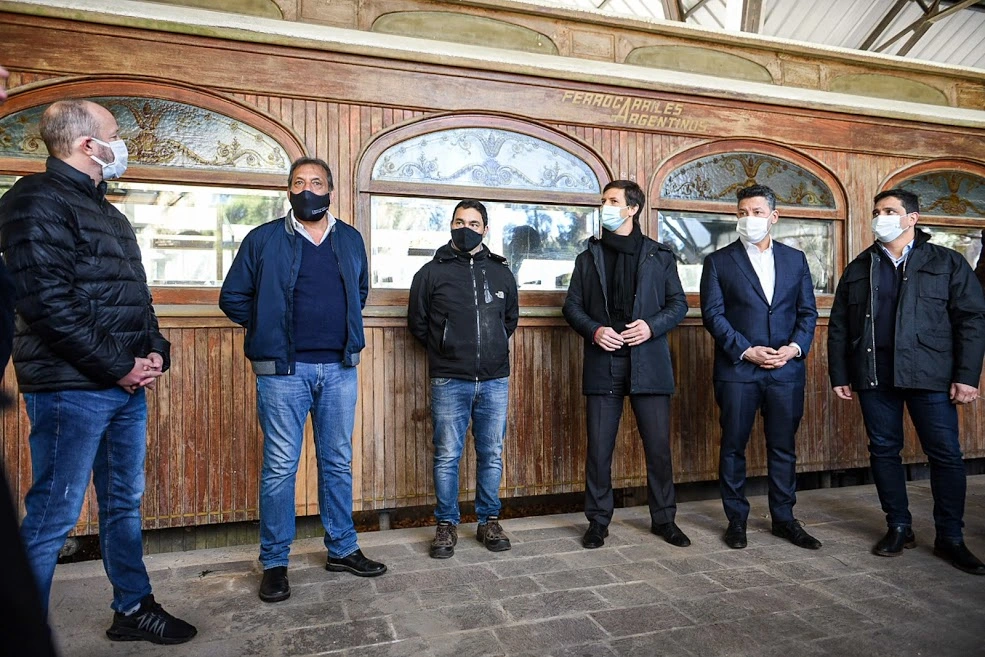
In September 2020, Argentina’s railway heritage authorities announced exterior restoration work for the presidential train at the Museo Histórico 17 de Octubre in San Vicente. The official account places construction of the consist in the Tafí Viejo workshops between 1908 and 1912. It distinguishes a narrowgauge Kitson locomotive and three carriages. G1 contained the president’s room, office and meeting room. G2 housed the kitchen and dining room. G3 served personnel and auxiliary functions. The report identifies the Junín workshops cooperative as responsible for the announced exterior work. An announcement gives a documented starting point. A completion date would require a later record.
Imagine that two similar fittings are removed from different carriages. A photograph of both on a bench preserves appearance but can lose their identities. Give each item the carriage identifier, side, orientation and a position on a small sketch. Keep a separate line for observed condition and for the action authorized. At reassembly, the entry reconnects fitting and location. This is the same bookkeeping problem found on a small timber frame when two similar rails have different holes or sight marks. Carry the identifier through removal, comparison and return. The museum photograph documents the project announcement and its setting. It leaves the mechanical condition of individual fittings unrecorded.
The railway restoration announcement at San Vicente
Trenes Argentinos Capital Humano, Argentine national portal. Photographer unlisted. Published 17 September 2020
The group is shown inside a railway carriage at the museum. The official account identifies proposed exterior work and names the Junín cooperative. The photograph records the announcement, before a completion report.
The section distinguishes the observed worn profile, a proposed finished surface and the material between them. No railway dimensions are supplied.
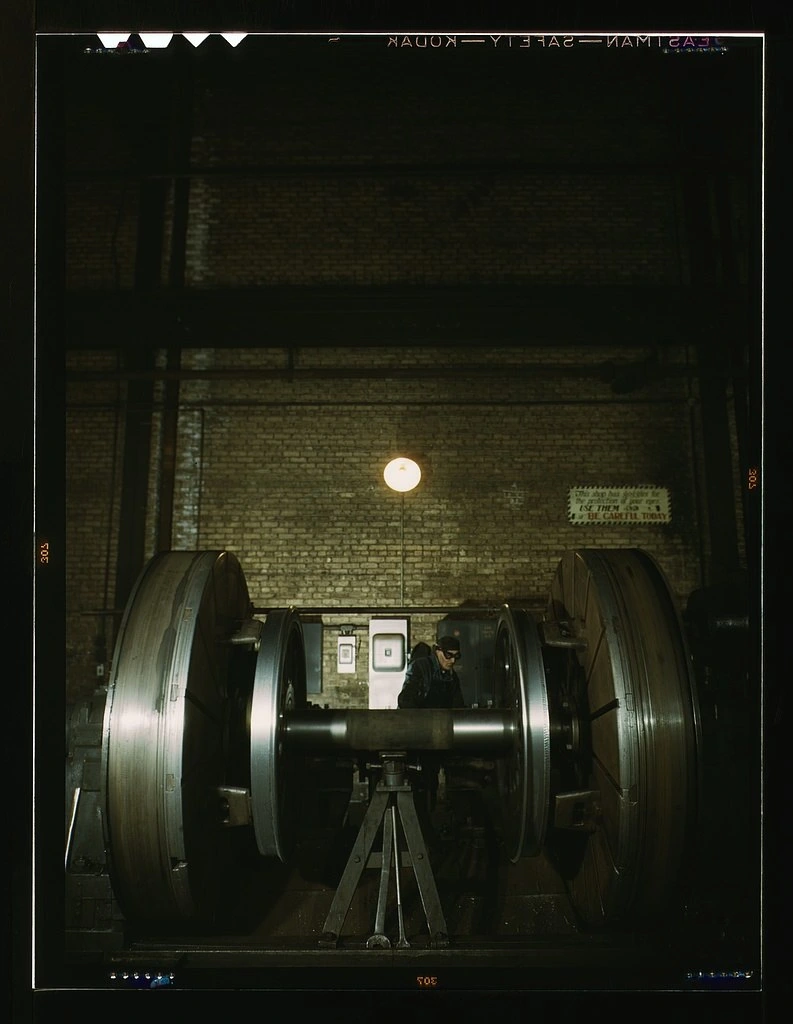
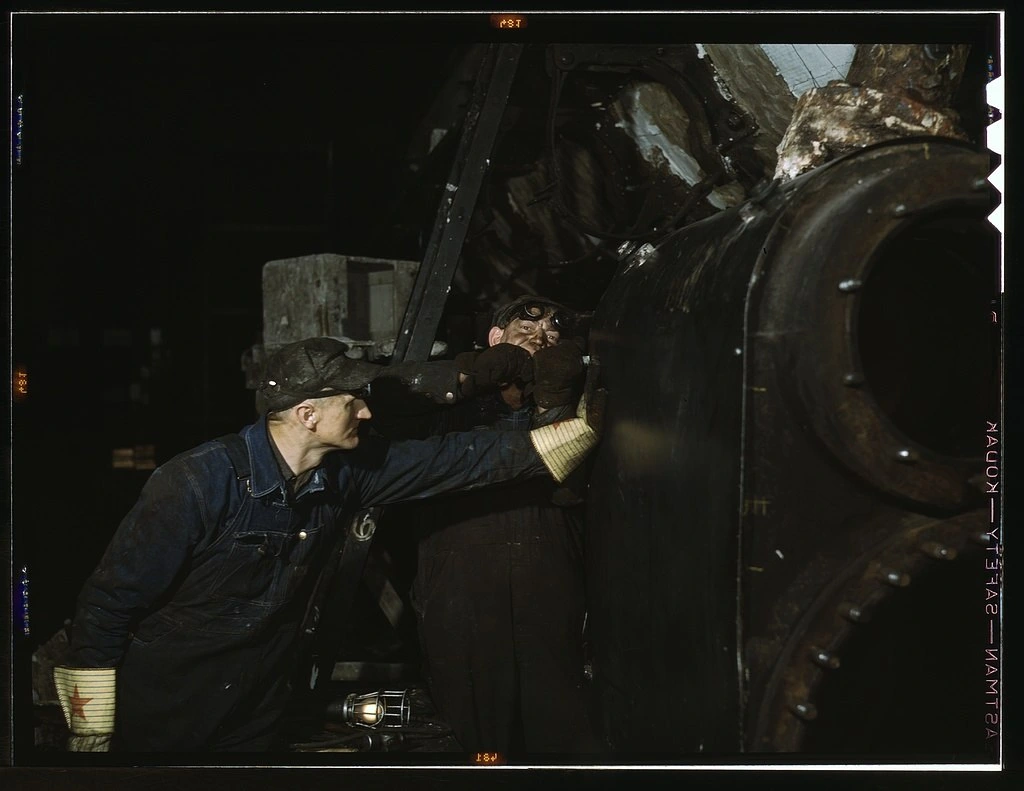
Jack Delano’s colour transparency shows a pair of railway wheels in the Chicago and North Western wheel shop. The Library of Congress caption identifies the operation as refacing worn wheel tyres. A tyre in this setting is the metal running surface. The photograph records a large machine and a workpiece held in position. It does not measure the amount of metal removed or establish that the wheel passed inspection. Another Delano photograph from the same Chicago shop system shows a worker at a locomotive cylinder. Together they make it possible to see two very different jobs hidden inside a general phrase such as locomotive repair.
The small teaching profile above puts three outlines on one reference. One represents the worn shape, another the intended surface, and the enclosed band the material that would have to be removed. A repair decision needs a limit beyond which further removal is unacceptable, and a method of checking the result. The drawing intentionally supplies no operating values for rail equipment. On a scrapwood divider, however, the same reasoning can be tested at low consequence. A shaving can correct a high spot. Extra planing at an already low spot deepens the error. Mark the contacting faces during a dry fit and record where the evidence calls for material removal.
Refacing metal tyres in the Chicago wheel shop
Jack Delano, United States Office of War Information. Library of Congress. December 1942
Digital reproduction fsac.1a34605. Two wheels stand in the machine. The caption identifies the Chicago and North Western shop and the operation. It provides no acceptance dimension.
An editable rectangle and a ZeusC frame drawing explain why one matching number is insufficient.
Two diagonals check one frame
Read the illustration’s labels
Outside width 400 mm
Outside height 300 mm
Both diagonals 500 mm
Measure from matching corners.
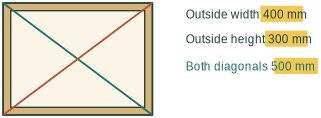
The teaching frame is 400 by 300 millimetres outside. For a rectangle with those sides, both diagonals are 500 millimetres.
Lay four expendable frame members on a flat surface and label the corners A, B, C and D in sequence. On a rectangle measuring 400 by 300 millimetres outside, each diagonal should be 500 millimetres. The calculation follows from 400 squared plus 300 squared equalling 500 squared. Measure both diagonals between the same kind of corner points. A rounded edge on one diagonal and a projecting burr on the other can make a good assembly look wrong. Record the two readings separately. Their difference is evidence that sends the maker back to the frame.
Before accepting the shape, check the four side lengths, corner seating and flatness. An isosceles trapezoid can have equal diagonals while its opposite sides differ in length. A frame can also twist out of plane. ZeusC sheet 029 places several views of a chassis together, allowing the reader to distinguish a plan from a side elevation. The tubular section on sheet 030 and gusset on 039 take the comparison down to component level. What the drawings share is the habit of stating a view and its reference points before interpreting a dimension.
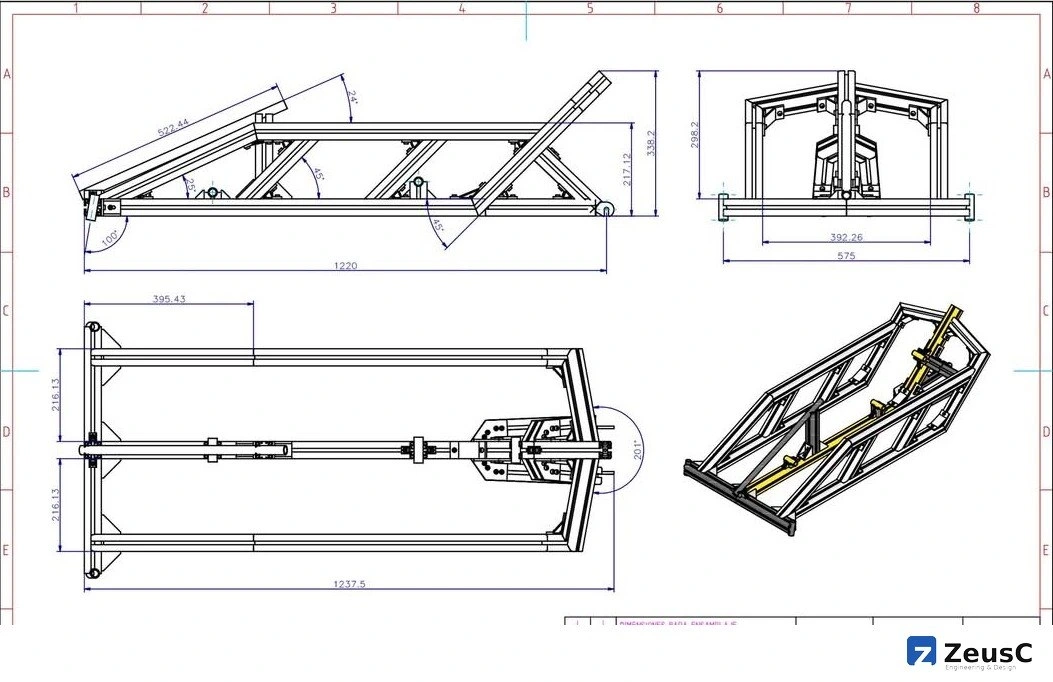
The plan, elevation and perspective describe a frame. Their viewpoints differ. No measured dimension in the book’s timber example is attributed to this chassis.
Terms in this reading
Information from the source panel
mm · Millimetre. One thousandth of a metre. Drawings identify the endpoints of each measurement.
A photograph identifies a family of shapes. A component record resolves the actual fit.
Read the fastener in two views
Hex nut · end view
One pitch
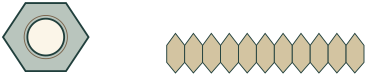
Thread crests repeat along the axis.
Pitch is an axial spacing between corresponding thread crests. Diameter, seating face and retaining features are separate observations.
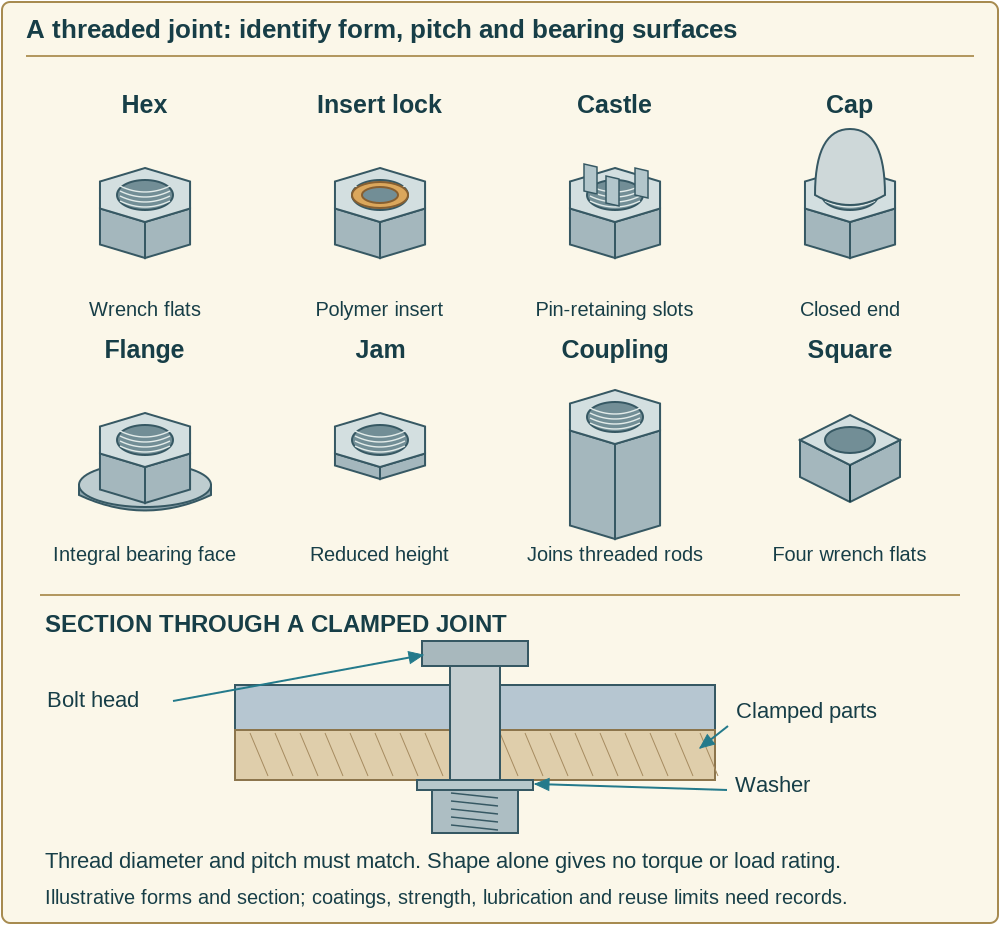
Two fasteners may accept the same spanner across their flats and still have different threads or seating arrangements. A component record identifies nominal diameter, pitch, thread system, material, strength class where applicable, and required seating or locking features. Trial engagement alone does not establish compatibility.
A dimensioned fastener record separates axial pitch from outside diameter and width across flats. Corresponding thread crests define pitch; the seating face and locking feature identify separate interfaces. Keep the manufacturer’s specification with the drawing.
Read the illustration’s labels
A threaded joint: identify form, pitch and bearing surfaces
Hex
Wrench flats
Insert lock
Polymer insert
Castle
Pin-retaining slots
Cap
Closed end
Flange
Integral bearing face
Jam
Reduced height
Coupling
Joins threaded rods
Square
Four wrench flats
SECTION THROUGH A CLAMPED JOINT
Bolt head
Clamped parts
Washer
Thread diameter and pitch must match. Shape alone gives no torque or load rating.
Illustrative forms and section; coatings, strength, lubrication and reuse limits need records.
The four rows compare named nut forms. The chart includes hex, jam, flange, coupling, slotted and castle types. A parts record still needs thread specification, material and assembly requirements.
A second maker needs finished sizes, a cut allowance and an unambiguous joint layout.
A cutting list begins at the joint
Read the illustration’s labels
20 mm faces
Finished stock 1,320 mm + four 3 mm cuts
300 mm
360 mm
In the drawing: 20 mm faces Finished stock 1,320 mm + four 3 mm cuts
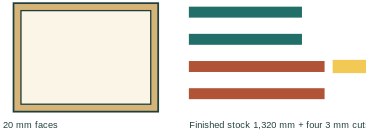
Two 300‐millimetre side members run full height. Two 360‐millimetre rails fit between their 20‐millimetre‐wide faces.
Give a small dryingframe trial an outside width of 400 millimetres and an outside height of 300 millimetres. Use members 20 millimetres wide in the plane of the frame. The two sides run the full 300millimetre height. The rails fit between them, so each rail measures 400 minus twice 20, or 360 millimetres. The four finished lengths total 1,320 millimetres. If the starting end is already square and four crosscuts each consume a 3millimetre kerf, the stock requirement under those assumptions is 1,332 millimetres. Any end trim, defects or extra cuts need their own allowance.
On the traveller for this lowconsequence sample, record stock condition, reference edge, cut order, joint arrangement and revision. Mark each rail before separating it from the stock. During dry assembly write down the two diagonals and compare the finished outside dimensions with the original requirement. If the first trial fits only after trimming, revise the appropriate line of the cutting list before the second maker starts. ZeusC’s bevelled aluminium section in sheet 031 illustrates why a dimension can be useless without its endpoints. Its printed length belongs to that component. The drawing accompanying the timber case locates the endpoints of every dimension used in our calculation.
The lower title block lists aluminium, position 5 and quantity 1. It gives a length of 421.7 millimetres using a decimal comma. The top part and lower part have their own drawings.
Terms in this reading
Information from the source panel
mm · Millimetre. One thousandth of a metre. Drawings identify the endpoints of each measurement.
Johansson’s blocks made combinations of lengths possible with a small set of pieces.
Construct a reference length
Read the illustration’s labels
11 mm
13 mm
Free face
Block stack
Reference surface
In the drawing: 11 mm; 13 mm
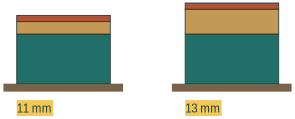
Three example blocks add to one reference length. The measuring face and the reference surface are shown separately.
In the 1890s Carl Edvard Johansson worked on a problem familiar to manufacturing inspectors. A different fixed gauge for every required length made inspection equipment difficult to provide and maintain. Sweden’s National Museum of Science and Technology dates his first gaugeblock set to 1897 and the Swedish patent to 1904. The American Gage Block Handbook places his idea of a combinable set in 1896. These dates refer to different stages in development. Johansson’s solution relied on carefully finished parallel faces that could be wrung together so a combination supplied a useful reference length.
A simple teaching set containing lengths of 1, 2, 4 and 8 millimetres illustrates the arithmetic. For 11 millimetres choose 8, 2 and 1. For 13 choose 8, 4 and 1. A real reference system adds surface condition, temperature, calibration and a definition of the measurement points. Figure 2.1 of the United States National Institute of Standards and Technology handbook shows the free gauging surface and the auxiliary surface against which length is defined. A timber story stick used in a small shop has a much narrower purpose. It can transfer a particular trial dimension from one frame to the next if the maker identifies its working end and preserves the reference mark.
The measuring point of a gauge block
Ted Doiron and John S. Beers, United States National Institute of Standards and Technology. June 1995
The diagram locates the point on the free measuring face, the auxiliary surface and the perpendicular length between them. The complete publication opens from this plate.
Terms in this reading
Information from the source panel
mm · Millimetre. One thousandth of a metre. Drawings identify the endpoints of each measurement.
An opening interrupts a woven grid. Inserted threads first bridge one direction, then interlace across the other.
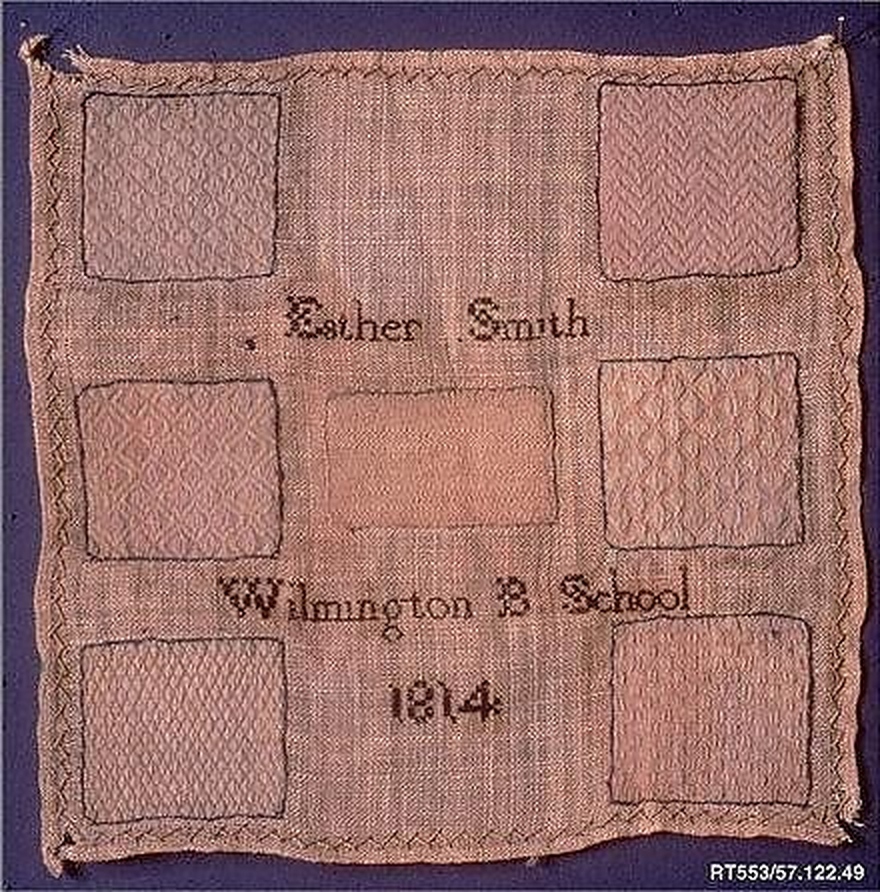
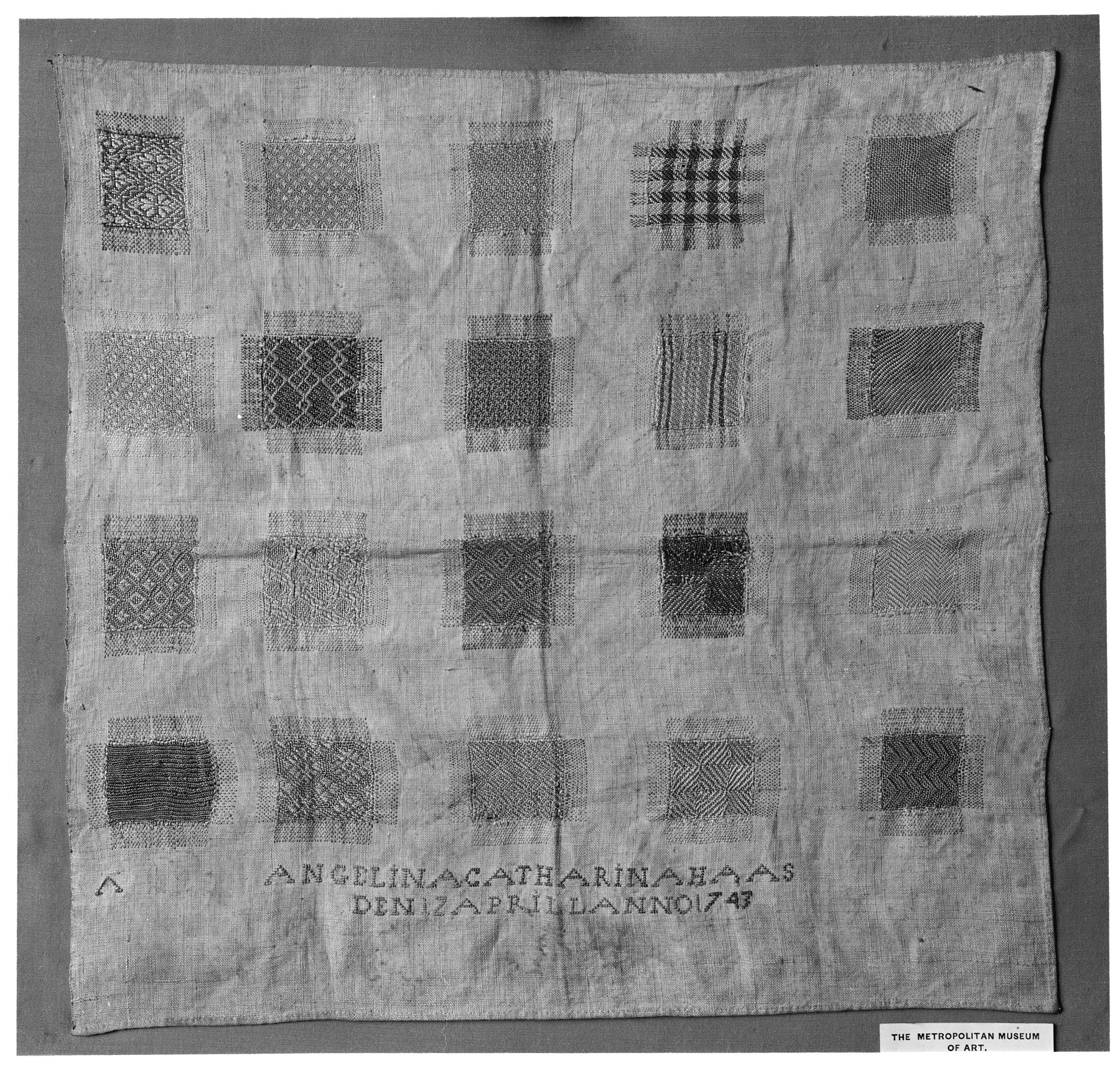
The Metropolitan Museum of Art holds a Dutch darning sampler dated 1743, worked in silk on linen. Its coloured or tonally contrasting test areas break the large field into separate trials. Look at the changes in spacing and direction across the surface. The sampler gives a viewer several results to compare on one support. The image reproduced in this reader is the museum’s monochrome catalogue photograph. Use it to read structure and placement. The museum record supplies the fibres and date. The photograph alone cannot tell a reader the original colour of every thread.
Make a diagram of a missing patch in a simple plain weave. Threads running in one direction can bridge the opening while the perpendicular system holds them in an interlaced arrangement. Identify the surviving margins through which the repair must connect to the old textile. This drawing explains one training model and leaves the individual stitches on the museum object to close examination. For a workshop record, keep a labelled sample showing both the front and the back. Record the material and size of the gap, the direction of the first bridging threads and the result after gentle handling. A later worker can compare the intervention with its neighbour on the sampler.
Dutch darning sampler
The Metropolitan Museum of Art, Rogers Fund, 1907. Maker unrecorded. 1743
A documented mended coat and a nineteenth‐century fabric specimen preserve different forms of evidence.
Separate woven colour from a sewn patch
Woven field and worn area Applied patch and its seam
The patch extends beyond the opening so its stitches enter sound surrounding cloth. Woven colour and applied seams occupy different layers.
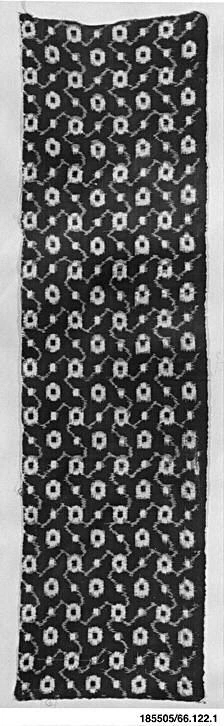
The Los Angeles County Museum of Art catalogues a Japanese kimono of repurposed, mended and patched cotton cloth from the early Shōwa period. Its maker is unrecorded. The catalogue identifies the plain weave, the later patching, the donor and the accession number. These fields let a reader find the garment again without treating every irregularity in a photograph as proof of a particular repair. The reader can open the museum record to examine the coat. The separately reproduced nineteenthcentury Japanese cloth is a different object in the Metropolitan Museum of Art. Its stylized rosettes come from warp and weft kasuri, a method of arranging resistdyed threads.
Trace a patch seam across a drawing of a worn sleeve. Its path can cross the woven pattern and terminate at the edge of an added piece. Trace the pattern of the museum fabric instead. Its changing colour follows the constituent threads. This distinction helps a repair note describe what was actually observed. For a repair patch, record the original gap, the sound margin, which fabric face receives the patch, and the location of the stitches. The coated, patterned and frequently repaired materials encountered in an actual collection require individual examination. A record that preserves sequence, materials and uncertainty is useful long after the garment has left the bench.
Kimono cloth with stylized rosettes
The Metropolitan Museum of Art, Seymour Fund, 1966. Maker unrecorded. Japan, nineteenth century
Object 66.122.1. Plain‐weave cotton with warp and weft kasuri, or resist‐dyed thread patterning. The mended coat discussed in the related chapter is a separate Los Angeles County Museum of Art object, M.2021.232.196.
The plan, elevation and perspective describe a frame. Their viewpoints differ. No measured dimension in the book’s timber example is attributed to this chassis. Complete source JPEG from the supplied ZeusC archive. Underlying rights and first publication recorded only where identified.
Terms in this reading
POS · Posición. Spanish title‐block field identifying a part or drawing position.
CANT · Cantidad. Spanish title‐block field giving the quantity.
ESC · Escala. Spanish title‐block field giving the drawing scale.
mm / MM · Millimetre. A length unit equal to one thousandth of a metre.
Reader contents Read the chapter
Tube and extruded section
Units and terms
JPEG Joint Photographic Experts Group
POS Posición, position in a Spanish drawing field · CANT Cantidad, quantity in a Spanish drawing field · ESC Electronic stability control · JPEG Joint Photographic Experts Group
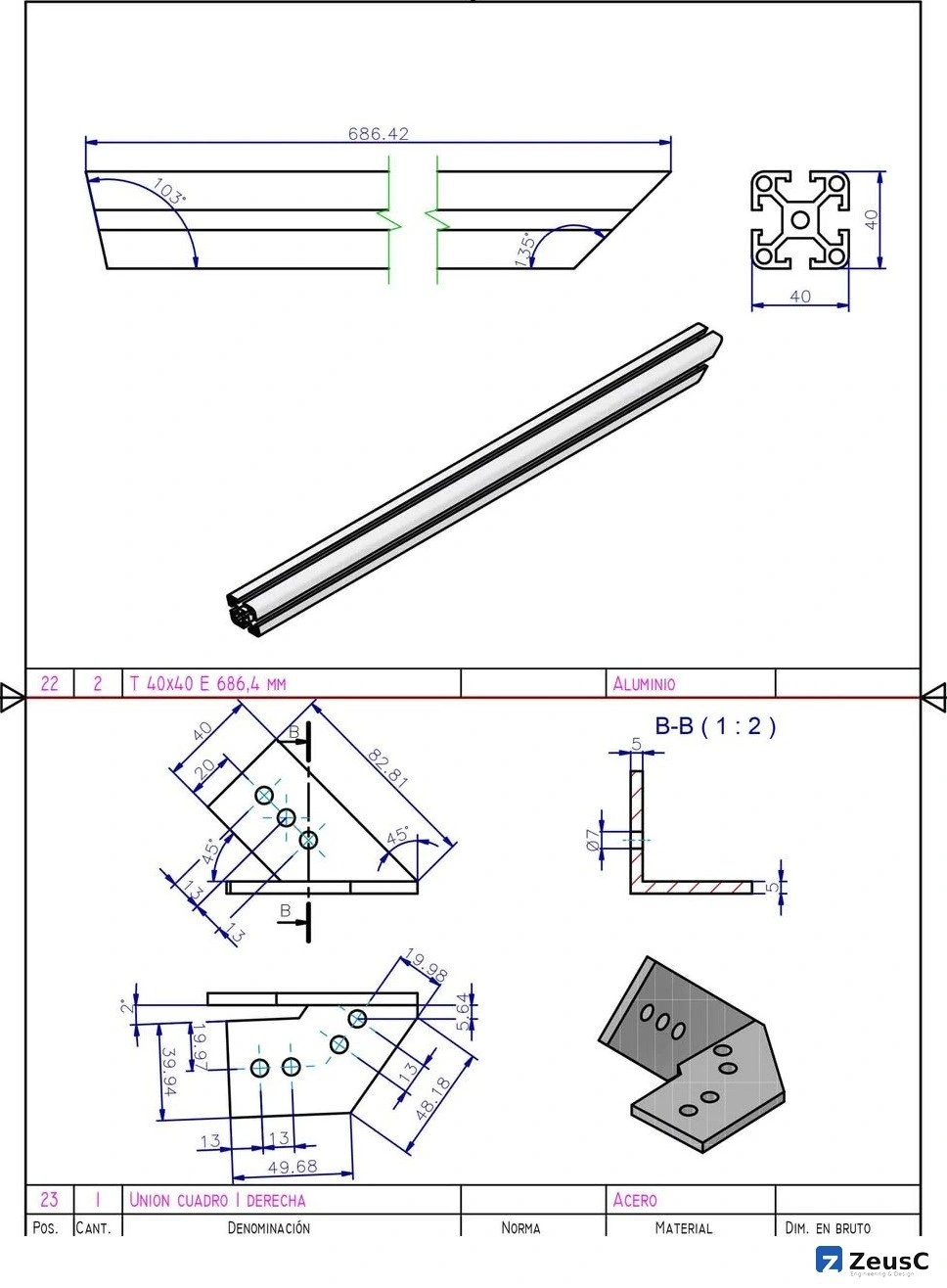
The upper part is a tube and its end view. The lower part gives a long slotted extrusion, a section and an oblique view. Read the individual part lines in their own title blocks. Complete source JPEG from the supplied ZeusC archive. Underlying rights and first publication recorded only where identified.
Terms in this reading
POS · Posición. Spanish title‐block field identifying a part or drawing position.
CANT · Cantidad. Spanish title‐block field giving the quantity.
ESC · Escala. Spanish title‐block field giving the drawing scale.
Read the illustration’s labels
mm / MM · Millimetre. A length unit equal to one thousandth of a metre.
Reader contents
Read the chapter
In the drawing: mm / MM · Millimetre. A length unit equal to one thousandth of a metre.; Reader contents Read the chapter
How a bevel dimension ends
Units and terms
POS Posición, position in a Spanish drawing field · CANT Cantidad, quantity in a Spanish drawing field · ESC Electronic stability control · JPEG Joint Photographic Experts Group
The lower title block lists aluminium, position 5 and quantity 1. It gives a length of 421.7 millimetres using a decimal comma. The top part and lower part have their own drawings. Complete source JPEG from the supplied ZeusC archive. Underlying rights and first publication recorded only where identified.
Terms in this reading
POS · Posición. Spanish title‐block field identifying a part or drawing position.
CANT · Cantidad. Spanish title‐block field giving the quantity.
ESC · Escala. Spanish title‐block field giving the drawing scale.
In the drawing: mm / MM · Millimetre. A length unit equal to one thousandth of a metre.; Reader contents Read the chapter
Extrusion and righthand steel bracket
Units and terms
POS Posición, position in a Spanish drawing field · CANT Cantidad, quantity in a Spanish drawing field · ESC Electronic stability control · JPEG Joint Photographic Experts Group
The bottom drawing gives a bent and drilled steel piece, labelled DERECHA (right). The face view carries the hole pattern. The section carries the bend. Complete source JPEG from the supplied ZeusC archive. Underlying rights and first publication recorded only where identified.
Terms in this reading
POS · Posición. Spanish title‐block field identifying a part or drawing position.
CANT · Cantidad. Spanish title‐block field giving the quantity.
ESC · Escala. Spanish title‐block field giving the drawing scale.
In the drawing: mm / MM · Millimetre. A length unit equal to one thousandth of a metre.; Reader contents Read the chapter
Extrusion and lefthand steel bracket
Units and terms
POS Posición, position in a Spanish drawing field · CANT Cantidad, quantity in a Spanish drawing field · ESC Electronic stability control · JPEG Joint Photographic Experts Group
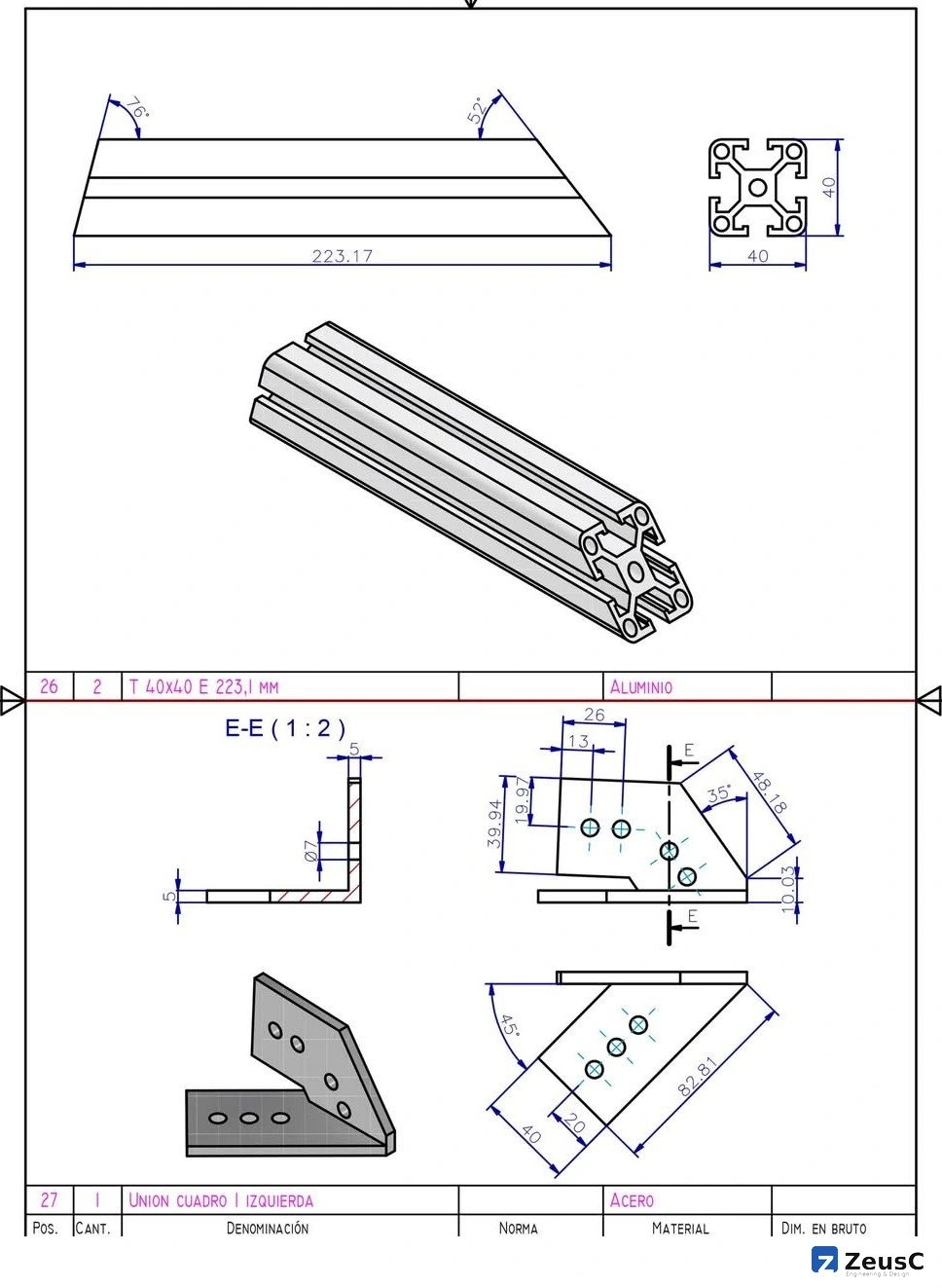
The sheet pairs a profiled member with a bent steel bracket. Compare the position of holes and bends with sheet 037 before assigning handedness or assuming interchangeability. Complete source JPEG from the supplied ZeusC archive. Underlying rights and first publication recorded only where identified.
Terms in this reading
POS · Posición. Spanish title‐block field identifying a part or drawing position.
CANT · Cantidad. Spanish title‐block field giving the quantity.
ESC · Escala. Spanish title‐block field giving the drawing scale.
In the drawing: mm / MM · Millimetre. A length unit equal to one thousandth of a metre.; Reader contents Read the chapter
Units and terms
POS Posición, position in a Spanish drawing field · CANT Cantidad, quantity in a Spanish drawing field · ESC Electronic stability control · JPEG Joint Photographic Experts Group
ESC Electronic stability control · JPEG Joint Photographic Experts Group
The sheet bears the date Sunday, November 11, 2018. The trunk section, roots and canopy are general tree explanations. The Maine basket chapter supplies independent evidence for brown ash. Complete source JPEG from the supplied ZeusC archive. Underlying rights and first publication recorded only where identified.
Reader contents Read the chapter
Units and terms
ESC Electronic stability control · JPEG Joint Photographic Experts Group
The four rows compare named nut forms. The chart includes hex, jam, flange, coupling, slotted and castle types. A parts record still needs thread specification, material and assembly requirements. Complete source JPEG from the supplied ZeusC archive. Underlying rights and first publication recorded only where identified.
Units and terms
ESC Electronic stability control · JPEG Joint Photographic Experts Group
Museo de Arte Popular José Hernández. Pilagá maker profiled: Micaela Sosa. Photographer unlisted.
The museum publishes this photograph in its account of Sosa’s practice in Formosa. The open radial structure is visible against the maker’s hands. Museo de Arte Popular José Hernández, Buenos Aires City. Creative Commons Attribution 2.5 Argentina.
Museo de Arte Popular José Hernández, Micaela Sosa feature. Photographer unlisted.
Two cylindrical forms show uninterrupted woven sides and loose hanging strands. The source does not provide measurements or identify these strands as damage. Museo de Arte Popular José Hernández, Buenos Aires City. Creative Commons Attribution 2.5 Argentina.
Units and terms
ESC Electronic stability control · JPEG Joint Photographic Experts Group
Museo de Arte Popular José Hernández, Micaela Sosa feature. Photographer unlisted.
The photo shows the early circular form outdoors. It is an image of basket work. The separate cord‐shortening calculation uses invented bench measurements. Museo de Arte Popular José Hernández, Buenos Aires City. Creative Commons Attribution 2.5 Argentina.
Documented source image
The railway restoration announcement at San Vicente
Trenes Argentinos Capital Humano, Argentine national portal. Photographer unlisted.
The group is shown inside a railway carriage at the museum. The official account identifies proposed exterior work and names the Junín cooperative. The photograph records the announcement, before a completion report. Argentine national portal, Creative Commons Attribution 4.0 except where otherwise indicated.
Digital reproduction fsac.1a34605. Two wheels stand in the machine. The caption identifies the Chicago and North Western shop and the operation. It provides no acceptance dimension. Library of Congress, Farm Security Administration / Office of War Information collection. No known restrictions on publication.
Documented source image
Working on a locomotive cylinder
December 1942
Jack Delano, United States Office of War Information. Library of Congress.
Digital reproduction fsac.1a34608. The 40th Street shops in Chicago provide a second example of a specialized repair workplace. The worker’s name is unrecorded in the cited caption. Library of Congress, Farm Security Administration / Office of War Information collection. No known restrictions on publication.
Ted Doiron and John S. Beers, United States National Institute of Standards and Technology.
The diagram locates the point on the free measuring face, the auxiliary surface and the perpendicular length between them. The complete publication opens from this plate. United States government publication. Figure‐only detail from Monograph 180, printed page 6, figure 2.1.
The Metropolitan Museum of Art, Seymour Fund, 1966. Maker unrecorded.
Object 66.122.1. Plain‐weave cotton with warp and weft kasuri, or resist‐dyed thread patterning. The mended coat discussed in the related chapter is a separate Los Angeles County Museum of Art object, M.2021.232.196. The Metropolitan Museum of Art, New York. Public‐domain image under its Open Access programme.
Documenting a repair
A reusable repair record names the material, dimensions, joint type, fasteners and sequence. The assembly drawing identifies similar parts and the final inspection records fit, sharp edges, stability and any limits on use. A record for a shelf cannot establish the design of a roof, ladder or lifting device.
Linen: the fibre, the tomb and the missing measurement
Read the illustration’s labels
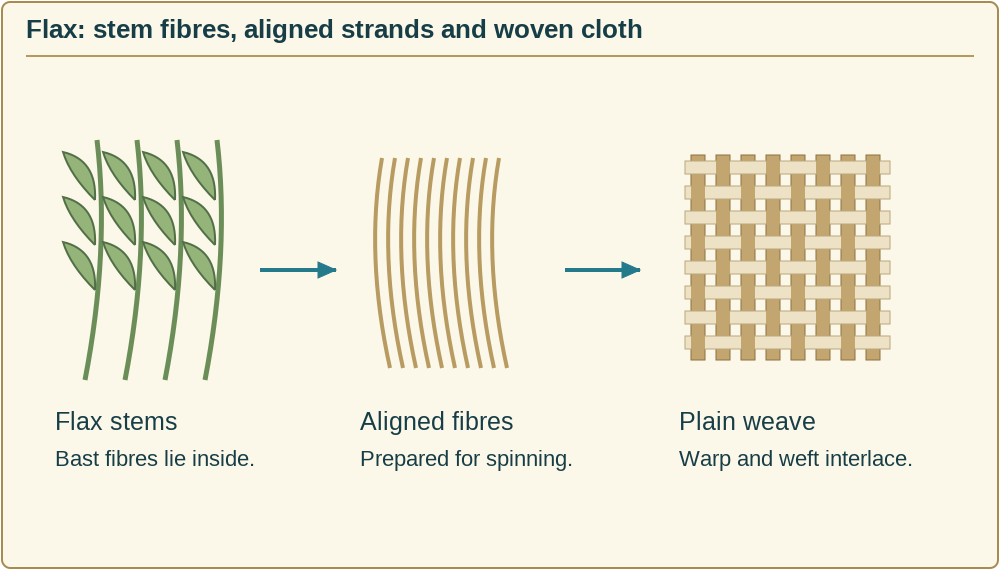
Flax: stem fibres, aligned strands and woven cloth
Flax stems
Bast fibres lie inside.
Aligned fibres
Prepared for spinning.
Plain weave
Warp and weft interlace.
Flax, woven structure and the surviving linen of Wah. A contemporary explanatory title plate.
A long cloth before a numerical slogan
The Metropolitan Museum of Art preserves a linen sheet or shawl associated with Wah’s burial at Thebes. It dates to about 1981-1975 BCE, early in Egypt’s Twelfth Dynasty. Its recorded length is 20.71 m plus fringe, and its width is 1.98 m plus fringe. Excavated in 1920, it survives as an object that can be examined for fibre, weave, ink, wear and burial context. Its museum number, 20.3.222, is a far stronger starting point than a modern assertion that all linen emits one healing frequency. [E01]
How a plant becomes a textile
Flax is a bast fibre: the useful long fibres lie in the stem rather than in the seed. Retting helps separate fibres from surrounding tissues; breaking and scutching remove woody material; combing aligns the fibres before spinning and weaving. These operations leave material consequences. A loose weave admits air differently from a tight one, and the same fibre can produce cloth with very different thickness and drape. Comfort therefore cannot be inferred from the fibre name alone. [E02]
Sheet or shawl of Wah, Middle Kingdom, Egypt, about 1981-1975 BCE. The Met, 20.3.222; Rogers Fund and Edward S. Harkness Gift, 1920. Public-domain collection image. Modern photograph of an ancient textile.
Units and terms
BCE Before the Common Era · m metre, a length unit
Hertz means cycles per second. It is a unit, not a ranking of spiritual or biological value. A plucked fabric strip can vibrate mechanically; a molecule can have several spectroscopic modes; a garment can absorb and emit electromagnetic radiation across many frequencies. Those are distinct measurements. To compare fabrics, specify the physical quantity, apparatus, sample dimensions, tension, humidity, temperature and uncertainty. The supplied image provides none of these. [E03]
Its claim that contact with linen raises a wearer’s frequency and promotes healing is notestablished by a documented measurement or clinical study supplied with the image. The numerical claim is retained in the transcription, not adopted as a health instruction. A genuine cultural history of cloth does not need an invented medical mechanism.
What a fabric measurement must record
Variable
Why the record needs it
Fibre and weave
The same fibre can form cloth of different thickness, density and drape.
Sample dimensions and conditioning
Area, temperature and moisture alter comparisons.
Quantity and instrument
Absorption, drying time and vibration frequency are different properties.
Repeat observations and uncertainty
Variation limits the strength of a comparison; it does not establish a medical effect.
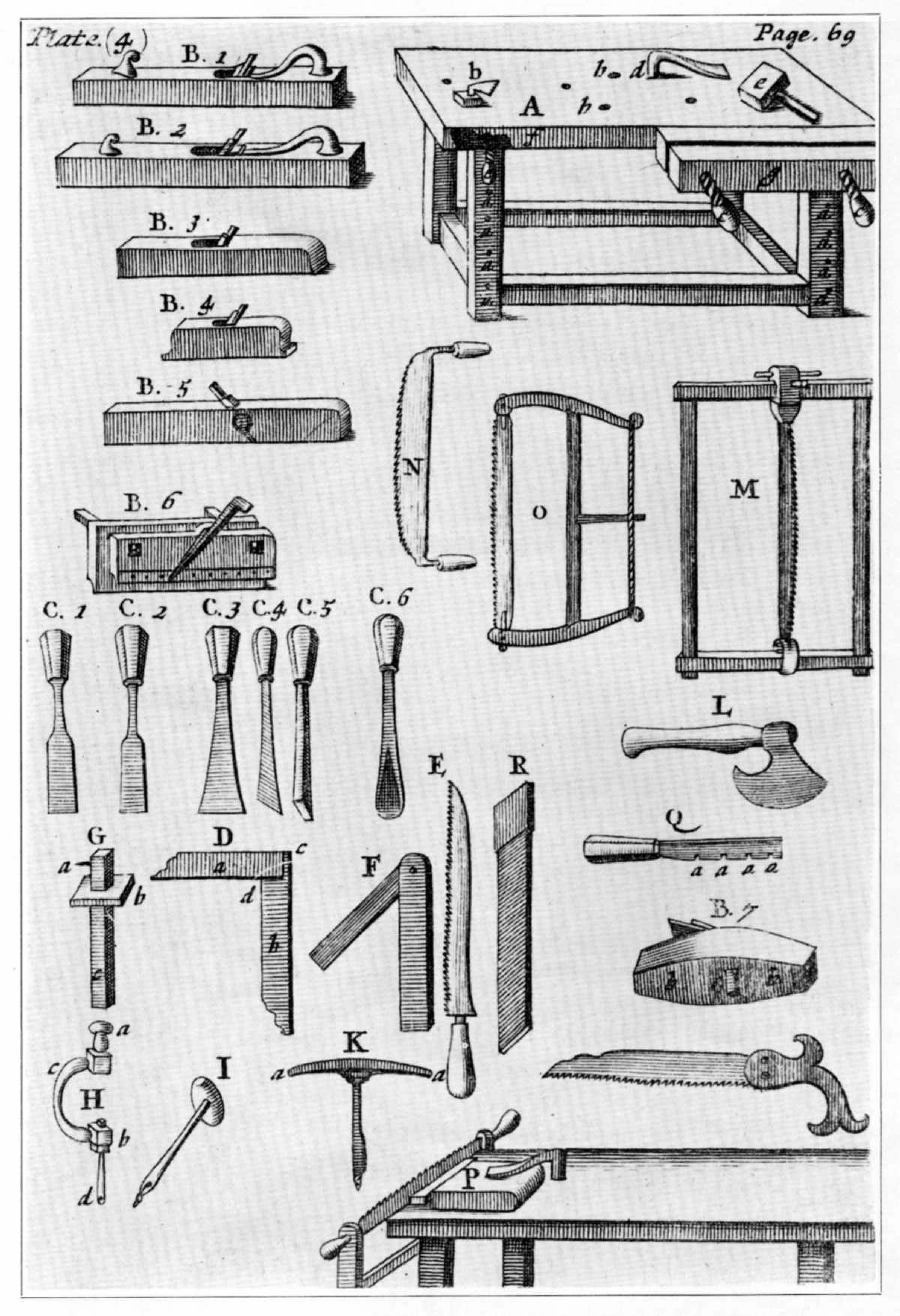
Joseph Moxon’s engraving of the workbench and joiner’s tools, 1703.
Read the object record
An artisan can show an apprentice how to work from a face and an edge. A drawing extends that lesson to someone who cannot visit the shop. The transfer succeeds only when the drawing records which surface controls a measurement and what counts as a finished result.
Practical knowledge from 1600 to 1900
A workshop that can be inspected Practical knowledge becomes more useful when its tools, reference surfaces and checks can be seen. This section follows selected English and American woodworking evidence within 1600-1900. It is one case study, not a claim that other societies lacked sophisticated craft traditions. Joseph Moxon, 1627-1691 Moxon was a printer and globemaker. His Mechanick Exercises made workshop operations readable in words and pictures. The third edition used here appeared in London in 1703, after his death. Plate 4 and the joinery text let us connect named tools with particular tasks. [D326-D328] Preparation comes before fitting Moxon describes working a first surface, checking it, then using it to establish adjoining surfaces. A square needs a reliable face against which to sit. A gauge transfers an offset from an edge. Those dependencies matter more than the attractive appearance of an old bench. [D326]
Read a workshop through its tools
Joseph Moxon, Mechanick Exercises, third edition, London, 1703 · Plate 4 [D326-D327]
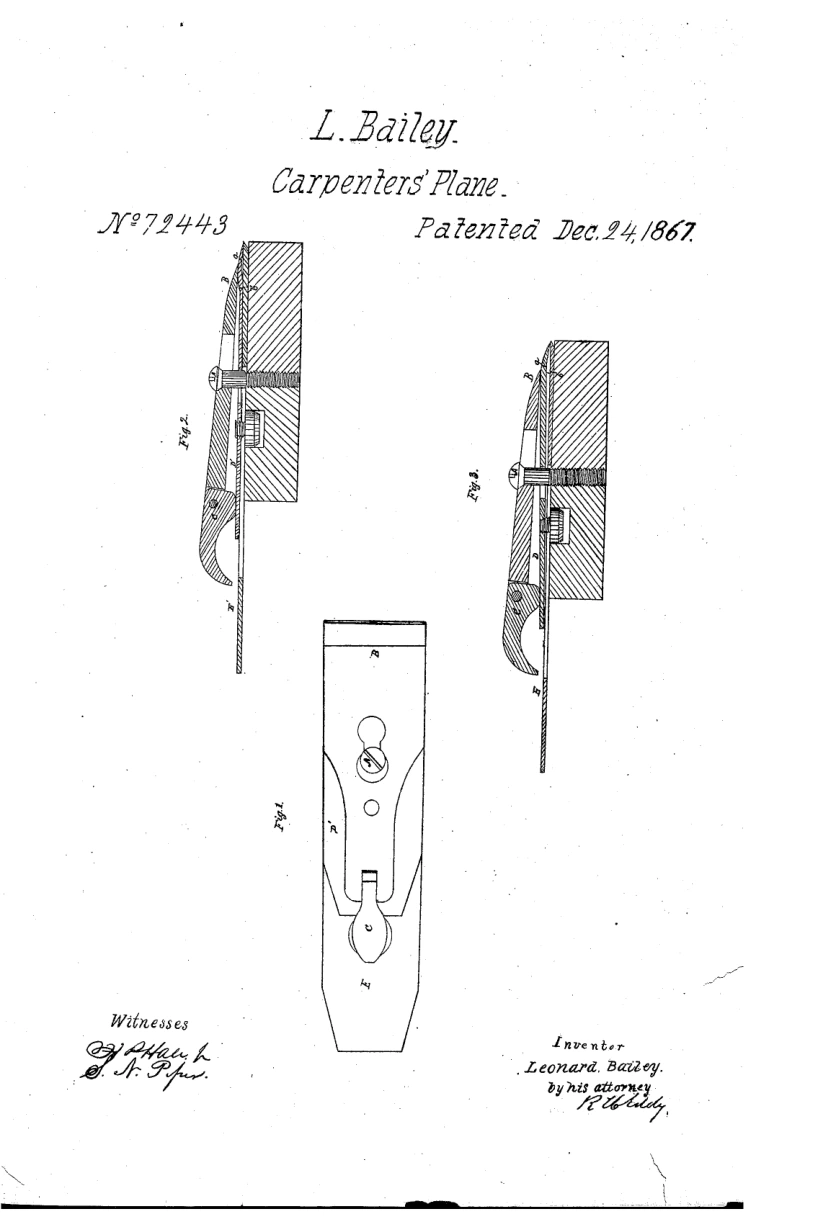
A mechanism claimed by the inventor, not an independent trial.
US 72,443 · 24 December 1867 [D330]
Check the tool before you trust the line
A modern reversal test · Original explanatory geometry, with the divergence exaggerated for clarity
Both lines meet at O; measure their gap at the same perpendicular height.
Read the illustration’s labels
A square checked by reversal
Two lines share O; equal and opposite errors create the measured gap.
d
L
O
α
Line A
Line B
d = 2 L tan(α)
α = arctan[d / (2 L)]
L: perpendicular distance
d: separation at that height
α: error of either line
Use the same length unit
for d and L.
The drawing exaggerates the error for visibility. It is not a scale drawing.
Assumptions: a straight reference edge, common origin and symmetric reversal.
In the drawing: d = 2L tan(α)
The divergence contains two equal errors.
Ideal straight edge and symmetric reversal assumed.
Why divide by two?
In the reversal geometry, L is the perpendicular distance from the common origin O to the line where the gap d is measured. The two lines lean equally in opposite directions by the angle α (alpha), so d = 2L tan(α). Here L is a length variable, not the litre symbol. Dividing the measured gap by two isolates one side’s displacement; the angular error is arctan(d / (2L)). This relation assumes a straight reference edge and a symmetric reversal.
Units and terms
US United States
L perpendicular length in the reversal diagram · = equals
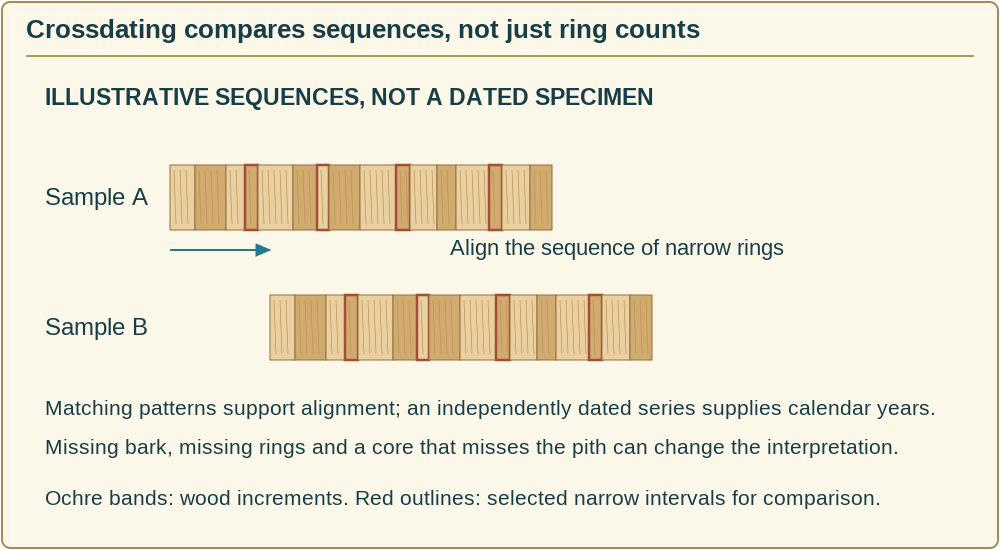
Crossdating compares sequences, not just ring counts
ILLUSTRATIVE SEQUENCES, NOT A DATED SPECIMEN
Sample A
Sample B
Align the sequence of narrow rings
Matching patterns support alignment; an independently dated series supplies calendar years.
Missing bark, missing rings and a core that misses the pith can change the interpretation.
Ochre bands: wood increments. Red outlines: selected narrow intervals for comparison.
Wood anatomy and a dated sequence A ring series asks a narrower historical question. A tree lays down wood as its cambium grows. Ring widths in a suitable species and climate can vary together among neighbouring trees. A dry season may leave a narrow band across many samples, while a local injury can affect just one.
The early Southwestern archaeological work associated with A. E. Douglass connected building timbers to an established tree-ring chronology. In 1929 the linkage between previously separate sequences gave archaeological timbers calendar dates. The analytical move was crossdating. Match a succession of narrow and wide rings across specimens, then anchor it to a sequence of known dates. Simply counting rings inward from broken, weathered timber cannot recover a missing outer date.
In the schematic the highlighted narrow intervals recur in both strips. They are an illustrative pattern showing sequence alignment. They contain no measurements from a Kew tree or an Argentine orchard. For an orchard tree, distinguish planting date, graft date and the age of the wood sampled. A core can miss the pith. Bark and outer rings can be lost. A dated last preserved ring may precede felling or construction. Those gaps are part of the historical result and belong in the account beside the date.
A cut surface and its growth rings
Supplied cross-section photograph, retained in full. Photographer and date are not established by the supplied record. A visible ring count alone is not a calendar date.
AT THE CLOSE OF THE BOOK
Carlos “Charlie” Verbelen
The complete collection of 379 illustrated author signatures. Choose a named design or move through the collection.