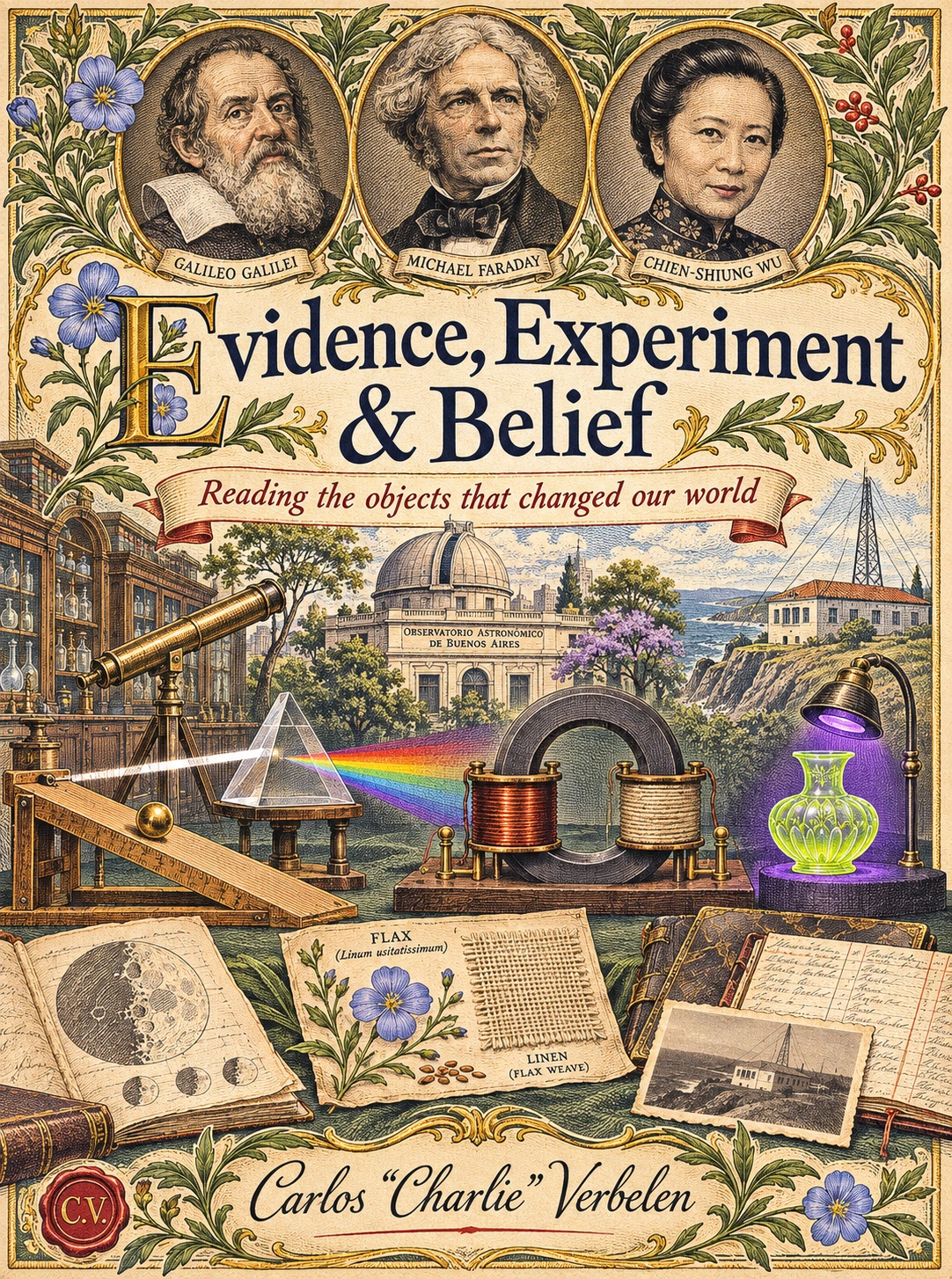
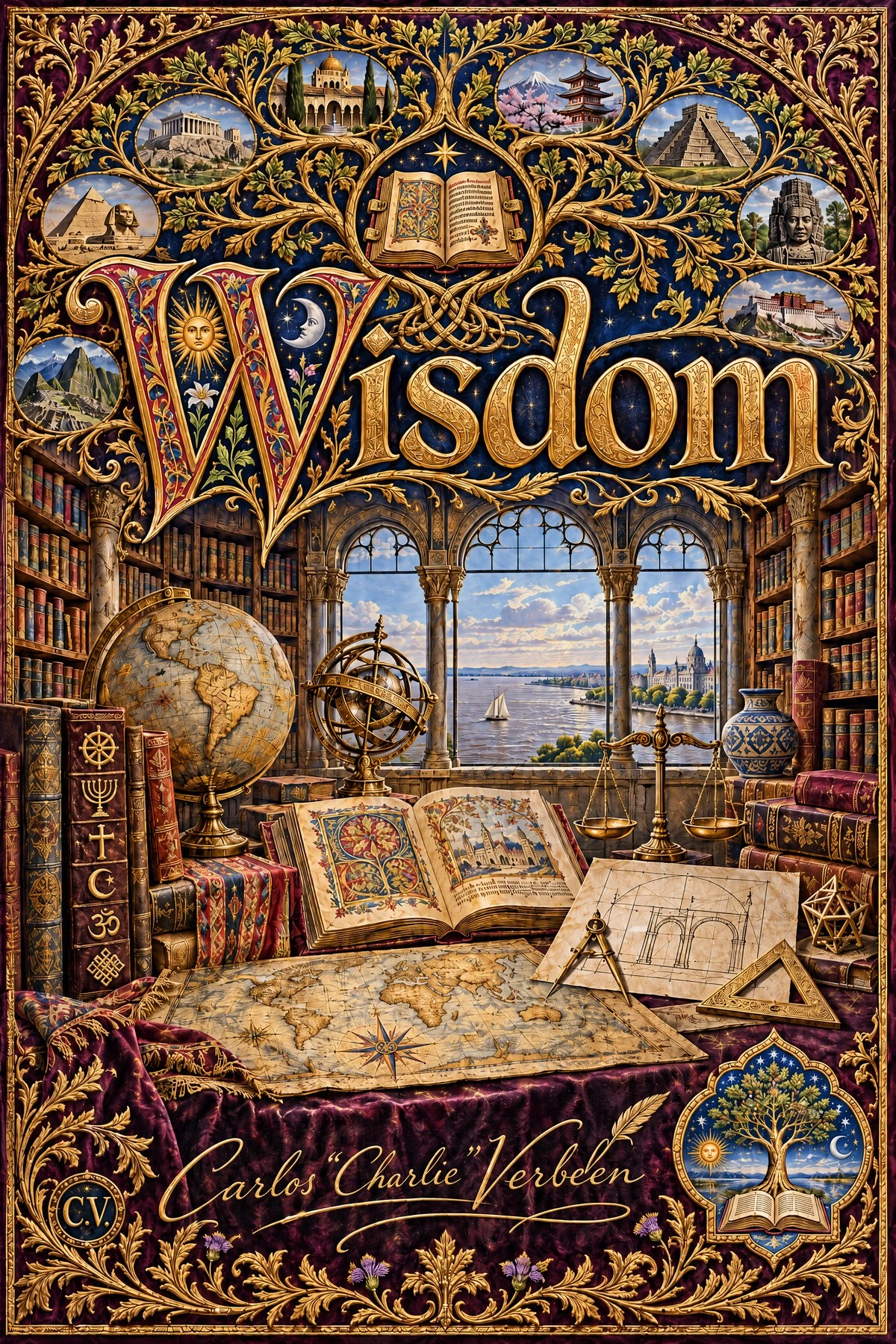
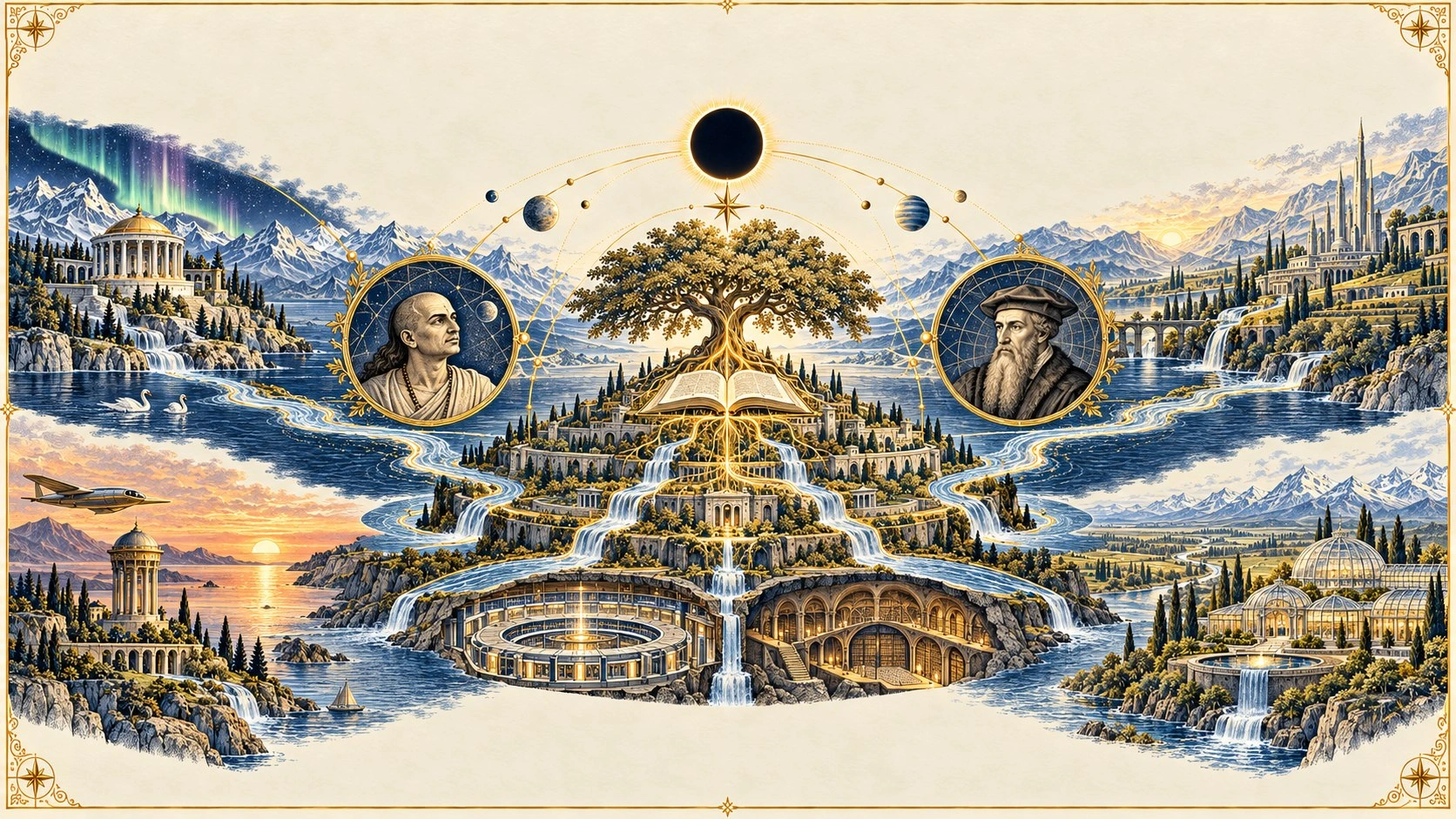
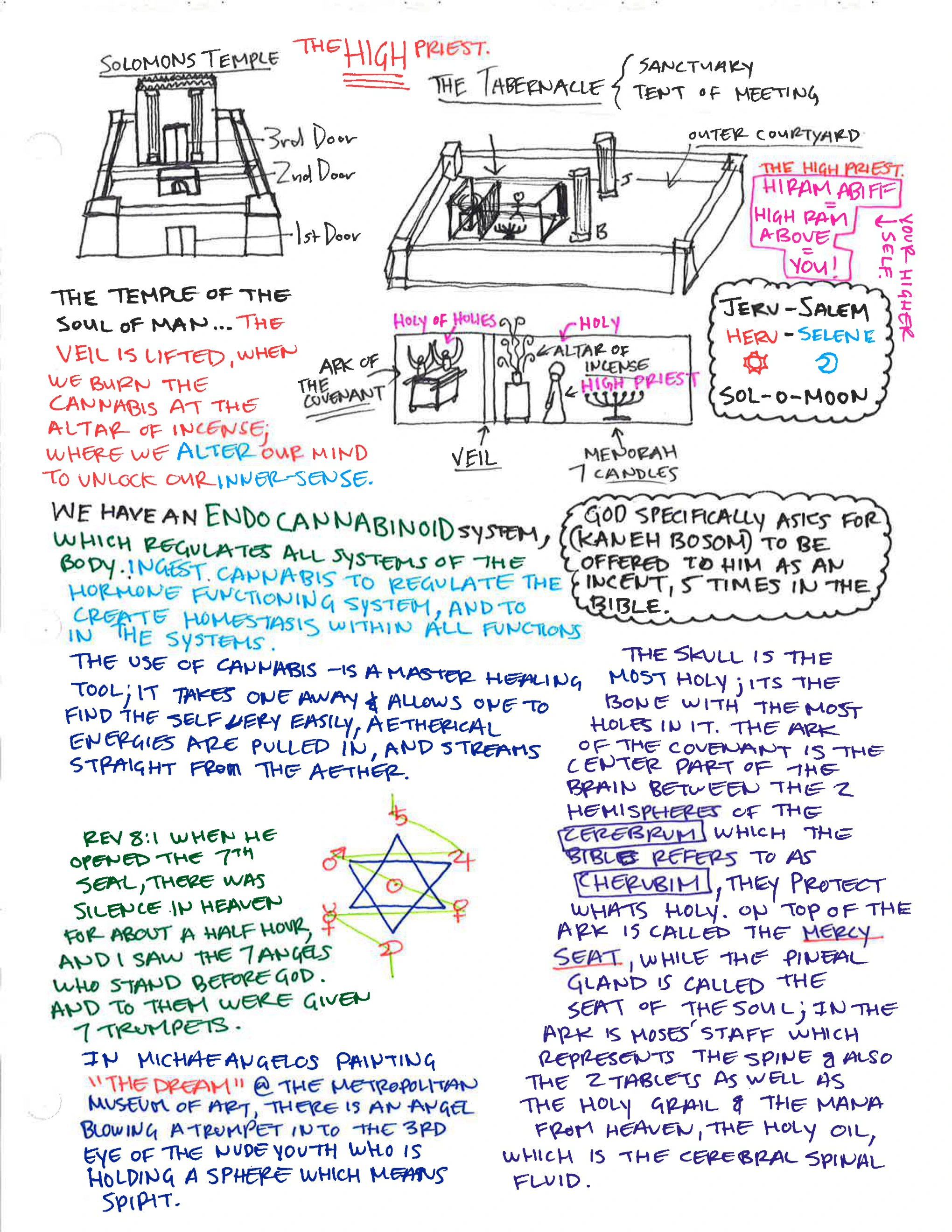
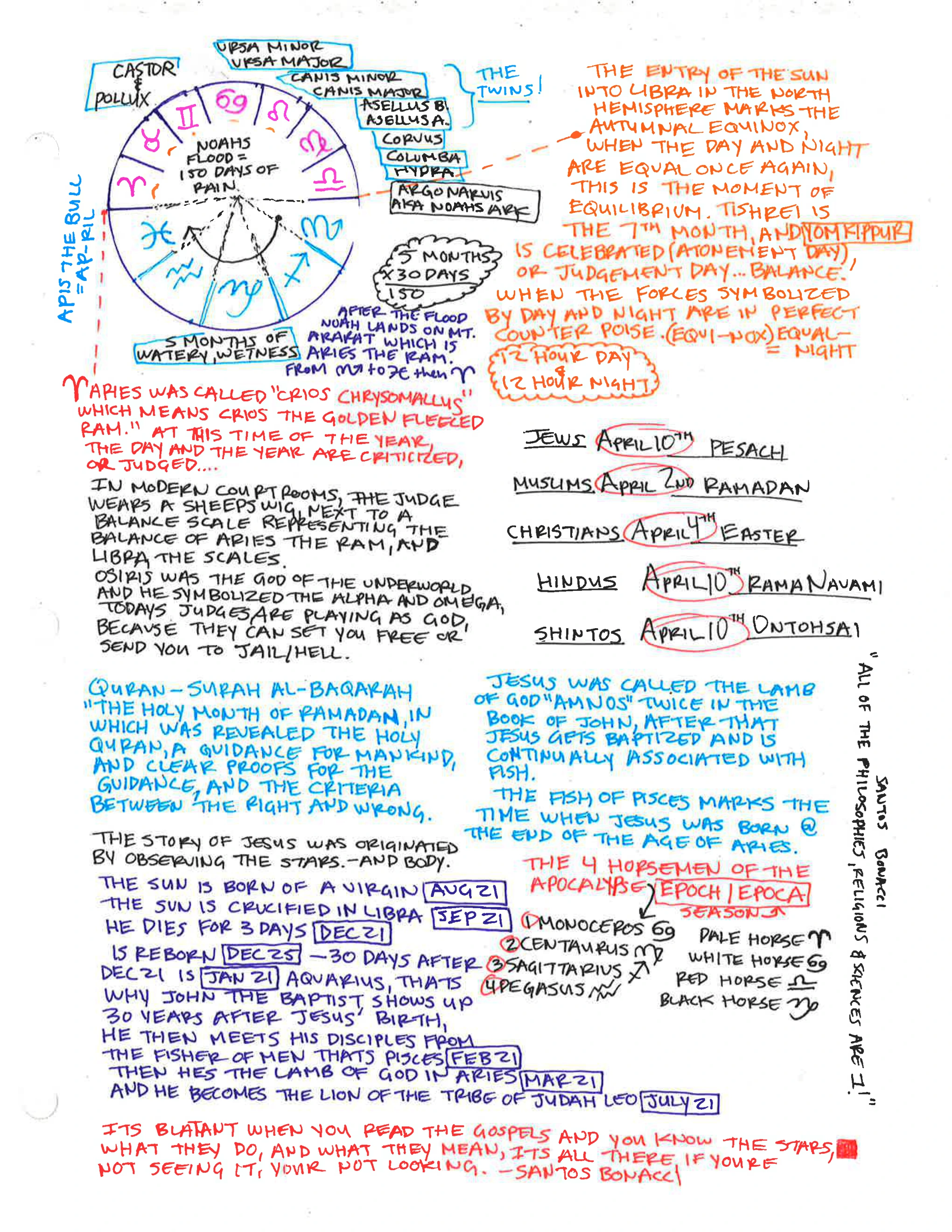
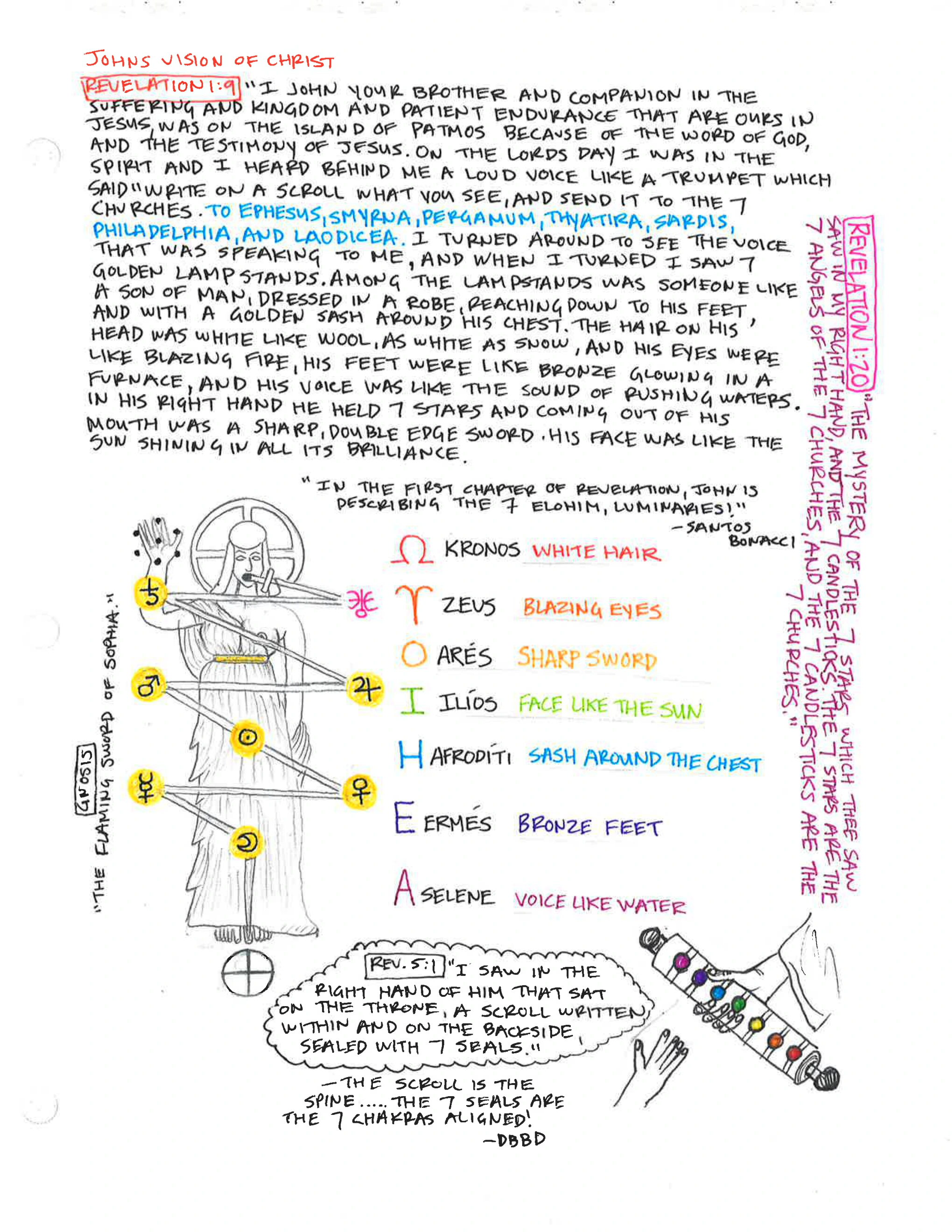
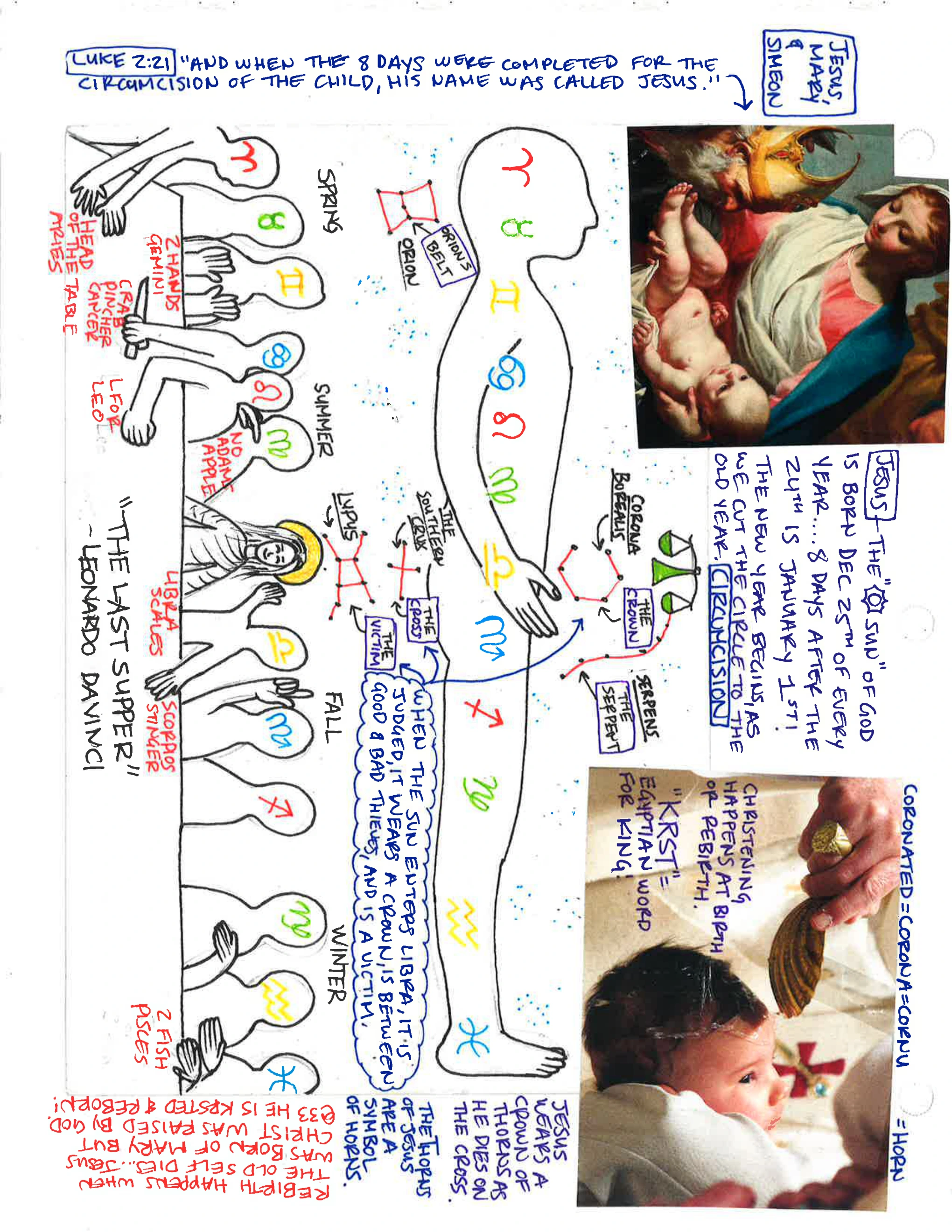
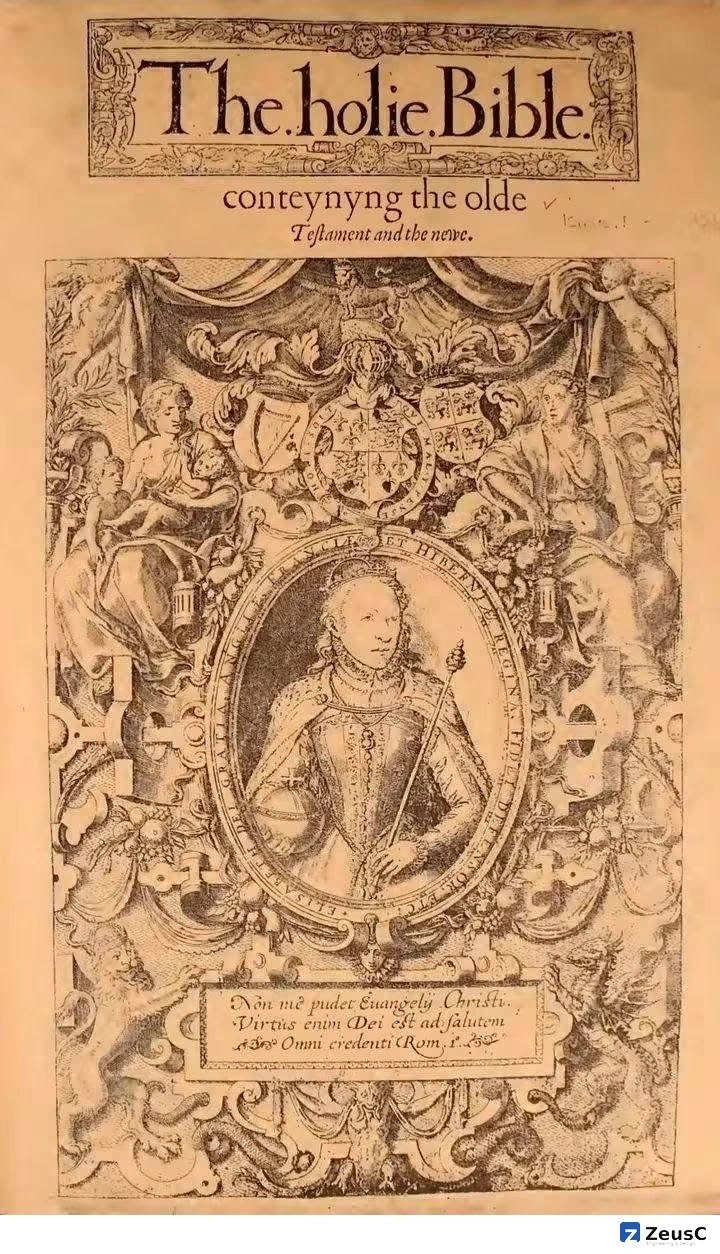
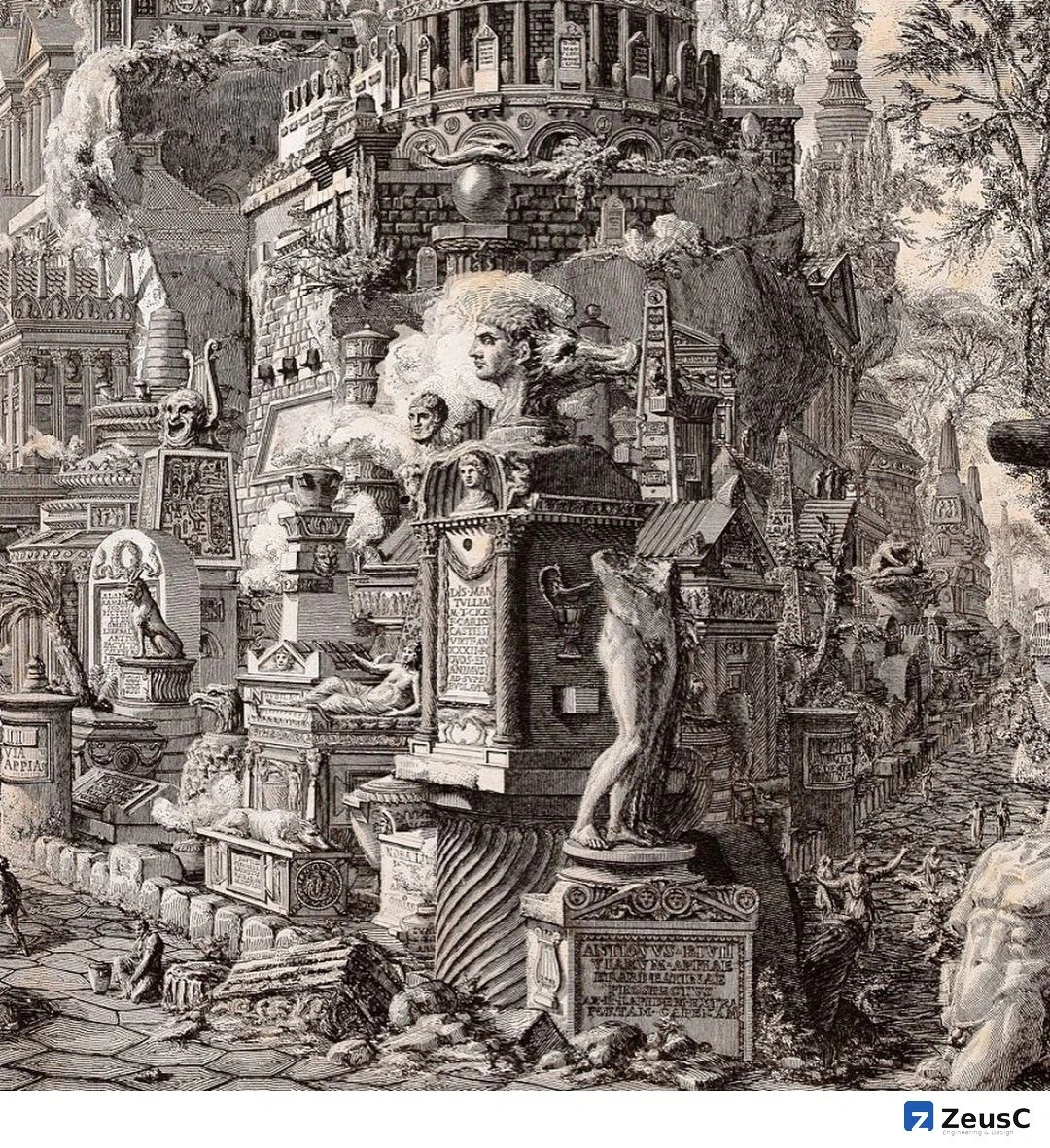
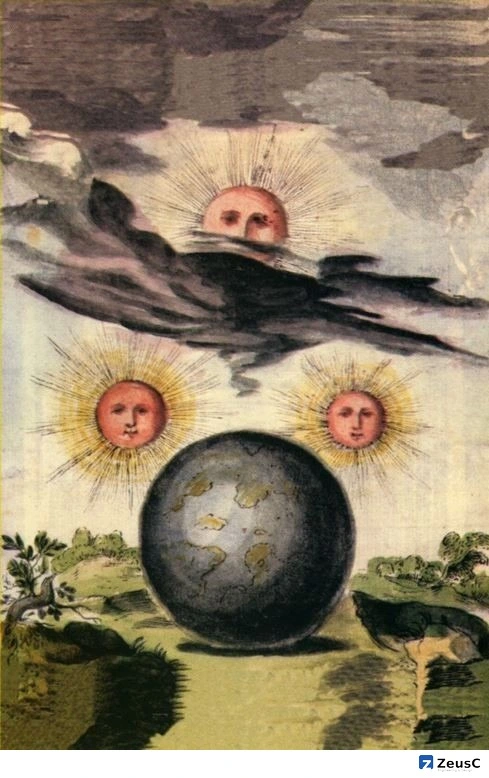
Contemporary illustrated title. The portraits and setting are interpretations; the pictured architecture is not a documentary view. Historical objects and records are identified on the following pages.
A linen garment, a glowing glass and a ring of copper can each be real while the story attached to them is wrong. The useful question is what a particular object, image or measurement can establish. This reader keeps the supplied claims visible, then follows their chronology, instruments and evidence. An attractive illustration does not turn an assertion into an observation.
The six supplied images enter three different parts of the library. Flax belongs with fibres and materials; the apparatus and thirty experiments belong with Tools and First Principles; the subtle-body diagram and the history of unsupported claims belong with Wisdom. This companion lets you read those connections together. A person already discussed elsewhere receives a link to that earlier account and a new experiment-specific passage, not a second interchangeable biography.
Argentina, United States, European Union, wider world
In Argentina, begin the investigation with the material or apparatus actually available to you, record measurements in the International System of Units, and retain the Spanish name on a supplier’s record. In the United States, preserve the seller’s customary units alongside the conversion. In the European Union, retain the exact product identity and local currency rather than treating every country as one market. The historical evidence remains tied to its real place of origin. This regional order does not relocate a discovery to Argentina.
Read the colour before the number
Purple identifies a person; blue a place; brown a material; green a plant or growth observation; ochre a measurement; rust a claim that still needs evidence. The written category and units remain visible in monochrome. A number such as 350 × 250 mm specifies a rectangle, not an area of 350 mm². A frequency such as 5,000 Hz requires a description of what is oscillating and how it was measured.
What a historical source can and cannot do
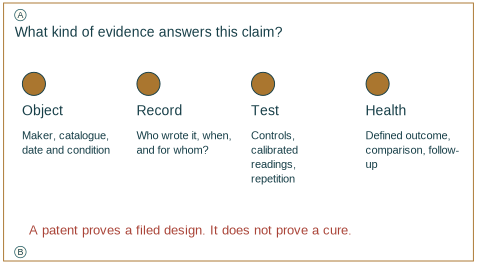
A patent records a claimed invention. An advertisement records what a seller promised. A museum object establishes a surviving material artefact and its catalogued history. A clinical claim needs evidence about people, outcomes, comparison groups and harms. These documents answer different questions. The source register makes those distinctions explicit.
Read the illustration’s labels
What kind of evidence answers this claim?
Object
Maker, catalogue,
date and condition
Record
Who wrote it, when,
and for whom?
Test
Controls,
calibrated
readings,
repetition
Health
Defined outcome,
comparison, follow-
up
A patent proves a filed design. It does not prove a cure.
A
B
Key
Small-print annotation
A
HISTORY • MATERIAL • MEASUREMENT
B
Schematic teaching drawing • not to scale
Units and terms
mm millimetre, 0.001 metre · mm² square millimetre · Hz hertz, cycles per second · × multiplied by
Four questions connect a striking image to a usable record.
The silver cord: reading a symbolic anatomy
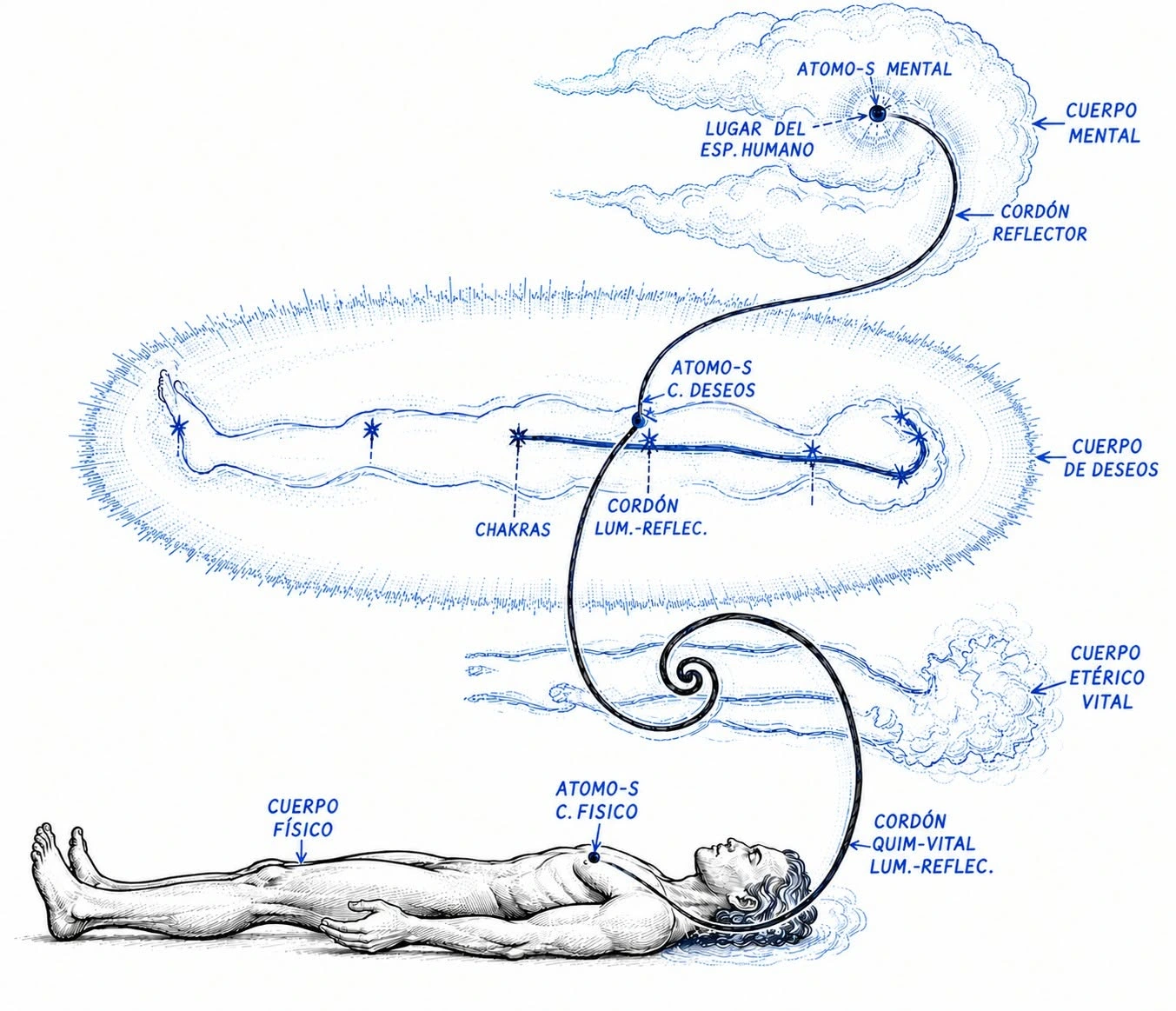
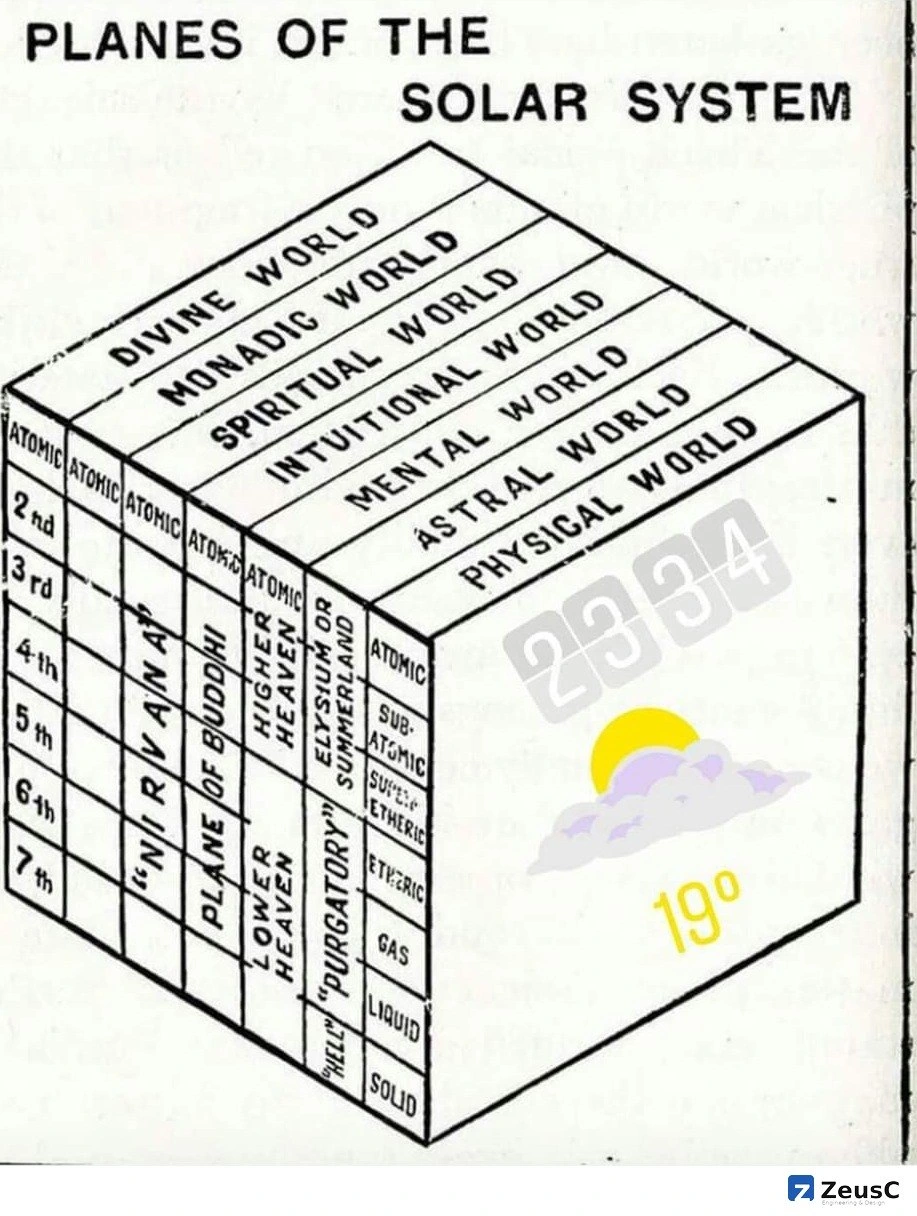
The Spanish drawing shows a physical body below an etheric or vital body, a desire body and a mental body. A cord passes between them, and several points are called seed atoms. This vocabulary closely resembles the Rosicrucian Fellowship’s teaching associated with Max Heindel and later students. The supplied file has no legible publisher, date or plate number, so that resemblance does not establish the exact edition or maker. Its filename “DreaMTime” does not make it an account of Australian Aboriginal Dreaming.
Supplied Spanish diagram, maker and publication not yet identified. Preserved as a source image. Its labels are translated below; the entities belong to the depicted belief system.
The Fellowship’s text The Silver Cord and the Seed Atoms describes its account as an unfinished investigation continued after Heindel’s death in January 1919. It connects the cord and seed atoms to consciousness, sleep and death within that teaching. That is evidence for what this community taught. It is not anatomical evidence that the drawn bodies or cords exist. [E13, E14]
Follow each label without confusing metaphor and anatomy
Read the illustration’s labels
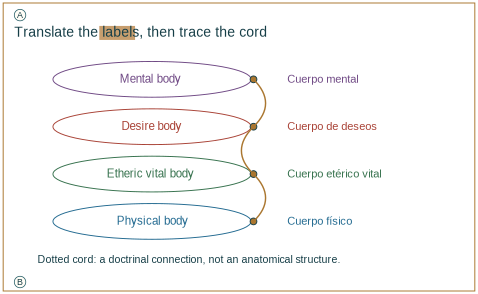
Translate the labels, then trace the cord
Mental body
Cuerpo mental
Desire body
Cuerpo de deseos
Etheric vital body
Cuerpo etérico vital
Physical body
Cuerpo físico
Dotted cord: a doctrinal connection, not an anatomical structure.
A
B
Key
Small-print annotation
A
ROSICRUCIAN VOCABULARY • ATTRIBUTION PROVISIONAL
B
Schematic teaching drawing • not to scale
Original translated guide to the supplied diagram. The dotted connections represent the source’s doctrine, not measurable nerve pathways.
Cuerpo físico means physical body. Cuerpo etérico vital means etheric vital body. Cuerpo de deseos means desire body. Cuerpo mental means mental body. Átomo-S is read here as seed atom in the related tradition; the abbreviation is not a chemical element. C. físico and C. deseos abbreviate the respective bodies. Lugar del esp. humano means place of the human spirit. Chakras names the centres represented in the drawing, rather than confirming their biomedical identity.
Cordón reflector means reflecting cord. Cordón lum.-reflec. abbreviates a luminous/reflecting connection. Cordón quim-vital lum.-reflec. combines chemical/vital and luminous/reflecting terminology. Because the exact source is unconfirmed, these expansions are a reading aid, not a claim that the original publisher used precisely these English terms.
A historian’s method
Read upward once to identify the four labelled bodies. Read downward a second time to trace the cord. Then compare the terminology with the cited Rosicrucian text, keeping the diagram and the text as separate witnesses. Record agreements, differences and unknowns. If an earlier edition is found, its title page and plate number should replace the provisional attribution. Do not use this picture to diagnose sleep, consciousness or illness.
Reich’s cloudbuster and the century that disappeared
Read the illustration’s labels
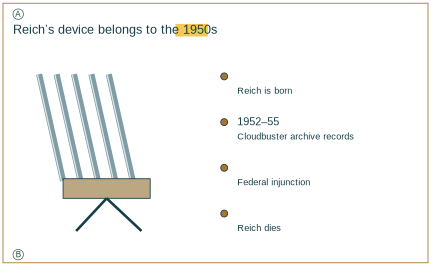
Reich’s device belongs to the 1950s
Reich is born
1952–55
Cloudbuster archive records
Federal injunction
Reich dies
A
B
Key
Small-print annotation
A
ARCHIVE CHRONOLOGY • MAINE, UNITED STATES
B
Schematic teaching drawing • not to scale
Wilhelm Reich and the difference between an archive and a weather test.
The supplied caption places cloudbusters in the 1800s and says Rockefeller banned them. The documented device associated with Wilhelm Reich belongs to the 1950s. Reich was born on 24 March 1897 and died on 3 November 1957. His museum’s chronology places cloudbuster work in his later American period, including a reported rain-making episode at Rangeley, Maine, in 1953. This chronology alone contradicts the image’s nineteenth-century story. [E04]
Units and terms
BY Attribution condition in a Creative Commons licence
Surviving cloudbuster in Maine, photographed by Dennis Redfield on 30 August 2012. CC BY 2.0, via Wikimedia Commons. Modern photograph of a historical device; it does not demonstrate weather control. [E06]
Reich described an “orgone” energy and attempted to influence atmospheric conditions with an array of tubes and connections to water. The archive index lists CORE publications and related records from 1952-1955. The presence of these records is historically important: people did build and describe such equipment. It does not independently validate the proposed energy or establish that a later rainfall was caused by the apparatus. [E05]
What a rain-making story leaves unmeasured
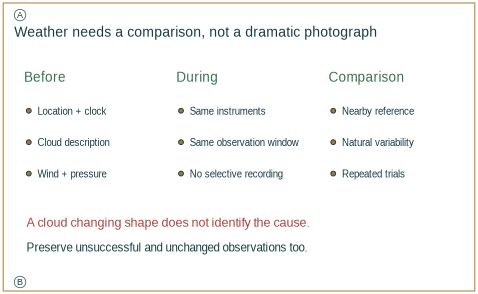
Rainfall changes naturally in space and time. A persuasive test would define the target outcome before operation, record a baseline, compare suitable untreated periods or areas, retain forecasts and radar information, and include unsuccessful trials. Choosing only a dramatic photograph followed by rain cannot separate intervention from coincidence. Copper’s electrical conductivity does not by itself supply a mechanism for removing clouds.
Read the illustration’s labels
Weather needs a comparison, not a dramatic photograph
Before
Location + clock
Cloud description
Wind + pressure
During
Same instruments
Same observation window
No selective recording
Comparison
Nearby reference
Natural variability
Repeated trials
A cloud changing shape does not identify the cause.
Preserve unsuccessful and unchanged observations too.
A
B
Key
Small-print annotation
A
OBSERVATION LOG • NO WEATHER-MODIFICATION CLAIM
B
Schematic teaching drawing • not to scale
A weather record distinguishes the operation time from the outcome window and the comparison area.
The Rockefeller ban is not supported by a dated order, named jurisdiction or document in the supplied material. Reich’s conflict with US authorities involved a 1954 injunction associated with orgone-related medical claims and interstate commerce. That is a different event from the alleged nineteenth-century prohibition. The museum is a useful primary archive for Reich’s work and its own account of events, but its advocacy is not an independent effectiveness trial. [E04, E05]
A useful observation project
Use one manual rain gauge, one thermometer, a notebook and a camera. Mount and read the gauge according to its manufacturer’s instructions, keep the location fixed, and note obstruction and wind exposure. Record daily observations at the same local time for at least a month. Compare them with the nearest suitable official weather station, noting the distance and elevation difference. This teaches rainfall measurement without claiming to control it. Argentina comes first through the local weather service; US and European comparisons should use their own station metadata rather than assuming all gauges share exposure and timing.
Units and terms
BY Attribution condition in a Creative Commons licence
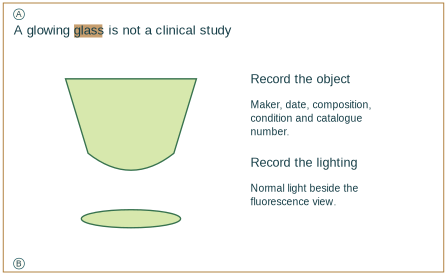
Green glass: colour, fluorescence and a medical story
Read the illustration’s labels
A glowing glass is not a clinical study
Record the object
Maker, date, composition,
condition and catalogue
number.
Record the lighting
Normal light beside the
fluorescence view.
A
B
Key
Small-print annotation
A
MATERIAL HISTORY • FLUORESCENCE • EXPOSURE
B
Schematic teaching drawing • not to scale
Uranium-bearing glass belongs to the history of colourants and radiation, not a proven healing method.
Uranium compounds were used as glass colourants in the nineteenth century. The Corning Museum of Glass notes an early reference in 1817 and the role of Josef Riedel in popularising uranium glass from the 1830s. Historical green and yellow glassware can therefore be examined as the product of a glasshouse, a recipe and a market. The supplied picture’s suggestion that these vessels nearly displaced the pharmaceutical industry is a separate claim for which it provides no clinical or economic evidence. [E08]
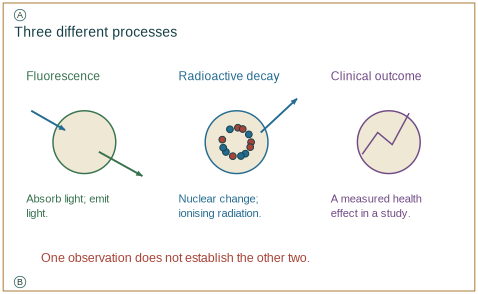
Under suitable ultraviolet illumination, some uranium-bearing glass fluoresces green. Absorbed light excites the material; part of the energy returns as visible light. Radioactive decay is a different process in the nuclei. A green glow is not a meter of therapeutic power, and a photograph cannot determine composition, activity or exposure. ORAU’s collection also explains that visually similar glass can use other colourants and that not every uranium-containing object gives the same fluorescent response. [E09]
ORAU: Oak Ridge Associated Universities. The institution holding the cited historical radiation-related collection.
Catalogue the vessel before making a claim about it
Read the illustration’s labels
Three different processes
Fluorescence
Absorb light; emit
light.
Radioactive decay
Nuclear change;
ionising radiation.
Clinical outcome
A measured health
effect in a study.
One observation does not establish the other two.
A
B
Key
Small-print annotation
A
DO NOT EXCHANGE THESE EXPLANATIONS
B
Schematic teaching drawing • not to scale
Light excitation and nuclear decay are separate processes. The arrows are explanatory, not an energy-scale plot.
Catalogue the vessel before making a claim about it
For a historical object, record its maker if known, catalogue number, dimensions, condition, provenance and the circumstances of the photograph. Ask whether its colour comes from a documented composition or from appearance alone. If it is shown under ultraviolet light, record that fact. Keep a normal-light photograph beside the fluorescence image so that lighting does not masquerade as a material change.
The US Environmental Protection Agency says intact radioactive antiques are usually a low risk, while advising against using radioactive glassware for food or drink and against damaged pieces. This is neither the claim that every intact vessel is a severe hazard nor permission to use one as a treatment. Handling, breakage, ingestion and exposure conditions matter. [E07]
A safer optical comparison
Use a museum’s documented photographs or a commercially labelled nonradioactive fluorescent sample. Compare the appearance under ordinary light and under the illuminator specified by its supplier. Do not stare into ultraviolet sources. The learning objective is to distinguish excitation, emission and composition, not to collect radioactive material. A paper-and-colour model needs two coloured pencils, a ruler and two labelled arrows; it can explain the energy distinction without an exposure experiment.
Lakhovsky’s rings: an invention and its medical promise
Henri Becquerel’s work on spontaneous radiation belongs with the experiment chapter later in this reader. His result concerns what happens without the light exposure expected by a phosphorescence explanation. It does not establish that irradiated water, uranium glass or an apparent aura heals a person. The same historic subject can support a sound physics lesson and still be misused in a medical advertisement.
Lakhovsky’s rings: an invention and its medical promise
Read the illustration’s labels
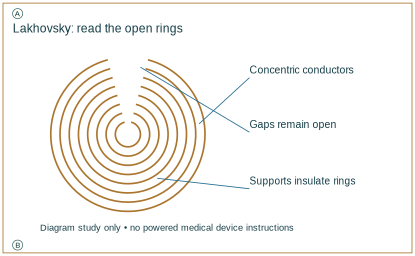
Lakhovsky: read the open rings
Concentric conductors
Gaps remain open
Supports insulate rings
Diagram study only • no powered medical device instructions
A
B
Key
Small-print annotation
A
PATENT HISTORY • 1931 PRIORITY, 1934 US GRANT
B
Schematic teaching drawing • not to scale
Georges Lakhovsky, concentric resonators and the claims attached to them.
Georges Lakhovsky proposed electrical and oscillatory explanations of living processes and promoted apparatus intended to act on them. His name is misspelled “Lachowski” in the supplied image. The Bibliothèque nationale de France gives his birth as 1869 with uncertainty and his death as 1942. Other dates circulate, so an exact birthday is not invented here. [E11]
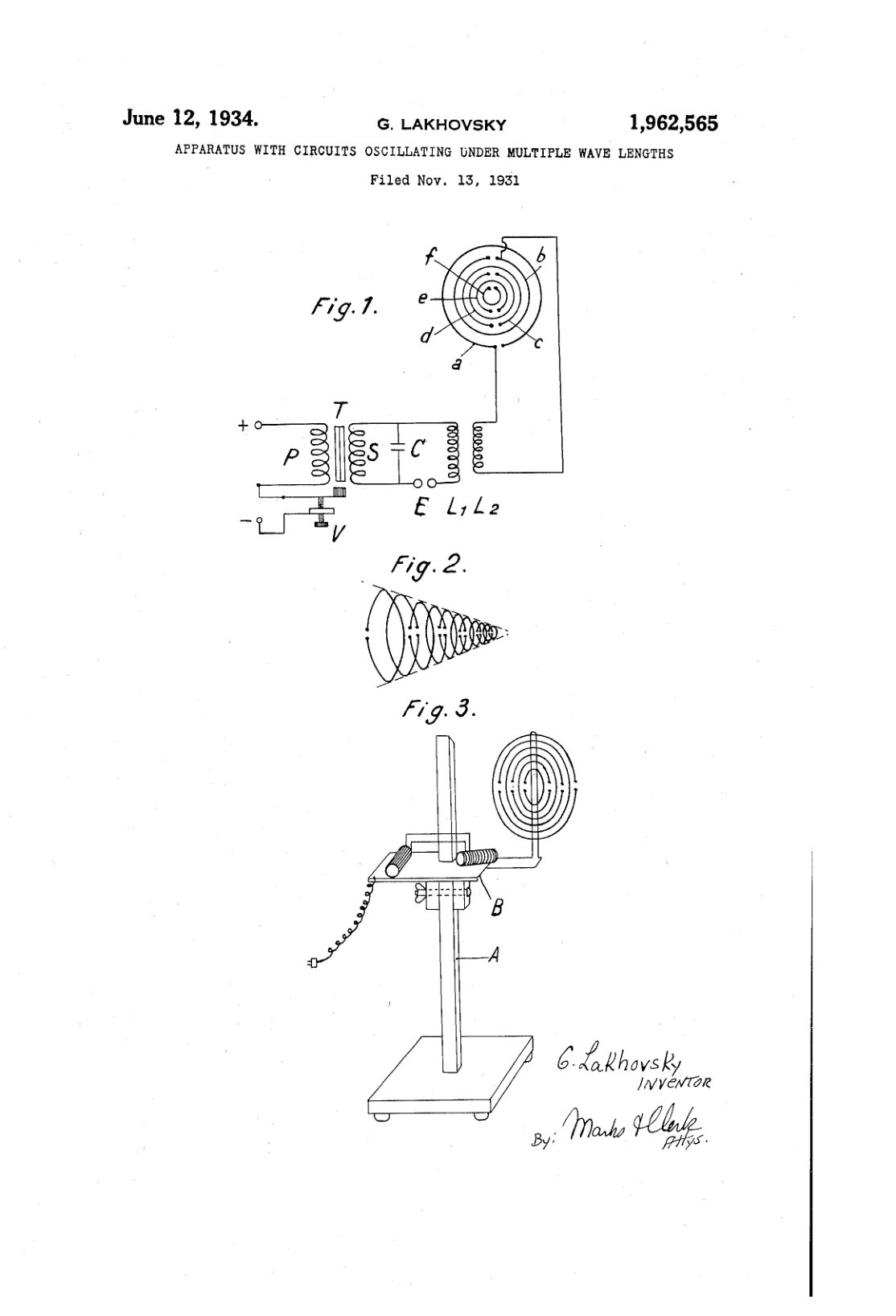
US patent 1,962,565 was granted on 12 June 1934, following a French priority claim of 2 May 1931. Its drawings show concentric open rings and an arrangement for excitation. The rings are not all one continuous closed conductor: their geometry and insulation are part of the claimed apparatus. The document establishes that a design was described and patented. It cannot establish a cure. [E10]
First drawing sheet of US patent 1,962,565. Georges Lakhovsky, granted 12 June 1934. Historical patent drawing, public domain. Inspect the full preserved PDF for the original specification.
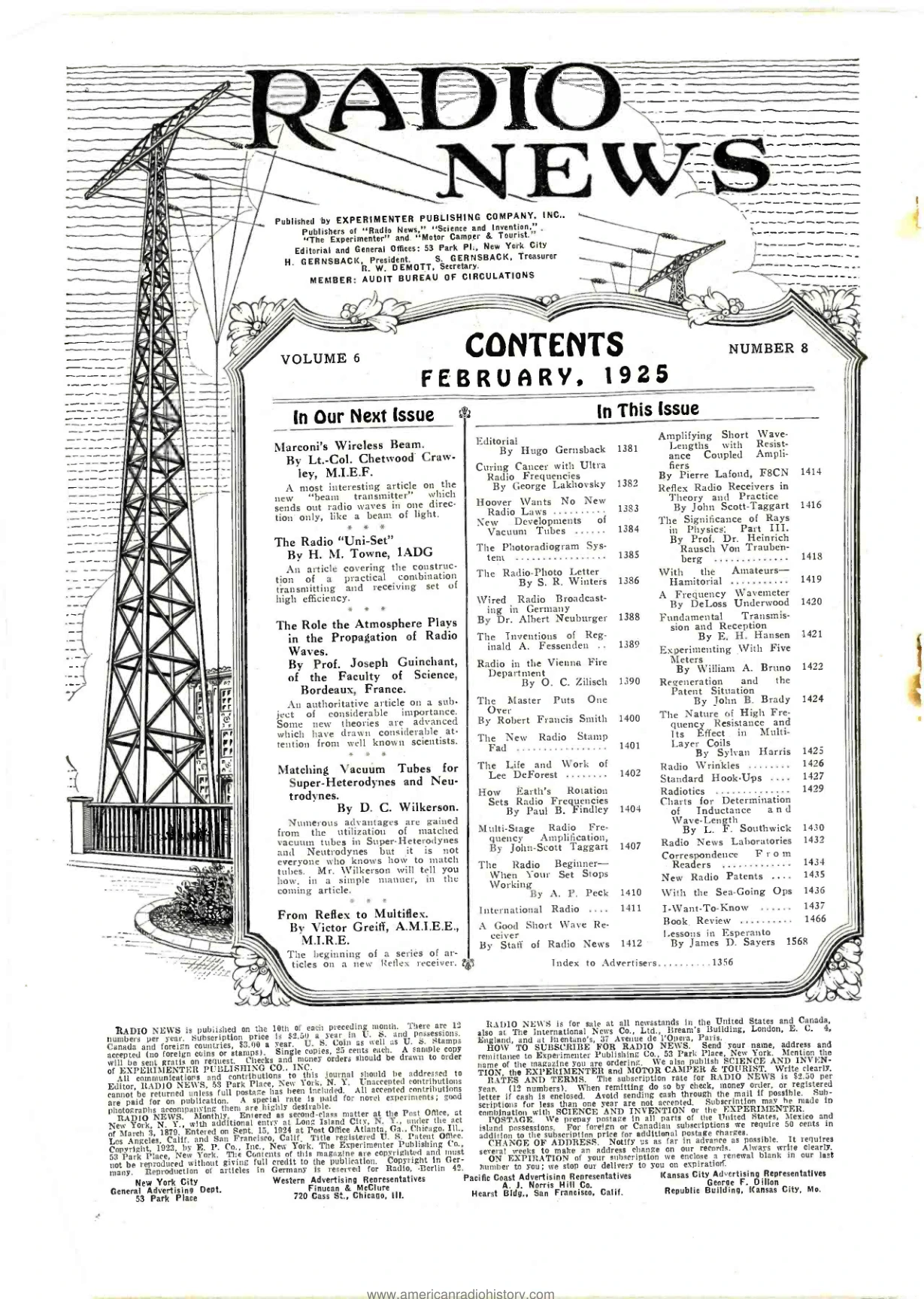
Lakhovsky’s February 1925 Radio News article is a contemporary record of his claims about radio-frequency treatment. The photographs and diagrams are valuable because they show what was presented to readers at the time. They are not a controlled clinical comparison, and a sequence of before-and-after faces in a social-media montage is not a substitute for patient identification, diagnosis, treatment details, follow-up and an independent assessment. [E12]
Historical article in Radio News, February 1925. The printed medical promises are claims made by the author at that time, not treatment advice endorsed by this book. US publication from 1925, public domain.
MWO means multi-wave oscillator. RF means radio frequency. Biological tissues use chemical energy and also respond to electrical and electromagnetic conditions, but that general statement does not validate this device’s specific claims. “Saturating cells with energy” gives neither a dose nor a measurable clinical endpoint. Frequency, field strength, exposure geometry, duration and heating must be specified before a physical exposure can even be characterised.
RF: Radio frequency. Electromagnetic oscillations in the radio-frequency range; a named frequency alone supplies neither an exposure dose nor evidence of therapeutic effect.
MWO: Multi-wave oscillator. The historical device name in this chapter; the expansion does not establish a medical benefit.
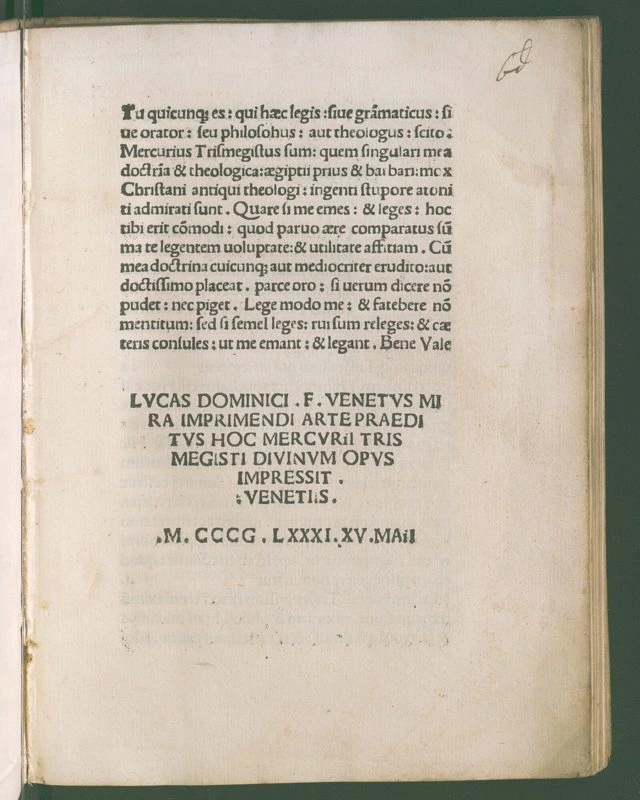
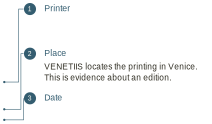
The printer’s colophon in the Venetian Pimander of 1481.
Read the object record
A dated object and a later commentary travel together surprisingly often. An inscription gives a wording at one point in the object’s history. A modern caption may translate it, interpret it or misidentify it. Establish the item and its catalogue record before attributing the caption to the maker.
A source record links a precise claim to the relevant passage and edition or object number. It distinguishes the source’s wording from a later inference.
Sources and evidence Read the chapter
Wisdom: keep the record and its context
1-5 build a checkable record
Prepare the complete source, its catalog entry, a text editor, a record sheet and separate storage for copies. Begin with one answerable question, such as whether a photograph documents an event or a proposal. [D257, D258]
1. Assign a local record ID. Copy the repository, item identifier, title and URL. Record who supplied the file and when you accessed it. Mark an unknown creator as unknown.
2. Separate dates: creation, publication, later annotation and digitization may differ. State which date the catalog actually supplies. A stamp date need not be the exact moment pictured.
3. Retain the complete available image and catalog context. Make crops as separate working files; record the parent file and crop bounds. A caption outside a crop may change its meaning.
4. Transcribe visible wording faithfully, including original spelling and punctuation. Mark unclear passages under a stated convention. Keep translation and paraphrase in separate fields. [D259]
5. Compare the transcript with the source again. Check names, dates, units, marginal notes and omissions. Preserve uncertainty rather than filling a gap from expectation. [D259]
6-10 test and preserve the claim
6. List visible features before interpreting them: people, objects, actions and inscriptions. Attribute details supplied by the caption or catalog to that source. [D258]
7. State a narrow claim. Link its evidence to a record ID and location. Distinguish an inference from what the source says. [D257]
8. Seek another record. Is it independent or repeating the same caption? Compare dates, objects and terminology before combining accounts. See the airship case on 237.
9. Mark the claim supported, disputed or unresolved. State what evidence could change it. Preserve earlier readings and explain corrections.
10. Keep image, transcript, translation, context and claim together. Name files clearly, keep copies in separate places and check readability. [D263]
Apply this to family papers, maps, workshop notebooks and building histories. A historical remedy does not prove a medical benefit. Keep Terra Realm’s original sequence distinct from commentary; resemblance alone does not establish shared origin.
Sources 1283 Record method 1281 Airship comparison 1282
URL: Uniform resource locator The web address that leads to a source or record.
Enna Jettick | item 2017645472. The catalog dates this Associated Press photograph to 15 September 1931, from a verso stamp. Its news-agency caption describes the craft just before a momentary mooring. The catalog summary describes it hovering nearby. The image and its caption make different kinds of evidence. [D260]
Columbia | item 2019632904. Dated 30 September 1931 from a verso stamp, this record concerns attempted mail collection. The published caption says the rope escaped the handler before the mail bags could be attached; it also describes a later staged lift for cameras. That account does not establish a successful aerial mail transfer. [D261]
Keep these item identifiers separate. Neither record is a demonstration of electrical charging, a passenger terminal in operation or a construction method. Claims about a mast's load, connection or dimensions require engineering evidence beyond these catalog entries.
Read the source description before shortening it for a label. Omitting the failed attempt from the second account would reverse its meaning.
A constructed image and a conflict
The Metropolitan Museum of Art lists object 2011.189 as a 1930 gelatin silver print by an unknown American maker. It depicts the dirigible Los Angeles at the tower. The work appears in Faking It, the Met publication on manipulated photography. It is evidence for an image and a proposed idea, not proof that the depicted docking occurred. [D262, D264]
The Met's essay broadly denies airship docking there; the Enna Jettick caption describes a brief mooring. Preserve that difference. These sources alone do not settle whether the authors use docking and mooring identically. Do not merge their language into an unqualified claim. [D260, D262]
A defensible conclusion: these three records must be evaluated separately. The documented caption claims, the museum's interpretation and the still image itself are not interchangeable.
Consult the linked repository records for their complete descriptions and access conditions. Preserve each item identifier, caption and date. The physical format of a print is not the dimension of the aircraft it depicts. [D257-D264]
An image record and its interpretation
Record layer
What it preserves
Original image and identifier
The unchanged item and the repository record that identifies it.
Transcript and translation
Readable text; uncertain readings and translation decisions remain explicit.
Context and claim
What the source says, who says it and what the image alone cannot establish.
Review and date
A dated account of corrections, evidence and unresolved alternatives.
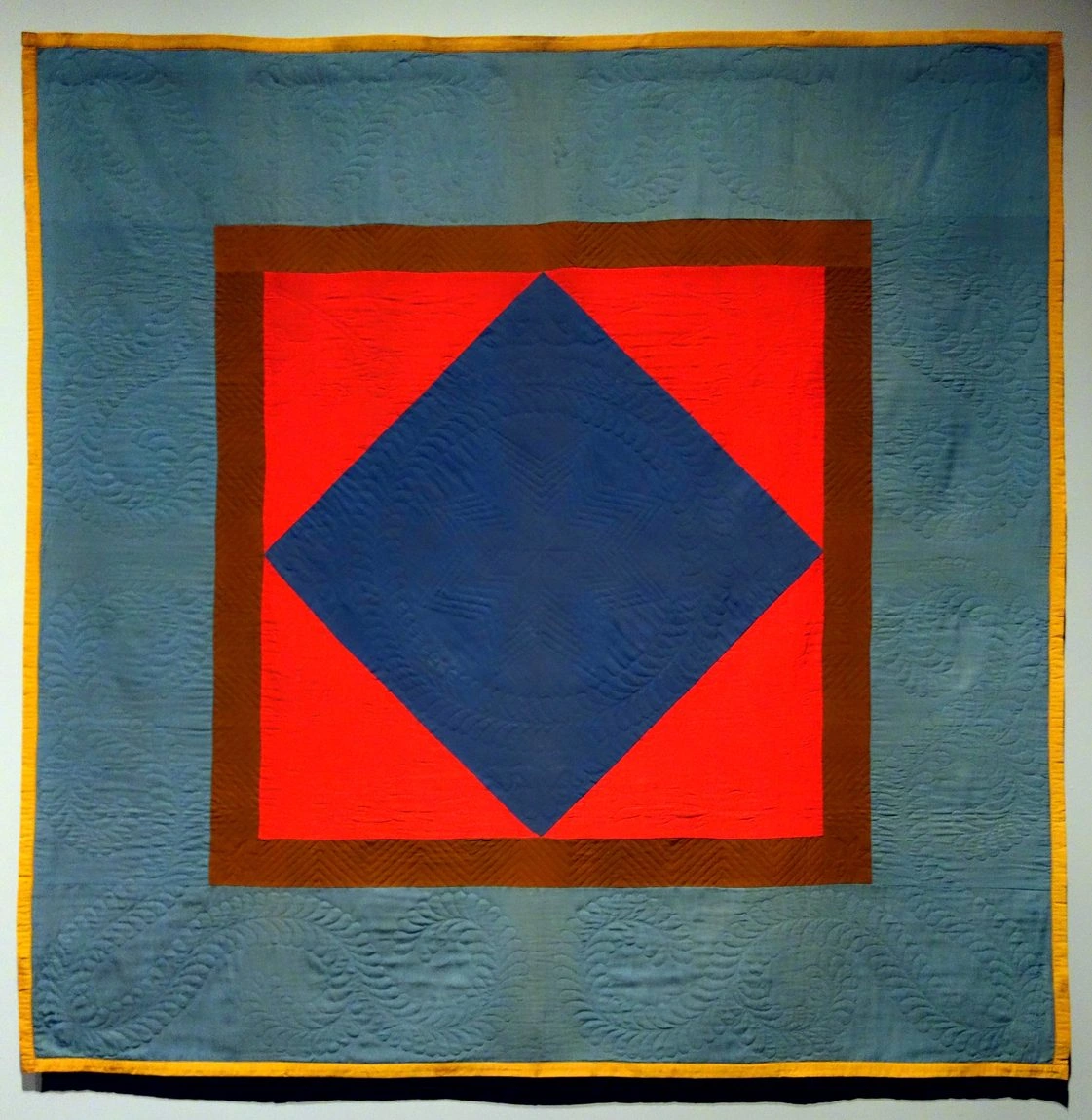
Framed Diamond in a Square, an Amish quilt from Lancaster County, Pennsylvania, about 1890.
Daderot Public domain
The Amish emerged from a division in Anabaptist communities associated with Jakob Ammann in 1693. Shared religious commitments take different practical forms in different settlements. A particular quilt, tool or method of making a seam belongs to a maker and a setting.
Amish communities emerged from the Anabaptist division associated with Jakob Ammann in 1693. Religious commitments and local decisions shape practical life; household techniques are not a single universal system. The Young Center describes selective use and adaptation of technology. [D265, D266]
Quilt records show why a specific object matters. The Met describes a Lancaster County Diamond in the Square quilt, about 1920, with a seven-pointed central star and elaborate quilting. Its maker is unnamed in the catalog. Those details belong to that object, not every Amish quilt. [D267]
The International Quilt Museum attributes Center Diamond, object 1997.007.0232, to Sarah Smoker, probably Lancaster County, 1915-1935. It records machine piecing. Machine piecing joins fabric pieces; it does not by itself identify how the quilting was stitched. [D268]
Piecing builds the top. Quilting joins top, batting and backing. Binding covers the perimeter. A pieced block alone is not a finished quilt. Choose compatible batting and backing if continuing; follow their instructions and the machine manual. [D271, D272]
When learning from a household or maker, record the person, place, date and permission to photograph. Keep religious interpretation separate from the sewing method.
“Je pense, donc je suis.” “I think, therefore I am.”
F
Discourse on Method, IV (1637) [D296]
G
Anatomy 1302 · Signals 1303
H
Portrait after Frans Hals [D301-D302]
I
Not to scale [D297-D298]
J
Anatomy 1302
K
Route 1303
L
Method 1305
M
Sources 1306
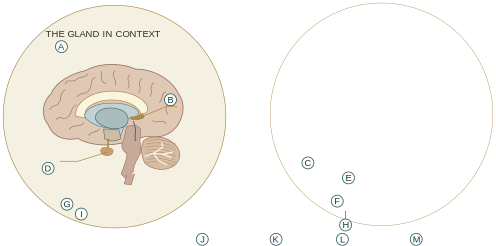
In the drawing: RENÉ DESCARTES · 1596-1650; “Je pense, donc je suis.” “I think, therefore I am.”; Discourse on Method, IV (1637) [D296]; Portrait after Frans Hals [D301-D302]; THE GLAND IN CONTEXT; Medial cutaway · anterior at left; Pineal; Pituitary; Anatomy 1302 · Signals 1303; Not to scale [D297-D298]; Anatomy 1302 Route 1303 Method 1305 Sources 1306
Numbered landmarks · Medial cutaway · Original schematic [D297-D298]
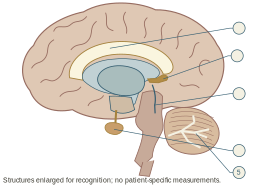
1PINEALGLAND Part of the epithalamus; a stalk attaches it to the roof of the third ventricle. Gold marks the gland behind the thalamic region. 2 PITUITARY GLAND Aseparateglandbelowthehypothalamus. Do not move a pineal label onto this lower structure when redrawing a head. 3 CORPUS CALLOSUM The pale arch crosses the midline and connectsthecerebralhemispheres.Its position alone does not establish function. 4 VENTRICULAR PASSAGE Blue marks a ventricular space and the narrow cerebral aqueduct. A cavity isnotthesamekindofobjectasagland. 5CEREBELLUM The folded structure behind the brainstem is an orientation landmark. It prevents a reversed front/back reading.
Read the illustration’s labels
5
Structures enlarged for recognition; no patient-specific measurements.
In the drawing: 5 Structures enlarged for recognition; no patient-specific measurements.
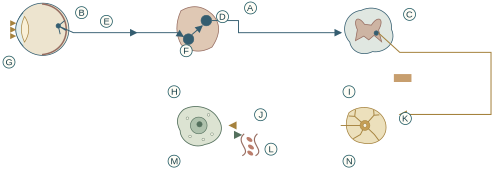
PVN: Paraventricular nucleus. The named hypothalamic region in the anatomical pathway diagram, rather than a general label for every relay in the brain.
PVN: Paraventricular nucleus A brain region mentioned in the pathway carrying signals from the circadian clock.
One claim, three different kinds of record
Read the illustration’s labels
A
B
C
D
E
F
G
H
Key
Small-print annotation
A
A worked source audit · Evidence categories are not interchangeable
B
SOURCE A · 1649
C
SOURCE B · ANATOMY
D
RECORD THE DIFFERENCE
E
Passions, article 32
F
A located endocrine gland
G
Historical proposal ≠ physiological test
H
EXPERIMENTAL RECORD
HISTORICAL RECORD D295, article 32: record the proposed union of sensory impressions at a gland. The source establishes that Descartes made the argument. It does not supply measurements demonstrating that mechanism. ANATOMICAL RECORD D298: compare identified structures and their locations. Draw a leader to the actual object, record the view and distinguish solid tissue from a cavity. A medial position is an anatomical observation; a proposed function needs its own evidence. KEEP THE QUOTATION IN CONTEXT The cogito on 247 is a philosophical starting point from D296. Moving it below a brain picture does not turn it into a claim about hormones. Record work, part and translation with the words.
D300 reports an observed response of nocturnal melatonin to bright artificial light in six people. The record concerns that response under study conditions. A small original study is not a universal schedule or an explanation of every aspect of sleep.
The resulting caption
In the drawing: A worked source audit · Evidence categories are not interchangeable; EXPERIMENTAL RECORD; SOURCE A · 1649; Passions, article 32; SOURCE B · ANATOMY; A located endocrine gland; RECORD THE DIFFERENCE; Historical proposal ≠ physiological test
“Descartes proposed a special role for the pineal. Modern physiology describes a neuroendocrine structure involved in circadian signaling.” This is an editorial synthesis with two separate sources, not a quotation by Descartes.
A reusable record
Fields: exact claim; source and locator; date; what was observed; what was inferred; limits; revision. Keep uncertain entries marked as uncertain. Another reader should be able to find the evidence without guessing which illustration you meant.
Write one proposition: “Descartes proposed a special role for the pineal.” Record the edition, article and date. Do not begin with a bundle of claims about consciousness, sleep and spiritual experience.
2. separate the verbs
Mark proposed, observed, measured and inferred in different ways. Keep a direct quotation in quotation marks. Put your own summary on a separate line so that later readers can identify whose words they are.
3. check the object
Locate the pineal, then the pituitary, third ventricle and corpus callosum. Confirm the view and orientation before comparing pictures. A frontal symbol cannot serve as a midsagittal anatomical section. 4. READ THE STUDY’S BOUNDARY
For a research result, record participants or species, conditions, measured outcome and comparison. Mark “not reported in the abstract” when the detail is absent. Do not invent a light intensity from the word bright.
For D300: the abstract reports light-related suppression of nocturnal melatonin in six participants. That supports a physiological response under the study conditions. It does not locate a soul or supply a treatment schedule.
6. record the open question
Use three fields: established by this source; interpretation; still untested here. Add author, access date, article or page locator and a stable URL. Keep a superseded wording in the revision log, not in the active caption.
7. let another reader repeat it
Give the record to a second reader. Ask them to find the passage and distinguish the historical claim from the current explanation. Resolve disagreements by checking the source.
Applications
Use this record for a portrait caption, historical quotation, museum label, classroom diagram or archived health claim. Each use requires its own source and scope; accuracy in one field cannot certify another.
Acceptance and failure check
Require a retrievable source for each factual statement and a declared view for each drawing. Revise reversed arrows, unsupported citations, quantities without units and interpretations presented as measurements.
Overview 247 Anatomy 1302 Route 1303 Sources 1306
The notebook that outlives its keeper
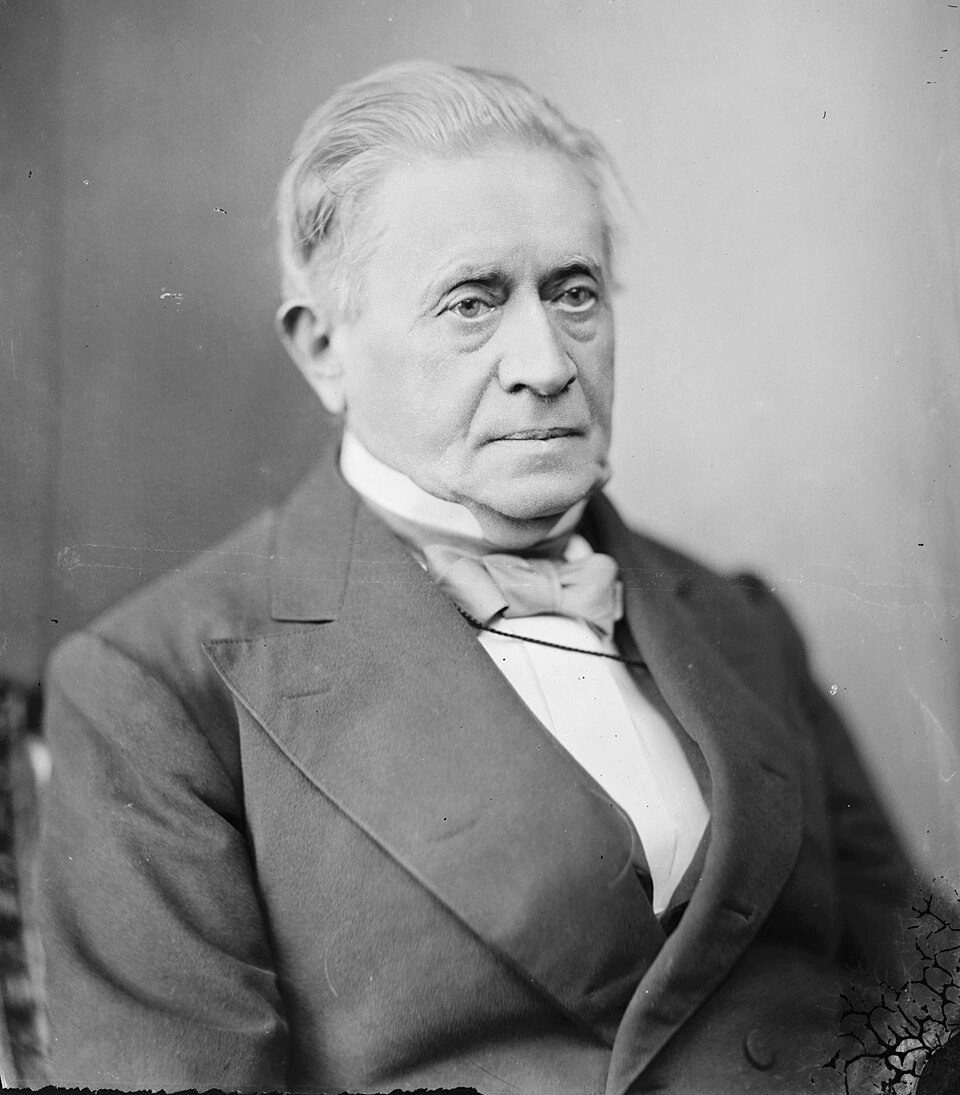
Joseph Henry, photographed by the Brady-Handy studio. He began his Record of Experiments in 1834.
Mathew Brady or Levin Handy Public domain
Joseph Henry began a dated Record of Experiments in 1834. A notebook could establish when an observation was made, what apparatus was used and which result justified changing the next trial. A village store or workshop faces the same problem whenever responsibility passes to someone new.
For a pump failure, record the time, observed symptom, reading and unit, the person who authorised the response and the next inspection. Give the repair an entry of its own. Later readers can then trace the decision without treating a planned repair as completed work.
Read the illustration’s labels
A DURABLE COMMUNITY NOTEBOOK
KEEP THE DISCREPANCY VISIBLE
In the drawing: A DURABLE COMMUNITY NOTEBOOK; KEEP THE DISCREPANCY VISIBLE
Community records: evidence and procedure versions
Joseph Henry began a carefully dated Record of Experiments in 1834. The Smithsonian relates this to his concern that earlier work had not been documented well enough to support a priority claim. The surviving notebooks connect observations, later reflections and references to other researchers. Their value is historical evidence of a developing investigation, not proof that every interpretation was correct. [D303] FROM PERSONAL MEMORY TO SHARED WORK A community record needs a stable address: collection, volume, page and entry. Keep the chronological record intact and use an index to connect decisions, stock, maintenance and observations. A later reader should be able to distinguish the original note from a copied value, a calculation and a proposed explanation. [D304-D306] WHAT THE WORKED EXAMPLE ASSUMES The figures follow a fictional workshop counting unopened screw packets. Each packet is treated as one item; nothing is inferred about the number of screws inside. Opening stock is 24 packets, six arrive and nine are issued. The expected balance is 21. A separate count finds 20. Those invented values teach reconciliation, not an account of an actual loss.
Record both the expected balance and the count, with the time and the scope of the count. A difference of minus one packet is a question to investigate. Check receipt R07, issue slip I12, shelf B2 and any later movements. Do not alter the opening balance merely to make the columns agree. A second observer can check the recount without endorsing every past entry.
A procedure and an entry differ
The procedure describes how a task should be done. An entry says what happened on one occasion and identifies the procedure version used. Retain earlier versions with a clear superseded status. Keep decision reasons, alternatives and a trigger for review alongside the current instruction. This version arrangement is an original community design, not an institutional mandate.
Access is part of the design
Keep shared operating notes separate from personal medical, financial and contact details. Give sensitive records a named custodian and limit copies to their intended readers. Public summaries should omit those details. Preserve essential copies apart, then ask another authorised person to retrieve a record and its attachments. Success means finding and understanding the evidence, not just possessing many files. [D306, D308]
Overview 249 Ledger 1308 Records 1309 Method 1311 Sources 1313
Count, calculate and reconcile
A fictional stock record · Count unit: unopened packets · Every quantity is a teaching assumption
Read the illustration’s labels
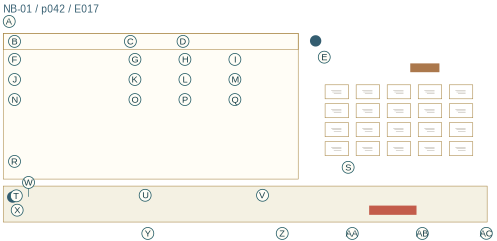
NB-01 / p042 / E017
A
B
C
D
E
F
G
H
I
J
K
L
M
N
O
P
Q
R
S
T
U
V
W
X
Y
Z
AA
AB
AC
Key
Small-print annotation
A
Fictional workshop count · 26 October 2026 · local time UTC−03:00
B
RECORD
C
PACKETS
D
EVIDENCETIME
E
One sealed packet is one item. Do not mix packets and screws.
AB · 11:40 · 26 Oct 2026: copied I12 incorrectly. Original slip shows 9. Difference remains unresolved.
Y
Overview 249
Z
Records 1309
AA
Method 1311
AB
Sources 1313
AC
1308
An entry, its evidence and its procedure
Stable identifiers connect records · Preserve the version actually used
Units and terms
AA A standardized cylindrical battery size designation, not an acronym · AC Alternating current · UTC Coordinated Universal Time, the international civil time standard; Argentina used UTC minus three hours for this event · = equals · × multiplied by
UTC Coordinated Universal Time, the international civil time standard; Argentina used UTC minus three hours for this event · AA A standardized cylindrical battery size designation, not an acronym · AC Alternating current · = equals · × multiplied by
STK-01 v1.1 · SUPERSEDED Keep for interpreting E017. Used on 26 October; never relabel as v1.2. The earlier procedure is part of the record.
STK-01 v1.2 · CURRENT Issued 27 October: add a second-personcount. Revision reason: E017 exposed an unresolved gap. Review trigger: next discrepancy or handover.
Overview 249
Ledger 1308
Method 1311
Sources 1313
1309
Protect the paper; prove the copy is usable
Preservation, controlled access and recovery · Original schematic [D307-D309]
Preservation needs a recovery test
Read the illustration’s labels
A
B
C
D
E
F
G
H
I
Key
Small-print annotation
A
Illustrative arrangement; copy locations and equipment depend on the collection
UTC Coordinated Universal Time, the international civil time standard; Argentina used UTC minus three hours for this event · AA A standardized cylindrical battery size designation, not an acronym · AC Alternating current · = equals · × multiplied by
Use one numbered notebook, a durable ink pen, a ruler, an attachment folder and an index card. An optional digital trial adds a camera or scanner, a document viewer and two separately stored copy destinations. These are teaching choices, not archival product specifications.
1. define the record and its reader
Choose one task and its scope. Here it is unopened packets on workshop shelf B2. Name the recorder, reviewer and custodian by role. Decide what belongs in the shared book before collecting personal details.
2. assign a stable address
Mark the volume NB-01 and number its pages. Use NB-01/p042/E017 for this entry. Add a subject-index pointer to page 42. Keep the address even if a later copy is stored elsewhere.
3. capture the occasion
Enter date, local time, time offset, location and recorder code. Write promptly. For a reconstructed event, distinguish event time from writing time. Mark an unknown time as unknown.
4. link supporting items
Give the receipt, issue slip and count sheet their own IDs. Note where each can be found. Preserve their complete contents, including reverse sides when relevant. If a value is copied from one, record that relationship. [D305-D306]
Keep opening stock, receipts and issues in different fields. Write the equation and count unit. In this example: 24 + 6 - 9 = 21 packets. Count the shelf independently; record 20 even though the expected value is 21. 6. CORRECT WITHOUT CONCEALING Eight issues would predict 22 packets. Strike through the eight once so it remains readable; add nine, initials, correction time and a reason linked to I12. Correct the earlier calculated balance visibly too. [D305] 7. RECORD THE NEXT DECISION Recount, inspect the slips and check movements after the count. If the difference persists, record it as unresolved and assign a follow-up. Do not assume theft, spoilage or a counting error from the arithmetic alone. 8. CLOSE AND INDEX THE ENTRY Have the reviewer state what was checked: arithmetic, a recount or the attached evidence. Add the entry and attachment locations to the index. Review is a documented action with a scope, not a decorative signature. FAILURE CHECK BEFORE FILING Can a second reader identify the unit, distinguish observation from calculation, and find I12? Clarify whether a blank means zero, unknown or not checked. Do not convert missing information into zero.
Overview 249 Ledger 1308 Records 1309 Sources 1313
Keep the record useful after a handover
Steps 9-10 · Five applications · Preservation and failure checks
PRESERVE THE RECORD AND ITS COPIES Protect the paper and make readable copies of both the entry and its evidence. Use descriptive names, retain versions and keep an inventory explaining the folders. Separate copies geographically where practical. Select a review interval that suits the value and rate of change of the records. [D307-D308]
TEST RETRIEVAL AND RECOVERY Use a copy to recover E017 and I12. Compare page count, legibility and the visible correction with the paper. For digital files, compare full hashes with the recorded baseline and open the files. Record the result, person, date and any missing item. A matching hash does not prove that the scan captured the original correctly. [D309] WHEN A COPY FAILS Keep the failed copy separate and preserve its error report. Compare another copy with the trusted inventory. Restore into a new location and verify it before replacing a working copy. If all copies share a missing page, return to the original; duplication cannot recover content that was never captured.
FIVE PRACTICAL APPLICATIONS 1. Stock: separate receipts, issues and physical counts. 2. Maintenance: record the asset, symptom, work performed and check result. 3. Garden observations: connect date and location to photographs. 4. Decisions: retain alternatives, reasons and a review trigger. 5. Teaching: record the task attempted, observed outcome and feedback without inventing a score. PAPER AND DIGITAL HAVE DIFFERENT RISKS Keep paper in a suitable enclosure on a shelf away from leaks, damp storage and direct handling damage. Do not force a bound volume flat for copying. Digital access depends on working media, software and custody arrangements. A remote copy helps only if the right person can retrieve and read it. [D307-D308] HANDOVER TO THE NEXT CUSTODIAN Provide the index, access rules, current procedure list and copy locations. Demonstrate one complete retrieval. Record unresolved discrepancies and the next planned check. Transfer responsibility explicitly; knowing a password or finding a box is not the same as understanding the collection.
Overview 249 Ledger 1308 Records 1309 Method 1311 Sources 1313
Family archive: connect a dish with the person who taught it and the occasion on which it is made.
Community meal: use measured preparation yields to estimate purchasing, then check a real batch.
Teaching: have learners compare their written sequence with a demonstration.
Garden planning: connect locally observed harvest seasons with a documented meal.
Claim review: separate a heritage statement, a modern recommendation and a clinical result. COMPARE LIKE WITH LIKE Compare the same ingredient state and unit. “500 g beans” could mean dried beans, soaked beans or a cooked drained portion. Record added water separately. Use observations from the same preparation stage when comparing yields, and preserve differences instead of averaging incompatible quantities. A USEFUL RECORD HAS BOUNDARIES A recipe record can preserve a contributor’s practice and make its steps easier to examine. It cannot, by itself, authenticate an ancient origin, certify an unfamiliar preservation process or establish a health benefit. Keep unanswered questions visible and direct the next check toward the particular missing evidence.
Overview 251 Landscape 1315 Mass 1316 Method 1318 Sources 1320
Pimander, Venice, 1481. The historical object discussed in the next pages.
Read the object record
Ancient Hermetic writings invoke Hermes Trismegistus, a figure bringing Egyptian and Greek traditions into relationship. The surviving works include philosophical dialogues as well as other materials transmitted under that name. A modern reader may encounter a translation far removed from the date of composition.
Compare a particular passage across editions. Record the dialogue, speaker, translator and publication year. A modern emblem can illuminate how later readers received the text; it cannot supply the missing date or authorship of an ancient work.
Hermetic writings invoke Hermes Trismegistus, a mythical authority associated with Egyptian Thoth and Greek Hermes. They include theological and philosophical dialogues as well as works on astrology, alchemy and other arts. The surviving literature has different purposes and histories. A shared attribution does not establish one author, one date or one teaching accepted by every reader. [D318] WHAT A HERMETIC DIALOGUE ASKS In Corpus Hermeticum XIII, Hermes teaches Tat about spiritual rebirth and union with the divine. Moral transformation matters: generosity opposes greed, and truth opposes deceit. These are religious and ethical claims. The dialogue belongs to the Graeco-Egyptian setting of the first centuries CE; its initiatory use remains a scholarly interpretation. [D320] A REAL BOOK IN THE READER’S HANDS The facing image reproduces a 1481 Venetian edition of Pimander in Ficino’s Latin translation. Its printed imprint survives. A physical edition gives a reader something specific to inspect: type, layout, printer, place and date. Those details locate this publication; they do not prove that its attributed speaker lived when later admirers imagined. [D319]
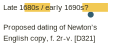
The Tabula Smaragdina, or Emerald Tablet, is a short alchemical text with an Arabic-to-Latin transmission. A Latin version is associated with Hugh of Santalla in the twelfth century. Its legendary discovery stories are part of its reception. The popular “as above, so below” slogan should not be treated as an exact quotation from every Hermetic text. [D323] NEWTON WAS A READER, NOT THE TABLET’S AUTHOR Keynes MS. 28 preserves Newton’s English translation, a Latin version and commentary. The English portion is tentatively dated to the late 1680s or early 1690s. A scientist’s interest in a text is evidence of that interest; his reputation does not experimentally establish every statement he copied. Read the actual wording on 1324. [D321] WHY THIS HISTORY CAN MATTER TODAY A persuasive name, an old-looking page and a memorable phrase can make a claim feel settled before its evidence has been examined. This chapter offers a practice for slowing that judgment: identify the object, locate the passage, distinguish interpretation from observation, and make one accountable choice. Spiritual meaning can be discussed respectfully while questions about dates, authorship and physical effects are checked on their own evidence.
Keep the source, its derivatives and the claim they support in the same packet
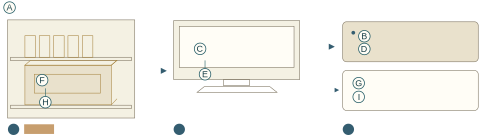
Use one durable ID for the source and new IDs for each derivative. Below is the actual relationship for this lesson: a received 1610 print reproduction, a PDF placement and a source-linked description. A checksum detects changed bytes; it does not establish authorship or truth. [D367]
Read the illustration’s labels
A
B
C
D
E
F
G
H
I
J
Key
Small-print annotation
A
DISPLAY DERIVATIVE
B
RECEIVED SOURCE
C
259 · scaled; no rotation or repainting
D
REVIEW RECORD
E
D363 · Venice · 1610
F
Check edition and orientation. Check caption against source. Record reviewer, date and result. Keep disputed readings visible.
Write a caption correction as a dated event. Preserve the earlier wording and explain why it changed. A second reviewer should be able to open the supplied image, find the cited feature and distinguish the source’s statement from the editor’s inference.
Check both bytes and meaning
A matching hash answers whether the file matches the recorded digest. It cannot tell whether a lens dimension was copied with the wrong unit. Perform both a byte check and a source-to-caption check. Keep a known-good manifest away from the working copy.
SHA-256: Secure Hash Algorithm, 256-bit A digital fingerprint used to check that two files contain the same bytes.
URL: Uniform resource locator The web address that leads to a source or record.
Basel, 1566: recover the whole document
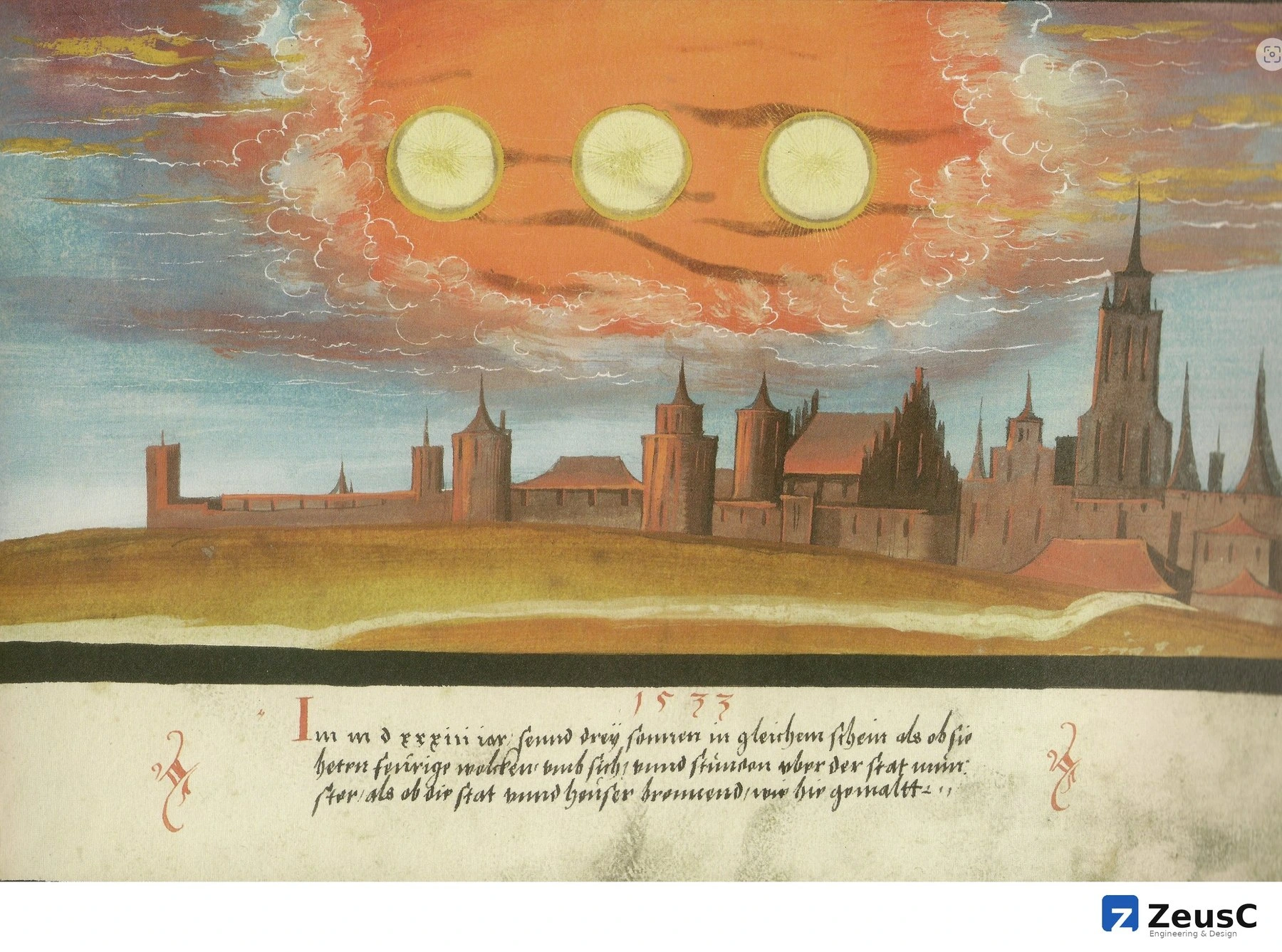
Samuel Apiarius / Samuel Coccius, Basel broadside, 1566. Zentralbibliothek Zürich, PAS II 6/5. DOI 10.7891/e-manuscripta-92162. Public Domain Mark. Complete digital frame retained. [D823]
IDENTIFY THE SURVIVING OBJECT Zentralbibliothek Zürich catalogues this broadside under Samuel Apiarius and Samuel Coccius, dated 1566, shelfmark PAS II 6/5. Its catalogue describes reported appearances over Basel on 27-28 July and 7 August 1566 and their interpretation as divine signs. The record identifies a woodcut with letterpress, 18.2 × 23.8 cm. The image at left is the institution’s complete digital scan, including the reference target, not a newly generated reconstruction. [D823]
Compare the received crop
object’s identity. Its modern colour treatment and reproduction history have not been verified. Use the catalogued scan for the historical plate and retain the supplied crop in the research record. A similar pattern is a reason to compare sources, not permission to assign an unrecorded date or author to another image.
SEPARATE THE RECORD FROM THE EVENT The print is evidence that a particular account and interpretation circulated. It is not a photograph, measured trajectory or instrument log. Its circles and other forms do not establish their physical size, composition or cause. This distinction leaves room to study the history seriously while resisting claims that the picture alone proves aircraft, an atmospheric mechanism or an altered geography. Explain what the object records before advancing an explanation of what people saw.
FOLLOW THE COMPLETE RECORD Follow D823 to the original-language document and catalogue. Identify the translator and uncertain readings in any translation. HE2 provides the companion method.
The illustration reproduces a coloured crop of this composition.
Units and terms
PDF Portable Document Format · URL Uniform Resource Locator · × multiplied by
DOI Digital object identifier · cm centimetre, 0.01 metre · × multiplied by
WRITE THREE DISTINCT STATEMENTS For each image, write what is visibly present, what the catalogue says about the object and what a later author claims it means. These statements may have different confidence levels. “A print depicts dark circles above a city” is an observation. Attribution, date and holding institution come from a record. A proposed physical explanation needs additional evidence. Keeping the statements separate makes disagreement productive because the reader can see exactly which step is disputed. RESTORE CONTEXT BEFORE ADDING DRAMA Find the full frame, title, imprint, adjoining page and original-language text. Preserve scale targets and margins in the archival master. If a crop improves a lesson, label it as a crop and retain a route back to the complete object. Do not repair missing historical detail by generating a plausible-looking building, machine or face. A clearly labelled modern reconstruction may explain a hypothesis, but it cannot become documentary evidence for the hypothesis. TEST REPETITION AGAINST INDEPENDENCE Ten copies of the same unsourced image are one transmission chain, not ten independent witnesses. Compare where the copies were published, which one retains the largest uncropped frame, and whether their captions cite an earlier record. An eighteenth-century map, a twentieth-century photograph and a modern meme require separate identification. A broad historical place-name or a similarity of architectural form does not by itself establish one hidden polity, a building date or a technology.
KEEP BELIEF, SYMBOL AND MEASUREMENT LEGIBLE Religious and symbolic images belong in cultural history with their named tradition and source. Mathematical diagrams require definitions, units and reproducible operations. Anatomical and engineering claims need discipline-specific evidence. A repeated number, visual resemblance or wordplay can be discussed as an interpretation without being used as a specification for a machine or a medical conclusion. Use the existing calendar companion for the distinction between a 13 × 28-day schedule, lunar observation and a named cultural tradition. [D824-D826]
Build an archive another person can audit
Retain the document name, checksum, catalogue URL, creator, title, date, edition and page. Check each quotation against that identifiable record before placing it beneath a historical portrait. Keep unanswered questions explicit and record the next research action. Preserve Spanish records for an Argentine estate archive, with a labelled English translation where needed.
URL: Uniform resource locator The web address that leads to a source or record.
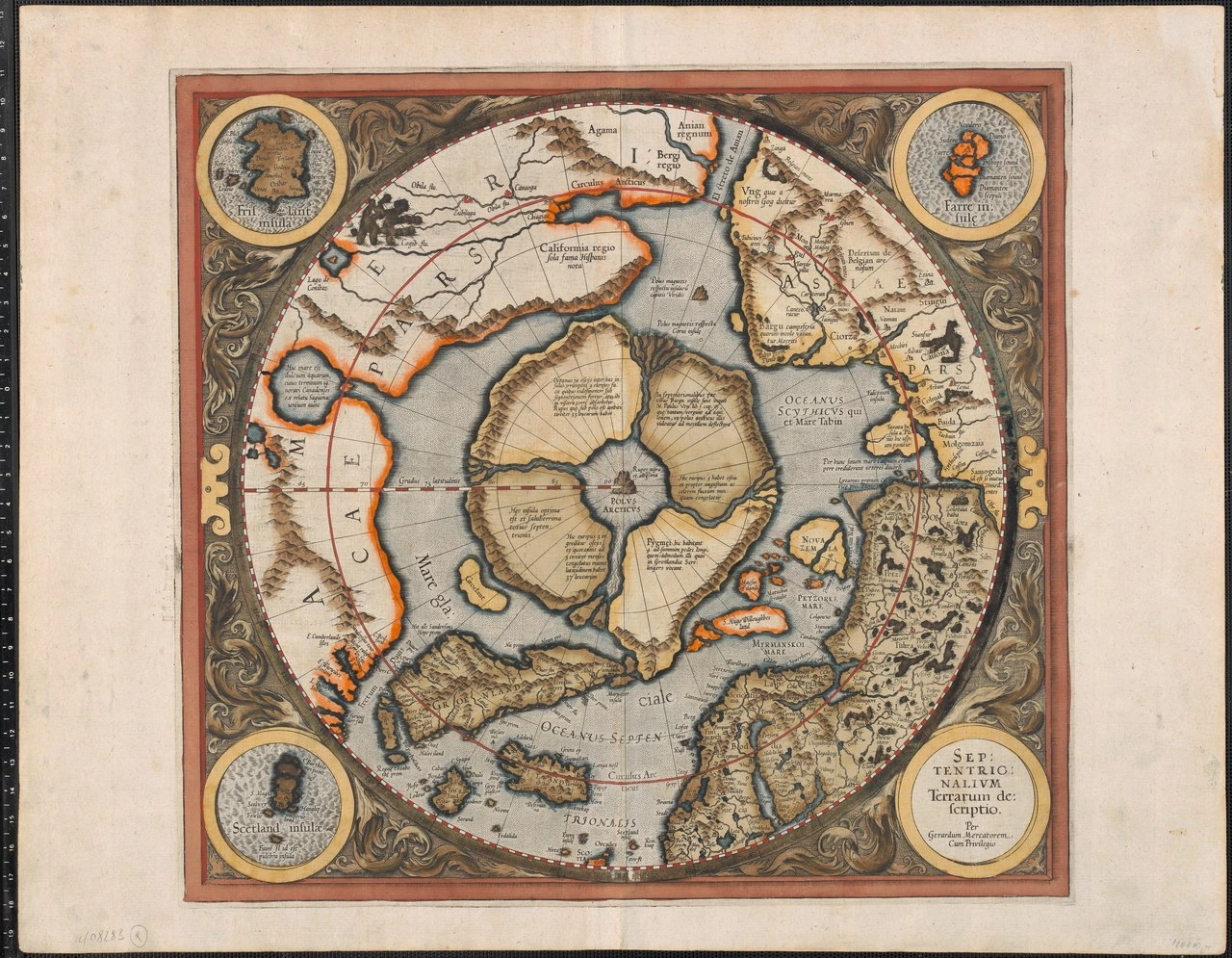
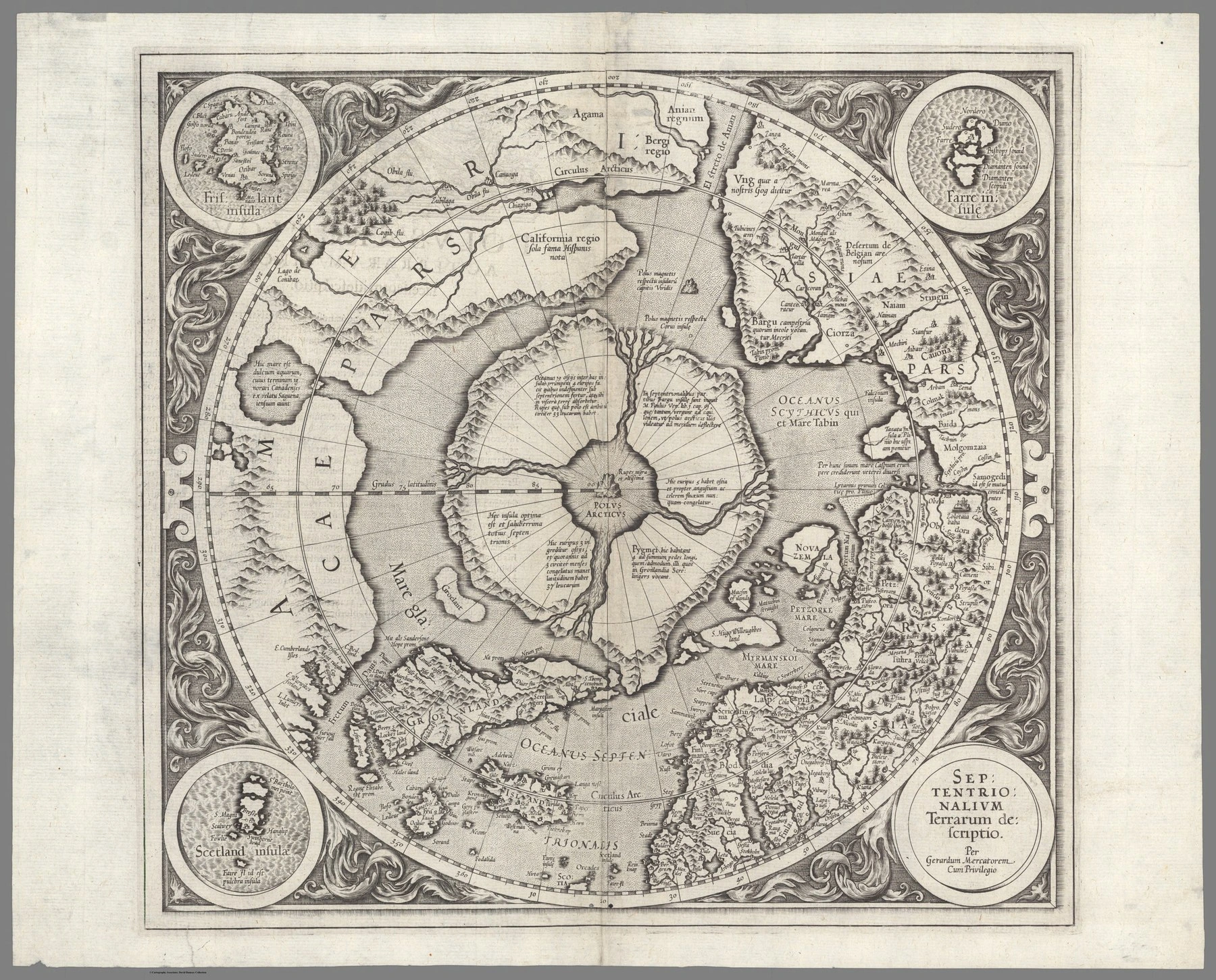
A DOCUMENTED MAP, NOT A SURVEY OF TODAY Gerard Mercator’s Septentrionalium terrarum descriptio was published in 1595. The reproduced copy is catalogued by Université Laval as 11-c.170-1595-r. Its polar composition and decorative border make it a useful companion to the Arctic-map image in Photo 3. This is a documented replacement scan; it does not authenticate the exact impression or colour treatment of the supplied reproduction. [D881-D882]
LOOK AT THE CLAIMS INSIDE THE FRAME Notice the central polar arrangement, surrounding coasts, inset islands and explanatory lettering. Each belongs to a historical representation. A convincing engraved border and a printed date do not establish that every geographical feature was observed. Separate the object’s identity from the truth of the world it depicts.
An institution rebuilding its knowledge needs to preserve older maps while retaining the ability to correct them. The archive records the creator, edition, holding institution and source identifier beside the image.
Units and terms
× multiplied by
URL Uniform Resource Locator
Sources for this account
Université Laval | Mercator Arctic map, 1595, 11-c.170-1595-r
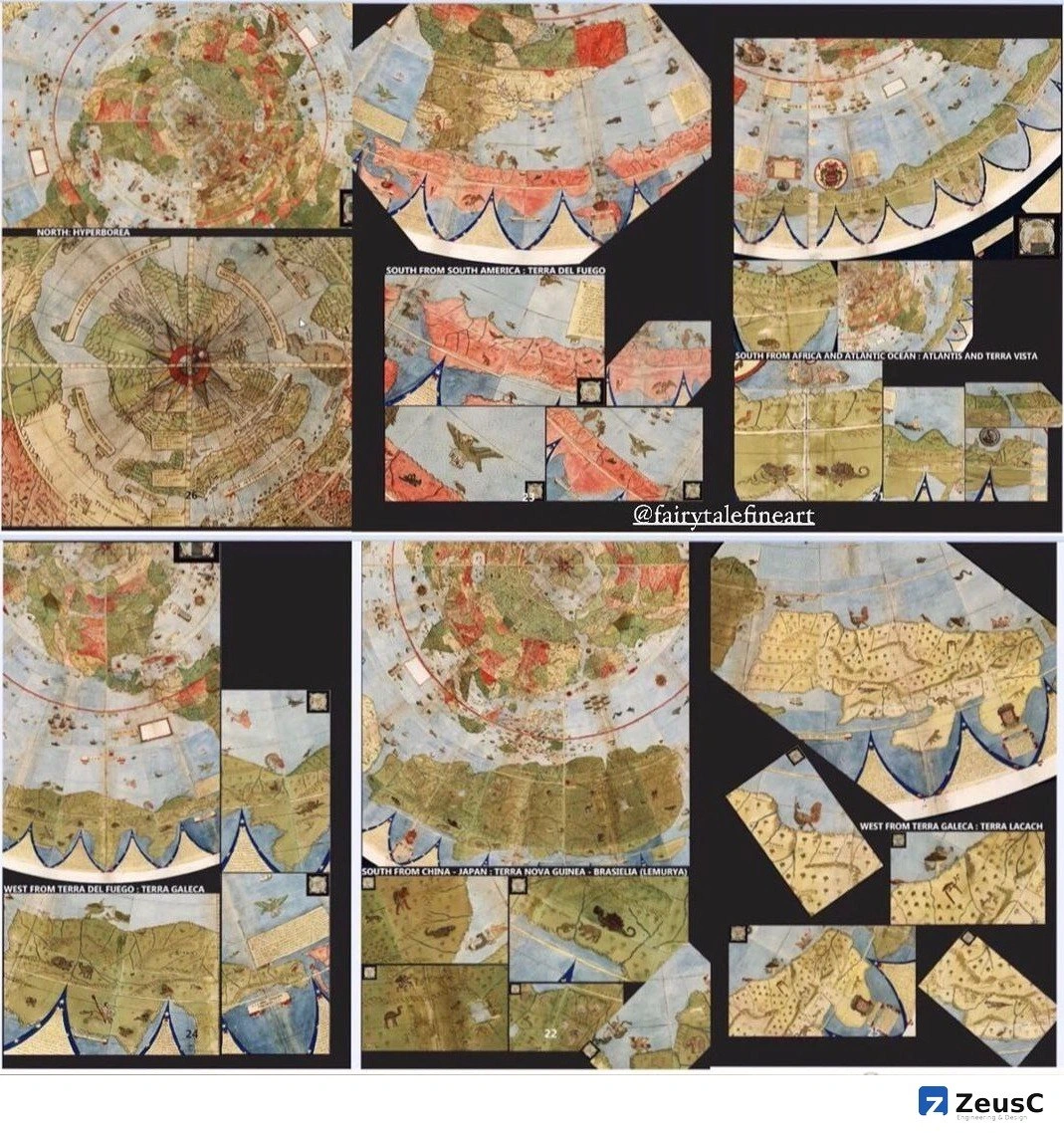
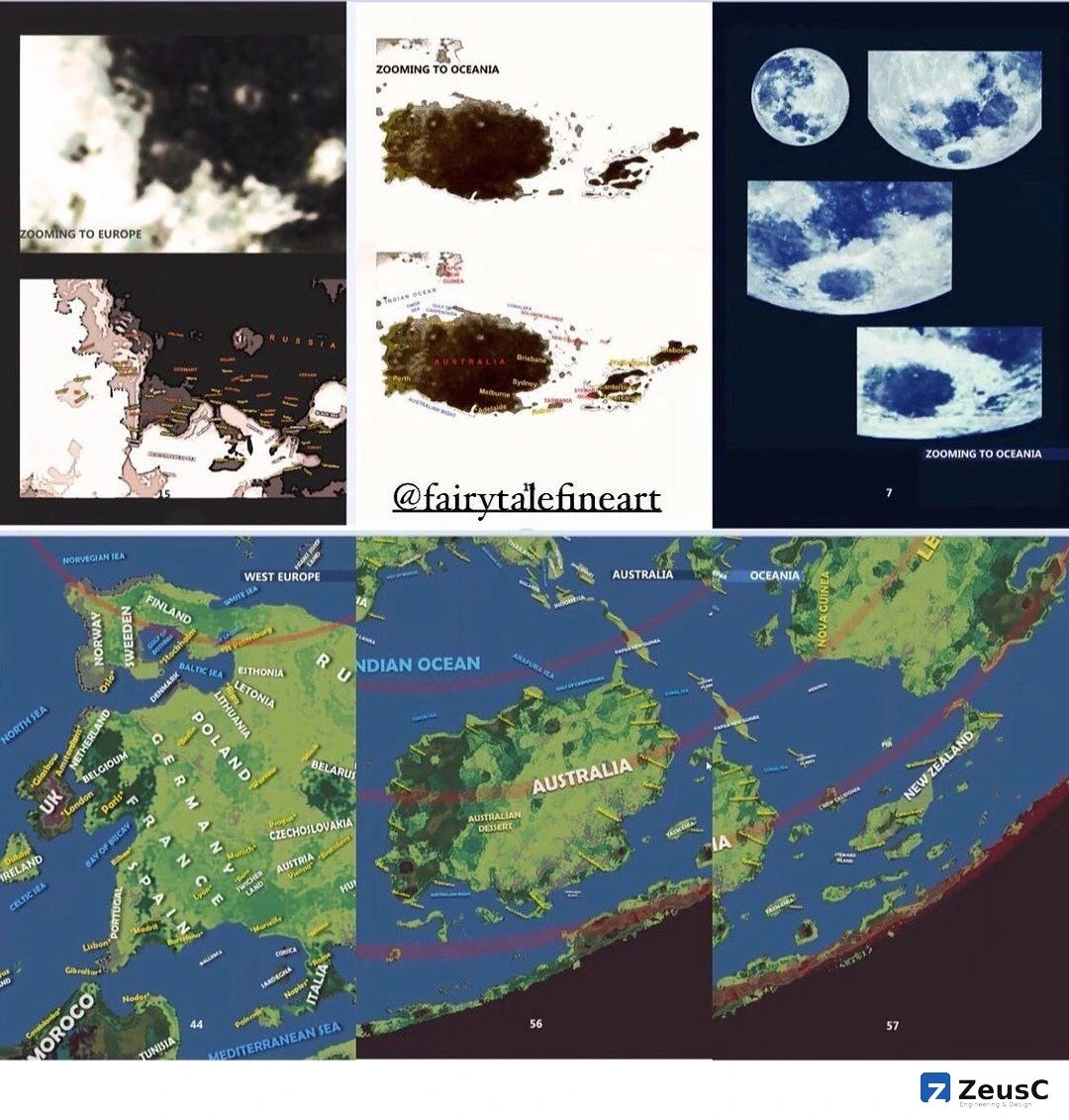
TURN THE RESULT INTO A DURABLE CAPTION A useful caption gives the maker, map title, date or date range, institution, identifier and the limited reason it is reproduced. Distinguish the original map from later annotations, crops and colouring. This method also applies to Photo 3’s South American relief map, Tierra de Patagones detail and lunar-map compilations. Their own exact editions remain to be established; this example does not confer a shared provenance on them. BUILD THE COLLECTION WITHOUT FREEZING ITS ERRORS Keep older explanations beside later corrections rather than erasing the evidence. Assign a responsible editor, a date and a reason to each revision. A community can then learn both what earlier people believed and how a claim was improved. The map is valuable as a historical object even where its geography requires correction.
Build a recoverable knowledge packet
Ten actions · an editorial operating procedure for preserving and testing usable records
01 · Assign identity Give the source an ID. Record author, title, edition, printer or repository, page or object number, language and retrieval date.
02 · Capture the whole witness. Retain the complete document. If a detail is used, keep its parent-page locator and crop coordinates beside it.
03 · Separate source and transcription Store the image, literal transcription and edited explanation as different files. Mark unreadable text rather than inventing it.
04 · Declare the evidence class Label a statement as observation, calculation, interpretation, hypothesis, cultural account or fictional teaching example.
05 · Record the transformation Log resizing, rotation, translation and unit conversion. A change in orientation belongs in the caption as well as the log.
06 · Record fixity Create a manifest with each filename, byte count and SHA-256 digest. Preserve the manifest’s identity and the date of its check.
07 · Create independent copies Keep a working copy, an offline copy and a copy in another location under a named custodian. Document access and update rules.
08 · Test recovery without the master Have the second custodian recover the packet from a designated backup, verify its manifest and open every required file.
09 · Recheck the actual claim Ask the reviewer to locate the cited page, recompute one formula and match one caption to its image. Log disagreements.
10 · Release with a change record Record what changed, what was preserved and what remains unreviewed. Retain the prior release until the new recovery test passes.
Materials: labelled folders, a printed catalogue, a computer, two separate backup destinations and a named second custodian.
Preservation framework: NDSA Levels v2.1 (March 2026), D368. The ten actions are this book’s editorial procedure.
NDSA: National Digital Stewardship Alliance The organisation behind the Levels of Digital Preservation framework.
Dürer, Albrecht: Melencolia I and its magic square
Read the illustration’s labels
A
B
C
D
E
F
G
H
Key
Small-print annotation
A
Engineering, cultivation, cultural memory and succession need different records
B
WORKING ARCHIVE
C
OFFLINE COPY
D
SECOND LOCATION
E
Editing access · changes logged
F
Disconnected between updates
G
Separate custodian and recovery path
H
Separate folders on one disk remain one disk failure. Test access, bytes and readability after copying.
WATER SYSTEM Keep sample location, date, laboratory report, method and decision together. A picture of a clear cistern cannot establish potable water. Preserve the relevant review, not an unsupported safety caption.
MACHINE REPAIR Tie drawings and settings to the exact model, serial number and revision. Keep the measured fault and post-repair check. An older machine’s familiar appearance does not establish interchangeable parts.
SEED AND ORCHARD File lot ID, species or cultivar, source, storage history and test result together. Preserve the observation protocol. Do not replace a measured germination result with an attractive plant illustration.
CULTURAL WORK Preserve the author’s words and imagery, attribution and context. Put interpretations beside the source as separate records. Symbolic meaning can be documented without assigning it an unmeasured physical force.
SUCCESSION A recovery record names the release, backup location, custodian, files opened, checks performed and unresolved failures. It documents whether another person can retrieve the estate record and its source without relying on the original editor.
Dürer’s engraving and its interpretations
Albrecht Dürer, Melencolia I, 1514. The number square stands at upper right.
Read the object record
Albrecht Dürer made Melencolia I in 1514. Tools, a solid geometric form and a numbered square appear with the seated figure. A particular museum impression is a material object with its own dimensions and history, even when the same composition is reproduced elsewhere.
Describe one visible object before assigning it a symbolic meaning. A catalogue can establish the artist, medium and date; a later writer may offer an interpretation of why the object is present. Keeping those two accounts distinct makes disagreement intelligible.
Dürer: the object and its interpretations
A historical object can carry several claims that require different kinds of support
A record with an identity
Albrecht Dürer (1471-1528) made Melencolia I in 1514. The reproduced impression is an engraving in The Metropolitan Museum of Art, object 43.106.1. Its catalogued sheet measures 24.1 × 18.7 cm. These particulars identify this museum object; dimensions from another impression must not be substituted. [D369]
Meaning is not a laboratory result
The Met connects the winged figure and her instruments with geometry and Renaissance ideas about melancholy and creativity. National Galleries of Scotland describes the proposed “hidden self-portrait” as an interpretation. Such readings need historical context and argument; the print does not settle every proposed meaning. [D369-D370]
Observation, arithmetic and interpretation
Units and terms
NDSA National Digital Stewardship Alliance
cm centimetre, 0.01 metre · × multiplied by
Sources for this account
THE MET · OBJECT 43.106.1 Albrecht Dürer, Melencolia I, 1514. Object identity, engraving, dimensions, curatorial context and reproduced public-domain image.
“The image contains a numbered square” can be checked against the surviving print. “Each row totals 34” can be checked by calculation. “The square brings a physical benefit” would need an operational definition, observations and a suitable comparison. The first two statements do not establish the third.
A tradition may combine a moral teaching, an account of the past and a proposed physical mechanism. Assess each part with relevant evidence. Lack of a test leaves a mechanism unestablished. A contradictory result challenges the tested prediction under its stated conditions; it does not erase the cultural object.
For a rebuilding project, keep an image’s source and interpretation beside it. Require separate performance evidence for a seed, water, medical or structural decision. Respect for a tradition and scrutiny of a measurable claim can coexist.
The number square in Melencolia I
Selectable transcription of the sixteen values, preserving their positions.
The lower middle entries, 15 and 14, repeat the year 1514. This modern transcription preserves the values and their positions, not the engraved numeral forms. It is an editorial aid, not another historical image.
The banner, dividers, hourglass, balance, tools and geometric forms are visible objects. Their location is evidence; an asserted symbolic meaning is an interpretation. Begin a caption with what can be located before explaining what it may signify.
THE MET · OBJECT 43.106.1 Albrecht Dürer, Melencolia I, 1514. Object identity, engraving, dimensions, curatorial context and reproduced public-domain image.
All sixteen entries are distinct. Each row, column and main diagonal sums to 34.
Relationship
Calculation
First row
16 + 3 + 2 + 13 = 34
First column
16 + 5 + 9 + 4 = 34
Main diagonal
16 + 10 + 7 + 1 = 34
Other main diagonal
13 + 11 + 6 + 4 = 34
The entries are the integers 1 through 16, each used once. Their total is 16 × 17 ÷ 2 = 136. If four rows share one total, each must sum to 136 ÷ 4 = 34.
This is a finite arithmetic result: adding the displayed integers settles it. The word “magic” names the mathematical arrangement. It does not, by itself, certify an influence on matter, health, rainfall or harvests.
A pattern with a boundary
Read the illustration’s labels
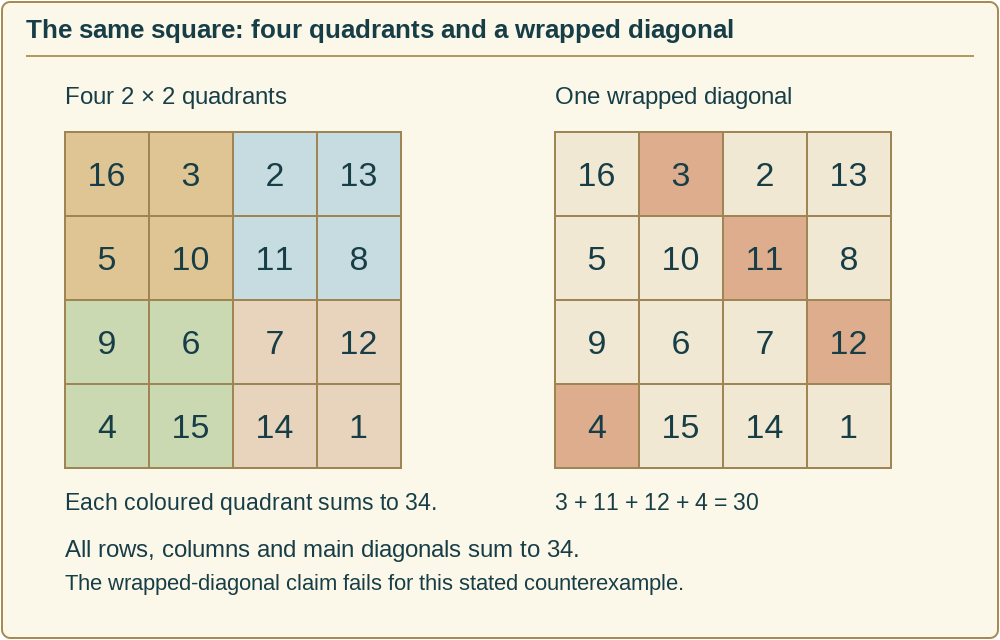
The same square: four quadrants and a wrapped diagonal
Four 2 × 2 quadrants
16
3
2
13
5
10
11
8
9
6
7
12
4
15
14
1
Each coloured quadrant sums to 34.
One wrapped diagonal
3 + 11 + 12 + 4 = 30
All rows, columns and main diagonals sum to 34.
The wrapped-diagonal claim fails for this stated counterexample.
For example: 16 + 1 = 17; 3 + 14 = 17.
A beautiful pattern can be real and still have limits. A single verified counterexample defeats “every wrapped diagonal sums to 34.” It does not defeat the narrower row, column and main-diagonal properties already checked. State precisely which claim survived.
Four claims need different evidence
Claim
Evidence and limit
History
The Met catalogues this impression as a 1514 engraving. Its dimensions and provenance identify that object. [D369]
Arithmetic
The sixteen transcribed values establish the stated sums.
Interpretation
The proposed self-portrait reading requires an argument from the object and historical context. [D370]
Physical effect
A claim about seed emergence needs independent observations and a defined comparison. The engraving cannot establish it.
Units and terms
= equals · × multiplied by · ÷ divided by
= equals · × multiplied by
Sources for this account
THE MET · OBJECT 43.106.1 Albrecht Dürer, Melencolia I, 1514. Object identity, engraving, dimensions, curatorial context and reproduced public-domain image.
A mathematical pattern and a biological effect are different claims. The presence of the square in Dürer’s engraving establishes an artistic and mathematical subject. It does not establish an effect on germination.
For an empirical comparison, the record must identify the treatment, independent experimental unit, outcome, allocation method and conditions. Seeds sharing one treated tray are not automatically independent treatment replicates. The source guidance distinguishes comparison design from the conclusion later drawn from it. [D371-D372]
Uncertainty, a useful effect threshold and independent replication belong beside any reported difference. A result supports only the conditions actually studied. No seed experiment or biological benefit is reported here.
NIST · RANDOMIZED DESIGNS NIST/SEMATECH e-Handbook, section 5.3.3.1. Random assignment of factor levels to experimental units; replication and balanced designs.
Two record keepers from the same model, with a board and a scroll.
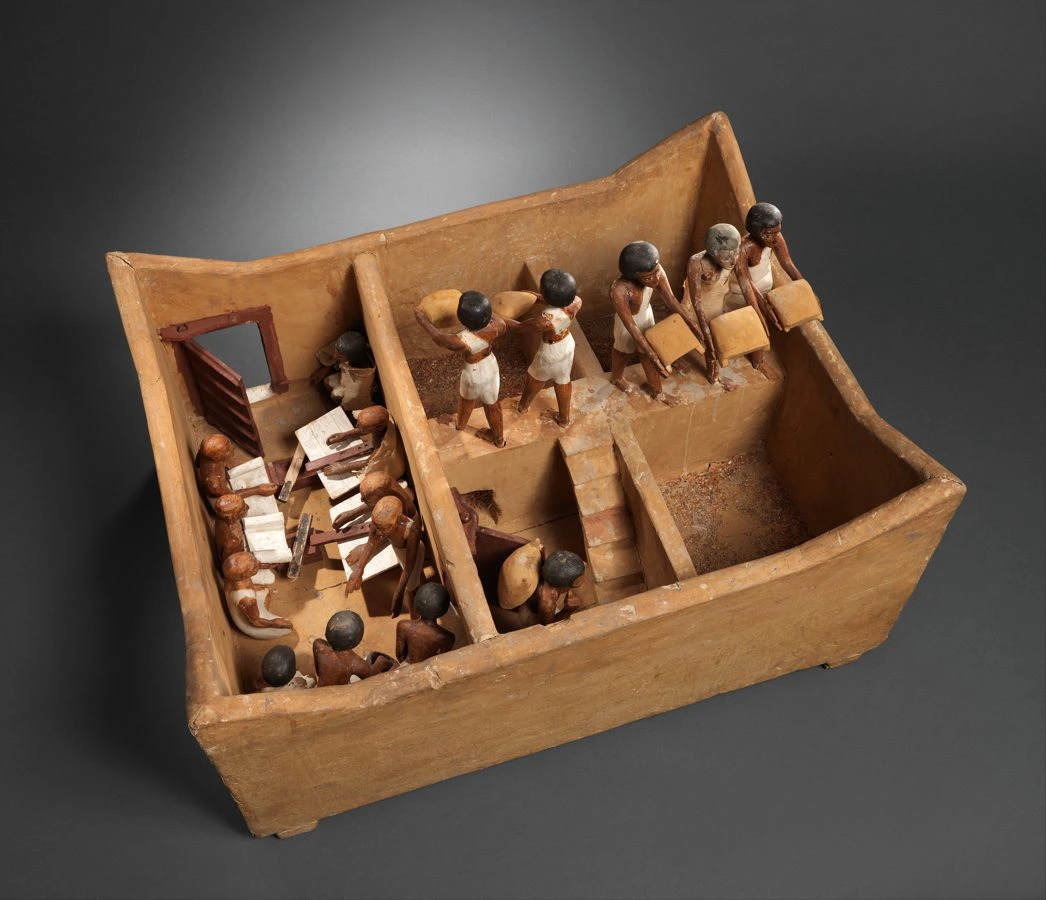
A model granary from the tomb of Meketre at Thebes represents a store and its administration. The Metropolitan Museum dates the model to about 1981–1975 BCE. Carriers and people engaged in recording occupy different parts of the enclosure.
A community store can similarly distinguish the movement of grain from its entry in a ledger. Record incoming mass, a witness, any adjustment and the reason. The Egyptian model documents an ancient representation of work; modern rules determine who can challenge a discrepancy.
Records and the right to be heard
Historical evidence distinguishes administration, provisioning and fair treatment
What the granary model shows
When provisions fail to arrive
The Met dates this wooden funerary model to about 1981-1975 BCE. It came from the tomb of the royal chief steward Meketre at Thebes. Grain storage and accounting occupy separate areas. The museum identifies six carriers and nine people measuring or accounting, including four scribes. [D374]
The Turin Strike Papyrus, Cat. 1880, records a dispute at Deir el-Medina during Ramesses III’s reign. The scribe Amunnakht describes workers protesting interrupted food rations owed for their work on royal tombs. The document locates an early protest in regnal year 29. [D377]
The limit of this evidence
The model was made for an elite burial, not as a survey of a modern cooperative. Its organised activity does not establish workers’ consent, adequate provisions or equal access. Preserve the distinction between a visible accounting system and the conditions experienced by the people within it.
A recorded complaint matters
In the museum’s translation, the workers say “we are hungry!” Supplies were paid, but renewed protest followed. The lesson is practical: a store can have officials and records while failing the people who depend on it. A complaint needs a response that can be checked, not merely an entry in a book. [D377]
The following quantities, forms and review procedures are proposed teaching examples. They are not translations of Egyptian documents. They connect physical custody to an accountable decision without claiming that one ancient system supplies a universal model.
Read the granary as a historical object
Two identified museum photographs; the explanatory arrows describe work, not a construction plan
Units and terms
BCE Before the Common Era
BCE Before the Common Era · cm centimetre, 0.01 metre · mm millimetre, 0.001 metre · × multiplied by
Sources for this account
MEKETRE’S GRANARY The Met, 20.3.11. Model of a Granary with Scribes, ca. 1981-1975 BCE. Object, context, dimensions and full model photograph.
TURIN STRIKE PAPYRUS Museo Egizio, Cat. 1880. Amunnakht’s account of ration disputes under Ramesses III. The short quotation follows the museum’s translation.
The separate detail shows a writing board and a papyrus scroll. It belongs to the same model, catalogued as 20.3.11-SCRIBES. The Met lists the right-hand figure at 15.5 cm high. These are model figures, not life-size workers. [D375]
Photographs: The Met Open Access · D374-D375; policy D373
From a labour tablet to a member-owned shop
Different institutions used records for different purposes; do not collapse them into one tradition
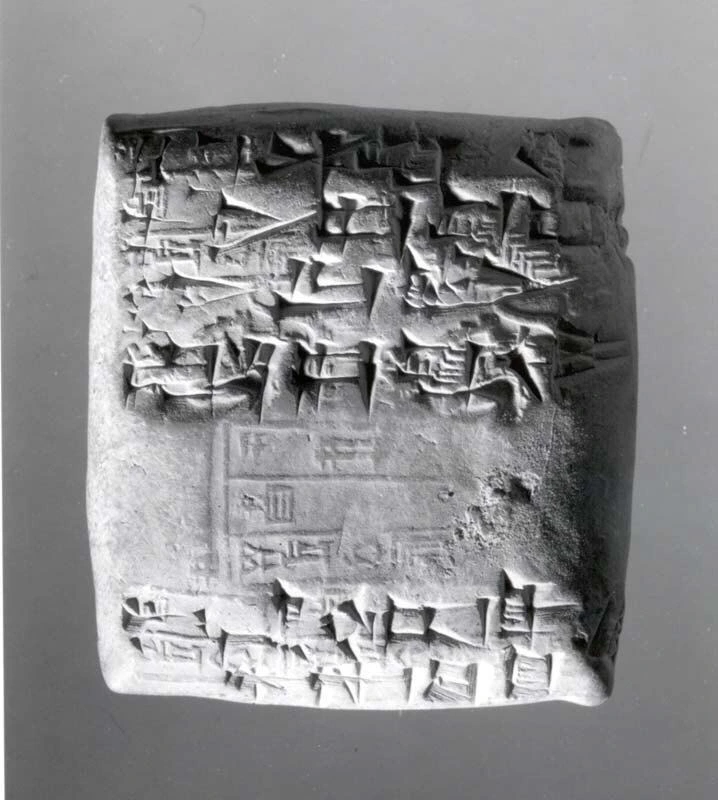
The Met · 57.16.1 Clay, 45 × 41 × 17 mm Umma · ca. 2042 BCE [D376]
A document about work
The Met identifies this sealed tablet as a record concerning labourers needed for irrigation work. Its photographed signs are evidence of a surviving administrative object. No English numbers or modern hours have been invented as a translation of those signs. [D376]
Rochdale · 21 December 1844
The Rochdale Equitable Pioneers opened their store with butter, sugar, oatmeal and flour. Their arrangements connected honest measures with member participation, education and a share in the surplus. Record-keeping could support a member’s claim, not only a manager’s control. [D378]
What the record allows
Record
Governance question
Shipment or work entry
Who can inspect and challenge it?
Purchase in a member’s account
What right follows from that entry?
Corrected record
Who approved the correction, and why?
ca., Circa (approximately) Before a date, the abbreviation indicates an estimate of when the object was made or the event occurred. BCE, Before the Common Era Dates years before the Common Era in the historical calendar. D + number: Book evidence record The number identifies a source entry in the book’s evidence section. The linked record gives the title, credit or publication details.
Units and terms
BCE Before the Common Era · cm centimetre, 0.01 metre · mm millimetre, 0.001 metre · × multiplied by
BCE Before the Common Era · mm millimetre, 0.001 metre · × multiplied by
kg kilogram, a mass unit · = equals
Sources for this account
THE MET · IMAGE AND DATA RESOURCES Open Access policy. The Met provides designated public-domain images and basic collection data under CC0.
ROCHDALE PIONEERS Co-operative Heritage Trust, Liz McIvor. Opening goods and rules of the 1844 shop; distinguishes a repeated origin story from evidence.
Invented one-day dry-bean ledger · all quantities are net mass in kilograms
Time
Movement
Record
Change: kg
Balance: kg
08:00
Opening count
B-001
300.0
300.0
09:20
Received, Lot B
R-017
+160.0
460.0
12:00
Issued, Lot A
I-033
−110.0
350.0
14:10
Documented loss, Lot A
L-004
−4.0
346.0
Prepare a consistent count
Use lot cards, numbered slips, a ledger, a suitable scale and a separate count sheet. Record the scale unit and resolution. Stop movements during the count, or record every movement across the cutoff.
Book stock = 300 + 160 - 110 - 4 = 346 kg
Counted stock = 342 kg; variance = -4 kg
Subtract the container
Example: 22.4 kg gross - 2.4 kg container = 20.0 kg net. Compare net receipts with net issues. Recording tenths of a kilogram does not by itself establish scale accuracy.
At 16:00 the ledger says 346 kg. At 16:20 the physical count is 342 kg. Keep both values and the -4 kg difference. A missing slip, a cutoff error, tare, spillage or an incorrect count must be investigated before the difference is attributed to a person.
Trace each lot and separate held stock
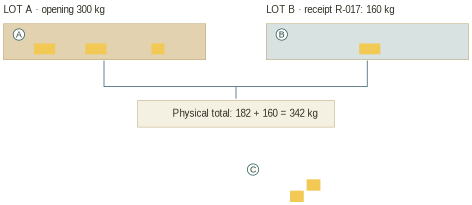
Continuation of the same invented example · a hold changes availability, not physical mass
Read the illustration’s labels
LOT A · opening 300 kg
LOT B · receipt R-017: 160 kg
Physical total: 182 + 160 = 342 kg
A
B
C
Key
Small-print annotation
A
300 - 110 issued - 4 recorded loss Book: 186 kg · Count: 182 kg · Difference: -4 kg
B
Book: 160 kg · Count: 160 kg 35 kg held for assessment; 125 kg not held
C
KEEP LOSS AND UNCERTAINTY DISTINCT
Not held: 342 - 35 = 307 kg
A hold needs a reason and an owner
Example H-002: 35 kg in Lot B is set aside after damaged packaging is found. Record location, date, reason and who may decide its disposition. The remaining mass is an inventory calculation, not a food-safety clearance.
The documented 4 kg loss is already deducted. The separate unexplained 4 kg variance remains open. Reclassifying 35 kg as held must not subtract it twice or make the missing 4 kg disappear.
In the drawing: KEEP LOSS AND UNCERTAINTY DISTINCT
Make work visible and govern the rules
An original duty-planning example; the hours are not historical data or staffing recommendations
Ostrom’s field research examined how users govern shared resources. She shared the 2009 economics prize for work on economic governance, especially the commons. Her findings support studying the actual institution rather than assuming cooperation must fail. [D380]
“panaceas are not to be recommended!”
Her 2009 lecture slides warn against universal remedies. The lecture discusses clear user and resource boundaries, participation in rule-making, and monitoring accountable to users. These are diagnostic questions, not a guarantee that any group will succeed. [D379-D381]
Do not count one person’s overlapping tasks twice.
Proposed local rule: agree assignments, rest, relief and a review date with the people doing the work. Count care and training. Keep essential food access separate from a simple tally of labour hours.
Resolve a discrepancy with a reviewable decision
Stage
Recorded action
Preserve
Keep B-001, R-017, I-033, L-004, the count sheet and the same cutoff.
Recount
Use a second person; check tare, units and movements near 16:00.
Hear the explanation
An unexplained difference is not a finding of misconduct.
Correction established
Add a dated adjustment with reason and approval. Retain the original and linked correction.
Cause unresolved
Keep the variance open with an owner and review date.
Separate custody, recording and review where the team permits. A person whose conduct is questioned should not be the sole reviewer of the decision. Publish the allocation rule and appeal route; restrict personal information to those who need it. These are proposed safeguards for the community’s agreement.
Exchange without cash: three different agreements
If a payment network stops, useful goods and skills still exist. The hard part is agreeing what can be offered, who accepts it and what happens if delivery fails. A ledger records a claim; it cannot create drinking water, spare parts or another person’s consent.
Sources for this account
OSTROM’S PRIZE LECTURE Elinor Ostrom, Beyond Markets and States, 2009. Context-dependent institutions, user participation and accountable monitoring.
OSTROM’S LECTURE SLIDES Nobel Foundation, 2009. The short warning against panaceas. The modern roster and procedures in this lesson are original proposals.
A barter offer needs two quantities and a boundary
Reserve for urgent needs. Publish eligibility and quantities. Do not make survival supplies conditional on ability to work.
Name both goods or services. Agree condition and deadline. Each side accepts delivery. No transferable token required.
One accepted hour, one credit. Receive help from another member. A credit system, not pure barter. Separate materials from hours.
BEFORE OPENING THE EXCHANGE
Appoint a storekeeper and an independent reviewer. Use a bound ledger, numbered duplicate receipts, a suitable scale with check weights, a clock, lot labels and separate held-stock space. For food, add the equipment and expertise needed to verify its specific storage conditions.
In the drawing: ESSENTIAL ALLOCATION; Reserve for urgent needs. Publish eligibility and quantities. Do not make survival supplies conditional on ability to work.; DIRECT BARTER; Name both goods or services. Agree condition and deadline. Each side accepts delivery. No transferable token required.; OPTIONAL TIME CREDIT; One accepted hour, one credit. Receive help from another member. A credit system, not pure barter. Separate materials from hours.; BEFORE OPENING THE EXCHANGE
The protected reserve is this book’s proposed rule. TimeBanks.Org documents the equal-hour convention [D411]; it is not a statement that every skill has the same commercial price. Participation must be voluntary, with a clear way to dispute an entry and leave the scheme.
Give every exchangeable lot a defined unit
A litre, a kilogram, an hour and a vehicle each require a different acceptance record
Water
L accepted for a stated use
Source, container ID, treatment and test record where required; collection time and access. Separate drinking water from irrigation water. A volume alone proves neither safety nor availability.
Fish
kg net; whole or prepared
Species, lawful source, whole/gutted/filleted state, harvest and handling times, cold-chain record and allergens. Unknown storage history is a hold, not a reason to discount it into the food supply. [D419]
Fruit / vegetables
kg net; named crop and grade
Variety, ripeness, sound fraction, package tare, harvest date, destination and time before use. Keep rejected produce out of the accepted quantity; do not treat unlike crops as nutritionally equal.
Materials
kg, m, m² or item count
Name alloy or timber species/grade where known, section, length, wall or board thickness, moisture/condition and traceability. Separate reusable components from scrap; do not infer load capacity from mass.
Vehicles / trailers
One identified asset or use period
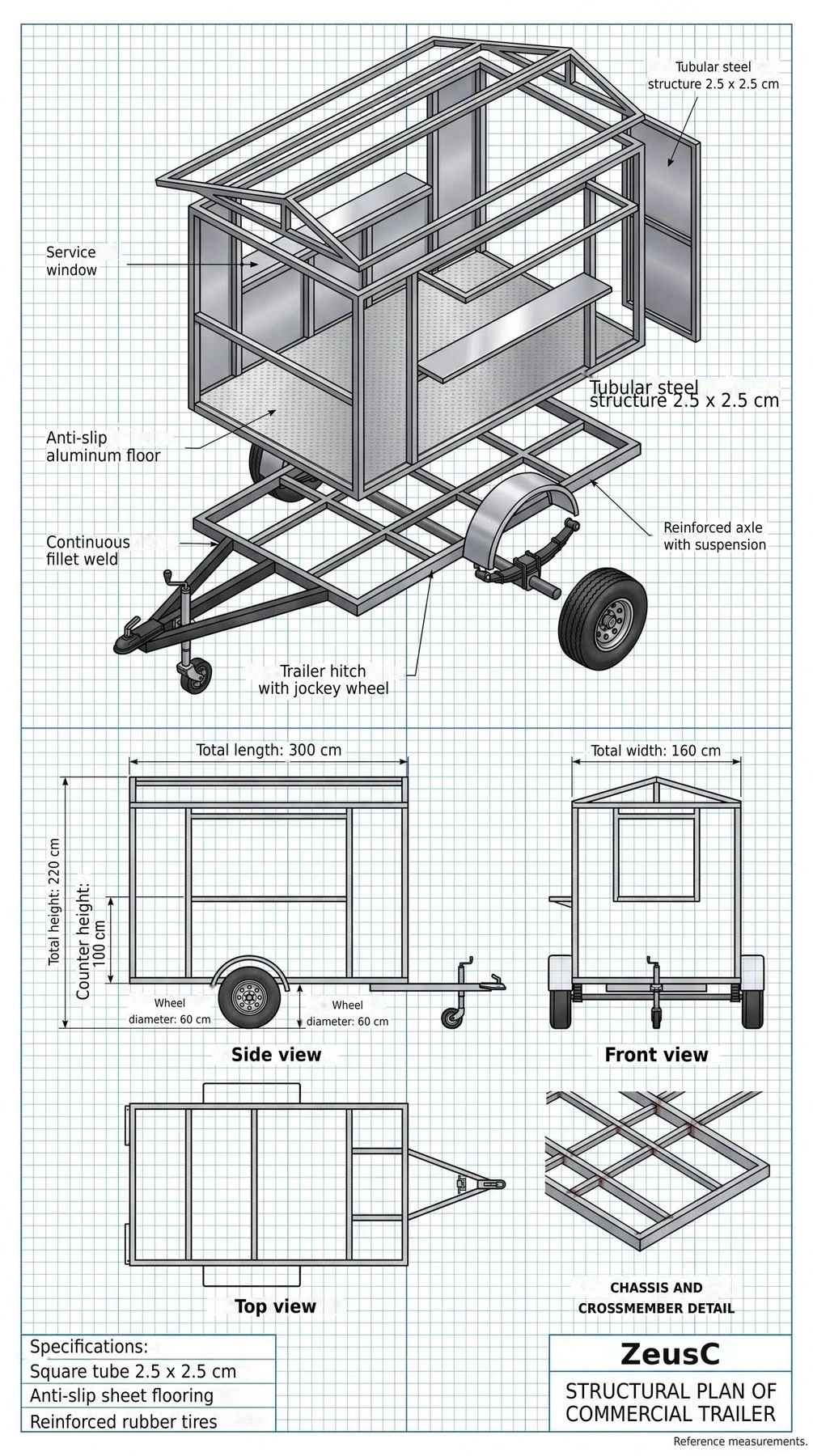
Record ownership, serial identity, condition, inspection, missing parts and permitted use. For a loan, add return time, fuel, damage, maintenance and who may operate it. No universal vehicle-to-food ratio follows.
Labour
Accepted hours or defined result
Specify the task, competence, tools, materials, travel, completion criteria and reviewer. An hour volunteered, a paid employment hour and a promised future hour are different records.
Keep the unit from the original measurement, then record any explicit conversion. Use the same product state on both sides of a comparison. INTI and NIST support measurement consistency, not a national barter tariff. [D418, D420]
A barter offer needs two quantities and a boundary
Invented apple-lot and drawer-repair example · quantities are not a food prescription or regional price
Read the illustration’s labels
LOT A-17 · WEIGH, SEPARATE, THEN OFFER
27 kg GROSS
Includes a 3 kg container
24 kg NET
27 kg - 3 kg tare
12 kg OFFERABLE
24 - 4 held - 8 reserved
In the drawing: LOT A-17 · WEIGH, SEPARATE, THEN OFFER; 27 kg GROSS; Includes a 3 kg container; 24 kg NET; 27 kg - 3 kg tare; 12 kg OFFERABLE; 24 - 4 held - 8 reserved
Units and terms
m² square metre, an area unit · INTI Instituto Nacional de Tecnología Industrial · NIST National Institute of Standards and Technology
kg kilogram, a mass unit
Sources for this account
TimeBanks.Org Terms of service: the equal-hour convention
Argentina, European Union and United States: comparable records
Held
Reserved
Offerable
4 kg
8 kg
12 kg
The offer
Six kilograms of accepted apples for two hours of drawer-runner repair, with the owner supplying the agreed hardware. That negotiated ratio is 3 kg per service hour for this one offer. Six kilograms remain offerable after accepted delivery.
The receipt
Both parties inspect the lot and the repaired drawer by 16:00. Their chosen check is ten complete opening/closing cycles without jamming. Record accepted quantities and the agreed remedy if either side fails. This is a furniture check, not a structural certification.
TimeBanks.Org counts an hour of service as one credit. [D411] In this teaching model, every accepted transaction makes equal and opposite ledger entries. A negative balance is permitted only by advance agreement; the example limit is three hours owed per member. It is not interest-bearing debt.
Accepted service ledger
Accepted service
Ana: h
Ben: h
Cam: h
Opening balances
0
0
0
Ana teaches Ben for 2 h
+2
−2
0
Ben repairs Cam’s bag for 1.5 h
+2
−0.5
−1.5
Cam translates for Ana for 1 h
+1
−0.5
−0.5
Closing check: +1 - 0.5 - 0.5 = 0 hours
Post only after the recipient accepts the service. Record materials separately; they do not become free when time is credited. Keep copies of the signed entries. Review disputes with someone outside the transaction. A balanced ledger proves arithmetic, not that the work was useful or that future help is available.
Argentina, EU and US: make the records comparable
Regional reference systems · no fixed conversion between food, labour and vehicles
Argentina
Mercado Central records can anchor a dated wholesale fruit or vegetable comparison. Specify the actual market, crop, grade, package and net mass. [D415] Use SI quantities and traceable measuring instruments. [D418]
Civil Code arts. 1172-1175 address permuta of non-money things. They do not create a standard exchange rate or answer every services, employment or tax question. [D412]
Units and terms
kg kilogram, a mass unit
h hour, 60 minutes · = equals · EU European Union · US United States · SI Système international d’unités, the International System of Units · VAT Value-added tax · USDA United States Department of Agriculture
Sources for this account
TimeBanks.Org Terms of service: the equal-hour convention
commercial trailer: read the complete source sheet
The Commission’s agri-food portal separates products, countries and supply-chain stages. Select a member state and the relevant market; an EU average is not a local offer. Preserve the quote currency, which is not always the euro. [D416]
VAT Directive Article 73 concerns consideration for supplies. Applicable national rules and the actual transaction still determine obligations. A disruption does not itself remove them. [D413]
United States
USDA Market News distinguishes wholesale, retail and shipping information. Match region, package, grade and date. Write kg or the exact customary unit used, not an ambiguous “box” or “gallon.” [D417, D420]
IRS Topic 420 generally requires the fair market value received through barter to be reported as income. Cashless does not automatically mean tax-free; exceptions and filing details need separate review. [D414]
IRS: Internal Revenue Service. The United States federal tax agency cited for the barter-income explanation.
For a local negotiation, collect comparable dated offers from willing counterparties and retain the low-to-high range. Normalize by accepted net quantity and state transport, tax and inspection inclusions. Where markets have stopped, record actual voluntary bids and scarcity constraints; do not relabel an old price as today’s value.
Commercial trailer: the complete supplied sheet
Carlos Verbelen’s supplied ZeusC collection. This drawing is source evidence, not a roadworthiness or fabrication approval.
“Total length” 300 cm = 3.00 m; “total width” 160 cm = 1.60 m; “total height” 220 cm = 2.20 m; counter height 100 cm = 1.00 m; wheel diameter 60 cm = 0.60 m. The tube label becomes 25 ×25 mm, but supplies no wall thickness.
What the drawing actually states
The source shows a sales body, service opening, counter, chassis, drawbar, hitch with jockey wheel, axle/suspension and two wheels. It labels tubular steel at 2.5 × 2.5 cm, anti-slip aluminium flooring, a continuous fillet weld and reinforced rubber tyres. These are source claims, not approved specifications.
The length arrow spans the body while the hitch extends beyond it. Do not treat 3.00 m as a verified end-to-end towing length. The sheet gives no steel grade, weld sizing, axle rating, gross mass, tongue-load limit, braking design or road approval. Price neither a roadworthy trailer nor a food-service unit from this illustration alone.
exchange contract: accept a result, not a picture
The commercial-trailer case · a purchasing and evidence workflow, not fabrication instructions
Units and terms
h hour, 60 minutes · = equals · EU European Union · US United States · SI Système international d’unités, the International System of Units · VAT Value-added tax · USDA United States Department of Agriculture
IRS Internal Revenue Service · cm centimetre, 0.01 metre · m metre, a length unit · mm millimetre, 0.001 metre · = equals · × multiplied by
cm centimetre, 0.01 metre · × multiplied by · m metre, a length unit · m² square metre, an area unit
Sources for this account
European Union VAT Directive 2006/112/EC, Article 73
Hitch, axle, wheels and tyres: identity, rating, condition and compatibility.
Service
Allowed use, owner and operator, delivery and maintenance plan, acceptance evidence and handover.
The deliverable must be defined before a vehicle value is accepted.
The two nominal body dimensions multiply to 4.80 m². That is a bounding rectangle only, not a floor order: openings, supports, fixing details, joints and cutting layout still matter. One axle, one hitch and two wheels are depicted; their count does not establish a safe assembly.
State whether the offer is a concept drawing, loose materials, a stationary kiosk or an approved trailer. Keep labour, materials, transport and third-party inspection separate. Accept against the actual specification and test record. Record title transfer, defects, remedies and who bears maintenance after delivery.
What a mason’s mark can tell us
A mark on a Glasgow Cathedral stone. The ruler records scale.
Read the object record
A mark found on one stone may concern its maker, its position in construction or another workshop procedure. A repeated sign becomes more informative when its exact location and orientation are recorded across the structure. One symbol alone cannot prove membership in a named guild.
Draw the mark close up and also draw its place on the wall. Include a scale, which face is exposed and how nearby stones join. These observations allow later researchers to compare patterns without removing the mark from its architectural setting.
A mark, a craft and a documented institution
Compare different kinds of evidence before assigning a symbol to a guild or named worker
Why a stone may be marked
The Scottish Stonemasons’ Marks Research Project distinguishes marks connected with the mason’s work from signs used to position components. Payment, quality control and setting-out are possible functions. A particular cut needs its location and construction context before one explanation is preferred. [D382]
Guild history has its own records
The Masons’ Company traces its London regulation to 1356, its grant of arms to 1472 and its royal charter to 1677. Those institutional records are a different kind of evidence from a mark on a stone. No individual guild membership is established by the Black Abbey photograph. [D388]
The surface and material matter
A named mason is still not a match
Units and terms
cm centimetre, 0.01 metre · × multiplied by · m metre, a length unit · m² square metre, an area unit
mm millimetre, 0.001 metre · × multiplied by
Sources for this account
Scottish recording guide SSMRP, February 2023. Context, orientation, visible limits, scale and survey records.
Historic England describes carpenters’ assembly marks that help reunite timbers. Roman numerals can occur in additive forms such as IIII. It also distinguishes such practical marks from marks interpreted as ritual protection. A familiar geometry may therefore have several explanations. [D383]
Moira Greig’s study of the Holy Rude church names the twentieth-century repair mason William Scott. Yet it leaves open whether he reused an earlier mark on replacement stone or used it as his own. A name in a record and a similar sign are not enough to settle attribution. [D385, p. 46]
Measure the surviving mark, not an imagined whole
The 42 × 31 mm example is invented; it is not a measurement of either historical photograph
Drawing scale changes the drawing
Let the visible height be 42 mm and visible width 31 mm. Multiply both by the drawing scale. The numerical checks below remain valid at any viewer zoom; the explanatory shapes are schematic, not calibrated print rulers.
Drawing scale
Displayed height
Displayed width
1:2
21 mm
15.5 mm
1:1
42 mm
31 mm
2:1
84 mm
62 mm
Broken edge? Record “42 mm visible; complete height unknown.” Do not add a missing stroke because symmetry suggests one. A dotted reconstruction belongs on a separate interpretive layer. Keep the observation and proposed restoration distinguishable. [D382]
Separate the building, mark and photograph dates
The Black Abbey photograph records a present surface; it does not date every feature on that surface.
Record
Evidence and limit
Building phase
Architectural evidence, documents or dated fabric are needed. No date is inferred here.
Carving of the mark
The mark could precede relocation or a later repair. Its date is unknown in this example.
Photograph
A.-K.D., 19 April 2025, as dated in the supplied record. This is not the carving date.
The photograph shows an angular cut on a stone column. The yellow ring is an annotation already present in the uploaded image. It is not a carved circular boundary and must not enter a tracing of the mark. [D386]
The image does not establish a cutter’s name, the complete purpose of the sign or a membership in a particular guild. Its pixels provide no dependable millimetre scale. Preserve those unanswered questions instead of converting a caption into evidence.
For a real survey, seek the custodian’s permission and retain an overview that fixes the stone’s position. Record the visible orientation, material and a scale in the same plane as the feature. Preserve the original photograph alongside the drawing. [D382]
Units and terms
mm millimetre, 0.001 metre · × multiplied by
BY-SA Creative Commons Attribution-ShareAlike
Sources for this account
Scottish recording guide SSMRP, February 2023. Context, orientation, visible limits, scale and survey records.
Greig: Stonemasons’ marks Moira Greig, Tayside and Fife Archaeological Journal 26 (2020), pp. 35–53. William Scott and unresolved mark attribution, p. 46.
The photograph contains a deep angular incision, repeated diagonal tooling on the stone face, and a ruler held beside the surface. Those are separate observations. A tracing should not combine the general tooling with the particular mark. [D387]
A ruler does not remove every error
A scale can support a measurement only if its units and divisions can be read and its position relative to the mark is suitable. Tilt, distance from the surface and perspective can alter the apparent ratio. No millimetre dimensions are asserted from this reproduction.
Do not borrow an identification
This 2025 photograph is not identified here as Wallace’s mark M035. The next page’s historical dataset comes from his own survey and must keep its separate identifiers.
One shape across several buildings
Recorded occurrences from Iain Ross Wallace’s MRes, catalogue year 2020, Table 26, printed p. 87
Site
M035
M105
M241
M540
Bothwell Castle
1
–
3
3
Glasgow Cathedral
35
20
2
9
Glenluce Abbey
–
4
–
–
Melrose Abbey
–
2
–
–
Paisley Abbey
4
7
1
4
Forty cuts, not forty people
Wallace associates M035 at Bothwell with thirteenth-century fabric. Glasgow’s examples occur in different parts of that century; Paisley includes later medieval fabric and an area rebuilt around 1907. Reused stone is one possible explanation. Matching form alone does not establish one mason’s journey. [D384]
A dash means no occurrence listed in this table, not a complete absence survey.
M035: 1 + 35 + 4 = 40 recorded occurrences
Preserve the table as occurrences in one study. It is neither a workforce census nor proof that every surviving surface was accessible. The researcher’s identifiers organize observations; they do not confer personal names.
Data redrawn as a comparison matrix; photographs and imagined mark shapes are not substituted for the source classifications.
Units and terms
BY-SA Creative Commons Attribution-ShareAlike
= equals
Sources for this account
Glasgow Cathedral photograph A.-K.D., 19 June 2025. Mark, stone tooling and ruler; CC BY-SA 4.0. No millimetre measurement inferred here.
Illustrative coverage figures, not historical site counts. An inaccessible surface remains unexamined; it does not become evidence that no mark exists.
Sector
Eligible stones
Examined
Marks observed
A
30
24
6
B
30
15
5
C
30
30
9
D
30
0
Unknown
Total
120
69
20 among the examined stones
The team examined 24 + 15 + 30 = 69 stones. Sector D has no observation. Record “not examined” rather than converting inaccessible surfaces into zero marks.
Twenty examined stones carry marks. This proportion describes the examined stones only. The unexamined 51 stones prevent a whole-building prevalence claim without further evidence.
A replacement part retains a traceable identity
Identity field
Reference information
Assembly and component
Unique part identifier connected to its drawing.
Revision
Current issue, previous issue and the reason for change.
Material and orientation
Specified material and its direction where relevant.
Inspection
Measured result, acceptance criterion and responsible person.
The label connects the part to its record. It does not establish that material, dimensions or workmanship are suitable. Inspection criteria must come from the actual design. Keep an old component’s identity when it is retired so its replacement and the reason for change can be traced.
Correct a record without erasing the evidence
A correction preserves the first observation and identifies which interpretation changed.
Visible extent and unit; original photograph or drawing.
Incomplete boundary
Identify the broken or hidden edge; full size remains unknown.
Interpretation
Separate the inferred complete form from what was observed.
Correction
Keep the original entry and add the dated correction and reason.
Responsibility
Name the recorder and reviewer without attributing an unknown maker.
Keep original images, a location overview, an editable drawing, units, the recorder, revision history and the source of each interpretation. Store a readable copy beside the working files. Someone returning years later should be able to tell what was seen, what was inferred and what was corrected.
Passing one workshop operation to a new worker
The training document sets out the stages of Job Instruction.
Read the object record
The 1942 Job Instruction material broke instruction into a practical sequence: prepare the worker, present the job, have the learner try it and follow up. The point of the demonstration was to make the critical operation and its reasons visible.
Four stages from a 1942 instructor manual
Historical method beside its source · current examples still require task-specific standards
In the drawing: 1 PREPARE; Find out what the learner already knows. Put the work where both people can see the relevant edge, control or mark.; 2 PRESENT; Show one operation at a time. Explain the key point and its reason while the learner can observe it.; 3 TRY; Have the learner perform and explain the task. Correct the specific error, then repeat the relevant operation.; 4 FOLLOW UP; Name who will help. Check the work again after prompting is reduced, and record unresolved difficulty.; Printed page 11, PDF page 13 · D399. Full page shown; historic wording retained in the scan. Four-step method: D399; current NIST description: D400.
Units and terms
PDF Portable Document Format · NIST National Institute of Standards and Technology
A short range does not establish accuracy or a full uncertainty budget. The rule could have an offset; the opening could vary by position. Repetition cannot correct an undefined boundary. NIST distinguishes these measurement terms. [D402]
The knowledge base: from curiosity to a maintained record
The supplied Let’s Mingle.ar collection connects places, migration, language, historical figures, stories and everyday expressions. Its value is the range of questions it brings together: where a name came from, what a word means, who transmitted a skill and how one person can teach it to another. It is a starting collection, not an authority for every claim it contains.
KEEP THE ORIGINAL
CHECK ONE CLAIM
TEACH AND MAINTAIN
Preserve the supplied wording. Identify the author and edition. Separate a story from a fact.
Locate the actual primary record. Name its place, date and limits. Record disagreement honestly.
Explain the specific evidence. Test the instruction or translation. Keep corrections with the source.
WHAT THE SUPPLIED FILES CONTAIN
A CORRECTION WITH A PURPOSE
Units and terms
PDF Portable Document Format · NIST National Institute of Standards and Technology
RAE-ASALE Real Academia Española and Asociación de Academias de la Lengua Española · DLE Diccionario de la lengua española
Lunfardo: meaning, pronunciation and the history of a word
The inspected data contains 80 word cards, 135 lesson sets and 1,583 nonempty Lunfardo entries. These are inventory counts, not verified lessons. The collection mixes etymologies, facts, fiction, pronunciation guides and generated examples; each needs its own evidence test before reuse.
The supplied explanation of morfar proposes Italian or Romani origins. The consulted RAE-ASALE entry instead gives a French route. Preserve that distinction and cite the dictionary rather than presenting a guess as settled history. The facing page shows how an entry can become teachable. [D423]
RAE-ASALE: Real Academia Española and Asociación de Academias de la Lengua Española. The two institutional names identify the consulted Spanish-language dictionary.
ASALE: Asociación de Academias de la Lengua Española The association of Spanish-language academies.
Lunfardo: a word has a place, a sound and a history
Three edited entries · broad pronunciations below are editorial transcriptions, not recorded speakers
Laburo
/laˈbuɾo/
la-BU-ro
Work or a job, colloquial in Argentina and Uruguay. The DLE traces it to Italian dialect lavuro or lavuru. [D422]
DLE: Diccionario de la lengua española. The dictionary of the Real Academia Española and the Asociación de Academias de la Lengua Española.
“Conseguí laburo en el taller.”
I found work in the workshop.
Morfar
/moɾˈfaɾ/
mor-FAR
To eat, colloquial in Argentina and Uruguay. The DLE gives French morfer, then Middle High German murfen. This is the dictionary’s account, not proof of every speaker’s route of borrowing. [D423]
“Después del laburo, vamos a morfar.”
After work, let’s get something to eat.
Fiaca
/ˈfjaka/
FIA-ca
In Argentina, laziness or lack of inclination; the DLE also records hunger in Uruguay. The consulted entry gives no origin, so no etymology is asserted here. Place can change meaning. [D424]
“Hoy tengo fiaca.”
I feel like taking it easy today.
Lunfardo belongs to popular Rioplatense speech and has circulated beyond Buenos Aires. [D421] Learn register and region with the definition. Stress cues are aids, not English pronunciations: the tapped r in these examples is not an English r. For each later entry, retain a dated dictionary source and an attributable regional audio example.
Mount meru and the four quarters
Reading the image before reading the world
Units and terms
RAE-ASALE Real Academia Española and Asociación de Academias de la Lengua Española · DLE Diccionario de la lengua española
DLE Diccionario de la lengua española
Sources for this account
Argentina, Cultura Interview on the Academia Porteña del Lunfardo
A modern synthesis of historical cosmologies and future ambitions. Its central question is how preserved knowledge can serve a community. The landscape is imagined.
The centre
The mountain evokes Meru, a cosmic centre in several South Asian traditions. The open book, tree and circuit roots are this book’s modern emblem of knowledge being preserved and used.
The sky
The dark disc represents the Moon during a total solar eclipse. The compass and orbital arcs suggest orientation; they provide no measured bearings or orbital calculation.
The edges
The temple, aircraft, conservatory, future city and underground archive combine mythic and future settings. The two portrait medallions are intended as Aryabhata and Mercator; they are modern interpretations, not archival portraits.
D350 · The Met D354 · AryabhataD355 · David Rumsey Map Collection D358 · NASA
A mountain woven in silk
Historical object · China · fourteenth century · The Met, 1989.140
This silk tapestry placesMount Meru at the centre of a Buddhist cosmic diagram. The mountain is an inverted pyramid, broad above and narrow below, with a lotus at its summit. The sun and moon appear near its base through Chinese symbols: a three-legged bird and a rabbit.
The four surrounding landscapes represent cosmic continents. Their blue-and-green manner belongs to Chinese painting, while the floral border has parallels in central Tibet. The object records the movement of religious imagery through artistic traditions. It is not a measured map of four terrestrial landmasses.
Read the illustration’s labels
Meru narrows below
Lotus above
Moon / rabbit
Sun / bird
In the drawing: Meru narrows below; Lotus above; Moon / rabbit Sun / bird
Jain cosmological map of adhaidvipa. India, 1900; lithograph. The Met, 2016.499.3. Entire sheet reproduced.
Jain example. In this print, Jambudvipa surrounds Meru at the centre. Successive oceans and continents form rings. The outer limit marks the boundary of the humanly accessible middle world; temples with Jinas occupy the corners. This arrangement differs from the Buddhist tapestry on the previous page.
Buddhist example. The British Library’s discussion of Burmese manuscript Or.14004 describes Meru, surrounding ranges and four great islands. This is a particular documented representation, not one diagram shared unchanged by all Buddhists.
Hindu textual example. Vishnu Purana II.2 describes the Ganga descending at Meru and dividing into four directional rivers. The arrows below reproduce that textual relationship. They do not specify gradients, volumes or a physical watershed.
D351 · The Met D352 · Vishnu Purana D353 · British Library
Meru
E · Sita
S · Alakananda
W · Caksu
Aryabhata: a polar point of view
A historical astronomical text can use sacred names within geometric reasoning
Read the illustration’s labels
Earth
Equator
In the drawing: Earth; Equator
Meru 4
In Gola 16 of the Aryabhatiya, the gods at Meru in the north see the northern stellar hemisphere, while beings in the south see the southern one. Verse 17 gives the polar observers half a solar year of sunlight. Clark’s 1930 translation makes the observer’s location central to the account.
Verses 18-19 then define circles through the observer’s sky: the meridian, prime vertical, horizon and a circle used to discuss changing day length. These are geometrical relationships. A claim about how the sky appears at a pole does not establish that a golden mountain stands there.
The useful lesson is to specify the viewpoint. Two observers can describe different apparent motions while referring to the same sky. The diagram separates the terrestrial globe from the surrounding celestial sphere. Polar daylight is shown as an idealized textual model. Refraction, the Sun’s apparent size and the chosen horizon definition matter when calculating actual rise and set times. D354 · Aryabhata D361 · U.S. Naval Observatory
North celestial pole
Mercator’s arctic: a beautiful error
1595 · first-state polar map · a surviving document of incomplete geographical knowledge
In the drawing: Shared geometry does not prove a shared origin.
David Rumsey Map Collection, David Rumsey Map Center, Stanford University Libraries. List 10805.001; full map reproduced.
Published posthumously in 1595, this map places four landmasses around a central polar rock. Its geography drew partly on reports linked to the lost Inventio Fortunata. Print gave these unverified claims a persuasive visual form.
Mercator’s channels run inward toward a whirlpool. The Purana’s rivers run outward. A shared four-part design does not establish that these accounts describe one place or share a proven line of transmission.
The geographic North Pole lies over the Arctic Ocean. The print records a historical representation, not land at the pole.
D355 · David Rumsey Map Collection D356 · NOAANESDIS
NESDIS, National Environmental Satellite, Data, and Information Service The United States satellite and data service within the National Oceanic and Atmospheric Administration. D + number, Book evidence record The number identifies a source entry in the book’s evidence section. The linked record gives the title, credit or publication details.
Hyperborea: follow the claim
A reported sacred geography is evidence of a tradition; its physical location is a separate question
Herodotus does not provide a survey of Hyperborea. In Histories IV.32, he notes how little neighbouring peoples say about the Hyperboreans. In IV.33, he records a Delian account of offerings passed through successive communities to Delos. His language preserves who is telling the story.
In IV.36 he questions tidy geographical symmetry, asking why a far-northern people should imply an equivalent far-southern one. The important historical act is the questioning itself. The text allows us to study a reported tradition without turning every detail into a verified itinerary.
Account layer
What it establishes
Delian account
A reported tradition of offerings passed through communities.
Herodotus, Histories IV.33
Who reports the account; not a measured route.
Modern reader
A historical text to compare with other evidence, not a verified itinerary.
The aurora, swans and round temple in our modern plate are an artistic interpretation. They do not locate an archaeological site. Keep the image caption attached to its source claim so a later reader cannot mistake a reconstruction for a discovered object. D357 · Herodotus
The eclipse: from symbol to geometry
The black disc is the Moon; the light around it belongs to the Sun
Units and terms
NOAA National Oceanic and Atmospheric Administration · NESDIS National Environmental Satellite, Data, and Information Service
SVG Scalable Vector Graphics · NASA National Aeronautics and Space Administration
A solar eclipse occurs when the Moon passes between Earth and the Sun. During totality, it covers the bright solar disc for an observer in the central shadow, allowing the solar corona to become visible. The Moon’s tilted orbit means that most new moons do not produce a solar eclipse.
The cover uses this observable event as an emblem. Its gold arcs, extra planets and simultaneous dawn scenes are compositional choices, not a diagram of one sky at one moment. Read this explanatory SVG for the alignment, and the artwork for its meaning. D358 · NASA
From an image to an estate record
Record stage
Water-channel proposal
Image
Record creator, date and the complete concept.
Claim
State the proposed channel function; water supply is unmeasured.
Evidence
Identify missing measurements and the assigned reviewer.
Decision
Record the decision, person responsible, date and reason.
Create one case folder for each estate. Give every plan, section, interior view, cost scenario and maintenance sheet the same case identifier. This keeps the gate, house, water system and later explanations together even when the publication changes order.
For the water-channel illustration, record its creator and date, proposed function, missing measurements, assigned reviewer and eventual decision. Mark this plate as a concept, with no measured water supply.
A coordinate list also needs its reference frame and units. NOAA’s geodetic guidance explains why known positions depend on an identified coordinate system. A compass rose alone cannot provide that information.
Preserve the rejected version beside the correction, with a reason. Mercator’s map is valuable partly because it lets later readers see what changed. The modern lesson is an auditable record: inspiration, evidence and a decision linked together. D359 · NOAA National Geodetic Survey D355 · David Rumsey Map Collection
Units and terms
SVG Scalable Vector Graphics · NASA National Aeronautics and Space Administration
NOAA National Oceanic and Atmospheric Administration
Adrien Dauzats travelled to Egypt with a French diplomatic mission in 1830. He painted this view after returning to Paris; the museum dates the oil painting to 1830 or later. Its viewpoint and treatment of the stonework belong to a painted account of the monument. They do not supply a survey of its dimensions. [RD-GIZA]
Cover image: Adrien Dauzats. The Metropolitan Museum of Art, 2015.506.1. Gift of Kenneth Jay Lane, 2015
The Metropolitan Museum of Art: Adrien Dauzats, The Great Pyramid, Giza, 1830 or later, 2015.506.1; John Beasley Greene, [Excavations near the Sphinx], 1853, 2005.100.276; Francis Frith, The Sphynx and Great Pyramid, Geezeh, 1857, 66.640.2.6; Nina de Garis Davies, Carpenter with Tools, Tomb of Rekhmire, 31.6.12. The ancient dating in the last record describes the tomb scene, not the modern facsimile. The Frith work is a linked comparison record; its photograph is not newly reproduced here. Museum records checked 23 November 2026.
Giza and the number 666: a modern interpretive overlay
Supplied archive, sheet 284. Sheet 285 repeats the photograph and symbolic claims in another layout. Its second placement has been removed. Neither watermark establishes the underlying designer, date or reproduction rights.
The star, sun and number relationships are modern additions to a photograph. They are not inscriptions on the monument. The two supplied versions connect the Great Pyramid with 666; repetition in another layout does not provide a second source for that claim.
W. M. Flinders Petrie’s The Pyramids and Temples of Gizeh, available through Harvard’s Digital Giza catalogue, provides a historical survey record. Its observed points, reconstructed dimensions and methods need to be read together. A later numerical overlay does not demonstrate ancient intent.
The dated image accounts that follow offer different evidence: Adrien Dauzats painted his view in 1830 or later; John Beasley Greene photographed excavations in 1853; Francis Frith’s related museum photograph dates to 1857. Painting, photography, measurement and symbolic interpretation answer different questions. Perspective alone prevents an uncalibrated reproduction from supplying reliable dimensions. [RD-GIZA]
Sources for this account
Dated Egyptian source records
The Metropolitan Museum of Art: Adrien Dauzats, The Great Pyramid, Giza, 1830 or later, 2015.506.1; John Beasley Greene, [Excavations near the Sphinx], 1853, 2005.100.276; Francis Frith, The Sphynx and Great Pyramid, Geezeh, 1857, 66.640.2.6; Nina de Garis Davies, Carpenter with Tools, Tomb of Rekhmire, 31.6.12. The ancient dating in the last record describes the tomb scene, not the modern facsimile. The Frith work is a linked comparison record; its photograph is not newly reproduced here. Museum records checked 23 November 2026.
Pyramid Dimensions and Earth-Size Comparisons, Panel C
User‐supplied ZeusC archive, sheet 288. Original mark preserved.
Dimensions and a selected multiplier
Quantity in the source
Given dimension
Multiplier
Result
Perimeter
921.3 m
43,200
39,800.16 km
Height
146.6 m
43,200
6,333.12 km
The source panel compares these results with 40,075 km for Earth’s circumference and 6,356 km for its polar radius. It labels the differences as 0.686% and 0.36%. These are values printed in the supplied panel. Correct arithmetic alone does not establish ancient intention.
A perimeter calculated as four times one measured side inherits that measurement’s uncertainty. Repeating the same side estimate in a calculation does not create four independent observations.
For a separately measured foursided boundary, the uncertainty model may differ because the readings are not simply copies. Correlated errors, such as a stretched tape or a common endpoint mistake, can affect all sides. The calculation should reflect the method. More decimal places in the calculator do not create more reliable evidence.
If a scale factor is selected after seeing the desired result, the comparison has an additional interpretive problem. Many dimensions and factors can be searched until a close match appears. The arithmetic may be correct while the historical inference remains weak. State the selection process and ask whether an independent text, construction mark or archaeological context supports the proposed intention.
Units and terms
m metre, a length unit · km kilometre, 1,000 metres · % percent, parts per hundred
A strong caption identifies the maker, date or date range, collection and what the reader is seeing. Adrien Dauzats's painting of Giza, dated 1830 or later by the museum, is an artwork. Greene's and Frith's photographs are photographic records. The supplied numbered overlays are modern graphics whose underlying creator and date are not fully established by the archive alone.
Keep those categories visible. Do not relabel a painting as a historical photograph or a reconstruction as an excavated object. The Egyptian carpenter image is a modern facsimile of ancient decoration, so both the represented subject and the facsimile's authorship matter. The archive mark ZeusC remains on the supplied originals without replacing an underlying creator's credit.
A photograph may show a visible face but not the hidden foundation. A drawing may show a proposed dimension but not a measured built condition. A symbolic overlay may show an interpretation but not the ancient builders’ intention.
Local teaching grid: stable endpoints and repeatable readings.
Choose two stable points on a small permitted working area and call them A and B. Measure the baseline between them and record how the endpoints are marked. Put the origin at A and the positive x direction toward B. This gives a local coordinate system that another person can reconstruct. It does not by itself connect the plot to a national geodetic reference frame.
For a 3 × 4 m teaching rectangle, use a tape, four visible stakes, string, a plumb line and a notebook. Confirm that the area is clear and permitted before placing stakes. Measure the 3 m and 4 m sides and check the theoretical 5 m diagonal. Repeat the measurements in the reverse direction and record the readings before adjusting the corners.
Measure the monument on the page before interpreting it
Units and terms
m metre, a length unit
m metre, a length unit · × multiplied by · % percent, parts per hundred · km kilometre, 1,000 metres
In the drawing: Observe • measure • reconstruct • interpret; A source image is evidence of what is shown. Added lines are an interpretation.
Keep maker, date, collection and object number.
John Beasley Greene made this salted-paper photograph in 1853, during his first expedition to Egypt and Nubia. It records excavations beside the Sphinx and the surrounding terrain. The Metropolitan Museum of Art, 2005.100.276; Gilman Collection, Purchase, Ann Tenenbaum and Thomas H. Lee Gift, 2005. Public domain. [RD-GIZA]
Uncertainty travels through a calculation
Units and terms
m metre, a length unit · km kilometre, 1,000 metres · × multiplied by
Sources for this account
Dated Egyptian source records
The Metropolitan Museum of Art: Adrien Dauzats, The Great Pyramid, Giza, 1830 or later, 2015.506.1; John Beasley Greene, [Excavations near the Sphinx], 1853, 2005.100.276; Francis Frith, The Sphynx and Great Pyramid, Geezeh, 1857, 66.640.2.6; Nina de Garis Davies, Carpenter with Tools, Tomb of Rekhmire, 31.6.12. The ancient dating in the last record describes the tomb scene, not the modern facsimile. The Frith work is a linked comparison record; its photograph is not newly reproduced here. Museum records checked 23 November 2026.
A larger exhibit needs a new structure and stability check, not just enlarged card.
If a length is multiplied by ten, area grows by one hundred and volume by one thousand for geometrically similar solid objects. This is why a cardboard model cannot simply be enlarged into a building. Its joints, material thickness, self-weight and interaction with wind change in ways that a uniform drawing scale does not solve.
A 2 m base display using the same height-to-base ratio would be about 1.273 m high. It is a large non-occupiable exhibit, not a life-size Great Pyramid and not a shelter. For an indoor lightweight display, a timber skeleton with thin panels may be more practical than solid material. Its base needs stable support and its edges need safe finishing.
An outdoor or occupiable version needs site, wind, foundation, fire, access and structural design. Steel tube size, glass thickness and anchorage cannot responsibly be chosen from the shape alone. Glass is especially unsuitable as an improvised substitute for card because breakage, support and thermal movement must be addressed. There is no fan requirement in this geometry model; adding a fan would be a separate ventilation design.
For the costed large exhibit, use a defined indoor display scope with a base frame, four inclined timber ribs, lightweight removable faces and restrained joints. Obtain local fabrication review for stability before display. Keep its budget separate from any building project. A clear scope makes a cost estimate useful instead of disguising missing engineering.
Units and terms
m metre, a length unit · km kilometre, 1,000 metres · × multiplied by
The museum’s related record, The Sphynx and Great Pyramid, Geezeh, is an albumen silver print from a glass negative by Francis Frith. Its date is 1857. It offers a later photographic viewpoint for comparison with Greene’s 1853 record. Camera position and perspective must be considered before treating either view as a measured elevation. [RD-GIZA]
Related collection record: The Metropolitan Museum of Art, 66.640.2.6. David Hunter McAlpin Fund, 1966. The linked museum record supplies the complete photograph.
Sources for this account
Dated Egyptian source records
The Metropolitan Museum of Art: Adrien Dauzats, The Great Pyramid, Giza, 1830 or later, 2015.506.1; John Beasley Greene, [Excavations near the Sphinx], 1853, 2005.100.276; Francis Frith, The Sphynx and Great Pyramid, Geezeh, 1857, 66.640.2.6; Nina de Garis Davies, Carpenter with Tools, Tomb of Rekhmire, 31.6.12. The ancient dating in the last record describes the tomb scene, not the modern facsimile. The Frith work is a linked comparison record; its photograph is not newly reproduced here. Museum records checked 23 November 2026.
Nina de Garis Davies made this facsimile on paper with tempera and ink. The original scene comes from the tomb of Rekhmire, TT 100, at Sheikh Abd el-Qurna in the Theban necropolis. The museum gives the ancient scene’s date as about 1479–1396 BCE; that is not the production date of Davies’s modern copy. [RD-GIZA]
An ancient tool image can show a worker, a tool shape and a working posture, but it cannot supply the modern dimensions of your fixture. Keep the historical plate and the present drawing distinct. The Egyptian carpenter image in this reader is a later facsimile of tomb decoration; its museum date and authorship belong in the caption. It is not a photograph taken in an ancient workshop.
The Metropolitan Museum of Art, 31.6.12. Rogers Fund, 1931. Public domain. The recorded facsimile measures 26 × 41.5 cm at a scale of 1:1.
Units and terms
BCE Before the Common Era · cm centimetre, 0.01 metre · × multiplied by · POSGAR Posiciones Geodésicas Argentinas
Sources for this account
Dated Egyptian source records
The Metropolitan Museum of Art: Adrien Dauzats, The Great Pyramid, Giza, 1830 or later, 2015.506.1; John Beasley Greene, [Excavations near the Sphinx], 1853, 2005.100.276; Francis Frith, The Sphynx and Great Pyramid, Geezeh, 1857, 66.640.2.6; Nina de Garis Davies, Carpenter with Tools, Tomb of Rekhmire, 31.6.12. The ancient dating in the last record describes the tomb scene, not the modern facsimile. The Frith work is a linked comparison record; its photograph is not newly reproduced here. Museum records checked 23 November 2026.
giza_painting / The Great Pyramid, Giza. Adrien Dauzats. The Metropolitan Museum of Art, 2015.506.1. Gift of Kenneth Jay Lane, 2015 Public Domain. The Met Open Access.
giza_excavation / [Excavations near the Sphinx]. John Beasley Greene. The Metropolitan Museum of Art, 2005.100.276. Gilman Collection, Purchase, Ann Tenenbaum and Thomas H. Lee Gift, 2005 Public Domain. The Met Open Access.
giza_frith / The Sphynx and Great Pyramid, Geezeh. Francis Frith. The Metropolitan Museum of Art, 66.640.2.6. David Hunter McAlpin Fund, 1966 Public Domain. The Met Open Access.
z287 / Pyramid Dimensions and Earth‐Size Comparisons, Panel A. User‐supplied ZeusC archive, sheet 287. Original mark preserved. User‐supplied reference. The mark does not establish the underlying designer, publisher or licence.
z284 / Giza and the Number 666 · A Modern Interpretive Overlay. User‐supplied ZeusC archive, sheet 284. Original mark preserved. User‐supplied reference. The mark does not establish the underlying designer, publisher or licence.
z285 / Giza and Symbolic Cycles · A Second Overlay. User‐supplied ZeusC archive, sheet 285. Original mark preserved. User‐supplied reference. The mark does not establish the underlying designer, publisher or licence.
Horus and Aquarius are associated through two symbols and modern captions. Egyptian religious iconography and astrological ages have separate histories. Identify the source of each symbol and the author’s rule for connecting them before accepting a chronology. The montage belongs with comparative interpretation rather than with a measured astronomical calendar.
Bird-Headed Deities in a Modern Comparative Montage
The montage groups birdheaded figures with a modern occult book cover and symbolic diagrams. Distinguish each culture, period and source before comparing attributes. A bird head is not enough to identify a deity or establish a direct historical lineage. The collage is a comparative argument whose individual components need separate records.
A feathered serpent curves around a stepped building in a modern illustration. The combination refers visually to Mesoamerican motifs, but its maker and specific historical sources are notestablished here. Do not treat the drawing as a measured reconstruction or a photograph of an archaeological object. It belongs with the interpretation of inherited symbols.
The image links a cube with a figure labelled Set. Geometric shape, Egyptian iconography and a modern caption are separate evidence layers. Establish the particular object and its historical context before treating the association as an ancient teaching. The illustration documents the compiler’s comparison, not a demonstrated connection between all cubeshaped objects.
Obelisks and gateways are placed beside bar and horseshoemagnet diagrams. A magnetic field diagram describes a specified physical source, a monumental shape does not supply one. Historical function must be established from the building’s own records and material evidence. Keep the modern analogy separate from the architectural object.
Terra Realm · Carlos “Charlie” Verbelen. Contemporary symbolic cover: Mount Meru, imagined outer lands and the black solar disc express the author’s cosmological imagery.
Terra Realm: fields and spiritual interpretation
The opening notes introduce the author's unified-field vocabulary: aether, magnetism, dielectricity, light and counterspace. Several quotations and word associations are used to connect that vocabulary with consciousness and spiritual experience.
The main contrast is between visible motion and an invisible source. The author repeatedly interprets outward manifestation and inward return as complementary aspects of one process. This gives the later toroidal drawings their conceptual framework. Physical terminology and spiritual interpretation are interwoven from the opening page. The invisible source becomes a way to discuss consciousness as well as matter, and the outward-and-returning movement becomes a recurring image of manifestation. This vocabulary establishes the manuscript's own model and continues through its later toroidal drawings.
Four portraits gesture while the inner element wheel makes one clockwise turn, followed by a direction arrow. Clockwise is an animation convention; this sheet specifies no rotation direction. In the historical alchemical key, an upward barred triangle denotes air, an upward triangle fire, a downward barred triangle earth, and a downward triangle water. The surrounding handwriting stays fixed and the unchanged still preserves the author’s arrangement.
Interpretive animation of the original image. The full sheet and its writing remain visible; choose Show still image to inspect the unchanged source.
Syncretism & the God Mind
This page introduces syncretism as the author's method of connecting religious, philosophical and scientific ideas. The notes relate knowledge, consciousness and an inner source to examples involving water, growth and bodily experience.
Four portraits gesture while the inner element wheel makes one clockwise turn, followed by a direction arrow. Clockwise is an animation convention; this sheet specifies no rotation direction. In the historical alchemical key, an upward barred triangle denotes air, an upward triangle fire, a downward barred triangle earth, and a downward triangle water. The surrounding handwriting stays fixed and the unchanged still preserves the author’s arrangement.
Interpretive animation of the original image. The full sheet and its writing remain visible; choose Show still image to inspect the unchanged source.
The central claim is that different traditions and natural patterns can be read together as parts of one larger system. Names, quotations and diagrams are brought into the same field to support that synthesis. The proposed synthesis prepares the comparisons among temples, anatomy, myths and geometry that follow. Their association on a page is part of the author's argument. Similar imagery can provide a useful comparison without by itself establishing a shared origin or the same physical mechanism.
The Nile & the Spine
The long river drawing maps Egyptian places and divine names onto a vertical structure. Nearby bodily sketches invite a comparison between the Nile and the human spinal axis.
Interpretive animation of the original image. The full sheet and its writing remain visible; choose Show still image to inspect the unchanged source.
The drawing follows a vertical sequence from the lower river or bodily region toward the crown. Paired labels sit on either side of that axis, while the lotus-like forms below introduce growth from a common base. Geography supplies the outward landscape and the spinal comparison supplies an inward route; their alignment is the author's symbolic construction. The author is using geography as an inner map. The Nile remains a river in the original drawing, while the added correspondences interpret its course through the body and spiritual ascent. This outer-landscape/inner-body relationship recurs throughout the manuscript.
The drawn figures gesture, the crown changes orientation and the linked circles move through the page’s symbolic arrangement. These are animated interpretations of the author’s correspondences; the untouched manuscript remains available.
Interpretive animation of the original image. The full sheet and its writing remain visible; choose Show still image to inspect the unchanged source.
Tehuti, Thoth, Hermes & Mercury
The page groups several names associated in the manuscript with knowledge, communication and mediation. Serpents, staffs, crowns and scriptural passages provide its main visual and textual material.
The drawn figures gesture, the crown changes orientation and the linked circles move through the page’s symbolic arrangement. These are animated interpretations of the author’s correspondences; the untouched manuscript remains available.
Interpretive animation of the original image. The full sheet and its writing remain visible; choose Show still image to inspect the unchanged source.
The central motif is the lifted serpent. The author compares a creature near the ground with an elevated or winged form, turning vertical movement into a symbol of transformation. Egyptian, classical and biblical names enter a comparative argument organized around the staff and serpent. Their grouping leads into the following discussion of radiance, anointing and movement toward the crown. The page connects these subjects through transformation and elevation.
The Seraphim & the Radiant Face
The page connects the serpent narratives in Numbers with Moses' radiant face, anointing and Egyptian crown imagery. The author emphasizes a source that can be associated with both suffering and renewal.
The Egyptian figures become moving characters within an imagined desert setting. The winged serpent opens its wings and the smaller serpent bends along its drawn path. The desert and bodily movement are contemporary additions, while the original page records the author’s symbolic associations.
Interpretive animation of the original image. The full sheet and its writing remain visible; choose Show still image to inspect the unchanged source.
The drawings provide several forms of elevation: a serpent raised on a staff, winged imagery and ornaments worn on the head. The crook and flail add paired implements to the composition. Associations among horns, radiance, crown and blood carry the theme into language. Quotations supply one layer of the argument and the author's links between them supply another. Ascent and illumination hold the composition together.
Notes attributed to Helena Blavatsky introduce Lucifer through contrasting roles of illumination and opposition. The author places this beside the two trees, awakening and freedom of mind.
The field drawing and monthly-seed note connect that spiritual discussion with the manuscript's bodily and cosmic cycles. The page moves between a philosophical idea and a diagrammatic model rather than staying within one genre. The guiding contrast is between a mind constrained by lower impulses and one moving toward awareness. The two trees provide a narrative image of that contrast, while the field and seed supply the author's proposed inner correspondences.
Metals, Centres & the Double Torus
This reference plate aligns weekday names, planetary signs and metals with bodily centres and their petal counts. A skeleton and double-torus drawing provide two different frameworks for the same vertical arrangement.
The skeleton transforms into a clothed adult who raises his arms; the seated diagram becomes a living figure. This is an allegorical transformation requested for the animation, not a biological sequence. The original labels and complete still sheet can be inspected separately.
Interpretive animation of the original image. The full sheet and its writing remain visible; choose Show still image to inspect the unchanged source.
A sequence of coloured centres rises from root to crown. Numbers and anatomical labels give positions on the drawn body, while zodiac names add a second, symbolic classification. The illustration combines these systems by proximity and colour; the associations express the manuscript's scheme of correspondence. The double torus is the bridge between the bodily and field imagery. Its central plane and paired volumes repeat the structure developed on later pages. The chart is a map of the author's correspondences, not a clinical anatomical classification.
The central diagram labels high pressure, mid pressure, a plane of inertia and a dielectric direction toward counterspace. The author uses these terms to explain paired inward and outward tendencies.
The atom and Earth-Moon sketches compare large apparent volumes with the manuscript's idea of underlying field organization. The Sun is described as a focal point within the same proposed system. Trace the arrows toward the centre and away from it. That simple reading path clarifies the author's distinction between creation of visible space and return toward a source. The explanations belong to the manuscript's alternative model of fields.
Seasons & Solar Paths
Several sketches compare the author's representations of summer, winter and intermediate solar paths. Cardinal directions, seasonal dates and high or low positions provide the key labels.
Interpretive animation of the original image. The full sheet and its writing remain visible; choose Show still image to inspect the unchanged source.
The sketches use several different geometries: some enclose the world in a globe-like form, while others arrange it as a plane. Placing them together makes the author's proposed alternatives visible, but the drawings do not supply a common scale or an observational test that would make them interchangeable maps. The larger theme is cyclical change around a centre. The original drawings and dates are retained so the proposed relationships remain inspectable. The reading guide explains their organization without presenting the manuscript's alternative cosmology as an established seasonal mechanism.
The three globe sketches and the two nested orbital diagrams move together while the flight notes and numerical table stay fixed. The animation separates the page’s drawn route geometry from its symbolic planetary arrangement. The handwritten dates and quantities belong to the source, not to a calculated flight reconstruction.
Interpretive animation of the original image. The full sheet and its writing remain visible; choose Show still image to inspect the unchanged source.
Primum Mobile & Cycles
The page introduces primum mobile as first motion and lists periods associated with named luminaries. The sequence places different time scales within one ordered scheme.
The three globe sketches and the two nested orbital diagrams move together while the flight notes and numerical table stay fixed. The animation separates the page’s drawn route geometry from its symbolic planetary arrangement. The handwritten dates and quantities belong to the source, not to a calculated flight reconstruction.
Interpretive animation of the original image. The full sheet and its writing remain visible; choose Show still image to inspect the unchanged source.
Three flight-route notes add another kind of movement across the world. Definitions and wordplay around astrology, astronaut and the quadrivium connect motion with the author's approach to knowledge. The period list and route drawings organize different kinds of movement and recurrence. Their juxtaposition prepares the transition to rotating-vault and zodiac diagrams. The listed values remain part of the manuscript's own notes rather than a newly calculated timetable.
The Vault & the Zodiac
The manuscript depicts a stationary plane beneath a rotating celestial enclosure. Its notes distinguish the movement of stars from that of the luminaries and introduce retrograde motion within the author's model.
Interpretive animation of the original image. The full sheet and its writing remain visible; choose Show still image to inspect the unchanged source.
The clock-like diagrams use the four axes of an astrological chart. AC is the Ascendant, the rising point at the eastern horizon; DC is the Descendant, its setting counterpart in the west. MC, Medium Coeli or midheaven, and IC, Imum Coeli, mark the other paired axis. The upward and downward viewpoints reverse the apparent orientation of the surrounding circle. Times, seasonal labels and arrows must therefore be read with the viewpoint shown in that particular construction. The drawings present the author's proposed enclosure and its cyclical motions. They document a cosmological model rather than establish the Earth's physical structure. [RD-I-TERRA-AXES]
Units and terms
AC Ascendant, the rising point in this astrological chart · DC Descendant, the setting point in this astrological chart
The upper structure lists realms around a layered or circulating form. The lower drawings connect that arrangement with a zodiac clock and four seasonal turning points.
Ram, crab, scales and goat identify Aries, Cancer, Libra and Capricorn in the author's scheme. Geographic labels add Giza and other locations to the same comparative field. The seasonal key assigns recurring positions to the circular drawings. Mythological levels and cyclical time are brought into a common visual vocabulary, connecting the realm diagrams with the succession of seasons.
The Primum Mobile & Cosmic Zones
This landscape plate combines a circular world plane, surrounding zodiac signs and a layered upper model. It labels a crystalline sea, heaven and the primum mobile.
The daily clock marks the main axes, while a separate list gives forward and retrograde periods for the luminaries. The land forms and central north pole anchor the author's arrangement. The central plane, upper enclosure, outer ring and time annotations form related layers of the proposed cosmology. Together they present a detailed statement of the manuscript's world model, with the source's own labels and period values retained.
Units and terms
AC Ascendant, the rising point in this astrological chart · DC Descendant, the setting point in this astrological chart
Passages attributed to Carl Jung and Manly P. Hall connect long celestial cycles with changes in collective life. The discussion moves through Taurus, Aries, Pisces and Aquarius as successive symbolic ages.
The author uses these ages to frame historical and psychological transformation. A further passage returns to aether as the shared foundation of consciousness and existence. The astronomical cycle provides a framework for a cultural interpretation of changing awareness. Passage of time and the qualities assigned to an age are distinct parts of the argument. The manuscript connects them through its conception of historical transformation.
Cycles of Consciousness
The page describes the end of the Kali Yuga as a period of declining virtue and rising disorder, then imagines a return toward knowledge and spiritual understanding.
The discussion extends from historical cycles to the relationship between consciousness, solar activity and a shared field. The lower magnet notes return to the physical vocabulary used earlier in the book. A cycle approaching reversal or renewal connects the social interpretation with the field model. One is expressed at the scale of collective life and the other through the author's physical vocabulary. Their association links the ethical discussion with the proposed cosmology.
The manuscript gives the Great Pyramid and Giza a symbolic role as a zero point, beginning and ending of a cycle. It relates this to the axis mundi or world axis.
The comparison expands through Atlas, Meru, Yggdrasil, the djed pillar and the human spine. Each supplies a central support or route between levels. The key is the distinction between a reference line and its symbolic meaning. The author's geographic and historical assertions are retained in the original; the explanation traces how those assertions are used to build a larger metaphor of orientation, centre and ascent.
The Pyramid & the Inner Journey
The pyramid's square base, inclined sides and apex become a model of spiritual ascent. The author reads the movement from broad base to single point as a journey from multiplicity toward unity.
Meridians, the missing capstone, meditation and shamanic ascent are brought into the same discussion. Jacob's ladder, a spiral staircase and the world tree provide alternative images of the upward route. Architecture becomes a metaphor for inward experience. The apex represents a point of integration, and the paths toward it give psychological transformation a spatial form. Ladder, staircase and tree offer different images for that ascent.
The manuscript presents abstaining from animal food as a question of justice, compassion and self-discipline. It attributes related arguments to ancient and Renaissance thinkers.
A central comparison concerns language: inability to understand an animal's communication is not taken as a reason to exclude it from moral consideration. The discussion then asks whether appetite should govern judgment. The ethical argument moves from the status of animals to the responsibilities of people who can choose how to act. Names and quotations serve that philosophical discussion. The central question is whether inability to understand another creature excuses disregard for its experience.
Justice, Appetite & Temperance
This page continues the argument that bodily desire should be governed by principle. It contrasts limited physical needs with a potentially unlimited appetite for consumption.
The author connects the treatment of animals, the scale of food provision and personal discipline. The seven virtues provide a positive framework for the restraint being advocated. The concluding Leonardo da Vinci example presents compassion as an act rather than only an opinion. The page's main question is ethical: what habits follow when a person tries to align daily choices with justice and self-command? Its medical assertions remain in the original source rather than becoming dietary treatment advice.
This page gathers quotations, wordplay and spiritual arguments around the author's idea of a disciplined life. Its first movement concerns food: the named thinkers are presented as advocates of restraint, compassion for animals and eating to sustain life rather than satisfy appetite.
The discussion of sexuality and the conservation of energy treats bodily habits as expressions of consciousness within the manuscript's spiritual philosophy. Word rearrangements make the argument memorable, while the quoted passages supply its rhetorical support. The connection between conduct and inward change is the author's concern here. The common thread is self-mastery. Food, desire and breath are placed under one ethical question: how can a person act deliberately and reduce harm? The attributions are reproduced as features of the manuscript; this explanatory edition does not independently authenticate them.
Particles, Waves & the Aether
The manuscript introduces quantum mechanics through quantization, measurement and the Einstein-Podolsky-Rosen thought experiment. It then contrasts a particle-based account of light with the author's preferred account of a continuous medium called aether.
The key analogy is a wave travelling through water or air. The author uses it to ask whether light should be understood as an object moving between points or as a disturbance propagating through a medium. References to density, pressure and elasticity develop that comparison. The page changes from describing concepts in physics to arguing for an alternative model. Keep those two roles distinct when reading: the opening establishes the debate, while the later paragraphs state the manuscript's interpretation of it.
Here the aether becomes more than a proposed physical medium. The manuscript identifies it with a living source of energy and consciousness, then describes material forms as temporary patterns within that source.
The argument moves from vibration to form, from form to consciousness, and from consciousness to love. Love becomes an organizing relationship between beings rather than simply an individual feeling. Resonance supplies the analogy joining the physical and spiritual vocabulary: separate things are pictured as responding to a common pattern. The intended conclusion is ethical: if everything participates in one field, each person's conduct matters to the whole. The page's references to collective consciousness and world peace extend that idea from the individual to the community.
Experiments & the Question of a Medium
This page discusses Michelson-Morley and Airy's telescope experiment through the manuscript's alternative interpretation of aether and terrestrial motion. It also introduces zero-point energy and the cancellation of measured magnetic effects.
Three issues run through the argument: the quantity an experiment measures, the conclusions that can follow from a null result, and the additional assumptions needed to propose an unobserved medium. The manuscript treats these questions together in its defence of aether. The distinction between measurement and proposed explanation is central to that defence. The author's interpretation should be understood as the position being argued on this page, rather than an experimental result established by the drawings. The final magnet example returns to a recurring motif: a central balance or null point can organize the surrounding motion.
The page proposes that an atom is an ongoing circulation sustained by a source, rather than a collection of isolated pieces. Blood circulation is used as an analogy: outward and return paths belong to one connected process.
The argument then shifts into symbolism. Yin and yang, the ouroboros, the chicken-and-egg question and the Garden of Eden all express the relationship between unity and division. The author reads embodiment as a movement from an undivided source into the world of opposites. The final terms Ain, Ain Soph and Ain Soph Awr are placed beside soul, spirit and body. These are correspondences within the manuscript's synthesis. Their role here is to describe successive aspects of manifestation, not to supply a laboratory model of an atom.
Magnetism, Dielectricity & Counterspace
The central distinction is between expansion into visible volume and convergence toward an invisible centre. The manuscript assigns those tendencies to magnetism and dielectricity, using counterspace for the source or centre toward which convergence is directed.
Several familiar technical terms are repurposed within this model: permeability, permittivity, capacitance and resistance appear alongside the torus and hyperboloid. The page's own vocabulary should guide the reading; its use of a term is not automatically identical to its conventional technical definition. The proposed pattern is a pulse or exchange: outward and inward motion, formation and information, visible and invisible. The closing scriptural reference joins that physical imagery to the broader theme that the seen world expresses an unseen source.
This page describes nature as economical and self-repeating. Statements attributed to Ken Wheeler and Stan Tenen introduce simplicity, necessity and the idea that a form can contain the pattern of its own renewal.
The plant anecdote attributed to Cleve Backster is used to argue that living things respond across a shared field. It functions as a supporting story within the manuscript. The tuning-fork analogy then explains the intended meaning of sympathetic response: a vibration in one place is pictured as eliciting a corresponding vibration elsewhere. The page ends by comparing the individual with a cell or atom in a larger living whole. Breath, Brahma and manifestation connect this image to the book's recurring movement between the physical body and spiritual cosmology.
The Atom as an Open Process
The author contrasts a closed-system picture of the atom with an open-system picture continually sustained by energy. Hal Puthoff, zero-point energy and Walter Russell are brought into the discussion as reference points for this argument.
The bent-wire example shows the author's distinction between an object and an appearance produced by rapid motion. A wire moving quickly can appear as a surface; similarly, the page asks the reader to imagine solidity arising from a sustained pattern rather than static substance. The diagrams compare outward energy loss with continual replenishment. A candle is the accompanying analogy: its apparently stable flame depends on an ongoing process. This is the explanatory purpose of the drawings, regardless of the manuscript's broader claims about atomic physics.
Units and terms
TEM Transverse electromagnetic, the wave label in this diagram
The manuscript contrasts transverse electromagnetic motion with what it calls longitudinal magneto-dielectric motion. Its abbreviations TEM and LMD are the main keys to the page.
The transverse drawing emphasizes an oscillation across the direction of propagation. The longitudinal description emphasizes compression and rarefaction along a direction. The author then associates the latter with Tesla, scalar transmission and counterspace. Arrows, the central plane and helical paths compare different geometries. The author's claims about instantaneous transmission are an interpretation added to those shapes. The lower drawing joins the comparison to Meru, the plane of inertia and the proposed division between space and counterspace.
Here TEM names transverse electromagnetic motion. In established transmission-line theory, this term describes fields transverse to the direction of propagation. The manuscript's LMD label means longitudinal magneto-dielectric in its proposed model. Defining that label does not establish the separate claim of instantaneous transmission. The drawings compare directions and shapes; the existence and performance of a proposed transmission mechanism require evidence beyond that visual analogy. [RD-I-TERRA-TEM]
Spirals & the Golden Angle
This illustrated page brings together the Fibonacci sequence, spirals, opposing rotations and the golden angle. The sequence begins 1, 1, 2, 3, 5, 8, 13, 21 and 34; each new number is obtained by adding the previous two.
The circular construction divides a turn into approximately 137.5 degrees and 222.5 degrees. The plant sketches repeat the smaller angle from one leaf position to the next, connecting numerical proportion with a visual growth pattern. The magnetic sketches and the plant sketches perform different roles. One belongs to the manuscript's field model; the other illustrates arrangement and recurrence. Their placement on the same page invites a comparison of pattern rather than establishing that the underlying mechanisms are identical.
Units and terms
TEM Transverse electromagnetic, the wave label in this diagram
The hexagram and yin-yang symbol are read as images of complementary motion. The manuscript connects their paired forms with magnetism and dielectricity, then extends the comparison to spirit and matter.
The centre of the page explains attraction and repulsion through pressure mediation in the author's field model. The important relationship is between the common source and the opposing expressions that arise from it. The passages attributed to Manly P. Hall move from cosmology to human identity. The visible body is presented as only one aspect of a larger self. Philosophy is therefore described as a way of understanding one's relationship to the whole, with ignorance and wisdom serving as the page's concluding opposites.
Proportion, Growth & Repeating Form
The golden rectangle, sunflower, leaf arrangements and human figure all illustrate proportion across changing scales. The page emphasizes a form that can grow while preserving a recognizable relationship between its parts.
The rectangle, spiral, golden-angle circle and stem diagrams show several kinds of proportion. Fibonacci numbers organize the discussion of successive growth, while the lower branching chart makes recurrence visible across repeated levels. Their connection is a repeated rule producing a larger structure, although each construction has its own geometry. The toroidal drawings add the author's interpretation of these patterns as expressions of paired inward and outward motion. The reader can distinguish the mathematical constructions from that proposed field explanation while still following the page's central theme: unity of pattern amid variation of size.
This plate develops the torus through several complementary views. The arrows matter more than the outline: trace a line around the outer volume, toward the central axis and back through the circulating path.
Pink and dark green distinguish the two directions or components of the proposed flow. The green central band marks the dividing plane. Smaller views compare what the pattern looks like from above and below, including regions labelled high pressure. The boxed note develops self-similarity: the author proposes that a part can repeat the pattern of a whole. The plate organizes otherwise different structures through that visual resemblance, while each image retains its own subject and scale.
One Pattern Across Several Images
The chandelier-like form, seated figure and field drawing place a similar central axis inside different subjects. Each has a centre, a transverse plane and looping paths around it.
The hand diagram supplies a directional mnemonic. The thumb marks the axis while the curled fingers suggest rotation. The lower group of geometric and religious symbols extends the comparison into a visual catalogue. The boxed note describes self-similarity: the author proposes that a part can repeat the pattern of the whole. Read across the plate to compare structures, then return to each image's own context. A shared visual resemblance is the organizing device of this page.
The upper-left comparison shows disordered directions before alignment and more coordinated directions afterward. This is the page's starting image for the difference between a weak and strong collective field.
The author repeats the toroidal pattern at the scales of an atom, an eye, a planet and a galaxy. The eye drawing is especially important: its lens, light path and surrounding form become another version of the same visual vocabulary. The lower word list links plane and related spellings to the manuscript's cosmology. These associations work as wordplay within the book. The overall composition asks the reader to compare alignment, an organizing centre and an equatorial plane across otherwise different subjects.
Drawn Flows & Photographic Comparisons
The top of the page shows paired toroidal paths, a central plane and areas labelled high and mid pressure. These provide the conceptual key for the photographic images below.
The four photographs emphasize luminous rings, openings and curved bands. The manuscript places them beside the drawings to suggest a resemblance between a visible pattern and the proposed field geometry. Shape, symmetry and orientation are the common features of the four images. Their arrangement supplies a comparison with the proposed geometry. Experimental conditions and provenance would be needed to identify the physical process behind each photograph; the visible resemblance alone cannot provide them.
Alchemy is introduced as a tradition concerned with transformation, including the making of gold and silver and the philosophical great work. The diagram then turns these material aims into an inner or spiritual journey.
The two sides pair spirit and matter, inner and outer, knowing and thinking, and feminine and masculine. The triangle's upward direction gathers those opposites toward unity, while gold and lead mark contrasting states in the symbolic process. Horizontal pairs are gathered toward a vertical axis. Integration is the chart's central theme: personal transformation is imagined as a reconciliation of divided tendencies. The correspondence list expresses the author's synthesis of several traditions.
The Phoenix & the Balanced Human
The central figure places opposites within a single body. The left side is associated with cooperation and virtues; the right with conflict, appetite and vices. A staff-like spine and rising serpentine forms connect the lower body to the crown.
Interpretive animation of the original image. The full sheet and its writing remain visible; choose Show still image to inspect the unchanged source.
The phoenix represents renewal through transformation. The text reads the serpent's ascent as a symbolic movement from instinct toward a more integrated state. The accompanying spinal image and number 33 reinforce the vertical theme. The page's lists do not function as a medical diagram. They form a moral and spiritual map. The intended destination is the balanced human named at the bottom: a person whose different capacities work together rather than pull in opposing directions.
This plate gathers several versions of the same vertical arrangement: a person inside a surrounding field, a tree spanning upper and lower realms, an Egyptian scarab, and a magnet-like central axis.
Each drawing joins an inner axis to a circulating or enclosing form. In the standing figure, that axis runs through the body; in the tree, it connects roots and branches. The cube and sphere translate the same visual relationship into geometry. The manuscript gathers these different subjects around the contrast between a centre and its surrounding space. The weekday-and-metal list gives the familiar sequence Sun/gold, Moon/silver, Mars/iron, Mercury/mercury, Jupiter/tin, Venus/copper and Saturn/lead. The scriptural note supplies the page's theme of moving from darkness toward light.
From Paired Bowls to Yin and Yang
The large lower drawings show how two opposing curved volumes can be pictured as an interlocking whole. One version reveals the internal grid; another shades the two regions like a yin-yang symbol.
Smaller comparisons include Saturn, paired bowls, a diabolo shape, a Masonic apron and the Vatican pinecone setting. The ferrocell sketch names a glass-and-ferrofluid arrangement used in the manuscript's discussion of visible patterns around magnets. Similar curves and central openings connect cultural symbols with the pictured apparatus. The page uses their resemblance to develop the theme of complementary halves. A symbol's meaning and an apparatus's operation remain different questions even when their outlines are alike.
The upper table pairs each zodiac sign with a phrase, a life stage, a cell salt and a food. Aries begins with 'I am'; Pisces closes with 'I believe.' The author cites George Carey and a cell-salt tradition as sources for this arrangement.
Each horizontal row groups correspondences within a twelve-part cycle. The zodiac wheel below adds months, planetary symbols and elements. Smaller figures associate the cycle with bodily centres, petal counts and a seven-branched lamp. The chart therefore combines a twelve-part calendar with other numerical schemes rather than presenting every column as the same classification. This page is a symbolic reference chart within the manuscript, not a dosing or nutrition prescription. Its explanatory function is to show how the author organizes many different categories into one repeated twelve-part structure.
The Heart's Circuit & Its Symbols
The four numbered heart drawings distinguish the right atrium, right ventricle, left atrium and left ventricle. The blue and red arrows show the author's depiction of returning and outgoing routes through the heart, lungs and body.
The upper composite drawing joins the separate routes into one circuit. Its numbers describe an ordered sequence through the pictured chambers and vessels. This sequence is what makes the heart appear as a coordinated circulation rather than four isolated spaces; the spiritual correspondences are added around that anatomical framework. The ankh, djed pillar, was sceptre and scarab belong to a second layer of interpretation. They connect the circulation image with the manuscript's themes of life, stability and paired forces. The page deliberately places anatomical drawing beside symbolic resemblance.
An eye, a pyramid, a tree, a volcano and Tesla's tower are arranged around a common visual idea: a central passage connects an upper structure with a lower source or reservoir.
The eye drawing connects lens, retina and optic nerve along a path of sight. The tree balances branches above with roots below. Underground chambers and vertical passages recur in the tower and pyramid, while the volcano introduces material emerging through a central opening. These are the specific relationships behind the collage's repeated axis. These drawings are linked by shape and word association, including torus, tower and vortex. The page is best read as the author's comparative plate: it asks what these structures look like when organized around a centre and a flow.
Scripture as an Inner Journey
The page collects passages from Luke, Mark, Acts, Hebrews, Ephesians, Revelation and Genesis. The author's annotations reinterpret their light, fire, throne, ladder and temple imagery through the body and spiritual awakening.
The INRI word expansion introduces purification through fire. Jacob's ladder becomes an image of ascent, while the heavenly throne and surrounding figures are associated with structures in the head. These are interpretive correspondences made by the manuscript. To follow the argument, read each quoted passage first and its nearby annotation second. This keeps the scriptural wording distinct from the author's added anatomical or symbolic reading. The connecting theme is an inward transformation described through ascent and illumination.
Units and terms
INRI Iesus Nazarenus Rex Iudaeorum, Jesus of Nazareth, King of the Jews
Two standing figures flank a large central spine. Coloured flower-like centres line up vertically on the bodies, while the central drawing emphasizes the route from the pelvis toward the head.
The notes build a numerical chain from petal counts: 4, 6, 10, 12 and 16 total 48; the third-eye and crown numbers are then brought into the calculation leading to 144,000. The original arithmetic and annotations remain visible for comparison. The author interprets a number from Revelation as a symbol of elevated consciousness. This is a numerological reading, and the plate's task is to make that reading visible through bodily levels, repeated colours and an upward axis.
Celestial Layers & Divine Guardians
The upper toroidal form is divided into repeated curved compartments. Its central plane and vertical funnels continue the manuscript's recurring field imagery.
The lower circular chart places earth, elements, luminaries and angelic orders in nested rings. The sequence runs from the centre through successive surrounding levels. The notes distinguish the manuscript's uses of seraphim and cherubim and associate protective serpent-and-bird imagery with Egyptian crowns. The page combines two ways of imagining order: circulation around a centre and hierarchy through concentric layers. Both organize a many-part universe into an intelligible whole, but neither drawing is presented here as a measured map of the heavens.
Units and terms
INRI Iesus Nazarenus Rex Iudaeorum, Jesus of Nazareth, King of the Jews
This page attributes an interpretation of sacred oil to Santos Bonacci. It links the pineal and pituitary glands with Joseph and Mary, then narrates descent into the body and a return toward the head.
The adjacent drawings label the brain, ventricular system, medulla and vagus nerve. They give the reader locations to compare with the spiritual narrative. Ida and pingala serve as the page's paired symbolic channels. The passage overlays a religious narrative on bodily imagery. Its sacred-oil route, biblical identifications and numerical refinements belong to that esoteric account. The anatomical drawings locate the symbols, but do not establish the proposed spiritual route as a physiological mechanism.
The Skull, the Glands & the Fountain
The head at upper left distributes zodiac signs across facial and cranial regions. Beside it, a branching staff pairs pineal and pituitary imagery with gold/honey and silver/milk, then connects the pair to the Holy Grail and fountain motif.
The body outline locates the glands named in the manuscript: pineal, pituitary, thyroid, thymus, adrenal glands, pancreas, ovaries and testes. The small skull sketches introduce the changing soft-spot region in early development. The lower brain drawing separates thinking, emotional and instinctual layers using a simplified three-part scheme. Across the page, the author's goal is to join bodily structure with a symbolic account of renewal and higher awareness.
The page compares biblical, Greek, Egyptian, Mesopotamian, Norse and Star Wars family narratives. Parent pairs, descendants, rival brothers and recurring groups are written in parallel sequences.
The columns arrange each tradition as a chain of relationships, then align selected figures across traditions. Opposing siblings and successive generations are the recurring structures. The modern fictional example extends that method beyond ancient religion, showing that the author is comparing narrative patterns across different kinds of stories. The lower atomic and ripple sketches add another proposed correspondence between a centre and its surrounding members. These genealogies and associations are the manuscript's comparative scheme; similarity of pattern does not by itself establish a shared historical origin.
Stories Written Around the Zodiac
A twelve-part wheel associates zodiac sectors with constellations and surrounding myths. The handwritten notes then connect celestial figures with biblical scenes, seasons and recurring characters.
Each zodiac sector contains constellation names and nearby narrative annotations. The lamb, shepherd, serpent, harp and twins recur among these groupings, alongside images of seasonal descent. The wheel makes a collection of separate comparisons appear as a cycle; the assigned correspondences are part of the author's interpretation of those stories. The page's method is astrotheological: it reads narratives as expressions of celestial cycles. That is the interpretation being presented, rather than a literal astronomical account or proof that every cited story has the same origin.
This sideways chart places Greece, Egypt, the Bible and Mesopotamia in adjacent columns, with additional Norse and biblical examples below. Each column descends from an earlier pair or source toward later gods, families or heroes.
Arrows provide the reading order. Parentage, succession and opposition are emphasized through repeated shapes and colours. Planetary symbols beside the Greek figures create another bridge between myth and the celestial system used elsewhere in the manuscript. The chart is a comparative study sheet. Its purpose is to make the author's proposed similarities easy to see at once. The edition keeps the whole chart upright and intact so individual names and links can be checked against the original drawing.
Geometry & Levels of Awareness
The top row compares a cylinder, sphere and curved hourglass-like forms. An apple and tree then transfer the same central-axis imagery into living shapes.
The human figures organize coloured centres along the body. One column pairs states such as fear, courage, reason, love and enlightenment with numbers, while other labels associate the centres with sounds. These are the manuscript's spiritual scale and sound correspondences. Progressive integration along an axis joins the geometry to the scale of qualities. The numerical ladder is part of the author's spiritual system. It organizes a movement from basic experience toward unified awareness rather than reporting clinical measurements.
Interpretive animation of the original image. The full sheet and its writing remain visible; choose Show still image to inspect the unchanged source.
The Winged Serpent & the Phoenix
Birds, serpents, crowns and staffs fill this plate. Its central creature combines a rooster-like head, wings and a serpentine body, bringing the page's separate motifs into one hybrid image.
Interpretive animation of the original image. The full sheet and its writing remain visible; choose Show still image to inspect the unchanged source.
The scriptural passages include the rooster's call, wisdom and innocence, a falling adversary and an angel of light. The author uses them to explore how the same symbol can appear in roles associated with danger or change. Trace the serpent from the ground or staff toward the winged form above. This repeats the book's theme of ascent and renewal. The Egyptian crown, Abraxas figure and brain-like cobra drawing extend the comparison across religious and bodily imagery.
Threefold Unity & Seven Centres
At upper left, the manuscript aligns Isis, Ra and El with Holy Spirit, Son and Father, and with light, spirit and body. Egyptian crowns and grouped figures develop the idea of distinct aspects joined into one order.
The central seven-part column gives a simple sequence: be here, feel, act, love, speak, see and know. Reading upward turns the symbols into an ordered progression of human capacities. The menorah, tree-like diagram, Tarot Chariot and skull imagery continue the theme of coordination. Each has several parts governed by a shared structure. The page's correspondences are symbolic associations within the author's synthesis, not claims that the traditions are interchangeable.
The large Tree of Life diagram has ten numbered stations linked by paths. A winding serpent crosses the structure, while the two sides are labelled severity and mercy.
Numbered stations establish the central framework. The adjacent pillars and the seated figure between Boaz and Jachin repeat a position held between complementary sides. The composition gives the middle a distinct role: it is the point where the page's opposed qualities are brought into relation. The manuscript also assigns qualities to right and left brain, feminine and masculine, creativity and order. These are symbolic pairings used to explain balance. They should be read as the page's interpretive language rather than a detailed account of how brain functions are distributed.
Four Worlds & the Tree's Central Path
This version of the Tree of Life adds the worlds of emanation, creation, formation and action. The coloured central route descends through the diagram while the three pillars organize its lateral relationships.
At the right, elemental triangles distinguish fire, air, water and earth. Below, the four qualities hot, cold, wet and dry connect those elements to another recurring classification. The small network of minerals, plants, animals and humans broadens the map to forms of life. The page can be read from abstract source to material expression, or upward as a return toward unity. Its many names belong to the manuscript's combined symbolic system. The shared vertical structure is the key that keeps the chart readable.
Historical and modern maps of Washington are overlaid with triangles, a pentagram and a Tree of Life-like network. Monuments, circles, the Capitol and the White House are positioned as points in the author's geometric interpretation.
The streets and landmarks form the underlying map. Coloured lines laid over them create the proposed geometric relationships. The distinction matters because an actual street connection and a line selected to join distant features are different kinds of evidence. The overlay records the author's interpretation of the urban plan. The map, anatomical labels and added symbolic lines remain distinct layers of the composition. Their juxtaposition connects an outer landscape with an inward journey. It shows how the author constructs a correspondence without demonstrating an anatomical identity for an ancient symbol.
The Eye of Horus & the Inner Landscape
The upper images place the Eye of Horus over a brain section and compare a bird shape with parts of the brainstem. Labels identify the thalamus, pineal gland, pituitary and related structures.
The lower half juxtaposes the Jordan River and Dead Sea with the spinal column and pelvis. The manuscript interprets geography as a parallel to an inner bodily journey, continuing the river-and-spine comparison introduced earlier. Read these as visual overlays and esoteric interpretations. The original anatomical labels, map and added symbolic claims are distinct layers. The page's purpose is to invite a comparison between outer landscape and inner experience, rather than demonstrate anatomical identities for ancient symbols.
A triangle joins thought, action and feeling with the manuscript's terms spirit, body and soul. Mercury, salt and sulphur provide an alchemical set of correspondences for the same three-part arrangement.
The three corners frame a division between spiritual and material qualities. Below them, the white queen, red king and black child give transformation a sequence of symbolic figures. The comparison with thesis, antithesis and synthesis presents the third term as a result of the relationship between the first two. The biblical passages and alchemical colour stages extend the theme of change through combination. The page does not merely contrast two sides; it introduces a third element that mediates between them. That mediating role is the key to its organization.
Yggdrasil & the Nine Realms
The page presents the Norse world tree through several forms: a tree bearing Odin, a circular cosmos with a serpent, a network of realms and a vertically ordered list.
Interpretive animation of the original image. The full sheet and its writing remain visible; choose Show still image to inspect the unchanged source.
Asgard occupies an upper position and Helheim a lower one, with Midgard marking the human realm between them. Connecting lines turn the mythological landscape into a structured network. Height, centrality and adjacency are the means by which the author organizes the relationships shown in this particular diagram. The weekday names and planetary symbols create a second set of correspondences. The serpent ascending toward the bird repeats the book's broader transformation motif. These cross-connections show how Norse material is incorporated into the manuscript's larger symbolic system.
Interpretive animation of the original image. The full sheet and its writing remain visible; choose Show still image to inspect the unchanged source.
The Rainbow Bridge & the World Tree
The main drawing places Asgard in the branches, Midgard around the trunk and the other named realms among the roots. The coloured Bifrost bridge links the lower and upper regions.
Interpretive animation of the original image. The full sheet and its writing remain visible; choose Show still image to inspect the unchanged source.
The tree's height is the first reading path: roots, inhabited middle and elevated branches. The second path is the rainbow, which makes connection between levels visible. The bird above and serpent below continue the paired imagery of the surrounding pages. At the bottom, a seated figure, a Tree of Life diagram and a simplified heaven-earth-hell tree repeat the same vertical arrangement. The author is comparing maps of the cosmos with maps of inner human experience.
Inner States & Layers of the World
The central drawing places a seated person beneath a layered enclosure. The adjacent list names atmospheric regions, while the other side assigns positive capacities to levels associated with spiritual centres.
A lower list supplies contrasting states such as fear, anger and confusion. The paired statements about sleeping and waking describe the author's distinction between ordinary identification and awakened awareness. Three parallel ladders organize bodily or spiritual centres, qualities of experience and cosmic levels. A field diagram reconnects these sequences to the toroidal model. The arrangement is a correspondence chart, with symbolic placement taking the role that measured altitude would have in an atmospheric diagram.
After revisiting the author's interpretation of Airy's experiment, this page develops the djed pillar as a symbol of stability, the backbone and regeneration. The ankh and was sceptre appear as related emblems of life and power.
The coloured central passages describe the spine as a route toward inward transformation. The lower table groups names from Nordic, Babylonian, Egyptian, Hebrew, Indian and Greek traditions beside planetary symbols. Planetary symbols organize the proposed equivalents in the table. The seven-branched lamp gathers the comparison into one image: many names appear within a repeated seven-part order. That structure is the author's organizing principle.
The Manuscript's Healing Claims
This page discusses Alfredo Bowman, known as Dr Sebi, and attributes healing claims to herbs, diet and urine therapy. It also invokes Otto Warburg in an argument about oxygen, acidity and cancer.
The page has three layers: claims attributed to named figures, the author's explanation of disease, and a spiritual appeal to love as a healing force. Separating those layers helps the reader understand the argument without treating every sentence as an established medical finding. The original is preserved for documentary completeness. Its claims about curing AIDS or cancer, consuming urine and replacing treatment are not clinical guidance, and this reading edition does not endorse them as safe or effective care.
The upper section describes the locations of the pituitary and pineal glands and discusses the pancreas and insulin. Alongside it, the author uses word divisions such as at-one-ment and a-tune-ment to connect bodily and spiritual themes.
The lower section shifts to respiratory illness, symptoms and a proposed connection with 5G. This change of subject should remain visible: descriptive anatomical notes and claims about disease causation are different kinds of statements. The source page is retained in full, but the health assertions and suggested practices are not presented as instructions for diagnosis or treatment. The explanation identifies how the page is organized without validating its causal claims.
Blood, Glands & Anointing Imagery
The page begins with blood and chlorophyll, then discusses alcohol and several brain structures. The author connects these subjects with renewal and the conservation of bodily energy.
The three wise men become a metaphor for three structures in the head. A long sequence of scriptural passages about oil, lamps, anointing and ascent then develops the same symbolic connection between bodily substance and spiritual awakening. The association runs from life-bearing fluids to oil imagery and then to the inward journey. Anatomical assertions and scriptural interpretation play different roles in that chain. The physiological and therapeutic statements remain claims made in the original source.
The Qabbalah discussion introduces Adam Kadmon as a primordial or archetypal human. The manuscript proposes that physical human life reflects a larger spiritual pattern and that body, soul and spirit can be integrated.
The right-hand column introduces apophasis: approaching understanding by saying what something is not. It then presents a criticism of particle-centred explanations associated with Ken Wheeler. The page joins a view of human identity with a method of inquiry. One asks what the human being reflects; the other asks how to remove mistaken assumptions. The final theme is connection and unity, framed in the manuscript through love, light and the shared field.
Descent into Form & Return to Source
The Tree of Life is arranged between Kether above and Malkuth below. Beside it, four worlds describe a movement from emanation through creation and formation to action or manifestation.
The descending zigzag is called a lightning path. The returning serpent follows a complementary route upward. Together they express a cycle: the source unfolds into differentiated form, and form is imagined as returning toward the source. Metals, angelic orders and scriptural passages add parallel scales beside the main vertical movement. Together they summarize generation, embodiment and return, three themes that recur throughout the manuscript.
The page places Nuwa and Fuxi, the bagua, Shiva, the alchemical Rebis and Saint Michael in a shared field of comparisons. Each image joins, balances or governs contrasting forces.
The paired serpentine bodies emphasize interdependence; the bagua organizes change around a centre; the Rebis combines two aspects in one figure. Saint Michael's scales return the discussion to the balanced human. Scriptural passages about truth, contentment, discernment and food surround the drawings. The page's opening statement about balance and elevated consciousness gives the reading key: its many traditions are being used to develop an ethical and spiritual ideal of integration.
Reading the Planetary Glyphs
Three basic shapes lead the page: the crescent, circle and cross. The manuscript associates them with Moon, Sun and Earth, then uses their combinations to interpret the seven planetary and metallic symbols.
The relative placement matters. Jupiter and Saturn are contrasted as mind above or below matter. Mercury combines all three shapes, making it the page's fullest image of spirit, soul and body held together. The lower notes connect salt with contraction, sulphur with expansion and mercury with mediation. This is a symbolic grammar: learn the simple forms first, then see how the compound glyphs express relationships between them.
Time divisions, zodiac sectors, geometrical solids and selected measurements are brought together through repeated numbers. The manuscript emphasizes 72, 216, 432, 864, 2,160 and 25,920.
The zodiac wheels provide the main framework: twelve sectors of 30 degrees make a full circle. Around them, the author compares selected quantities and scales. The lower constructions introduce the golden ratio, a right triangle and a pyramid. The calculations retain their stated units and rounding. Their numerical parallels form a numerological argument: repeated digits serve as symbolic associations. A match in digits across unlike quantities does not itself establish a physical relationship between them.
A Notebook of Influences
This page gathers statements attributed to Walter Russell, Nikola Tesla, Leonardo da Vinci, J. J. Thomson, Michael Faraday and Eric Dollard. It also names books and experiments relevant to the manuscript's field model.
The quotations emphasize waves, energy, independent observation and counterspace. The lower section revisits Michelson-Morley and the double-slit experiment through the author's interpretation. Treat the page as a map of intellectual influences and proposed supporting references. The explanation preserves the distinction between a quotation's role in the manuscript, the accuracy of its attribution and the validity of the claim it is used to support. No independent quotation verification is implied.
The page asks how complex networks can arise from repeated simple rules. Neurons, blood vessels and plant branches are compared through bifurcation and arborization, with Robert Sapolsky named in connection with emergence and complexity.
The small branching sketch is the key visual example: one segment divides, and the process repeats at smaller scales. The discussion of packing describes how extensive networks can occupy limited space. The author then extends self-similarity into a spiritual account of human identity. Physical form is described as a temporary vessel within a larger consciousness. The page moves from a pattern-building explanation to metaphysical interpretation; the tree image links those two parts.
Convergence, Divergence & the Central Vortex
The upper drawings contrast inward convergence with outward divergence, alongside contraction in cold and expansion in heat. The torus and hyperboloid are presented as complementary geometries.
The definitions assign magnetism, dielectricity and electricity different roles in the author's field model. Movement toward the centre, movement away from it, and their combined relation distinguish the terms. The arrows supply the geometry of that argument, while the accompanying prose assigns its physical interpretation. The page extends this model to the world, water cycles, the body and mind. These extensions belong to the manuscript's proposed cosmology. The conceptual lesson is the recurring exchange between an organizing centre and the volume or activity surrounding it.
A column of flower-like centres, planetary signs and elemental symbols sits beside passages from Revelation and other biblical books. The petal numbers are again used to connect 144 with 1,000.
The quoted passages refer to seals, a city, a temple, ascent and the unseen. The author's annotations interpret those images through the body, especially the head and the central structures of the brain. The page is built as a correspondence study: a number or image in a passage is paired with a bodily or symbolic feature. Reading the quoted words separately from the coloured commentary makes the proposed interpretation easier to evaluate.
The Hidden Stone & the Inner Journey
Scriptural passages about being in the world without belonging to it frame a page about inward renewal. Serpent, copper and bronze word associations connect the biblical serpent stories with alchemical symbolism.
The green lion appears beside VITRIOL: Visita Interiora Terrae Rectificando Invenies Occultum Lapidem. The seven initials correspond to the seven Latin words. In English, the phrase means “Visit the interior of the earth; by rectifying, you will find the hidden stone.” The manuscript uses this alchemical motto as an image of inward renewal. This is the author’s symbolic interpretation, not a measured claim about anatomy or matter.
The page combines moral restraint, spiritual identity and transformation of material imagery. Its recurring instruction is to look beneath the surface. The original letter forms and transliterations remain visible so the author's word associations can be examined directly.
Temple and tabernacle drawings show successive thresholds, an outer court, a holy area and the Holy of Holies. The author reads the movement through these spaces as an inward progression within the human being.
The ark, lamp, veil and staff are associated with structures or processes in the head and spine. This is the page's main symbolic method: architectural enclosure becomes a metaphor for inner awareness. The human interior is the manuscript's central interpretation of the temple. Architectural parts and bodily correspondences form two connected layers. Several passages have been assembled into a symbolic map, so the result does not represent one historical building plan.
Solomon's Temple & the New Jerusalem
A temple facade, paired pillars, a chequered floor and a model of the temple complex develop the preceding page's architectural symbolism. Matter and spirit are shown as contrasting forms above the columns.
The scriptural notes discuss doors, lampstands, Boaz and Jachin, the ark and the heavenly city. Repeated twelves connect gates, tribes, foundations and apostles, while the final four creatures link back to the fixed signs used elsewhere. The manuscript's central interpretation is that the temple represents the human interior. Read the architectural image first, then follow the added correspondences. The page combines several passages into one symbolic map rather than reproducing a single historical building plan.
The wheel at upper left associates flood imagery with a sequence of zodiac signs and constellations. The surrounding text connects Aries and Libra with judgment, balance and the turning points of the year.
The author then reads the life of Jesus through a solar sequence of birth, baptism, sacrifice and renewal. A list of religious observances is used as another proposed parallel. Its dates belong to the manuscript's notes and should not be treated as a reusable calendar. Emergence, growth, decline and return organize the story as a cycle. The manuscript assigns religious events to these seasonal transitions and uses the repeating sequence as a framework for renewal.
A Zodiac Reading of Mark
The upper list assigns successive portions of Mark's Gospel to the twelve signs. Each entry identifies a scene or theme, such as sowing, feeding, anointing, entry into the temple or crucifixion.
The lower notes add constellations, solstice imagery and Jacob's sons. Together they develop the author's view that a narrative can encode a recurring celestial order. Biblical references identify passages, while the assigned signs state the author's proposed correspondences. This distinction gives the page its function as an interpretive index. Its associations depend on a figurative reading of the narrative.
Interpretive animation of the original image. The full sheet and its writing remain visible; choose Show still image to inspect the unchanged source.
John's Vision & the Sevenfold Pattern
The upper passage describes the vision in Revelation: lampstands, white hair, fiery eyes, bronze feet, stars, a sword and a radiant face. The author then pairs those features with seven planetary figures.
Interpretive animation of the original image. The full sheet and its writing remain visible; choose Show still image to inspect the unchanged source.
The lower figure places symbols along a winding route through the body. Beside it, the named correspondences explain the proposed pairings, including Kronos with white hair and Selene with a voice like water. The sealed scroll at the bottom becomes another image of the spine and its centres. The page's organizing device is the number seven, used to connect the vision's imagery with the manuscript's bodily and planetary systems.
Eden, Nativity & the Seasonal Sky
Religious paintings are placed beside a circular constellation chart. The author relates the expulsion from Eden and the Nativity to the visibility and seasonal placement of celestial figures.
The notes identify pairs of stars, Sirius, Perseus, Virgo and other constellations, then connect them with characters and animals in the paintings. Saturn and Capricorn provide additional images of decline or constraint. The annotations connect details in the paintings with the adjacent celestial chart. These pairings make the author's astrotheological interpretation visible. They are comparisons applied to the artworks rather than evidence that each painted scene was designed as a literal star chart.
A long human outline assigns zodiac signs from head to feet. Beneath it, twelve figures are grouped by season around a central Jesus, offering the author's schematic reading of the Last Supper.
The upper images introduce naming, circumcision and anointing. The accompanying notes connect those rituals with a solar cycle and the idea of renewal. In the body diagram, Libra occupies the middle, continuing the motif of balance. The composition has three coordinated sequences: the year, the body and the group of disciples. Reading each from one end to the other reveals how the author uses a twelve-part arrangement to organize different kinds of imagery.
The Equinox, the Obelisk & the Cross
The upper horizon compares summer, equinox and winter sunrise positions. An obelisk on the central axis links that seasonal comparison to architectural symbolism.
The dome-and-shadow sketch is the author's interpretation of a relationship between monuments, conception and a later birth. Below, Revelation's woman, child and dragon imagery is set beside a crucifixion painting. The page connects balance at the equinox with transition and renewal in a sacred narrative. Distinguish the observed idea of changing seasonal direction from the symbolic meanings added to it. The artwork preserves both layers so the reader can follow the author's construction.
The Last Supper image introduces bread and wine. The author associates them with the harvest and the seasonal decline of the Sun, then develops the comparison through several diagrams.
The circular chart divides the year into hot and cold halves around the equinox line. The obelisk and St Peter's Square sketch use red and blue areas to emphasize opposed directions or phases. At lower right, the same colours appear in a drawing connected to the crucifixion passage about blood and water. The page's purpose is to link agricultural produce, seasonal change and religious ritual through a shared pattern of giving, decline and renewal.
Pluto & the Theme of Transformation
The manuscript records a sequence of dates for Pluto's movement between Capricorn and Aquarius, then interprets Pluto as a symbol of destruction, regeneration and deep change. Those dates are historical notes from the source, not an updated forecast.
The discussion distinguishes a generational interpretation from an individual one. Capricorn is connected with institutions, standards, authority and material organization; Pluto's movement is then used to frame changes in those areas. The glyph explanation and red-star list add symbolic associations to the discussion of change. The page records an astrological interpretation of transformation and obsolete patterns. Its vocabulary describes that interpretation, rather than establishing a tested prediction.
A four-column grid places religious, mythological and civic figures beside one another. Among them are Saint Michael, Horus, Osiris, Isis, Kronos, Zeus, Venus, Hermes, Thor, Jesus and Liberty.
Scales, swords, sceptres, torches, wings, keys, crowns and lightning distinguish the assembled figures. Repeated attributes give the grid its organization. The author uses those similarities to connect figures from different traditions, although the object held by a figure has to be understood within its own story as well as within the comparison. The plate is a visual reference for motifs encountered throughout the manuscript. It invites recognition and comparison of roles such as judgment, sovereignty, illumination and protection. It should be read as a catalogue of the author's drawings, not as proof that all the figures are the same deity.
Parallel Families & Opposing Figures
Rows of Egyptian, Norse, Greek, Christian and Buddhist figures organize the plate. The author places related family or narrative roles in similar positions and puts several adversarial or destructive figures along the right side.
The Egyptian figures move in a desert tableau, Thor lifts his hammer, Zeus raises a lightning bolt, Surtur’s flames move and the painted Saturn rotates. These actions dramatize the attributes shown on the page. The handwritten claim “same deities” remains part of the author’s comparison, not an established historical conclusion.
Interpretive animation of the original image. The full sheet and its writing remain visible; choose Show still image to inspect the unchanged source.
Row labels identify particular groups, and the vertical alignment proposes relationships between their members. Colour separates names; recurring poses and attributes reinforce the visual comparisons. The resulting grid is the author's arrangement of the material, not a surviving historical chart shared by all the traditions represented. The note about sameness states the author's interpretive conclusion. The reading guide presents it as a comparison of mythic roles and visual patterns, retaining the individuality of the traditions rather than treating the alignment itself as historical evidence.
This collage brings together Shiva's eye, the Eye of Horus, a brain section, one-eyed divine figures and an anatomical view of the spine. Lightning-bearing figures and an image of a wrapped body complete the comparison.
The upper group concentrates on sight and the centre of the head. The right side shifts attention to the long vertical structure of the body. Together they repeat the manuscript's connection between the inner eye and the spinal route. Juxtaposed shapes and identifying attributes carry the argument. The grouping expresses the manuscript's symbolic account of sight and awakening. It does not demonstrate a physiological mechanism merely by placing the anatomical and religious images together.
The Great Work in Stories & Symbols
The cross at the top combines planetary, elemental and geometrical signs. The notes connect it with Rosicrucian symbolism, atonement and the alchemical transformation of the self.
The lower pairs translate that transformation into familiar stories: caterpillar and butterfly, Pinocchio and a real body, grey and white Gandalf, lead and gold. Arrows turn each pair into a before-and-after sequence. A final pyramid gathers body, mind and soul into an ascending structure. The philosopher's stone becomes a metaphor for the transformed person. Popular-culture examples illustrate that metaphor without serving as historical sources for alchemy.
The upper boxes assign numerical values to selected Hebrew letter sequences associated with father, mother, child, garden and Tree of Life. The manuscript uses their totals to form further numerical comparisons.
The planetary wheel and menorah add a seven-part structure. A list of heroes and adversaries then extends the familiar opposition pattern into mythology, religion and popular fiction. These are three kinds of association: letter-number calculation, planetary symbolism and narrative comparison. Keeping them separate while reading makes the page clearer. Their combination expresses the author's belief in recurring patterns, without making the numerology a linguistic or historical proof.
The Heart as a Circulating Pattern
Several simplified heart drawings use arrows to emphasize return and outward flow. Alongside them, toroidal sketches organize circulation around an axis and central plane.
The author compares this circulation with magnetic and dielectric motion and with paired masculine and feminine qualities. The red and blue routes are visual guides to the proposed relationship, rather than interchangeable labels for every vessel. The meeting and exchange of the two loops gives the circulation its visible structure. A lower paragraph extends the torus across scales and associates human resonance with the Earth. That larger interpretation grows from the author's use of the loop as a recurring model.
The upper row compares an arch, an angle, the human figure within circle and square, and a golden rectangle. These forms establish the page's contrast between curved and straight structures.
The middle drawings pair body, mind and soul with terrestrial, intermediate and celestial levels. A divided toroidal form assigns the four elements to its regions. A magnet image supplies another visual comparison of a centre and surrounding pattern. The lower group names seed, flower, fruit, germ, egg and lotus forms. Read these as a vocabulary sheet for the repeated circular constructions in the manuscript. Their names distinguish related diagrams built from overlapping circles.
Paired Forms & Central Openings
This plate places hearts, bowls, toroidal forms, an apple section, a spider marking, a cube and bodily outlines into a chain of visual comparisons. A central opening or paired curvature recurs across the images.
The hourglass-like outline recurs in paired bowls, an apple section and a torus. A cube introduces straight edges within a curved surrounding field. The page is organized through these repeated shapes: the author is drawing a visual analogy between objects whose materials, functions and origins otherwise differ. The seed, flower, fruit, germ, egg and lotus names distinguish related constructions made from overlapping circles. This vocabulary gives the manuscript's recurring circular patterns individual identities within a shared geometric family.
Five polyhedra form the upper row: cube, icosahedron, octahedron, tetrahedron and dodecahedron. Their faces, vertices, edges and angle calculations accompany a set of elemental correspondences.
The columns beneath connect each solid with categories such as matter, sensation, life forms and qualities. These assignments belong to the manuscript's symbolic chart. The lower zodiac wheel organizes another set of elements and modalities into twelve sectors. Yuga diagrams add cyclical time to the classifications of form and quality. Geometric solids, correspondence columns and cycles are arranged as three related ways to organize the material through recurring structures.
The Four Elements & the Centre
The upper wheel places fire, water, air and earth around a centre labelled plasma. The lower drawings repeat this arrangement in a volcano, stepped pyramid and square plan.
The central point or apex receives the emphasis in each version. Water, earth and ascending light are arranged as paths or regions around it. The manuscript's word division of pyramid reinforces its theme of fire in the middle. This plate is a visual synthesis of the author's elemental model. The triangle, square, wheel and volcano are different ways of framing a centre. Their juxtaposition explains the intended symbolism without making them equivalent physical systems.
A sketch of Manhattan and its surroundings identifies Central Park, several obelisks and the Statue of Liberty. Beside it, a large human figure distributes zodiac signs along the body.
The text returns to Adam Kadmon and the integration of physical, spiritual and soul aspects. The staff held by the figure, the obelisks and the stepped path all provide vertical images of ascent. The city landmarks are compared with a symbolic human form. Geographic labels identify the locations, while the added correspondences express the author's interpretation. The stair diagram and constellation sketches extend this comparison through number and progression.
The Zodiac Year in Pictures
The twelve signs are drawn as recognizable figures around a brightly coloured wheel. Seasonal groups organize the outer ring: spring, summer, autumn and winter.
The figures proceed around the wheel from Aries, accompanied by signs and months. Planetary symbols and numbers occupy the inner sectors. A smaller wheel reduces the year to seasonal turning points, making the relation between the detailed cycle and its four main divisions visible. The cerebrospinal-fluid images at the bottom connect the annual cycle to the manuscript's recurring inner-body theme. The plate's primary function is a visual index: it gives the reader a memorable picture for each sign and its position within the author's seasonal scheme.
The golden rectangle sits beside drawings of the skull at several early stages. Below, a stylized spinal axis links the head with tree and world-centre imagery.
Two lists name the manuscript's body-system categories and the twelve cranial nerves. A DNA drawing then pairs the four bases with four zodiac signs. These elements combine anatomical reference, proportion and symbolic correspondence. Anatomical lists locate structures, while zodiac pairings add the author's symbolic interpretation. Branching, paired strands and a central axis connect the body's pictured organization with the larger patterns repeated throughout the manuscript.
Transformation in Popular Culture
Goku and Sonic appear beside their golden transformed versions. Seven Dragon Balls and seven Chaos Emeralds supply another repetition of the seven-part pattern familiar from the manuscript's centres and luminaries.
The author reads the change from ordinary to empowered form through the alchemical language of silver and gold, lunar and solar consciousness. The fictional images make that abstract transformation immediately recognizable. The lower notes return to dielectricity, magnetism, rest, motion and synchronized energy. The claims about bodily fluids belong to the manuscript's esoteric interpretation. The page's clearest explanatory role is to show how the author sees an old transformation motif repeated in modern stories.
Units and terms
DNA Deoxyribonucleic acid, the molecule that carries genetic information; the label appears in the supplied collage
A Tree of Life structure is overlaid on a large flower-of-life construction. Smaller diagrams labelled Assyrian, Norse and Hebrew present related arrangements, while another is associated with the body.
The large Tree of Life is drawn over a flower-of-life lattice, so two structures occupy the same space: overlapping circles provide the background, while coloured nodes and straight links define the tree. A vertical line holds the middle of the composition and paired side nodes create its lateral balance. Smaller versions labelled Assyrian, Norse and Hebrew repeat selected colours and positions. The diagram associated with anatomy transfers that arrangement to a human outline. These repetitions are the author's method of comparison; the labels alone do not establish that the traditions used an identical diagram or shared a single historical origin. The caduceus gives the same theme another form: paired winding lines surround a central staff. Across the page, the author emphasizes unity through variation. A circle lattice, a branching tree and a bodily emblem can share selected compositional features while retaining different histories and meanings.
Mount Meru & the Layered Cosmos
The large circular image placesMount Meru at a centre surrounded by named regions and seas. Other images add a Babylonian cosmological structure, Yggdrasil, a skull, a spinal staff and Tesla's tower.
The main diagram builds outward from a centre through successive zones. Nearby stepped and layered structures repeat the relationship between central height and surrounding levels. Their arrangement gives the author's cosmological comparison a visible order, with the centre serving as a point of connection between the different forms. The page combines cosmological traditions with bodily and technological imagery. Its purpose is comparative: it develops the manuscript's centre, axis and enclosure motif across different subjects. The original labels remain intact so each source image can still be read in its own terms.
Interpretive animation of the original image. The full sheet and its writing remain visible; choose Show still image to inspect the unchanged source.
Eden as an Inner Landscape
Trees, roots, serpents and toroidal fields surround a seated figure. The larger circular drawings map the brain and spine onto a garden-like inner landscape.
Interpretive animation of the original image. The full sheet and its writing remain visible; choose Show still image to inspect the unchanged source.
The four rivers named in one drawing are compared with bodily fluids in another. Cherubim and the protected centre connect the Garden of Eden narrative with the manuscript's interpretation of structures in the head. The trunk or spine runs from the lower roots to the crown, giving the repeated composition its direction. The accompanying quotation interprets biblical material through anatomy and astrology. That allegorical approach explains the associations made on the page.
The Dome & Paired Field Paths
The upper image combines a domed enclosure, concentric ground paths and a central bird-and-sun emblem. Directions are arranged around a central north in the manuscript's cosmological model.
The lower drawing makes the proposed flows more explicit: red paths are labelled magnetic and blue paths dielectric. Both curve around the central opening and plane. Trace one colour at a time before comparing them. This avoids the visual confusion of the overlapping curves. The plate illustrates the author's model of complementary circulation around a world axis; it is preserved as a conceptual drawing rather than a surveyed map.
The large sideways plate shows a broad plane with land-like forms surrounded by red and blue circulating paths. Funnels above and below the centre establish the main axis.
The smaller diagrams along the side isolate the full volume, a rotational view and a more complex nested form. They act as keys to the large drawing by showing the same pattern from different viewpoints. Smaller loops repeat along the central plane within a larger enclosing circulation. The opening and surrounding forms express a nested structure: local patterns are shown as parts of one proposed global arrangement.
The World as an Open Eye
The author places an eye-like dome over a land surface and surrounds it with eyelash-like forms. The labels cornea and iris turn the landscape into an enlarged bodily analogy.
A separate upper disc carries zodiac symbols and rotation arrows. The light source and the smaller Sun-like form introduce a path from illumination above to the centre below. This is a symbolic comparison between seeing and the cosmos. The wordplay connecting islands with eye-lands signals how the author builds the association. The edition keeps that analogy visible while distinguishing it from a literal model of the eye or the Earth's structure.
The hand drawings mark selected lengths with 1 and phi, comparing finger segments through the golden ratio. The pyramid and human figure extend that proportional theme to larger constructions.
The lower diagrams show a golden rectangle and a rectangle-based geometric construction. They provide a more abstract version of the relationships sketched on the body. Measurement marks give the proposed proportional correspondences explicit positions. The plate compares natural form, human form and geometry through those choices. It does not include a measurement study showing that every pictured body or building follows an identical ratio.
The Lower Centre & the Path of Awareness
The pelvis and sacrum dominate the upper-left drawing. A small Tree of Life diagram beside them contrasts the upper and lower stations through the author's language of consciousness and embodiment.
Two wave-like sketches are labelled fear and love. The manuscript assigns them different frequencies and makes claims about DNA activation. These belong to its spiritual model; the drawing is not a biological measurement or a treatment method. The lower symbols add Odin, a pillar-like form and Anu. Together they return to the central axis and the movement from a limited state toward a more integrated one. The page is best read as a symbolic map of that movement.
Units and terms
DNA Deoxyribonucleic acid, the molecule that carries genetic information; the label appears in the supplied collage
The large eye-like enclosure places a world plane at the pupil and a central passage through the surrounding volume. A smaller drawing compares an equatorial galactic plane with two opposing funnels.
The manuscript contrasts a resting source with energy in motion using sleeping-dragon and fountain imagery. The diagrams of precession and paired flows add direction to that comparison. The eye-and-vortex analogy links the separate drawings through a central plane. The lower notes extend that argument into a dispute with conventional accounts of terrestrial and cosmic motion. Those notes state the author's reasoning rather than supplying a new set of observations.
The Cosmic Human & Four Worlds
A standing figure spans four labelled levels: archetypal, spiritual, psychological and physical. Rings around the body turn those levels into a cosmic arrangement, while the feet rest above a landscape of four rivers.
The lower lists distinguish body, spirit and soul through senses, awareness and inner qualities. Planetary periods add a temporal scale beside the vertical structure. The figure bridges successive levels of existence. An upward sequence describes ascent; a downward sequence describes manifestation. The spiritual passage presents these as aspects of a whole person, joined by the central axis.
Units and terms
DNA Deoxyribonucleic acid, the molecule that carries genetic information; the label appears in the supplied collage
Two diagrams compare shadows under a nearby light above a plane with shadows on a curved surface. The page uses that comparison to argue for the author's alternative model of the Earth and Sun.
Other sketches discuss density, floating objects, gases and water. These are brought into the argument as examples of how a surrounding medium affects the position or behaviour of an object. Horizon and long-distance visibility notes extend the argument about a surrounding medium. The illustrated setups and the conclusions drawn from them are separate parts of the source's reasoning. The page records that reasoning without providing a demonstration that establishes the proposed world model.
The Tokamak & Magnetic Confinement
This page describes a tokamak as a toroidal chamber in which magnetic fields confine a hot plasma. It introduces the challenge of keeping the plasma away from the chamber walls and names several fusion projects.
The central explanatory sequence is fuel, heating, plasma and confinement. The surrounding notes then connect fusion with the manuscript's wider interest in energy, the torus and magnetic organization. Project status, dates and output figures are preserved as historical manuscript notes; they are not updated specifications. The page's place in the book is to introduce a technological use of toroidal geometry alongside the symbolic and cosmological uses explored elsewhere.
The world map marks major rivers, selected latitude lines, the Nile and a proposed central meridian. A smaller atmospheric drawing shows circulation cells above different latitude bands.
The author connects river systems, lightning, pressure and the Earth-ionosphere system through the idea of continuous circulation. The Nile delta detail gives the map a specific geographical focus. Geographic labels locate the map's features, while the atmospheric sketch and written account assign them an energetic significance. Centre and circulation connect the drawings. The energetic interpretation is an addition to the mapped locations.
The Dendera Zodiac & the Pole
A large drawing of the Dendera zodiac is paired with a reproduction of the relief. Directional axes and coloured curves are added to identify the author's proposed alignments.
The surrounding notes discuss Polaris, Thuban, Draco and a cyclical change of pole star. The author explains that change through the manuscript's central-vortex model. Coloured overlays and directional annotations interpret the historical celestial relief through the manuscript's cosmology. The depicted zodiac and the proposed mechanism are separate layers: one is the object under discussion and the other is the author's account of it.
Several circular charts arrange zodiac figures, planetary symbols, Egyptian names and times of day. The large upper wheel provides the main visual index.
The lower clock-like chart marks ascendant, descendant, midheaven and lower meridian positions. Its colours distinguish rulership, exaltation, detriment and fall within the manuscript's astrological scheme. Rings and colours separate several systems of correspondence. The smaller drawing of the Milky Way and ecliptic adds another crossing relationship. The page collects these relationships as a reference chart rather than as a single chronological narrative.
The Star Map, the World Tree & the Spine
A celestial map fills the upper half, with Draco emphasized by an added angular outline. Below, Yggdrasil's nine realms are placed beside a labelled spinal column.
The spinal drawing separates cervical, thoracic, lumbar, sacral and coccygeal regions. The tree diagram gives another vertically ordered system. Their juxtaposition continues the manuscript's comparison of cosmic and bodily levels. The note about a monthly seed belongs to the author's esoteric account of lunar cycles. The page's visual argument is broader: stars, mythological realms and the body are all organized around centres, levels and recurring sequences.
A standing human outline carries the twelve zodiac constellations from Aries at the head to Pisces at the feet. Additional northern and southern constellations are placed in columns beside the body.
The headings separate the twelve zodiac figures from the surrounding constellation groups. The central body provides one axis of arrangement, while names and constellation shapes on either side provide another. Smaller diagrams below wrap the body-to-zodiac relationship into a circle, translating the same symbolic correspondence between a linear and a circular form. The title identifies the figure with Adam Kadmon. In the manuscript's symbolic language, the human form becomes a map of the heavens. The plate is an interpretive arrangement rather than a literal projection of all those stars onto the body.
The Zodiac within a Circulating Whole
The central diagram combines a large toroidal volume, opposing arrow fields and a zodiac band. Moon phases and a solar-faced seated figure surround the upper portion.
The lower construction places a reclining human figure inside a zodiac ring above a map-like plane. Ascendant, descendant and meridian labels connect orientation with the larger circulation. Trace the blue and red arrows separately, then locate the central plane where their paths meet. The page gathers the book's major motifs into one plate: the body, the year, paired motion and a shared organizing axis.
The upper pair compares two different matching problems: relating a circle's circumference to a square's perimeter, and relating a circle's area to a square's area. These must be kept distinct when reading the handwritten calculations.
The lower diagrams add a phi-based right triangle, a 3-4-5 triangle and a human figure within geometric boundaries. Body, mind and soul are assigned square, triangle and circle symbols.
The Human Figure between Square & Circle
Several versions of the outstretched human figure are overlaid with squares, circles and triangles. The central drawing emphasizes a pyramid-like triangle whose base crosses the body's middle and whose apex reaches upward.
The lower diagrams strip away the body to reveal the geometric construction. Comparing them with the central figure makes the chosen centres, boundaries and proportions easier to see. The final phrases connect this ascent with rebirth, meditation, Jacob's ladder, the Tree of Life and spiritual awakening. The page is a concluding synthesis: different traditions are presented as describing a journey from divided experience toward integration.
The final page returns to the human figure inside square and circle, now combined with zodiac signs and the named pole stars Polaris and Thuban. Arrows emphasize rotation and cyclical change.
The large concentric circles in the middle simplify that construction to centre and surrounding rings. At the bottom, small wheels and lists collect elemental, numerical, planetary and metallic correspondences. The closing sheet gathers the manuscript's recurring structures into compact forms. Centre, cycle, proportion and correspondence connect its small wheels and lists back to the opening discussion. The repeated diagrams conclude a sustained comparative method rather than introduce one new argument.
Patterns, Symbols & Claims
Twenty supplied plates read beside their images, following the complete Terra Realm manuscript
These collages extend the manuscript’s motifs of centre, polarity, cycle and correspondence. Their juxtapositions offer visual analogies across different subjects. The following accounts distinguish the depicted claim, its documented context and the evidence needed to establish an anatomical, historical or physical relationship.
Select an image
TR-S01 Image index Terra Realm 121 Sources
Four worked visual explanations
Exact number patterns Optic pathways Musical intervals A measured pendulum
Original collages are shown in full as supplied. Existing source crops, small lettering and uncertain attribution are identified in the notes. Reference links provide context; they do not authenticate every component of a montage.
Mount Meru is a central world mountain in Hindu, Buddhist and Jain cosmologies. These traditions contain different accounts of its form and surroundings. In Buddhist art, the mountain can organise the heavens, oceans and inhabited realms around a sacred centre. A mandala is a religious diagram; its arrangement belongs to a particular text, ritual and community. [TR-MERU-RUBIN]
Cosmological Mandala with Mount Meru, China, 14th century, Yuan dynasty. Silk tapestry (kesi), 83.8 × 83.8 cm. The Metropolitan Museum of Art, accession 1989.140. Public-domain collection image. [TR-MERU-MET]
This tapestry presents Meru as an inverted pyramid topped by a lotus. A three-legged bird and a rabbit represent the sun and moon. Four landscape scenes stand for continents, rendered in Chinese blue-and-green landscape conventions. The object records the transmission and adaptation of religious imagery; its date identifies the surviving textile, not the beginning of the tradition. [TR-MERU-MET]
Read the particular tradition
Feature
Meaning in the documented example
Central mountain
Meru orders the religious world around a centre.
Lotus
A Buddhist symbol of purity in the Met tapestry.
Four surrounding landscapes
Continents represented through Chinese landscape painting conventions.
Different cosmological schemes
The Rubin Museum’s Kalachakra illustration uses six continents. It should not be silently combined with this four-continent tapestry. [TR-MERU-KALACHAKRA]
The Rubin Museum dates a gilt-silver mandala offering set from Central Tibet to the mid 20th century. Its base, rings and finial form a ritual representation of a universe with Meru at its centre. This is a documented religious use of the cosmological arrangement. [TR-MERU-OFFERING]
The new Terra Realm cover
The cover combines a world mountain, concentric lands, a polar boundary and a black solar disc in a contemporary composition chosen by the author. The black disc expresses the author’s holographic-sun symbolism. The museum records cited here do not establish a historical doctrine of that black disc or verify continents beyond the pole. Those additions belong to this cover’s interpretation.
Mount Meru, Mount Kailash and the magnetic rock in Gerard Mercator’s polar map should retain their separate identities. Religious associations with a mountain do not make different maps interchangeable. Princeton University Library describes the four islands and central magnetic rock in Mercator’s Arctic map, and later revisions of the coastlines as exploration advanced. That is evidence about European cartographic history, not a measurement of Meru. [TR-MERCATOR]
The supplied photograph shows page 18 under the running title Ancient Operative Masonry. The Harry Yetter Masonic Research Library catalogues a book of this title by S. R. Parchment, published in San Francisco in 1930 by the San Francisco Center of the Rosicrucian Fellowship. The title and page are visible in the photograph; the photograph alone does not identify its printing or photographer. [TR-PARCHMENT]
Supplied image: Maybe archive, theory (57).jpg. Page 18, diagram 2, “The Ruling Spirits of Day and Night”. Complete supplied photograph, including its partial paragraph; photographer and printing unconfirmed.
Names and symbols visible in the diagram
Printed name
Emblem
Printed name
Emblem
Michael
Sun
Samael
Mars
Zachariel
Jupiter
Cassiel
Saturn
Gabriel
Moon
Raphael
Mercury
Anael
Venus
The connecting lines, seven planetary emblems and central eye form an esoteric symbolic arrangement. The table transcribes what is visible without assigning an astronomical mechanism to it. The word “ancient” in a 1930 title is not evidence that every association on this page has been documented continuously since antiquity.
The Maybe archive also contains versions with added coloured lines and weekday labels. Only this unannotated version is placed here. Later marks would be a separate interpretation and should carry their own date and attribution.
Meli-Shipak: land, divine emblems and an inscription
Supplied detail photograph: Maybe archive, theory (94).jpg. The scene matches the Louvre’s Kudurru du roi Melishipak II, SB 23. The original photographer is unconfirmed. [TR-KUDURRU]
The Louvre identifies the limestone monument as a kudurru of King Meli-Shipak II. In the scene he presents his daughter Hunnubat-Nannaya to the seated goddess Nannaya. Above them are divine emblems: the star of Ishtar, the crescent of Sin and the solar disc of Shamash. [TR-KUDURRU]
Visible element
Catalogue interpretation
Star at upper left
Ishtar
Crescent near the centre
Sin, the moon deity
Radiating disc at upper right
Shamash, the sun deity
Standing king and smaller figure
Meli-Shipak II and his daughter
Seated figure
The goddess Nannaya
The Akkadian inscription commemorates a grant of land to the king’s daughter and repairs to irrigation canals. The complete monument is catalogued at 83 cm high, 42 cm wide and 33 cm thick. It was found at Susa, after having been taken there from Babylonia as booty in the 12th century BCE. [TR-KUDURRU]
These emblems belong to a recorded political and religious setting. The inscription and catalogue establish the identities; resemblance to a later drawing alone does not establish a shared doctrine.
Units and terms
BCE Before the Common Era · cm centimetre, 0.01 metre
Follow the construction The top line separates the English letters I, A and M, then superimposes their strokes. Below it, the repeated 3 by 3 grid contains 4–9–2, 3–5–7 and 8–1–6. Lines drawn across that grid imitate letters and a planetary seal. The lower table aligns A with fire and father, M with water and mother, and I with matter and child. Egyptian names, stars, body–mind terms and a small human figure broaden that proposed correspondence. These are the collage’s associations, not translations of the symbols.
What the sources establish Exodus 3:14 concerns the divine name in the encounter between Moses and God. Its Hebrew wording is discussed in the USCCB notes; the shapes of modern English capital letters do not explain that Hebrew passage. Agrippa’s Book II, chapter 22, assigns a 3 by 3 number table to Saturn. This documents a historical occult correspondence. It does not establish that Saturn produces the spiritual or physical effects attributed to the square.
USCCB: United States Conference of Catholic Bishops. The institution publishing the cited Bible passage and explanatory notes.
Reading references: TR01 TR02
TR-S02 Image index Terra Realm 121 Next image
Roman Numerals, Hexagrams & Visual Association
Read from top to bottom Overlapping circles, opposing triangles, a letter monogram, a six-pointed star and a wireframe cube form the top row. The large 911 is split into 9 and 11, then rendered IX and XI. Below, those strokes are arranged around a red hexagram between two vertical bars. A square-and-compasses emblem stands between pillars on the left; an animal-headed star, a cube with numbered vertices and a looped serpent occupy other panels. The design moves from similarity of shape to an implied common meaning.
Separate notation from assertion IX means 9 and XI means 11 in Roman notation. Putting the two groups beside one another is a graphic arrangement; it is not a standard conversion of the integer 911, which is CMXI. Two equilateral triangles each have interior angles totalling 180°, giving 360° when the two totals are added. Deleting a zero is not an allowed equality operation. The lower calculation 1 + 2 + … + 36 = 666 is arithmetically correct, but no historical connection follows from selecting that endpoint.
Ask what would establish a connection The Museum of Freemasonry explains the square and compasses through stonemasons’ tools and moral symbolism. A hexagram or cube can occur in several settings. Juxtaposition alone cannot establish that religious communities, Freemasons or historical events share a hidden cause. The captions asserting worship or political continuity require independent, dated evidence, which this montage does not supply. A reliable interpretation identifies the shape and transformation, retains the full calculation, and distinguishes documented uses from the compiler’s inference. Small, blurred passages remain untranscribed rather than reconstructed.
Reading references: TR02 TR04
TR-S03 Image index Terra Realm 121 Next image
Units and terms
BCE Before the Common Era · cm centimetre, 0.01 metre
USCCB United States Conference of Catholic Bishops
Examine the four panels The large photograph shows a raised stone design with a central angular crossing, small circular bosses and four ringed crosses near its corners. Grooves and relief make the bands appear to weave or turn through the surface. The lower left panel shows a fine tessellated angular pattern. The lower middle places a hooked cross inside an octagonal centre with surrounding interlace. The lower right repeats hooked crosses and other motifs across a patterned floor. Materials, scale and perspective differ between the four views.
Context determines meaning The swastika or hooked-cross motif has a history across many cultures long before its appropriation by Nazism. The United States Holocaust Memorial Museum documents both that earlier history and the Nazi adoption in 1920. Neither the presence of a hooked cross nor its direction alone identifies the maker, date, religion or political intention of an object. The uploaded montage gives no dependable site names, accession numbers, excavation records or dates for these particular photographs. Calling the stonework Celtic, Roman, Hindu or medieval would therefore exceed the available evidence.
Make a useful comparison record For each panel, record what can actually be counted: four arms or another number, straight or curved turns, presence of a border, and whether the pattern repeats. Trace only visible edges; do not complete worn sections as if intact. Keep an unknown object label until an original caption or collection record is found. A future identification should match the whole object and its surrounding details, not one similar symbol. This plate connects to Terra Realm’s recurring fourfold arrangements, but the comparison is formal. It cannot establish one continuous ancient doctrine, nor erase the very different meanings the motif acquired in different historical settings.
Reading references: TR03
TR-S04 Image index Terra Realm 121 Next image
Labyrinth Paths & Paired Opposites
Trace the upper sequence The numbered sketches begin with a small cross and dots, then add successive curved connections. The final drawing has a narrow entrance and a winding route toward an enclosed centre. Some material at the left edge is already missing from the supplied image. Distinguish the black boundary lines from the white passage between them: following a wall produces a different route from walking the passage. The dotted arcs and arrowheads indicate the order of drawing, not measured movement or a magnetic field.
Read the lower transformations A familiar black-and-white taiji form appears in the centre. To the left, curved lobes and dots are arranged into a fourfold figure labelled Fylfot; to the right, multiple taiji-like forms are combined into a larger rotational pattern. The Smithsonian’s bowl F1995.8 provides a documented example of taiji imagery associated with yin and yang. That museum object establishes a historical use of the symbol, not the age or authorship of this particular diagram. The collage proposes a visual relationship by repetition and rotation.
Use geometry without inventing a lineage On a paper copy, start at the labyrinth entrance and draw one continuous line along the passage. Mark any branch, dead end or accidental crossing. The Ashmolean distinguishes the single-path labyrinth on Knossian coins from the complex maze of literary stories. That distinction is useful here, although it does not authenticate the uploaded drawing’s claimed origin. For the lower motifs, rotate a tracing by a quarter-turn and check which parts coincide. A reproducible rotation demonstrates symmetry. It does not prove that Chinese taiji imagery and every hooked-cross tradition developed from one another or describe the same physical mechanism.
Map the picture’s own model A circular enclosure contains a horizontal disc with green land shapes. A vertical arrangement places Polaris at the top, a yellow Sun on the left, a grey Moon on the right and a dark central object below. Lines form large triangles through these objects. Green horizontal arrows oppose one another, while white vertical arrows suggest movement toward and away from the disc. The words above and below divide the picture into complementary domains, and the title breaks Solomon into SOL, OM and MON.
Where interpretation begins The diagram treats the world as a temple-like enclosure and assigns symbolic roles to its lights and centre. The lettering is wordplay; the image supplies no linguistic evidence that the biblical name derives from those three pieces. Its statements about altered physical laws below the plane, an inner black sun and a central magnetic structure are claims of the illustrated model. There are no measured distances, coordinates, dates, field strengths or observations with which to calculate its proposed arrangement. Its land outlines are not a surveyed map.
Compare with measured Earth and Moon NOAA describes Earth as an irregular ellipsoid measured by geodesy. A flat disc under a dome is inconsistent with that measured global shape. NASA explains moonlight as reflected sunlight; the Moon is not an independent visible lamp of the kind suggested here. These findings do not determine the personal or spiritual significance a reader may give the artwork. They do determine whether it can function as a navigation or engineering plan. Read it beside Terra Realm as an example of centre–boundary and above–below imagery. Use geodetic coordinates and an identified map projection for an actual journey or site plan; the artwork provides neither.
Reading references: TR07 TR08
TR-S06 Image index Terra Realm 121 Next image
Tools, Planetary Seals & Unsupported Equivalence
Compare the marks carefully On the left, hinged compasses sit above a carpenter’s or mason’s square. The compass legs meet a V-shaped right-angle tool with visible graduation marks. On the right, a line figure has crossing diagonals, a horizontal stroke, small circular terminals and pointed upper and lower ends. The upper labels equate the left side with Freemasonry and the right side with Satanism; the lower right caption instead calls its mark a seal of Saturn. That change of label is part of the argument being made by the compiler.
What each source can support The Museum of Freemasonry identifies the square and compasses as tools adopted for moral teaching, including fairness and moderation. Agrippa’s planetary tables document seals and correspondences assigned to Saturn within Renaissance occult philosophy. These two sources describe different contexts. Neither establishes the montage’s asserted equivalence between a fraternal organisation, a planetary symbol and Satanism. A resemblance between straight strokes is not sufficient evidence of shared religious identity, secret practice or historical descent.
A practical way to test the comparison Make separate outlines of the two marks. Label the actual parts of the left tool: hinge, legs, points and square. On the right, label only intersections and endpoints unless a specific historical diagram confirms another name. Record which features are present in one drawing but absent from the other. Then seek a dated object or text for each use, with its maker or issuing organisation. This turns a suggestive juxtaposition into a question that can be investigated. It also prevents a modern caption from silently becoming evidence about the beliefs of real people. The image remains a comparative symbolic plate, not a verified classification of religions.
Reading references: TR04 TR02
TR-S07 Image index Terra Realm 121 Next image
Units and terms
NOAA National Oceanic and Atmospheric Administration · NASA National Aeronautics and Space Administration
Prism, Retina & Eclipse: Three Different Processes
Locate the four visual arguments At the top, a white ray enters a triangular prism and a band of colours exits. At lower left, rays from a small object cross inside an eye and form an inverted image near the back. At right, Sun, Moon and Earth are aligned with labelled shadow regions. A large angular sigil overlays the centre and lower edge, with a multicoloured triangular motif behind it. The compiler joins these pictures through triangles, crossing lines and the theme of light.
Explain the actual mechanisms A prism separates wavelengths because the refractive index depends on wavelength. The eye uses its cornea and lens to focus light on the retina, where photoreceptors begin conversion to neural signals. In a solar eclipse, the Moon blocks sunlight from reaching part of Earth. The umbra is the full-shadow region; the penumbra produces a partial eclipse. Refraction, image formation and occultation are distinct operations. Their line diagrams use some similar shapes because straight rays and triangular sections are useful ways to draw them.
Read the sigil as the comparison layer. The plate names its central figure as a sigil of Lucifer. The uploaded collage does not establish the historical edition, maker or original use of that particular mark. Its resemblance to rays is an interpretive overlay, not an anatomical structure or a cause of eclipses. None of the illustrated astronomical distances is to scale. The accompanying physical account distinguishes emission, transmission, refraction and obstruction of light.
Reading references: TR09 TR10 TR12
TR-S08 Image index Terra Realm 121 Next image
The Eye-Shaped Enclosure & the Association Collage
Read the composition in regions The crowded left strip combines world diagrams, rings, an eye, overlapping circles, meme captions, photographs of people and a coloured central-axis image labelled Kundalini. The upper right contains a pointed oval enclosing a circle, a downward triangle and a central dot. Below are looping bands around a shared axis. At the bottom, repeated curved bands frame a large eye. The larger right-hand shapes act as visual summaries of motifs scattered through the left-hand mosaic.
Understand the proposed connection The pointed oval can be read here as an eye, enclosure or overlapping-circle region. The neighbouring passage associates a feminine figure with birth, death and initiation, but its beginning, ending and bibliographic reference are cropped. The depicted people and short captions do not authenticate quotations, agreement or authorship. Read each small panel as a separate source fragment. Their placement creates an argument about resemblance and recurrence; it does not supply the chronology or documentary links needed to demonstrate a shared origin.
Keep anatomy and cosmology distinct A real eye has an aperture, refracting structures, a retina and a neural output. A pointed oval alone does not represent those structures. Similarly, the disc-world images are symbolic or speculative maps, not substitutes for geodetic measurements of Earth. The plate is useful for studying how visual emphasis works: compare the scale of the central eye with the much smaller evidence fragments. Transcribe only legible words, distinguish a quotation from a meme overlay, and find the uncropped source before attributing a statement. No biography or portrait identification is assigned from this montage. Its connection to Terra Realm is the repeated image of a centre contained by a boundary.
Inventory the separate panels An orange rosette occupies the upper left and four outward arrows the upper right. A wireframe hourglass below is labelled with horizons and a singularity. Two circular arrow diagrams claim clockwise and counterclockwise motions for magnetic poles. The lower strip places dated crop-pattern pictures beside geometric rosettes and a close view of spirally arranged botanical material. These are different kinds of image: constructed graphics, claimed field diagrams and photographs. Similar curved outlines connect them visually.
Separate form from physical explanation A black-hole event horizon is a boundary beyond which light cannot escape to a distant observer. A double funnel is not an observed tunnel through an ordinary magnet, and the picture provides no evidence for such a connection. Arrow labels alone do not specify field strength, position, time or how a measurement was made. The botanical photograph is too context-poor for a verified species identification. The sunflower study cited here found both Fibonacci and non-Fibonacci structures; it concerns measured sunflower heads and cannot identify or validate every spiral pictured in this collage.
Turn resemblance into a limited test For a rosette, count lobes and check whether a fixed rotation makes the pattern coincide with itself. For a plant photograph, mark visible centres and count spiral families in both directions, preserving ambiguous counts rather than choosing a desired number. Perspective, damage and missing edges can change the count. For a claimed magnetic result, require the magnet geometry, instrument, units, measurement positions and repeat trials. The crop photographs have no verified location or creation history in the supplied file. Their resemblance to a geometric construction is an observation about appearance, not evidence of an unknown maker, energy source or universal field law.
Reading references: TR13 TR14
TR-S10 Image index Terra Realm 121 Next image
The Optic Chiasm & a Superimposed Sigil
Follow the two drawings The left drawing places two eyes above a brain outline. Coloured lines travel through the eyes, converge near a label for the optic chiasm and continue toward the rear of the head. The right drawing is the angular mark captioned as a sigil of Lucifer. The two are aligned to make their diagonals look comparable. The title joins vision to the image’s light-bringer theme. Some words at the top and lower left were already cropped before this file was supplied.
What crosses in the real pathway Light is focused on the retina; it does not continue as a light beam through the optic nerve. Retinal output travels as neural signals. Fibres from the nasal half of each retina cross to the opposite optic tract, while temporal retinal fibres remain on the same side. A photomicrographic study of human chiasms confirms this distinction and shows a more complex arrangement than a neat central X. The cerebral hemispheres themselves do not cross. The schematic is therefore useful only if its coloured paths are identified as selected nerve pathways after the retina.
Use the comparison without changing anatomy On a separate drawing, label left and right from the subject’s perspective, mark the nasal side of each eye and follow those paths across the midline. Follow the temporal paths without crossing them. Keep the lens’s ray crossing separate from the chiasm’s nerve-fibre crossing: they occur in different places and involve different processes. The accompanying vector diagram makes that distinction visible. The uploaded sigil is a symbolic comparison, not an anatomical discovery, and its historical origin is notestablished by this file. The appropriate connection to Terra Realm is its interest in paired structures and a central crossing, with the anatomical limits made explicit.
Shri Yantra, Repeated Cones & the Golden-Ratio Sign
Read the upper and lower fields The upper left is labelled Shri Yantra and contains interlocking upward and downward triangles, a central point, circular bands and a square ornamental frame. To the right, repeated conical spirals alternate their orientation beneath a large phi symbol. A small doughnut-like wireframe with an axial funnel sits below them. The lower panels combine a partly cropped spiral text diagram, stacked star-like forms and a dense mesh bearing the title Dougherty Set. The file name contains a comma:
Identify the tradition carefully The Sri or Shri Yantra is a Hindu ritual diagram; a Spanish national museum catalogue describes nine interlocking triangles associated with masculine and feminine symbolism. That contextual identification does not authenticate the date, maker or exact construction of the uploaded image. The phi character is often used for the golden ratio, but placing it beside a shape does not demonstrate that shape’s proportions. The golden ratio is (1 + √5) / 2, approximately 1.618. No scale, construction coordinates or measured ratio accompanies these cones.
Distinguish a diagram from a defined model Trace the large triangles separately before counting the many small regions formed by their intersections. Record the central point, triangle orientations and surrounding enclosures. In the lower panel, a name attached to a mesh is not enough to define a mathematical set: an equation, algorithm and parameter values would be required to reproduce it. Those details and a dependable original publication are absent here. The religious diagram can be discussed as a structure for symbolic attention while the additional cone, torus and fractal-like comparisons remain the compiler’s interpretation. Neither spiritual benefit nor a physical energy output can be inferred from the ornamental complexity.
Reading references: TR15
TR-S12 Image index Terra Realm 121 Next image
Paired Figures, Colour & the Birth-of-Matter Metaphor
Follow the central meeting point Two classical-looking human figures stand on opposite sides of a dotted vertical axis. Their hands approach yellow radiating marks. Both upper symbols appear as plus signs, with red and blue used to distinguish the sides. A vertical list of colours occupies the centre. Below, red and blue coils and widening conical spirals face a shared sphere labelled male and female, with an equator underneath. The image says this is how matter is born. The figures are treated as symbolic representations; no identity or maker is assigned from appearance.
What the visual metaphor proposes The arrangement uses union, polarity, colour and rhythmic movement to suggest generation. The male/female labels belong to that symbolic scheme. They do not classify people as electric charges or establish the mechanism of biological reproduction. Nor are red and blue opposing electric substances. In physics, positive and negative charge describe a measurable property of particles and bodies. Visible colour concerns light and perception. Using the same two colours in both discussions does not make charge, sex and wavelength interchangeable.
Compare with a documented physical process ATLAS reports particle–antiparticle production in high-energy photon interactions using detector measurements. This is a specific experimental phenomenon with energy and momentum constraints, not the meeting of coloured spirals or human hands. The collage supplies no apparatus, energies, units, observations or repeatable test for its larger claim. It can still be read as a metaphor for complementary forces meeting at a centre. When using it in discussion, write two separate statements: the symbolic reading suggested by the composition and the physical process being claimed. Ask what measurement would distinguish that claim from the metaphor. The current image establishes the first, not the second.
Read each quadrant At upper left, a disc-world diagram places a Sun above and a dark sphere below an axial jet. At upper right, a section of an eye labels pupil, iris, cornea, lens, ciliary muscle and retina. The lower left is a close view of an iris around a dark pupil. The lower right repeats a dome, central axis, celestial lights and a lower black-sun motif. The surrounding social-media frame adds a reaction caption, date and view count. These interface elements describe circulation of the image, not verification of its claims.
Keep the visible parts correctly named The pupil is the opening through which light enters; it is not a black hole. The iris is the coloured tissue around it. The cornea and lens help focus light, and the retina at the back receives it. The close-up shows the front of an eye, not the retina. The coloured fan in the sectional drawing is a simplified graphic and does not mean that a rainbow-shaped structure physically fills the eyeball. The montage invites comparison between a round aperture, surrounding rings and a centrally organised world model.
Reading references: TR10 TR07 TR08
TR-S14 Image index Terra Realm 121 Next image
Arithmetic Signs & Rotated Field-Like Shapes
Read the two layers separately The upper strip is a cropped classroom vocabulary chart for subtraction, multiplication and division, with operator signs and related words. Below it, two red-and-blue wireframe forms are divided vertically into opposite-looking halves. Large black plus-like strokes cover one form; a horizontal bar covers the other. Two lower versions rotate these elements into diagonals. Small circled plus, minus and cross marks sit at the poles. Several panels carry the same social-media handle, which identifies a credited online label rather than a verified original publication.
An operation is not determined by its silhouette Addition, subtraction, multiplication and division act on specified quantities according to stated rules. Turning a plus sign through 45° can make an X-shaped mark, but rotating the drawing does not transform addition into multiplication. A slash may mean division in an equation and a diagonal line in a picture. Likewise, a plus sign can denote a positive electric charge, yet the shape of that sign is a convention rather than the shape of the charge. The image shifts between these meanings without defining the quantities involved.
Trace the coloured framework Concentric numbered rings surround a dark polygonal centre. Green upward-pointing triangles and cyan downward-pointing triangles connect repeated 3, 6 and 9 labels at different radii. Other digits fill sectors between them. The visual emphasis makes the selected three digits appear structurally different from the remaining six. No units, physical apparatus or experimental data are supplied. The diagram is best approached first as an arrangement of numbers and a choice of connecting lines.
Calculate the rule explicitly A decimal digital root repeatedly adds digits until one digit remains: 38 becomes 3 + 8 = 11, then 1 + 1 = 2. For a positive integer n, the result is 1 + ((n − 1) mod 9). Repeated doubling from 1 produces the roots 1, 2, 4, 8, 7, 5 and then 1 again. Starting from 3 alternates 3 and 6; starting from 9 keeps the digital root at 9. Those patterns follow from arithmetic modulo 9. They are not new forces or evidence that three digits govern matter.
Use it, and test its limits Make a two-column record of the unreduced number and its digital root for each doubling. The full numbers continue growing even when their reduced labels repeat. Multiples of 9 have remainder 0 modulo 9, although the positive digital-root convention writes 9; keep those conventions distinct. Digit checks can catch some copying errors, but 18 and 81 both reduce to 9, so a matching root cannot certify a correct calculation. The plate does not explain how every ring was generated, and that missing rule is not invented here. Its useful connection to Terra Realm is cyclic repetition, with the precise mathematical operation made visible.
Arithmetic: see worked number rules
TR-S16 Image index Terra Realm 121 Next image
The Chromatic Wheel: Notes, Intervals & Colour
Read the notes around the rim Starting with A at the top and moving clockwise, the labels proceed A#, B, C, C#, D, D#, E, F, F#, G and G#. They form the twelve pitch classes of a chromatic octave. The interior is a rosette of intersecting coloured arcs. It is not the circle of fifths, which advances by a different musical interval. The uploaded crop slightly cuts the outside of some rim labels. The colours help separate arcs but are not accompanied by measured optical wavelengths or a stated sound-to-colour rule.
Put a measurable scale beside it In twelve-tone equal temperament, each semitone multiplies frequency by 2^(1/12). With the chosen conventional reference A4 = 440 Hz, a note n semitones above A4 has f = 440 × 2^(n/12) Hz. At n = 12, A5 is 880 Hz. At n = 7, E5 is about 659.26 Hz. The note name A on a circle does not specify an octave by itself. The same pitch class can therefore correspond to several frequencies. A tuning system and reference pitch are needed before making a frequency table.
What the rosette can and cannot tell you Use a keyboard or low-volume tone generator to compare adjacent semitones and an octave while checking the selected tuning. Record note, octave, frequency and duration. The internal arcs do not provide enough information to infer chords, loudness, timbre or a composition. Sound in air is a mechanical pressure disturbance; visible light is electromagnetic radiation. A chosen colour mapping can be an artistic or teaching device, but the diagram does not establish a universal correspondence, healing effect or cosmic resonance. The accompanying vector comparison distinguishes chromatic order from fifths and shows why the interval rule matters.
Reading references: TR19 TR20
TR-S17 Image index Terra Realm 121 Next image
Units and terms
° degree, an angle unit
= equals
Hz hertz, cycles per second · = equals · × multiplied by
JPL Jet Propulsion Laboratory, managed by the California Institute of Technology for NASA
Identify the layers Zodiac glyphs ring a luminous centre. Coloured curves make nested loops around it, with small coloured discs marking selected positions. Along the bottom are separate rosettes beneath the familiar symbols for Mercury, Venus, Mars, Jupiter and Saturn. The artwork brings the main curves and the small examples into one visual family. There is no date range, coordinate grid, time interval, viewing position or stated orbital model. It is therefore impossible to recover a unique set of planetary positions from the picture alone.
Why real apparent paths can loop A planet’s apparent path depends on the observer’s location as well as the planet’s motion. Subtracting Earth’s position from another planet’s heliocentric position gives an Earth-relative vector; it does not mean the planet physically follows a little flower-shaped track in space. Real ephemerides also require a reference frame and time definition. JPL Horizons supplies calculated positions with explicit settings and documentation. It is a suitable comparison source once the body, centre, dates and coordinate system have been fixed. The unlabeled curves here are not a substitute for that information.
A reproducible comparison Choose one planet and a fixed span of dates, request the same quantity at equal time intervals, and record the complete Horizons settings with the output. Plot both coordinates using the same distance scale if comparing physical shape. For sky positions, use angular coordinates consistently and state the observer. Connecting widely spaced samples can create artificial corners or erase loops; repeat with a smaller time step to check. Do not compare an angular track to a distance plot as though their outlines must coincide. The plate’s contribution to Terra Realm is its visual vocabulary of cycles and return. Which curves are physically accurate remains unverified until their generating data and assumptions are known.
Reading references: TR21
TR-S18 Image index Terra Realm 121 Next image
Stacked Celestial Rings & the World Axis
Read from the ground upward A bright central beam rises from concentric coloured ground rings through a stack of elliptical patterns. At the right, planetary glyphs accompany the levels: Moon, Mercury, Venus, Sun, Mars, Jupiter and Saturn are visible in ascending order. Higher up, constellation sketches surround a zodiac band and a radiant central mark. A rainbow arch and white interlaced curves cap the scene. The spacing, colours and small triangular ground forms create a sense of layered ascent around one axis.
Understand the diagram’s visual grammar The image uses vertical order to suggest levels, while the ellipses imply circular structures seen obliquely. The beam unifies those levels as an axis, and the lower rings echo the larger enclosure above. This can be read as a symbolic cosmogram of centre, repetition and ascent. The familiar planetary names do not by themselves make it a scale model of the Solar System. The Sun and Moon are included in a traditional seven-body scheme, whereas modern astronomical classification distinguishes a star, planets and a natural satellite.
What is missing for a physical model There are no lengths, orbital inclinations, epochs or speeds. Vertical spacing on the page cannot be converted into planetary distance or altitude, and the coloured rings do not establish atmospheric or geological layers. To compare actual bodies, select a common epoch and frame in an ephemeris, then state whether distance is measured from Earth or the Sun. A separate scale key is required if any distance is compressed. Keep that calculated model distinct from the symbolic stack. This plate extends Terra Realm’s world-axis motif; it is presented as an artwork to interpret, with its physical scale and authorial source unverified.
TR-S19 Image index Terra Realm 121 Next image
Units and terms
JPL Jet Propulsion Laboratory, managed by the California Institute of Technology for NASA
Follow the paired columns The upper left pairs an expanding funnel with words about dispersal and destruction; the right pairs a narrowing funnel with words about concentration and generation. The middle row turns those profiles into opposing spirals with arrows. Curves beneath them are labelled with friction and radius. At the bottom, a plus-marked centre, a minus-marked centre and a third central mark sit within overlapping loops under the title Sound of Silence. The design equates outward motion with noise and inward motion with silence.
Explain the claim without adopting its labels Expansion and concentration can describe real processes, but the diagram does not identify what is moving, what exerts a force or what the plotted variables measure. Its friction graphs have no numerical scales, material properties or equations. A spiral arrow can show a direction chosen by the illustrator; it cannot establish a measured relation between friction, radius and sound. The positive and negative signs also shift between electrical-looking symbols and metaphorical opposites without a defined physical quantity.
Use an acoustics comparison instead Sound in air involves changing pressure carried through a material medium. Its presence and level depend on the source, environment and measurement location, not simply on whether a drawn spiral narrows. A useful investigation records the same sound source at stated positions with the same calibrated instrument and settings, while keeping background noise and reflections in view. A phone display without calibration should be treated as a relative indication. Quietness does not demonstrate concentrated free energy, and this image supplies no electrical ratings or circuit. Its artistic connection is the return from many outward motions to a still centre, a recurring theme in the manuscript.
Reading references: TR20 TR18
TR-S20 Image index Terra Realm 121 Next image
The Cosmic Pendulum & a Testable Oscillation
Read the chart from rim to centre Two upper text blocks contrast positive and negative electricity through pressure, contraction and expansion. A central spiral is numbered across its diameter, surrounded by colour words and musical syllables. Lines connect it to a curved row of coloured discs below. The bottom labels pair inhalation with exhalation, contraction with expansion and both with a zero or inertia point. A small dial above repeats the balancing idea.
Place the historical language carefully The title The Cosmic Pendulum is associated with Walter Russell’s The Universal One, catalogued by the Library of Congress as a 1926 publication. The exact edition and later colouring of this uploaded derivative have not been authenticated against a complete original plate. The chart proposes a unified cosmology, using breathing and pendulum motion as analogies for generation and return. Its definitions of positive and negative electricity are not the operational definitions used for electric charge. The words law and periodicity in the artwork do not establish a measured law or a construction specification.
Contrast with a defined pendulum For a small-angle ideal pendulum, T ≈ 2π√(L/g), with length L in metres and gravitational acceleration g in m/s²; T is in seconds. L is measured from pivot to the bob’s centre of mass. A chosen example, L = 0.50 m and g = 9.81 m/s², gives T ≈ 1.42 s. The assumption is a small swing, a light inextensible suspension and negligible damping; this is not a value measured from the collage. Timing several complete cycles tests that model. The cosmic chart supplies no comparable parameters, so it remains a historical symbolic proposal, not a validated universal oscillator.
Reading references: TR22 TR17 TR23
TR-S21 Image index Terra Realm 121 Worked diagrams
Number Patterns You Can Reproduce
Exact row sums, repeating digital roots and the limits of digit checks
Units and terms
m metre, a length unit · m/s² metres per second squared, acceleration · s second, a time unit · = equals · ≈ approximately equal to · × multiplied by
Materials and sequence Use squared paper, pencil and a calculator. Copy the nine entries exactly. Add each row, column and diagonal independently. For the second drawing, keep two columns: the full power of two and its reduced digit result. Continue until the six-label cycle returns.
Why the check works In decimal notation, each power of 10 has remainder 1 when divided by 9. A number and its digit sum therefore have the same remainder modulo 9. The repeating labels describe that arithmetic. They do not show the unreduced number repeating.
Limits and useful applications Use the pattern to teach checksums, cyclic order and the distinction between equality and reduction. A changed digit may be detected; rearranged digits may not. Always check the original full-value calculation as well. No physical unit or energy claim belongs to the digit wheel.
Reading references: TR02
Both diagonals also sum to 15.
Total = 45; digit sum = 4 + 5 = 9.
45 and 9 are different numbers.
× 2, then digital root
3 6; 9 reduces to 9 again.
Base 10; positive integers.
The Chiasm Without the Symbolic Overlay
Nasal fibres cross; temporal fibres stay on the same side
Selected retinal pathways
Superior view; anterior at top; subject’s left shown on left
Read the illustration’s labels
midline
LEFT EYE
retina
RIGHT EYE
temporal
nasal
optic chiasm
LEFT OPTIC TRACT
toward relay and visual cortex
RIGHT OPTIC TRACT
Blue: nasal fibres cross.
Gold: temporal fibres stay.
Not all fibres cross.
Signals, not light rays.
TR-S23 Image index Terra Realm 121 Sources
Read the legend before tracing Blue represents selected nasal retinal fibres; gold represents temporal fibres. These colours identify pathways, not the colour of light seen. The pathways shown are a simplified topological explanation, not a surgical map, exact tissue shape or measured cross-section.
Keep the two crossings separate Ray crossing during focusing occurs before the retinal signal. Crossing at the chiasm concerns nerve fibres after the retina. Follow the blue fibres to the opposite optic tract and the gold ones to the same side. The brain hemispheres do not swap positions.
Anatomical limits The human photomicrographic study found distributed crossing regions rather than one neat central X. Only selected routes are drawn here; other projections and detailed relay anatomy are omitted. Use the drawing for pathway concepts, not to diagnose symptoms or infer a medical condition from a symbol.
Reading references: TR11 TR10
midline LEFT EYE
retina
Right eye
retina temporal nasal nasal temporal
optic chiasm
Left optic tract
toward relay and visual cortex
Right optic tract
Blue: nasal fibres cross.
Gold: temporal fibres stay.
Not all fibres cross.
Signals, not light rays.
Units and terms
m metre, a length unit · m/s² metres per second squared, acceleration · s second, a time unit · = equals · ≈ approximately equal to · × multiplied by
Compare one-semitone steps with seven-semitone steps using a stated tuning reference
Read the illustration’s labels
CHROMATIC ORDER
A
A#
B
C
C#
D
D#
E
F
F#
G
G#
+1 semitone
per clockwise step
FIFTHS ORDER
+7 semitones
Chromatic order, clockwise from A: A, A#, B, C, C#, D, D#, E, F, F#, G, G#.
Fifths order, clockwise from A: A, E, B, F#, C#, G#, D#, A#, F, C, G, D.
TR-S24 Image index Terra Realm 121 Sources
Build the comparison Write the twelve pitch classes in semitone order, then number them 0 to 11 from A. For chromatic order, advance one position each time. For fifths order, advance seven and wrap after 11. Both visit all twelve pitch classes, but their neighbour relationships differ.
Listen and record Choose a tuning reference, here A4 = 440 Hz, and use a keyboard or a low-volume tone generator. Compare A4 with E5, then A4 with A5. Record the octave as well as the note name. The calculated values are reference frequencies, not measurements of a particular instrument.
Use the right kind of diagram Pitch-class circles discard octave height. A frequency table restores it. Neither diagram specifies loudness or timbre. Colours in the uploaded rosette are an artistic mapping; a sound-frequency measurement cannot be read as a visible-light wavelength without an explicitly chosen conversion rule.
Equal temperament; A4 = 440 Hz is the selected reference.
From a Cosmic Metaphor to a Measured Period
Pivot-to-centre length, a small swing and timing complete cycles
Read the illustration’s labels
MEASURE FROM PIVOT TO BOB CENTRE
L = 0.50 m
chosen example
10° maximum
weight
Light suspension; compact bob; secure pivot.
Clear swing area. Release without pushing.
CALCULATED SMALL-ANGLE MODEL
angle (degrees) against time (seconds)
-10
0
10
0.00
0.71
1.42
2.13
2.84
T ≈ 1.42 s per complete cycle
g = 9.81 m/s² assumed
T ≈ 2π √(L/g)
TR-S25 Image index Terra Realm 121 Sources
Assemble a simple observation Use a secure support, light non-stretching cord, compact bob, ruler and stopwatch. Measure from pivot to the bob’s centre. Keep the swing area clear. Pull the bob aside by a small angle, here 10° for the drawing, and release without a push.
Count complete cycles Start and stop at the same position and direction of travel. Time 20 full cycles, divide by 20 and repeat. Record the actual length, timing trials and their spread. The graph at left is calculated from chosen values, not observed data and not a prediction for every real apparatus.
Check the failure modes A loose pivot, stretching cord, large swing, air resistance or a bob that is large relative to the length weakens the ideal model. Use the equation only under its stated assumptions. The 0.50 m example gives about 1.42 s per cycle; doubling the length changes period by √2, not by two.
Reading references: TR23
Measure from pivot to bob centre
L = 0.50 m
chosen example
10° maximum
weight
Light suspension; compact bob; secure pivot.
Clear swing area. Release without pushing.
Calculated small-angle model
angle (degrees) against time (seconds)
-10
0.00 0.71 1.42 2.13 2.84
T ≈ 1.42 s per complete cycle
g = 9.81 m/s² assumed
T ≈ 2π √(L/g)
A dated teaching and the printed image used to explain it
Units and terms
Hz hertz, cycles per second · = equals
Hz hertz, cycles per second · = equals · × multiplied by
m metre, a length unit · ° degree, an angle unit · s second, a time unit · m/s² metres per second squared, acceleration · = equals · ≈ approximately equal to
° degree, an angle unit · s second, a time unit · ≈ approximately equal to · m/s² metres per second squared, acceleration · = equals
Interpretive animation of the original image. The full sheet and its writing remain visible; choose Show still image to inspect the unchanged source.
The Third Eye In Religious Art
A movement with named authors The Theosophical Society began in New York in 1875 with Helena P. Blavatsky, Henry S. Olcott, William Q. Judge and other founders. Its history includes rival organizations and distinct writers. “Theosophy” therefore does not identify one unchanging diagram or a single ancient anatomical system. [D503]
Interpretive animation of the original image. The full sheet and its writing remain visible; choose Show still image to inspect the unchanged source.
Read the actual plate This is Plate XII from C. W. Leadbeater’s Man Visible and Invisible, the New York edition published by John Lane in 1903. On printed page 98 he connects the blue forms with a nun’s devotional feeling during contemplation. That is his claimed observation. The page does not supply an instrument reading or an independently verified detection. [D505]
How the picture reached the reader The author’s note credits Count Maurice Prozor with drawing and colouring the illustrations, and Gertrude Spink with copying them using an airbrush for photographic reproduction. The object is thus a designed and reproduced colour plate. Its coils, bands and colour choices make Leadbeater’s interpretation visible; they are not photographs of an aura. [D505]
What this record can establish The dated book documents an assertion and its illustration. It does not establish the depicted field’s existence. Keep author, edition, plate and production credit together. That record separates a historical publication from evidence for a physical claim.
PLATE XII 1903 printed image Claimed devotion
1 Repeated bands Claimed pulsation
Blue coils Drawn forms
Outer film A colour boundary 4
Cloud-like wisps Colour interpretation
C. W. Leadbeater, Man Visible and Invisible. John Lane, 1903. Plate XII; explanation on pp. 98-99. Library of Congress scan. A historical illustration of a claim, not a measurement. [D505]
D503 · Society history D505 · Leadbeater, Plate XII Paired reference 424
Group in this text
Term
Meaning
Lower four
Rupa / Sthula-Sarira
Physical body
Lower four
Prana
Vitality / life principle
Lower four
Linga Sharira
Astral double
Lower four
Kama rupa
Desire and passion
Upper three
Manas
Mind; dual function
Upper three
Buddhi
Spiritual soul
Upper three
Atma
Spirit
Keep the classification attached to its source In section VI of The Key to Theosophy, first published in 1889, Blavatsky divides the person into a lower group of four principles and an upper group of three. The table at left follows her sequence on pages 70-71. The consulted transcription reproduces a 1920 edition. Spellings are simplified here for legibility. [D504]
Seven principles are not seven concentric shells Her list includes a physical body, vitality, an astral double, desire, mind, spiritual soul and spirit. These categories do not all describe the same kind of thing. The text treats Manas as having a dual function, drawn toward desire or toward Buddhi. Drawing seven identical rings would erase those distinctions and suggest a spatial measurement that the table never provides. [D504]
Do not merge later pictures into the earlier table Leadbeater’s Plate XII depicts a claimed emotional condition in an astral body. Blavatsky’s table is a classification of principles. Their different authors, dates and purposes matter. A modern diagram assembled from both needs an explicit comparison; it must not be passed off as one original historical chart. [D504, D505]
A usable catalogue entry Record author, edition, term, page and image credit. Distinguish the writer’s meaning from your interpretation. For a measurable claim, require a defined variable, method, units, control and repeatable result. A coloured diagram supplies none of those measurements by itself.
In the drawing: Blavatsky’s classification, with its own terms and limits; THE CLASSIFICATION ON PAGES 70-71 The Key to Theosophy: terms and meanings in this text; a Rupa / Sthula-Sarira Physical body; b Prana Vitality / life principle; c Linga Sharira Astral double; d Kama rupa Desire and passion; e Manas Mind; dual function; f Buddhi Spiritual soul; g Atma Spirit; LOWER GROUP: FOUR UPPER GROUP: THREE; Manas links the two directions in the text: desire and spirit.; The grouping is doctrinal. Positions here are tabular, not bodily.; D504 · Blavatsky, pp. 69-71 D505 · Leadbeater, Plate XII Paired reference 423
Read one identified image before generalizing across traditions
Units and terms
° degree, an angle unit · s second, a time unit · ≈ approximately equal to · m/s² metres per second squared, acceleration · = equals
An object that can be checked This Kolkata print, dated about 1880-1900, depicts Shiva as Kashi Vishvanatha. The Met catalogues it as lithograph with watercolor on paper, accession 2016.499.2. Its recorded image size is 50.2 x 35.6 cm. The artist is not identified in the object record used here. [D506]
Several signs on the same forehead The vertical eye and the horizontal forehead bands are separate marks. The museum identifies the bands as tilaka. In Dehejia’s account of Shiva’s attributes, the third eye expresses all-seeing power. Calling every forehead mark a third eye would lose the distinction visible in this very print. [D506, D508]
Follow the image’s own story The museum connects the descending Ganges in the hair with Shiva receiving Ganga, and the throat mark with the poison-swallowing myth. These details belong to a named religious narrative. They are not a diagram of glands, fluid circulation or a hidden physical organ. [D506]
Preserve the object, not just an attractive crop Keep a full reproduction beside any enlarged detail. The edge, lettering, surrounding figures and condition can help a later reader identify the same print. Label a detail as a detail, retain the accession number and cite the collection record. A compelling image becomes useful evidence when another person can recover its context and check your reading.
Vertical eye
Forehead bands Tilaka
Cobra Protective serpent
Throat mark Poison myth
Kolkata, ca. 1880-1900. Lithograph with watercolor. The Met, 2016.499.2. Gift of Mark Baron and Elise Boisanté, 2016. Public-domain image; numbered guides added here. [D506]
ca., Circa (approximately) Before a date, the abbreviation indicates an estimate of when the object was made or the event occurred. PDF, Portable Document Format A file format used to preserve the layout of a document when it is shared or printed. D + number: Book evidence record The number identifies a source entry in the book’s evidence section. The linked record gives the title, credit or publication details.
Compare the object, the tradition and the claim
The Buddhist comparison This 12th-century Buddha Shakyamuni from Central Tibet is brass with colored pigments, height 39.4 cm, Met 2012.458. The museum identifies the forehead mark as an urna, described in texts as a hair curl. The ushnisha is the head protuberance. [D507]
Keep three categories separate Shiva’s additional eye and this Buddha’s urna belong to different iconographies. Neither object establishes the history of every chakra system, bindi or tilaka. Equating them with an ajna centre requires a particular yogic text and an argument, not merely their shared forehead location. [D506-D508]
Read the gesture with the head The right hand reaches downward toward the earth. The museum connects that gesture to the moment before enlightenment. A hand position, forehead mark and head feature together identify a richer story than a cropped “third eye” alone. The whole object preserves that relationship. [D507]
Why it belongs in a rebuilding library Keep cultural records alongside practical manuals, with their purposes explicit. These images support the study of art and religious history. Claims about a physical organ or treatment require evidence that tests that claim; repeated symbols and visual resemblance do not perform the test.
1 Ushnisha Head protuberance
Urna Forehead mark
Lowered right hand Earth-touching gesture
Buddha Shakyamuni. Central Tibet, 12th century. Brass with colored pigments; height 39.4 cm. The Met, 2012.458. Public-domain image; numbered guides added here. [D507]
D506 · Shiva, Met 2016.499.2 D507 · Buddha, Met 2012.458 D508 · Dehejia, iconography Paired reference 425
A reading route through the source atlas
The atlas follows twentyfour subjects. The source plates preserve the supplied ZeusC marks; historical identifications and unresolved attributions remain distinct. Use the outline to move between chapters, and open the interactive library to search every plate or inspect the original file.
The opening image in this sequence is a painting, not a map. Its towering central figure, ornamental throne and crowded lower register identify the supplied reproduction as Gustave Moreau’s Jupiter and Semele. That matters because the earlier surrounding paragraph discussed coastlines and printers. A plausible paragraph can still be attached to the wrong object. Here the mistake becomes a useful first lesson: give an image a reliable identity before asking it to support an interpretation. The complete painting appears once in the art chapter; this opening explains how to follow its record.
Several dates belong to one image
The museum dates Moreau’s first sketch to 1889 and the completed painting to 1895; the patron donated it in 1903. None of these dates is the date on which the ZeusC reproduction was assembled. The museum identifies Semele’s fatal encounter with Jupiter in divine splendour and interprets figures around the throne as part of Moreau’s deliberately layered mythology. That is an arthistorical reading of an authored picture. It does not turn the painting into a photograph of a supernatural event. A useful catalogue holds the work’s date, the reproduction’s source and a later caption in separate fields.
Build a small archive that another person can use
Start with one unaltered file and a separate description. Write its visible title, any signature, the collection or publisher, the source address, the date you obtained it and the changes you make. Give an uncertain identity a question mark in the record, not a confident invented name in the picture. If two pages use the same bytes, keep one master and link both discussions to it. If a detail is enlarged, keep its rectangle on a small overview so the reader can return to the whole. A crop is useful when it answers a question; an isolated fragment of type is not a chapter illustration.
Argentina first, then a wider comparison
Apply this habit to a family photograph in Argentina before a famous European painting. A location written on the back, a photographer’s stamp and the testimony of the person who kept it can establish different parts of its history. For a United States collection image, record its catalogue identifier and rights statement. For a European museum work, distinguish the artist from the photographer of the object. Elsewhere, retain the community or institution’s own description alongside a translation. The method travels, but the authority to identify an object stays with evidence about that object.
Images, Beliefs and the Historical Record / working plate
Use a sheet with six ruled columns: object, maker, date, place, source and remaining question. Add a second row for each reproduction or alteration. The aim is not to suppress interpretation. It is to let a later reader recover the path from a material object to a claim. This book’s original images, historical comparisons, new artwork and explanatory diagrams are different kinds of material. Their captions say which kind is being used. A cover creates an invitation; a source plate lets the invitation be checked.
Images, Beliefs and the Historical Record / working plate
A painting, a reproduction, a later claim
Three records belong beside the same image, but they are not interchangeable.
The composition begins
The painting is completed
A collection history
Moreau’s first sketch A museum-documented stage
Jupiter and Semele A Symbolist interpretation of myth
The completed work is donated The museum records the object
Supplied digital reproduction ZeusC mark retained Modern interpretation separately attributed; not evidence of the painter’s intention
Original explanatory drawing · Authorship and sources in the central credits
Gustave Moreau, Jupiter and Semele, completed 1895. This is a Symbolist painting of a mythological encounter, not a historical map. The museum identifies an initial sketch in 1889 and the completed work in 1895. The supplied reproduction retains its ZeusC mark. See the museum record for the painting; the supplied reproduction’s separate licence has not been established.
The flag raised by Manuel Belgrano at Rosario on 27 February 1812 belonged to a practical military setting on the Paraná. A recognisable signal could identify a body of people, distinguish a position and turn allegiance into a visible act. Argentina’s official account connects its colours to the cockade. The later national flag should not simply be projected backward onto that ceremony: adoption, specification and remembrance are separate stages in a symbol’s history.
An emblem acquires a public form
The Congress at Tucumán adopted the lightblue and white flag in July 1816, after the declaration of independence. The Sun was incorporated in 1818. The supplied chart puts several designs in one sequence, including regional and political variants. Such a row is a starting point for comparison, not a substitute for identifying the authority, territory and period of each flag. A band arrangement can be copied accurately while the historical label beneath it is wrong. Compare the dated act and the actual object whenever a museum flag survives.
Rosario builds remembrance in stone
The Monumento Nacional a la Bandera was inaugurated in 1957. The government’s architectural record names Ángel Guido and Alejandro Bustillo, with sculptors José Fioravanti, Alfredo Bigatti and later Eduardo Barnes. Its reinforcedconcrete structure is faced with travertine. Tower, civic stair and ceremonial spaces transform a riverside event into a route through public memory. This is useful to a builder: the symbolic programme, loadbearing material and public circulation are three parts of a design, not interchangeable explanations.
Read other flags without flattening their histories
After the Argentine case, compare a United States flag object with its documented star count and date, then a European civic or national flag with the authority that adopted it. A modern standard gives reproducible proportions; an old painting may record an artist’s choice. Neither alone tells the complete history. For the wider world, ask whose flag is being described and whether a community’s own account differs from an outside catalogue. A symbol can serve several institutions at different times without having one timeless meaning.
Manuel Belgrano raised the new flag beside the Paraná.
The occasion does not identify every surviving cloth attributed to 1812.
20 July 1816 · Tucumán
Congress adopted the light-blue and white national flag.
Formal adoption is a different event from the first raising.
25 February 1818 · Buenos Aires
Congress incorporated the Sun in the flag used for war.
Later official standards do not reconstruct the exact earlier textile.
An object record still needs a maker, material, dimensions, date and documented occasion. Source: Argentina’s official national-symbol record and Decree 1027/1943. https://www.argentina.gob.ar/pais/simbolos/bandera
On 27 February 1812 Manuel Belgrano raised the flag at Rosario, beside the Paraná. The event belongs to the struggle for independence. Later decisions gave the national flag its official form, so a row of historical variants needs dates as well as colours. Look at the position of the lightblue and white bands and the central Sun of May. A painting of the 1812 ceremony and an officially specified modern flag answer different historical questions. Argentina’s official account connects the act at Rosario to subsequent adoption of the symbol.
Sky Woman, Chief Dan George and the Keeping of a Voice
A story belongs to its tellers
Turtle Island is not one anonymous caption available to stand for every Indigenous nation. The Oneida accounts consulted here tell of Sky Woman, water animals and earth carried on a turtle. The telling published by the Oneida Nation of the Thames gives the muskrat a decisive part in bringing earth from beneath the water. The Wisconsin Oneida account offers its own narrative sequence. Reading both reveals continuity and variation without requiring the editor to combine them into a supposedly original master version.
Cooperation inside the narrative
The story’s work is distributed. Birds receive the descending woman; animals attempt a difficult task; a small creature succeeds where strength alone did not; Turtle provides support. This is a literary observation about the published story, not a geological explanation of the continent. It offers a way to discuss responsibility and interdependence while keeping the account in its cultural setting. A diagram can map the actions without pretending to map the physical formation of North America.
A portrait is not a citation
The supplied Chief Dan George card attaches a statement to his portrait. The card itself proves that someone circulated that attribution. It does not supply a book title, edition or page for the words. This edition preserves the card as a source object but does not print the passage as an authenticated quotation. The stronger chapter is the one that leaves this gap visible and directs the reader toward an identifiable publication or recording, rather than borrowing authority from a face.
A regional reading route
Begin an Argentine comparison with the name and language of the particular community whose account is being read. Do not translate a Mapuche, Guaraní or Qom tradition into a generic label merely to fill an Argentinafirst template. The United States portion here has a direct source: a named Oneida nation speaking in its own published materials. European creation narratives can then be compared by motif and manuscript history. Similar animals or world trees are questions for comparison, not evidence that one people secretly authored every tradition.
An attributed reading guide identifies the storyteller or publishing institution, the version and date, and any translation used. The Oneida Nation of the Thames and the Oneida Nation in Wisconsin remain separate named sources. Their tellings should not be silently combined, and an editor’s interpretation should remain distinguishable from the published narrative.
For an oral account, the speaker’s agreement governs recording, attribution and circulation. A public website does not make all related ceremonial knowledge public. Corrections by the community belong with the account and its provenance.
Chief Dan George: a portrait with an attributed statement
The card pairs a portrait labelled Chief Dan George with a statement about human relationships and nature. Keep the attribution attached to the card, its original publication and wording have not been established here. The relevant lesson is how a community preserves quotations: author, work, date and page should travel with a statement rather than being inferred from a portrait.
In the Oneida Indian Nation’s telling, the world below Sky Woman was covered in dark water. As she descended, the water animals tried to fetch earth from the depths. The loon and others returned empty. At last Muskrat floated up with a little earth held in closed claws. The animals opened them and pressed the earth upon Great Turtle’s back. Turtle grew, and so did the ground it carried. A flock of swans rose to meet Sky Woman and set her down on the new land. In this account North America takes shape through the work of the diving animals, the support of Turtle and the flight of the swans. The Nation continues its account with Sky Woman’s twins.
Giants on Paper: Perspective, Bodies and the Measuring Line
The measuring line and the giant
A print can make a giant persuasive before it supplies a single measurement. It places a small figure beside a large one, adds a confident label and lets the eye complete the argument. The supplied engravings and montages are valuable records of how extraordinary stature is represented. Their drawings are not examinations of identified skeletons. A reliable physical claim needs an object or person with a traceable identity, a scale in the same plane and a documented measurement procedure.
Perspective changes apparent height
In an ideal pinhole camera, image height is proportional to real height divided by distance. Two equally tall people at distances of two and four metres have image heights in the ratio two to one. A foreground person can therefore appear twice as large without any change in stature. A measuring rod behind the subject introduces the same error. The diagram uses a deliberately simple camera model to show this relationship; a real lens also introduces distortion, cropping and focus effects that must be checked.
A literary body and a measured body
A story may use a great body to express power, ancestry, danger or an earlier age. A portrait bust records a sculptor’s representation, often made long after the person lived. The supplied AdamandNoah illustration assigns heights inside a modern composition, but its scale is part of the claim. Preserve those categories when comparing Egyptian, Persian, biblical or Chinese traditions. A reign length in a chronology, a lifespan in a legend and a height measured from remains answer different questions.
Giants on Paper: Perspective, Bodies and the Measuring Line / working plate
In Argentina, begin with a local museum catalogue and its measurements. For a United States or European collection, retain accession numbers and the distinction between object dimensions and a reconstructed body. Elsewhere, use the same standard without treating unfamiliar cultural representations as deceptive. A picture can be historically important even when its subject is not literally measurable. The question is which history it records: a body, a belief, a performance or the circulation of an image.
Distance and apparent size
Read the illustration’s labels
Equal objects subtend different angles at different distances
Viewpoint
Near object
Same height h
Far object
d
h
Exact angle for an object centred on the sight line: θ = 2 arctan(h / 2d).
For h much smaller than d: θ ≈ h / d radians. Doubling distance
approximately halves the angle only within this small-angle condition.
θ is angular size, h is the object height and d is the perpendicular distance to its centre. arctan is inverse tangent; ≈ means approximately equal. The exact relation assumes a flat object centred on, and perpendicular to, the sight line. This geometry does not identify an object’s actual size from an uncalibrated image.
Historical figures and a misleading sense of scale
The montage places people of different sizes in a photograph and an illustration. Perspective, costume, display figures and reproduction scale must be understood before inferring anyone’s height. A valid stature claim needs a known scale and an identified subject. Keep the image as a lesson in photographic and illustrative interpretation rather than as a measurement record.
Printed Giants: Image, Scale and Historical Attribution
The print compares figures labelled as giants with a smaller human reference. Labels and relative drawing size are not measurements of recovered skeletons. A physical stature claim needs an identified specimen, scale and documented examination. Read the image instead as evidence of how extraordinary bodies were represented and circulated in print.
The photographed display contains portrait busts with name plaques. The plaques are the immediate source for the identifications, while the sculptures are later representations of historical people. Neither facial features nor an imposing beard establish a lifespan or biological claim. A catalogue should record the display’s institution, sculptor and date when those are known.
The drawing assigns large heights to Adam and Noah and a smaller height to modern people. The proportions illustrate a claim, they are not measurements of identified specimens. Keep scriptural interpretation, artistic convention and biological evidence separate. A scale label becomes scientific evidence only when the object and method behind it are documented.
Look at the observations before selecting the test
Exploratory data analysis means examining a dataset’s structure, range, missing values and unusual observations before deciding what a summary should mean. For a household water log, list date, reading, unit, instrument and interruptions. A zero may mean no use, a failed meter or an unreadable entry. Replacing every blank with zero creates a different dataset. Preserve the original column and place corrections beside it with reasons. The supplied statistics chart becomes a menu of questions rather than a collection of impressive method names.
A label cannot diagnose an opponent
The cognitivedissonance poster and the schoolprison comparison are arguments framed as images. They may prompt useful questions, but resemblance between furniture does not establish identical institutional purposes, and disagreement does not establish a psychological diagnosis. Identify the actual policy, population, outcome and comparison period. The marketemotion curve has a similar limitation: a persuasive sequence of feelings is not a dated price series and cannot predict the next turn.
From a Question to a Checkable Answer / working plate
Invented daily water log. Litres are volume; the data are not observations of a real household.
Read the illustration’s labels
Day 1
Day 2
Day 3
Day 4
42
Day 5
Mean 56 L
Median 41 L
Keep the 120 L reading until its cause is established.
Four remaining days average 40 L; deletion needs a documented reason.
In the drawing: Day 1; Day 2; Day 3; Day 4; Day 5; Mean 56 L; Median 41 L; Keep the 120 L reading until its cause is established. Four remaining days average 40 L; deletion needs a documented reason.
Original explanatory drawing · Authorship and sources in the central credits
Exploratory data analysis: questions before conclusions
The sheet asks about missing values, outliers, distributions and relationships between variables. Apply those questions to estate records before calculating a trend. For a water log, preserve the original reading, unit, location and reason for any exclusion. An unusual value may be an instrument error or the event the system was installed to detect.
Statistics: describe, estimate and test separately
This overview places descriptive summaries beside inferential methods and code examples. Choose the question and data structure before selecting a test. A mean describes a sample, a confidence interval and hypothesis test require additional assumptions. Retain sample size, missing observations and units in the report so a polished chart cannot conceal weak or incomparable records.
The chart places emotional labels along a stylised price path. It can prompt discussion of decisionmaking, but it is not a forecast or a measured universal cycle. For estate finances, use dated cash flows, liabilities and explicit scenarios. Do not derive a purchase or sale decision from the poster’s position labels or implied timing.
The meme compares buses, dining spaces and food in schools and prisons. Similar equipment can reflect shared transport or catering requirements without establishing that the institutions have the same purpose. A useful institutional comparison would examine rules, rights, staffing and outcomes. The collage is a rhetorical prompt, not a representative survey.
The whiteboard explains philosophers through jokes about doughnuts. The format is a mnemonic and caricature, not a set of authenticated quotations. Use one line to identify a question worth investigating, then read the philosopher’s actual text. A teaching notebook should distinguish a humorous paraphrase from the words of the named person.
Cognitive dissonance: a label applied to disagreement
The poster invokes a psychological concept in an argument about beliefs. Calling a disagreement cognitive dissonance does not demonstrate that the other person’s evidence is false or identify a brain mechanism. A useful discussion states the conflicting propositions and examines their support. Keep the poster’s rhetorical use separate from a clinical assessment.
The supplied notebook pages contain changes of direction that a polished poster can conceal: crossings-out, underlining, wordplay, arrows and shifts in emphasis. The handwritten ownership, currency, memory, insect and bodily observation accounts are primary records of the writer’s developing ideas. Later illustrated versions are different objects. They select details, add scenes and create visual connections that may not have existed on the earlier sheet. Keeping both allows the reader to see how an argument was made.
Wordplay is an artistic method with limits
Currency and current can be placed beside the sea as a metaphor. Ownership can be broken into suggestive fragments; element symbols and clocks can become visual punctuation. These devices can carry a poem or philosophical reflection. They do not, by themselves, establish a word’s historical derivation, a monetary mechanism or a physical relationship. The edition preserves the expressive voice and adds a commentary lane so that an interpretation does not quietly become a technical instruction.
Related versions preserve the development of an idea
The ownership manuscript and its designed reinterpretation belong in one family. The currency manuscript and two illustrated variants form another. The good old days pages, the four W sequence, the cicada account and the medical observation sequence each have their own chain. The gallery keeps every distinct supplied version once. A comparison table identifies additions such as the pocket watch, serpent, geometric figure or anatomical illustration. An added drawing is an editorial choice until evidence links it to the recorded event.
Observation can be strengthened without rewriting the memory
For the cicada encounter, preserve the original words and add a separate dated record: place, approximate time, photographs, scale, behaviour and uncertainty about identification. For a nighttime encounter, separate what was seen or heard from inferred motives. For bodily symptoms, retain timing and changes while avoiding a causal conclusion that the note cannot establish. These additions make the record more useful without claiming that the writer’s first interpretation was either a diagnosis or a universal law.
Make the next version reversible
Photograph or scan the complete sheet before editing. Transcribe uncertain words in brackets, keep line breaks when they affect meaning, and mark omissions. Place a new illustration in a separate layer or file and list what it introduces. A simple kit uses a flat support, diffuse light, a ruler outside the writing, a phone and a notebook. This method is equally useful for an Argentine family archive, an American field notebook or a European workshop manuscript.
Keep each distinct page once; the later artwork is another record.
Family
Earlier object
Later additions
Ownership
Handwritten argument
Designed reinterpretation
Currency
Manuscript and wordplay
Two illustrated variants
Memory
Good-old-days account
Selected symbols and scenes
Encounter
Cicada or night-time notes
Later identification or inference
Body
Timed symptom observations
Commentary, not a diagnosis
Capture the complete sheet first. Transcription and new illustration remain separate.
Original explanatory drawing · Authorship and sources in the central credits
Ownership and possession · the manuscript page
The notebook uses wordplay around ownership, possession and ions. Its marks, underlining and spatial arrangement show how the argument was developed. Similar spelling does not establish a shared etymology or a physical effect. Preserve this page as an authored reflection and compare it with the illustrated reinterpretation.
The handwritten account begins with the speaker placing himself on a stage, then moves through wordplay and a series of conflicting identities before arriving at a wish to return home. Childhood becomes the point of comparison. The reference to decades from the 1950s through the 2000s makes a specific argument: people can attach the phrase ‘the good old days’ to very different periods because the remembered condition is their own youth. This is the writer's interpretation of nostalgia, expressed through a personal reflection rather than a survey of everyone's experience.
The physical writing makes the change in emphasis visible. The title is underlined; CHILDHOOD is enlarged; loss, truth and death receive red or strongly marked lettering. The page ends with three fears: dancing, judgement and reprisal. Their order moves from an inhibited action, to the anticipated opinion of other people, to a consequence feared for acting freely. The result is more specific than a general complaint about modern life. The writer links a remembered freedom of expression to the pressures that can make an adult suppress it.
The later illustrated version develops these notes into a sequence of scenes. The notebook remains valuable beside it because the initial page contains uncertainty, abrupt changes and an unfinished list. A finished composition can make an argument seem more systematic than it was at this stage. Preserving both versions allows the development of the idea to remain visible without treating the later illustrations as records of events in the writer's childhood.
A night-time incident: observation and interpretation
This field note records an encounter and the writer’s interpretation of it. A durable notebook separates time, place and observable actions from later inference about intentions. Preserve the original voice while adding a dated factual record where available. The page is a personal account, not independent confirmation of another person’s motives.
Currency and the sea: a page of financial wordplay
The writer connects currency, current and sea through sound and metaphor. Such associations can support poetry or philosophical reflection. They do not describe the legal or economic mechanism of money. For estate accounts, keep these reflections separate from contracts, bank records and measured cash flows.
Artificial intelligence and the periodic table: handwritten associations
The page connects AI, matter, elements and several symbolic phrases. Its value is as a record of an individual line of thought. A scientific claim needs a defined relationship and testable quantities, a list of words and arrows does not establish causation. Preserve the page’s date and author information when known.
The note describes an insect, its movement and the writer’s immediate response. For a naturalhistory record, add species identification where possible, location, date and a photograph with scale. Keep direct observation separate from the meanings assigned to the encounter. The later illustrated wildlife page can be compared with this primary personal record.
The page develops a sequence of similarsounding words and a balancing motif. Its layout and emphasis belong to the author’s expressive system. Read the terms in their immediate context rather than assuming they form a recognised scientific classification. A community archive can retain creative material while clearly distinguishing it from operating instructions.
Ownership and possession: the illustrated reinterpretation
This designed page expands with a pocket watch, elemental motifs and a geometric diagram. The new images add interpretation to the handwritten source. Keep the two versions linked so readers can see which details were present originally. Neither the element symbols nor the resonance label demonstrate the poster’s proposed causal relationships.
The plate turns the handwritten currency metaphor into a composition with a serpent, globe and monetary symbols. It is an illustrated argument about value, not a documented history of monetary systems. Compare each added visual with the original note and preserve the distinction between the writer’s language and later graphic elaboration.
This variant combines the earlier composition with ownership, elements and a pocketwatch motif. It is retained separately because the arrangement and emphasis differ. In a source archive, a later designed version should not overwrite the original manuscript. The imagery can be discussed aesthetically without treating its economic or physical claims as established facts.
Medical field observations: the handwritten account
The writer describes bodily sensations, injury and a personal interpretation of adaptation. Such a note may help someone communicate a history, but it does not establish the cause of symptoms or an effective treatment. Preserve timing, observed changes and interventions clearly. Clinical conclusions require appropriate assessment beyond this personal account.
The illustrated page turns the notebook's reflection into a staged account of lost freedom. Children running beneath a tree establish the remembered world; a theatre sign and a performing figure frame ordinary life as a stage. The central claim is that longing for an earlier decade can also be longing for a former version of oneself. The printed date, 20 August 2026, places this particular composition in the author's contemporary work. Its imagined scenes give visual form to that reflection rather than document a particular childhood event.
Five small panels develop the argument through innocence, exposure, inhibition, adaptation and awakening. The free child first encounters comparison and correction. Expression becomes guarded, and the adapted adult is shown carrying the weight of a role. The final figure opens outward again. Directional arrows give these scenes a sequence, but the sequence is an artistic narrative, not a measured account of stages that every person must pass through. It makes the writer's concern concrete: a person may preserve outward performance while losing the ease with which they once spoke, moved or belonged.
The right-hand column separates three pressures. Fear of dancing represents embarrassment about expression. Fear of judgement makes other people's opinions a measure of personal worth. Fear of reprisal adds the expectation of punishment or exclusion. Musical notes, scales and a lock distinguish these ideas, so the decorative objects also carry the argument. The theatre imagery then returns in the invitation to reclaim a place on the stage. The lower tree and child image gives ‘home’ an inward meaning, a place of welcome that the speaker hopes to recover.
Within a book concerned with rebuilding communities, the reflection raises a question about the life those communities should make possible. Shelter, water and tools support survival; shared music, stories and places of welcome help give a settlement continuity and belonging. This page approaches that subject through one writer's memories and metaphors. Its contribution is the attention it gives to expression and dignity, including the pressures that can silence them. The handwritten version preserves the earlier form of the thought, while this composition shows how images and arrangement change its emphasis.
A film title and timerelated imagery frame this illustrated reflection. Fiction provides a metaphor, not evidence for a physical timetravel mechanism. Keep film references, personal memory and scientific statements distinct when indexing the page. Its place is in the notebook and interpretation section, not in an engineering construction sequence.
The page combines a personal encounter, a word sequence and illustrated figures. Treat the dates and dialogue as part of the account unless corroborated by an independent record. A useful archival caption identifies the version and its relationship to the manuscript, without converting expressive drawings into documentary photographs.
A cicada encounter: the illustrated wildlife update
This page develops the handwritten insect observation with photographs and diagrams. Record which images document the actual encounter and which are explanatory additions before using it as a species record. Naturalhistory work benefits from date, location, diagnostic views and a scale. The writer’s interpretation remains a separate layer of the account.
The design rearranges the handwritten account of injury and bodily sensations around anatomical and symbolic figures. It records a personal interpretation, the added drawings do not validate a physiological mechanism. Keep symptoms, measured findings and professional advice separately identifiable. The page is included as an authored source, not as a rehabilitation programme.
Medical field observations: illustrated continuation
The continuation develops the same personal account with further bodily and symbolic associations. Compare the continuation with the writer’s earlier account before citing a statement. Repetition across versions is a history of the document, not independent medical evidence. A treatment decision needs an appropriate clinical assessment and a record of the actual intervention and outcome.
An engraved Bible frontispiece prepares the reader through architecture, figures and hierarchy. The supplied title leaf names John S. Brown of Paris, Ontario. That imprint belongs to the commercial history of that edition. It does not identify the place where the underlying biblical writings originated. Keep the title leaf, frontispiece and tables together; a later compilation can otherwise make pages from different editions seem to be one continuous witness.
Four narratives, not one flattened paragraph
The feeding story appears in Matthew 14, Mark 6, Luke 9 and John 6. Mark describes groups seated on green grass and the collection of fragments. John introduces Philip and Andrew and identifies a boy with barley loaves and fish. A harmony places accounts in parallel so the reader can compare what each includes. It should not silently insert on Gospel’s detail into another. The diagram therefore has four columns, a shared episode row and a separate detail row for each narrative.
Chronology is an editorial construction
The photographed patriarchalage table is headed The Theory of the Earth. Its numbers belong to a textual argument about generations and the Flood. The later poster uses a declining sequence of ages to make another argument about diet and bodily change. These are distinct layers. A table can reproduce a passage’s numbers faithfully without establishing a verified series of biological lifespans. Record text, translation, compiler and the rule used to add the intervals before comparing chronologies.
Read a difficult table in manageable pieces
Begin with one row, not the entire page. Transcribe its heading and column labels, then record the figure and unit. Compare that row with the cited biblical passage in a named edition. Note whether a number describes an age at parenthood, total life, reign or elapsed period. A misplaced column can create a large chronological error. The supplied photographs remain intact in the gallery; the new diagram explains the reading method without inventing illegible entries.
A Printed Bible: Images, Editions and Chronology / working plate
An Argentine family Bible may have arrived through migration, local publishing or a religious community. Its inscriptions and bookseller marks can tell that history. The Ontario imprint provides a North American case. European printed and manuscript traditions offer further comparisons, while translations elsewhere raise their own questions about language and numbering. Treat these as histories of texts and communities. Readers can study theological meaning seriously while also identifying the material evidence for a particular edition.
A Printed Bible: Images, Editions and Chronology / working plate
Four accounts beside one another
A harmony helps comparison only when it preserves differences.
Account
Location
Detail to compare
Matthew
14:13–21
Crowd, loaves, fish and fragments
Mark
6:30–44
Green grass and arranged groups
Luke
9:10–17
Groups of about fifty
John
6:1–15
Philip, Andrew and barley loaves
Read the named translation. Do not silently insert one account’s detail into another.
Original explanatory drawing · Authorship and sources in the central credits
Architecture, figures and ornament frame the title of this printed Bible. The border is part of the edition’s visual argument: it gives authority and hierarchy to the text before a reader reaches a chapter. Read the imprint and accompanying title leaf together. A photographed frontispiece does not, by itself, establish when the biblical texts were composed.
In Mark 6 the disciples want the crowd to go away to buy food. Jesus asks how many loaves they have. The answer is five, with two fish. People sit down in groups on the green grass. The disciples distribute the food and collect twelve baskets of fragments. John 6 opens the scene by naming Philip and Andrew. Andrew points to a boy with five barley loaves and two fish. A printed harmony can align this account with Matthew 14, Mark 6 and Luke 9. The aligned row identifies a shared narrative episode; the individual columns preserve details that belong to one telling.
The visible title leaf identifies a Holy Bible associated with John S. Brown in Paris, Ontario. A bookseller’s imprint records this physical edition’s commercial history, not the birthplace of the underlying religious tradition. Keep the title leaf, frontispiece and chronological tables as a set so that later readers can distinguish edition evidence from modern annotations.
This is a printed table of patriarchal ages, headed The Theory of the Earth, rather than a zodiac chart. It compares figures before and after the Flood within a textual chronology. Read the ages as claims in that historical argument, not as verified biological records. The screenshot adds modern commentary below the photographed page.
The screenshot lists exceptionally long lives attributed to figures in Egyptian, Persian and Chinese traditions. It is a compilation of textual claims, not a table of planetary correspondences. Literary chronology, a ruler’s symbolic reign and a verified human lifespan require different evidence. Identify the cited work and passage before repeating any number.
Ancient Lifespans: Textual Claims and Historical Evidence
The poster arranges named biblical figures and ages into a declining sequence. It illustrates a reading of religious texts, not an independently verified biological trend. The modern dietary commentary below it adds another claim that the historical picture cannot test. A careful archive retains the passage, translation and compiler rather than converting the sequence into medical guidance.
The supplied wall image carries arrows assigning China and Tartaria to opposite sides of a defensive structure. Before accepting the labels, recover the camera position, the wall segment, its date and the direction of the ridge. A crenellation visible on one side of one photograph does not establish the military orientation of every section of an extensive, repeatedly altered system. The crop has lost the very landscape information needed to test its argument.
Read a fortification as a working place
A defensive wall is not only a silhouette. Gates, towers, access stairs, water, storage, signalling and terrain affect its use. A parapet may have been repaired or reconstructed, and a present visitor route may differ from a historical approach. Draw a section through the actual documented segment before assigning a field of view. Mark which surfaces are observed and which are inferred. An arrow labelled enemy cannot replace a dated account of who controlled the site.
Comparisons that retain local histories
Start an Argentine fortification study with a named site and its own documentary record. Compare a United States coastal fort or a European town wall only after defining the period and weapon system under discussion. For the Chinese example, consult sitespecific archaeological or conservation records. Shared defensive forms can arise from shared practical problems without implying one hidden state built them all. The chapter’s map and section leave unknown dates and alignments visible rather than disguising them as certainty.
The Great Wall: Read the Ridge before the Caption / working plate
A wall needs a location and a section
A photographic label cannot establish a defensive history by itself.
Visible record Missing measurement Next check
Parapet and openings Orientation and camera position Locate the actual segment
Towers and ridge Date and building phases Compare site archaeology
Steps and access Historic route versus visitor work Record repairs
Added arrows Author and date of annotation Keep the unmarked original
Opposing territory labels Period and controlling authority Use a dated map
A drawing of a generic wall must never masquerade as a survey of the pictured site.
Original explanatory drawing · Authorship and sources in the central credits
Arrows and labels assign political meaning to the photographed wall’s crenellations. A single view cannot establish the orientation, phase or military purpose of every section of a long, repeatedly altered defensive system. Identify the location, date and construction history before drawing that conclusion. The added labels are an argument layered over a photograph.
A portrait, a remarkable age and a memorable saying can travel together for decades. The supplied Li Ching Yuen materials show how a later compilation can repeat a newspaper story and add dietary details. Several repetitions may descend from one report. Counting them as independent confirmations would confuse the number of copies with the number of witnesses. The first task is to draw the chain of retelling and locate its earliest identifiable record.
What a lifespan record has to connect
A birth entry, later identity records and a death entry must refer to the same person. Names can be shared, calendars can differ and a retrospective age can be rounded or exaggerated. A photograph demonstrates an appearance at a moment only when its date and sitter are identified. It cannot supply a birth date on its own. The comparison diagram distinguishes a verified chain of identity from a chain of quotations so that a reader can see exactly which link is missing.
What a lifespn record has to connect
The book and the claim are separate objects
Hilton Hotema’s Man’s Higher Consciousness belongs to the history of esoteric publishing. The supplied pages titled Breath of Life and Fruit and Longevity present ideas about diet, degeneration and exceptional life. Their presence in print is evidence that those ideas circulated. It is not evidence that air supplies the energy and essential nutrients required for human life. The volume studies these claims as texts and does not turn them into survival practices. The chronology posters likewise remain illustrations of their compilers’ arguments.
A useful archival investigation
Make a row for each claimed person, then separate name, claimed birth, claimed death, source date and the document actually inspected. Use blank cells for unknowns. A later writer’s statement that an official record existed is a lead, not the record itself. For Argentina, begin with the relevant civil or parish archive and its calendar. Follow the same identity standard in UnitedStates, European and other records. Never replace missing dates with an attractive round number just to complete the design.
A rebuilding manual needs people to make decisions from reliable records. The same discipline used here applies to a machine’s age, a timber’s claimed durability or an inherited water treatment. A long story of successful use can be worth investigating, but the actual conditions and failures matter. Preserve unusual claims as research questions, then separate the cost of examining them from the cost of acting on them. Curiosity becomes useful when the next check is concrete.
The Long Life of an Extraordinary-age Story / working plate
Read the number’s meaning before its size
A chronology is not automatically a biological dataset.
Printed number
Possible meaning
What is needed
Age at parenthood
A genealogical interval
Text, translation, column label
Total life
A lifespan reported by a text
Independent identity and records
Reign length
A political chronology
Accession and death dates
Generations
A sequence, possibly selective
Rule for omissions and overlap
Diet claim
A proposed causal explanation
Comparable observations
Keep textual history, belief and measured lifespan in separate columns.
Original explanatory drawing · Authorship and sources in the central credits
A 1962 edition of Man’s Higher Consciousness is catalogued under Hilton Hotema. Its title belongs to the history of twentiethcentury esoteric publishing. A title page is a dated object with an author and a publisher, and can be compared with other editions. A later composition placed a photographic portrait, this title and an aphorism together. The documented connection here is the printed work and its author. The surviving edition record supplies no chain of attribution from the added portrait to the words. The quotation is omitted from this account.
The photographed page is headed Breath of Life and describes a supposed progression between diets and breatharianism. It is a historical or ideological claim, not evidence that humans can live without food. Air does not supply the energy and essential nutrients normally obtained from diet. Keep the page for critical study of the text, do not follow it as a survival method.
Fruit and longevity in a quoted historical compilation
The page is headed Fruit and Longevity and collects statements attributed to ancient authors. It is not a table of planetary correspondences. Locate each cited passage and examine how it was translated and selected. A literary statement about diet and long life does not establish a modern causal relationship or a safe nutritional programme.
Li Ching Yuen: a portrait and an extraordinary-age claim
The post identifies Li Ching Yuen and repeats an exceptionalage story with a quotation. The photograph and the claim need separate provenance. A reliable lifespan record requires consistent birth, identity and death evidence, not a striking caption. Keep the wording as attributed by the post and avoid using the story to justify a diet or medical conclusion.
The photographed page discusses an exceptionally longlived man and a newspaper account. It belongs with the longevity claims, not with an astronomical diagram. Follow the chain from this later compilation to the cited report and any original civil records. Repetition of the same story in several publications does not make those publications independent evidence.
The post presents photographs and accounts of people said to have lived exceptionally long lives. A portrait can document appearance at one moment, but cannot establish age without identity and date records. Keep the individual stories separate and follow each cited source. The shared theme does not create a single verified dataset.
Birth and berth sound alike in English. Currency and current invite an image of flowing water. Such relationships can support poetry, humour or an author’s philosophical system. Historical derivation asks a different question: which earlier forms are attested in which languages, at which dates, and with what meanings? The supplied posts move quickly from resemblance to a legal or political conclusion. The missing middle is a documented linguistic and institutional history.
Follow the word and the paper separately
Draw two parallel timelines. On the first, place dated dictionary or textual attestations. On the second, place the actual document types and the authority that issues them. Connect the timelines only when a source establishes a relationship. The historical expression behind mortgage can be examined without claiming that it resolves the obligations of a modern loan. Likewise, a modern resemblance between Jesus and Zeus in English does not establish a shared derivation; the relevant earlier languages and forms must be examined.
Make a claim table
Copy no more than a short phrase needed to identify a claim. Beside it write what would have to be true, what record could test it and whether that record was actually found. Keep a column for an alternative explanation. For the berth example, the test is not whether ships use manifests; it is whether an applicable authority treats the particular birth document as the claimed commercial instrument. This structure prevents an impressive pile of unrelated facts from substituting for the missing link.
Words, Documents and the Limits of a Resemblance / working plate
Use one notebook, a pencil, a ruler and access to the original record or an authorised digital copy. Printed comparisons should retain headings, page numbers and the publication identity. Allow an hour for a first claim map, but do not promise that archival research ends in an hour. Keep fees, translation, travel and copying separate in the budget. A clear unresolved result is more useful than a decorative certainty that a reader cannot verify.
Words, Documents and the Limits of a Resemblance / working plate
A resemblance begins a question
Wordplay can be meaningful without being an etymology.
Layer
Example of a task
Evidence
Sound
Hear a resemblance
State language and pronunciation
Spelling
Divide a word into parts
Show the actual earlier spellings
Meaning
Trace a change in use
Dated texts and dictionaries
Borrowing
Follow contact between speakers
Route, period and documented use
Symbolism
Create a poetic relationship
Credit it as interpretation
The meaning of a new artwork need not be the historical origin of its words.
Original explanatory drawing · Authorship and sources in the central credits
The Word Corporation: Legal Meaning and Folk Etymology
The post uses the word corporation to make claims about government and individual legal identity. Similar vocabulary across institutions does not establish the legal conclusion printed here. A real legal question must be answered from the applicable jurisdiction’s law and records. In this book the screenshot is a source for studying an argument, not legal advice.
The screenshot builds an argument from the similar sound of birth and berth. A sound resemblance is not evidence that a birth certificate is a shipping document. Trace each word and document through its own historical and legal context. Preserve the post as an example of folk etymology without applying its conclusion to an Argentine identity or contract.
The post connects mortgage with an older expression meaning a dead pledge, then extends that language into a modern argument. The historical expression and a current loan’s legal obligations are separate questions. Read the actual agreement, repayment terms and applicable law. An etymological observation cannot determine the effect of an Argentine mortgage contract.
The poster associates names through spelling or sound. A historical linguistic claim requires attested forms, dates, languages and a documented path of transmission. A modern English resemblance does not supply that chain. Treat the image as the claim being examined rather than as a source that resolves the history of either name.
The musicandmedicine image places similarlooking symbols side by side. It can open a discussion of visual analogy, but it supplies no chain of historical borrowing and no clinical result. Count the features before assigning the meaning: number of serpents, presence of wings, staff or instrument, and the context in which the symbol appears. A singleserpent staff and the winged doubleserpent caduceus should not be treated as one interchangeable emblem.
Bodies drawn in different systems
The supplied spine and chakra composition places anatomical forms beside symbolic correspondences. Each layer needs its own vocabulary and source. A chakra diagram represents a tradition’s account of the body; an anatomical drawing represents structures described through another method. Putting the pictures together does not establish that a nerve, gland and symbolic centre are identical. A useful comparison explains what each system is trying to describe before asking whether a specific physical claim can be tested.
The brain is not a pair of personality labels
The mentalgender poster assigns broad masculine and feminine traits to opposite hemispheres. Its categories are part of the poster’s interpretive system. They should not be presented as a diagnostic division of individual people. The edition retains the source image and moves its claim into a comparison table, where the required evidence can be stated. Readers should not infer a person’s abilities, identity or medical condition from that symbolic diagram.
Music, Medicine and the Body in Symbol / working plate
Make three columns headed form, documented use and claimed effect. Draw the two staff symbols at the same size and list their visible differences. Add a musical symbol as a third object with its own source. Keep any proposed therapeutic effect in the last column until an appropriate study is identified. The materials are paper, pencil and a ruler; the main investment is careful reading. The result should make a reader more observant, not more certain than the evidence permits.
Music, Medicine and the Body in Symbol / working plate
A string, its divisions and the harmonic series
Ideal flexible string with fixed ends. Length, tension and linear mass must be stated.
Read the illustration’s labels
Mode 1: 1 × fundamental
Example: 110 Hz
Mode 2: 2 × fundamental
Example: 220 Hz
Mode 3: 3 × fundamental
Example: 330 Hz
Mode 4: 4 × fundamental
Example: 440 Hz
In the drawing: Mode 1: 1 × fundamental Example: 110 Hz; Mode 2: 2 × fundamental Example: 220 Hz; Mode 3: 3 × fundamental Example: 330 Hz; Mode 4: 4 × fundamental Example: 440 Hz
Hz means cycles per second. A harmonic relationship alone establishes no healing claim.
Original explanatory drawing · Authorship and sources in the central credits
Two similar symbols are placed under the words music and medicine. The comparison invites an interpretation, but does not establish a linguistic history or a therapeutic effect. A clinical claim about music would need a defined intervention and measured outcome. Read the image here as a compact visual analogy rather than as evidence of treatment.
The collage overlays bodily structures with chakra, Kabbalistic and medicalsymbol imagery. These systems have different origins and purposes. A symbolic correspondence is not an anatomical connection demonstrated by dissection or imaging. The image belongs to the comparative study of symbolic traditions.
The poster assigns masculine and feminine qualities to opposite sides of the brain. That symbolic division is not an established neurological classification. Nielsen and colleagues’ 2013 connectivity study did not support a wholebrain leftdominant or rightdominant personality type. Keep the Hermetic metaphor separate from evidence about brain function and individual ability.
The supplied image shows an Orbit chewinggum wrapper covered with later labels for water above, a dome or firmament, a flat plane, an ice wall and a great deep. Its visual argument depends on treating a commercial design as a concealed cosmological diagram. The overlaid text is part of a modern interpretation. The image does not identify the packaging campaign, designer’s brief or a statement from its maker explaining such an intention.
Separate the layers before debating the conclusion
There are at least three objects to recover: the commercial package, the annotated version and the commentary distributed with it. A photograph of an unopened packet would help identify language, market, variant and approximate period. A campaign record could explain the design brief. A dated first posting could establish when the cosmological overlay entered circulation. Without those records, the strongest available conclusion concerns the annotated image’s rhetoric, not the designer’s hidden purpose.
How the visual persuasion works
A rounded blue shape invites the reader to see an ocean or enclosing boundary. Labels then supply names that the underlying design did not state. Once named, the shapes seem to confirm the labels. This is a feedback between suggestion and recognition. It can be examined without mocking the person who found the resemblance. Ask a second reader to describe the unannotated design before seeing the overlay, and record the descriptions without prompting them toward a cosmological answer.
Make the comparison reversible
Place a transparent sheet over a printed copy and keep all annotations on that sheet. Use numbered arrows, not cropped fragments. Make a separate key stating which labels came from the supplied post and which are your observations. The original bytes remain in the gallery, including the ZeusC mark; the new explanatory drawing is labelled as a modern layer analysis. Do not reconstruct a supposed original package by painting out the labels and call it historical evidence.
A chewinggum packet has been overlaid with labels for water, a dome and an ice boundary. Those labels reinterpret a commercial graphic. They do not establish the designer’s intent or a hidden geographic message. A sourcebased discussion would identify the actual packaging campaign and separate its documented purpose from the later annotation.
A temple tower and an electrical insulator may both have repeated projecting layers. A city plan and a circuit board may both contain a central area and branching connections. Such similarities deserve close description, but they do not establish identical function. The material, scale, connections, energy source and operating conditions determine what a device can do. The supplied collages often place these unlike objects beside one another without documenting those intermediate requirements.
Trace a real path
For a circuit, identify the conductor, source, load and return path. For a building, identify the supports, spaces, routes, weather surfaces and services. A conductor must be connected appropriately; a decorative repeated edge does not supply that connection. A ceramic insulator works within a specified electrical installation, with material and surface behaviour that cannot be inferred from a silhouette. The diagram draws two complete networks so that the comparison concerns actual connections rather than a selected outline.
Tesla as an inventor, not a universal caption
A poster can place a documented Tesla device beside a later speculative claim. Keep the patent number, date, drawing and described function with the device being discussed. An alternatingcurrent machine, a highvoltage experiment and a claim about reading thought are not equivalent because one collage associates them with the same name. Historical curiosity becomes more productive when the reader can locate a specific record and distinguish a proposal from a demonstrated result.
When a Temple Looks like a Circuit / working plate
In Argentina, begin with a documented building and its materials. Compare a United States patent or tested component with an identified European or Asian architectural example. Preserve the building’s community, religious use and construction history. A universal hiddenmachine claim is weak when it erases those differences. The stronger result is often a list of genuinely shared design problems, such as drainage, repeatable parts, access or insulation, each supported by its own evidence.
When a Temple Looks like a Circuit / working plate
A machine image is a starting point
Build records connect a drawing to a measurable result.
Stage
Quantity or relationship
Record
Input energy
Constant parallel force × displacement; or constant voltage × current × time
Joules; source, duration and assumptions
Transmission
Shafts, bearings and other components
Motion, losses and the defined boundary
Output work
Force component along displacement × displacement
Joules; load and displacement
Stored energy change
Final stored energy minus initial stored energy
Height, spring or rotational state
Balance
Input energy = output energy + losses + stored-energy change
Same time interval, boundary and units
Volts × amperes gives watts, a rate of energy transfer. For constant voltage and current, multiplying by elapsed seconds gives joules. For varying quantities, accumulate power over the interval: E = ∫V(t)I(t) dt. Here t is time and ∫ denotes integration. [RG-ENERGY]
Units and terms
= equals · × multiplied by
Sources for this account
Electrical power and energy
The earlier table confused power with energy. The corrected relation distinguishes watts from joules and retains elapsed time. OpenStax, University Physics Volume 2, section 9.5. Checked 23 November 2026.
Tesla inventions: distinguish a device from a later claim
The poster combines Wardenclyffe, a turbine and several proposed or disputed inventions. Each needs its own dated patent, drawing or experimental record. A historical proposal is not the same as an operating system with measured performance. Use the inventor as a route into electrical history while keeping later slogans and speculative applications separate from documented achievements.
Ancient Plans and Circuit Boards: A Visual Analogy
Architectural plans are placed beside circuit boards to emphasise repeated rectangles and connections. Buildings route people, water, loads and air, electronic boards route signals and electrical power through specified materials. A proposed ancient electrical function needs evidence of components, conductors, energy input and output. Similar plan geometry alone does not supply that evidence.
Maya Motifs and Microchips: Compare Form and Function
The montage juxtaposes Maya ornament and modern microelectronics. Repeated paths and rectangles can arise from very different materials, tools and purposes. A claim of an electrical function needs archaeological and physical evidence beyond resemblance. Retain the comparison as a visual argument and identify each original object before drawing a historical connection.
Temples and Circuit Layouts: Test the Proposed Mechanism
Temple plans and computer circuits are arranged as if they were interchangeable templates. Test the proposed mechanism by identifying materials, connections, energy input and output, not only repeated geometry. Architectural circulation and electrical connectivity are different relationships. Retain the quotation as attributed by the montage until its original context is established.
Coils, Staircases and Sculpture: Similarity and Mechanism
Coils, a spiral stair and repeated columns are juxtaposed through curved form. An electrical coil requires a conductor and defined current, while a stair supports movement and loads. Similar curvature cannot establish electrical operation. Compare materials and function first, then investigate a technological claim through measurements rather than appearance.
Temple towers are placed beside electrical insulators and substation equipment. Insulators separate conductors at specified voltages through material and geometry. The stepped shape of a temple does not demonstrate that function. Identify each structure and the proposed circuit before treating the resemblance as evidence of ancient electrical infrastructure.
The montage combines sacred buildings with mechanical and electrical illustrations. The technical drawing has a particular machine context that should be read from its own caption. It cannot be transferred to a temple by matching a silhouette. Keep the buildings, machine drawing and modern annotations as separately documented components of the comparison.
The collage groups stupas, architectural sections, colour wheels and flame colours. Each uses a different system of explanation. A coloured flame arises from a physical process, a coloured symbolic diagram may classify beliefs or attributes. Similar colours cannot establish a shared mechanism. Preserve the source and scale of each panel when comparing them.
The upper panels label suspensioninsulator parts, the lower panels show pagoda finials. The comparison is visual. Electrical service depends on rated material, clearances and a complete circuit, while a finial has a documented architectural and ritual context. Identify those functions separately before proposing a historical technological connection.
The montage combines electrical discharges, coil diagrams and crowns. Electrical arcs require a power source and specific field conditions. A crown’s decorative points do not demonstrate an equivalent circuit or historical use. Compare each image’s source and operating context before treating a formal resemblance as a technological explanation.
Circuit Boards and City Plans: Different Kinds of Networks
Circuit boards and city plans share branching and rectangular networks. Their edges represent different things: conductors, streets, walls or service routes. A useful comparison defines what a node and connection mean in each system. Similar network appearance does not demonstrate that a city functions as an electronic circuit.
The Basel crop shows a city beneath conspicuous coloured forms. The companion image shows several bright solar forms above a town. Both require the full sheet, caption, date and collection identity before a precise event can be reconstructed. A small crop can preserve the most dramatic shapes while losing the words that explain how a contemporary printer understood them. This edition retains the supplied frames and does not silently identify every multiple sun picture as the same famous painting.
Observation, report and interpretation
Separate the event someone said they saw, the artist’s rendering, the printer’s text and a modern explanation. These layers may have different dates. A broadside is evidence that an account circulated, even if its drawing is not an optical measurement. A natural explanation should account for the reported geometry and conditions rather than merely attach the word halo to an unfamiliar image. Conversely, a historical interpretation of an omen does not establish the presence of a physical craft.
What an optical diagram can show
A ray path drawing can demonstrate how refraction through a prism changes direction. It cannot prove that a particular historical report had the required crystals, illumination or viewing geometry. The diagram therefore labels its ray model as an explanatory comparison. For a present observation, record the Sun’s position without looking directly at it, the surrounding cloud, the time and the angular location of bright features using a safe indirect method. Never stare at the Sun to reproduce an illustration.
Compare the records, not just the spectacle
An Argentine sky report, a United States weather observation and a European early print can be compared through location, time, duration, geometry and reporting conditions. The wider world supplies many traditions of interpreting unusual skies. Retain those interpretations as cultural history while keeping the observational questions distinct. The most interesting result may be how the same unusual appearance entered a sermon, a newspaper or a scientific notebook with different purposes.
An editor’s stopping rule
When the exact source cannot be identified, say which visible details are known and what is still missing. Do not fabricate a caption to fill a decorative label. A future match to a museum or library catalogue can then improve the chapter without undoing an invented story. This is why the historical plate is larger here and the generic explanatory icon is removed: the surviving details are where the next identification will come from.
Several Suns over the City / working plate
The sky print and its later caption
Describe the marks before assigning an event.
Feature
Direct observation
Attribution still needed
Luminous discs
Several discs are drawn above a place
Print, painter or edition
Buildings
Depicted skyline
Actual site and date
Rays and arcs
Marks visible in the source
Optical event or symbolic design
Lettering
Only legible text can be transcribed
Language and publisher
Modern crop
Edges and missing margins
Complete collection image
This source crop has not been securely identified as a particular named sky event.
The crop shows coloured objects over a town and observers below. Keep it linked to the fuller historical discussion at HE1, where the printed account and its limitations are considered together. A close crop can reveal graphic details while removing the words that explain how the original publisher framed the event.
A historicalstyle sky print containing multiple luminous discs. The supplied crop is not securely identified as a particular named painting or event. Its symbols can be described; an attribution requires a complete collection record.
The Alchemical Page: Furnace, Emblem and Interpretation
Alchemy’s surviving pictures often place apparatus, learned figures and emblems in the same room. A furnace, retort, balance and vessel can be studied as objects used in material operations. A serpent, tree, crowned pair or planetary sign may organise an argument about transformation. The two levels can interact without becoming identical. The National Gallery of Art’s discussion of The Alchemist, painted in 1663, identifies a distillation vessel and examines the scene’s inscriptions and apparatus. That is a more demanding reading than calling every object a secret code.
Moreau’s picture has its own century
The supplied Jupiter and Semele reproduction is a nineteenthcentury Symbolist painting, not an early laboratory plate. Moreau completed it in 1895 after a commission begun in 1889. The museum explains the fatal revelation of Jupiter to Semele and the layered figures around the throne. This edition uses the complete supplied image once and links its separate detail to the same object. The important correction is chronological: a later artist can reinterpret old mythology without becoming a witness to the period in which the story arose.
Read the emblem with its text
The photographed book spreads contain an androgynous figure, an ouroboros, a tree, a learned figure and chemical title pages. A modern book’s caption is an interpretation of the reproduced older object. Record both publication identities if they can be recovered. A serpent biting its tail is a visible motif; the particular meaning assigned to it must come from the work and context being studied. The same restraint applies to Blake’s dividerbearing figure and medieval manuscript images of a world measured with compasses.
Metals, planets and weekdays
The supplied correspondence chart connects gold, silver, iron, mercury, tin, copper and lead with celestial and weekday symbols. Such a chart records a symbolic system. In a workshop, Au means gold, Ag silver, Fe iron, Hg mercury, Sn tin, Cu copper and Pb lead. These are chemical identifiers, not evidence that a weekday changes a metal’s composition. Keep a material’s actual grade, condition and hazards beside its symbol. Mercury and lead should not be handled casually to recreate an attractive historical arrangement.
An investigation without a hazardous reconstruction
Use printed reproductions and a drawn apparatus inventory. Label vessel, heat source, support, condenser and receiver only where the object can be identified. Draw the material route as a hypothesis and compare it with an explicit historical description. A museum image may show impossible or satirical apparatus; do not build it merely because it is old. Begin with Argentine collections and local craft records, then compare United States and European catalogues and wider traditions on their own terms. The reward is a more precise history of making, language and imagination.
The Alchemical Page: Furnace, Emblem and Interpretation / working plate
Historical illustrations and a portrait labelled Paracelsus
Apparatus and allegory occupy one room
A vessel can perform a physical task while the picture carries a moral story.
Drawn object
Possible material task
Evidence needed
Furnace
Supply controlled heat
Fuel, draught and vessel limits
Retort
Distillation or reaction vessel
Material, joint and contents
Receiver
Collect a condensed fraction
Cooling and separation
Book / inscription
Textual authority or satire
Edition and readable words
Figure or emblem
Narrative and symbolic function
Artist, patron and interpretation
Do not use an old painting as a chemical procedure. Consult the object and image records.
Original explanatory drawing · Authorship and sources in the central credits
Historical illustrations and a portrait labelled Paracelsus
The photographed spread combines small historical illustrations and a portrait identified in its printed caption as Paracelsus. The page is itself a later discussion of earlier works. Record both layers: the author and edition of the book being photographed, and the attribution of each reproduced image. A cropped spread does not establish the full publication history.
An androgynous figure in alchemical interpretation
The reproduced emblem shows a combined or androgynous figure within an alchemical discussion. Such figures can express union and transformation through symbolic composition. The Spanish page is retained as received, with this English explanation. It does not provide an experimental apparatus or a chemical procedure. Identify the original work before assigning a precise date or meaning.
Sant Climent de Taüll in a later interpretive book
The photographed page identifies a reproduced church image from Sant Climent de Taüll in its caption. It places the image within a discussion of religious and alchemical symbolism. Preserve that attribution as printed, while distinguishing the medieval artwork from the later author’s interpretation. The geometry and figures communicate a sacred order rather than a construction section.
The printed spread reproduces an interior crowded with books, apparatus and figures. Its caption connects the engraving with an alchemical setting. Read the objects as part of the work’s historical visual language before treating them as an operating laboratory layout. The later book’s explanation is a separate source from the earlier image it reproduces.
Hermes and the Emerald Tablet in a historical illustration
The illustrated page shows a figure, attendants and a tablet in an architectural setting. Its printed caption refers to Hermes Trismegistus and the Emerald Tablet. Preserve that textual context rather than isolating the central object as an engineering device. A symbolic account of transformation and a reproducible chemical experiment are different kinds of evidence.
The oval emblem combines a tree, figures and a framed inscription within a later book discussion. Its composition can be read through repeated motifs and the accompanying text. Avoid assigning a universal meaning to a serpent, tree or oval without identifying the work. The page is useful as an example of how an author interprets an earlier image.
The montage brings together women carrying cups in religious and esoteric art. The cup’s meaning depends on the work, text and tradition. Identify each panel before treating them as versions of one figure. A visual archive should retain separate titles, dates and makers rather than using a common object to collapse distinct traditions.
A historical chemical title page and its commentary
The title page names a chemical work and appears beside commentary on Franz Kieser and related traditions. Preserve the printed title, language and date as catalogue evidence. A photographed title page identifies a book more reliably than a modern thematic label. The later commentary and the original publication should be cited separately.
The spread juxtaposes a learned figure with a branching diagram labelled Arbor elementalis. The tree classifies ideas through branches, it is not a botanical specimen. Read the printed captions and the book’s argument together before interpreting the diagram. The later reproduction’s page and edition remain part of the source record.
The book page reproduces a circular mythological scene and discusses Hermesrelated interpretation. The visible caption supplies one layer of identification, while the original artwork’s catalogue supplies another. Preserve both when developing a historical account. A winged figure or staff can have different meanings across works and should not be assigned a universal technical function.
The elaborate interior brings architecture, books, figures and apparatus into one engraved composition. Its density makes it valuable for studying how knowledge and authority were pictured. It is not a measured workshop plan. Identify the original print and read its inscriptions before treating any pictured object as a record of actual equipment.
The miniature shows a sacred figure using dividers against a circular form. The instrument can express ordering or creation within an image’s religious language. It should not automatically be read as a literal report of the world’s shape. Catalogue the manuscript and folio before assigning a specific historical date or theological interpretation.
The serpent circles back toward its tail beside Greek writing. This is an ouroboros motif, whose interpretation depends on the manuscript and surrounding text. Retain the writing when investigating the image rather than using the serpent alone as a universal code. A symbolic cycle does not establish a physical perpetualmotion mechanism.
The engraving shows a sea creature beneath a dramatic divine figure and carries a Gustave Doré signature. The imagery belongs to biblical illustration and artistic interpretation. A scene of this kind is not a zoological observation. Identify the edition and passage when using it in a history of print, religion or visual storytelling.
The richly ornamented interior surrounds a central figure and attendants. Read the work through composition, costume and the religious or literary scene it represents. The exact title and version of this reproduction have not been established. Avoid treating painted architecture as a measured record of a real building.
Jupiter and Semele: a detail of figures and ornament
The close detail belongs to the lower architectural and figural world of Jupiter and Semele. Enlarging a fragment helps study ornament and relationships between figures, but removes the full composition’s hierarchy. Keep it linked to and the museum record. A detail should not be catalogued as a separate ancient object or photographed building.
The spread pairs a human figure with a serpentandtree emblem and explanatory captions. The page’s author connects these images with an alchemical tradition. Read the inscriptions and original attributions before generalising their meaning. The photographed book is a secondary interpretive layer, not the original manuscript or print itself.
The stainedglass detail shows a hand, rays and geometric instruments. Glass colour, lead lines and placement shape how light carries the image. Identify the building and window programme before assigning a specific institutional meaning. A pictured compass or square can function symbolically without being evidence of the window’s structural design.
The image is associated with William Blake’s The Ancient of Days, the frontispiece to Europe, a Prophecy, first published in 1794. The Library of Congress documents that relationship. Blake’s dividers and powerful figure belong to an imaginative poetic work. The particular coloured reproduction still needs its own copy identification before a precise object provenance is claimed.
A manuscript figure uses dividers over a circular world containing land and water. The scene visualises creation or ordering within a religious book. Its meaning depends on the manuscript’s text and programme, not only the circle’s shape. Record the repository and folio when identified, keeping this crop separate from a complete manuscript record.
A Figure with a Ceremonial Instrument in a Landscape
The painting places a figure with a lyrelike instrument in a dramatic landscape. Its exact title and version are not established from this reproduction. Read the instrument, costume and setting as parts of a literary or mythological scene. A musical symbol in art does not supply evidence of a lost technological device.
The medallion combines an eye, triangle, classical figure, beehive and other motifs. Their combination belongs to this particular designed object. Without maker, date and issuing context, it cannot be used to identify an ancient institution or universal code. Preserve the full face and any reverse when developing a catalogue entry.
Planets, metals and weekdays in an alchemical chart
The chart connects familiar planetary symbols with metals and days. Such correspondence tables belong to the history of astrology and alchemy. They do not describe chemical composition or prove that a planet controls a metal. Record the particular table and tradition, since names and arrangements can vary across periods and languages.
An official seal authenticates a document through an authorised process. Its design can also appear on a coin, a banknote or a building. Those are different uses. The United States National Archives records the adoption of the Great Seal on 20 June 1782 after several committees and revisions involving Charles Thomson and William Barton. The supplied annotated dollarnote details are later readings of that public emblem. They do not replace the adopted description or the surviving design history.
Argentina before the American comparison
The Argentine coat of arms belongs to the formation of national institutions and has its own documentary history. Its joined hands, pike, cap, sun and wreath should be studied in the relevant record, not assigned the meaning of an American eagle. After that local case, the Great Seal provides a useful comparison of design, adoption and use. European doubleheaded eagles in the supplied prints belong to particular dynastic or civic contexts. Their two heads do not make them variants of the United States bald eagle.
Count features in the right object
The American emblem’s thirteenrelated features refer to the original states, but an individual die can differ from the prescribed design. The State Department’s history describes the 1841 die with six arrows instead of the required thirteen and discusses other changes from the original. This is a valuable counterexample to confident numerology: a count may reflect the diecutter’s source or a reproduction, not an encoded universal system. Identify the actual edition or die before assigning significance to every feather or line.
A motto needs a translation and a context
Keep Latin words in their complete phrase and record the historical explanation attached to the adopted design. A letter count depends on spelling, abbreviations and which characters the compiler includes. The supplied captions call the eagle a phoenix and attach religious conclusions to the eye, pyramid and shield. Those are the modern compiler’s interpretations. The chapter places them beside the documented emblem so readers can see where the argument changes from description to inference.
Make an auditable comparison
Draw a table for object, date, maker, official description and visible variation. Add the original source image once, then a new vector tracing of the specific feature under discussion. A crop of the shield can be useful when its location is shown on the complete emblem. Repeating the whole dollar note beside every numerical claim adds pages without adding evidence. The new arrangement uses one plate and linked details, preserving both the historical object and the history of its reinterpretation.
Eagles, Mottos and the Public Seal / working plate
A documentary design history is stronger than an anonymous symbol collage.
Record
Date / maker
Interpretation
Adoption
20 June 1782
An official political act
Design work
Committees, Thomson and Barton
More than one contributor
Throop die
1841
Six arrows instead of thirteen
Document use
Impression on a specific instrument
Compare that die and date
Later montage
Modern editor
A separate symbolic argument
A die variation does not itself invalidate the documents stamped with it.
Original explanatory drawing · Authorship and sources in the central credits
The Great Seal · A Modern Interpretive Caption
The arrows attach a modern religious interpretation to the reverse of the Great Seal. The National Archives records the design process and its approval on 20 June 1782. The added claims should be compared with that documentary history rather than treated as the original designers’ explanation.
The US One-Dollar Note: Two Faces of a Printed Object
Both faces of a US onedollar note are shown. The Great Seal designs are printed objects with a documented history, while the note also carries denomination, signatures and identifying marks. Study these layers separately. A currency image can teach graphic and institutional history without validating the numerical interpretations attached to neighbouring posters.
The Eye and Triangle in a Modern Religious Diagram
The eyeandtriangle motif is assigned modern theological labels in this poster. Those labels belong to the compiler’s interpretation. A historical account must identify the particular object, institution and period in which the motif appears. The Great Seal’s documentary record provides one bounded case, it does not settle every use of an eye or triangle.
The Eagle and a Modern Commentary on the Great Seal
The eagle is surrounded by added claims about government, power and bondage. Separate the original emblem from this later commentary. Documentary records can establish when a design was approved and how its makers described it, the modern arrows cannot replace those records. Compare this sheet with the unannotated dollarnote image.
A doubleheaded eagle is surrounded by inscriptions and radiating labels. Heraldic interpretation depends on the precise authority, date and document, not only the number of heads. Preserve readable inscriptions and the full border when cataloguing it. The image’s shared motifs with other emblems do not establish that all of them had one meaning or origin.
The eagle carries crown, sceptrelike objects and a central shield. Each feature belongs to a heraldic description that should be tied to a particular authority and period. Compare the arrangement with the other eagle prints without assuming identity. A shared animal motif can travel between institutions while its meaning and legal use change.
Feathers and Numbers: A Modern Seal Interpretation
The poster counts feathers and associates the counts with fraternal degrees. A count should first be reproducible on the specified version of the emblem. Its supposed meaning then requires independent historical evidence. Artistic variations and reproduction quality can change small details, so a numerical pattern in one image is not sufficient to establish the designer’s intent.
The Great Seal of the United States: union, peace and public authority
Read the illustration’s labels
The Great Seal of the United States
The eagle side · Adopted 20 June 1782
1
2
3
4
5
6
Thirteen stars
A new state taking its place
among the sovereign powers.
Out of many, one
E pluribus unum expresses
the union of the states.
Thirteen stripes; a blue chief
The states join beneath the blue
chief, representing Congress.
Olive branch: peace
In the eagle’s right talon,
on the viewer’s left.
Thirteen arrows: war
In the eagle’s left talon,
on the viewer’s right.
An eagle without supporters
The arms rely on the eagle alone:
the nation’s own virtue.
The written description defines the arms. Engravers vary the fine details.
The seal and the document it authenticates
The Great Seal belongs to the history of how a government establishes that a document was issued under its authority. The eagle design is the obverse, or front. Its image can appear in a book, on a building or in an illustration; a formal seal impression has a different function because it accompanies a particular official record. A picture of the arms alone does not authenticate the page carrying it. The National Museum of American Diplomacy describes the seal’s use on instruments such as treaties and commissions. This practical purpose explains why the image combines a national identity with symbols of common authority. [RD-I-SEAL1]
Six years to agree on a national emblem
On 4 July 1776, the Continental Congress appointed Benjamin Franklin, Thomas Jefferson and John Adams to propose a seal. Their work did not produce the final adopted design. Two more committees followed in 1780 and 1782. The proposals supplied different ingredients: a motto expressing union, a shield, a constellation, an olive branch and an eagle. The finished result was a synthesis rather than the unchanged invention of one artist. Charles Thomson, secretary of Congress, combined ideas from the committees; the heraldic consultant William Barton helped refine the design. Congress adopted Thomson’s report on 20 June 1782. [RD-I-SEAL2; RD-I-SEAL3]
Congress adopted a written heraldic description, called a blazon, rather than one finished illustration. A blazon gives a maker the elements, colours and arrangement required to reproduce arms. It leaves some artistic decisions to the engraver. This distinction is essential when comparing seals from different dates: a differently drawn feather or cloud is not automatically a change in the nation’s constitutional symbolism. The adopted description and its accompanying explanation are the starting documents. A later drawing is evidence of how a particular maker interpreted them. [RD-I-SEAL4; RD-I-SEAL5]
Dexter and sinister: the eagle’s right and left
Heraldry describes right and left from the bearer’s position. Dexter means the eagle’s right, which appears on the viewer’s left; sinister means the eagle’s left, which appears on the viewer’s right. The olive branch therefore belongs in the eagle’s right talon and the arrows in its left. A mirrored reproduction reverses that relationship. The word displayed describes the eagle with its wings spread. These are descriptive terms used to make a design reproducible, not hidden meanings assigned to ordinary words. [RD-I-SEAL4; RD-I-SEAL6]
Element in the arms
Meaning in the adopted report
Thirteen vertical shield pieces
The several states joined into one confederacy. Their relationship to the blue chief expresses mutual support between the states and Congress.
The blue chief
The horizontal upper part of the shield. Thomson identified it with Congress, uniting the states represented beneath it.
E pluribus unum
The Latin motto means “Out of many, one.” It refers to the union represented in the shield.
Olive branch and thirteen arrows
Peace and war. Thomson associated these powers with Congress. His explanation belongs to the governmental arrangement of 1782.
Thirteen stars above the eagle
A new state taking its place among sovereign powers. The count also belongs to the design’s founding context of thirteen states.
No additional supporters
The shield rests on the eagle’s breast. Thomson explained this as reliance on the nation’s own virtue rather than foreign support.
The table follows the contemporary explanation attached to the adopted design. It reports what that document says, rather than treating the design as a catalogue of present-day governmental powers. [RD-I-SEAL4]
Colour is part of the description
In the blazon, argent denotes silver or white, gules denotes red, and azure denotes blue. The shield alternates white and red vertical pieces beneath a blue chief. Thomson associated white with purity and innocence, red with hardiness and valour, and blue with vigilance, perseverance and justice. These are stated symbolic associations in a historical document. They are not measurements, scientific properties of pigments or universal meanings that every culture attaches to those colours. A monochrome seal impression can preserve the design without reproducing its full painted palette. [RD-I-SEAL4]
Why different engravings do not match in every detail
The first seal die of 1782 had a leaner eagle and an olive branch without fruit. An 1841 replacement showed only six arrows, although the adopted description required thirteen. The more formal 1885 design returned to thirteen arrows and used thirteen leaves and thirteen olives. Later engraving refined the bird and its feathering. The Department of State’s illustrated history records these changes; they show why the date and maker of an image matter. A count taken from one rendition cannot safely be assumed to describe every earlier seal. [RD-I-SEAL6]
The labelled plate uses a reference adaptation of the eagle published in Our Flag. It follows the adopted arrangement of the shield, olive branch, arrows and constellation. The sources volume records the government illustration and the changes made to its decorative details. [RD-I-SEAL4; RD-I-SEAL7]
Separate an adopted meaning from a later interpretation
The supplied poster connects nine tail feathers with “completion” and assigns a further meaning to the eagle’s closed claws. Those assertions do not occur in the adopted explanation. The report specifies the olive branch and the thirteen arrows but does not prescribe a number of leaves, olives or tail feathers. The later thirteen-leaf and thirteen-olive arrangement can be described as an engraving choice with a documented history. It cannot, by itself, establish an additional eighteenth-century meaning. The complete supplied poster remains in the source companion so its claims can be compared with the contemporary record. [RD-I-SEAL4; RD-I-SEAL6]
What this history teaches about keeping public records
A dependable record system needs more than an attractive emblem. It needs an identified issuing authority, a dated document, a defined approval procedure and a preserved record of what was actually issued. An emblem helps people recognise an institution; the institution’s records establish which particular acts it authorised. The seal’s history illustrates that distinction: the written design can remain stable while tools and engravings change. Keeping the governing description beside dated examples makes those changes visible and prevents a later decorative choice from quietly replacing the original meaning.
The caption identifies a riderbearing seal as the face of a golden bull associated with Vasily III and the year 1514. That is the publication’s attribution. To develop a historical case, locate the original object or catalogue and preserve the inscription and reverse as well as this face. A line drawing may simplify features of the actual seal.
The enlarged shield is assigned numerical meanings for bands and columns. First distinguish the heraldic description from the artist’s line work and later added arrows. The documented seal history provides the institutional context, the meanings printed here require separate support. Small reproduction differences can make an apparent count unstable.
The caption calls this eagle a phoenix and an original seal. The National Archives describes an eagle in the final approved design. Historical identification should follow a dated design record, not a later animal label. Preserve the caption as the claim under discussion and compare it with the documentary source.
The panel combines Latin mottos, letter counts and a Romannumeral date. MDCCLXXVI represents 1776, it does not specify a day or month. The meaning of a motto and the history of its selection require textual sources. The poster’s additional theological conclusions do not follow from counting letters alone.
A Double-Headed Eagle in a Circular Armorial Design
A central doubleheaded eagle is surrounded by smaller armorial motifs and inscriptions. The surrounding emblems may distinguish territories or claims within a particular historical authority. Their identification needs the actual object or a catalogue transcription. Preserve the complete border so the central symbol is not detached from the information that could explain it.
This annotated eagle adds counts for stars, arrows, letters and guide lines. Reproduce the counting rule on the same image before interpreting a number. Then compare the interpretation with the historical design record. A repeated number can be deliberately compositional without supporting every theological or political meaning attached to it.
World Trees, Imagined Lands and the Shape of a Cosmos
A world picture can organise meaning
A world tree, a layered heaven or an imagined concentric continent can organise relationships between human life, divine powers and landscape. That is a serious cultural function. It is different from a survey chart intended to predict a distance, bearing or coastline. The supplied Yggdrasil, Agharta, TerraInfinita, Moonmap and ancientcosmology images are therefore placed in separate named categories. Their shared circles or layers do not make them interchangeable accounts of physical geography.
The modern map carries a modern author
A map labelled TerraInfinita is a contemporary imaginedworld composition. Its additional lands should be examined through the creator’s stated system and publication history, not silently added to an atlas of measured Earth. The protected Terra Realm manuscript elsewhere in this book retains the author’s voice. The surrounding commentary must identify what is narrative, symbolic proposal, geometric model or testable physical assertion. That distinction permits detailed criticism without deleting the imaginative work.
A likeness is not a mechanism
An eye can resemble a world diagram; a bird can be fitted with a spiral; a ringed planet can resemble another circular object. The choices of crop, rotation and scale are part of the construction. A Fibonacci rectangle sequence uses successive lengths such as 1, 1, 2, 3, 5 and 8. Drawing quartercircle arcs in those squares creates a useful approximation to a spiral, not proof that a chosen bird’s outline follows an exact law. Record fitting choices and compare a second object before drawing a general conclusion.
World Trees, Imagined Lands and the Shape of a Cosmos / working plate
One notebook can study the literary meaning of a world tree; another can record the accuracy of a map. They need not compete for the same kind of answer. The problem arises when a moving symbolic interpretation is presented as a tested machine or surveyed landscape without the intervening evidence. The chapter covers identify imaginative scenes as such, while the historical plates keep their source names. The diagrams make the claims inspectable so that curiosity has somewhere concrete to go next.
World Trees, Imagined Lands and the Shape of a Cosmos / working plate
One page can contain several kinds of world
A map of an imagined realm needs its own legend and date.
Image type
Purpose
Evidence to retain
Surveyed geography
Represent measured positions
Projection, scale and source
Literary realm
Organise a narrative
Text, characters and publication
Cosmological diagram
Represent an order of existence
Tradition and commentary
Modern outer-lands map
Develop an alternative world
Creator, date and claims
Later overlay
Join separate layers
Identity of each borrowed object
The Terra Realm material remains in the audit queue where its own source checks are unfinished.
The stepped block assigns names to physical, astral, mental and spiritual planes. It is a diagram within an esoteric teaching, not a measured crosssection of the solar system. Read the author’s vocabulary and intended hierarchy in context. The word plane here should not be confused with an orbital plane in astronomical geometry.
The map surrounds familiar continents with additional rings and named lands. It is an imaginedworld composition rather than a surveyed geographic dataset. A real map requires a projection, coordinate system, scale and traceable observations. Use the drawing in the cosmology section to discuss how maps can express a worldview.
The crosssection labels a subterranean world, passages and an interior sun. It is a modern lore diagram, not a geophysical survey or an undergroundconstruction plan. The practical shelter chapters deal with measured ground conditions, ventilation and access. Keep this speculative cosmology in the wisdom section so its imagery is not confused with a buildable facility.
The illustrated tree connects named worlds in a modern presentation of Norse cosmology. It organises a narrative tradition through height, roots and branches. The arrangement should be compared with the specific text and translation used by its artist. It is not an astronomical map or evidence that the named worlds occupy measured physical locations.
This tree illustration combines branches, inhabited levels and a serpentlike lower form. It belongs to the history of worldtree imagery. The precise edition and maker are not established by the crop, so avoid assigning a date from its aged appearance. Compare motifs with the preceding modern rendering while preserving their separate provenance.
The nine panels share circular organisation but include eyes, plans, symbols and natural forms. Compare what each circle represents: boundary, orbit, aperture, pathway or ornament. A common outline does not imply a common mechanism. Keep separate scale, material and provenance records for every panel before proposing a relationship.
The map is explicitly titled TerraInfinita Map 4.0 and credited to Nos Confunden, with a 2022 copyright line. It is a modern authored world design. Its named lands and boundaries are not a surveyed geography. Preserve the creator credit and treat the page as cosmological or imaginative cartography rather than as an Argentine travel or landpurchase map.
The collage connects a figure labelled Enki with a brand name and Saturn. Linguistic resemblance, a logo and a planet image are different forms of evidence. Establish the date and context of each item before proposing a historical relationship. The picture’s association does not supply a documented chain of transmission.
Familiar continents occupy a central polar arrangement while additional silhouettes sit outside it. The image lacks the survey framework needed for geographical use. Compare coordinate definitions, scale and source observations before treating any outline as a real landmass. The composition is retained in the cosmology collection as an example of an expanded imagined world.
The circular world image is surrounded by mountains, inscriptions and smaller diagrams. It expresses a cosmological ordering through a maplike format. The exact maker, edition and date are not established from this reproduction. Preserve the inscriptions and border when investigating it, decorative geography is not automatically a measured survey of the physical world.
Crumpled paper, plant cells, patterned surfaces and maps are grouped by visual resemblance. Similar patterns can arise at different scales through different processes. State the scale and material for each panel before proposing a common mechanism. The collage is useful for teaching comparison, provided resemblance is treated as a question rather than a conclusion.
Historical Cosmologies in a Modern Comparative Collage
Fragments of a cosmological map are enlarged and supplied with modern geographic labels. A closeup helps read the original drawing, but added names can change its apparent meaning. Compare every fragment with the complete source image and its inscriptions. Treat a proposed modern correspondence as an interpretation until the map’s own historical context is established.
Cloud patterns, Moon images and labelled map fragments are compared across the panels. The processing steps matter: cropping, contrast, rotation and colour can influence what a viewer recognises. A geographic claim needs independent coordinates and observations. Keep the montage as an example of pattern interpretation rather than a map suitable for navigation.
The diagram summarises an interpretation of ancient Israelite cosmology and cites biblical passages. It is a modern explanatory reconstruction of textual imagery. Read the passages in their language and literary setting rather than treating the drawing as a measured section of Earth. The distinction preserves both historical study and physical observation.
Two versions of a circular world map differ in their annotations and highlighted region. Comparing variants shows how a proposed model changes, but does not establish which version describes physical geography. A testable map needs coordinate rules, distances and independently located features. Retain both versions with the compiler’s claims clearly attributed.
Landforms and Coastlines in an Alternative-Map Collage
The composite gives familiar continent names to shapes in an alternative map and compares them with image fragments. A name and a visual match are not geodetic evidence. Preserve the original datasets and transformation rules if the correspondence is to be tested. For Argentine planning, use surveyed geography and verified local access information.
The numbers 3, 6 and 9 in a modern spiritual poster
This design combines diet, resonance, symbols and a fourstep spiritual programme. Its numbers organise a modern belief presentation, they do not establish a physiological mechanism or a treatment. Read each layer separately: the visible symbol, the attributed teaching and any measurable claim. Food and health decisions require evidence beyond a numerical association.
Cube and sphere: geometry within a cosmological poster
This design combines valid geometric forms with metaphysical interpretations of matter and consciousness. For a unit cube, distinguish the inscribed sphere from the circumscribed sphere before computing volumes. The numerical result is a property of a defined geometry, it does not validate the surrounding cosmological claims. Write the chosen radius and length unit explicitly.
An eye diagram is placed beside a layered cosmological scene. Light entering an eye and the geometry of Earth are separate subjects with separate observations. A resemblance between circular pictures cannot establish a common physical structure. Use the optical lessons for rays, lenses and image formation, and retain the collage here as a modern symbolic interpretation.
The page arranges integers, polarity and gender labels around a figure eight. Arithmetic relationships can be checked directly, but they do not establish the stated quantum or biological interpretation. Read the sheet as a modern authored symbolic system. A physical hypothesis would need defined quantities, units and an observation that could distinguish it from competing explanations.
A room of eyes: perspective as an expressive device
Lines converge around the room and ceiling while repeated eyes and suspended forms change the sense of scale. This is an artwork to read through composition, viewpoint and symbolism. It is not a measured interior or an anatomical description. Compare the drawing’s perspective with a simple surveyed room to see which effects depend on geometry and which on imaginative distortion.
A religious image relabelled as a model of the self
The collage places awareness, body, mind, will and emotion over a religious composition. Those words are a modern interpretive layer, separate from the original work’s iconography. Retain both levels when discussing it. A symbolic arrangement can express a philosophy of the person without becoming a diagram of brain regions or a clinical model.
The poster places a spiral over a bird and lists Fibonacci numbers. The sequence and the golden ratio are mathematical objects, choosing an overlay does not prove that every outline follows them. Specify the landmark points and measure the fit before making a biological claim. Other spirals and proportions must be considered rather than selected away.
The collage compares an eye’s optical structures with a cosmological drawing. A useful optics explanation specifies the refracting surfaces, indices and ray paths. Similar curves in unrelated pictures cannot supply those measurements. Retain the comparison as an example of visual analogy and use the optical lessons for a testable account of image formation.
Faces in the sun and the placement of a globe give this image an emblematic character. Treat its objects as part of a composition before reading them as a literal physical diagram. Historical interpretation needs the work’s title, maker, date and surrounding text. Those details are not securely established by this cropped reproduction.
The collage places a ringed planet beside an eyelike emblem. Saturn is a physical planet with rings, while the emblem belongs to a symbolic design. The resemblance does not establish a historical connection between them. NASA’s planetary account provides the astronomical context, an emblem’s origin requires its own dated source.
Units and terms
NASA National Aeronautics and Space Administration
The collage connects an imagined lost land with photographs labelled as people from the Andaman region. A face or body cannot establish ancestry, ethnicity or a migration route. The pictures also need their own provenance and context. Keep the lostland claim in the history of ideas, without treating human subjects as evidence for a speculative racial classification.
A stupa is approached through the history of relic veneration, architecture and practice. The Rubin Museum describes the dome and the path used for circumambulation, walking around the monument in a prescribed direction. The British Library’s International Dunhuang Programme likewise explains the stupa as an object of worship associated with relics and devotional movement. A section drawing should therefore show both the enclosed architectural form and the route of the visitor, not only the silhouette.
The supplied diagrams are not one universal blueprint
The cutaway model, Robert Gulick’s cosmological chart and the sheet of eight great stupa forms serve different purposes. A teaching chart can correlate architectural levels with a religious system; a model can expose internal layers; a typological sheet can distinguish named forms. Their proportions cannot be combined into a construction drawing without a particular tradition, site and design source. The archive keeps the chart’s visible credit and does not convert it into an anonymous electrical diagram.
Symbolic meaning and building behaviour
The material structure must support its weight, shed weather and accommodate its intended use. Its symbolic interpretation belongs to a community’s practice and texts. A resemblance to an insulator is not evidence that a stupa was an electrical device. Such a claim would need a conductor path, materials, source, load and measured performance. The new section diagram labels architectural components and circulation while giving the cosmological correspondences their own legend.
The Stupa: Relic, Path and Cosmological Form / working plate
A documented stupa should be interpreted with sources from its owning community, museum and relevant tradition. United States collection descriptions and European archival records provide additional accounts. Their location does not establish where the tradition originated. Religious authority remains with its practitioners.
The Stupa: Relic, Path and Cosmological Form / working plate
A stupa has architecture and religious meaning
The visible structure and its interpretive diagram are related records.
Part or layer
Physical description
Context to retain
Base
Platform and approach
Site and building phase
Mound or body
Mass enclosing or marking a focus
Relic and commemorative tradition
Upper elements
Harmika, mast and umbrellas
Local form and interpretation
Circumambulation
A route around the structure
Practice and access
Modern element chart
Assigned correspondences
Credit the chart’s author
The supplied correspondence chart names Robert Gulick; keep that credit with the image.
Original explanatory drawing · Authorship and sources in the central credits
The cutaway model exposes a stupa’s interior arrangement and sacred contents. It is a teaching representation with a visible stockimage watermark, retained as received. Identify the model’s institution and tradition before generalising its contents to all stupas. A devotional section is not automatically a loadbearing construction drawing.
The chart is credited to Robert Gulick, 2016, and labels a universal dome stupa through cosmological and bodily correspondences. Read it as the named author’s interpretive model. Its symbolic dimensions do not supply a structural design or demonstrate anatomical equivalence. Preserve the credit and the diagram’s own explanatory framework.
This account presents eight stupa forms associated with events or themes in Buddhist tradition. It is a teaching chart credited on the image to VajraSecrets. The forms and names should be understood within that tradition, not as eight interchangeable engineering designs. A real building needs a sitespecific structural and conservation record.
The supplied collages connect black cubes, the Kaaba, memorial pools, graduation caps, Saturn imagery and public sculpture. A shared geometric form is an observable resemblance. A shared origin, purpose or ritual requires additional evidence. The chapter gives each object its own record before comparing it. This is particularly important for memorial sites, where a formal analogy can obscure the people and events being commemorated.
Read the named work first
The source page about the 9/11 Museum identifies Spencer Finch’s installation of 2,983 coloured squares and a quotation made in steel. A later montage places planetary or numerical interpretations around that work. The installation’s documented commemorative purpose and the added interpretation belong in separate captions. The same method applies to an architectural cube or pool: identify artist, commission, date and site before linking its outline to an unrelated religious or astronomical symbol.
A ritual text has an edition
The supplied cover of The Sword of Moses names M. Gaster and presents the work as an ancient book of magic from a Hebrew manuscript. The physical edition and its editor or translator need a record distinct from the date claimed for the underlying text. A book cover cannot verify the effects of the rituals it describes. Here the work belongs to the history of textual transmission and practice, not to an operating manual for physical outcomes.
A monument’s inscription, maker, date, materials and visitor route belong to its own historical setting. Similar forms in different communities do not establish a common ritual or belief.
A memorial makes absence visible
Colour, material and quotation carry different parts of a public memory.
The cover names The Sword of Moses and M. Gaster. It belongs beside the history of texts, translation and ritual practice. A title and translator provide a starting point for cataloguing, but the photographed cover does not establish the age of every passage or the effectiveness of a ritual. Record edition, language, publisher and page when making a quotation.
This collage compares a graduation cap with cubic religious imagery. The resemblance can support a discussion of shape, ceremony and visual association. It cannot establish a shared origin without dated evidence connecting the objects. Treat each item separately: who uses it, in which setting, what participants say it means, and which historical source supports that account.
The diagram is labelled The Threefold Nature of Man and credits Clarence Larkin. Its concentric structure connects theological categories through a visual teaching system. Read body, soul and spirit in that religious context, rather than as measured anatomical compartments. The printed credit is preserved, a complete citation would also identify the edition and page.
Four public cubes: separate objects, separate histories
The collage labels cubelike objects in several cities. Each needs its own title, artist, location and installation record. A shared geometry does not show a shared religious purpose. For a publicspace case study, compare circulation, scale and the relationship to surrounding buildings while keeping the unverifiedlabels distinct from confirmed catalogue facts.
The collage juxtaposes a sacred building and the World Trade Center memorial pools. Their documented functions and histories are different. The 9/11 Memorial identifies its design as Reflecting Absence by Michael Arad and Peter Walker, with pools in the former towers’ footprints. That record supplies context which a shape comparison alone cannot provide.
The poster brings together a mythological painting, a planetary name and modern religious claims. Goya’s Saturn is catalogued by the Prado as a Black Painting from 1820–1823. That arthistorical identification does not authenticate the poster’s etymological or theological associations. Separate the painting’s record from the argument written around it.
The page is inverted, it is displayed upright here without changing its image pixels. Arrows and labels propose migrations from Atlantis. Treat it as a historical or speculative map whose author and edition remain unidentified. The racial classifications in such a diagram are not accepted genetic or demographic categories and should not be used to classify people.
The montage compares circular crowds, magneticpattern imagery and a religious illustration. A magnet organises filings through a physical field, people and an artist’s figures follow different causes. Similar visual order does not establish one mechanism. Identify the original religious image and the actual magnetic setup separately when discussing the comparison.
A checkerboard floor and architectural perspective
The floor’s alternating squares create strong perspective cues within a ceremoniallooking interior. The exact site is not established by the photograph. Analyse the vanishing direction and the room’s visible openings before assigning symbolic meanings. A measured architectural study would require actual dimensions and a documented building identity.
The collage combines a historicallooking page with a modern building plan and numerical interpretation. The objects need independent dates and sources before a historical relationship can be proposed. A plan can be rotated or overlaid in many ways, state the rule of comparison in advance rather than selecting the arrangement that best supports a desired pattern.
Saturn imagery and an unsupported word association
The images depict mythological violence associated with Saturn or Cronus, while the captions add claims about names and language. Goya’s painting has a documented museum record, the linguistic claims require separate historical evidence. Similar sounds across languages do not establish a common origin. Keep art history and folk etymology distinct.
The engraving centres an altarlike structure beneath the phrase In odorem suavitatis. Its exact publication and ritual context are not established from the crop. Preserve the inscription and border when researching it. An altar image can express an offering or devotional theme without documenting the construction of a particular surviving site.
Spencer Finch’s installation uses 2,983 watercolour squares to commemorate the victims of the 2001 and 1993 attacks. The museum identifies the embedded Virgil line and Tom Joyce’s letters made from recovered World Trade Center steel. Those documented meanings should be distinguished from the Saturn associations added by this montage.
The montage turns the square geometry of a memorial into a cuberelated interpretation. The memorial’s own record describes twin pools occupying the towers’ footprints and a design concerned with absence and remembrance. The photograph and the added symbolic claim should remain separate. Architectural resemblance alone does not establish another hidden purpose.
This version preserves a different crop and interface around the Saturn composition. It remains a separate item, linked to P4006, so changes in presentation can be compared. The museum record supports identification of Goya’s painting, it does not validate the additional religious and linguistic claims in either version.
The design combines an eyerelated quotation with cosmic imagery. The source and exact wording of the quotation are not established here. The background can support a philosophical reflection, but does not demonstrate a model of perception. When quoting the statement, retain its attribution status rather than assigning it to a familiar thinker.
The sevenprinciple posters present mentalism, correspondence, vibration, polarity, rhythm, cause and effect, and gender as a coherent system. Their immediate textual comparison is The Kybalion, published in 1908 under the name Three Initiates. That publication should not be silently treated as a verbatim ancient Egyptian manual. Earlier Hermetic literature, later alchemical imagery and modern New Thought writing have their own histories. The chapter’s timeline keeps those layers separate instead of using the name Hermes to erase their dates.
A numerical result begins with a rule
Gematria assigns numerical values to letters according to a stated convention. A calculation can be reproducible when spelling, alphabet, treatment of final forms and addition rule are explicit. For the supplied example, the values 8, 20, 40 and 5 sum to 73 under the displayed ordinaryvalue system; the reduced values 8, 11, 13 and 5 sum to 37 under a different convention. The arithmetic can be checked. The conclusion someone draws from the relationship is an additional interpretation, not a consequence of addition alone.
Selectivity changes what a pattern means
A striking pattern becomes less surprising when many spellings, languages, rotations or counting rules were tried before one was published. Keep a record of those choices. State the rule before selecting the object to which it will be applied, then test a comparison object with the same rule. This does not decide a spiritual question. It clarifies whether a numerical demonstration has been chosen after the result was seen.
Symbols deserve specific attributions
The supplied Ravens of Antimony sheet credits a modern sigil vocabulary. Its credit belongs with the chart; it should not be presented as an anonymous ancient alphabet. A hexagram can appear in different textual and ritual contexts, and a spiral over Michelangelo’s Creation of Adam is a later analytical overlay. Distinguish the original artwork, the geometric construction and the interpreter’s claim. The reader should be able to remove the overlay mentally and still identify the underlying object.
Use an Argentinelanguage example first if the chosen alphabet and spelling are clearly stated, then compare a United States publication, a European edition and other traditions without changing the rules to force a match. Keep symbolism in one column and physical predictions in another. If a claim concerns a force, material change or medical effect, specify the measurement that would support it. A richly illustrated book can take esoteric traditions seriously while declining to turn their metaphors into untested workshop instructions.
Hermetic Reading, Number and Correspondence / continued
The digitised copy consulted here carries a 1912 title page. The work is commonly catalogued as first published in 1908. That distinction matters: the date of a particular copy and the firstpublication date are different fields. Its title page names Three Initiates, a publication identity rather than a securely established ancient author. A reader can study its seven principles as a twentiethcentury synthesis without manufacturing a continuous chain of ownership back to Egypt. Record a page citation from the edition actually read, then compare a separately identified earlier text.
A dated esoteric reading map
Keep ancient attributions, modern synthesis and your own interpretation distinct.
Layer
Record
Comparison
Earlier Hermetic literature
Identified text and translation
The actual passage
The Kybalion
First publication commonly dated 1908
Three Initiates as the named author
Consulted digitised copy
1912 title page
Citations refer to this particular copy
Seven-principle posters
Later summaries
Omissions and additions compared with their source
Reproducible arithmetic does not establish a physical force or a medical effect.
The poster associates a hexagram with Solomon and an attributed statement by Arthur Edward Waite. Establish the quoted work and edition before treating the wording as exact. The hexagram has been used in different religious and esoteric settings, a particular talisman’s meaning depends on its own text and practice. A geometric form is not evidence of a supernatural effect.
This account presents two principles in a modern Hermetic vocabulary. The sevenprinciple sequence is associated with The Kybalion, published in 1908 under the name Three Initiates. Read these terms within that text’s philosophical framework. Its use of vibration does not by itself specify a measurable frequency, amplitude or physical medium.
The sheet connects Hebrew letter values with 37 and 73. Under ordinary arithmetic, 37 times 73 equals 2,701, and adding its reversed digit string, 1,072, gives 3,773. These calculations can be checked. A claim about a word also requires the exact spelling and value system, arithmetic alone does not establish a physical or historical cause.
The underlying image is Michelangelo’s Creation of Adam in the Sistine Chapel ceiling. The Vatican documents the ceiling’s completion by late October 1512. The spiral is a later analytic overlay, not visible proof of the artist’s intended construction. Establish the chosen points and compare alternatives before claiming a deliberate goldenratio design.
The page contrasts an ordinary hexagram with a form described as magical. Read the accompanying text and identify the book edition before assigning the diagram to a particular historical school. Geometric construction, ritual meaning and claims of efficacy are separate subjects. The photograph preserves a page of interpretation, not a demonstration of a physical effect.
A hexagram between life, knowledge and the heavens
The poster assigns cosmological meanings to parts of a geometric star. Its structure is a teaching device within the compiler’s interpretation. Read each label as a proposition and seek the relevant textual source. The symmetry of the shape does not demonstrate that all the named concepts form one physical system.
The card makes a statement about scepticism and belief under Bentinho Massaro’s name. Its original publication and exact wording are not verified here. Evaluate the argument by what would count as evidence for or against it, rather than by the design or authority of the attribution. The card is retained as an example of contemporary spiritual communication.
Thirty-seven and seventy-three: a counting pattern
Coins or circular marks form a geometric arrangement around the same number pair discussed in P5006. Count the objects and state the grouping rule before interpreting the result. A valid arithmetic pattern remains valid without an additional cosmological claim. Distinguish the constructed arrangement from a pattern measured independently in nature.
This account presents two of the principles associated with The Kybalion. The 1908 text is a modern published source, even when it invokes ancient teachings. A historical claim about transmission requires earlier documents, while a physical claim requires measurements. Read the philosophical vocabulary on its own terms without treating it as a laboratory law.
The poster uses causation and rhythm within a philosophical sequence. In an experiment, causation requires a defined intervention and alternatives to be considered, a rhythm needs a measured variable and interval. Those requirements are different from a broad maxim. The Kybalion provides the textual context for the sevenprinciple arrangement.
The poster gathers mentalism, correspondence, vibration, polarity, rhythm, cause and effect, and gender. The Kybalion is the documented modern text associated with this sequence. Use the list to navigate that work, while distinguishing its philosophical assertions from established scientific laws. The age of a theme and the publication date of this formulation are different questions.
The chart credits Ravens of Antimony to Wolf of Antimony and assigns meanings to a set of drawn signs. It should be catalogued as a modern authored symbolic system, not silently relabelled as an ancient alphabet. Preserve the creator credit and each sign’s defined meaning when discussing how private visual languages are constructed.
AT THE CLOSE OF THE BOOK
Carlos “Charlie” Verbelen
The complete collection of 379 illustrated author signatures. Choose a named design or move through the collection.