A share can be listed on Nasdaq or the New York Stock Exchange and still trade somewhere else. Listing identifies the security’s principal exchange relationship; execution identifies where a particular trade happened. A dark pool is an alternative trading system that does not publicly display its orders before execution. Its operator is a broker-dealer subject to securities regulation.
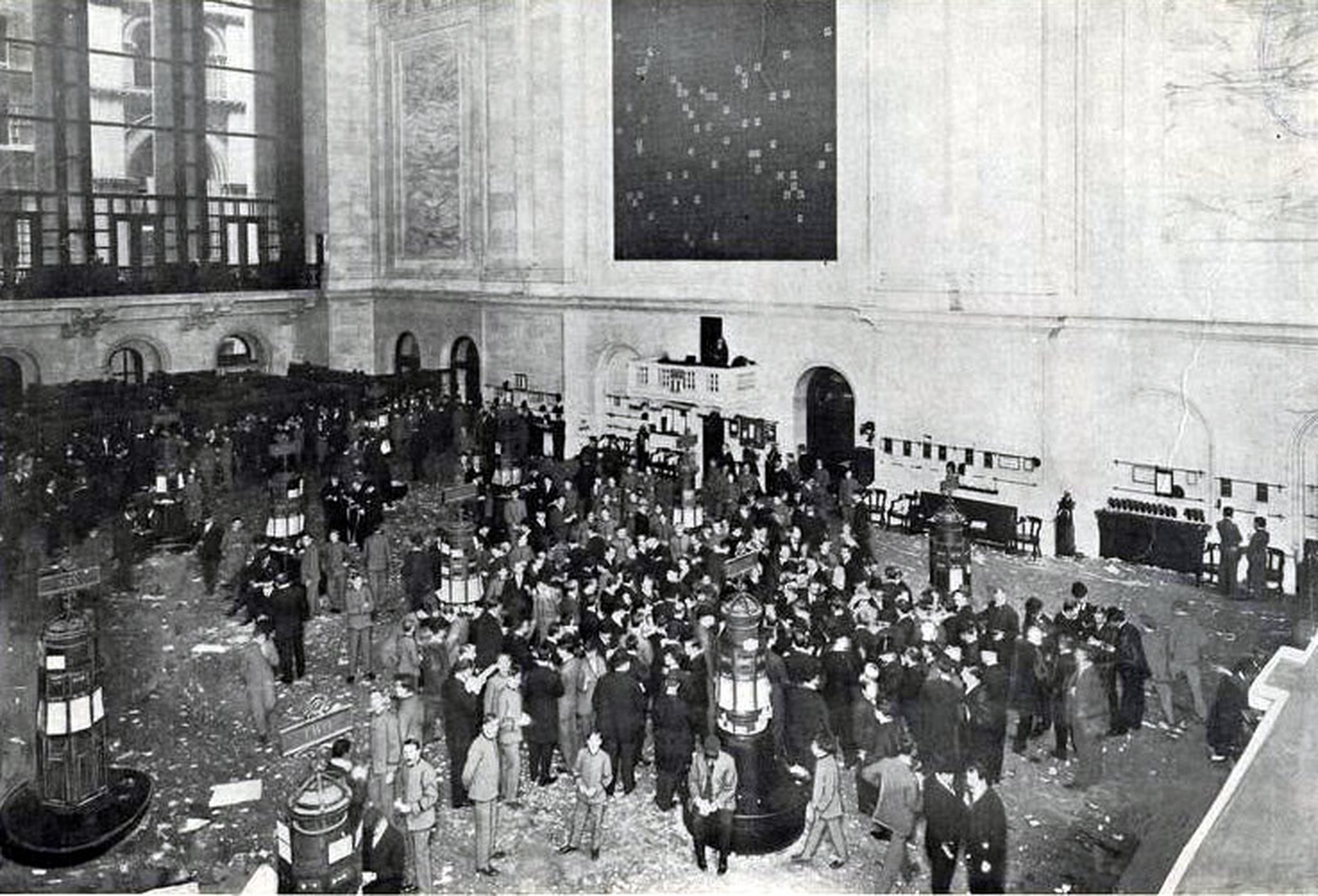
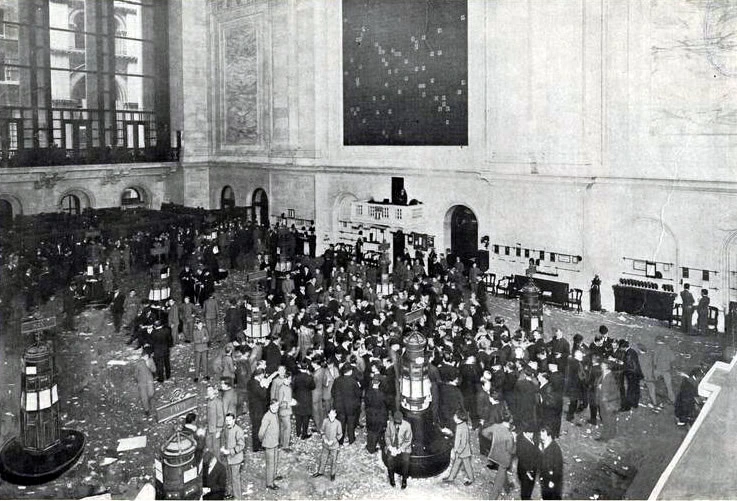
New York Stock Exchange floor, published in 1908; Helen D. van Eaton, via the New York Public Library and Wikimedia Commons. This historical trading floor is not a photograph of a dark pool.
The historical photograph shows people, posts and a shared trading floor. Today, orders can meet through electronic systems in several places. The relevant distinction is what each system displays, who can access it, how it matches orders and how its trades enter the public record. A building’s visibility tells us little about those rules.
Privacy before execution; reporting after execution
Institutions use non-displayed orders to reduce information leakage and the market impact of revealing a large intended trade. A fund selling two million shares does not necessarily crash a stock on an exchange, and a dark pool does not guarantee a fair price or an impact-free execution. Urgency, liquidity, order size and the available counterparties matter.
For listed US equities, off-exchange executions are reported through FINRA facilities and reach the consolidated trade record. That reporting does not reveal every customer’s identity or unexecuted intention. A reported print records an execution, not a hidden investor’s complete portfolio plan.
Many individual investors encounter these systems through a broker’s routing. Some brokers give customers routing choices, while the venue’s access and subscription rules still govern participation. “Most retail investors do not connect directly” is more accurate than “retail traders can never use dark liquidity.”
Units and terms
US United States · FINRA Financial Industry Regulatory Authority · ATS Alternative trading system
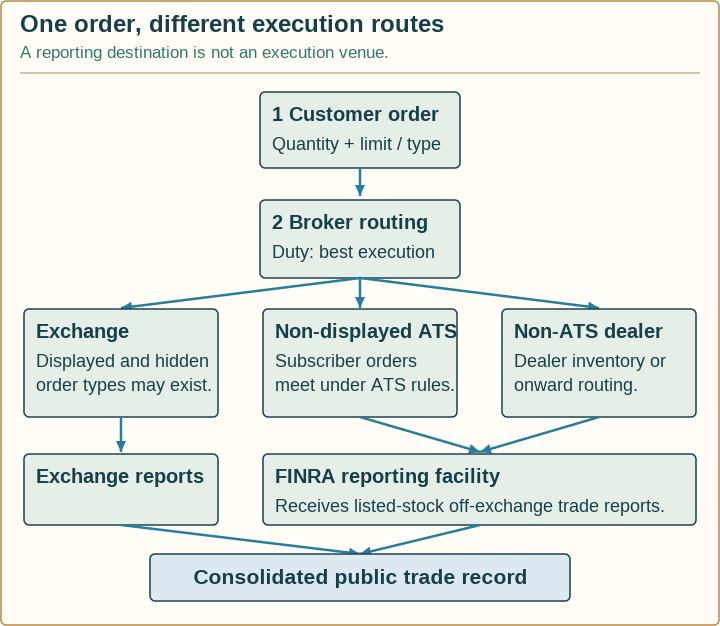
A reporting destination is not an execution venue.
1 Customer order
Quantity + limit / type
2 Broker routing
Duty: best execution
Exchange
Displayed and hidden
order types may exist.
Non-displayed ATS
Subscriber orders
meet under ATS rules.
Non-ATS dealer
Dealer inventory or
onward routing.
Exchange reports
FINRA reporting facility
Receives listed-stock off-exchange trade reports.
Consolidated public trade record
Original route diagram. The reporting route is separate from the execution venue; it is not another purchase of the same shares.
Route
What happens there
What the name does not tell you
Registered exchange
Orders execute under exchange rules. Exchanges can also support non-displayed order types.
A listed stock is not confined to its listing exchange.
Non-displayed ATS
An alternative trading system matches trading interest without a public displayed order book.
ATS is not a synonym for every off-exchange trade.
Non-ATS dealer / wholesaler
A dealer may execute against its own inventory or route an order onward.
A large wholesaler is not automatically a dark-pool venue.
Trade reporting facility
Receives reports of off-exchange executions in listed stocks.
The reporting facility is not necessarily where the trade was matched.
FINRA and the SEC have different roles
FINRA means Financial Industry Regulatory Authority. It is a US self-regulatory organization for member broker-dealers, operating under SEC oversight. The SEC is a federal agency. FINRA does not supervise every trading market in the world, and its US off-exchange data should not be presented as a census of global trading.
An ATS is not a national securities exchange and does not take on an exchange’s self-regulatory role. NMS stock ATSs disclose their operations and conflicts through Form ATS-N. Read the venue’s filing when identifying its order types, subscribers and matching process; a marketing label is not a regulatory classification.
NMS: National Market System. The United States securities-market framework referred to by the ATS disclosure discussion.
Units and terms
US United States · FINRA Financial Industry Regulatory Authority · ATS Alternative trading system
FINRA Financial Industry Regulatory Authority · SEC U.S. Securities and Exchange Commission · US United States · ATS Alternative trading system · NMS National Market System · OTC Over-the-counter · API Application programming interface
Read FINRA volume without inventing a trading signal
FINRA’s OTC Transparency service separates ATS and non-ATS statistics. It publishes share counts and trade counts by security and venue or firm. These are executed-volume statistics, not a live display of resting orders. Use the free public tables or downloads; the method here requires no paid feed or API.
OTC: Over-the-counter. In the equity-market discussion this refers to trading away from a national securities exchange. ATS and non-ATS volumes are separate categories within the reporting data.
API: Application programming interface. A defined way for software to request data or operations from another program. The public-data method here does not require buying access to one.
Read the illustration’s labels
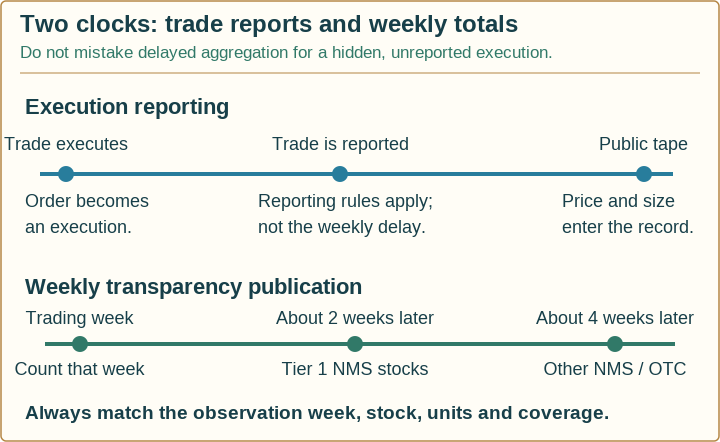
Two clocks: trade reports and weekly totals
Do not mistake delayed aggregation for a hidden, unreported execution.
Execution reporting
Trade executes
Order becomes
an execution.
Trade is reported
Reporting rules apply;
not the weekly delay.
Public tape
Price and size
enter the record.
Weekly transparency publication
Trading week
Count that week
About 2 weeks later
Tier 1 NMS stocks
About 4 weeks later
Other NMS / OTC
Always match the observation week, stock, units and coverage.
Two clocks: trade reporting and delayed weekly statistics. The delays shown are the published security-specific FINRA schedule, not an indication that ordinary tape prints wait several weeks.
1. Fix the question.
Choose the security, the week beginning date, the security category and the unit: shares or number of executions. Record the download date separately.
2. Download both categories.
Keep ATS and non-ATS observations in separate columns. For a security-specific comparison, match the same week in both datasets. Tier 1 NMS statistics normally have a two-week publication delay; Tier 2 and OTC equity statistics normally have a four-week delay.
3. Inspect the fields.
Retain the security identifier, venue or firm, week, share quantity and trade count. Check whether a row is a total or a component. Do not add an aggregate row to the rows it already summarizes.
4. Supply the missing denominator.
To calculate the share of all trading, obtain comparable consolidated market volume for that security and week. A subtotal of off-exchange trading is not the full-market denominator.
5. Check comparability.
Align sessions, corporate actions, units and reporting coverage. Note corrections and revisions. Keep unadjusted share volume separate from a price series adjusted for stock splits or dividends.
6. Write the limited conclusion.
Report the measured percentages and changes over several comparable weeks. State what the data cannot establish: customer identity, whether a fund is building a net position, the aggressor’s intent or the next price move.
Units and terms
FINRA Financial Industry Regulatory Authority · SEC U.S. Securities and Exchange Commission · US United States · ATS Alternative trading system · NMS National Market System · OTC Over-the-counter · API Application programming interface
NMS National Market System · OTC Over-the-counter · FINRA Financial Industry Regulatory Authority · ATS Alternative trading system
% percent, parts per hundred · ATS Alternative trading system · m metre, a length unit · = equals · ÷ divided by
Consider an invented stock over one complete week. These figures are teaching inputs, not an observation of NVIDIA or any other company. Each executed share is counted once in the market-volume total; it is not counted again merely because the trade has both a buyer and a seller.
Execution category
Shares
Share of all volume
Exchanges
4,500,000
45%
ATSs
1,500,000
15%
Non-ATS off-exchange
4,000,000
40%
All categories
10,000,000
100%
Read the illustration’s labels
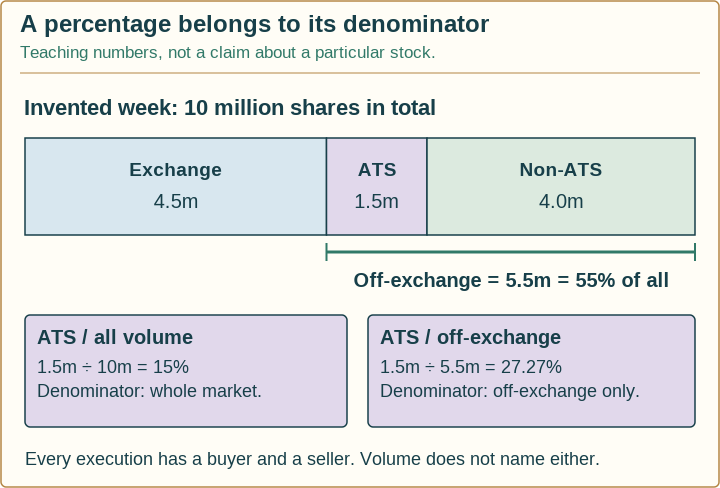
A percentage belongs to its denominator
Teaching numbers, not a claim about a particular stock.
Invented week: 10 million shares in total
Exchange
4.5m
ATS
1.5m
Non-ATS
4.0m
Off-exchange = 5.5m = 55% of all
ATS / all volume
1.5m ÷ 10m = 15%
Denominator: whole market.
ATS / off-exchange
1.5m ÷ 5.5m = 27.27%
Denominator: off-exchange only.
Every execution has a buyer and a seller. Volume does not name either.
One dataset, two denominators. ATS volume is 15% of all trading but about 27.3% of off-exchange trading in this invented example.
Off-exchange share = (1.5 million + 4 million) / 10 million = 55%. ATS share of all trading = 15%. ATS share of off-exchange trading = 1.5 / 5.5 = 27.27%. Calling the entire 55% “dark-pool buying” changes both the category and the meaning of the measurement.
Why heavy trading can coexist with a nearly flat price
Executions can occur repeatedly at nearby prices while liquidity replenishes, buyers and sellers offset one another, and activity is spread across venues. A chart can therefore show substantial turnover without a large net price change. That observation alone cannot identify a hidden accumulation programme, distribution programme or deliberate suppression.
Every completed trade has a buyer and seller. A vendor’s “buy volume” may classify trades by a price-versus-quote rule; it is not the same as net purchases by institutions. Ask for the classification method before drawing conclusions from a green bar.
Short-sale volume is a different measurement
FINRA’s daily short-sale volume describes trades marked short within that file’s coverage. Short interest is a snapshot of outstanding short positions, reported on separate dates. A short sale covered later that day can increase daily short volume without leaving an open position at the snapshot. Neither measure, by itself, guarantees a squeeze.
Units and terms
% percent, parts per hundred · ATS Alternative trading system · m metre, a length unit · = equals · ÷ divided by
ATS Alternative trading system · % percent, parts per hundred · = equals · FINRA Financial Industry Regulatory Authority
Payment for order flow, execution quality and real abuses
Payment for order flow is compensation associated with routing orders. It can create an incentive to prefer one destination. It is not the same thing as a dark pool, and a non-ATS wholesaler can receive retail orders through such an arrangement. “Commission-free” describes one charge; it does not describe the entire economic cost of execution.
PFOF: Payment for order flow. Compensation a broker receives for directing customer orders to another firm; it must be distinguished from the customer’s execution quality and the broker’s routing duties.
FINRA’s guidance says payment must not interfere with best execution. Relevant comparisons include price improvement, execution speed, the chance of a limit order filling, order size and transaction costs. A disclosure does not by itself excuse a failure to obtain best execution.
A practical broker review
1. Read the routing report.
Find the broker’s public Rule 606 report for the relevant quarter. Identify the asset class, order types, receiving venues and payment disclosures before comparing brokers.
2. Preserve your own evidence.
Keep the order time, limit price, quantity, execution price, fees and confirmation. A weekly ATS total cannot reconstruct the handling of your individual order.
3. Compare like orders.
A marketable retail order, a resting limit order and an institutional block have different execution needs. A single “best venue” ranking can hide those differences.
Legal structure does not guarantee honest conduct
In 2016 the SEC announced settlements involving Barclays and Credit Suisse over dark-pool operations, disclosures and other violations. This is evidence that abuses can occur and be prosecuted. It is not evidence that all dark-pool transactions are illegal, or that any stock’s high off-exchange percentage proves misconduct.
Claim
What the evidence supports
“Dark volume proves accumulation.”
Volume alone does not reveal net positions or owners.
“A squeeze must follow.”
A squeeze depends on positions, liquidity, financing and future orders.
“All retail orders are stolen.”
Routing incentives and execution outcomes must be examined separately.
“The rules are the same worldwide.”
This chapter explains US equities. The EU’s PFOF rules differ; its temporary exemption ended on 30 June 2026.
Units and terms
ATS Alternative trading system · % percent, parts per hundred · = equals · FINRA Financial Industry Regulatory Authority
ATS Alternative trading system · SEC U.S. Securities and Exchange Commission · US United States · EU European Union · PFOF Payment for order flow
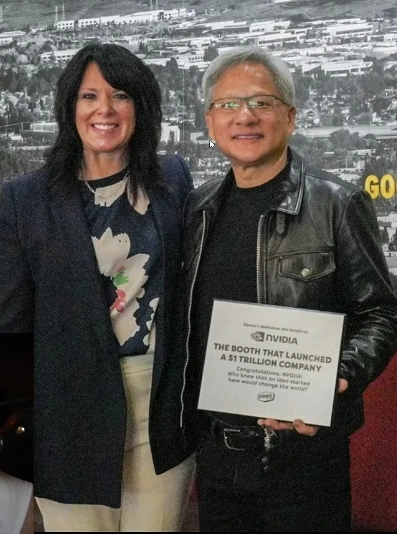
User-supplied photograph of the Denny’s commemorative plaque. NVIDIA’s dated account documents the September 2023 event with Jensen Huang and Kelli Valade. The plaque commemorates the founding story; it is not a 1993 photograph or a current valuation statement.
NVIDIA’s account of 26 September 2023 describes the unveiling of a plaque at the Denny’s where Huang, Chris Malachowsky and Curtis Priem discussed their graphics-chip business in 1993. The USD 1 trillion wording belongs to that commemoration. Market capitalization is the share price multiplied by shares outstanding; it is not a trillion dollars held in a bank account.
What the name means
In a 2017 interview, Huang explained NV as “next version”; the founders then found Latin invidia, “envy”.
The green eye gives that wordplay a memorable visual identity. Accounts of who proposed the final name differ. The documented naming story supports an association with envy; it does not establish that the company practises an esoteric tradition. A corporate mark can invite cultural comparisons without making those comparisons historical facts.
NVIDIA was incorporated in California in April 1993 and later reincorporated in Delaware. Its public offering took place on 22 January 1999 at USD 12 per share. That historical nominal price must not be directly compared with a modern post-split quote as if the share count had stayed unchanged.
Units and terms
USD United States dollar
USD United States dollar · BCE Before the Common Era · CC0 Creative Commons Zero, a public-domain dedication tool
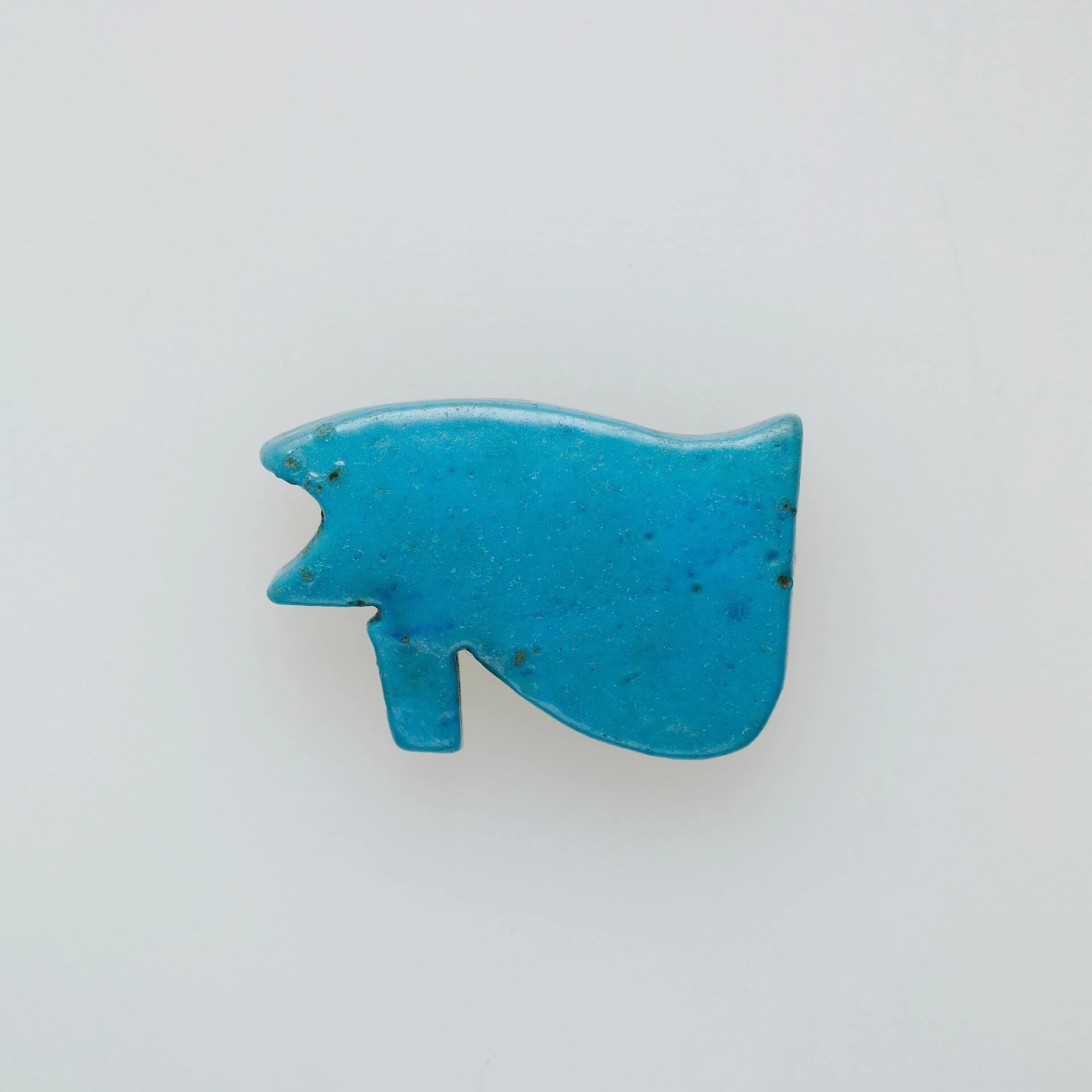
Wedjat eye amulet, 664-332 BCE, Metropolitan Museum of Art, accession 10.130.1870. Ancient Egyptian faience; the collection record and CC0 image credit are in the companion. This is a historical object, not NVIDIA’s logo.
The “evil eye” is a belief about a harmful or envious gaze. An eye-shaped amulet is often intended to protect against harm. Confusing the feared gaze with a protective object reverses the meaning. The Egyptian wedjat represents the restored eye of Horus and belongs to its own religious setting; it should not be casually relabelled as every other eye tradition.
The Met explains the wedjat through the myth of injury and restoration. The Science Museum also records protective uses of Eye of Horus amulets. These records support an account of historical beliefs, not a claim that an object has measurable supernatural power.
Read the illustration’s labels
Three different questions about an eye symbol
A protective eye object is not evidence of a company’s hidden purpose.
FORM
What is visible?
Eye, curve, colour
and composition.
1
OBJECT HISTORY
The object’s purpose?
A wedjat amulet had
a protective role.
2
DESIGN INTENT
Whose stated intent?
Requires a dated,
attributable source.
3
Similarity can suggest a question; it cannot establish intent.
Keep a modern interpretation labelled as an interpretation.
Three separate questions prevent a visual resemblance from being promoted into an invented corporate history.
For NVIDIA, the evidence reviewed supports a green eye mark and a name associated with envy. It does not establish the Eye of Horus, a curse, occult membership or a deliberate “evil eye” programme as the company’s intention. Label those readings as interpretations if discussing them. Stock-market performance supplies no test of an esoteric interpretation.
Read a symbol responsibly.
Identify its date, maker, culture and stated purpose. Compare form only after establishing that context. A similar outline can appear in unrelated places without proving a shared origin or a secret connection.
Units and terms
USD United States dollar · BCE Before the Common Era · CC0 Creative Commons Zero, a public-domain dedication tool
ART Argentina Time, UTC minus three hours · UTC Coordinated Universal Time, the international civil time standard; Argentina used UTC minus three hours for this event · US United States
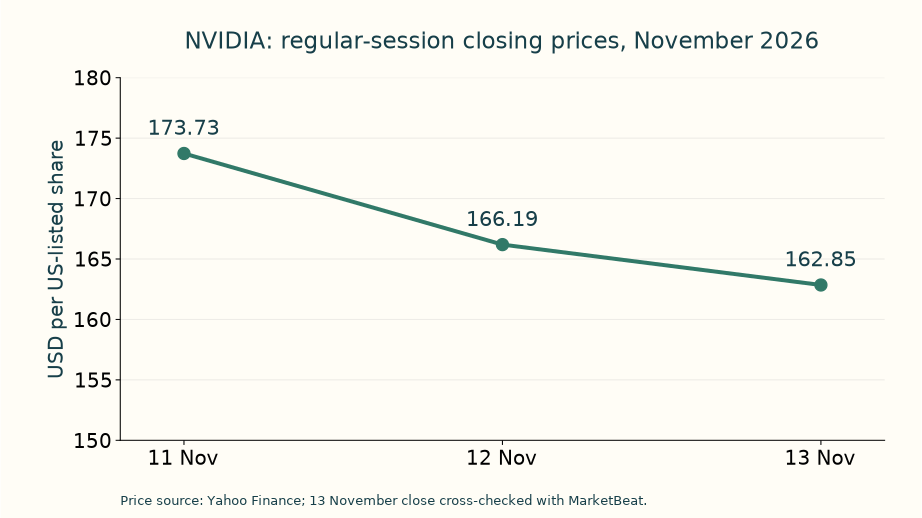
The cutoff is 16 November 2026, 02:01 in Argentina: 05:01 UTC and 00:01 US Eastern Standard Time. The last completed regular US session was Friday, 13 November. The prices below are regular-session closes, not a claim to reproduce an overnight trade at the exact cutoff.
Read the illustration’s labels
11 Nov
12 Nov
13 Nov
150
155
160
165
170
175
180
USD per US-listed share
173.73
166.19
162.85
NVIDIA: regular-session closing prices, November 2026
Price source: Yahoo Finance; 13 November close cross-checked with MarketBeat.
Regular-session closing prices, USD per share: 11, 12 and 13 November 2026. The short window is labelled explicitly and is not a forecast or a full investment-return history.
Date
Close, USD
Daily change
11 November 2026
173.73
+2.87%
12 November 2026
166.19
-4.34%
13 November 2026
162.85
-2.01%
Yahoo Finance’s historical table and other market-data reports agree on the USD 162.85 close. Vendor volume totals differ, so this table does not combine their volume series. From the 11 November close to the 13 November close, the price change is approximately -6.26%. A price move around news does not prove that one event caused every trade.
The 33-year CEO description needs a date
NVIDIA’s Form 8-K says the board accepted Jen-Hsun Huang’s resignation as president, chief executive and director on 11 November 2026. The public announcement followed on 12 November. Colette M. Kress became interim CEO while continuing as CFO, and Harvey C.Jones became board chair. Thus Huang’s 33-year leadership is historical at this cutoff; calling him the current CEO would be incorrect.
CFO: Chief financial officer. The executive role responsible for a company’s financial management and reporting.
Documented filing sign-off: /s/ Colette M. Kress. Form 8-K dated 12 November 2026. This is the filing’s typed legal signature, not a fabricated handwritten autograph.
The board stated that it expected operations, customer commitments and the product roadmap to continue. That is management’s expectation, not a guarantee about future revenue, staff retention or the stock price.
Units and terms
ART Argentina Time, UTC minus three hours · UTC Coordinated Universal Time, the international civil time standard; Argentina used UTC minus three hours for this event · US United States
USD United States dollar · % percent, parts per hundred · CEO Chief executive officer · CFO Chief financial officer
USD United States dollar · GAAP Generally accepted accounting principles · % percent, parts per hundred · ART Argentina Time, UTC minus three hours · UTC Coordinated Universal Time, the international civil time standard; Argentina used UTC minus three hours for this event
NVIDIA developed from graphics chips into a supplier of accelerated computing systems and software. Its latest published quarterly results at this cutoff were for the second quarter of fiscal 2027, ended 26 July 2026. The fiscal-year label is not the calendar year in which every sale occurred.
GAAP: Generally accepted accounting principles. In the United States company account, this label distinguishes financial statements prepared under the stated accounting rules from adjusted, non-GAAP measures.
Reported measure
Q2 FY2027
Revenue
USD 96.221 billion
Data Center revenue
USD 89.0 billion
GAAP gross margin
75.0%
GAAP diluted earnings per share
USD 2.46
Non-GAAP diluted earnings per share
USD 2.22
The same release guided third-quarter revenue to USD 108 billion, plus or minus 2%, with no Data Center compute revenue from China assumed. This is a company forecast. It is not a reported third-quarter result. NVIDIA scheduled those results for 17 November at about 13:20 Pacific time, followed by a 14:00 call: approximately 18:20 and 19:00 ART.
ART: Argentina Time, UTC minus three hours. Times in the dated market account use this time zone, not the exchange’s local clock.
Read the illustration’s labels
An AI system needs more than a processor
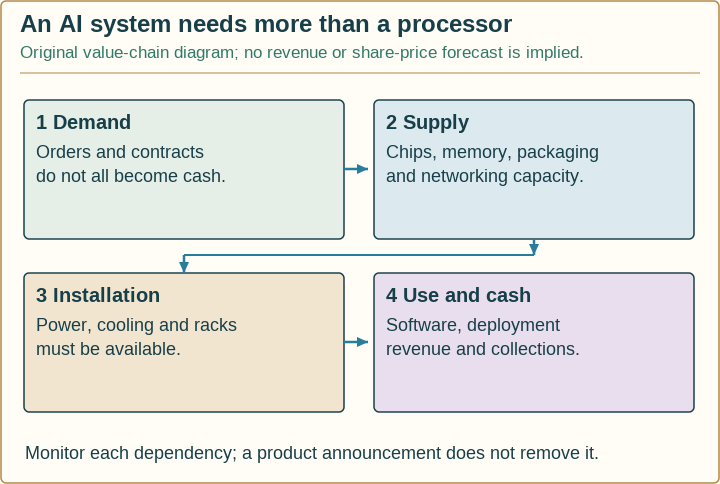
Original value-chain diagram; no revenue or share-price forecast is implied.
1 Demand
Orders and contracts
do not all become cash.
2 Supply
Chips, memory, packaging
and networking capacity.
3 Installation
Power, cooling and racks
must be available.
4 Use and cash
Software, deployment
revenue and collections.
Monitor each dependency; a product announcement does not remove it.
A demand chain rather than a price target. Each connection can constrain the conversion of orders into installed, revenue-producing systems.
Watch
Evidence that matters
Leadership continuity
Appointment of a permanent CEO; subsequent filings and responsibility changes.
Delivery and earnings quality
Recognized revenue, margins, cash collection, inventory and customer commitments.
Physical bottlenecks
Power, cooling, packaging, memory and data-centre deployment capacity.
Competition and policy
Alternative accelerators, customer-designed chips, export rules and customer concentration.
Valuation
Expectations already reflected in the price, using a consistent earnings and share-count basis.
A strong business can still be an expensive stock, and a falling share price does not by itself establish that the business has failed. The next useful step is to compare the new report with the prior guidance and cash-flow evidence, not to set a guaranteed price target from the logo, dark-pool percentage or CEO biography.
Units and terms
USD United States dollar · GAAP Generally accepted accounting principles · % percent, parts per hundred · ART Argentina Time, UTC minus three hours · UTC Coordinated Universal Time, the international civil time standard; Argentina used UTC minus three hours for this event
AI Artificial intelligence · CEO Chief executive officer
CEO Chief executive officer · USD United States dollar · ARS Argentine peso · EUR Euro · BCRA Banco Central de la República Argentina · CEDEAR Certificado de Depósito Argentino
A conversion answers a measurement question. It does not create an executable offer. At the dated reference rates used in this chapter, the last regular NVIDIA close of USD 162.85 converts as follows.
Item
ARS
USD
EUR
One US-listed share, reference value
251,934.42
162.85
147.35
Ten such shares, before costs
2,519,344.22
1,628.50
1,473.49
Hypothetical USD 5 transaction charge
7,735.17
5.00
4.52
The ARS column uses the BCRA wholesale reference. An Argentine retail broker can use another exchange-rate mechanism and charge commissions, taxes and other costs. A CEDEAR has a depositary conversion ratio and local pricing conditions; its peso quote is not simply the number in this table. Check the instrument, current ratio and broker’s charge schedule before comparing prices.
CEDEAR: Certificado de Depósito Argentino. A locally traded depositary certificate representing an interest in a foreign security under its stated conversion ratio. Its local price also reflects market and currency conditions.
Keep stock splits separate from economic returns
NVIDIA’s 2021 split was four-for-one and its 2024 split was ten-for-one. Splitting a share increases the number of units while reducing the price per unit proportionally at the split; the operation alone does not create that multiple of wealth. A long-term chart must use one consistent adjustment basis.
1. Choose the comparison.
For price return, compare split-adjusted prices. For total return, account for dividends and the chosen reinvestment assumption. State the currency used.
2. Keep the dates.
Use the exchange rates on the relevant dates if studying an investor’s historical currency return. Applying today’s rate to every year creates a different question.
3. Add actual costs.
Use the broker’s applicable charges and instrument rules. The USD 5 row is an arithmetic example, not a quotation.
A simplified unhedged currency-return identity is (1 + stock return in USD) × (1 + change in ARS per USD) - 1. It omits charges and taxes. For example, a 10%USD stock gain combined with a 20% rise in ARS per USD gives 1.10 × 1.20 - 1 = 32% in ARS before costs. This is arithmetic, not a forecast.
Units and terms
CEO Chief executive officer · USD United States dollar · ARS Argentine peso · EUR Euro · BCRA Banco Central de la República Argentina · CEDEAR Certificado de Depósito Argentino
USD United States dollar · ARS Argentine peso · % percent, parts per hundred · = equals · × multiplied by
Research records: sources, dates and interpretation
Question: A specific proposition that could be supported or contradicted. Source: Named author or institution, document title and direct link in the companion. Date: Publication date, event date and observation period, distinguished. Measurement: Quantity, unit, denominator and coverage. Interpretation: What follows from the observation and what remains an inference. Next check: A document, observation or calculation that would resolve the uncertainty.
When a result changes, preserve the earlier dated record. State the reason for the revision and link it to the new evidence.
Units and terms
USD United States dollar · ARS Argentine peso · % percent, parts per hundred · = equals · × multiplied by
AT THE CLOSE OF THE BOOK
Carlos “Charlie” Verbelen
The complete collection of 379 illustrated author signatures. Choose a named design or move through the collection.