

Main navigation books and collected sections. The alphabetical index provides the individual people, methods, materials and crops.
 Source page
BOOK REFERENCE 1831
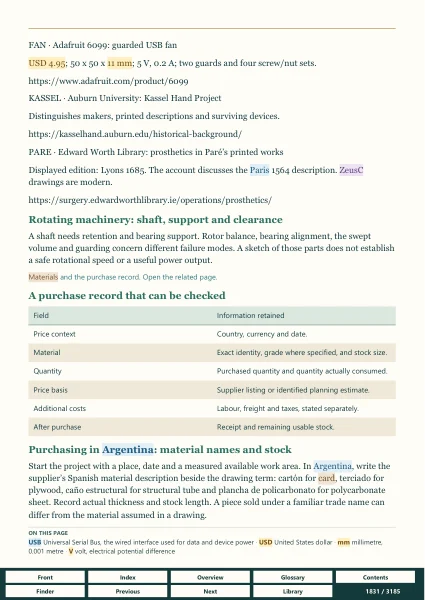
Build Motion and Measure It
A shaft needs retention and bearing support. Rotor balance, bearing alignment, the swept volume and guarding concern different failure modes. A sketch of those parts does not establish a safe rotational speed or a useful power output.
Read the account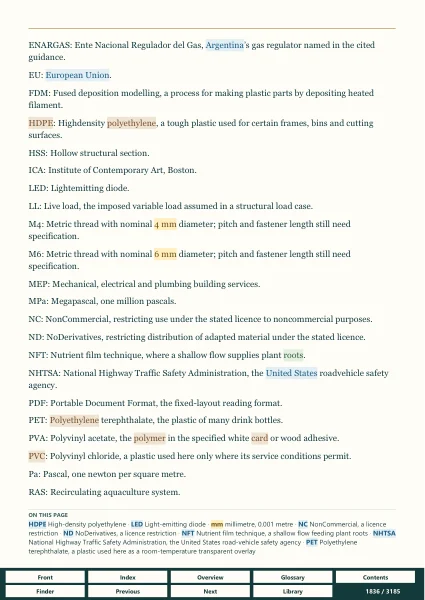 Source page
BOOK REFERENCE 1836
Workshop terms and component definitions
ENARGAS: Ente Nacional Regulador del Gas, Argentina’s gas regulator named in the cited guidance.
Read the account Source page
 Source page
 Source page
 Source page
BOOK REFERENCE 1875
Give an Arm a Reach and a Limit
08B: European-series roller-chain designation with 12.7 mm pitch; a suffix identifies strand count.
Read the account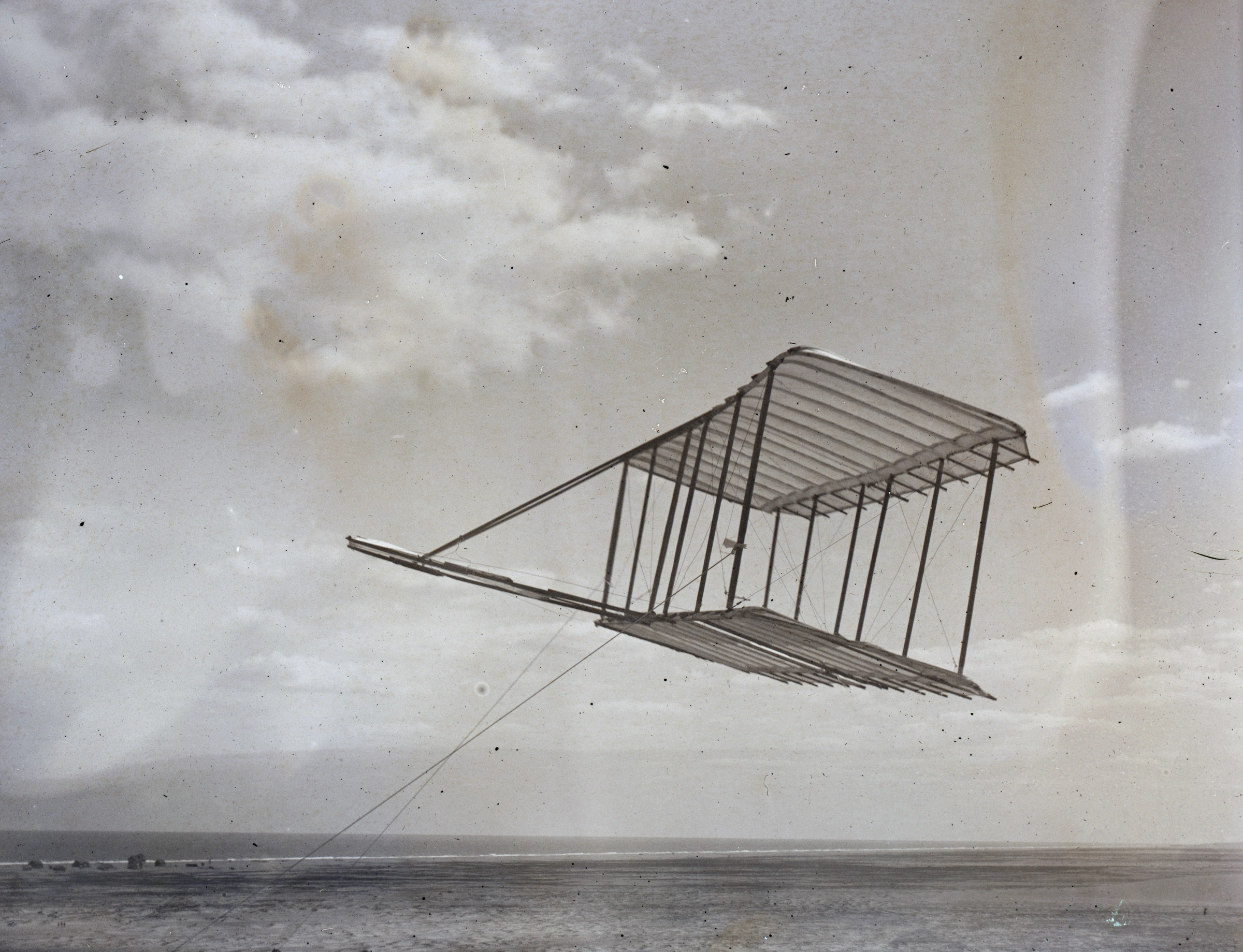
BOOK REFERENCE 1885
Measurements, maps and the sky
The Wright brothers’ 1900 glider flown as a kite near Kitty Hawk, North Carolina. Attributed to Wilbur and/or Orville Wright; Library of Congress, LC-W85-96, digital image LC-DIG-ppprs-00556. The reproduction omits damaged outer borders. Period photograph, no known…
Read the account Source page
 Source page
BOOK REFERENCE 1991
Moon, Month and the Architecture of a Calendar
A civil month organises dates; a synodic month describes the changing SunEarthMoon geometry from one lunar phase to the next. A thirteenmonth calendar with twentyeight days in each month contains 364 days. It needs one additional day to make a 365day year and a further…
Read the account Source page
 Source page
BOOK REFERENCE 2037
From Antarctic Flight Lines to the Moon
The supplied collage joins Operation Highjump, Deep Freeze, the creation of NASA, the Antarctic Treaty, Operation Fishbowl and Apollo 11. Their dates fall into a sequence, but sequence alone does not establish a shared secret purpose. Each badge points to a different…
Read the account
BOOK REFERENCE 2040
Read the Ground and Recover the Hidden Map
The complete supplied poster is preserved with its ZeusC mark. Its sphere appearances are not treated as a uniformly scaled, uniformly processed set of true-colour photographs. The new atlas uses separately credited mission images and JPL mean-radius data.
Read the account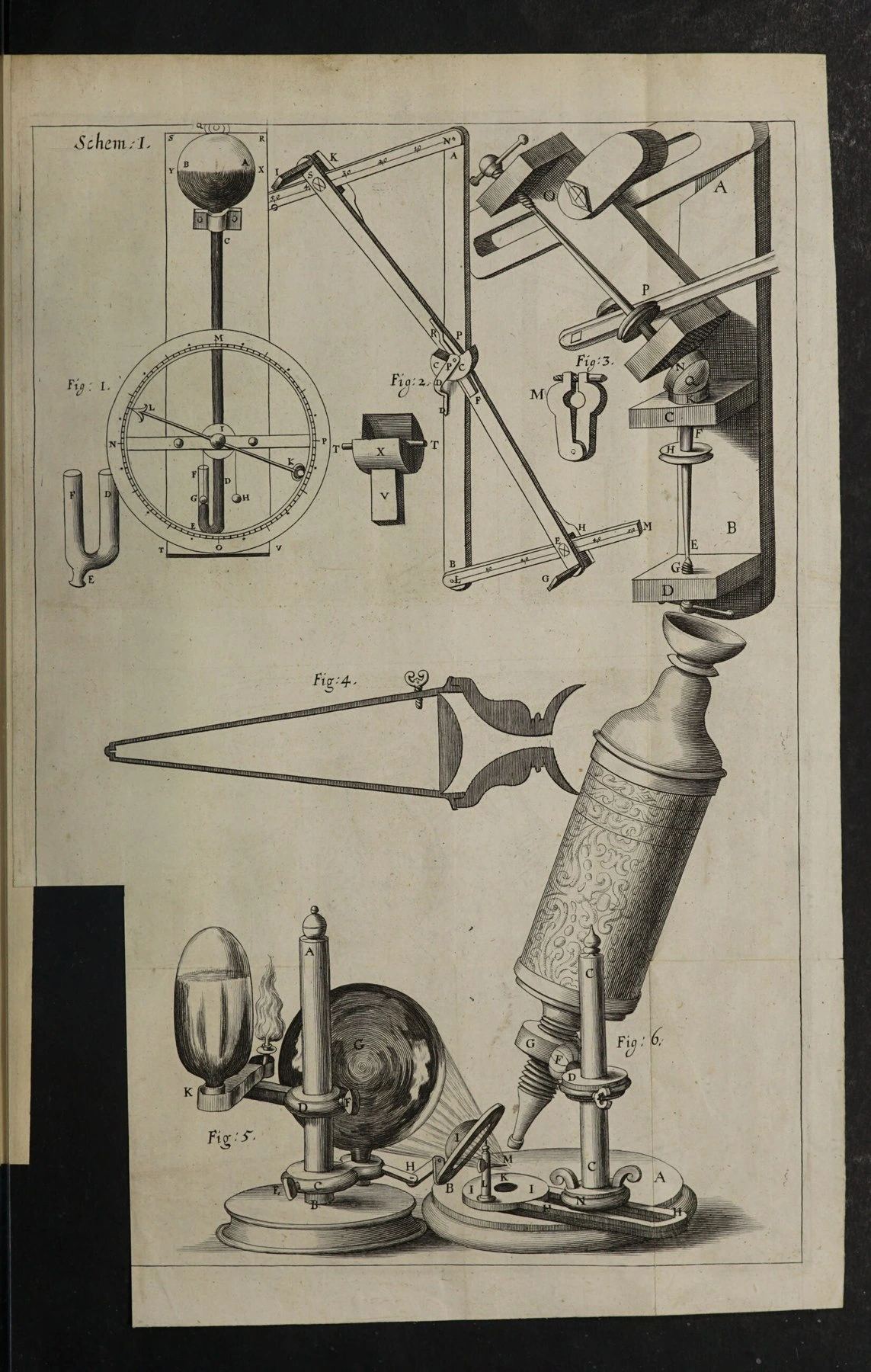
BOOK REFERENCE 2083
Make a Measurement Worth Comparing
Calibrated images · counted materials · original records · reproducible calculations
Read the account
BOOK REFERENCE 2124
Trace the Evidence Before Building
Follow the history of flight from Argentina to the United States, Europe and the wider world, then build, measure and keep a record that another person can inspect.
Read the account Source page
BOOK REFERENCE 2155
Public Clocks, Astronomical Dials and the Keeping of Time
Begin with the public service in Buenos Aires, measure the behaviour of a clock, then compare United States railway time, Prague and Rouen. The final workshops use counted card models. The source photographs, supplied ZeusC diagrams and working models are different kinds of…
Read the account- Source page
 Source page
BOOK REFERENCE 2156
Argentina: the public clock as a shared service
A public clock turns a measurement into a service. A passerby needs to read it from the street, a caretaker needs to know what drives it, and an institution needs to decide which reference it should follow. Begin in Buenos Aires with Torre Monumental in Retiro. The city’s…
Read the account Source page
BOOK REFERENCE 2162
Measure the clock before changing it
The simple pendulum model gives a useful direction of effect. For a point mass on a light support, at sufficiently small amplitude, the full oscillation period is T = 2 pi times the square root of L divided by g. Here T is the period in seconds, L is the effective length in…
Read the account Source page
BOOK REFERENCE 2168
United States: railway time and the public dial
A common time system requires a common decision as well as good clocks. A railway order issued by S. T. Smith on 14 November 1883 gives a concrete United States example. For the Kansas Division of the Union Pacific Railway, the change took effect on 18 November. East of…
Read the account