

Reading uses the speech service available on your phone or browser. Some voices need an internet connection.
ElevenLabs · ElevenReader
Copy this reading, then paste it into ElevenReader to choose an ElevenLabs voice. You can also import this page’s link.
The book’s colour key
- People and history
- Measurements and quantities
- Places
- Materials and tools
- Living systems
- Conditional or unresolved claims
Colour identifies a type of information. It does not certify a claim. Named terms and source links provide the context.
Follow the drain from the sink
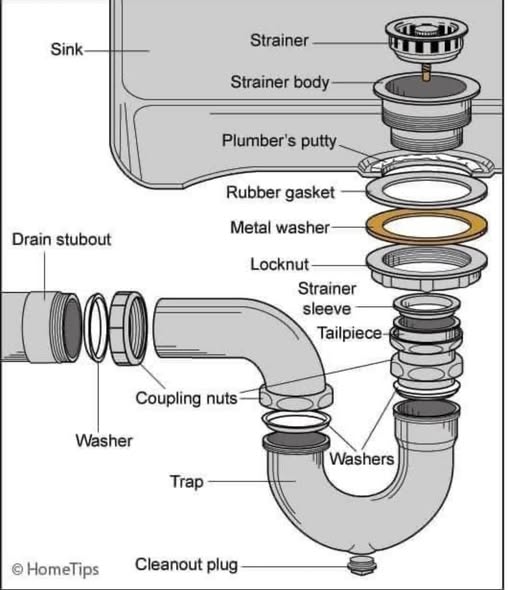
The upper part of the illustration shows the strainer body and the components that fasten it to the sink. The tailpiece carries water down to the trap. Slip nuts and shaped washers join tubular sections, while the outlet leads toward the wall drain.
The strainer-to-sink joint, the connection below the strainer and the tubular slip joints serve different locations and use different sealing arrangements. A gasket or sealant appropriate to one connection is not automatically suitable for another. The drawing does not show the entire building drain or the arrangement hidden beyond the wall.
Three joints with different sealing jobs
At the sink opening, the strainer body meets the sink surface through the sealing arrangement specified for that product. Below it, the locknut and associated gasket or washer secure the assembly. Farther down, the tubular waste fittings use slip-joint nuts and washers. These parts may all have threads, but the threads do not necessarily form the water seal. In a typical slip joint, tightening the nut seats the washer against the adjoining surfaces.
This explains why the exploded drawing should be read in groups rather than as one long stack of interchangeable rings. A flat gasket at the strainer and a tapered slip-joint washer have different locations and functions. Their orientation and compatibility come from the actual fitting instructions. Adding tape to every visible thread can obscure the real sealing surface and will not correct a missing, damaged or incorrectly seated washer.
The retained water has a purpose
Water left in the curved trap forms a barrier against drain gases. The trap must retain this seal while water flows through the drainage system. Suitable venting helps protect it against pressure changes.
Gurgling or an empty trap can have different causes. The picture alone cannot diagnose them. An air-admittance valve is not a universal substitute for every vent arrangement; its permitted use and position depend on the applicable code and the complete installation. No such complete arrangement is shown here.
How to install a P-trap · 2024 International Plumbing Code, Chapter 9: vents
The water seal depends on the surrounding drain
After discharge, the curved portion retains water up to the level controlled by the outlet. That retained water interrupts the open air path from the drain toward the room. Its function depends on remaining present. Evaporation during prolonged disuse and pressure changes in the drainage system can affect the seal, so the visible bend cannot be assessed independently of use and ventilation.
A vent provides the drainage system with an air path that helps control pressure changes. It is not a second waste outlet and is not shown completely in the supplied illustration. The trap arm, the pipe between the trap and its vent connection, has to be evaluated with its diameter, slope, length and actual connection arrangement. Adding extra bends to make a mismatched assembly reach the wall can change that arrangement rather than simply extend it.
2024 International Plumbing Code, Chapter 9: vents · How to install a P-trap · ICC: trap-seal protection and venting
A washer seal is not a taped thread
In the illustrated tubular slip joints, the nut presses a shaped washer against the mating surfaces. That is the sealing mechanism. Oatey's guidance does not call for thread tape on these slip joints. Adding tape to every threaded-looking connection confuses a washer joint with other kinds of threaded connection.
Excessive tightening can damage a nut, washer or plastic fitting. Parts also need to align without being forced into position. Where metal and plastic meet, the transition must match the fittings and their intended use. The combination is not automatically a case of galvanic corrosion.
Locate the symptom before changing a part
A wet joint, slow discharge and an odour are different observations. A wet joint points to water escaping at a particular location. Slow discharge may involve an obstruction or another drainage problem. An odour may involve the water seal or a different source. Replacing the curved trap solely because all three occur near a sink can miss the actual cause. Record when the symptom occurs and which surfaces become wet first.
For accessible tubular joints, the manufacturer describes alignment, assembly and a leak check as part of installation. The pipe should meet the fitting without being forced sideways, and tightening should follow the product instructions rather than a generic torque. A concealed connection, persistent pressure symptom or incompatible arrangement requires assessment of the wider system. The diagram provides the names needed to describe that system clearly to the person investigating it.
How to install a P-trap · 2024 International Plumbing Code, Chapter 9: vents · ICC: trap-seal protection and venting
Why the connection stays adjustable until the parts align
The tubular assembly has to connect two fixed locations: the sink outlet above and the drain connection at the wall. Their relative positions determine how the intervening parts fit. In Oatey's installation sequence, the bend is temporarily positioned before the wall tube is measured. This order matters because the required length belongs to the assembled geometry. A measurement taken between two isolated openings can miss the portions that must enter the fittings.
A slip joint permits a tube to enter a mating part while the nut and washer remain loose enough for positioning. When the correct arrangement is established, tightening compresses the washer into its sealing position. The nut is therefore part of a seal around an aligned tube. Using it to pull a sideways or short assembly into place adds force to a connection whose purpose is to close the joint. A seal that depends on the pieces being held under strain is vulnerable when those pieces move.
The exploded illustration separates the rings so their order can be seen, but the finished assembly must bring their surfaces together. This is why component identity, insertion and alignment belong in the explanation alongside the water seal. The trap's curve controls the retained water, while the joints make a continuous, serviceable passage between the fixture and the building drain.
Slope belongs to a defined pipe and code
The supplied note quotes a quarter-inch fall per foot as if it covered every drain. Drainage requirements vary with pipe size and jurisdiction. The cited International Plumbing Code is a model-code example, not proof of the rule applicable to this reader's building.
Trap-arm slope, developed length and vent position must be established from the actual installation. A service record identifies the water seal, washer orientation and distinct joints, then records the dimensions, selected components and applicable plumbing requirements.
2024 International Plumbing Code, Chapter 7: sanitary drainage · 2024 International Plumbing Code, Chapter 9: vents
Words and symbols
- P-trap
- A curved drain assembly retaining a water seal, with an outlet arrangement resembling the letter P in profile.
- water seal
- Retained water that forms a barrier between room air and gases in the drain.
- slip joint
- A tubular connection whose nut compresses a washer to make the seal. It is not sealed by adding thread tape to the nut.
- trap arm
- The downstream segment connecting the trap toward its vented drainage arrangement; exact limits follow the governing code terminology.
- AAV
- Air-admittance valve. Whether and how it may be used depends on the applicable plumbing code.
- PVC
- Polyvinyl chloride, a plastic material. The particular fitting must still be identified and used with compatible components.
- PTFE
- Polytetrafluoroethylene, a material used in some thread-sealing tapes. It does not replace the washer in a slip joint.
- slope
- Vertical fall divided by horizontal length. The required value depends on the pipe and applicable code.