

Reading uses the speech service available on your phone or browser. Some voices need an internet connection.
ElevenLabs · ElevenReader
Copy this reading, then paste it into ElevenReader to choose an ElevenLabs voice. You can also import this page’s link.
The book’s colour key
- People and history
- Measurements and quantities
- Places
- Materials and tools
- Living systems
- Conditional or unresolved claims
Colour identifies a type of information. It does not certify a claim. Named terms and source links provide the context.
The route begins before the tank
A rainwater system receives water on a catchment surface, carries it through gutters, separates some debris and stores the runoff. The tank is one part of that route. Its presence does not establish that the water is safe to drink. The intended use determines the materials, treatment, monitoring and maintenance that the system needs.
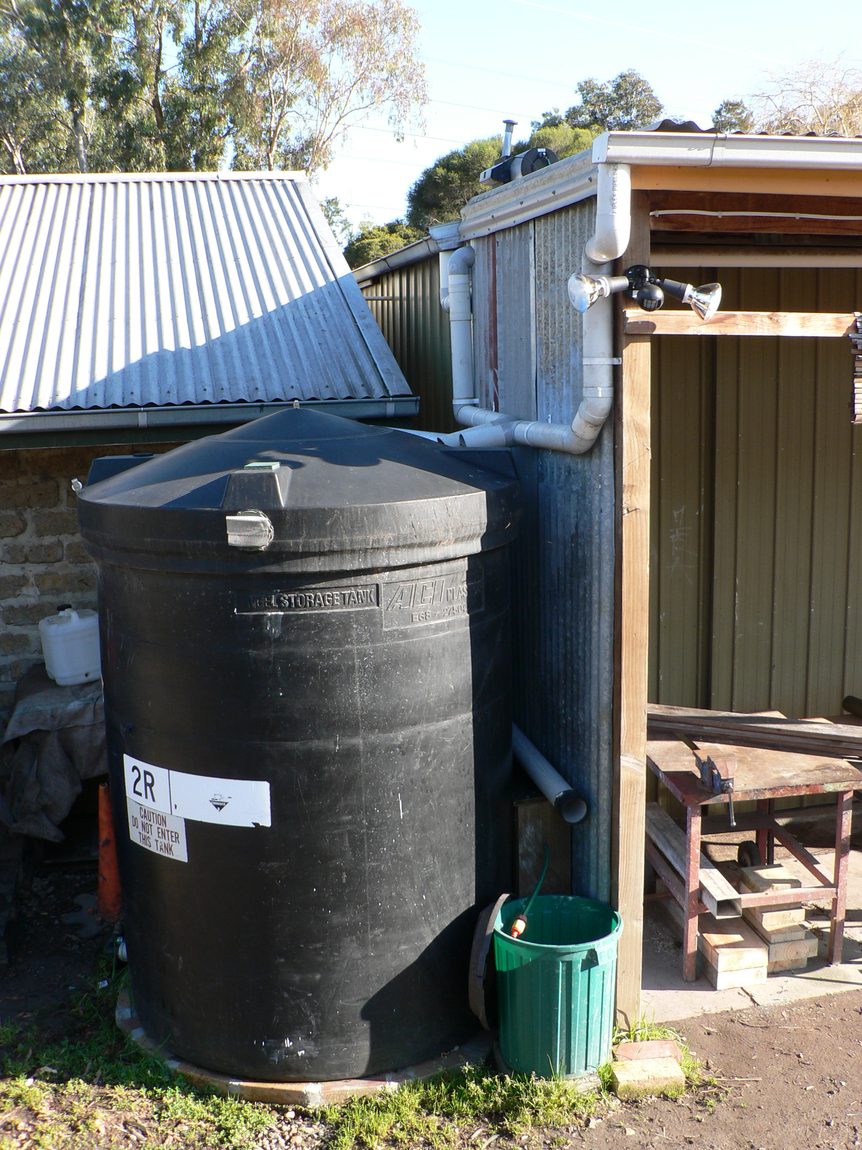
The photograph records a particular installation at CERES Environment Park in Melbourne. The closed tank and connecting pipes are visible. Its internal condition, flow and water quality require other evidence. This distinction matters whenever a photograph is used to explain how a system works.
United States Department of Energy: rainwater harvesting systems · Pengo: CERES photograph and licence
Follow the water through each barrier
The collection route is a series of components with different jobs. The roof gathers rainfall. Gutters and downpipes convey it. A coarse screen intercepts leaves and larger debris before they reach the tank. A first-flush diverter sends an initial portion of runoff elsewhere, reducing some of the material washed off the catchment after a dry interval. It needs a defined discharge and a way to return to service for the next rainfall. Its presence does not establish that the remaining water is drinkable.
Inside storage, sediment can settle while new water enters and stored water leaves. The inlet, outlet and overflow therefore belong on the same installation drawing. Trace the overflow to its destination, including what happens when the receiving drain is already full. A sound tank can still cause trouble if its overflow discharges against a building or its supply pipe can cross-connect with drinking water. The drawing should make these connections visible before equipment is selected.
United States Department of Energy: rainwater harvesting systems · CDC: collecting rainwater and health
Quantity and quality are different questions
Estimating collection requires the horizontal catchment area, rainfall depth and an allowance for losses. One millimetre of rain over one square metre represents one litre before losses. Diversion, leaks and overflow reduce the amount retained. The free space in the tank also limits how much can be stored.
A volume estimate cannot guarantee supply through a dry period. Compare inflow and demand over time, including the intervals between storms. The useful storage capacity follows from that comparison and the conditions of the site, rather than from the appearance of a tank in a picture.
United States Department of Energy: rainwater harvesting systems
Storage is a balance through time
A tank's useful capacity is governed by the sequence of wet and dry periods. For each interval, start with the water already stored, add usable inflow, then subtract demand and other losses. Storage cannot exceed the tank's usable capacity; any excess must leave through an overflow. It cannot fall below zero; demand beyond the available supply must be reduced or met by a separate source. An annual rainfall total hides both of these events.
This balance explains why a larger tank is not automatically the answer to every shortage. A small catchment may never fill it, while a highly seasonal catchment may fill it quickly and then provide nothing for months. Record the rainfall period, collection area, allowance for losses and pattern of use beside any capacity estimate. These assumptions make the estimate revisable when the household, garden or workshop changes.
United States Department of Energy: rainwater harvesting systems
A visible barrier does not remove every contaminant
Rainwater can collect microorganisms and chemicals from the air, roof, gutters and pipework. A screen catches leaves and insects, but it does not certify the removal of dissolved contaminants or all microorganisms. Water can look clear and still be contaminated.
The CDC advises keeping collected rainwater separate from drinking-water plumbing and consulting the local health authority about testing and treatment. A safe drinking-water source is preferable for drinking, cooking and brushing teeth when one is available. The required controls depend on the water's use and the installed system.
Choose treatment from the intended use
Water used to irrigate a planted area and water used to prepare food do not have the same exposure route. The end use determines what needs testing, what treatment must achieve and how a failure is noticed. Filtration can remove material of a particular size; disinfection addresses susceptible microorganisms under specified conditions. Neither word alone describes a complete response to every contaminant. Treatment equipment also needs maintenance, consumables and an available power supply where required.
Keep those dependencies with the system record. A maintenance entry should identify the component, date, observation and action, such as clearing a blocked screen or replacing a specified filter. A change in roof coating, nearby contamination or water use is a reason to reassess the system, even if the tank itself has not changed.
CDC: collecting rainwater and health · United States Department of Energy: rainwater harvesting systems
The journey from stored water to a working tap
A tank can contain water while a connected outlet delivers none. Storage and delivery are separate functions. In a simple gravity arrangement, the height of the water surface above the outlet provides the driving pressure. As that surface falls, the available pressure falls too. A pump supplies energy to move water through the delivery pipe and any treatment equipment. Increasing the tank's width can increase its volume without increasing the pressure associated with a given water depth.
This makes the outlet route part of the system's design. Pipes, filters and fittings resist flow, and a treatment stage may require particular operating conditions. The Department of Energy's component diagram includes a pump, a power supply, level monitoring and a flow meter alongside collection and storage. Together they explain why the visible size of a reservoir cannot establish how much usable water will reach a fixture during an interruption of power.
Connections also have to remain safe when pressures change. A line that normally carries water toward a tank can become a route in the opposite direction if the pressure relationship reverses. Backflow protection addresses that possibility; an ordinary connecting pipe does not. The separation between harvested water and a drinking-water supply therefore belongs to the physical arrangement, including its failure conditions, rather than only to a label on the tank.
United States Department of Energy: rainwater harvesting systems · CDC: collecting rainwater and health
Keep the operating history with the installation
A useful record identifies the catchment, tank, overflow destination, permitted use and maintenance requirements. After rain, interpret the change in stored volume alongside any withdrawals, diversion and overflow. If the tank overflowed, its final level alone cannot reveal how much runoff arrived. Inspection access should remain clear, and tank openings should stay secure against unintended entry.
Keep the route of the water understandable from inlet to outlet. Specifications for a new installation must come from measurements, local requirements and equipment documentation. The CERES photograph preserves a real example of that physical arrangement; it does not supply missing dimensions or a drinking-water certificate.
United States Department of Energy: rainwater harvesting systems · Pengo: CERES photograph and licence
Words and symbols
- m²
- Square metre: a unit of area.
- mm
- Millimetre: one thousandth of a metre; here it expresses rainfall depth.
- L
- Litre: a unit of volume.
- CDC
- United States Centers for Disease Control and Prevention.
- CERES
- Centre for Education and Research in Environmental Strategies, an environmental institution in Melbourne.
- CC BY-SA
- Creative Commons Attribution-ShareAlike: credit the creator and share adaptations under the same licence.