

Reading uses the speech service available on your phone or browser. Some voices need an internet connection.
ElevenLabs · ElevenReader
Copy this reading, then paste it into ElevenReader to choose an ElevenLabs voice. You can also import this page’s link.
The book’s colour key
- People and history
- Measurements and quantities
- Places
- Materials and tools
- Living systems
- Conditional or unresolved claims
Colour identifies a type of information. It does not certify a claim. Named terms and source links provide the context.
A page that preserves working relationships
The third edition of Joseph Moxon's Mechanick Exercises appeared in London in 1703. The book brings manual trades into print through descriptions and engravings. Joinery is one of its subjects. Its account connects particular tools with the surfaces they prepare, the marks they transfer and the results expected from their use.
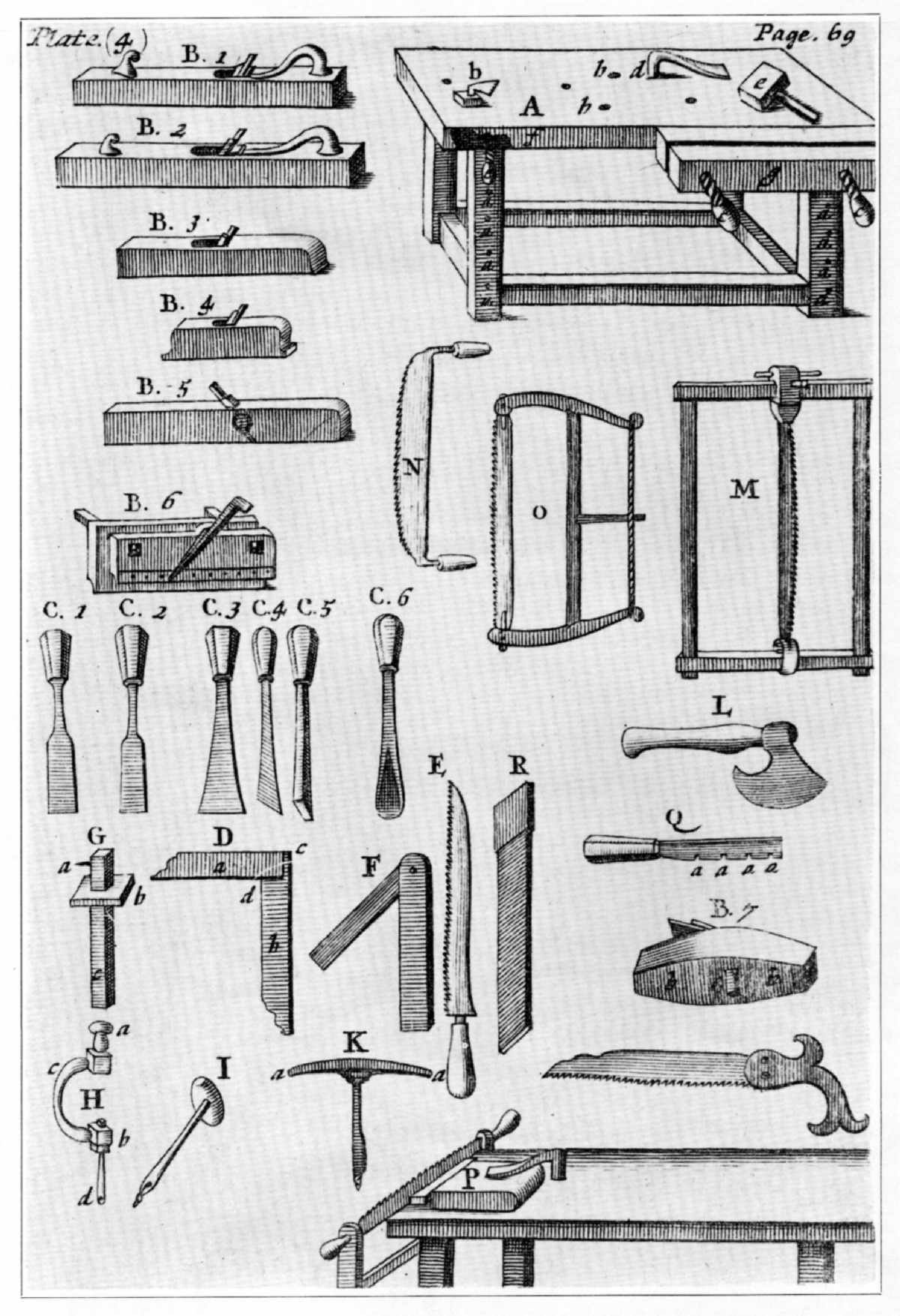
Plate 4 assembles a bench, planes, chisels, saws and marking tools. It is not an instantaneous view of a workshop. The objects are arranged to support the written explanation. Their labels let a reader move between an engraved shape and the corresponding passage.
The Huntington: the 1703 edition · Smithsonian: Woodworking Tools, 1600–1900
A tool is a set of working surfaces
The wooden plane makes sense when its parts are read together. Its body guides the cutting iron over the timber; the sole bears on the surface being worked; the opening admits the projecting edge and the shaving it removes. The wedge holds the iron in the body. A drawing of the outside can identify this arrangement, but it cannot reveal the condition of the cutting edge, the flatness of the sole or whether the wedge grips properly.
The distinction matters when an old tool is encountered in a collection or recovered for use. Age and ornament describe the object, while alignment, support and cutting geometry describe its operation. Moxon's text and plates belong together because the names alone do not explain how the parts cooperate. Welsh's later survey adds comparisons across surviving tools rather than treating one engraved page as a complete workshop inventory.
Getty Research Institute: digitised Moxon volume · Smithsonian: Woodworking Tools, 1600–1900
A face and an edge establish the reference
Moxon's account describes preparing a surface, checking it and using it to establish adjoining surfaces. A square requires a dependable face against which to sit. A marking gauge transfers a constant offset from an edge. If the reference changes, the resulting line may no longer represent the intended dimension.
This dependence explains why a tool collection alone cannot describe a craft. The working method also needs criteria: where a measurement begins, which surface is ready and how a finished joint is recognised. Reading the manual beside its plate makes these relationships visible without assigning modern tolerances to the engraving.
Marking keeps a joint related to its neighbours
A reference face is useful because later measurements can return to the same surface. If each mark is taken from whichever rough edge happens to be nearest, small differences can accumulate until two pieces disagree. A square carries a direction from an edge across a face. A marking gauge repeats an offset from its fence. These tools transfer relationships; they do not correct an unreliable reference surface by themselves.
The cut also removes material. The saw's kerf is the space taken away by the teeth, so a marked boundary and the centre of a saw cut are not interchangeable. Reading a joint drawing requires distinguishing the retained member, the waste and the eventual bearing surfaces. This is why layout marks, tool descriptions and joint illustrations convey more information together than an isolated list of tool names.
The arrangement has a purpose
The bench occupies the upper right. The planes form a group on the left, their bodies differing in length and profile. Chisels sit below them; saws and marking tools complete the sheet. The letters are references to the historical text, rather than abbreviations requiring invented expansions.
In 1966, Peter C. Welsh reproduced this plate for a Smithsonian history of woodworking tools between 1600 and 1900. That study's date range does not make every pictured object an invention of one period. Nor does this selected English and American evidence establish a single worldwide sequence of craft development.
The bench belongs to the cutting system
The workbench is more than a table below the tools. Cutting produces a reaction in the workpiece. Stops, holding devices and supported surfaces provide a route for that force into the bench. If the timber moves or overhangs without suitable support, the relationship between the edge, the mark and the cutting tool changes. The bench in the plate therefore explains part of the method, even where no person is drawn.
A useful description of a historical workshop records where a piece is supported, which surface is being established and what the next operation depends upon. It also distinguishes visible evidence from missing detail: a printed screw or stop may be recognisable without providing its dimensions or capacity. Preserving that distinction allows the plate to explain craft practice without turning it into an unverified fabrication drawing.
Getty Research Institute: digitised Moxon volume · Smithsonian: Woodworking Tools, 1600–1900
Rough cutting and final smoothing solve different problems
Moxon's sequence gives the planes different jobs. The fore plane begins with an iron whose cutting edge rises toward the middle. Set to take a relatively substantial shaving, it removes the high portions of rough timber quickly. The resulting surface still carries shallow hollows from the curved edge. Those marks are a consequence of the first tool's geometry, not proof that the whole operation has failed. Material removal and the final quality of the surface are different stages of the same process.
The next stage changes the cut. Moxon describes setting the fore plane finer and then using the jointer, or the smoothing plane, to remove its remaining irregularities. His smoothing plane has its iron set very fine. A long sole helps relate separated portions of the surface, whereas a short tool can work a smaller area. The joiner's task therefore moves from removing obvious excess to establishing the relationship of the face along its length and width.
This sequence explains the varied plane bodies in the engraving. Several similar-looking tools need not be redundant copies. Their length, cutting profile and setting suit different points in the transformation from sawn stock to a prepared member. The written account turns an inventory of wooden shapes into a record of how the craft controlled the material it removed.
Getty Research Institute: digitised Moxon volume · Smithsonian: Woodworking Tools, 1600–1900
What survives, and what still needs examination
The engraving documents a way of explaining skilled work. Its profiles, labels and arrangement belong to an identifiable publication. Keeping the complete sheet allows details to be enlarged and compared, while preserving the relationship between each tool and its neighbours.
An actual tool also has a present condition: its cutting edge, handle, adjustment and means of holding the work. Those conditions cannot be certified by a historical picture. The plate is valuable because it connects objects and methods across time, while the manual records the reasoning that gives their arrangement meaning.
Getty Research Institute: digitised Moxon volume · Smithsonian: Woodworking Tools, 1600–1900
Words and symbols
- Reference face
- A prepared surface used to establish or check other dimensions.
- Edge
- The narrow surface along the side of a board.
- Marking gauge
- A tool that marks a constant distance from an edge.
- Plate 4
- The illustration's identifier in the historical publication.