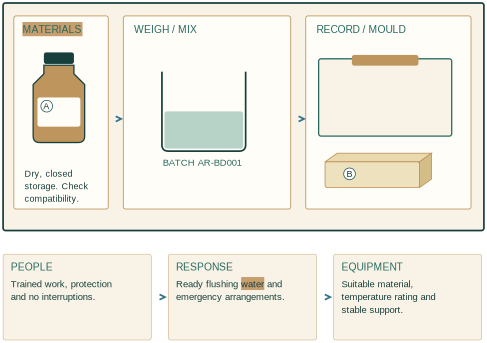
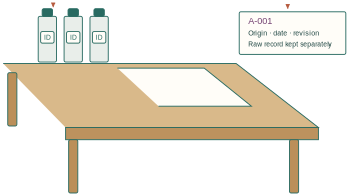
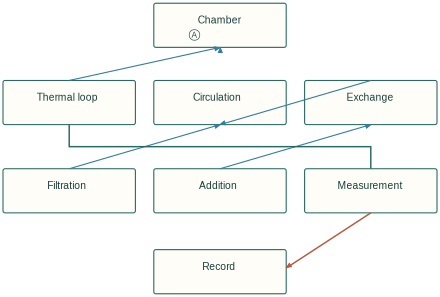
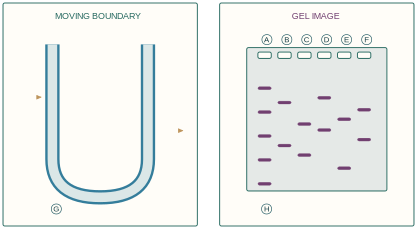
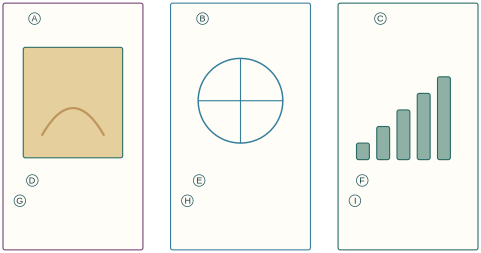
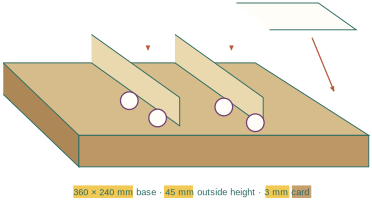
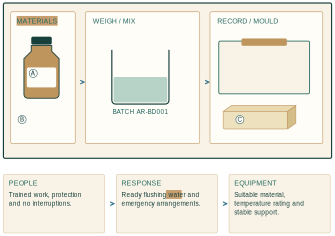
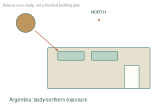
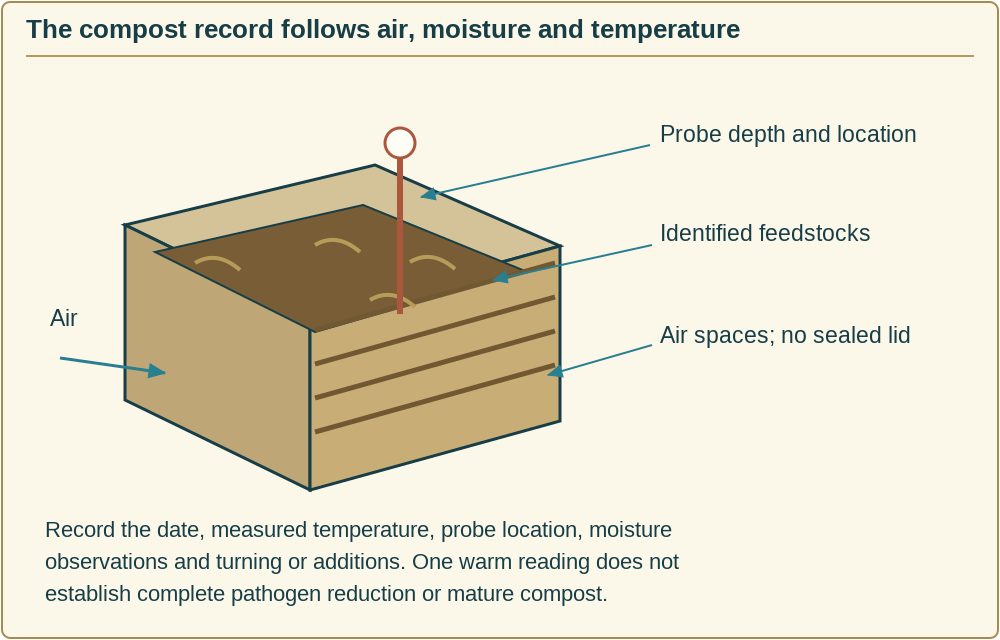
The work area connects labelled materials, weighing, mixing and a protected record. This conceptual layout is not a building or ventilation design.
A prepared soap bench keeps identity beside the work
Original teaching drawing · Read the figure caption for source and example status
The first dependency in soapmaking is a prepared place to work. Establish an uncluttered, stable area with suitable ventilation, compatible equipment, ready access to water for emergency flushing and a way to prevent interruption. Keep food, children, pets and unrelated work out of the area. Identify where each material, tool and record will go before opening the alkali container. Preparation reduces the number of decisions made while holding a corrosive material. [US2, WO1]
Select equipment for the actual chemical, concentration and temperature. Sodium hydroxide attacks several metals, including aluminium; an attractive cooking pot is not automatically suitable. A plastic recycling symbol by itself does not establish a container's temperature rating or chemical service suitability. Use the supplier's specification for the intended application. Keep chemical equipment dedicated and distinguish it clearly from food utensils. [US2, WO1]
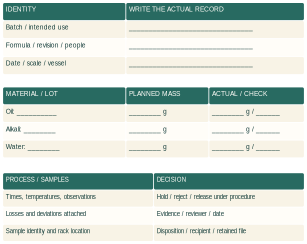
Assign a batch identifier to the record, the mixing vessel and the mould or mould group. In this chapter, ARBD001 is an invented teaching identifier: AR marks Argentina in the example, and BD001 is a local sequence. It is not an official registration or an actual batch. A vessel label should survive normal handling and remain readable from the position where the operator works.
A prestart check should answer concrete questions: are the correct formula revision and ingredient lots present; is the scale suitable and stable; is the mould ready; are protective goggles, appropriate chemicalresistant gloves and protective clothing available; are containers identified; and is there a response plan for a spill or exposure? A tick beside each question means that a person actually checked it. If any necessary condition is missing, preparation continues. A full chapter earns its length by explaining the dependencies behind the checkboxes, not by multiplying boxes on a page.
Protect the record from splashes without moving it so far away that weighing details must be remembered. A clean recording position beside the process allows an operator or checker to capture each observation when it happens. If the work requires attention, stop at a defined stable point before writing. Do not manipulate a phone above an open corrosive mixture merely to obtain a dramatic photograph.
AR‐BD001 ‐ Invented teaching batch identifier. AR identifies Argentina in the example; BD001 is a local sequence. It is not an official registration.
AR / US / CH / EU / WO / Z / IM + number ‐ Source‐register keys. Argentina, United States, chemistry, Europe, world, supplied ZeusC sheets and retained image. Numbers identify the cited record.
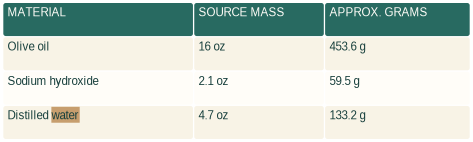
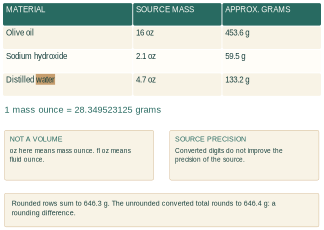
In the drawing: MATERIAL SOURCE MASS APPROX. GRAMS; Olive oil 16 oz 453.6 g; Sodium hydroxide 2.1 oz 59.5 g; Distilled water 4.7 oz 133.2 g
Read the illustration’s labels
NOT A VOLUME
oz here means mass ounce. fl oz means
fluid ounce.
SOURCE PRECISION
Converted digits do not improve the
precision of the source.
Rounded rows sum to 646.3 g. The unrounded converted total rounds to 646.4 g: a
rounding difference.
In the drawing: NOT A VOLUME; oz here means mass ounce. fl oz means fluid ounce.; SOURCE PRECISION; Converted digits do not improve the precision of the source.; Rounded rows sum to 646.3 g. The unrounded converted total rounds to 646.4 g: a rounding difference.
Bramble Berry’s source quantities are mass ounces. The metric figures are rounded conversions for reading the source, not newly measured precision.
Read the castile quantities in one coherent mass system
1 mass ounce = 28.349523125 grams
Original teaching drawing · Read the figure caption for source and example status
The existing book page cites Bramble Berry's Classic Castile Soap Project. The checked source lists 16 ounces of olive oil, 2.1 ounces of sodium hydroxide and 4.7 ounces of distilled water. These are mass quantities. Its optional sodium lactate is a separate addition; it must not appear in an actual batch without its own documented amount and specification. This reading follows the core three-material example and keeps the publisher's complete procedure linked. [US1]
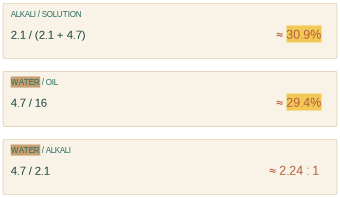
Using the avoirdupois conversion of 28.349523125 grams per ounce, the three source masses correspond to approximately 453.6 grams of olive oil, 59.5 grams of sodium hydroxide and 133.2 grams of water when rounded to one decimal place. The extra digits in the conversion factor do not make the original 2.1-ounce instruction more precise. Never confuse ounces of mass with fluid ounces of volume. [US5]
The unrounded converted total is approximately 646.37 grams, or 646.4 grams to one decimal place. Adding the three separately rounded displayed numbers gives 646.3 grams. That tenth of a gram difference is a rounding effect, not a chemical discovery or an unexplained spill. A working formulation must choose one coherent system and its approved weighing resolution before production rather than mixing rounded columns from several versions.
This is a source-reading example, not a universal recipe for every oil sold locally. Changing the oil, alkali type, alkali product specification, water amount or additives creates a formulation change. A new calculation needs appropriate material information and review. The next chapters show how to read the arithmetic without presenting an invented oil factor as a tested formulation.
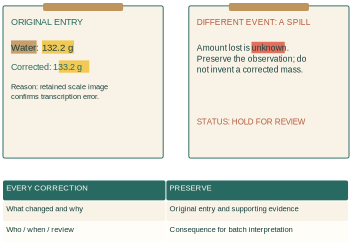
Retain three different records: the published formula, the approved working version and the actual batch sheet. The first explains where the example came from; the second states exactly what the maker intends to do; the third records what happened. If a later result is poor, those documents allow a meaningful comparison. A photograph of a pleasing bar cannot supply missing masses, and a copied recipe cannot prove that the operator used them. That is why a formula page and a batch-record page belong together in a serious book.
g / kg / mg ‐ Gram / kilogram / milligram. Mass units: 1 kilogram is 1,000 grams; 1 gram is 1,000 milligrams.
oz / fl oz ‐ Ounce of mass / fluid ounce. The source formula uses mass ounces; a fluid ounce is a volume unit.
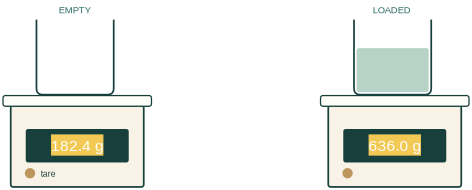
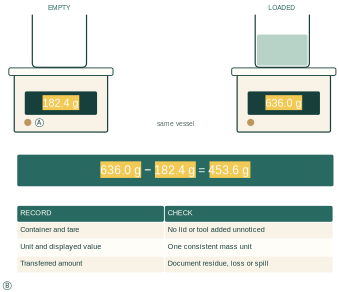
In the drawing: RECORD CHECK; Container and tare No lid or tool added unnoticed; Unit and displayed value One consistent mass unit; Transferred amount Document residue, loss or spill
Gross mass minus tare mass equals net mass when the same container, conditions and units apply. All shown readings are invented.
Gross minus tare equals net mass
same vessel
636.0 g − 182.4 g = 453.6 g
Original teaching drawing · Read the figure caption for source and example status
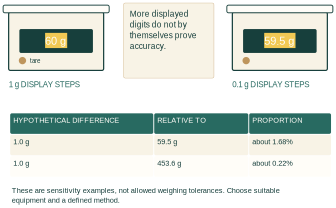
A useful weighing record begins before the ingredient is poured. Give the scale an identifier, confirm that it is appropriate for the required range and resolution, place it on a stable surface and follow its operating and checking instructions. Record the unit shown on the display. A device that can show tenths of a gram has a display resolution; that fact alone does not establish its accuracy under every load.
Tare is the mass of the empty receiving container under the conditions of the weighing. Gross mass is the container plus its contents. Net mass is the difference. In the teaching example, a container reads 182.4 grams and the container with material reads 636.0 grams, so the net amount is 453.6 grams. The subtraction is valid only if the container and relevant conditions have stayed the same.
A scale's tare button can display net mass directly, but the operator still needs to know what was tared. A newly added lid, a different spatula resting on the vessel or a replacement container changes the relationship. If the container changes, create a new documented weighing rather than silently carrying forward an earlier tare. Do not copy a visually similar vessel's tare from yesterday.
Write the displayed result as observed, using the chosen unit and a consistent decimal separator. In an Argentine record, a decimal comma may be natural; in an English transcription, a decimal point may be used. State the convention clearly so that 59,5 is not read as a thousands grouping. The source's ounce
values must not be combined with a gram tare unless they are converted through a documented, consistent method. [US5]
An independent check should compare material identity, target and actual value. It should not merely confirm that the form contains a number. If the scale reading is unstable, the operator is interrupted or material spills after weighing, stop and document the event. The amount weighed and the amount entering the mixture can differ. That distinction is the bridge from a correct subtraction to a trustworthy batch record.
% / ≈ / × / − / ‐ Percent / approximately / multiplication / subtraction / direction. Symbols used in the labelled calculations and diagrams.
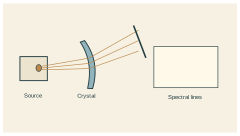
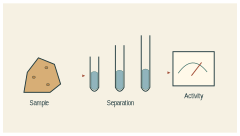
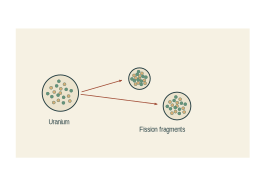
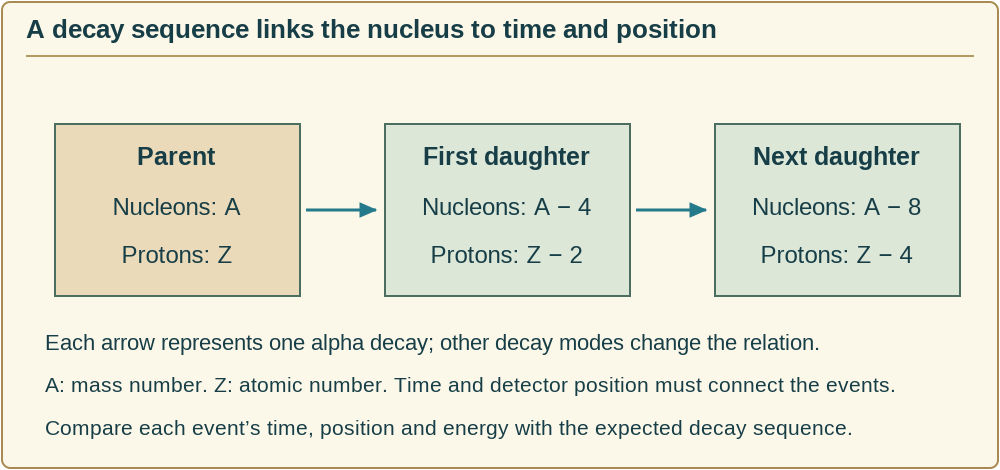
The following nine historical accounts describe different kinds of scientific work. Curie and Noddack helped identify elements through chemical separations and measurements. Cauchois developed an X-ray instrument; Perey identified francium; Meitner helped explain nuclear fission. Brooks investigated radioactive emanation, while Hoffman, Phelps and Shaughnessy worked on the difficult chain between rare material, its production and a measurable signal. A discovery record must distinguish these contributions.
The linked accounts follow the named researchers through their institutions, instruments and publications. A discovery record identifies the sample, its origin, the original readings and the interpretation. Historical dates and places remain separate from present-day regional labels.
Several source-sheet claims need qualification. Noddack’s rhenium identification belongs to a team and is distinct from the unconfirmed masurium claim. Cauchois’s curved-crystal spectroscopy is supported by the instrument record. Phelps’s contribution concerns isotope purification within a team. Shaughnessy’s institutional account identifies work on elements 114 to 118. These distinctions remain visible in the individual chapters rather than being reduced to a list of famous names.
Darleane Hoffman: separate the sample from its signal
Clarice Phelps: the contribution before the detector
Dawn Shaughnessy: a chain of short‐lived events
Marie Curie and Ida Noddack: identification takes more than a name
Yvette Cauchois and Marguerite Perey: making a weak distinction readable
Lise Meitner: a new explanation for an unexpected result
Harriet Brooks and the behaviour of emanation
isotope: Atoms of an element with the same proton count but different neutron counts.
Matter wavelength and momentum
Momentum
Wavelength
Relationship
p
lambda
Reference wavelength: Planck constant divided by momentum.
2p
lambda / 2
Doubling momentum halves the wavelength.
4p
lambda / 4
Four times the momentum gives one quarter of the wavelength.
The symbols denote a mathematical relation, not a sinusoidal particle trajectory. The following account explains Louis de Broglie’s contribution and the units.
Units and terms
≈ approximately equal to · × multiplied by
= equals · × multiplied by · λ lambda, the wavelength of light
Louis de Broglie's 1929 Nobel lecture explains the development of the wave description of matter. The relation associated with this work is λ = h/p: wavelength equals Planck's constant divided by momentum. The Greek letter λ, pronounced lambda, denotes wavelength. Momentum p has units of kilogram metres per second. Planck's constant h is 6.62607015 × 10 to the power minus 34 joule seconds in the present International System of Units.
If momentum is 6.62607015 × 10 to the power minus 24 kilogram metres per second, the relation gives a wavelength of 1 × 10 to the power minus 10 metre, or 0.1 nanometre. This numerical example is chosen to make the powers of ten transparent. A nanometre is one billionth of a metre. Increasing momentum by a factor of ten reduces the wavelength by a factor of ten. Keep the exponent and the unit visible; losing a minus sign changes the scale enormously.
A wavy line drawn beside a particle is a representation, not a photograph of a tiny object following a sinusoidal track. The mathematical description predicts wave-related behaviour under appropriate conditions. It does not turn a ball on a bench into an observable water wave. For ordinary slow objects, using mass times speed for momentum is a useful approximation; for relativistic particles the momentum relation must be treated accordingly.
Units and terms
= equals · × multiplied by · λ lambda, the wavelength of light
Women in chemistry: individual historical accounts
These twelve research histories begin with named people, institutions and publications. They connect chemical discoveries with the circumstances of the work: access to laboratories, collaboration, the making of instruments and the interpretation of measurements. Historical photographs, research papers, archives and later memoirs supply different kinds of evidence. The source notes identify the record supporting each account.
Read the illustration’s labels
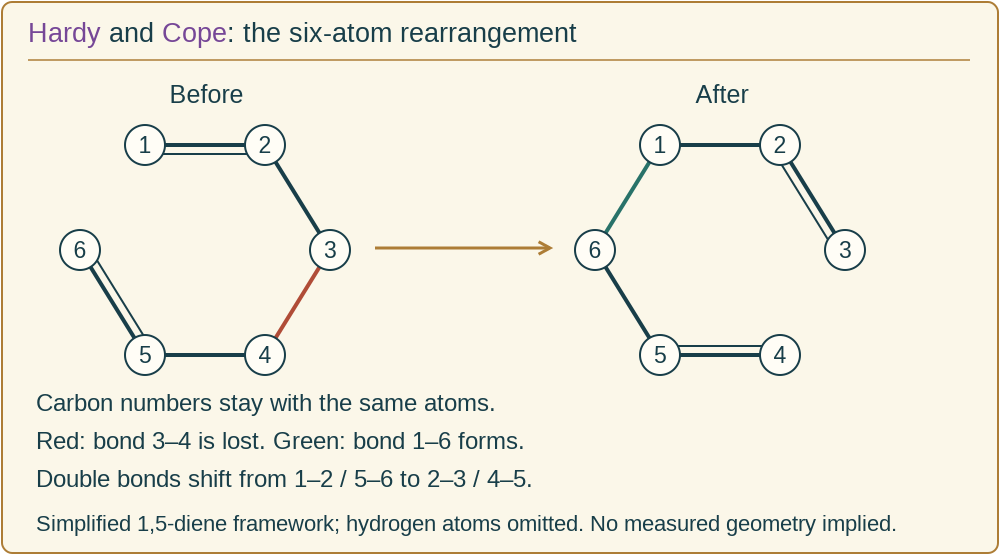
Hardy and Cope: the six-atom rearrangement
Before
1
2
3
4
5
6
After
Carbon numbers stay with the same atoms.
Red: bond 3–4 is lost. Green: bond 1–6 forms.
Double bonds shift from 1–2 / 5–6 to 2–3 / 4–5.
Simplified 1,5-diene framework; hydrogen atoms omitted. No measured geometry implied.
Read the illustration’s labels
Gao: distinguish the functions of the electrodes
Potential control
and current measurement
Counter electrode
Reference electrode
Working electrode
Counter: balances current. Reference: establishes a potential reference.
Working: the chemical response of interest. The liquid carries ionic charge.
General three-electrode schematic; no recorded experimental data or scale.
Read the illustration’s labels
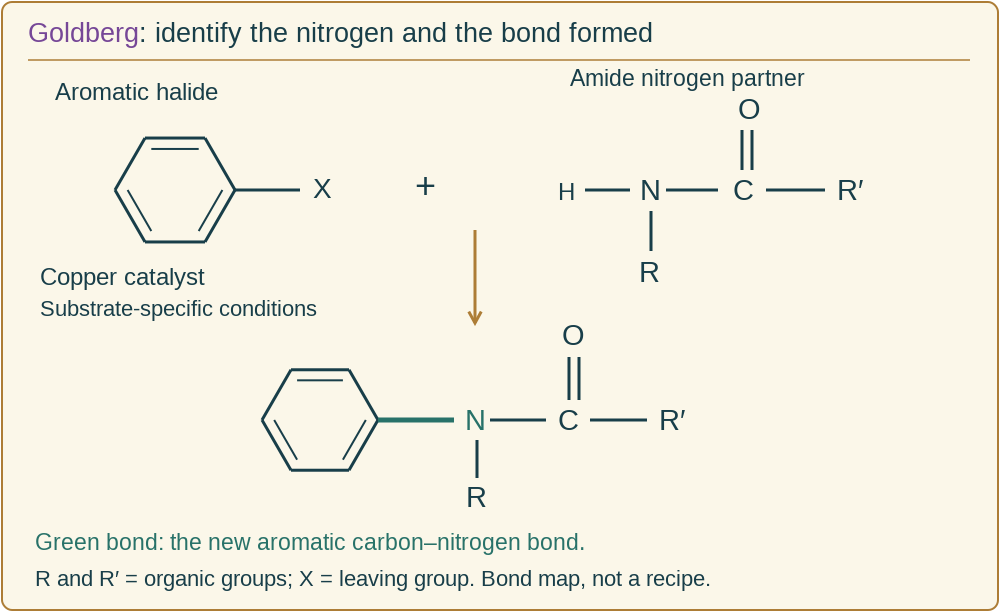
Goldberg: identify the nitrogen and the bond formed
Aromatic halide
Amide nitrogen partner
X
+
H
N
C
O
R′
R
Copper catalyst
Substrate-specific conditions
Green bond: the new aromatic carbon–nitrogen bond.
R and R′ = organic groups; X = leaving group. Bond map, not a recipe.
Read the illustration’s labels
Lawson: the axes determine how a spectrum is read
4000
3500
3000
2500
2000
1500
1000
500
0
0.5
1.0
Absorbance (dimensionless)
Wavenumber / cm⁻¹
Illustrative curve, not a measured spectrum or a chemical identification.
Wavenumber decreases left to right here. Absorption bands rise on this absorbance axis.
Read the illustration’s labels
Kelley: measurement belongs inside the process
Gas inlet
Exhaust path
Temperature probe
Gas distribution
Agitator shaft
Heat-transfer jacket
Conceptual section: parts that affect mixing, gas transfer, temperature and sampling.
Not a historical apparatus reconstruction or a culture-production specification.
Emily Aston: boron, liquid surfaces and coauthorship
Emily Aston’s name appears beside William Ramsay’s on an 1893 investigation of the atomic weight of boron. The paper occupies pages 207-217 of volume 63 of the Journal of the Chemical Society, Transactions. Its authorship is a firmer starting point than a portrait with a one-line achievement: it identifies a particular chemical problem and the publication through which the work could be examined. [RC-ASTON]
The next year’s record shows a different question. The Royal Society preserves fourteen manuscript pages on the molecular surface energy of mixtures of non-associating liquids, again credited to Ramsay and Aston. Received in the spring of 1894 and read on 14 June, the manuscript includes ink and pencil annotations. The subject moved from the composition of a compound to the behaviour of liquid mixtures. Those two records show a research practice spanning chemical analysis and physical chemistry.
An atomic weight obtained through compound analysis depends on the assumed chemical formula, the purity of the material and the measured relationship between constituents. A balance gives a mass, while the chemical interpretation connects that mass to atoms in a formula. A convincing account must keep those stages separate. An incorrectly identified compound can produce precise weighing and still support the wrong conclusion.
Surface energy concerns the energetic cost of increasing a liquid’s surface. In a mixture, bulk composition and surface composition need not behave identically. The 1894 manuscript asks how the behaviour of constituent molecules should be represented. Its title therefore identifies a specific modelling question, rather than a claim that every mixture follows one simple rule. Neither manuscript is evidence for assigning Aston an unrelated invention or filling gaps in her biography.
Sources for this account
Emily Aston: boron, liquid surfaces and coauthorship
William Ramsay and Emily Aston, The atomic weight of boron, Journal of the Chemical Society, Transactions 63 (1893), 207-217. Royal Society manuscript PP/24/15, The molecular surface-energy of mixtures of non-associating liquids (1894), fourteen pages, received in April/May and read on 14 June 1894. Sources checked 22 November 2026.
Irma Goldberg: copper catalysis and a nitrogen-carbon bond
Irma Goldberg’s 1906 paper placed copper catalysis in the title itself: Ueber Phenylirungen bei Gegenwart von Kupfer als Katalysator. The short report appeared in Berichte, volume 39, pages 1691-1692. The reaction family associated with her name concerns forming a bond between an aromatic carbon and nitrogen, particularly the nitrogen of an amide. A 2011 historical analysis by Julie A. Olson and Kevin M. Shea examines Goldberg among women whose work established named organic reactions. [RC-GOLDBERG]
The source trail contains a naming problem. The present publisher record spells her given name “Iram,” whereas historical accounts use Irma. This entry retains the established historical name and records the metadata difference in the source volume. It does not convert an uncertain catalogue field into a new person, or supply a death date that the checked records do not establish.
Read the illustration’s labels
Goldberg: identify the nitrogen and the bond formed
Aromatic halide
Amide nitrogen partner
X
+
H
N
C
O
R′
R
Copper catalyst
Substrate-specific conditions
Green bond: the new aromatic carbon–nitrogen bond.
R and R′ = organic groups; X = leaving group. Bond map, not a recipe.
Original explanatory drawing by Carlos “Charlie” Verbelen, 2026. Read the named parts and scope in the adjacent account.
An amine and an amide are different functional groups. In an amide, nitrogen is attached to a carbonyl carbon, which also has a double bond to oxygen. That relationship changes the chemical behaviour of the nitrogen. Describing every nitrogen-containing starting material as an amine erases a distinction needed to understand the reaction.
The drawing identifies the bond being changed without presenting a preparation recipe. Ar denotes an aromatic group; R denotes an attached organic group; X marks the leaving group on the aromatic partner. These symbols stand for chemical groups, not measured quantities. A named reaction does not specify a universal catalyst loading, solvent, temperature or yield. Those belong to a particular experiment and its published conditions.
Units and terms
= equals
Sources for this account
Irma Goldberg: copper catalysis and a nitrogen-carbon bond
I. Goldberg, Ueber Phenylirungen bei Gegenwart von Kupfer als Katalysator, Berichte 39 (1906), 1691-1692, DOI 10.1002/cber.19060390298. Julie A. Olson and Kevin M. Shea, Critical Perspective: Named Reactions Discovered and Developed by Women, Accounts of Chemical Research 44 (2011), 311-321, DOI 10.1021/ar100114m. Publisher metadata carries the spelling Iram; historical accounts use Irma. No death date is inferred. Sources checked 22 November 2026.
Mary Engle Pennington: refrigeration from laboratory to railway
Mary Engle Pennington studied chemistry at the University of Pennsylvania, receiving a certificate where a woman could not then receive the corresponding bachelor’s degree. She nevertheless earned a doctorate in 1895. After difficulty finding an academic post, she operated a clinical laboratory in Philadelphia and investigated the hygiene of milk and ice cream. Those problems connected laboratory bacteriology with the food actually reaching a household. [RC-PENNINGTON]
Harvey Wiley brought her into federal food research in 1905. After the 1906 Pure Food and Drugs Act, she became the first female chief of the Food Research Laboratory. The Food and Drug Administration’s historical account records how the initials M. E. concealed her sex during the civil-service selection process. Her work followed food through storage and transport, where refrigeration failures could undo careful handling elsewhere.
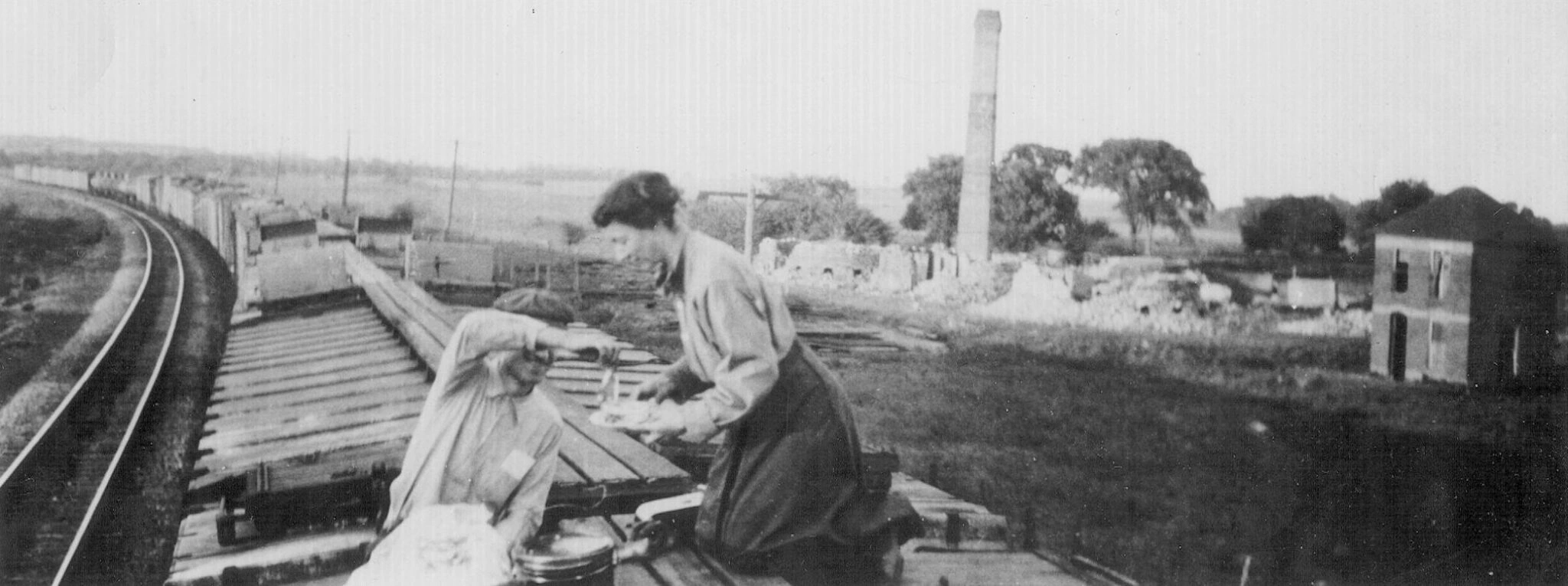
Mary Engle Pennington beside refrigerated railway equipment, circa 1910. Science History Institute; original historical photograph retained. [PENPHOTO]
The railway photograph belongs to that practical setting. An insulated wagon, loading platform and refrigerated store form successive parts of a service. The cold chain means the connected sequence of temperature-controlled handling, storage and transport. A satisfactory reading inside a wagon says little about a warm loading interval unless the time and conditions of that interval are also known.
Pennington’s history concerns organised measurement and logistics as well as a refrigerating machine. Bacterial counts, food condition and recorded temperature helped connect an intervention with an observed result. The photograph is evidence of the setting and people shown; it cannot by itself establish the temperature, product quality or performance of the wagon. The native explanation supplies those distinctions beside the historical image.
Units and terms
= equals
Sources for this account
Mary Engle Pennington: refrigeration from laboratory to railway
United States Food and Drug Administration, Mary Engle Pennington: The Cold Chain of Food Safety; National Inventors Hall of Fame, Mary Engle Pennington. Retained railcar photograph, circa 1910, Science History Institute, image provenance retained from PENPHOTO. Sources checked 22 November 2026.
Michiyo Tsujimura: a research career through green tea
Michiyo Tsujimura moved from school teaching into research when opportunities for women were sharply limited. In 1920 she joined Hokkaido Imperial University as an unpaid assistant and studied silkworm nutrition. A move to Tokyo in 1922 was followed by the destruction of her laboratory in the Great Kanto Earthquake of 1923. She continued at Riken in Umetaro Suzuki’s laboratory. [RC-TSUJIMURA]
Her work with Seitaro Miura identified vitamin C in green tea. In 1929 she isolated catechin, and her thesis on green-tea components earned a doctorate in agriculture in 1932. Ochanomizu University records her as Japan’s first woman to receive that doctorate. She became a professor there in 1949 and later the first dean of its Faculty of Home Economics. Research and the education of later generations both belong to her account.
Tea is a mixture. Leaf particles, dissolved compounds and the water carrying them occupy different roles. A paper filter may retain suspended leaf fragments while dissolved substances pass through. Clearer liquid is therefore not evidence that a single pure compound has been isolated. Catechin names a chemical constituent; green tea names a prepared material containing many constituents.
That elementary separation differs from Tsujimura’s analytical achievement. Colour alone cannot identify catechin or measure vitamin C. Isolation and identification require evidence about the substance itself. Her research moved from describing a familiar drink to investigating its particular components, despite institutional barriers and the physical loss of a laboratory.
Sources for this account
Michiyo Tsujimura: a research career through green tea
Ochanomizu University Library and History Museum, Michiyo Tsujimura, institutional biography and chronology. The prose and chronology differ on tannin dates, so the new account does not assign one disputed isolation date. Sources checked 22 November 2026.
Sibyl M. Rock: making a mass spectrum interpretable
Sibyl M. Rock worked where an instrument’s electrical output had to become a usable chemical result. Her January 1946 Computing Manual treated the analysis of gas and liquid mixtures by mass spectrometry. The report belonged to the Consolidated Engineering Corporation, commonly shortened to CEC. The Science History Institute preserves the historical setting through its collections and oral histories. [RC-ROCK]
Rock also appears among the authors of the 1946 paper A Computer for Solving Linear Simultaneous Equations, with Clifford E. Berry, David E. Wilcox and Harold W. Washburn. The connection matters: mixture analysis can require several contributions to be separated mathematically. Better hardware alone does not decide which combination of substances explains an observed signal.
A mass spectrometer separates ions according to mass-to-charge ratio, written m/z. One substance can produce several ion signals, and different substances can contribute at the same recorded channel. The size of one peak is therefore not automatically the quantity of one ingredient. Interpretation depends on reference behaviour, instrument response and a model appropriate to the sample.
Rock’s contribution is best presented through that work of interpretation, documentation and calculation. The surviving manual is a specific historical object, not a generic symbol of women in science. Later accounts sometimes print her first name as Sybil. This entry follows the spelling Sibyl used in the institutional transcript and reproduced report. The spelling variation is retained in the source notes so a reader can find both catalogue forms.
Sources for this account
Sibyl M. Rock: making a mass spectrum interpretable
Science History Institute oral history of Marvin L. Vestal, 2010; Sibyl M. Rock, Computing Manual: Analysis of Gas and Liquid Mixtures by Means of the Mass Spectrometer, Consolidated Engineering Corporation report MC 25.51d, January 1946; C. E. Berry, D. E. Wilcox, S. M. Rock and H. W. Washburn, A Computer for Solving Linear Simultaneous Equations, Journal of Applied Physics 17 (1946), 262. Manual cover metadata uses Sybil but the reproduced title and institutional history use Sibyl. Sources checked 22 November 2026.
Loney Clinton Gordon: cultures, collaborators and the archive
Loney Clinton Gordon’s work belongs to the Michigan laboratory history of whooping-cough prevention, alongside Pearl Kendrick and Grace Eldering. The Grand Rapids Public Museum places the three women within the research developed during the 1930s and 1940s. Gordon’s contribution involved the bacterial cultures needed by that work. Describing the result as the achievement of one isolated inventor loses the laboratory team. [RC-GORDON]
Her own recollections survive in a 1998 oral-history interview. The Grand Rapids Public Library’s Collection 328 finding aid identifies that recording among research papers, photographs, correspondence and later commemorations. Michigan Public’s 2021 account returns to the recorded interview rather than relying only on a retrospective poster. A person’s voice and the laboratory’s documentary record provide different kinds of evidence.
A bacterial culture has an identity and a history of handling. In laboratory research, the organism, strain, conditions and observation date affect what a result can support. An archival reference to culture work does not supply a safe production protocol or prove that every later vaccine used the same material. The historical account here identifies the contribution without converting it into a household biological procedure.
These records serve different purposes. A collection describes where evidence is preserved; an interview records what a speaker remembered; a research document records the work as it was reported. Agreement between them strengthens a history, while a difference deserves examination. Gordon’s contribution can be followed through her own interview and the records of the laboratory team.
Sources for this account
Loney Clinton Gordon: cultures, collaborators and the archive
Grand Rapids Public Library, Michigan women and the whooping cough vaccine collection, Collection 328, finding aid generated 22 January 2022; Loney Gordon oral-history interview, 1998, accession 1998.041. Grand Rapids Public Museum public-health history account. Michigan Public, 12 February 2021, original reporting incorporating Gordon’s recorded interview. Sources checked 22 November 2026.
Elizabeth M. Hardy: the coauthor behind the Cope rearrangement
Elizabeth M. Hardy appears with Arthur C. Cope on the 1940 paper that reported the rearrangement now commonly called the Cope rearrangement. The published title describes migration of an allyl group in a three-carbon system. Its place in the Journal of the American Chemical Society, volume 62, pages 441-444, gives the historical claim a precise record. [RC-HARDY]
The customary reaction name preserves Cope’s surname but does not reproduce the paper’s complete authorship. Naming Hardy beside the reaction restores that missing connection. JulieA. Olson and Kevin M. Shea’s later historical analysis explicitly examines women who discovered or developed named reactions. That scholarship supports attention to the original author list, rather than attaching a modern portrait to an unsourced story.
Read the illustration’s labels
Hardy and Cope: the six-atom rearrangement
Before
1
2
3
4
5
6
After
Carbon numbers stay with the same atoms.
Red: bond 3–4 is lost. Green: bond 1–6 forms.
Double bonds shift from 1–2 / 5–6 to 2–3 / 4–5.
Simplified 1,5-diene framework; hydrogen atoms omitted. No measured geometry implied.
Original explanatory drawing by Carlos “Charlie” Verbelen, 2026. Read the named parts and scope in the adjacent account.
In the basic 1,5-diene pattern, two carbon-carbon double bonds and the intervening single bonds can reorganise through a six-atom arrangement. The diagram numbers the same six carbon atoms on both sides. The central single bond changes position relative to the two double bonds; the atom identities remain traceable. A molecular formula alone cannot express this change in connectivity.
The drawing is a simplified bond map of the reaction class, not an exact reproduction of every substituted compound in the 1940 experiments. It supplies neither a reaction temperature nor a yield. Those details depend on the actual molecule and reported conditions. This distinction lets the history explain a real chemical idea without presenting a symbolic diagram as a complete synthesis instruction.
Sources for this account
Elizabeth M. Hardy: the coauthor behind the Cope rearrangement
Arthur C. Cope and Elizabeth M. Hardy, The Introduction of Substituted Vinyl Groups. V. A Rearrangement Involving the Migration of an Allyl Group in a Three-Carbon System, Journal of the American Chemical Society 62 (1940), 441-444, DOI 10.1021/ja01859a055. Olson and Shea’s 2011 historical analysis discusses Hardy’s role. Original publication year is 1940, not a later online archive date. Sources checked 22 November 2026.
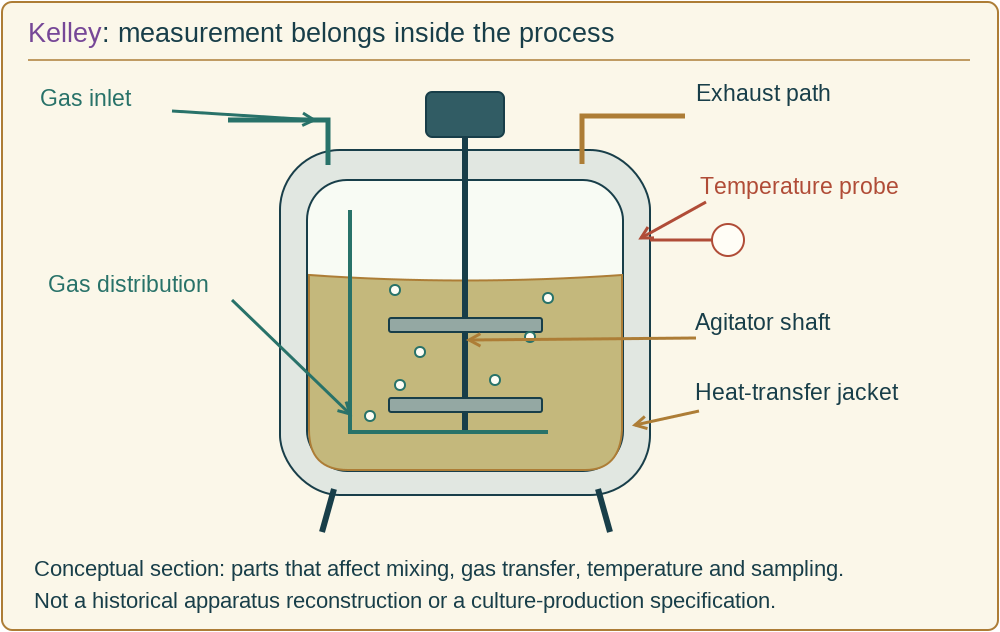
Sinah Estelle Kelley’s research connected analytical chemistry with the behaviour of a working fermentation process. A 1947 United States Department of Agriculture staff profile describes her as an analytical chemist at the Northern Regional Research Laboratory in Peoria and notes her work on penicillin analyses. It also records her move from Picatinny Arsenal to the laboratory’s fermentation division. [RC-KELLEY]
Her publication record extends beyond that wartime product. In 1952 she coauthored a study of itaconic-acid production by Aspergillus terreus in twenty-litre fermentors. A 1959 paper with R. A. Rhodes, A. J. Moyer and Mabel L. Smith examined fumaric-acid production by Rhizopus arrhizus. The institutional affiliations connect the latter work with the Department of Agriculture’s fermentation laboratory in Peoria.
Read the illustration’s labels
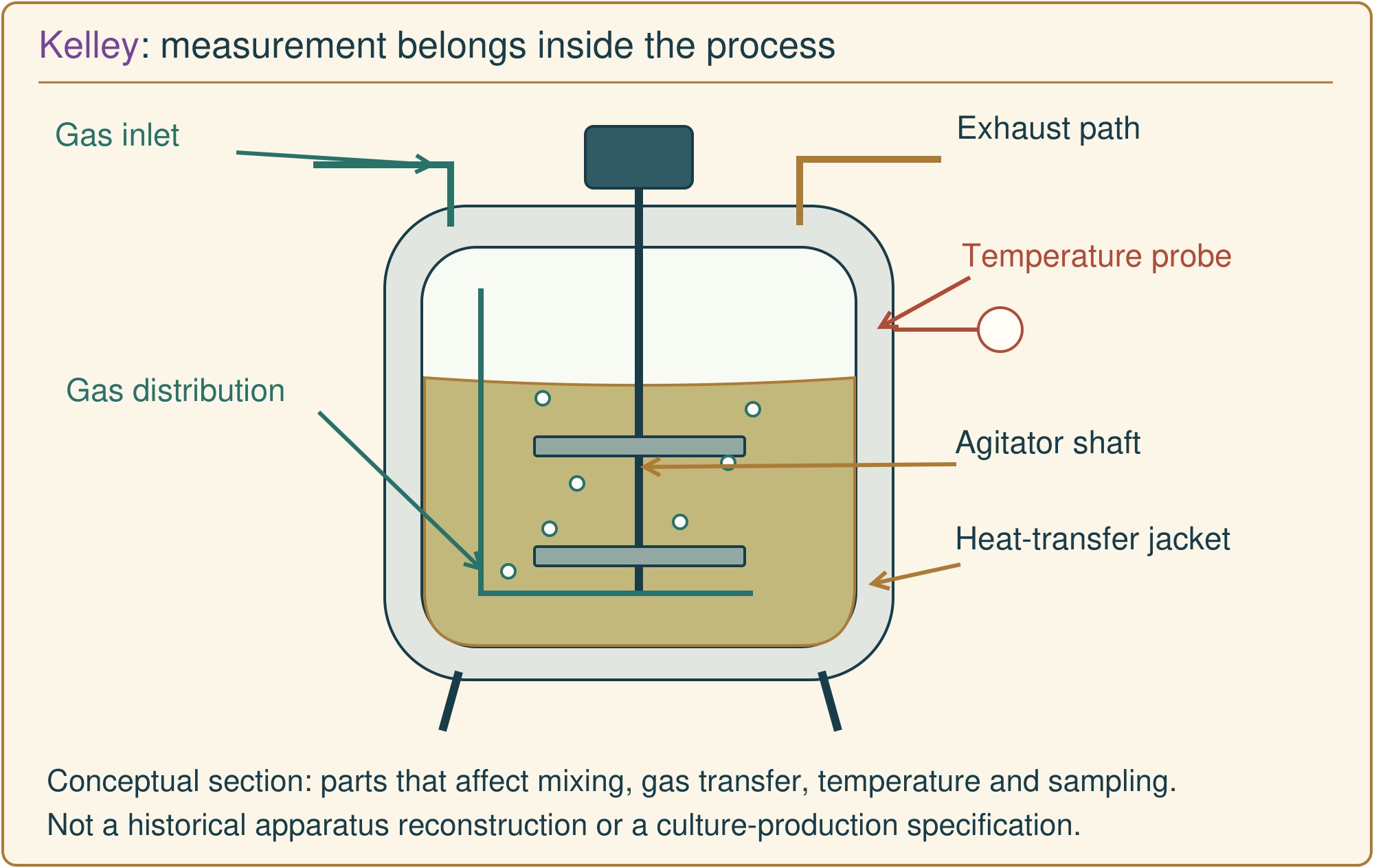
Kelley: measurement belongs inside the process
Gas inlet
Exhaust path
Temperature probe
Gas distribution
Agitator shaft
Heat-transfer jacket
Conceptual section: parts that affect mixing, gas transfer, temperature and sampling.
Not a historical apparatus reconstruction or a culture-production specification.
Original explanatory drawing by Carlos “Charlie” Verbelen, 2026. Read the named parts and scope in the adjacent account.
These studies distinguish a biological organism from the process surrounding it. A named microorganism does not by itself determine the amount of product obtained. Mixing, gas transfer, temperature, nutrient supply and the analytical method all influence how a vessel’s performance is described. The figure therefore names the physical parts involved in control and measurement; it is not a reconstruction of Kelley’s exact apparatus.
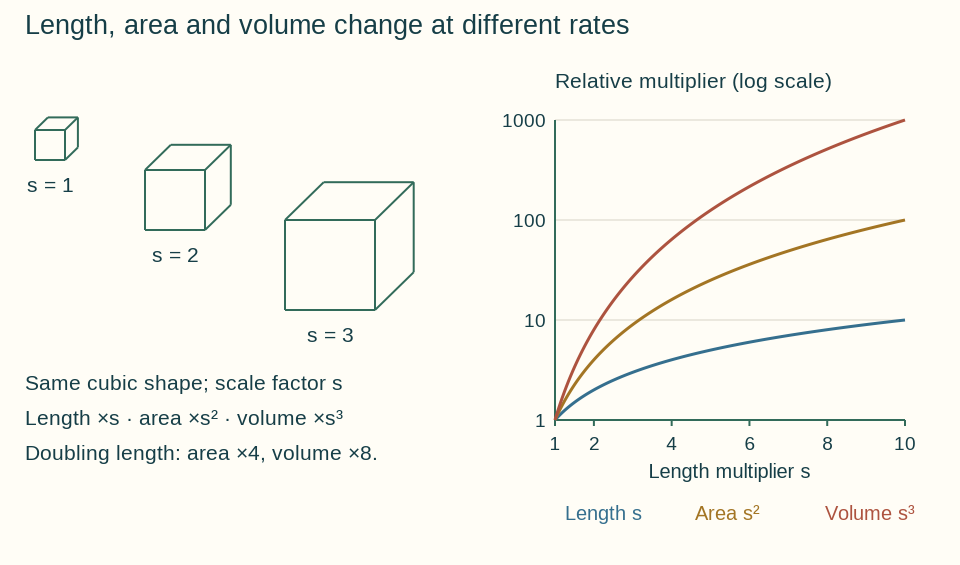
Scaling a process also changes relationships between volume, surface area and the distance over which material or heat must move. A larger vessel is not simply a small flask with more liquid. Kelley’s coauthored papers place measurement inside that practical problem. Their titles establish actual products, organisms and experimental scales, rather than a vague claim that she made all industrial fermentation possible.
USDA staff bulletin, 1947, profile of Sinah E. Kelley at the Northern Regional Research Laboratory; G. E. N. Nelson, D. H. Traufler, S. E. Kelley and L. B. Lockwood, Production of Itaconic Acid by Aspergillus terreus in 20-Liter Fermentors, Industrial & Engineering Chemistry 44 (1952), 1166-1168; R. A. Rhodes, A. J. Moyer, Mabel L. Smith and Sinah E. Kelley, Production of Fumaric Acid by Rhizopus arrhizus, Applied Microbiology 7 (1959), 74-80, DOI 10.1128/am.7.2.74-80.1959. Sources checked 22 November 2026.
Sara Borrell Ruiz: from water analysis to steroid biochemistry
Sara Borrell Ruiz began pharmacy studies in Madrid in 1933 after being unable to enter agricultural engineering. She graduated in 1940 and completed a doctorate in 1944 on analysis of water from the River Tagus, supervised by Román Casares. María Jesús Santesmases’s account draws on a 1995 interview with Borrell and documents retained by her family. [RC-BORRELL]
Research on milk proteins took her to the Hanna Dairy Research Institute in Ayr in 1946-1947, working with Norman C. Wright. In 1949 she obtained a permanent research position at the Spanish National Research Council. Gregorio Marañón invited her into hormone biochemistry when the Institute of Experimental Endocrinology was established in 1950. Further training in Britain and the United States connected the Madrid laboratory with international research.
Borrell later directed a steroid section and became a founding member of the Spanish biochemical society in 1963. Her trajectory links food and water analysis, laboratory training and the measurement of hormones. A steroid is a molecule belonging to a structural family; the word does not identify a single hormone or a single physiological effect.
For a biochemical measurement to be interpreted, the substance, specimen, collection conditions and analytical method must remain connected. A number detached from its unit or specimen loses meaning. The historical account describes a research career, while this measurement principle explains why her specialism needed careful chemical separation and interpretation. It does not offer a diagnosis or a hormone treatment from an isolated result.
Sources for this account
Sara Borrell Ruiz: from water analysis to steroid biochemistry
María Jesús Santesmases, Sara Borrell Ruiz, Spanish Society for Biochemistry and Molecular Biology. Account based on the author’s 1995 interview with Borrell and family records. The new entry does not repeat the page’s erroneous Nobel attribution to Edward Dodds. Sources checked 22 November 2026.
Gao Xiaoxia: electroanalysis, instruments and trace measurements
Gao Xiaoxia graduated from Jiaotong University in 1944, obtained a master’s degree at New York University in 1951 and joined Peking University’s chemistry department that year. The university’s historical account describes her combination of teaching, analytical research and instrument development. She was elected to the Chinese Academy of Sciences in 1980. [RC-GAO]
Her work included electroanalytical chemistry, polarographic catalytic waves and instruments for monitoring atmospheric pollution. Later research used complex adsorption waves to investigate rare-earth elements and their relation to plant physiology. A 1995 paper with QiaoQingdong concerns electrochemical investigation of chlorophyll derivatives. These are specific analytical problems, not a general claim that every small signal reveals an unknown substance.
Read the illustration’s labels
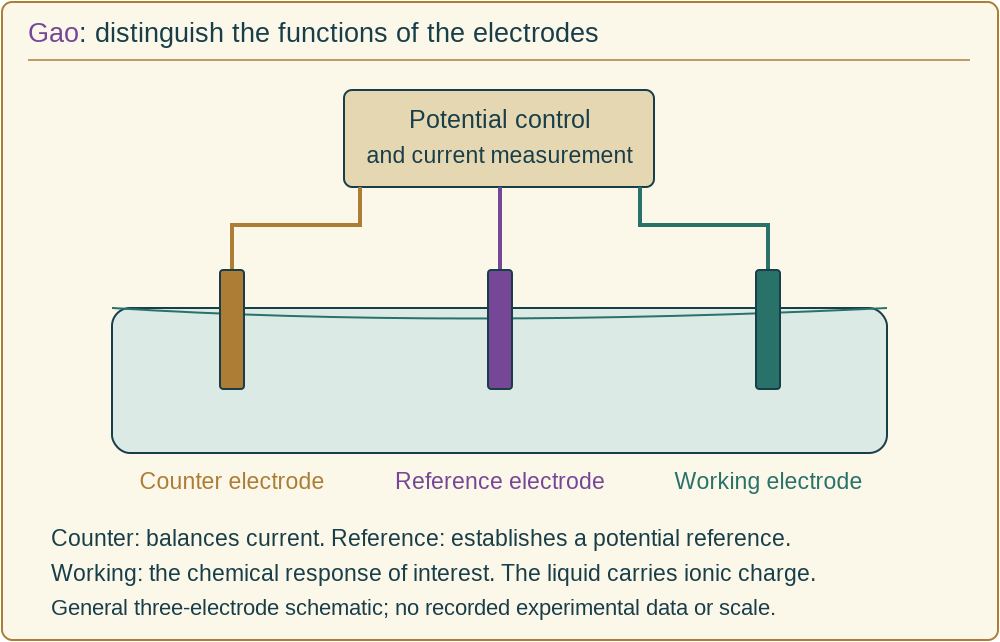
Gao: distinguish the functions of the electrodes
Potential control
and current measurement
Counter electrode
Reference electrode
Working electrode
Counter: balances current. Reference: establishes a potential reference.
Working: the chemical response of interest. The liquid carries ionic charge.
General three-electrode schematic; no recorded experimental data or scale.
Original explanatory drawing by Carlos “Charlie” Verbelen, 2026. Read the named parts and scope in the adjacent account.
Electroanalysis relates an electrical response to a controlled chemical and instrumental setting. In a common three-electrode arrangement, a working electrode is the site of interest, a reference electrode provides a potential reference and a counter electrode carries the balancing current. The diagram distinguishes these functions. It does not claim that every apparatus used by Gao had exactly this form.
A trace measurement must be judged against the response of the background, possible interfering substances and the calibration method. A peak’s presence, position and size answer different questions. The analyst needs evidence that the observed feature is attributable to the proposed constituent. That connection between chemical selectivity and a measurable signal gives the historical research its meaning.
Sources for this account
Gao Xiaoxia: electroanalysis, instruments and trace measurements
Peking University institutional history, 27 November 2019, Gao Xiaoxia. Qiao Qingdong and Gao Xiaoxia, Peking University journal 31 (1995), issue 2, page 205, electrochemical study of chlorophyll derivatives. The illustration is a conceptual electroanalytical cell, not a reconstruction or measured trace from the paper. Sources checked 22 November 2026.
Katheryn E. Lawson: organising the infrared literature
Katheryn E. Lawson’s Infrared Absorption of Inorganic Substances appeared in 1961, published in New York by Reinhold and in London by Chapman & Hall. The two-hundred-page book addressed a practical difficulty: information on inorganic spectra was spread across a growing literature. Its contemporary reception is preserved in G. Ryback’s 1963 review in Mineralogical Magazine. [RC-LAWSON]
Ryback describes a substantial chronological bibliography covering work mainly from 1952-1958, with additions through April 1960, and a section linking spectra with molecular structure. He found useful treatments of simpler molecules but criticised the limited coverage of more complex structures and the effort needed to navigate the references. The review nevertheless recognised the time the book could save someone beginning research. This is a documented reception, including limitations, rather than retrospective praise without evidence.
Read the illustration’s labels
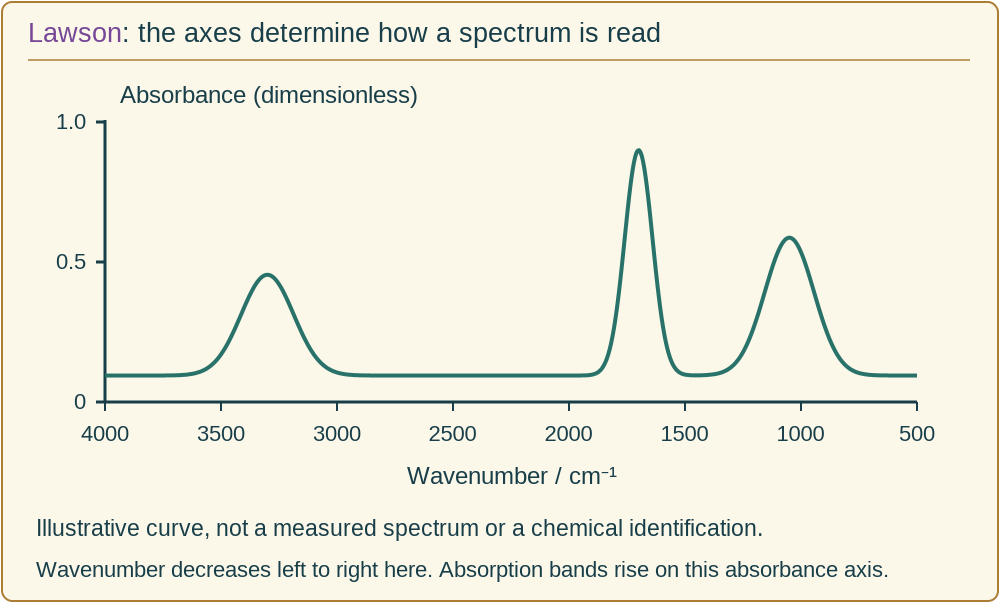
Lawson: the axes determine how a spectrum is read
4000
3500
3000
2500
2000
1500
1000
500
0
0.5
1.0
Absorbance (dimensionless)
Wavenumber / cm⁻¹
Illustrative curve, not a measured spectrum or a chemical identification.
Wavenumber decreases left to right here. Absorption bands rise on this absorbance axis.
Original explanatory drawing by Carlos “Charlie” Verbelen, 2026. Read the named parts and scope in the adjacent account.
Infrared absorption records how a material interacts with radiation across a range of wavelengths or wavenumbers. Wavenumber is commonly expressed in reciprocal centimetres, written cm⁻¹. It increases as wavelength decreases. Absorbance and transmittance are different vertical-axis quantities, so a peak and a dip cannot be compared without reading the axis.
Lawson’s book belongs to the history of organising evidence as well as collecting measurements. An identification based on a spectrum needs the sample conditions, physical state and reference assignment. Similar-looking curves alone are insufficient. The historical author’s middle initial is retained as printed in the contemporary review; an expansion is not invented merely to make a catalogue entry look complete.
Sources for this account
Katheryn E. Lawson: organising the infrared literature
G. Ryback, review of Katheryn E. Lawson, Infrared Absorption of Inorganic Substances, Mineralogical Magazine 33 (1963), 528-529. Book published by Reinhold, New York, and Chapman & Hall, London, 1961, 200 pages. The contemporary review gives the author as Katheryn E.; no uncertain middle-name expansion is supplied. Sources checked 22 November 2026.
Darshan Ranganathan: molecular organisation and an independent career
Darshan Ranganathan completed doctoral research under T. R. Seshadri while teaching chemistry in Delhi. Postdoctoral work with D. H. R. Barton took her to Britain; she returned to India in 1969. The Indian National Science Academy’s memoir, written by SubramaniaRanganathan, records both their scientific collaboration and the obstacles to her obtaining an independent institutional position. [RC-RANGANATHAN]
She worked for years in Kanpur through fellowships and shared laboratory resources, later establishing a bioorganic research laboratory at the Regional Research Laboratory in Trivandrum in 1992. A move to the Indian Institute of Chemical Technology in Hyderabad followed in 1998. Her work included chemical models of biological processes and supramolecular organisation. She became an Academy fellow in 1996.
The memoir is valuable first-person evidence, but its author was also her husband and collaborator. Statements about personal experience and professional barriers are therefore attributed to that record. Its celebratory descriptions are not converted into unsupported rankings. Specific institutions, publications and dates provide the verifiable structure of this account.
Supramolecular chemistry studies organisation through interactions between molecules as well as the covalent bonds within them. Shape, orientation and the placement of interacting groups influence whether molecules associate into a particular arrangement. The placement of interacting groups helps determine which associations are possible. An exact molecular structure requires the original experimental and crystallographic record.
Sources for this account
Darshan Ranganathan: molecular organisation and an independent career
Subramania Ranganathan, Darshan Ranganathan (1941-2001), Biographical Memoirs of Fellows of the Indian National Science Academy 34 (2008), 85-98. A first-person memorial by a spouse and scientific collaborator; recollections and evaluative language are treated as attributed testimony. Sources checked 22 November 2026.
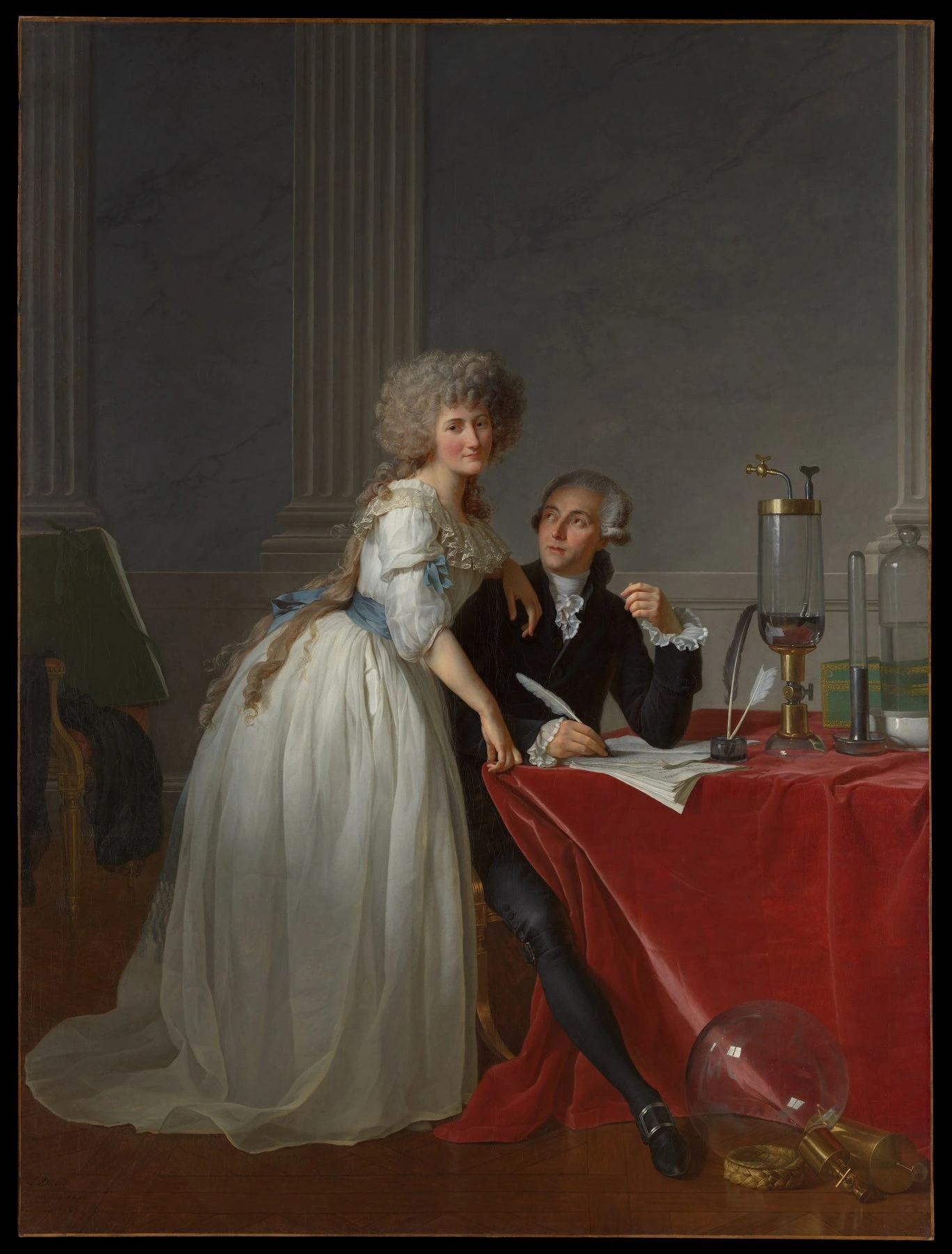
Jacques Louis David, Antoine Laurent Lavoisier and Marie Anne Lavoisier, 1788. Oil on canvas. The Metropolitan Museum of Art, accession 1977.10; purchase, Mr. and Mrs. Charles Wrightsman Gift, in honor of Everett Fahy, 1977. [RC-LAVOISIER]
Marie Anne Lavoisier kept laboratory records and etched illustrations for her husband’s publications. The portrait brings the couple and their scientific apparatus into one setting, although later technical examination found that an earlier version omitted the instruments. This painted representation is evidence of how their work and status were presented, not a record of a single experiment. [RC-LAVOISIER]
Units and terms
mm millimetre, 0.001 metre · × multiplied by · ARS Argentine peso · g gram, 0.001 kilogram
Sources for this account
David’s portrait of the Lavoisiers, 1788
The Metropolitan Museum of Art collection record, accession 1977.10. Artist, sitters, date, medium, credit and technical examination. Checked 23 November 2026.
The following synthetic offers are comparison examples in Argentine pesos, not supplier quotations.
Field
Defined purchase
Part
Water-bench base
Finished size
900 × 600 × 18 mm
Condition
Sound, flat, sealed edges
Price basis
Cut piece plus delivery
Receiving record
Date, seller and condition on arrival
Offer
Parts
Delivery: ARS
Total paid: ARS
A
1 at ARS 12,000
4,000
16,000
B
2 at ARS 10,000
2,000
22,000
A lower advertised unit price can require more cash. Sound leftover stock is recorded separately from waste. At a usable fraction of 0.90, a 900 g requirement needs 1,000 g of input. Two 600 g packs purchase 1,200 g; the 200 g above the requirement remains stock until its actual use or loss is recorded.
Units and terms
mm millimetre, 0.001 metre · × multiplied by · ARS Argentine peso · g gram, 0.001 kilogram
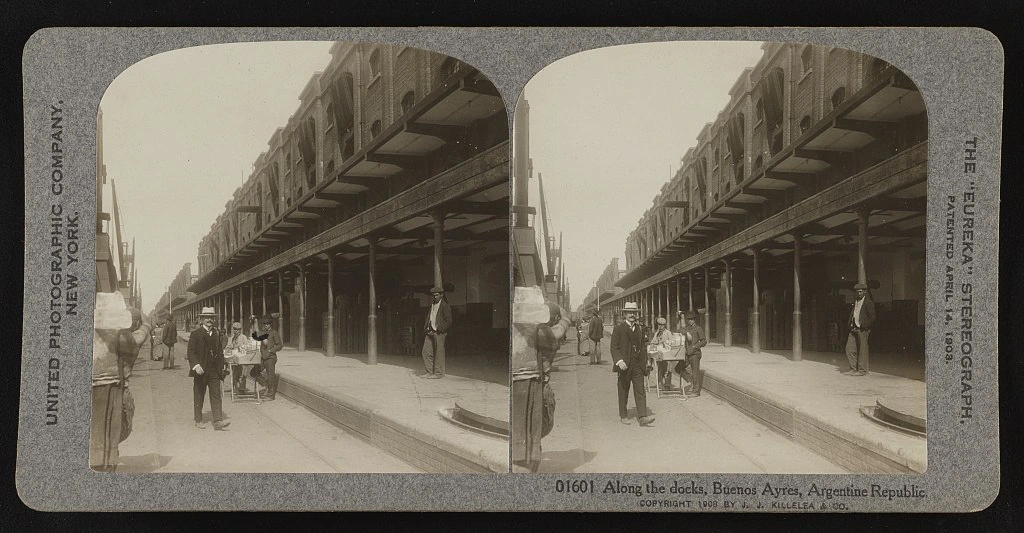
The 1908 stereograph of the Buenos Aires docks is a useful opening document because a material reaches a workshop through a physical chain: cargo, storage, handling, transport and an agreement about what has been delivered. The two nearly identical photographs are the two views of a stereograph. They are not a printing mistake. The collection identifies the publisher as United Photographic Company, but the image alone cannot identify the supplier or quality of an imagined workshop purchase. Historical evidence becomes useful when the question asked of it matches what it actually records.
A purchase specification is a small engineering model. For the water-transfer bench in this chapter it names a 900 by 600 by 18 mm plywood base, a sound face, sealed edges and a maximum one-litre water demonstration. Thickness, flatness, damage and the intended use matter more than a persuasive adjective. Ask whether the quoted price buys a cut piece, an entire panel or a nominal dimension before trimming. Keep delivery, cutting and additional taxes in their own fields. An Argentine quotation remains in Argentine pesos, with its date and seller, rather than being silently translated through an unknown exchange rate.
Units and terms
mm millimetre, 0.001 metre · × multiplied by · ARS Argentine peso · g gram, 0.001 kilogram
mm millimetre, 0.001 metre · g gram, 0.001 kilogram · = equals
Cost assigned to the first job and cash paid today are different quantities. If a second purchased part has a documented next use, it remains stock. Otherwise, the smaller advertised unit price may still require a larger immediate payment.
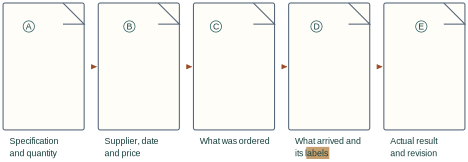
A price becomes comparable only when the material, form, quantity, date and delivery conditions match. The supplied price graphic mixed gemstones, isotopes and hypothetical production costs. The following material-identity table separates those categories; no unverified price is carried into the budget.
Use a common denominator only after choosing the useful output. If 900 g of usable stock is needed and the expected usable fraction is 0.90, the pre-rounded purchase is 900/0.90 = 1,000 g. Adding ten percent to 900 gives 990 g and delivers only 891 g at that yield. The inverse matters. Next apply package rounding: two 600 g packages buy 1,200 g, even though the mathematical requirement was 1,000 g. Report the remaining stock separately from the losses.
United Photographic Company, publisher. Library of Congress, LC‐DIG‐stereo‐1s16929. 1908
Units and terms
mm millimetre, 0.001 metre · g gram, 0.001 kilogram · = equals
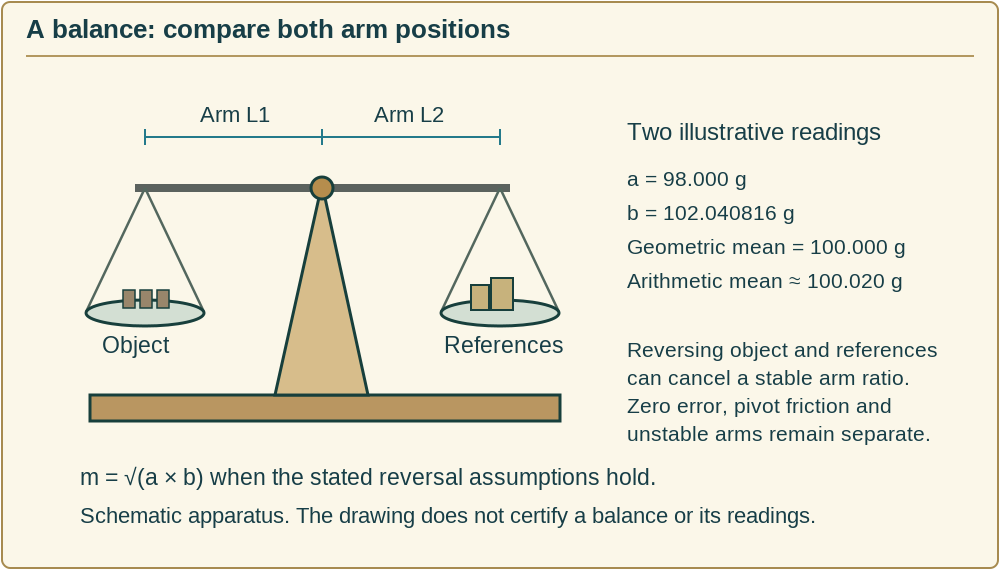
m = √(a × b) when the stated reversal assumptions hold.
Schematic apparatus. The drawing does not certify a balance or its readings.
Measured term
Mass: g
Standard uncertainty: g
Input
200.0
0.5
Receiver
192.0
0.5
Retained
3.0
0.5
Caught spill
4.0
0.5
The unaccounted residual is 200.0 − 192.0 − 3.0 − 4.0 = 1.0 g. This is distinct from the two-reading balance reversal shown above.
Independent net readings: u = sqrt(0.5² + 0.5² + 0.5² + 0.5²) = 1.0 g. With coverage factor 2, U = 2.0 g. Shared tare readings require covariance terms.
All numbers are illustrative inputs. A residual is not automatically evaporation or an identified physical loss.
Units and terms
g gram, 0.001 kilogram · = equals · ≈ approximately equal to · × multiplied by
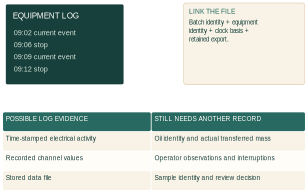
Argentina’s Instituto Nacional de Tecnología Industrial discusses metrological traceability as a chain connecting a measurement result to a reference. The subtle point is that a scale with a familiar label does not automatically make every result trustworthy. The result also depends on the method, the reference used, the conditions and the uncertainty. For this workshop, first state the measurand: the mass of water transferred during one specified pour, excluding the receiving container. That definition prevents a later change of container or timing from quietly changing the question.
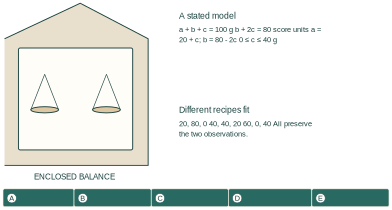
Build the small comparison balance to see an error that a digital display can hide. With unequal beam arms, the same object can balance against two different reference masses when the pans are exchanged. If the readings are a and b under ideal, stable lever conditions, the mass estimate is sqrt(a × b). The arm ratio appears once in the numerator and once in the denominator, so it cancels. With a = 98.000 g and b =
102.040816 g, the geometric mean is 100.000 g. The arithmetic mean is about 100.020 g and does not perform the same cancellation.
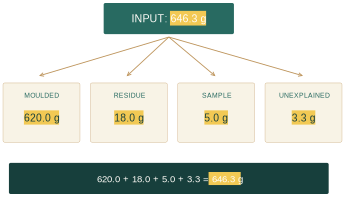
For a transfer trial, define a boundary around the first cup, funnel, receiver and catch tray. Begin with 200.0 g of water. Suppose 192.0 g reaches the receiver, 3.0 g remains on the equipment and 4.0 g is recovered from the tray. The residual is 200.0 - 192.0 - 3.0 - 4.0 = 1.0 g. That residual is an observation about incomplete accounting. Calling it evaporation without measuring or bounding evaporation replaces an unresolved quantity with a story.
If each of these four net masses has an independent standard uncertainty of 0.5 g, the standard uncertainty of the residual is sqrt(4 × 0.5²) = 1.0 g. A stated coverage factor of two gives an expanded uncertainty of 2.0 g. The example therefore does not establish a one-gram physical disappearance. Real tare calculations need more care: using the same empty-container reading in several differences creates correlation. Do not count that common reading as independent each time. The notebook should preserve raw gross and tare readings so the dependence can be reconstructed.
Pour the same starting mass three times, changing only one feature such as the funnel angle. Weigh the retained liquid and the caught spill, record elapsed time and inspect the residual alongside its uncertainty. This is how a simple workshop acquires knowledge that survives beyond one person’s hand movements. The useful discovery may be that a slower pour recovers more material, or that the scale resolution is too coarse to distinguish the proposed improvement. Either conclusion is more informative than forcing every balance to close exactly.
Units and terms
g gram, 0.001 kilogram · = equals · ≈ approximately equal to · × multiplied by
g gram, 0.001 kilogram · = equals · × multiplied by
Separate water, useful solids, waste and recoverable stock
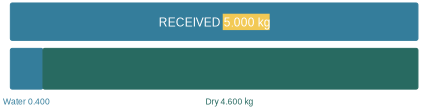
Take a synthetic lot weighing 5.000 kg with a stated water fraction of 0.08 on a wet-mass basis. Its water mass is 0.400 kg and its dry mass is 4.600 kg. If only 90 percent of those dry solids meets the intended specification, usable dry mass is 4.140 kg. Paying ARS 20,700 gives a cost of ARS 5,000 per usable dry kilogram, before transport and labour. The apparent price of ARS4,140 per received kilogram answers a different question. Both figures can be correct while describing different denominators.
A moisture percentage on a dry basis is different again. For the same lot, dry-basis moisture is 0.400/4.600 = 0.0869565, or about 8.70 percent. A number copied without its basis can therefore create an apparent disagreement between two honest records. Write the defining fraction beside the percentage: water divided by received mass, or water divided by dry-solids mass. The interactive calculator keeps those definitions visible rather than treating percent as a self-explanatory unit.
The usable fraction also has a geometry. A 600 by 400 mmcard sheet can contain three 200 mm widths only when the cuts remove negligible material and the edge allowance is zero. A saw kerf of 3 mm changes the required length to 600 + 2 × 3 = 606 mm for three finished 200 mm parts cut in one row. A knife cut in thin card behaves differently from a saw cut in wood. Make a cutting sketch, state the kerf and trimming allowance, and count finished pieces rather than estimating them from total area alone.
Recovered stock needs two ledgers. The physical ledger records received, used, rejected, returned and remaining quantities. The cost ledger records the purchase cash, preparation effort and the amount assigned to each job. An unused sound offcut is stock, while a damaged ffcut can be waste. A zero purchase price for donated card does not imply zero cutting time, zero storage space or zero inspection. This distinction prevents the apparent efficiency of a small demonstration from depending on work that another person performed invisibly.
Finish with a specimen label on each retained offcut: material as known, thickness measured, usable dimensions, date received, source and any unresolved condition. Keep unknowns literal. A workshop can make a provisional choice while acknowledging that a grade is unverified. It cannot recover a missing material property by printing more decimal places in the budget. The long-term value of the ledger is that future builders inherit observations and usable stock instead of an unexplained pile of leftovers.
Units and terms
kg kilogram, a mass unit · = equals · % percent, parts per hundred · ARS Argentine peso · mm millimetre, 0.001 metre · × multiplied by
mm millimetre, 0.001 metre · = equals · × multiplied by
From an impressive label to a closed process balance
The specimen passport
United States · Each field answers a different question. A name or an attractive poster cannot supply a measured composition, a traceable lot or an acceptance result.
Field
What to record
Identity
Name, isotope or nuclear state, and physical form.
Composition
Mass fraction, volume fraction or stated grade.
Lot and quantity
Delivered amount, package size and lot code.
Condition
Damage, moisture, sound dimensions and storage.
Documents
Supplier, date, revision and reference method.
Acceptance
Measured result, uncertainty and decision rule.
A lower-limit example
Limit 199.5 mm; result 199.6 mm with U = 0.3 mm. A conservative classroom rule examines 199.6 - 0.3 = 199.3 mm, which does not reach the limit.
Units and terms
mm millimetre, 0.001 metre · = equals · × multiplied by
mm millimetre, 0.001 metre · = equals · m metre, a length unit · kg kilogram, a mass unit · g gram, 0.001 kilogram · NIST National Institute of Standards and Technology
Technetium-99 and technetium-99m are distinct nuclear states. A pictured block is not an assay or a seller offer.
Units and terms
mm millimetre, 0.001 metre · = equals · m metre, a length unit · kg kilogram, a mass unit · g gram, 0.001 kilogram · NIST National Institute of Standards and Technology
The extraordinary-price poster names technetium-99, actinium-225, californium, tritium, several gemstones and antimatter as though a single price-per-gram column made them directly comparable. It does not. A complete identity can require an isotope, nuclear state, chemical form, concentration, specimen quality and reference date. The United States Environmental Protection Agency distinguishes technetium-99 from technetium-99m: the former has a half-life of roughly 210,000 years in its summary, while the metastable state has a half-life of about six hours. Omitting the small letter m can therefore change the identity in a technically decisive way.
Magnitude suffixes K, M, B and T usually denote thousand, million, billion and trillion in English short-scale financial notation. A dollar sign alone does not identify the currency. An undated promotional figure is not a supplier quotation.
A similar confusion occurs in ordinary workshop buying. A 1 kg package containing a useful component at mass fraction 0.30 provides 0.30 kg of that component before process losses. The phrase “30 percent” is incomplete unless its basis is stated; volume fraction and mass fraction need not agree. For a harmless labelled mixture, 30 g of table salt and 70 g of water give a 100 g mixture with salt mass fraction 0.30. This is arithmetic about composition, not a claim that every substance dissolves at that concentration or that the mixture is suitable for a particular use.
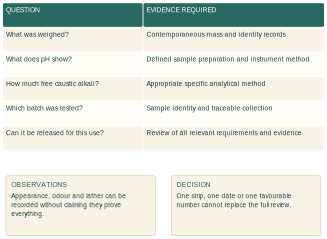
In United States metrology, NIST explains that traceability is a property of a measurement result. A calibration certificate or reference material helps establish a chain of comparison, but the chain must fit the actual quantity and method. A certificate for mass does not certify chemical purity. A purity statement does not establish that a particular delivered piece has the required geometry. A workshop acceptance sheet should therefore separate identity, quantity, condition, dimensional checks and documentary evidence. Passing one category must not silently count as passing all the others.
Units and terms
mm millimetre, 0.001 metre · = equals · m metre, a length unit · kg kilogram, a mass unit · g gram, 0.001 kilogram · NIST National Institute of Standards and Technology
NIST National Institute of Standards and Technology
A class of antiparticles. A calculated production cost is not a retail inventory.
Production method, quantity actually produced and basis of the estimate.
Actinium-225 / technetium-99 / tritium
Isotope identities. Activity, reference time, form and handling conditions affect the record.
Nuclide, activity and date, chemical form, purity and applicable supply conditions.
Californium / plutonium
Element names do not identify the isotope or material composition.
Isotopic composition, form, amount and a documented source.
Diamond / red diamond
Gem value depends on a specific specimen, not merely elemental carbon.
Mass, colour, clarity, cut and the basis and date of valuation.
Painite / grandidierite / serendibite
Mineral names are not evidence of gem quality or a completed sale.
Identification, treatment, dimensions, quality and specimen-specific evidence.
Beryl / benitoite / taaffeite
Mineral or gemstone identity still leaves substantial quality differences.
Independent identification and the exact lot offered.
Endohedral fullerene
A molecular cage containing another species. Identity depends on what is inside.
Molecular identity, composition, purity, amount and actual offer.
A valid purchase record states the quantity being bought, the currency, tax and delivery basis, the quotation date and the required specification. None of these categories has one universal price per gram. The original promotional sheet remains in the supplied archive, outside this clean reading sequence.
Acceptance also depends on measurement uncertainty. A reported dimension can lie above a lower limit while its uncertainty interval extends below it. The agreed decision rule must state how that uncertainty is handled; a bare “pass” must not hide the assumptions. [RD-MATERIAL-IDENTITY]
Units and terms
NIST National Institute of Standards and Technology
Sources for this account
Material identity and traceable comparison
Identity categories reorganise the supplied sheet 065 without adopting its unsupported prices. Element names and atomic numbers: IUPAC periodic table, 4 May 2022. Radioisotope and measurement distinctions retain the chapter’s existing EPA and NIST source records. This comparison adds no market quotation or medical use claim.
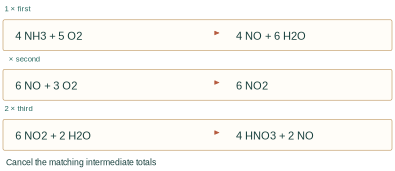
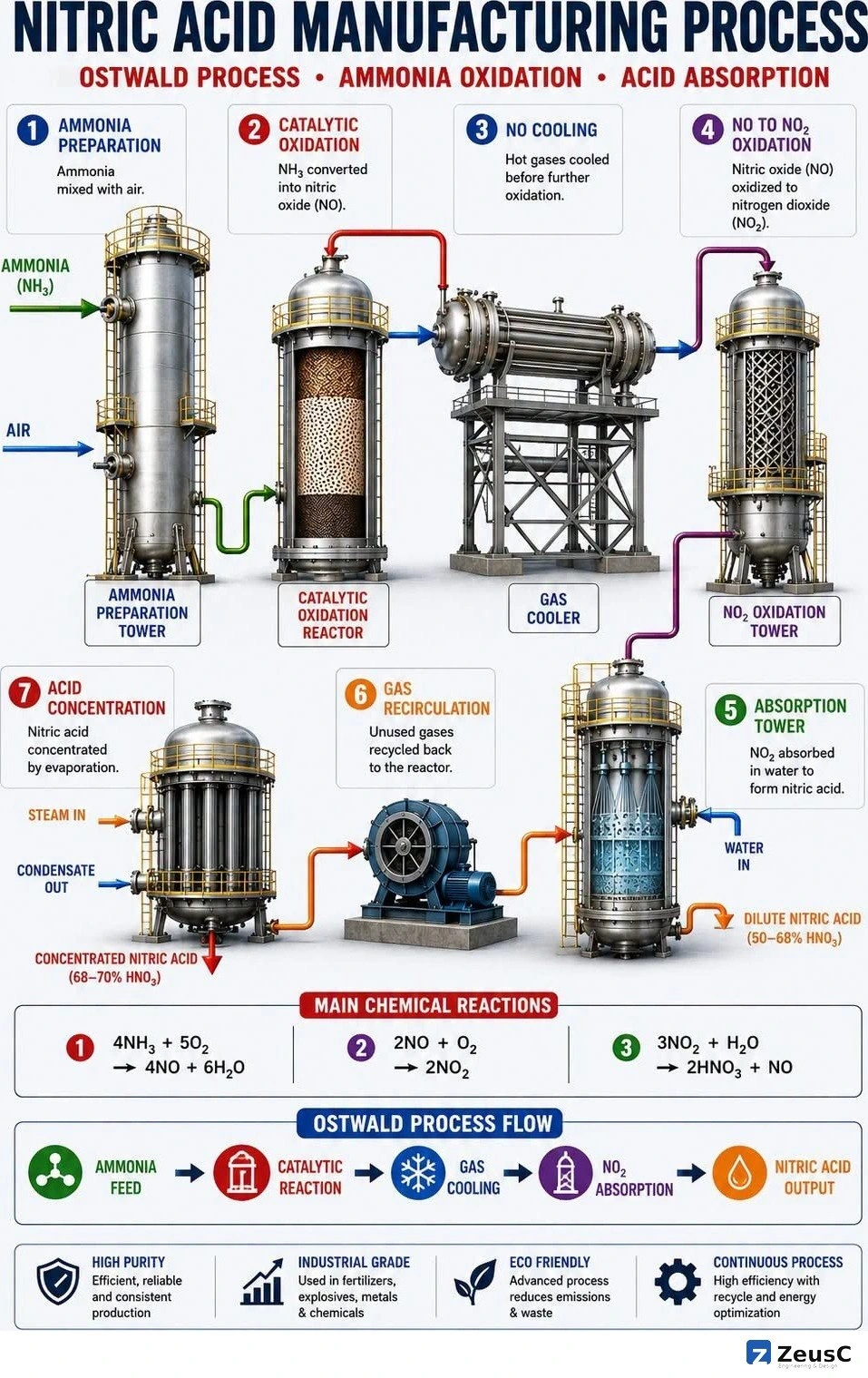
The nitric-acid sheet presents three balanced reactions. The first writes ammonia and oxygen becoming nitrogen monoxide and water: 4 NH3 + 5 O2 yields 4 NO + 6 H2O. The second writes 2 NO + O2 yields 2 NO2. The third writes 3 NO2 + H2O yields 2 HNO3 + NO. These are atom-count statements. They do not specify the machinery, rates, energy transfers or conditions needed to obtain a particular output. Read them first as a conservation problem, using the coloured counters, with the meaning of every colour stated.
An intermediate is produced in one part of a sequence and consumed in another. It can appear in several lines while disappearing from the overall equation. Multiply the first displayed reaction by one, the second by three and the third by two. The intermediate totals then include six NO on each side and six NO2 on each side; cancel them. Two of the six water units produced are consumed in the absorption equation. The remaining result is 4 NH3 + 8 O2 yields 4 HNO3 + 4 H2O, or NH3 + 2 O2 yields HNO3 + H2O after division by four.
H = 1, N = 14 and O = 16 g/mol are rounded teaching values. No reactor settings or chemical mixing are implied.
Use deliberately rounded teaching atomic masses H = 1, N = 14 and O = 16 g per mole of atoms. One mole of ammonia then represents 17 g, two moles of oxygen 64 g, one mole of nitric acid 63 g and one mole of water18 g. The mass check is 17 + 64 = 63 + 18 = 81 g. The exact values used in analytical work require a stated convention and composition; these rounded values make the bookkeeping transparent. A mole is an amount of substance containing the specified number of entities, not a synonym for a gram.
Units and terms
H2O Water · × multiplied by · NO Nitrogen monoxide, also called nitric oxide
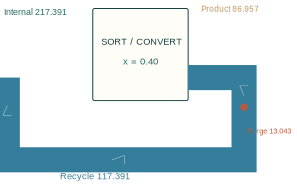
A recycle arrow can hide the largest flow in the workshop
A recycle loop looks like a small addition to a drawing, but it can make internal throughput much larger than the fresh material entering from outside. Consider a synthetic sorting process with one kind of useful token. On each pass, a fraction x becomes acceptable product. Of the unconverted remainder, a fraction p is removed as a purge and the rest returns to the inlet. The separator is assumed ideal and the process has reached steady operation. These are declared model assumptions, not measured properties of a nitric-acid plant.
Let F be fresh input per time interval and I the total input to the sorting operation, including recycle. The returning stream is (1 - p)(1 - x)I. The inlet equation is I = F + (1 - p)(1 - x)I, so I = F/[1 - (1 - p)(1 - x)].
Widths are proportional to the calculated stream rates. Recycle is internal flow, not a new source of material.
Product is xI and purge is p(1 - x)I. At steady state, product plus purge must equal F. The internal returning stream does not create new material, even though it can be larger than the fresh input.
With F = 100 units per interval, x = 0.40 and p = 0.10, I is approximately 217.391. Product is 86.957, purge is 13.043 and recycle is 117.391. The external balance closes at 100, while the internal equipment sees more than twice the fresh input. A conveyor, sorter or collecting pocket sized only for the 100 fresh units would misrepresent the job. This is why the arrows in the explanatory plate have widths proportional to the calculated stream values and why the interactive tool reports both external recovery and internal throughput.
A closed loop is not automatically an efficient loop. Reducing purge can improve recovery of the useful component, but other components may accumulate. If an unwanted inert component enters with the fresh feed, does not become product and leaves only in a purge, the rate at which it leaves must eventually match its rate of entry. A loop with no outlet for that component cannot possess the assumed steady inventory. The exact component balance depends on the real separation, so the teaching calculation does not invent a universal purge setting.
Start-up is another hidden term. Before steady operation, some input fills pockets, wets surfaces or increases the amount waiting in the loop. Over a measured interval the correct external statement is input minus output equals change of inventory. The dry board makes that visible: leave tokens in the return pocket and count them at the beginning and end. If the total rises from 20 to 35 mass tokens, with each token defined as 5 g, accumulation is 75 g. It is retained stock during that interval, not automatically lost material.
Run three rounds with the same input and a written separation rule. Count each pocket before and after the round, and retain a cumulative ledger. Compare the transient rounds with the steady-state calculation only when their inventories stop changing. The lesson is a general one for rebuilding systems: a process drawing must say what crosses the boundary, what circulates inside it and what changes with time. An elegant circular arrow can otherwise conceal storage, delay, congestion or a component with no exit.
The measured vessel and the language of transformation
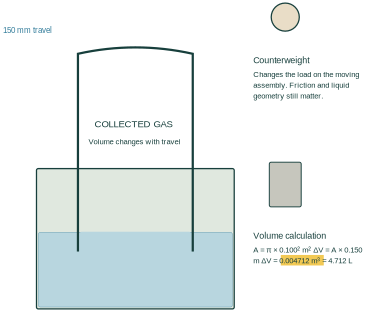
A moving boundary makes volume visible
Synthetic cylindrical collector / not dimensions taken from the 1789 plate
Collected gas
Volume changes with travel
Model diameter 200 mm
150 mm travel
Counterweight
Changes the load on the moving assembly. Friction and liquid geometry still matter.
Volume calculation
A = π × 0.100² m² ΔV = A × 0.150 m ΔV = 0.004712 m³ = 4.712 L
Record temperature, pressure and whether water vapour is included. The apparatus image is historical evidence; this is a declared ideal geometry.
Units and terms
mm millimetre, 0.001 metre · m metre, a length unit · m³ cubic metre, a volume unit · L litre, a volume unit · m² square metre, an area unit · = equals · × multiplied by
Read the apparatus that made an invisible stream countable
The cross-section is schematic. The liquid seal and moving bell are shown to explain the accounting boundary.
A catalyst changes the path and the clock, not the final balance
Choose a material for a stated fluid and a stated duty
European Union
Read the apparatus that made an invisible stream countable
Synthetic cylindrical collector / not dimensions taken from the 1789 plate
A moving boundary makes volume visible
Read the illustration’s labels
COLLECTED GAS
Volume changes with travel
150 mm travel
Counterweight
Changes the load on the moving
assembly. Friction and liquid
geometry still matter.
Volume calculation
A = π × 0.100² m² ΔV = A × 0.150
m ΔV = 0.004712 m³ = 4.712 L
In the drawing: COLLECTED GAS; Volume changes with travel; 150 mm travel; Counterweight; Changes the load on the moving assembly. Friction and liquid geometry still matter.; Volume calculation; A = π × 0.100² m² ΔV = A × 0.150 m ΔV = 0.004712 m³ = 4.712 L
Units and terms
mm millimetre, 0.001 metre · m metre, a length unit · m³ cubic metre, a volume unit · L litre, a volume unit · m² square metre, an area unit · = equals · × multiplied by
mm millimetre, 0.001 metre · m³ cubic metre, a volume unit · L litre, a volume unit · m² square metre, an area unit · = equals · × multiplied by · m metre, a length unit
Read the apparatus that made an invisible stream countable
Model diameter 200 mm
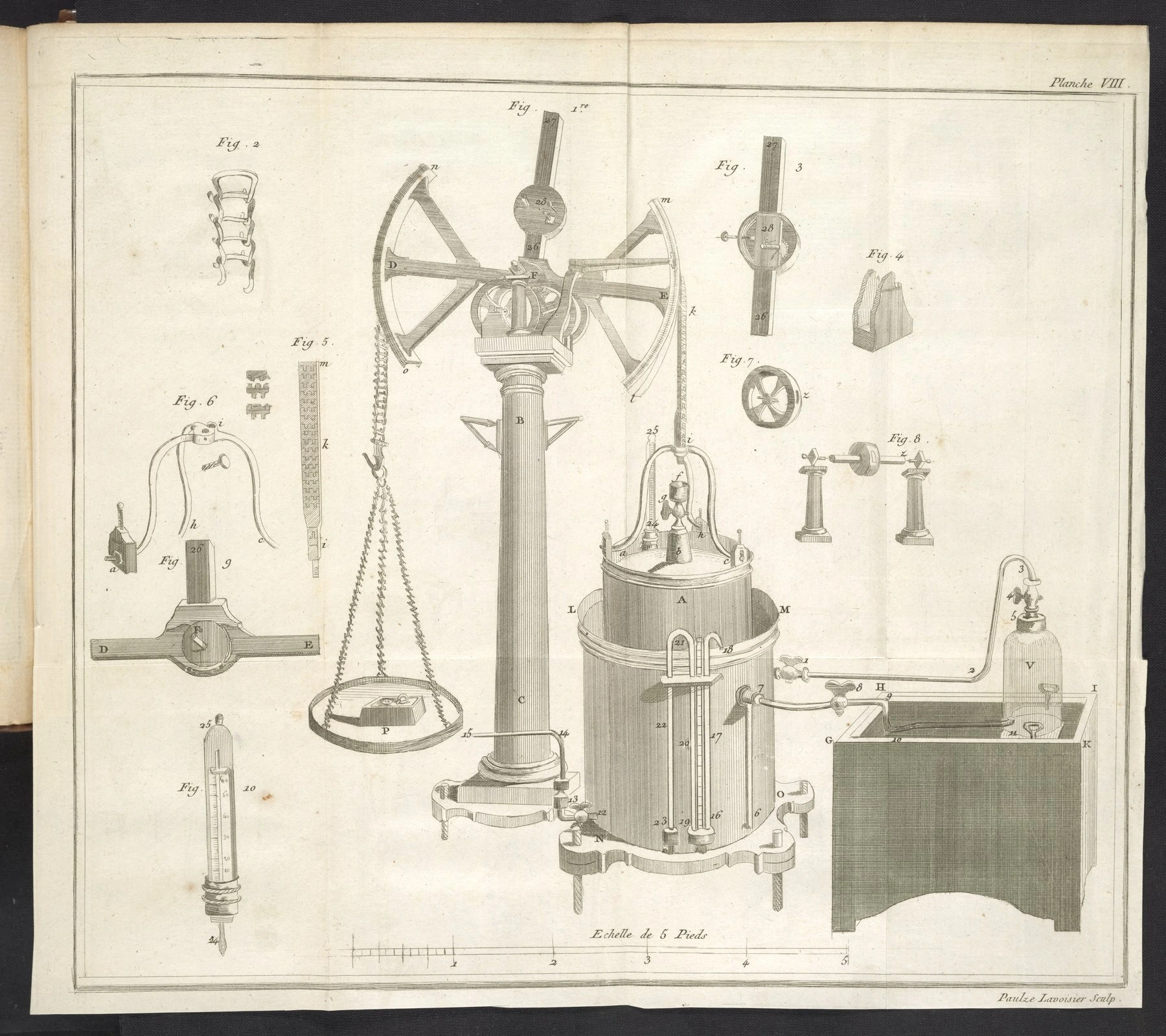
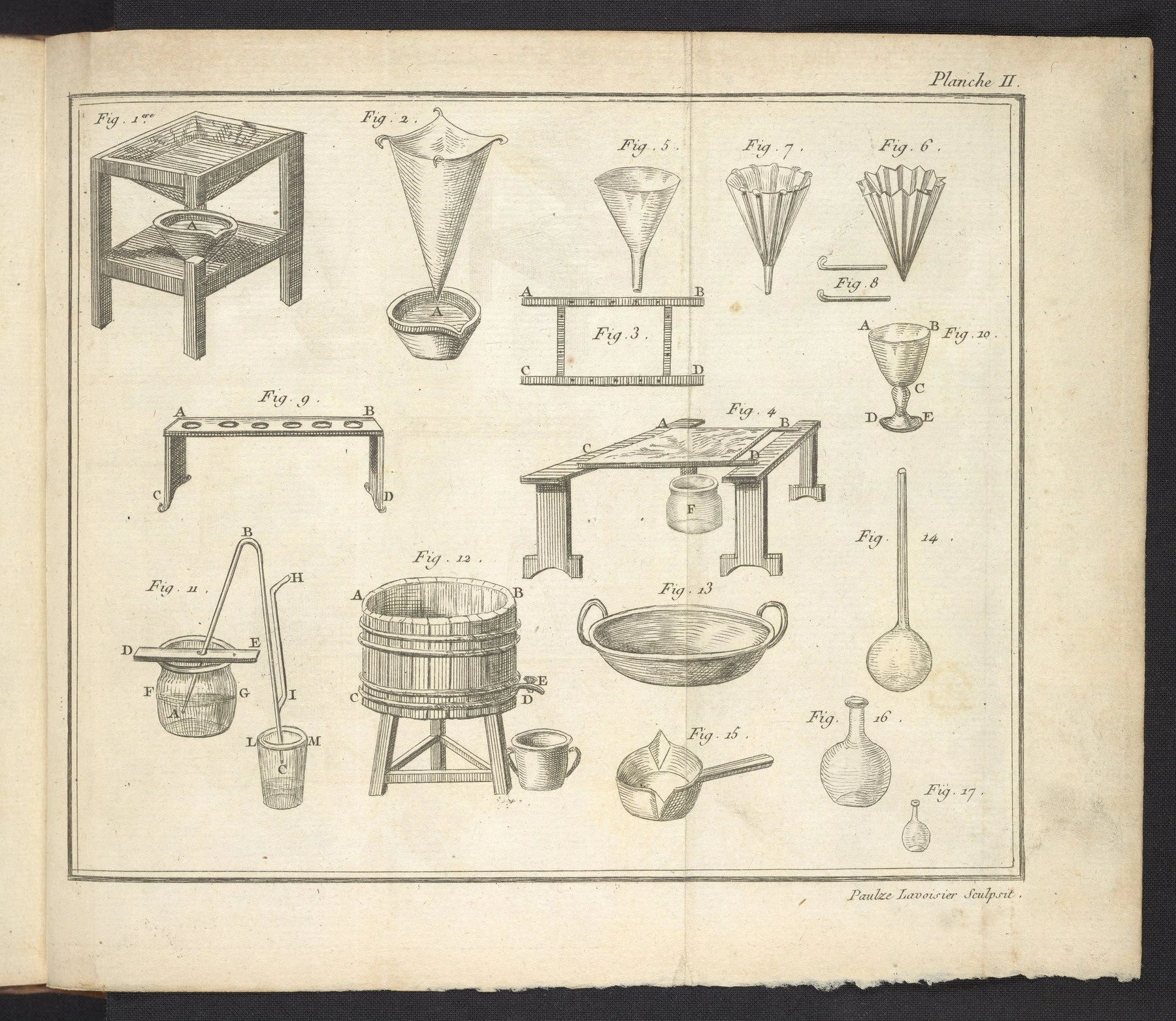
The 1789 apparatus plates in Lavoisier’s Traité Élémentaire de Chimie are working historical evidence. Science History Institute credits the copperplate engravings to Marie Anne Pierrette Paulze Lavoisier. In the eighth plate, the large apparatus combines a vessel, supporting structure, chains, wheels and a counterweight arrangement. The drawing makes relationships visible that a portrait or a reaction equation cannot show. Read the letters, separate views and mechanical connections before treating the apparatus as a decorative symbol of scientific progress.
A gas collector poses a bookkeeping problem: material can cross a boundary without leaving a visible pile on the bench. A movable bell in a liquid seal turns part of that invisible change into displacement. In an ideal cylindrical teaching model, volume change equals cross-sectional area multiplied by vertical travel. A diameter of 200 mm and a travel of 150 mm give π × 0.100² × 0.150 cubic metres, approximately 4.712 litres. These are invented model dimensions. They are not measurements taken from the eighteenth-century engraving, whose scale and construction must be studied independently.
The counterweight is not merely ornament. It changes the mechanical load carried by the moving assembly, and therefore can affect the pressure needed to displace it. Friction, an uneven suspension and the changing liquid geometry can complicate that relationship.
Gas volume also carries conditions. A reading must identify temperature, pressure and whether water vapour is included. The same amount of gas can occupy different volumes under different conditions, so volume alone is not a complete material inventory. In the book’s dry accounting model, keep an explicit condition field even when no gas is collected. In the open water-transfer experiment, use mass readings directly rather than converting a casually observed volume into a supposedly exact mass.
The old picture also helps correct a misleading history of invention. It is tempting to say that one famous chemist invented the practice of weighing. Yet the 1652 Norton engraving reproduced later in this reader already depicts a balance. The historical question is how measurements were organised, compared, interpreted and made persuasive in a particular research programme. The gasometer plate, the publication that explains it and the recorded experimental quantities are distinct kinds of evidence. None should be substituted for the others.
David’s 1788 double portrait provides another kind of evidence: the public representation of Antoine Laurent and Marie Anne Lavoisier alongside scientific apparatus. It names two people whose contributions should not be merged into a single anonymous laboratory. In this chapter, keep three credits separate: the author of the treatise, the engraver of its apparatus plates and the painter of the portrait. A technically rich book owes its reader that same separation of authorship, measurement and interpretation.
Units and terms
mm millimetre, 0.001 metre · m³ cubic metre, a volume unit · L litre, a volume unit · m² square metre, an area unit · = equals · × multiplied by · m metre, a length unit
A catalyst changes the path and the clock, not the final balance
Marie Anne Pierrette Paulze Lavoisier, engraver. Antoine Laurent Lavoisier, Traité Élémentaire de Chimie, plate VIII. Courtesy of Science History Institute. 1789
A catalyst changes the path and the clock, not the final balance
Read the illustration’s labels
0.0
0.2
0.4
0.6
0.8
1.0
Reaction coordinate, not elapsed time
0
20
40
60
80
Relative energy / arbitrary units
A changed pathway with the same endpoints
Schematic direct route
Schematic alternative route
10
30
50
Elapsed time / minutes
100
Normalised conversion / percent
Separate first-order rate model: 1 − exp(−kt)
k = 0.05 per minute
k = 0.20 per minute
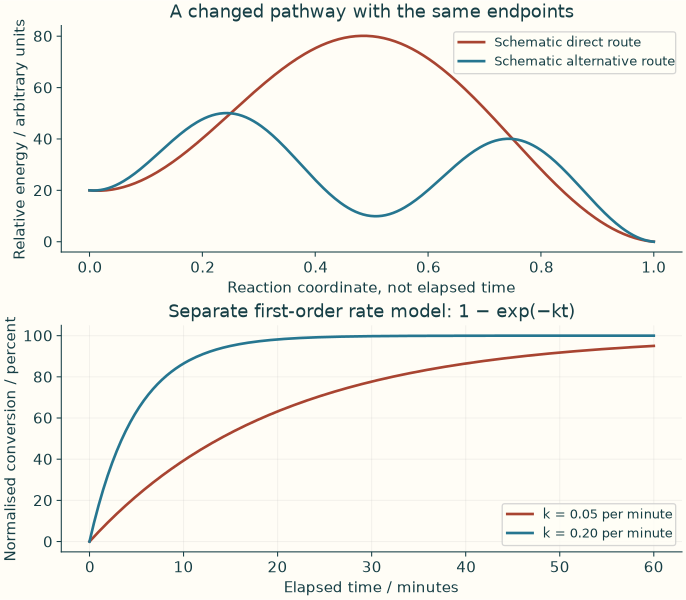
Wilhelm Ostwald’s 1909 Nobel lecture connects catalysis with the rate of chemical change and examines the possible role of intermediate reactions. The process poster compresses reaction, heat transfer, gas handling and absorption into a sequence of vessels. To understand the catalytic idea, separate the chemical route from the rate at which a system moves along it, and separate both from the engineering equipment that maintains the required conditions.
The explanatory energy diagram uses a schematic reaction coordinate. Its horizontal axis is neither distance down a pipe nor elapsed time. Its vertical axis represents a relative energy-like quantity for comparing paths. Two routes begin and end at the same stated levels, while the route with a catalyst has a lower highest barrier in this simplified picture. The alternative route can include intermediate states. The diagram is a teaching sketch of the idea, not a computed molecular pathway for ammonia oxidation.
The separate rate plot uses the ideal first-order relation 1 − exp(−kt). Reaching 90% conversion takes ln(10)/k: about 11.51 minutes at k = 0.20 per minute and 46.05 minutes at k = 0.05 per minute. These are model parameters and calculated times, not measurements of an industrial process.
Units and terms
= equals
% percent, parts per hundred · = equals
A catalyst changes the path and the clock, not the final balance
Choose a material for a stated fluid and a stated duty
A catalyst is regenerated over the overall catalytic cycle, so it does not appear as a net consumed reagent in the ideal overall equation. That statement does not mean an actual catalyst lasts forever. Real material can be deactivated, contaminated, damaged or physically lost, and the plant must account for those changes. Nor does a catalyst, by itself, change the thermodynamic equilibrium of a closed system under unchanged conditions. It affects the approach to that equilibrium. Product removal or a changed temperature is a separate intervention.
Use a declared mathematical model to see the time distinction. Let a normalised progress variable approach its limiting value according to q(t) = 1 - exp(-kt). This is a single-parameter illustrative law, not measured nitric-acid kinetics. With k = 0.05 per minute, reaching 90 percent takes -ln(0.10)/0.05, approximately 46.05 minutes. With k = 0.20 per minute, it takes 11.51 minutes. Both curves approach the same limit. The fourfold change in the rate parameter divides that model’s time-to-target by four without creating a larger limiting amount.
A workshop can learn the analogous distinction between capacity and speed through the open transfer bench. A wider funnel may reduce the transfer time while leaving the final recovered mass unchanged. Another arrangement may reduce the retained liquid while taking longer. Measure both quantities and choose the criterion that belongs to the task. “Faster” and “more complete” are different claims. The cost model should also retain cleaning time and reset time, because a rapid individual pour may not produce a faster sequence of repeatable trials.
Return to the historical source with a sharper question: what could the author explain about a change in rate, and which assumptions made the comparison meaningful? The esoteric vocabulary of older chemical traditions often grouped operations and transformations in ways that do not map one-to-one onto modern mechanisms. Studying that vocabulary is worthwhile, but a modern kinetic curve should not be presented as the hidden numerical content of an old emblem. The comparison becomes interesting when the different kinds of explanation remain legible.
Choose a material for a stated fluid and a stated duty
Choose a material for a stated fluid and a stated duty
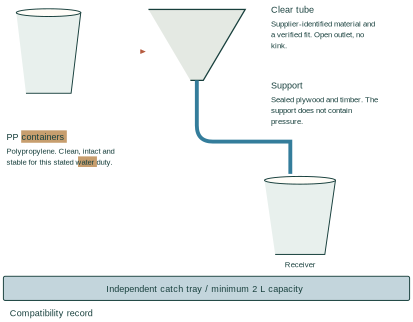
The fluid defines the duty
Room-temperature open water / no pressure / at most one litre per transfer
Funnel
Read the illustration’s labels
PP containers
Polypropylene. Clean, intact and
stable for this stated water duty.
Clear tube
Supplier-identified material and
a verified fit. Open outlet, no
kink.
Support
Sealed plywood and timber. The
support does not contain
pressure.
Receiver
Independent catch tray / minimum 2 L capacity
Compatibility record
Feed jug
In the drawing: Receiver; PP containers; Polypropylene. Clean, intact and stable for this stated water duty.; Clear tube; Supplier-identified material and a verified fit. Open outlet, no kink.; Support; Sealed plywood and timber. The support does not contain pressure.; Independent catch tray / minimum 2 L capacity; Compatibility record
Fluid + concentration + temperature + pressure + load + joints + cleaning. A generic material name cannot supply the missing conditions.
A rebuilding workshop is often offered a seductive list of universal materials: glass because it is inert, stainless steel because it is strong, or plastic because it is cheap. Each description leaves out the conditions that determine whether the choice works. Temperature, pressure, stress, concentration, exposure time, joints, cleaning and contamination can matter as much as the material’s generic name. The lesson’s open water bench has a deliberately limited duty: room-temperature water, atmospheric pressure, small containers and a maximum one-litre transfer. That duty can be specified and inspected.
Glass, steel and powered fans are not required by this open-water measurement. Other duties require their own design.
Units and terms
= equals
PP Polypropylene, the plastic specified for the room-temperature open-water containers · L litre, a volume unit
SDS Safety data sheet in purchasing; sodium dodecyl sulfate in protein separation · EPA Environmental Protection Agency, United States · mm millimetre, 0.001 metre
Choose a material for a stated fluid and a stated duty
For this duty, the proposed containers are intact, clean polypropylene jugs or bowls with stable bases. The short clear tube must be identified by its supplier as suitable for the intended room-temperature water use and must fit the actual funnel outlet. The plywood supports the apparatus; it does not form a pressure boundary. It is sealed against incidental splashes and dried afterwards. No heating element, pressure vessel, powered fan or glass process column is needed to answer the measurement question. Adding impressive components would change the cost without improving that experiment.
A safety data sheet, abbreviated SDS in purchasing, organises information about a substance or mixture. The European framework uses sixteen sections. For a material-compatibility investigation, a useful reading route links identification and composition with physical properties, stability and reactivity, handling, exposure controls and disposal. The actual sheet must match the actual product and revision. A generic substance sheet cannot establish the additives in an unidentified mixture. In later laboratory chapters, SDS can also mean sodium dodecyl sulfate, so the expansion must travel with the context.
The poster’s concentration stage offers a particularly useful source-reading problem. A pair of percentages beside an evaporator does not establish what separation is possible. Vapour and liquid compositions depend on the mixture and conditions, and some systems form an azeotrope, a composition at which ordinary boiling does not provide the hoped-for enrichment. The EPA’s historical nitric-acid description distinguishes weak-acid production from high-strength production. A workshop should therefore treat the poster’s neat evaporator icon as an incomplete process claim, rather than stretching the room-temperature water demonstration into an acid-manufacturing plan.
Write an acceptance matrix with the intended fluid in the first row, then temperature, pressure, load, permitted contamination, joint type and cleaning method. For each proposed component, record the supplier evidence and the inspection that can actually be performed. A clear plastic tube and a stainless steel tube are not interchangeable merely because their internal diameters match. For the water rig, direct visibility can be an advantage; for another duty, a different property may dominate. The matrix explains the decision instead of turning a material name into a promise.
The larger dry display is a separate build with a separate bill. Its 1,200 by 800 mm plywood panel lies flat on a supported table and carries removable labels and counters. It is not a miniature pressure plant and it does not need chemical-resistant pipework to teach a boundary balance. Keeping the dry board and the wet tray separate gives each a clear purpose, reduces ambiguous demonstrations and lets a reader replace a locally unavailable material without losing the method.
Units and terms
SDS Safety data sheet in purchasing; sodium dodecyl sulfate in protein separation · EPA Environmental Protection Agency, United States · mm millimetre, 0.001 metre
Read the secret language, then test the reconstruction
Marie Anne Pierrette Paulze Lavoisier, engraver. Antoine Laurent Lavoisier, Traité Élémentaire de Chimie, plate II. Courtesy of Science History Institute. 1789
Why the alchemist’s three principles are not three modern ingredients
Two observations do not reveal three ingredients
A modern inverse problem beside the historical debate about chymical principles
Read the illustration’s labels
A stated model
a + b + c = 100 g b + 2c = 80 score units a =
20 + c; b = 80 - 2c 0 ≤ c ≤ 40 g
Different recipes fit
20, 80, 0 40, 40, 20 60, 0, 40 All preserve
the two observations.
ENCLOSED BALANCE
A
B
C
D
E
Key
Small-print annotation
A
c / g
B
a / g
C
b / g
D
Total / g
E
Score
A third independent measurement can resolve the model. Repeating twice the total mass adds no independent information.
The 1652 engraving associated with Thomas Norton’s Ordinall of Alchimy places an enclosed balance inside a highly organised scene of people, apparatus, inscriptions and ornament. Science History Institute identifies it as a seventeenth-century print after a fifteenth-century illuminated manuscript. Those dates name different stages in the image’s history. The scene is therefore not a photograph of a 1652 workshop, and its composition cannot be assigned to every practitioner called an alchemist. Study the particular object before borrowing its authority.
The enclosure around the balance, the working figures below and the signs on the front of the central table invite different questions. Some details concern apparatus and craft; others concern social order, allegory or the organisation of knowledge. The new analytical drawing isolates the balance enclosure and the relation between observation and interpretation. It does not pretend to decipher every banner. A responsible transcription preserves an uncertain letter as uncertain and distinguishes a visible mark from a modern explanation placed beside it.
The balance enclosure is a new analytical illustration. The algebra is a modern teaching analogy, not a decoded ancient recipe.
Units and terms
g gram, 0.001 kilogram · = equals · ≤ less than or equal to
Robert Boyle’s 1661 Sceptical Chymist provides a more demanding route into the historical argument. In its dialogue, the familiar chymical principles called sulphur, mercury and salt are debated alongside other accounts of matter. Those terms do not automatically mean three bottles of the modern substances with those names. They could be used in discussions of combustible, volatile or fixed products and properties, while different writers disagreed about their scope. Boyle’s objections ask whether products obtained by an operation must have existed as separable ingredients in the original body. The procedure itself may help produce the observed products.
A modern inverse problem asks which underlying material states could produce the observations. Different compositions can give the same small set of measured outputs. An additional independent observation may distinguish them; a repeated measurement of the same constraint does not necessarily add that information. The measurement process and its assumptions determine what can be inferred.
Esoteric study becomes substantial when it attends to this difficulty rather than promising an effortless universal key. A symbol can carry a learned convention, a practical instruction, an analogy or several meanings at once. Its historical context and the operations described around it constrain interpretation. Read Norton’s image, Boyle’s dialogue and a modern balance as three connected but distinct documents. The productive question is how each makes a transformation knowable, and what evidence would force a reader to revise an attractive interpretation.
Make a transcription ledger with five columns: an unchanged image of the mark; its location in the document; the neighbouring words; a proposed reading with a source; and the unresolved alternatives. Keep a clipped label exactly as clipped, rather than silently completing it. If two drawings differ by a stroke or a dot, record both forms before deciding they are equivalent. This method recovers the craft of reading technical manuscripts while making the limits of the interpretation visible to the next reader.
Thomas Norton / Elias Ashmole / Robert Vaughan, Theatrum Chemicum Britannicum. Courtesy of Science History Institute. 1652, after a fifteenth‐century manuscript
Supplied by the author in ZeusC_ZEVSC_Photos-1-007.zip, image p7_005. The ZEVSC mark and screenshot labels are preserved. Underlying symbol compiler and image creator have not been identified. The labels include truncated filenames. They do not authenticate a particular manuscript usage. Compare forms against a source-specific scholarly catalogue and preserve uncertainty where the name is incomplete. This sheet is a research object, not a chemical recipe.
A larger model needs a new design, not just a magnification
Read the illustration’s labels
Length, area and volume change at different rates
s = 1
s = 2
s = 3
Same cubic shape; scale factor s
Length ×s · area ×s² · volume ×s³
Doubling length: area ×4, volume ×8.
1
10
100
1000
2
4
6
8
Length multiplier s
Relative multiplier (log scale)
Length s
Area s²
Volume s³
These are geometric multipliers for the same cubic shape. A tenfold length increase produces 100-fold surface area and 1,000-fold volume. A larger working surface is not automatically a scaled chemical plant; heat transfer, support loads and process performance require their own models.
A larger model needs a new design, not just a magnification
Thomas Major’s 1755 engraving after David Teniers II shows a working alchemical interior with a hearth, bellows, vessels, books and several workers. It is rich evidence for how a workshop was represented, but its perspective does not supply a cutting list or a ventilation calculation. In the same way, a polished modern picture of a tower and a fan cannot specify a functioning installation. When moving from a teaching model to a larger object, begin with the function that must be retained and identify which physical relationships actually scale.
For geometrically similar objects, multiplying every length by a factor s multiplies area by s² and volume by s³. A tenfold enlargement has one hundred times the area and one thousand times the volume. Its area-to-volume ratio is one tenth of the original. Heat transfer, surface wetting, structural load and working clearances therefore cannot all be inferred from the small object’s appearance. The diagram uses
dimensioned cubes and a cutaway tray to make these different exponents visible rather than hiding them in a slogan.
A one-litre open water demonstration scaled tenfold in every dimension would geometrically enclose one thousand litres, not ten. That change would transform the support load and consequences of a spill. It is not a sensible way to obtain a classroom bench that adults can use.
The proposed support uses an 18 mm plywood base, two 40 by 30 mmtimber rails beneath it, a 40 by 30 mm upright and two 12 mm plywood triangular gussets. The water contacts polypropylene containers, a funnel and a short transparent tube chosen for room-temperature water. The tube is open to atmosphere and is not an invitation to connect a pump or compressed gas. There is no need for a powered fan, a glass column or stainless process pipe to answer the stated transfer question. Material selection follows duty rather than the visual vocabulary of a factory.
To cost the larger versions, list cut parts, purchased stock, fasteners, containers, labels, finishing materials and shared tools separately. The supplied regional figures are planning allowances, with actual local quotations entered in the interactive bill. Preserve unused stock in the ledger. A meaningful full-size model is one that can be assembled, inspected, reset and understood by another reader. Its achievement is the fidelity of the physical lesson, not a misleading resemblance to hazardous industrial equipment.
Leave a ledger that another workshop can challenge
A process record becomes historical evidence the moment another person must use it without the original demonstrator present. Give it the context that is so often missing from an old label: who made the observation, what was measured, the material or specimen identity, the instrument, the units, the time interval and the revision of the drawing. Include both the favourable result and the observation that failed to fit. A record polished until every residual disappears cannot reveal the weaknesses of the method.
Begin the physical ledger with opening stock, add received material, subtract used and rejected quantities, then compare the calculated closing stock with a count or measurement. With 1,200 g received, 900 g used and 80 g rejected, the expected remaining stock is 220 g. If the actual count gives 205 g, the 15 g difference remains an unresolved discrepancy until investigated. Do not hide it by changing the opening quantity.
Marking it visibly allows the next person to examine packaging residue, an unrecorded sample or a transcription error.
The cost ledger answers a separate set of questions. Record cash paid, material assigned to the job, reusable stock, labour, delivery and additional taxes. If a 1,200 g purchase costs 6.00 in a stated currency, the nominal purchased-material rate is 0.005 per gram. Assigning 900 g to the job gives 4.50 of material consumption at that rate, while the cash paid remains 6.00. Waste and recoverable stock must be classified before claiming a saving. Keep Argentina’s ARS, the United States’ USD and the Spain example’s EUR in separate columns without an invented exchange rate.
The transfer record includes a prediction before the trial, raw gross and tare readings, the calculated net masses, elapsed time, the residual and the uncertainty assumptions. The browser tool can export these quantities, but a saved number is not self-explanatory. Name the data file and keep the legend with it. If a scale reading was copied after changing containers, record that event. If the trial was abandoned because the support moved, keep the failed trial as an inspection result rather than reporting only the successful repeat.
Close the source ledger with three levels of assertion. First, what is directly present in the supplied object, such as the Happyloop and ZeusC marks or a printed formula. Second, what an identified collection or primary technical reference supports. Third, what the new chapter calculates or proposes as a synthetic teaching design. These categories can sit beside one another on the same page, but they must not borrow one another’s certainty. The credited historical images remain available in full, and the new diagrams state their assumptions.
The handover package is complete when another reader can open the chapter, locate the original image, rebuild the teaching apparatus from the counted list, repeat the measurements and identify the next unresolved question. Dry the containers, count the 74 small-kit counters, return the labels to their folders and export the notebook before changing device. The deeper knowledge here is reproducible judgement: knowing which observation would change the conclusion, and leaving enough of the work visible for someone else to perform that test.
Units and terms
g gram, 0.001 kilogram · = equals · × multiplied by · ARS Argentine peso · USD United States dollar · EUR Euro
ARS Argentine peso · USD United States dollar · EUR Euro · g gram, 0.001 kilogram
United Photographic Company, publisher. Library of Congress, LC‐DIG‐stereo‐1s16929.
Library of Congress: no known restrictions on publication.
The full stereograph is retained. Its two views are the original stereo pair, not an accidental duplicate. It records a port scene, not the provenance of a particular workshop purchase.
Antoine Laurent and Marie Anne Lavoisier
Units and terms
ARS Argentine peso · USD United States dollar · EUR Euro · g gram, 0.001 kilogram
Jacques Louis David. The Metropolitan Museum of Art, object 436106.
The painting includes both Lavoisiers. Marie Anne Pierrette Paulze is separately credited as engraver of the 1789 apparatus plates. This portrait is not a photograph of an experiment.
Supports, funnels and laboratory vessels / plate II
The full folding plate is preserved. The new 200 mm diameter example is a synthetic teaching geometry, not a dimension read from this historical instrument.
Thomas Major, engraver, after David Teniers II. Courtesy of Science History Institute.
An engraved workshop scene, not a measured installation drawing. The hearth, bellows, vessels, books and workers can be compared without inventing a universal symbolic code.
The current comparison table separates isotope identity, gemstone quality and molecular composition. It does not treat undated promotional prices as project costs.
User-supplied ZeusC archive, sheet 068. Original marks preserved.
The three displayed atom-balance equations are checked in the reader. The illustrated equipment, recycle route, concentration labels and environmental badges do not constitute a verified plant design or emissions record. Original marks and labels are preserved.
Supplied by the author in ZeusC_ZEVSC_Photos-1-007.zip, image p7_005. The ZEVSC mark and screenshot labels are preserved. Underlying symbol compiler and image creator have not been identified.
User-supplied reference. Underlying publication rights have not been verified.
Argentina · United States · European Union · Wider world
Learn to recover a laboratory record, read a separating method, trace a patent and build dry models whose parts, costs and limits another reader can inspect.
Title artwork interprets Luis Federico Leloir and the craft of recording evidence. It is contemporary illustration, not an archival portrait.
Every object has an identity, a place and a record
1 Incoming item: retain its received label. 2 Notebook: observation and interpretation get separate fields.
Read the illustration’s labels
ID
A-001
Origin · date · revision
Raw record kept separately
In the drawing: ID ID ID; A-001; Origin · date · revision; Raw record kept separately
3 Measured dimensions, instrument and units. 4 Backup away from the working bench.
Modern teaching arrangement, not a reconstruction of Leloir’s original laboratory.
In Buenos Aires, the beginning of a laboratory could be a converted house rather than a purpose-built scientific palace. The institute later named for Luis Federico Leloir opened in Palermo on 3 November 1947. Jaime Campomar’s support gave a research group a place and a measure of continuity. Leloir’s autobiography also recalls the financial vulnerability that followed Campomar’s death in 1957. The history is not a fable in which determination makes resources unnecessary. It is a record of people keeping a difficult sequence of work alive.
A notebook makes that sequence visible. Imagine a workshop inheriting three unmarked bottles, a photograph of purple bands and a conclusion written on a loose slip. Almost everything needed to test the conclusion has gone missing. A recoverable record would identify the sample, the preparation, the comparison material, the instrument and the raw observation. It would keep the rejected result too, with a dated explanation. The useful unit of knowledge is therefore larger than the final picture.
Begin the record at the door. Give an arriving item an accession identifier, meaning a unique entry in the collection. For this lesson, A-001 means the first teaching object, not a biological sample. Record who supplied it, when it arrived, its dimensions, the label as received and the place where the original is kept. Attach a separate interpretation field. This prevents a later correction from silently changing the evidence itself.
The Argentine comparison starts with repairable infrastructure: a clean writing surface, legible labels, dry storage, a ruler whose zero is intact, and a second copy of the record away from the bench. A larger laboratory adds specialised services and trained staff. These layers do different jobs. Building the first layer well does not automatically qualify a room for biological research, but it does prevent many avoidable losses of knowledge.
Units and terms
kDa Kilodalton, a molecular-mass unit · = equals · ≈ approximately equal to
Milstein and the difference between a band and an identity
Luis Federico Leloir: autobiography
Fundación Instituto Leloir: seventy‐five years
Milstein and the difference between a band and an identity
Read the illustration’s labels
Immunoglobulin G: four chains and two binding sites
Binding site
Light chain
About 25 kDa
Heavy chain
About 50 kDa
Disulfide bond
Flexible hinge
Two identical heavy chains + two identical light chains ≈ 150 kDa.
kDa = kilodalton. Domain arrangement is schematic, not a molecular scale.
Immunoglobulin G (IgG) has two heavy and two light polypeptide chains. Heavy chains are about 50 kilodaltons (kDa) each and light chains about 25 kDa each; the intact molecule is about 150 kDa. Disulfide bonds link the chains. These are approximate molecular masses, not a diagnostic identification rule. [RB-IGG]
César Milstein’s route began in Bahía Blanca and crossed between Argentina and Cambridge. His work with Georges Köhler on monoclonal antibodies belongs to the history recognised by the 1984 Nobel Prize in Physiology or Medicine, shared with Niels Jerne. The word monoclonal matters: it refers to antibodies derived from one clone. It does not mean that every dark mark in a protein image has become a uniquely identified molecule.
A separating method and an identifying method answer different questions. A denaturing protein gel can suggest the apparent size of material in a band. Two different proteins may migrate to nearly the same position. A single protein may also behave unexpectedly because of its chemistry or preparation. A neat band is therefore an observation that needs context, not a name tag attached by nature.
Under reducing, denaturing separation conditions, interchain disulfide bonds can be broken and separated chains can migrate as different bands. A band’s apparent molecular mass depends on the method and molecule. Its position alone does not establish molecular identity.
Units and terms
kDa Kilodalton, a molecular-mass unit · = equals · ≈ approximately equal to
Sources for this account
Structure of an immunoglobulin G molecule
Janeway and colleagues, Immunobiology, section 3-1, The structure of a typical antibody molecule. Two identical heavy chains and two identical light chains are linked by disulfide bonds; approximate masses are 50 and 25 kDa, respectively. The original editorial diagram shows the relationship schematically. It is not a molecular scale model or a clinical test. Access checked 22 November 2026.
Read the apparatus from the wells down. The cathode is the negative electrode in this electrolytic arrangement; the anode is positive. The sample wells lie near the upper part of the vertical gel. The stacking region concentrates material before it enters the resolving region. Neither region turns an unknown sample into a complete molecular inventory. A band can contain more than one component, and weak material may remain below the detection limit.
The label kDa means kilodalton, a unit of molecular mass equal to one thousand daltons. Relative molecular mass itself is dimensionless. The common laboratory phrase molecular weight can blur this distinction. Write the numerical value and the stated unit together, and describe a gel-derived result as apparent molecular mass when that is what the method supports.
The ZeusC mark is preserved. Another visible mark reads BIOLOGY FOUNDATION; the underlying illustrator, publication date and reuse licence have not yet been established. That uncertainty belongs to the image’s provenance, not to a guess printed as a credit. The full supplied sheet remains in the gallery while the new large diagram separates the teaching labels into readable parts.
Follow the sources
Bio-Rad: protein standards and molecular-mass estimation
U. K. Laemmli: cleavage of structural proteins during bacteriophage T4 assembly, 1970
SDS: Sodium dodecyl sulfate, an anionic detergent used in the illustrated separation method.
PAGE: Polyacrylamide gel electrophoresis.
DTT: Dithiothreitol, a reducing agent that can break disulfide connections under suitable conditions.
Units and terms
kDa Kilodalton, a molecular-mass unit · SDS Sodium dodecyl sulfate, a detergent used in protein separation
Greenberg’s 1955 drawing: read the document in layers
The command path and the return path
A dry control game with declared thresholds
Read the illustration’s labels
Reference
Compare
Actuator
Object
Sensor
A
B
C
D
E
Key
Small-print annotation
A
18 / 22 °C
B
keep state inside
C
on / off
D
model value
E
what is displayed
One step at a time
Read sensor
Apply thresholds
Keep or change state
Apply model change
Record the round
Below 18: on. Above 22: off. At the thresholds switch as specified. Between them retain the previous state. A faulty sensor can conceal a changing object.
Temperatures and increments are invented game values, not biological or equipment settings.
Walter Bradford Cannon’s The Wisdom of the Body appeared in 1932. Its place in the history of homeostasis invites a practical question: what has to happen for a changing system to remain within useful bounds? The word homeostasis concerns regulated internal conditions. It does not mean that every quantity stays perfectly constant or that a single thermostat represents an organism.
For a workshop, begin with a deliberately simpler system. A sensor reports a measured temperature; a reference gives the desired value; a controller compares them; an actuator changes heat input. The object being controlled also exchanges heat with its surroundings. A drawing that omits the surroundings can make an inadequate heater appear adequate, because the missing loss never enters the account.
Now introduce a fault card: the displayed temperature stops changing while the real object continues warming. A controller that trusts that signal blindly can continue asking for heat. Ask what independent observation, cut-off or operator action would reveal the fault. A second copy of the same failed assumption is not independent protection. The point is to trace the consequence of a failure through the whole path.
The first build uses cards and counters, with no heater or powered fluid circuit. One person plays the sensor, another the controller and another the environment. The roles make delay, bias and disagreement visible. Keep a round-by-round log rather than relying on a memory of whether the system seemed stable. This modest game is useful precisely because its assumptions can be inspected.
Follow the sources
The Wisdom of the Body: contemporary bibliographic review
Actuator: A component that changes the controlled system in response to a command.
Greenberg’s 1955 drawing: read the document in layers
Read the illustration’s labels
Chamber
Thermal loop
Circulation
Exchange
Filtration
Addition
Measurement
Record
A
Key
Small-print annotation
A
Function to verify
Emanuel M. Greenberg filed the application for an Artificial uterus on 22 July 1954. US patent 2,723,660 was published on 15 November 1955. The supplied ZeusC image reproduces figure 1 from the first drawing sheet. It is a schematic proposal within a larger document, not a photograph of a successful experiment.
Read a proposed system without claiming it works
Eight teaching nodes, three kinds of connection
Blue: material relation. Green: signal relation. Rust: evidence question. Grouped reading map, not clinical plumbing.
The drawing names a thermostat, water heater, blood pumps, an artificial kidney and a liquid-food supply. The specification also describes a water-jacket circuit and separate pathways intended for the biological system. These labels reveal intended functions. They do not provide a validated operating envelope, clinical outcome or present-day manufacturing specification. A patent can be historically revealing without proving that its depicted machine was successfully used.
Read the sheet in three passes. First trace each line without interpreting it, marking junctions and uncertain crossings. Second collect the numbered references and find their descriptions in the written specification. Third ask what evidence would be required to test the claimed function. Keep those three passes separate so that a plausible explanation does not conceal a missing connection.
A useful document table has columns for label, stated function, required input, expected output, observable failure and supporting evidence. The word thermostat, for example, describes a control role. It does not specify sensor placement, delay, alarm behaviour or how a fault is detected. These are questions for an engineering record. They cannot be resolved by enlarging the word on the page.
From an animal study to a claim that survives scrutiny
Emanuel M. Greenberg: US patent 2,723,660
From an animal study to a claim that survives scrutiny
What kind of evidence is actually available?
Four distinct records; advancement requires new work
Read the illustration’s labels
PROPOSAL
1955 patent
Intended functions and claims
BENCH MODEL
This book’s dry display
Geometry, labels and a reading method
ANIMAL STUDY
2017 lamb paper
Reported animal outcomes under study conditions
HUMAN EVIDENCE
A separate question
Needs its own dated study and context
A
B
C
D
Key
Small-print annotation
A
Operating success is not established
B
No biological function is tested
C
Human outcomes do not follow automatically
D
No clinical approval is asserted here
A dramatic illustration does not move a claim from one evidence category to another.
In 2017, Emily Partridge and colleagues reported an extra-uterine system supporting extremely premature lambs for up to four weeks. The primary paper describes a controlled research setting and animal outcomes. It does not establish that a human can be gestated from conception in a machine. The distinction is essential when an arresting picture travels farther than its caption.
A 2023 meeting of the US Food and Drug Administration considered development plans, safety, effectiveness and ethical questions for artificial-womb technologies. FDA means Food and Drug Administration. The meeting is a dated part of the record, not a statement that any particular system is approved today. The chapter preserves the date rather than turning a historical discussion into a current regulatory claim.
Build an evidence ladder with four rungs: proposal, bench demonstration, animal study and human clinical evidence. The rungs describe different kinds of support; they are not an automatic conveyor belt. A well-made demonstration may fail at the next question. Moving a card upwards requires new evidence appropriate to that question, not a more impressive illustration.
The same discipline applies far from medicine. A water collector tested in one rainstorm does not establish its annual yield. A cardboard model demonstrates fit and geometry, not the strength of a steel frame. A thermostat game exposes logic, not the reliability of a manufactured controller. Write the tested scale and conditions beside every result. This keeps a successful small experiment useful without asking it to prove more than it measured.
Units and terms
US United States
US United States · FDA Food and Drug Administration, the United States regulatory agency named in the dated source
Tiselius, moving boundaries and the history of separation
Two ways to make separation visible
Moving boundaries and stained gel bands have different observation chains
Read the illustration’s labels
MOVING BOUNDARY
GEL IMAGE
A
B
C
D
E
F
G
H
Key
Small-print annotation
A
R
B
A
C
B
D
C
E
D
F
E
G
Observe a solution boundary
H
Measure a recorded band image
Simplified comparison of observations, not a measured reconstruction of Tiselius’s apparatus.
Arne Tiselius’s 1948 Nobel lecture treats electrophoresis and adsorption as ways to investigate large molecules. His moving-boundary approach made differences within protein mixtures observable through their behaviour in an electric field. The historical apparatus and a modern slab-gel picture belong to a developing family of methods, but they are not the same instrument.
A boundary is an interface whose movement can be observed. In a moving-boundary experiment, the optical arrangement helps reveal changes within a solution. In a gel image, the reader sees separated stained regions after a different sequence of operations. The visual resemblance of lines and bands should not erase the difference between the two records.
U. K. Laemmli’s 1970 paper on bacteriophage T4 structural proteins is associated with a widely used discontinuous gel system. Discontinuous means that the chemical and physical conditions change between regions. The useful historical insight is cumulative: one inventor does not stand alone behind every component of a familiar method. Apparatus, buffer systems, stains, standards and image analysis have distinct histories.
The European section begins with Sweden and the scientific record; the rest of the region is not treated as a single interchangeable workshop. Paper sizes, supplier packaging and local availability still belong in the cost sheet. A shared equation can travel readily while the material route to its use changes from place to place.
Follow the sources
Arne Tiselius: Nobel lecture, 13 December 1948
U. K. Laemmli: cleavage of structural proteins during bacteriophage T4 assembly, 1970
A ruler gives distance. It does not directly give molecular mass. A calibration connects distance to standards under stated conditions. In a common working range for denaturing protein gels, the logarithm of apparent mass is approximately related to relative migration. Relative migration, written Rf here, is the band distance divided by the reference dye-front distance measured from the same origin.
Distance becomes mass through a calibration
Synthetic reference ladder: a doubling distance is not a doubling mass
Relative migration Rf
Mass in kDa; logarithmic spacing
40 mm band / 80 mm front = 0.5
Between 80 and 40 kDa: geometric mean = 56.6 kDa
39-41 mm reading gives about 59.1-54.2 kDa in this model only.
The points and their relationship were constructed for teaching. No experimental gel is represented.
Use the synthetic teaching board: the dye front is 80 millimetres from the origin. Standards of 160, 80, 40, 20 and 10 kilodaltons are placed at 16, 32, 48, 64 and 80 millimetres. These are deliberately constructed values, not results from a real gel. Every extra 16 millimetres halves the assigned mass. A mass axis with equal steps of 10 would therefore misrepresent the relationship.
For an unknown band at 40 millimetres, Rf is 0.5. Interpolating halfway between the 80 and 40 kilodalton standards in logarithmic space gives the square root of 80 times 40, approximately 56.6 kilodaltons. An arithmetic average would give 60, a different answer. The interactive calculator shows the regression and warns when a band lies outside the calibrated interval.
Measurement uncertainty belongs beside the answer. In this constructed model, shifting the band centre from 39 to 41 millimetres changes the estimate from approximately 59.1 to 54.2 kilodaltons. That interval
reflects only the chosen one-millimetre reading variation. It does not include uncertainties in the standards, gel behaviour, staining or fitted model. Do not present it as a complete confidence interval.
Units and terms
kDa Kilodalton, a molecular-mass unit · mm millimetre, 0.001 metre · = equals
Intensity, background and the temptation of a dark band
Bio-Rad: protein standards and molecular-mass estimation
Rf: Relative migration: band distance divided by reference‐front distance, both from the same origin.
James Clerk Maxwell Born 13 June 1831 · Died 5 November 1879
Intensity, background and the temptation of a dark band
Count signal after accounting for background
A transparent arithmetic example, not a protein assay
Read the illustration’s labels
REGION A
REGION B
CLIPPED
In the drawing: REGION A; REGION B; CLIPPED
200 pixels
Raw 18000 units; background 20 per pixel; net 14000.
Raw 14000 units; background 20 per pixel; net 10000.
At the recording limit: larger signals may look equal. Do not infer equal quantities.
Net A / net B = 14,000 / 10,000 = 1.4
Bright-band signal convention. A dark-on-light image requires an explicitly recorded transformation.
A darker band may indicate more stained material, but darkness is not automatically proportional to protein quantity. The image can saturate. Background can vary. Different proteins can bind a stain differently. The question must be narrowed before numbers become meaningful: what is being compared, by what detection method and within what usable range?
If a dark-on-light image is used, first define how darkness is converted to positive signal. Keep the transformation with the record. Do not switch conventions between samples. An equal number of pixels is not an equal physical area when two pictures have different magnifications. Saturated pixels cannot reveal how far above the recorded limit the true signal lay.
Units and terms
kDa Kilodalton, a molecular-mass unit · mm millimetre, 0.001 metre · = equals
A useful image record keeps the original file, acquisition settings when available, processing steps, selected regions and excluded areas. An attractive crop can accompany the explanation, but it must not become the only surviving evidence. The gallery and the worksheet serve different purposes, and both have a place in a reproducible book.
Follow the sources
Bio‐Rad: protein standards and molecular‐mass estimation
A sectional teaching sketch, not a historical reconstruction
1 Outlet rate depends on conditions. 2 Float travel needs a calibrated scale.
Read the illustration’s labels
Reservoir
Head changes
The dry model replaces flow with counted tokens. A human supplies the timing.
In the drawing: Reservoir; Head changes; The dry model replaces flow with counted tokens. A human supplies the timing.
Al-Jazari’s mechanical treatise was composed in 1206, according to the Ashmolean’s account of its manuscript tradition. A surviving folio at the Metropolitan Museum of Art shows a peacock water clock in a copy dated 715 AH, corresponding to 1315 CE. AH means Anno Hegirae, the year numbering of the Islamic calendar; CE means Common Era. The author’s work and this later painted witness must not be assigned the same date.
The peacocks make time theatrical. The museum describes moving and sounding elements in the completed conception. Such spectacle belongs to the history of courtly mechanical art. It should neither be dismissed as decoration nor converted into a claim that every surviving illustration proves a working reconstruction. Manuscripts record intentions, descriptions and visual conventions as well as mechanisms.
Follow water through a simple teaching clock. A reservoir provides a changing head; an outlet releases water; a receiving vessel or float converts accumulated volume into a visible indication. If the head falls, the rate can change. A uniform time scale cannot simply be painted beside a nonlinear process and expected to become accurate. Calibration is the negotiation between an intended display and the behaviour of the actual apparatus.
Our dry clock model represents flow with counters moved at declared intervals. Its limitation is intentional: a human supplies the regular timing. The model can explain accumulation, scale divisions and a reset, but it cannot establish the constancy of real fluid flow. A subsequent water experiment would need a measured vessel, a timing reference, repeated readings and a record of changing conditions.
This is the chapter’s quieter historical lesson. The spectacular bird draws the eye, while the uncelebrated vessel, joint, float and adjustment determine whether the display keeps useful time. Rebuilding knowledge requires attention to both. The cover interprets the engineer imaginatively; the dated manuscript plate remains the historical evidence.
Follow the sources
Ashmolean Museum: a copy of al‐Jazari’s mechanical treatise
The Metropolitan Museum of Art: Water Clock of the Peacocks
AH: Anno Hegirae, Islamic calendar year numbering; a lunar‐calendar year is not interchangeable with a Common Era year.
CE: Common Era, the year numbering used for the manuscript comparison.
Units and terms
AH Anno Hegirae, Islamic calendar year numbering · CE Common Era, historical year notation
A vessel can be an apparatus, a metaphor or both. Readers of alchemical and other esoteric traditions encounter enclosed chambers, transformation, maturation and the language of generation. Those associations can be studied as cultural history. They do not establish that a twentieth-century patent descended from a particular older text merely because both drawings contain a chamber.
Three columns that should not be collapsed
History, interpretation and test each ask for their own evidence
Similarity is a starting question, not proof of transmission or a physical mechanism.
Ask four questions before presenting a hidden connection: which text or object contains it, how securely is that source dated, what did the relevant words mean in that setting, and what evidence links the people or traditions being compared? A resemblance without a documented route of transmission is a comparison made by the present reader. Label it as such.
The modern reader can still learn from a symbolic comparison. A sealed vessel may draw attention to boundaries, exchange and observation. Translate that attention into explicit questions: what enters, what leaves, what changes inside and how would an observer know? These questions are our interpretation. They are useful because they can lead to a better description, not because symbolic authority replaces a measurement.
The chapter’s comparison chart therefore has separate columns for historical object, cultural interpretation and physical test. The peacock folio has a collection record and date. A symbolic reading of the bird or vessel requires its own supporting text. A claim about the clock’s rate requires measured
operation. Keeping the columns apart allows them to enrich one another without being mistaken for the same kind of evidence.
Build a record cabinet before collecting more objects
The Metropolitan Museum of Art: Water Clock of the Peacocks
Ashmolean Museum: a copy of al-Jazari’s mechanical treatise
Build a record cabinet before collecting more objects
Give the small parts a recoverable home
Three-compartment record tray with a removable inventory
Removable inventory
Read the illustration’s labels
360 × 240 mm base · 45 mm outside height · 3 mm card
In the drawing: 360 × 240 mm base · 45 mm outside height · 3 mmcard
Modern original design. Card thickness and divider clearances must be measured on the actual material.
A growing workshop accumulates drawings, spare parts and unfinished trials. Without a storage system, it can become rich in objects and poor in recoverable knowledge. The reference photographs supplied for this book suggest an effective visual habit: show the parts beside the work, and let a reader count them before starting. The new tray project develops that principle in its own dimensions and wording.
The tray is a dry organiser for teaching cards and clean model components. Two sliding dividers create three compartments. A removable record card identifies the project, its revision and the place where the full notebook is stored. The tray is not a specimen container and does not establish chemical compatibility, food safety or sterile storage. Its purpose is to keep a modest set of educational parts complete.
For a community workshop, keep the vocabulary bilingual where it helps local use. Quantity is cantidad, unit price is precio unitario, working time is tiempo de trabajo and waiting time is tiempo de espera. Retain the same item identifier across languages. Names can vary while the physical specification remains comparable.
Units and terms
mm millimetre, 0.001 metre · × multiplied by · ARS Argentine peso · USD United States dollar · EUR Euro · PVA Polyvinyl acetate, the polymer in the specified white card or wood adhesive · mL millilitre, 0.001 litre
A4card for labels and divider sleeves · 1 sheet · 0.70
PVA craft adhesive · 60 mL · 1.08
Paper reinforcing tape · 3 metres · 0.81
Printed inventory card · 1 sheet · 0.25
Total for this list 8.24
Hands-on work: 90-150 minutes. Waiting: 12-24 hours for adhesive, subject to its label.
A4: Paper format measuring 210 by 297 millimetres.
A3: Paper format measuring 297 by 420 millimetres.
PVA: Polyvinyl acetate, the polymer named in common white craft and wood adhesives.
Units and terms
mm millimetre, 0.001 metre · × multiplied by · ARS Argentine peso · USD United States dollar · EUR Euro · PVA Polyvinyl acetate, the polymer in the specified white card or wood adhesive · mL millilitre, 0.001 litre
ARS Argentine peso · USD United States dollar · EUR Euro · PVA Polyvinyl acetate, the polymer in the specified white card or wood adhesive · mm millimetre, 0.001 metre · mL millilitre, 0.001 litre · × multiplied by
ARS Argentine peso · PVA Polyvinyl acetate, the polymer in the specified white card or wood adhesive · mm millimetre, 0.001 metre · mL millilitre, 0.001 litre · USD United States dollar · × multiplied by
Sources for this account
Zonaprop, Colón 10 ha, two wells www.zonaprop.com.ar
A three-compartment record tray / numbered build sequence
1. Cut a base 360 × 240 mm from the first A3 sheet. Keep its corrugations running along the long dimension where practical. Mark the actual thickness; the following side dimensions assume 3 mmcard.
2. Cut two long walls 360 × 42 mm and two end walls 234 × 42 mm. The end walls fit between the long walls. Bond the walls on top of the base, producing an outside height of 45 mm including the 3 mm base.
3. Cut two dividers 234 × 39 mm. They span the inside width. Mark divider positions along the long axis at 120 and 240 mm from the outside end, then adjust for your chosen compartment clearances. Keep a dry assembly beside the drawing before applying glue.
4. Make four U-shaped retaining sleeves from the A4card, two for each divider. Fit them to the long walls with enough clearance for the measured divider thickness. The dividers should slide in by hand without bowing the walls.
5. Apply thin adhesive joints and reinforce the outside corners with papertape. Keep the tray square on a flat surface and allow the product’s stated curing time. Do not seal wet card inside a plastic bag.
6. Fit the record card beneath a paper corner pocket on one end wall. List project title, revision, expected part counts, date checked and where the full record is stored. Add a written inventory of the retained offcuts.
7. Test the tray first with the empty teaching pieces. Lift it with two hands under the base. No load rating is claimed; add a stronger separate carrier if the contents bend the base. Count parts before and after each session.
Check before calling it finished
A4: Paper format measuring 210 by 297 millimetres.
A3: Paper format measuring 297 by 420 millimetres.
Shared tools and purchase planning
Buy or borrow shared tools once. Enter zero new purchase cost for an already owned tool only after checking that it is suitable.
Argentina / ARS
Steelruler, 300 mm 1 piece 4,500.00
Scissors 1 pair 6,500.00
Pencil and eraser 1 set 2,000.00
Craft knife and cutting mat 1 set 18,000.00
Small clamps, optional for wood panel 4 pieces 14,000.00
Total for this list 45,000.00
United States / USD
Steelruler, 300 mm 1 piece 5.00
Scissors 1 pair 7.00
Pencil and eraser 1 set 2.00
Craft knife and cutting mat 1 set 20.00
Small clamps, optional for wood panel 4 pieces 16.00
Units and terms
ARS Argentine peso · PVA Polyvinyl acetate, the polymer in the specified white card or wood adhesive · mm millimetre, 0.001 metre · mL millilitre, 0.001 litre · USD United States dollar · × multiplied by
mm millimetre, 0.001 metre · × multiplied by · ARS Argentine peso
USD United States dollar · mm millimetre, 0.001 metre
Sources for this account
Zonaprop, Colón 10 ha, two wells www.zonaprop.com.ar
Small clamps, optional for wood panel 4 pieces 14.00
Total for this list 44.30
Keep a record that another reader can use
Before making
Record the question, project revision, original source, drawing scale, expected part counts and local prices. Name the measurement rule before seeing the answer.
While making
Write actual cuts, substitutions, active minutes and waiting time separately. Preserve failed trials, missing pieces and any changes to the plan.
After making
Check the result against the stated scope. Export the record and keep a second copy away from the device. A dry model demonstrates a reading or measurement method; it does not validate a medical mechanism.
Units and terms
USD United States dollar · mm millimetre, 0.001 metre
Sodium dodecyl sulfate polyacrylamide gel electrophoresis
A conventional discontinuous gel, shown in section.
A / THE SEPARATION PATH
B / READING THE BANDS
Cathode (-)
Anode (+)
Power
off to open
Stacking
zone
Resolving
gel
Migration toward (+)
Smaller chains usually travel farther.
L
A
B
kDa
100
75
50
35
25
L: reference ladder; A and B: sample lanes.
Illustrative positions, not laboratory data.
WHAT CHANGES THE RESULT?
SDS gives denatured chains a strong negative charge. The gel acts as a sieve.
Reduction of disulfide bonds is a separate preparation choice.
Choose gel chemistry, ladder and preparation for the actual sample.
VOLTAGE / TIME / TEMPERATURE
Use the matched gel and tank protocol. Record volts (V), minutes (min)
and degrees Celsius (°C); this diagram supplies no universal settings.
kDa means kilodalton. A band position estimates mass, not protein identity.
A stained gel is a record of separation. The detergent SDS unfolds many proteins and gives their chains a predominantly negative charge. In the conventional vertical arrangement, those chains migrate from the upper cathode toward the lower anode. The resolving matrix retards larger chains more strongly. A reference ladder run beside the samples supports an estimate of apparent molecular mass. [RD-SDS1]
What the pattern can establish
A matching band height does not identify a protein. Changes in sample preparation, gel chemistry and protein behaviour can change migration. The ladder in this original drawing is illustrative; its labelled masses do not describe an experiment. Detection or identification needs an appropriate further method, such as a specific immunoblot or mass spectrometry. [RD-SDS1]
The stacking region narrows the entering sample band before separation in the resolving region. Gel concentration is selected for the size range. Higher concentrations generally favour smaller proteins. Handling unpolymerised acrylamide requires laboratory controls because it is neurotoxic. Use the selected tank, gel and reagent instructions rather than transferring a time or voltage from an unrelated poster. [RD-SDS2]
Units and terms
SDS-PAGE Sodium dodecyl sulfate polyacrylamide gel electrophoresis · kDa Kilodalton, a molecular-mass unit · SDS Sodium dodecyl sulfate, a detergent used in protein separation · °C degree Celsius, a temperature unit
SDS Sodium dodecyl sulfate, a detergent used in protein separation
The Metropolitan Museum of Art. Folio from al‐Jazari’s treatise, copy dated 715 AH / 1315 CE. Rogers Fund, 1955 Accession 55.121.15.
The surviving page is a later manuscript witness, not an image of the author at work. The museum page contains an inconsistent century in one narrative sentence; the object date and manuscript distinction are retained here.
CE: Common Era, the year numbering used for the manuscript comparison.
Accession: A unique collection entry used to preserve an item’s identity and source.
Units and terms
AH Anno Hegirae, Islamic calendar year numbering · CE Common Era, historical year notation
Argentina · United States · European Union · Wider world
Follow materials from a Patagonian well and an Argentine mineral locality to a molecule model, a measured observation and a recoverable workshop record.
Haüy and the specimen cabinet introduce the difference between a material, its description and the record that supports its identity. The title artwork is a contemporary interpretation.
The person, place and objects in this title artwork introduce the chapter’s historical setting. Technical quantities and dimensions belong to the separately labelled drawings.
Two molecules can share a formula and differ in shape
Comodoro: an unexpected material, a traceable record
Historical event and modern record practice are shown separately
Read the illustration’s labels
Well No.2 •13 December1907
In the drawing: Well No.2 •13 December1907
Comodoro Rivadavia, Chubut. The drawing is a schematic, not a geological survey.
1 expectation
A water supply
2 observation
An unexpected oily material
3 record
People, equipment, depth and date
4 message
A documented report to Buenos Aires
5 today
Container, identity, quantity and intended use
The museum marks the historical well. Subsurface geometry and layer depths are not claimed by this illustration.
In Comodoro Rivadavia, a search for water became a petroleum discovery. The national heritage record places the event at Well Number 2 on 13 December 1907. The museum now surrounds that well. The useful lesson is not that surprise excuses a poor record. It is that a record must be able to admit a result different from the one the workers expected.
The national archive’s account names José Fuchs and Humberto Beghín among the drilling workers and Julio Krause in the state mining organisation. Its sequence includes equipment, depth, an oily liquid and a telegram to Buenos Aires. These details turn a celebrated date into a chain of work. They also help distinguish this state discovery from a claim that nobody in the country had encountered petroleum before.
A barrel does not contain a single molecule called petroleum. Crude oil is a variable mixture, and a product name describes a commercial category rather than a complete chemical identity. The supplied chart places numbered hydrocarbons beside gasoline, kerosene and other products. Its arrows are a teaching simplification. They are not purchase specifications, guaranteed cut points or a recipe for a refinery.
Begin a community material register with the container, supplier, batch identifier, quantity, intended use and supporting specification. Keep a photograph of the original label. Give an unidentified container a separate unresolved record rather than borrowing the identity of a nearby labelled one. An attractive historical image cannot fill that gap.
Follow the sources
Museo Nacional del Petróleo, Argentine national heritage record
Archivo General de la Nación: the Comodoro discovery record
Capillitas: a pink colour is a beginning, not an identity
One formula, two carbon frameworks
C4H10 •28 atom counters and26 bond strips across both models
H; C; C; C; C
H c c c
H h
In the drawing: C C C C H
Butane 2-methylpropane
Each model:4 C +10 H •13 bonds •every carbon has four connections
Flat connectivity models. Bond lengths and angles are not represented. Carbon and hydrogen remain identified by letters as well as colour.
For an acyclic saturated hydrocarbon, the alkane pattern is CnH2n+2. Acyclic means that the carbon framework contains no ring; saturated means that the carbon-carbon bonds in this class are single bonds. The conditions matter. The same expression is not a formula for every substance made of carbon and hydrogen.
Count four carbon atoms and ten hydrogen atoms. Those numbers describe both butane and 2-methylpropane, commonly called isobutane. In one structure the four carbons form an unbranched chain. In the other, one carbon is connected to three other carbons. The molecular formula is the same, but the connectivity differs. This is structural isomerism, and it is why a formula alone may fail to identify a bottle.
Build both connectivities with eight dark caps and twenty pale caps. Twenty-six paperconnectors represent the bonds in the two complete models. Each carbon has four bond connections and each hydrogen has one. Do not rely on a plausible silhouette. Count the connections at every atom and account for every remaining cap before accepting the model.
The flat board records connectivity. It does not show the real three-dimensional bond angles or the continuous motion of a molecule. Do not infer that a carbon atom has square geometry because four paper strips lie at right angles on the board. A second drawing can show the tetrahedral idea, while the written scope keeps the two representations distinct.
Follow the sources
IUPAC Gold Book: alkanes
C: Chemical symbol for carbon when used in a chemical formula.
H: Chemical symbol for hydrogen when used in a chemical formula.
IUPAC: International Union of Pure and Applied Chemistry.
Units and terms
IUPAC International Union of Pure and Applied Chemistry
Capillitas: a pink colour is a beginning, not an identity
The specimen and the claim travel together
Capillitas, Catamarca •rhodochrosite •MnCO3
Object identifier
Read the illustration’s labels
Colour and banding are observations
Arg-cap-001
Claimed locality
Capillitas, Catamarca
Supporting record
Invoice or collection record
Observed condition
Dry, rough, banded
Identification status
Record what is established
In the drawing: Colour and banding are observations
Keep locality claims, visible observations and laboratory identification in separate fields. Preserve the same identifier on the tray, photograph and notebook.
Illustrated banding is interpretive. It does not identify a particular specimen or replace mineralogical evidence.
Mina Capillitas in Catamarca is internationally associated with rhodochrosite. The Argentine geological survey describes banded material and a range of colours from raspberry red to pale pink. Its account also records successive mineralogical studies. This is a locality with a research history, not merely a colour swatch in a souvenir catalogue.
Rhodochrosite is a manganese carbonate, conventionally written MnCO3. That formula does not tell a reader the exact composition, texture, associated minerals or condition of every specimen sold under the name. A banded polished object, a transparent crystal and a rough mixed fragment can present different practical questions even when the same mineral name appears on their labels.
The survey lists diagnostic observations including cleavage, fracture, hardness, streak and lustre. A beginner should record visible features before attempting any test that could damage a specimen. Scratching a polished stone may destroy information and value. Unknown powders, dust and chemical spot tests do not belong in the introductory observation tray.
Assign a specimen number that stays with the object. Record the claimed locality separately from a locality supported by a collection record or purchase document. Include a scale in photographs and note the lighting. If the stone is wet or oiled, say so, because the apparent colour and surface can change. A precise record can retain an uncertainty without hiding it.
Our compartment tray is built for clean, dry teaching objects with padded supports. It is not a laboratory identification service. Its purpose is to keep the object, the label and the observations together. The quiet skill here is provenance: preserving the route by which a claim about a material arrived at the workbench.
Follow the sources
SEGEMAR: La rodocrosita de Mina Capillitas
SEGEMAR: Servicio Geológico Minero Argentino, the Argentine geological and mining survey.
Units and terms
IUPAC International Union of Pure and Applied Chemistry
A product range is not a set of pure numbered bottles
Five records behind one material purchase
A provenance chain that can be inspected
Read the illustration’s labels
Specification
and quantity
Supplier, date
and price
What was ordered
What arrived and
its labels
Actual result
and revision
A
B
C
D
E
Key
Small-print annotation
A
REQUEST
B
QUOTE
C
PURCHASE
D
RECEIPT
E
USE
A disagreement between records is a finding. Keep the original wording and resolve the difference before claiming a material is equivalent.
Inspired by documentary practice. A tick or colour code cannot replace the actual specification, batch identity or quantity.
The American petroleum story includes the history of documents as well as the history of drilling. Ida Tarbell’s investigation of Standard Oil is a useful companion to a material ledger because it directs attention to records, transactions and the organisation behind a product. Her presence on the chapter cover identifies that documentary approach; it does not imply that she devised the chemical model in this book.
At a workshop scale, a purchase has its own chain of evidence. A seller’s advertisement, the invoice, the container label, a technical specification and the material delivered may not say exactly the same thing. Keep each record with its date. A change in wording can be a clue to a change in grade, concentration, provenance or intended use.
Draw the chain as five linked records: request, quotation, purchase, receipt and use. Put a check beside the fields that agree, and describe any discrepancy in words. Do not let a coloured tick replace the actual quantity or specification. If a supplier changes a product after the first trial, the old result no longer establishes the behaviour of the new batch.
For this reader, the example prices are editable planning allowances in three independent currencies. They do not claim that a particular supplier has stock at that price. The bill separates material, shared tools, active time, waiting time and excluded services. The reader can replace each allowance with a dated local quotation without changing the physical part count.
The historical thread and the practical thread meet in the same habit: preserve the document that supports the claim. A beautifully made model is less useful if nobody can discover which material it used or what changed between two versions. The ledger is part of the object’s working history.
Follow the sources
Library of Congress: Ida Tarbell and the Standard Oil investigation
Product arrows overlap; boundaries below are deliberately schematic
Carbon atoms in an alkane molecule
LPG: often propane/butane mixtures
illustrative
Read the illustration’s labels
Petroleum ether: a mixture name
Gasoline: variable commercial mixture
Kerosene: composition depends on specification
Diesel fuel: composition depends on specification
In the drawing: Petroleum ether: a mixture name; Gasoline: variable commercial mixture; Kerosene: composition depends on specification; Diesel fuel: composition depends on specification
Use the actual product identity, composition data and specification. Do not operate equipment or choose a fuel from these bands.
Dry classification display only. These bands are not universal cut points, measured samples or distillation instructions.
The ZeusC hydrocarbon sheet lists methane through eicosane, with their molecular formulas, beside broad petroleum-product arrows. Read the left column as a sequence of named compounds. Read the right side as an approximate teaching comparison. The two sides do not turn commercial fuels into pure substances with one fixed carbon count.
Liquefied petroleum gas, abbreviated LPG, is commonly associated with propane and butane mixtures. The word petroleum ether is especially easy to misunderstand: it is a mixture name and does not mean that the molecules necessarily contain the oxygen linkage of the chemical class called ethers. Terminology inherited from trade and history can mislead a reader who assumes every familiar word is a structural description.
The original arrows overlap and omit many of the variables that matter in an actual product. Branching, aromatic constituents, additives and the process history all complicate a simple carbon-number ladder. A classroom fraction display should therefore use overlapping bands, and its caption should state that the boundaries are illustrative.
Make the display with twenty numbered cards and five translucent paper bands. The cards stand for carbon count, not for volumes of liquid. Move a band and ask what evidence would justify the new boundary. The correct answer is a product specification or measured composition, not the convenience of the drawing.
No heating or separation of fuel is part of this project. The dry model teaches classification and the limits of a chart. Rebuilding a functioning refinery would require a completely different engineering scope, including feed characterisation, process design and environmental controls. A larger wall display is priced here as a display, so its dimensions cannot be mistaken for a scaled industrial plant.
Follow the sources
IUPAC Gold Book: alkanes
IUPAC: International Union of Pure and Applied Chemistry.
LPG: Liquefied petroleum gas; a product category often involving propane and butane mixtures.
Units and terms
LPG Liquefied petroleum gas
IUPAC International Union of Pure and Applied Chemistry
A coloured drawing starts a question; it does not identify a stone
Ruby
Corundum •Al2O3
Chromium contributes red
Sapphire
Colour mechanisms vary
Jade
Jadeite or nephrite
Not a single universal formula
MOHS HARDNESS is an ordinal scratch scale. Hardness is not toughness; colour is not authenticity.
Use collection records and appropriate identification methods. Do not scratch a valued specimen because a chart lists a hardness.
The Smithsonian’s ruby record identifies corundum as the mineral and chromium as the cause of the ruby’s red colour. Sapphire is also corundum, with other colours associated with different trace constituents and interactions. The shared host material is aluminium oxide, Al2O3. A small compositional change can alter appearance without turning the specimen into an entirely different host mineral.
This does not make a red photograph an identification test. Glass, synthetic material, treated stones and other minerals can resemble one another in an image. The name of a colour is a description of perception under particular illumination. The name of a mineral is a claim about the material.
The supplied gemstone chart is useful as a starting vocabulary, but several entries compress a much richer story. Jade can refer to jadeite or nephrite, which are not one chemical formula. Garnet and tourmaline are mineral groups with varying compositions. A drawing of one coloured faceted shape cannot communicate all that variation.
Mohs hardness is a comparative scratch scale. The numbers are ordinal: a value of eight is not twice as hard as four in a linear mechanical sense. Hardness also differs from toughness, which concerns resistance to breaking. A hard stone can still chip along an unfavourable direction. Do not use a scratch test on a valued object merely because a table provides a number.
Our observation card keeps mineral name, trade name, colour, lighting, dimensions, mass, visible condition and supporting record in separate fields. A reader may leave the mineral identity unresolved while completing every directly observable field. That is an informative result, and it makes a later professional identification more useful.
Follow the sources
Smithsonian: corundum, variety ruby
Australian Museum: sapphire and ruby
Units and terms
IUPAC International Union of Pure and Applied Chemistry
A geometric model beside Haüy’s historical question
ONE50 mm CUBE EIGHT CUBES
Read the illustration’s labels
A
B
C
D
E
F
G
H
I
Key
Small-print annotation
A
Measure
B
50 mm edge
C
100 mm edge
D
Outside area
E
150 cm²
F
600 cm²
G
Geometric volume
H
125 cm³
I
1000 cm³
Doubling edge length multiplies outside area by4 and volume by8. This cube model does not imply that every mineral is cubic.
René Just Haüy published his essay on crystal structure in Paris in 1784. The Deutsches Museum’s account describes his interest in the recurring forms revealed by crystal fragments and his attempt to explain larger forms through smaller, regularly arranged units. The surviving book is evidence of a theory under construction, not a modern atomic photograph.
Haüy’s vocabulary of integral molecules belongs to its historical setting. A contemporary unit cell and an eighteenth-century building-block model are related through a history of ideas, but they are not interchangeable definitions. Preserve that distance when using an old drawing to introduce modern crystallography.
A stack of identical card cubes makes repetition tangible. Count faces, edges and corners; then compare a single cube with a two-by-two-by-two arrangement of eight cubes. The external volume grows by a factor of eight when each linear dimension doubles, while external area grows by a factor of four. The model turns an abstract scaling statement into something that can be checked with a ruler.
It does not prove that every mineral is built from visible cubes. Crystal systems, atomic arrangements and cleavage behaviour require their own evidence. Use the cube as a stated geometric model. A reader who understands what it represents will learn more than one who is encouraged to treat every attractive pattern as a universal law.
The model’s cut list specifies six equal square faces and the joining tabs for each cube. Cutting error accumulates at the joints, so trial-fit one cube before making eight. Keep the first imperfect cube beside the improved version and record which dimension changed. The craft of the model becomes an introduction to the discipline of the theory.
Follow the sources
Deutsches Museum: Haüy’s 1784 crystal treatise
Polarity belongs to a whole molecule
Units and terms
mm millimetre, 0.001 metre · cm² square centimetre
Disappearance in a cup is not a solubility measurement
Illustrative dipole arrows, not measured magnitudes
H; H
Read the illustration’s labels
O
C
In the drawing: O C O
In the drawing: H H
Water: bent
Net dipole does not cancel
Carbon dioxide: linear
Opposing contributions cancel
A material’s compatibility, solubility and boiling behaviour still need substance-specific evidence. A colour or polarity label is not a complete specification.
The geometry is schematic. No solvents from the source poster are required for the dry model.
A polar bond and a polar molecule are different ideas. Electrons can be distributed unevenly along a bond, while the arrangement of several bonds can cause their dipole contributions to cancel. The overall shape matters. This is why a list of constituent elements is not enough to decide whether a molecule has a permanent dipole.
Water has a bent molecular geometry and a permanent dipole. Carbon dioxide is linear; its two bond contributions oppose one another in the ideal isolated molecule. Carbon tetrachloride provides a tetrahedral example of cancellation despite polar bonds. The latter is shown only as a structural comparison because it is not a suitable household experiment.
The source poster presents polar and non-polar solvents in two columns. That classification can start a discussion, but “like dissolves like” is a heuristic, not a complete prediction engine. Temperature, concentration, hydrogen bonding, ionic interactions and the particular solute all matter. A single polar/non-polar label cannot establish compatibility with a seal, coating or plastic.
Likewise, a broad statement that one solvent class boils higher than another is not a reliable rule for arbitrary pairs. Molecular size and shape, the possible interactions and the definition of the comparison have to be considered. A workshop should use the data for the specific substance and grade rather than infer a working temperature from the colour of a chart.
Follow the sources
IUPAC Gold Book: solubility
IUPAC‐NIST Solubility Data Series
C: Chemical symbol for carbon when used in a chemical formula.
H: Chemical symbol for hydrogen when used in a chemical formula.
O: Chemical symbol for oxygen when used in a chemical formula.
IUPAC: International Union of Pure and Applied Chemistry.
Polarity: Here, the uneven charge distribution and molecular geometry associated with an electric dipole.
Disappearance in a cup is not a solubility measurement
Units and terms
IUPAC International Union of Pure and Applied Chemistry · NIST National Institute of Standards and Technology
mL millilitre, 0.001 litre · g gram, 0.001 kilogram
Stir30 seconds •observe immediately and after5 minutes •record temperature
Read the illustration’s labels
Four cups, one controlled comparison
CONTROL
No addition
100 mL water
SALT
4 g table salt
SUGAR
4 g sugar
OIL
5 mL edible oil
A
Key
Small-print annotation
A
100 mL water per cup •same stirring period •observations at two times
Stir30 seconds •observe immediately and after5 minutes •record temperature
Qualitative observations only. This does not determine saturation solubility. Food-grade ingredients; do not drink the test mixtures.
Solubility describes the composition of a saturated solution under stated conditions. Stirring a spoonful into water and watching it disappear does not by itself determine that limit. It may show that the chosen amount dissolves within the observation period. The distinction between rate and equilibrium is one of the most useful small pieces of chemical knowledge a workshop can retain.
The introductory comparison uses only clean water, table salt, sugar and a small quantity of edible oil. Four labelled cups each receive one hundred millilitres of water. One remains a control, one receives four grams of salt, one four grams of sugar and one five millilitres of oil. Separate stirrers prevent a result from becoming a record of accidental cross-contamination.
Stir each test cup for the same thirty seconds and observe again after five minutes. Record the approximate water temperature, the visible layers, any settled material and the observation time. Do not call the cloudy oil mixture a true solution simply because stirring dispersed small droplets. The control cup shows whether the water or container already had visible material in it.
A useful result sheet leaves room for a second person’s observation. If two readers disagree about whether a faint haze remains, record the disagreement and improve the observation conditions. Better lighting and a clear background may resolve the issue; a confident adjective will not.
Follow the sources
IUPAC Gold Book: solubility
IUPAC‐NIST Solubility Data Series
IUPAC: International Union of Pure and Applied Chemistry.
Units and terms
mL millilitre, 0.001 litre · g gram, 0.001 kilogram
IUPAC International Union of Pure and Applied Chemistry · NIST National Institute of Standards and Technology
An old name can conceal a different chemical language
Read the illustration’s labels
Faraday’s vial: the object keeps its old words
1825 •Royal Institution, London
Bicarburet of
hydrogen
A modern explanatory drawing of the record. The sample is colourless; no open handling or preparation of
benzene is proposed.
Historical wording
Retain the words on the surviving label.
Modern identification
Benzene, supported by the collection record.
Interpretive limit
An old name is not automatically a modern formula.
In London in 1825, Michael Faraday investigated a liquid residue associated with portable illuminating gas. The Royal Institution preserves his benzene sample and the scratched name “bicarburet of hydrogen”. The institution’s bicentenary account explains that the name belongs to a contemporary language of proportional weights rather than the molecular formula a modern reader expects.
In the drawing: Faraday’s vial: the object keeps its old words; 1825 •Royal Institution, London; Bicarburet of hydrogen; A modern explanatory drawing of the record. The sample is colourless; no open handling or preparation of benzene is proposed.
The surviving vial joins three kinds of evidence: the material, the words on its container and the documentary account of the investigation. Keep them together when telling the story. A modern label added by a museum helps visitors identify the substance, but it does not erase the historical label or the reasoning behind it.
Faraday’s example is especially useful beside the word aromatic. A term can carry an older association with smell and later acquire a more specific structural meaning. A reader must not infer that smelling an unknown liquid is an acceptable method of identifying an aromatic compound. Historical practice and current workshop method have different responsibilities.
Make a two-column record: what the historical source calls the material, and the modern identification supported by the collection or analysis. Add a third column for unresolved points. This prevents a translator from silently replacing uncertainty with a familiar modern name.
The chapter cover interprets Faraday and the vial in new artwork. The collection record supplies the date and object description. The distinction is deliberate: a cover may invite the reader into the story, while the source record allows the reader to examine what that story rests on.
Follow the sources
Royal Institution: Faraday’s original benzene sample
A carved stone can be material, image and cultural object
One engraved object, three different claims
Carnelian scarab •Greek •early fifth century BCE •Met25.78.94
Read the illustration’s labels
MATERIAL
Carnelian, as catalogued by the museum.
IMAGE
Herakles with club and lion, as catalogued.
INTERPRETATION
A cultural or esoteric claim needs its own dated
source.
In the drawing: MATERIAL; Carnelian, as catalogued by the museum.; IMAGE; Herakles with club and lion, as catalogued.; INTERPRETATION; A cultural or esoteric claim needs its own dated source.
The historical photograph appears separately with its collection credit. This diagram organises evidence; it does not reproduce the engraving.
The Metropolitan Museum’s carnelian scarab numbered25.78.94 is catalogued as Greek, early fifth century BCE. Its carved image shows Herakles with a club and a lion. A scarab-shaped object therefore cannot be assigned a single cultural meaning solely from its outline. The collection record, carving and date all matter.
Carnelian is a material name; Herakles is an iconographic identification; a statement about the object’s use is another claim again. Keep those descriptions separate. The same object can belong to the histories of stone working, exchange, personal adornment and religious or mythological interpretation without those histories becoming interchangeable.
This is where an esoteric reading can become interesting without becoming careless. A reader may explore why a tradition valued a colour, animal or engraved figure, but the interpretation needs a dated text or documented cultural context. A modern resemblance between a crystal shape and a sacred diagram is not evidence that the maker held the same interpretation.
Let the carved surface remain detailed. Look at the small decisions of the engraver, the relation between object size and image, and the labour needed to cut a durable material. The object’s history is already rich before an unsupported supernatural mechanism is added to it.
Two complete butane connectivity models / parts, price and time
Colours support words; they do not replace specifications
Material
Identification record
Au / gold
Element; record purity and form.
Hg / mercury
Element; a sealed illustration is not a handling instruction.
Fe / iron and steel
Fe is iron; steel is an alloy. Record grade and condition.
Wood
Record species, section, moisture and defects.
Stone
Keep specimen identity, locality and evidence together.
A reader rebuilding a workshop needs more than a list of celebrated substances. The useful record answers what the material is believed to be, where it came from, what quantity exists, how that quantity was measured and which uses have actually been tried. These questions apply to timber, steel, paper and stone as much as to a labelled chemical.
Gold receives the symbol Au and mercury Hg because those are element symbols. Steel is an alloy, not an element with its own chemical symbol. Wood is a biological material whose species, moisture, grain and condition matter; a brown colour does not supply those missing specifications. The book’s colour marks accompany words so that an attractive page cannot quietly replace a material description.
For the teaching collection, use a specimen card and a removable compartment label with the same identifier. Store the photograph, measurement record and purchase note under that identifier. If an object is replaced, issue a new record or document the substitution. Otherwise a later reader may unknowingly attach an old measurement to a different specimen.
Follow the sources
SEGEMAR: La rodocrosita de Mina Capillitas
IUPAC Gold Book: solubility
Au: Chemical symbol for gold, atomic number 79. A colour cue does not establish purity.
Hg: Chemical symbol for mercury, atomic number 80. The symbol is not a handling instruction.
Fe: Chemical symbol for iron. Steel is an iron‐based alloy, not a separate chemical element.
IUPAC: International Union of Pure and Applied Chemistry.
SEGEMAR: Servicio Geológico Minero Argentino, the Argentine geological and mining survey.
Units and terms
BCE Before the Common Era · SEGEMAR Servicio Geológico Minero Argentino · IUPAC International Union of Pure and Applied Chemistry
ARS Argentine peso · USD United States dollar · EUR Euro · PVA Polyvinyl acetate, the polymer in the specified white card or wood adhesive · mm millimetre, 0.001 metre · mL millilitre, 0.001 litre · × multiplied by
Hands-on work: 2-3 hours. Waiting: 12-24 hours if wet craft adhesive is used, subject to its label.
PVA: Polyvinyl acetate, the polymer named in common craft and wood adhesives. Read the actual product specification.
A twelve-compartment specimen-record tray / numbered build sequence
1. Cut the 360 ×240 mm base. Cut two long walls 360 ×42 mm and two end walls 234 ×42 mm. Fit the short walls between the long ones on top of the 3 mm base, giving 45 mm overall height.
Units and terms
ARS Argentine peso · USD United States dollar · EUR Euro · PVA Polyvinyl acetate, the polymer in the specified white card or wood adhesive · mm millimetre, 0.001 metre · mL millilitre, 0.001 litre · × multiplied by
ARS Argentine peso · PVA Polyvinyl acetate, the polymer in the specified white card or wood adhesive · mm millimetre, 0.001 metre · mL millilitre, 0.001 litre · USD United States dollar · × multiplied by
Sources for this account
Zonaprop, Colón 10 ha, two wells www.zonaprop.com.ar
2. The nominal clear interior is 354 ×234 mm. Make three dividers 234 ×39 mm and two dividers 354 ×39 mm. These form four columns and three rows.
3. On the two long dividers, mark slot centre-lines 87.75,177 and 266.25 mm from one end. On the three short dividers, mark slot centre-lines 77.5 and 156.5 mm from one end. Adjust only after measuring the actual card thickness.
4. Cut each interlocking slot to the measured thickness, nominally 3 mm wide, and 19.5 mm deep. Cut the long-divider slots down from the top and the short-divider slots up from the bottom. Six crossings make a single removable grid.
5. Dry-fit the grid and walls before applying adhesive. The nominal clear compartments are 86.25 ×76 mm. Avoid forcing thick or distorted card into an undersized slot; revise and record the slot width.
6. Bond and reinforce the outside walls. Keep the divider grid removable. Add a clean padding piece to each of the twelve compartments and give every compartment an identifier matching a separate record card.
7. Load only light teaching objects after the joints have dried. Carry the tray with both hands beneath the base. Store the inventory, photographs, measurements and unresolved identifications together. Record substitutions instead of silently reusing an old label.
What to keep with the model
Shared tools and purchase planning
Count shared tools once. Borrowing or reusing a suitable tool can reduce a new purchase; record the actual arrangement.
Argentina / ARS
Steelruler,300 mm 1 piece 4,500.00
Scissors 1 pair 6,500.00
Pencil and eraser 1 set 2,000.00
Craft knife and cutting mat 1 set 18,000.00
Digital balance,0.1 g displayed resolution 1 piece 18,000.00
Graduated measuring vessel,250 mL 1 piece 5,000.00
5 mL measuring spoon or syringe 1 piece 1,500.00
Total for this list 55,500.00
United States / USD
Steelruler,300 mm 1 piece 5.00
Scissors 1 pair 7.00
Pencil and eraser 1 set 2.00
Craft knife and cutting mat 1 set 20.00
Digital balance,0.1 g displayed resolution 1 piece 15.00
Graduated measuring vessel,250 mL 1 piece 5.00
5 mL measuring spoon or syringe 1 piece 1.50
Total for this list 55.50
Units and terms
ARS Argentine peso · PVA Polyvinyl acetate, the polymer in the specified white card or wood adhesive · mm millimetre, 0.001 metre · mL millilitre, 0.001 litre · USD United States dollar · × multiplied by
mm millimetre, 0.001 metre · × multiplied by · ARS Argentine peso · g gram, 0.001 kilogram · mL millilitre, 0.001 litre · USD United States dollar
g gram, 0.001 kilogram · mL millilitre, 0.001 litre
A saturated hydrocarbon. An acyclic alkane has the formula CₙH₂ₙ₊₂.
Alkene
A hydrocarbon containing a carbon-carbon double bond.
Alkyne
A hydrocarbon containing a carbon-carbon triple bond.
Aromatic hydrocarbon
A hydrocarbon with an aromatic electronic structure, such as benzene.
Petroleum ether
A mixture of volatile hydrocarbons sold over a boiling range. Despite its name, it is not an ether functional-group compound.
A family name identifies a structural class. It does not establish the composition, boiling range or suitability of a supplied mixture. Read the complete product specification and safety information. [RG-POLARITY]
Units and terms
g gram, 0.001 kilogram · mL millilitre, 0.001 litre
Sources for this account
Molecular structure and polarity
Original molecule comparison and native terminology. OpenStax, Chemistry: Atoms First, section 4.6; Organic Chemistry, sections 2.2 and 3.1. Drawings are schematic and do not specify a chemical procedure. Checked 23 November 2026.
Molecular shape determines whether bond dipoles cancel
Water, H₂O: bent
Carbon dioxide, CO₂: linear
O
H
about 104.5°
Net dipole
C
180°
Equal and opposite dipoles
Arrows point toward the more electron-attracting atom.
O = oxygen; H = hydrogen; C = carbon. Atom sizes are schematic.
Polar bonds alone do not guarantee a polar molecule: shape matters.
Solvent behaviour also involves hydrogen bonding and other interactions.
A polarity label is not a mixing instruction or a chemical-safety rating.
Molecular polarity depends on the arrangement of polar bonds. Water has a bent arrangement and a net molecular dipole. The two carbon-oxygen bond dipoles in linear carbon dioxide cancel by symmetry. The new drawing makes that vector distinction explicit. [RG-POLARITY]
Term
Meaning in this account
Dipole
Separation of positive and negative charge. Molecular dipole is a vector quantity.
Polar protic solvent
A polar solvent with a hydrogen bonded to an electronegative atom that can donate a hydrogen bond, such as water or ethanol.
Polar aprotic solvent
A polar solvent without that hydrogen-bond donor, such as acetone.
Nonpolar solvent
A solvent with low molecular polarity, such as hexane. This classification alone does not determine solubility or safe use.
Do not choose a solvent from polarity alone. Compatibility, concentration, temperature, volatility and the complete chemical hazard information remain relevant. [RG-POLARITY]
Units and terms
° degree, an angle unit · = equals
Sources for this account
Molecular structure and polarity
Original molecule comparison and native terminology. OpenStax, Chemistry: Atoms First, section 4.6; Organic Chemistry, sections 2.2 and 3.1. Drawings are schematic and do not specify a chemical procedure. Checked 23 November 2026.
Ruby and sapphire are varieties of corundum, aluminium oxide (Al₂O₃). Chromium gives ruby its red colour. Other trace elements contribute colours in sapphire. Colour depends on the material and its structure; a colour name alone cannot identify an unknown stone. [RF-GEM]
Property
Reference meaning
Mineral
Corundum, aluminium oxide.
Crystal system
Trigonal.
Mohs hardness
9 on the scratch-resistance scale. This is not a toughness rating or an evenly spaced engineering scale.
Identification record
Record the specimen and the examination method. A photograph cannot establish composition, treatment, natural origin or value.
Carnelian scarab
Units and terms
BCE Before the Common Era
Sources for this account
Corundum, ruby and sapphire
Australian Museum, Sapphire and ruby: composition, colour and mineral properties. The native comparison is an editorial paraphrase; the former compilation image is no longer used.
Fletcher Fund, 1925; Metropolitan Museum of Art, 25.78.94.
Greek carnelian scarab; the catalogue identifies Herakles with a club and lion. Cultural interpretation and material identification are separate claims.
BCE: Before Common Era, a convention for historical dates.
René Just Haüy; collection image: Deutsches Museum.
Historical title page. The theory’s vocabulary is described in its eighteenth-century context.
Colour and the material’s identity
People and historical accounts: Names and documented historical narratives; the label identifies the subject even in monochrome.
Places and regional context: Argentina, the United States, Europe and other locations; geography also appears in words.
Materials and tools: Physical parts, quantities and workshop operations.
Measurements and methods: Equations, instruments, units and repeatable procedures.
Unresolved claims and interpretation: Questions, unverified claims and symbolic interpretations; a written label states their status.
Gold is labelled Au, mercury Hg and iron Fe. Steel is identified as an alloy and requires a grade and condition. Wood is named by species and condition where known. The palette accompanies these written meanings, so the page remains usable when printed in monochrome.
Open the Interactive Library
Au: Chemical symbol for gold, atomic number 79. A colour cue does not establish purity.
Hg: Chemical symbol for mercury, atomic number 80. The symbol is not a handling instruction.
Fe: Chemical symbol for iron. Steel is an iron‐based alloy, not a separate chemical element.
Units and terms
BCE Before the Common Era
NASA National Aeronautics and Space Administration
The Elements: From Stellar History to the Workbench
A cosmic story with material consequences
The periodic table arranges elements by atomic number, the number of protons in the nucleus. NASA’s Origins of the Elements chart uses data compiled by astronomer Jennifer Johnson to indicate leading production pathways for elements found on Earth. Some origins reach back to the early universe; others involve processes in stars and their deaths. The following vector table and selectable directory give the atomic numbers, symbols and names. A separate official NASA plate records the cosmic-origin model.
The table and the workshop ask different questions
A cosmic origin does not specify a useful engineering grade. Iron identified as Fe may occur in many materials, while steel is a family of alloys whose composition, treatment and condition affect its performance. Gold is Au, copper Cu, carbon C and silicon Si. Record the actual stock, thickness, mass and supplier specification when planning a build. A colour associated with a metal in a symbolic chart is not a substitute for a material designation.
Read the legend before the colour
The origin chart gives categories and, where contributions are comparable, more than one category. These are scientific modelling summaries, not a claim that every individual atom can be assigned a known personal history. Preserve the publication date and its legend. A later result can refine the model. The new material diagram connects selected symbols to familiar objects while leaving the astrophysical chart’s categories intact.
A counted material library
Start with safe, clearly identified samples already available: a steel washer, a copper wire offcut, an aluminium offcut, graphite in a pencil and a labelled glass fragment with protected edges or an intact small glass object. These are materials, not necessarily pure elements. Record count, dimensions and mass where a balance is available. Do not add mercury, lead dust or unknown powders simply to complete the colour scheme. The sample library should improve identification and recordkeeping rather than create avoidable exposure.
Price the stock in the place it will be used
Begin with Argentina and obtain a dated local quotation for the actual grade and quantity. Keep the United States and European examples in their own currencies until an exchangerate date is supplied. For the wider world, compare availability, transport and substitution rather than translating one retail price into every market. A model built from scrap can have a low cash cost and still require time for identification, cleaning and measurement. The interactive material record keeps those costs separate.
The Elements: From Stellar History to the Workbench / working plate
Units and terms
NASA National Aeronautics and Space Administration
Atomic number and chemical symbol · names in the following directory
1
2
3
4
5
6
7
8
9
10
11
12
13
14
15
16
17
18
H
Li
Be
Na
Mg
19
K
20
Ca
37
Rb
38
Sr
55
Cs
56
Ba
87
Fr
88
Ra
B
Al
31
Ga
49
In
81
Tl
C
Si
32
Ge
50
Sn
82
Pb
N
P
33
As
51
Sb
83
Bi
O
S
34
Se
52
Te
84
Po
F
Cl
35
Br
53
I
85
At
Ne
He
Ar
36
Kr
54
Xe
86
Rn
22
Ti
40
Zr
72
Hf
104
Rf
23
V
41
Nb
73
Ta
105
Db
24
Cr
42
Mo
74
W
106
Sg
25
Mn
43
Tc
75
Re
107
Bh
26
Fe
44
Ru
76
Os
108
Hs
27
Co
45
Rh
77
Ir
109
Mt
28
Ni
46
Pd
78
Pt
110
Ds
29
Cu
47
Ag
79
Au
30
Zn
48
Cd
80
Hg
111
Rg
112
Cn
114
Fl
113
Nh
115
Mc
117
Ts
118
Og
116
Lv
57
La
58
Ce
59
Pr
60
Nd
61
Pm
62
Sm
63
Eu
64
Gd
65
Tb
66
Dy
67
Ho
68
Er
69
Tm
70
Yb
71
Lu
89
Ac
90
Th
91
Pa
92
U
93
Np
94
Pu
95
Am
96
Cm
97
Bk
98
Cf
99
Es
100
Fm
101
Md
102
No
103
Lr
21
Sc
39
Y
La–Lu
Ac–Lr
Lanthanoids
Actinoids
s block
p block
d block
f block
Positions are a reading map; colour denotes electron blocks, not material safety.
Names and numbers: International Union of Pure and Applied Chemistry (IUPAC), 4 May 2022. Original vector layout for this edition. [RD-ELEMENTS]
The atomic number counts protons. A chemical symbol is case-sensitive: Co is cobalt, while CO denotes carbon monoxide in a molecular formula. The colours identify electron blocks; they do not indicate price, toxicity or the book’s categories of people and places. Helium is placed with the noble gases but coloured for its filled s shell. Lanthanoids and actinoids are shown separately to keep the page readable.
Sources for this account
Atomic numbers, symbols and element names
IUPAC table dated 4 May 2022. All 118 factual number-symbol-name records were parsed and checked for a complete 1–118 sequence. The current book uses an original editable vector layout and a selectable name directory. Standard atomic weights are not reproduced in this simplified map.
The periodic table classifies elements by atomic number. Their origins are a separate question: different physical processes produce nuclei, and more than one process can contribute to an element found on Earth. The following reference distinguishes those mechanisms without treating a thumbnail illustration as an explanation. [RD-ELEMENT-ORIGINS]
Process
What changes
Reading the evidence
Early hot universe
Nuclear reactions produced mainly hydrogen and helium, with traces of light isotopes.
The abundance pattern concerns the early universe, not a later explosion inside a star.
Fusion inside stars
Light nuclei combine into heavier nuclei under stellar conditions.
The products depend on stellar mass, temperature and evolutionary stage.
Neutron capture
Nuclei absorb neutrons; later decays can change the element.
Different capture conditions occur in evolved stars and energetic events, including neutron-star mergers.
Explosive stellar events
Rapid reactions and ejection redistribute newly made material.
White-dwarf supernovae and massive-star deaths have different histories.
Energetic-particle fragmentation
Collisions break heavier nuclei into lighter fragments.
Cosmic-ray spallation contributes to some light elements; it is not ordinary chemical breakage.
Artificial nuclear reactions
Accelerators and reactors can create isotopes and elements.
A laboratory production record does not imply a naturally mineable deposit.
An element is not an isotope
Atoms of an element have the same proton count. Isotopes have different neutron counts and may have different stability and production histories. A source chart that assigns one dominant colour to an element compresses that variation. The atomic-number directory remains the identity reference; production pathways, isotope composition and material grade answer different questions.
Scientific basis: NASA Goddard’s 2021 synthesis, with data compiled by Jennifer Johnson. This edition uses an original selectable explanation instead of the received poster. [RD-ELEMENT-ORIGINS]
Units and terms
NASA National Aeronautics and Space Administration
Sources for this account
Origins of the Elements
NASA Goddard Space Flight Center, 1 July 2021, Scientific Visualization Studio item 13873; scientific data compiled by Jennifer Johnson. Used to check the production-pathway explanation. The supplied and official poster images are not reproduced in this release.
The supplied nine-image collage resembles a collection of carved faces, but the pictures alone do not establish their locations, dates, scale or whether carving occurred. Preserve each caption as a claim to investigate. Begin with the original photograph, named site, photographer, date and viewpoint. A cropped screenshot with a country name is not yet an archaeological record.
The equipment-usage sheet retains its visible designer credit. Historical dates are distinguished from photographic dates. The retained soap photograph depicts nettle soap in Denmark; it does not document the castile formula.
LC / FSA / OWI ‐ Library of Congress / Farm Security Administration / Office of War Information. United States archive and historical agency labels; reproduction numbers identify images, not batches.
HLHJ ‐ Contributor name used by the image editor. The source credits this account with the simplified derivative; no personal‐name expansion is invented.
Information from the source panel
% / ≈ / × / − / - Percent / approximately / multiplication / subtraction / direction. Symbols used in the labelled calculations and diagrams.
Plate 1 · open
Plate 2 · open
Plate 3 · open
Plate 4 · open
Plate 5 · open
Plate 6 · open
Plate 7 · open
Plate 8 · open
Plate 9 · open
Earlier page 645
Earlier page 647
Read the chapters
Source register
Units and terms
FSA Farm Security Administration, a historical United States agency · ≈ approximately equal to · × multiplied by
Buenos Aires: a person, a business and a source trail
PUBLICATION
Semanario: agriculture,
industry and commerce
Early 1800s
SOAP BUSINESS
Vieytes and Nicolás
Rodríguez Peña
c. 1815
PORTRAIT
HISTORICAL ACCOUNT
A modern biography
identifies people and
events.
MUSEUM OBJECT
A named artist, sitter,
material and approximate
date.
MISSING FACTORY DATA
No recovered formula or
batch ledger is asserted.
Use the historical sources to establish what is known. Mark the rest as unresolved.
A
B
C
Key
Small-print annotation
A
Simplicio Juan Rodríguez de Saá
B
Original teaching drawing · Edition 58 · Read the figure caption for source and example status
C
A dated source trail connects a person, a business and an object. It does not reconstruct an undocumented factory interior.
A bar of soap brings agriculture, animal products, fuel, water, vessels, labour and trade into one object. That makes soapmaking a useful way to study rebuilding systems: the visible finished product conceals a long chain of decisions. In Argentina, the story can begin with Hipólito Vieytes and Nicolás Rodríguez Peña rather than with a nameless medieval laboratory. The official historical notice identifies their soap business and connects Vieytes with the Semanario de Agricultura Industria y Comercio, founded in 1802. [AR1]
This relationship between publishing and production matters. A workshop needs explanations that can travel beyond a single experienced worker. Measurements, descriptions of materials and accounts of a failed trial turn private experience into something another person can question and repeat. That is the historical connection developed here; the batch forms later in this chapter are new teaching documents, not recovered pages from the Vieytes business.
The portrait reproduced alongside this reading is also a record with limits. The Museo Histórico Nacional identifies the sitter as Vieytes, the artist as Simplicio Juan Rodríguez de Saá and the date as about 1815. Its object number is 814. The miniature is watercolour on ivory, not a photograph of a soapmaker at work. The catalogue image therefore documents a person and an artistic representation. It cannot show which oils, vessels, alkalis or mixing temperatures the business used. [AR2]
The official biographical account also describes political meetings at the soap business. Read that statement as a claim made by a modern historical source. A careful chapter distinguishes that retrospective account from a contemporary ledger, a building plan and a chemical recipe. None of those missing records is supplied by a convincinglooking illustration.
For a local study, start a threecolumn evidence notebook: what the source says, what the object visibly shows, and what remains unknown. Add a source address and date beside each entry. A modern diagram of material flow belongs in a fourth category: the author's explanation. Keeping these categories visible allows historical curiosity without turning gaps into invented facts. The same discipline will later prevent a remembered ingredient quantity from being mistaken for an actual weighing record.
Hipólito Vieytes: a named sitter, a named artist
Simplicio Juan Rodríguez de Saá; Museo Histórico Nacional, object 814. Circa 1815
Complete portrait image extracted from catalogue page 46, without retouching. Available image is 451 × 654 pixels; its limits are visible when enlarged.
Document formulation + use + claims + distribution
RECORD
WHAT IT IDENTIFIES
Batch number
An internal production event
RNE
A registered establishment
RNPUD
A household-use product registration
Formula revision
The intended composition and method
ANMAT = Administración Nacional de Medicamentos, Alimentos y Tecnología Médica.
In the drawing: SKIN / BODY; External cleansing: consult cosmetic requirements.; SURFACE / TEXTILE; Household-use purpose: consult domisanitario rules.; MEDICAL CLAIM; Disease-related claim: obtain the correct classification.; Document formulation + use + claims + distribution; RECORD WHAT IT IDENTIFIES; Batch number An internal production event; RNE A registered establishment; RNPUD A household-use product registration; Formula revision The intended composition and method; ANMAT = Administración Nacional de Medicamentos, Alimentos y Tecnología Médica.
Original teaching drawing · Read the figure caption for source and example status
Skin cleansing, household surface cleaning and a medical claim require different questions. This is a classification map, not a registration certificate.
In Argentina, a batch record should name the intended use in ordinary language before it lists an impressive product name. Washing a person's hands, washing a work surface and claiming to prevent an infection are different purposes. The material can look similar in all three cases, while the evidence, label and regulatory route differ. An attractive wrapper does not resolve those differences.
ANMAT, the Administración Nacional de Medicamentos, Alimentos y Tecnología Médica, describes cosmetics as externaluse preparations with purposes including cleansing, protecting and maintaining parts of the body. Its current cosmetics page links to technical requirements and establishment information. For a skincleansing product, begin with that product category and the actual formulation and claims. Do not assume that a small workshop, a natural ingredient or the word handmade creates a blanket exemption. [AR3]
The official householdproducts guidance addresses preparations used on inanimate surfaces, textiles, objects and environments. It explains the registration context for imported products and domestic products distributed across provincial jurisdictions. The RNE is the Registro Nacional de Establecimiento, an establishment identifier; the RNPUD is the Registro Nacional de Producto de Uso Doméstico, a product identifier for the category described in that guidance. A workshop's internal batch number is neither of these registrations. [AR4]
For the teaching batch in this book, the intended use line remains an educational formulation study. It is not a product released for sale. A real production file needs a responsible person to establish the current rules for its jurisdiction, use and distribution. Record the official source consulted and the date because an old form can retain a familiar heading after the procedure has changed.
A useful local specification also states the language of the label, the ingredient identities, the mass unit and the route for complaints. Keep Spanish ingredient names alongside a supplier's technical identity when necessary: soda cáustica names caustic soda, while NaOH specifies sodium hydroxide chemically. Those two labels still do not reveal the product's purity or added ingredients. Read the supplier documentation before treating a retail package as suitable feedstock. This is where a regional chapter becomes practical: it connects familiar names to evidence that can actually be checked.
RNE ‐ Registro Nacional de Establecimiento. An establishment registration identifier in the Argentine guidance; not a batch number.
RNPUD ‐ Registro Nacional de Producto de Uso Doméstico. A household‐use product registration identifier in the cited Argentine guidance.
NaOH ‐ Sodium hydroxide. A chemical formula: sodium, oxygen and hydrogen in the stated compound. It is distinct from potassium hydroxide.
An oil name is the beginning of identification
The materials and the reaction
Units and terms
× multiplied by
RNE Registro Nacional de Establecimientos · RNPUD Registro Nacional de Producto de Uso Doméstico, Argentina · = equals
RNE Registro Nacional de Establecimientos · RNPUD Registro Nacional de Producto de Uso Doméstico, Argentina
Original teaching drawing · Edition 58 · Read the figure caption for source and example status
In the drawing: WATER LOT; OIL; Identity, supplier, lot and condition; ALKALI; Chemical identity and product specification; WATER; Required type, source and amount; MATERIAL ACCEPTANCE EVIDENCE STATUS; Oil / alkali / water Label + supporting document Accept / hold / reject; Substitution Reviewed revised formula Unresolved until checked; Original teaching drawing · Read the figure caption for source and example status
Record the supplier, material, lot, condition and supporting document before calculating. The example containers are explanatory drawings.
Recovered fats raise an additional question: what has entered the material during use and collection? Filtering removes some suspended particles but does not establish the absence of dissolved contaminants or reveal the full chemical history. The 1943 American rendering photograph later in the chapter documents an industrial recovery chain. It is not evidence that an unidentified modern waste oil is appropriate for a skincontact product.
An original batch file can use a simple acceptance table. Give each incoming material its own row and attach the label photograph or supplier record. Write accepted, held for review or rejected, with the person's name and reason. An empty certificate field must remain empty until evidence arrives. Copying a value from a different supplier's oil makes the form look complete while weakening its meaning. The record should expose an unanswered question early enough to stop it becoming an irreversible mixing error.
A recipe stating olive oil does not authorize every liquid sold with an olive picture. A blend, a used frying oil, a fragranced product and a documented pure oil can have different compositions. The first job is therefore identification. Record the exact product name, supplier, lot identifier, purchase or receipt date, storage condition and the document used to accept the material. Preserve that information even after the oil has left its original container.
The same principle applies to the alkali. Sodium hydroxide, written NaOH, and potassium hydroxide, written KOH, are different chemicals. Their formulas are chemical symbols, not casual shorthand for interchangeable products. A drain cleaner can contain other ingredients; its usefulness for a drain does not establish its suitability for soap. A partly used container exposed to moisture also presents a different evidence problem from a sealed product with known specifications. [US2, WO1]
Saponification changes fats into fattyacid salts and glycerol. Different oils contain different mixtures of fattyacid chains. An oil substitution can therefore change both the amount of alkali required and the character of the resulting soap. The theoretical amount cannot be recovered simply by looking at the colour of an oil or by asking whether it feels slippery. The chemical explanation is developed in the next reading. [CH1, CH2]
KOH ‐ Potassium hydroxide. A chemical formula identifying a different alkali from sodium hydroxide.
Schematic molecular relationships, not a measured microscopic image.
B
Original teaching drawing · Edition 58 · Read the figure caption for source and example status
A triglyceride has three ester‐linked fatty‐acid chains. The schematic equation balances one triglyceride with three sodium hydroxide units; real oils contain mixtures.
The useful chemical model begins with a triglyceride, a molecule built from a glycerol framework joined to three fattyacid residues through ester bonds. In the simplified overall reaction with sodium hydroxide, those ester bonds are broken and the products are glycerol and three sodium salts of fatty acids. The drawing uses R1, R2 and R3 for the hydrocarbon portions of the chains. These labels allow the chains to differ; they are not ingredient names. [CH1]
The equation describes the overall chemical accounting. It does not show every intermediate step, the speed of mixing or the heat released during preparation. Water serves as part of the reaction environment and the working mixture, even when it is omitted from a compact net equation. Drawing a balanced equation is therefore a way of understanding what must be conserved, not a substitute for a validated procedure.
A fattyacid salt has a charged carboxylate end and a hydrocarbonrich chain. In water, these contrasting parts help explain why soap interacts with both water and oily material. Under suitable conditions, many molecules associate into aggregates, including micelles. The diagram deliberately shows several molecules around an oily region. A single cartoon molecule is not a literal photograph of a cleaning event, and the arrangement depends on concentration and conditions.
Hard water introduces calcium and magnesium ions. These can form poorly soluble fattyacid salts, producing deposits and changing apparent lather. A poor foam result can therefore involve the water as well as the soap. It cannot, on its own, diagnose the original oil, the amount of free alkali or the adequacy of curing. Separate those questions before changing a formula.
This molecular account also explains why glycerol and soap are related products rather than synonyms. An industrial process may separate streams differently from a small coldprocess batch. A claim about one production method should not be transferred automatically to another. When you read an old photograph of vats or a modern list of ingredients, ask which chemical species and which process stage the words actually describe. A useful chapter keeps the visible workshop, the molecular model and the written batch account connected without pretending they are the same kind of evidence.
Na+ ‐ Sodium ion. A positively charged sodium ion; the plus sign is its electrical charge.
R1 / R2 / R3 ‐ Hydrocarbon‐chain labels. R represents the variable chain in the schematic triglyceride; the numbers distinguish three positions.
CH / CH2 / O / C / COO− ‐ Chemical structural labels. Carbon with one or two attached hydrogens; oxygen; carbon; negatively charged carboxylate group. These describe the reaction schematic.
A water monitor describes selected measurements. A soap sample requires its own sampling method and analytical question.
Water deserves its own material line in a batch record. The checked castile project specifies distilled water. That instruction is part of the published formulation; it should not silently become tap water because the tap looks clear. Record the product or preparation route and the amount actually weighed. If a different water supply is proposed, treat it as a documented process change requiring review. [US1]
Water monitoring distinguishes pH, dissolved oxygen, conductance, turbidity and temperature. Keep their units and methods separate. The river-measurement chapter explains these channels with an original sensor diagram. [RD-WATER1]
pH needs a stated measurement method. pH is a logarithmic measure associated with hydrogen-ion activity. It is not the mass of sodium hydroxide in a vessel. A water instrument's stated range and accuracy cannot simply be adopted for a concentrated soap mixture with different temperature, viscosity and matrix effects. The manufacturer's method, electrode suitability, calibration and sample preparation would all matter. [CH3]
Sample identity, calibration and method belong with the number. A field instrument for river water is not automatically suitable for a concentrated soap mixture.
For skin or eye exposure: immediate water flushing / irrigation and urgent
assistance.
In the drawing: MEASURED WATER; ADD ALKALI TO WATER; Slowly, under the checked procedure. Do not pour water onto a mass of alkali.; HEAT IS GENERATED; Use a suitable vessel. Allow controlled cooling before the next stage.; CONTROLLED PREPARATION STORED SOLID; Measured materials and suitable equipment Keep dry, closed and labelled; Order, pace and cooling documented Separate from food and incompatibles; For skin or eye exposure: immediate water flushing / irrigation and urgent assistance.
Original teaching drawing · Read the figure caption for source and example status
Controlled preparation adds the measured alkali gradually to the measured water. Accidental wetting of stored alkali is a separate hazard.
Sodium hydroxide dissolving in water releases heat. The resulting liquid can become hot even when no heater is operating. That is why the order and pace of addition belong in the procedure rather than in a casual memory of a previous batch. The checked castile project adds the measured sodium hydroxide slowly to the measured water, with careful stirring, then allows the solution to cool. Do not reverse that instruction by pouring water onto a mass of alkali. [US1, WO1]
A diagram of an open vessel is not a specification for its material, size or wall thickness. The container must be appropriate for both the chemical and the heat involved. Provide enough room for controlled stirring without splashing, keep the vessel stable and use the actual supplier guidance. Larger batches change heat dissipation and handling. Doubling ingredient quantities does not automatically establish a safe scaledup procedure.
The International Chemical Safety Card describes sodium hydroxide as hygroscopic: it takes up moisture. Keep the original container dry, well closed and separated from food, incompatible chemicals and unsuitable metals. Record the lot and condition before weighing. A poorly sealed container with unknown exposure history is an identification and quality question, not an opportunity to guess a compensation factor from appearance. [WO1]
For skin or eye contact, immediate water flushing or irrigation is the primary response identified by NIOSH; seek urgent medical assistance. Do not delay flushing while searching for vinegar or attempt to neutralize a chemical burn on the body. Prevent a second person from being contaminated while helping. The product's current safety data sheet and local emergency arrangements belong in the workplace preparation, accessible before an incident. [US2]
Separate an exposure response from cleanup of a spill. A substantial spill, unknown concentration or contaminated equipment can require trained assistance and a controlled disposal route. This chapter does not turn a sink into an unrestricted waste outlet. A good batch record includes interruptions and spills because they may change both personal exposure and the mass that actually entered the mixture. Once an ingredient is lost, the planned formula and the actual batch are no longer automatically equivalent.
NIOSH ‐ National Institute for Occupational Safety and Health. The United States institute publishing the cited chemical‐hazard guide.
A checked formula with explicit units
Read the American castile formula accurately
Units and terms
NIOSH National Institute for Occupational Safety and Health
Rounded rows sum to 646.3 g. The unrounded converted total rounds to 646.4 g: a
rounding difference.
Original teaching drawing · Read the figure caption for source and example status
The unrounded converted total is approximately 646.37 grams, or 646.4 grams to one decimal place. Adding the three separately rounded displayed numbers gives 646.3 grams. That tenth of a gram difference is a rounding effect, not a chemical discovery or an unexplained spill. A working formulation must choose one coherent system and its approved weighing resolution before production rather than mixing rounded columns from several versions.
Ingredient identities, formula revision, masses, vessel and instruments.
Combination
Procedure-specific temperature range and controlled addition.
Emulsion
Observed consistency and mixing conditions; appearance alone does not prove reaction completion.
Moulding
Batch identity, portion or mould identity and any transfer loss.
Curing
Start date, ventilation, location and subsequent observations.
A complete procedure contains decision points as well as quantities. In the checked castile project, the oil is warmed to about 100-110 degrees Fahrenheit, and the lye solution is allowed to cool to that range or below, ideally with the two temperatures close together. The corresponding 100-110-degree range is about 38-43 degrees Celsius. These are instructions for that project, not universal temperatures for every soap formulation. [US1]
The source then combines the materials and uses controlled blending and stirring before moulding at a thin pudding-like consistency. In workshop language, trace describes an observable thickening of the emulsion. It is not a complete chemical assay. Record what was actually observed and when, together with the instrument and temperature readings used. A word such as normal is much less useful than a specific description.
The relationship between mixing and reaction helps explain why appearance can mislead. A cold or partially solidified fat can thicken for a physical reason, while a moving mixture can appear more uniform than it is. An operator should follow a validated method and its decision criteria, not invent a new endpoint from a photograph. The table records observations at each stage without assigning a universal time to every formulation.
The record should identify the mixer and vessel, the formula revision, the start and end of each relevant stage and any interruption. If material is left in a transfer container, record the loss or the measurement used to estimate it. If an operator changes a tool, add the reason. Those events can matter later even when the poured soap looks ordinary.
Keep visual documentation subordinate to the work. A fixed photograph taken from a safe position can help show a labelled mould or a later surface condition. It does not replace temperature, mass or timing information, and it should never require an unsafe hand position. The useful result is a reproducible account: another trained reader can tell what the instructions required, what observations were made and where the record no longer supports an assumption.
The soapmaking batch record
Give every soap batch a number. Record the verified formula, ingredient identities and masses, scale resolution, equipment, preparation date and observations. Keep the caustic alkali dry and labelled, away from food and children. Use compatible equipment specified by the recipe and avoid aluminium.
Before starting, set out the mould and establish a clear work area with running water available. Wear appropriate eye and skin protection. Do not use a familiar kitchen container if its material or heat resistance is uncertain. Sodium hydroxide can cause serious burns; skin or eye exposure requires immediate water flushing and urgent appropriate advice. [R21]
Quarantine a batch with a weighing or ingredient error. Longer storage does not neutralise an excess of alkali. Keep the approved formula with the batch rather than relying on a handwritten quantity detached from its oil type. The sourced olive-oil example in this chapter is a bounded reference example, not a formula for whatever fat can be found.
Original teaching drawing · Read the figure caption for source and example status
The rack is a tracking system as well as a physical support. The time series is invented to teach water‐loss records, not a release criterion.
The checked castile project separates unmoulding from curing. It suggests leaving the soap in the mould for one or two days, then curing in a cool, dry place with airflow, and recommends about a year for the desired performance of this oliveoil soap. That long recommendation belongs to the specific source. It should not become either a universal oneyear rule for every soap or a shortened generic promise because a bar feels firm. [US1]
Curing includes physical changes, including water loss. A sample's mass can therefore fall while its identity remains the same. Keep each sample identifier attached to its rack location and weighing history. State whether the measurement concerns one bar, all bars, packaging or a retained sample. A rack map makes it possible to find the same piece again instead of comparing unrelated bars.
The plotted teaching example follows a hypothetical sample from 112.0 to 103.2, 99.4 and 97.8 grams. Those values illustrate a declining series; they are not observations from a real batch. The final number is not an acceptance threshold. A record giving only the last mass loses the initial reference, the elapsed time and the conditions that shaped the change.
Time also cannot correct every error. If the wrong ingredient or amount was used, a calendar entry does not prove that the composition has become appropriate. A suspicious or uncertain batch stays identified and held for review. Do not blend it with a known batch, distribute it as a gift or assume that another month will resolve an unknown alkali error.
A useful cure record includes the moulding date, unmoulding date, rack location, environmental observations, sample weights where relevant and the eventual review decision. Describe odour, surface changes or damage as observations rather than diagnosing their cause from appearance alone. The source photograph retained from the earlier lesson shows nettleextract soap in Denmark, not this castile batch. Its real provenance is preserved in the gallery so that an attractive picture cannot quietly become false evidence for the formula under discussion.
Related source image: The earlier soap photograph, with its real provenance. The complete source image and its credit notes are in the source gallery; use the link below.
T0 / T1 / T2 / T3 ‐ Successive observation labels. The cure chart uses ordered observations without claiming actual dates or measured production data.
Original teaching drawing · Edition 58 · Read the figure caption for source and example status
Write the displayed result as observed, using the chosen unit and a consistent decimal separator. In an Argentine record, a decimal comma may be natural; in an English transcription, a decimal point may be used. State the convention clearly so that 59,5 is not read as a thousands grouping. The source's ounce values must not be combined with a gram tare unless they are converted through a documented, consistent method. [US5]
These are sensitivity examples, not allowed weighing tolerances. Choose suitable
equipment and a defined method.
Original teaching drawing · Read the figure caption for source and example status
The drawing distinguishes resolution, repeated readings and suitability. The numerical error illustration is hypothetical and not an allowed tolerance.
Suppose a scale changes only in onegram steps. Displaying a calculated target as 59.5340 grams does not make that scale capable of resolving the target. Equally, a scale displaying 0.1 gram can still be affected by calibration, load position, air movement, temperature and operating practice. Resolution is the smallest displayed increment; uncertainty describes the limits attached to a measurement result under stated conditions.
A proportional comparison shows why small ingredient masses deserve attention. A hypothetical onegram difference relative to 59.5 grams is about 1.68 percent. Relative to 453.6 grams, the same difference is about 0.22 percent. These numbers illustrate sensitivity; they are not acceptable deviations for a soap formulation. The actual weighing requirements must come from the approved method and suitable equipment.
Before a batch, use the scale manufacturer's instructions and the workshop's measurement procedure to establish that the device is fit for purpose. A check mass is a reference with its own identity and evidence. An arbitrary coin, a packet marked with a nominal retail weight or a remembered household item is not automatically a calibrated reference. Record which check was made and what result would prevent use.
Repeated readings can reveal instability, but agreement between repetitions is not proof of correctness. A biased scale may repeat the same wrong value. In the diagram, three readings are close together in one example and widely scattered in another; neither illustration alone establishes the true mass. The purpose is to separate repeatability from the wider question of measurement quality.
A record should make its limits readable. State the scale identifier, capacity, resolution, relevant check and the precision actually recorded. Preserve the raw observation before rounding a reported result. If the equipment is unsuitable, obtain suitable equipment rather than rounding a critical ingredient until it seems convenient. This principle applies to soap, repair parts and food weighing alike: a calculation can only use the information that the measurement actually supports.
Saponification values carry their own units
Read the formula arithmetic before using it
Units and terms
g gram, 0.001 kilogram · % percent, parts per hundred
Original teaching drawing · Read the figure caption for source and example status
A saponification value is not a unitless magic number. The conventional analytical expression gives milligrams of potassium hydroxide needed per gram of oil. A soap calculator may instead use grams of sodium hydroxide per gram of oil. Those are different numerical conventions. Read the heading, alkali identity and unit before copying a value into any calculation. [CH2]
The illustrative conversion starts with a fictional oil called X and a stated value of 190 milligrams KOH per gram. Divide by 1,000 to express that as 0.190 grams KOH per gram of oil. An approximate molarmass ratio of 40.0 to 56.1 then converts the theoretical alkali equivalent to about 0.13547 grams NaOH per gram of oil. The numbers are rounded chemical teaching values, not a supplier specification for olive oil.
A lye discount describes a deliberate reduction relative to a calculated reference amount. Superfat is often used conversationally for the intended excess of oil, but an assumed discount does not directly measure the composition of every finished bar. Variable oil composition, alkali specification, weighing and processing all intervene. Do not report an intended percentage as a laboratory result.
When auditing a calculation, show the units on every line and keep the original source value. If a factor came from a particular supplier or analytical report, record its identity and date. If that evidence is missing, label the calculation unresolved. A welldesigned form gives uncertainty a visible place; it does not hide it behind a calculator screenshot. The important achievement is knowing what information is required before a revised formula can be accepted.
KOH ‐ Potassium hydroxide. A chemical formula identifying a different alkali from sodium hydroxide.
Three percentages that answer different questions
Read the formula arithmetic before using it
Units and terms
KOH Potassium hydroxide · NaOH Sodium hydroxide
% percent, parts per hundred · ≈ approximately equal to
In the drawing: ALKALI / SOLUTION; 2.1 / (2.1 + 4.7) ≈ 30.9%; WATER / OIL; 4.7 / 16 ≈ 29.4%; WATER / ALKALI; 4.7 / 2.1 ≈ 2.24 : 1
Ratios use the source mass-ounce quantities. None measures free alkali in a finished bar.
Original teaching drawing · Read the figure caption for source and example status
Alkali divided by solution mass differs from water divided by oil mass. The fractions below analyze the cited source quantities.
Percentages become useful only when the denominator is explicit. For the core castile quantities, the sodium hydroxide portion is 2.1 ounces and the water portion is 4.7 ounces. Treating those stated masses as the calculation inputs, the nominal alkali mass fraction in their combined solution is 2.1 divided by 6.8, or about 30.9 percent. This arithmetic assumes the named alkali material for the source example; it does not independently assay its purity.
Water relative to oil is a different fraction: 4.7 divided by 16, or about 29.4 percent. A watertoalkali mass ratio is different again: 4.7 divided by 2.1, or about 2.24 to 1. All three statements can describe the same listed quantities. Confusing their denominators can produce a very different mixture while leaving a familiarlooking percentage on the worksheet.
These calculations are shown in the original source's mass units so that the units cancel directly. Converting all three masses consistently to grams gives the same dimensionless ratios before rounding. Mixing rounded values from one column with original values from another can introduce small differences. State the inputs and rounding rule beside a result rather than treating every final digit as a new fact. [US1, US5]
Changing water changes the working concentration and can affect heat, handling and process behaviour. It is a formulation or process change, not merely a way to make a spreadsheet look tidier. The diagram is an interpretation of a published example; it is not a recommendation to concentrate the solution further or improvise a different addition sequence.
The soapmaking batch record
The batch record as a working document
Units and terms
% percent, parts per hundred · ≈ approximately equal to
In the drawing: IDENTITY WRITE THE ACTUAL RECORD; Batch / intended use _______________________________; Formula / revision / people _______________________________; Date / scale / vessel _______________________________; MATERIAL / LOT PLANNED MASS ACTUAL / CHECK; Oil: __________ ________ g ________ g / ______; Alkali: ________ ________ g ________ g / ______; Water: ________ ________ g ________ g / ______; PROCESS / SAMPLES DECISION; Times, temperatures, observations Hold / reject / release under procedure; Losses and deviations attached Evidence / reviewer / date; Sample identity and rack location Disposition / recipient / retained file
Original teaching drawing · Read the figure caption for source and example status
Follow the mass without inventing missing material
Read the illustration’s labels
ORIGINAL ENTRY
Water: 132.2 g
Corrected: 133.2 g
Reason: retained scale image
confirms transcription error.
DIFFERENT EVENT: A SPILL
Amount lost is unknown.
Preserve the observation; do
not invent a corrected mass.
STATUS: HOLD FOR REVIEW
EVERY CORRECTION
PRESERVE
What changed and why
Original entry and supporting evidence
Who / when / review
Consequence for batch interpretation
In the drawing: ORIGINAL ENTRY; Water: 132.2 g; Corrected: 133.2 g; Reason: retained scale image confirms transcription error.; DIFFERENT EVENT: A SPILL; Amount lost is unknown. Preserve the observation; do not invent a corrected mass.; STATUS: HOLD FOR REVIEW; EVERY CORRECTION PRESERVE; What changed and why Original entry and supporting evidence; Who / when / review Consequence for batch interpretation
Original teaching drawing · Read the figure caption for source and example status
A correction should improve the record while preserving what was originally written. On paper, the usual practical pattern is a single line through an incorrect entry, the corrected entry nearby and a dated explanation with the responsible person's identification. A digital system needs an equivalent change history. The exact procedure belongs to the workshop's document controls, but the principle is stable: a later reader must be able to distinguish the observation from the correction.
Consider an invented transcription error. An operator's retained scale image shows 133.2 grams, while the form says 132.2 grams. If the image is clearly identified and contemporaneous, the correction can cite that evidence. The corrected form should not pretend that the original entry never existed. If no independent evidence survives, the operator cannot turn a recollection into a certain measurement by writing it more neatly.
A spill is a different event. The planned amount may have been weighed correctly, yet less material reached the mixing vessel. Crossing out the target and writing a guessed actual amount does not solve the missing evidence. Describe when and where the spill occurred, what is known, what is uncertain and why the batch is held. Do not silently add extra material after the reaction has begun to force the paperwork back toward the plan.
Corrections to identity can be more serious than corrections to a decimal. A wrong ingredient lot, ambiguous container or mislabeled sample can break the link between a test and the batch it supposedly represents. A valid test result attached to the wrong sample is not valid evidence for this batch. The diagram therefore shows document links as well as numbers.
At review, ask whether the correction changes the batch's interpretation. A harmless spelling correction and an unresolved alkali mass do not deserve the same decision. Preserve both the person who made the entry and the person who reviewed the consequence. This is how a batch record supports learning: the next operator sees the real failure mechanism and the improvement made, rather than an immaculate sheet that conceals a repeated problem.
Follow the mass without inventing missing material
In the drawing: INPUT: 646.3 g; MOULDED; 620.0 g; RESIDUE; 18.0 g; SAMPLE; 5.0 g; UNEXPLAINED; 3.3 g; 620.0 + 18.0 + 5.0 + 3.3 = 646.3 g
Unexplained difference ≈ 0.51% of input. Do not rename it evaporation without evidence. All values are invented.
Original teaching drawing · Read the figure caption for source and example status
An invented 646.3‐gram input account is divided among moulded material, vessel residue, sample and unexplained difference. It is not a chemical acceptance test.
A mass account helps locate losses, but it must define its boundary. Are you comparing ingredients weighed, ingredients transferred, material poured into moulds or bars after curing? These totals refer to different moments. Water loss, retained residue, sampling and spills can change the result. A single yield percentage without those boundaries is difficult to interpret.
The example starts with a hypothetical recorded input of 646.3 grams, using the displayed rounded metric column. Suppose 620.0 grams reaches the moulds, 18.0 grams is measured as vessel residue and 5.0 grams is removed as a separately identified sample. The accounted output is 643.0 grams. The remaining difference is 3.3 grams, about 0.51 percent of the stated input. These invented values demonstrate reconciliation; they are not observed results from the source recipe.
Do not automatically call the remaining difference evaporation. It could include measurement uncertainty, unrecorded transfer loss, material on a utensil, a transcription error or an inadequately defined weighing boundary. The correct label is unexplained difference until evidence supports a more specific description. A plausible story should not be promoted into a measured fact.
Later curing changes the mass again. Compare like with like: the same identified sample, consistent packaging status and a recorded date or elapsed time. A reduction in bar mass is not a direct measurement of reaction completion or free alkali. The chemistry and testing chapters explain why those questions need different evidence. [CH1, CH4]
A good yield worksheet separates planned mass, actual input, moulded output, retained sample, documented residue and unresolved difference. Give each number its unit and basis. When material is recovered from a vessel, any proposal to reuse it belongs to a defined reviewed process; it should not vanish from one record and appear anonymously in another. This discipline is useful well beyond soapmaking. It makes missing information visible while it can still be investigated and keeps a tidy percentage from disguising an incomplete account.
pH, free alkali and the release question
What a test or electronic log can establish
Units and terms
g gram, 0.001 kilogram · = equals
% percent, parts per hundred · ≈ approximately equal to · pH A logarithmic measure of hydrogen-ion activity
Original teaching drawing · Read the figure caption for source and example status
Different tests address different properties. No single strip, screen reading, appearance or calendar date completes the whole decision.
Begin a test plan with a question. If the question concerns hydrogenion activity under defined sample conditions, pH is relevant. If it concerns free caustic alkali, a dedicated analytical method is needed. The International Organization for Standardization publishes ISO 456 for determining free caustic alkali in soaps; its public abstract describes methods based on chemical separation and titration. Those methods are distinct from merely touching a wet bar with a strip. [CH3, CH4]
This distinction supports a limited but important inference: a plausible pH result cannot by itself certify that every part of a batch is appropriate for use. Sample preparation, temperature, instrument calibration and the sample's representativeness all matter. A dry bar does not present the same measurement conditions as a prepared solution. Record the method used rather than reporting a number without context.
The same discipline applies to appearance, odour, hardness and lather. These can be useful observations under a defined comparison, but they do not independently recover the original masses or demonstrate absence of contamination. Do not use a tongue or a skin exposure as a substitute for a reviewed analytical method. The book's purpose is to teach evidence, not to reward a dramatic shortcut.
A retained sample needs a chain of identity. Label it when it is taken, record where it came from in the batch and keep its storage conditions connected to the result. If several moulds or portions differ, one convenient sample may not represent them all. A report must identify the sample and method before its result can support a decision about the batch.
The release question is broader than a laboratory number: does the reviewed record and appropriate evidence support this product's intended use? A result may justify further investigation rather than release. Keep that possibility visible. This chapter does not invent universal pH limits or a household titration procedure; actual acceptance criteria depend on the formulation, intended use, applicable requirements and a competent assessment. A serious batch book records the reason for a decision as carefully as the reading that helped inform it.
A usage logger is not the whole batch record
What a test or electronic log can establish
Units and terms
pH A logarithmic measure of hydrogen-ion activity · ISO International Organization for Standardization; ISO is its internationally used short name
In the drawing: LINK THE FILE; Batch identity + equipment identity + clock basis + retained export.
Current alone is not real power. The supplied mains illustration is not an approved construction design.
Original teaching drawing · Read the figure caption for source and example status
The original sheet remains in the gallery. The new diagram separates electrical activity, timestamp, material identity and human observations.
The supplied Laboratory Equipment Usage Logger sheet is marked Design Variant 4 and credits Rizwan Khan. It also bears the ZeusC Engineering & Design mark. Preserve both visible credits. The archive does not establish that ZeusC personally designed every component or that the pictured assembly has been built and validated. Its drawings and printed specifications are source claims that can be examined, not silently adopted.
The sheet names an ESP32 controller, a DS3231 realtime clock, an ACS712 current sensor and storage on an SD card in CSV format. A timestamped current measurement can potentially help describe when equipment drew current, if the hardware and method are appropriate. It does not identify which oil was weighed, the contents of a vessel or the operator's reason for stopping a mixer. [Z1]
The printed idea of power monitoring needs qualification. Current alone does not establish real electrical power; voltage and the relationship between voltage and current also matter. The sheet's mainsconnected illustration is not a complete electricalsafety design. This book does not endorse constructing that connection from the poster. The useful recordkeeping lesson is independent of copying its wiring.
A practical batch system can link an instrument log to a humanreadable record through a batch identifier, equipment identifier and a defined clock basis. If the clock is wrong, a neat sequence of timestamps may still be misleading. If a memory card is overwritten, the display may have shown a real event whose record no longer survives. Make a dated export, preserve the original file and record any later interpretation separately.
Related source image: Laboratory Equipment Usage Logger, Design Variant 4. The complete source image and its credit notes are in the source gallery; use the link below.
ESP32 / ESP32‐WROOM‐32 / DS3231 / ACS712 ‐ Electronic device or module identifiers. Preserve the exact part number; these are not words whose initials should be invented.
SD / CSV ‐ Secure Digital / comma‐separated values. Storage‐card family and a text‐table file format. A saved file still needs sample and batch identity.
Read the factory photograph as evidence
American industry and the meaning of claims
Units and terms
SD Secure Digital, a memory-card family · CSV Comma-separated values
The United States definition depends on more than a name
Read the illustration’s labels
Soap manufacture sits inside a material and transport chain
COLLECT
Identified feedstock
RENDER
Documented processing
TRANSFER
Tank and transport
MANUFACTURE
Named process batch
1943 PHOTOGRAPH
Palmer: material transfer in a wartime
industrial chain.
2016 PHOTOGRAPH
Highsmith: a plant whose building
history reaches back to 1886.
Historical recovery is evidence of a process, not certification of an unknown modern
oil.
A
B
C
D
Key
Small-print annotation
A
LOT
B
PROCESS
C
Original teaching drawing · Edition 58 · Read the figure caption for source and example status
D
The 1943 transfer photograph and the 2016 plant photograph document different dates and different parts of production.
The American industrial images show why a workshop chapter should include transport and infrastructure. Alfred T. Palmer's February 1943 photograph depicts tallow being transferred toward a tank car. The contemporary caption connects reclaimed kitchen grease, rendering, soap manufacture and glycerin as a byproduct. It records a chain of operations rather than a selfcontained household recipe. [US6]
The image can support observations about tanks, access and the movement of material. It does not establish the composition of a particular batch, the purity of the recovered feedstock or the conditions inside the later soap factory. An industrial chain may include controls and separations that a photograph does not show. This is why a historical recovery practice should not be converted into a modern skinsoap instruction without further evidence.
Carol M. Highsmith's photograph of the St. Bernard Soap Company was taken on 19 October 2016. The Library of Congress catalogue identifies the plant as dating to 1886 and describes its earlier connection with Procter & Gamble. Both dates matter: one belongs to the building's history, the other to the photograph. Calling the image an 1886 photograph would turn an accurate caption into false evidence. [US7]
Compare these records with the Argentine example. In each case, soap connects materials with organization: suppliers, storage, processing, transport, accounts and people. The scale differs, but the need to know what entered a process and what left it remains. A local workshop can learn from that relationship without pretending it possesses an industrial plant's controls or throughput.
Use the accompanying diagram to annotate a material chain for a hypothetical local study. Put a named document at every transfer: supplier record, receiving check, batch sheet, sample record and delivery or disposal decision. Mark missing evidence in a separate colour. The purpose is not to recreate a factory from a picture. It is to understand why a finished bar carries a history that can be lost unless each transfer preserves identity. Historical images make this chain visible; a modern record makes it inspectable.
Tallow entering an industrial transport chain
Alfred T. Palmer, Office of War Information; Library of Congress, fsa.8b06088. February 1943
The tank car connects rendering with soap manufacture in the contemporary caption. It cannot identify the composition of a particular modern oil.
GATX / D‐9061 ‐ Railcar reporting mark / photographic negative identifier. These are identifiers visible in the image, not recipe abbreviations. The railcar number identifies equipment, not a soap batch.
The United States definition depends on more than a name
United States: read composition, cleaning action and claims
COMPOSITION
Mainly alkali salts of
fatty acids?
CLEANING ACTION
Do those salts provide
the cleaning action?
INTENDED CLAIMS
Marketed only for use as
soap?
ALL THREE CONDITIONS INFORM THE FDA DEFINITION
QUALIFYING TRUE SOAP
Consumer Product Safety Commission
route described by FDA.
OTHER CLAIMS / FORMULATIONS
Cosmetic or drug categories may apply.
Read the current requirements.
A brand name, a historic factory image or a handmade label is not product approval.
A
Key
Small-print annotation
A
Original teaching drawing · Edition 58 · Read the figure caption for source and example status
Composition, cleaning action and intended claims lead the classification. The diagram summarizes the official explanation, not every current obligation.
In the drawing: United States: read composition, cleaning action and claims; COMPOSITION; Mainly alkali salts of fatty acids?; CLEANING ACTION; Do those salts provide the cleaning action?; INTENDED CLAIMS; Marketed only for use as soap?; ALL THREE CONDITIONS INFORM THE FDA DEFINITION; QUALIFYING TRUE SOAP; Consumer Product Safety Commission route described by FDA.; OTHER CLAIMS / FORMULATIONS; Cosmetic or drug categories may apply. Read the current requirements.; A brand name, a historic factory image or a handmade label is not product approval.; Original teaching drawing · Read the figure caption for source and example status
The United States Food and Drug Administration explains a specific regulatory meaning of soap. In its account, the product must be composed mainly of alkali salts of fatty acids, those salts must provide its cleaning action, and the product must be marketed only for use as soap. A cleanser can carry the word soap on its label while falling into another category. [US3]
Claims are consequential. A product promoted for cosmetic effects or for treating or preventing disease can follow a different route from qualifying true soap. The FDA page explains that true soap under this definition falls under the Consumer Product Safety Commission. That does not mean an unreviewed homemade bar becomes approved simply because a seller avoids one particular word.
The distinction is useful for the batch book even before commercialization. Write the intended use and claims clearly enough that a reviewer can determine what evidence is relevant. A cleaning observation in a classroom does not establish an antibacterial claim. A pleasing smell does not establish skin suitability. A beforeandafter photograph does not establish a medical outcome.
Compare the United States map with the Argentine one earlier in this chapter. Do not translate the name of an agency and assume the categories are identical. The official definitions, territorial scope and obligations must be checked for the actual jurisdiction. For EuropeanUnion products, the later comparison points to product safety, good manufacturing practice and safety assessment as separate requirements. [AR3, AR4, EU3]
The historic factory photograph is placed here to make one further distinction. A recognized industrial setting does not provide an endorsement for this book's teaching batch. Company names, agency references and source photographs are evidence and credits, not seals of approval. Keep the educational formula, invented worksheets and actual official guidance clearly identified. That transparency allows the reader to learn from each source without confusing a chapter about production with authorization to market a finished product.
A historic soap plant photographed in 2016
Complete available photograph. Architecture documents an industrial setting; it does not reveal the formula used in any particular vat.
Chevreul studied a craft that already existed
Europe and Palestine: explanation and living craft
Units and terms
FDA Food and Drug Administration, the United States regulatory agency named in the dated source
Nablus: movement, setting and transmitted knowledge
Read the illustration’s labels
Craft, chemical explanation and current product requirements
AN ESTABLISHED CRAFT
Soapmaking predates the
nineteenth-century
investigation of fats.
1823 PUBLICATION
Chevreul publishes
research on animal fats
and saponification.
MODERN EVIDENCE
Composition, analytical
methods and product-
specific safety.
CRAFT
ANALYSIS
REVIEW
SOURCE TYPE
WHAT IT ESTABLISHES
Historical title page
Work, author and publication information
Modern reaction model
Explanatory chemical relationships
EU product requirements
Current duties for a defined market and use
Do not treat a historical book as a timeless operating manual or an automatic
approval.
A
B
Key
Small-print annotation
A
Original teaching drawing · Edition 58 · Read the figure caption for source and example status
B
1823 marks the cited publication on fats. It does not mark the invention of soap.
Soapmaking was already an established craft when MichelEugène Chevreul investigated the nature of fats. The French Muséum national d'Histoire naturelle dates his published research on fats and saponification to 1823. The historical achievement should therefore be described as a development in chemical understanding, not as the first moment anyone made soap. [EU1]
The title page reproduced here comes from his Recherches chimiques sur les corps gras d'origine animale, preserved by the Wellcome Collection. A title page establishes a work, an author and publication information. It is a strong historical source for what book existed. It is not, by itself, a complete modern laboratory method or a test result for a contemporary ingredient. [EU2]
The connection to the workshop is the move from a broad material name toward analysis of composition. Different fats may look alike while containing different proportions of chemical components. Separating and characterizing those components changes the kinds of questions a maker can ask. The modern triglyceride diagram earlier in the chapter is an explanatory reconstruction using current chemical language, not a claim that Chevreul printed that exact drawing.
Modern European requirements add a different layer. The European Union cosmeticproducts regulation addresses product safety, good manufacturing practice and safety assessment in separate provisions. A historical tradition, an elegant formula and a wellkept notebook are useful, but none alone replaces those duties for an actual product placed on the market. Consult the current consolidated text and relevant annexes for the product and date involved. [EU3]
A careful reader can therefore move through three levels without confusing them: the historical book, the chemical model and the current product decision. Each has its own author, date and purpose. To study a historical chapter, preserve its language and then explain unfamiliar terms in the modern commentary. To run a modern batch, use an appropriate current procedure. Respect for the older work becomes stronger when it is read accurately rather than pressed into service as a timeless operating manual.
Original title page reproduced as a historical document. The modern reaction diagram and explanations are separate original drawings.
M. E. / F. G. / N° ‐ Author initials / publisher initials / number. M. E. identifies Michel‐Eugène Chevreul. F. G. is retained as the printed publisher’s initials with Levrault; no unverified expansion is invented. N° precedes street numbers.
M. le Prince ‐ Monsieur le Prince. A historical Paris street‐name expression on the title page, not a chemical abbreviation.
Units and terms
EU European Union
UNESCO United Nations Educational, Scientific and Cultural Organization
Nablus: movement, setting and transmitted knowledge
Europe and Palestine: explanation and living craft
Read the illustration’s labels
Nablus: material movement requires space and identity
BOILING AREA
SETTING AREA
TRANSFER PATH
12 JUNE 1940
Matson photographs document carrying
and spreading operations.
2024 HERITAGE LIST
UNESCO recognizes a living tradition
and its transmission.
Interpretive spatial diagram: not a measured factory plan or a modern handling
procedure.
In the drawing: Nablus: material movement requires space and identity; BOILING AREA; SETTING AREA; TRANSFER PATH; 12 JUNE 1940; Matson photographs document carrying and spreading operations.; 2024 HERITAGE LIST; UNESCO recognizes a living tradition and its transmission.; Interpretive spatial diagram: not a measured factory plan or a modern handling procedure.
Original teaching drawing · Read the figure caption for source and example status
Two Matson Photo Service negatives from 12 June 1940 document distinct operations. The illustrated workflow is an interpretation, not a recovered factory plan.
The Nablus photographs give the chapter a view of labour and space that a molecular equation cannot provide. Matson Photo Service photographed soap being carried from a boiling pot and soap spread out to harden on 12 June 1940. The Library of Congress dates the images from the photographer's logbook. Their paired sequence makes movement and allocation of floor space visible. [WO2, WO3]
Look first at what is actually present: vessels, people, access routes and areas occupied by material. Then separate those observations from what the caption identifies. Finally, list what remains outside the frame: ingredient measurements, temperature records, cleaning arrangements, later testing and the decision to distribute a particular batch. The photograph is valuable precisely because it is specific; it does not have to prove everything.
Units and terms
UNESCO United Nations Educational, Scientific and Cultural Organization
UNESCO United Nations Educational, Scientific and Cultural Organization · JPEG Joint Photographic Experts Group
UNESCO inscribed the tradition of Nabulsi soap making in Palestine on its Representative List in 2024. Its description emphasizes olive oil, water and lye, the role of families and workshops, and the transmission of practical knowledge. The heritage recognition concerns a living tradition. It does not certify the chemical safety of every historic batch or endorse every practice visible in an old photograph. [WO4]
The modern diagram places material movement, setting space, batch identity and recordkeeping beside one another. It deliberately avoids presenting a historic worker's clothing or carrying method as current guidance. Historical images can teach how work was organized while presentday handling still requires appropriate equipment and procedures.
Nablus: moving the hot soap
Matson Photo Service; Library of Congress, matpc.20376. 12 June 1940
Complete negative scan, converted to a viewing JPEG. Historical clothing and handling are documentary evidence, not recommended practice.
UNESCO ‐ United Nations Educational, Scientific and Cultural Organization. Its heritage list recognizes the Nabulsi soap‐making tradition, not a tested product batch.
Units and terms
UNESCO United Nations Educational, Scientific and Cultural Organization · JPEG Joint Photographic Experts Group
A release decision follows evidence, not appearance
Read the illustration’s labels
REVIEW THE COMPLETE FILE
Are identity, actual composition, process, sampling and required
evidence adequately supported?
NO / UNCERTAIN
Hold and identify. Investigate.
Record the disposition decision.
SUPPORTED
Record reviewer, scope, date and
evidence for the decision.
In the drawing: REVIEW THE COMPLETE FILE; Are identity, actual composition, process, sampling and required evidence adequately supported?; NO / UNCERTAIN; Hold and identify. Investigate. Record the disposition decision.; SUPPORTED; Record reviewer, scope, date and evidence for the decision.
Held / rejected / released are documented states, not visual impressions.
Original teaching drawing · Read the figure caption for source and example status
The decision follows the evidence. A missing critical fact returns the batch to review instead of being filled by assumption.
A completed process is not automatically a released product. The final review should connect the intended use, approved formula, material identities, actual quantities, process observations, deviations, sampling and any required test evidence. The person responsible for the decision needs enough information to understand what was made and whether the evidence supports its next use.
Use three distinct states: held for review, rejected, or released under the applicable procedure. These are record states, not descriptions of how attractive the bar looks. A held batch should be physically identified and separated so that it cannot accidentally enter the usable stock. A rejected batch needs a documented disposition consistent with the material and local requirements; the label should not disappear before that disposition is complete.
The diagram makes missing evidence an explicit route. An unresolved alkali mass, uncertain oil identity or misassigned sample is not repaired by copying a favourable result from another batch. A long cure does not reconstruct a lost weighing. If a review requires specialist analysis or additional documentation, record the request and keep the batch's status clear. [CH4, US4]
When the evidence does support a decision, record the person, date, scope and references. Released for a defined internal study is a different statement from released for a particular marketed use. Keep the product's jurisdiction and claims connected to that scope. The Argentine and United States sections show why one generic approval sentence cannot serve every purpose. [AR3, AR4, US3]
A handover should also preserve what will matter later: retained sample location, recipient or stock location, relevant labels and a way to connect a complaint to the batch. Record lessons learned in a separate improvement note so that the actual batch history stays intact. The aim is a readable account another person can follow. A strong record does not promise certainty beyond the evidence; it makes the evidence, its gaps and the resulting decision easy to inspect.
When a transfer loss is discovered, record what was weighed, what is known about the transfer and what remains uncertain. Keep remaining material separately identified. Do not guess a loss, silently change the original entry or add an arbitrary amount to make the arithmetic appear balanced. Unsupported actual composition requires review under the applicable procedure.
Next, review the evidence that does survive. A scale photograph might confirm the original net mass; it cannot prove how much later reached the mixing vessel. A mixer usage log might show activity; it cannot measure the spilled oil. A photograph of the mould might show a uniform appearance; it cannot establish the alkali balance. Each record remains useful within its scope, and none should be asked to answer a question it did not observe.
Prepare the transfer route before weighing. Use a compatible receiving vessel suited to the approved process, define how residue will be accounted for and record deviations when they occur. An improvement note can inform a later work instruction while the original batch record preserves the event.
Simplicio Juan Rodríguez de Saá; Museo Histórico Nacional, object 814.
Historical artwork; museum digital reproduction credited. No separate open licence for the catalogue photograph is asserted. Complete portrait image extracted from catalogue page 46, without retouching. Available image is 451 × 654 pixels; its limits are visible when enlarged.
Alfred T. Palmer, Office of War Information; Library of Congress, fsa.8b06088.
United States government photograph; Library of Congress FSA/OWI collection. The tank car connects rendering with soap manufacture in the contemporary caption. It cannot identify the composition of a particular modern oil.
Carol M. Highsmith Archive, Library of Congress, highsm.41888.
Library of Congress: no known restrictions on publication. Complete available photograph. Architecture documents an industrial setting; it does not reveal the formula used in any particular vat.
Matson Photo Service; Library of Congress, matpc.20376.
Library of Congress: no known restrictions on publication. Complete negative scan, converted to a viewing JPEG. Historical clothing and handling are documentary evidence, not recommended practice.
Matson Photo Service; Library of Congress, matpc.20377.
Library of Congress: no known restrictions on publication. Complete negative scan, converted to a viewing JPEG. The source dates the exposure; a cure duration or safety result cannot be inferred from appearance.
Plate contents Original image record Continue reading
Soap: chemistry, preparation and a sourced small batch
Soap forms when suitable fats react with an alkali. Sodium hydroxide is corrosive; it is not a casual substitute for detergent. Establish a ventilated, child-free work area with eye protection, gloves, protected skin, accurate scales and compatible heat-resistant equipment. Keep immediate access to running water. Do not use unknown drain cleaner or unmeasured wood-ash liquid as though it were pure soapmaking lye. [R21]
Bramble Berry's published olive-oil example uses 16 oz olive oil, 2.1 oz sodium hydroxide and 4.7 oz distilled water, all measured by mass. These are approximately 453.6 g, 59.5 g and 133.2 g. Do not substitute another oil without recalculating the alkali requirement. Add lye slowly to water, not water onto a pile of lye. Allow the solution to cool; the source combines oil and lye solution around 100-110°F (38-43°C), then blends to thin trace and pours into moulds. [R22]
The source allows 1-2 days before unmoulding and recommends about a year of cure for this particular castile formula. Time does not correct a wrongly measured batch. Keep the full source procedure, ingredient specifications and batch record. Start with training while normal supplies are available; soap manufacture is not an emergency improvisation. [R22]
In the drawing: Solar-access study, not a finished building plan; NORTH; Argentina: study northern exposure
United States / EU: check local southern solar exposure
Climate, shade, glazing, ventilation and local requirements must be checked together.
Argentina begins with the actual plot and the people who will maintain it. A rural house, a town row house and a highaltitude refuge have different access, climate and service problems. Treat the supplied house studies as visual prompts. Their apparent glass, timber or concrete does not identify a certified material or a buildable detail.
For a southernhemisphere heating study, investigate northern solar exposure, surrounding shade and the seasonal sun path. This is the opposite direction from the southfacing examples in much United States guidance. More glass is not automatically better. Record winter heat loss, summer overheating, glare, privacy and how a window will be cleaned. Wind, flood exposure, soil and local building requirements remain separate site checks.
Make a household routine map before drawing rooms: sleeping, cooking, washing, food storage, repairs, waste removal and access for someone carrying a load. Put noisy or dusty work away from clean food preparation. Allow a route for replacing a pump, tank or large tool. Use a 600 × 400 millimetre card site model and removable blocks; at 1:100, a 10 metre wall is 100 millimetres long. Record assumed dimensions as assumptions.
For food production, the INTA Valle Inferior report describes a specific combined carpandgarlic trial in Río Negro. That example supports local experimentation and records. It does not establish a stocking rate for every household, authorise introducing fish into a waterway or prove that a decorative pond is an aquaponic system.
STEEL_AR: Materiales Aldana: steel tubing
HUERTA: INTA: garden, poultry and appropriate tools
SOLAR_SOUTH: New Zealand Ministry for the Environment: passive solar design guidance
AQUA_AR: INTA Valle Inferior: carp and Morado INTA garlic in an aquaponic module
ZEVSC: The supplied collection’s stylised archive mark; not a technical acronym.
User-supplied ZeusC / ZEVSC collection. Original ZEVSC mark preserved. Design reference; the pictured site and specifications are unverified.
B
Section study: water, air, heat and access
C
New explanatory section. Loads, materials and connections require their own design.
The United States Department of Energy treats passive solar design as a relationship among site, windows, shading, storage of heat and its distribution. Its southfacing examples refer to northernhemisphere conditions. The new section drawing is a teaching model: solar direction and shading are shown separately from the structural support of the house.
Use the supplied farmhouse study to ask concrete questions. How far does someone carry groceries from the entrance? Can a filter be removed without dismantling a cupboard? Which rooms need quiet, daylight, drainage or a washable surface? A large porch creates useful sheltered space only if its roof, surface water, steps and connections are designed for the site.
Build a sunandshade model with one 300 × 200 millimetre base, four card wall panels, a removable roof and a 50 millimetre window opening. Use a desk lamp as a repeatable comparison source, not as a calibrated sun. Mark two lamp positions and compare the shadow made by 20 and 40 millimetre overhangs. Record lamp distance and angle so another person can repeat the observation.
Measure energy rather than assigning savings from the picture. Electrical energy in watthours equals measured power in watts multiplied by operating hours when power is constant. A nominal 20 watt pump running continuously would consume 480 watthours in 24 hours, before other equipment. The actual pump label, measured duty and powersupply losses belong in the household record.
The European Commission describes renovation measures that include better insulation, windows, efficient heating and cooling, and shading. A useful house study therefore shows how the outer enclosure and the service systems can be maintained together. The supplied narrowfrontage designs prompt a different set of questions from a detached rural house.
Check the width of the circulation route, stair geometry, natural light, privacy and how a large replacement appliance reaches its final position. A handsome glazed stairwell does not establish an evacuation route. A visual arch does not prove that a wall can be removed beneath it. Keep structural assessment, fire precautions, accessibility and local approvals in their own design records.
Draw one walltowindow junction at a large scale. Identify rain shedding, drainage, insulation continuity, air leakage control and the interior finish. Draw the intended cleaning and replacement route for the window. A sealant bead alone is not a complete watermanagement strategy, and adding insulation without considering ventilation and moisture can create a different problem.
For a table model, use one A3 sheet of card, four 150 × 30 millimetre strips, one 100 × 80 millimetre clear packaging panel and removable tape. Build a layered window surround with labelled drainage and insulation zones. The model explains the order of layers; it is not a productapproved installation detail. Retain actual manufacturer instructions with a real specification.
A house is an enclosure and a service route
Section study: water, air, heat and access
Roof: shed rain and provide drainage
Wall: continuous layers, serviceable joints
Door: people, tools and replacement equipment
New explanatory section. Loads, materials and connections require their own design.
Units and terms
× multiplied by
Sources for this account
Zonaprop, Colón 10 ha, two wells www.zonaprop.com.ar
Start in Argentina with water quality, seasonal temperature, reliable electricity, access to suitable feed and the local status of the proposed fish species. Compare the United States extension sources next, then European Union building and service requirements. A household food system also needs space for cleaning, record keeping and a way to isolate a fault. Other regions require the same questions with their own climate, supply chain and species.
Aquaponics joins fish culture and plant production through recirculating water. Fish, microbes and plants perform different functions. The supplied diagram is a useful overview, but its words “clean water” do not establish drinking-water quality. Solid waste removal, biological conversion, oxygen supply and plant uptake must be considered separately. Nitrifying microbes convert ammonia to nitrite and then nitrate; oxygen, temperature and water chemistry affect the process.
A productive aquaponic installation is a further project. Before adding animals, specify the fish species, maximum biomass, daily feed input, biological filtration, solids handling, aeration, water testing and response to power failure. Record dissolved oxygen, temperature, pH, ammonia and nitrite with instruments appropriate to the expected range. pH is a logarithmic measure of acidity or alkalinity. A clear tank or a successful plumbing test does not demonstrate that a biofilter is established.
A larger system’s tank, bed area and feed rate must be designed together; the image does not provide those values. Obtain a local aquaculture plan and quotations for the selected system before stocking.
The farm diagram is also a reference rather than proof of zero waste. Name every input and output: feed, seed, water, electricity, harvested food, sludge, compost, losses and unusable material. Keep untreated manure and digestate out of the fish loop and ready-to-eat crop system. Composting and anaerobic digestion require their own controlled process and handling rules. Do not build a sealed gas-producing vessel from the illustration.
For everyday use, assign a short morning inspection and a written shutdown procedure. Check water level, pump operation, leaks and the condition of the strainer. Keep a spare compatible hose clip and a place to record a fault. A system becomes understandable when someone else can trace the water, find the isolation point, read the measurements and repeat the maintenance sequence.
AQUA_AR: INTA Valle Inferior: carp and Morado INTA garlic in an aquaponic module
AQUA_US: Oklahoma State University: nitrification and maintenance in media‐bed aquaponics
AQUA_LAYOUT: Clemson University: aquaponics system layout and components
RENOVATE_EU: European Commission: energy renovation of buildings
COMPOST_US: Environmental Protection Agency: composting at home
Optogenetics: what the Nobel discovery actually changed
The 2026 Nobel Prize in Physiology or Medicine recognized Karl Deisseroth, Peter Hegemann and Georg Nagel for discoveries concerning light-gated ion channels and optogenetics. Karolinska Institutet and the US National Science Foundation document the award. It did not announce a universal remote-control system for ordinary human brains.
Karl Deisseroth, photographed by Christopher Michel on 16 December 2025. CC BY-SA 4.0. A documented portrait predating the award, not an invented scene of discovery.
Optogenetics joins two capabilities: making selected cells express a light-sensitive protein, and delivering light that changes those cells’ activity. The selectivity depends on biological targeting and experimental validation; ordinary neurons do not all acquire this response merely because a blue light is present.
In 2003, Nagel and colleagues described channelrhodopsin-2 as a directly light-gated cation channel. In 2005, Boyden, Zhang, Bamberg, Nagel and Deisseroth demonstrated precise optical control of neuronal activity. The work involved a broader research community than the three names permitted on a Nobel award.
These advances made it possible to test contributions of particular neural populations more directly. They did not remove every experimental limitation: targeting can be imperfect, light can affect a volume of tissue, behaviour depends on context, and an intervention can produce indirect network effects.
Units and terms
BY Attribution condition in a Creative Commons licence · CIP Cast-in-place concrete · DO Dissolved oxygen in water · US United States
If activating a selected population produces an effect under controlled conditions, that supports a contribution sufficient for the measured effect in those conditions. If inhibiting it disrupts an effect, that supports a necessary contribution in that task. Neither result alone proves that the population has only one function or is the sole cause.
The transcript’s “blue on, yellow off” description compresses particular tools into a universal rule. Different opsins respond differently to wavelength and affect cells through different mechanisms. The useful lesson is the experimental contrast: identify the tool, the cell population, the intervention, the control and the measured result.
Read the methods before the headline.
Ask whether the experiment used cultured cells, a genetically modified animal, a retinal treatment or electrical stimulation in a clinical setting. Those are different interventions with different limits.
Read the illustration’s labels
Optogenetics: a selected cell, light and a measurement
Concept only. Biological expression, appropriate light delivery and controls are required.
1 A selected cell expresses a light-sensitive protein
Selected neuron
2 Membrane channel
Ion movement
Light
3 Measure a defined response
Illustrative electrical trace; not experimental data or a treatment design.
Conceptual cell diagram. It shows the relationship between expression, light and ion flow; it supplies no biological procedure, dosage or implantation specification.
Part
Role
What must not be inferred
Light-sensitive protein
Changes ion movement when activated by suitable light.
A visible light beam cannot generally control an unmodified person’s thoughts.
Targeting / expression
Determines which cells carry the relevant tool.
A colour alone does not identify a unique emotion or memory.
Readout and controls
Measure the physiological or behavioural response and compare conditions.
A response is not automatically a complete explanation of consciousness.
False memories, dissociation and the limits of a headline
Study
What was measured
Boundary of the conclusion
Ramirez and colleagues, 2013
Context-related fear behaviour in mice after manipulation of memory-associated cells.
Not the insertion of an arbitrary human autobiography.
Vesuna and colleagues, 2020
Neural rhythms linked to dissociation; animal experiments and observations/stimulation in a clinical patient.
The human intervention was electrical, not proof of covert human optogenetic control.
Sahel and colleagues, 2021
Partial visual function in one blind patient after retinal optogenetic therapy combined with light-stimulating goggles.
A limited clinical result, not complete restoration of normal sight or general mind control.
The 2013 mouse study measured behaviours such as freezing in a context. “False memory” describes the experimental association and its behavioural expression. It does not mean researchers wrote a detailed fictional life into a conscious human subject.
The 2020 dissociation research connected an internal state with measurable activity and tested causal mechanisms. The human patient and mouse interventions must not be merged into one story. Electrical stimulation in a person does not establish that the person’s neurons had been genetically modified to respond to light.
The 2021 retinal case also corrects the transcript’s broad claim that the approach works only in laboratory mice. There has been human optogenetic research. Its existence is not evidence of routine, unrestricted control of human thoughts.
What this says about free will
Changing neural activity can change perception or behaviour. That is evidence about the physical processes supporting experience. Whether a particular philosophical definition of free will survives is a further argument, not a measurement reported by these studies. An honest account keeps the experimental observation, the interpretation and the philosophical question separate.
A line on a periodic table can join a scientist to an element for several reasons: separation, instrument design, interpretation, target preparation or the identification of decay sequences. The following individual histories distinguish those contributions and their evidence.
Marie Curie and the mineral that gave too much signal
In the drawing: Active material Electrical reading
1898–1911 Pitchblende posed a quantitative problem. A natural ore discharged an electroscope faster than its uranium content could explain. Marie Curie had already compared uranium compounds and found that activity followed the quantity of uranium. The mineral’s excess activity suggested that a small constituent might be giving a very large signal.
Pierre and Marie Curie put the chemical separation and the electrical measurement into the same loop. They took a fraction, measured its activity, and let the result decide which fraction to separate again. One active fraction followed bismuth in the chemistry. Another followed barium. The first led them to announce polonium in July 1898. The December report on radium also bore Gustave Bémont’s name. A substance that follows barium through a separation can still contain mostly barium. A strong reading alone could neither weigh a new element nor establish its purity.
What it took to name radium
In her 1911 lecture Curie looked back on the years of fractional crystallisation that followed. Small differences in the behaviour of the salts, repeated many times, raised the proportion of radium enough for spectroscopy and atomic-weight measurements. These tests asked different questions. The electrical instrument selected material worth keeping. The chemical and spectral work tested the identity of what had accumulated. When reading a discovery date on a periodic table, keep the announcement, the first concentrated preparation and the later measurement as separate events.
WOMEN BEHIND THE PERIODIC TABLE Ida Noddack and the two empty places
1925-1934 In the 1920s the periodic table offered a powerful prediction. Two gaps below manganese should correspond to elements with atomic numbers 43 and 75. The prediction told a laboratory which characteristic X-ray lines to seek. It did not guarantee that a rare constituent was present at detectable concentration in a particular mineral.
In 1925 Ida Tacke, later Ida Noddack, Walter Noddack and Otto Berg published their search under the title Die Ekamangane. They reported rhenium, element 75, and also claimed a signal for element 43. Rhenium became an established discovery. The reported evidence for 43 did not secure the same recognition. Treating both claims identically because they appeared in one paper would erase the most instructive feature of this episode. Concentration, background signals and independent repetition determine what the instrument can support.
A second intervention
In 1934 Noddack challenged the interpretation of the products obtained when uranium was bombarded with neutrons. She raised the possibility that the nucleus might break into large fragments, a possibility missed if the chemist searched only for neighbours of uranium. She did not present the later barium evidence or a quantitative account of the energy released. Her paper matters because it widened the list of outcomes an experiment had to exclude. Meitner and Frisch’s 1939 report added a physical interpretation of the later barium evidence. These were distinct contributions at different stages of the discovery.
Symbol
Element and historical distinction
Tc
Technetium, atomic number 43. The 1925 claimed signal did not establish the discovery.
Re
Rhenium, atomic number 75. The 1925 identification became established.
1932–1940 A faint line on a photographic plate presents two problems. There must be enough radiation to register a mark, and its position must be measured well enough to distinguish it from neighbouring lines. In 1932 Yvette Cauchois described an X-ray spectrograph in which radiation passed through a curved crystal. The crystal provided the geometry for dispersing and focusing the radiation. The instrument itself was a scientific contribution that other laboratories could use.
Cauchois and Horia Hulubei investigated weak lines they associated with element 85. A line close to a predicted position is revealing, but the attribution depends on calibration, competing emitters and the background. A reproducing instrument and a unique sample identification are different achievements. The original graphic places Cauchois beside astatine. This chapter keeps that historical association while showing what the measurement could settle.
A separate route to element 85
In 1940 Dale Corson, Kenneth MacKenzie and Emilio Segrè reported production of a radioactive element by bombarding bismuth with alpha particles. Here the starting material and projectile constrained the possible products, and the investigators could follow the activity after separation. Read the two methods side by side. One began with a faint signal in a material whose full contents were uncertain. The other deliberately made a product and tracked its behaviour. Neither method alone explains the historical importance of the other.
Harriet Brooks and the transport of emanation
Read the illustration’s labels
A source, a transport region and a detector ask different questions
Source region
Transport through gas
Detection region
Measure activity and elapsed time at defined positions.
Transport, radioactive decay and deposits on the walls can each affect a later reading.
Interpretive pathway, not a reconstruction of the dimensions of the 1901 apparatus.
1901 When a radioactive preparation made a nearby surface active, the word emanation left the carrier’s identity open. A beam could reach a surface without transporting a gas. Material could also move through a tube and deposit descendants on its walls. Those mechanisms could make similar marks at the end of an experiment.
At McGill, Harriet Brooks and Ernest Rutherford investigated material escaping from radium. Their paper, read on 23 May 1901, describes a diffusion experiment. The material was allowed to spread through another gas. Changes in activity served as the tracer, so the investigators could study movement even when there was too little material for an ordinary weighing. A comparison of diffusion rates constrained the carrier’s molecular weight. It also made the case for a mobile gaseous substance more concrete than the observation of a blackened plate alone.
Reading an indirect measurement
The experiment did not begin with a bottle bearing the modern label radon. Time mattered at every stage. Gas could move between observations while its activity decayed, and material deposited on a wall could contribute a later reading. A convincing interpretation had to distinguish where a signal originated from where it was detected. The source, gas space and detecting region must be distinguished in an apparatus record. The distinction is the historical reason to remember Brooks’s measurement.
1971 and after A periodic-table square identifies an element by proton number. A radiochemist may need to distinguish two nuclei in that square whose lifetimes and decay modes differ profoundly. Darleane Hoffman’s career at Los Alamos and later Berkeley linked chemical isolation to just such questions about nuclear structure.
In 1971 Hoffman and colleagues reported evidence for naturally occurring plutonium-244. A long half-life made survival from early Solar System material plausible. It did not make a sample easy to identify. The investigators had to isolate an extraordinarily small amount of material from a much larger mineral matrix. Background, contamination and the selectivity of the measurement bear directly on the inference. The paper’s question was the survival of a particular isotope, rather than the first production of the element plutonium.
Why the fragments matter
Hoffman’s research on spontaneous fission also examined how heavy nuclei divide. A fragment-mass distribution is a collection of events. Its shape can reveal whether a particular parent tends to produce unequal fragments or more nearly equal ones. One photographic symbol for a split nucleus cannot convey that distribution. To compare results, name the isotope, the event selection and the measured quantity. Hoffman's work connects two scales of evidence that the periodic table hides in one square, the chemistry that identifies the element and the measurements that distinguish its nuclei.
Marguerite Perey and the actinium decay branch
Read the illustration’s labels
A minor alpha-decay branch changes both numbers
Ac
227
89
Actinium
Fr
223
87
Francium
He
4
2
Alpha particle
+
Mass number: 227 = 223 + 4
Proton number: 89 = 87 + 2
Upper number: protons plus neutrons. Lower number: protons.
An alpha particle is a helium nucleus: two protons and two neutrons.
This is the minor alpha branch of actinium-227; it does not describe its dominant decay branch.
1939 Marguerite Perey worked at the Radium Institute in Paris, where purifying radioactive materials was a specialised experimental practice. A contaminant that lingered after separation could imitate a discovery. A daughter product continually generated by its parent could also reappear after the most careful purification. The difference lay in the history of the sample.
In 1939 Perey traced an unexpected activity to a daughter of actinium. A small branch of actinium-227 decay emits an alpha particle. The daughter therefore has two fewer protons and four fewer nucleons, taking atomic number 89 to 87 and mass number 227 to 223. Francium-223 is short-lived. Recording when an activity was separated and how it changed thereafter was central to showing that it belonged to a decay sequence. The experiment identified an element whose accumulation in a weighable bottle was a poor expectation.
Chemistry against the clock
After purification, a radioactive daughter can accumulate again as its parent decays. Two portions separated after different delays can therefore yield different daughter amounts. The separation times are part of the evidence, rather than a sign of inconsistent chemistry. Perey’s single authorship of the original report is a documented publication fact. The sequence of separations and activity measurements explains the experimental basis of that report.
1910s–1939 Earlier in her career Lise Meitner worked with Otto Hahn on the long-lived isotope of protactinium. In late 1938 she faced a different identification puzzle. Hahn and FritzStrassmann obtained a product behaving chemically like barium after uranium had been irradiated with neutrons. Barium lies far from uranium in the table. An explanation involving only a succession of small changes had a serious difficulty.
Meitner, then in exile, and her nephew Otto Frisch considered what an electrically charged nucleus might do if it deformed like a drop of liquid. If the drop separated, repulsion between the fragments could turn stored energy into motion. Their short paper, published in Nature in February 1939, estimated an energy of about 200 million electronvolts for a split. That estimate gave the chemical observation a physical scale a detector could test.
Three different contributions
Noddack had earlier raised large fragments as a possible outcome. Hahn and Strassmann supplied the chemical evidence for barium. Meitner and Frisch explained how splitting could release the observed order of energy. Those statements refer to different questions and different publications. The original plate also connects Meitner to an element named in her honour. An honour records commemoration. The published calculation records an argument that another physicist can follow from assumptions to consequences.
In the drawing: Uranium Fission fragments
Clarice Phelps and the target before the beam
Read the illustration’s labels
The target, projectile and compound nucleus are different records
Ca
48
20
Projectile
Bk
249
97
Target
Ts*
297
117
Excited compound nucleus
+
Mass-number sum: 48 + 249 = 297
Proton-number sum: 20 + 97 = 117
The asterisk marks excitation. Subsequent neutron loss changes the product mass number.
Target preparation and a possible reaction are separate from evidence for a detected event.
A correlated decay record, with backgrounds checked, supports identification of the product.
The confirmation of element 117 A heavy-ion experiment begins well before the accelerator is switched on. A target must contain the desired isotope, enough nuclei must survive its preparation and shipment, and the chemical and physical form must suit a beam. At Oak Ridge National Laboratory, Clarice Phelps worked on purification of berkelium-249 used in work confirming element 117. That attribution comes from her laboratory’s own account.
The 2010 discovery paper by Oganessian and colleagues describes the reaction of calcium-48 with berkelium-249. Adding their proton numbers gives 20 + 97 = 117. The mass numbers sum to 297 before neutrons are lost from an excited compound nucleus. The arithmetic specifies plausible products. It cannot establish that a particular collision produced one. The team looked for correlated decay sequences after separating reaction products from a far larger background.
Keep the dates and teams distinct. The original discovery paper documents the first reported events. The Oak Ridge account assigns Phelps a role in preparing material for confirmation. A contributor who changes the purity and usability of a target changes which experiment can actually be performed. In an experimental record, the isotope identity, preparation date, recovered quantity and transfer history give the later detector events an accountable starting point. The name tennessine commemorates a region and its institutions. It cannot replace that chain of laboratory evidence.
A decay sequence links the nucleus to time and position
Parent
Nucleons: A
Protons: Z
First daughter
Nucleons: A − 4
Protons: Z − 2
Next daughter
Nucleons: A − 8
Protons: Z − 4
Each arrow represents one alpha decay; other decay modes change the relation.
A: mass number. Z: atomic number. Time and detector position must connect the events.
Compare each event’s time, position and energy with the expected decay sequence.
Two successive alpha decays reduce mass number by eight and atomic number by four. The observation record must connect the events.
The Livermore collaboration A new superheavy atom may vanish before any balance or conventional chemical analysis can register it. The experiment therefore asks where a recoil landed, what it emitted, how long elapsed and whether subsequent emissions came from the same position. An isolated flash in a detector has little identifying power. A sequence constrained by position, energy and time can have much more.
At Lawrence Livermore National Laboratory, Dawn Shaughnessy contributed to the international heavy-element research program and led its heavy-element group. Livermore and its partners documented a chain of tasks from targets and irradiation through separation and interpretation. The 2010 element-117 paper is a record of one such team experiment. It lists many contributors. Its event sequences and reported operating conditions let a reader examine what was measured without attributing the entire discovery to a single portrait.
What survives the atom
Successive alpha decays can connect an unknown parent to better characterised descendants. Competing assignments, accidental coincidences and the number of observed chains still matter. The publication identifies the researchers; its event record supplies the measured positions, energies and times. This schematic shows the nuclear bookkeeping without inventing detector readings.
AT THE CLOSE OF THE BOOK
Carlos “Charlie” Verbelen
The complete collection of 379 illustrated author signatures. Choose a named design or move through the collection.