No uniform inflation uplift has been applied to the dated anchors. Costs are not presented as Argentine prices. A real Argentine estimate needs a location, specification, dated local labor and supplier quotes, taxes, import costs and an agreed exchange-rate basis.
The model includes ordinary installed work and contractor margin in its chosen rates. Additional professional/permit allowance is 12-20% of priced works; contingency is 25-40%, both added to that same base. These percentages are assumptions, not an accuracy guarantee.
Excluded amounts stay visible
Land purchase, financing, taxes, insurance, exceptional ground works, major bridges, runway construction, aircraft, boats, livestock, feed and veterinary costs remain unpriced unless expressly scheduled. A scenario envelope is therefore not a complete purchase or development total.
NAHB : National Association of Home Builders The United States building industry association cited in the housing source.
m2 : Square metre The area of a square with sides one metre long.
DOE : Department of Energy The United States government department responsible for the energy reference cited here.
BLS : Bureau of Labor Statistics The United States agency publishing the employment or wage statistic. ARS : Argentine peso The currency in which the local price, quote or exchange rate is recorded.
Budget units and maintenance rules
Every rate below is a replaceable scenario input | No rate is a construction specification
Package / unit build USD / unit care / year
gate / set $20.0k-60.0k 2-4% of build guard / m2 $1.5k-3.0k 1-2% of build wall / m $200-600 0.5-1.5% of build road / m2 $80-160 1-2.5% of build path / m2 $40-100 1-2.5% of build house / m2 $2.5k-5.0k 1-2% of build shop / m2 $900-1.8k 1-2.5% of build barn / m2 $600-1.5k 1.5-3% of build coop / m2 $250-700 2-4% of build pasture / ha $8.0k-20.0k 4-8% of build greenhouse / m2 $150-500 2-4% of build garden / m2 $20-60 4-8% of build orchard / ha $15.0k-40.0k 4-8% of build solar / kWdc $2.0k-3.5k 1-2% of build battery / kWh $600-1.0k 1-2.5% of build water / set $30.0k-150.0k 2-4% of build tank / m3 $300-800 1-2% of build treat / set $20.0k-100.0k 4-8% of build septic / set $20.0k-100.0k 2-4% of build waste / set $10.0k-35.0k 4-8% of build
compost / set $10.0k-35.0k 4-8% of build heat / set $25.0k-100.0k 2-4% of build fuel / set $20.0k-80.0k 2-4% of build standby / set $25.0k-100.0k 2-5% of build pool / set $60.0k-150.0k 3-6% of build play / set $25.0k-90.0k 2-4% of build court / set $60.0k-150.0k 2-4% of build fountain / set $10.0k-40.0k 3-6% of build pond / set $60.0k-250.0k 1.5-4% of build dock / m2 $700-1.8k 2-4% of build pavilion / m2 $1.0k-2.5k 1-3% of build boathouse / m2 $1.4k-3.0k 1.5-3% of build hangar / m2 $1.2k-2.5k 1-2.5% of build helipad / set $100.0k-400.0k 1-2.5% of build tower / set $50.0k-250.0k 1-2.5% of build shelter / m2 $3.5k-9.0k 1-3% of build retaining / m2 $500-1.5k 0.5-1.5% of build landscape / ha $15.0k-50.0k 4-8% of build vehicle / set $80.0k-250.0k 5-10% of build light / set $20.0k-80.0k 2-4% of build
Care is a planning allowance for external service, small repairs and asset consumables. Staff, utilities and renewal reserves are separate. A reserve is money set aside, not a prediction that the same amount will be spent every year. Replace percentage allowances with an asset-by-asset service and renewal schedule.
Units and terms
USD United States dollar · NAHB National Association of Home Builders, United States · DOE Department of Energy · BLS Bureau of Labor Statistics, United States · % percent, parts per hundred
NAHB National Association of Home Builders, United States · BLS Bureau of Labor Statistics, United States · USD United States dollar · k (currency) thousand, 1,000 of the stated currency · % percent, parts per hundred · kWh kilowatt-hour, energy
The estate is a living system: animals, work and a yearly account
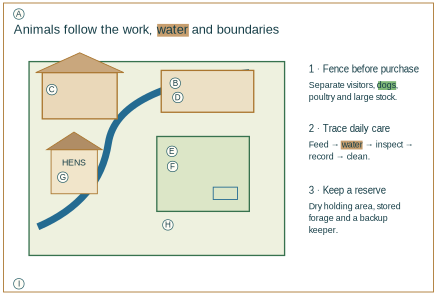
Read the illustration’s labels
Animals follow the work, water and boundaries
HENS
1 · Fence before purchase
Separate visitors, dogs,
poultry and large stock.
2 · Trace daily care
Feed water inspect
record clean.
3 · Keep a reserve
Dry holding area, stored
forage and a backup
keeper.
A
B
C
D
E
F
G
H
I
Key
Small-print annotation
A
ESTATE ANIMAL PLAN • ARGENTINA FIRST
B
FEED + TOOL STORE
C
HOUSE / GUESTS Controlled dog area
D
Dry, secure, accessible
E
FENCED PADDOCK
F
Measured forage area
G
Secure run
H
Trough on firm ground
I
Illustrative layout; areas and setbacks require a measured site plan
A new site-reading plate connects care areas, containment and daily routes. It is not the surveyed plan of any supplied estate.
The fifteen estates begin with the Forest-Edge Estate. Their pictures show ambitions, not animal carrying capacity. This chapter gives each case a conditional starter plan, a reason for its dog role and a test before expansion. Zero animals is an intentional result where visitors, water, steep ground or aircraft make livestock unsuitable.
Argentina comes first. Breed candidates then receive United States and European comparisons, followed by the wider-world questions of heat, disease pressure, predators, feed and local law. The numbers below are authored planning scenarios. They are not stocking recommendations certified from an image. A named breed does not guarantee temperament, guarding ability, riding safety or milk production.
Each case links back to its existing estate account. Read the animal count beside the forage balance, equipment inventory, price evidence and recurring-care budget. The illustrations remain distinct from documentary photographs; no historical likeness is invented for an unnamed stock keeper.
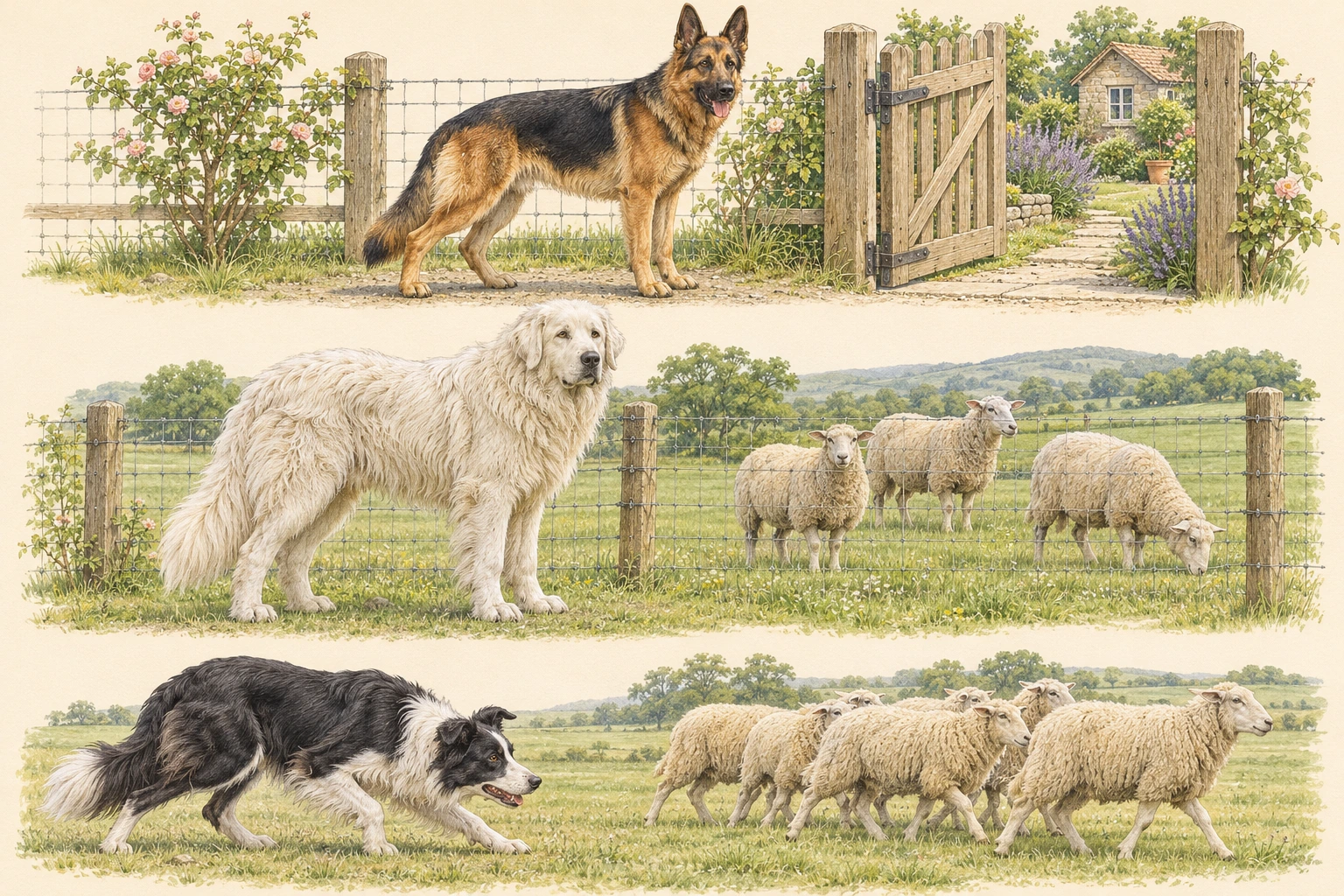
A gate alarm, a flock guardian and a herding dog are different jobs
Top: German Shepherd type at a household gate. Middle: Abruzzese Maremmano type beside sheep. Bottom: Border Collie type moving a flock. Contemporary illustration, not a photograph or a prediction of an individual dog's behaviour. Training and management determine the working role.
Start with the job. A household alert dog lives under human control and signals unfamiliar activity. A livestock guardian is raised and managed with the animals it protects. A herding dog moves stock under a handler. Selecting a Border Collie for intelligence does not make it a flock guardian, and buying a large guardian puppy does not create immediate security.
INTA describes Maremma guardian work in Argentine livestock systems. Its raising guide makes early bonding, progressive introduction and continuing supervision central to the process. These dogs require secure boundaries, daily welfare checks and a keeper who understands their role. The decision to use one or two depends on terrain, predators, flock distribution, working compatibility and management capacity. No universal ratio of dogs to hectares is claimed here. [A01] [A02]
Choose an individual, then check the breed
For a household, compare an adult dog’s documented behaviour around visitors, children and existing animals. German Shepherd or similar working types require appropriate training, physical activity and handling; a stable mixed-breed adult may fit an alert role better than a poorly suited pedigree puppy. For a flock, Maremma and Pyrenean Mountain Dog are candidates to discuss locally. Anatolian-type guardians may also be used in appropriate working systems. Do not place a territorial guardian in a guest courtyard and call it hospitality security.
Units and terms
INTA Instituto Nacional de Tecnología Agropecuaria · US United States
Hens, sheep, beef cattle, dairy cattle or horses: choose the enterprise
The Italian breed standard traces the Abruzzese Maremmano to sheepdogs of Abruzzo and the Maremma/Latium plains, with movement of flocks bringing populations together. Its historical work is flock protection. That background explains a selection goal; it does not prove that every individual will work safely in a modern estate. In Argentina, the relevant question is whether the locally raised dog has suitable stock experience and support. In the US and Europe, assess the same working evidence rather than paying for a fashionable label. [A03]
Hens, sheep, beef cattle, dairy cattle or horses: choose the enterprise
A beginner’s estate should establish one animal enterprise at a time. Six laying hens create a smaller feed and handling commitment than two cows, but still require predator-resistant housing, water, daily inspection and a plan for illness and absence. Negra INTA and Rubia INTA are Argentine laying-hen crosses developed for relevant production systems. Their parentage is documented by the national poultry multiplication programme. Compare local supply, age and vaccination records before purchase. [A15]
Cattle in Argentina, then the US and Europe
For temperate Argentine beef systems, Angus and Hereford are common comparison candidates. In hotter environments, Brangus or Braford may suit a different management problem; Braford combines Hereford with zebu ancestry. Local adaptation, parasite pressure, feed and handling matter more than the breed’s marketing. US and European comparisons should use locally adapted stock and actual market records. A Jersey dairy option requires daily milking, clean equipment, cooling and reliable cover. It is not a low-labour substitute for beef cattle. [A11]
Horses need a purpose and a companion
A two-horse scenario allows companionship; it does not justify buying two animals before there is enough feed and competent care. In Argentina, assess a suitably trained Criollo individual. In the US, compare a quiet, sound stock-horse type with a demonstrated history appropriate to the rider. In relevant European settings, a Haflinger may be a candidate for recreation or light work. Breed names do not replace a veterinary pre-purchase examination, a riding assessment and verification of training. No breeding stallion or bull is part of the starter scenarios.
The journey behind the Criollo name
Aimé Félix Tschiffely’s journey with Gato and Mancha began in Buenos Aires in 1925 and reached New York in 1928. The Criollo association’s centenary account connects the horses with Emilio Solanet and records the journey’s role in the breed’s public history. This is a story of particular animals, preparation and travel. It does not make every Criollo suitable for a novice or eliminate feed and conditioning needs. [A13]
The Haflinger breeding association traces its founding stallion Folie to 1874 and describes a history of mountain pack and light-draught work, followed by changing post-war uses. Such histories explain why people selected certain traits. The estate still needs a present-day assessment of the actual animal. [A14]
Units and terms
INTA Instituto Nacional de Tecnología Agropecuaria · US United States
All yield, utilisation, body-mass and intake figures on this plate are explicit example inputs, not measured data for the supplied estates.
Measure usable grazing hectares separately from buildings, paths, water, gardens and protected woodland. Estimate forage production through local records and field assessment. Then deduct the portion that must remain, trampling and other losses. Compare usable supply with demand month by month; an annual total can hide a winter shortage. INTA pasture guidance and US extension pasture planning both make management and local conditions essential. [A10] [A12]
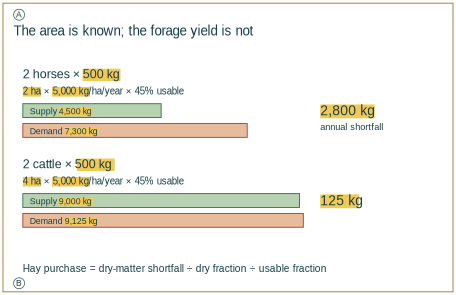
Worked example: the last estate’s twograzing parcels
Assume 5,000 kg of dry matter per hectare per year and 45% usable forage. These are example inputs. The 4 ha cattle parcel gives 4 × 5,000 × 0.45 = 9,000 kg usable dry matter. Two 500 kg cattle at an illustrative daily intake of 2.5% of body mass require 2 × 500 × 0.025 × 365 = 9,125 kg. The 125 kg deficit occurs before calves, drought and any omitted demand. This is not spare capacity.
The 2 ha horse parcel gives 4,500 kg. Two 500 kg horses at an illustrative 2% intake require 7,300 kg, leaving 2,800 kg of dry matter to supply elsewhere. At 85% dry matter and 15% feeding loss, that shortfall corresponds to 2,800 ÷ 0.85 ÷ 0.85 = 3,875 kg of delivered hay. Round purchases to actual bale weights and test quality. These simplified calculations are not complete rations; age, work, pregnancy, lactation and forage quality change the plan.
The editable worksheet keeps these inputs visible. Replace yield and utilisation with local evidence, use a monthly feed table, then price the shortfall. Do not solve a failed forage balance by assuming the animals will eat weeds, garden waste or an unspecified supplement.
Units and terms
US United States
kg kilogram, a mass unit · ha hectare, 10,000 square metres · % percent, parts per hundred · = equals · × multiplied by · ÷ divided by · INTA Instituto Nacional de Tecnología Agropecuaria · US United States
ha hectare, 10,000 square metres · kg kilogram, a mass unit · % percent, parts per hundred · = equals · ÷ divided by · ARS Argentine peso · USD United States dollar
Before the animals arrive: a counted site and care plan
Exchange basis, not a promise about the purchase
The comparisons use Banco Nación’s banknote selling quotation of ARS 1,570 per US dollar on 13 November 2026 at 17:00. Divide an Argentine peso figure by 1,570 to show this illustrative USD equivalent. It is not an import price, a future exchange rate or a statement about which exchange mechanism a buyer will use. ARS means Argentine peso; USD means United States dollar. [A05]
Argentina: cattle and working guardian dogs
Grupo Guarino’s 9-15 November 2026 reference lists pregnant breeding-female categories between ARS 1.9 million and ARS 2.5 million per head, about USD 1,210-1,592 on the stated exchange basis. Two would be ARS 3.8-5.0 million, about USD 2,420-3,185. These are category benchmarks, not pedigree Angus, Hereford or Jersey quotations. Its light-calf reference of ARS6,400/kg makes a 150 kg example ARS 960,000, about USD 611. Weight, category, health and sale terms must match before comparison. [A04]
In a March 2026 firsthand breeder interview, Mario Medina described working guardian dogs at roughly three to four times an approximately ARS 1 million beauty-line price. That produces a historical ARS 3-4 million benchmark per dog, about USD 1,911-2,548 when translated at the November rate. It is not a fresh November offer, and does not establish the cost of a trained adult. Ask for the dog’s age, stock exposure, health record, transport and after-sale support. Household alert-dog adoption fees and breeder prices remain unquoted. [A06]
Horses: compare like with like
At the 2026 Nacionales Criollas auction in Corrientes, reported mare prices averaged ARS 5.65 million and reached ARS 9 million; these convert to about USD 3,599 and USD 5,732. The sale offered instalment terms. These are breeding-sale observations, not a novice-safe riding-gelding price range. Obtain an individual trained-horse quotation with an independent examination. [A07]
Two US seller listings checked for this edition asked USD 4,500 for Smokey and USD 5,000 for Joe, both unregistered Quarter Horse-type geldings. Smokey was marked sale pending. Their peso equivalents are ARS 7.065-7.85 million per horse; transport, import and veterinary costs are not included. Seller statements about riding experience are not independent guarantees. These two asking prices are examples, not a national market range. [A08] [A09]
No checked EU seller basket or current breed-specific sheep, hen, dairy-cow or household-dog price was obtained for this release. Those lines stay visibly unquoted in the worksheet. Enter a dated local quotation in euros or the local currency, then record the conversion separately. A blank is more useful than a fabricated cheap animal.
Before the animals arrive: a counted site and care plan
1. Map the enclosure and the service route
For a rectangular example measuring 40 × 25 m, the perimeter is 2 × (40 + 25) = 130 m. A 3 m gate leaves 127 m of fence fabric. Posts, strainers, corners and gates still need their own design and quantities. Mark the water point, shelter, isolation area, delivery access and a route for taking an animal to veterinary care.
Units and terms
ha hectare, 10,000 square metres · kg kilogram, a mass unit · % percent, parts per hundred · = equals · ÷ divided by · ARS Argentine peso · USD United States dollar
US United States · USD United States dollar · ARS Argentine peso · EU European Union · m metre, a length unit · = equals · × multiplied by · ÷ divided by
Before the animals arrive: a counted site and care plan (continued)
Complete the fence, reliable water supply and handling arrangements before bringing animals onto the site. Confirm a local veterinarian, individual health records, transport and an appropriate isolation plan. A breed name does not establish an individual animal’s temperament, training or suitability.
3. Test an ordinary working day
Lay out labelled feed bins, scoops, a brush, shovel, wheelbarrow, identity records and cleaning equipment. Walk the actual feeding and cleaning route carrying the expected loads. Record minutes and obstacles. A nominal fifteen minutes each day already totals 91.25 hours a year: 15 × 365 ÷ 60. Twice-daily care, training, milking or treatment changes the account.
4. Match the group to the site
Use the animal and breed comparisons in the adjacent estate profiles. Match individual identity, age, health, purpose, available forage and social requirements to the purchase record. Introduce a livestock guardian under a competent handler’s plan; an untrained dog is not a complete protection system. Do not assume cattle require a guardian simply because a sheep flock might.
5. Keep two accounts
Capital includes animals, transport, pre-purchase examination, fencing, gates, water hardware, feed storage, handling facilities and initial bedding. Recurring costs include feed, bedding, veterinary care, parasite management, hoof care, repairs, labour and applicable insurance. Record delivery and tax separately when excluded from a quotation.
Before the animals arrive: a counted site and care plan (continued)
Purchase example retained from the estate record ARS range
Two cows, ARS 1.9-2.5 million each 3.8-5.0 million
One working guardian benchmark 3.0-4.0 million
These three animals alone 6.8-9.0 million
The inherited subtotal corresponds to about USD 4,331-5,732 at the exchange basis stated in the preceding price record. The animal observations have different dates and are not a current combined quotation or a recommendation to buy this combination. Fencing, feed, health, transport and labour remain unpriced here. Use quantity × unit price for every line; preserve seller, date, specification and currency.
Units and terms
US United States · USD United States dollar · ARS Argentine peso · EU European Union · m metre, a length unit · = equals · × multiplied by · ÷ divided by
ARS Argentine peso · USD United States dollar · × multiplied by
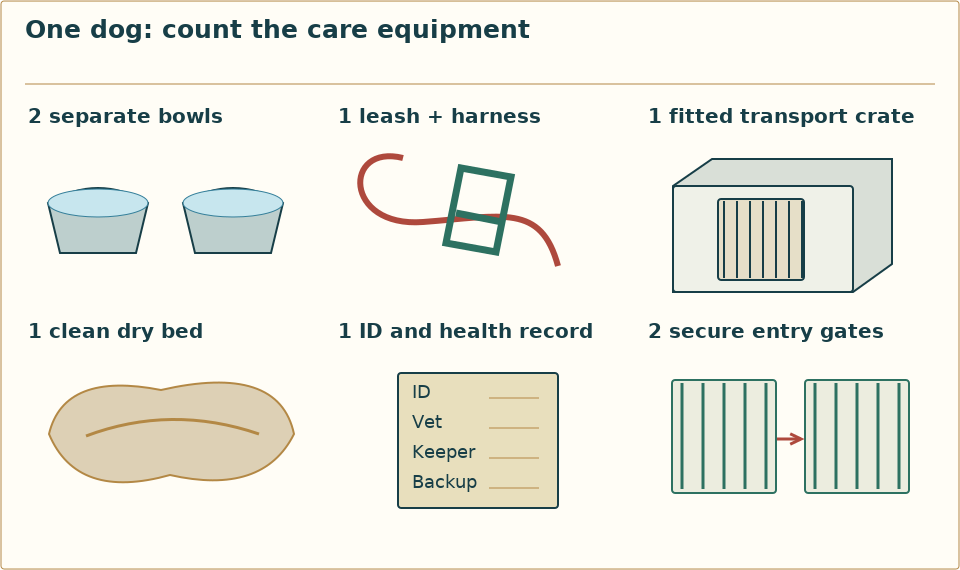
Size every item to the actual adult dog. Count two bowls, one leash and harness, one fitted transport crate, one dry bed, one identification and health record, and two secure entry gates. The drawing is an equipment inventory; it does not prescribe enclosure dimensions.
Units and terms
ARS Argentine peso · USD United States dollar · × multiplied by
The fifteen plans that follow are authored starting scenarios based on the existing estate uses. They name a candidate breed, count and placement, then state what must be checked in the individual dog. They are not security guarantees. Where visitors, children or staff use the site, containment and competent handling are part of the design from the beginning.
1. Decide the job. Write who receives an alert and how that person responds. Keep gates, lighting, communication and access control functional even when the dog is resting or away.
2. Choose an individual. Meet the adult dog or discuss a puppy’s long development with a qualified trainer and veterinarian. Review health, behaviour around people and other animals, and the proposed working environment.
3. Prepare the keeper’s routine. Assign daily physical activity, feeding, water, cleaning, training and record keeping. Name a substitute before a holiday or illness. Buy only after the refuge, transport and gates are ready.
Read the breed photograph accurately
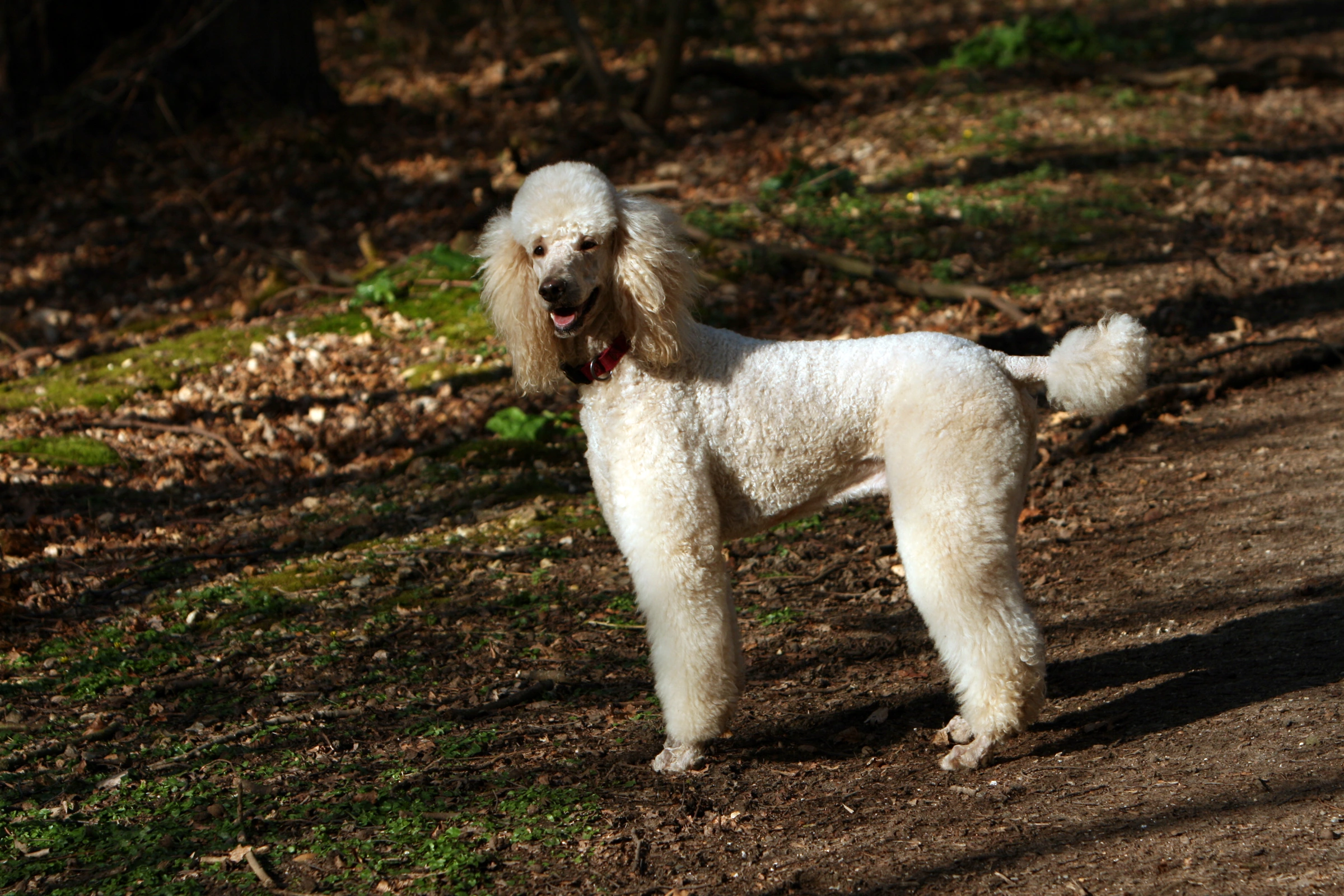
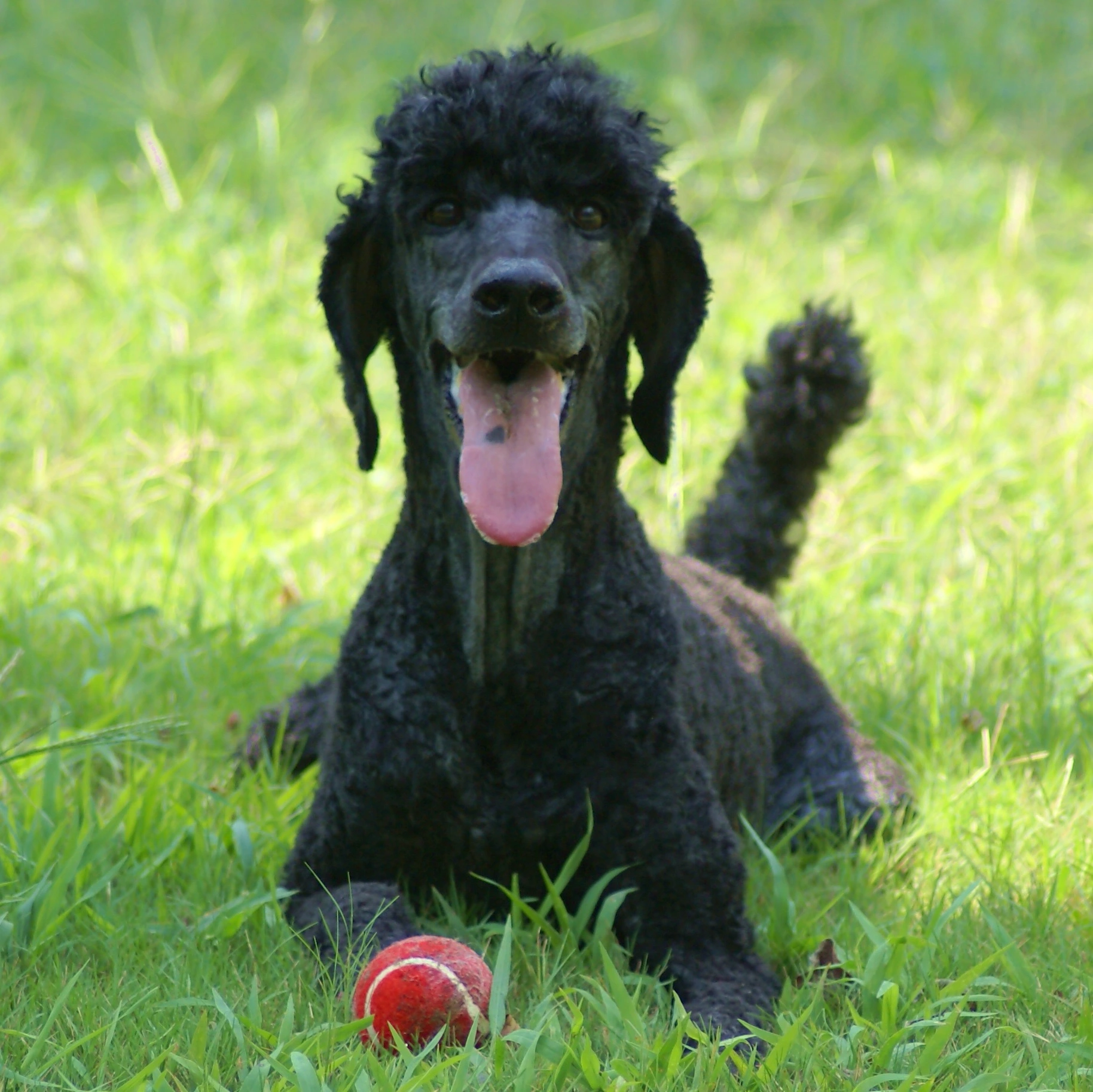
Candidate Role in these plans A limiting condition
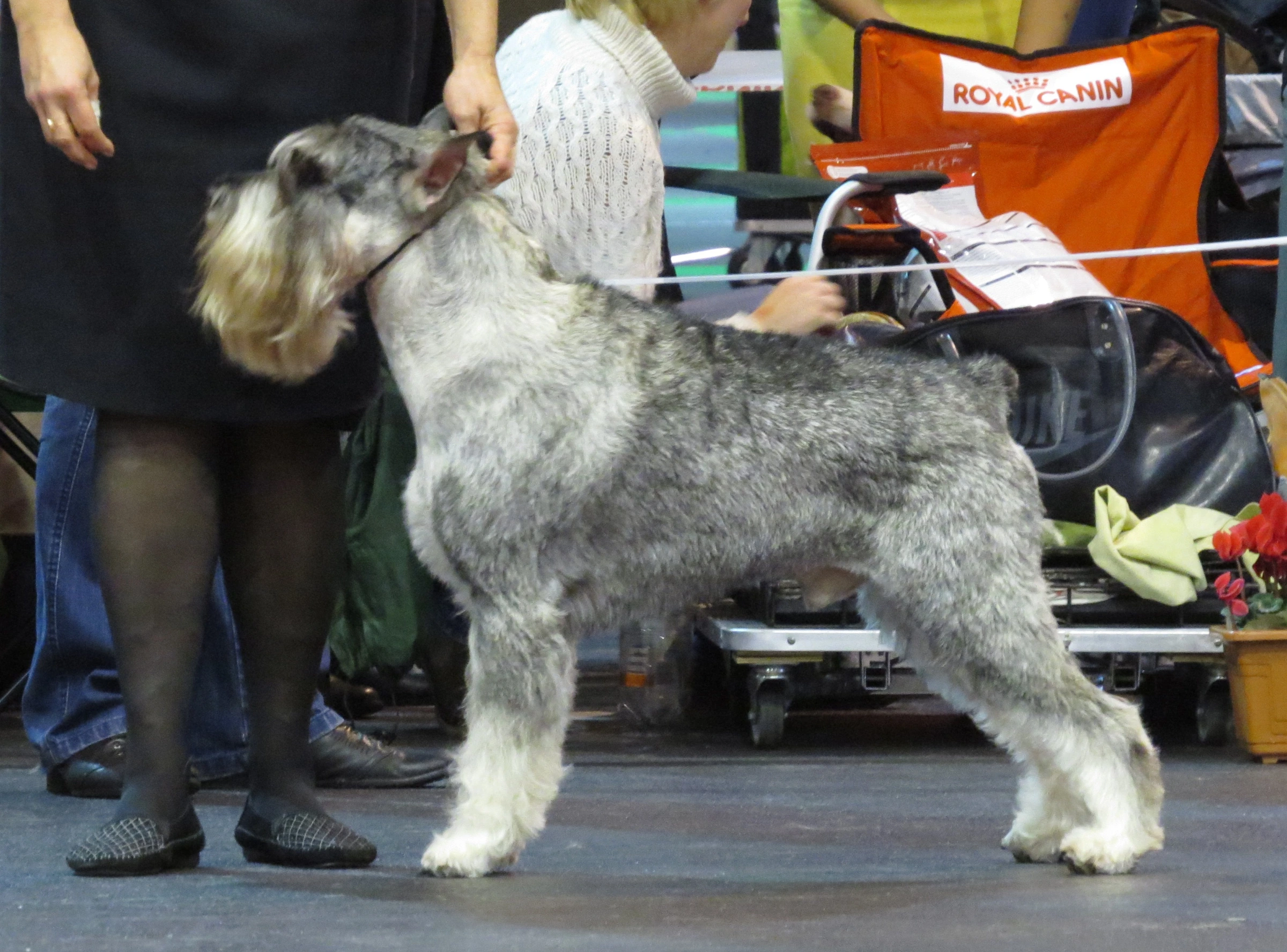
Standard Schnauzer Household alert and companion
Grooming, physical activity, visitor training and assessment of barking.
German Shepherd Dog Staffed-yard alert companion Experienced handling, health evaluation and control around deliveries.
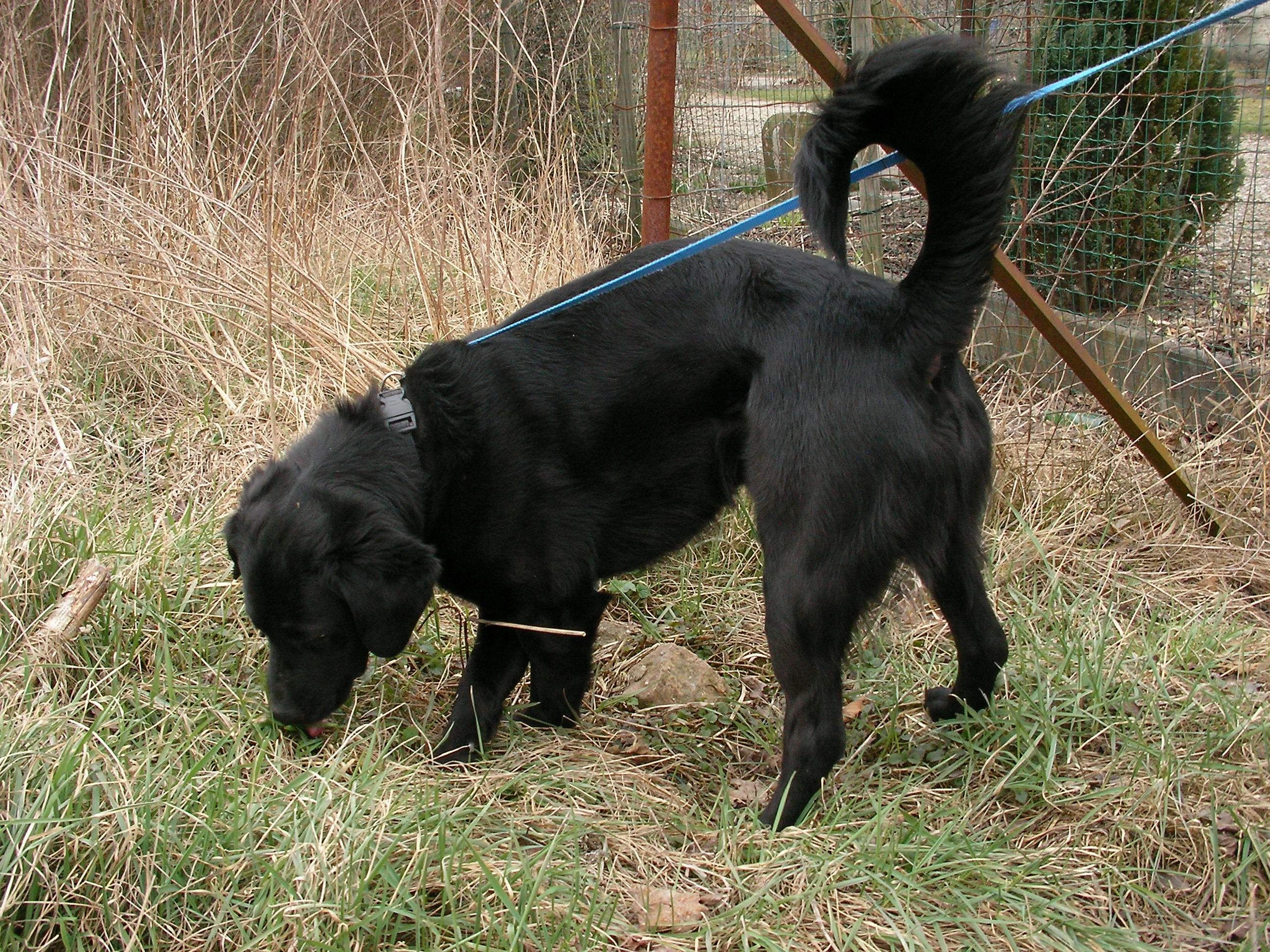
Labrador Retriever Controlled household companion
Standard Poodle Household companion near gardens and guests
Herding ancestry is not a livestock-guardian qualification.
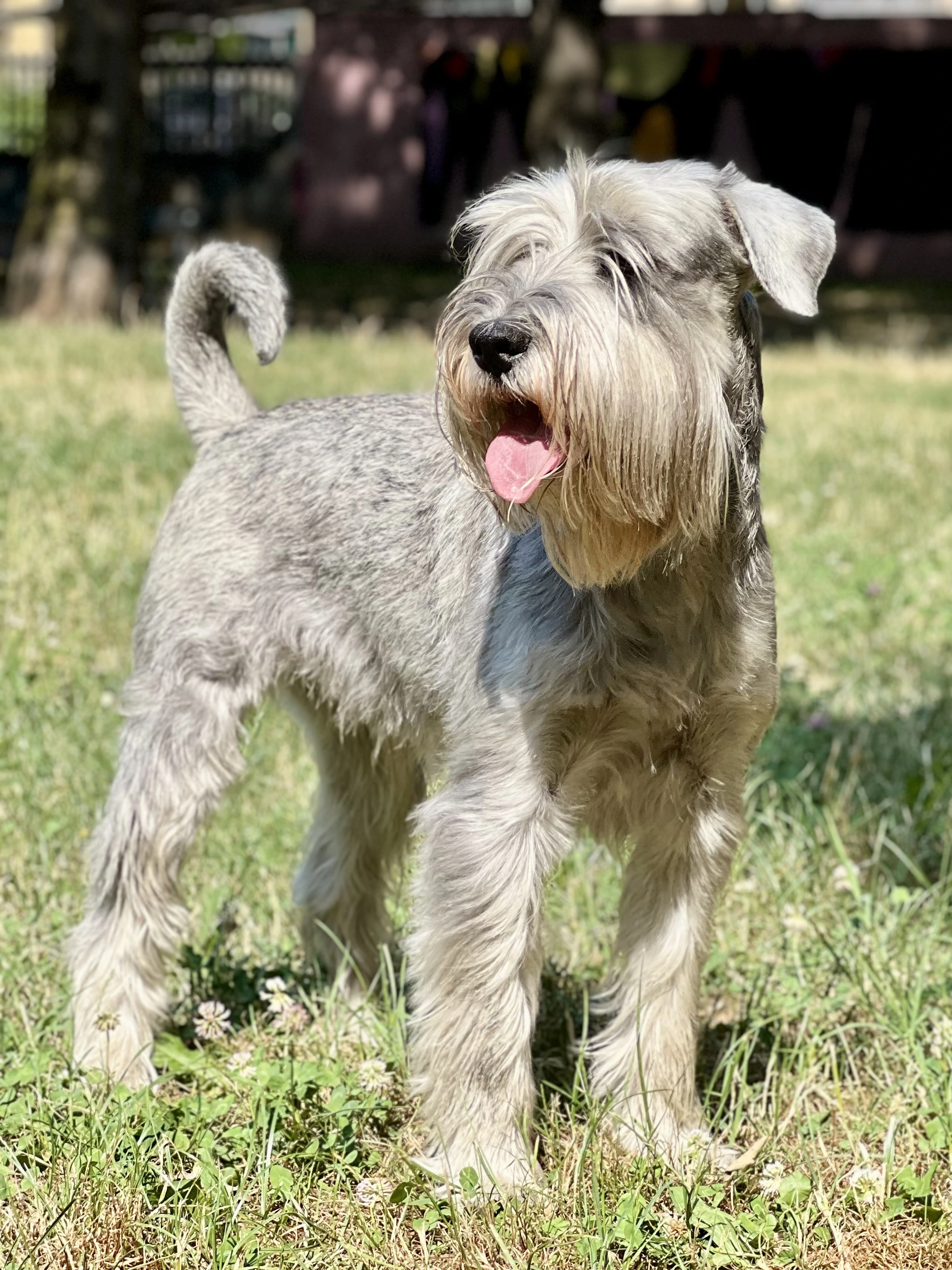
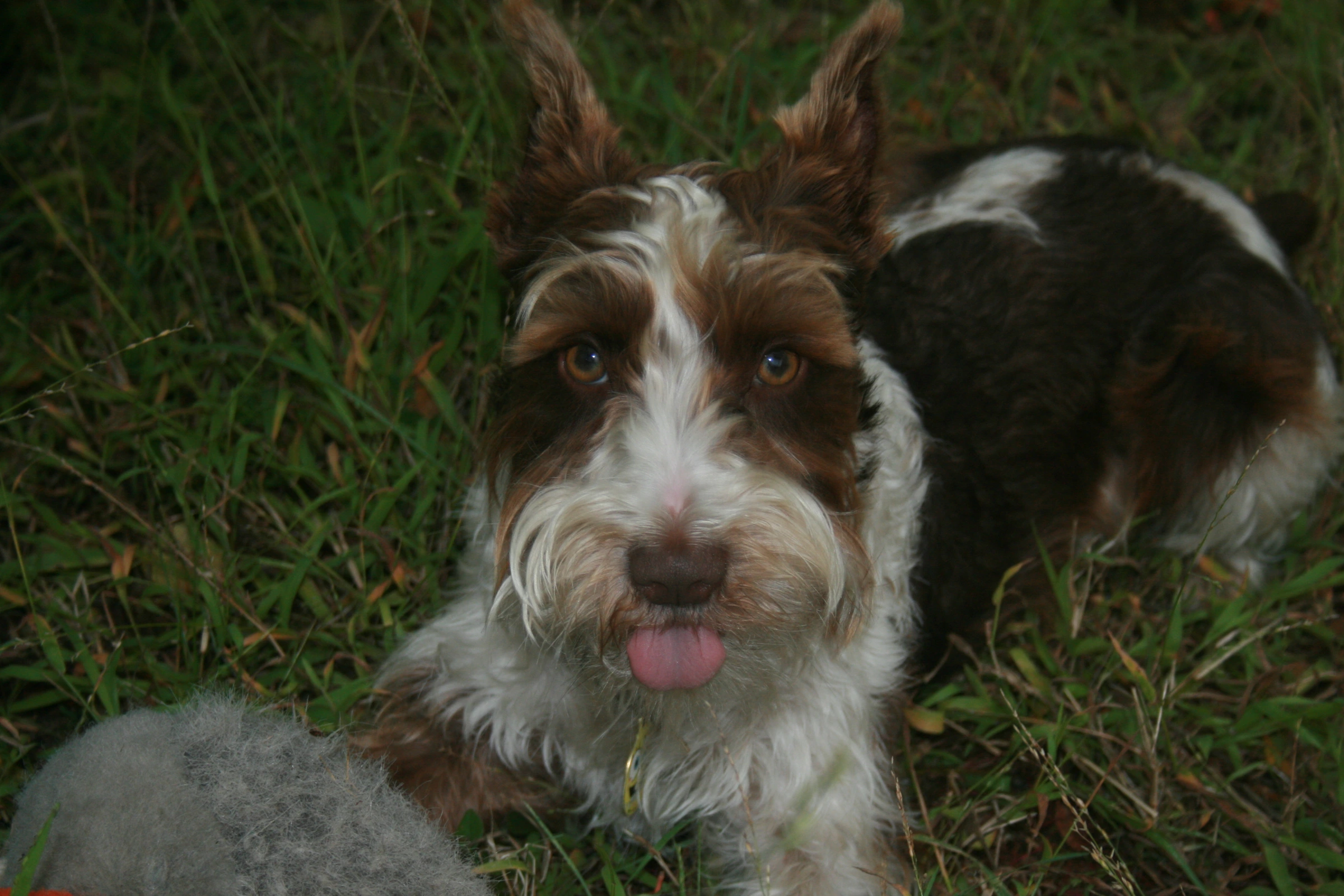
Standard Schnauzer. A German stable and household working-dog tradition sits behind the modern breed standard. The beard and coarse coat identify the pictured breed; they do not prove a particular dog will be calm with visitors.
Miniature Schnauzer. The miniature breed is distinct from the Standard Schnauzer. A small body is convenient on a contained domestic site, but it does not remove the need for physical activity, grooming, training and a quiet retreat.
Read the breed photograph accurately
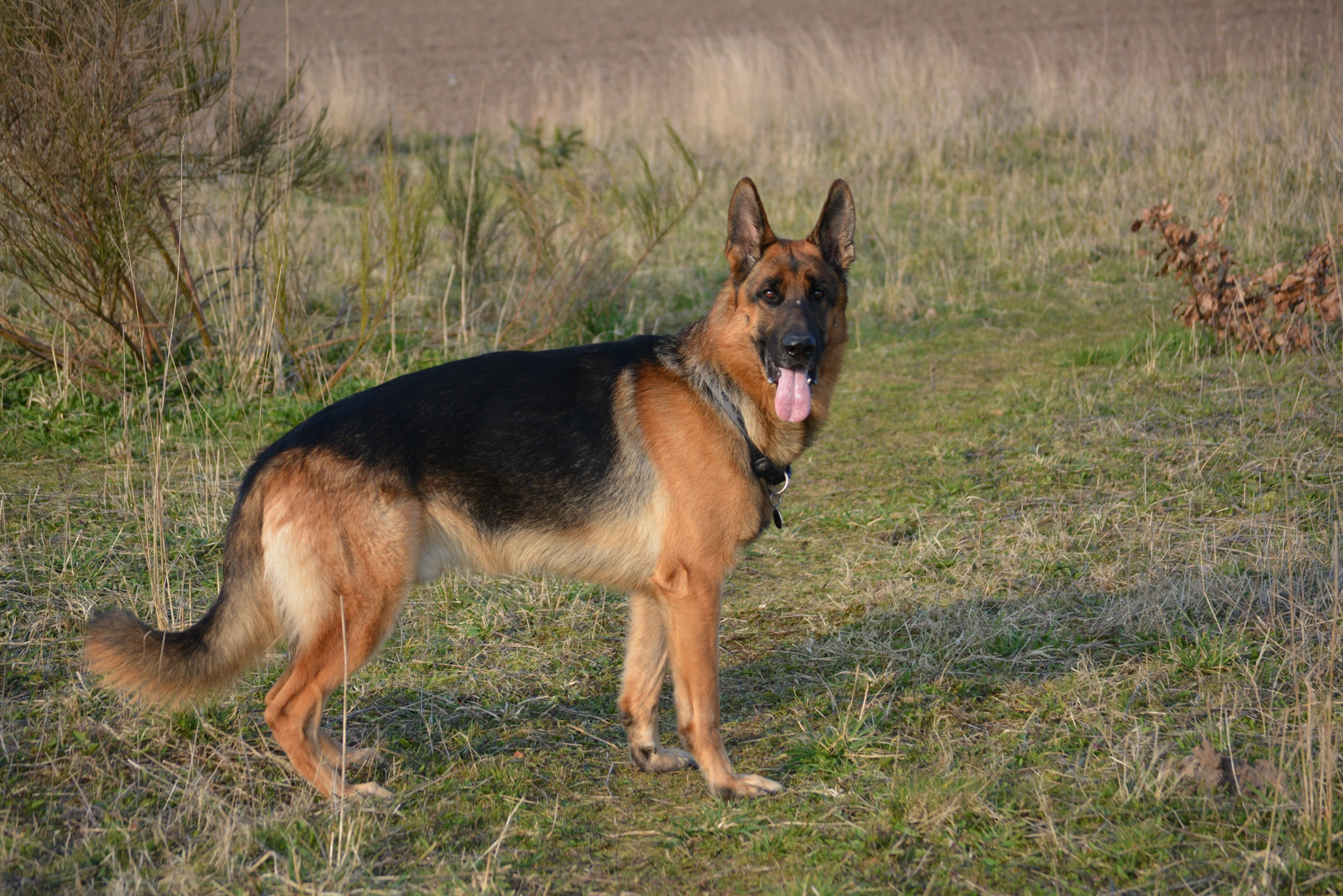
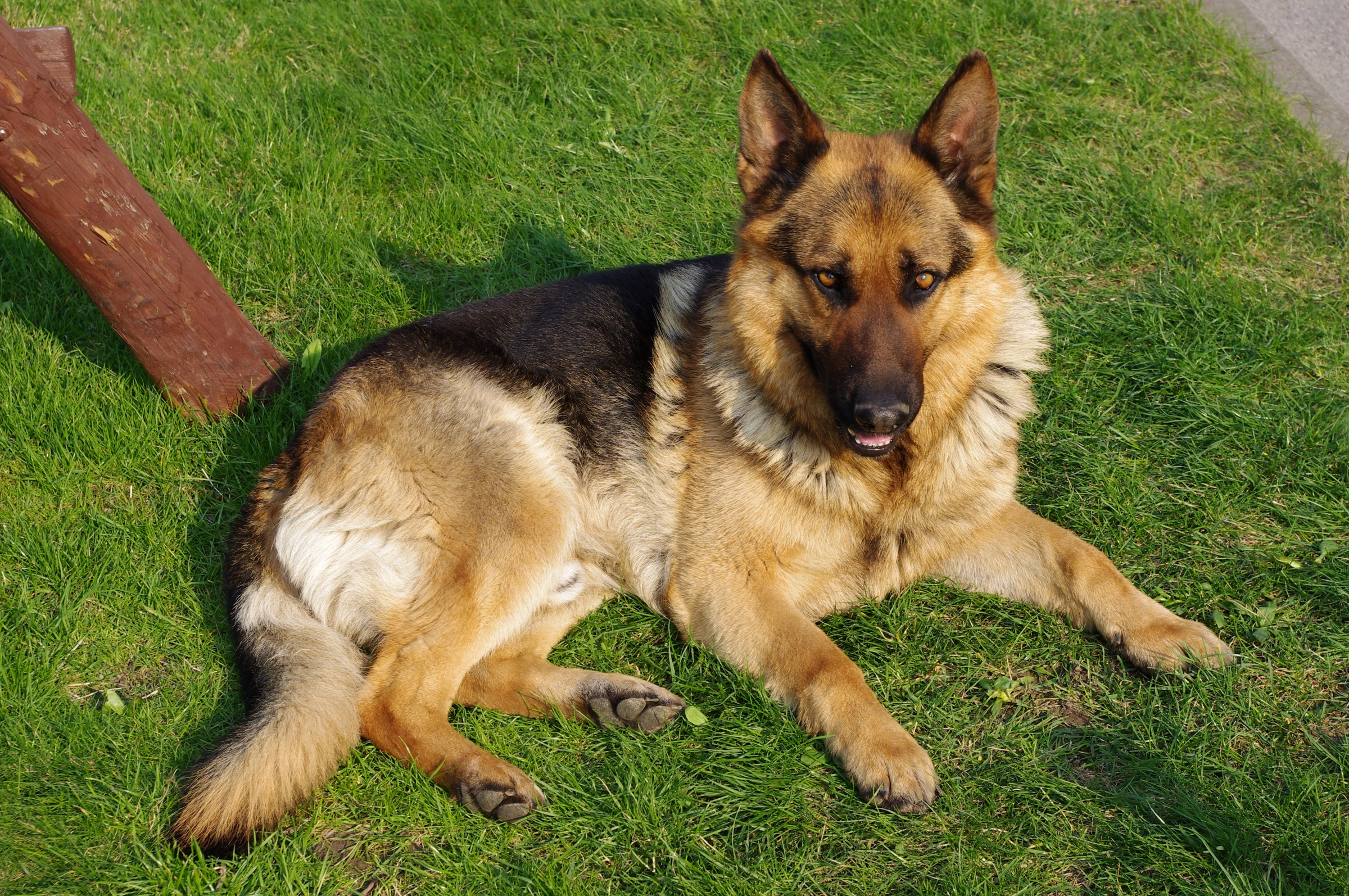
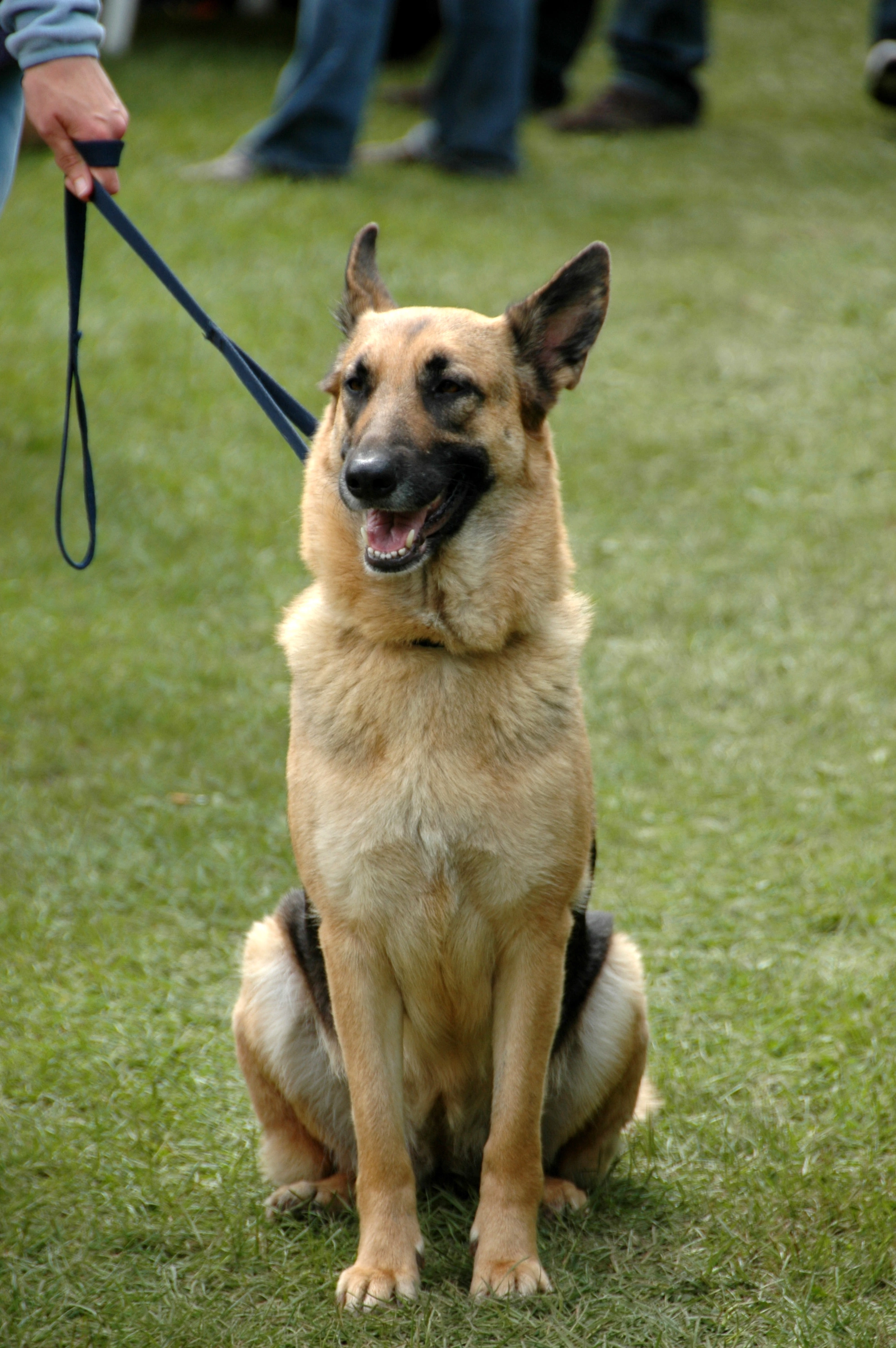
German Shepherd Dog. The breed was developed from German herding dogs as an all-round working dog. The FCI account places organised breeding from 1899. A household should evaluate health and behaviour, not buy a dramatic stance or a protection claim.
FCI: Fédération Cynologique Internationale. The international canine organisation cited for the breed standard and historical account.
In the drawing: (continued)
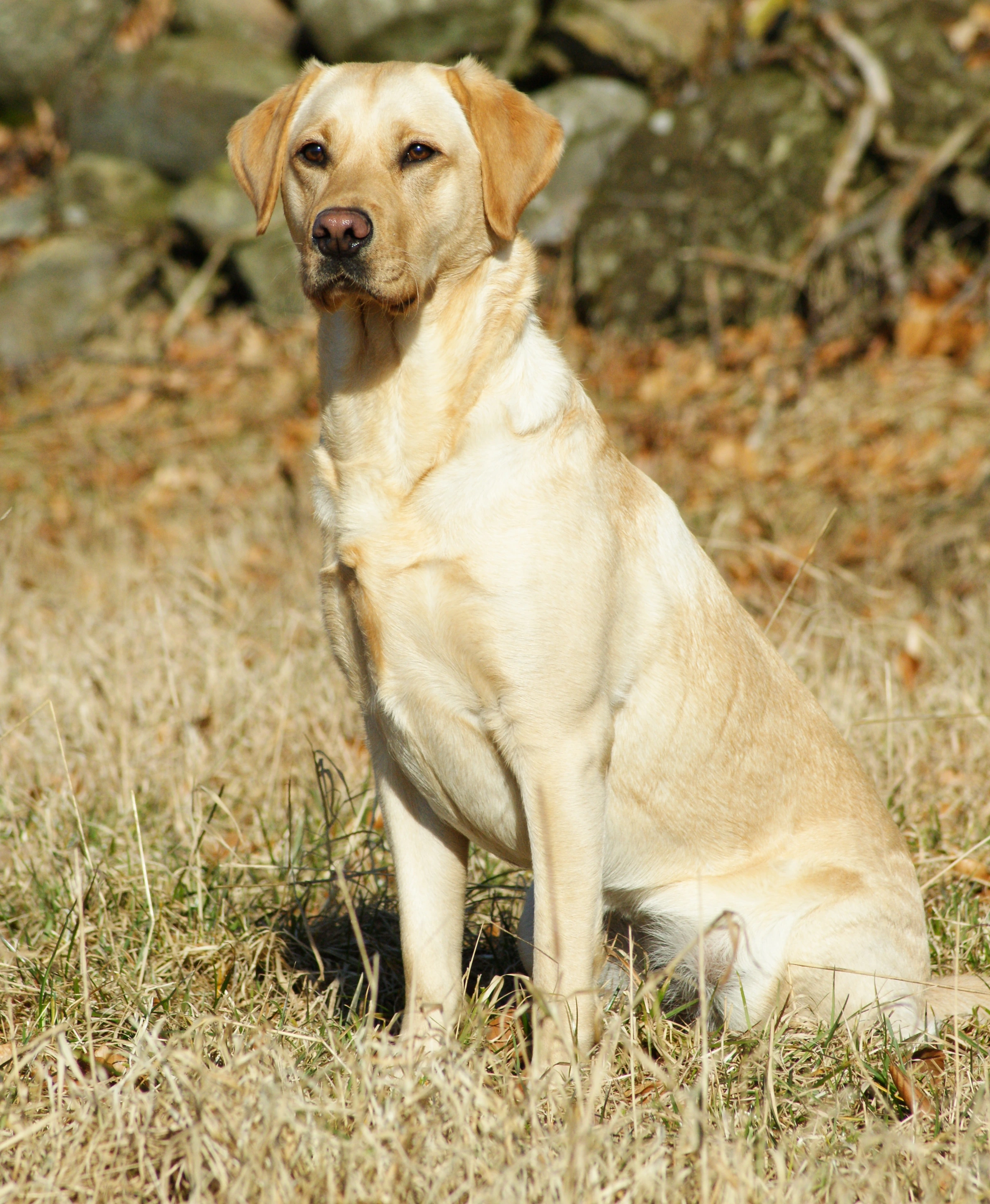
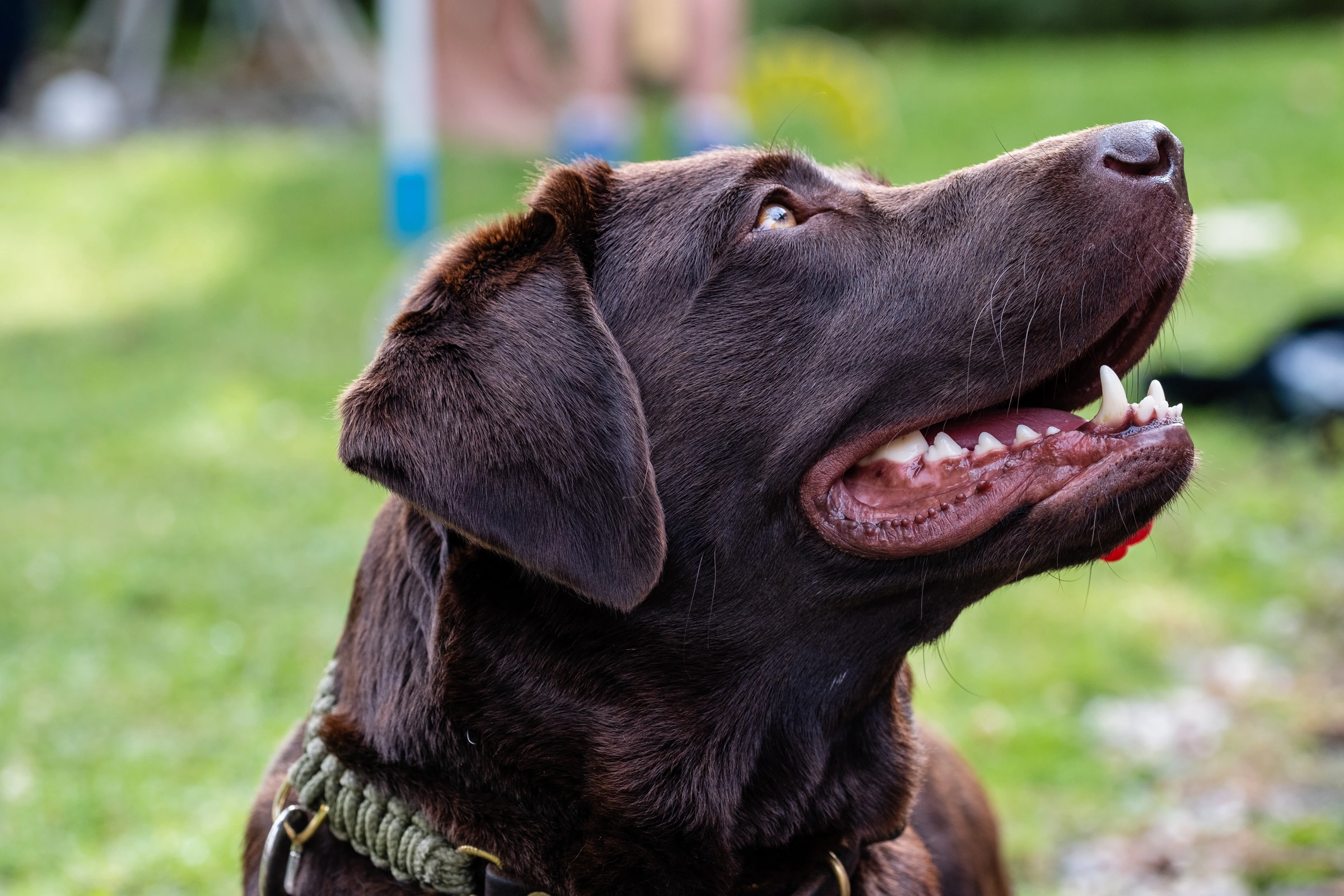
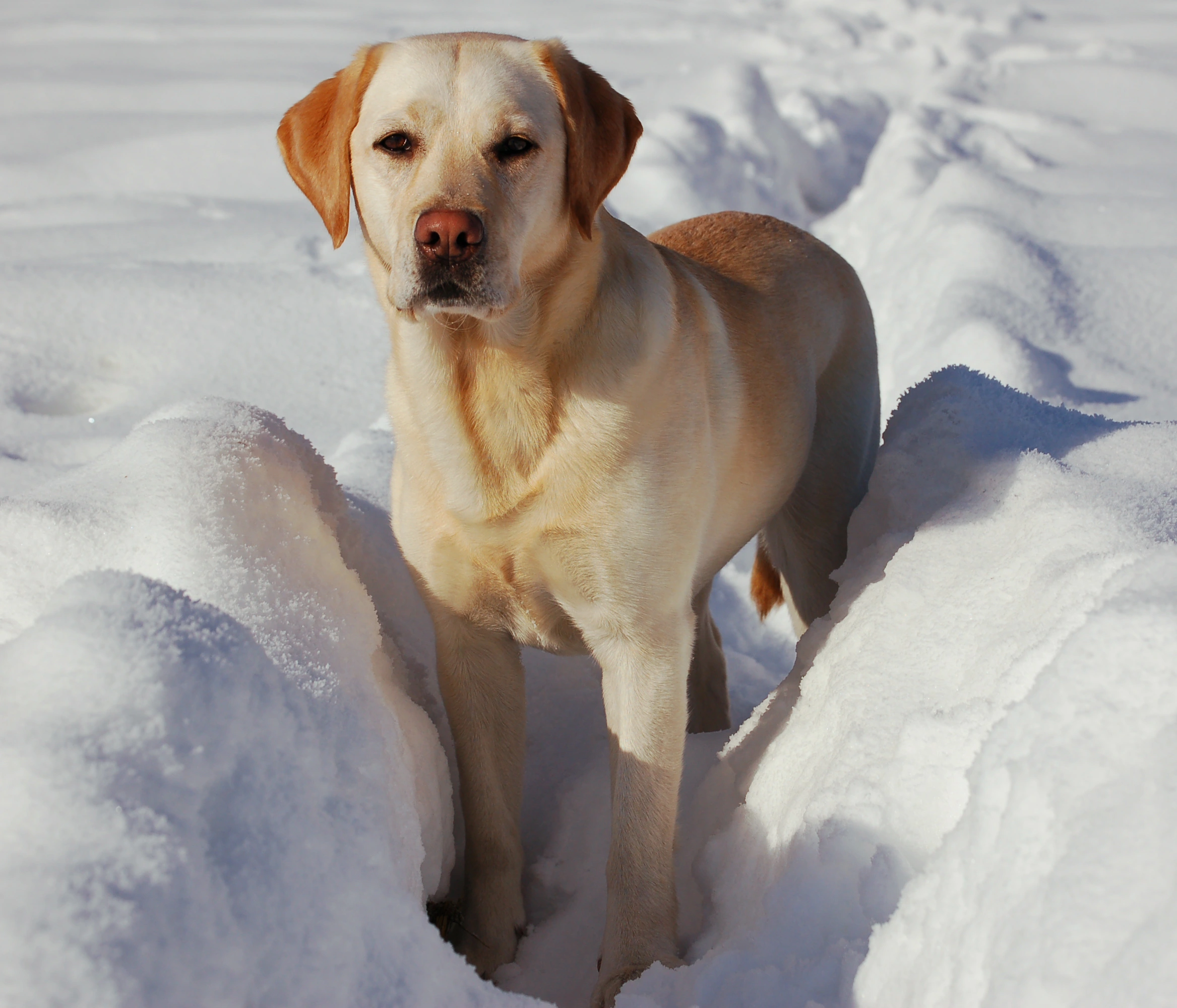
Labrador Retriever. The Labrador is a retriever. A suitable individual may fit a household with visitors and activity, but retrieving ancestry is not evidence of trained protection or permission to let the dog enter water unsupervised.
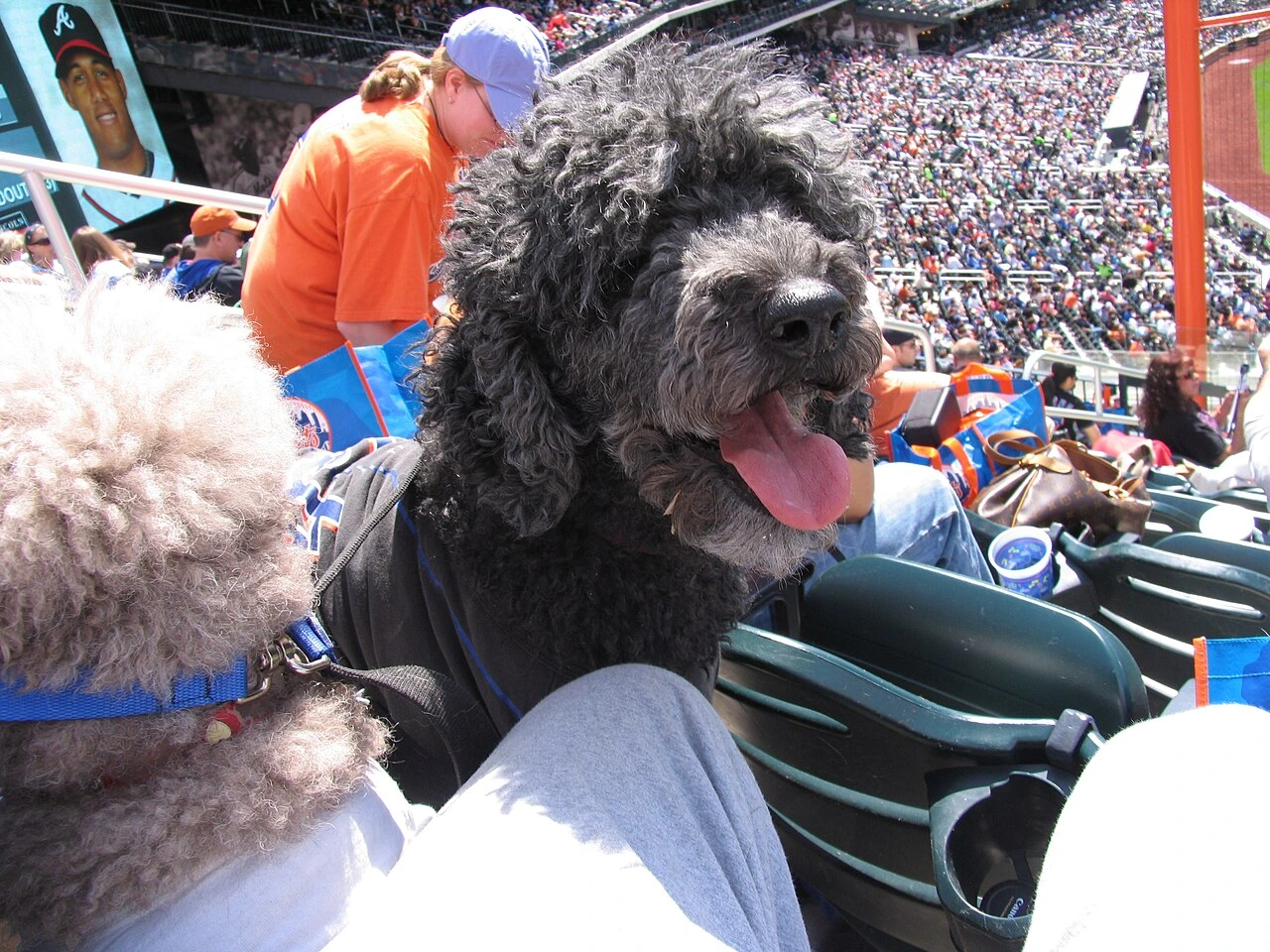
Standard Poodle. The Poodle has a water-retrieving history. The Standard size shown here is chosen as a household companion candidate, with grooming and activity treated as scheduled work rather than decoration.
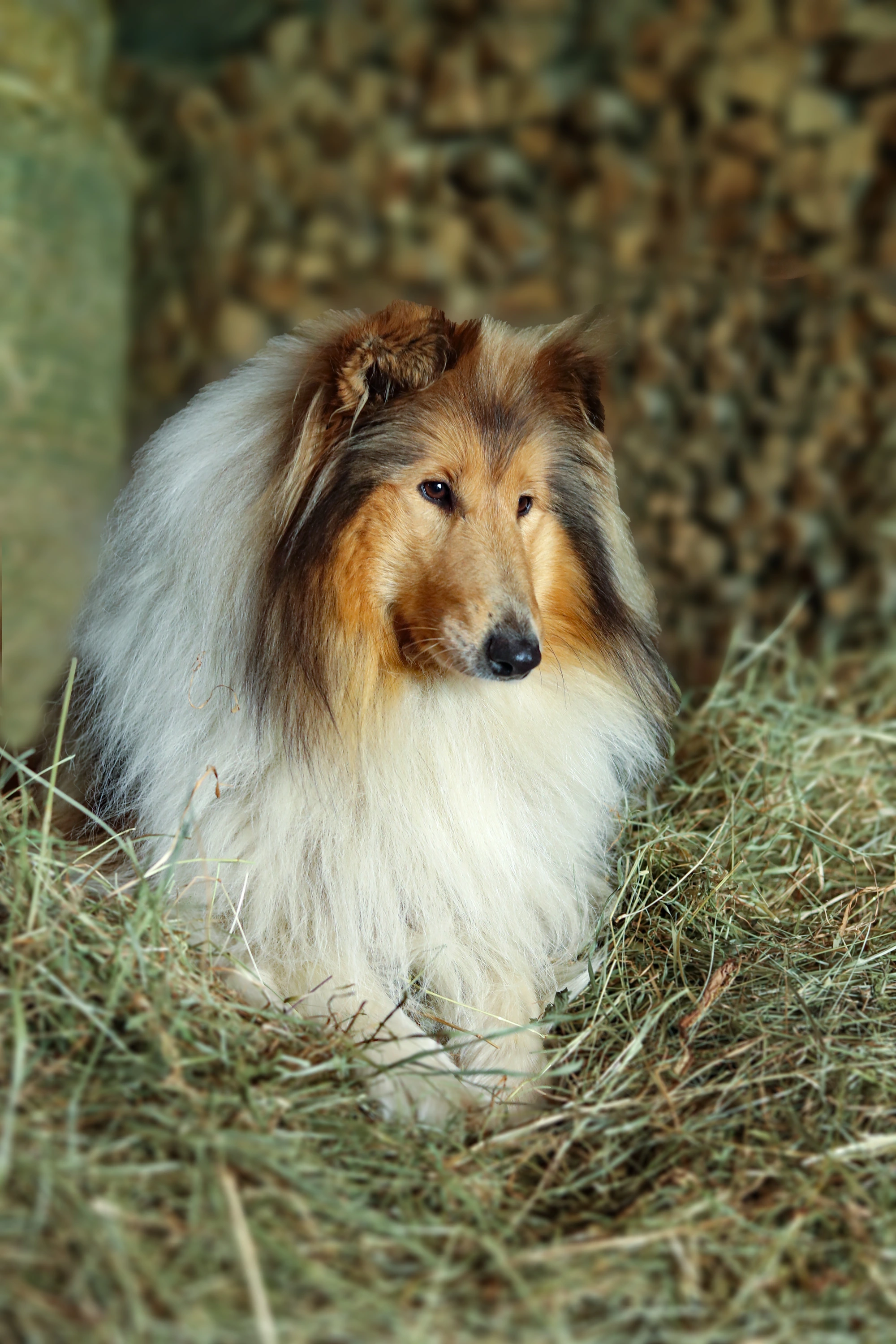
Rough Collie. The Rough Collie belongs to a herding tradition. A long coat and a pastoral image do not make it a livestock guardian. A household companion role requires a different daily relationship from a dog living with sheep.
The following modern photographs are documented breed references. They are not historical photographs of these fictional estate scenarios, evidence of trained guarding, or pictures of animals offered for sale. Their creator, date when recorded and reuse terms are preserved.
These public prices were checked on 15 November 2026. They are location-specific offers, not national averages or guarantees of behavioural results. A “session” varies in length, format and follow-up. Prices do not establish the trainer’s suitability for a particular difficult case.
Provider / place Published service Original price
Filosofía Animal · CABA/Buenos Aires
4 home visits, each 1.5-2 h, team educator
ARS 440,000; ARS 374,000 with stated prepayment discount
PetSmart · US listed store 6-week group class; 4 private hours USD 149 group; USD 259 private package; USD 89 single private hour
HaSidoElPerro · Madrid 4 sessions; first 1.5-2 h, later typically 1-1.5 h
EUR 230 package; EUR 75 first / 65 later single sessions
Filosofía Animal lists travel outside CABA and some parking separately. CustosClub recommends at least six individual classes and continuing practice at home. PetSmart availability is store-dependent. Confirm Madrid tax and travel treatment because the quoted page does not establish every additional charge. Keep those exclusions in the budget. [TP1-TP4]
What a trainer costs, and what the fee buys (continued)
Read the estate training tables
The individual estate tables price an editorial four-, six- or eight-visit purchasing scenario. They do not predict how many lessons a dog will need. Argentina uses CustosClub’s four-visit package plus two singles for six, or its eight-visit package. The US uses four private hours plus single hours; Madrid uses four sessions plus later singles. Thus duration and service differ across countries. Confirm package combinations with the provider before relying on them.
Units and terms
h hour, 60 minutes · ARS Argentine peso · min minute, 60 seconds · US United States · USD United States dollar · EUR Euro · CABA Ciudad Autónoma de Buenos Aires
Sources for this account
Filosofía Animal: home education prices, CABA and Buenos Aires
1. Describe the actual problem. Send a written summary of the site, dog, carers and specific objective. Mention chasing, bites, fear or medical concerns honestly so the provider can assess suitability and referral.
2. Ask how the work is done. Request the methods, session length, owner participation, follow-up, cancellation terms, travel and total taxes. Choose reward-based methods and a written practice plan, rather than a promise of instant protection.
3. Budget the owner’s practice. Paid sessions teach the carers as well as the dog. Record the time spent practising between visits; it remains labour even when no trainer invoice is issued. Reassess after the agreed review point.
Read the illustration’s labels
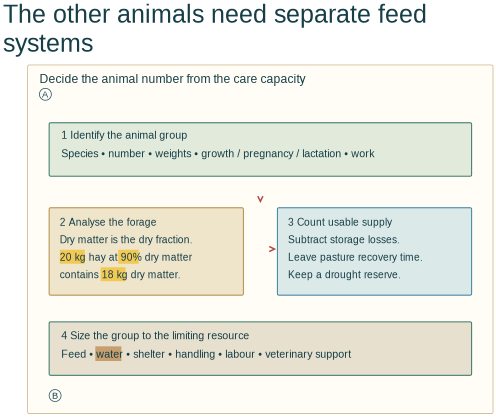
The other animals need separate feed
systems
Decide the animal number from the care capacity
1 Identify the animal group
Species • number • weights • growth / pregnancy / lactation • work
2 Analyse the forage
Dry matter is the dry fraction.
20 kg hay at 90% dry matter
contains 18 kg dry matter.
3 Count usable supply
Subtract storage losses.
Leave pasture recovery time.
Keep a drought reserve.
4 Size the group to the limiting resource
Feed • water • shelter • handling • labour • veterinary support
A
B
Key
Small-print annotation
A
Worked planning diagram · a local livestock adviser supplies the ration and forage assumptions
B
An attractive estate picture cannot establish hectares, forage yield or stocking rate.
Units and terms
h hour, 60 minutes · ARS Argentine peso · min minute, 60 seconds · US United States · USD United States dollar · EUR Euro · CABA Ciudad Autónoma de Buenos Aires
kg kilogram, a mass unit · % percent, parts per hundred
The other animals need separate feed systems (continued)
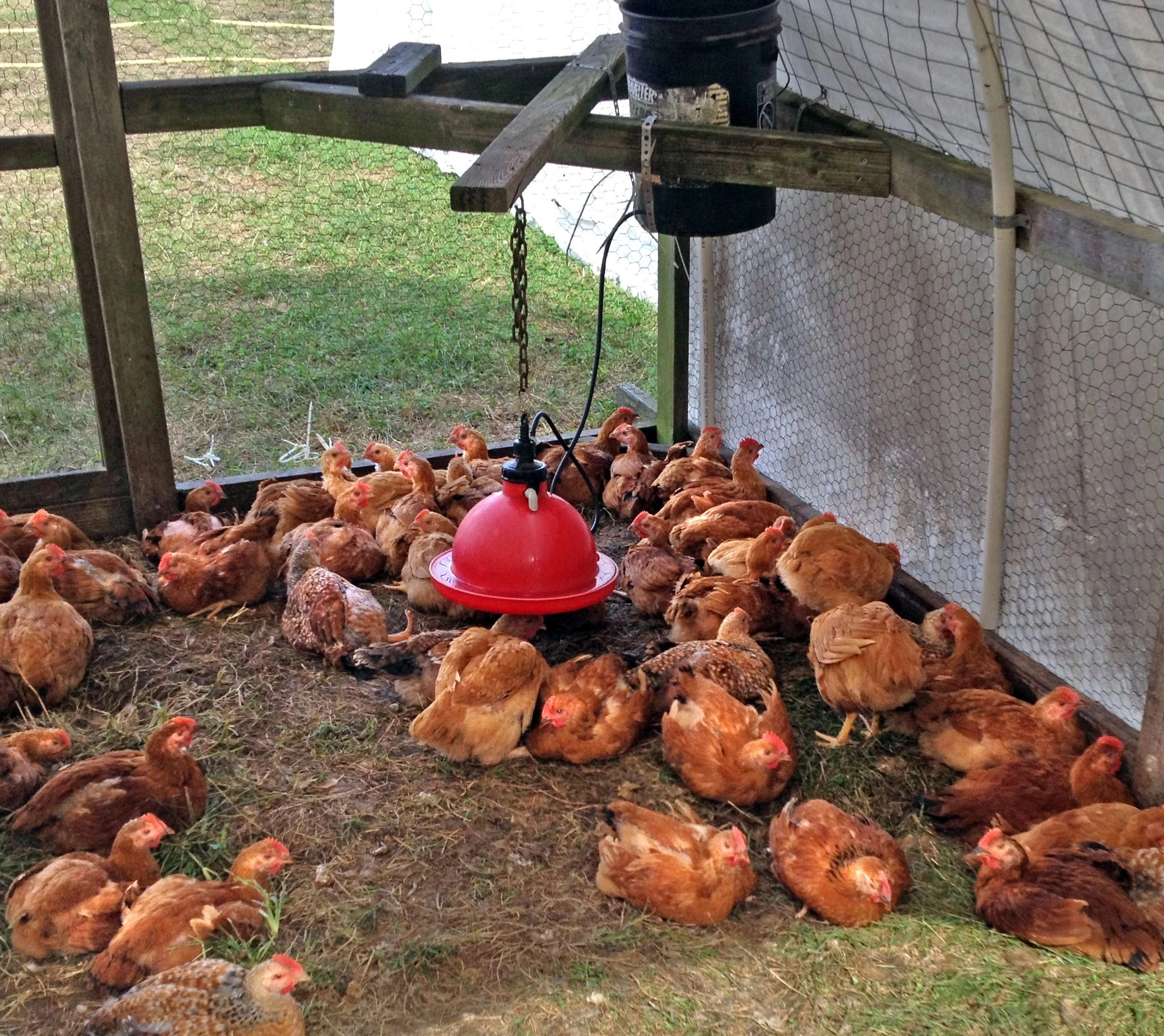
Chicks, growing pullets and laying hens have different feed requirements. Complete poultry feeds are practical for a small flock; provide the formulation appropriate to the stage. A basket of scraps is not the primary ration. Keep clean water and a dry, pest-resistant store, and do not let dogs or wild birds share the feeder. [L02]
Sheep and goats: forage and species-specific minerals
Have forage analysed and balance the ration for the animal’s size and production stage. Do not exchange sheep and goat mineral mixes casually: goat diets generally need more copper, while excess copper can harm sheep. Grain changes and high-grain diets need particular care for rumen health. A goat is not a no-cost lawn mower. [L03]
Horses: forage first, with individual assessment
University of Minnesota guidance puts most mature horses around 1.5-2.5% of body weight daily in forage, with the full ration adjusted for the horse. Fresh water, teeth, body condition and gradual feed changes matter. A 500 kg horse at an assumed 2% gives 10 kg/day for a planning calculation; have the adviser specify dry-matter versus as-fed basis and actual forage quality before buying that amount as a ration. [L01]
The other animals need separate feed systems (continued)
Cattle: production changes the account
A nonlactating cow, growing animal and high-yield dairy cow do not have interchangeable requirements. A balanced ration must account for the moisture in each ingredient and whether animals sort or leave parts of the feed. Weighing “one bucket” without its contents and dry matter does not establish intake. [L05]
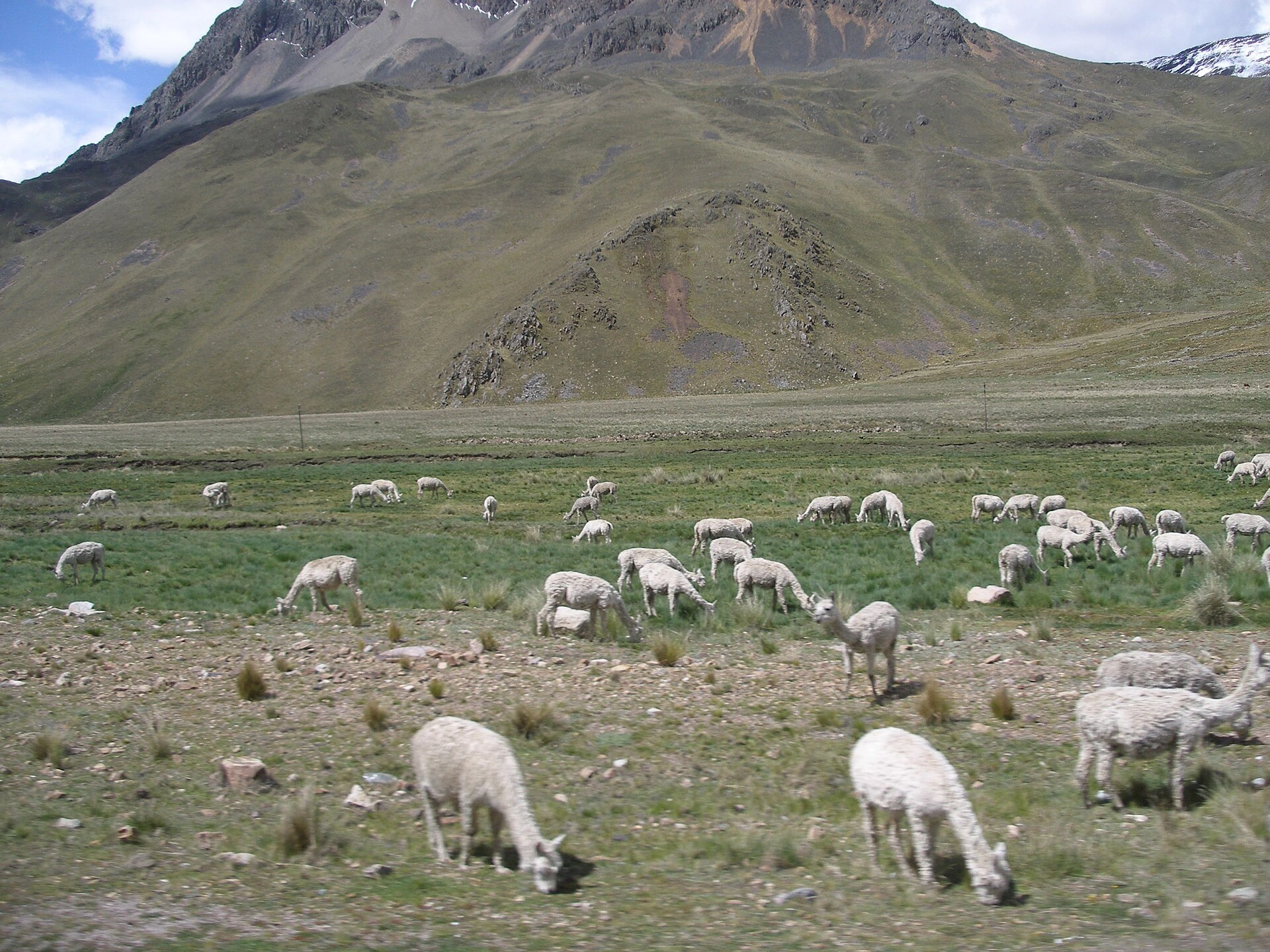
Alpacas: a compatible group, not a lone ornament
For adult camelids under basal conditions, Merck describes dry-matter intake around 1.8-2% of body weight. This is a reference range, not an instruction to feed the same amount to every pregnant, lactating, growing or unwell animal. Assess body condition by touch as well as appearance under the fibre, and use species-appropriate forage and minerals. [L04]
Raptors are meat-eating specialist birds, but random supermarket meat is not a complete falconry feeding plan. The competent falconer and avian veterinarian specify food, hygiene and monitoring. Parrots, tortoises and koi have different species and environmental requirements; none belongs on a generic “exotic pet” ration. Their acquisition remains a separate feasibility decision in the following chapters.
Units and terms
kg kilogram, a mass unit · % percent, parts per hundred
% percent, parts per hundred · kg kilogram, a mass unit
Sources for this account
University of Minnesota Extension: feeding the mature horse
The opening numbers in the estate chapters are deliberately conditional management scenarios. They are not calculated stocking rates. A site illustration supplies no reliable hectares, forage yield, legal animal limit or labour capacity. The permitted and workable number is the lowest capacity established by feed, water, housing, handling, staffing and local rules.
Proposed group Opening decision What must be demonstrated
Household dog Usually 1; shared court and runway begin at 0 pending approval
Livestock guardian 0 until a flock and need exist; assess 1 for a suitable later flock
Hens 4-6, 8 or 12 as the estate plan specifies
Sheep Conditional 4 or 6, not added automatically
Horses 0 initially; study 2 compatible animals for a later riding phase
Cattle 0 initially; a later small group is a separate enterprise
Alpacas Study 3 compatible animals as an alternative group
Named carer, refuge, physical activity and containment. A second dog needs a separate assessment.
Working history, supervised bonding, stock-safe feeding and backup handling.
Complete feed, secure housing, water, cleaning and applicable local limits.
Compatible flock, usable forage, handling pen and seasonal feed reserve.
Pasture/forage account, shelter, hoof and dental care, competent handling.
Purpose, forage, handling, reproductive plan and daily labour if milking.
Other alpaca companionship, suitable forage, fencing, shelter and veterinary support.
Choose a breed for the job, then assess the individual
For an Argentine riding project, a locally suitable Criollo may be one candidate; a Quarter Horse may suit a different riding programme. Temperament, soundness, training and the rider’s ability matter more than a breed label. For cattle, distinguish a dairy purpose such as a Jersey-based small dairy from a beef purpose such as an Angus-based herd. The farm must support that purpose before selecting the animals. The existing animal-economics chapter retains its dated acquisition observations; they are not relabelled as new offers here.
Units and terms
% percent, parts per hundred · kg kilogram, a mass unit
kg kilogram, a mass unit · % percent, parts per hundred · = equals · × multiplied by · ÷ divided by
How many animals can this estate support? (continued)
A feed-stock calculation that can be checked
Suppose an adviser specifies a combined 20 kg/day as-fed hay allowance for two particular horses during a 90-day stored-feed period. Net requirement is 20 × 90 = 1,800 kg. If the handling plan assumes 10% of purchased hay is lost, order 1,800 ÷ 0.90 = 2,000 kg. That is 100 bales only if each bale actually weighs 20 kg. The 20 kg/day, 90 days and 10% are invented inputs for arithmetic, not a complete feeding recommendation.
At a locally quoted price q per kilogram, purchase cost is 2,000q. Record the original currency, date, bale weights, quality, delivery and taxes; compare ARS/USD/EUR only after those facts are present. No current hay, veterinary, farrier or livestock purchase quote was verified for all three regions, so the ledger marks those lines as requiring a quote rather than inventing a total.
1. Measure the limiting supply. Start with usable forage and water, not the whole property area. Exclude buildings, woodland, protected banks and ground that must rest. Add a dry-season or winter-feed plan.
2. Test the daily workload. Rehearse water checks, feeding, cleaning and handling with the actual staff. Include weekends, illness and holidays. Animals cannot wait for the estate to become less busy.
3. Approve one phase. Buy only the group whose full care system is ready. Record what the first season shows before expanding. An extra animal consumes reserve capacity even when its purchase price seems affordable.
Units and terms
kg kilogram, a mass unit · % percent, parts per hundred · = equals · × multiplied by · ÷ divided by
INTA Instituto Nacional de Tecnología Agropecuaria
A guardian grows into its relationship with a flock
INTA describes livestock-guardian work with breeds including the Maremmano-Abruzzese and Pyrenean Mountain Dog. The central relationship is with livestock, not a decorative patrol of the estate. Rearing, supervised introduction, veterinary care and continued observation are part of the job. A puppy is not immediate predator protection. [D01, D02]
1. Document the problem. Record actual losses, location, timing and evidence of the predator. Review fencing, night housing and husbandry before deciding that a dog is the missing component.
2. Match the working source. Ask about the parents’ working context, the dog’s rearing with stock, age, health and behaviour. A show-breed photograph or an online breed name does not establish this history.
3. Prepare livestock and boundaries. Give the flock and dog an appropriate introduction area, protected feeding arrangements and a way for the handler to intervene. Keep the household dog and guest route outside this process.
4. Keep an outcome record. Record stock injuries, chasing, escapes, predator signs and dog condition. Review failures with the adviser and alter the system. Adding a second dog is a working-team decision, not a promise to double protection.
Units and terms
INTA Instituto Nacional de Tecnología Agropecuaria
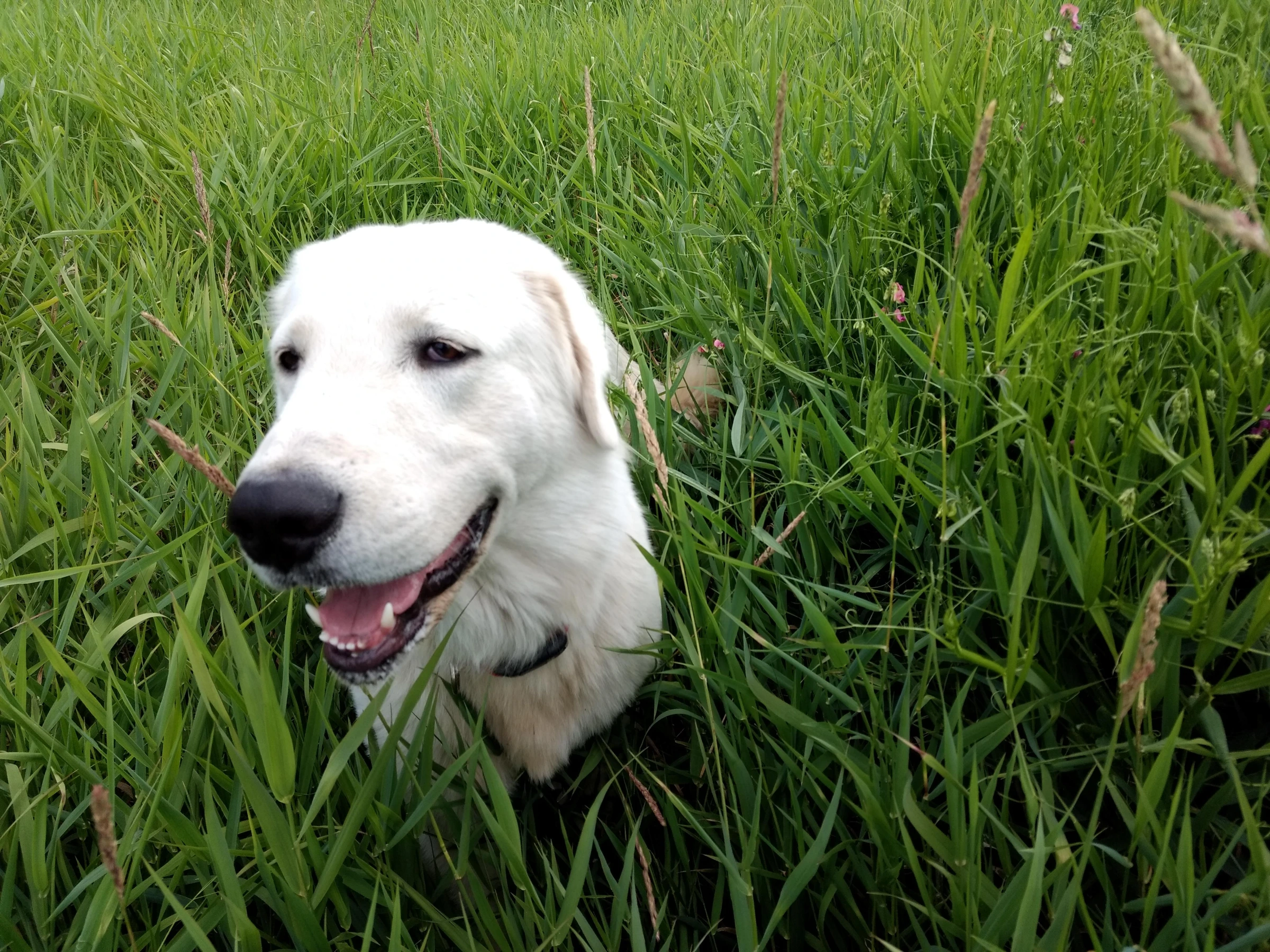
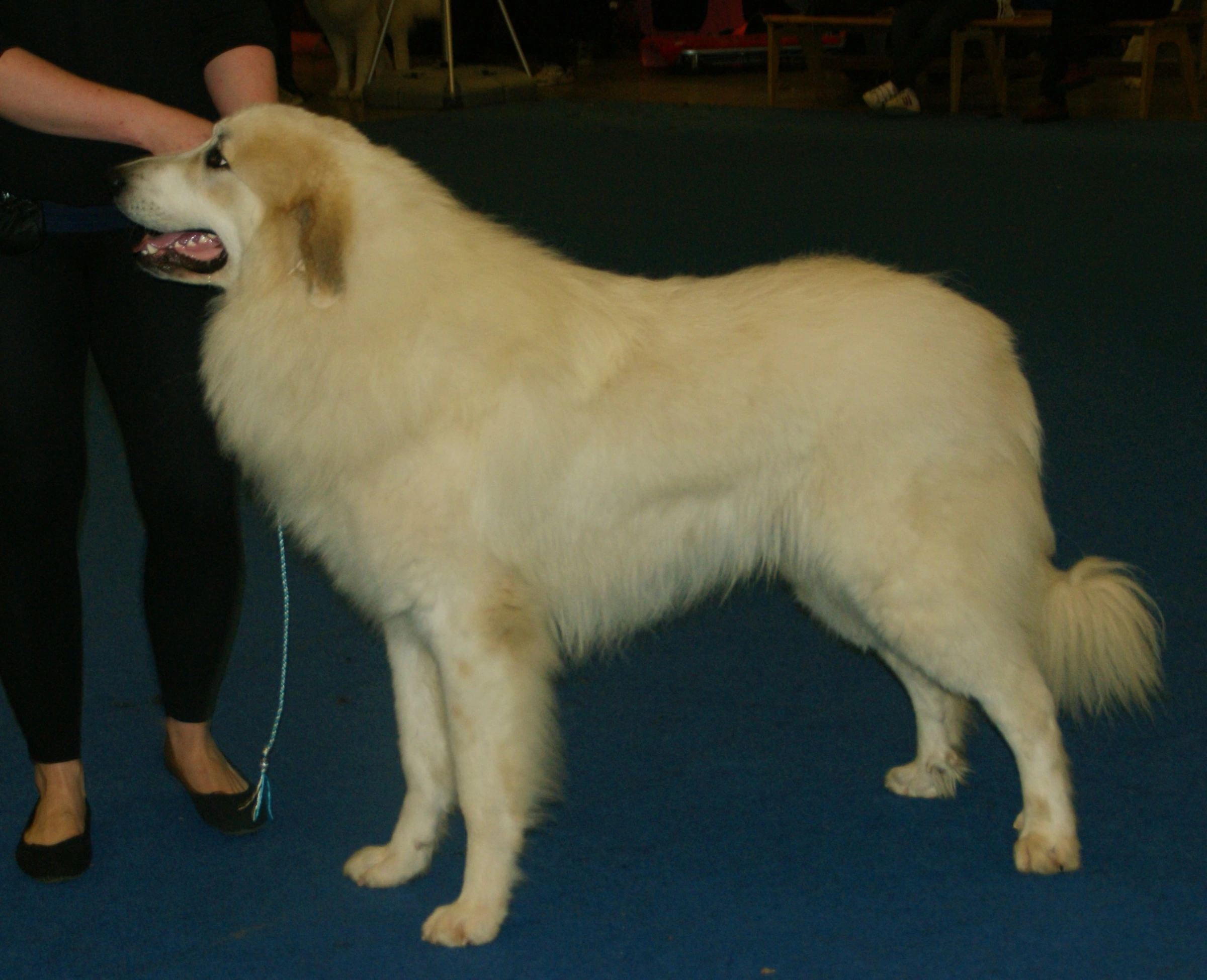
When comparing a Maremma with a Pyrenean Mountain Dog or another locally established guardian line, ask about the particular dog’s rearing, stock experience, health and behaviour around the people who will enter the pasture. Select with an experienced local livestock adviser. The photograph and breed name support identification, while working history and the actual holding determine suitability.
What the dog budget includes
The acquisition price depends on age, provenance, health, training and the specific contract. There is no verified current purchase quote for each of the six household breeds in this edition. Rather than assign them invented prices, keep acquisition as a named, unpriced line until the seller or adoption organisation supplies the details.
Checked acquisition example Original fee ARS comparison EUR comparison
Great Pyrenees Rescue Atlanta, dog under 1 year
USD 650 1,020,500 576.55
Same organisation, other dogsUSD 500 785,000 443.50
Units and terms
ARS Argentine peso · EUR Euro · USD United States dollar · US United States · EU European Union · kg kilogram, a mass unit · = equals · × multiplied by
Three jurisdictions, three separate checks (continued)
The US apprentice examination threshold is at least 80%, and the facility must be inspected before the permit is granted under the federal framework. Florida’s wildlife agency provides a practical example of the application and sponsor route. Those are examples of requirements, not a promise that every bird is available to every new permit holder. [F03, F04]
CITES documentation for protected species concerns lawful international trade; it is not a household pet licence. The gyrfalcon appears in the Appendix-I captive-breeding context in the cited CITES notification. Ask the management authority to verify the exact species or hybrid and the proposed transaction before paying a deposit. [F10]
1. Write a one-page proposal. State species, captive-bred source, keeper, address, purpose, intended movement and whether visitors will handle or watch the animal.
2. Obtain the applicable route. Use the competent wildlife and animal-health authorities for that location. Keep their response and the current application requirements with the proposal.
3. Complete facilities and competence. Arrange training, a specialist veterinarian, backup care and the required inspection before acquisition. Reconcile the bird’s identity across every document.
Three jurisdictions, three separate checks (continued)
Read the file as a chain of permissions
Document or record What it answers What it does not replace
Identity and breeding record Which animal and which recorded source?
Transfer and trade authority Is this transaction authorised where required?
Veterinary and movement documents
Does this animal meet the applicable movement conditions?
Current health or destination keeping permission.
Animal-health entry requirements.
Permission to hunt or display it.
Keeper and facility approval May this keeper use this facility for the approved activity?
A different species, address or commercial activity.
Use the same identifying details throughout the file. If a seller’s certificate, transport document and authority’s approval describe different birds or different recipients, resolve the mismatch before transfer. Keep expiry dates and limits visible. The issuing authority determines whether a particular document is applicable; a copied form from another country is not a substitute.
Units and terms
SENASA Servicio Nacional de Sanidad y Calidad Agroalimentaria · CITES Convention on International Trade in Endangered Species of Wild Fauna and Flora · US United States · % percent, parts per hundred
Sources for this account
US official CFR: 50 CFR part 21, including section 21.82, 2025 edition
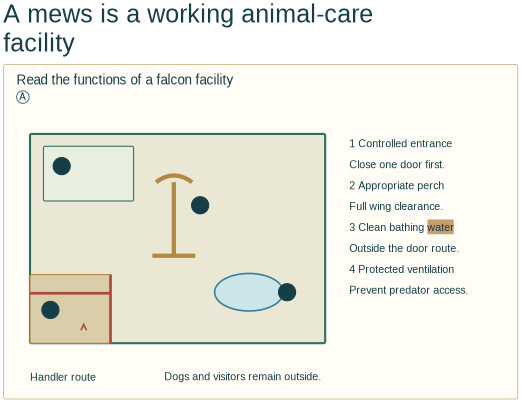
Concept only · dimensions, surfaces and perch type require the falconer and inspecting authority
A mews is housing used for falconry birds. The drawing shows functions, not universal dimensions or a permit-ready design. A competent falconer and the inspecting authority must match perch type, clearances, surfaces, ventilation, weather protection and bathing arrangements to the actual bird and local requirements.
Number Read the drawing Prepare and verify
1 Controlled entrance Two-stage access keeps an open exterior door from becoming a direct exit. Maintain a clear handler route.
2 Perch and movement space Position equipment so the bird does not strike walls or damage feathers during normal movement. The drawn perch is symbolic.
3 Bathing water Provide an appropriate clean container and a cleaning routine. Keep it clear of the door route.
A mews is a working animal-care facility (continued)
4 Protected ventilation Airflow and light must be compatible with confinement and predator exclusion. A window drawing is not a complete mesh or glazing specification.
A mews is a working animal-care facility (continued)
Count the equipment by function
For one bird, prepare a suitable weighing arrangement, transport container, bathing container, food-storage system, cleaning tools and identity/health record. The falconer specifies any glove, perches, tethering equipment or tracking system appropriate to the bird and method. Count replacements and maintenance; do not improvise a restraint from the appearance of a medieval picture.
The daily record
The keeper records the observations and measurements agreed with the trainer and veterinarian, feeding, cleaning, physical activity or training, weather exposure and any abnormal condition. This guide does not prescribe a target weight or fasting schedule. Food handling and veterinary advice belong to the actual bird. A named backup keeper and a transport plan are needed before the primary keeper travels.
Walk the route before an animal arrives
1. Enter with empty hands first. The keeper walks through both entrance stages and closes each door in sequence. Check that the other door, storage and cleaning equipment do not obstruct the movement. Practise this route without a bird before adding transport equipment.
2. Separate clean and used equipment. Assign a location for clean food containers, a different place for used cleaning equipment and a route for waste removal. Keep these functions outside the bird’s movement space. Ask the inspecting authority and veterinarian to review the actual surfaces and cleaning method.
3. Test the backup arrangement. The substitute keeper must be able to find the identity record, veterinarian’s contact, approved food supply and transport equipment. Walk through a realistic owner absence before acquisition. If nobody competent can cover the routine, the estate is not ready to keep the bird.
Some unusual animals can be kept lawfully by suitably equipped owners. There is no permission to keep “any exotic animal” just because an estate is large or a budget is high. Begin with a named species and decide whether its social, environmental and veterinary needs can be maintained for its whole life.
Choose an animal by its needs, not its price (continued)
Option A meaningful first decision
Domestic alpacas Consider a compatible group with other alpacas, forage, shelter, handling and local veterinary support. A lone ornamental alpaca is not the starting plan.
Koi in a contained ornamental pond
Price filtration, oxygenation, water testing, quarantine and backup power with the fish. Do not release them into natural waters.
Units and terms
US United States · ARS Argentine peso · USD United States dollar · EUR Euro · CITES Convention on International Trade in Endangered Species of Wild Fauna and Flora
Captive-bred parrots Resolve legal provenance, social needs, flight/physical activity space, noise and decades of care. A cage beside a guest room is not a complete plan.
Captive-bred tortoises Specify the species, lawful source, climate, enclosure and specialist veterinary care. Native or protected wild animals are not free collecting stock.
Large wild cats Do not treat a large enclosure as automatic eligibility. US federal law now prohibits new private pet ownership of the covered big cats, with limited statutory exceptions.
For the agricultural and mountain estate scenarios, a domestic alpaca group is a possible subject for a separate feasibility study, not an extra animal added to the existing forage account. Alpaca Canada’s guidance emphasises herd relationships and husbandry. Keep a compatible social group and an experienced local adviser involved. [E01]
For visitor-heavy courts, dock parcels and the runway estate, a visit to a licensed specialist facility is generally the more practical first experience. The estate pages state where unusual animals conflict with the actual use. Ownership is considered only after that conflict has been resolved.
From interest to a documented animal plan
1. Define the animal and purpose. Write the scientific name, intended number, social grouping, expected role and who will be responsible. A plan for three compatible domestic alpacas is different from a plan for a breeding herd or public animal encounters.
2. Check the site and permissions. Identify jurisdiction and property restrictions. Resolve wildlife, movement and animal-health requirements before booking transport. Keep the relevant authority’s answer with the plan.
3. Prepare care and backup. Find a veterinarian who works with the species, a competent primary keeper and a substitute. Specify routine supplies, handling arrangements and what happens during power loss, illness, evacuation or an owner’s absence.
4. Quote the complete system. Request written acquisition, transport, facilities and annual-care quotes. Record tax, delivery and exclusions. Price the whole social group, not one photographed animal. Keep current ARS, USD and EUR offers in separate country columns.
5. Check the identified individual. Reconcile the animal’s marks, papers and health record. A pedigree document is not necessarily an import permit, a CITES document or evidence of current health. Use the competent authority and veterinarian for their respective checks.
6. Keep the transfer and first-month record. Log arrival, identity checks, authorised separation or quarantine arrangements, feed acceptance, behaviour and veterinary follow-up. Do not introduce an animal to guests or existing stock simply to complete a photograph.
Cost scenario ARSUSDEUR
Written acquisition quotation Required Required Required
Units and terms
US United States · ARS Argentine peso · USD United States dollar · EUR Euro · CITES Convention on International Trade in Endangered Species of Wild Fauna and Flora
ARS Argentine peso · USD United States dollar · EUR Euro · EU European Union · ha hectare, 10,000 square metres · kg kilogram, a mass unit
Facility and transport quotation Required Required Required
Annual care and labour Required Required Required
Historical falcon record Comparison on preceding page
Decision Incomplete until the actual country, species and written offers are known
USD 466,666.67 conversion
Not a current EU offer
This table deliberately avoids invented prices for unspecified exotic animals. The offline ledger supports a real quote comparison and marks missing lines. A higher price cannot fill an absent permit, competent keeper or suitable habitat.
What may follow
Use the worked balance in this chapter. At its illustrative yield and utilisation, the 2 ha horse parcel falls short for two 500 kg horses by 2,800 kg of dry matter per year. The 4 ha cattle parcel is also marginal for two 500 kg cattle before calves, drought or extra loss.
The constraint that changes the answer
If the operating purpose is guest riding, buy suitable trained horses and staff the activity; do not substitute a breeding stallion because an auction average is available. If the purpose is livestock production, choose the cattle enterprise and its handling system. Running both requires the combined feed, land and labour ledger.
What to price and record
Use the dated price chapter for matching animal categories. Add this case’s fence and gate lengths, water equipment, feed storage, handling or transport equipment, veterinary arrangements and annual feed shortfall. Keep unquoted lines blank. Record actual care time, a backup keeper and the condition that would make you reduce the group. Before adding an animal, re-run the forage and annual-cost worksheet.
Units and terms
ARS Argentine peso · USD United States dollar · EUR Euro · EU European Union · ha hectare, 10,000 square metres · kg kilogram, a mass unit
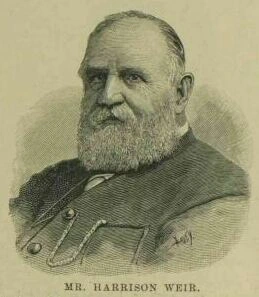
Harrison Weir: a drawing became a standard to argue about
Harrison Weir, pictured in The Illustrated London News, 14 May 1892. His own name identifies the portrait; the book author is credited separately.
Historical plate WEIRCAT. Page from Harrison Weir’s Our Cats and All About Them, 1889. Image identity and rights: I103-weircat.
Harrison Weir (1824–1906) worked as an animal artist and published Our Cats and All About Them in 1889. Museum Wales preserves a copy and describes its place in the history of the cat fancy. The reproduced page is a primary historical illustration; its standards and husbandry opinions must be read in their nineteenth-century setting.
A show standard makes features comparable: coat, head, ears, body and condition can be described rather than praised vaguely. But standardising a look does not prove that every selected feature benefits the animal. Modern welfare evidence raises questions that an attractive Victorian illustration cannot answer.
Units and terms
CFA Cat Fanciers' Association · TICA The International Cat Association · FIFe Fédération Internationale Féline
TICA The International Cat Association
Sources for this account
rice · Oryza sativa Blanco1.102.png
Rice in the illustrated Flora de Filipinas, late nineteenth century; grain-bearing panicle and plant parts
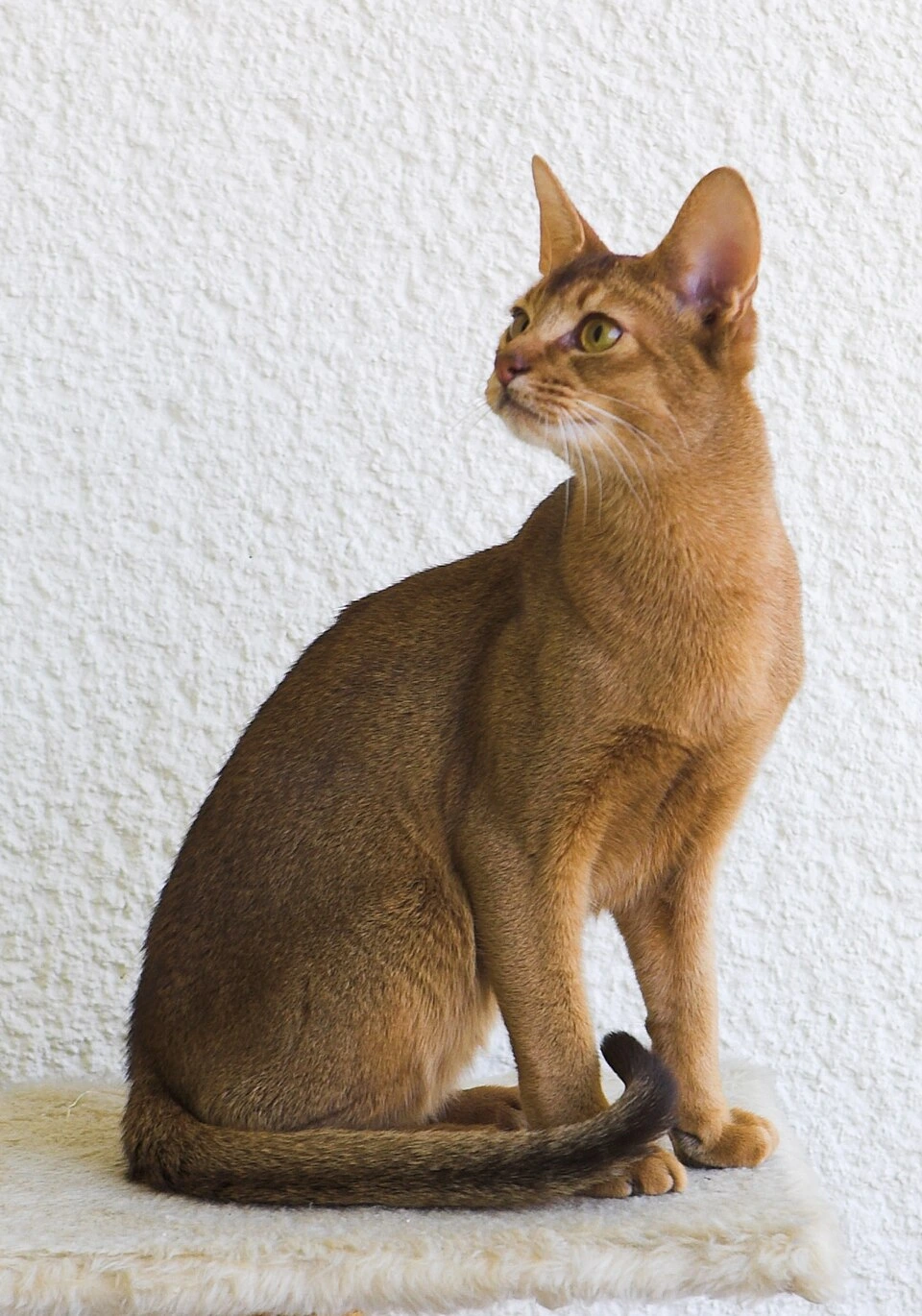
Cat breeds and variants: an alphabetical working directory
This edition reconciles 90 named catalogue entries, including separately listed coat/tail variants. Aliases are shown explicitly. TICA’s headline breed count and the number of displayed directory entries differ; do not turn this union into an official count for any one registry. Every entry uses the same life-stage nutrition principles in the feeding chapter.
The care column is a practical editorial grouping. It does not diagnose an individual or claim that all members have the same behaviour. Choose a vet-assessed animal with normal breathing and movement; review family screening appropriate to the breed. No entry earns a “rat-killer” rating.
Colour words such as tabby, calico and tortoiseshell do not name a single breed. A Bengal is not a tiger; a Toyger is not an exotic wild cat. For a hybrid-derived breed, verify the ancestry generation and local keeping/import rules separately from the registry name. The directory is a route to further assessment, not an import authorisation.
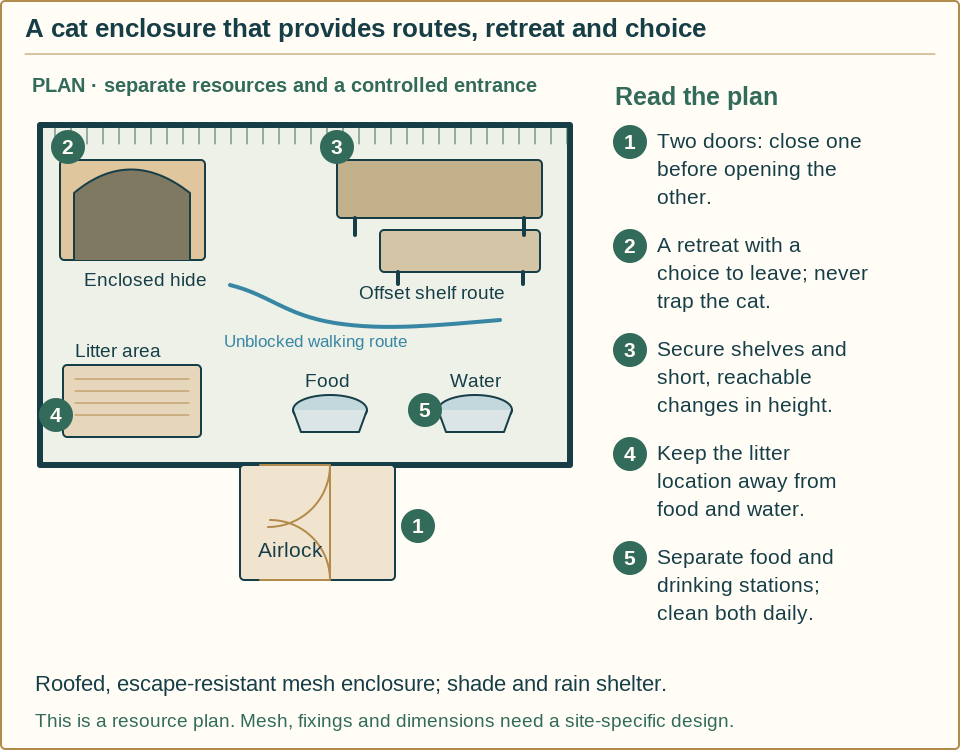
A cat enclosure that provides routes, retreat and choice
PLAN · separate resources and a controlled entrance
Airlock
1
Enclosed hide
2
3
Offset shelf route
Litter area
4
Food
Water
5
Unblocked walking route
Read the plan
Two doors: close one
before opening the
other.
A retreat with a
choice to leave; never
trap the cat.
Secure shelves and
short, reachable
changes in height.
Keep the litter
location away from
food and water.
Separate food and
drinking stations;
clean both daily.
Roofed, escape-resistant mesh enclosure; shade and rain shelter.
This is a resource plan. Mesh, fixings and dimensions need a site-specific design.
Household situation
Starting candidate
The test that matters
First-time quiet household
Calm adult domestic cat with known handling history.
Meet it, review medical history, and plan a quiet settling room.
People wanting two cats
An established compatible pair.
Enough separated resources; friendship is not guaranteed by buying two siblings.
Busy home with dogs
Cat already assessed around suitable dogs.
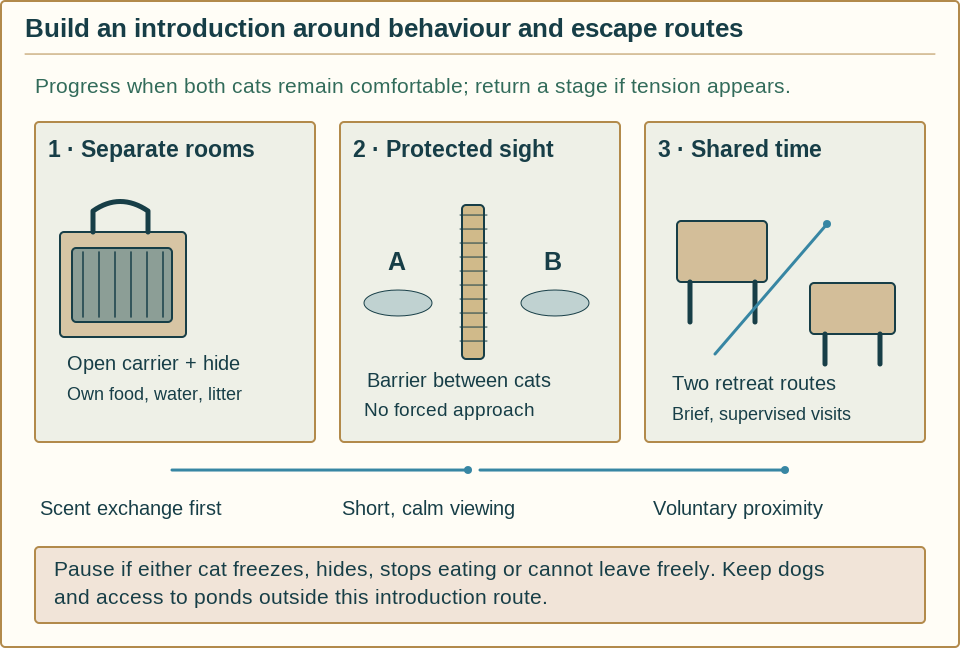
Dog control, barriers and elevated escape routes; no forced introduction.
Owner wanting an active pedigree
A healthy individual from a suitable active breed, with enrichment time available.
Can the household supply play, climbing, companionship and containment every day?
Owner with limited grooming time
A healthy short-coated individual.
Short hair does not remove dental, weight, litter or veterinary care.
Senior household or senior cat
Calm compatible adult/senior with accessible resources.
Steps, low-entry trays, pain assessment and a predictable routine.
A larger estate does not automatically justify more cats. Begin with one suitable cat or a compatible pair. Add another only after observing social compatibility and confirming that there is space, time, finance and separation capacity. The limit is the ability to provide good lives, not hectares divided by an arbitrary number.
Cats may catch mice, small rodents, birds, reptiles and invertebrates, but individual hunting behaviour varies. There is no responsible breed table promising that a Maine Coon removes large rats or a Siamese clears a barn. Releasing more cats can harm wildlife without solving the original food-and-shelter problem.
Parsons and colleagues observed cats and Norway rats at an urban site in 2018. Their study found very limited observed predation and changes in rat space use. It was one field study, not a claim that no cat ever catches a rat. It does show why “there are cats here” is not adequate evidence that an infestation is controlled.
1. Remove access to feed
Store grain and pet food in sound closed containers; clean spills; protect waste; repair leaks. Keep feeding stations away from the secure food store.
2. Inspect the building
Check doors, vents and service entries. CDC notes that mice can pass through gaps around 6 mm wide. Use durable, appropriately installed exclusion materials; preserve necessary ventilation and fire safety.
3. Monitor and control
Use a dated inspection map and suitable protected traps placed by a competent person where cats, dogs and children cannot reach them. Coordinate any rodenticide use with a professional because poisoned rodents can expose other animals.
4. Measure success
Record droppings, gnawing, trap captures and new entry points over time. A cat sitting in the yard is not the measurement.
The cat’s food allowance must never be cut to make it hunt. Hunting does not supply a balanced ration and can expose the animal to parasites, injury and poisons. Keep routine parasite prevention and veterinary advice appropriate to the actual exposure.
Units and terms
mm millimetre, 0.001 metre
% percent, parts per hundred · g gram, 0.001 kilogram · = equals · ÷ divided by
A cat diet begins with a complete food, not a breed recipe
Read the illustration’s labels
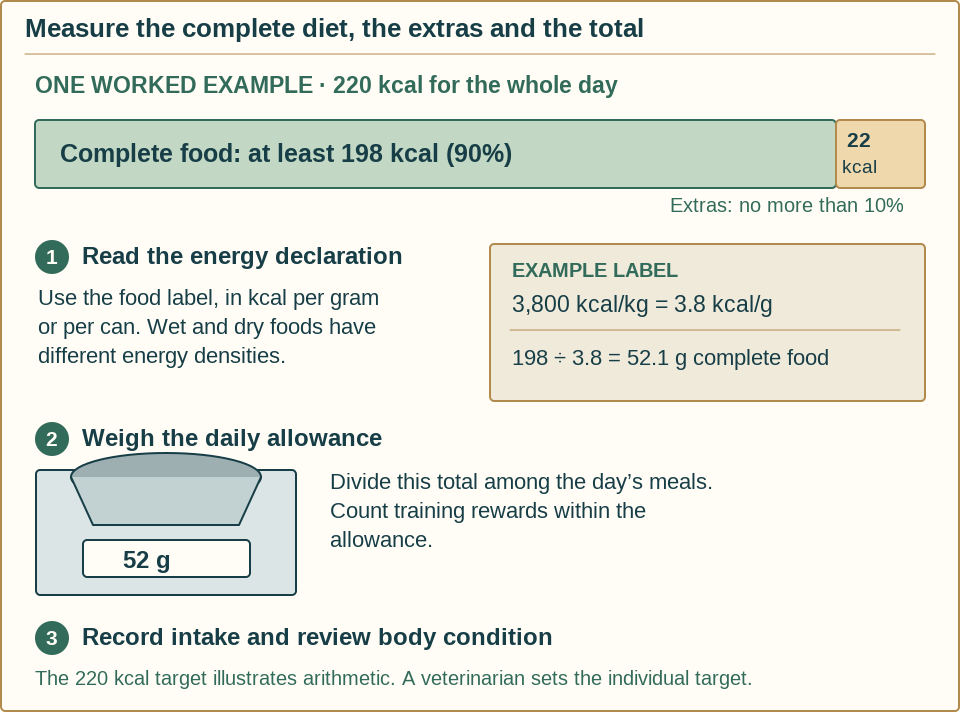
Measure the complete diet, the extras and the total
ONE WORKED EXAMPLE · 220 kcal for the whole day
Complete food: at least 198 kcal (90%)
22
kcal
Extras: no more than 10%
1
Read the energy declaration
Use the food label, in kcal per gram
or per can. Wet and dry foods have
different energy densities.
EXAMPLE LABEL
3,800 kcal/kg = 3.8 kcal/g
198 ÷ 3.8 = 52.1 g complete food
2
Weigh the daily allowance
52 g
Divide this total among the day’s meals.
Count training rewards within the
allowance.
3
Record intake and review body condition
The 220 kcal target illustrates arithmetic. A veterinarian sets the individual target.
Cats are obligate carnivores with specific nutrient needs. A complete food appropriate to the life stage can be wet, dry or a compatible mixture. Muscle meat alone is not nutritionally complete. A home-cooked staple diet requires a qualified veterinary nutrition formulation, including its exact ingredients and supplements; “meat plus vegetables” is not a substitute.
Breed matters indirectly through body size, coat-related grooming, inherited conditions and the individual’s activity. It does not establish a different safe-fruit list for every pedigree. Use the veterinarian’s calorie target, body-condition assessment and the product’s energy density. Kidney disease, urinary disease, diabetes, allergies, pregnancy and growth can require a different diet.
Food
How it can fit
What to avoid
Complete wet cat food
Check the life-stage adequacy label and kcal per pouch/can.
Do not confuse complementary treats with a complete staple.
Complete dry cat food / kibble
Weigh the portion in grams; supply fresh water.
A cup is imprecise; a dog-food label is not a cat-food specification.
Plain cooked chicken or turkey
Small boneless, unseasoned extras within the daily calorie allowance.
Raw poultry, skin/fat-heavy scraps, bones, sauces and onion/garlic seasoning.
Plain cooked lean beef
Small boneless pieces if tolerated.
A whole-meat daily diet or salty cured meats.
Cooked fish
Occasional boneless, unseasoned extra.
Raw fish, bones, or tuna as the sole diet.
Cooked egg
A small fully cooked unseasoned extra if tolerated.
Raw egg and replacing balanced meals with eggs.
Units and terms
% percent, parts per hundred · g gram, 0.001 kilogram · = equals · ÷ divided by
Review portion size after neutering and changes in activity.
Short play, food puzzles, voluntary carrier entry and calm handling.
Mature adult, 7–10 years
Watch weight, dental health and changes in movement or drinking.
Keep familiar skills; adjust shelf heights and play intensity.
Senior, over 10 years
More individual monitoring; easy access to food, water and litter.
Gentle predictable routines, low steps and comfortable retreats.
End of life, any age
Veterinary comfort and quality-of-life plan.
Choice, familiarity and reduced demands; no performance expectation.
A practical training session can last one or two minutes: mark the behaviour you want, give a small reward from the measured food allowance, then stop while the cat is comfortable. For carrier training, first reward looking toward the carrier, then approaching, then entering. Close the door only after the open carrier has become a safe place. Progress follows relaxed behaviour, not a fixed birthday.
Never punish toileting changes or reluctance to jump as disobedience. Pain, urinary disease and stress can change behaviour. Sudden inability to pass urine, breathing difficulty or collapse needs urgent veterinary assessment; the training record does not replace care.
Units and terms
ARS Argentine peso · kg kilogram, a mass unit · g gram, 0.001 kilogram · USD United States dollar · EUR Euro
A retailer observation gives one real price anchor: Puppis lists Excellent adult chicken/ricecat food, 7.5 kg, at ARS 70,100 in the retrieved listing. This is one product and package, not a recommendation for every cat. At an assumed 52 g/day, yearly dry-food use would be 18.98 kg; buying three 7.5 kgbags costs ARS 210,300 and leaves nominal inventory. The mixed wet/dry plan requires a separate wet-food line.
One-cat setup allowance, before the animal and veterinary care
Item / quantity
ARS
USD equivalent
EUR equivalent
Carrier, allowance
55,000
35.03
31.07
2 litter trays and scoop, allowance
45,000
28.66
25.42
Scratch post and hide, allowance
70,000
44.59
39.55
Bowls, scale and basic toys, allowance
40,000
25.48
22.60
Subtotal
210,000
133.76
118.64
Planning figures authored 15 November 2026, not supplier offers. USD = ARS ÷ 1,570; EUR = ARS ÷ 1,770. BNA selling rates dated 13 November 2026. Conversions do not represent US/EU retail prices. Tax, delivery and unpriced labour must be entered separately. A103-FX.
Recurring item
Editable budget allowance
How to replace it
Behaviour consultation / training help
ARS 40,000–100,000 per session; USD25.48–63.69 / EUR 22.60–56.50 equivalents
Authored reserve, not a market survey. Request method, duration, qualifications and follow-up in writing.
Litter, cleaning and replacement toys
ARS 15,000–35,000 per month; USD9.55–22.29 / EUR 8.47–19.77
Price actual package sizes and measured use.
Veterinary routine and emergency care
Quote required; no invented all-in price
Ask for examination, vaccination, neutering, parasite care and emergency arrangements separately.
Adoption or breeder purchase
Quote required; local supply and animal condition vary
Do not create a price table for rare breeds from unverified advertisements.
A professional should teach humane, reward-based handling and investigate medical causes of behaviour changes. Do not pay for a promise to make a cat hunt rats, fight wildlife or tolerate frightening forced introductions. Ask whether the work is a veterinary behavioural assessment or a trainer’s coaching service; they are different services.
Units and terms
ARS Argentine peso · kg kilogram, a mass unit · g gram, 0.001 kilogram · USD United States dollar · EUR Euro
ARS Argentine peso · USD United States dollar · EUR Euro · BNA Banco de la Nación Argentina · = equals · ÷ divided by
Sources for this account
Banco Nación: retail banknote selling rates, 13 November 2026
P1 Source investigation and supply: $30.0k-150.0k P2 Storage allowance, assumed 20 m3: $6.0k-16.0k P3 Treatment allowance: $20.0k-100.0k P4 Wastewater completion allowance: $20.0k-100.0k P5 Estate distribution and communications: $80.0k-240.0k P6 Fire-service water provision: $40.0k-150.0k P7 Site drainage beyond priced roads: $40.0k-150.0k
Forest access before luxury finishes
The long service route links animals, food growing and accommodation. Keep manure, workshop deliveries and visitors on distinct daily routes. The image shows only one obvious entrance; a site review must test emergency access and wildfire evacuation.
Day and night responsibilities
Day: inspect access and water/energy alarms; handle deliveries; separate food, livestock and waste routes; complete scheduled maintenance. Night: check routes and gate release; shield lights; secure service areas; assign emergency contacts. This is not a 24-hour staffed security commitment.
Open prices: No additional labelled feature is unpriced, but the global exclusions still apply.
Forest-Edge Estate: Argentine Pesos
Retained scenario conversion
The original worksheet used ARS 1,540 per USD. ARS means Argentine peso and USD means United States dollar. All amounts in this table are millions of pesos, including annual care. These are dated planning allowances, not a current market quotation.
Component
Build / ARS million
Care / ARS million per year
1. Security gate
30.800 to 92.400
0.616 to 3.696
2. Gate-side cabin
92.400 to 184.800
0.924 to 3.696
3. Perimeter wall
277.200 to 831.600
1.386 to 12.474
4. Internal access road
431.200 to 862.400
4.312 to 21.560
5. Utility workshop
415.800 to 831.600
4.158 to 20.790
6. Service vehicles and yard
123.200 to 385.000
6.160 to 38.500
7. Equestrian barn and pen
323.400 to 808.500
4.851 to 24.255
8. Roof solar panels
92.400 to 161.700
0.924 to 3.234
9. Livestock barn
147.840 to 369.600
2.218 to 11.088
10. Poultry coop and run
30.800 to 86.240
0.616 to 3.450
11. Fruit orchard
11.550 to 30.800
0.462 to 2.464
12. Vegetable gardens
30.800 to 92.400
1.232 to 7.392
13. Greenhouse complex
115.500 to 385.000
2.310 to 15.400
14. Guest houses
2,310.000 to 4,620.000
23.100 to 92.400
15. Main lodge
2,695.000 to 5,390.000
26.950 to 107.800
16. Terraces and connecting paths
43.120 to 107.800
0.431 to 2.695
17. Forest edge and planted grounds
46.200 to 154.000
1.848 to 12.320
BUILD ENVELOPE ARS M 10,385.490 to 26,862.528 ANNUAL FUND ARS M 673.773 to 1,745.005
Totals include service/fee/contingency or staffing/reserve allowances beyond the rows. Unpriced items remain excluded.
Units and terms
k (currency) thousand, 1,000 of the stated currency · m (currency) million, 1,000,000 of the stated currency
ARS Argentine peso
BY-SA Creative Commons Attribution-ShareAlike
Sources for this account
open source P2 · open source Chapter contents Continue reading
01. Forest-Edge Estate: animals, feeding and daily care
Standard Schnauzer: a distinct documented breed photograph for estate 01. The individual shown is not offered for sale or certified as a trained guard. LoProject09 · 2025-06-29 16:43:00 · CC BY-SA 4.0.
Standard Schnauzer · household alert
Starting number: 1 household dog; 0 livestock guardians initially. Keep the dog inside the home-and-service fence; leave the woodland outside its patrol area.
Starting livestock: 6 laying hens initially; 0 cattle; 0 horses. A forest edge needs a wildlife boundary, not dogs allowed to patrol the woodland. Put a roofed, predator-resistant poultry run near the daily service route. Keep feed in sealed storage and clear spilled grain. A domestic dog belongs behind a separate fence when it has not been trained around birds.
Set up before arrival
1. Make the route work.
Walk the forest fence with the handler and photograph gaps, fallen branches and wildlife access. Repair the boundary before the dog arrives.
2. Prepare one complete kit.
Use the illustrated one-dog kit: two bowls, fitted harness and lead, fitted transport crate, dry bed, identity and veterinary record. Specify two secure gates for the entrance routine where the site layout permits it. Measure fence length and openings on site; no generic metre quantity is claimed.
3. Test the normal day.
Walk deliveries, household departures and cleaning through the plan. Put the dog in its quiet refuge before a visitor enters. Introduce known people and animals gradually with a competent handler; stop and reassess if the individual dog is distressed or chasing livestock.
Read the illustration’s labels
Recall on the home side of the forest fence
Site-specific teaching drawing • use the numbered explanation in the lesson
WOODLAND • outside the home enclosure
HOUSE
Shade + rest
Hens
Arrival
1
2
4
3
ESTATE 01
READ THE NUMBERS
1 Keeper at the house
2 Shaded home refuge
3 Two-stage arrival
4 Separate poultry run
REHEARSE THE ROUTE
Walk inside the fence.
Return toward the
house.
Wildlife stays outside.
TAKE ON THE SITE WALK
Gate checklist • harness and lead • wildlife-gap record
Original care-route schematic • not a survey, measured plan or security guarantee
Read the numbered drawing
The keeper starts at 1, walks the inner fence route and returns to the shaded refuge at 2. Visitors enter through the two closed-in-turn gates at 3. The poultry run at 4 has its own service approach; the woodland beyond the boundary is not the dog’s physical activity ground.
Livestock and a second phase
A small enclosed flock of 4 sheep is a possible second phase only after a forage and parasite plan. A Maremma or Pyrenean guardian can be considered for that flock after a local predator assessment and a supervised introduction. Do not buy a puppy expecting immediate protection. If the stated sheep phase goes ahead, assess one properly reared Maremma-type livestock guardian with the flock adviser. The household dog remains separate. A second guardian needs a demonstrated workload and compatible working team, not a fixed dog-per-hectare rule.
The earlier 80 m²poultry area, 0.5 ha orchard and 1,000 m² vegetable plot are scenario inputs. They do not establish feed supply for cattle or horses. Exclude goats from young trees and fence the orchard before any grazing trial.
A recall away from the woodland
Start in the enclosed garden with no wildlife visible. Reward a turn toward the keeper, then a short return. On later walks keep a long line on the harness and practise before the dog fixes on a scent. The forest fence remains closed even after the cue improves.
Meals and rewards on this site
Weigh the daily allowance before walks and put the training portion in a separate pouch. Every person who rewards the dog draws from that pouch; biscuits from several workers otherwise disappear from the food record.
Care for the other animals
The six-hen start needs a locked night house, complete layer feed and its own water. The possible four-sheep phase needs a forage account before purchase. The guardian, if later justified, eats complete dog food at a station that sheep cannot enter.
Training purchase and care budget
Use 6 visits as this scenario’s initial purchasing allowance, then review progress with the trainer. It is an editorial allowance, not a forecast of treatment duration. The agenda above gives the trainer a specific route to inspect.
Training purchase example
Local amount
Currency comparison
Argentina · 6 individual visits
ARS 250,000
USD 159.24 / EUR 141.24
US · 6 private hours
USD 437
ARS 686,090 / EUR 387.62
Madrid · 6 sessions
EUR 360
ARS 637,200 / USD 405.86
Observed 15 November 2026. Services and session lengths differ; see “What a trainer costs” for package arithmetic, locations and exclusions. Add the actual dog’s food forecast, veterinary care, grooming, gates, refuge, transport and keeper time. Missing quotes stay visible in the offline ledger; the training subtotal is not the annual total.
Falcons or other unusual animals here
No falcon beside the poultry run. A later specialist bird facility needs a separate controlled area and handler; the forest edge is not a release site.
The cat belongs to this estate too
1 assessed adult, or 2 already-compatible cats. Choose temperament, health and tolerance of this household rather than buying a pedigree as a pest-control guarantee. Forest-edge wildlife and ticks: enclosed outside access; no hunting release.
Provide one carrier, two litter trays for one cat, separate food and water points, a scratching surface and a quiet hide. For two compatible cats, provide at least three trays and separated resources. Keep dog introductions controlled; protect chicks, small livestock and fish behind suitable barriers.
Feeding at this property
Use complete cat food for the life stage: wet, dry kibble or a measured combination. Plain cooked boneless chicken, turkey, lean beef, fish or egg can be small extras; muscle meat alone is not a balanced staple. Tiny plain pumpkin, carrot, peas or green beans, or seedless apple/melon flesh, are optional if tolerated. Do not offer alliums, grapes, raisins, chocolate, alcohol, bones or seasoned scraps.
There is no safe-fruit list unique to a breed. Set calories from this individual’s veterinary assessment and the actual food label. The worked adult example in the common feeding guide allocates 75 g wet food morning and evening plus 20 g dry, using assumed 0.9 and 3.8 kcal/g: 211 kcal, leaving 9 kcal within a 220 kcal plan. Replace these assumed values before feeding; kittens, nursing or ill cats need a different plan.
Care from arrival through old age
Before arrival, agree the main carer and backup. For kittens or puppies, follow the veterinarian’s growth and vaccination plan and introduce handling gently. Use brief reward-based sessions for carrier, lead or harness, recall and settling. Adult routines include daily appetite, water, toilet and behaviour checks. In old age, lower difficult routes, review pain or mobility changes and reassess diet with the veterinarian.
Authored reserves, 15 November 2026, not quotes. Exchange basis: ARS 1,570/USD and ARS 1,770/EUR. Food, veterinary care, enclosure work, animal purchase/adoption and delivery remain separate. The preceding dog table records the site’s dog-coaching scenario; do not silently add cat reserves as quoted services.
Keep rodent control based on sealed feed, cleaned spills, excluded entry and monitored traps inaccessible to animals. A cat may hunt small prey but is not a reliable or safe solution for a wild-rat infestation. Any falcon or other regulated wildlife needs a separately lawful, specialist facility; the estate’s food and pet routes do not become a release area.
Units and terms
BY-SA Creative Commons Attribution-ShareAlike
m² square metre, an area unit · ha hectare, 10,000 square metres · ARS Argentine peso · USD United States dollar · EUR Euro · US United States
g gram, 0.001 kilogram · ARS Argentine peso · USD United States dollar · EUR Euro
02. Formal Courtyard Estate: animals, feeding and daily care
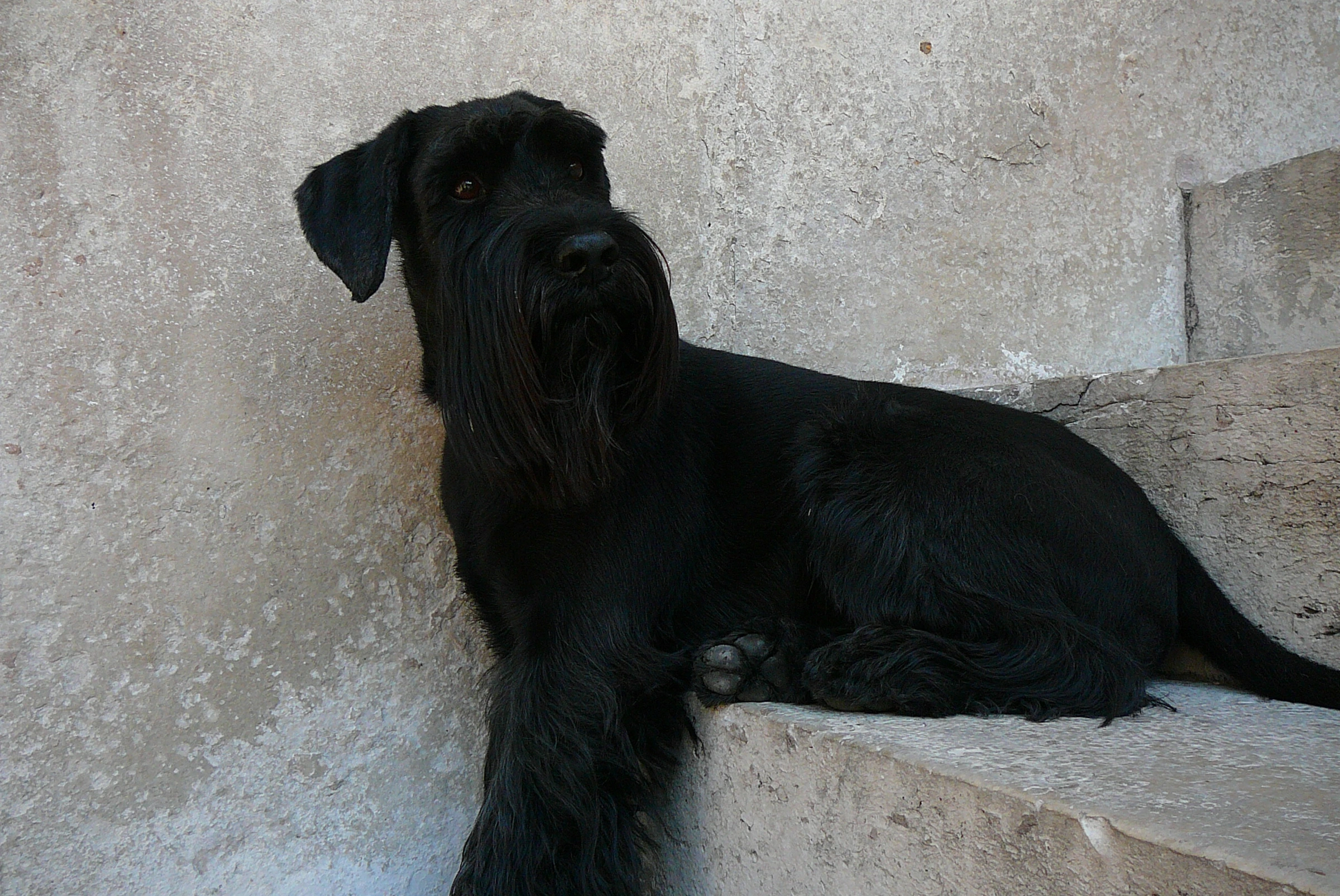
Standard Schnauzer: a distinct documented breed photograph for estate 02. The individual shown is not offered for sale or certified as a trained guard. Arthur Pons · 2012-08-14 · CC BY-SA 3.0.
Standard Schnauzer · household alert
Starting number: 1 household dog; 0 livestock guardians initially. Use a quiet side-room or enclosed garden during deliveries, dining and public courtyard visits.
Starting livestock: 0 grazing livestock; optionally 4 hens in a separate service garden. Use gates, lighting and a named visitor route for the courtyard. A calm adult dog with a known history around visitors may alert the household, but it should have a quiet retreat and a handler. Keep it out of the public entrance during deliveries.
Set up before arrival
1. Make the route work.
Rehearse the arrival routine without the dog: close the inner gate, admit the visitor, then release the dog only under its handler’s control.
2. Prepare one complete kit.
Use the illustrated one-dog kit: two bowls, fitted harness and lead, fitted transport crate, dry bed, identity and veterinary record. Specify two secure gates for the entrance routine where the site layout permits it. Measure fence length and openings on site; no generic metre quantity is claimed.
3. Test the normal day.
Walk deliveries, household departures and cleaning through the plan. Put the dog in its quiet refuge before a visitor enters. Introduce known people and animals gradually with a competent handler; stop and reassess if the individual dog is distressed or chasing livestock.
Read the illustration’s labels
Let guests cross the court while the dog rests
Site-specific teaching drawing • use the numbered explanation in the lesson
HOUSEHOLD
ARCADE
GUEST WING
PUBLIC COURT
Rest
Kitchen
delivery
Dog rests in side-room before guests enter.
1
2
3
4
ESTATE 02
READ THE NUMBERS
1 Household rooms
2 Quiet side-room
3 Entrance vestibule
4 Kitchen service route
REHEARSE THE ROUTE
Settle before arrival.
Guests follow the
arcade.
Keep food service
separate.
TAKE ON THE SITE WALK
Resting mat • reward portion • delivery rehearsal log
Original care-route schematic • not a survey, measured plan or security guarantee
Read the numbered drawing
Read the plan as a courtyard with four wings. The household is 1 and the quiet side-room is 2. The dog rests behind that room’s barrier while a visitor passes through vestibule 3 into the public court. Kitchen deliveries use service route 4 instead of crossing the refuge.
Livestock and a second phase
Hens belong beyond the guest court in a secure run with washable equipment. Add no cattle or horses unless a separately measured farm parcel, daily stock worker and manure route are part of the estate. No livestock guardian is included in this starting plan. Adding cattle, horses or decorative grounds does not automatically create a guardian-dog requirement.
An attractive enclosed court is not a paddock. Repeated hard surfaces, flower beds and kitchens create conflict with roaming birds, manure and dog traffic. Count cleaning and supervision as daily work.
A settled dog during courtyard arrivals
Place the mat in the side room while the court is empty. Reward quiet resting; next have one familiar helper approach the outer gate. Keep the inner barrier shut. Rehearse a delivery with an empty trolley before adding a real guest or meal service.
Meals and rewards on this site
Keep the feeding station behind the household gate and clear all dining scraps. Record treats given by visitors or staff. A Schnauzer does not need a special vegetable mixture: small plain carrot or green-bean pieces are optional within its agreed allowance.
Care for the other animals
Start with no grazing animals. Ornamental planting is not pasture. If hens are later proposed, first find a separate washable service route and resolve noise, pests and local permission; do not put a coop inside the dining court.
Training purchase and care budget
Use 4 visits as this scenario’s initial purchasing allowance, then review progress with the trainer. It is an editorial allowance, not a forecast of treatment duration. The agenda above gives the trainer a specific route to inspect.
Training purchase example
Local amount
Currency comparison
Argentina · 4 individual visits
ARS 160,000
USD 101.91 / EUR 90.40
US · 4 private hours
USD 259
ARS 406,630 / EUR 229.73
Madrid · 4 sessions
EUR 230
ARS 407,100 / USD 259.30
Falcons or other unusual animals here
A public courtyard is a poor place for a privately kept raptor. Begin with a visit to a licensed falconry establishment, not a display bird at dinner.
The cat belongs to this estate too
1 assessed adult, or 2 already-compatible cats. Choose temperament, health and tolerance of this household rather than buying a pedigree as a pest-control guarantee. Use a quiet indoor room off the courtyard; prevent access to roofs and neighbouring properties.
Feeding at this property
Serve the measured ration in the quiet room off the courtyard, with the door protected from dogs and visiting children. Store the food there, rather than at an outdoor ornamental feeding point. A second cat needs a separate place to eat without being watched or blocked by the first.
Care from arrival through old age
Introduce the courtyard view from the secure room before allowing access to a roofed enclosure. Keep the carrier available for calm handling. As mobility changes, move essential resources onto the same level; the route to food or a litter tray should not require a jump over the courtyard threshold.
Authored reserves, 15 November 2026, not quotes. Exchange basis: ARS 1,570/USD and ARS 1,770/EUR. Food, veterinary care, enclosure work, animal purchase/adoption and delivery remain separate. The preceding dog table records the site’s dog-coaching scenario; do not silently add cat reserves as quoted services.
Units and terms
ARS Argentine peso · BY-SA Creative Commons Attribution-ShareAlike
ARS Argentine peso · USD United States dollar · EUR Euro · US United States
ARS Argentine peso · USD United States dollar · EUR Euro
03. Axial Estate and Growing Grid: animals, feeding and daily care
German Shepherd Dog: a distinct documented breed photograph for estate 03. The individual shown is not offered for sale or certified as a trained guard. Hans Kemperman · 2014-03-30 · CC0.
German Shepherd Dog · household alert
Starting number: 1 household dog; 0 livestock guardians initially. Keep the central crop axis open to harvest carts; put the dog’s home zone beside the staffed service building.
Starting livestock: 8 hens; later up to 6 sheep only with suitable separate forage; 0 horses or cattle initially. The axis should remain a route for people, harvests and emergency access. Place poultry housing in a side service bay. Use hens in a fenced rotation after harvest, not among crops being collected for eating.
Set up before arrival
1. Make the route work.
Practise a leash route from the refuge to a physical activity area that does not pass through poultry or ready-to-harvest beds.
2. Prepare one complete kit.
Use the illustrated one-dog kit: two bowls, fitted harness and lead, fitted transport crate, dry bed, identity and veterinary record. Specify two secure gates for the entrance routine where the site layout permits it. Measure fence length and openings on site; no generic metre quantity is claimed.
3. Test the normal day.
Walk deliveries, household departures and cleaning through the plan. Put the dog in its quiet refuge before a visitor enters. Introduce known people and animals gradually with a competent handler; stop and reassess if the individual dog is distressed or chasing livestock.
Read the illustration’s labels
Keep the harvest axis clear
Site-specific teaching drawing • use the numbered explanation in the lesson
Harvest axis
SERVICE HOUSE
Shade + rest
COOP
Hen run
Vegetables and poultry occupy separate blocks.
1
2
3
4
ESTATE 03
READ THE NUMBERS
1 Staffed service house
2 Fenced dog yard
3 Controlled side entry
4 Hen service bay
REHEARSE THE ROUTE
Harvest carts use the
axis.
Walk along the side
lane.
No chasing through
crops.
TAKE ON THE SITE WALK
Lead and harness • crop-route record • hen-run latch check
Original care-route schematic • not a survey, measured plan or security guarantee
Read the numbered drawing
The long central arrow is the harvest-cart route. The keeper works from service house 1; dog yard 2 is reached from the side lane. Entry 3 avoids the crop beds. Hen service bay 4 is separately fenced, so neither the dog nor loose poultry interrupts the harvest route.
Livestock and a second phase
If sheep are added, give them their own paddocks, handling pen and water supply. Assess whether 1 trained guardian is useful; a second dog is an individual risk and working-team decision, not an automatic doubling of protection. If the stated sheep phase goes ahead, assess one properly reared Maremma-type livestock guardian with the flock adviser. The household dog remains separate. A second guardian needs a demonstrated workload and compatible working team, not a fixed dog-per-hectare rule.
Separate the vegetable area from pasture in the land ledger. Crop residues are variable feed, not a complete ration. Record every feed purchase and do not credit the same hectare to crops and livestock simultaneously.
Walking past crops without chasing
Walk parallel to an empty crop row at an easy distance. Reward attention to the handler and a loose lead. Introduce a stationary harvest cart before any moving helper. Stock stay behind a second fence; a dog that chases is removed from the rehearsal and reviewed with the trainer.
Meals and rewards on this site
Keep feed away from fertiliser, seed treatments and produce storage. For a growing German Shepherd, ask for an appropriate large-dog growth diet; do not add calcium to make a puppy grow faster. An adult yard dog still needs measured meals.
Care for the other animals
Eight hens are the opening flock. Keep their feed separate from the household dog. Six sheep are a later alternative only with adequate grazing, handling and winter feed; the crop grid shown in an image establishes none of those capacities.
Training purchase and care budget
Training purchase example
Local amount
Currency comparison
Argentina · 6 individual visits
ARS 250,000
USD 159.24 / EUR 141.24
US · 6 private hours
USD 437
ARS 686,090 / EUR 387.62
Madrid · 6 sessions
EUR 360
ARS 637,200 / USD 405.86
Falcons or other unusual animals here
A falcon facility would need its own route outside the food-production grid; no free-roaming exotic animals among the crops.
The cat belongs to this estate too
1 assessed adult, or 2 already-compatible cats. Choose temperament, health and tolerance of this household rather than buying a pedigree as a pest-control guarantee. Keep cats out of the seedling house and feed store; protect growing beds and machinery routes.
Feeding at this property
The seedling house and agricultural feed store are unsuitable feeding stations. Measure the cat's complete food at the household service point and carry it to a clean indoor station. Keep pet-food utensils apart from crop chemicals, seed treatments and livestock rations; record which worker has already fed the cat.
Care from arrival through old age
A new cat first settles behind the household boundary, away from moving carts and growing beds. Keep veterinary transport on the service route without opening the cat enclosure onto the central axis. Older cats need nearby resting and toileting places, not a daily crossing of the working grid.
Authored reserves, 15 November 2026, not quotes. Exchange basis: ARS 1,570/USD and ARS 1,770/EUR. Food, veterinary care, enclosure work, animal purchase/adoption and delivery remain separate. The preceding dog table records the site’s dog-coaching scenario; do not silently add cat reserves as quoted services.
Units and terms
ARS Argentine peso · CC0 Creative Commons Zero, a public-domain dedication tool
ARS Argentine peso · USD United States dollar · EUR Euro · US United States
ARS Argentine peso · USD United States dollar · EUR Euro
04. Lakeside Mixed-Use Estate: animals, feeding and daily care
Labrador Retriever: a distinct documented breed photograph for estate 04. The individual shown is not offered for sale or certified as a trained guard. Skansken · 2009-03-17 · CC BY 3.0.
Labrador Retriever · household companion
Starting number: 1 household dog; 0 livestock guardians initially. Fence the household dog away from boats, livestockwater points and the shore buffer.
Starting livestock: 6 hens away from the shore; 0 cattle and horses initially. Protect the lake edge with a fence and a vegetated buffer chosen for the site. Supply drinking water in troughs on firm ground. Do not use unlimited access to the lake as the stock-watering plan.
Set up before arrival
1. Make the route work.
Inspect the water boundary from the dog’s side. Check gates after boat deliveries, and provide clean drinking water in the household zone.
2. Prepare one complete kit.
Use the illustrated one-dog kit: two bowls, fitted harness and lead, fitted transport crate, dry bed, identity and veterinary record. Specify two secure gates for the entrance routine where the site layout permits it. Measure fence length and openings on site; no generic metre quantity is claimed.
3. Test the normal day.
Walk deliveries, household departures and cleaning through the plan. Put the dog in its quiet refuge before a visitor enters. Introduce known people and animals gradually with a competent handler; stop and reassess if the individual dog is distressed or chasing livestock.
Read the illustration’s labels
Separate the house, boat path and shore buffer
Site-specific teaching drawing • use the numbered explanation in the lesson
HOUSE
Shade + rest
Household arrival
LAKE
Planted buffer
1
2
3
4
ESTATE 04
READ THE NUMBERS
1 Household compound
2 Landward refuge
3 Controlled house gate
4 Boat-access gate
REHEARSE THE ROUTE
Drink from a clean
bowl.
Stop at the shore
fence.
Boat work uses its own
gate.
TAKE ON THE SITE WALK
Fresh-water bowl • lead • shore-gate checklist
Original care-route schematic • not a survey, measured plan or security guarantee
Read the numbered drawing
House 1 and refuge 2 lie on the landward side of the care diagram. The household entrance is 3. The blue edge is the lake; the planted band and fence separate it from the dog. Boat-access gate 4 opens only for a supervised task and is not a free-running dog route.
Livestock and a second phase
Two cattle could be considered only on a measured upland parcel with a forage balance, handling facilities and suitable veterinary support. Two companion horses require a separate grazing and physical activity plan; they are not lakefront ornament. No livestock guardian is included in this starting plan. Adding cattle, horses or decorative grounds does not automatically create a guardian-dog requirement.
Guests, boats and animals need separate gates. A guardian roaming a waterfront path can conflict with visitors and wildlife. Water quality, mud and manure runoff are operating constraints before breed selection.
A shore boundary that stays meaningful
Practise recall on dry enclosed ground first. The next stage is a parallel walk inland of the locked shore gate, with the lead attached. Reward returning to the landward mat. Do not throw food or toys into the lake as a training shortcut.
Meals and rewards on this site
Maintain a landward bowl of fresh drinking water. Weigh food before guests arrive and record picnic rewards. The Labrador’s appetite or willingness to swim does not tell the keeper how much energy it needs; watch weight and body condition.
Care for the other animals
Keep the six hens on dry land with runoff contained. No horses or cattle are included at opening. Fish in a separate ornamental system require their own water and feed plan; a lake view is not a fish-stocking assessment.
Training purchase and care budget
Training purchase example
Local amount
Currency comparison
Argentina · 6 individual visits
ARS 250,000
USD 159.24 / EUR 141.24
US · 6 private hours
USD 437
ARS 686,090 / EUR 387.62
Madrid · 6 sessions
EUR 360
ARS 637,200 / USD 405.86
Falcons or other unusual animals here
Koi belong only in a purpose-built contained ornamental pond if lawful; do not release ornamental fish into the lake.
The cat belongs to this estate too
1 assessed adult, or 2 already-compatible cats. Choose temperament, health and tolerance of this household rather than buying a pedigree as a pest-control guarantee. Fence the cat enclosure away from the lake and waterfowl.
Feeding at this property
Place the food station inside the dwelling, away from the lake gate and poultry feed. The cat's measured ration is complete cat food, not fish caught from the lake or scraps left by visitors. Supply a separate clean drinking point so the lake is not part of the feeding routine.
Care from arrival through old age
Introduce indoor rooms before the protected outdoor enclosure. Check the barrier between the cat and the waterfowl whenever a service gate is used. A senior cat's bed, water and tray belong on an accessible dry route; difficulty moving or a change in appetite needs veterinary assessment.
Authored reserves, 15 November 2026, not quotes. Exchange basis: ARS 1,570/USD and ARS 1,770/EUR. Food, veterinary care, enclosure work, animal purchase/adoption and delivery remain separate. The preceding dog table records the site’s dog-coaching scenario; do not silently add cat reserves as quoted services.
Units and terms
ARS Argentine peso · BY Attribution condition in a Creative Commons licence
ARS Argentine peso · USD United States dollar · EUR Euro · US United States
ARS Argentine peso · USD United States dollar · EUR Euro
05. Long Lakeside Service Estate: animals, feeding and daily care
German Shepherd Dog: a distinct documented breed photograph for estate 05. The individual shown is not offered for sale or certified as a trained guard. Jakub Hałun · 2011-04-25 · CC BY-SA 4.0.
German Shepherd Dog · household alert
Starting number: 1 household dog; 0 livestock guardians initially. Place the household dog at the staffed yard, with controlled physical activity away from the long delivery road.
Starting livestock: 8 hens; possible 2 beef cattle on verified grazing; 0 horses at first. Use the long service route to separate feed delivery, manure removal and guest movement. Locate the stock yard on a drained surface with vehicle access, not at the lowest shoreline point.
Set up before arrival
1. Make the route work.
List who controls each service gate on each shift. A driver must not need to handle the dog to complete a delivery.
2. Prepare one complete kit.
Use the illustrated one-dog kit: two bowls, fitted harness and lead, fitted transport crate, dry bed, identity and veterinary record. Specify two secure gates for the entrance routine where the site layout permits it. Measure fence length and openings on site; no generic metre quantity is claimed.
3. Test the normal day.
Walk deliveries, household departures and cleaning through the plan. Put the dog in its quiet refuge before a visitor enters. Introduce known people and animals gradually with a competent handler; stop and reassess if the individual dog is distressed or chasing livestock.
Read the illustration’s labels
Give deliveries a stopping bay, not a dog to move
Site-specific teaching drawing • use the numbered explanation in the lesson
Original care-route schematic • not a survey, measured plan or security guarantee
Read the numbered drawing
Follow the service road from the delivery stopping bay at 3 to the staffed office at 1. The dog remains in refuge 2 while vehicles unload. Feed and stock work use yard 4 farther along the road. The shoreline is a separate boundary, not a shortcut between service areas.
Livestock and a second phase
For a temperate Argentine site, compare suitable Angus and Hereford animals. If heat and tick pressure dominate, discuss Brangus or Braford with local advisers. Buy compatible animals of known health status, rather than choosing by coat colour. No livestock guardian is included in this starting plan. Adding cattle, horses or decorative grounds does not automatically create a guardian-dog requirement.
Two cattle are a manageable comparison unit, not a claim about this estate’s carrying capacity. Price handling equipment and winter feed before the animals. Cattle need a safe handling arrangement that does not depend on a dog pushing them through a guest area.
A delivery road with a calm handover
Mark a refuge inside the staffed yard. One helper stops a vehicle beyond the closed gate while the keeper rewards the dog at the refuge. Begin with the engine off, then practise the same sequence with greater activity only if the dog stays comfortable.
Meals and rewards on this site
Assign one worker to weigh breakfast and another to confirm the evening entry. Use a shared log, not two full bowls from two shifts. Food containers stay inside a dry secure store, away from vehicle chemicals.
Care for the other animals
The eight hens need their own enclosed service corner. Keep cattle and horses at zero until the long site has measured paddocks, water points and handling access. A long driveway is maintenance work, not evidence of spare grazing land.
Training purchase and care budget
Training purchase example
Local amount
Currency comparison
Argentina · 6 individual visits
ARS 250,000
USD 159.24 / EUR 141.24
US · 6 private hours
USD 437
ARS 686,090 / EUR 387.62
Madrid · 6 sessions
EUR 360
ARS 637,200 / USD 405.86
Falcons or other unusual animals here
Specialist animals belong on a separate serviced parcel. Distance along a scenic road does not establish biosecurity or a trained keeper.
The cat belongs to this estate too
1 assessed adult, or 2 already-compatible cats. Choose temperament, health and tolerance of this household rather than buying a pedigree as a pest-control guarantee. Keep service vehicles and loading bays outside the animal route.
Feeding at this property
Keep food preparation and storage at the household end of the service estate. Deliver the measured ration before a loading period, with the cat safely inside. A bowl beside a loading bay encourages the animal onto the vehicle route and leaves food exposed to dirt and spilled materials.
Care from arrival through old age
The arrival room should be reached without passing through the loading area. Keep a carrier and veterinary record at that entrance. Review the household route as the cat ages: open stairs, slippery thresholds and a long walk between resting and toileting places may need adjustment.
Authored reserves, 15 November 2026, not quotes. Exchange basis: ARS 1,570/USD and ARS 1,770/EUR. Food, veterinary care, enclosure work, animal purchase/adoption and delivery remain separate. The preceding dog table records the site’s dog-coaching scenario; do not silently add cat reserves as quoted services.
Units and terms
ARS Argentine peso · BY-SA Creative Commons Attribution-ShareAlike
ARS Argentine peso · USD United States dollar · EUR Euro · US United States
ARS Argentine peso · USD United States dollar · EUR Euro
All table amounts are millions of Argentine pesos; care is per year. Retained scenario: ARS1,540 per USD. These are dated planning allowances, not current supplier quotations.
Component Build · ARS million Care · ARS million/year
Component
Build / ARS million
Care / ARS million per year
1. Estate entrance
30.800 to 92.400
0.616 to 3.696
2. Perimeter enclosure
431.200 to 1,293.600
2.156 to 19.404
3. Circulation road
616.000 to 1,232.000
6.160 to 30.800
4. Garage
346.500 to 693.000
3.465 to 17.325
5. Workshop
346.500 to 693.000
3.465 to 17.325
6. Trash system
15.400 to 53.900
0.616 to 4.312
7. Septic system
30.800 to 154.000
0.616 to 6.160
8. Water recycling
30.800 to 154.000
1.232 to 12.320
9. Solar parking structure
308.000 to 539.000
3.080 to 10.780
10. Carport canopy
485.100 to 970.200
4.851 to 24.255
11. Orchard
18.480 to 49.280
0.739 to 3.942
12. Organic gardens label
46.200 to 138.600
1.848 to 11.088
13. Greenhouse
69.300 to 231.000
1.386 to 9.240
14. Private lake label
UNPRICED
UNPRICED
15. Dock and lakeside pavilion
86.240 to 221.760
1.725 to 8.870
16. Main residence
3,465.000 to 6,930.000
34.650 to 138.600
17. Grandparents' house
1,347.500 to 2,695.000
13.475 to 53.900
18. Parents' house
1,347.500 to 2,695.000
13.475 to 53.900
19. Guest villa
1,155.000 to 2,310.000
11.550 to 46.200
20. Residential pools
369.600 to 924.000
11.088 to 55.440
21. Terraced landscaping and paths
69.300 to 231.000
2.772 to 18.480
Build envelope: ARS 14,956.372 to 37,420.768 million. Annual fund: ARS 996.472 to 2,512.587 million. Totals include service, fee and contingency or staffing and reserve allowances beyond the rows. Unpriced items remain excluded.
Staff: $50k-90k per FTE/year, chosen loaded allowance. Utilities: $5k-15k per FTE/year as a coarse placeholder, not an energy calculation. Replace both with rosters and metered demand. Taxes, insurance, food, feed, aircraft and exceptional works are additional. Proposed services, not verified: P1 Source investigation and supply: $30.0k-150.0k P2 Storage allowance, assumed 20 m³: $6.0k-16.0k P5 Estate distribution and communications: $80.0k-240.0k P6 Fire-service water provision: $40.0k-150.0k P7 Site drainage beyond priced roads: $40.0k-150.0k Keep reuse water separate from drinking water. The illustration places multiple waste and water functions close to gardens and the lake. Resolve source protection, wastewater disposal and reserve areas before landscaping. Day and night responsibilities. Day: inspect access and water/energy alarms; handle deliveries; separate food, livestock and waste routes; complete scheduled maintenance. Night: check routes and gate release; shield lights; secure service areas; assign emergency contacts. This is not a 24-hour staffed security commitment.
Units and terms
k (currency) thousand, 1,000 of the stated currency · m (currency) million, 1,000,000 of the stated currency · USD United States dollar · ARS Argentine peso
ARS Argentine peso
k (currency) thousand, 1,000 of the stated currency · m³ cubic metre, a volume unit · BY-SA Creative Commons Attribution-ShareAlike
Sources for this account
open source P2 · open source Chapter contents Continue reading
06. Terraced Landscape Estate: animals, feeding and daily care
Miniature Schnauzer: a distinct documented breed photograph for estate 06. The individual shown is not offered for sale or certified as a trained guard. Brocken Inaglory · 06/16/07 · CC BY-SA 3.0.
Miniature Schnauzer · household alert
Starting number: 1 household dog; 0 livestock guardians initially. Provide a level domestic refuge and a short controlled route; terraces and retaining edges remain physically protected.
Starting livestock: 4–6 hens in a level secure service area; 0 cattle; 0 horses. Terraces are structures as well as land. Keep heavy animals, manure storage and feed deliveries away from retaining-wall edges until access, drainage and loading have been checked. Use a level yard for poultry care.
Set up before arrival
1. Make the route work.
Walk the route carrying cleaning equipment, then check it again for a small dog’s escape gaps and abrupt drops.
2. Prepare one complete kit.
Use the illustrated one-dog kit: two bowls, fitted harness and lead, fitted transport crate, dry bed, identity and veterinary record. Specify two secure gates for the entrance routine where the site layout permits it. Measure fence length and openings on site; no generic metre quantity is claimed.
3. Test the normal day.
Walk deliveries, household departures and cleaning through the plan. Put the dog in its quiet refuge before a visitor enters. Introduce known people and animals gradually with a competent handler; stop and reassess if the individual dog is distressed or chasing livestock.
Read the illustration’s labels
A level refuge above protected terrace edges
Site-specific teaching drawing • use the numbered explanation in the lesson
HOUSE
Rest
Tools
SECTION • levels and edges must be surveyed
No dimensions or retaining-wall capacity are implied.
Lower access
1
2
3
4
ESTATE 06
READ THE NUMBERS
1 House on upper bench
2 Level enclosed refuge
3 Controlled level
entry
4 Lower maintenance
zone
REHEARSE THE ROUTE
Use the level route
first.
Guard every exposed
edge.
Keep maintenance below
separate.
TAKE ON THE SITE WALK
Small-gap check • level resting mat • maintenance route log
Original care-route schematic • not a survey, measured plan or security guarantee
Read the numbered drawing
This is a section through terraces, not a flat site plan. House 1, refuge 2 and controlled entrance 3 share the upper level. Zone 4 lies below a retaining edge and is reached by a separate maintenance route. The drawing does not specify wall strength, safe loading or railing dimensions.
Livestock and a second phase
A small sheep flock is only an option on a genuinely grazable parcel with safe movement between levels. Goats can browse, but their climbing, bark stripping and fence pressure can damage an ornamental or productive terrace. They are not the default solution. No livestock guardian is included in this starting plan. Adding cattle, horses or decorative grounds does not automatically create a guardian-dog requirement.
A plan showing steps or narrow paths does not show a safe livestock route. Map turning space, evacuation and veterinary access. In steep or wet conditions, a zero-grazing-animal plan can be the most workable estate plan.
A small dog on terraces
Teach the dog to pause at an interior doorway, with a physical barrier protecting the drop beyond. Reward a return to a level mat. Then practise calm harness fitting and a short flat route. Never test the pause by opening an unguarded terrace edge.
Meals and rewards on this site
For a Miniature Schnauzer, discuss the breed’s predisposition to inherited high blood fats with the veterinarian. That is a reason to review health and fatty treats, not to impose an improvised fat-free diet on every dog. [N09]
Care for the other animals
No livestock is allocated to this start. Terraces can restrict safe handling, drainage and access to feed storage. A small companion dog is already a daily care commitment; avoid adding an animal merely because it fits in a picture.
Training purchase and care budget
Training purchase example
Local amount
Currency comparison
Argentina · 4 individual visits
ARS 160,000
USD 101.91 / EUR 90.40
US · 4 private hours
USD 259
ARS 406,630 / EUR 229.73
Madrid · 4 sessions
EUR 230
ARS 407,100 / USD 259.30
Falcons or other unusual animals here
Large grazing exotics do not fit this terraced start. A lawful small-species facility needs stable temperatures and a designated indoor keeper.
The cat belongs to this estate too
1 assessed adult, or 2 already-compatible cats. Choose temperament, health and tolerance of this household rather than buying a pedigree as a pest-control guarantee. Use ramps and low resting levels where falls or age-related mobility are concerns.
Feeding at this property
Use one level feeding station inside the dwelling rather than several bowls scattered among terraces. Record the measured complete-food allowance and any rewards. Food, drinking water and litter should have separate locations, but none should force a cat with limited mobility to negotiate the terrace stairs.
Care from arrival through old age
At arrival, confine access to a protected, furnished room before introducing further levels. Provide stable low steps or a suitable ramp where the individual can use them comfortably. Reassess access to resting shelves with age; reduced jumping should prompt a health review rather than a higher obstacle.
Authored reserves, 15 November 2026, not quotes. Exchange basis: ARS 1,570/USD and ARS 1,770/EUR. Food, veterinary care, enclosure work, animal purchase/adoption and delivery remain separate. The preceding dog table records the site’s dog-coaching scenario; do not silently add cat reserves as quoted services.
Units and terms
k (currency) thousand, 1,000 of the stated currency · m³ cubic metre, a volume unit · BY-SA Creative Commons Attribution-ShareAlike
ARS Argentine peso · USD United States dollar · EUR Euro · US United States
ARS Argentine peso · USD United States dollar · EUR Euro
07. Waterfront and Garden Compound: animals, feeding and daily care
Standard Poodle: a distinct documented breed photograph for estate 07. The individual shown is not offered for sale or certified as a trained guard. John Leslie from London, UK · 2007-03-17 15:39 · CC BY 2.0.
Standard Poodle · household companion
Starting number: 1 household dog; 0 livestock guardians initially. Keep the dog behind a side gate during garden tours and away from shore access.
Starting livestock: 4 hens in a screened service run; 0 cattle; 0 horses. This case prioritises gardens, deliveries and public movement. Place the bird run beyond food preparation and protect garden beds from scratching. Use gates and a daily closing routine rather than a roaming dog as the main boundary.
Set up before arrival
1. Make the route work.
Schedule coat care, drying and cleaning in the service zone so a wet dog does not cross food preparation or guest routes.
2. Prepare one complete kit.
Use the illustrated one-dog kit: two bowls, fitted harness and lead, fitted transport crate, dry bed, identity and veterinary record. Specify two secure gates for the entrance routine where the site layout permits it. Measure fence length and openings on site; no generic metre quantity is claimed.
3. Test the normal day.
Walk deliveries, household departures and cleaning through the plan. Put the dog in its quiet refuge before a visitor enters. Introduce known people and animals gradually with a competent handler; stop and reassess if the individual dog is distressed or chasing livestock.
Read the illustration’s labels
Grooming and garden visits need different paths
Site-specific teaching drawing • use the numbered explanation in the lesson
HOUSE
Shade + rest
Screened hen run
Garden-tour path stays outside the care area.
1
2
3
4
ESTATE 07
READ THE NUMBERS
1 Household pavilion
2 Drying / grooming
refuge
3 Garden-tour entrance
4 Screened hen service
run
REHEARSE THE ROUTE
Guests stay on the
garden path.
Wet coats use the
service door.
Keep feed away from
kitchens.
TAKE ON THE SITE WALK
Grooming kit • drying mat • labelled reward portion
Original care-route schematic • not a survey, measured plan or security guarantee
Read the numbered drawing
The visitor path curves through the garden from entrance 3. The household pavilion is 1. Its service door leads to drying refuge 2, so coat care does not occupy the public path. Screened hen run 4 uses the back service lane, away from meals and garden tours.
Livestock and a second phase
If a separate market-garden enterprise develops, increase bird numbers only after checking manure management, feed, neighbours and applicable rules. Sheep, goats and horses should not be added to make the picture look rural. No livestock guardian is included in this starting plan. Adding cattle, horses or decorative grounds does not automatically create a guardian-dog requirement.
Keep a visitor-free care route from feed store to run to waste collection. On flood-prone ground, plan where animals will be moved before water reaches the compound. Count transport crates and a dry destination in the inventory.
Coat care and garden visitors
Practise standing briefly on a nonslip mat, reward, and release. Introduce the brush without pulling the coat. Build comfortable handling with the groomer; meanwhile rehearse the garden-tour route with the dog behind its side gate.
Meals and rewards on this site
Prevent coat and water-bowl contamination of the kitchen route. Measure the complete food first, then reserve a small reward portion for grooming practice. A cooked-food preference still requires a balanced recipe; meat plus vegetables alone is incomplete.
Care for the other animals
Keep grazing stock at zero. An aviary is a separate project with species-specific diet and social needs. Guests must not feed seed mixes or fruit indiscriminately to an unknown species.
Training purchase and care budget
Training purchase example
Local amount
Currency comparison
Argentina · 4 individual visits
ARS 160,000
USD 101.91 / EUR 90.40
US · 4 private hours
USD 259
ARS 406,630 / EUR 229.73
Madrid · 4 sessions
EUR 230
ARS 407,100 / USD 259.30
Falcons or other unusual animals here
A garden aviary would need species-specific design, noise review and permits; a landscaped enclosure by itself is insufficient.
The cat belongs to this estate too
1 assessed adult, or 2 already-compatible cats. Choose temperament, health and tolerance of this household rather than buying a pedigree as a pest-control guarantee. Separate cats completely from ducklings, chicks and pond wildlife.
Feeding at this property
Prepare cat meals in the household area, separate from the poultry and pond-feed containers. Keep the cat's ration and utensils identifiable to avoid substituting bird or fish feed. Feed behind the household barrier before keepers open the garden gates; do not use ducklings or live prey as enrichment.
Care from arrival through old age
Check each barrier between the cat enclosure, chicks and ducklings before either keeper begins work. A young cat needs supervised introduction to its household, not access to the breeding pens. For an older cat, keep a sheltered ground-level retreat and an easy route to its own litter tray.
Authored reserves, 15 November 2026, not quotes. Exchange basis: ARS 1,570/USD and ARS 1,770/EUR. Food, veterinary care, enclosure work, animal purchase/adoption and delivery remain separate. The preceding dog table records the site’s dog-coaching scenario; do not silently add cat reserves as quoted services.
Units and terms
ARS Argentine peso · UK United Kingdom · BY Attribution condition in a Creative Commons licence
ARS Argentine peso · USD United States dollar · EUR Euro · US United States
ARS Argentine peso · USD United States dollar · EUR Euro
Component Build · ARS million Care · ARS million/year
Component
Build / ARS million
Care / ARS million per year
1. Entrance gate
30.800 to 92.400
0.616 to 3.696
2. Boundary enclosure
338.800 to 1,016.400
1.694 to 15.246
3. Access drive and forecourts
492.800 to 985.600
4.928 to 24.640
4. Garage
415.800 to 831.600
4.158 to 20.790
5. Barn
231.000 to 577.500
3.465 to 17.325
6. Chicken coop and run
38.500 to 107.800
0.770 to 4.312
7. Trash system
15.400 to 53.900
0.616 to 4.312
8. Septic system
30.800 to 154.000
0.616 to 6.160
9. Water treatment
30.800 to 154.000
1.232 to 12.320
10. Battery storage
110.880 to 184.800
1.109 to 4.620
11. Solar array
184.800 to 323.400
1.848 to 6.468
12. Orchard
13.860 to 36.960
0.554 to 2.957
13. Vegetable gardens
30.800 to 92.400
1.232 to 7.392
14. Greenhouse
69.300 to 231.000
1.386 to 9.240
15. Main residence
3,465.000 to 6,930.000
34.650 to 138.600
16. Family villas
2,695.000 to 5,390.000
26.950 to 107.800
17. Guest lodge
1,347.500 to 2,695.000
13.475 to 53.900
18. Swimming pool
92.400 to 231.000
2.772 to 13.860
19. Lakeside pavilion
154.000 to 385.000
1.540 to 11.550
20. Private dock label
107.800 to 277.200
2.156 to 11.088
21. Lake
UNPRICED
UNPRICED
22. Courts, paths and grounds
69.300 to 231.000
2.772 to 18.480
Build envelope: ARS 14,066.037 to 35,309.120 million. Annual fund: ARS 979.548 to 2,434.909 million. Totals include service, fee and contingency or staffing and reserve allowances beyond the rows. Unpriced items remain excluded.
Asset care and minor repairs $74.4k-349.5k Staff: assumed 9 full-time equivalents $450.0k-810.0k Utilities and operating energy $45.0k-135.0k Renewal reserve, set aside $66.7k-286.6k Funded annual subtotal $636.1k-1.58m Staff: $50k-90k per FTE/year, chosen loaded allowance. Utilities: $5k-15k per FTE/year as a coarse placeholder, not an energy calculation. Replace both with rosters and metered demand. Taxes, insurance, food, feed, aircraft and exceptional works are additional. Proposed services, not verified: P1 Source investigation and supply: $30.0k-150.0k P2 Storage allowance, assumed 20 m³: $6.0k-16.0k P5 Estate distribution and communications: $80.0k-240.0k P6 Fire-service water provision: $40.0k-150.0k P7 Site drainage beyond priced roads: $40.0k-150.0k Protect the shore. The lower utility cluster is useful for deliveries, but sewage disposal, battery siting and crop areas need verified separation. The repeated poultry label is one operating zone. Day and night responsibilities. Day: inspect access and water/energy alarms; handle deliveries; separate food, livestock and waste routes; complete scheduled maintenance. Night: check routes and gate release; shield lights; secure service areas; assign emergency contacts. This is not a 24-hour staffed security commitment.
Units and terms
k (currency) thousand, 1,000 of the stated currency · m (currency) million, 1,000,000 of the stated currency · ARS Argentine peso
ARS Argentine peso
k (currency) thousand, 1,000 of the stated currency · m (currency) million, 1,000,000 of the stated currency · m³ cubic metre, a volume unit · BY-SA Creative Commons Attribution-ShareAlike
Sources for this account
open source P2 · open source Chapter contents Continue reading
08. Dock and Pavilion Estate: animals, feeding and daily care
Labrador Retriever: a distinct documented breed photograph for estate 08. The individual shown is not offered for sale or certified as a trained guard. Gzen92 · 2010-03-09 15:16:29 · CC BY-SA 4.0.
Labrador Retriever · household companion
Starting number: 1 household dog; 0 livestock guardians initially. Keep the dog in the shore-side household zone; use a controlled lead route to any boat activity.
Starting livestock: 0 livestock on the dock/pavilion parcel. A dock concentrates slippery edges, ropes, people and moving boats. Use physical barriers and supervised access. A dog can fall, interfere with work or chase birds; it is not a substitute for secure storage or a responsible operator.
Set up before arrival
1. Make the route work.
Inspect gaps under dock gates and keep ropes, hooks and fuel out of the physical activity route. Dog swimming ability is not an emergency plan.
2. Prepare one complete kit.
Use the illustrated one-dog kit: two bowls, fitted harness and lead, fitted transport crate, dry bed, identity and veterinary record. Specify two secure gates for the entrance routine where the site layout permits it. Measure fence length and openings on site; no generic metre quantity is claimed.
3. Test the normal day.
Walk deliveries, household departures and cleaning through the plan. Put the dog in its quiet refuge before a visitor enters. Introduce known people and animals gradually with a competent handler; stop and reassess if the individual dog is distressed or chasing livestock.
Read the illustration’s labels
The dock gate is a deliberate boundary
Site-specific teaching drawing • use the numbered explanation in the lesson
LANDWARD HOUSE
Shade + rest
PAVILION
Feed and fresh water
remain on dry land.
Mooring / rope work
1
2
3
4
ESTATE 08
READ THE NUMBERS
1 Landward household
2 Dry enclosed retreat
3 Locked dock gate
4 Mooring / rope work
zone
REHEARSE THE ROUTE
Lead attached before
transit.
Keep bait and hooks
enclosed.
Return to dry ground to
feed.
TAKE ON THE SITE WALK
Lead • locked hook / bait storage • dock-gate checklist
Original care-route schematic • not a survey, measured plan or security guarantee
Read the numbered drawing
Start on land at house 1 and retreat 2. Gate 3 divides the household route from the dock. Rope, cleat and boat work occupy zone 4 beyond it. The sectioned dock drawing shows this separation; it is not a floating-platform, rescue or railing design.
Livestock and a second phase
Any livestock enterprise belongs on a separate land parcel. If that parcel exists, write a second plan with its own area, forage, water and keeper before selecting animals. Keep poultry and manure handling away from docking and food-service areas. No livestock guardian is included in this starting plan. Adding cattle, horses or decorative grounds does not automatically create a guardian-dog requirement.
This is a deliberate zero-stock starter. It avoids inventing a farm where the illustrated programme is water access and gathering. The cost line is gates, barriers, storage and maintenance rather than animals.
A dock is a controlled workplace
Start a mat routine well inland. A helper carries a coiled rope past at a distance, then rehearses boarding while the dog stays behind the shore gate. Practise entering a dry transport crate on land before considering any supervised boat trip.
Meals and rewards on this site
Serve meals and drinking water in the house zone, never beside hooks, bait or fuel. Record any motion sickness or poor appetite for the veterinarian. A dock Labrador is not automatically a working water-rescue dog.
Care for the other animals
No farm stock belongs on this opening dock parcel. Keep feed that attracts wild birds away from the waterfront. Specialist bird experiences are arranged off site rather than introducing a resident falcon beside boats and visitors.
Training purchase and care budget
Training purchase example
Local amount
Currency comparison
Argentina · 6 individual visits
ARS 250,000
USD 159.24 / EUR 141.24
US · 6 private hours
USD 437
ARS 686,090 / EUR 387.62
Madrid · 6 sessions
EUR 360
ARS 637,200 / USD 405.86
Falcons or other unusual animals here
No resident falcon facility on the dock parcel. Arrange specialist experiences off site; a pavilion is not a mews.
The cat belongs to this estate too
1 assessed adult, or 2 already-compatible cats. Choose temperament, health and tolerance of this household rather than buying a pedigree as a pest-control guarantee. No free access to docks, ropes or watercraft; inspect the enclosure after storms.
Feeding at this property
Feed in the enclosed household space before dock activity begins. Store the measured cat ration in a closed container away from fishing bait and boat supplies. Provide drinking water at the retreat. A food bowl on the dock would draw the cat toward ropes, open water and moving equipment.
Care from arrival through old age
A new cat remains in the household arrival room while keepers establish the gate routine. After storms, inspect the enclosure before reopening outside access. Keep older animals' food, water and resting place near the protected entrance so the route does not depend on wet decking or steep steps.
Authored reserves, 15 November 2026, not quotes. Exchange basis: ARS 1,570/USD and ARS 1,770/EUR. Food, veterinary care, enclosure work, animal purchase/adoption and delivery remain separate. The preceding dog table records the site’s dog-coaching scenario; do not silently add cat reserves as quoted services.
Units and terms
k (currency) thousand, 1,000 of the stated currency · m (currency) million, 1,000,000 of the stated currency · m³ cubic metre, a volume unit · BY-SA Creative Commons Attribution-ShareAlike
ARS Argentine peso · USD United States dollar · EUR Euro · US United States
ARS Argentine peso · USD United States dollar · EUR Euro
Scenario costs carried from the estate’s dated assumptions and preceding currency comparison. These are not current supplier quotations.
Component
Build: ARS million
Care: ARS million/year
1. Main gate
30.800 to 92.400
0.616 to 3.696
2. Perimeter enclosure
554.400 to 1,663.200
2.772 to 24.948
3. Internal roads
800.800 to 1,601.600
8.008 to 40.040
4. Septic system
30.800 to 154.000
0.616 to 6.160
5. Trash system
15.400 to 53.900
0.616 to 4.312
6. Labelled SPASH system
UNPRICED
UNPRICED
7. Furnace and utility zone
38.500 to 154.000
0.770 to 6.160
8. Cattle pasture
49.280 to 123.200
1.971 to 9.856
9. Fish pond and adjacent water
184.800 to 770.000
2.772 to 30.800
10. Orchard
23.100 to 61.600
0.924 to 4.928
11. Greenhouse and garden
115.500 to 385.000
2.310 to 15.400
12. Lower vegetable beds
36.960 to 110.880
1.478 to 8.870
13. Main manor
5,390.000 to 10,780.000
53.900 to 215.600
14. Sister's house
1,540.000 to 3,080.000
15.400 to 61.600
15. Parents' house
1,540.000 to 3,080.000
15.400 to 61.600
16. Unlabelled residence
1,540.000 to 3,080.000
15.400 to 61.600
17. Barn and stables
554.400 to 1,386.000
8.316 to 41.580
18. Horse arena
12.320 to 30.800
0.493 to 2.464
19. Greenhouse village
231.000 to 770.000
4.620 to 30.800
20. Water treatment
30.800 to 154.000
1.232 to 12.320
21. Upper fuel and storage
30.800 to 123.200
0.616 to 4.928
22. Lower fuel and storage
30.800 to 123.200
0.616 to 4.928
23. Service shop and tractor garage
970.200 to 1,940.400
9.702 to 48.510
24. Solar farm
770.000 to 1,347.500
7.700 to 26.950
25. Recreation pools
184.800 to 462.000
5.544 to 27.720
26. Formal fountain and courts
15.400 to 61.600
0.462 to 3.696
27. Trees and grounds
138.600 to 462.000
5.544 to 36.960
Build envelope: ARS 20,770.981 to 53,020.352 million. Annual fund: ARS 1,680.648 to 4,089.870 million. Totals include service, fee and contingency or staffing and reserve allowances beyond the rows. Unpriced items remain excluded.
Units and terms
m (currency) million, 1,000,000 of the stated currency · k (currency) thousand, 1,000 of the stated currency · ARS Argentine peso
ARS Argentine peso
ARS Argentine peso · BY-SA Creative Commons Attribution-ShareAlike
09. Sunset Estate Overview: animals, feeding and daily care
Standard Schnauzer: a distinct documented breed photograph for estate 09. The individual shown is not offered for sale or certified as a trained guard. Томасина · 2013-11-09 20:21:13 · CC BY-SA 3.0.
Standard Schnauzer · household alert
Starting number: 1 household dog; 0 livestock guardians initially. Establish the household fence and retreat before extending the view-driven landscape plan.
Starting livestock: 6 hens if a care yard exists; 0 cattle and horses until the survey. A scenic overview does not disclose boundaries, shade, water reliability or forage. Begin with a measured plan and a week of service-route observations. Locate a small hen run only after the daily keeper and backup keeper are named.
Set up before arrival
1. Make the route work.
Translate the overview into a measured boundary walk. Mark neighbour gates, slopes and delivery access that the aerial image hides.
2. Prepare one complete kit.
Use the illustrated one-dog kit: two bowls, fitted harness and lead, fitted transport crate, dry bed, identity and veterinary record. Specify two secure gates for the entrance routine where the site layout permits it. Measure fence length and openings on site; no generic metre quantity is claimed.
3. Test the normal day.
Walk deliveries, household departures and cleaning through the plan. Put the dog in its quiet refuge before a visitor enters. Introduce known people and animals gradually with a competent handler; stop and reassess if the individual dog is distressed or chasing livestock.
Read the illustration’s labels
Turn a panorama into a recorded boundary walk
Site-specific teaching drawing • use the numbered explanation in the lesson
HOUSE
Shade + rest
Deferred
stock decision
A
B
C
D
E
F
G
H
Lettered stations record observations, not surveyed coordinates.
1
2
3
4
ESTATE 09
READ THE NUMBERS
1 Household base
2 Confirmed home
enclosure
3 Surveyed arrival
point
4 Deferred stock parcel
REHEARSE THE ROUTE
Mark actual gates and
gaps.
Record slope and
neighbours.
Do not infer grazing
hectares.
TAKE ON THE SITE WALK
Site notebook • boundary photographs • survey appointments
Original care-route schematic • not a survey, measured plan or security guarantee
Read the numbered drawing
The irregular outline represents a boundary that must be surveyed. Begin at house 1 and inspect the closed home enclosure at 2. Arrival point 3 and the dashed proposed stock parcel 4 are separate decisions. The lettered pegs are observation stations, not coordinates or distances.
Livestock and a second phase
A later flock of 4–6 sheep may fit a measured farm parcel. A livestock guardian becomes a question only when predator pressure and flock management justify it. Do not assign a breed from a sunset scene. If the stated sheep phase goes ahead, assess one properly reared Maremma-type livestock guardian with the flock adviser. The household dog remains separate. A second guardian needs a demonstrated workload and compatible working team, not a fixed dog-per-hectare rule.
Use this estate as the survey-first example: no large-animal purchase until the year-round feed budget, containment and veterinarian route are documented. A drawing can suggest places to investigate; it cannot certify them.
Turn a panoramic view into a daily route
Choose a measured loop inside the actual household fence. Practise a recall from each corner with a helper recording the result. If a neighbour’s entrance is close, start farther from it. The next step is one calm delivery rehearsal, not a wider unsupervised patrol.
Meals and rewards on this site
Keep the food plan tied to the dog’s actual workload. A large-looking estate does not mean the dog walks all of it. Use the weekly care diary to discuss changing needs; do not automatically increase food because the property is extensive.
Care for the other animals
Keep any four-sheep proposal conditional on a separate forage assessment and compatible flock. A livestock guardian is considered only after the flock and predator problem exist. It is not a second ornamental household dog.
Training purchase and care budget
Training purchase example
Local amount
Currency comparison
Argentina · 4 individual visits
ARS 160,000
USD 101.91 / EUR 90.40
US · 4 private hours
USD 259
ARS 406,630 / EUR 229.73
Madrid · 4 sessions
EUR 230
ARS 407,100 / USD 259.30
Falcons or other unusual animals here
Defer exotic acquisition until the survey and daily staffing are real. An impressive view supplies no animal capacity.
The cat belongs to this estate too
1 assessed adult, or 2 already-compatible cats. Choose temperament, health and tolerance of this household rather than buying a pedigree as a pest-control guarantee. Provide shade and a cool retreat; sunset photographs do not show summer heat exposure.
Feeding at this property
Locate meals in the shaded indoor retreat, not in an exposed west-facing court. Keep fresh drinking water available and follow the food label for storage after opening. Record how much of the measured ration is eaten; a sunset rendering is not evidence that a feeding position stays cool during the day.
Care from arrival through old age
Check the retreat during the hottest occupied part of the day before introducing the cat. Give the animal a choice of protected resting places. With age, retain easy access to the cooler room and review appetite, drinking and mobility with the veterinarian when they change.
Authored reserves, 15 November 2026, not quotes. Exchange basis: ARS 1,570/USD and ARS 1,770/EUR. Food, veterinary care, enclosure work, animal purchase/adoption and delivery remain separate. The preceding dog table records the site’s dog-coaching scenario; do not silently add cat reserves as quoted services.
Units and terms
ARS Argentine peso · BY-SA Creative Commons Attribution-ShareAlike
ARS Argentine peso · USD United States dollar · EUR Euro · US United States
ARS Argentine peso · USD United States dollar · EUR Euro
10. Shared Courtyard Estate: animals, feeding and daily care
Standard Poodle: a distinct documented breed photograph for estate 10. The individual shown is not offered for sale or certified as a trained guard. Belinda Hankins Miller · 2007-09-18 14:29:06 · CC BY 2.0.
Standard Poodle · household companion
Starting number: 0 until the shared-site approval; then at most 1 contained household dog. One resident may keep one suitable dog in that resident’s enclosed unit; there is no unassigned communal roaming dog.
Starting livestock: 0 communal livestock; possible 4–6 hens with a named responsible keeper. Collective ownership does not create collective daily care automatically. Agree who feeds, cleans, pays for veterinary treatment and takes over during absence. Provide a controlled animal area separate from the common court.
Set up before arrival
1. Make the route work.
Write the named owner, backup carer, cleaning duty and visitor route before any animal enters the shared court.
2. Prepare one complete kit.
Use the illustrated one-dog kit: two bowls, fitted harness and lead, fitted transport crate, dry bed, identity and veterinary record. Specify two secure gates for the entrance routine where the site layout permits it. Measure fence length and openings on site; no generic metre quantity is claimed.
3. Test the normal day.
Walk deliveries, household departures and cleaning through the plan. Put the dog in its quiet refuge before a visitor enters. Introduce known people and animals gradually with a competent handler; stop and reassess if the individual dog is distressed or chasing livestock.
Read the illustration’s labels
One resident, one contained household area
Site-specific teaching drawing • use the numbered explanation in the lesson
UNIT A
UNIT B
UNIT C
UNIT D
SERVICE
SHARED COURT
Shade + rest
ARRIVAL
LOBBY
Only UNIT A has the proposed dog arrangement.
1
2
3
4
ESTATE 10
READ THE NUMBERS
1 Named resident’s unit
2 Private enclosed
patio
3 Shared arrival lobby
4 Communal service room
REHEARSE THE ROUTE
Owner and backup are
named.
No communal roaming
dog.
Ask before using shared
space.
TAKE ON THE SITE WALK
Owner and backup agreement • mat • gate keys
Original care-route schematic • not a survey, measured plan or security guarantee
Read the numbered drawing
Only the highlighted resident’s unit at 1 and private patio at 2 belong to this animal arrangement. Other units and the central court remain shared space. Entry lobby 3 and service room 4 require agreed rules. The illustration does not assign anyone else’s patio to the dog.
Livestock and a second phase
A poultry group can be workable where residents accept the noise, hygiene and costs. Do not introduce a territorial livestock guardian into a shared visitor court. Larger livestock needs a separate farm agreement, land and staff. No livestock guardian is included in this starting plan. Adding cattle, horses or decorative grounds does not automatically create a guardian-dog requirement.
Write the contingency before buying: who has access to the feed store, who may authorise treatment, and where animals go if the group dissolves. Budget care labour even when the first keeper volunteers.
One owner in a shared court
All residents agree on one cue and one responsible handler before arrival. Practise the inner-door routine with each authorised carer. If one person cannot maintain the barrier, revise the route before allowing the dog into a shared space.
Meals and rewards on this site
The owner measures meals and labels the reward allowance. Shared bowls and unrecorded treats from several flats are avoided. Include a rule for food allergies or prescribed diets in the resident agreement.
Care for the other animals
Zero communal livestock and zero unassigned dogs. Begin with no dog until consent and accountability are settled; then at most one resident-owned companion in the approved unit. Another household’s future request receives a separate review.
Training purchase and care budget
Training purchase example
Local amount
Currency comparison
Argentina · 4 individual visits
ARS 160,000
USD 101.91 / EUR 90.40
US · 4 private hours
USD 259
ARS 406,630 / EUR 229.73
Madrid · 4 sessions
EUR 230
ARS 407,100 / USD 259.30
Falcons or other unusual animals here
No shared exotic pet without one accountable keeper and lawful facilities. The collective garden is not a substitute for ownership and care records.
The cat belongs to this estate too
1 assessed adult, or 2 already-compatible cats. Choose temperament, health and tolerance of this household rather than buying a pedigree as a pest-control guarantee. Agree responsibility for feeding, trays and veterinary care between households.
Feeding at this property
Assign one household to issue the day's ration and record each meal. Other residents use only the agreed reward allowance, so several well-meaning feeders do not multiply the intake. Separate eating places allow compatible cats to finish without crossing another animal's resting or toileting area.
Care from arrival through old age
Name the main carer and a backup before the cat arrives; agree who closes shared gates and arranges veterinary visits. Keep one quiet arrival room outside the through-route. Later changes in household occupancy or the cat's mobility require a fresh check of access to its retreat and resources.
Authored reserves, 15 November 2026, not quotes. Exchange basis: ARS 1,570/USD and ARS 1,770/EUR. Food, veterinary care, enclosure work, animal purchase/adoption and delivery remain separate. The preceding dog table records the site’s dog-coaching scenario; do not silently add cat reserves as quoted services.
Units and terms
ARS Argentine peso · BY Attribution condition in a Creative Commons licence
ARS Argentine peso · USD United States dollar · EUR Euro · US United States
ARS Argentine peso · USD United States dollar · EUR Euro
PC-12 NGX dimensional reference | The estate image’s aircraft model remains unconfirmed
Argentina guide estate atlas sources 1215
Measure the largest operating envelope
Pilatus publishes 16.28 m span, 14.40 m length and 4.26 m height for the NGX. The 4.53 m front-view dimension is landing-gear spacing. These are aircraft dimensions, not the required hangar dimensions. [AR11]
Size the opening and working space
Choose clearances with the aircraft operator, door supplier and designers. Allow for the moving door, wingtip path, tug, maintenance access and emergency circulation. A 165 m² floor area does not establish that the aircraft fits.
Keep performance separate
The original estate’s 1,000 m² hangar and 9,000 m² apron are assumed pricing quantities. No runway length, pavement thickness or load rating is verified. Site elevation, weather, obstacles, surface and actual aircraft performance must drive an aviation study. [AR10-AR11]
Aircraft envelope and hangar clearance
PC-12 NGX dimensions [AR11] | outline schematic
Read the illustration’s labels
rear wall
W = 16.28 m
cL
cR
In the drawing: W = 16.28 m; rear wall; cL cR
Clear opening ≥ W + cL + cR
L/R face into the hangar. Clearances are project decisions.
Tail height: 4.26 m. Add verified vertical clearance.
Check door travel, wingtip sweep, tug and service access.
14.40 m
Units and terms
m metre, a length unit · m² square metre, an area unit
m metre, a length unit · = equals · ≥ greater than or equal to
m metre, a length unit · CC0 Creative Commons Zero, a public-domain dedication tool
11. Runway-Adjacent Estate: animals, feeding and daily care
Labrador Retriever: a distinct documented breed photograph for estate 11. The individual shown is not offered for sale or certified as a trained guard. Dktue · 2019-07-20 18:17:36 · CC0.
Labrador Retriever · household companion
Starting number: 0 until the shared-site approval; then at most 1 contained household dog. At most one household companion inside an approved contained domestic area; zero free-ranging dogs on the airfield parcel.
Starting livestock: 0 livestock within aircraft operating or protected areas. Aircraft movement makes containment a safety requirement. Keep feed, troughs, ponds and waste that attract wildlife out of sensitive airfield areas according to the actual airport or strip management plan. Do not infer clearance distances from this illustration.
Set up before arrival
1. Make the route work.
Have the airfield operator check the animal zone, gates, feed storage and attraction of wildlife before accepting the household arrangement.
2. Prepare one complete kit.
Use the illustrated one-dog kit: two bowls, fitted harness and lead, fitted transport crate, dry bed, identity and veterinary record. Specify two secure gates for the entrance routine where the site layout permits it. Measure fence length and openings on site; no generic metre quantity is claimed.
3. Test the normal day.
Walk deliveries, household departures and cleaning through the plan. Put the dog in its quiet refuge before a visitor enters. Introduce known people and animals gradually with a competent handler; stop and reassess if the individual dog is distressed or chasing livestock.
Read the illustration’s labels
Keep the household boundary outside airfield movement
Site-specific teaching drawing • use the numbered explanation in the lesson
AIRFIELD
HOUSEHOLD
Shade + rest
CONDITIONAL • operator approval required
No setback or aviation dimension is specified by this sketch.
4
1
2
3
ESTATE 11
READ THE NUMBERS
1 Approved household
zone
2 Contained domestic
refuge
3 Household access gate
4 Restricted airfield
side
REHEARSE THE ROUTE
Operator approval comes
first.
No free-running dog or
falcon.
Store feed to avoid
wildlife.
TAKE ON THE SITE WALK
Operator approval record • enclosed feed bin • gate log
Original care-route schematic • not a survey, measured plan or security guarantee
Read the numbered drawing
Household zone 1 and refuge 2 are conditional on the airfield operator’s approval. They use a landward gate at 3. The red fence marks the separation from restricted airfield area 4. The runway symbol communicates the conflict; it gives no required setback or aviation dimension.
Livestock and a second phase
Animals may be possible on a legally separate, assessed agricultural parcel, but that needs agreement with the aerodrome operator and local authority. A cattle fence that fails once can create a serious runway hazard. No livestock guardian is included in this starting plan. Adding cattle, horses or decorative grounds does not automatically create a guardian-dog requirement.
The starter count remains zero on the airfield parcel. Price secure boundaries and inspections first. A guardian dog’s tendency to follow a flock or investigate intruders is a liability near an active runway.
No dog on the movement area
The airport operator approves the domestic enclosure first. Inside it, teach mat settling and crate entry. Use a quiet home practice before exposing the dog to normal distant aircraft sounds; never take it onto the runway to prove obedience.
Meals and rewards on this site
Store food in pest-resistant containers and clear leftovers promptly. Keep the dog’s feeding point within the approved domestic zone. Avoid outdoor reward scattering that could attract birds near aircraft operations.
Care for the other animals
Keep poultry, roaming livestock and leisure falcon flying out of this plan. Professional wildlife-control operations are a separate authorised activity. If a safe household zone cannot be approved, the initial dog count remains zero.
Training purchase and care budget
Training purchase example
Local amount
Currency comparison
Argentina · 6 individual visits
ARS 250,000
USD 159.24 / EUR 141.24
US · 6 private hours
USD 437
ARS 686,090 / EUR 387.62
Madrid · 6 sessions
EUR 360
ARS 637,200 / USD 405.86
Falcons or other unusual animals here
No leisure falcon flying beside the runway. Professional bird-abatement operations are a separate authorised aviation activity.
The cat belongs to this estate too
1 assessed adult, or 2 already-compatible cats. Choose temperament, health and tolerance of this household rather than buying a pedigree as a pest-control guarantee. Indoor/enclosed household cats only; no roaming on an operational airfield.
Feeding at this property
All cat meals are served inside the household enclosure. Keep pet-food deliveries separate from aircraft servicing and store food away from fuels and other workshop products. The ration is measured complete cat food; no feeding station or reward route should encourage an animal toward an operational airfield.
Care from arrival through old age
Keep arrival and veterinary transport within a controlled household route. The cat first settles in an enclosed quiet room; an airfield is not a place for a recall trial. As hearing or mobility changes, maintain indoor refuges and review the individual's response to noise with its veterinarian.
Authored reserves, 15 November 2026, not quotes. Exchange basis: ARS 1,570/USD and ARS 1,770/EUR. Food, veterinary care, enclosure work, animal purchase/adoption and delivery remain separate. The preceding dog table records the site’s dog-coaching scenario; do not silently add cat reserves as quoted services.
Units and terms
m metre, a length unit · CC0 Creative Commons Zero, a public-domain dedication tool
ARS Argentine peso · USD United States dollar · EUR Euro · US United States
ARS Argentine peso · USD United States dollar · EUR Euro
Component Build · ARS million Care · ARS million/year
Component
Build / ARS million
Care / ARS million per year
1. Entrance gate
30.800 to 92.400
0.616 to 3.696
2. Boundary fencing
400.400 to 1,201.200
2.002 to 18.018
3. Central access road
554.400 to 1,108.800
5.544 to 27.720
4. Home 1
1,540.000 to 3,080.000
15.400 to 61.600
5. Home 2
1,540.000 to 3,080.000
15.400 to 61.600
6. Home 3
1,540.000 to 3,080.000
15.400 to 61.600
7. Home 4
1,540.000 to 3,080.000
15.400 to 61.600
8. Home 5
1,540.000 to 3,080.000
15.400 to 61.600
9. Big garage
554.400 to 1,108.800
5.544 to 27.720
10. Community pond
92.400 to 385.000
1.386 to 15.400
11. Pond pavilion and jetty
86.240 to 221.760
1.725 to 8.870
12. Walking track
92.400 to 231.000
0.924 to 5.775
13. Pasture enclosures
49.280 to 123.200
1.971 to 9.856
14. Helicopter landing marking
154.000 to 616.000
1.540 to 15.400
15. Depicted helicopter
UNPRICED
UNPRICED
16. Landing-area support building
110.880 to 221.760
1.109 to 5.544
17. Residential pools
462.000 to 1,155.000
13.860 to 69.300
18. Small field shelters
92.400 to 231.000
1.386 to 6.930
19. Pond fountain
15.400 to 61.600
0.462 to 3.696
20. Grounds and planting
69.300 to 231.000
2.772 to 18.480
Build envelope: ARS 14,834.004 to 38,054.016 million. Annual fund: ARS 1,080.387 to 2,692.890 million. Totals include service, fee and contingency or staffing and reserve allowances beyond the rows. Unpriced items remain excluded.
Staff: $50k-90k per FTE/year, chosen loaded allowance. Utilities: $5k-15k per FTE/year as a coarse placeholder, not an energy calculation. Replace both with rosters and metered demand. Taxes, insurance, food, feed, aircraft and exceptional works are additional. Proposed services, not verified: P1 Source investigation and supply: $30.0k-150.0k P2 Storage allowance, assumed 20 m³: $6.0k-16.0k P3 Treatment allowance: $20.0k-100.0k P4 Wastewater completion allowance: $20.0k-100.0k P5 Estate distribution and communications: $80.0k-240.0k P6 Fire-service water provision: $40.0k-150.0k P7 Site drainage beyond priced roads: $40.0k-150.0k Plan the shared pond. Five homes share roads, water edges and a garage. Define ownership, maintenance access and the annual contribution formula. The helicopter marking is not evidence that flight operations are feasible. Day and night responsibilities. Day: inspect access and water/energy alarms; handle deliveries; separate food, livestock and waste routes; complete scheduled maintenance. Night: check routes and gate release; shield lights; secure service areas; assign emergency contacts. This is not a 24-hour staffed security commitment.
Units and terms
k (currency) thousand, 1,000 of the stated currency · ARS Argentine peso
ARS Argentine peso
k (currency) thousand, 1,000 of the stated currency · m³ cubic metre, a volume unit · BY-SA Creative Commons Attribution-ShareAlike
Sources for this account
open source P2 · open source Chapter contents Continue reading
12. Pond-Centred Estate: animals, feeding and daily care
Standard Poodle: a distinct documented breed photograph for estate 12. The individual shown is not offered for sale or certified as a trained guard. Met20 · 2010-04-24 · CC BY-SA 3.0.
Standard Poodle · household companion
Starting number: 1 household dog; 0 livestock guardians initially. Keep the dog’s refuge on firm dry ground; separate it from the pond, poultry and any future sheep paddock.
Starting livestock: 6 hens; later 4–6 sheep on dry measured pasture; 0 cattle or horses initially. Keep a fenced pond buffer and provide trough water. Wet margins are easily damaged by repeated hooves and can concentrate parasites and manure. Put the care yard on firm ground with a drainage route that does not empty into the pond.
Set up before arrival
1. Make the route work.
Check wet-season access and manure runoff. A path that works in dry weather may force people through mud at the next inspection.
2. Prepare one complete kit.
Use the illustrated one-dog kit: two bowls, fitted harness and lead, fitted transport crate, dry bed, identity and veterinary record. Specify two secure gates for the entrance routine where the site layout permits it. Measure fence length and openings on site; no generic metre quantity is claimed.
3. Test the normal day.
Walk deliveries, household departures and cleaning through the plan. Put the dog in its quiet refuge before a visitor enters. Introduce known people and animals gradually with a competent handler; stop and reassess if the individual dog is distressed or chasing livestock.
Read the illustration’s labels
A dry loop around the pond, never through it
Site-specific teaching drawing • use the numbered explanation in the lesson
HOUSE / STORE
Shade + rest
Separate poultry corner
POND
Inspect drainage and the actual wet-season walking surface.
1
2
3
4
ESTATE 12
READ THE NUMBERS
1 House and care store
2 Dry elevated refuge
3 Dry entrance
threshold
4 Separate poultry
corner
REHEARSE THE ROUTE
Walk the wet-season
route.
Keep pond water out of
bowls.
Separate feed and
runoff.
TAKE ON THE SITE WALK
Boots for the wet-season walk • dry bed • runoff record
Original care-route schematic • not a survey, measured plan or security guarantee
Read the numbered drawing
The blue shape is the pond; the brown raised route goes around it. House 1 connects to the dry refuge at 2 without passing through the water margin. Threshold 3 is the arrival point. Poultry corner 4 has a separate service approach and must not drain manure into the pond.
Livestock and a second phase
A small sheep flock may use suitable dry ground after a forage and animal-health assessment. Consider a guardian only if there is a real predator problem and enough supervision for introduction. Ducks are not added automatically because water is present. If the stated sheep phase goes ahead, assess one properly reared Maremma-type livestock guardian with the flock adviser. The household dog remains separate. A second guardian needs a demonstrated workload and compatible working team, not a fixed dog-per-hectare rule.
Record water level, muddy areas and feed use through a season. A pond’s visual size does not tell you its safe stock-water yield or quality. Treat irrigation, household water and animal water as competing demands in the dry-season ledger.
Dry routes around a pond
Train the return from a garden path to the dry refuge with the pond gate closed. Practise the same movement after rain using a safe nonslip route. Mark any muddy pinch point that prevents the keeper from closing a gate while holding the lead.
Meals and rewards on this site
Feed in the dry service area, and keep fresh water separate from pond water. Record wet-food leftovers and wash bowls after use. Do not use fish food or kitchen scraps as the dog’s routine training reward.
Care for the other animals
The six hens require dry bedding and their own complete feed. A proposed four-sheep group needs drainage, forage and handling access before adding a guardian. Pond nutrients and manure runoff must be addressed together.
Training purchase and care budget
Training purchase example
Local amount
Currency comparison
Argentina · 4 individual visits
ARS 160,000
USD 101.91 / EUR 90.40
US · 4 private hours
USD 259
ARS 406,630 / EUR 229.73
Madrid · 4 sessions
EUR 230
ARS 407,100 / USD 259.30
Falcons or other unusual animals here
Ornamental fish need a contained engineered pond and a water-care plan; do not stock the existing pond on the strength of a garden photograph.
The cat belongs to this estate too
1 assessed adult, or 2 already-compatible cats. Choose temperament, health and tolerance of this household rather than buying a pedigree as a pest-control guarantee. Put the enclosure away from the pond; protect stocked fish and nesting wildlife.
Feeding at this property
Prepare the cat's complete-food ration away from the fish-feed store. Give it a drinking bowl in the household refuge and remove uneaten food according to the product's storage guidance. Pond fish, nesting wildlife and bird feed remain outside the cat's food supply and outside its accessible enclosure.
Care from arrival through old age
Keep the arrival room and later outdoor enclosure on the house side of the pond barrier. Inspect barriers after maintenance or vegetation cutting. For an older cat, arrange essential resources on a dry, low-level route and keep a protected resting place away from pumps and pond service activity.
Authored reserves, 15 November 2026, not quotes. Exchange basis: ARS 1,570/USD and ARS 1,770/EUR. Food, veterinary care, enclosure work, animal purchase/adoption and delivery remain separate. The preceding dog table records the site’s dog-coaching scenario; do not silently add cat reserves as quoted services.
Units and terms
k (currency) thousand, 1,000 of the stated currency · m³ cubic metre, a volume unit · BY-SA Creative Commons Attribution-ShareAlike
ARS Argentine peso · USD United States dollar · EUR Euro · US United States
ARS Argentine peso · USD United States dollar · EUR Euro
13. Agricultural Service Estate: animals, feeding and daily care
German Shepherd Dog: a distinct documented breed photograph for estate 13. The individual shown is not offered for sale or certified as a trained guard. Tim Dobbelaere from Ieper, Belgium · 2007-05-13 15:30 · CC BY-SA 2.0.
German Shepherd Dog · household alert
Starting number: 1 household dog; 0 livestock guardians initially. Assign one alert companion to the staffed service yard; assess a separate livestock guardian only if the sheep operation proceeds.
Starting livestock: 12 hens; choose either 6 sheep or 2 beef cattle at the first grazing stage; 0 horses initially. This is the strongest farm-service case, but machinery, visitors and stock still need separation. Build the handling yard and feed store before buying. Use one clearly marked animal route that avoids workshop doors and fuel storage.
Set up before arrival
1. Make the route work.
Draw machinery turning areas and stock gates first. Put the dog’s refuge outside those swept paths and rehearse a delivery with both inner gates closed.
2. Prepare one complete kit.
Use the illustrated one-dog kit: two bowls, fitted harness and lead, fitted transport crate, dry bed, identity and veterinary record. Specify two secure gates for the entrance routine where the site layout permits it. Measure fence length and openings on site; no generic metre quantity is claimed.
3. Test the normal day.
Walk deliveries, household departures and cleaning through the plan. Put the dog in its quiet refuge before a visitor enters. Introduce known people and animals gradually with a competent handler; stop and reassess if the individual dog is distressed or chasing livestock.
Read the illustration’s labels
Put the refuge outside the loader’s turning area
Site-specific teaching drawing • use the numbered explanation in the lesson
MACHINE
TURNING AREA
OFFICE
Shade + rest
FEED / STOCK
Household dog and flock guardian are different care plans.
1
2
3
4
ESTATE 13
READ THE NUMBERS
1 Staffed farm office
2 Fenced household-dog
yard
3 Vehicle handover
point
4 Stock handling / feed
zone
REHEARSE THE ROUTE
Driver waits at the
handover.
No dog inside the swept
path.
Guardian work is a
later plan.
TAKE ON THE SITE WALK
Vehicle-route drawing • gate keys • named shift keeper
Original care-route schematic • not a survey, measured plan or security guarantee
Read the numbered drawing
The hatched fan marks an illustrative machinery turning area. Office 1 and refuge 2 sit outside it. Vehicles stop at handover point 3 before stock handling or feed access at 4. A livestock guardian, if later justified, has a separate flock arrangement; this is the household dog’s plan.
Livestock and a second phase
For a temperate Argentine beef enterprise, compare Angus/Hereford suitability; for hot regions consider locally adapted Brangus/Braford. A dairy alternative could use 2 suitable Jersey cows, but only with daily milking cover, clean handling, cooling and a lawful milk-use plan. It is a different business. If the stated sheep phase goes ahead, assess one properly reared Maremma-type livestock guardian with the flock adviser. The household dog remains separate. A second guardian needs a demonstrated workload and compatible working team, not a fixed dog-per-hectare rule.
Do not buy sheep, cattle and horses at once to fill every pictured building. Establish one enterprise, record a season’s feed and labour, then evaluate the next. Two horses can be considered later for a defined task and companionship, with separate training and care costs.
A dog outside the machinery sweep
Draw the loader’s actual turning envelope and fence the refuge beyond it. Practise one silent cart movement first, then a helper at the stock gate. Keep stock and dog separated. The farm manager and trainer review any chasing before a second phase.
Meals and rewards on this site
The household dog and any working guardian need separate feeding records. Do not infer a ration from sheep feed or the dog’s apparent thinness under a heavy coat. Prevent access to livestock minerals, carcasses and medicated feed.
Care for the other animals
Start with twelve hens. Six sheep are a separate forage-tested phase; one suitably reared guardian is assessed for that flock, not bought to patrol machinery. Three compatible alpacas may be studied as an alternative group, replacing part of the stock plan rather than being added without feed capacity.
Training purchase and care budget
Use 8 visits as this scenario’s initial purchasing allowance, then review progress with the trainer. It is an editorial allowance, not a forecast of treatment duration. The agenda above gives the trainer a specific route to inspect.
Training purchase example
Local amount
Currency comparison
Argentina · 8 individual visits
ARS 280,000
USD 178.34 / EUR 158.19
US · 8 private hours
USD 615
ARS 965,550 / EUR 545.51
Madrid · 8 sessions
EUR 490
ARS 867,300 / USD 552.42
Falcons or other unusual animals here
A small domestic alpaca group could be studied on a separate forage parcel, replacing rather than simply adding to the stocking plan.
The cat belongs to this estate too
1 assessed adult, or 2 already-compatible cats. Choose temperament, health and tolerance of this household rather than buying a pedigree as a pest-control guarantee. Protect feed by exclusion and storage; separate machinery and chemicals from the cat route.
Feeding at this property
Store measured cat food in the household service cupboard, apart from livestock feed, rodent-control products and agricultural chemicals. Feed before machinery movements begin. Clean spilled pet food promptly; attracting rodents to the cat's bowl would undermine the estate's feed-storage and exclusion measures.
Care from arrival through old age
The first room and carrier route belong in the household zone, not the machinery shed. Introduce predictable handling and a consistent carer before widening access within the secure enclosure. As the cat ages, shorten the route to food and litter and protect it from loading and spraying operations.
Authored reserves, 15 November 2026, not quotes. Exchange basis: ARS 1,570/USD and ARS 1,770/EUR. Food, veterinary care, enclosure work, animal purchase/adoption and delivery remain separate. The preceding dog table records the site’s dog-coaching scenario; do not silently add cat reserves as quoted services.
Units and terms
ARS Argentine peso · BY-SA Creative Commons Attribution-ShareAlike
BY-SA Creative Commons Attribution-ShareAlike
ARS Argentine peso · USD United States dollar · EUR Euro · US United States
ARS Argentine peso · USD United States dollar · EUR Euro
14. Mountain-Waterfront Estate: animals, feeding and daily care
Rough Collie: a distinct documented breed photograph for estate 14. The individual shown is not offered for sale or certified as a trained guard. Creator not recorded · Date not recorded in the retrieved catalogue · CC0.
Rough Collie · household companion
Starting number: 1 household dog; 0 livestock guardians initially. Use one suitable household companion with a warm dry retreat; steep shore and stock routes remain fenced.
Starting livestock: 4–6 hens in a weather-protected run; 0 cattle; 0 horses initially. Cold, slope and access dominate this case. Secure feed against weather and wildlife, provide frost-resistant water arrangements and identify a winter vehicle route. Reserve a dry confinement area rather than relying on year-round grazing.
Set up before arrival
1. Make the route work.
Inspect the winter route to shelter and water. Record snow clearance, grooming and a backup carer before choosing the individual dog.
2. Prepare one complete kit.
Use the illustrated one-dog kit: two bowls, fitted harness and lead, fitted transport crate, dry bed, identity and veterinary record. Specify two secure gates for the entrance routine where the site layout permits it. Measure fence length and openings on site; no generic metre quantity is claimed.
3. Test the normal day.
Walk deliveries, household departures and cleaning through the plan. Put the dog in its quiet refuge before a visitor enters. Introduce known people and animals gradually with a competent handler; stop and reassess if the individual dog is distressed or chasing livestock.
Read the illustration’s labels
Keep the winter care route above the steep shore
Site-specific teaching drawing • use the numbered explanation in the lesson
HOUSE
Shade + rest
SECTION • winter route above the shore
Clear access; check water; inspect the real slope.
No structural snow load or slope angle is implied.
1
2
3
4
ESTATE 14
READ THE NUMBERS
1 Mountain household
2 Warm dry retreat
3 Cleared arrival route
4 Fenced shore / stock
edge
REHEARSE THE ROUTE
Check access before
snowfall.
Keep drinking water
available.
Groom and feel body
condition.
TAKE ON THE SITE WALK
Winter-access plan • grooming kit • water check log
Original care-route schematic • not a survey, measured plan or security guarantee
Read the numbered drawing
Read this as a terrain section. House 1 and retreat 2 sit above the steep water edge. The gold line from arrival 3 is the route to keep accessible in winter. Fence 4 separates the route from the shore or any later stock area. Snow symbols do not specify a structural snow load.
Livestock and a second phase
Two trained horses might serve a real travel or work need after terrain, feed and experienced handling are confirmed. Criollo in Argentina, suitable stock-horse types in the US and Haflinger in relevant European settings are comparison candidates, not interchangeable guarantees. No livestock guardian is included in this starting plan. Adding cattle, horses or decorative grounds does not automatically create a guardian-dog requirement.
Budget stored forage, hoof care, transport and shelter before purchase. A horse’s ability to travel in mountains does not remove the need for companionship, conditioning, suitable tack and a competent rider. Keep shore and steep-slope vegetation protected.
A winter route and cooperative coat care
Teach the dog to stand on a nonslip surface for a brief paw and coat check, then release. Practise the same quiet route to shelter in daylight. Shorten or move training indoors when footing or weather becomes unsafe.
Meals and rewards on this site
Record body weight and feel condition under the Rough Collie’s coat; appearance alone can hide a change. Cold weather may alter needs, but ration changes should follow the individual’s condition and workload. Keep water available when outside containers freeze.
Care for the other animals
Begin with no livestock. A later forage parcel needs winter feed storage and dependable water before sheep or domestic camelids are considered. A herding-breed household Collie is not a replacement for a livestock guardian.
Training purchase and care budget
Training purchase example
Local amount
Currency comparison
Argentina · 6 individual visits
ARS 250,000
USD 159.24 / EUR 141.24
US · 6 private hours
USD 437
ARS 686,090 / EUR 387.62
Madrid · 6 sessions
EUR 360
ARS 637,200 / USD 405.86
Falcons or other unusual animals here
Domestic camelids would need a complete local forage and veterinary plan. A mountain setting is not automatic proof of suitability.
The cat belongs to this estate too
1 assessed adult, or 2 already-compatible cats. Choose temperament, health and tolerance of this household rather than buying a pedigree as a pest-control guarantee. Provide wind/rain shelter, protected water edges and safe low-level routes.
Feeding at this property
Use the wind- and rain-protected household room for meals. Carry the measured ration there in a closed container and keep the drinking point on the same protected route. Do not leave food on exposed waterfront steps, where weather and animal access make the meal difficult to supervise.
Care from arrival through old age
Settle the cat indoors before introducing the enclosed outside area. Check gate closure and weather protection after storms. Low resting platforms and an accessible litter location are especially useful when mobility declines; keep the water edge physically excluded at every life stage.
Authored reserves, 15 November 2026, not quotes. Exchange basis: ARS 1,570/USD and ARS 1,770/EUR. Food, veterinary care, enclosure work, animal purchase/adoption and delivery remain separate. The preceding dog table records the site’s dog-coaching scenario; do not silently add cat reserves as quoted services.
Units and terms
ARS Argentine peso
CC0 Creative Commons Zero, a public-domain dedication tool
US United States
ARS Argentine peso · USD United States dollar · EUR Euro · US United States
ARS Argentine peso · USD United States dollar · EUR Euro
15. Guest-House and Water Estate: animals, feeding and daily care
Labrador Retriever: a distinct documented breed photograph for estate 15. The individual shown is not offered for sale or certified as a trained guard. Original author Hand, edit by Pharaoh Hound · Date of original photo: 20.1.2006. Date of edit: December 7, 2007 · CC BY 2.5.
Labrador Retriever · household companion
Starting number: 1 household dog; 0 livestock guardians initially. Use one assessed calm adult household companion; separate it from guests during check-in, meals and riding activities.
Starting livestock: 6 hens in a separate service zone; 0 grazing stock initially; conditional 2 horses OR 2 cattle after the feed test. The earlier scenario lists 2 ha of horse ground and 4 ha of cattle ground. Those areas are not a measured feed yield. Separate guest circulation, animal handling, manure removal and emergency access before using the barn/stable allowance.
Set up before arrival
1. Make the route work.
Practise the guest arrival with the dog settled behind a gate. Provide a route where guests can reach their rooms without passing through the dog’s refuge.
2. Prepare one complete kit.
Use the illustrated one-dog kit: two bowls, fitted harness and lead, fitted transport crate, dry bed, identity and veterinary record. Specify two secure gates for the entrance routine where the site layout permits it. Measure fence length and openings on site; no generic metre quantity is claimed.
3. Test the normal day.
Walk deliveries, household departures and cleaning through the plan. Put the dog in its quiet refuge before a visitor enters. Introduce known people and animals gradually with a competent handler; stop and reassess if the individual dog is distressed or chasing livestock.
Read the illustration’s labels
Check-in, meals and riding use separate routes
Site-specific teaching drawing • use the numbered explanation in the lesson
RECEPTION
ROOM A
ROOM B
ROOM C
Shade + rest
CHECK-IN
Later riding / service
Guest route stays outside refuge.
1
2
3
4
ESTATE 15
READ THE NUMBERS
1 Keeper / guest
reception
2 Private household
refuge
3 Guest check-in
entrance
4 Later riding /
service gate
REHEARSE THE ROUTE
Guests reach rooms
directly.
Settle the dog before
check-in.
Keep feeding out of
dining.
TAKE ON THE SITE WALK
Guest route sign • resting mat • no-feeding notice
Original care-route schematic • not a survey, measured plan or security guarantee
Read the numbered drawing
Guests arrive at check-in 3 and use the central path to reception 1 and their rooms. The household refuge at 2 has a separate keeper’s route. Gate 4 serves a possible later riding programme. No visitor needs to walk through the dog’s resting or feeding area to reach a room.
Livestock and a second phase
Use the worked balance in this chapter. At its illustrative yield and utilisation, the 2 ha horse parcel falls short for two 500 kg horses by 2,800 kg of dry matter per year. The 4 ha cattle parcel is also marginal for two 500 kg cattle before calves, drought or extra loss. No livestock guardian is included in this starting plan. Adding cattle, horses or decorative grounds does not automatically create a guardian-dog requirement.
Guests, meals and horses use different routes
Rehearse check-in with one familiar helper while the dog rests behind its gate. Practise a calm departure to the physical activity area after the guest passes. Riding guests use a separate route; never test the dog’s recall with a mounted beginner as the distraction.
Meals and rewards on this site
Guests receive a clear no-feeding instruction. Put any permitted rewards into the keeper’s daily allowance and record them. Give the dog a place to eat undisturbed; children and guests do not approach its bowl.
Care for the other animals
The six-hen opening plan stays separate from guest catering. A future pair of compatible horses needs forage, fencing, handling and an experienced carer before purchase. Count both animals’ care; a single attractive riding-horse photograph is not a complete stable plan.
Training purchase and care budget
Training purchase example
Local amount
Currency comparison
Argentina · 6 individual visits
ARS 250,000
USD 159.24 / EUR 141.24
US · 6 private hours
USD 437
ARS 686,090 / EUR 387.62
Madrid · 6 sessions
EUR 360
ARS 637,200 / USD 405.86
Falcons or other unusual animals here
Offer a visit to a licensed falconer before considering resident birds. Guest handling or display can create extra licensing and welfare obligations.
The cat belongs to this estate too
1 assessed adult, or 2 already-compatible cats. Choose temperament, health and tolerance of this household rather than buying a pedigree as a pest-control guarantee. Keep the cat retreat away from guest arrivals; assign one consistent carer and protect water access.
Feeding at this property
The keeper serves the measured complete-food ration in the quiet cat room, before guest meal service. Guests do not supply scraps or unrecorded treats. Store food and utensils separately from the catering kitchen, and keep the cat's drinking point inside its protected route rather than beside the pond.
Care from arrival through old age
Begin with the quiet room behind reception, where one named carer can monitor eating and toileting. Keep a carrier accessible without taking the cat through check-in traffic. For a senior cat, lower difficult resting routes and keep food, water and litter readily accessible; discuss changing appetite or mobility with the veterinarian.
Authored reserves, 15 November 2026, not quotes. Exchange basis: ARS 1,570/USD and ARS 1,770/EUR. Food, veterinary care, enclosure work, animal purchase/adoption and delivery remain separate. The preceding dog table records the site’s dog-coaching scenario; do not silently add cat reserves as quoted services.
Units and terms
ARS Argentine peso · BY Attribution condition in a Creative Commons licence · ha hectare, 10,000 square metres
ha hectare, 10,000 square metres · kg kilogram, a mass unit · ARS Argentine peso · USD United States dollar · EUR Euro · US United States
ARS Argentine peso · USD United States dollar · EUR Euro
Planning method | Diagram is not to scale and is not issued for construction
Materials and information
Room schedule; structural design; foundation and frame system; roof and wall assemblies; windows; waterproofing; insulation; plumbing; electrical and ventilation schedules; finishes and fixed joinery.
A room schedule is not a dimensioned floor plan. Confirm wall thickness, egress, daylight and local requirements. Loose furniture, art, unusual finishes and commercial kitchens need separate schedules and prices.
Entry, circulation and accessible route Laundry / plant
Floor area alone does not define a house. The budget must cover the structural shell, weather protection, services and useful interior rooms, with shared estate systems counted separately.
Sequence and acceptance
1. Record occupants, guest stays and accessibility needs.
2. List every room with function and assumed area.
3. Allocate kitchen, laundry, storage and plant access.
4. Resolve site levels and foundation conditions.
5. Choose a designed structural and envelope system.
6. Coordinate service routes before closing walls.
7. Inspect waterproofing and concealed work before covering.
8. Install finishes compatible with moisture and use.
9. Test ventilation, water, electrical protection and alarms.
10. Handover as-built drawings, manuals and defect records.
Failure checks and limits
Quiet rooms Living / dining Kitchen / store
Main lodge; family home; guest accommodation; accessible suite; shared service rooms.
Planning method | Diagram is not to scale and is not issued for construction
A workshop is organized around tasks, materials and safe access. Its shell price does not buy machinery, lifting systems, extraction or an operating fleet.
Materials and information
Equipment and load schedule; designed slab and frame; doors; benches; storage; extraction; protected electrical outlets; task lighting; spill containment; waste containers; fire provisions.
Failure checks and limits
Loading and inspection Clean tool store
Work cells / extraction Contained waste / service
Sequence and acceptance
1. List tasks and the largest equipment or vehicle.
2. Map loading, work, storage and pedestrian zones.
3. Determine floor loads, lifting points and door clearances.
4. Separate hot work, dust and flammable storage.
5. Design ventilation and extraction for the process.
6. Coordinate power, water and contained drainage.
7. Construct the shell to approved structural drawings.
8. Install and commission equipment to its instructions.
9. Test isolation, extraction and access with actual workpieces.
10. Record servicing, inspections, consumables and replacement dates.
Do not assign a general garage drain to oily washwater without a disposal design. Verify lifting equipment and slab anchorage separately. Aircraft maintenance requires its own scope and approvals.
Planning method | Diagram is not to scale and is not issued for construction
Feed and clean store Shelter / stalls Paddock / water
Manure collection
Clean roof water stays separate
Species, climate and management determine housing. The number of illustrated animals and the apparent pasture size cannot establish a sustainable stocking rate.
Materials and information
Species and stocking brief; feed budget; fences and gates; shelter and ventilation design; drinkers; dry feed storage; bedding; cleaning equipment; manure collection and containment.
What transfers from the United States The useful US comparisons are a distinction between maize maturity and storage dryness, clearly defined grain-storage conditions, postharvest handling and altitude-aware cooking. Their climate assumptions require examination. An Argentine operator cannot assume the winter cooling used in a US grain store, or adopt a Minnesota potato-storage estimate as a guarantee of twelve-month supply. Ask the designer to show how the proposed building holds its conditions during the local hot and humid period and during a power failure. [D726, D734-D735, D745-D746]
What transfers from the European Union Ireland’s Teagasc material is useful for soil workability and condensation, Finland’s manufacturer guidance for instrument verification, and EFSA for bean preparation. The German harvest photograph illustrates a machinery-intensive option. These references help specify performance and questions for suppliers; they do not transfer Irish planting dates, European pesticide authorisations or German operating costs to Argentina. Request local service support, parts availability, compatible electrical supply and trained operators with every imported-equipment proposal. [D732-D733, D736, D742-D743]
resilience or transport availability.
Uncooked black beans, identified from commercial packaging. Bean appreciator, 27 November 2024 / Wikimedia Commons, CC0. Full frame, no new retouching; orientation respected. [D744]
Commission in stages, with named owners First, the chef and food-service lead establish an observed menu and issue ledger. Second, the agronomist and farm manager deliver the measured pilot and a crop calendar. Third, the storage lead demonstrates condition, losses, inspection and traceable release through the intended holding period. Fourth, procurement proves the backup route and finance reconciles costs per usable kilogram. Expand after those records agree. Keep the original assumptions, the date each was replaced and the person responsible for the new figure. A billionaire’s advantage is the ability to fund competent staff, trials and redundancy; the guide should turn that capacity into dependable food, not merely a larger collection of assets.
EFSA : European Food Safety Authority The European Union body that assesses food-related risks.
Chicken breeds: compare the production system
Choosing livestock by the work it creates
Units and terms
EFSA European Food Safety Authority
CC0 Creative Commons Zero, a public-domain dedication tool
START WITH THE PRODUCT AND THE PEOPLE Define the service the estate needs: eggs for a kitchen, milk for an approved dairy operation, seasonal meat, wool, grazing management or trained working animals. Specify quantity, delivery frequency and the acceptable substitute when production fails. A wealthy owner can fund buildings and equipment quickly; a competent stockperson, a healthy replacement flock and a reliable forage supply take longer to establish. Appoint an accountable manager before placing an animal order, and give that manager authority to delay arrivals when essential services are incomplete.
MAKE ONE ENTERPRISE WORK FIRST Use a bounded pilot to measure daily work and identify its weakest link. The example in this chapter is 100 adult laying hens, bought from a documented source. It is a chosen operating scale, not a legal exemption, universal family requirement or recommendation to buy immediately. Its purpose is to connect animal numbers with feed deliveries, water, egg handling, cleaning and staff cover. Keep sheep, goats, pigs and dairy cattle on separate decision sheets because their breeding cycles, nutrition, housing and product handling change the entire service.
FUND THE OBLIGATION THROUGH ITS END The purchase decision must include routine care, replacement animals, illness, drought, a failed buyer and eventual retirement or humane disposal. Reserve cash for food purchased from outside the estate while the pilot underperforms. Name the veterinarian, relief carer, transport provider and approved processing outlet. Record how long each takes to respond. An attractive breed or a low purchase price cannot compensate for an unavailable essential service. The first investment is the ability to keep every animal properly cared for throughout the year.
Rhode Island Red hens at Stone Barns Center, New York. SteveStrummer / Wikimedia Commons, CC0. File description dated 4 September 2013; full source frame, no new retouching. [D777]
Units and terms
CC0 Creative Commons Zero, a public-domain dedication tool
CC0 Creative Commons Zero, a public-domain dedication tool · INTA Instituto Nacional de Tecnología Agropecuaria
WRITE A ROOM SCHEDULE BEFORE A BUILDING STYLE List every activity the estate must accommodate: receiving feed, keeping animals, collecting eggs, storing tools, handling fresh produce, washing containers and managing waste. For each, specify the users, peak load, equipment, water quality, drainage, cleaning method and environmental conditions. Distinguish clean food handling from animal care and dirty returns. The useful building is the one that allows a tired substitute to follow the correct route without carrying contaminated tools through a food room.
DEVELOP TWO SEPARATE WORKING BRIEFS The following pages develop a 10 × 6 m internal poultry-service layout and an independent 8 × 6 m fresh-produce handling layout. These are original measured planning examples, not drawings of the photographed barn. They show how to count floor area, allocate rooms, test equipment access and prepare a procurement scope. The architect and engineers must add site levels, wall thicknesses, structure, fire and electrical provisions, ventilation, drainage and the locally approved construction details before building.
TEST AN EXISTING BUILDING BEFORE REUSING IT Survey roof condition, foundations, moisture, pests, services, openings and the history of stored chemicals or fuels. Compare the cost of making surfaces cleanable and routes workable with a purpose-built alternative. Identify materials that require specialist assessment before cutting or removing them. Preserve a building because it can perform the intended service economically and safely, rather than because its shell appears inexpensive. A food-handling conversion may require much more than a new sink and paint.
Wash Common Farm, Enborne, England, 24 March 2023. Oscar Taylor / Geograph / Wikimedia Commons, CC BY-SA 2.0. Full source frame, no new retouching. [D778]
KEEP THE DESIGN RESPONSIBILITIES VISIBLE Use Argentina’s applicable CIRSOC and INPRES framework with the locally adopted editions. National Resolution 11/2026 approved updated regulations and invited provincial, municipal and CABA adoption. Ask the designer to state the actual jurisdictional basis, loads and approvals in the project documents. [D766, D767]
INPRES : Instituto Nacional de Prevención Sísmica Argentina’s national earthquake-prevention and seismic-information institute.
Units and terms
m metre, a length unit · × multiplied by
BY-SA Creative Commons Attribution-ShareAlike · CIRSOC Centro de Investigación de los Reglamentos Nacionales de Seguridad para las Obras Civiles · INPRES Instituto Nacional de Prevención Sísmica · CABA Ciudad Autónoma de Buenos Aires · m metre, a length unit · m² square metre, an area unit · × multiplied by · US United States
CABA : Ciudad Autónoma de Buenos Aires The autonomous city of Buenos Aires, a distinct jurisdiction within the wider metropolitan area. m : Metre The base unit of length in the International System of Units. D + number : Book evidence record The number identifies a source entry in the book’s evidence section. The linked record gives the title, credit or publication details.
A measured poultry-service layout
The drawing is a dimensioned operating brief, not a surveyed site or structural permit set. Arrows show intended routes; final openings need detailing. Outdoor runs, isolation, waste storage, setbacks and external vehicle turning are additional areas; local approval and biosecurity determine their position.
COUNT BIRD AREA SEPARATELY FROM SERVICE AREA The selected internal rectangle is 10.00 × 6.00 m, or 60 m². A 10.00 × 4.00 m bird room provides 40 m² gross. Provisionally deduct 6 m² for equipment and inaccessible space, leaving 34 m² usable: 0.34 m² per hen for 100 birds. Confirm that deduction on the final equipment layout. The service band is 10.00 ×2.00 m: a 2 × 2 m hygiene entry, 3 × 2 m feed room and 5 × 2 m egg room. Wall thicknesses are additional to these clear planning dimensions.
PROVIDE ACCESS TO THE FACILITIES Select 20 individual nests and 20 m of usable perch, for example four accessible 5 m runs. Detail perch position, height, supports and manure removal with the poultry adviser. Twenty nests mean one per five birds, consistent with the cited US small-flock guidance. Select four distributed feeders and enough drinking points for simultaneous access, including birds that lose competition at one point. Tank capacity and a seller’s birds-per-feeder claim do not establish that access works. [D748, D769]
KEEP THE SERVICE ROUTES DISTINCT Feed deliveries enter the feed store from outside. Carers cross the hygiene entry before entering the flock. Eggs move through a controlled collection route into their own room and leave through a clean dispatch door. Manure leaves by a separate exterior route. Detail partitions and ventilation so dust and dirty air do not simply pass into egg handling. Locate incoming-animal and sick-animal facilities separately on the property, with the veterinarian defining effective separation.
100-hen service brief
Clear internal room dimensions; equipment is schematic
Read the illustration’s labels
BIRD ROOM · 10 × 4 m = 40 m²
6 m² provisional equipment deduction
34 m² usable ÷ 100 = 0.34 m²/hen
ENTRY
2 × 2 m
FEED
3 × 2 m
EGG ROOM
5 × 2 m
6.00 m
In the drawing: BIRD ROOM · 10 × 4 m = 40 m²; 6 m² provisional equipment deduction 34 m² usable ÷ 100 = 0.34 m²/hen; ENTRY; 3 × 2 m EGG ROOM 5 × 2 m; FEED; 2 × 2 m
Carer Feed in Eggs out
Build the animal rooms in a controlled sequence
10.00 m
Manure route
Units and terms
BY-SA Creative Commons Attribution-ShareAlike · CIRSOC Centro de Investigación de los Reglamentos Nacionales de Seguridad para las Obras Civiles · INPRES Instituto Nacional de Prevención Sísmica · CABA Ciudad Autónoma de Buenos Aires · m metre, a length unit · m² square metre, an area unit · × multiplied by · US United States
m metre, a length unit · m² square metre, an area unit · = equals · × multiplied by · ÷ divided by
Draw the usable resting, feeding and nesting areas at their installed dimensions. Separate clear length of a perch from its purchased length. Ask the local poultry adviser how many birds of the intended line, age and size the finished system can accommodate. A feed-storage aisle or a square metre occupied by equipment cannot be counted twice.
Commission and hand over
Run the water system before the birds arrive and inspect the litter beneath it the next morning. Put spare clean water equipment, a feed measure, handwashing supplies and the local veterinary contact where the relief keeper can find them.
Write down how to close the house and whom to call if drinking water fails during a hot afternoon.
AER : Agencia de Extensión Rural A local rural extension office in the Argentine agricultural institute’s network.
Size the perches and nests for twelve hens
Twelve adult layers
Item Calculation Result
Perches 12 × 0.30 m3.60 m
Nests 12 ÷ 4 3 nests
Rails 3 × 1.20 m3.60 m
Measure installed clear length
INTA Río Gallegos values. The rails in this example are measured between obstructions.
Start with a regional husbandry reference Carla Larrosa’s INTA Río Gallegos guide gives 30 cm of perch per hen and one nest for four hens. For twelve adult hens its figures give 360 cm, or 3.60 m, of usable perch and three individual nests. Count the length where a bird can actually perch. Brackets, tight corners and blocked ends can consume part of a purchased rail.
Check the material schedule on site If each of three rails is 1.20 m clear between obstructions, the three provide the calculated 3.60 m. A supplier offering pieces 1.20 m long has quoted a different measurement if the fittings reduce that clear span. Measure after assembly, confirm access and clearances with the adviser, and check at dusk whether birds can settle without repeated displacement.
Keep the European comparison in scope EU Directive 1999/74/EC excludes establishments with fewer than 350 laying hens. In covered alternative systems Article 4 specifies at least 15 cm of perch per hen and one individual nest per seven hens, with a separate provision for group nests. Those figures illustrate how a regulated system defines its quantities. The 12-hen plan here uses the separately identified Río Gallegos guide.
Order feed against the delivery interval
A cold-zone winter order
Measure Result
Daily use, 12 birds 1.680 kg
14 days + 3 reserve 28.560 kg
Usable stock 9.000 kg
Units and terms
m metre, a length unit · × multiplied by · ÷ divided by · INTA Instituto Nacional de Tecnología Agropecuaria · cm centimetre, 0.01 metre · EU European Union
EU European Union · cm centimetre, 0.01 metre · kg kilogram, a mass unit · g gram, 0.001 kilogram
Example package. Check its label, delivery schedule, available stock and the feed actually consumed.
Convert bird-days into a feed order For the laying stage the Santa Cruz leaflet lists 128 g of layer feed per bird-day and 140 g in cold-zone winter. Twelve birds at the first rate require 1.536 kg per day or 21.504 kg in fourteen days. At the winter figure the corresponding quantities are 1.680 kg and 23.520 kg. Record bird numbers and actual feed use before using either planning rate for another flock.
Distinguish a reserve from the order Choose three reserve days for a worked winter delivery plan. Seventeen days at 1.680 kg per day need 28.560 kg. If 9.00 kg of usable feed is already weighed in the store, the net need is 19.560 kg. One illustrative 20 kg bag raises available stock to 29.00 kg. That leaves 0.440 kg beyond the planned seventeen days. Separate wet or spoiled feed from the usable stock count.
Make heat and water observable Las Lomitas staff recorded changes in a flock during hot weather and emphasised shade and cool water. Check water flow at the point the birds reach, and keep a second supply available while a drinker is cleaned. Compare daily feed issued with leftovers and visible waste. Record a sudden change in drinking or feeding for same-day attention. A feed allowance cannot supply the missing water.
Read the flock before moving people or equipment
Observe from outside the gate At each round compare movement, breathing, feed use, drinking and mortality with the usual pattern for this flock. Protect feed and water from wild birds. Keep visitors and shared tools out of the bird area unless there is a reason for entry and a clean procedure. Work with the flock’s own footwear and clothing, and wash hands before entering a household food area.
Respond to a suspicious event With sudden unexplained deaths or unusual respiratory, digestive or nervous signs, keep people and animals away, avoid handling birds or carcasses and notify SENASA immediately. Use the nearest SENASA office or the agency’s official notification route linked below. Record locality, time, species, numbers and observations from a safe position. Leave sampling, movement and disposal instructions to the responding authority.
A documented Buenos Aires case On 16 September 2026 SENASA reported laboratory confirmation in backyard ducks and chickens at Carlos Spegazzini. A keeper’s mortality notification brought official personnel to the premises for sampling. Authorities established a 3 km prevention area for that event. For a new suspicion the useful precedent is the sequence of observation, reporting and official response. SENASA determines the measures for the new site.
Units and terms
EU European Union · cm centimetre, 0.01 metre · kg kilogram, a mass unit · g gram, 0.001 kilogram
SENASA Servicio Nacional de Sanidad y Calidad Agroalimentaria · km kilometre, 1,000 metres · INTA Instituto Nacional de Tecnología Agropecuaria · BY Attribution condition in a Creative Commons licence
Hatchery photograph accompanying the 2026 Negra INTA parent-stock report. INTA El Colorado, CC BY 4.0. Reduced full frame.
Two places in the history of Argentine poultry The experimental farm at Pergamino dates to 1912. Early work included the use of maize in feeding pigs and poultry. The station joined the new INTA organisation in 1956. Farther north, the Nilo Alberto Schaller multiplication centre at El Colorado developed a local parent-stock programme for Negra INTA layers. These are distinct institutions and milestones.
Read the hatchery record for what was counted On 26 January 2026 INTA reported that more than 1,500 breeding chicks had hatched at El Colorado in establishing its own parent stock. The figure counts chicks in that programme. It cannot be entered into a plan as 1,500 eggs per week, 1,500 adult layers already available to buy, or a promised output from a receiving farm. The supplier should identify age, line, origin and availability for the actual order.
Compare a flock in the field At Las Lomitas an educational flock received birds from El Colorado. Staff weighed a sample during rearing and changed several conditions before a later weighing. With ventilation, feeding and other conditions changing together, the response cannot isolate one cause. An estate comparing two management choices would need comparable flocks, dated weights and a record of everything else that changed.
Units and terms
SENASA Servicio Nacional de Sanidad y Calidad Agroalimentaria · km kilometre, 1,000 metres · INTA Instituto Nacional de Tecnología Agropecuaria · BY Attribution condition in a Creative Commons licence
INTA Instituto Nacional de Tecnología Agropecuaria · % percent, parts per hundred · = equals · ÷ divided by · × multiplied by
After Arthur Oscar Schilling, Province of Ontario Picture Bureau / probably 1920s Public domain
The Barred Plymouth Rocks in the historical illustration can be compared with the barred plumage on the modern chart. Colour pattern helps recognise the variety. It cannot reveal how many eggs the birds laid in a year.
The chart places several named birds alongside ratings for traits that vary with feed, daylight, age and management. A keeper comparing two flocks needs the same period at risk. For example, 84 eggs from 12 hens over 10 days equals 70 eggs per 100 hen-days if all twelve hens were present throughout. Record absences separately before interpreting the result.
Labels on the sheet
Barred Plymouth Rock · Light Sussex · Rhode Island Red
The chart compares breeds and hybrids through icons for eggs, meat, temperature tolerance and temperament. Those categories are not guaranteed output.
In Argentina, source healthy stock suited to the intended system and record feed, housing, mortality and actual production. The poster’s ratings do not replace local husbandry advice or the supplier’s strain-specific information.
Liberty Hyde Bailey / 1910 Public domain, historical publication
A hen’s egg supports the development of an animal embryo. A bean seed already contains a plant embryo before it germinates. A mushroom releases spores from a fruiting structure formed by a fungus whose feeding body is usually elsewhere.
The three outlines can be compared at the same scale on a page, although their biological roles differ. Bailey’s whip-graft engraving adds a fourth possibility. An orchardist can propagate a particular shoot by joining it to a stock. A named scion can therefore persist without a seed reproducing its exact combination of characters.
Labels on the sheet
Avian egg · amphibian egg · plant seed · mushroom
The poster places animal development, seed germination and fungal growth in parallel. The comparison is useful only if the organisms and processes remain distinct.
An embryo, a seed embryo with stored reserves and a fungal spore are not interchangeable structures. Preserve the actual species and environmental conditions when designing an observation or cultivation record.
An egg rests at the base of the cell. After hatching, a larva receives food from adult workers. The workers then cap the cell. Inside it the larva spins a cocoon and changes into a pupa before the new adult cuts through the capping. A worker commonly takes about 21 days from egg to adult under normal brood conditions.
Queens and drones follow different schedules. The plate engraved by E. W. Robinson and reproduced in the 1878 Apiary distinguishes the adult castes.
Labels on the sheet
Egg · larva · capped cell · pupa · emerging adult
This design combines a honeybee life cycle, colony roles and body structures. Separate what a colony does collectively from the anatomy of an individual bee.
A local observation record should identify hive, date, conditions and the behaviour actually seen. This is a useful visual companion to orchard pollination, with the original illustrator credit retained.
Choose Oryza sativa adapted to the actual site and the intended food. Long-grain rice for a local market, sticky glutinous rice for a particular cuisine and a demonstration plant are different objectives. “Asian rice” is a species route, not a seed-order specification.
INTEA: Innovaciones Tecnológicas Agropecuarias S.A. The Argentine company associated with INTA and the cited crop catalogue.
Location / purpose Examples to discuss locally What to verify
Northeastern Argentina
Camba INTA PROARROZ, Gurí INTA CL and Puitá INTA CL appear in the INTEA catalogue.
Certified seed availability, season length, local disease and weed plan.
Dong heritage comparison
Local Xianghe glutinous rice types.
Historical context does not establish import permission or performance abroad.
United States A locally recommended cultivar from the state rice extension programme.
Latitude, disease resistance, maturity and water system.
European Union A locally registered cultivar selected with the regional rice service.
Market type, water limits and season; Italy and Spain are not one climate.
The letters CL in a cultivar name must not be treated as permission to apply a herbicide in a fish-and-duck field. Crop-protection products, water discharge and aquatic animals have separate constraints. Obtain an integrated management plan before purchasing seed for the whole field.
1. Write a seed specification Species, cultivar, certified lot, intended grain type, local sowing window, maturity description and supplier.
2. Check an actual season Compare the variety’s development with local frost dates and the period during which water can be supplied. Do not use a Northern Hemisphere month list unchanged in Argentina.
3. Trial before expanding Use the small measured crop plot first. Keep the resulting germination, maturity, water and harvest records with the later pond design.
Units and terms
INTA Instituto Nacional de Tecnología Agropecuaria · INTEA Innovaciones Tecnológicas Agropecuarias S.A
A yellow bill is not a breed: choose the duck by its job
Historical plate DUCK. Magnus von Wright, Ducks, 1853; a historical painting, not a modern breed identification. Image identity and rights: I103-duck.
The 1853 duck painting is historical animal art, not a breed certificate for today’s flock. Bill colour varies by species, breed, sex and individual. A wild duck called a yellow-billed duck is not simply a yellow-billed version of a domestic layer; do not capture wild birds for this project.
Domestic type Useful comparison Important trade-off
Khaki Campbell Egg-oriented domestic breed; a candidate where healthy local stock and an experienced keeper are available.
Egg production still requires a complete diet and health care.
Sources for this account
rice · Oryza sativa Blanco1.102.png
Rice in the illustrated Flora de Filipinas, late nineteenth century; grain-bearing panicle and plant parts
Bananas from several cultivated varieties Red-skinned bananas beside smaller yellow ones
Berry · dessert fruit
A bunch is divided into hands. The edible portion of a dessert banana lies inside a peel that separates easily when ripe. Cultivars differ in shape, tip and skin colour.
In the kitchen
Peel ripe dessert fruit for immediate use. A soft, sweet banana suits purée or baking; the cooking bananas eaten as starch staples have a separate entry under P.
Place and history
Bananas connect subtropical northern Argentina with tropical fruit markets. Caribbean and Pacific cooks also distinguish varieties by their use at several ripening stages.
Picture credits [D1206]
Barley
Hordeum vulgare · cebada
Grains and hulls
Barley grains before and after removal of their outer covering
Ripening heads
Barley growing in bristled ears
Grass grain · caryopsis
Barley heads often carry conspicuous long awns. The grain sold in a kitchen may have lost its hull or been polished further. Pearled barley and whole hulled barley differ.
Simmer the product according to its degree of milling. Pearled barley adds body to soups; malting involves controlled germination and serves a different purpose.
Cebada is important in Argentine farming. Britain grows barley for feed and malting, while barley in US or UK soup recipes usually means a grain processed for cooking.
Picture credits [D1289]
UK: United Kingdom Identifies the country of the source, guidance or institution.
Beetroots lifted with their leaf stalks Each swollen root narrows into a thin tail.
Swollen root and lower shoot
A beet can be red, gold or ringed. The coloured flesh forms below the leaf crown. Leaf beet belongs to the same species but was selected for a different edible organ.
In the kitchen
Scrub before roasting or boiling. Wash fresh greens separately and cook them as leaves. Cut red beets on a board that can be washed promptly.
Place and history
Remolacha in Argentina, beet in the US and beetroot in the UK describe the root crop. Compare the chard entry to see the effect of selection within one species.
Picture credits [D1207]
UK: United Kingdom Identifies the country of the source, guidance or institution.
Bok choy
Brassica rapa · pak choi / repollo chino de pencas
Bok choy with its leaves and pale stalks The stalks broaden at the base and meet in a compact head.
Leaves and petioles
Individual spoon-shaped leaves stand on fleshy pale or green petioles. Bok choy forms an open cluster rather than the dense cylindrical head of napa cabbage.
Separate the leaves and wash soil from the bases. Add thick sliced petioles before the blades in a stir-fry. A small whole plant needs washing between its leaves.
Pak choi is common in British shops and bok choy in US shops. Both connect the vegetable to Chinese horticultural and culinary traditions.
The dance path is schematic; direction and distance require the experimental reference frame.
Breeding records, anatomy and observed behaviour In the first volume of The Variation of Animals and Plants under Domestication, published in 1868, Darwin compared domestic fowl. A breed name was a starting point for comparing forms and the effects of selection. On a modern holding, a breed chart can guide questions about egg production or husbandry. Actual output depends on the animals, feed, season and management represented in the record.
Karl von Frisch’s bee experiments began from observations of foragers returning to their colony. By providing food at known positions, observing dances and following recruits, researchers could compare the direction and distance of the food with features of the dance. In his 1973 Nobel lecture, von Frisch described how experimental control turned a striking pattern into evidence that other bees could use. The geometry was meaningful because a location outside the hive could be tested.
A drawing and an experiment
An anatomical plate distinguishes the head, thorax, abdomen and three pairs of legs. A separate behavioural record explains activity. A comb’s hexagonal cells do not themselves explain bee communication. An egg, a seed and a mushroom belong to different reproductive processes; resemblance alone does not establish a common mechanism.
Bird flight as the foundation of flight, 1889 title page
Otto Lilienthal, Der Vogelflug als Grundlage der Fliegekunst. Berlin, 1889. ETH-Bibliothek Zürich, Rar 4730.
The historical frontispiece links close observation of birds with the book’s experimental purpose. It is historical artwork, not a measured airflow field.
Bird flight as the foundation of flight, 1889 title page
Greenberg’s 1955 drawing: read the document in layers
Read the illustration’s labels
Chamber
Thermal loop
Circulation
Exchange
Filtration
Addition
Measurement
Record
A
Key
Small-print annotation
A
Function to verify
Emanuel M. Greenberg filed the application for an Artificial uterus on 22 July 1954. US patent 2,723,660 was published on 15 November 1955. The supplied ZeusC image reproduces figure 1 from the first drawing sheet. It is a schematic proposal within a larger document, not a photograph of a successful experiment.
Read a proposed system without claiming it works
Eight teaching nodes, three kinds of connection
Blue: material relation. Green: signal relation. Rust: evidence question. Grouped reading map, not clinical plumbing.
The drawing names a thermostat, water heater, blood pumps, an artificial kidney and a liquid-food supply. The specification also describes a water-jacket circuit and separate pathways intended for the biological system. These labels reveal intended functions. They do not provide a validated operating envelope, clinical outcome or present-day manufacturing specification. A patent can be historically revealing without proving that its depicted machine was successfully used.
Read the sheet in three passes. First trace each line without interpreting it, marking junctions and uncertain crossings. Second collect the numbered references and find their descriptions in the written specification. Third ask what evidence would be required to test the claimed function. Keep those three passes separate so that a plausible explanation does not conceal a missing connection.
A useful document table has columns for label, stated function, required input, expected output, observable failure and supporting evidence. The word thermostat, for example, describes a control role. It does not specify sensor placement, delay, alarm behaviour or how a fault is detected. These are questions for an engineering record. They cannot be resolved by enlarging the word on the page.
From an animal study to a claim that survives scrutiny
Emanuel M. Greenberg: US patent 2,723,660
From an animal study to a claim that survives scrutiny
What kind of evidence is actually available?
Four distinct records; advancement requires new work
Read the illustration’s labels
PROPOSAL
1955 patent
Intended functions and claims
BENCH MODEL
This book’s dry display
Geometry, labels and a reading method
ANIMAL STUDY
2017 lamb paper
Reported animal outcomes under study conditions
HUMAN EVIDENCE
A separate question
Needs its own dated study and context
A
B
C
D
Key
Small-print annotation
A
Operating success is not established
B
No biological function is tested
C
Human outcomes do not follow automatically
D
No clinical approval is asserted here
A dramatic illustration does not move a claim from one evidence category to another.
In 2017, Emily Partridge and colleagues reported an extra-uterine system supporting extremely premature lambs for up to four weeks. The primary paper describes a controlled research setting and animal outcomes. It does not establish that a human can be gestated from conception in a machine. The distinction is essential when an arresting picture travels farther than its caption.
A 2023 meeting of the US Food and Drug Administration considered development plans, safety, effectiveness and ethical questions for artificial-womb technologies. FDA means Food and Drug Administration. The meeting is a dated part of the record, not a statement that any particular system is approved today. The chapter preserves the date rather than turning a historical discussion into a current regulatory claim.
Build an evidence ladder with four rungs: proposal, bench demonstration, animal study and human clinical evidence. The rungs describe different kinds of support; they are not an automatic conveyor belt. A well-made demonstration may fail at the next question. Moving a card upwards requires new evidence appropriate to that question, not a more impressive illustration.
The same discipline applies far from medicine. A water collector tested in one rainstorm does not establish its annual yield. A cardboard model demonstrates fit and geometry, not the strength of a steel frame. A thermostat game exposes logic, not the reliability of a manufactured controller. Write the tested scale and conditions beside every result. This keeps a successful small experiment useful without asking it to prove more than it measured.
Units and terms
US United States
US United States · FDA Food and Drug Administration, the United States regulatory agency named in the dated source
Bird-Headed Deities in a Modern Comparative Montage
The montage groups birdheaded figures with a modern occult book cover and symbolic diagrams. Distinguish each culture, period and source before comparing attributes. A bird head is not enough to identify a deity or establish a direct historical lineage. The collage is a comparative argument whose individual components need separate records.
The poster places a spiral over a bird and lists Fibonacci numbers. The sequence and the golden ratio are mathematical objects, choosing an overlay does not prove that every outline follows them. Specify the landmark points and measure the fit before making a biological claim. Other spirals and proportions must be considered rather than selected away.