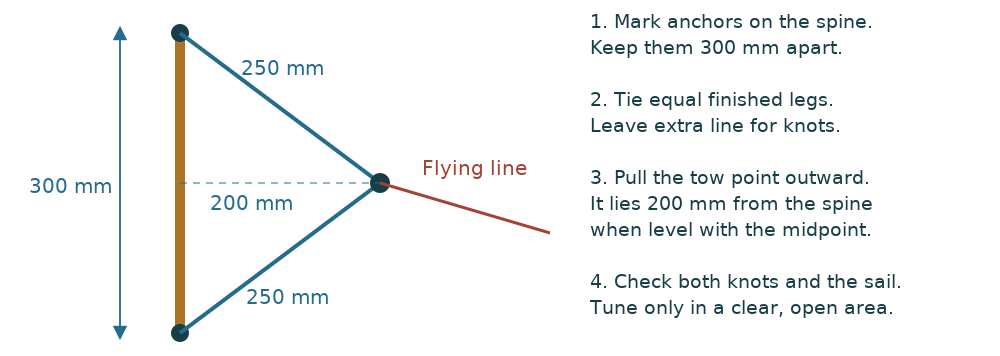
Shelter begins with a section, a route and a record
A courtyard house as a record of flows
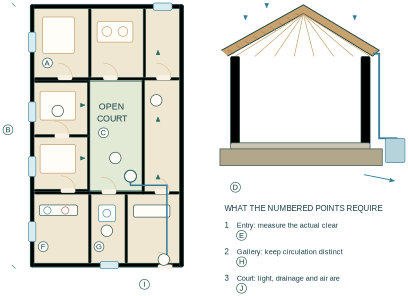
Argentina first / modern comparative study, not a reconstruction of Casa Padilla
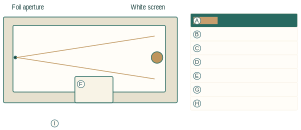
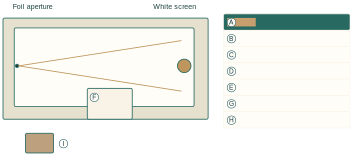
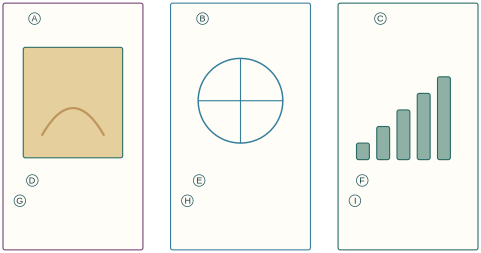
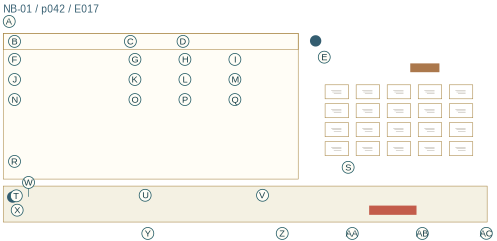
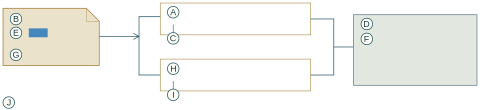
Read the illustration’s labels
OPEN
COURT
WHAT THE NUMBERED POINTS REQUIRE
1
Entry: measure the actual clear
2
Gallery: keep circulation distinct
3
Court: light, drainage and air are
A
B
C
D
E
F
G
H
I
J
Key
Small-print annotation
A
Front rooms
B
14.4 m
C
3 × 6 m
D
Drain to a verified discharge point
E
route.
F
Kitchen
G
Wet zoneWork area
H
from storage.
I
STREET / ENTRY
J
separate checks.
Dimensioned architectural study. No member sizes, foundation design, glazing schedule or compliance approval are implied.
Argentina: a house shaped by the lot
8.4 m outside
Section: follow the water
4 Wet zone: trace supply, waste and isolation.
5 Rain inlet: keep a record of overflow and cleaning.
6 Rooms: record use, openings and changing moisture.
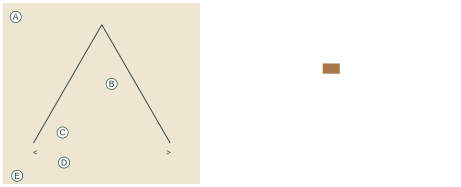
Casa Padilla in San Miguel de Tucumán is a useful place to begin because its heritage record describes a particular building. Dating from around 1860, it occupies an 11 by 70 metre lot. Its long arrangement follows two parallel axes, with successive rooms and a substantial entrance passage, the zaguán. The record also describes an ironandglass inner screen between the entrance and the interior. These are features of that house, not a universal Argentine floor plan.
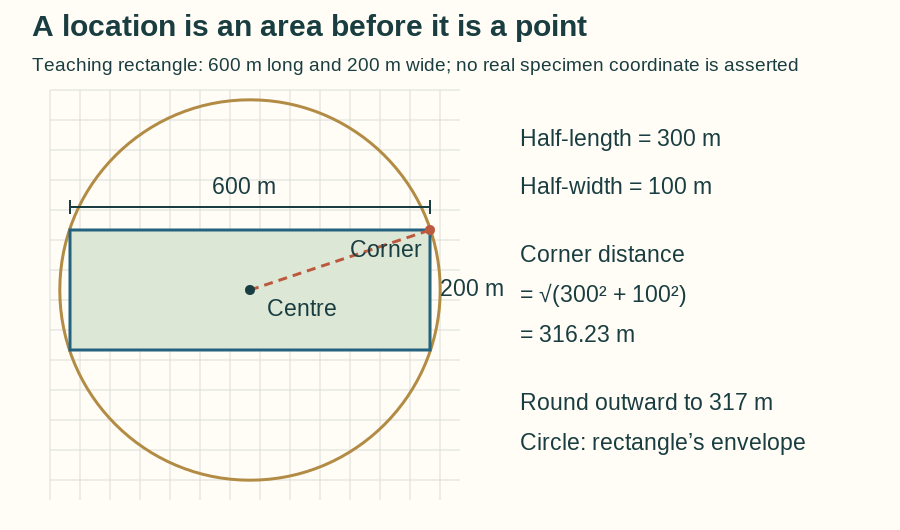
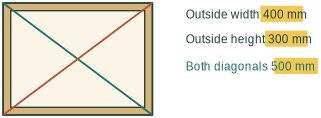
The adjacent drawing is a modern comparative study. It uses an 8.4 by 14.4 metre outer outline and an open court within a sequence of rooms, passage and service spaces. It is deliberately not labelled as a reconstruction of Casa Padilla. The room divisions explain what to observe; they do not specify a foundation, beam size, ventilation rate or permission to build.
Units and terms
m metre, a length unit · × multiplied by
m metre, a length unit · = equals · × multiplied by · % percent, parts per hundred
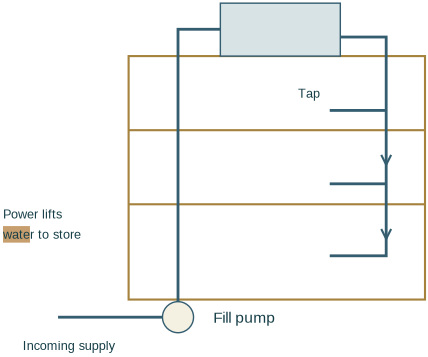
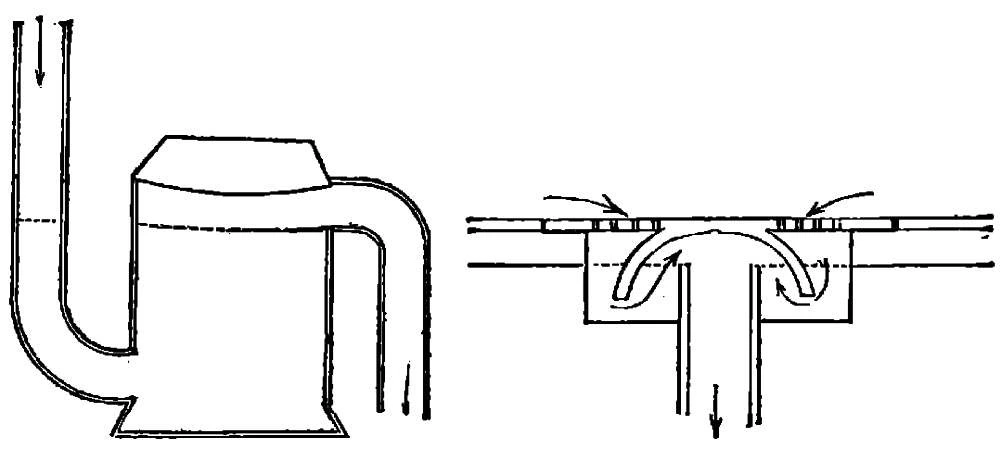
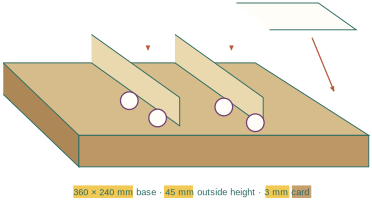
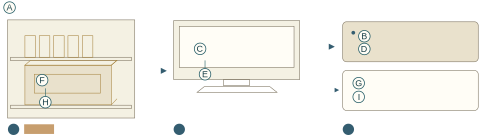
In the drawing: Tap; Power lifts; water to store; Fill pump; Incoming supply
Power and water are not identical
Gravity feeds taps
NYC Health describes rooftop tanks filled by pumps. The stored water is then available for use. In the illustrated arrangement, a power loss stops replenishment unless a suitable backup operates; it does not instantly remove water already in the tank. [D391]
NYC: New York City. The municipal health reference cited for rooftop water tanks.
Duration needs real inputs
Do not print an endurance claim without the usable stored volume, demand, minimum service level and actual system configuration. Other buildings use different supply arrangements. A generator’s nameplate alone does not establish which pumps, controls or access systems it can support.
Obtain the actual installation diagram and a dated operating check from the building team. This drawing supplies no pipe sizes, pressure ratings or emergency procedures.
Record who can restore each service
A proposed building record: evidence, responsibility and a verified fallback belong together
Service
Evidence to obtain
Responsible role
Fallback to verify
Water
Supply arrangement and tank record
Building operator
Usable storage / approved alternative
Power
Circuits supplied by tested backup
Facilities lead
Loads actually supported
Access
Exit and accessibility arrangements
Building manager
Assistance plan agreed with residents
Contact
Written contacts and meeting places
Household coordinator
Out-of-area contact and second meeting place
Units and terms
NYC New York City
BY-SA Creative Commons Attribution-ShareAlike · NYC New York City
Sources for this account
New York City Health: Drinking Water Tank Inspection Reporting
Original source URL recovered from the retained catalogue.
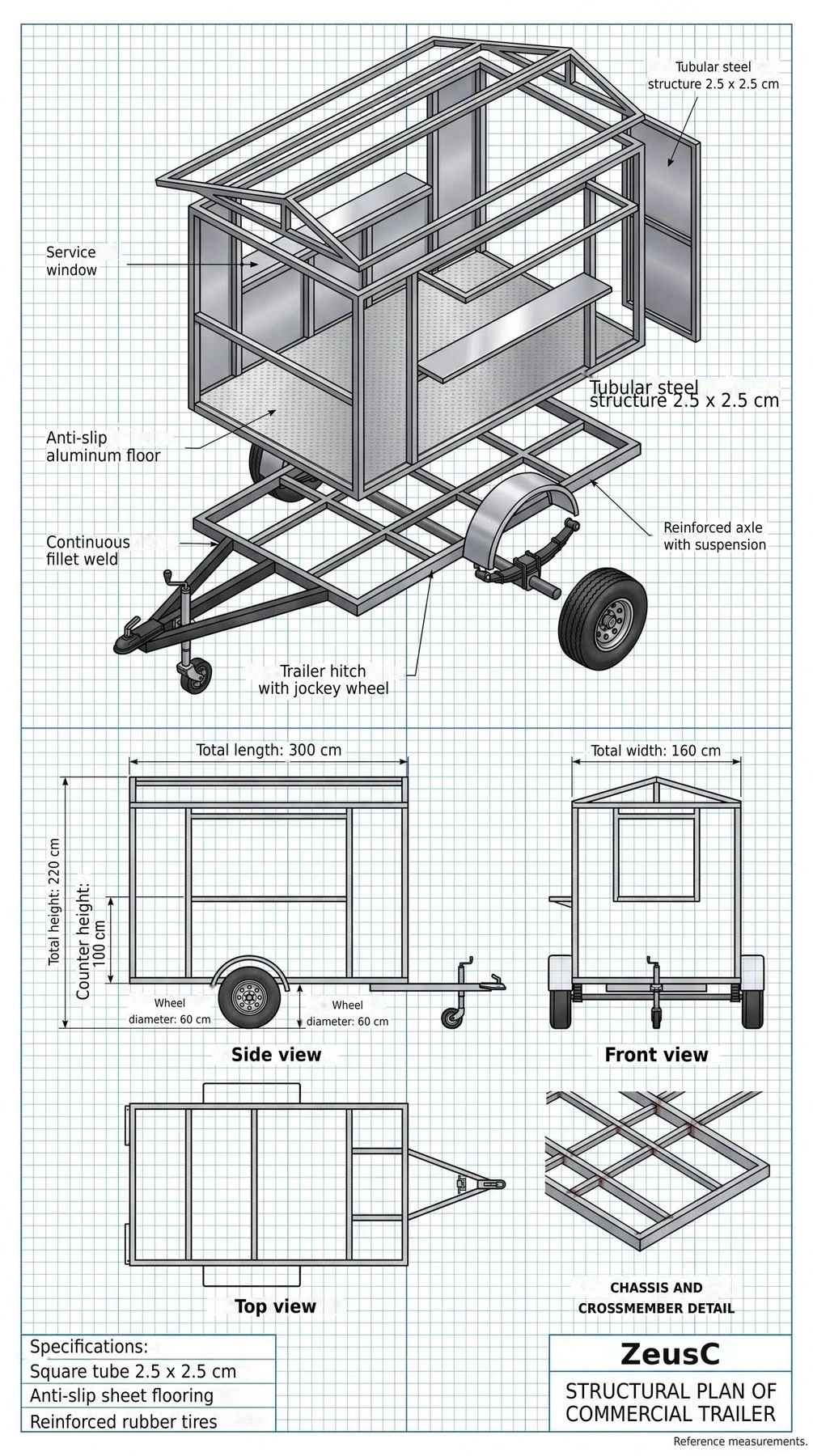
Quadrosphere material quantities and missing project information
Source item
Quantity shown
Specification printed
Rectangular steel tube
156 m
100 × 50 × 2–3 mm
Metal connector
90 pieces
5 mm
Lower/base metal connector
4 pieces
No further size printed
Wooden beam
145 m
50 × 50 mm
Insulation
64 m²
100 mm
Waterproofing membrane
70 m²
No product identified
Vapour barrier
70 m²
No product identified
Fibre cement board
65 m²
Cementex
External dome cladding
63 m²
Aluminium composite
External wall cladding
45 m²
Wooden plank / planed wood
Internal finish of dome and walls
65 m²
Wood panelling
Panoramic window and entrance door
1 piece
2430 × 2175 plus entrance door
Small awning-type window
1 piece
1190 × 600
Lengths are in metres where marked m, areas are in square metres where marked m², and dimensions explicitly marked mm are in millimetres. The opening figures 2430 × 2175 and 1190 × 600 have no unit printed beside them on this source; obtain the dimension convention before specifying the openings. The single panoramic-window entry also includes an entrance door, so separate product dimensions and quantities still need to be resolved.
Keep the estimate connected to a coordinated drawing set
The developed project needs a dimensioned base plan, node locations, a member schedule, a connector register, details around each opening and sections through the enclosing layers. A member identifier should lead to its end locations and connection details. A panel identifier should lead to its shape, edge support and fixing detail. That traceability is what lets a quantity be checked after the overall appearance has been chosen.
Foundations, anchors, fasteners, seals, flashings, services, lifting access and temporary works need separate records. Materials consumed in the building and reusable tools should not be counted as the same kind of purchase. The printed estimate is evidence of the supplied concept; it does not establish that every necessary item has been included.
Units and terms
m metre, a length unit · m² square metre, an area unit · mm millimetre, 0.001 metre · × multiplied by
Quadrosphere fabrication records and dated quotations
Fabrication, erection and enclosure produce different records. The fabricator identifies material certificates, component marks, dimensions and coating. Site records connect the supports and anchors to the coordinated plan, then record the frame before joints and surfaces are concealed. Enclosure records identify the actual layers and details used around openings. Keeping these stages distinct makes a missing item easier to locate than a single note saying that the dome was assembled.
The responsible design team specifies the first-joint sample, lifting arrangements, temporary restraint and erection sequence. A sample verifies the stated detail and process; it does not establish a new structural design through trial alone. Changes to materials, joint geometry or fixings should be returned to the coordinated drawings so that the purchasing record, fabrication record and installed work describe the same arrangement.
Keep quotations tied to place, date and specification
Argentina uses an ARS quotation sheet first, followed by USD for the United States and EUR for an identified euro-area market. Other European currencies remain separate where used. Obtain quotations for the specified grade, thickness, length and finish, with supplier, date, tax and delivery. The previous USD 11,490.50 example was a hypothetical allowance, not an offered price for this building. Keep the source estimate, net material quantity, rounded purchase quantity and quoted unit rate in separate columns.
For each quotation, distinguish the net required quantity from the pack, board, sheet or stock length actually offered. Record whether tax, transport, cutting, coating, installation and waste disposal are included. Keep the original currency and exchange-rate date if a comparison is made. An old illustrative allowance can remain as a dated example, but it should not silently become the current procurement budget.
4 November 2026 | Currency conversion does not update a construction price
Banco Nación: dollar banknotes At the displayed 17:00 update, BNA listed buying at ARS 1,520 and selling at ARS 1,570 per USD. The tables use the selling side, ARS 1,570, as a stated conversion convention. Buying and selling are quoted from the dealer’s perspective.
Blue dollar: a reported informal-market quote Ámbito’s closing report at 16:16 listed buying at ARS 1,545 and selling at ARS 1,565 per USD, based on its city-operator survey. The blue column uses that reported selling rate. Other times, sellers, locations and sources can differ; it is not an official universal rate.
Calculate, then keep the exclusions For a USD 1,000 allowance: 1,000 × 1,570 = ARS 1,570,000 at BNA selling, or 1,000 × 1,565 = ARS 1,565,000 at the selected blue selling quote. Neither is a delivered Argentine price. Keep taxes, freight, labour, scope and the original price date visible.
Read inherited amounts by their date Older component sheets explicitly use ARS 1,540/USD from 19 October. They remain historical scenario records. The new estate comparisons apply the 4 November rates to the same planning envelopes; they do not validate assumed areas, staffing or service demand.
Open the detail
Units and terms
BNA Banco de la Nación Argentina · ARS Argentine peso · USD United States dollar
USD United States dollar · ARS Argentine peso · BNA Banco de la Nación Argentina · = equals · × multiplied by
Fifteen contiguous case groups Each estate opening remains beside its existing case material. The estate guide locates the complete groups. Read habitation, food production, workshops, access and utilities as connected services.
Compare without inventing provenance The estate pictures are supplied modern concepts. The historical places on these pages are documented comparisons for particular features. They are not the pictured sites, or proof of the concepts' origins, dimensions or performance.
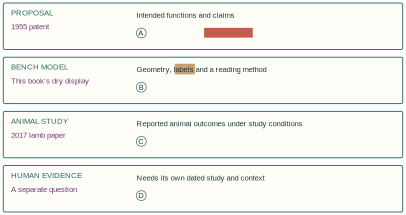
Separate three evidence states Record what is visible, what is proposed, and what is measured. Attach surveyed dimensions, loads, materials and operating tests before moving a component from proposal to installed record.
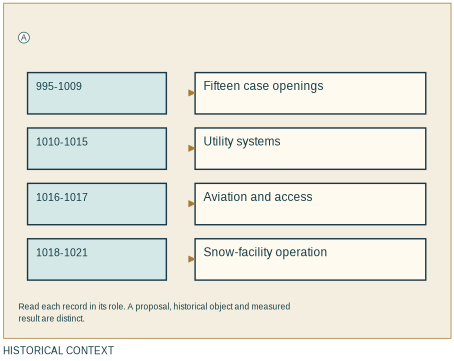
Use the stable references References 995-1009 open the fifteen cases. Utilities use 1010-1015; aviation uses 1016-1017; snow planning uses 1018-1021. Related supplements remain grouped by topic. Old standalone-companion page numbers are retired.
Read the illustration’s labels
995-1009
Fifteen case openings
1010-1015
Utility systems
1016-1017
Aviation and access
1018-1021
Snow-facility operation
Read each record in its role. A proposal, historical object and measured
result are distinct.
HISTORICAL CONTEXT
A
Key
Small-print annotation
A
Analytical drawing. Example quantities are labelled; geometry is not a site survey.
Units and terms
USD United States dollar · ARS Argentine peso · BNA Banco de la Nación Argentina · = equals · × multiplied by
Sources for this account
Ámbito: dollar blue closing report, 4 November 2026
Córdoba's Jesuit block and five estancias connected urban institutions with rural production during the seventeenth and eighteenth centuries. Their relationship is a historical comparison for service planning, not a social model to copy without criticism.
LEFT and RIGHT Write the viewing direction beside the drawing. The spatial legend may use blue LEFT and red RIGHT, but these colours are not electrical wiring instructions. Keep the original legend on every supplied sheet.
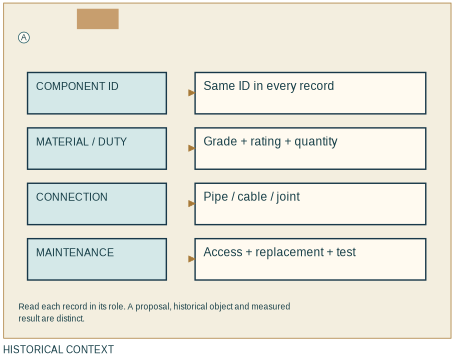
Component schedule Record ID, function, quantity, material, dimensions, connection, supplier, service access and inspection. Use unknown where evidence is absent. Do not derive pipe sizes or structural members from image appearance.
Cable and pipe schedules A cable record needs circuit ID, load, route, length, installation method, protection and termination. A pipe record needs fluid, flow, pressure, material, valve and drain. Complete the schedules before specifying sizes.
Aviation convention Aircraft position lights use red on the left and green on the right, viewed in the aircraft forward direction. This differs from the proposed spatial colour legend. [L4]
Read the illustration’s labels
COMPONENT ID
Same ID in every record
MATERIAL / DUTY
Grade + rating + quantity
CONNECTION
Pipe / cable / joint
MAINTENANCE
Access + replacement + test
Read each record in its role. A proposal, historical object and measured
result are distinct.
HISTORICAL CONTEXT
A
Key
Small-print annotation
A
Analytical drawing. Example quantities are labelled; geometry is not a site survey.
The Plan of St Gall, made around 825, coordinated accommodation, work, gardens and care. Its holding institution states that it is not to scale and no monastery was built exactly to it.An important plan is not necessarily an as-built record.
In the drawing: Analytical drawing. Example quantities are labelled; geometry is not a site survey.; COMPONENT ID Same ID in every record; MATERIAL / DUTY Grade + rating + quantity; CONNECTION Pipe / cable / joint; MAINTENANCE Access + replacement + test; Read each record in its role. A proposal, historical object and measured result are distinct.; HISTORICAL CONTEXT
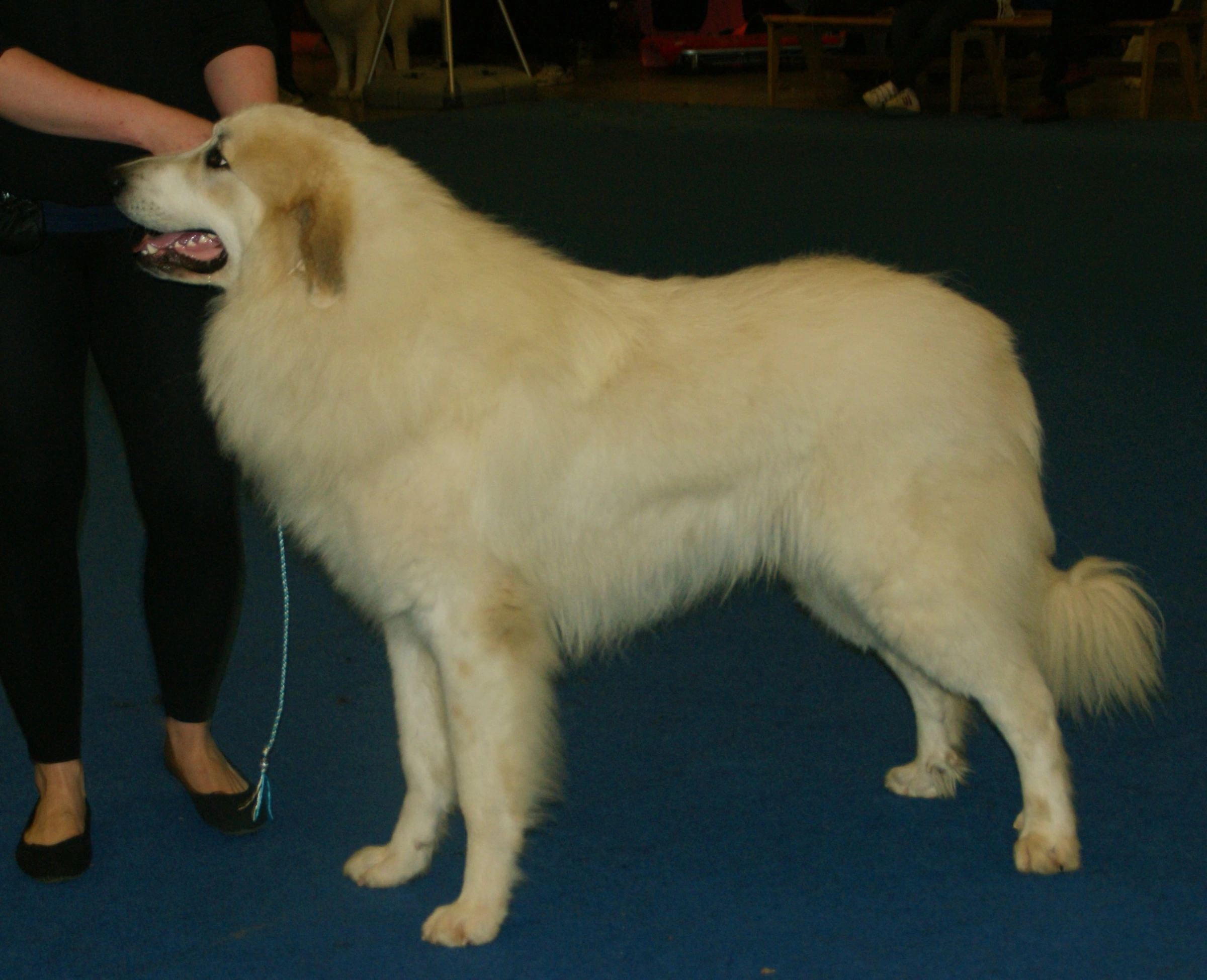
When comparing a Maremma with a Pyrenean Mountain Dog or another locally established guardian line, ask about the particular dog’s rearing, stock experience, health and behaviour around the people who will enter the pasture. Select with an experienced local livestock adviser. The photograph and breed name support identification, while working history and the actual holding determine suitability.
What the dog budget includes
The acquisition price depends on age, provenance, health, training and the specific contract. There is no verified current purchase quote for each of the six household breeds in this edition. Rather than assign them invented prices, keep acquisition as a named, unpriced line until the seller or adoption organisation supplies the details.
Checked acquisition example Original fee ARS comparison EUR comparison
Great Pyrenees Rescue Atlanta, dog under 1 year
USD 650 1,020,500 576.55
Same organisation, other dogsUSD 500 785,000 443.50
Units and terms
ARS Argentine peso · EUR Euro · USD United States dollar · US United States · EU European Union · kg kilogram, a mass unit · = equals · × multiplied by
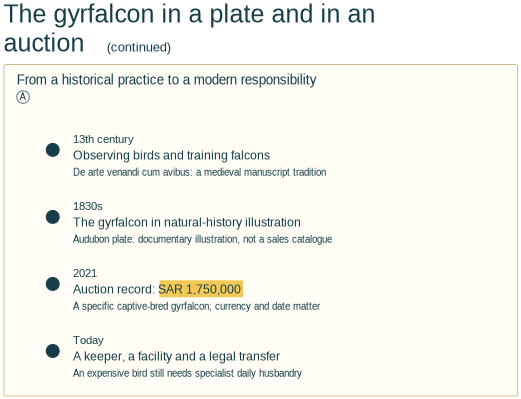
Falcons: a historical practice, a daily responsibility
These are US rescue-adoption fees checked on 15 November 2026, not prices for trained livestock guardians and not quotations for imports to Argentina or the EU. Eligibility, travel and individual placement still apply. Earlier Argentine working-dog benchmarks are retained in the prior animal-economics chapter with their original dates; they are not fresh offers. [P05]
Food observation · 15 November 2026 Pack and price Status
Puppis Argentina, Pro Plan adult medium 15 kg · ARS 122,850 Displayed promotion; regular price ARS 136,500.
Chewy US, Pro Plan adult shredded chicken/rice
35 lb · USD 74.48 One-time purchase, not introductory subscription.
Kiwoko Spain, Pro Plan medium adult chicken 16.5 kg · EUR 62.99 14 + 2.5 kg promotional pack; the plain 14 kg option was marked unavailable.
Count the full year
First-year cost = acquisition + setup + recurring care + labour + transport and applicable charges. Setup includes measured fencing, gates, refuge and the care kit. Recurring care includes food, veterinary work, parasite prevention advised for the region, grooming, cleaning and replacement equipment. Record an emergency reserve separately; an unused reserve is not an expense already incurred.
If the diary records 45 minutes of daily direct care, that is 0.75 × 365 = 273.75 hours per year, before unusual events. This is arithmetic for an example diary, not a universal sufficient time allocation. At an entered hourly rate, multiply those hours and keep the assumed rate visible.
Falcons: a historical practice, a daily responsibility
Units and terms
ARS Argentine peso · EUR Euro · USD United States dollar · US United States · EU European Union · kg kilogram, a mass unit · = equals · × multiplied by
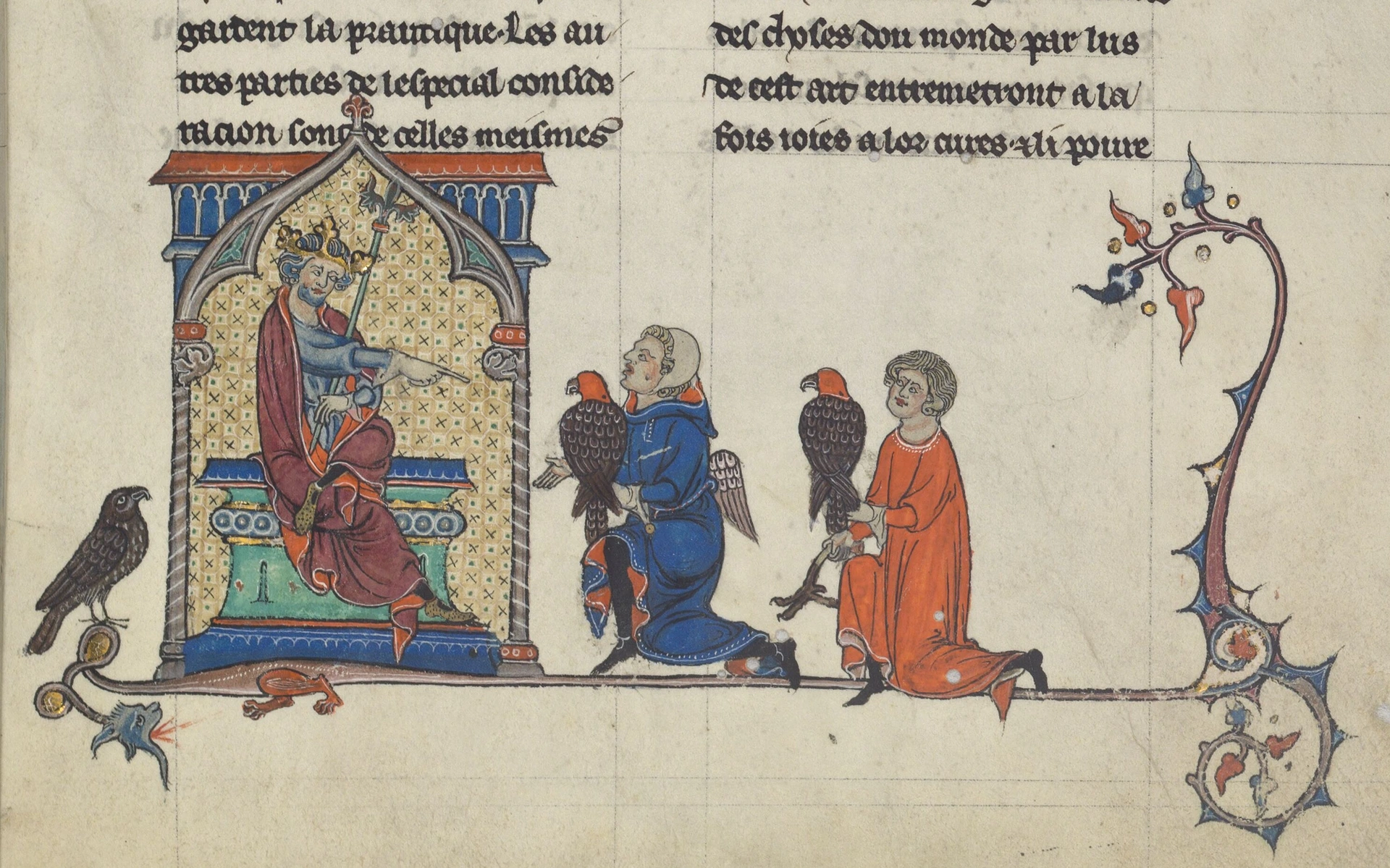
From a historical practice to a modern responsibility
13th century
Observing birds and training falcons
De arte venandi cum avibus: a medieval manuscript tradition
1830s
The gyrfalcon in natural-history illustration
Audubon plate: documentary illustration, not a sales catalogue
2021
Auction record: SAR 1,750,000
A specific captive-bred gyrfalcon; currency and date matter
Today
A keeper, a facility and a legal transfer
An expensive bird still needs specialist daily husbandry
A
Key
Small-print annotation
A
Original teaching drawing · labels are explained in the adjacent text
A museum or natural-history plate describes a bird and the publication that represented it. An auction report describes an individual animal and a transaction. Keep those records separate. White plumage in an illustration cannot authenticate a bird’s pedigree, captive-breeding record, ring number, health or price.
The Saudi Press Agency’s account of the international breeders auction refers to a gyrfalcon from Pacific Northwest Falcons sold for SAR 1.75 million. Saudipedia dates the record to September 2021. The denomination is Saudi riyals, not US dollars. This is a documented exceptional sale, not a normal price range for falcons. [F01, F02]
SAR: Saudi riyal. The currency of the exceptional falcon-auction price; the amount must not be relabelled as US dollars.
What “1.75 million” actually buys in the record
Record or calculation Amount Meaning
Recorded 2021 sale SAR 1,750,000 Specific gyrfalcon sale; original currency retained.
SAR conversion example USD 466,666.67 1,750,000 ÷ 3.75, using the SAR/USD peg.
Illustrative 2026 ARS comparison ARS 732,666,667USD equivalent × 1,570; not a 2021 peso price.
Units and terms
SAR Saudi riyal · US United States
SAR Saudi riyal · USD United States dollar · ÷ divided by · ARS Argentine peso · × multiplied by · EUR Euro · US United States · EU European Union
Sources for this account
Saudi Press Agency: International Falcon Breeders Auction, 7 August 2024
Some unusual animals can be kept lawfully by suitably equipped owners. There is no permission to keep “any exotic animal” just because an estate is large or a budget is high. Begin with a named species and decide whether its social, environmental and veterinary needs can be maintained for its whole life.
Choose an animal by its needs, not its price (continued)
Option A meaningful first decision
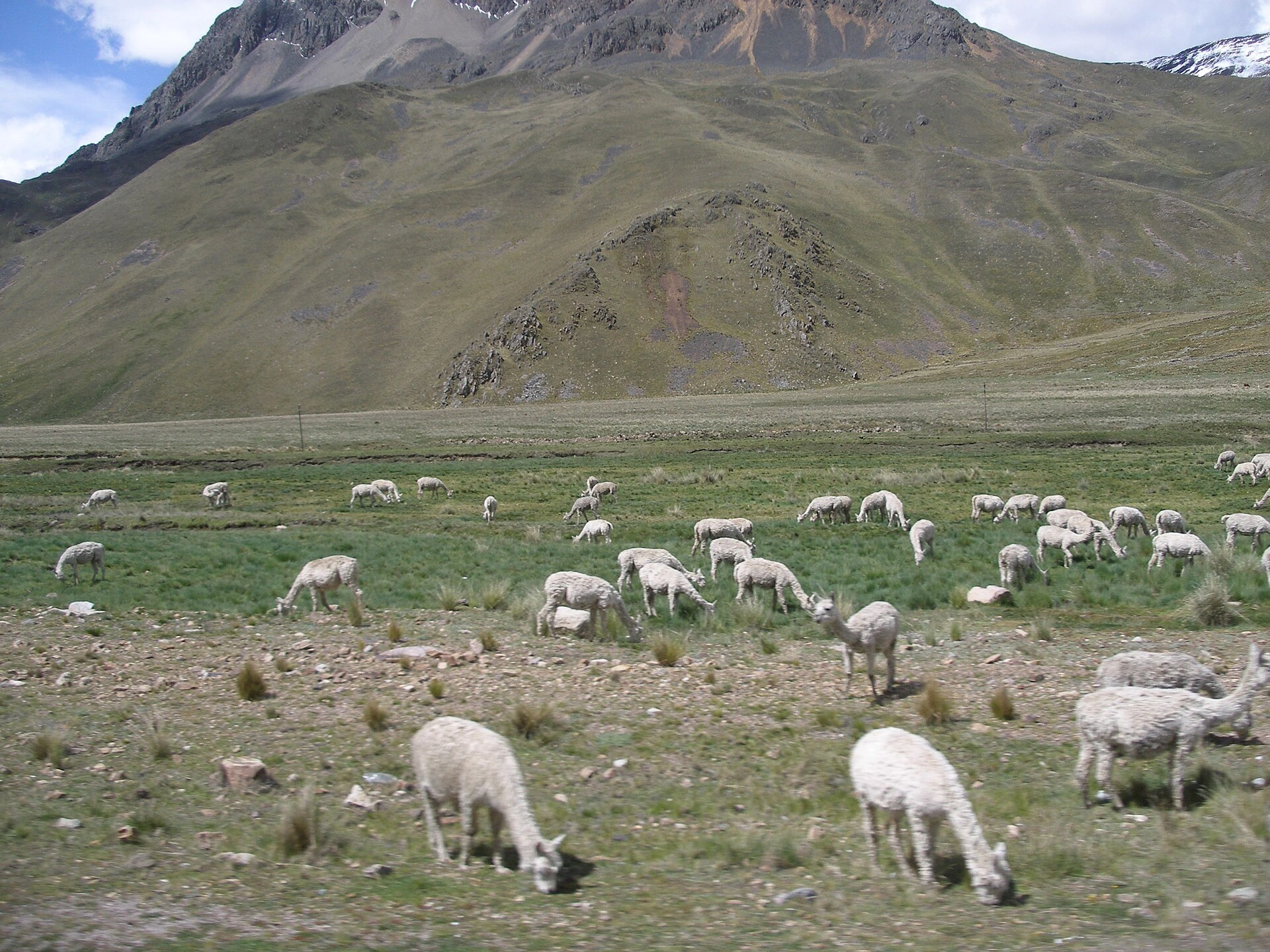
Domestic alpacas Consider a compatible group with other alpacas, forage, shelter, handling and local veterinary support. A lone ornamental alpaca is not the starting plan.
Koi in a contained ornamental pond
Price filtration, oxygenation, water testing, quarantine and backup power with the fish. Do not release them into natural waters.
Units and terms
US United States · ARS Argentine peso · USD United States dollar · EUR Euro · CITES Convention on International Trade in Endangered Species of Wild Fauna and Flora
Captive-bred parrots Resolve legal provenance, social needs, flight/physical activity space, noise and decades of care. A cage beside a guest room is not a complete plan.
Captive-bred tortoises Specify the species, lawful source, climate, enclosure and specialist veterinary care. Native or protected wild animals are not free collecting stock.
Large wild cats Do not treat a large enclosure as automatic eligibility. US federal law now prohibits new private pet ownership of the covered big cats, with limited statutory exceptions.
For the agricultural and mountain estate scenarios, a domestic alpaca group is a possible subject for a separate feasibility study, not an extra animal added to the existing forage account. Alpaca Canada’s guidance emphasises herd relationships and husbandry. Keep a compatible social group and an experienced local adviser involved. [E01]
For visitor-heavy courts, dock parcels and the runway estate, a visit to a licensed specialist facility is generally the more practical first experience. The estate pages state where unusual animals conflict with the actual use. Ownership is considered only after that conflict has been resolved.
From interest to a documented animal plan
1. Define the animal and purpose. Write the scientific name, intended number, social grouping, expected role and who will be responsible. A plan for three compatible domestic alpacas is different from a plan for a breeding herd or public animal encounters.
2. Check the site and permissions. Identify jurisdiction and property restrictions. Resolve wildlife, movement and animal-health requirements before booking transport. Keep the relevant authority’s answer with the plan.
3. Prepare care and backup. Find a veterinarian who works with the species, a competent primary keeper and a substitute. Specify routine supplies, handling arrangements and what happens during power loss, illness, evacuation or an owner’s absence.
4. Quote the complete system. Request written acquisition, transport, facilities and annual-care quotes. Record tax, delivery and exclusions. Price the whole social group, not one photographed animal. Keep current ARS, USD and EUR offers in separate country columns.
5. Check the identified individual. Reconcile the animal’s marks, papers and health record. A pedigree document is not necessarily an import permit, a CITES document or evidence of current health. Use the competent authority and veterinarian for their respective checks.
6. Keep the transfer and first-month record. Log arrival, identity checks, authorised separation or quarantine arrangements, feed acceptance, behaviour and veterinary follow-up. Do not introduce an animal to guests or existing stock simply to complete a photograph.
Cost scenario ARSUSDEUR
Written acquisition quotation Required Required Required
Units and terms
US United States · ARS Argentine peso · USD United States dollar · EUR Euro · CITES Convention on International Trade in Endangered Species of Wild Fauna and Flora
ARS Argentine peso · USD United States dollar · EUR Euro · EU European Union · ha hectare, 10,000 square metres · kg kilogram, a mass unit
Facility and transport quotation Required Required Required
Annual care and labour Required Required Required
Historical falcon record Comparison on preceding page
Decision Incomplete until the actual country, species and written offers are known
USD 466,666.67 conversion
Not a current EU offer
This table deliberately avoids invented prices for unspecified exotic animals. The offline ledger supports a real quote comparison and marks missing lines. A higher price cannot fill an absent permit, competent keeper or suitable habitat.
What may follow
Use the worked balance in this chapter. At its illustrative yield and utilisation, the 2 ha horse parcel falls short for two 500 kg horses by 2,800 kg of dry matter per year. The 4 ha cattle parcel is also marginal for two 500 kg cattle before calves, drought or extra loss.
The constraint that changes the answer
If the operating purpose is guest riding, buy suitable trained horses and staff the activity; do not substitute a breeding stallion because an auction average is available. If the purpose is livestock production, choose the cattle enterprise and its handling system. Running both requires the combined feed, land and labour ledger.
What to price and record
Use the dated price chapter for matching animal categories. Add this case’s fence and gate lengths, water equipment, feed storage, handling or transport equipment, veterinary arrangements and annual feed shortfall. Keep unquoted lines blank. Record actual care time, a backup keeper and the condition that would make you reduce the group. Before adding an animal, re-run the forage and annual-cost worksheet.
Units and terms
ARS Argentine peso · USD United States dollar · EUR Euro · EU European Union · ha hectare, 10,000 square metres · kg kilogram, a mass unit
Cats in the house, the image and the historical record
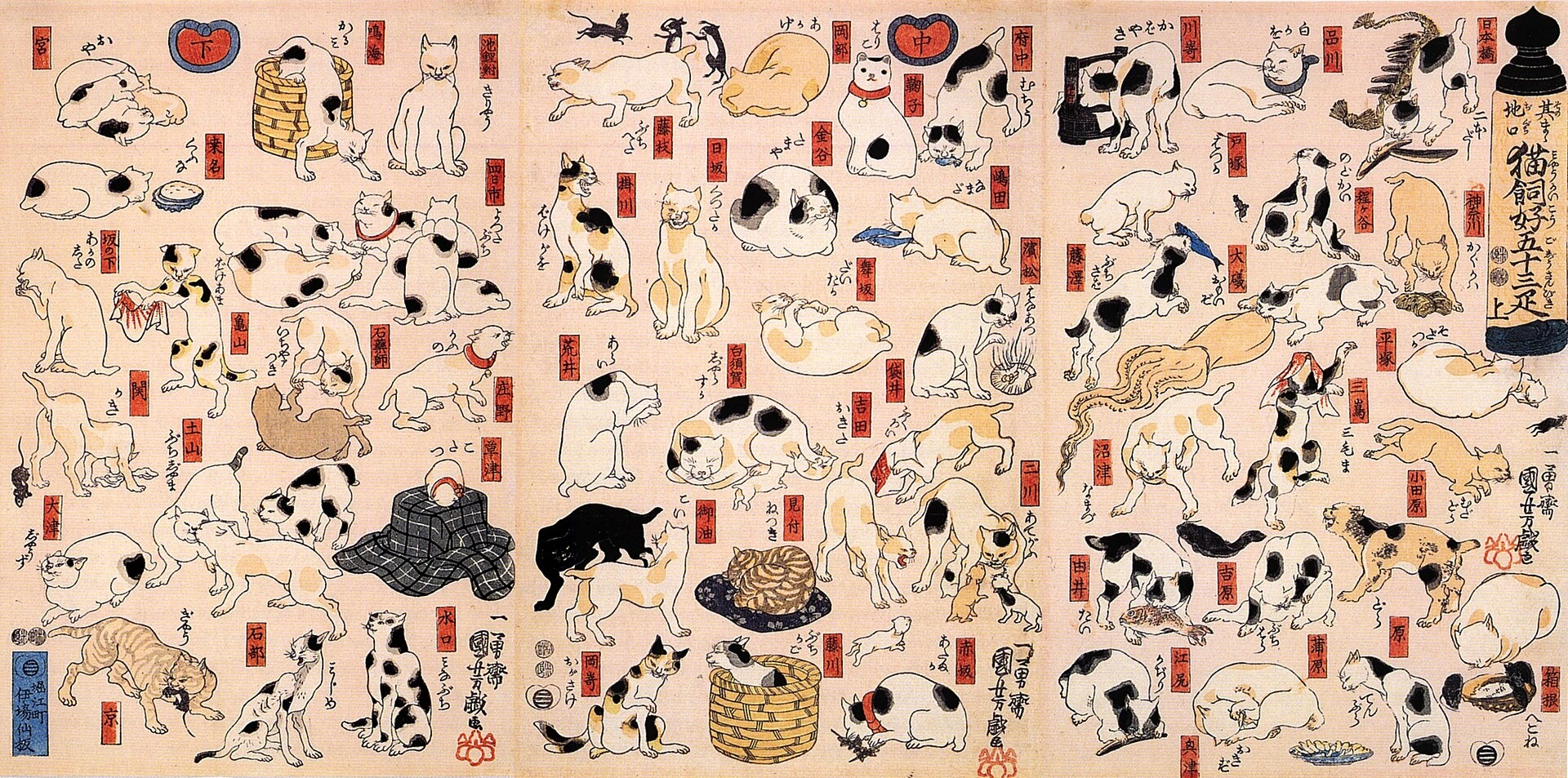
Historical plate CATS. Utagawa Kuniyoshi, Cats suggested as the fifty-three stations of the Tokaido, catalogue date 1850. Image identity and rights: I103-cats.
Kuniyoshi’s nineteenth-century cats make a lively beginning because they are an actual historical work, not invented portraits of modern pedigree animals. Their postures can be read as cats stretching, watching and grooming. The print’s cultural context and visual humour belong beside those observations; it is not evidence that a particular modern breed caught a particular rodent.
Domestic cats are companions with individual histories. The most useful estate question is whether a particular cat can live safely with the people, dogs, birds and daily routine already present. A breed name narrows some questions about appearance and inherited risks; it does not guarantee affection, trainability, hunting success or compatibility with ducks.
For most households in this guide, the first candidate is a healthy, neutered domestic shorthaired or longhaired cat assessed by a reputable rescue or veterinary team. A known bonded pair can be a sensible choice where two cats are wanted. A pedigree is an option to investigate, not a prerequisite for a useful or enjoyable life.
The following directory covers the names and coat variants found in the current CFA, TICA and FIFe catalogues consulted for this edition. It is a defined cross-registry directory, not a claim that every cat organisation in the world recognises the same list. Household cats sit outside pedigree breed counts. Recognition, preliminary status and a directory listing are not identical.
Units and terms
CFA Cat Fanciers' Association · TICA The International Cat Association · FIFe Fédération Internationale Féline
Sources for this account
rice · Oryza sativa Blanco1.102.png
Rice in the illustrated Flora de Filipinas, late nineteenth century; grain-bearing panicle and plant parts
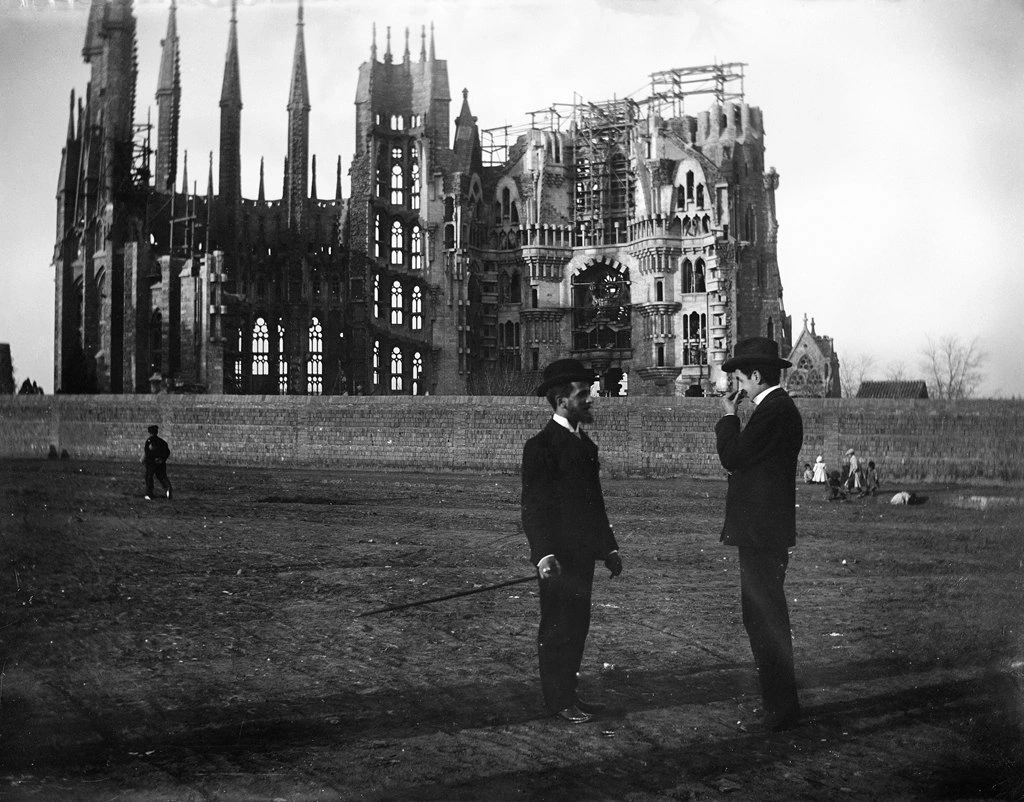
BARCELONA, WITH A SPECIFIC PHOTOGRAPH Baldomer Gili i Roig photographed the Sagrada Família under construction in 1905. The reproduced image is a modern copy of the original glass negative, held by the Museu d’Art Jaume Morera. It replaces an unverified timeline collage with one dated view. The two foreground figures are not named here because the consulted record does not identify them. [D884-D885]
THE HISTORICAL SEQUENCE The basilica’s own history records the foundation stone on 19 March 1882, Gaudí taking over in 1883 and his death in 1926. In 1936, plans and photographs were burned and plaster models damaged. Later work relied on surviving material and reconstruction from published drawings and photographs. These specific events explain why a construction archive is part of the infrastructure. [D886]
THE ARGENTINE APPLICATION For a school, workshop or estate intended to serve several generations, fund the records as well as the first building campaign. Keep measured drawings, decisions, material specifications, photographs of concealed work and a repair history. The purpose is continuity: the next team must be able to distinguish what was built from what was merely proposed.
Baldomer Gili i Roig, Sagrada Família, 1905. Museu d’Art Jaume Morera; public-domain reproduction via Commons. Full frame, unchanged. [D884-D885]
A PHOTOGRAPH’S PROPER LIMIT This view documents one stage of the building. It supplies no verified section sizes, foundations, material strengths or present completion status. The historical lesson concerns construction continuity; it is not a plan for reproducing the basilica.
Make the next builder’s record before you leave
RECORD THE CONCEALED WORK Before covering a pipe, cable, joint or foundation, record its location, scale, date, approved drawing revision and inspection result. Photograph from a position that another person can recognise. Keep the original file and a labelled copy. Link a change made on site to the person who authorised it and the drawing that it supersedes. BUDGET AN ARCHIVE AS AN OPERATING SERVICE For an illustrative four-stage project, require a record review at site preparation, structure, services and handover. A provisional allowance of two labour-hours per stage is eight hours; it is a planning allowance, not a professional fee. Price photography, survey updates, printing, backups and storage separately. The archival work should be an explicit contract deliverable with a named reviewer.
Project stage
Record retained
Site preparation
Levels, existing services, measured drawing, photograph and review.
Structure
Material specifications, joints and concealed work.
Services
Routes, isolation points and approved changes.
Handover
As-built drawings, inspection results and repair log.
Bathroom services: supply and drainage are different systems
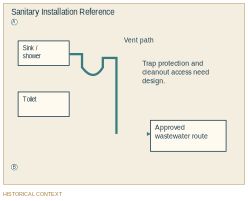
Trace fixtures to discharge The inherited sanitary reference shows fixtures and drainage. This replacement diagram identifies traps, vent and discharge without assigning universal pipe sizes. Actual dimensions belong to the local design.
Read the illustration’s labels
Sanitary Installation Reference
Sink /
shower
Toilet
Vent path
Approved
wastewater route
Trap protection and
cleanout access need
design.
HISTORICAL CONTEXT
A
B
Key
Small-print annotation
A
Analytical drawing. Example quantities are labelled; geometry is not a site survey.
B
Functional schematic. Pipe sizes, gradients and venting follow the actual local design.
A complete design also needs Fixture schedule, venting strategy, trap protection, cleanouts, gradients, pipe supports and an approved discharge destination. Keep rainwater, wastewater and potable systems identifiable.
Inspection and operation Document every concealed route before closing walls. Provide access for blockage removal. Check leakage and trap performance with the installed system. Record defects rather than concealing them behind finishes.
Drawing status Redraw the arrangement only after confirming the applicable local design requirements. The source is a teaching reference, not a universal plumbing specification.
In the drawing: HISTORICAL CONTEXT; Sanitary Installation Reference; Analytical drawing. Example quantities are labelled; geometry is not a site survey.; Sink / shower; Toilet; Vent path; Approved wastewater route; Trap protection and cleanout access need design.; Functional schematic. Pipe sizes, gradients and venting follow the actual local design.
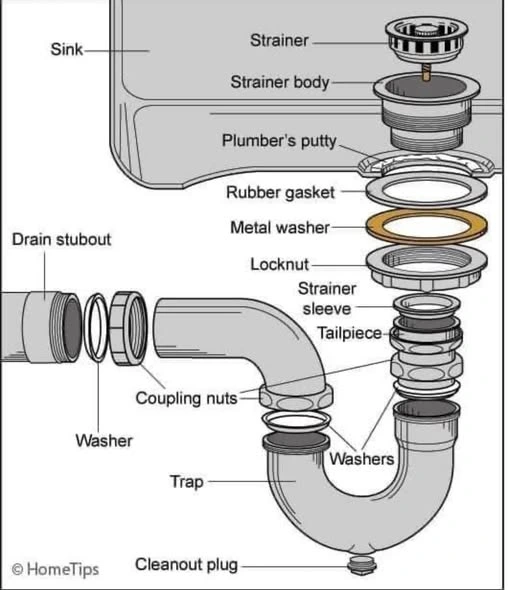
The exploded drawing separates a sink strainer, tailpiece and trap. Understanding how each joint seals prevents several misleading generalisations in the supplied note.
Sink strainer and tubular trap, separated into parts
Illustrative generated sound
The exploded HomeTips illustration distinguishes the strainer fastening from tubular slip-joint seals. It does not show a complete vent system or establish the slope of the concealed drain.
Follow the drain from the sink
The upper part of the illustration shows the strainer body and the components that fasten it to the sink. The tailpiece carries water down to the trap. Slip nuts and shaped washers join tubular sections, while the outlet leads toward the wall drain.
The strainer-to-sink joint, the connection below the strainer and the tubular slip joints serve different locations and use different sealing arrangements. A gasket or sealant appropriate to one connection is not automatically suitable for another. The drawing does not show the entire building drain or the arrangement hidden beyond the wall. [RD-H-TRAP-OATEY]
The retained water has a purpose
Water left in the curved trap forms a barrier against drain gases. The trap must retain this seal while water flows through the drainage system. Suitable venting helps protect it against pressure changes.
Gurgling or an empty trap can have different causes. The picture alone cannot diagnose them. An air-admittance valve is not a universal substitute for every vent arrangement; its permitted use and position depend on the applicable code and the complete installation. No such complete arrangement is shown here. [RD-H-TRAP-OATEY, RD-H-VENT-IPC]
A washer seal is not a taped thread
In the illustrated tubular slip joints, the nut presses a shaped washer against the mating surfaces. That is the sealing mechanism. Oatey's guidance does not call for thread tape on these slip joints. Adding tape to every threaded-looking connection confuses a washer joint with other kinds of threaded connection.
Excessive tightening can damage a nut, washer or plastic fitting. Parts also need to align without being forced into position. Where metal and plastic meet, the transition must match the fittings and their intended use. The combination is not automatically a case of galvanic corrosion. [RD-H-TRAP-OATEY, RD-H-TRAP-MATERIAL]
Slope belongs to a defined pipe and code
The supplied note quotes a quarter-inch fall per foot as if it covered every drain. Drainage requirements vary with pipe size and jurisdiction. The cited International Plumbing Code is a model-code example, not proof of the rule applicable to this reader's building.
Trap-arm slope, developed length and vent position must be established from the actual installation. A service record identifies the water seal, washer orientation and distinct joints, then records the dimensions, selected components and applicable plumbing requirements. [RD-H-DRAIN-IPC, RD-H-VENT-IPC]
Words, symbols and component names
Term
Meaning in this chapter
P-trap / sifón tipo P
A curved drain assembly retaining a water seal, with an outlet arrangement resembling the letter P in profile.
water seal / cierre hidráulico
Retained water that forms a barrier between room air and gases in the drain.
slip joint / unión con arandela de compresión
A tubular connection whose nut compresses a washer to make the seal. It is not sealed by adding thread tape to the nut.
trap arm / tramo de salida del sifón
The downstream segment connecting the trap toward its vented drainage arrangement; exact limits follow the governing code terminology.
AAV
Air-admittance valve. Whether and how it may be used depends on the applicable plumbing code.
PVC
Polyvinyl chloride, a plastic material. The particular fitting must still be identified and used with compatible components.
PTFE
Polytetrafluoroethylene, a material used in some thread-sealing tapes. It does not replace the washer in a slip joint.
slope / pendiente
Vertical fall divided by horizontal length. The required value depends on the pipe and applicable code.
Units and terms
PVC Polyvinyl chloride, a plastic used here only where its service conditions permit
Sources for this account
2024 International Plumbing Code, Chapter 7: sanitary drainage
International Code Council. US model code; local adoption and amendments are not established. Indexed official text checked; full interactive page availability may vary. Checked 27 November 2026.
Oatey. Manufacturer project guide, not evidence that all parts or unseen ventilation in the supplied illustration comply with a local plumbing code. Checked 27 November 2026.
2024 International Plumbing Code, Chapter 9: vents
International Code Council. No claim that an air-admittance valve is permitted or sufficient at the photographed installation. Checked 27 November 2026.
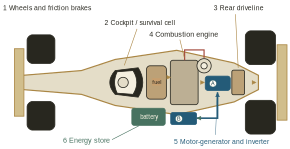
The 1.6 L hybrid power unit includes combustion power and electrical assistance. MGU-K exchanges energy with the driveline; the inverter mediates between it and the energy store. The drawing separates these paths so the battery is not mistaken for a fuel source. [AR13]
Braking is not all recovered
Friction brakes dissipate energy as heat. Electrical recovery has operating limits, so it does not eliminate cooling or friction braking. The arrows show function, not a guaranteed recovery fraction or a fixed deployment rating.
Estate workshop application
Identify the actual equipment and its service documentation. Record lifting points, load ratings, isolation steps, coolant and battery requirements from that equipment. No F1 service procedure or high-voltage work instruction is inferred from the artwork.
Hybrid race car: where the energy goes
2026 system relationships [AR13] | component positions schematic
Drive: fuel engine gearbox rear wheels
Assist: battery inverter MGU-K driveline
Harvest: driveline MGU-K inverter battery
GOES: Geostationary Operational Environmental Satellites The weather satellite programme supplying imagery and observations from geostationary orbit.
Estate records and site utilities
Keep the ledger, the water system and the service routes together.
Units and terms
SVG Scalable Vector Graphics · L litre, a volume unit
OASIS Offline Advanced System for Information and Survival
Roadheader: cutting, collecting and supporting a tunnel
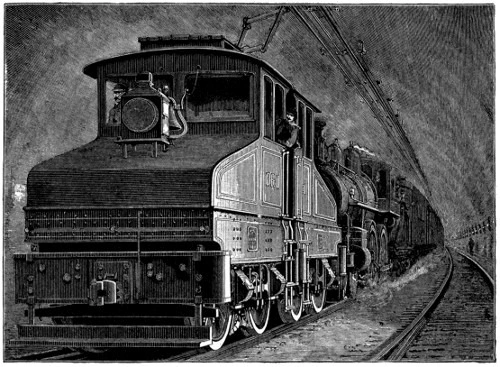
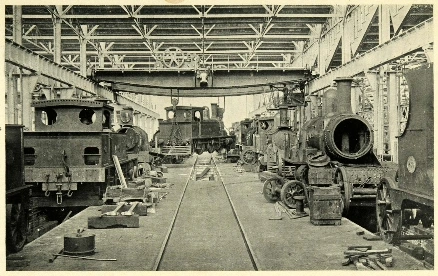
Electric locomotive in the Baltimore and Ohio tunnel, fig. 39 Edward W. Byrn / 1900 Public domain, historical publication
The cutter needs a complete removal system
The roadheader image documents cutting equipment. Material removed at the face must be collected and carried away. Dust control, support, utilities and escape routes remain essential parts of a real underground operation.
A roadheader places a rotating cutting head against a limited part of the face. Broken material must fall within reach of its gathering mechanism and pass onto the conveyor. The crawler gives the machine a movable base. Ground support belongs to a separate operation whose timing depends on the rock and the excavation design. Byrn’s 1900 illustration shows an electric locomotive in the Baltimore and Ohio tunnel. Set it beside the roadheader to separate the equipment that operates in a finished tunnel from the machines that excavate it. Follow the spoil route on the supplied bilingual drawing, then trace the supports around the crown as a separate system.
Read it with a pencil and a record
On a process sketch mark face, cutter, collection apron, transport route and support zone. Record where people work relative to moving equipment. A machine silhouette cannot establish suitable ground conditions or a tunnel support design.
Bathroom services: supply and drainage are different systems
Bottle-trap and bell-trap, figs. 7-8 Roger S. Tracy / 1884 Public domain, historical publication
A water seal must remain a water seal
Tracy’s 1884 illustrations record historical trap designs. Read the dip and retained water, then locate the flow path. Their publication is historical evidence and does not make every illustrated design acceptable in current plumbing.
Roger S. Tracy’s 1884 handbook reproduced bottle and bell traps for household readers. Nineteenth-century sanitary writers debated how fixtures could discharge while retaining a barrier between rooms and the drainage system. The useful section is the one that shows the standing water after flow stops. A supply branch brings pressurised water to a fixture. Waste moves away through the drain. A trapped bend retains a water seal between uses, while venting helps control pressure changes that might disturb it. Use the historic engraving to compare shapes, then trace the water level in the new section.
Read it with a pencil and a record
For a conceptual comparison draw a U-shaped passage at rest and during flow, with separate upstream and downstream labels. A real installation needs current local plumbing rules, venting, cleanout access and a specified fixture connection.
Argentina and European outlines: compare area carefully
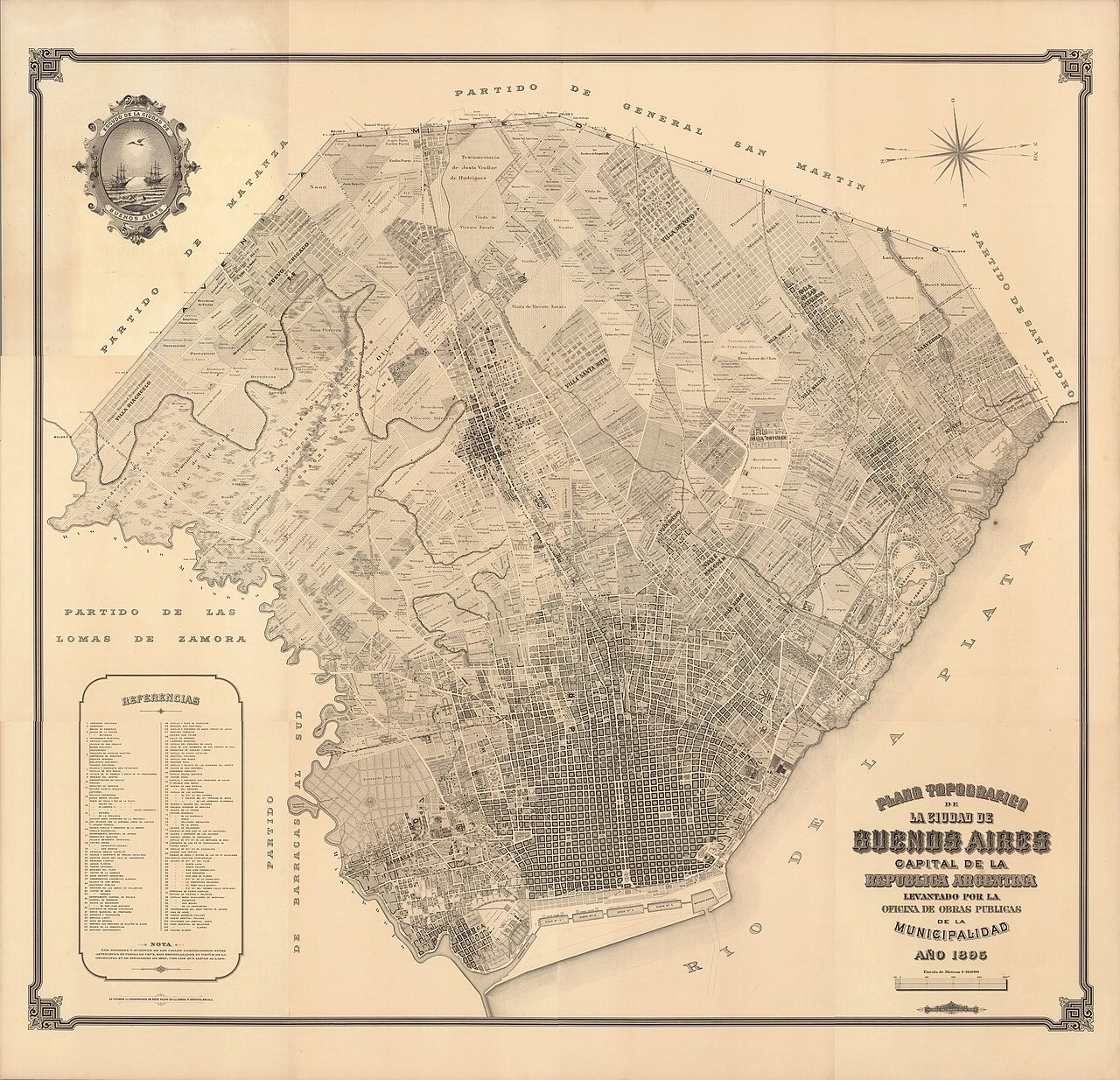
Topographical plan of Buenos AiresBuenos Aires municipal Department of Public Works / 1895 Public domain
Area requires a map projection
The Buenos Aires topographic plan dates from 1895. Its surveyed urban purpose differs from a modern equal-area world map. Two printed country outlines cannot be compared quantitatively until scale and projection are known.
An 1895 topographical plan of Buenos Aires is an urban map made for different work from a national silhouette chart. Its scale gives the reader a relationship between distances on the sheet and distances on the ground. In the modern comparison, the question is area. Both sets of boundaries must use a common equal-area method and the same scale before one outline can be moved onto another. A relocation on an ordinary latitude-longitude map can enlarge a shape without adding land. Record territorial scope and boundary date alongside the projection when comparing the supplied silhouettes.
Read it with a pencil and a record
Choose a map with a scale and named projection. Keep the legend, north reference and edition date. If transferring an outline to tracing paper, include a scale bar in the same transfer so enlargement cannot masquerade as a change in area.
Units and terms
AH Anno Hegirae, Islamic calendar year numbering · CE Common Era, historical year notation
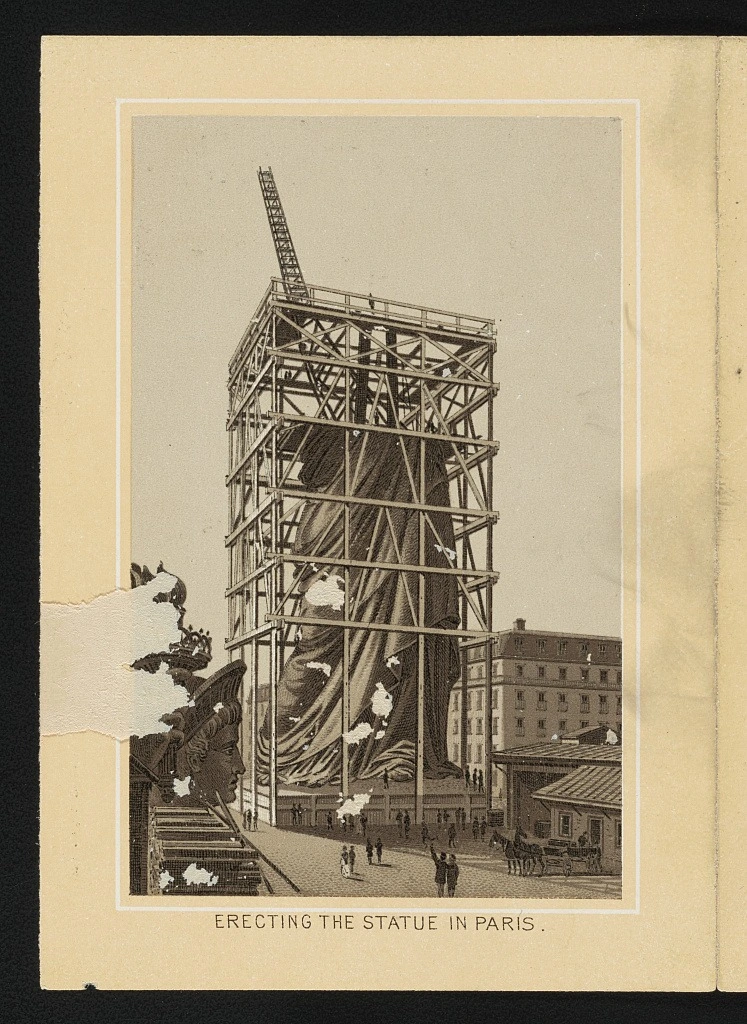
Erecting the statue in Paris Adolph Witteman, publisher / 1887 publication Public domain, historical publication
The statue was assembled before its Atlantic crossing
The 1887 publication shows erection of the Statue of Liberty in Paris. Its date is the publication date, not a statement that every visible construction operation happened in 1887.
An 1887 publication illustrated the erection of the Statue of Liberty in Paris. The statue was assembled in France, dismantled and shipped across the Atlantic as numbered pieces for reassembly in New York. The copper face lying apart from the monument is a particularly clear record of that reversal. A face creates the visual impression of mass while its shell requires support during handling. Use seam positions and scale against the workmen or surroundings when comparing successive images. The same source sheet returns in the Liberty face study for a closer reading of the skin.
Read it with a pencil and a record
Distinguish copper skin, supporting framework and temporary access. Put fabrication, trial assembly, dismantling, shipping and final erection into separate dated entries. A picture of one stage should not serve as proof for all five.
A visual reading of the existing method and its evidence.
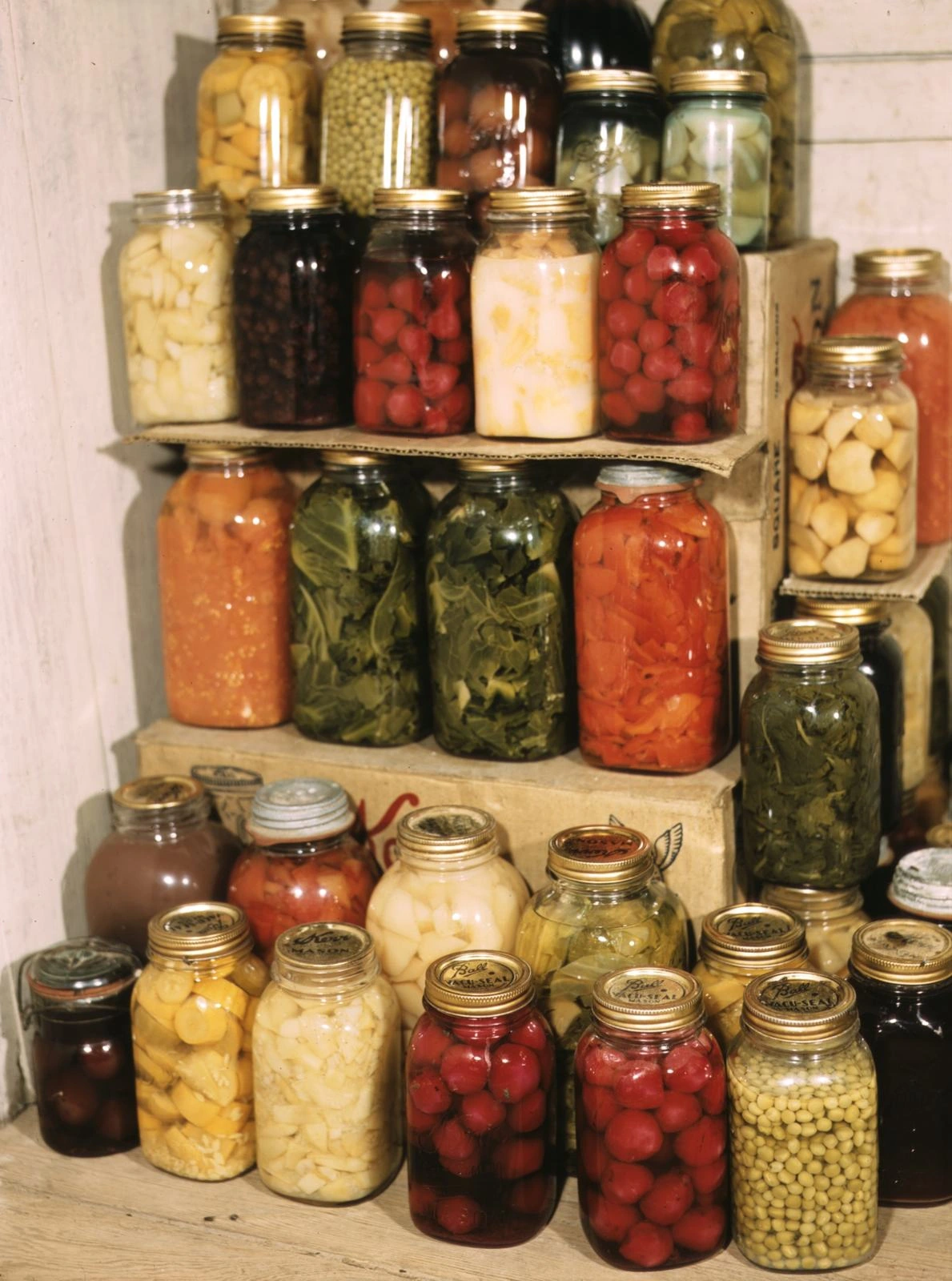
Display of homecanned food
United States, 1941–45. Library of Congress, item 2017878891. Farm Security Administration / Office of War Information collection. Photographer unlisted.
A United States government colour transparency from 1941–45 records homecanned vegetables arranged for display. The Library of Congress identifies yellow squash, peas and beets. The photographer is unlisted.
Terms in this reading
US · United States of America. Identifies the country or jurisdiction of the source, price or institution.
Historical photograph Read the full method
Bug-in: turn a reserve into a working plan
Start with people and duration
Write down how many people depend on the home and which needs require special provision. CDC advises storing at least one US gallon per person per day for three days, and trying for two weeks where possible. More may be needed for hot weather, illness, pregnancy and pets. This minimum is not a full estimate of ordinary household water use.
Work the arithmetic
For four people over three days, the baseline is 4 × 3 × 1 = 12 US gallons. One US gallon is 3.785411784 litres, so the result is about 45.42 litres. Round storage upward and add the extra needs separately. For example, four sealed 12-litre containers total 48 litres, only about 2.58litres above that baseline. Do not count uncertain or contaminated water as usable reserve.
Make responsibility explicit
Give each essential task an owner and backup. Record where supplies are kept, how to obtain them and when they were last checked. A working plan includes water, food, medication access, communication, sanitation and the conditions that make staying at home unsafe.
Maintain the reserve
Label stored drinking water and its storage date. CDC advises replacing water filled into containers every six months; commercially bottled water follows its expiry information. Use appropriate food-grade containers and never reuse a container that held toxic chemicals. Keep stored water protected from heat, sunlight and contamination.
Check more than quantities
Confirm access to containers, safe handling and a way to open or dispense supplies. Review what changes if power, stairs, transport or a usual helper becomes unavailable. Keep a dated decision record: current conditions, action, reason and next review. A reserve supports a plan; it does not prove that the building is safe to occupy.
Sources and image
CDC, “How to Create an Emergency Water Supply”, cdc.gov/water-emergen cy/about/how-to-create-and-store-an-emergency-water-supply.html. Pantry image: Library of Congress, FSA-OWI collection, digital ID fsac.1a35476,
FSA-OWI: Farm Security Administration and Office of War Information. These names identify the Library of Congress historical photographic collection.
domain. The photograph is not a modern food-preservation instruction. Checked 18 October 2026.
dated 1941-1945; Wikimedia Commons file , public
Units and terms
US United States
US United States · = equals · × multiplied by · FSA-OWI Farm Security Administration and Office of War Information
FSA-OWI: Farm Security Administration and Office of War Information The United States agencies behind the historical documentary photograph collection.
The complete bug-in guide
Practical method and reference
Origin and practical purpose
Staying at home through disruption is a household planning strategy, not a discovery attributable to one inventor. Contemporary preparedness guidance combines supplies with communication, evacuation options and individual needs. A home remains useful only while its location, structure and essential services permit safe occupation.
Five applications
1. Power failure: maintain essential care and a safe daily routine.
2. Interrupted supply: reconcile food and water against actual use.
3. Severe weather: prepare before travel becomes dangerous.
4. Caregiving: assign a backup for each indispensable task.
5. Recovery: record damage and repairs without losing the daily essentials.
Ten-step method
1. List the people, pets and care needs covered by the plan, including visitors likely to be present.
2. Identify the local hazards and the official channels that issue warnings or evacuation instructions.
3. Walk the dwelling and trace water, heat, sanitation, communication and safe exit dependencies.
4. Count usable supplies, recording their location, condition and expiry rather than relying on purchase receipts.
5. Write a daily operating routine with named primary and backup people for essential tasks.
6. Calculate an initial water reserve and food plan using the chapters that follow; add particular medical and climate needs.
7. Record what would make the home unsafe and where the household could go instead.
8. Prepare transport, portable records, essential medicines and contact details before the need to leave becomes urgent.
Practical method and reference · continued
The household operating record
Use a one-page operating sheet: date and time; current hazard; people present; usable drinking water; next meal; critical care tasks; responsible person; next review. A blank field is unresolved, not a reassuring zero. For example, a battery is not a working communication system until the correct cable and receiving device have been tried together. The handbook supplies methods, but the household must supply its real quantities and constraints.
Limits and failure checks
Do not interpret a stored supply as permission to ignore evacuation orders, fire, gas leaks or structural danger. Planned self-reliance includes knowing when to leave.
796 Reference library
Units and terms
US United States · = equals · × multiplied by · FSA-OWI Farm Security Administration and Office of War Information
A visual reading of the existing method and its evidence.
Read the illustration’s labels
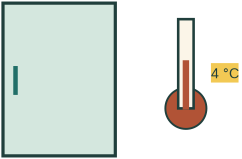
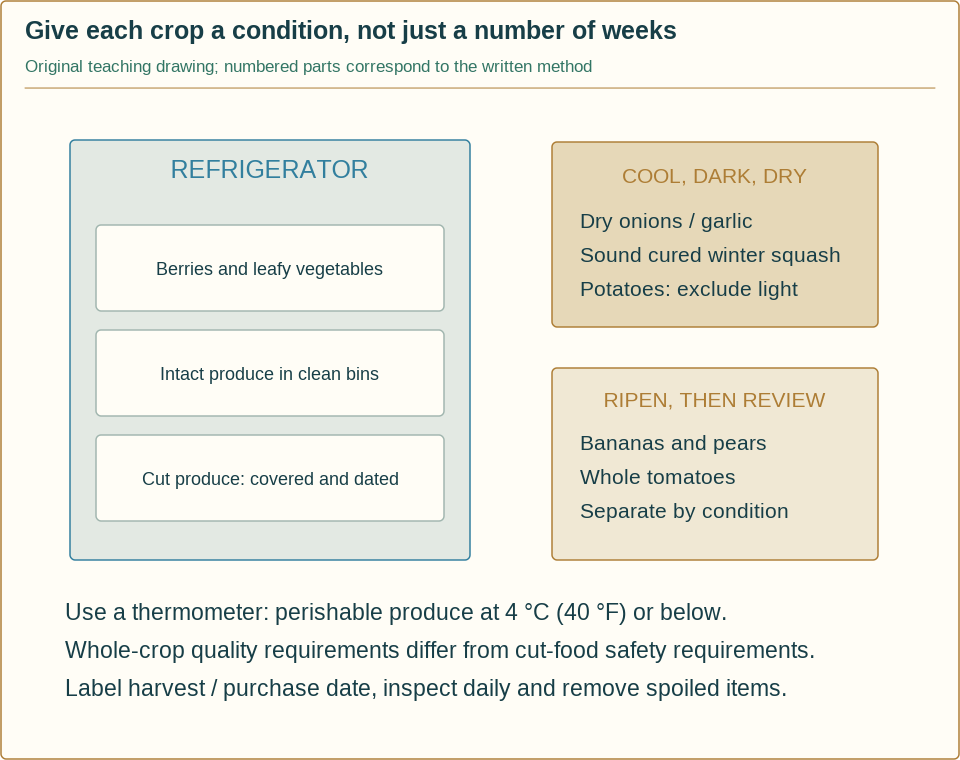
4 °C
In the drawing: 4 °C
Thermometer Observation time Cold storage
Read a refrigerator thermometer while keeping the door closed as far as practical during an outage. The lesson’s target of four degrees Celsius or below belongs with a dated observation.
Record the start of the outage and follow current foodsafety guidance for the actual time and temperature history. Appearance and taste cannot establish the safety of perishable food.
Terms in this reading
°C · Degrees Celsius. Temperature scale used for the refrigerator reading.
Read the full method Earlier image gallery
Create menus from foods the household can prepare with available water and fuel. Maintain a normal rotating pantry rather than an untouched collection of unfamiliar rations. List allergies and dietary needs. Keep a manual opener and practise preparing at least one meal under the planned outage conditions, while still using appliances and fuels safely.
Reserve the cleanest water for uses that require it. Reduce unnecessary washing losses with suitable routines, but do not economise by abandoning hand hygiene or using contaminated water on food. Track daily consumption so a leak or unexpectedly high demand becomes visible early.
Hold a short daily check: people, information, water, food, sanitation, temperature, energy and departure triggers. Record the next review time. Shared decisions become easier when everyone can see the same numbers. Make rest and ordinary routines part of the plan; exhausted people make poorer decisions and are less able to care for one another.
Cowpeas can be weighed dry when planning a pantry ration.
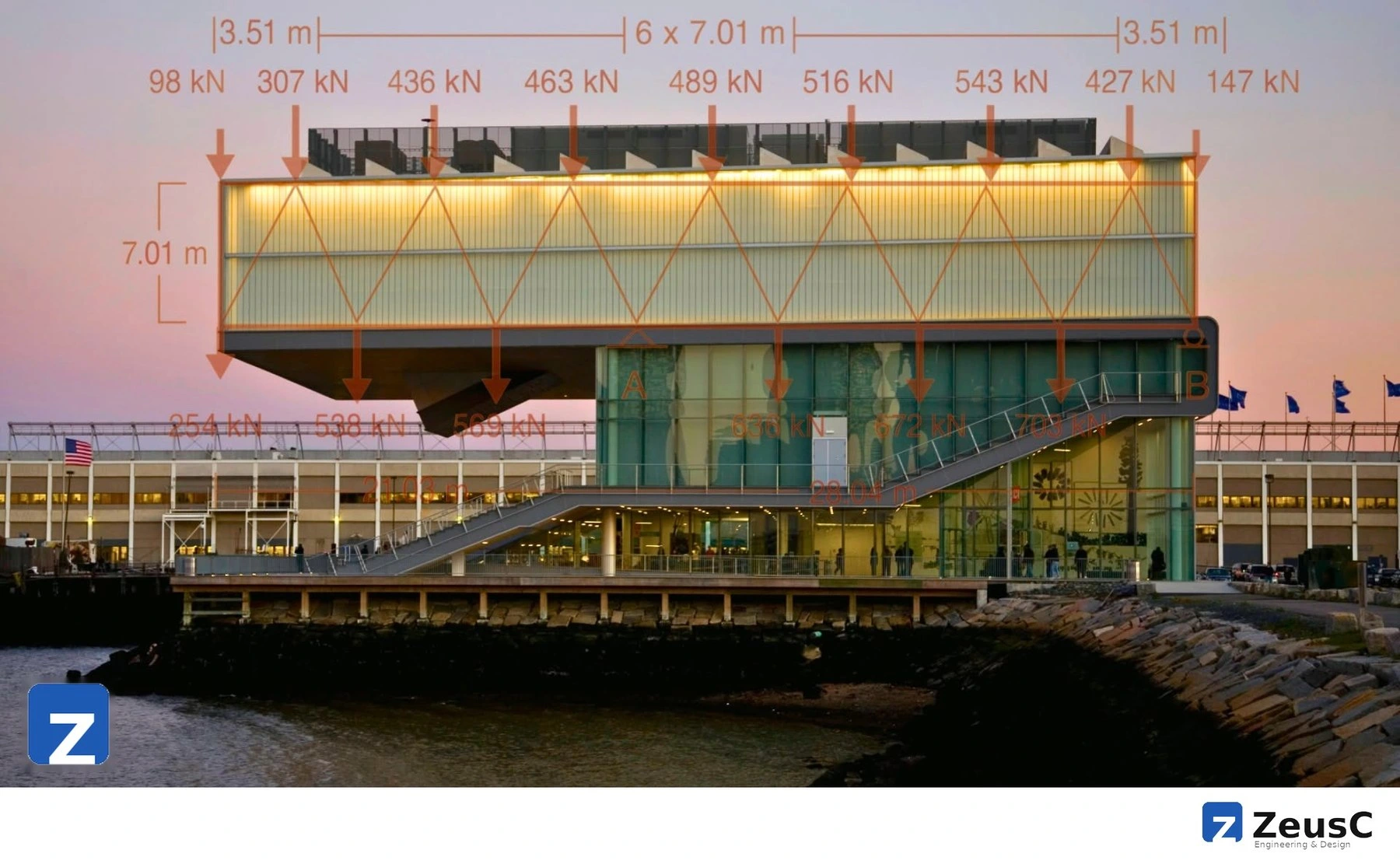
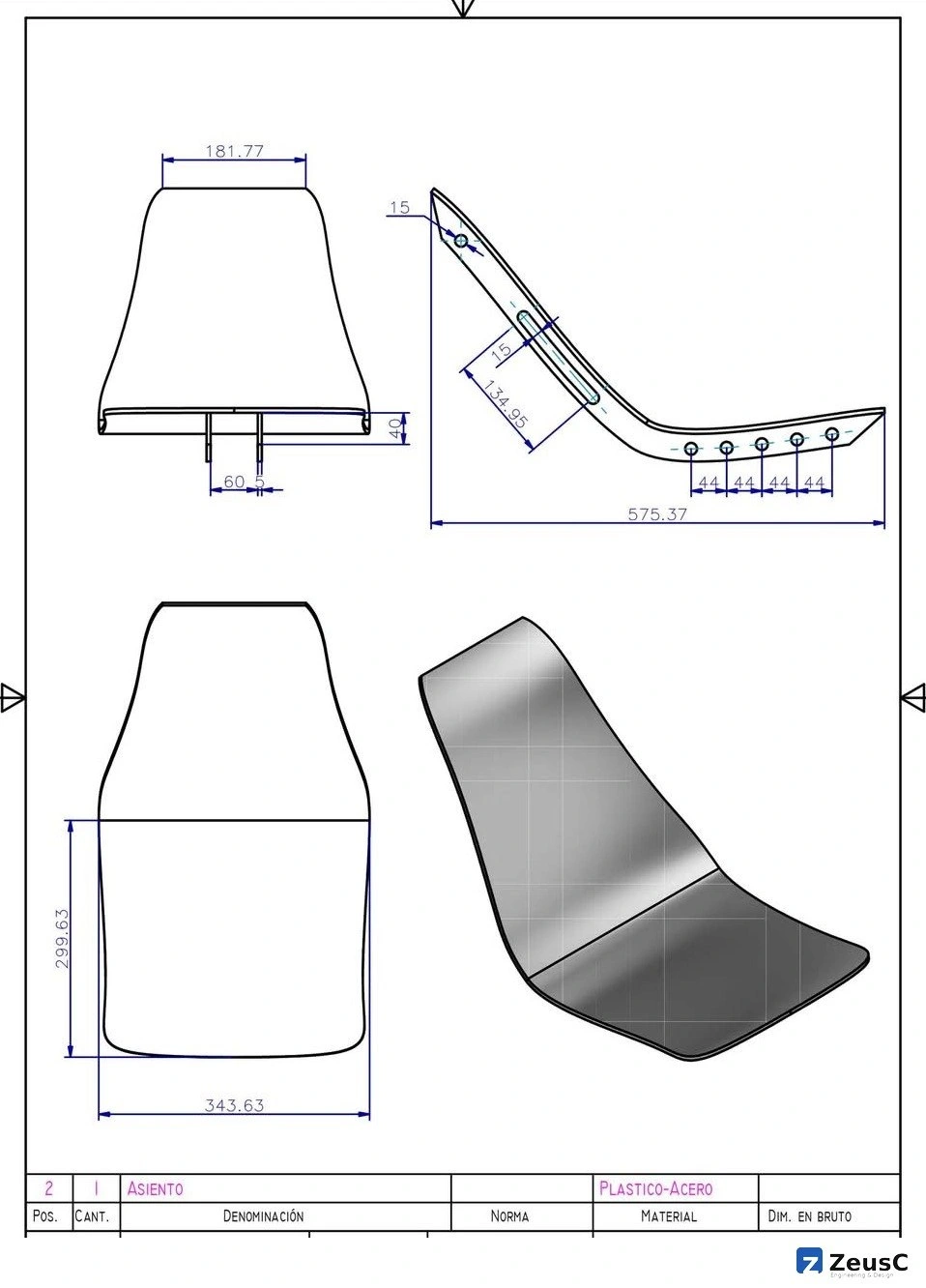
ZeusC supplied additions, sheet 008. Watermark preserved. Building design: Diller Scofidio + Renfro.
The source overlays arrows and numbers on a photograph of the museum’s projecting volume. The broad cantilever arrangement is visible in the photograph. The load values belong to the supplied analysis, whose assumptions, combinations and calculations have not been authenticated; they are not a construction specification.
Visible feature
How it relates to this plate
Cantilever
The projected volume extends beyond its nearby support line. Its force path continues back into the supported frame.
Applied arrows
Arrows are the supplied author’s analysis marks. Their units and loading assumptions must accompany any numerical use.
Reference photograph
The image locates the analysis on the building. Perspective distortion prevents direct dimensional measurement.
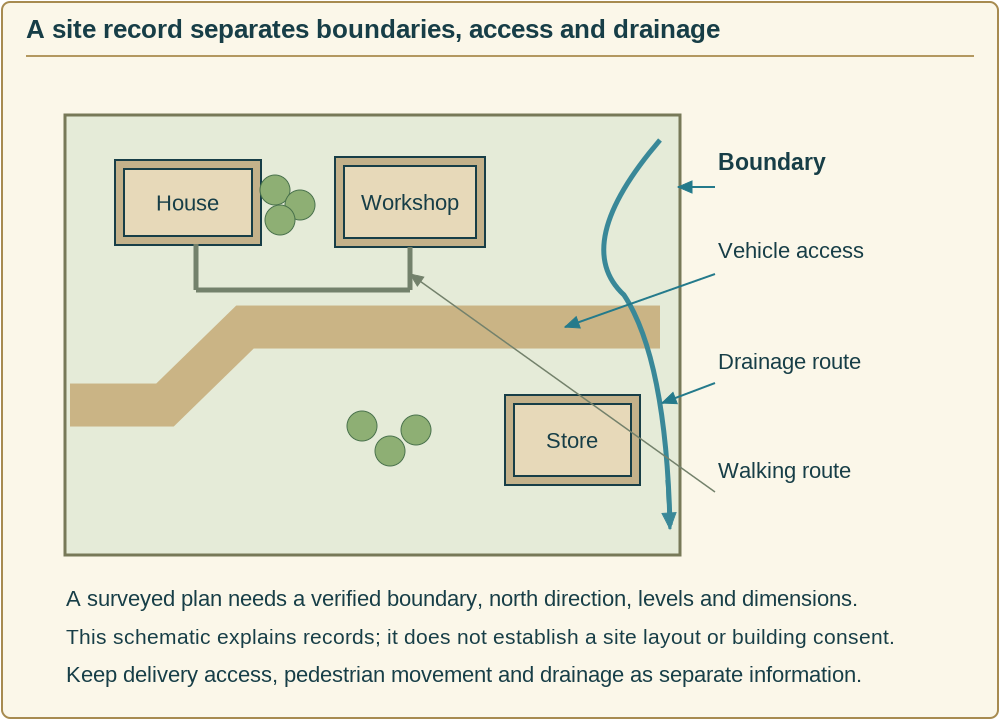
Begin with a surveyed boundary, north direction, levels, access, water, drainage and the legal building envelope. The eight supplied plans have unconfirmed sites and authors. Their layouts can support comparison of roads, plots, open space and circulation; their graphic appearance cannot establish what an Argentine site is allowed to build. Copy no boundary or dimension into a real project without a survey and a source.
A site record distinguishes access for people, service vehicles and surface water. Conflicts arise where routes require the same narrow space. A layout comparison can reveal a conflict; it does not predict flood depth, foundation settlement or legal compliance.
Diller Scofidio + Renfro describe the Boston Institute of Contemporary Art as a building whose upper gallery extends over the waterfront public space. The elevated gallery and sheltered plaza are related architectural decisions. Credit the building design to that practice; the supplied structural diagrams are separate documents whose individual authors and calculations remain unverified.
The new diagram traces a load through a projecting beam, its backspan, support and foundation. It is an explanatory load path, not the museum’s structural calculation. Downward force on the projection produces a turning effect. A model with a beautifully drawn cantilever can still overturn if its backspan and support are not restrained.
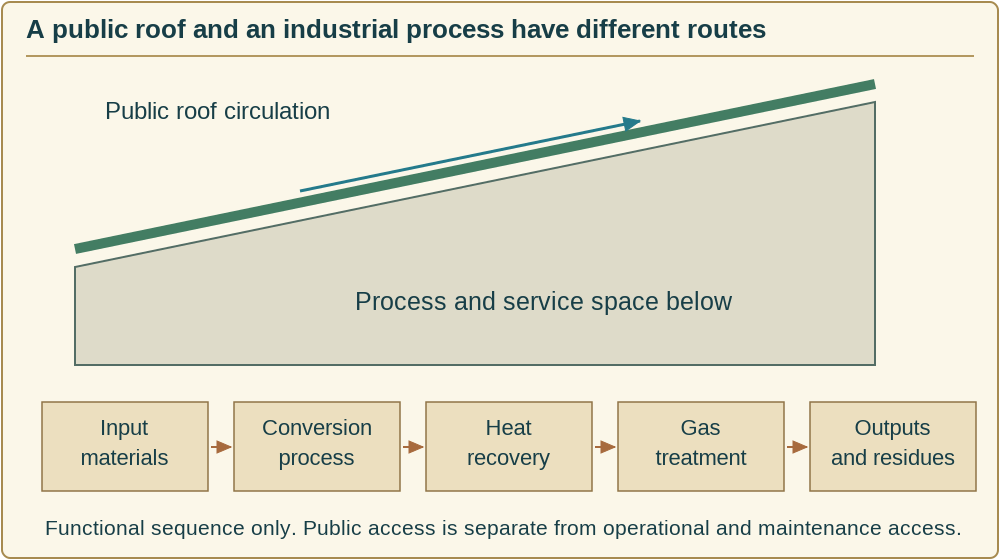
Copenhagen: a roof above a process plant
Read the illustration’s labels
A public roof and an industrial process have different routes
Public roof circulation
Process and service space below
Input
materials
Conversion
process
Heat
recovery
Gas
treatment
Outputs
and residues
Functional sequence only. Public access is separate from operational and maintenance access.
Schematic reading of the public roof and industrial process. It is not a surveyed section or an operating specification.
Units and terms
ICA Institute of Contemporary Art, Boston · = equals · × multiplied by
BIG Bjarke Ingels Group, the architectural practice
CopenHill in Copenhagen combines a public roof landscape with an industrial energy facility. Its operator dates the official opening to 4 October 2019. The supplied photographs and analytical sheets belong beside waste processing and building systems accounts. The architecture is credited to BIG, Bjarke Ingels Group. A supplied diagram’s watermark does not verify its engineering analysis or its image photographer.
Read the building in separate layers: incoming material, controlled conversion, heat recovery, gas treatment, maintenance access and the occupied roof. A route for visitors must not be confused with a route for servicing machinery. A coloured structural view is also different from a processflow diagram: one describes support, the other the movement and transformation of material or energy.
COPEN: CopenHill: opening and visitor information
BIG: BIG: CopenHill project
BIG: Bjarke Ingels Group, the architectural practice.
Units and terms
BIG Bjarke Ingels Group, the architectural practice
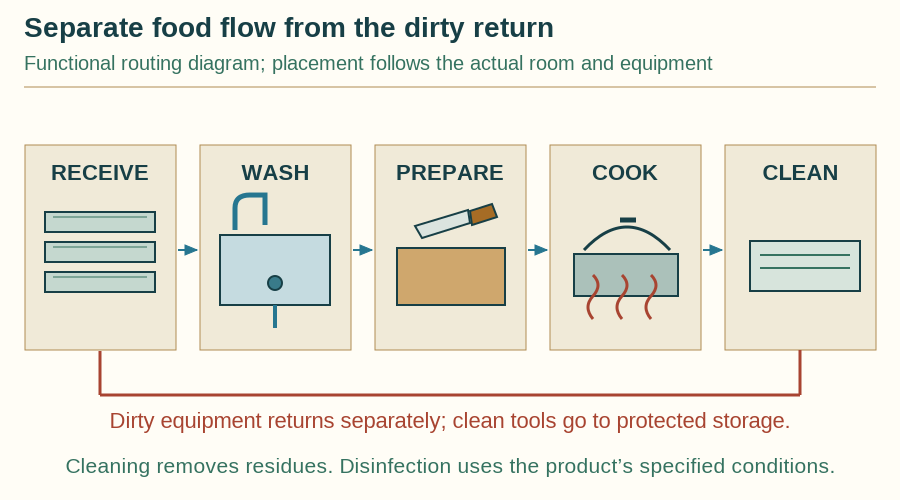
START WITH THE PRODUCT ROUTE For an operating pilot, receive one named vegetable in traceable harvest lots. Provide a covered receiving point, a dirty trimming position, a clean washing and preparation area, a controlled processing position, and separate finished-stock storage. Draw the movement of people, crates, waste and clean containers before positioning benches. Test the route with loaded crates: a worker should not have to carry soil-covered produce across the clean packing surface. This is an original workflow brief, not a building approval. A QUOTE THAT INCLUDES THE SMALL ITEMS Specify food-contact benches, potable water, drainage accepted for the site, handwashing, washable containers, a calibrated scale, timer, food probe, appliance thermometers, label stock and cleaning equipment. Add racks that hold finished containers without blocking inspection. The freezing route requires suitable packaging and a monitored freezer. The canning route requires the correct canner, its rack, compatible jars and closures, jar lifter, funnel and headspace tool. Have the installer confirm the cooker’s load and heat-source compatibility.
WHAT CAN BE MADE ON THE ESTATE An estate workshop can fabricate non-food-contact storage frames, trolley platforms and sign holders to a reviewed design; a competent fabricator can supply cleanable food-contact work surfaces. Pressure vessels, safety valves and refrigeration circuits require appropriate manufactured equipment and qualified service. A home canning schedule cannot be scaled into an industrial retort simply by multiplying the number of jars. The larger installation needs its own engineered process and validation. ARGENTINA: DEFINE THE AUTHORISATION ROUTE Describe whether the facility feeds one household, staff, paying guests or a wider market. Obtain the applicable municipal and provincial requirements before fitting out a commercial operation. The national RNE/RNPA system distinguishes establishment authorisation from product registration; ANMAT separately describes food-handler credentials. Keep the written scope with the commissioning file, because permission for one activity should not be assumed to cover a different product or distribution channel. [D848, D849] ACCEPT THE ROOM THROUGH A WORKING TRIAL Run a full shift at the intended trial quantity. Count every filled package, rejected item and cleaning task; record elapsed time as well as worker-hours. Check that cold storage accepts the load without compromising existing stock. Demonstrate the alarm response and the route for quarantining an uncertain batch. Pay for operational acceptance after these checks, with a named person trained to repeat them when the principal operator is absent.
RNPA : Registro Nacional de Productos Alimenticios Argentina’s registration for an authorised food product.
Freeze a known product in measured lots
Read the illustration’s labels
A
B
C
D
E
F
G
H
I
J
K
L
M
N
O
P
Key
Small-print annotation
A
FREEZING ROUTE: the blanch is not a canning treatment
B
1 PREPARE
C
2 BLANCH + COOL
D
3 PACK + RECORD
E
4 FREEZE + CHECK
F
Wash
G
≤ −18°C
H
Lot
I
Cool
J
Trim
K
Date
L
store
M
Named food, sound pods
N
Green beans: 3 min blanch
O
24 × 500 g = 12 kg
P
Capacity and temperature
PREPARE THE FOOD FOR THIS ROUTE NCHFP’s green-bean method selects tender pods, washes and trims them, then uses water blanching for three minutes. Start timing when boiling resumes. Cool promptly in cold water, drain and package, allowing 12.7 mm of headspace. For cut beans its specified length is 2–4 inches, about 51–102 mm. Blanching is a quality treatment; it does not make a room-temperature preserve. Use the complete vegetable-specific guidance and do not substitute this timing for the canning process on FZ2. [D838, D839]
MAKE THE PACK A UNIT OF ACCOUNT An illustrative 12 kg of prepared, drained beans becomes twenty-four 500 g packs. Weigh the food rather than assuming a container volume equals its mass. Choose packaging intended for freezer use, close it securely and label product, ingredients, net mass, preparation date, lot code and storage position. Separate raw products from cooked food. Log the time the load enters the freezer and its measured progress; a cold air display alone does not prove the centre of every pack has frozen. [D840, D842] REPEAT ONLY AFTER THE FIRST LOAD IS PROVED Use the appliance’s stated fresh-food capacity and loading instructions, preserving space and airflow as required. Check the freezer thermometer and retain the batch record. Select a safe test pack or instrumented equivalent for the agreed commissioning measurement without contaminating saleable food. Review texture after normal cooking and compare usable yield with the starting harvest weight. The result defines the next trial; it does not justify immediate multiplication to industrial volume.
Units and terms
USDA United States Department of Agriculture · ANMAT Administración Nacional de Medicamentos, Alimentos y Tecnología Médica
°C degree Celsius, a temperature unit · min minute, 60 seconds · g gram, 0.001 kilogram · kg kilogram, a mass unit · = equals · ≤ less than or equal to · × multiplied by · NCHFP National Center for Home Food Preservation · mm millimetre, 0.001 metre
kg kilogram, a mass unit · g gram, 0.001 kilogram · NCHFP National Center for Home Food Preservation · US United States · m metre, a length unit · mL millilitre, 0.001 litre · psi pounds-force per square inch, pressure · kPa kilopascal, 1,000 pascals · mm millimetre, 0.001 metre · USDA United States Department of Agriculture
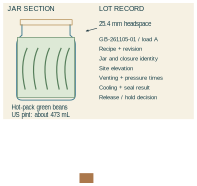
FIX THE CONDITIONS BEFORE STARTING This example follows the NCHFP green-bean process at an assumed 200 m above sea level, about 656 ft. Use sound, tender pods and purpose-made US pint canning jars, nominally 473 mL, with compatible closures. A locally sold 500 mL jar is not automatically interchangeable. For a dial-gauge pressure canner within 0-2,000 ft, the table specifies 20 minutes at 11 psi gauge, approximately 75.8 kPa gauge. Do not transfer this setting to a weighted gauge, another food, an altered recipe or a different altitude. [D836] PREPARE AND FILL THE JARS Wash and trim beans; leave whole or cut into approximately 25 mm pieces. Cover with boiling water and boil for five minutes. Fill hot jars loosely with beans and hot cooking liquid, retaining 25.4 mm headspace. Salt is optional in this recipe. Remove trapped bubbles, recheck headspace, wipe rims and fit lids according to the closure instructions. Use the complete linked process and the manufacturer’s jar and canner directions at the workstation. [D836]
RUN THE PRESSURE PROCESS Use a suitable pressure canner with an accurate gauge, clear vent and rack; USDA schedules require capacity for at least four upright US quart jars. Add the prescribed water, load, lock and heat. Vent a continuous steam flow for ten minutes before pressurising. Start the 20-minute process only at the required pressure. If pressure falls below the requirement, restore it and restart the complete 20 minutes. Depressurise naturally; do not force cooling. At zero pressure remove the weight or open the petcock, wait ten minutes, then open away from the face. Follow the full equipment instructions. [D835] COOL, CHECK AND RELEASE THE LOT Lift jars upright and leave undisturbed for 12-24 hours; do not tighten hot bands. Check seals after cooling. Record preparation, jar specification, elevation, canner identity, venting, pressure, start/finish times and any deviation. A failed seal is withheld; a missing or inadequate heat-process record is a separate reason to withhold the whole affected lot. Do not improvise a rescue procedure. Consult the preservation authority for safe disposition and use its full disposal guidance for suspect food. [D837] THE ARGENTINE APPLICATION This is an explicitly identified US household process for learning controlled preservation. It is not authorisation to market a product in Argentina. For estate or community production, ask the local food technologist to verify equipment, containers, intended scale and the applicable approval route before adopting it. Preserve the tested source wording in the operator’s controlled reference copy; revise the work instruction only through a documented technical review. [D848]
NCHFP : National Center for Home Food Preservation The University of Georgia centre that publishes the food-preservation method cited here.
kPa : Kilopascal A pressure equal to one thousand pascals. mm : Millimetre A unit of length equal to one thousandth of a metre. USDA : United States Department of Agriculture The federal department responsible for the agricultural, food and research programmes cited here.
A sealed jar still needs a process record
Units and terms
kg kilogram, a mass unit · g gram, 0.001 kilogram · NCHFP National Center for Home Food Preservation · US United States · m metre, a length unit · mL millilitre, 0.001 litre · psi pounds-force per square inch, pressure · kPa kilopascal, 1,000 pascals · mm millimetre, 0.001 metre · USDA United States Department of Agriculture
US United States · mL millilitre, 0.001 litre · mm millimetre, 0.001 metre
Section is schematic, not a pressure-vessel drawing. The 25.4 mm headspace belongs only to the worked green-bean process. A closure check cannot reconstruct missing process conditions. [D836, D837]
In the drawing: JAR SECTION LOT RECORD; 25.4 mm headspace; GB-261105-01 / load A; Recipe + revision; Jar and closure identity; Site elevation; Venting + pressure times; Cooling + seal result; Release / hold decision; Hot-pack green beans US pint: about 473 mL
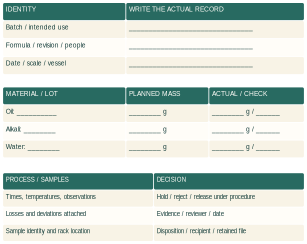
RECORD AN INTERRUPTION AS IT HAPPENS Keep a clock beside the operator. Record the required pressure and the times at which venting, processing and natural cooling begin and end. When a deviation occurs, write what happened and the action actually taken. Do not fill in an uninterrupted trace after the event. The supervisor reviews the source process and the recorded load together before release; an illegible time or absent page requires investigation.
LEARN FROM THE FAILURE RATE Compare held units with all processed units and separately record the reasons. Two out of twelve is 16.7%, but closure faults, glass breakage and process deviations are different failure categories. Investigate the cause before purchasing another canner. The improvement may be a compatible closure, a clear work instruction or operator practice. A higher output target cannot compensate for batches whose history cannot be reconstructed.
ONE CODE CONNECTS THE WHOLE LOT Assign a code such as GB-261105-01 to the receiving record, preparation sheet and every finished jar. This invented code means green beans, 5 November 2026, first lot; it contains no safety claim. The sheet records supplier or harvest bed, ingredient masses, recipe revision, container, equipment serial number and operator. If two canner loads use the same prepared vegetables, give each load a suffix because their pressure histories may differ.
Units and terms
US United States · mL millilitre, 0.001 litre · mm millimetre, 0.001 metre
% percent, parts per hundred · L litre, a volume unit · kg kilogram, a mass unit · kWh kilowatt-hour, energy · V volt, electrical potential difference · Hz hertz, cycles per second · = equals · ÷ divided by
RECORD AN INTERRUPTION AS IT HAPPENS Keep a clock beside the operator. Record the required pressure and the times at which venting, processing and natural cooling begin and end. When a deviation occurs, write what happened and the action actually taken. Do not fill in an uninterrupted trace after the event. The supervisor reviews the source process and the recorded load together bfore release; an illegible time or absent page requires investigation.
Freezer capacity, capital and electricity
THREE RATINGS THAT MUST STAY SEPARATE Gafa’s FGHF200B-M manual lists 200 L net storage, 15.5 kg of fresh-food freezing capacity per 24 hours and 290 kWh annual energy consumption under its rating conditions. Litres describe space, kilograms per day describe a freezing load, and kWh describe energy. None is a substitute for the others. Its 220-240 V, 50 Hz supply specification also needs a compatible installation. Match the delivered model and manual revision before accepting the appliance. [D844] THE 60 KG-PER-DAY SCREENING CALCULATION For an assumed 60 kg of prepared product arriving daily, 60 ÷ 15.5 = 3.87 units, rounded up to four by nominal capacity. Four provide 62 kg per 24 hours; one out of service leaves only 46.5 kg. Five units would leave four operating after a single failure. This is arithmetic screening, not proof that five domestic freezers form a suitable processing plant. Measure actual loading, pack geometry, pull-down time and storage occupancy; compare a purpose-designed freezing installation before purchasing at scale.
A DATED ARGENTINE PRICE, WITH ITS LIMITS Leogar displayed ARS 578,999 for one FGHF200B-M in a single payment. The page also showed contradictory stock messages, so supply remains unconfirmed. Banco Nación’s 5 November 2026, 09:49 banknote selling rate was ARS 1,570 per USD. That makes one unit USD 368.79, four ARS 2,315,996 / USD 1,475.16, and five ARS 2,894,995 / USD 1,843.95. These are price comparisons, not installed quotations. Delivery, electrical work, monitoring, backup supply and financing are additional. [D845, D846] PAY FOR THE ENERGY THAT IS ACTUALLY USED Four rated units sum to 1,160 kWh/year and five to 1,450 kWh/year. Actual consumption depends on the room, use and loading. For a measured annual total E and electricity price T in ARS/kWh, energy cost is E × T; include fixed and demand charges separately. Do not size backup power from annual average watts. Have the electrical designer measure starting demand, operating load and required autonomy, then test the installation under a representative outage. RESERVE SPACE FOR TOMORROW’S HARVEST Storage can become full even when daily freezing capacity is adequate. At an invented 60 kg/day for six days, 360 kg enters the system before any withdrawals. Record how many actual packs fit under the approved loading arrangement and how much leaves each day. Set a maximum intake when occupancy or processing capacity is reached. Harvest scheduling, same-day use and another validated preservation route belong in the contingency plan.
kWh : Kilowatt-hour A unit of energy. One kilowatt supplied for one hour equals one kilowatt-hour, or 1,000 watt-hours. Hz : Hertz Frequency in cycles per second. ARS : Argentine peso The currency in which the local price, quote or exchange rate is recorded.
Units and terms
% percent, parts per hundred · L litre, a volume unit · kg kilogram, a mass unit · kWh kilowatt-hour, energy · V volt, electrical potential difference · Hz hertz, cycles per second · = equals · ÷ divided by
ARS Argentine peso · USD United States dollar · kWh kilowatt-hour, energy · kg kilogram, a mass unit · × multiplied by · FDA Food and Drug Administration, the United States regulatory agency named in the dated source · US United States · FSAI Food Safety Authority of Ireland · °C degree Celsius, a temperature unit
PREPARE THE RESPONSE BEFORE THE OUTAGE Assign the duty operator and alternate, keep appliance thermometers readable and test alarm messages. Record the time supply fails; keep doors closed and stop adding fresh warm product. The FDA’s household estimate is approximately 48 hours for a full closed freezer and 24 hours for a half-full one. Room temperature, loading and equipment change the result. Use those figures for preparedness, never as a guaranteed release clock. [D841] DISTINGUISH EMERGENCY ASSESSMENT FROM ROUTINE THAWING US emergency guidance allows refreezing or cooking food that still has ice crystals or is at 40°F, about 4.4°C, or colder. It requires assessment of the food, not merely the restored freezer display. For ordinary work in Argentina, thaw in the refrigerator; Ireland’s FSAI also recommends refrigerated thawing and advises against routinely refreezing thawed food. An estate’s approved procedure must state which rule applies. Do not select the most convenient sentence from different jurisdictions. [D841–D843]
CLOSE THE INCIDENT WITH ACCOUNTABLE DISPOSITION For each affected lot record time history, measurements, quantity, location and the competent person’s decision. Unknown exposure is not repaired by freezing again; do not taste food to assess safety. Separate uncertain stock from released food. Reconcile transferred, used and discarded quantities, then repair the failed equipment and prove the alarm path before normal intake resumes. Include the value of discarded food and emergency labour in the incident cost, not only the electrician’s invoice.
Read the illustration’s labels
POWER FAILURE
Record start time
Keep doors closed
In the drawing: POWER FAILURE; Record start time Keep doors closed
Assess each lot
Units and terms
ARS Argentine peso · USD United States dollar · kWh kilowatt-hour, energy · kg kilogram, a mass unit · × multiplied by · FDA Food and Drug Administration, the United States regulatory agency named in the dated source · US United States · FSAI Food Safety Authority of Ireland · °C degree Celsius, a temperature unit
kg kilogram, a mass unit · % percent, parts per hundred · g gram, 0.001 kilogram
USE LOCAL ACCEPTANCE LIMITS INTA describes colour, firmness, soluble solids, acidity and starch degradation as complementary indices. Appropriate values vary by cultivar and destination. Ask the local postharvest adviser or receiving operator to specify the method and acceptance window before harvesting. Do not convert a single Brix reading into a declaration that fruit will store for a particular number of months. The intended storage system must actually exist and be ready. [D917] RECORD THE RELEASE DECISION Put the lot, date, measurements, decision-maker and next check on one sheet. SENASA’s 3 March 2021 Granny Smith decision advanced an Alto Valle tentative date after local evaluation; it illustrates why dates can change. That historical authorisation cannot be reused for 2027. Fruit cut or treated for a laboratory test stays outside the food supply, with its mass recorded as a sample. [D918]
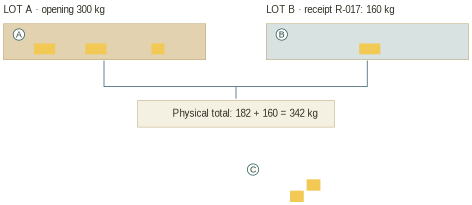
Close the mass balance on every lot
WEIGH CONTAINERS BEFORE COUNTING FOOD The example lot arrives in 12 crates, each with a measured tare of 1.50 kg. Combined gross mass is 258.00 kg. Subtract 18.00 kg of crates to obtain 240.00 kg of fruit. Weigh different container types separately; rainwater, liners or repaired crates can change tare. Record kilograms to a precision the instrument and method can support. [D936] ACCOUNT FOR EVERY DESTINATION After grading, allocate 180 kg to fresh dispatch, 36 kg of suitable sound fruit to processing, 4 kg to destructive sampling and 20 kg to rejected material. These outputs sum to 240 kg. The food allocation is 216 kg, or 90% of the incoming net mass. Processing is not a way to rescue mouldy or otherwise unsafe fruit; its intake must meet the selected process specification.
INVESTIGATE THE DIFFERENCE If the physical totals add to only 237 kg, the unexplained variance is 3 kg, or 1.25% of the 240 kg input. Check omitted containers, double-counted tare, scale zero, spilled fruit and unrecorded transfers. Record any measured moisture loss separately. Do not automatically call the difference theft or hide it inside an assumed waste percentage. The person correcting the ledger signs the reason and keeps the original entries.
In the drawing: INCOMING NET FRUIT; FOOD ALLOCATION; 258 kg gross − 18 kg tare = 240 kg; 180 kg fresh + 36 kg processing; Balance: 180 + 36 + 4 + 20 = 240 kg. Food allocation: 216 / 240 = 90%. Declared example.
Other destinations
4 kg samples + 20 kg rejected
Plan for the busiest harvest day
COMPARE DAILY ARRIVALS WITH DAILY CAPACITY Selected five-day arrivals are 80, 120, 160, 120 and 80 kg, totalling 560 kg. A fresh-use route can receive 40 kg each day and a commissioned processing route 80 kg each day. Weekly capacity appears ample at 600 kg. Yet day three brings 40 kg more than the combined daily limit. Spare capacity on day one cannot be stored and used retrospectively. [D936]
Units and terms
USDA United States Department of Agriculture · AMBA Área Metropolitana de Buenos Aires Buenos Aires and its surrounding metropolitan area · INTA Instituto Nacional de Tecnología Agropecuaria · SENASA Servicio Nacional de Sanidad y Calidad Agroalimentaria
kg kilogram, a mass unit · % percent, parts per hundred · = equals
TRACK THE QUEUE THROUGH THE WEEK With up to 120 kg leaving each day, closing backlog is 0, 0, 40, 40 and 0 kg. This arithmetic assumes suitable, available holding conditions; it does not establish a safe holding time. On days four and five, move the oldest acceptable lot first while preserving lot identity. If the holding conditions are unavailable, arrange another destination or alter picking within the cultivar’s legitimate maturity window. TEST LABOUR AND PROCESS BOTTLENECKS Suppose a timed trial measures 20 kg of incoming fruit prepared per worker-hour. An 80 kg processing day requires four preparation worker-hours before cooking, filling, cooling and cleaning. Check all later stages separately. A canner’s jar capacity and a freezer’s kilograms frozen per day are different limits. Reserve relief staff and transport against the peak day, then replace every example rate with a commissioning trial.
DAILY FLOW (kg) DAY 1 DAY 2 DAY 3 DAY 4 DAY 5 Arrivals 80 120 160 120 80
Dispatch + processing 80 120 120 120 120
Closing backlog 0 0 40 40 0
Daily ceiling: 40 kg fresh + 80 kg process = 120 kg. Safe holding conditions must be established separately.
The orchard record kit and its cost
ASSEMBLE THE KIT BEFORE THE FIRST PICK For the 40-tree register, procure 40 durable tags, four row signs, a site plan, waterproof field sheets, two clipboards, pencils and a protected duplicate register. At receiving, provide a stable weighing station, containers with known tare, numbered lot labels and a reject area. Maturity testing adds the specific instruments and reference materials selected with the adviser. Label equipment with its own ID so a doubtful measurement can be traced to the instrument used. USE A DATED ARGENTINE SCALE BENCHMARK On 5 November 2026, STEC displayed a Systel Croma at ARS 459,547.96 including taxes, with freight extra. A separate transfer price was ARS 363,043. The title says 31 kg while the technical description says 30 kg; confirm the exact supplied model and nameplate before ordering. For this plan use 30 kg as the ceiling. Display increments of 5 or 10 g do not establish measurement accuracy. [D933]
SEPARATE CAPITAL FROM ANNUAL WORK At the BNA banknote selling quotation of ARS1,570 per USD, the displayed standard scale price is about USD 292.71. This is a comparison, not an import cost. Obtain separate quotes for tags, crates, maturity instruments, verification, freight and setup. For a declared labour example, 40 weekly observations at two minutes each require 80 minutes; add 20 minutes for entry and review. Over 20 weeks this is 33 hours20 minutes, before harvesting or laboratory work. [D934, D936] MAINTAIN THE EVIDENCE CHAIN Before use, check the station is stable, clean and zeroed; verify it according to the instrument supplier’s instructions with suitable reference masses. Record failed checks and stop using suspect results until resolved. After the season, replace unreadable tags, reconcile the tree count, archive signed sheets and test restoration of the digital copy. Budget staff time at the actual employer cost, including relief and travel.
STEC : STEC retailer The trading name of the seller whose dated equipment price is cited.
Units and terms
kg kilogram, a mass unit · % percent, parts per hundred · = equals
kg kilogram, a mass unit · = equals · ARS Argentine peso · g gram, 0.001 kilogram · BNA Banco de la Nación Argentina · USD United States dollar
In the drawing: DRY; FERMENT; Water removal; Recipe + submersion; Condition + protect; Temperature + time; CAN; COLD STORE; Tested heat process; Measured conditions; Jar + food + elevation; Crop + lot + airflow No universal shelf life
Turn a harvest into a process plan
DEFINE THE LOT AND THE CONSTRAINT Example: receive 10.00 kg of sound apples under one harvest code. Reserve the handling area, water, three dryer runs and covered conditioning space before cutting fruit. Write the receiving date, orchard/tree group, variety when known, and intended product. Assign one person to receive and weigh, one to prepare and load, and one to review the finished record; one trained person may hold more than one role. These are planning choices. [D964]
DRAW THE PHYSICAL ROUTE Use separate positions for incoming crates, washing, cutting, drained slices, loaded trays, cooling, conditioning and finished packages. Return dirty utensils through a cleaning route that does not cross exposed dry fruit. Raw meat for the smoker stays out of the fruit preparation area. Wash hands and food-contact equipment; rinse produce under running safe water. The FDA guidance supports cleaning and separation; the station arrangement is an original example. [D963,D964]
CHECK THE BOTTLENECK BEFORE COMMITTING A ten-tray dryer is not a ten-kilogram dryer. Tray area, slice spacing and the slowest acceptable run determine its usable throughput. If all prepared fruit cannot enter the validated process, prepare smaller portions or use an established refrigerated holding procedure. Do not leave cut fruit waiting through two ten-hour runs because a spreadsheet assumes instant loading. The capacity calculation on AD2 makes this scheduling problem visible. [D964]
DEFINE WHO CAN RELEASE THE LOT Use a paper sheet that travels with the food. The operator records actual mass, times, readings and exceptions; the reviewer checks the evidence before moving it to normal stock. Hold uncertain lots separately with a clear status and responsible person. Record disposal and samples as well as edible output so a missing kilogram cannot vanish from the balance. [D964]
WHO: World Health Organization. The institution cited for its food-hygiene framework.
A tested recipe is a complete specification
Units and terms
SENASA Servicio Nacional de Sanidad y Calidad Agroalimentaria · FDA Food and Drug Administration, the United States regulatory agency named in the dated source · kg kilogram, a mass unit
FDA Food and Drug Administration, the United States regulatory agency named in the dated source · kg kilogram, a mass unit · WHO World Health Organization · pH A logarithmic measure of hydrogen-ion activity · SENASA Servicio Nacional de Sanidad y Calidad Agroalimentaria · US United States · NCHFP National Center for Home Food Preservation · mm millimetre, 0.001 metre · mL millilitre, 0.001 litre
KEEP MEASUREMENT AND VALIDATION DISTINCT A pH reading describes the tested sample. It does not prove that every particle has equilibrated or that heat reached the required locations for the required time. Likewise, a sealed lid records closure, not the full heat history. SENASA warns that botulinum toxin cannot be reliably detected by sight, smell or taste. Never use tasting to release a suspect preserve. [D938] DESIGN THE COMMUNITY SYSTEM Before commercial production in Argentina, agree the product specification, process review, registration route, labelling and verification programme with the relevant food authority and a qualified food technologist. Keep supplier lots and customer destinations linked to each batch. European traceability requirements offer a useful comparison already documented in D929; they do not replace Argentine requirements. A usable blueprint includes responsibility and records alongside equipment. [D938,D929,D964]
Fermented cabbage: ingredients and submersion
PREPARE ONE SPECIFIED PORTION The USDA/NCHFP method works in portions of 5 lb cabbage, equivalent to 2.268 kg, with 3 US tablespoons of canning or pickling salt. Remove outer leaves, rinse and drain, quarter and core, then shred finely. Mix with the measured salt using clean hands and pack firmly until juices are drawn out. This is a recipe ratio: do not replace it with a guessed spoonful or an assumed gram conversion for a different salt. [D939,D940]
SIZE THE VESSEL AND BRINE CORRECTLY Use a sound food-grade vessel and a fitted plate with suitable weights. Keep cabbage 1-2 in (25.4-50.8 mm) beneath brine. The NCHFP recipe leaves 4-5 in of space above the cabbage; this is vessel clearance, not the submersion depth. If needed, its supplemental brine is 1.5 US tablespoons salt per US quart of water, boiled and cooled. Cover as directed. [D939,D941] USE REAL MEASURES One US quart is 946.35 mL; three US tablespoons occupy about 44.36 mL. Neither conversion determines salt mass because crystal packing varies. Keep the original recipe measures or use a separately validated mass-based recipe. Mark the vessel with its batch code and record cabbage quantity, salt measure, start time and location. [D964]
Read the illustration’s labels
Fermentation: submersion and vessel clearance differ
Clean cover
Sealed weights
Brine surface
Fitted plate
Cabbage below brine
25.4–50.8 mm (1–2 in)
Keep the rim 4–5 inches above the cabbage. This is separate from brine depth.
Section is schematic. Use the complete source method and suitable equipment. [D939–D941]
One recipe portion: 5 lb cabbage (2.268 kg) and 3 US tablespoons canning or pickling salt. Preserve the source measures; the drawing is not a vessel-scale plan.
Fermentation: observe, record and refrigerate
Units and terms
FDA Food and Drug Administration, the United States regulatory agency named in the dated source · kg kilogram, a mass unit · WHO World Health Organization · pH A logarithmic measure of hydrogen-ion activity · SENASA Servicio Nacional de Sanidad y Calidad Agroalimentaria · US United States · NCHFP National Center for Home Food Preservation · mm millimetre, 0.001 metre · mL millilitre, 0.001 litre
NCHFP National Center for Home Food Preservation · US United States · mm millimetre, 0.001 metre · mL millilitre, 0.001 litre · kg kilogram, a mass unit
Sources for this account
European Commission: general food-law requirements
Maintenance and a release record that can be audited
COOK THE PARTICULAR FOOD For ordinary whole beef, pork, lamb or veal steaks, chops and roasts, US guidance gives at least 145 F (about 63 C) with a three-minute rest. Ground meat needs 160 F (about 71 C); poultry needs 165 F (about 74 C). These are minimum internal temperatures for the specified foods, not temperatures for the smoker air. Follow a complete method appropriate to the cut and equipment. [D963] CHILL THE COOKED PRODUCT Refrigerate promptly in shallow portions: within two hours, or one hour if ambient temperature exceeds 90 F (about 32 C). FSIS advises using refrigerated smoked meat within four days or freezing it. Hot smoking in this lesson does not make a shelf-stable product. Plan refrigerator capacity before lighting the smoker. [D957,D963]
Read the illustration’s labels
Smoking: measure chamber air and the centre of the food
FOOD PROBE
Tip in the thickest part
AIR PROBE
Chamber: 107–149°C
Separate from food reading
Whole cuts: at least 63°C, then 3 minutes rest. Ground meat: at least 71°C.
Poultry: at least 74°C. These are internal food temperatures. [D963]
Schematic arrangement; follow the smoker’s instructions and the cited food guidance.
FSIS : Food Safety and Inspection Service The United States Department of Agriculture service responsible for the food-safety guidance cited here.
Maintenance and a release record that can be audited
GIVE EVERY CHECK AN OWNER For each run, the operator checks clean trays, secure supports, unobstructed vents, instrument condition and package identity. After use, follow the equipment’s cleaning instructions and dry components before storage. A second named person reviews exceptions and stock status where staffing allows. For a sole operator, make the review a distinct step with a time and signature. This ownership pattern is an original management design. [D964] CHECK SMALL LOSSES BEFORE THEY BECOME INVISIBLE Choose ten labelled storage crates as a monitoring sample. If each contains 12.00 kg net initially, the sample starts at 120.00 kg. Suppose the later total is 116.40 kg with no withdrawals: the reduction is 3.60 kg, or 3.0%. Investigate water loss, decay, handling and weighing errors. Mass change alone cannot identify the cause. Record disposals separately rather than silently updating the starting mass. [D964]
PLAN STAFF TIME AND INSTRUMENT CARE A planning allowance of twelve minutes daily for store checks and forty-five minutes weekly for cleaning and review is 4,380 + 2,340 = 6,720minutes annually, or 112 hours, excluding repairs.
Units and terms
US United States · FSIS Food Safety and Inspection Service · °C degree Celsius, a temperature unit
kg kilogram, a mass unit · % percent, parts per hundred · = equals · m² square metre, an area unit · m metre, a length unit · × multiplied by
Start with the family Changing tomato to pepper changes the crop name but leaves the bed in the Solanaceae. A useful rotation follows botanical families and the organisms that use them as hosts. A tomato, potato, aubergine and pepper therefore belong in one planning group. Cabbage, broccoli and radish belong in Brassicaceae. Beans and peas are Fabaceae; pumpkin, cucumber and squash are Cucurbitaceae. What a rotation can change A gap between suitable hosts can reduce opportunities for some pests and diseases. Different crops also place different demands on the soil and the work calendar. Rotation does not repair compaction, drainage failure, contaminated irrigation or a nutrient deficit by itself. Diagnose a repeated failure before deciding which part of the system needs to change. [D965-D968; D989]
Units and terms
kg kilogram, a mass unit · % percent, parts per hundred · = equals · m² square metre, an area unit · m metre, a length unit · × multiplied by
An original dimensioned example | 96 m² of cropped ground inside a 189.6 m² working footprint
Adapt the access before digging The 0.6 m internal paths are an example, not an accessibility standard. Measure the real wheelbarrow, turning space and needs of the people who will work here. Widen paths where necessary and recalculate the footprint. Mark drainage, water lines, gates, shade and existing roots on the actual site plan. Do not place the rectangle across an unresolved drainage route. [D969]
Measure the complete footprint Each bed is 1.2 m wide and 10 m long: 12 m². Eight beds provide 96 m² of cropped ground. Seven internal paths at 0.6 m and two outside paths at 1.0 m make the width 15.8 m. Adding 1.0 m at each end makes the length 12 m. The complete rectangle is therefore 15.8 × 12 = 189.6 m². These are assumed planning dimensions.
Pair the beds without changing their names Beds 1-2 form A; 3-4 form B; 5-6 form C; 7-8 form D. Each group has 24 m². Physical bed numbers stay fixed for the life of the garden. Crop names move across the map each season. A permanent identifier lets a future steward reconstruct what happened even when every current crop has changed.
Read the illustration’s labels
15.8 m overall
Bed: 1.2 × 10 m
Path: 0.6 m
Outer path: 1 m
12 m
In the drawing: 15.8 m overall; Bed: 1.2 × 10 m; Path: 0.6 m; Outer path: 1 m
Follow the family through four years
Site plan · dimensions in metres
8 beds × 12 m² = 96 m² cropped
The main-crop matrix | Every winter crop and volunteer must also enter the bed record
Leave a truthful space for the off-season The matrix describes four main crop groups, not an instruction to leave soil bare between them. Choose off-season protection and crops with the local adviser, then add those families to the history. A repeated grass cover is still a repeated family. If an off-season host invalidates the intended break for a particular disease, revise the plan rather than concealing the overlap. [D965-D969; D989]
Read down one column In group A, the sequence is Solanaceae, Cucurbitaceae, Fabaceae, Brassicaceae, then Solanaceae again. Follow the same group through time rather than reading only across a single year. The four groups have equal area, so each main family receives 24 m² in every year of this example.
Units and terms
kg kilogram, a mass unit · % percent, parts per hundred · = equals · m² square metre, an area unit · m metre, a length unit · × multiplied by
m metre, a length unit · m² square metre, an area unit · = equals · × multiplied by
m² square metre, an area unit · AMBA Área Metropolitana de Buenos Aires Buenos Aires and its surrounding metropolitan area
A practical handover At the weekly meeting the grower signs the planting window, the irrigation lead demonstrates water delivery and the storekeeper reports shortages. If the pump test slips, reserve the nursery space or move the day’s crew to a field already supplied. Record the change before dispatching people or plants.
Six stations, six different frost histories
Station Series Mean last Latest last Days/yr
Aeroparque 1956-2012 15 Jul 2 Sep 1
Ezeiza 1956-2012 8 Sep 15 Nov 16
Pergamino 1950-2011 13 Sep 23 Oct 22
Corrientes 1962-2012 15 Jul 26 Aug 1
La Consulta 1970-2011 1 Oct 14 Nov 65
Bariloche 1956-2012 19 Dec 31 Dec 117
FAUBA, historic station series at 0 °C. Days/yr is mean annual frost-day frequency. Last-frost dates use the years in the source table for that statistic.
1956-2012
Same period at Aeroparque and Ezeiza, different exposure and frost frequency.
The same metropolitan area can require different plans Aeroparque and Ezeiza cover the same historical period. Their mean annual counts are one and sixteen frost days. A city nursery planning a delivery to the conurbano needs the receiving plot’s conditions. Pergamino, farther inland, supplies another distinct record.
Read each column on its own terms These stations use minimum air temperature at or below 0 °C in a standard screen. The separate 3 °C agricultural indicator is a proxy for conditions near vegetation. The atlas calculates statistics from available observations and lists frost-free years separately. A historical extreme describes one series. It cannot promise a safe planting day.
From station to decision At La Consulta, use the spring record when reserving protection and staff for a vulnerable crop stage. At Bariloche, keep a protected production option available for longer. For Corrientes, plan around local rain and access as well as occasional cold. Check the current forecast and the actual bed before dispatch.
How much water reaches a 100 m² bed?
Agree the net refill A chosen 100 m² bed needs the equivalent of 10 mm of water at the root zone. The grower credits 4 mm of effective rain after inspecting wetting depth. Rainfall in a gauge can exceed the amount stored where roots can reach it. On sloping or crusted soil, inspect more than one position.
Convert depth to water and time One millimetre spread over one square metre equals one litre. A 6 mm deficit over 100 m² is 600 L net. At an assumed application efficiency of 75%, the system must deliver 600 ÷ 0.75 = 800 L gross. At a measured zone flow of 400 L/h, schedule two hours, subject to infiltration and available water.
Units and terms
FAUBA Facultad de Agronomía de la Universidad de Buenos Aires · °C degree Celsius, a temperature unit
m² square metre, an area unit · mm millimetre, 0.001 metre · L litre, a volume unit · % percent, parts per hundred · = equals · ÷ divided by
Apply the method in the other hemisphere NOAA’s US last-spring-freeze map uses the 1991-2020 normals and a threshold of 32 °F, or 0 °C. A historic station normal is one input to planning. Pair it with the crop’s tolerance, an up-to-date local forecast and the farm’s own exposure. Record the exact definition used before comparing a US normal with the INTA near-ground series.
Keep an observation separate from a missing visit
A four-day observation interval
Visit Status
10 September No open flower
11-13 September No visit recorded
14 September Open flower seen
Later than 10 Sep, by 14 Sep
Checks occur at the same hour. The recorded interval preserves what can be known about the first opening.
Install a repeatable field round Choose identifiable sites, for example an exposed vegetable bed, a sheltered bed and a permanent rain gauge. Record instrument, height or probe depth, time and units. Inspect whether the shelter or foliage has changed. Read and empty the gauge according to its own instructions. A missing visit can leave a multi-day total; mark the period before comparing it with a single-day reading.
Date the observation, then bound the event Suppose a marked plant had no open flower at the same observation time on 10 September and the first open flower was seen on 14 September. Opening occurred after the first clear check and no later than the second. The interval is four elapsed days. Write the two dated observations and the interval. Assigning 12 September as the actual flowering date would invent a visit.
Keep a matched record across sites If a sheltered row shows flowers on the 12th while an exposed row was last checked on the 10th and next checked on the 14th, the observations cannot prove which row flowered first. Resume matched visits at a consistent hour, and note cultivar, planting date, irrigation and protection. Record observations even when nothing changes so the next event has a meaningful lower bound.
Units and terms
INTA Instituto Nacional de Tecnología Agropecuaria · BY Attribution condition in a Creative Commons licence · cm centimetre, 0.01 metre · m metre, a length unit · NOAA National Oceanic and Atmospheric Administration · US United States · °C degree Celsius, a temperature unit
Choose the next sowing from the season just recorded
Make the short list regional In the Buenos Aires growing belt, investigate heat and irrigation-water quality where leaf symptoms develop during a dry spell. In El Colorado, Formosa, divide sites by drainage when intense rain is the concern. In the southern cordillera distinguish protected starts from exposed beds. Budget for the constraint you can observe and measure on that holding, then revisit it after the season.
Review an operating decision If a farm trial originally allowed 100 days and records now support only 86 usable days under the same definition, a 70-day crop plus its 14-day reserve leaves two days. At an 80-day window the same plan is four days short. Write the observed window, the crop-stage basis, reserve and resulting slack separately. Retain the unsuccessful season alongside the successful one.
Carry the result to the next keeper File the supplier’s variety description, marked bed plan, instrument positions, sowing and harvest dates, labour and losses under one season code. Name the keeper who will start the next record. A later reader can reconstruct whether a change came from the crop, the measurement, a delayed start or the weather that the plants actually experienced.
Dinner Table, from a 1923 edition of Mrs. Beeton’s Book of Household Management. Historical illustration, digitally enhanced by rawpixel; the edition date is later than Isabella Beeton’s lifetime.
A laid table is a plan for a meal. The objects tell a guest where to sit, what will arrive and how each course will be served. The 1923 illustration shows a particular Western domestic ideal, not a universal rule for every culture or household.
The Metropolitan Museum describes a shift from service à la française, with several dishes arranged on the table, toward nineteenth-century service à la russe, with courses served in sequence. The V&A’s account of silver fish-serving tools shows how specialised food service also changed the shape of implements.
The supplied chart contained nine informal labels and twenty-three formal labels. All are transcribed in the next native-text inventories. Use the pieces needed for the actual menu; an absent wine course does not require three unused wine glasses.
For an Argentine family meal, begin with the plate, waterglass, napkin and utensils that the food requires. Add a soup spoon or dessert implement when the course exists. The count belongs to the menu and the number of people, not to an image of luxury.
In the drawing: Outer bark; Cambium; Secondary xylem; Pith
Bark cambium successive xylem increments
Water and Food · anatomy before a tool is lifted
Shigo’s junction and the record in a tree section
Locate the structures named in the lesson
A branch bark ridge is the raised bark pattern at the upper junction of branch and parent stem. The branch collar is the swelling or transition around the base. On the new drawing the red line stays outside that junction. The US Forest Service pruning guidance explains locating the ridge and collar for the final cut and retaining the collar. The adjacent drawing is an anatomical lesson, not a prescription for a branch under load. [E7]
Alex L. Shigo is relevant because this lesson concerns tree structure and response to injury. A portrait of an unrelated inventor would add decoration without explaining the page. The historical portrait source remains in the archive; the corrected reading material uses the anatomical diagram to do the teaching. This section does not present a stylised portrait as evidence of a pruning procedure.
A section records growth and injury
Concentric bands are a teaching simplification. Real rings can be eccentric,
missing or locally interrupted.
Read the illustration’s labels
Read from pith
toward bark.
Pith · earlywood · latewood · cambial region · bark
A ring count alone is not a secure age for every species or position. Record
species, section height, sample orientation and method.
Alex Shigo looking at decay in a downed tree, 1975. USDA Forest Service, Region 6, State and Private Forestry, Forest Health Protection slide collection, Portland. Photographer unknown. Public domain as marked by the collection. [H2]
What this photograph contributes
The photograph records a researcher examining an actual fallen stem. Compare that act of inspection with the labelled branch-collar and growth-ring plates. A photograph of the observer establishes neither the dimensions of your tree nor the location of decay within it. Keep the field observation, diagram and interpretation as separate parts of the record.
A named apple needs a named scion and a sound union
Original teaching drawing; numbered parts correspond to the written method
1 Prepare matching cuts
2 Align living cambium
3 Bind and label
Name
Scion: the named cultivar above the union. Rootstock: the rooted lower part.
Cambium: a thin living layer just inside the bark; match it on at least one side.
A graft joins plants. It does not blend two cultivars into a new seed variety.
A graft combines a rooted lower plant, the rootstock, with a selected shoot, the scion. The thin cambium layers just inside the bark must meet so the union can form. The scion preserves the selected cultivar above the join; it does not blend two varieties into new genetic seed.
1. Prepare three labelled pairs.
Choose compatible apple rootstocks and healthy dormant scion wood from a verified source. Record each cultivar before cutting. Match the method to the relative stem sizes and learn the cut with a competent demonstrator.
2. Make clean matching cuts.
Use a sharp suitable grafting knife and a stable working position, cutting away from the body. Keep prepared surfaces clean and avoid letting them dry while the pair is assembled.
3. Align and bind.
Bring cambium into contact on at least one side when diameters differ. Bind with suitable grafting tape and label the pair. The drawing illustrates a simple functional join; it does not show every graft method.
4. Observe the result.
Record bud growth, callus and failures. Remove unwanted rootstock growth appropriately and inspect the wrap so it does not girdle the stem. Keep the graft union above the intended soil level when planting.
In Argentina, translate dormant-season timing to the local winter and ask an orchard nursery about rootstock, disease-free material and pollination partners. A successful join is not yet a mature productive orchard.
Counted materials and a replaceable budget
Item · quantity × ARS/unit
ARS
USD
EUR
Shared grafting knife · 1 × 28,000
28,000
17.83
15.82
Grafting tape roll · 1 × 6,500
6,500
4.14
3.67
Three durable labels · 3 × 1,500
4,500
2.87
2.54
Shared pruning tool · 1 × 30,000
30,000
19.11
16.95
Priced subtotal
69,000
43.95
38.98
Author’s planning allowances dated 15 November 2026, not retailer quotations. Retained BNA exchange basis, 13 November 2026: ARS 1,570/USD and ARS 1,770/EUR. Three legal rootstocks, three identified scions, training, sanitation supplies and site preparation require local quotations. No fruit income is assumed.
Units and terms
USD United States dollar · EUR Euro · × multiplied by · BNA Banco de la Nación Argentina · ARS Argentine peso
Packing apples in the Oregon Agricultural College packing house, 1910. Oregon State University Special Collections and Archives, P090:010. This is an actual period photograph of packing work.
The 1910 Oregon Agricultural College photograph shows workers, crates and packing benches. Its identified institution and date make it evidence of a particular packing setting. It does not establish the storage temperature, cultivar or shelf life of fruit on a present-day Argentine estate.
Assign a lot before mixing crops from different places or dates. Record species, cultivar where known, orchard or supplier, harvest date, packing date, crate identity, tare mass, gross mass and damage. Net fruit mass equals gross mass minus the actual empty-container tare.
Worked crate record
Quantity
Gross mass of filled crate
13.8 kg
Measured empty-crate tare
1.8 kg
Net incoming fruit
12.0 kg
Rejected after inspection
1.5 kg
Usable before kitchen trimming
10.5 kg
For the Alto Valle comparison, preserve the earlier INTA evidence record: maturity is assessed with several indices, including firmness, acidity, starch change, colour and sugar-related measurements. A red photograph cannot replace those measurements. The original INTA record remains in the sources companion.
Keep date, mass and reason for every removal. A crate that loses water and a crate from which spoiled fruit was discarded need different explanations. The next record should account for both rather than silently reducing the expected balance.
Units and terms
USD United States dollar · EUR Euro · × multiplied by · BNA Banco de la Nación Argentina · ARS Argentine peso
kg kilogram, a mass unit · INTA Instituto Nacional de Tecnología Agropecuaria
Arthur Rothstein, Farm Security Administration / October 1938 U.S. government photograph; LOC lists no known restrictions
LOC: Library of Congress. The United States institution holding the cited historical photograph or document.
Arthur Rothstein photographed apple packing in Camden County, New Jersey, in October 1938. Fruit on the packing bench was already moving through a chain of selection, containers and transport. A quoted keeping period depends on what happened before the crate reached the store.
Cultivar, maturity, bruising, temperature, humidity and adjacent produce all matter. The USDA commercial storage handbook treats commodities separately. Mark the time and location of each temperature reading. A cold room can have warm fruit near its door, and a single air reading on the wall can hide that difference.
Labels on the sheet
Produce · storage location · duration · notes
The chart gives broad storage locations and durations. Temperature, humidity, cultivar, maturity and handling can change the outcome.
The completed ST1–ST2 lessons replace vague categories with four sourced crop cases and a commissioning record. Keep this original beside that comparison, without treating every duration printed here as a validated shelf life.
LOC: Library of Congress The United States national library, which holds the cited photograph or manuscript.
Units and terms
LOC Library of Congress · USDA United States Department of Agriculture
The former chart mixed room, cool and refrigerator storage with unsupported universal week counts. All thirty crop names are retained below. Its original time claims are transcribed in the sources companion as source claims, not adopted as guaranteed safe lives.
Use a thermometer. FDA guidance keeps perishable produce and purchased pre-cut produce refrigerated at 4 °C (40 °F) or below. Separate produce from raw meat and wash it under running water before preparation. Do not use soap on food. Spoiled produce is discarded, not made safe by soaking.
For intact garden crops, quality can require different humidity and temperature. The table is a sorting guide for home holding, not a commercial controlled-atmosphere specification. Inspect daily, use vulnerable lots first, and obtain crop-specific local storage advice for a large harvest.
Crop
Whole-produce condition
Priority / distinction
Apples
Refrigerate for holding
Keep lot and cultivar separate.
Bananas
Room temperature to ripen
Refrigeration darkens peel; inspect flesh.
Berries
Refrigerate promptly
Use early; keep intact fruit dry until preparation.
Citrus
Short room holding or refrigeration
Inspect for decay; temperature changes quality.
Grapes
Refrigerate
Keep damaged fruit out of the lot.
Melons
Ripen whole fruit as appropriate
All cut melon needs refrigeration.
Pears
Ripen whole fruit, then refrigerate
Ripeness changes the holding period.
Stone fruit
Ripen whole fruit, then refrigerate
Peaches and plums are not one cultivar.
Asparagus
Cold, humid; upright if practical
Use early; protect tender tips.
Snap beans
Cold, humid; brief home storage
Chilling can damage intact pods.
Beets
Cold, humid; remove tops
Store roots and edible greens separately.
Broccoli
Cold, humid
Use early; inspect flower buds.
Brussels sprouts
Cold, humid
Keep intact heads in good condition.
Cabbage
Cold, humid
A whole head differs from cut cabbage.
Carrots
Cold, humid; remove tops
Prevent drying; inspect damage.
Cauliflower
Cold, humid
Protect the curd from damage.
Cucumber
Cool, humid; short holding
Prolonged very cold holding can injure it.
Leeks
Cold, humid
Keep soil from other ready-to-eat produce.
Onions, dry
Cured; dry and ventilated
Separate from humid leafy crops.
Parsnips
Cold, humid
Remove tops; protect roots from drying.
Peas
Cold, humid
Use early.
Peppers
Cool; short refrigerated holding
Cultivar and chilling sensitivity matter.
Potatoes
Cool, dark, ventilated
Exclude light; discard green or badly damaged tubers.
Radishes
Cold, humid; remove tops
Roots and greens have different holding needs.
Salad greens
Refrigerate promptly
Use early; follow packaged-food instructions.
Summer squash
Cool; short holding
Thin skins bruise easily.
Sweet corn
Cold; use promptly
Fresh quality declines after harvest.
Tomatoes, whole
Room temperature to ripen
Do not apply this rule to cut tomato.
Turnip roots
Cold, humid; remove tops
Inspect roots separately from greens.
Winter squash
Cured, cool, dry
Store only sound mature fruit.
1. Sort at arrival.
Keep damaged, ripe and sound unripe lots distinct. Label the incoming date and count or weigh them.
2. Assign a condition.
Put each lot in its appropriate clean area, avoiding mixed crates that conceal different needs. Check the temperature where the crop sits.
3. Review and use.
Inspect daily and plan meals around the most perishable sound produce. Record discard mass and cause. A printed maximum does not overrule visible spoilage or a failed cold chain.
Counted materials and a replaceable budget
Item · quantity × ARS/unit
ARS
USD
EUR
Refrigerator thermometer · 1 × 16,000
16,000
10.19
9.04
Ventilated reusable crates · 3 × 12,000
36,000
22.93
20.34
Shared kitchen scale · 1 × 28,000
28,000
17.83
15.82
Labels and record book · 1 × 7,000
7,000
4.46
3.95
Priced subtotal
87,000
55.41
49.15
Author’s planning allowances dated 15 November 2026, not retailer quotations. Retained BNA exchange basis, 13 November 2026: ARS 1,570/USD and ARS 1,770/EUR. Appliances, electricity, food-safe containers, produce and labour are outside this small equipment subtotal.
Units and terms
°C degree Celsius, a temperature unit
FDA Food and Drug Administration, the United States regulatory agency named in the dated source · °C degree Celsius, a temperature unit
USD United States dollar · EUR Euro · × multiplied by
USD United States dollar · EUR Euro · × multiplied by · BNA Banco de la Nación Argentina · ARS Argentine peso
From the tree to a measured store A storage poster may offer a number of days beside a picture of an apple. Those days imply a starting condition and an environment. Fruit harvested at different maturities does not enter storage in the same state. Nor do a domestic cupboard, refrigerated air and a controlled-atmosphere chamber preserve the same conditions.
The University of California, Davis fact sheet for Red Delicious separates maturity and quality indicators, handling conditions and sources of loss. It is useful precisely because it identifies its cultivar and the kinds of commercial handling it describes. A storage recommendation for that case cannot be copied into a record for every fruit on a mixed farm. A fruit can lose water and mass, continue to respire, or develop a disorder whose visible signs appear only after removal.
A useful storage record identifies the lot, intake mass, temperature, elapsed time and each removal. Separate saleable fruit from bruised or decayed fruit. A decline in recorded mass alone cannot distinguish water loss from disposal or sampling. The cultivar, maturity and storage conditions belong with that record.
Units and terms
USD United States dollar · EUR Euro · × multiplied by · BNA Banco de la Nación Argentina · ARS Argentine peso
Functional routing diagram; placement follows the actual room and equipment
RECEIVE
WASH
PREPARE
COOK
CLEAN
Dirty equipment returns separately; clean tools go to protected storage.
Cleaning removes residues. Disinfection uses the product’s specified conditions.
A kitchen is a workshop in which the product is eaten. Arrange the sequence so dirty containers and raw ingredients do not cross clean utensils and ready-to-eat food unnecessarily. Start with the space actually available: water, drainage, light, preparation surface, heat source, storage and a place for waste. A beautiful tool collection cannot compensate for a poor route between them.
Argentina's ANMAT food-handling manual distinguishes cleaning from disinfection. Cleaning removes dirt and residues; disinfection reduces microorganisms through an appropriate process. One does not automatically replace the other. Use products intended for the task and follow their labelled dilution, contact time and rinsing instructions. Mixing cleaning chemicals is not a shortcut.
The supplied utensil montage is useful for naming tools, but it does not identify their materials, food-contact suitability or condition. A utensil with a cracked handle, deep damage or an inaccessible dirt trap may be difficult to clean. Inspect handles, joints and cutting surfaces as carefully as the visible bowl or blade.
Units and terms
USD United States dollar · EUR Euro · × multiplied by · BNA Banco de la Nación Argentina · ARS Argentine peso
ANMAT Administración Nacional de Medicamentos, Alimentos y Tecnología Médica
Zoom the original image for small type. The complete table is retained without repainting its entries.
1789 · Philosophical Transactions 79 · table p.156 · reproduction via Public Domain Image Archive [D332]
Four states, two protocol versions
Preserve what an older symbol meant before combining records
A coded record is only as clear as its instructions. The 2010 field handbook grouped uncertainty and an event not checked under “?”. The documentation updated 11 March 2025 separates an uncertain answer from an unmarked, unchecked event. These documents do not establish the exact date of that change. [D334–D335]
Meaning at a visit
2010 handbook
2025 documentation
Criterion clearly present
Yes
y
Checked; criterion absent
No
n
Checked; answer uncertain
?
?
Event not checked
?
Leave unmarked
The flower criterion also matters
Keep originals and translations
The April 2021 general definition counts fresh open flowers with reproductive parts visible. Its historical lilac protocol instead requires at least half the flower clusters to have an open fresh flower. A rule that works for one method cannot silently replace another. [D336, pp.10,16]
Store the raw symbol, protocol name, version and any later interpretation in separate fields. An old “?” cannot be split into “uncertain” and “not checked” unless another record supports the distinction. Dated definitions belong beside the data.
Four days, five visits, one interval
Fictional teaching record P01 · 10–14 September 2026 · 09:00 UTC-03
P01 is a fictional tagged plant. Here, “present” means at least one fresh open flower meeting a written criterion; this is not a species identification or a universal protocol. Each visit concerns the same individual and criterion.
Sources for this account
Banco Nación: banknote selling rates, 13 November 2026
The left end is excluded: the flower criterion was absent then. The right end is included: it was present then. The elapsed time is 96 hours. Choosing 12 September as a midpoint creates an estimate, not a new observation. [D337]
What this interval cannot prove
An onset bound assumes reliable checks and a continuously detectable transition. A brief earlier flowering episode, or flowers opening and closing, can defeat that assumption. Call 14 September the first confirmed detection, not the first bloom of the season without further evidence. [D336–D337]
Compare intervals before telling a trend
Separate fictional comparison series B02 · all endpoints at 09:00 UTC-03
The bars show observation intervals, not measured onset dates. This separate example assumes consistent plant identity and criterion across years. Its dates are invented to show the effect of visit timing; they are not Marsham’s observations or estate measurements.
Read the illustration’s labels
10 Sep
11
12
13
14
15
16
2024: (10,14]
2025: (11,13]
2026: (12,16]
In the drawing: 10 Sep 11 12 13 14 15 16
The shared range is (12,13]
Every bar includes times after 12 September and up to 13 September. The observations allow the same onset time in all three years. Their midpoints therefore do not establish an ordered change toward earlier or later flowering.
Make the comparison stronger
Keep individual identity, event definition and visit effort visible. Record replacement and management changes. More frequent checks can narrow a bound; they cannot retrospectively fill a missed visit or establish a climate cause. [D337–D338]
A record another observer can continue
A continuous field record retains these ten pieces of information.
Record component
Method
01 · Identify the individual
Give each plant a unique ID and map its position. Keep any uncertain species identification explicit.
02 · Fix the criterion
Attach the species-specific event definition, provider, version and date. Keep a copy with the register.
03 · Set the visits
Choose a feasible route and cadence. Write the clock zone and planned visit window before collecting data.
04 · Record actual time
Enter actual time, observer and plant ID. A planned appointment is not a completed visit.
05 · Inspect the defined event
Check the part named by the criterion. A leaf observation cannot substitute for a flower observation.
06 · Preserve four states
Enter present, absent, uncertain or not checked. Explain uncertainty or a missed visit when the reason is known.
07 · Tie evidence to the visit
If taking a photograph, include plant ID in the record and store its filename. Check the ID before filing.
08 · Bound the event
Find last clear absence and first clear presence. Record assumptions about detectability and earlier episodes.
09 · Correct with a trail
Keep original entry, corrected value, date, editor and reason. Never fill a blank with a remembered guess.
10 · Hand over and back up
Have a second observer find the plant and apply the definition. Keep a second copy away from the field notebook.
Teaching rectangle: 600 m long and 200 m wide; no real specimen coordinate is asserted
600 m
200 m
Centre
Corner
Half-length = 300 m
Half-width = 100 m
Corner distance
= √(300² + 100²)
= 316.23 m
Round outward to 317 m
Circle: rectangle’s envelope
THIS IS ONLY THE RECTANGLE’S ENVELOPE
It does not include uncertain map boundaries, datum errors, an uncertain place-name match or an observer’s location error.
Retain verbatim locality and the method used to interpret it.
Record fields: H12, H22. Geometric example calculated from its stated rectangle only.
Modern teaching drawing · measurements apply only where stated.
Argentina: preserve the estimate and its status
The inherited teaching budget allowed ARS 24,000 for two boards, ARS 18,000 for two straps, ARS 16,800 for 48 blotters and ARS 6,500 for 13 ventilators. The total is ARS 65,300 in selected materials. Three hours at an assumed ARS 8,000 per hour make ARS 89,300 before omissions. These remain planning allowances, not verified supplier quotations. No exchange-rate conversion is carried forward as a current fact. Add actual quotes, taxes, delivery, tags, envelopes and subsequent paper changes before using the total for a purchase.
Units and terms
m metre, a length unit · = equals · ARS Argentine peso · g gram, 0.001 kilogram
On 13 November 2026, Librería Teorema’s public resma listing showed Ledesma Autor A380 gpaper at ARS 17,300. That is a reference for ordinary record-printing paper. It is not a quotation for archival mounting paper or purpose-made blotters, and it is not included in the press subtotal. The distinction matters more than having a price beside every blank. A cheap paper can still be unsuitable for the job assigned to it. [H23]
United States: inspect what the kit actually includes
Herbarium Supply’s plant press kit 171 was listed at USD 106.25 when checked. The contents shown were one press, a pair of straps, 30 blotters, 15 ventilators and 100 newsprint sheets. Against this chapter’s twelve-packet design, 30 blotters cover 24 in use plus only 6 spare; the planned first full change needs 24 spare. The shortfall is 18 blotters. The kit price is therefore not a fully replenished twelve-packet budget. Shipping, local tax and the extra paper remain separate. [H24]
Field desk · locality, cost and custody
Europe and other markets: compare a specification
No complete European supplier basket was verified for this release. The EUR worksheet is deliberately blank until a local quotation is entered. Send the same dimensions, quantities and intended material role to suppliers in each region. Do not compare a small decorative flower press with a field press simply because both are sold under the same name. Outside the three lead regions, retain the local currency, delivery route and collection requirements. The arithmetic travels; the price and supply chain do not.
Units and terms
m metre, a length unit · = equals · ARS Argentine peso · g gram, 0.001 kilogram
ARS Argentine peso · g gram, 0.001 kilogram · USD United States dollar
Sources for this account
Zonaprop, Colón 10 ha, two wells www.zonaprop.com.ar
Pancrace Bessa, illustrator; Gabriel, engraver. The North American Sylva, 1819, plate 88. Public domain. The historical printed name is retained; its modern taxonomic identity is not inferred from the title alone.
Spegazzini’s living archive: a dandelion and its record
A house becomes an archive
Carlos Spegazzini arrived in Argentina in 1879 and became closely involved in the scientific life of La Plata. His collections, instruments, books and house were part of the legacy that became an institution. A collection is more than a cabinet of dried plants: it preserves objects that later workers can compare with names and descriptions. Spegazzini belongs here through that collecting tradition. This chapter does not claim that the invented specimen on its illustrated cover is one he collected. The cover’s sheet is an illustration; the documentary gallery identifies real retained sources. [H01]
Begin with the local status
The Argentine National Parks biodiversity system records Taraxacum officinale and identifies it as an exotic invasive species in the controlled-use category of the cited national list. That record changes the practical task. An observation project should not become an excuse to spread seed into a reserve. Study plants already present where access and observation are permitted. Record the date and source used for status, because a legal list, a distribution point and a botanical identification are different records. A point on a map does not authorise collection. [H02]
Start where the leaves attach
Teaching arrangement of the dandelion form; confirm identity with a regional flora.
Sources for this account
Buenos Aires historical calendar: Bonpland arrives in 1817
In the drawing: One head contains many small flowers.; Leafless flower stalk; Leaves meet at the basal rosette.
Do not use a decorative cover as a plant key. Keep the whole plant, attachments and scale in the documentary record.
Argentina
The rosette is a map of attachments
A basal rosette places leaves around a short central region near ground level. Follow each leaf back to that region before drawing it. Then follow a flowering stalk from the same plant to its head. The familiar dandelion form has a leafless, hollow stalk carrying one head; the yellow head contains many small flowers. These are useful characters, not a sufficient one-picture identification test. Other yellow composites can resemble it from above. Photograph the whole arrangement and use a current regional flora when identity matters. [H03]
Give every image a recoverable position
Use a stable code such as D01 for an observed rosette, and name images D01-overview, D01-leaf and D01-head with the date retained in the record. Place a ruler beside the organ in the same plane. A ruler near the camera and a leaf farther away do not share a scale. Keep the full original frame before making an annotated lesson image. The unedited frame may later reveal a neighbouring plant, an attachment or a label that a beautiful crop removed.
Asa Gray · 1810 to 1888 · illustrated interpretation
United States
Gray’s small flower: read the whole plant
A manual is a tool for comparison
Asa Gray completed the first edition of his Manual of Botany in 1848. A manual compresses many observations into characters that a reader can compare. Its usefulness depends on the territory and plants it covers, and on the edition. It is not a promise that every modern name or introduced species will appear in an old book. Read the old description for its historical vocabulary, then compare with a current regional source. The chapter’s connection to Gray is this disciplined use of descriptions. [H04]
The head is a crowded neighbourhood
The dandelion’s yellow display is an inflorescence, a group of small flowers packed into a head. A strap-shaped ray belongs to one floret. At maturity, the familiar white globe is built from many individual dispersal units. The small dry fruit is more precisely called a cypsela in this family, although many field accounts use achene or simply seed. The embryo is inside the fruit; the bristled pappus is outside. That vocabulary explains why a diagram of one unit is more informative than a fuzzy white circle. [H03, H08]
Many flowers inside one yellow head
Schematic magnification; the floret and fruit are shown at different stages.
Sources for this account
Cereza del Valle de Los Antiguos Patagonia: specification and Resolution 49/2025
Cypsela is the dry one-seeded fruit of this group. The pappus belongs to the dispersal structure, not to a second seed.
United States
A simple preparation record
Wash hands before food preparation, use clean equipment, remove damaged portions and rinse suitable produce under plain running water. The Food and Drug Administration advises against washing produce with soap or detergent. Do not assume washing will remove every chemical exposure or correct a mistaken identification. After washing, drain for a stated period before weighing so that clinging water does not silently change the comparison. If cooking follows, use a complete recipe suited to the ingredient and record the cooked yield separately. [H06]
The rejected portion still cost money
Units and terms
USD United States dollar · g gram, 0.001 kilogram · % percent, parts per hundred · kg kilogram, a mass unit · = equals · ÷ divided by
Sources for this account
Argentina: protagonists of forest science, Burkart biography
Draw one dispersal unit large enough to show the fruit, beak and pappus. Mark it “schematic, not to scale” unless the dimensions come from a measured specimen or cited source. A beautiful 10 cm printed fruit should not imply a 10 cm real object. If a photograph is used for measurement, retain its scale and establish that the structures lie in the same plane. The illustration can then teach anatomy while the measurement record carries the numerical claim.
The chapter connects the La Plata collections, a North American manual, a Renaissance drawing and present-day fluid mechanics. These records have different purposes and evidence: specimen preservation, botanical description, artistic observation and measured airflow. The sources remain distinct.
Albrecht Dürer
1471 to 1528
Dürer connects close observation of turf to the chapter’s history of botanical pictures.
New vector study · no reuse of the opening historical print
B
Interpretive botanical schematic; compare a named living specimen with the archive plate.
Identify the leaf, compound fruit and attachment. The separate opening plate remains the historical source; this is a contemporary explanatory drawing.
1. Begin with the visible part. Write “leaf”, “fruit”, “flowering structure” or “section” beside each visible element. Do not call the large compound fruit a seed or interpret every small drawing as the same scale.
2. Keep the evidence apart. Record what the image shows in one column and what the catalogue states in another. The catalogue’s uncertain artist attribution and missing retrieved date remain uncertain. Neither the old Latin name nor a beautiful engraving proves that a nursery plant is the desired cultivar.
3. Make a useful modern photograph. Place a ruler beside a known specimen, photograph the whole organ and then its connection to the plant. Keep the label in a separate sharp photograph. Record date and location; do not collect from a restricted site or import a cutting with the photograph.
4. Use the photograph for a decision. Compare the nursery’s identity and cultivation guidance with local climate records. Decide whether an in-ground trial, protected container or no planting is appropriate. A decorative tropical corner is not evidence that a large food tree will bear a useful crop.
Three Chinese histories behind the circulating-water idea
Historical plate SILK. The daily feeding of silkworms with fresh leaves; printed for Carington Bowles in London. Wellcome catalogues the represented scene as China; exact print date notestablished. Image identity and rights: I103-silk.
The historical silk-making plate is evidence of a represented task: people tending silkworms and their food. It is not a photograph of a rice-duck field. Separating these identities prevents a popular collage from becoming an invented single invention.
Sources for this account
rice · Oryza sativa Blanco1.102.png
Rice in the illustrated Flora de Filipinas, late nineteenth century; grain-bearing panicle and plant parts
Three Chinese histories behind the circulating-water idea (continued)
Read a landscape as connected workplaces
A dyke is raised land between water bodies; it can carry plants and a working path. A paddy is a deliberately managed crop field, not simply a pond with rice scattered into it. A refuge is a deeper part where fish can remain as shallow field water is lowered. Those three words describe different jobs. Mark each on a plan before discussing where the animals go.
GIAHS: Globally Important Agricultural Heritage Systems. The Food and Agriculture Organization programme that recognises living agricultural heritage systems and their associated knowledge and biodiversity.
In the silk example, the land crop feeds an animal kept for fibre. In the rice example, the grain remains a crop even when fish share its water. The farmer must still deliver feed or plant material to the right place, collect the product and manage waste. An arrow connecting two boxes is a proposed movement of a real material; the account must name that material and its quantity.
System Where / historical record What circulates
Dong rice-fish-duck Congjiang, Guizhou. FAO traces the tradition to the Eastern Han era; GIAHS designation 2011.
Rice, fish and locally raised ducks share managed paddies.
Qingtian rice-fish Zhejiang. A distinct long-lived rice-fish tradition; GIAHS pilot since 2005.
Rice habitat and fish activity interact within the paddy.
Huzhou mulberry-dyke / fish-pond Zhejiang. FAO describes origins more than 2,500 years ago; GIAHS designation 2017.
Mulberry leaves feed silkworms; pond and dyke resources are reused.
These are living landscapes maintained by communities, not a device patented by a single inventor. “Two thousand years” is a broad historical description, not proof that every present-day stocking rate, duck breed or pipe arrangement has existed unchanged for that interval.
Dong farming communities
Living rice, fish and duck knowledge
Units and terms
FAO Food and Agriculture Organization of the United Nations · GIAHS Globally Important Agricultural Heritage Systems
3. Record establishment. Twelve planned positions do not guarantee twelve living plants. Count emerged seedlings and surviving transplants separately. Water the root zone, observe the soil and replace failed plants only with the date recorded.
4. Harvest young growth. Take tender tips regularly once plants are established and branching. Keep enough leaf area for continued growth. Use clean scissors, a food-use bowl and a label showing the harvest date; keep soil and garden chemicals away from harvested leaves.
5. Prepare and measure the food. Weigh the harvest and cleaned usable portion separately. NSW Health’s classroom guide calls for blanching leaves in hot water for one minute and rinsing them in cold water before further preparation. Discard the blanching water. This treatment addresses oxalates in an identified crop; it cannot make an unknown plant edible.
Number 1 identifies a fleshy leaf, 2 a growing tip and 3 a horned fruit. The twelve dots are a count of planting positions. At 0.30 m spacing, five gaps span 1.50 m between the first and last centres; adding the two half-spacings gives the 1.80 m row envelope.
Counted materials and cost allowance
Item · quantity
ARS total
USD
EUR
Seed tray · 1
9,000
5.73
5.08
Labels and string · 1
7,000
4.46
3.95
Shared scissors · 1
14,000
8.92
7.91
Harvest bowl · 1
10,000
6.37
5.65
Priced subtotal
40,000
25.48
22.60
Author’s planning allowances, 15 November 2026, not supplier quotations. Conversions use BNA selling rates of 13 November: USD 1 = ARS 1,570; EUR 1 = ARS 1,770. Seed, growing medium, soil preparation, water and labour are not priced. Reuse clean food-appropriate harvest equipment already owned.
Units and terms
m metre, a length unit · NSW New South Wales, Australia
ARS Argentine peso · USD United States dollar · EUR Euro · BNA Banco de la Nación Argentina · = equals
Macadamia: a historical name needs a modern identification
Macadamia illustration in Frederick Manson Bailey’s Comprehensive Catalogue of Queensland Plants, 1909. Its historical name is not sufficient to identify a modern edible nursery tree.
The leaves, fruits and printed name belong to a particular botanical catalogue. In 1857 Ferdinand von Mueller used the name Macadamia ternifolia; distinctions between the species were clarified later, including Lindsay Smith’s work in 1956. The same historical wording cannot simply be transferred to every tree sold today.
Commercial edible macadamias are chiefly M. integrifolia, M. tetraphylla and their hybrids. Confirm the accepted species and the named cultivar with a competent nursery. Do not use an old picture as permission to eat unidentified nuts.
Australian native plants supplied the biological basis of this crop, while selection and commercial cultivation developed through later networks, including Hawaiʻi. Botanical naming, prior Indigenous knowledge and commercial orchard development are different histories. Calling one cataloguer the inventor of the food would collapse them.
Units and terms
ARS Argentine peso · USD United States dollar · EUR Euro · BNA Banco de la Nación Argentina · = equals
Litchi ponceau, plate 332 of Flore médicale des Antilles, 1827. The publication credit names Descourtilz and Pichard. It documents a historical representation of lychee, not a photograph of a Mauritian orchard.
Litchi chinensis. The 1827 plate opens one fruit to show the translucent aril around the seed. The edible part is the aril; the seed is removed. A colour illustration cannot distinguish every cultivar or tell whether a seedling will reproduce its parent’s qualities.
The tropical-fruit reference gives roughly 3–5 years after transplanting for bearing under suitable conditions. Poor flowering or fruit loss can extend that interval. Start with one tree; expand only after the site has demonstrated a crop.
For an Argentine trial, obtain a province-specific nursery and agronomic assessment. Record frost exposure, soil drainage, water quality and the tree’s future footprint. The historical image is evidence of the plant’s representation; the local planting record will be evidence of this tree’s performance.
Original teaching drawing; numbered parts correspond to the written method
1 Thin rough rind
2 Edible translucent aril
3 Seed: remove before eating
Future canopy and access
One named nursery tree is the starter count. Mature space, water and
harvest access must be checked locally before adding a second tree.
1. Confirm stock.
Choose one named, vegetatively propagated nursery tree; record whether it is air-layered or otherwise propagated. Seedlings may differ from the fruit that supplied their seed.
2. Reserve the future space.
Reserve a sunny, suitable site with enough room for the stated mature canopy. Lychee flowering depends on climate; warmth alone does not prove that a tree will crop reliably.
3. Establish and observe.
Keep the root collar at its nursery level, supply establishment water and keep mulch clear of the trunk. Record actual water rather than using a fixed quantity copied from another soil.
4. Prepare the harvest.
Mark a reachable branch and record vegetative flushes, flowering, fruit set and ripe harvest. Protect fruit through locally appropriate non-entangling methods and inspect access before using any net.
Record
Entry to make for this tree
Identity
Species, cultivar, propagation, supplier and receipt date.
Establishment
Planting date, root-zone condition, measured water and losses.
Development
First flush, flowers, retained fruit and rejected fruit.
Work
Minutes spent, tools used, harvest access and maintenance cost.
Counted materials and a replaceable budget
Item · quantity × ARS/unit
ARS
USD
EUR
Durable plant label · 1 × 2,000
2,000
1.27
1.13
Layout pegs and string · 1 × 9,000
9,000
5.73
5.08
Mulch allowance · 1 × 18,000
18,000
11.46
10.17
Shared hose allowance · 1 × 45,000
45,000
28.66
25.42
Priced subtotal
74,000
47.13
41.81
Author’s planning allowances dated 15 November 2026, not retailer quotations. Retained BNA exchange basis, 13 November 2026: ARS 1,570/USD and ARS 1,770/EUR. The nursery tree, soil advice, actual irrigation fittings, labour, transport and future harvest equipment require quotations. Count reused tools only once.
Units and terms
USD United States dollar · EUR Euro · × multiplied by
BNA Banco de la Nación Argentina · ARS Argentine peso
Coconut inflorescence and fruit details from Köhler’s Medizinal-Pflanzen, a nineteenth-century botanical publication. The repository’s 2014 date describes the digital upload, not the plant or original printing.
Cocos nucifera. This plate shows the branching inflorescence and small fruit details. The new section drawing names skin, husk, shell, white endosperm and liquid. These are different layers; the fibrous husk is not the hard shell around the familiar white flesh.
UF/IFAS describes flowering after about 4–6 years and about a year for an individual fruit to develop. Mature production takes longer. Include harvesting labour throughout the palm’s life; a low seedling price does not represent that cost.
Units and terms
BNA Banco de la Nación Argentina · ARS Argentine peso
UF/IFAS University of Florida / Institute of Food and Agricultural Sciences
Coconut: one tree, a complete establishment record
Read the illustration’s labels
Coconut: separate the fruit layers and the site decision
Original teaching drawing; numbered parts correspond to the written method
Outer skin
Fibrous husk
Hard shell
White endosperm
Liquid inside
Opening a food coconut is different from selecting planting stock.
Keep palms and falling fruit clear of guest paths and parking.
Name the cultivar; price harvest access before the palm becomes tall.
1. Confirm stock.
Choose one locally suitable nursery palm with a recorded cultivar. The coldest winter conditions and legal supply matter before any planting-hole calculation.
2. Reserve the future space.
Map the future crown and falling-fruit area clear of paths, guest seating and vehicles. Plan how a competent worker will harvest and inspect it without improvised climbing.
3. Establish and observe.
Set the palm according to nursery guidance, protecting the trunk and root ball. Arrange water and record new fronds, tie condition and wind damage during establishment.
4. Prepare the harvest.
Keep fallen fruit out of waterways and review local invasive-species restrictions. A coastline photograph is not permission to introduce a palm next to a sensitive habitat.
Record
Entry to make for this tree
Identity
Species, cultivar, propagation, supplier and receipt date.
Establishment
Planting date, root-zone condition, measured water and losses.
Development
First flush, flowers, retained fruit and rejected fruit.
Work
Minutes spent, tools used, harvest access and maintenance cost.
Counted materials and a replaceable budget
Item · quantity × ARS/unit
ARS
USD
EUR
Durable plant label · 1 × 2,000
2,000
1.27
1.13
Layout pegs and string · 1 × 9,000
9,000
5.73
5.08
Mulch allowance · 1 × 18,000
18,000
11.46
10.17
Shared hose allowance · 1 × 45,000
45,000
28.66
25.42
Priced subtotal
74,000
47.13
41.81
Author’s planning allowances dated 15 November 2026, not retailer quotations. Retained BNA exchange basis, 13 November 2026: ARS 1,570/USD and ARS 1,770/EUR. The nursery tree, soil advice, actual irrigation fittings, labour, transport and future harvest equipment require quotations. Count reused tools only once.
Units and terms
UF/IFAS University of Florida / Institute of Food and Agricultural Sciences
USD United States dollar · EUR Euro · × multiplied by
BNA Banco de la Nación Argentina · ARS Argentine peso
Jackfruit: plan for the tree and the weight of its fruit
Jak tree with fruit, Wellcome Collection V0043492, catalogued as a pen drawing of the Society Islands. Artist and creation date are not established in the accessible record. It is retained as a catalogued historical object, not as proof of a dated Indian Ocean introduction.
Artocarpus heterophyllus. The Wellcome object is a catalogued drawing, with an unconfirmed artist and date in the accessible record. Its label links it to the Society Islands; it cannot be relabelled as a photograph of Mauritius. The comparison is botanical: fruit developing on substantial woody parts of a large tree.
The Florida reference reports seedlings beginning to bear in about their third or fourth year under suitable conditions. The account counts no first-year crop and no sale income. Mark harvest date, whole mass and edible usable mass separately.
Units and terms
BNA Banco de la Nación Argentina · ARS Argentine peso
Jackfruit: one tree, a complete establishment record
Read the illustration’s labels
Jackfruit: read a compound fruit
Original teaching drawing; numbered parts correspond to the written method
1 Outer rind and latex
2 Fleshy bulbs around seeds
3 Central core and fibrous tissue
Future canopy and access
One named nursery tree is the starter count. Mature space, water and
harvest access must be checked locally before adding a second tree.
1. Confirm stock.
Start with one identified nursery tree. Record cultivar, propagation method and local growing advice; a seedling and a selected graft are different purchases.
2. Reserve the future space.
Mark mature canopy, roots and harvest access on the site plan. Keep the tree away from narrow guest paths where a heavy fruit could become an unmanaged hazard.
3. Establish and observe.
Maintain drainage, mulch clear of the trunk and a measured establishment-water record. Inspect young growth before treating any leaf damage; identify the problem first.
4. Prepare the harvest.
Arrange controlled ground-based handling with a suitable container and help for heavy fruit. Latex complicates cutting and cleaning; use tools and food-contact surfaces that can be properly cleaned.
Record
Entry to make for this tree
Identity
Species, cultivar, propagation, supplier and receipt date.
Establishment
Planting date, root-zone condition, measured water and losses.
Development
First flush, flowers, retained fruit and rejected fruit.
Work
Minutes spent, tools used, harvest access and maintenance cost.
Counted materials and a replaceable budget
Item · quantity × ARS/unit
ARS
USD
EUR
Durable plant label · 1 × 2,000
2,000
1.27
1.13
Layout pegs and string · 1 × 9,000
9,000
5.73
5.08
Mulch allowance · 1 × 18,000
18,000
11.46
10.17
Shared hose allowance · 1 × 45,000
45,000
28.66
25.42
Priced subtotal
74,000
47.13
41.81
Author’s planning allowances dated 15 November 2026, not retailer quotations. Retained BNA exchange basis, 13 November 2026: ARS 1,570/USD and ARS 1,770/EUR. The nursery tree, soil advice, actual irrigation fittings, labour, transport and future harvest equipment require quotations. Count reused tools only once.
Units and terms
USD United States dollar · EUR Euro · × multiplied by
BNA Banco de la Nación Argentina · ARS Argentine peso
Mangifera indica, drawn by Govindoo, 1873. Flower and leaf details belong to this period botanical plate; its outline does not identify a modern nursery cultivar.
Mangifera indica. Govindoo’s 1873 plate shows leaf venation, the branching flower cluster and enlarged floral details. It is a historical botanical drawing, not a cultivar selection chart. A nursery tag and propagation record must supply what the plate cannot.
UF/IFAS gives roughly 3–5 years after planting for grafted trees to bear, with about 100–150 days from flowering to fruit maturity. Site and cultivar alter that schedule. Rain and disease during flowering can reduce fruit set even when the tree grows vigorously.
Units and terms
BNA Banco de la Nación Argentina · ARS Argentine peso
UF/IFAS University of Florida / Institute of Food and Agricultural Sciences
Original teaching drawing; numbered parts correspond to the written method
1 Skin and edible flesh
2 Fibrous stone around seed
3 Graft union on nursery tree
3 Graft union
Rootstock below; cultivar above
One named nursery tree is the starter count. Mature space, water and
harvest access must be checked locally before adding a second tree.
1. Confirm stock.
Buy one healthy named grafted tree from a legal local nursery. Record the scion cultivar and rootstock if known. Preserve the tag and receipt; seed from a good fruit does not always reproduce the same tree.
2. Reserve the future space.
Choose a full-sun, draining site with future canopy room. Discuss a manageable cultivar and trained pruning plan before planting near a building or power line.
3. Establish and observe.
Establish the root ball at the proper level and water according to the soil and weather. Keep trunk wounds, ties and mulch under observation rather than assuming every yellow leaf needs fertiliser.
4. Prepare the harvest.
Record flowering and fruit development on named branches. Harvest from a safe reachable position and separate damaged fruit from storage lots. Do not copy Florida harvest months directly into Argentina.
Record
Entry to make for this tree
Identity
Species, cultivar, propagation, supplier and receipt date.
Establishment
Planting date, root-zone condition, measured water and losses.
Development
First flush, flowers, retained fruit and rejected fruit.
Work
Minutes spent, tools used, harvest access and maintenance cost.
Counted materials and a replaceable budget
Item · quantity × ARS/unit
ARS
USD
EUR
Durable plant label · 1 × 2,000
2,000
1.27
1.13
Layout pegs and string · 1 × 9,000
9,000
5.73
5.08
Mulch allowance · 1 × 18,000
18,000
11.46
10.17
Shared hose allowance · 1 × 45,000
45,000
28.66
25.42
Priced subtotal
74,000
47.13
41.81
Author’s planning allowances dated 15 November 2026, not retailer quotations. Retained BNA exchange basis, 13 November 2026: ARS 1,570/USD and ARS 1,770/EUR. The nursery tree, soil advice, actual irrigation fittings, labour, transport and future harvest equipment require quotations. Count reused tools only once.
Units and terms
UF/IFAS University of Florida / Institute of Food and Agricultural Sciences
USD United States dollar · EUR Euro · × multiplied by · BNA Banco de la Nación Argentina · ARS Argentine peso · m² square metre, an area unit
A harvest begins with water, labour and a recorded loss
Separate money spent on a reusable tool from money consumed by a crop. A shared hose can serve several trees, while a plant label belongs to a particular tree. A greenhouse or shade house is a separate capital project with its own design, running cost and useful life.
Worked first trial
Counted quantity
What remains unknown
Pineapple bed
6 positions; 2.16 m²
Survival, fruiting date and crop mass.
Vanilla supports
2 plants; 2 supports
Age to flowering, pollination success and curing loss.
Four tree crops
1 lychee, 1 coconut, 1 jackfruit, 1 mango
Local suitability; these are alternatives, not an instruction to plant all four.
Shared equipment
1 watering can, 1 hose, 1 record book
Actual water tariff, repairs and labour rate.
One transparent water calculation
For a measured application, litres equal square metres multiplied by millimetres. A 2.16 m² bed receiving an assumed 10 mm uses 21.6 L. Four such applications would total 86.4 L. This arithmetic is not a schedule: effective rain, drainage and root-zone moisture determine whether an application is needed.
Work can dominate the price
If a record shows 15 minutes of work on 20 days, that is 300 minutes or 5 hours. Multiply by the actual local hourly rate and enter travel separately. Pollinating, inspecting, harvesting and curing are distinct jobs; unpaid household time still belongs in the labour record.
Count food after losses
An incoming lot of 12 kg with 1.5 kg rejected leaves 10.5 kg before kitchen trimming. The rejected fraction is 12.5%. If later preparation removes another 2 kg, food reaching the kitchen is 8.5 kg. Keep each stage’s mass separate instead of describing all harvested weight as food.
Units and terms
USD United States dollar · EUR Euro · × multiplied by · BNA Banco de la Nación Argentina · ARS Argentine peso · m² square metre, an area unit
m² square metre, an area unit · mm millimetre, 0.001 metre · L litre, a volume unit · kg kilogram, a mass unit · % percent, parts per hundred
1. Check the parts dry. Seat all six cups, support the lid and confirm that the reservoir remains stable when filled. Number the positions one to six. Put a matching number on the crop sheet, where replacements and losses can be traced.
2. Prepare the water account. Measure the initial charge with the jug instead of guessing from a wall mark. Record the source water, date and volume. Keep the nutrient product and its instructions available. Measure each component according to its label; do not mix concentrated products together unless their instructions require it.
3. Test aeration and leaks. Connect the matched pump, tubing and diffuser under the equipment instructions. Observe bubbling and inspect joints, the lid and the surrounding surface. Disconnect equipment safely before repositioning anything wet. A successful empty test is recorded separately from later operation with roots.
4. Set and verify the timer. Record the programmed hours and observe an actual switch-on and switch-off. Note fixture height and the lit footprint. In this trial, 14 hours is a chosen starting schedule for the accounting example, not a claim that any 30 W lamp provides adequate light.
5. Start the seedlings as a named batch. Record seeds sown, emergence and losses. Transfer established plugs with accessible young roots into the cups without crushing roots or burying crowns. Record the transplant date for each position. Keep reserve seedlings labelled instead of mixing ages without a record.
6. Establish a baseline. Before the first unattended period, record water level, pH, EC, room temperature, plant count and a dated photograph. Note the instrument identifiers. Name the person who will inspect the tray next and show them the normal pump sound and water mark.
7. Review daily. A new leak, stopped pump, unusual smell, damaged leaf or root change is an observation to investigate, not a reason to add an unidentified chemical. Record what changed and the action taken. If equipment or water quality is unsafe, stop the trial and resolve the cause before using its produce.
Units and terms
ARS Argentine peso · USD United States dollar · EUR Euro · LED Light-emitting diode · mm millimetre, 0.001 metre · W watt, power · × multiplied by
pH A logarithmic measure of hydrogen-ion activity · EC Electrical conductivity, a water-quality measurement
Use the nutrient product’s crop instructions and a local hydroponic protocol to establish the actual pH and EC targets. They depend on crop, growth stage and source water. Check meters with their specified standards; rinse probes and follow storage instructions. A reading taken with an unverified instrument should remain marked as uncertain. This trial does not substitute a universal spoonful recipe for a formulated nutrient solution.
Daily entry
Write the observation
People and time
Date, operator and minutes worked
Water
Level; measured additions and removals
Solution
pH, EC, temperature and instrument check
Plants
Count, position numbers, leaf/root observations
Equipment
Light schedule, aeration, leaks or faults
Intervention
Product, quantity, reason and follow-up result
Food safety is a separate record. Virginia Cooperative Extension warns that hydroponic produce is not inherently free from contamination. Use suitable water, cleanable surfaces and dedicated harvest containers. Clean and sanitise between cycles with products labelled for the intended food-contact use, following their concentration and contact-time instructions. Keep chemical containers identified. Investigate contamination before harvest; washing later does not erase every production failure.
Units and terms
pH A logarithmic measure of hydrogen-ion activity · EC Electrical conductivity, a water-quality measurement
The diagram provides a short daily account and a 30-day electricity total. The worked text below extends the same electrical loads to a separate 42-day trial and closes a different water ledger. These are distinct examples; retain their dates and boundaries rather than combining their balances.
Read the illustration’s labels
Count purchased electricity and actual water additions
Worked classroom arithmetic: these are selected example inputs, not measured Antarctic performance.
ELECTRICITY: POWER × RUNNING TIME
Lamp: 30 W × 14 h = 420 Wh/day
Pump
72 Wh
Air pump: 3 W × 24 h = 72 Wh/day
Daily total: 420 + 72 = 492 Wh = 0.492 kWh
Thirty days: 0.492 × 30 = 14.76 kWh
Cost = 14.76 × local tariff
Use tariff per kWh.
Keep fixed fees separate.
Heating, cooling, dehumidification and fans are excluded from this two-device example.
A real enclosed greenhouse needs its complete meter record.
WATER: KEEP THE RESERVOIR ACCOUNT SEPARATE
15.0 L
starting charge
+ 3.0 L
measured refill
− 14.5 L
ending reservoir
= 3.5 L
net disappearance
Record drained samples, spills and harvested water-bearing material.
Only after these are accounted for can the balance help estimate other losses.
A recirculating pump flow is not the same as new water consumed.
Contemporary teaching drawing. Read the meter and jug; replace example inputs with measured values.
Recovered condensate belongs inside the chosen system boundary and must not be counted twice.
The worked electrical account uses a 30 W light for 14 hours: 420 Wh/day. A 3 W air pump operating for 24 hours adds 72 Wh/day. Together they use 492 Wh/day, or 0.492 kWh/day. Over a chosen 42-day accounting period, that is 20.664 kWh. The period is an arithmetic example, not a harvest promise.
At a hypothetical tariff of USD 0.15/kWh, that energy costs USD 3.10 after rounding, equivalent to about ARS 4,866 or EUR 2.75 on the stated comparison basis. Replace the tariff with the actual bill and include its billing conditions. Room heating, cooling, dehumidification, standby losses and other equipment are outside this two-device example. A plug-in meter can test the example against actual consumption.
An original water example starts with 15 L and records 9 L added: 24 L entered. Suppose 4 L was deliberately removed and 6 L remained at closure. The 14 L difference includes water lost through evaporation and plant transpiration, water retained in plants and any unmeasured loss. It is not automatically “14 L drunk by the plants”. A balance becomes more useful when leaks, samples and discarded solution have their own entries.
For labour, a hypothetical 20 minutes each day for 42 days gives 14 hours. Add two hours of preparation and one hour of closing and cleaning: 17 hours. These are example inputs, not an assurance that every beginner will finish in that time. Multiply recorded hours by the local hourly rate when paid labour is relevant.
Keep consumables consumed, equipment purchased and shared-tool use distinct. If a scale lasts many trials, allocate it using a stated method or leave it in the initial capital account. Do not divide the whole purchase bill by one small harvest and present the result as a mature farm’s production cost.
Units and terms
W watt, power · h hour, 60 minutes · Wh watt-hour, energy · kWh kilowatt-hour, energy · L litre, a volume unit · = equals · × multiplied by · USD United States dollar · ARS Argentine peso · EUR Euro
L litre, a volume unit · kg kilogram, a mass unit · % percent, parts per hundred · = equals · × multiplied by · ÷ divided by
Close the crop record before starting the next batch
Choose the harvest container, tare the scale and write the unit before cutting. Record gross harvested mass, rejected material and usable food separately. For a worked example, 1.20 kg collected minus 0.15 kg rejected leaves 1.05 kg usable. The rejected fraction is 12.5% of gross harvest. These numbers demonstrate the account; they are not a predicted yield from six lettuce plants.
Also record survival. If five of six transplanted plants reached harvest, survival was 5 ÷ 6 × 100 = 83.3%. Report the failed position and its observed history. Do not replace the denominator with five simply because the failed plant disappeared. If that position was replanted, report two cohorts rather than making the replacement look the same age.
Store the completed sheet with the seed label, nutrient instructions, equipment settings and photographs. A photograph needs a date, plant position and scale reference when size matters. Reusing the most attractive photograph from another batch would destroy the record’s value.
At handover, show the next operator the water mark, timer, pump, meter standards and shut-off procedure. List unresolved faults and the next planned observation. Close the cleaning and waste record before the next sowing uses the same equipment. A complete handover is a practical test of whether the method has been explained clearly.
Salad prepared for the Antarctic overwintering crew from the EDEN ISS harvest. DLR photograph published 5 April 2018; CC BY 3.0. This documented meal is separate from the hypothetical six-plant harvest account above.
Expansion should follow a question the trial answered. More trays may increase output, but they also multiply daily work and the consequences of a shared failure. Preserve an independent food supply while learning. Antarctic growing projects demonstrate skilled provision under controlled conditions; their achievement is more useful when the supporting services remain visible.
Units and terms
L litre, a volume unit · kg kilogram, a mass unit · % percent, parts per hundred · = equals · × multiplied by · ÷ divided by
ISS International Space Station; EDEN ISS is the name of an Antarctic greenhouse research project · DLR German Aerospace Center (Deutsches Zentrum für Luft- und Raumfahrt) · BY Attribution condition in a Creative Commons licence
Yerba mate belongs to a different botanical family and growing region.
Franz Eugen Köhler, Köhler's Medizinal-Pflanzen Public domain
A named species, an actual locality and a date form the beginning of a distribution record. A photograph of a pot at a Buenos Aires nursery documents that cultivated plant. A voucher from a natural population can answer a quite different question about occurrence.
Enter the environment and the certainty of the identification. Where a collector withheld the precise site to protect a sensitive population, retain that restriction. A shaded continent in an atlas is a reading aid; positive local identification needs finer evidence.
Sources and evidence Read the chapter
Build an observation record
A regional atlas connects named plants to documented observations. The 77-entry register groups topics for reading; its continental headings are not distribution maps. All 77 pictured-specimen authentications remain open. A name in a database cannot identify the plant in front of you.
Materials: a notebook and pencil, camera, metric ruler, a local flora, and a map or receiver that reports its coordinate reference system. Carry a way to protect the notes and keep a second copy of photographs. This is an observation kit, not a collecting prescription.
Give each observation a stable identifier before separating its notes and images. Record the date, observer, locality as described on site, habitat, and whether the plant was cultivated or growing spontaneously. Preserve the original wording when later correcting a transcription.
Keep the recorded locality, interpreted coordinates, identification and proposed use in separate fields. A change in one must not silently rewrite the others. Link photographs by their original filenames, and retain the date and reason for each later correction. [D218-D219]
Photographs that answer questions
Make a site view and a whole-plant view. Then photograph the structures needed by the relevant key: leaf attachment, upper and lower leaf surfaces, buds, flowers or fruit when present. Follow the stem so that tangled neighbours do not supply a misleading leaf. [D223-D224]
Check focus on the plant rather than the background. Use several angles, avoid artistic filters and include a ruler where size helps. Review fine details before leaving the site; enlarging a blurred file cannot recover them. Keep the original image as well as any labelled crop. [D223, D225]
Do not infer a missing flower, underground structure or fruit from a different plant. Record what was not visible. Do not uproot or injure an unknown plant merely to complete a picture set; arrange any necessary specimen work with the appropriate botanical institution.
For Argentina, the Instituto de Botánica Darwinion's Flora Argentina provides keys, descriptions, distribution information and reference specimens. Record the exact treatment used and the key characters actually observed. A map occurrence is a clue, not a determination. [D220]
Sources 1268 Field plate 1266 Location plate 1267
A regional atlas, not a universal foraging shortcut
Practical method and reference
Units and terms
°C degree Celsius, a temperature unit · h hour, 60 minutes
A regional atlas is an organised body of local evidence. Geographic range, season, habitat and lookalikes change what an identification requires. A world map is an index to regional entries, not a universal shortcut to foraging.
Five applications
1. Travel preparation: obtain the appropriate regional flora.
2. Garden planning: compare site conditions.
3. Seasonal study: record local phenology.
4. Image selection: match photographs to locality and species.
5. Knowledge preservation: retain who observed what, where and when.
Ten-step method
1. Define the geographic extent and intended audience.
2. Choose the botanical institutions and regional floras used.
3. Record accepted names and relevant synonyms.
4. Separate native range, introduced range and cultivation.
5. Describe habitat and elevation where supported.
6. Record flowering and harvest observations with locality and year.
7. Include diagnostic views and named regional lookalikes.
8. Attach preparation evidence to the exact species and part.
9. Mark uncertain records and gaps instead of filling them by analogy.
10. Review and date the atlas so later users can trace changes.
Worked example and measurements
Use a site card with locality, coordinates where appropriate, elevation, habitat, observation date, observer and image reference. An observation made in Scotland in May cannot supply a May harvest rule for southern Chile. The hemisphere changes seasonal timing, while altitude and local weather add further differences.
A regional atlas, not a universal foraging shortcut
Location: state what is known
Coordinates need a reference system and an uncertainty estimate. Record the source of the position, date, locality description and method used to interpret it. A receiver's displayed digits do not establish the whole record's accuracy. The occupied area, map, datum and measurement may each contribute uncertainty. [D219]
Darwin Core separates decimal latitude and longitude, geodetic datum, coordinate precision and coordinate uncertainty in metres. Unknown uncertainty is left empty, not entered as zero. Under the current term guidance, an unrecorded datum is marked "not recorded"; do not silently assume WGS84. [D218]
The plate on 1267 uses a hypothetical local metric grid. Its 40 m by 30 m rectangle has a 25 m centre-to-corner distance: sqrt(20² + 15²). If an additional position error is bounded by 10 m in any direction, a 35 m radius covers both. This is a worst-case geometric example, not a measured site or a GPS accuracy claim.
Real coordinates require the appropriate geographic method. Keep horizontal uncertainty distinct from elevation and its vertical reference. More decimal places cannot repair an unknown location. [D219]
Review before reuse
Keep a determination log: name as first recorded, current proposed name, reference or key, decisive observed characters, identifier and date. Flag disagreement and missing features. A regional expert may need more views or a permitted voucher before the name can be resolved.
Kew's Medicinal Plant Names Services helps reconcile names used in references. Its inclusion of a name does not endorse medicinal effectiveness. Neither that index nor a regional atlas supplies a safe recipe for an unidentified specimen. Keep uncertain material out of food collection. [D221]
Before publishing, assess whether exact locality data could expose sensitive plants or restricted knowledge. Keep an access-controlled original, release only the agreed precision, and state what was generalized or withheld. A false precise point is not an honest substitute for a protected locality. [D222]
Reject a record for its intended use if the image cannot be linked to the note, coordinates contradict the locality, the scale is absent where essential, or the identification depends on an unseen feature. Return it for clarification rather than filling the gap by analogy. Date the review so another reader can follow the evidence.
Sources 1268 Field plate 1266 Location plate 1267
Field notebook, diagnostic views and a determination record | Sources D218, D220, D223-D225
Units and terms
GPS Global Positioning System · m metre, a length unit
Phenology records the timing of biological activity. Keep the tree's identity, place and observer attached to each visit. A seasonal record supports orchard planning and botanical study; it cannot establish whether a plant part is safe to eat.
Choose an accessible plant of confirmed species. Retain a cultivated tree's supplier and cultivar label. Assign a unique identifier, such as T01, and map it against stable landmarks. A replacement tree needs a new identifier. [D241, D243]
Bring the species' observation definitions, record sheet, pencil, clipboard, ruler and camera. Binoculars help with high canopies. Obtain access permission. Mark the individual without changing its growing conditions; inspect the marker on later visits. [D242]
For this book's photo record, take an overall view, bark detail and attached twig views. Include leaf arrangement, both leaf surfaces, buds, flowers and fruit when available. Keep originals with dates and the tree ID.
Photograph a ruler in the feature's plane when recording size. An image without a scale cannot establish millimetres.
Observe one defined phase at a time
Read the species-specific definition before scoring a phase, such as open flowers. Inspect the relevant structures across the plant; one convenient branch may not represent the whole crown. Several phases may coexist. A branch photograph documents detail, not a whole-tree sample. [D245]
Record Y when present, N when absent after checking, or ? when inspected but uncertain. Leave the status blank if unchecked. Enter the visit date and any visibility problem. These four outcomes are not interchangeable. [D241]
Plan weekly visits, increasing to every two or three days during rapid change when practical. These suggested monitoring intervals do not predict a species' development. Retain actual observations and missed visits. [D243]
The apple plate on 1275 shows alternate simple leaves, a short flowering shoot and a pome fruit: selected Malus domestica features, not a complete identification key. Flower and fruit panels depict different seasonal moments. [D244]
For a berry shrub, use its own definitions and botanical reference. Colour, a common name or a photograph cannot replace species and food-preparation evidence.
Sources 1277 Field plate 1275 Visit record 1276
Trees, berries and regional knowledge
Practical method and reference
Origin and practical purpose
Tree foods depend on species, part, season and preparation. An edible fruit does not imply edible leaves or seeds. Regional knowledge is especially important where several trees share a common name or where fruiting seasons vary with climate.
Five applications
1. Orchard planning: compare harvest succession.
2. Wild-food records: connect fruit to its parent tree.
3. Conservation: distinguish gathering from destructive harvest.
4. Food processing: separate edible and unsuitable parts.
5. Teaching: observe buds, flowers and fruit through the year.
Ten-step method
1. Identify the tree using a regional reference.
2. Record bark, leaves and growth habit from the same tree.
3. Observe flowers and attached fruit when identification requires them.
4. Map or label the tree so observations refer to the same individual.
5. Check access, contamination and conservation constraints.
6. Record local ripening rather than copying an unrelated calendar.
7. Select the exact food part supported by guidance.
8. Separate damaged material and inedible portions.
9. Use a preparation suited to that species and part.
10. Keep yield, preparation and storage records with the tree's identification.
Worked example and measurements
A seasonal record uses dates of bud break, flowering, fruit set, ripeness and harvest, not a single generic "summer" label. Distinguish fruit falling naturally from fruit fit for food. Photograph the attachment of fruit to the branch before collecting detached examples.
Units and terms
BY-SA Creative Commons Attribution-ShareAlike
= equals
Sources for this account
AVSAB: humane dog training position statement, 2021
The hypothetical record on 1276 gives N on Day 1, ? on Day 2 and Y on Day 4 for open flowers, at the same clock time. Day 4 is the first confirmed presence here, not necessarily the first opening date.
Assuming reliable observations and one continuous onset, it lies after the Day 1 visit and no later than the Day 4 visit. The bracket spans 4 - 1 = 3 days. Day 2 uncertainty cannot narrow it. An earlier missed flowering episode remains possible.
This is an editorial example, not a measured tree, local calendar or statistical confidence interval. Keep raw statuses separate from inferred dates. Review plant identity, phase interpretation and transcription errors. [D246]
Check the tree ID, date, definition version and photo filenames. For a hidden canopy, preserve ? or a blank as appropriate. Recover a lost marker's identity from the map and records before continuing the series.
For harvest accounting, weigh actual material; record units, rejects and prepared output separately. A fruit count is not a measured mass yield. This observation method supplies no food-processing temperature or storage life.
Keep knowledge attached to place
The Australian National Botanic Gardens' resource concerns the NSW Southern Tablelands and ACT. Nursery plants may come from elsewhere. Keep the locality and source with every plant-use account. [D247]
For Aboriginal and Torres Strait Islander research, the AIATSIS Code requires engagement, consent and respect for collective and individual rights. Agree recording, attribution and sharing with knowledge holders. A published mention does not replace this process. [D248]
AIATSIS: Australian Institute of Aboriginal and Torres Strait Islander Studies. The institution cited for its research-ethics code.
For the source register, enter the named people or community, place, author or knowledge holder, date and edition, plant and part, preparation and reuse conditions. Mark unknown fields unresolved.
These Australian sources do not verify Māori, Andean or Argentine practices. Each needs local evidence and appropriate knowledge holders. Nor do they authenticate the overview photograph or justify a medicinal benefit.
Use the illustrations to organise observation and species-specific food evidence for food decisions. Source scopes and links are on 1277.
Sources 1277 Field plate 1275 Visit record 1276
NSW: New South Wales The Australian state in which the cited collection or site is located.
AIATSIS: Australian Institute of Aboriginal and Torres Strait Islander Studies The Australian institution responsible for the cited cultural record.
Whole-tree record and separate close-ups | Malus domestica example | Sources D241, D242, D244, D245
The example on 1279 begins with 1,000 g of already dried, sorted milling input. Its invented outputs are 850 g flour, 120 g coarse material and a 30 g unaccounted difference. These are teaching values, not a measured algarrobo yield.
Mass check: 1,000 - 850 - 120 = 30 g. Flour recovery is 100 × 850 / 1,000 = 85%. This compares flour with prepared input only. It is not recovery from fresh pods or a guarantee of food quality.
Tare every receiving vessel, then weigh each fraction. Record spills, samples and material left in the mill separately. Investigate an unexplained balance difference; do not automatically describe it as evaporation or usable flour.
Keep collection mass, sorting rejects, dried milling input and packaged output in separate columns. Include the weighing stage, moisture result and analytical method. Different moisture contents make a simple mass ratio unsuitable for comparing dry-matter yields.
Use actual batch records to compare screen choices or estimate ingredient costs. Divide attributable processing cost by released flour mass in kilograms. No cost, yield or release decision follows from these illustrative numbers.
CHECK THE PROCESS BEFORE RELEASE Seed flour and whole-fruit flour have different definitions. The current Articles 681 and 681 tris specify microbiological compliance but no numerical moisture limit. The adjacent European-carob limits must not be transferred to Neltuma. [D254]
Retain operating limits, time and temperature records, sensor location, loading, moisture method, packaging and disposition. Check instruments and record deviations. Hold affected product for assessment when a control fails. [D255]
FDA explains that milling does not reliably remove harmful bacteria. Separate raw flour from ready-to-eat food, clean utensils and surfaces, and follow product cooking directions. This general guidance supplies no Neltuma processing schedule. [D256]
Use purchased, traceable flour with a documented intended use for kitchen trials. Record the recipe and quantities. Do not taste raw experimental flour or infer a shelf life from dry appearance. Production requires a validated process and storage specification; identity and moisture alone establish neither.
Algarrobo: leaves, pods and seed cases
White algarrobo · Neltuma alba
Black algarrobo · Neltuma nigra
Left: leaf with two pairs of pinnae. Leaflet range 7–20 mm × 1.5–3 mm; 20–35 leaflet pairs per pinna. Pale, often curved pod; published length 12–25 cm.
Right: the same two-level leaf structure. Leaflet range 3–6 mm × 1–2 mm; 20–35 leaflet pairs per pinna. Pod constricted between seeds and often purple-marked; published length 7–18 cm.
Inside the pod: enlarged longitudinal fragment
Left upper leader: outer skin (epicarp). Left lower leader: pulp (mesocarp). Right upper leader: hard seed case (endocarp). Right lower leader: seed.
The outer skin is the epicarp. The surrounding pulp is the mesocarp. Each seed sits within a hard case, the endocarp. These are original explanatory drawings, not scaled identification keys: the published botanical descriptions and pod-tissue sources remain in the companion record. Appearance alone does not establish species or food safety.
Units and terms
g gram, 0.001 kilogram · % percent, parts per hundred · = equals · × multiplied by
FDA Food and Drug Administration, the United States regulatory agency named in the dated source
mm millimetre, 0.001 metre · cm centimetre, 0.01 metre · × multiplied by
Sorting surface, reject container and labelled retained-lot container. Keep rejects out of milling input. Follow the wash step in the related process method.
2. Control drying
Drying chamber and a temperature log. Record the load, probe position and time history. A drawing is not a validated drying schedule.
3. Mill and separate
Mill, collection containers and sieve. Record the actual sieve openings; weigh each output separately.
Hypothetical mass record: 1,000 g prepared input = 850 g flour + 120 g coarse material + 30 g unaccounted difference. Flour is 85% of this prepared input. Investigate the difference; do not count it as flour. This is a bookkeeping example, not a measured yield or food-safety test.
Units and terms
mm millimetre, 0.001 metre · cm centimetre, 0.01 metre · × multiplied by
g gram, 0.001 kilogram · % percent, parts per hundred · = equals
A household or neighbourhood record has a limited purpose. Record the information the task requires, who can use it and the date on which the record should be reviewed.
When a contact or access arrangement changes, correct or withdraw older copies. Trace the correction to everyone responsible for the task.
WATER: container ID; capacity; potable or non-potable; source; fill date; treatment; next review; actual amount remaining.
NEIGHBOUR NETWORK: name; consent to be included; preferred contact; useful skill; assistance requested; backup person; last check-in. Store this privately.
HOME CHECK: roof and drainage; exits; alarms; electrical hazards; water reserve; sanitation; safe lighting; cooking arrangement; heating or cooling; communications; animal needs; unresolved defect and person responsible.
DECISION LOG: date and time; observed conditions; source of information; stay or leave decision; destination if leaving; person informed; next trigger or review time.
Printable household and neighbour records
Practical method and reference
Origin and practical purpose
Household records reduce memory errors and improve continuity, but collecting more personal information is not always helpful. Record what serves an agreed purpose, with consent, and keep it accessible to the people who need it.
Five applications
1. Contact continuity: retain a paper copy when devices fail.
2. Care handover: communicate essential arrangements.
5. Recovery records: preserve dates, repairs and receipts.
2. Ask the people involved what they consent to share.
3. Choose the minimum fields needed for the purpose.
4. Verify contact details directly rather than copying an old list.
5. Give each record a date and an identified keeper.
6. Store a usable offline copy where authorised household members can find it.
7. Keep sensitive care details separate from widely shared contact lists.
9. Correct outdated entries and withdraw obsolete copies where practical.
10. Review after changes in residence, health, consent or contact arrangements.
Ten-step method
1. State the purpose of each record before collecting information.
Worked example and measurements
Practical method and reference · continued
A neighbour assistance entry can contain name, preferred contact, agreed help, limitations and last confirmation date. It need not disclose spare-key locations, valuables, medical diagnoses or periods when a house is empty. Keep a simple revision number so helpers can recognise the current sheet without comparing every line.
Limits and failure checks
Consent to help is not a promise of unlimited availability. Do not publish a neighbourhood contact list without the people's agreement.
Medicine reminders: an aid to an existing prescription
The device illustration combines compartments, alerts and a controller. A useful reminder preserves the prescribed medicine, dose, timing and patient identity, while recording a missed or uncertain administration.
An alarm cannot prove that a dose was taken. The mechanism is unvalidated, it should not determine treatment or replace pharmacist-checked packaging and a reliable medication record.
The Complete Bug-In Guide
Two linked containers illustrate how roof water enters, equalises and leaves a small collection system. Trace overflow separately from the outlet used for watering.
For an Argentine property, calculate roof catchment and reserve a stable base, cleaning access and mosquito exclusion. The container illustration does not establish potable-water suitability, support capacity or a complete treatment process.
Rainwater and household plumbing: separate the routes
Blue, yellow and green paths distinguish incoming roof water, supplied fixtures and wastewater. This is a useful first sketch of service separation.
Before an installation, label every pipe by its actual water quality and destination and prevent cross-connections with drinking-water supplies. The pictured household does not specify local backflow protection, treatment performance or Argentine plumbing requirements.
WaterWater quality Rainwater
The Complete Bug-In Guide
The meme lists contaminants as though every tap has the same water. Actual assessment depends on source, treatment, distribution, premises plumbing and sampling.
AySA describes controls through the treatment and supply process. For an Argentine property, obtain the relevant provider information and targeted analyses, neither a reassuring colour nor a frightening poster establishes the condition at a specific tap.
Utensils and materials for starting brown soup stock
E
Photograph in Fannie Merritt Farmer’s The Boston Cooking-School Cook Book / 1910 edition Public domain, 1910 publication
F
SOURCE FOR THE TEXT Utensils and materials for starting brown soup stock
In the drawing: DOCUMENTARY IMAGE Utensils and materials for starting brown soup stock; Photograph in Fannie Merritt Farmer’s The Boston Cooking-School Cook Book / 1910 edition Public domain, 1910 publication; LABELS ON THE SHEET; Braising · boiling · roasting · confit; ZeusC supplied sheet. Cooking-method chart, individual author unrecorded; SOURCE FOR THE TEXT Utensils and materials for starting brown soup stock
In the 1910 edition of her Boston Cooking-School Cook Book, Fannie Farmer printed a photograph of the utensils and ingredients for brown soup stock. It fixes an ordinary working setup in time. The chart on the facing subject puts named processes into families.
A braise crosses a boundary in that chart. A piece of meat can brown against a hot pan before liquid and a lid change how heat reaches its surface. Confit uses fat as the surrounding liquid. For comparison, follow the heat carrier, the exposed surface and the sequence through the pot rather than classifying every liquid as water.
The chart connects food types with moist or dry heat and faster or slower cooking. It helps frame a culinary choice, but gives no complete time-and-temperature process.
Ingredient size, starting condition and the intended result matter. Use the cooking and preservation lessons for measured methods, do not infer food safety from a branch labelled slow or fast.
Photograph in Fannie Merritt Farmer’s The Boston Cooking-School Cook Book / 1910 edition Public domain, 1910 publication
Farmer’s frontispiece shows the table laid before diners arrived. The photograph fixes the positions of plates, stemware and cutlery, but its table belongs to a particular service tradition. The supplied chart makes the same arrangement into a numbered key.
Read from a guest’s seat. A separate soup course explains an additional implement. A plate already on the table can serve as a place marker. Compare one cover in the photograph with the numbered chart, then remove the soup course from the imagined menu and see which pieces still have a job.
Two place settings assign different utensils to successive courses. This is a convention of service, not a universal rule for a shared meal.
For an Argentine community dining room, choose the menu first, then specify the minimum durable utensils, washing capacity and storage. The larger formal arrangement creates extra handling and cleaning work that must be justified.
Units and terms
PPOC Prints and Photographs Online Catalog, Library of Congress · m metre, a length unit
Miscellaneous Items in High Demand, PPOC, Library of Congress / 1896 Public domain
A horse-drawn ash cart in an 1896 New York photograph documents the work a fill-level sensor is meant to help schedule. A downward-looking transducer measures the air space above a surface. If the usable depth is 0.80 m and the measured gap is 0.20 m, a level surface fills 75 percent of the depth.
This is a geometric estimate. One tall object under the sensor can create a small measured gap in a bin that still has free space at its edges. Check several manual observations before using the estimate to dispatch a collection.
Labels on the sheet
Ultrasonic sensor · fill level · remote alert
The poster combines a level sensor, controller, power source and remote dashboard. Trace the complete chain from a reading to a collection decision.
A useful estate trial records false-full alarms, battery life, communications failures and the time saved per collection. The rendered circuit and component labels have not been verified as a manufacturable board or a complete wiring specification.
Units and terms
PPOC Prints and Photographs Online Catalog, Library of Congress · m metre, a length unit
IEEE Institute of Electrical and Electronics Engineers
Bain News Service / 1911 Public domain, historical image
An alert reaches a dispatcher at a particular time. That time may be later than the moment when the sensor observed the bin. Two consecutive high readings give a different operational signal from a single brief obstruction.
Compare the alert sequence with the route, the vehicle’s remaining capacity and access hours before sending a crew. Bain News Service photographed a horse-drawn cart during the New York collectors’ strike of 1911. Removal depended on people and horses making a round, whatever a dispatcher knew about the size of a pile. Record a completed collection against its container identity and look for a fall in the next reading.
Units and terms
IEEE Institute of Electrical and Electronics Engineers
Fill estimate · GPS · wireless link · collection alert
This screenshot retains the phone interface around the waste-bin poster. It is kept as a separate document, alongside , so the image history remains visible.
Compare the sensor-to-controller-to-network route in the two versions. The screenshot adds no measured field performance or electrical validation, those would come from an identified prototype and a recorded trial.
Electric locomotive in the Baltimore and Ohio tunnel, fig. 39
Edward W. Byrn / 1900 Public domain, historical publication
A roadheader places a rotating cutting head against a limited part of the face. Broken material must fall within reach of its gathering mechanism and pass onto the conveyor. The crawler gives the machine a movable base.
The drawing shows a cutting head on a boom, crawler base and material-conveying path. Excavation and ground support must be planned together, an unsupported opening is not made safe by the machine’s presence.
For a real tunnel proposal, geology, groundwater, ventilation, power and spoil removal determine the system. The illustration provides no site-specific support design.
WIPP : Waste Isolation Pilot Plant The United States underground radioactive-waste disposal facility identified in the reference.
Original measured lesson / book iii 604
Read the illustration’s labels
A
B
C
D
E
Key
Small-print annotation
A
An equilateral construction
B
51.96 mm
C
30 mm
D
60 mm drawn baseline
E
Example dimensions for a drawing
Draw a proportion, then date a building
Construct the example at the drawing table Draw a 60 mm baseline and an equilateral triangle above it. Halving the base gives two right triangles. The height is √(60² − 30²) = 30√3 mm, or approximately 51.96 mm. The example illustrates an operation visible in proportional drawing. It supplies no measured dimension for either cathedral.
What happened in La Plata The cathedral records its foundation stone in 1884, its first Mass on 19 November 1932 and the completion of its towers in 1999. That is a 48-year interval to the year of the first Mass and another 67 calendar years to the tower milestone. A single date beside an elevation would conceal which parts were standing when the building was already in use.
How to commission a measured section Define the survey datum, span endpoints and accessible observation stations. Give every measured height its unit, date and method. Use a separate line style for an assumed continuation above an inaccessible vault. Ask the drafter to label each construction phase on the elevation and name the photograph or site record that supports it.
CI means confidence interval. These are the reported estimates and intervals, not absolute event probabilities. [D317]
Study: 7,447 adults in Spain, ages 55-80, at high cardiovascular risk without cardiovascular disease at enrolment.
Outcome: heart attack, stroke or cardiovascular death. Median follow-up: 4.8 years.
The revised analysis addresses assignment deviations; the original 2013 report was withdrawn.
A ratio of 1 marks equal hazards. These ratios are not absolute event probabilities [D317]. This study does not rank all food traditions or establish extra years of life for every reader.
Record a recipe with its context
Ten practical steps, 1-8 · Materials, ingredient states, measurements and checks
MATERIALS FOR A RECIPE RECORD Use a notebook, pen, kitchen scale, two clean bowls and, when needed, a measuring jug, timer and suitable food thermometer. Obtain the cook’s agreement before recording or sharing their words or images. 1. IDENTIFY THE CONTRIBUTOR AND OCCASION Record the contributor’s preferred credit, dish name, language, place, season and occasion. Identify what may be shared. Distinguish a demonstration from a remembered account or a copied recipe. 2. DESCRIBE THE INGREDIENTS Record the variety or product, quantity and state: whole, peeled, dried, soaked or cooked. Retain relevant package details. List substitutions and check ingredients against diners’ allergy restrictions. 3. DEFINE THE EQUIPMENT AND UNITS Record pan dimensions, capacity, heat source and scale resolution. Use grams for mass and millilitres for volume. Define spoon size and filling method. One millilitre does not weigh one gram for every ingredient. 4. MEASURE BEFORE AND AFTER PREPARATION Weigh the empty bowl, then bowl plus ingredient; subtract the bowl mass. In the fictional example on 1316, 1,050 g gross minus 450 g tare gives 600 g ingredient. Keep trim and prepared ingredient separate.
5. record the actual sequence
Write the order of operations and ingredient state at each step. Ask what “soft” or “ready” means. Separate observations from instructions for a future attempt. Note pauses and equipment changes.
6. attach the safety-critical method
WHO’s framework covers hygiene, raw/cooked separation, cooking, temperature control, and safe water and ingredients. Obtain specific tested instructions for the food and process; memory or smell cannot supply missing safety limits. [D315]
7. check the mass account
The example yields 510 g prepared and 90 g trim from 600 g purchased: 85% prepared. These invented figures are not species averages. Check discrepancies for spills, water changes, scale zero or copying errors.
8. record yield and service
Record a real recipe’s final mass or volume, servings and serving conditions. Keep preparation yield separate from cooked yield. Cooking can change water content; the example’s 85% does not predict the finished dish.
Failure check before repeating
Can another cook identify ingredients, equipment, order and essential checks? Mark missing quantities as unknown. Clarify ambiguous instructions with the contributor or a suitable tested source before repeating them.
Review, compare and pass on the practice
Steps 9-10 · Five applications · Scaling, attribution and unresolved questions
Units and terms
% percent, parts per hundred · CI Confidence interval; statistical uncertainty in an estimate · g gram, 0.001 kilogram
WHO World Health Organization · g gram, 0.001 kilogram · % percent, parts per hundred
A multiparameter sonde holds several sensors in one probe body.
The arrangement below explains functions, not a particular commercial device.
DATE / TIME
Dry recorder
Cable kept clear of strain
Sonde
Water flow
PROBE-END DETAIL
pH
SC
DO
Turbidity
Temp.
Sensor locations are schematic.
Guard openings let water reach
the measurement surfaces.
QUANTITY
UNIT / MEANING
Temperature
°C: degrees Celsius
Specific conductance (SC)
µS/cm at 25°C: microsiemens per centimetre
Acidity or alkalinity scale; no physical unit
Dissolved oxygen (DO)
mg/L: milligrams per litre of water
FNU or NTU, with the measurement method stated
RECORD THE CONDITIONS WITH THE READING
Site, date, local time, depth, calibration checks and sensor stability belong together.
Wait for the selected method’s stability criterion. There is no universal hold time.
A sonde reading alone cannot establish that water is safe to drink.
Keep the instrument and its calibration record together
The US Geological Survey’s multiparameter guidance, revised in June 2025, calls for sensor calibration or checks before field use. Follow the manufacturer’s warm-up instructions. Retain the standards, check results and instrument identity with the field record. A stable display does not by itself prove accurate calibration. [RD-WATER1]
Conductance describes dissolved ions
Specific conductance reflects the ability of dissolved ions to carry current. Temperature affects that response, so values commonly refer to 25°C. Keep the compensation convention with the result. A change can indicate a change in dissolved constituents, but it does not identify which substance caused it. [RD-WATER2]
Turbidity needs its method as well as its number
Turbidity measures an optical response to suspended material. FNU means formazin nephelometric unit; NTU means nephelometric turbidity unit. Common FNU instruments use near-infrared light and a 90° detector, while common NTU methods use white light with a 90° detector. Results from different methods are not automatically interchangeable. Retain the instrument method, range and any dilution with the reported value. [RD-WATER3]
These measurements support observation of a water body. Drinking-water decisions also require the appropriate microbiological and chemical assessment. The drawing is a measurement reference, not a certificate for an untested instrument or water source.
Units and terms
pH A logarithmic measure of hydrogen-ion activity · SC Specific conductance; conductivity referred to a stated temperature · DO Dissolved oxygen in water · FNU Formazin nephelometric unit; turbidity method must be stated · NTU Nephelometric turbidity unit · °C degree Celsius, a temperature unit
US United States · °C degree Celsius, a temperature unit · FNU Formazin nephelometric unit; turbidity method must be stated · ° degree, an angle unit
An editable rectangle and a ZeusC frame drawing explain why one matching number is insufficient.
Two diagonals check one frame
Read the illustration’s labels
Outside width 400 mm
Outside height 300 mm
Both diagonals 500 mm
Measure from matching corners.
The teaching frame is 400 by 300 millimetres outside. For a rectangle with those sides, both diagonals are 500 millimetres.
Lay four expendable frame members on a flat surface and label the corners A, B, C and D in sequence. On a rectangle measuring 400 by 300 millimetres outside, each diagonal should be 500 millimetres. The calculation follows from 400 squared plus 300 squared equalling 500 squared. Measure both diagonals between the same kind of corner points. A rounded edge on one diagonal and a projecting burr on the other can make a good assembly look wrong. Record the two readings separately. Their difference is evidence that sends the maker back to the frame.
Before accepting the shape, check the four side lengths, corner seating and flatness. An isosceles trapezoid can have equal diagonals while its opposite sides differ in length. A frame can also twist out of plane. ZeusC sheet 029 places several views of a chassis together, allowing the reader to distinguish a plan from a side elevation. The tubular section on sheet 030 and gusset on 039 take the comparison down to component level. What the drawings share is the habit of stating a view and its reference points before interpreting a dimension.
The plan, elevation and perspective describe a frame. Their viewpoints differ. No measured dimension in the book’s timber example is attributed to this chassis.
Terms in this reading
Information from the source panel
mm · Millimetre. One thousandth of a metre. Drawings identify the endpoints of each measurement.
A photograph identifies a family of shapes. A component record resolves the actual fit.
Read the fastener in two views
Hex nut · end view
One pitch
Thread crests repeat along the axis.
Pitch is an axial spacing between corresponding thread crests. Diameter, seating face and retaining features are separate observations.
Two fasteners may accept the same spanner across their flats and still have different threads or seating arrangements. A component record identifies nominal diameter, pitch, thread system, material, strength class where applicable, and required seating or locking features. Trial engagement alone does not establish compatibility.
A dimensioned fastener record separates axial pitch from outside diameter and width across flats. Corresponding thread crests define pitch; the seating face and locking feature identify separate interfaces. Keep the manufacturer’s specification with the drawing.
Read the illustration’s labels
A threaded joint: identify form, pitch and bearing surfaces
Hex
Wrench flats
Insert lock
Polymer insert
Castle
Pin-retaining slots
Cap
Closed end
Flange
Integral bearing face
Jam
Reduced height
Coupling
Joins threaded rods
Square
Four wrench flats
SECTION THROUGH A CLAMPED JOINT
Bolt head
Clamped parts
Washer
Thread diameter and pitch must match. Shape alone gives no torque or load rating.
Illustrative forms and section; coatings, strength, lubrication and reuse limits need records.
The four rows compare named nut forms. The chart includes hex, jam, flange, coupling, slotted and castle types. A parts record still needs thread specification, material and assembly requirements.
Hertz means cycles per second. It is a unit, not a ranking of spiritual or biological value. A plucked fabric strip can vibrate mechanically; a molecule can have several spectroscopic modes; a garment can absorb and emit electromagnetic radiation across many frequencies. Those are distinct measurements. To compare fabrics, specify the physical quantity, apparatus, sample dimensions, tension, humidity, temperature and uncertainty. The supplied image provides none of these. [E03]
Its claim that contact with linen raises a wearer’s frequency and promotes healing is notestablished by a documented measurement or clinical study supplied with the image. The numerical claim is retained in the transcription, not adopted as a health instruction. A genuine cultural history of cloth does not need an invented medical mechanism.
What a fabric measurement must record
Variable
Why the record needs it
Fibre and weave
The same fibre can form cloth of different thickness, density and drape.
Sample dimensions and conditioning
Area, temperature and moisture alter comparisons.
Quantity and instrument
Absorption, drying time and vibration frequency are different properties.
Repeat observations and uncertainty
Variation limits the strength of a comparison; it does not establish a medical effect.
Joseph Moxon’s engraving of the workbench and joiner’s tools, 1703.
Read the object record
An artisan can show an apprentice how to work from a face and an edge. A drawing extends that lesson to someone who cannot visit the shop. The transfer succeeds only when the drawing records which surface controls a measurement and what counts as a finished result.
Practical knowledge from 1600 to 1900
A workshop that can be inspected Practical knowledge becomes more useful when its tools, reference surfaces and checks can be seen. This section follows selected English and American woodworking evidence within 1600-1900. It is one case study, not a claim that other societies lacked sophisticated craft traditions. Joseph Moxon, 1627-1691 Moxon was a printer and globemaker. His Mechanick Exercises made workshop operations readable in words and pictures. The third edition used here appeared in London in 1703, after his death. Plate 4 and the joinery text let us connect named tools with particular tasks. [D326-D328] Preparation comes before fitting Moxon describes working a first surface, checking it, then using it to establish adjoining surfaces. A square needs a reliable face against which to sit. A gauge transfers an offset from an edge. Those dependencies matter more than the attractive appearance of an old bench. [D326]
Read a workshop through its tools
Joseph Moxon, Mechanick Exercises, third edition, London, 1703 · Plate 4 [D326-D327]
A mechanism claimed by the inventor, not an independent trial.
US 72,443 · 24 December 1867 [D330]
Check the tool before you trust the line
A modern reversal test · Original explanatory geometry, with the divergence exaggerated for clarity
Both lines meet at O; measure their gap at the same perpendicular height.
Read the illustration’s labels
A square checked by reversal
Two lines share O; equal and opposite errors create the measured gap.
d
L
O
α
Line A
Line B
d = 2 L tan(α)
α = arctan[d / (2 L)]
L: perpendicular distance
d: separation at that height
α: error of either line
Use the same length unit
for d and L.
The drawing exaggerates the error for visibility. It is not a scale drawing.
Assumptions: a straight reference edge, common origin and symmetric reversal.
In the drawing: d = 2L tan(α)
The divergence contains two equal errors.
Ideal straight edge and symmetric reversal assumed.
Why divide by two?
In the reversal geometry, L is the perpendicular distance from the common origin O to the line where the gap d is measured. The two lines lean equally in opposite directions by the angle α (alpha), so d = 2L tan(α). Here L is a length variable, not the litre symbol. Dividing the measured gap by two isolates one side’s displacement; the angular error is arctan(d / (2L)). This relation assumes a straight reference edge and a symmetric reversal.
Units and terms
US United States
L perpendicular length in the reversal diagram · = equals
The supplied sheet places Ohm, Coulomb, Gauss, and Biot with Savart into four panels. The photographs or drawn portraits establish what the poster wants to discuss, not independent proof of its wording. Its visible ZeusC watermark is retained in the source gallery. The underlying compiler and rights history have not been established from the supplied image. New explanations and drawings are credited separately from that original.
Ohm concerns a circuit relationship
The upper-left panel gives V = I × R and its rearrangements. The useful missing condition is the range over which an element behaves ohmically. The circuit drawing also needs actual nodes, a source model and measurement points before it becomes an experimental plan. Our modern plates supply those things. They are not traced reconstructions of an apparatus from Ohm’s lifetime. [R08]
Coulomb concerns electric force
The upper-right panel’s inverse-square form concerns the electrostatic force between idealized point charges in vacuum. Direction depends on the signs and geometry of the charges. A dielectric medium requires additional treatment. It is not an alternative formula for the current in a battery-resistor loop. In the new plate, two separated charges and a labelled separation r make that distinction visible. [R10]
Source reading · zeusc sheet 358
Gauss concerns a closed surface
The lower-left panel relates total electric flux through a closed surface to enclosed charge. Its integral is not an ordinary sum of voltage readings around a circuit. A sphere or cylinder is often selected because symmetry helps evaluate the field, not because every real field must have that shape. The new drawing uses an explicitly imaginary closed surface around a charge, so the surface cannot be mistaken for a conductor’s physical shell. [R11]
Units and terms
= equals · × multiplied by
Sources for this account
Babak Mansouri, Ernő Rubik at the 2014 Genius Gala, image and
The lower-right panel gives the magnitude of a field contribution associated with a small current element, including the sine of the angle. The direction must also be established, and contributions from the complete current path must be combined for the full field. The poster’s compressed prose can be read too broadly if it is taken as the result for every complete wire. The modern plate labels the element and observation point rather than presenting an unexplained hand gesture. [R12]
Source reading · zeusc sheet 358
Wider world · a portable workshop record
Leave a measurement another place can understand
Units and terms
= equals · × multiplied by
= equals · INM Instituto Nacional de Metrología, Colombia
Sources for this account
Rokicki, Kociemba, Davidson and Dethridge, twenty-move result
A generic teaching diagram for understanding the supplied vehicle collage
Source protection control load
Explicit return path
Before real service
Needed information
Equipment identity
Exact model, year and service document
Connection identity
Connector number, cavity and wire specification
This block diagram does not supply vehicle fuse ratings, pinouts, airbag procedures or high-voltage repair instructions.
ECU: Electronic control unit; the vehicle sheet uses Engine ECU for the engine controller.
ECM: Engine control module.
TCM: Transmission control module.
BCM: Body control module, serving body‐related electrical functions.
ABS: Anti‐lock braking system.
ESC: Electronic stability control.
MAP: Manifold absolute pressure, the quantity sensed by the labelled engine sensor.
MAF: Mass air flow, the quantity sensed by the labelled intake sensor.
CKP: Crankshaft position, used for the labelled crankshaft‐position sensor.
CMP: Camshaft position, used for the labelled camshaft‐position sensor.
ECT: Engine coolant temperature, used for the labelled temperature sensor.
ETC: Electronic throttle control.
Units and terms
BCM Body control module, serving body-related electrical functions · ABS Antilock braking system · CKP Crankshaft position, used for the labelled crankshaft-position sensor
CMP Camshaft position, used for the labelled camshaft-position sensor
Make the circuit record reusable in another workshop
The node list survives a change in physical layout
One-resistor example: preserve the diagram and the measured record
Read the illustration’s labels
Connection
From
To
Switched positive lead
Source +
A
Resistor R1
B
Negative lead
Source -
Record
Keep with the build
Components
Value, rating, tolerance and source
Measurements
Meter, range, sockets, units and raw readings
Verification
Prediction, observation, fault and repeat check
In the drawing: Connection From To; Switched positive lead Source + A; Resistor R1 A B; Negative lead B Source -; Record Keep with the build; Components Value, rating, tolerance and source; Measurements Meter, range, sockets, units and raw readings; Verification Prediction, observation, fault and repeat check
Remove cells before storing the kit. The physical examples have been calculated and documented, but not built for this edition.
Finish with a record that lets another person rebuild the small bench without guessing. Include the source type and cell count, resistor values and ratings, a numbered parts list, a node diagram, a connection list and the meter setup. Photograph the board only as an additional aid. The node list remains readable when the board is rearranged or replaced by a different model.
Record actual purchase prices beside the dated planning sheet. Separate a reusable meter and breadboard from consumable cells and damaged leads. A borrowed meter reduces the immediate purchase cost but still belongs in the requiredtools list. A free salvaged component is useful only after its identity, condition and suitability are established.
Repeat the oneresistor, series and parallel measurements with the same method. Compare predictions with observed values and explain any disagreement that remains. Remove the cells before storage, keep the resistors labelled and retain the final drawing with the kit. A workshop gains capability when its successful small builds can be repeated and checked.
Units and terms
CMP Camshaft position, used for the labelled camshaft-position sensor
AA A standardized cylindrical battery size designation, not an acronym · V volt, electrical potential difference · Ω ohm, electrical resistance · W watt, power · cm centimetre, 0.01 metre · ARS Argentine peso
Includes a planning allowance for cells, holder, two resistors, breadboard, jumpers, basic digital multimeter and labels. The ruler is shared. All nonanchor prices require local confirmation.. Reused or borrowed items can reduce purchases; inspect their condition first.
ARPRICE · price record USPRICE · price record EUPRICE · price record
Itemized costs and shared tools
Item Quantity / basis ARSUSDEUR
AA alkaline cells 2 same‐type cells 6,000.00 5.00 5.00
Units and terms
AA A standardized cylindrical battery size designation, not an acronym · V volt, electrical potential difference · Ω ohm, electrical resistance · W watt, power · cm centimetre, 0.01 metre · ARS Argentine peso
USD United States dollar · ARS Argentine peso · EUR Euro · AA A standardized cylindrical battery size designation, not an acronym · US United States · W watt, power · × multiplied by
A lift cable and the separate problem of a falling car
Read the illustration’s labels
How to read a second arrow
A
B
Key
Small-print annotation
A
Spin axis
B
Weight
A spinning rotor under an external torque The Musée des Arts et Métiers preserves a gyroscope associated with Léon Foucault’s experiments of 1852. The rotor was supported so that it could turn about more than one axis. Its mechanical arrangement made the direction of angular momentum an observable part of the experiment. A spinning disc on a page is easier to draw than the supports that define the motion.
For a rotor with moment of inertia 0.20 kg·m² about its spin axis and angular speed 10 rad/s, the angular momentum in the simple fixed-principal-axis model is 2.0 kg·m²/s. Its vector lies along the spin axis. Hold that axis horizontal at one end. Gravity acting on the rotor’s offset centre produces a torque perpendicular to the initial angular momentum. Over a short time the change in angular momentum points along that torque.
With a rapidly spinning symmetric rotor and steady, slow precession, the approximate precession rate is τ/L for perpendicular torque. A torque of 0.10 N·m in the worked situation gives 0.05 rad/s. Start-up wobble, friction and changing spin speed can spoil this approximation. A vector diagram distinguishes the rotation of the rotor from the slower movement of its axis. A photograph cannot supply either rate without timing information.
The patent, the circuit and the light meter Thomas Edison’s United States patent 223,898, issued on 27 January 1880, described an electric lamp with a carbon filament in an evacuated enclosure. The drawing and claims are evidence for what the inventor sought to protect. They do not give a modern lamp’s measured luminous output. Filament construction, the surrounding gas or vacuum and the external circuit belong to different parts of the explanation.
In a steady direct-current example a lamp across 12 V draws 0.50 A. The electrical input is 6 W. If that operating point holds for ten minutes, the input energy is 3,600 J, or 1 Wh. The quotient V/I is 24 Ω at that operating point. A filament’s resistance changes with temperature, so the same quotient need not describe the cold lamp when it is first switched on.
The filament heats and exchanges energy with its surroundings through radiation and other paths. Only part of its emission lies in the visible band. A voltmeter and ammeter measure electrical input. An optical measurement is needed for visible output or luminous efficacy. If a second lamp draws the same 6 W, the electrical data alone cannot tell the reader which appears brighter. The historical patent anchors the design question. The worked circuit identifies what present-day measurements would answer it.
In the drawing: EIGHT EVERYDAY SITUATIONS IN MECHANICS What a glowing filament tells an electrician; Input is easier to measure than useful output; Light output; Heat output; Electrical input
Tension during motion and Otis’s safety mechanism Elisha Graves Otis’s United States patent 31,128, issued in 1861, describes a hoisting apparatus whose safety mechanism engages the guides if the lifting connection fails. Its drawing shows why an engineer must distinguish carrying a load during ordinary travel from arresting it after a failure. A cable-tension formula addresses the first question.
Take a 100 kg load suspended by one vertical line, neglecting cable mass and friction. At rest or at constant speed its tension is 980 N if g = 9.8 m/s². With upward acceleration of 1.0 m/s², the tension is 1,080 N. With downward acceleration of the same magnitude it is 880 N. A car descending while slowing has upward acceleration. Its cable tension can therefore exceed the static weight while the car is still travelling down.
What the patent adds
Arrest after loss of support introduces different contacts, stopping distances, transient forces and material behaviour. The 100 kg classroom model does not specify how a safety device should be built. To read the patent critically, follow the load in ordinary service and then follow the altered path after engagement. Two different sketches are needed because the second introduces reactions at the guides. That difference is exactly what an unlabelled arrow beside a lift car tends to conceal.
United States workshops: supply, repair and records
Read the illustration’s labels
BEFORE ACTIVE USE
Inspect known needs;
verify parts and
competence.
DURING ACTIVE USE
Record symptoms, changed
conditions and
interruptions.
AFTER ACTIVE USE
Review failures, stock use
and the next service plan.
GOOD REQUEST
Observed symptom + condition
+ date + needed service
UNCONFIRMED DIAGNOSIS
“Replace the motor” without
evidence of the cause.
The calendar is a generic planning structure, not a crop calendar for Colfax or any Argentine province. Local dates and equipment instructions must supply its contents.
Repair planning follows the service calendar
Local equipment and actual seasonal dates supply the plan. The 1941 photograph does not supply a diagnosis.
Original teaching drawing · Numerical examples are invented
Russell Lee photographed a Caterpillar tractor repair shop at Colfax, Washington, in July 1941. The Library of Congress caption identifies the tractors' use on wheatlands. The image is valuable because it places repair inside an agricultural economy: the machine is part of a wider task whose timing matters. It does not identify a particular breakdown, the mechanics' names or the time needed to complete a repair.
For a present agricultural workshop, begin with the service that the equipment enables. A delay during a critical field operation may have a different consequence from the same delay during a quiet period. That does not justify an unchecked repair. It changes how early the inspection, parts ordering and alternative arrangements should be planned.
The invented seasonal board separates preparation, active use and review. Before the busy period, inspect known wear items according to the relevant manufacturer guidance, identify needed parts and confirm who can carry out specialist work. During use, record new symptoms and interruptions. Afterwards, review what failed, what was consumed and which assumptions about stock or availability were wrong.
A useful repair request describes observed behaviour rather than jumping directly to a replacement. 'The machine stops under this documented condition' preserves a symptom. 'Replace the motor' is already a diagnosis and may be wrong. Give the competent maintainer the operating context, recent changes and relevant records. The photograph does not supply those facts for the historical tractor, so the chapter does not invent them.
An asset record follows the equipment through its life
For Argentina, the transferable method is to connect the local workshop to the actual production calendar and equipment in use. Crop, terrain, climate, sparepart availability and operator experience will differ. Copy the structure of the record and verify its local contents. A workshop becomes more useful when it anticipates a dependency before the season makes that dependency urgent.
Agricultural repair at Colfax, Washington
Russell Lee; Library of Congress, LC‐USF34‐039961‐D. July 1941
The original caption identifies a Caterpillar tractor repair shop serving wheatland use. The photograph does not identify a particular fault, repair procedure or output rate.
An asset record follows the equipment through its life
Count available stock, reserved stock and replenishment separately
Read the illustration’s labels
FIELD
EXAMPLE / REQUIRED EVIDENCE
Identity
Local asset number + maker/model if known
Purpose
Intended service and limits
Reported symptom
Observed behaviour, conditions and date
Confirmed finding
What the examination established
Action
Part identity, method and responsible person
Result
Check conditions and acceptance basis
Status
Available / held / out of service
Next review
Owner, date or observed trigger
Suspected cause remains labelled as suspected.
A
Key
Small-print annotation
A
Original teaching drawing · Edition 57 · Numerical examples are invented
An invented asset card separates reported symptom, confirmed finding, action and checked result. No machine‐specific servicing procedure is supplied.
An asset record is a continuing account of an identifiable item. Begin with the workshop's identifier, maker and model where known, location, purpose, relevant specification and the person responsible for its care. Add the manufacturer's instructions and the evidence needed to distinguish this item from a similar one. A photograph helps, but a photograph without an identifier becomes difficult to connect to later repair notes.
Separate three kinds of maintenance reasoning. Reactive work follows a failure or reported problem. Preventive work follows a planned interval or usage condition intended to reduce deterioration. Predictive or conditionbased work uses observations to decide when action is needed. None of these labels supplies the correct interval for every machine. Base the actual task on manufacturer guidance, service conditions, competent assessment and recorded experience.
An entry should preserve the symptom, finding, action and result as separate fields. If a loose connection was found, record where and how it was confirmed. If an item was replaced, identify the replacement and its specification. If a test was made, state the conditions and acceptance basis. 'Fixed' is too small a word to carry this information.
The workshop also needs a clear outofservice state. Attach the status to the equipment and its record so another worker cannot assume availability from appearance. Work involving hazardous energy requires the applicable taskspecific control procedure and authorized people. In United States terminology, LOTO means lockout/tagout; it is not a general instruction to improvise an isolation method. Argentina and other jurisdictions have their own applicable requirements.
Use the record to learn without erasing uncertainty. A suspected cause can remain marked as suspected until evidence supports it. Repeated symptoms deserve review even if each individual incident was quickly resolved. The purpose is a reliable history that supports the next decision and survives a change of staff, rather than an impressive list of completed actions.
LOTO ‐ Lockout/tagout. Hazardous‐energy control terminology; the acronym is not a complete isolation procedure.
Count available stock, reserved stock and replenishment separately
Keep equipment and stock recoverable
Units and terms
LOTO Lockout/tagout, hazardous-energy control terminology
Restore a useful service, then verify the next dependency
Read the illustration’s labels
PREPARATION
15 min / item 4 per
hour
ASSEMBLY
30 min / item 2 per
INSPECTION
20 min / item 3 per
In the drawing: PREPARATION; 15 min / item 4 per hour; ASSEMBLY; 30 min / item 2 per hour; INSPECTION; 20 min / item 3 per hour
Bottleneck
Read the illustration’s labels
MODEL
RESULT
Independent stations
Steady-state limit: 2 items / hour
One item, no waiting
15 + 30 + 20 = 65 minutes
One worker, no overlap
60 / 65 ≈ 0.923 item / hour
First-pass quality
10 / 12 ≈ 83.33%
Time availability
6.5 / 8 = 81.25%
These are distinct measures. Do not average them into one claim.
In the drawing: MODEL RESULT; Independent stations Steady-state limit: 2 items / hour; One item, no waiting 15 + 30 + 20 = 65 minutes; One worker, no overlap 60 / 65 ≈ 0.923 item / hour; First-pass quality 10 / 12 ≈ 83.33%; Time availability 6.5 / 8 = 81.25%; These are distinct measures. Do not average them into one claim.
Original teaching drawing · Numerical examples are invented
Invented station times, independent staffing and no transfer losses. The one‐worker comparison and the first‐item processing time use different, explicitly stated models.
Capacity describes a rate under stated conditions. It should not be confused with the elapsed time of one job. In the invented line, preparation takes fifteen minutes per item, assembly thirty and inspection twenty. With independent adequately staffed stations, preparation can handle four items per hour, assembly two and inspection three. Assembly is the limiting station at two items per hour in this simplified steadystate calculation.
One item still needs sixtyfive minutes of processing across the three operations, before transfer or waiting time. The line does not complete the first item in thirty minutes merely because its steadystate bottleneck rate is two per hour. A diagram that reports only the fastestlooking number hides this distinction.
If one person performs all three operations, the relevant processing total is sixtyfive minutes per item. The idealized rate is sixty divided by sixtyfive, approximately 0.923 item per hour. Adding another machine at preparation will not remove that person's time constraint. Resource assignments must match the claimed rate.
Quality affects useful output. If twelve inspected jobs include ten that pass on their first attempt, firstpass yield is ten divided by twelve, approximately 83.33 percent. This is distinct from equipment availability. If a planned eighthour period contains one and a half hours of downtime, time available is six and a half hours, or 81.25 percent. Neither measure alone establishes delivered output.
Choose a few measures tied to an actual decision. Track waiting time if jobs accumulate between stations, rework if defects recur, and missingpart delays if preparation repeatedly stops. Do not combine unlike measures into a reassuring average. The purpose of a board is to show the constraint clearly enough that an improvement can be tested and its effect observed.
min ‐ Minute. Time unit; the diagram’s min/item means minutes of processing per item.
Restore a useful service, then verify the next dependency
Rebuilding systems beyond the household
Units and terms
min minute, 60 seconds
% percent, parts per hundred · = equals · ≈ approximately equal to
Whether specification, materials, access and authorization are available.
Resource conflict
Whether proceeding consumes something reserved for a more urgent need.
Responsible person
Who can act and communicate a change in status.
Review trigger
A new finding, changed need or arrival of a missing dependency.
A priority list should explain why one job is being done before another. A simple numerical score can hide disagreement about what matters. Start with the consequences of leaving each service unavailable, the people affected, available alternatives and the time before conditions worsen. Then identify what can actually be completed with the current capabilities and dependencies.
The invented board compares three requests: restoring a noncritical tool bench, replacing an approved part in a service under its operator's control, and investigating an uncertain machine fault. Their labels do not determine priority by themselves. The service operator's need, the fault's consequence, the available alternative and the required competence decide the order. A dramatic machine should not automatically outrank a small task that restores an essential shared function.
Separate urgent from ready. An urgent task can still be blocked by an unknown specification or missing authorization. Mark the block and assign a person to resolve it. Meanwhile, a different ready task may proceed if it does not consume a resource reserved for the urgent work. This is a reasoned allocation, not an excuse to ignore the blocked need.
Use a short decision note: evidence available, decision taken, owner, next review and trigger for changing the decision. For example, a confirmed delivery delay may activate an already verified alternative. A failed inspection may stop the planned handover. Write those triggers before events become confusing.
After completion, compare the predicted benefit with the observed result. Did the action restore the promised service, merely improve one component, or reveal another dependency? Keep all three outcomes distinct. An honest partial result is more useful than a completed checkbox that hides continued unavailability. The next team needs the actual state of the system.
A complete job folder separates plan from accepted result
Read the illustration’s labels
JOB-020 / TEACHING EXAMPLE
RECORD
PLANNED CONTENT
ACTUAL EVIDENCE
Request
20 slats at 450 mm
Confirm requested result
Material
4 bars at 2,400 mm
Identity and received count
Cut plan
20 mm end allowance
Record actual losses
Separation
20 kerfs at 3 mm
Verify chosen method
Inspection
Defined feature limits
Accepted / held counts
Handover
Named recipient
Result, limits, next review
A correct plan is not proof of twenty accepted pieces. If two fail
inspection, record eighteen accepted and two held.
In the drawing: JOB-020 / TEACHING EXAMPLE; RECORD PLANNED CONTENT ACTUAL EVIDENCE; Request 20 slats at 450 mm Confirm requested result; Material 4 bars at 2,400 mm Identity and received count; Cut plan 20 mm end allowance Record actual losses; Separation 20 kerfs at 3 mm Verify chosen method; Inspection Defined feature limits Accepted / held counts; Handover Named recipient Result, limits, next review; A correct plan is not proof of twenty accepted pieces. If two fail inspection, record eighteen accepted and two held.
Original teaching drawing · Numerical examples are invented
The final job folder connects request, stock balance, inspection and handover. Planned quantities remain separate from actual acceptance evidence.
A complete workshop job leaves a usable object and a usable account of what happened. The final worked record returns to the invented twentyslat batch. The request identifies quantity and finished length. The material record identifies four stock bars. The cut plan accounts for kerf, end allowance and offcuts. The inspection record states which dimensions and conditions were checked and how. The handover identifies the accepted quantity and who received it.
Do not allow the arithmetic example to supply missing acceptance evidence. A correct calculation of twenty pieces does not prove that twenty acceptable pieces were made. If two pieces fail inspection, record eighteen accepted, two held and the reason for the hold. Update the material balance and replacement plan from actual observations. The example's ideal outcome is a plan, not a fabricated production report.
A handover should state remaining limits in concrete terms. If a repaired bench has been inspected for its specified use, identify that use and the inspection basis. Do not silently extend it to a lifting platform or another duty. If a temporary arrangement has a review date, carry that date into the recipient's copy. If a source drawing contains an unresolved dimension, it remains unresolved at handover.
Close the information loop with the stock and capability records. Return identified offcuts to a known location, record consumables used, release unused reservations and note any newly demonstrated capability. Keep the original source sheets and the current approved working documents distinguishable. The record should make it possible to reproduce the reasoning without pretending that every job can be reproduced under different conditions.
This is the workshop's contribution to rebuilding systems: a reliable chain from need to evidence, from evidence to action, and from action to a checked service. Argentina's local conditions come first in applying it; United States and other historical examples widen the comparison. The next reader should be able to find the object, understand the result and see exactly which question remains for the next job.
Photographer unrecorded. Museo Ferroviario Ranchos historical collection.
Historical photograph; original photographer and publication details unconfirmed. Reproduction credited to the museum. Complete available museum scan, 438 by 276 pixels. Rails, locomotives and roof structure are visible; small detail is limited by this surviving web copy. No invented photographic detail has been added.
Official downloadable educational imagery credited to INPE; the item page does not state a separate image licence. Full downloaded satellite raster. Its 2.7-metre spatial-resolution description belongs to the source sensor; it is not a survey accuracy claim. No workshop boundary or supply route has been invented on the image.
Source plate / documentary image
Units and terms
INPE Instituto Nacional de Pesquisas Espaciais, Brazil · CONAE Comisión Nacional de Actividades Espaciales, Argentina
The United States Department of Transportation marking accompanies the Tire Identification Number, abbreviated TIN. The final four digits identify production week and year. For example, 2324 means week 23 of 2024. Record all visible characters as well as the four date digits, because the longer identification supports a manufacturer’s recall or production search.
A date code is not a condition certificate. Sunlight, heat, storage, loading, inflation and physical damage affect serviceability. A spare tyre may have little tread wear yet still have aged. Follow the tyre and vehicle manufacturers’ replacement guidance rather than inventing a universal safe age from the date alone.
During a groundlevel walkaround, look for cuts, bulges, exposed reinforcement, embedded objects and uneven wear. Record where a defect appears and photograph it with the wheel position identified. Do not crawl under an unsupported vehicle or remove an object that may be sealing a puncture during this inspection. A bulge or exposed cord warrants professional assessment before further use.
The maintenance record should show the action taken, not merely the observation. Write who inspected the tyre, whether it was removed from service, what was replaced and the next review date. That history lets the next user distinguish a resolved problem from a photograph of an old defect.
Units and terms
psi pounds-force per square inch, pressure · kPa kilopascal, 1,000 pascals · = equals · NHTSA National Highway Traffic Safety Administration, the United States road-vehicle safety agency
TIN Tire Identification Number, the manufacturer and production identification on the sidewall · NHTSA National Highway Traffic Safety Administration, the United States road-vehicle safety agency
In the drawing: Finger pivots; Input motion; Palm frame; Wrist support
The ZeusC sheets show a modern mechanical hand through assembly views, sections, part numbers and dimensions. Keep those sheets intact in the gallery. A perspective view helps identify the overall form, but a part is manufactured from its defined dimensions and tolerances. A dimension obscured by an arrow or a small photograph must be checked in the source drawing, not guessed from the apparent scale on a screen.
PARE: Edward Worth Library: prosthetics in Paré’s printed works
KASSEL: Auburn University: Kassel Hand Project
PARE · source KASSEL · source
ARGENTINA Set out a single finger with one fixed pivot
In the drawing: 04 Light foam block, mass recorded; 01 Defined motion range; 02 Ten slow unloaded cycles; 03 Faults and interventions; 05 Repair made and repeated trial; 06 No wearable or load-rating claim
Acceptance is a measured statement
Keep raw observations, units and decisions together
A useful acceptance record contains a defined motion range, the number of cycles attempted, the number completed without intervention and the observed faults. Begin with ten slow cycles without an object. Then, if the mechanism remains secure, use a light foam block that can fall harmlessly into the tray. Record its mass and dimensions. A grasp that works once is not evidence of repeatable operation.
Units and terms
ARS Argentine peso · USD United States dollar · US United States · EU European Union · EUR Euro · m² square metre, an area unit · mm millimetre, 0.001 metre
ARS Argentine peso · USD United States dollar · US United States · EU European Union · EUR Euro · m² square metre, an area unit · mm millimetre, 0.001 metre
Keep receipts, shared tools and each model version separate.
Purchased item / stock unit · Qty · Argentina / ARS · US / USD · EU / EUR
1 m² plywood 9 mm · 0.1 · Unit 15,000.00 · Unit 22.00 · Unit 25.00
Line 1,500.00
Line 2.20
Line 2.50
one pin, washer and retainer set 1 Unit 800.00
Line 800.00
Unit 1.20
Line 1.20
Unit 1.30
Line 1.30
one specified steel washer 2 Unit 300.00
Line 600.00
Unit 0.25
Line 0.50
Unit 0.30
Line 0.60
1 m masking tape 1 Unit 250.00
Line 250.00
Line 0.30
Unit 0.35
Line 0.35
Two needle‐free syringes and 0.5 m compatible water tube
1 Unit 12,000.00
Line 12,000.00
Unit 10.00
Line 10.00
Unit 12.00
Line 12.00
Argentina / ARS: materials allowance 15,150.00. Labour and shared tools are separate.
United States / USD: materials allowance 14.20. Labour and shared tools are separate.
European Union / EUR: materials allowance 16.75. Labour and shared tools are separate.
Ambroise Paré: mechanical hand engraving
Wellcome catalogue dates the volume to [1564].
Units and terms
ARS Argentine peso · USD United States dollar · US United States · EU European Union · EUR Euro · m² square metre, an area unit · mm millimetre, 0.001 metre
m metre, a length unit · ARS Argentine peso · USD United States dollar
LL: Live load, the imposed variable load assumed in a structural load case.
M4: Metric thread with nominal 4 mm diameter; pitch and fastener length still need specification.
M6: Metric thread with nominal 6 mm diameter; pitch and fastener length still need specification.
MEP: Mechanical, electrical and plumbing building services.
MPa: Megapascal, one million pascals.
NC: NonCommercial, restricting use under the stated licence to noncommercial purposes.
ND: NoDerivatives, restricting distribution of adapted material under the stated licence.
NHTSA: National Highway Traffic Safety Administration, the United States road-vehicle safety agency.
PDF: Portable Document Format, the fixed-layout reading format.
PET: Polyethylene terephthalate, the plastic of many drink bottles.
PVA: Polyvinyl acetate, the polymer in the specified white card or wood adhesive.
PVC: Polyvinyl chloride, a plastic used here only where its service conditions permit.
Pa: Pascal, one newton per square metre.
RC: Reinforced concrete.
ROV: Remotely operated vehicle; underwater versions typically use a tether for control or recovery.
RSP: RSP Architects Planners & Engineers, the company named in the cited project credits.
SA: ShareAlike, requiring qualifying adaptations to use the same or a compatible licence.
SLS: Serviceability limit state, a defined check such as deflection or vibration.
SVG: Scalable Vector Graphics, the editable vector-drawing format.
TEG: Thermoelectric generator, a device converting part of heat flow into electrical energy.
TIN: Tire Identification Number, the manufacturer and production identification on the sidewall.
TPMS: Tyre Pressure Monitoring System.
ULS: Ultimate limit state, a defined structural safety check.
US: United States.
USB: Universal Serial Bus; here the complete low-voltage power connection supplied with the fan.
UTQG: Uniform Tire Quality Grading, a United States tyre comparison system.
UV: Ultraviolet radiation.
V: Volt in an electrical measurement; in tyre code 87V, V is the speed-category letter instead.
VAT: Value-added tax.
W: Watt, one joule per second.
WL: Wind load.
Wh: Watt-hour, an energy unit.
XL: Extra Load, a tyre load-capacity designation.
cm: Centimetre, one hundredth of a metre.
ft: Foot or feet; one foot is 0.3048 metre.
M: Metric screw-thread designation. The number after M gives the nominal diameter in millimetres; pitch and fastener length need separate specification.
kN: Kilonewton, one thousand newtons.
kPa: Kilopascal, one thousand pascals.
ksi: Thousand pounds-force per square inch.
mV: Millivolt, one thousandth of a volt.
m³: Cubic metre, equal to 1,000 litres.
psf: Pounds-force per square foot, a load per area.
psi: Pounds-force per square inch, a pressure unit.
rpm: Revolutions per minute, a rotation rate.
Reference
Sources, image credits and reading notes
Sources checked 2026‐11‐07. Interpretations and workshop examples are identified in the readings.
CIP Cast-in-place concrete · mm millimetre, 0.001 metre · NC NonCommercial, a licence restriction · ND NoDerivatives, a licence restriction
PET Polyethylene terephthalate, a plastic used here as a room-temperature transparent overlay · SA ShareAlike, a licence condition for adaptations · USB Universal Serial Bus, the wired interface used for data and device power · UV Ultraviolet Electromagnetic radiation with wavelengths shorter than visible violet light · V volt, electrical potential difference
m³ cubic metre, a volume unit · cm centimetre, 0.01 metre · ARS Argentine peso · ASTM ASTM International, a standards organisation; a standard number is part of a material specification, not proof that a supplied part complies · EUR Euro
USB Universal Serial Bus, the wired interface used for data and device power · USD United States dollar · mm millimetre, 0.001 metre · V volt, electrical potential difference
A shaft needs retention and bearing support. Rotor balance, bearing alignment, the swept volume and guarding concern different failure modes. A sketch of those parts does not establish a safe rotational speed or a useful power output.
Units and terms
USB Universal Serial Bus, the wired interface used for data and device power · USD United States dollar · mm millimetre, 0.001 metre · V volt, electrical potential difference
USB Universal Serial Bus, the wired interface used for data and device power · USD United States dollar · mm millimetre, 0.001 metre · V volt, electrical potential difference
Argentina: prepare a workshop that can keep records
Field
Information retained
Price context
Country, currency and date.
Material
Exact identity, grade where specified, and stock size.
Quantity
Purchased quantity and quantity actually consumed.
Price basis
Supplier listing or identified planning estimate.
Additional costs
Labour, freight and taxes, stated separately.
After purchase
Receipt and remaining usable stock.
Units and terms
USB Universal Serial Bus, the wired interface used for data and device power · USD United States dollar · mm millimetre, 0.001 metre · V volt, electrical potential difference
Start the project with a place, date and a measured available work area. In Argentina, write the supplier’s Spanish material description beside the drawing term: cartón for card, terciado for plywood, caño estructural for structural tube and plancha de policarbonato for polycarbonate sheet. Record actual thickness and stock length. A piece sold under a familiar trade name can differ from the material assumed in a drawing.
Retained regional cost columns are dated planning assumptions unless a source explicitly identifies a quotation. ARS, USD and EUR allowances are independent estimates, not exchange-rate conversions. Keep the supplier, date, stock unit, tax and delivery basis with each actual purchase.
Prepare a cut plan before purchasing long stock. Add the saw’s kerf, the material removed by each cut, and leave room to trim damaged ends. Keep offcuts labelled by material and dimensions. A six-metre tube can supply several parts, but a list of lengths that totals exactly six metres will usually not fit once kerf is included.
Buy shared tools once and record their actual use and cost separately from project materials. Keep receipts, measured stock dimensions and the cut schedule together.
STEEL_AR: Materiales Aldana: steel tubing
HUERTA: INTA: garden, poultry and appropriate tools
Units and terms
USB Universal Serial Bus, the wired interface used for data and device power · USD United States dollar · mm millimetre, 0.001 metre · V volt, electrical potential difference
ARS Argentine peso · USD United States dollar · EUR Euro · INTA Instituto Nacional de Tecnología Agropecuaria
If the platform tilts, inspect mass distribution and unequal gaps before adding magnets. If a guide rubs, record that friction is carrying part of the load. A gap measurement alone cannot establish free levitation.
If depth readings change, check whether the bridge rests on the same points. If the material volume differs, inspect irregular recess edges and losses. Real pavement repair also requires assessment of drainage and base failure; filling the visible hole can leave the cause unresolved.
Photograph date unconfirmed; first recorded upload 7 November 2008.
Horatius, via Italian Wikipedia and Wikimedia Commons. Creative Commons Attribution 2.0.
The catalogue file title identifies a restored VS‐300, but its original upload log identifies a crop from an R‐4B museum photograph. The precise aircraft identification remains unresolved. The separate VS‐300 historical account is supported by the American Society of Mechanical Engineers source, not inferred from this photograph.
A slot gives travel and creates an inspection task
Washer must bear on sound material at every permitted setting.
A
B
C
D
Key
Small-print annotation
A
European Union / explanatory drawing
B
26 mm total slot length
C
18 mm centre travel with 8 mm shank
D
Teaching geometry and stated examples. Read the accompanying source audit before fabrication.
A slotted connection needs an explicit means of retaining its setting. Clamp friction may be part of that design, sometimes supplemented by a stop or locating feature. Do not assume that a serrated washer makes every adjustable joint secure. The correct fastener system depends on the material, vibration, environment and maintenance plan.
Draw the seat load at the pelvis and back, then follow it to each mount. A thin shell can be locally damaged by a small washer even if its overall shape looks rigid. A mounting bracket can concentrate bending at the shell edge. The support must be designed for the shell, rather than forcing the shell to match whichever rails were already built.
In the drawing: Full book lesson; WIDER WORLD AND WORKSHOP
A repair record that names the cause
Read the illustration’s labels
BEFORE
DISASSEMBLE
measure
REVISE
REV 02
In the drawing: BEFORE DISASSEMBLE; measure; REVISE; REV 02
When a joint loosens, record the location and symptom before choosing a repair. Was the nut rotating, the bolt stretching, the wood crushing, the slot slipping or a bearing wearing? Several causes can produce the same visible wobble. Replacing the nut alone may leave the actual failure untouched.
Photograph both faces after disassembly. Measure the hole in two directions and compare it with the original record. Inspect the bolt shank for steps, polished areas or damaged threads. Keep suspect hardware out of the reusable tray. A fastener removed from a failed safetycritical joint is not automatically suitable for another loadbearing application.
Choose one corrective change with a reason. It might be a proper spacer to prevent crushing, a revised bearing surface, corrected alignment or a different retention method specified by the designer. Record the new drawing revision and repeat the relevant check. If the joint carries a rider or moving machinery, returntoservice decisions require an appropriate engineering assessment.
Record the cause, the changed detail and the repeated inspection.
Tip: x = L1 cos(a) + L2 cos(a+b); y = L1 sin(a) + L2 sin(a+b)
A revolute joint turns about an axis; a prismatic joint slides along one. A degree of freedom is an independent coordinate needed to describe configuration. Two rotating links in a plane need two joint angles. Adding a rotating base gives another motion, but it also changes the space swept by the arm and the demands on its support.
Identify each joint on the source drawing with a coloured tag. Draw its axis through the bearing location, then mark what rotates relative to what. An exploded view may show many rings and fasteners at one joint. Those parts do not each create an additional degree of freedom. Separate the bearing, drive, housing and retention functions.
For the teaching arm, use two horizontal links moving over the board, with vertical pivot bolts. Gravity then acts largely through the supports rather than lifting the links. This keeps the first experiment simple. A later verticalplane version introduces substantial gravitational moments and must be treated as a different mechanism.
Make a paper sweep envelope for each link and the held block. Rotate the model through its range and mark every collision with the base, stops or the other link. Reach alone is not accessibility: a point may lie within the geometric envelope while the arm cannot approach it with the required orientation or without an obstacle collision.
Industrial history without invented specifications
Mechanism power work cell
An industrial arm belongs to a controlled system, not just a moving mechanism.
Repeatability is not the same as reaching the target
The Smithsonian's Unimate Mark II record describes a onearmed hydraulicpneumatic industrial robot. That is evidence of a historical machine category and preserved object, not a specification for the unidentified arm in sheet 052. The two should appear together as a comparison with their identities kept separate.
Industrial automation combines mechanism, power, control and the surrounding work cell. A mechanism that repeats a motion can still be dangerous if a person enters its path or a gripped object is released. The boundary around the task is part of the system. A stop button does not by itself define a complete protective design.
If the project later adds motors, review the mechanism again from the start. Motor torque can exceed handapplied force, and a control error can drive into a stop repeatedly. Select power limits, guarding, emergency stopping and control architecture for the actual application with competent engineering input. This chapter's manual construction does not validate a powered industrial machine.
3. Cut on the outer line. Fold the allowance over the perimeter line and tape it, working opposite sides alternately to keep tension even. Reinforce the crossing and bridle attachment zones with small patches. Avoid a heavy patch at just one corner.
A bridle is a measured triangle
Side view · a geometric starting setup, not a guaranteed flight adjustment
Read the illustration’s labels
Flying line
300 mm
250 mm
200 mm
1. Mark anchors on the spine.
Keep them 300 mm apart.
2. Tie equal finished legs.
Leave extra line for knots.
3. Pull the tow point outward.
It lies 200 mm from the spine
when level with the midpoint.
4. Check both knots and the sail.
Tune only in a clear, open area.
The half-triangle is 150 : 200 : 250 mm, a 3 : 4 : 5 ratio.
The towing angle changes with the knot position, wind, bow, tail and sail.
A straight geometric drawing cannot predict a stable kite by itself.
The 150-200-250 mm right triangle explains the two-leg geometry. It does not prescribe a proven aerodynamic trim.
4. Use two attachment points 300 mm apart along the spine. Two finished bridle legs of 250 mm meet 200 mm away from the midpoint when the geometry is symmetric: √(250² − 150²) = 200 mm. Knot allowances are extra. Confirm that the bridle lies on the intended flying side of the sail and that the pull reaches both anchors.
5. Attach a light tail centrally at the lower end. Test in mild steady wind with a helper and a clear retreat route. If the kite turns repeatedly to one side, inspect unequal spar halves, sail tension and tail attachment before adding weight. Change one thing at a time and write down what changed. Never use a person, animal or vehicle as a lifting test.
Cost the first attempt and the repeat
Market Material allowance Separate purchase checks
ArgentinaARS 5,000-12,000 Unquoted allowance for spars, sail, tape, line and tail. Shared tools excluded.
United StatesUSD 5-12 Unquoted allowance for a small model; delivery excluded.
European UnionEUR 5-12 Unquoted allowance; use an actual local supplier list.
Allow 1½-2½ hours for layout and assembly, plus a separate supervised flight session. The ARS1,900card sheet in the basket example is only 44.7 × 61 cm and is too small for this 620 × 470 mm blank. Do not silently reuse that price as a complete sail quotation. Record the actual stock and its measured mass. [W14]
Units and terms
mm millimetre, 0.001 metre · mm² square millimetre · m² square metre, an area unit · = equals · × multiplied by · ÷ divided by
ARS Argentine peso · USD United States dollar · cm centimetre, 0.01 metre · mm millimetre, 0.001 metre · × multiplied by
Orville Wright (1871-1948) and Wilbur Wright (1867-1912) appear here because their kite tests belong to this story.
The 15‐20‐25 triangle explains bridle stand‐off only. Its dimensions are not a prescribed trim setting or a measured historical kite.
The bridle is a separate length of cord attached at two reinforced points on the spine. The flying line attaches to the bridle at a tow point. In the side view, those three points form a triangle. A bridle longer than the spacing between its attachments can stand away from the sail; one that is too short cannot form the intended triangle. The line must pull on the frame through reinforced attachments rather than tear at unsupported paper.
The drawing gives a geometric bench example, not a tested flight setting. Put the two attachment points 30 centimetres apart and imagine equal bridle legs of 25 centimetres. The tow point then stands 20 centimetres from the spine: a right triangle with sides 15, 20 and 25 appears on each half. This result follows from the chosen lengths. It does not specify where along a real kite the attachments should sit or which tow position will trim that kite in a particular wind.
Mark the tow point before the first trial and keep a scale beside the mark. If the line is attached by an adjustable connection, record the position before and after moving it. A small change can alter the angle at which the covering meets the air. Make one adjustment at a time. If the covering, tail and bridle all change together, a better flight will not tell you which change mattered.
Use a clear open field, a helper and gentle conditions for a first light kite trial. Stay away from overhead lines, roads, trees, crowds and airports, and do not fly in thunderstorms. Keep metal out of the flying line. Bring the kite down before changing its attachment. A tail can steady a diamond by adding drag, but an excessively heavy tail also increases the force needed to keep it aloft. Record length, material and attachment as three separate tail properties. A photograph of the kite at rest completes the bench record; a second photograph or observation from the side can document its attitude in flight.
√ / ≈ / ² ‐ Square root / approximately equal / squared. Mathematical notation used in the geometrical dimensions and force calculations. Squared length units express area.
Units and terms
ARS Argentine peso · USD United States dollar · cm centimetre, 0.01 metre · mm millimetre, 0.001 metre · × multiplied by
Urbano Monte, Eclisse del sole. Libro Quarto, 1587
Describe what is present before interpreting it.
Separate collection metadata from a modern claim.
Do not relabel the manuscript as the 2020 eclipse.
The historical plate is reproduced separately with its collection credit. This figure is a new reading guide.
Urbano Monte's Eclisse del sole belongs to the fourth book of his 1587 manuscript. The catalogued sheet is list 10130.073 in the David Rumsey Map Collection. A bright Sun, a dark intervening Moon and a small Earth appear within an elaborate arrangement of spheres and rays. The page is a historical explanation expressed in the visual language of its time. Its central Earth and surrounding circles should be described before they are compared with a modern astronomical model.
Read a historical image in layers. First record what can actually be seen: the positions of the bodies, the coloured regions, the direction of the rays and the handwriting. Next identify what the catalogue supplies, such as author, date, physical dimensions and manuscript location. Only then propose an interpretation of the diagram. An illegible word is not permission to invent a translation. An old drawing can teach shadow geometry while retaining assumptions about the cosmos that a modern calculation does not use.
The sheet is not a drawing of the 2020 Patagonia eclipse. It contains neither that date nor a local Argentine observing station. Its inclusion connects two forms of explanatory work: a manuscript maker arranging a cosmological diagram and a presentday observer building a record that others can examine. The full historical plate remains available alongside a separate new reading diagram; the new diagram does not impersonate Monte's handwriting or add modern labels to the surviving manuscript.
Credit the image to the David Rumsey Map Collection, David Rumsey Map Center, Stanford University Libraries. The collection permits credited use within publications under its published policy. That permission does not turn an isolated reproduction into an unrestricted commercial product, nor does it establish authorship of a modern redraw. Keep the original sheet, the catalogue reference and the new explanatory figure as distinct records.
Historical plate: the complete 1587 manuscript sheet
Urbano Monte. David Rumsey Map Collection, David Rumsey Map Center, Stanford University Libraries.
Full sheet, catalogue list 10130.073. Reused intact from the earlier book. It does not depict the 2020 Patagonia eclipse.
The person, the printed object, the observation and the limits of the argument
Galileo Galilei · 1564-1642
Galileo’s Sidereus nuncius was printed in Venice by Tommaso Baglioni in 1610. The Library of Congress catalogue identifies both woodcut and engraved illustrations, with lunar images drawn from Galileo’s observations. Author, printer, place and date distinguish this object from a later translation or copy. [D362]
Read the claim in its own context
In Edward Stafford Carlos’s 1880 English translation, Galileo describes the lunar surface as “rough and uneven.” He reasons from the irregular boundary of light and shadow and from illuminated points separated from the bright portion. The passage argues for relief; it is not a calibrated modern elevation map. [D364]
What the print retains
The engraving records a published representation of an observation. Its linework, shading and selection of features belong to a process of looking, drawing and printing. Preserve that process in the caption. Do not turn a dark engraved region into a measured depth merely because it looks convincing.
What a reader must reconstruct
Which edition is being read? Which instrument is documented? Is a number an angle, an area ratio or a distance? Which steps connect the observation to the conclusion? The following pages separate an actual print, catalogued telescope dimensions and an explicitly idealised geometric model.
For a rebuilt library
Keep cultural meaning and technical claims identifiable. Terra Realm retains original manuscript pages 2–121 beneath the approved replacement portrait cover. Editorial reading notes are separate interpretations. An archive can preserve a symbolic account in full while requiring measurements, methods and review for a water, medical or structural decision.
Two lunar engravings, Venice, 1610
Two engraved lunar views in the 1610 Venetian printing of Sidereus nuncius.
When the copied picture changes the evidence
Venice and Frankfurt, 1610 · historical reproductions in their supplied orientation
Venice · engraved image Frankfurt · woodcut page same year, different witness
Linda Hall Library identifies the Frankfurt printing as a pirated edition. Its woodcuts copied the Venetian lunar engravings with the images in reversed sequence and upside-down orientation. The catalogue reports that later editions repeated these errors. [D363]
The prominent round feature lies low in the Venetian image and high in the upper Frankfurt woodcut. This comparison follows the supplied scans. It does not assign north or south to the Moon, register the images geometrically, or convert an engraving into a measurement.
The editorial consequence
A recognisable picture may already contain a copying change. Give each image its own edition and source ID; describe transformations beside the derivative.
Read the illustration’s labels
Edition + image position
Orientation + source file
Retain both witnesses before interpreting the change.
Never overwrite the evidence of how an error entered the record.
In the drawing: Edition + image position; Orientation + source file; Retain both witnesses before interpreting the change.
Preserve the original document and show a corrected reading separately.
The collage includes historical lunar maps with distinct titles, shading and naming systems. Compare editions and observational methods rather than merging their outlines. A map’s old appearance does not make it a map of hidden terrestrial land. Preserve the title and author information in each panel so its own cartographic purpose can be investigated.
Keep assemblies repairable. Alidade vanes, paper overlays and plumb string should be replaceable without erasing the datum marks. Record material thickness, fastener length and substituted parts. Shared saws, drills, clamps and eye protection are counted once in a workshop equipment budget.
John Augustus Lloyd’s levelling instrument, 1831
Philosophical Transactions, 1831, Plate IV, accompanying John Augustus Lloyd’s account of levels between London Bridge and Sheerness. Complete public-domain plate from the digitised article. [RB-LLOYD]
The parts visible in the 1831 plate
Read the illustration’s labels
Lloyd’s 1831 plate: the instrument and the levelling staff
OBSERVING INSTRUMENT
Eyepiece
Telescope
Objective end
Frame
Levelling screws
STAFF
Graduated
face
Support
Interpretive redrawing of visible parts. The complete historical plate is retained.
Object proportions are schematic; dimensions and staff divisions are not transcribed.
Visible view
Readable identification
Centre, Figure 1
General view of the levelling instrument: telescope, supporting frame and adjustable base.
Left
Front view of the levelling staff and its graduated face.
Right
Back view of the levelling staff and its support.
The instrument belonged to Lloyd’s survey of the Thames and its connection with sea level. Telescope, support frame and levelling adjustment belong to the observing instrument. The separate staff provides the graduated target seen through it. The new drawing follows those visible parts; it does not reproduce a missing dimension or calibrate the historical staff. The complete faint engraving remains above. [RB-LLOYD]
Units and terms
m metre, a length unit · mm millimetre, 0.001 metre
RMG Royal Museums Greenwich, the collection holding the cited geomantic compass · ° degree, an angle unit · = equals
Sources for this account
Thames levelling instrument, 1831
Public-domain Plate IV, sourced from https://archive.org/details/philtrans00009982. John Augustus Lloyd, An account of operations carried on for ascertaining the difference of level between the River Thames at London Bridge and the sea, Philosophical Transactions 121 (1831), pp. 167–197, doi:10.1098/rstl.1831.0011. The Royal Society account https://royalsociety.org/blog/2022/11/water-under-the-bridge/ provides the Thames Levels Committee context. The current complete plate is 1,800 × 1,542 pixels. A larger repository copy was identified but retrieval was rate-limited; no resolution upgrade is claimed. No new dimensions or mechanical performance are inferred from the reproduction. Access checked 22 November 2026.
Royal Museums Greenwich describes NAV0442, made circa 1850, as a wooden compass with a south-pointing dry-pivot needle and nine rings. Its fourth ring carries 24 traditional direction characters. These names are not literal translations of north, south, east and west. The maker-name Wang Yangxi may have been used across generations. [QR-LUOPAN]
Read a luopan as a layered document
Recover a meridian from equal shadows
Deliver a map that carries its own evidence
Units and terms
RMG Royal Museums Greenwich, the collection holding the cited geomantic compass · ° degree, an angle unit · = equals
Sources for this account
Geomantic compass NAV0442
Royal Museums Greenwich, National Maritime Museum. Catalogue date circa 1850; diameter 111 mm, overall depth 20 mm. The description supplies the fourth-ring sequence and cautions that Wang Yangxi may be a name used by several generations. The new ring is an editorial diagram, not a reproduction of the collection photograph. Access checked 22 November 2026.
One 24-part direction ring, with its reference stated
Zi
0°
Gui
15°
Chou
30°
Gen
45°
Yin
60°
Jia
75°
Mao
90°
Yi
105°
Chen
120°
Xun
135°
Si
150°
Bing
165°
Wu
180°
Ding
195°
Wei
210°
Kun
225°
Shen
240°
Geng
255°
You
270°
Xin
285°
Xu
300°
Qian
315°
Hai
330°
Ren
345°
Needle’s
south end
Names follow RMG NAV0442. Degrees are an added analytical scale, north = 0°.
Degrees
Name
Degrees
Name
Degrees
Name
0°
Zi
120°
Chen
240°
Shen
15°
Gui
135°
Xun
255°
Geng
30°
Chou
150°
Si
270°
You
45°
Gen
165°
Bing
285°
Xin
60°
Yin
180°
Wu
300°
Xu
75°
Jia
195°
Ding
315°
Qian
90°
Mao
210°
Wei
330°
Hai
105°
Yi
225°
Kun
345°
Ren
The degree convention begins at north and increases clockwise. It is added to make the geometry legible. The source describes the character sequence beginning at south; the order is preserved by rotation. The other eight rings are not reconstructed here. Magnetic indication, naming conventions and cosmological interpretation are distinct claims. [QR-LUOPAN]
Units and terms
RMG Royal Museums Greenwich, the collection holding the cited geomantic compass · ° degree, an angle unit · = equals
° degree, an angle unit
Sources for this account
Geomantic compass NAV0442
Royal Museums Greenwich, National Maritime Museum. Catalogue date circa 1850; diameter 111 mm, overall depth 20 mm. The description supplies the fourth-ring sequence and cautions that Wang Yangxi may be a name used by several generations. The new ring is an editorial diagram, not a reproduction of the collection photograph. Access checked 22 November 2026.
Public Clocks, Astronomical Dials and the Keeping of Time
Seven ways into the clock
Begin with the public service in Buenos Aires, measure the behaviour of a clock, then compare United States railway time, Prague and Rouen. The final workshops use counted card models. The source photographs, supplied ZeusC diagrams and working models are different kinds of evidence.
A public clock turns a measurement into a service. A passerby needs to read it from the street, a caretaker needs to know what drives it, and an institution needs to decide which reference it should follow. Begin in Buenos Aires with Torre Monumental in Retiro. The city’s history describes a gift from British residents associated with the 1810 centenary, construction in 19121916, architect Ambrose Macdonald Poynter and a clock by Gillett & Johnston. These are separate attributions: the architect did not thereby become the clockmaker, and the photographed building is not evidence that every internal part dates from its construction.
The city identifies four clock faces and distinguishes quarterhour bells from the large hour bell. This gives us three things to document: the displayed indication, the movement or drive producing it, and the sound sequence. A tower can show the expected hour while a striking mechanism is stopped. Conversely, an audible signal may occur when one face is difficult to read or has a fault. Calling all of these simply “the clock” conceals useful information.
The 2015 photograph shows the exterior. The city history describes a mechanical clock with electrical assistance. To establish the operating arrangement on a later date, consult the maintenance log and inspect the relevant mechanism. Record the movement, drive, hands and striking system separately.
Before drawing a community clock, define its service: “The public face will display Argentine civil time, with a reference comparison recorded each working day.” List the faces, viewing positions, caretaker and bell schedule. A historic movement may be conserved while a separate drive supplies the daily indication. Record which system performs each function.
Retiro: a tower, a clock and a community / working plate
Retiro · a public clock has several functions
Read the illustration’s labels
READ
Four public faces: record the face and
viewing position.
DRIVE
Movement, assistance and transmission need
their own records.
HEAR
Quarter-hour and hour signals have separate
functions.
Torre Monumental, Buenos Aires. Construction: 1912-1916. Diagram is not an
architectural survey.
In the drawing: READ; Four public faces: record the face and viewing position.; DRIVE; Movement, assistance and transmission need their own records.; HEAR; Quarter-hour and hour signals have separate functions.; Torre Monumental, Buenos Aires. Construction: 1912-1916. Diagram is not an architectural survey.
functional drawing, not a measured architectural elevation. The dated photograph provides the building’s actual appearance; the diagram separates visible faces, internal movement and audible signals.
An error estimate needs a reading bound / working plate
A calculated rate should not be more precise than its observations allow. Return to the twoday example: positive twelve seconds at the start and positive twentysix seconds at the end. Suppose each offset reading has a bound of plus or minus one second. The starting value could lie from eleven to thirteen seconds; the ending value from twentyfive to twentyseven seconds.
The smallest possible increase within those bounds is twentyfive minus thirteen, or twelve seconds. The largest is twentyseven minus eleven, or sixteen seconds. Dividing by two days gives a rate range from positive six to positive eight seconds per day. We can report positive seven seconds per day with a worstcase bound of one second per day under the stated assumptions.
This is interval arithmetic, not a statistical confidence claim. It does not say that errors are normally distributed, independent or equally likely. If both observations share a fixed reference bias, part of that bias may cancel in the difference. If the reference drifts, it may not. The example deliberately uses simple bounds so that the logic can be checked without concealing assumptions inside a formula.
A longer observation interval can make the same endpoint reading bounds less important to the average rate. Across one day, the twosecond worstcase difference bound becomes two seconds per day; across two days, it becomes one. But longer is not automatically better. A reset, stoppage, changing condition or reference problem can make the average misleading. Inspect the record before extending a straight line.
In a workshop report, state the measured offsets, elapsed interval, sign convention, reading method and known interruptions. Then give the result at an appropriate precision. If the face only supports minutescale readings, do not attach a onesecond bound because it makes the calculation look tidy. Honest limits allow another reader to improve the observation; false precision prevents that reader from knowing what needs improvement.
An error estimate needs a reading bound / working plate
Rate bounds from two uncertain readings
Observation
Reading and bound
Allowed interval
START
Offset +12 s; bound ±1 s
START RANGE: +11 to +13 s
END
Offset +26 s; bound ±1 s
END RANGE: +25 to +27 s
Endpoint comparison
Increase
Rate over 2 days
SMALLEST INCREASE
25 - 13 = 12 s
+6 s/day
LARGEST INCREASE
27 - 11 = 16 s
+8 s/day
In the drawing: START; Offset +12 s; bound ±1 s interval +11 to +13 s.; END; Offset +26 s; bound ±1 s interval +25 to +27 s.; START RANGE; END RANGE; SMALLEST INCREASE; 25 - 13 = 12 s; over 2 days +6 s/day.; LARGEST INCREASE; 27 - 11 = 16 s; over 2 days +8 s/day.
This example uses endpoint bounds of plus or minus one second. The diagram uses worst‐case addition, not a statistical confidence interval. Longer intervals reduce this particular rate uncertainty only while the reference and clock behaviour remain comparable.
Units and terms
m/s² metres per second squared, acceleration · m metre, a length unit · mm millimetre, 0.001 metre · = equals · ≈ approximately equal to
s second, a time unit · ± plus or minus; stated tolerance or uncertainty · = equals
A historical clock contains evidence in its materials as well as its display. Maker’s marks, altered holes, replaced components, wear and old repair inscriptions can explain how the object has changed. Cleaning away a mark or replacing a part without recording it can destroy that evidence even if the clock subsequently runs.
The Institute of Conservation advises careful documentation and competent servicing. Inappropriate oiling can damage a movement. Record its condition and previous treatment before arranging mechanical work. Keep lubricants and cleaning methods specific to the mechanism and its conservation needs.
Begin with identification. Record the object, location, visible maker and serial marks, known provenance and the source for each date. Photograph the whole object and relevant details before any authorized intervention. Distinguish what was observed directly from what an earlier label says. A museum caption, a family recollection and a stamped number are different forms of evidence, each useful within its limits.
For an intervention record, connect the reason, action and outcome. “Stopped” describes a symptom. “Reference comparison failed after an observed interruption” describes more. “Part replaced” remains incomplete unless the part is identified and its disposition recorded. A replacement component should not erase the history of the original component merely because it solves an immediate operating problem.
The same habits help a community workshop without a museum collection. Date drawings, identify revisions, keep removed parts labelled where appropriate, and retain the readings that led to a decision. A later caretaker should be able to distinguish a deliberate change from an accidental mismatch.
Conservation also involves a choice about use. A historic mechanism may be preserved as evidence while a separate drive serves a public display. Such an arrangement must be described honestly. The object’s value does not depend on pretending that every present function is still performed by every original part. Clear records allow a continuing service and a material history to coexist.
Keep the object and its evidence together / working plate
Care preserves the object and its history
Stage
What to preserve
IDENTIFY
Maker, serial, provenance and date evidence
DOCUMENT
Whole object and details before intervention
ASSESS
Qualified examination; observation kept separate
RECORD
Reason, action, parts, outcome and revision
OBJECT / ID
PART / LOCATION
DATE / SOURCE
Identify the object
Identify the part and its location
Date the record and retain its source
KEEP THE CHAIN: A removed or replacement part needs an identity and an associated record.
KEEP THE DISTINCTION: A conserved movement and a public time service may have separate roles.
This is a documentation workflow, not a movement-disassembly or lubrication procedure.
In the drawing: IDENTIFY; Maker, serial, provenance and date evidence; DOCUMENT; Whole object and details before intervention; ASSESS; Qualified examination; observation kept separate; RECORD; Reason, action, parts, outcome and revision; OBJECT / ID; PART / LOCATION; DATE / SOURCE; KEEP THE CHAIN; A removed or replacement part needs an identity and an associated record.; KEEP THE DISTINCTION; A conserved movement and a public time service may have separate roles.; This is a documentation workflow, not a movement-disassembly or lubrication procedure.
This is a documentation workflow. The drawing separates observation from intervention and assigns every removed or replacement part an identity. It is not a dismantling sequence.
Units and terms
s second, a time unit · ± plus or minus; stated tolerance or uncertainty · = equals
UTC Coordinated Universal Time, the international civil time standard; Argentina used UTC minus three hours for this event
A useful clock log allows someone else to reconstruct what happened. Give the object a stable identifier and specify which face or indication was read. Record the date, the time scale, the reference, the observed offset, the reading bound and any event that could interrupt the comparison. Include the observer or recorder so that an unclear entry can be investigated later.
Field
What it records
Object and indication
Stable identifier; face, hand or display read.
Date and civil convention
Local date, time zone and applicable UTC offset. UTC means Coordinated Universal Time.
Reference and offset
Reference source; observed difference with an explicit ahead/behind sign.
Reading uncertainty
Resolution, observation method and a realistic bound.
Intervention
Reset, regulation, repair, power interruption or changed reference.
Record responsibility
Observer, drawing revision and dated amendments.
Do not replace an original observation with a corrected value. Preserve what was recorded, then add the interpretation and the reason for any amendment. If a sign was entered incorrectly, a dated correction can explain that. If a reference was unavailable, leave the comparison incomplete rather than filling it with an expected result. Missing information is useful when it remains visible.
Attach the drawing or configuration revision to the log. A changed drive, hand position or regulator setting divides the record into distinct operating intervals. An average spanning those intervals may be mathematically possible but mechanically uninformative. The log should allow a reader to select a period during which the assumptions remain reasonably consistent.
For a United States or European collection, change the local convention and reference as appropriate; retain the same structure. The words and units matter more than the software. A paper ledger, a plain table and a digital database can all preserve a sound record. An elaborate system that omits the sign convention or an intervention date cannot recover that information simply by displaying more decimal places.
A reset divides the series into operating intervals. Preserve the reading taken before the reset, the reset time and the first reading afterwards. Do not interpret a reset as a change in natural running rate. For historical Argentine records using UTC-3, the minus sign is part of the time convention.
Units and terms
UTC Coordinated Universal Time, the international civil time standard; Argentina used UTC minus three hours for this event
From a visible symptom to a testable question / working plate
Turn a symptom into a testable question
Read the illustration’s labels
THE INDICATION DISAGREES
CHECK THE MEANING
Same date, time scale, offset and intended
display?
CONSTANT OFFSET
Check setting and reading
method; do not assume zero
rate error.
STEADY CHANGE
Check reference, interval
and interruptions before
estimating rate.
SUDDEN JUMP
Look for a recorded reset,
stoppage or changed
observation.
Document the evidence; refer historic mechanisms for competent assessment.
In the drawing: THE INDICATION DISAGREES; CHECK THE MEANING; Same date, time scale, offset and intended display?; CONSTANT OFFSET; Check setting and reading method; do not assume zero rate error.; STEADY CHANGE; Check reference, interval and interruptions before estimating rate.; SUDDEN JUMP; Look for a recorded reset, stoppage or changed observation.; Document the evidence; refer historic mechanisms for competent assessment.
When a clock disagrees with a reference, resist the urge to name a faulty part immediately. Start with the meaning of the comparison. Are both readings on the same time scale? Was a seasonal or historical offset applied correctly? Was the intended hand or display read? An apparent hoursized discrepancy may be a convention problem rather than a mechanical rate problem.
Next separate constant offset from changing offset. A roughly constant difference across a suitable interval suggests a setting issue, but it does not prove perfect rate. A steady change suggests a rate difference, provided the reference and observations are adequate. A sudden jump calls for an event record: reset, stoppage, power interruption, changed observation method or another documented intervention. The pattern narrows questions; it does not identify a hidden component by itself.
If several faces share one service, compare them individually. Agreement among faces does not establish agreement with the reference. Disagreement among faces points toward their relative setting or distribution, but a photograph alone cannot reveal the cause. A bell and an hour hand should likewise be recorded as separate indications.
For a teaching model, the investigation can remain concrete and limited. Check the declared tooth counts, the compoundshaft connection, the input count and the output count. For a historical tower mechanism, observation and documentation should lead to competent specialist assessment rather than improvisation. The consequences of intervention and the evidential value of old parts are different.
End the inspection with a question that can be tested. Record which face disagrees, by how much, against which reference and under what viewing conditions. A second observation can then distinguish a setting difference, a rate difference or a problem in the distribution of motion.
This is a reasoning tree. Each branch proposes an observation or referral, not a diagnosis from appearance alone. Historic machinery should be examined by an appropriately qualified person.
An astronomical clock is also a layered historical object
Prague’s astronomical clock brings several histories into one facade. The medieval astronomical mechanism is associated with 1410 and with the work of Mikuláš of Kadaň and the astronomical advice of Jan Šindel. The calendar, decorative figures, repairs and modern appearance belong to later episodes as well. A date attached to the institution or earliest mechanism must not be spread indiscriminately across every object visible in a presentday photograph.
The historical paper by Alena Hadravová and Petr Hadrava provides a scholarly account of the clock’s astronomical setting and attribution. It is preferable evidence for that attribution to a dramatic legend. Stories about Master Hanuš being blinded are part of the clock’s cultural afterlife; they must not become a factual account of the documented 1410 construction merely because they are memorable.
The Library of Congress dates the albumen photograph to 18601890. Its street view includes the astronomical dial and lower calendar. Jacek Halicki’s photograph, taken in 2015, gives a closer view of the astronomical face. The catalogue interval is the available date evidence for the older picture.
A reader comparing them should start with visible questions. Which display is included in the frame? Which surrounding figures or architectural elements can be recognized? Does the photograph show enough detail to compare a feature reliably? A change in lighting, viewpoint or reproduction contrast can imitate a physical change. A blackandwhite photograph cannot establish the exact colour of a painted region.
Compare an old photograph and a recent one using fixed reference points: the edges of the two dials, the arch, the surrounding figures and the masonry joints. Note the image date and viewpoint before recording a change. Keep uncertain features in the observation log until a clearer image or dated repair record resolves them.
An astronomical clock is also a layered historical object / working plate
Prague · four different kinds of evidence
Read the illustration’s labels
Medieval astronomical mechanism
Mikuláš of Kadaň and Jan Šindel: documented
attribution.
Calendar, ornament and interventions
Do not assign the entire surviving facade one date.
Historical photograph
Library of Congress catalogue interval; exact year
unknown.
Modern close photograph
Jacek Halicki, 23 August: one dated view of the dial.
Later
1860-1890
In the drawing: Medieval astronomical mechanism; Mikuláš of Kadaň and Jan Šindel: documented attribution.; Calendar, ornament and interventions; Do not assign the entire surviving facade one date.; Historical photograph; Library of Congress catalogue interval; exact year unknown.; Modern close photograph; Jacek Halicki, 23 August: one dated view of the dial.
evidence timeline. The nineteenth‐century photograph and the modern close view are dated records of appearance, not a claim that all visible parts were made in 1410.
A public clock, an astronomical dial and an orrery
ZeusC sheet 397 bears the title The Compleat Orrery, Described, By S. Dunn and a Biblioteca Nacional de España watermark. Jadranka Ryle’s published facsimile identifies Samuel Dunn, publisher Robert Wilkinson, London, 1780. That facsimile supplies the bibliographic attribution; direct confirmation from the library catalogue remains outstanding.
An orrery is a mechanical model used to represent astronomical relationships. A historical example may combine orbital motions, reference rings, labels and demonstrations in one elaborate object. Those elements need to be identified from a legible source and a description of the actual instrument. The supplied image does not permit a reliable transcription of every tiny paragraph or a complete inventory of hidden gearing.
The SunEarthMoon diagram shows Earth’s orbital path and axis, with the Moon orbiting Earth. Body sizes and distances are enlarged for visibility. Use it to identify the motions before selecting ratios and supports for a physical model. The drawing does not specify Dunn’s historical gearing.
The distinction between a model’s frame of reference and a physical claim is important. A sky dial can place the observer or Earth at the centre of a representation because it describes what appears in the local sky. An orbital model can place the Sun at the centre of a selected planetary representation because it answers a different question. The useful test is what coordinates and relationships the model intends to show.
Inspect the print in three passes. First identify the central instrument and its surrounding rings. Next match a legible label to a part. Finally compare that part with the accompanying description. Record lettering that cannot be read at the available resolution as unresolved.
Read the illustration’s labels
The Compleat Orrery: identify the print before interpreting it / working
plate
A
B
C
D
E
F
G
H
I
J
Key
Small-print annotation
A
AN ORRERY EXPLAINS SELECTED RELATIONSHIPS
B
Earth axis
C
MOON
D
EARTH
E
SUN
F
Selected orbital path
G
Distances, bodies and angles are arranged for visibility, not to scale.
H
MODEL PURPOSE
I
Identify motions and frames of reference. This is not Dunn’s gearing.
J
The full historic print and its attribution are preserved in the source gallery.
explanatory Sun‐Earth‐Moon model, not a reconstruction of the Dunn instrument. The complete historical print from the ZeusC archive is presented separately with its visible title and library watermark.
In the drawing: The Compleat Orrery: identify the print before interpreting it / working plate; AN ORRERY EXPLAINS SELECTED RELATIONSHIPS; SUN; MOON; Earth axis; EARTH; Selected orbital path; Distances, bodies and angles are arranged for visibility, not to scale.; MODEL PURPOSE; Identify motions and frames of reference. This is not Dunn’s gearing.; The full historic print and its attribution are preserved in the source gallery.
Units and terms
= equals · ≈ approximately equal to · ÷ divided by
A public clock, an astronomical dial and an orrery / working plate
A public clock supplies a shared time indication. An astronomical dial combines time conventions and celestial relationships. An orrery represents selected motions and configurations. Define the function of the proposed instrument before selecting its mechanism.
Begin a comparison with the input. What drives the mechanism or determines the indication? Then identify the regulator or reference, the transformation performed by the mechanism, and the meaning of the display. For the handturned gear model, the input is the user’s uncontrolled motion, the transformation is twelve to one, and the output is a counted rotation. There is no independent time standard. Calling it a clock would hide the missing function.
Next compare records. Buenos Aires supplies a civic history and a modern exterior photograph. The United States railway order documents an instruction to adopt a shared convention. Denver supplies a photograph and object description of historic clockworks. Prague and Rouen bring together architecture, surviving displays, later interventions and several kinds of source image. The Dunn print adds an explanatory instrument image whose full bibliographic record still needs further checking.
For a new Argentine or United States workshop project, this comparison suggests a practical order of work. Define the service, choose the reference, draw the functions, calculate the simple model, test what the model actually claims and keep the record. European monuments and other world collections then become sources of history and principles, rather than universal construction templates transplanted without context.
The eclipse reading begins at fullbook page 657. Carry forward the distinction between a lunar phase and an eclipse, and record the date and time convention with every local observation. Use a model to predict a relationship, then compare that prediction with documented observations.
A public clock, an astronomical dial and an orrery / working plate
Three instruments · three primary questions
Public clock astronomical dial orrery
ITEM
MEANING
Public clock
What shared time indication should this community use?
Astronomical dial
Which time convention or celestial relationship does this marker represent?
Orrery
Which motions or configurations does this model demonstrate?
Hand-turned train
A known ratio is not a regulated time standard.
comparison matrix and three independent model views. Functions, evidence and limitations are named explicitly. This closing page links onward to the existing Patagonia eclipse section at book page 657.
mm millimetre, 0.001 metre · = equals · ÷ divided by · cm centimetre, 0.01 metre · UNESCO United Nations Educational, Scientific and Cultural Organization
USCG United States Coast Guard · PTC Performance Technology Center in the Coast Guard creator credit
Detroit Publishing Company, publisher; photographer unrecorded. Library of Congress. [1909]
Bell and assistants observing a ring of cells
Photographer unrecorded. Library of Congress, Alexander Graham Bell collection. 7 July 1908
La cometa
Francisco de Goya y Lucientes. Museo Nacional del Prado, P00774. 1777‐1778
Two Māori kites in Bell’s journal
Alexander Graham Bell. Library of Congress Manuscript Division, Bell Family Papers, Box 359. September 1910
USCGPTC Developer. Individual photographer unrecorded. 30 January 2020
Thomas E. Selfridge inside Cygnet
Photographer unrecorded. Bell Family Papers, Box 143, Library of Congress. 14 November 1907
The Charlestown Ropewalk
United States Naval History and Heritage Command; reproduced by the National Park Service. 10 May 1921
Ropemaking, plate 2
G. Daws, engraver; Richards & Co., London. Wellcome Collection, 44027i. Exact publication year unrecorded
ZeusC supplied archive. Underlying designer and first publisher unconfirmed.
Bowline, inside tail
Markus Bärlocher. Upload: 9 March 2008
Clove hitch around a square post
Sheet bend with both tails on one side
Earlier sheetbend photograph: opposite tails
Markus Bärlocher. 9 March 2008
Eight everyday situations in mechanics
Applied Mechanics: thirty reference panels
The supplied ZeusC sheets are complete originals. Their archive credit is kept separate from unresolved underlying authorship. Six vector figures adapt or incorporate Coast Guard source drawings; the other diagrams and the cover were drawn for this edition. The earlier sheetbend photograph is preserved as an explicitly labelled comparison.
Information from the source panel
NH - Naval History photograph prefix. A collection identifier, not a measurement.
Plate 1 · open
Plate 2 · open
Plate 3 · open
Plate 4 · open
Plate 5 · open
Plate 6 · open
Plate 7 · open
Plate 8 · open
Plate 9 · open
Plate 10 · open
Plate 11 · open
Plate 12 · open
Plate 13 · open
Earlier page 629
Earlier page 631
Earlier page 633
Earlier page 635
Read the chapters
Source register
Units and terms
USCG United States Coast Guard · PTC Performance Technology Center in the Coast Guard creator credit
The Argentine barrilete: material, memory and making
The drawing separates the material jobs. It is an original teaching diagram, not a reconstruction of an identified historical barrilete.
Three material jobs in one kite
1 frame 2 covering 3 line + bridle
Straight spars establish the outline. Light sheet spans the perimeter. The tow point carries the line pull.
Original teaching drawing
The Argentine word barrilete names an object whose materials can be read as carefully as its outline. In an educational text preserved by Educ.ar, a recollection attributed to the Instituto Histórico de la Ciudad de Buenos Aires describes children finding cane, covering a frame with light coloured paper and paste, and making a stabilising tail from tied strips of cloth. The excerpt passed through a 2006 classroom publication. It is evidence of remembered practice, with a chain of publication that should stay attached to the account. It does not establish a national invention date or prove that every family used the same shape.
Materials connect that recollection to a working bench. A cane’s outside surface, nodes, curvature and local splits matter before it becomes a spar. Paper may be lighter than fabric but weaker where a cord rubs or a damp seam softens. A cloth strip adds weight as well as drag. These are different properties: strength is resistance to a load; stiffness describes resistance to deformation; mass is the amount of material. An attractive frame can still be crooked, and a strong sail can still be too heavy for its available wind.
Make a material card before assembling the teaching kite. Give the two sticks separate identifiers, record their lengths and masses if a balance is available, and place each on the same flat surface. Sight along its edge. Turn it over and repeat the check; a shadow on the bench can otherwise masquerade as a bend. Note whether the covering tears along one direction more easily than another. Keep an offcut with the card so that a later repair can be compared with the original material.
USCGPTC Developer. Individual photographer unrecorded. 30 January 2020
Keep the earlier image, correct its interpretation
The sheet bend: a correction that changes the lesson
Endpoint map · compare the complete photographs
Read the illustration’s labels
KNOT BODY
SAME-SIDE TAILS
OPPOSITE-SIDE TAILS
This is an endpoint comparison, not a tying sequence.
A
Key
Small-print annotation
A
see photograph
Original teaching drawing
Comparison diagram marks the two tail relationships. The earlier original remains complete and is expressly labelled as the opposite‐tail variant.
The earlier page 635 used Markus Bärlocher’s photograph Schotstek rechts as its general illustration of a sheet bend. Its English description was broad, but the German caption identifies an incorrect variant. The two short ends emerge on opposite sides. The revised lesson therefore uses the Coast Guard photograph and sequence for the taught form, while preserving the exact earlier image here and in the comparison gallery.
This correction is about the path of the rope. It is not a judgement about the photographer: a photograph of an incorrect variant can be valuable when it is labelled for that purpose. A caption that removes that distinction can turn a useful comparison into a misleading instruction. The archive credit, photograph date and rights status remain attached to the original.
Compare the two images using endpoints before judging overall shape. Find the bight line’s tail and its standing part. Then locate the wrapping line’s tail and standing part. Mark the two tails on a separate sketch. In the taught sameside form, both short ends are on the same side of the knot. In the earlier comparison they are opposed. Rotating the entire image does not change that relationship; mirroring or turning the picture cannot convert one topology into the other.
The workshop record should include a reason for every replacement. “Poor image” is too vague in this case. The relevant finding is that an inherited caption failed to disclose the variant shown, and the lesson text asked for a different tail arrangement. The replacement aligns text, image and diagram. Keeping the earlier source with an explicit explanation makes the revision auditable and helps the reader learn a more general skill: inspect the original labels, including another language when present, before trusting a convenient title. This is why credit checking belongs inside technical editing rather than at the very end of the book.
Units and terms
USCG United States Coast Guard · PTC Performance Technology Center in the Coast Guard creator credit
This photograph formerly illustrated page 635. Its source calls the variant incorrect. It is retained for comparison, separate from the current method.
One change at a time makes a useful flight record
From a successful trial to a repeatable record
A proposed trial · results wait for observations
Read the illustration’s labels
Trial
Tow-point mark
Tail
Observed result
A
Initial mark
Initial tail
B
One recorded change
Unchanged
C
Initial mark restored
In the drawing: Trial Tow-point mark Tail Observed result; A Initial mark Initial tail; B One recorded change Unchanged; C Initial mark restored One recorded change
Record actual conditions, observation time and interruptions. Blank cells are not measured results.
A first flight is an event. A repeatable trial is a record that lets another person understand the event’s conditions and the change being tested. Give the kite a clear identifier and date the record. State the frame dimensions, covering, bridle attachment locations, towpoint mark and tail. These are the parts the builder can inspect on the ground before taking the kite outside.
Use the illustrated log as a structure, not as invented experimental evidence. Row A holds an initial configuration; row B changes only the towpoint mark; row C restores that mark and changes a tail property. The empty result cells are intentional. Fill them with observations after the actual trial. Write “not measured” for wind speed if no instrument was used. A description such as “gentle, with intermittent gusts” is qualitative evidence and should stay qualitative.
Choose an observation that can be repeated. Did the kite climb after release, turn consistently toward one side, oscillate or settle? How long was it observed, and from where? If the trial stopped because the site became busy or the wind changed, record that interruption. Do not convert a shortened trial into a claim that the configuration failed. Likewise, a brief stable moment is not proof of stability across all conditions.
When comparing photographs, keep the camera position and viewpoint in the record. A lower camera can make the apparent line angle look steeper even if the kite has not changed. Sagging line also makes a simple straightline height calculation only an approximation. For example, a 10metre straight line at 30 degrees has a vertical component of 5 metres above the hand, but a real curved line is not that ideal triangle. A helpful calculation states its assumptions beside its numbers. That habit joins the geometry chapter to field observation and prevents a preciselooking answer from becoming more confident than the evidence allows.
° ‐ Degree. One three‐hundred‐and‐sixtieth of a full turn; used here for a line angle.
The coordinate schedule provides an independent way to reproduce the result. In order around the outline, the vertices are (0,0), (20,0), (20,12), (15,12), (15,15) and (0,15), all in metres. Connecting them in this order gives the intended nonselfcrossing boundary. Listing the same points in a scrambled order could produce a different polygon. The record must include sequence, not just a bag of coordinates.
The shoelace calculation multiplies each x coordinate by the next y coordinate and sums the products, then subtracts the sum of each y coordinate multiplied by the next x coordinate. Close the sequence by returning to the first point. Here the two sums are 930 and 360 square metres. Half their absolute difference is 285 square metres. The diagram shows the products so the calculation can be checked without trusting a hidden spreadsheet.
Area responds to length errors in more than one direction. For a rectangle, changing both sides changes their product. A 20.00 by 15.00 metre figure and a 20.10 by 15.10 metre figure differ in area by 3.51 square metres. This simple comparison illustrates why a preciselooking area cannot be more trustworthy than the dimensions and boundary interpretation from which it was derived.
For planning, divide the polygon into named uses: beds, paths, storage and access. Keep gross area separate from usable planting area. A bed’s footprint may exclude space needed to stand, turn a
wheelbarrow or maintain a wall. Those design decisions are added after the measured outline is recorded, so they can be revised without changing the underlying observations.
A measured fence line can be used to estimate materials along that fence. It does not automatically identify ownership, public access rights or an easement. Record the physical feature and the planning purpose in ordinary language. The calculation becomes more useful when its meaning is narrower and explicit.
The United States: from survey records to a working map
Read the illustration’s labels
NATIONAL COVERAGE
Where a survey
programme was
recorded.
REGIONAL RELIEF
Terrain, roads and
geographic context.
LOCAL PLOT
Beds, walls, paths
and measured points.
In the drawing: NATIONAL COVERAGE; Where a survey programme was recorded.; REGIONAL RELIEF; Terrain, roads and geographic context.; LOCAL PLOT; Beds, walls, paths and measured points.
The diagram compares national coverage, a regional topographic sheet and a household plan. Each scale answers a different question.
National map, regional sheet, local plan
1867 administrative map Read interval and date Recover the field notes
A map can be accurate for its stated purpose while being unsuitable for another scale of decision.
Original teaching drawing · Numerical examples are invented
The 1867 map of the United States and territories showing the extent of public surveys was produced through the General Land Office and is associated in the Library of Congress record with Joseph Gorlinski. Its subject is not simply mountains and rivers. It presents an administrative survey programme across a large territory. Its lines and colours should therefore be read with the date, title and institutional purpose attached.
A historical map can make an expanding system of record look complete and orderly. That appearance does not establish that every locality was equally measured, occupied, agreed upon or represented. Indigenous territories, knowledge and political relationships cannot be reduced to the grid of a federal survey map. The document remains valuable evidence of what its institution sought to record, while other questions require other sources.
The three supplied sheets serve different purposes. Sheet 001 compares contour shapes with landscape pictures; sheet 088 presents rapid sketch mapping; sheet 093 depicts a digital compass concept. They are preserved as full originals, including visible watermarks and credits. The lesson diagrams are newly drawn and use explicit numerical models so that the reader can distinguish an inherited picture from a checked worked example.
For the contour sheet, the principal limitation is missing metadata. Without a contour interval, scale, location or labelled height, its landscapes cannot support a measured slope calculation. The correct response is to use them qualitatively and supply a separate dimensioned model. Inventing elevations would make the poster look more informative while making the book less reliable.
For the sketch sheet, the scale conversions are internally consistent: at 1:500 one centimetre represents 5 metres, at 1:1,000 it represents 10, at 1:2,500 it represents 25, and at 1:5,000 it represents 50. Other labels need caution. The sample grid string is inconsistent with its zone, and the pace example assumes a step length. OP is printed without a definition, so this reader does not invent one. The tactical wording remains source content in the gallery; the new chapter uses a civilian garden fieldbook.
For the compass sheet, the stated direction 312 degrees lies in the northwest sector, but that internal consistency does not verify the sensor performance. The display size, battery capacity and dimensions are claims in a concept sheet. HMC5883L, ATmega328P and TP4056 are model identifiers, not words that should be expanded by guessing. The named designer receives the printed credit, while the first publication remains unconfirmed.
An acronym note should explain function as well as expand letters. OLED means organic lightemitting diode; here it names the display technology. PCB means printed circuit board, the physical support and interconnection structure. I²C means InterIntegrated Circuit, a serial communication bus. A reader who knows only the expanded words may still not know what each item does, so the source plate adds a short contextual explanation.
The editorial record therefore has three columns: what the source prints, what can be checked, and what remains unresolved. This is more useful than either erasing the source or accepting every label. It keeps the supplied material available while giving the lesson a dependable chain from observation to claim.
Related supplied original: Rapid Sketch Mapping. The complete source image and its credit notes are in the source gallery; use the link below.
I²C ‐ Inter‐Integrated Circuit. A two‐wire serial communication bus; I2C is an alternative typesetting.
France: a network needs a measured foundation
European networks and fieldwork beyond them
A triangle network propagates measured information
Invented stations A–F
Angles α and β + a known side define the first plane triangle.
Read the illustration’s labels
A
B
α
β
AB: measured baseline
In the drawing: A B; α β; AB: measured baseline
Independent control checks the propagated network.
Original teaching drawing · Numerical examples are invented
An invented six‐station network explains the principle; the adjacent historical map is reproduced intact and is not reverse‐engineered into modern coordinates.
Units and terms
cm centimetre, 0.01 metre · m metre, a length unit · = equals · ≈ approximately equal to
OLED Organic light-emitting diode, the display technology named on the supplied compass poster · PCB Printed circuit board, the board carrying conductor tracks and electronic components · I2C Inter-Integrated Circuit, a serial communication bus using data and clock lines
The Philippines photograph: record the conditions of work
The French engraving catalogued by the Library of Congress as dating to about 1744 shows a network of principal triangles. Its printed credit names Maraldi and Cassini de Thury for the survey, Dheulland for engraving and Aubin for lettering. The map’s prime meridian is Paris. These details place it in a particular scientific and publishing context; they should not be replaced by modern coordinate assumptions.
A triangle network carries information outward from established measurements. In a simple plane triangle, one known side and two suitable angles determine the remaining geometry. Neighbouring triangles share sides or vertices, creating additional relationships that can be checked. At national scale, Earth curvature and the reference surface require geodetic treatment. The household plot calculation is deliberately flat and local.
The new diagram uses invented stations A through F to explain the network principle. It is not a reconstruction of the French stations. AB is a measured baseline; other lines represent observed angular relationships and calculated lengths. A second independent baseline or other control can test the propagated result. Colour distinguishes observed quantities from derived ones, so a line on the drawing is not mistaken for a tape actually stretched between two mountains.
Compare this with the twocircle plot method. There, AP and BP were observed lengths. Here, angles and an established length carry the calculation. Both can locate points, but their sources of uncertainty differ. Calling every triangle drawing triangulation conceals that distinction. The fieldbook should identify the actual observations before naming the method.
The historical engraving also reminds the reader that a map is a manufactured publication. Field observation, calculation, drawing, engraving, lettering and printing can involve different people and different opportunities for error. A complete credit line records that chain. The supplied ZeusC archive is treated with the same care: its mark is retained without replacing the printed creator where one is present.
Use the full plate to inspect the relationship between the triangle network and the mapped country. The decorative cartouche does not carry the same kind of information as a station or coordinate table, though both are part of the historical object. Reading them together explains how technical evidence and public presentation shared a single sheet.
France: a network of principal triangles
The full engraving includes its cartouche and coordinate table. Paris is the prime meridian. The ornamental cartouche and network have distinct documentary roles.
α / β ‐ Alpha / beta. Angle labels in the invented triangulation network.
The Philippines photograph: record the conditions of work
European networks and fieldwork beyond them
A field observation needs its conditions recorded
Read the illustration’s labels
Record
Question to answer
Date and time
Which state of the site was observed?
Water condition
Temporary water edge or stable feature?
Station
Can this exact point be recovered?
Visibility
Which feature was actually sighted?
Surface
Stable support and accessible ground?
People
Observer, recorder and credited source?
The Philippines photograph shows a moment of fieldwork. It does not supply the
missing notebook, names or exposure date.
In the drawing: Record Question to answer; Date and time Which state of the site was observed?; Water condition Temporary water edge or stable feature?; Station Can this exact point be recovered?; Visibility Which feature was actually sighted?; Surface Stable support and accessible ground?; People Observer, recorder and credited source?; The Philippines photograph shows a moment of fieldwork. It does not supply the missing notebook, names or exposure date.
Original teaching drawing · Numerical examples are invented
The field‐condition card records time, visibility, surface, water and recoverability. It draws questions from the photograph without inventing the missing field notes.
United States Coast and Geodetic Survey; E. Lester Jones, publication author. NOAA historical collection. Figure 15. Photographer unrecorded.
United States government historical publication; public domain. The table, telescope‐like alidade, staff and field party are visible. Their roles are distinguished in the companion drawing.
A theodolite for triangulation
Units and terms
NOAA National Oceanic and Atmospheric Administration
United States Coast and Geodetic Survey; E. Lester Jones, publication author. NOAA historical collection. Figure 10. Photographer unrecorded.
United States government historical publication; public domain. The telescope, circles and levelling assembly separate angular observation from a length measurement.
Plate contents Original image record Continue reading
Source plate / documentary image
Units and terms
NOAA National Oceanic and Atmospheric Administration
United States Coast and Geodetic Survey; E. Lester Jones, publication author. NOAA historical collection. Figure 6. Photographer unrecorded.
United States government historical publication; public domain. The instrument documents magnetic observation. Its dimensions and operating procedure are not recovered from this photograph.
Source plate / documentary image
Units and terms
NOAA National Oceanic and Atmospheric Administration
Historical comparison: the current revised lesson is at book page 639. Original internal folios and reading notes are preserved as earlier evidence.
From a contour plan to a building decision
ASK A QUESTION THE MAP CAN ANSWER Begin with a defined decision such as comparing two service-road corridors or locating a candidate growing area. A regional map can screen alternatives. It usually cannot set a finished-floor elevation, small drain fall or retaining-wall geometry. Write the required accuracy and the consequences of error in the survey brief. If the available data cannot answer the question at that accuracy, collect better measurements before refining the drawing. BUILD A TRACEABLE TRANSECT Mark the start, end and intermediate stations on a copy of the surveyed plan. Record horizontal chainage and elevation in consistent units. Preserve the original data and distinguish measured points from interpolated values. On a true-scale 1:2,000 plan, 35 mm represents 70 m on the ground. If a printed PDF was scaled to fit the paper, that ruler calculation is no longer valid until the scale bar or a known distance has been checked.
USE THE AVERAGE WITHOUT HIDING THE LOCAL GRADE For an invented corridor gaining 6 m over 120 m horizontally, the average grade is 5%. If 4 m of that rise occurs in one 20 m segment, that segment has a 20% grade even though the whole corridor averages 5%. Neither number alone approves a road. Vehicle type, traction, surface, drainage, curves, erosion and emergency access also matter. Ask the designer to show the profile and controlling segments rather than only a single attractive average. WALK THE LINE AND RECORD CONTRADICTIONS Compare the plan with visible outcrops, drainage structures, walls, trees and access restrictions. Photograph each discrepancy with a location and direction of view. The Tandil images in TD1-TD2 show why this matters: a desirable view shares the scene with rock, grazing and existing buildings. They supply field context, not elevations. An unresolved discrepancy should remain visible in the design record until a survey or other evidence closes it. AUTHORISE THE NEXT STAGE WITH THE RIGHT OUTPUT Accept a survey package that includes the control reference, dated observations, accuracy statement, points and breaklines, applicable map conventions and a legible plotted plan. Keep the model and its source records together. Then commission the road, drainage or building design with a measured quantity schedule and a revision procedure. The capital decision becomes more reliable when each attractive concept can be traced to quantities and constraints that a second team can check.
Original‐page gallery
Historical comparison: the current revised lesson is at book page 641. Original internal folios and reading notes are preserved as earlier evidence.
North: orient a compass and map
True north follows the local meridian toward the geographic North Pole. A magnetic compass follows the horizontal magnetic field. The difference, magnetic declination, varies with place and date. Steel, magnets, vehicles and wiring can disturb a compass. [R39]
Record location, date and declination on your map. Treating east declination as positive, true bearing equals magnetic bearing plus declination, reduced to 0-360 degrees. A magnetic bearing of 80 degrees with 5 degrees east declination gives 85 degrees true. Follow the instrument's instructions for its adjustment mechanism.
The cover's rose marks true north as a design reference. It cannot detect direction. Orient the book only after establishing true north with a corrected compass or a properly checked astronomical method. A printed north arrow alone is not a navigation measurement. [R39]
Diagram notes
Orient the map
Account for declination
Units and terms
IGN Instituto Geográfico Nacional, Argentina's national geographic institute · USGS United States Geological Survey · US United States · m metre, a length unit · PDF Portable Document Format · mm millimetre, 0.001 metre · % percent, parts per hundred
m metre, a length unit · % percent, parts per hundred
A sundial relates a shadow to apparent solar time. Its layout depends on latitude, orientation and the dial surface. Clock time also involves the chosen time zone and the seasonal difference between apparent and mean solar time. The following chapters keep these quantities separate.
The digital-compass and northern-sky sheets remain complete originals. The compass sheet visibly credits Rizwan Khan; the maker of the northern-sky sheet remains unidentified. Source captions distinguish historical object dates from image dates. Available source resolution is stated; no photographic detail has been invented.
D.C. ‐ District of Columbia. The United States federal district in the Washington photograph’s catalogue title.
No. / N° ‐ Number. An object or instrument identifier, not an observation time.
hec.33970 / ppmsca.41461 ‐ Library of Congress digital image identifiers. Codes identifying the Washington and Jaipur source images, not instrument specifications.
Córdoba: observation becomes a public service
Argentina: a local shadow and a shared time
Argentina: a local observation becomes shared time
Today
Read the illustration’s labels
CÓRDOBA
Observatory inaugurated on
24 October.
HISTORICAL IMAGE
Fénon clock No. 195 in its
cabinet.
DECLARE THE SCALE
Solar reading, official
clock and source.
OBSERVE
Date + place +
instrument
COMPARE
Clock + offset +
correction
PRESERVE
Raw reading +
revision
A
Key
Small-print annotation
A
The lower sequence is a new workshop model, not a reconstructed historic ledger.
Original teaching drawing · Read the figure caption for source and example status
Units and terms
m metre, a length unit · % percent, parts per hundred
In the drawing: STEP MINUTES MEANING; Civil 12:00 720.0 Clock reading; Add E +10.0 Assumed apparent-minus-mean; Add 4 × longitude -233.6 Longitude = -58.4°; Subtract 60 × offset +180.0 Offset = -3 h; Apparent solar result 676.4 11:16:24; REVERSE CHECK: SOLAR NOON; 720 - 10 - 4 × (-58.4) + 60 × (-3) = 763.6 min; Civil time at solar noon = 12:43:36
The seconds show arithmetic precision; they do not certify the handmade dial.
Original teaching drawing · Read the figure caption for source and example status
Worked scenario at longitude 58.4° west, UTC‐3 and E = +10 minutes. The same inputs are used in the forward and reverse checks; E is assumed, not a dated forecast.
Write the conversion as one auditable statement: apparent solar minutes equal civilclock minutes plus E plus four times longitude, minus sixty times the actual civil offset from Coordinated Universal Time. Longitude is positive eastward. The offset is a signed number of hours. For Buenos Aires use minus 58.4 degrees and minus three hours; retain the deliberately assumed E of plus ten minutes.
At 12:00 on the civil clock, begin with 720 minutes. Add 10, add 4 × (58.4), and subtract 60 × (3). The result is 676.4 minutes, or 11:16:24 apparent solar time. The two negatives in the final term produce an addition. That is why writing the signs is more reliable than recalling whether a westward site should be “added” or “subtracted.”
Now ask the reverse question: what does the civil clock show when the dial reaches solar noon? Set apparent time to 720 minutes and reverse the corrections. The result is 763.6 minutes, or 12:43:36 civil time. Insert that result back into the forward equation; it returns exactly 12:00 solar time within the arithmetic of the scenario. A correction method that fails its own round trip should not be engraved on a sign.
The seconds here expose the arithmetic: 0.4 minute is 24 seconds, and 0.6 minute is 36 seconds. They do not claim that a rough handmade dial can be read to one second. For an educational field comparison, the result might appropriately be reported as about 12:44 civil time, with the actual coordinate, equationoftime and observation uncertainties stated.
The Argentine officialtime service and the INTI time service provide distinct institutional references. INTI means Instituto Nacional de Tecnología Industrial; its account explains its local atomicclock time scale and contribution to Coordinated Universal Time. Keep the identity of the reference service in the notebook. An unlabelled phone screenshot, a historic station clock and a current official reference are not interchangeable records. [AR3, AR4]
A northern example with two civil offsets
United States: clocks, gardens and public evidence
Units and terms
= equals · ° degree, an angle unit · h hour, 60 minutes · min minute, 60 seconds · × multiplied by
° degree, an angle unit · h hour, 60 minutes · min minute, 60 seconds · = equals · × multiplied by · UTC Coordinated Universal Time, the international civil time standard; Argentina used UTC minus three hours for this event
Washington: read the historic image before copying the object
Read the illustration’s labels
STANDARD SCENARIO
UTC-7
11:50 at solar noon
DAYLIGHT SCENARIO
UTC-6
12:50 at solar noon
In the drawing: STANDARD SCENARIO; UTC-7; 11:50 at solar noon; DAYLIGHT SCENARIO; UTC-6; 12:50 at solar noon
40.0° N, 105.0° W; E = +10 minutes in both examples. The actual civil offset already includes any daylight-time change.
Check the locality and date. United States rules have exceptions.
Original teaching drawing · Read the figure caption for source and example status
Teaching site at 40.0° north, 105.0° west. Standard and daylight examples use UTC‐7 and UTC‐6 with the same assumed E = +10 minutes; they are not simultaneous official readings.
Use a rounded northern teaching site at latitude 40.0 degrees north and longitude 105.0 degrees west, near the Denver region. This is a second worked coordinate pair, not a survey of a named monument. The horizontal dial’s style rises northward at 40 degrees. Its afternoon rays lie east of the northpointing noon line. Its geometry remains in place when a civil clock changes seasonally.
At longitude minus 105 degrees, a minussevenhour offset has its nominal reference meridian at the site’s longitude. The longitude and standardoffset terms therefore cancel. With the assumed E of plus ten minutes, 12:00 civil standard time corresponds to 12:10 apparent solar time. Conversely, solar noon occurs at 11:50 on that standardtime clock.
Change only the civil offset to minus six hours for the daylighttime scenario. At 12:00 civil time, the apparent solar reading is now 11:10. Solar noon occurs at 12:50 civil time. The dial has not acquired a fault or physically moved; the numerical label on the clock has changed. Including daylight time in the actual offset and also adding an extra daylight hour elsewhere would count the same change twice.
NIST, the National Institute of Standards and Technology, lists the 2026 daylightsaving interval as 8 March to 1 November for participating locations. Its guidance identifies exceptions, including Hawaii and most of Arizona. A worked example for one region must not be used as a rule for the entire United States. Check the date and locality rather than assuming every American clock changes together. [US5]
Units and terms
° degree, an angle unit · h hour, 60 minutes · min minute, 60 seconds · = equals · × multiplied by · UTC Coordinated Universal Time, the international civil time standard; Argentina used UTC minus three hours for this event
° degree, an angle unit · = equals · UTC Coordinated Universal Time, the international civil time standard; Argentina used UTC minus three hours for this event
Washington: read the historic image before copying the object
United States: clocks, gardens and public evidence
Read the illustration’s labels
POLAR AXIS
EQUATORIAL READING
BAND
In the drawing: POLAR AXIS; EQUATORIAL READING BAND
The armillary diagram is an original explanation of an equatorial band and polar axis, not a measured reconstruction of the Washington object. The photograph records a separate historical instrument.
An armillary form: separate the axis from the reading band
Conceptual instrument family. No dimensions or time are inferred from the 1936 photograph.
Original teaching drawing · Read the figure caption for source and example status
The Harris & Ewing photograph records a sundial in Meridian Park, Washington, in 1936. Its catalogue identifier is 2016878673, with image identifier hec.33970. The Library of Congress image service supplies the reproduced frame; catalogue details were checked through its Commons mirror because the catalogue endpoint was unavailable. The date identifies the image record, not an assertion that every visible component was first made that year. [US9]
The object in the photograph has an armillary form: rings surround an axis, rather than presenting the flat horizontal face developed earlier in this reader. The teaching diagram isolates an equatorial reading band and a polar axis to explain a possible principle. It does not supply missing dimensions, hidden
attachments or an unverified time reading from the photograph. A historical image can establish appearance while leaving the operating details unresolved.
For a new public teaching dial, make the interpretation readable from where visitors stand. Explain which shadow to follow, what time scale is shown, what correction is needed and where the full evidence is kept. A compact sign can link to the longer chapter, but the basic operating words should remain on the object. Include a contact or responsible workshop role in the maintenance record rather than inventing a historic maker.
The photograph also invites a social question: who can see and use a public measurement? A dial placed where only one observer can reach the scale may be a poor teaching instrument despite correct mathematics. Check approach, viewing height, contrast and safe circulation with actual users. Geometry, historical documentation and practical access should be reviewed together before declaring the project finished.
Washington: a public sundial in 1936
The complete available 1024 × 793 image shows an armillary form in Meridian Park. It documents a historical scene, not present‐day serviceability. The negative’s edge markings are preserved.
Ideal symmetric example with constant solar declination. A circle around a vertical pin meets its morning and afternoon shadow tips; the perpendicular bisector gives a candidate meridian.
A vertical pin and a marked circle can help establish a meridian without treating a magnetic compass as true north. Fix the pin upright above a horizontal surface and mark its foot. Draw a circle centred on that foot with a radius the shadow will cross before and after local solar noon. Record the morning crossing when the shadow tip touches the circle, then the afternoon crossing of the same circle.
Equal shadow lengths correspond to equal solar altitudes for an unchanged vertical pin on a level surface. In an ideal model with the Sun’s declination held constant through the day, the two positions are symmetric about the meridian. Join the crossing marks to form a chord and construct its perpendicular bisector through the pin’s foot. That line is a candidate north-south direction. At the Buenos Aires example latitude, the noon shadow lies toward south.
The construction has limits. Solar declination changes during a real day; the pin may lean; the surface may not be horizontal; the shadow edge is not perfectly sharp. Unequal marking conventions can also shift the result. Therefore this is an approximate field method to be repeated and checked, not a guarantee of survey accuracy. Choosing two arbitrary observations an hour apart does not produce the same construction.
Use more than one circle or repeat the observation on another suitable day. Label each pair and keep the candidate meridians visible rather than erasing disagreement. The spread is part of the evidence. If the candidates differ appreciably, investigate the setup, timing and shadow marking before transferring a permanent line to the sundial base.
A short-interval shadow-tip method is often described as a quick east-west finder. Treat it as an estimate with conditions, not a substitute for the equal-altitude construction or a surveyed line. A slope, changing season and very short observation interval can make a small geometric error large in angular terms. For a permanent public dial, compare the field result with an independently established true direction and document the agreement achieved.
Magnetic north and true north are different references
True north
Magnetic north
8° e
Observer
Invented example
Magnetic north is 8° east of true north.
Sign check
True bearing = magnetic bearing + 8° in this example.
Actual field use
Get place, date, reference mode and independent direction check.
The 8° value is not a local default. Source-sheet performance remains unvalidated.
Original teaching drawing · Read the figure caption for source and example status
Original bearing diagram uses an invented 8° east magnetic declination solely to demonstrate the sign. Obtain a value for the actual place and date; 8° is not an Argentine default.
The supplied sheet 093 is titled Digital Compass Using Magnetometer and bears a visible design credit to Rizwan Khan as well as the ZeusC mark. Keep both credits. Its HMC5883L, ATmega328P and TP4056 labels identify named electronic parts or modules, not evidence that the depicted combination has been built and tested. The complete original remains in the source gallery, with its printed acronyms explained. [Z1]
A magnetometer responds to magneticfield components. True north is a geographic direction; magnetic north is a direction of the local magnetic field. The angular difference is magnetic declination, which varies with location and date. It must not be confused with solar declination, the Sun’s angular position north or south of the celestial equator. NOAA’s World Magnetic Model is a source for the mainfield estimate and its uncertainty, not a correction for every nearby steel object. [US6]
For an invented example, suppose magnetic north is eight degrees east of true north. A magnetic bearing of zero degrees then represents a true bearing of eight degrees. With this eastpositive convention, true bearing equals magnetic bearing plus declination, reduced to the usual fullcircle range. The example explains a sign, not the current magnetic variation in BuenosAires.
Check the instrument away from vehicles, reinforcing steel, magnets and live equipment likely to affect it. Confirm whether a phone or electronic display already applies a truenorth correction. Applying the correction a second time creates another error. Record the displayed reference mode, location, date and model used, together with any calibration procedure actually followed.
The sheet’s tiltcompensation and accuracy claims remain unvalidated. Three magnetic axes do not by themselves establish a complete, accurate orientation system; compensation needs a known relationship between the sensor and gravity or another suitable orientation reference. A display that changes in onedegree steps is not necessarily accurate to one degree. Use the instrument as a documented aid, compare it with an independent meridian and retain discrepancies rather than quietly rotating the hour scale until a single reading agrees.
Related source image: ZeusC 093: digital compass using a magnetometer. The complete source image and its credit notes are in the source gallery; use the link below.
HMC5883L / ATmega328P / TP4056 ‐ Magnetometer / microcontroller / charging‐device identifiers. Exact model labels on the supplied compass sheet; they are not abbreviations to expand into invented names. Their presence is not proof of a tested circuit.
Record a shadow tip in two coordinates
A shadow is a measured position on a dated surface
Units and terms
° degree, an angle unit · = equals
NOAA National Oceanic and Atmospheric Administration
In the drawing: Ridge or building can hide direct sunlight early; Dashed line: ideal horizon reference; CONDITION SOLAR-CENTRE REFERENCE; Conventional sunset Upper disc edge at reference horizon; Civil twilight boundary 6° below the horizon; Nautical twilight boundary 12° below the horizon; Astronomical twilight boundary 18° below the horizon
These definitions do not guarantee usable light on a route. Record terrain, weather and the stopping decision separately.
Original teaching drawing · Read the figure caption for source and example status
A labelled horizon section and twilight definitions. The angular thresholds concern the Sun’s centre below an ideal horizon; the diagram makes no promise about illumination on a particular route.
The word sunset can refer casually to several different experiences: the Sun disappearing behind a nearby building, its upper edge crossing a distant horizon, or the landscape becoming too dim for work. A useful record says which event was observed. An obstruction is a property of the site; a conventional astronomical event is defined against a reference horizon.
The United States Naval Observatory defines conventional sunset using the upper edge of the solar disc at the horizon under standard assumptions. It defines civil, nautical and astronomical twilight by the Sun’s centre being six, twelve and eighteen degrees below the horizon. These are named astronomical conditions, not measured illumination guarantees for a shaded valley or workshop yard. The time spent between the thresholds varies with latitude and season. [US7]
Draw a horizon profile from the observing site. Identify the ridge, trees or buildings likely to block the relevant directions. A photograph is helpful if its viewpoint and direction are recorded, but a decorative skyline sketch should not be used to calculate an exact event time. Note changes when a tree grows, a building is erected or the observer moves uphill.
For a practical afternoon session, set the latest safe stopping time before beginning. Account for packing the equipment, carrying materials and returning by the actual route. A clear upper sky does not guarantee sufficient contrast on a rough path. Cloud, haze and local shadow can make conditions worse than a simple sunset table suggests. Leave a margin appropriate to the activity instead of treating the last predicted minute of daylight as a target.
In the notebook, distinguish three entries: the predicted conventional sunset and its source; the observed loss of direct sunlight at the site; and the decision to stop work. They answer different questions. Over several sessions the record can reveal a repeatable local obstruction, but it cannot turn one site’s result into a universal schedule for Argentina, the United States or any other region.
How a small geometric error becomes a time error
Uncertainty, repairs and a complete observation record
Units and terms
° degree, an angle unit
mm millimetre, 0.001 metre · ° degree, an angle unit · × multiplied by
In the drawing: 2 mm lateral uncertainty shown exaggerated; CALCULATION NEAR-NOON RESULT; arctan(2 / 300) 0.382°; 4 × angle / sin(34.6°) about 2.69 minutes
Origin
Reading radius: 300 mm
Read the illustration’s labels
ONE CONTRIBUTION ONLY
This does not include level, alignment, style geometry or clock-reference uncertainty.
A
Key
Small-print annotation
A
Original teaching drawing · Edition 59 · Read the figure caption for source and example status
Local sensitivity calculation near noon for the 34.6°‐south model. A 2 mm lateral reading interval at 300 mm radius corresponds to about 2.7 minutes; it is not a complete uncertainty budget.
A calculated line angle is exact within its model, while a constructed and read dial has finite uncertainty. Separate the contributions instead of assigning one impressivelooking accuracy number. The latitude may be rounded, the base may tilt, the style may lean, the shadow may be broad and the observer may interpolate differently. The reference clock and the equationoftime calculation also have limits.
Near noon, differentiating the hourline relation gives a useful sensitivity: a small change in the line angle equals sin(latitude magnitude) times the change in solar hour angle. At 34.6 degrees, one degree of lineangle error corresponds locally to about 7.04 minutes of solar time. The factor is not the same at every hour, so this noon estimate must not be applied blindly to the entire face.
Consider a reading position 300 millimetres from the origin. A twomillimetre lateral uncertainty there subtends about arctan(2/300), or 0.382 degree. Applying the nearnoon sensitivity gives approximately 2.69 minutes. This is an illustrative contribution from one reading interval. It is not proof that the completed instrument is accurate to 2.69 minutes.
Write the dominant limits in ordinary words. For example: the shadow boundary could be placed within roughly two millimetres; the direction reference disagreed with an independent check by a stated amount; the board was level within the instrument’s demonstrated resolution. If a quantity was not measured, identify it as unresolved. Combining guessed tolerances with a formula does not create a tested uncertainty budget.
Use uncertainty to improve the design. A longer readable ray can make a small angular change easier to see, provided the shadow remains distinct and the board stable. Strong contrast can improve the edge reading. A rigid, inspected support can reduce movement. Increasing the number of printed minute ticks without improving these conditions adds decoration but may not add information. Choose labels that the actual geometry and observing method can support.
A field record that another observer can repeat
Uncertainty, repairs and a complete observation record
Units and terms
mm millimetre, 0.001 metre · ° degree, an angle unit · × multiplied by
° degree, an angle unit · mm millimetre, 0.001 metre
UTC Coordinated Universal Time, the international civil time standard; Argentina used UTC minus three hours for this event
Clock source, civil UTC offset and time convention.
Raw observation
Reading, shadow position, conditions and units.
Calculation
Coordinates, equation-of-time convention and derived result.
Configuration
Geometry, level checks, photographs and repair dates.
Give the observation session a clear heading: site identifier, date, observer, instrument configuration and purpose. State the coordinate pair and source, clock reference, actual civil offset and equation-of-time convention. These distinguish the observation from a local-time or camera-timestamp assumption.
Keep raw observations in one part of the record and derived values in another. The raw part contains the clock reading, shadow mark, measured coordinates or indicated hour, and conditions. The derived part contains the corrected solar time, predicted position and residual. This separation allows a later correction to an offset or transcription without pretending that the observer saw something different.
Attach configuration evidence: a side-view photograph of the style, a plan showing true directions, the measured pin height if a shadow board is used and the date of the last level check. Keep instrument repairs on a separate page. If the base is lifted between observations, the resulting data should not share a configuration identifier with the earlier fixed setup.
For a digital copy, preserve the original record as well as the cleaned table. Define file names and units, retain a second copy and document corrections. CSV means comma-separated values, a plain-text table format; SVG means Scalable Vector Graphics, an editable drawing format. Neither format guarantees truthful data. That depends on the relationship between saved entries, observations and the documented method.
Units and terms
UTC Coordinated Universal Time, the international civil time standard; Argentina used UTC minus three hours for this event
A useful final handover contains the design, the exact source images, the calculation record, the raw observations, the corrections and the limits of the result. A reader can follow the chain from original intent to present behaviour. This is the practical connection between a sundial and the larger rebuilding project: a tool becomes dependable when its construction, operation and care are intelligible to someone other than its maker.
Jacques Lucas: latitude travels with the instrument
European instruments: portability and different dial forms
Units and terms
UTC Coordinated Universal Time, the international civil time standard; Argentina used UTC minus three hours for this event
Town-level predictions from Argentina’s Instituto Geográfico Nacional
13:06
Junín de los Andes
1 min06 s
13:08
Piedra del Águila
1 min53 s
13:18
Las Grutas
2 min06 s
13:23
El Cóndor
1 min49 s
What the row means
What it does not establish
Maximum at the named town
Second-accurate contact at your site
Duration printed by this source
A measurement made by an observer
Historical event: 2020
A schedule for a future eclipse
PATH: Fred Espenak, NASA Goddard Space Flight Center: path of the 2020 eclipse
IGN · source PATH · source
ARGENTINA Wind, access and the observation record
Units and terms
min minute, 60 seconds · s second, a time unit
min minute, 60 seconds · s second, a time unit · NASA National Aeronautics and Space Administration · IGN Instituto Geográfico Nacional, Argentina's national geographic institute
The observer looks at the projected screen with the Sun behind them
Read the illustration’s labels
Foil aperture
White screen
A
B
C
D
E
F
G
H
I
Key
Small-print annotation
A
Notebook row
B
Clock / time scale
C
Cloud / wind
D
Image sketch
E
Fixed distance
F
Side opening
G
Equipment change
H
Observer initials
I
Weight the support below the screen
AGGO: Observatorio Argentino Alemán de Geodesia: eclipse observations, 2020
AGGO · source
Units and terms
min minute, 60 seconds · s second, a time unit · NASA National Aeronautics and Space Administration · IGN Instituto Geográfico Nacional, Argentina's national geographic institute
AGGO Argentine-German Geodetic Observatory · NASA National Aeronautics and Space Administration
In the drawing: WORKSHOP Predict image size, then measure it
Distance changes projected image size
Approximate Sun angle: 0.53 degrees = 0.00925 radians
Read the illustration’s labels
250 mm
2.3 mm
500 mm
4.6 mm
750 mm
6.9 mm
1000 mm
9.2 mm
Image diameter
In the drawing: 250 mm; 2.3 mm; 500 mm; 4.6 mm; 750 mm; 6.9 mm; 1000 mm; 9.2 mm Image diameter
Aperture-to-screen distance
Geometric estimate: diameter ≈ distance × angle in radians. Finite aperture, diffraction and movement blur the edge.
For a small angular source, projected diameter is approximately screen distance multiplied by angular diameter in radians. Taking the Sun's apparent diameter as 0.53 degrees for a rough design calculation gives 0.00925 radians. At 500 millimetres aperturetoscreen distance, the predicted solar image is about 4.6 millimetres wide. At 1,000 millimetres, it is about 9.3 millimetres. These are planning values; the Sun's apparent size varies during the year and a finite aperture blurs the edge.
Use the interactive projector model to compare distances before cutting a longer tunnel. Doubling distance doubles the geometric image diameter. It also spreads the available light across a larger area, so the image becomes harder to see. Enlarging the pinhole admits more light but increases geometric blur. Very small apertures introduce diffraction and demand careful construction. There is no advantage in claiming a precise optimal hole diameter when the foil is torn, the distance is poorly measured or the screen moves.
Draw a short millimetre scale beside, not through, the expected image position. A printed scale must be checked against a physical ruler after printing. A viewer's “fit to page” option can change it. If the blurred disk appears between 4 and 5 millimetres wide, record that interval instead of writing 4.63 millimetres. The latter number may come from a calculation, but the screen did not supply that precision.
Test the measurement method indoors using a small, clearly defined illuminated target across the room. Keep its distance and size fixed while changing aperturetoscreen distance. Record three readings at each setting. Such a test checks alignment and repeatability; it does not certify solarviewing protection. The safety of this design depends on indirect viewing and the observer's position, not on a calibration certificate.
Units and terms
NASA National Aeronautics and Space Administration · = equals
mm millimetre, 0.001 metre · ≈ approximately equal to · × multiplied by
In the drawing: WORKSHOP A record another team can repeat
A stable station and a traceable record
The observer looks at the projected screen with the Sun behind them
Read the illustration’s labels
Foil aperture
White screen
A
B
C
D
E
F
G
H
I
Key
Small-print annotation
A
Notebook row
B
Clock / time scale
C
Cloud / wind
D
Image sketch
E
Fixed distance
F
Side opening
G
Equipment change
H
Observer initials
I
Weight the support below the screen
Prepare the notebook before the event. Each row needs date, clock reading, time scale, image diameter or sketch, cloud condition, air temperature if measured, and a short equipment note. Draw a blank circle for each planned sketch so that a recorder can mark the visible crescent quickly. Label image orientation from an observed reference rather than assuming the top of the paper is celestial north. A simple projection can reverse the apparent view relative to a direct sky diagram.
Record a clock check at the beginning and end. Suppose the notebook clock is 12 seconds slow at the beginning and 14 seconds slow at the end. Preserve its raw readings. Add corrected times in a separate column and state how the correction was estimated. Do not erase the original time. If the clock was reset midsession, draw a clear line in the record and begin a new timing segment. A telephone may provide a convenient reference, but its displayed seconds and network connection need to be considered before making a precision claim.
After the session, repeat one fixed measurement with the equipment undisturbed. Has the screen moved? Has the foil torn? Are the carton and ruler still dry and flat? Photograph the final state. Changes found after the event belong in the interpretation. An unexplained jump in image diameter may have come from a moving screen rather than a change in the Sun.
The browser journal stores notes locally in that browser. Export the record as a text file at the end of the day and copy it with the photographs. Local browser storage is convenient but can be cleared. Name the exported record with the place and date. Keep measurements, calculations and remembered impressions in separately labelled paragraphs. A useful archive lets a future reader distinguish what was observed from what was reconstructed later.
Basic tools are shared across the seven readers. Do not count the same purchase seven times.
Carton and white card
One rigid carton, about 500 mm long; one white end screen. Salvage clean, dry material
Foil, opaque tape, cord
One small aperture patch, lightsealing tape and tiedown. Consumables
Pin, scissors, pencil
Make aperture, cut card and record data. Borrow or reuse
Steel rule and backing board
Measure screen distance and support cutting. Shared workshop tools
Notebook and clock
Record raw times and changes. Existing clock; no precision claim
Optional shaded thermometer
Record local air temperature with a fixed method. Excluded from basic budget
PRICE RECORD · Checked 20261107. The ruler is a dated listing anchor. The remaining amount is an editable planning allowance, except for components explicitly marked as dated listing anchors in the itemized sheet. Prices are not converted between currencies. Freight, local tax differences, labour and optional instruments are outside these totals.
Carton, white card, foil, tape, cord and pencil if none are already available. Reused or borrowed items can reduce purchases; inspect their condition first.
Argentina: Selplast Ibico 770100, 30 cm, ARS 2,784. United States: Volition lists Pittsburgh 66199 from vendor Harbor Freight at USD 1.99 on the opened page; the search index differed and lead time was not supplied. European Union: Casa Piera, Spain, 30 cm Ami ruler, EUR 5.88 including valueadded tax, discounted from EUR 6.00. Confirm availability and final checkout before purchasing.
Carton, white card, foil, tape, cord and pencil if none are already available. Reused or borrowed items can reduce purchases; inspect thir condition first.
ARPRICE · price record USPRICE · price record EUPRICE · price record
Itemized costs and shared tools
Argentina first, United States second, European Union third. Independent local budgets, with no currency conversion.
Each amount is a planning allowance except the specifically identified dated supplier anchors. No currency conversion is used. Check local suitability, stock, tax and delivery before buying.
Item Quantity / basis ARSUSDEUR
Carton and white screen 1 carton / screen set 2,000.00 3.00 4.00
Foil and opaque tape 1 small working set 2,500.00 4.00 4.00
Cord 1 short tie‐down length 500.00 1.00 1.00
Pencil and notebookpaper 1 working set 1,500.00 2.00 3.00
Lesson subtotal Excludes the shared ruler 6,500.00 10.00 12.00
Shared purchases and optional instruments
Units and terms
mm millimetre, 0.001 metre · ARS Argentine peso · USD United States dollar
ARS Argentine peso · USD United States dollar · cm centimetre, 0.01 metre · EUR Euro
Washable tray Shared, keeps water and small pieces contained 4,000.00 5.00 5.00
Waterthermometer Optional for temperature comparisons 15,000.00 12.00 12.00
Spring force scale Optional for small‐force measurements; suitable range required
18,000.00 15.00 15.00
Balance Optional for mass comparisons; resolution selected for the task
30,000.00 25.00 25.00
Caliper Optional for finer dimensional comparisons 40,000.00 30.00 30.00
Drawing compass Optional; marked‐strip construction is also described
5,000.00 5.00 5.00
Intact battery lamp Optional for observing an existing lamp 12,000.00 10.00 12.00
Record actual paid price, quantity, supplier and date beside each purchase. Reused supplies reduce purchases, but should be inspected for condition. Estimated allowances are not claims that a particular supplier offers those prices.
Workshop record
A reusable workshop record
Use the offline browser reader to save and export notes, or print this sheet.
Question
What are you trying to learn or make? Define one result that can be checked.
Materials and provenance
List each item, quantity, condition, supplier or salvage source, and actual cost.
Dimensions and units
Keep raw readings. State the instrument, its smallest division and the reference points.
Procedure and changes
Record the order of work, interruptions, substitutions and changes to the drawing.
Result and uncertainty
Separate observations, calculations and assumptions. Record failures as well as successes.
Repair and next trial
Describe the fault, evidence for its cause, one change, and a repeatable check.
Historical plate
Units and terms
ARS Argentine peso · USD United States dollar · cm centimetre, 0.01 metre · EUR Euro
In the drawing: Trial Long / mm Short / mm Ratio; 1 160 100 1.60; 2 161 100 1.61; 3 159 100 1.59
1.59 1.60 1.61
Mean = 1.60; observed range = 0.02
Suppose three measurements of a card's longer side are 160, 161 and 159 millimetres, while the shorter side is recorded as 100 millimetres each time. The resulting ratios are 1.60, 1.61 and 1.59. Their arithmetic mean is 1.60 and their observed range is 0.02. This invented example shows how a result can vary; it is not a dataset collected from people or a historical experiment.
Repeatability concerns measurements made under the same stated conditions. Reproducibility concerns comparison when relevant conditions change, such as observer or instrument. Neither word guarantees that a ruler is correctly calibrated. A damaged ruler can produce tightly grouped readings that all depart from the intended reference.
In a United States setting, record whether the scale uses inches or millimetres. Ratios of two lengths are independent of the common unit when both measurements use that unit consistently. Dividing a number in inches by a number in millimetres without conversion creates a meaningless numerical ratio. A mixedunit worksheet should keep the original units and the conversion visible.
Do not use a calculator's many digits as a measure of confidence. The ratio 160/99 can be displayed to ten decimal places even if the two lengths were only estimated to the nearest millimetre. Report a sensible number of digits and explain the main uncertainties. Use the interactive calculator to explore the effect of changing an input by the amount that the measurement could plausibly vary.
MEASUREMENT: National Institute of Standards and Technology, Technical Note 1297: terminology
A useful record includes whether the image was on paper or a screen, approximate viewing distance, display brightness setting and surrounding illumination. These are conditions, not a medical interpretation. The new diagram marks fixed rings and reference points so that a reader can distinguish an unchanged layout from a reported impression. No flashing animation is needed.
Read the illustration’s labels
VISION: National Eye Institute: how the eyes work
VISION · source
In the drawing: VISION: National Eye Institute: how the eyes work; VISION · source
Design labels and records that do not depend on colour alone
A useful label carries more than colour
Keep text, value, unit and identifying mark together
Read the illustration’s labels
CONTAINER A
CLEAN WATER
Measured: 500 mL
Date / observer
Check
Readable at work distance
Contrast remains in greyscale
Unit stays with the number
One fixed place for the label
Colour has a text partner
In the drawing: CONTAINER A; Check; Readable at work distance; CLEAN WATER; Measured: 500 mL; Date / observer; Contrast remains in greyscale; Unit stays with the number; One fixed place for the label; Colour has a text partner
Test recognition with another reader and record actual mistakes.
A rebuilding workshop needs labels that can be read in poor light, copied in black and white and understood by someone who did not make the equipment. Use a strong contrast between text and background, a plain typeface at an appropriate size, and enough empty space around a symbol. A colour band can reinforce a label, but the label should also carry a word, number or distinctive shape.
Test a label at the distance and angle where it will actually be read. Ask another reader to identify the item without coaching. If the task involves choosing between similar containers, put the discriminating information in the same place on each label. A beautiful heading is of little use when the relevant quantity is hidden in a crowded corner.
Carry the same discipline into the next electrical chapters. Identify a node by a letter and a wire by its documented connection, not merely by the colour that happens to be visible in a photograph. A clear diagram and a reliable measurement can prevent a misleading visual impression from becoming a wiring mistake.
WORKSHOP / ARGENTINA, UNITED STATES, EUROPEAN UNION
Tools, materials and local costs
Basic tools are shared across the seven readers. Do not count the same purchase seven times.
Units and terms
mL millilitre, 0.001 litre · cm centimetre, 0.01 metre
Paper, grey and dark card, pencil and tape; reuse the scissors, ruler and flat surface from the geometry workshop. A device is optional and not included.. Reused or borrowed items can reduce purchases; inspect their condition first.
Two Historical City Views: Identify the Place and Edition
The upper map and lower reconstructed city view use different visual methods to describe an urban place. A map abstracts layout, a reconstruction adds height, activity and a chosen viewpoint. Identify the edition and evidence behind each before combining them. In an estate atlas, retain this distinction between measured plan, historical depiction and later reconstruction.
Mercator's Arctic: The Geography of a Historical Map
The Arctic map presents Mercator’s historical northern geography, including features later exploration revised. The completed HM1 discussion supplies its cartographic context. Read the map as evidence of a particular period’s sources and conventions. It is not a current navigation chart, and the appearance of a central feature does not prove a modern physical claim.
In the drawing: MATERIAL SOURCE MASS APPROX. GRAMS; Olive oil 16 oz 453.6 g; Sodium hydroxide 2.1 oz 59.5 g; Distilled water 4.7 oz 133.2 g
Read the illustration’s labels
NOT A VOLUME
oz here means mass ounce. fl oz means
fluid ounce.
SOURCE PRECISION
Converted digits do not improve the
precision of the source.
Rounded rows sum to 646.3 g. The unrounded converted total rounds to 646.4 g: a
rounding difference.
In the drawing: NOT A VOLUME; oz here means mass ounce. fl oz means fluid ounce.; SOURCE PRECISION; Converted digits do not improve the precision of the source.; Rounded rows sum to 646.3 g. The unrounded converted total rounds to 646.4 g: a rounding difference.
Bramble Berry’s source quantities are mass ounces. The metric figures are rounded conversions for reading the source, not newly measured precision.
Read the castile quantities in one coherent mass system
1 mass ounce = 28.349523125 grams
Original teaching drawing · Read the figure caption for source and example status
The existing book page cites Bramble Berry's Classic Castile Soap Project. The checked source lists 16 ounces of olive oil, 2.1 ounces of sodium hydroxide and 4.7 ounces of distilled water. These are mass quantities. Its optional sodium lactate is a separate addition; it must not appear in an actual batch without its own documented amount and specification. This reading follows the core three-material example and keeps the publisher's complete procedure linked. [US1]
Using the avoirdupois conversion of 28.349523125 grams per ounce, the three source masses correspond to approximately 453.6 grams of olive oil, 59.5 grams of sodium hydroxide and 133.2 grams of water when rounded to one decimal place. The extra digits in the conversion factor do not make the original 2.1-ounce instruction more precise. Never confuse ounces of mass with fluid ounces of volume. [US5]
The unrounded converted total is approximately 646.37 grams, or 646.4 grams to one decimal place. Adding the three separately rounded displayed numbers gives 646.3 grams. That tenth of a gram difference is a rounding effect, not a chemical discovery or an unexplained spill. A working formulation must choose one coherent system and its approved weighing resolution before production rather than mixing rounded columns from several versions.
This is a source-reading example, not a universal recipe for every oil sold locally. Changing the oil, alkali type, alkali product specification, water amount or additives creates a formulation change. A new calculation needs appropriate material information and review. The next chapters show how to read the arithmetic without presenting an invented oil factor as a tested formulation.
Retain three different records: the published formula, the approved working version and the actual batch sheet. The first explains where the example came from; the second states exactly what the maker intends to do; the third records what happened. If a later result is poor, those documents allow a meaningful comparison. A photograph of a pleasing bar cannot supply missing masses, and a copied recipe cannot prove that the operator used them. That is why a formula page and a batch-record page belong together in a serious book.
g / kg / mg ‐ Gram / kilogram / milligram. Mass units: 1 kilogram is 1,000 grams; 1 gram is 1,000 milligrams.
oz / fl oz ‐ Ounce of mass / fluid ounce. The source formula uses mass ounces; a fluid ounce is a volume unit.
In the drawing: RECORD CHECK; Container and tare No lid or tool added unnoticed; Unit and displayed value One consistent mass unit; Transferred amount Document residue, loss or spill
Gross mass minus tare mass equals net mass when the same container, conditions and units apply. All shown readings are invented.
Gross minus tare equals net mass
same vessel
636.0 g − 182.4 g = 453.6 g
Original teaching drawing · Read the figure caption for source and example status
A useful weighing record begins before the ingredient is poured. Give the scale an identifier, confirm that it is appropriate for the required range and resolution, place it on a stable surface and follow its operating and checking instructions. Record the unit shown on the display. A device that can show tenths of a gram has a display resolution; that fact alone does not establish its accuracy under every load.
Tare is the mass of the empty receiving container under the conditions of the weighing. Gross mass is the container plus its contents. Net mass is the difference. In the teaching example, a container reads 182.4 grams and the container with material reads 636.0 grams, so the net amount is 453.6 grams. The subtraction is valid only if the container and relevant conditions have stayed the same.
A scale's tare button can display net mass directly, but the operator still needs to know what was tared. A newly added lid, a different spatula resting on the vessel or a replacement container changes the relationship. If the container changes, create a new documented weighing rather than silently carrying forward an earlier tare. Do not copy a visually similar vessel's tare from yesterday.
Write the displayed result as observed, using the chosen unit and a consistent decimal separator. In an Argentine record, a decimal comma may be natural; in an English transcription, a decimal point may be used. State the convention clearly so that 59,5 is not read as a thousands grouping. The source's ounce
values must not be combined with a gram tare unless they are converted through a documented, consistent method. [US5]
An independent check should compare material identity, target and actual value. It should not merely confirm that the form contains a number. If the scale reading is unstable, the operator is interrupted or material spills after weighing, stop and document the event. The amount weighed and the amount entering the mixture can differ. That distinction is the bridge from a correct subtraction to a trustworthy batch record.
% / ≈ / × / − / ‐ Percent / approximately / multiplication / subtraction / direction. Symbols used in the labelled calculations and diagrams.
Michiyo Tsujimura: a research career through green tea
Michiyo Tsujimura moved from school teaching into research when opportunities for women were sharply limited. In 1920 she joined Hokkaido Imperial University as an unpaid assistant and studied silkworm nutrition. A move to Tokyo in 1922 was followed by the destruction of her laboratory in the Great Kanto Earthquake of 1923. She continued at Riken in Umetaro Suzuki’s laboratory. [RC-TSUJIMURA]
Her work with Seitaro Miura identified vitamin C in green tea. In 1929 she isolated catechin, and her thesis on green-tea components earned a doctorate in agriculture in 1932. Ochanomizu University records her as Japan’s first woman to receive that doctorate. She became a professor there in 1949 and later the first dean of its Faculty of Home Economics. Research and the education of later generations both belong to her account.
Tea is a mixture. Leaf particles, dissolved compounds and the water carrying them occupy different roles. A paper filter may retain suspended leaf fragments while dissolved substances pass through. Clearer liquid is therefore not evidence that a single pure compound has been isolated. Catechin names a chemical constituent; green tea names a prepared material containing many constituents.
That elementary separation differs from Tsujimura’s analytical achievement. Colour alone cannot identify catechin or measure vitamin C. Isolation and identification require evidence about the substance itself. Her research moved from describing a familiar drink to investigating its particular components, despite institutional barriers and the physical loss of a laboratory.
Sources for this account
Michiyo Tsujimura: a research career through green tea
Ochanomizu University Library and History Museum, Michiyo Tsujimura, institutional biography and chronology. The prose and chronology differ on tannin dates, so the new account does not assign one disputed isolation date. Sources checked 22 November 2026.
Sibyl M. Rock: making a mass spectrum interpretable
Sibyl M. Rock worked where an instrument’s electrical output had to become a usable chemical result. Her January 1946 Computing Manual treated the analysis of gas and liquid mixtures by mass spectrometry. The report belonged to the Consolidated Engineering Corporation, commonly shortened to CEC. The Science History Institute preserves the historical setting through its collections and oral histories. [RC-ROCK]
Rock also appears among the authors of the 1946 paper A Computer for Solving Linear Simultaneous Equations, with Clifford E. Berry, David E. Wilcox and Harold W. Washburn. The connection matters: mixture analysis can require several contributions to be separated mathematically. Better hardware alone does not decide which combination of substances explains an observed signal.
A mass spectrometer separates ions according to mass-to-charge ratio, written m/z. One substance can produce several ion signals, and different substances can contribute at the same recorded channel. The size of one peak is therefore not automatically the quantity of one ingredient. Interpretation depends on reference behaviour, instrument response and a model appropriate to the sample.
Rock’s contribution is best presented through that work of interpretation, documentation and calculation. The surviving manual is a specific historical object, not a generic symbol of women in science. Later accounts sometimes print her first name as Sybil. This entry follows the spelling Sibyl used in the institutional transcript and reproduced report. The spelling variation is retained in the source notes so a reader can find both catalogue forms.
Sources for this account
Sibyl M. Rock: making a mass spectrum interpretable
Science History Institute oral history of Marvin L. Vestal, 2010; Sibyl M. Rock, Computing Manual: Analysis of Gas and Liquid Mixtures by Means of the Mass Spectrometer, Consolidated Engineering Corporation report MC 25.51d, January 1946; C. E. Berry, D. E. Wilcox, S. M. Rock and H. W. Washburn, A Computer for Solving Linear Simultaneous Equations, Journal of Applied Physics 17 (1946), 262. Manual cover metadata uses Sybil but the reproduced title and institutional history use Sibyl. Sources checked 22 November 2026.
Loney Clinton Gordon: cultures, collaborators and the archive
Loney Clinton Gordon’s work belongs to the Michigan laboratory history of whooping-cough prevention, alongside Pearl Kendrick and Grace Eldering. The Grand Rapids Public Museum places the three women within the research developed during the 1930s and 1940s. Gordon’s contribution involved the bacterial cultures needed by that work. Describing the result as the achievement of one isolated inventor loses the laboratory team. [RC-GORDON]
Her own recollections survive in a 1998 oral-history interview. The Grand Rapids Public Library’s Collection 328 finding aid identifies that recording among research papers, photographs, correspondence and later commemorations. Michigan Public’s 2021 account returns to the recorded interview rather than relying only on a retrospective poster. A person’s voice and the laboratory’s documentary record provide different kinds of evidence.
A bacterial culture has an identity and a history of handling. In laboratory research, the organism, strain, conditions and observation date affect what a result can support. An archival reference to culture work does not supply a safe production protocol or prove that every later vaccine used the same material. The historical account here identifies the contribution without converting it into a household biological procedure.
These records serve different purposes. A collection describes where evidence is preserved; an interview records what a speaker remembered; a research document records the work as it was reported. Agreement between them strengthens a history, while a difference deserves examination. Gordon’s contribution can be followed through her own interview and the records of the laboratory team.
Sources for this account
Loney Clinton Gordon: cultures, collaborators and the archive
Grand Rapids Public Library, Michigan women and the whooping cough vaccine collection, Collection 328, finding aid generated 22 January 2022; Loney Gordon oral-history interview, 1998, accession 1998.041. Grand Rapids Public Museum public-health history account. Michigan Public, 12 February 2021, original reporting incorporating Gordon’s recorded interview. Sources checked 22 November 2026.
Why the alchemist’s three principles are not three modern ingredients
Two observations do not reveal three ingredients
A modern inverse problem beside the historical debate about chymical principles
Read the illustration’s labels
A stated model
a + b + c = 100 g b + 2c = 80 score units a =
20 + c; b = 80 - 2c 0 ≤ c ≤ 40 g
Different recipes fit
20, 80, 0 40, 40, 20 60, 0, 40 All preserve
the two observations.
ENCLOSED BALANCE
A
B
C
D
E
Key
Small-print annotation
A
c / g
B
a / g
C
b / g
D
Total / g
E
Score
A third independent measurement can resolve the model. Repeating twice the total mass adds no independent information.
The 1652 engraving associated with Thomas Norton’s Ordinall of Alchimy places an enclosed balance inside a highly organised scene of people, apparatus, inscriptions and ornament. Science History Institute identifies it as a seventeenth-century print after a fifteenth-century illuminated manuscript. Those dates name different stages in the image’s history. The scene is therefore not a photograph of a 1652 workshop, and its composition cannot be assigned to every practitioner called an alchemist. Study the particular object before borrowing its authority.
The enclosure around the balance, the working figures below and the signs on the front of the central table invite different questions. Some details concern apparatus and craft; others concern social order, allegory or the organisation of knowledge. The new analytical drawing isolates the balance enclosure and the relation between observation and interpretation. It does not pretend to decipher every banner. A responsible transcription preserves an uncertain letter as uncertain and distinguishes a visible mark from a modern explanation placed beside it.
The balance enclosure is a new analytical illustration. The algebra is a modern teaching analogy, not a decoded ancient recipe.
Units and terms
g gram, 0.001 kilogram · = equals · ≤ less than or equal to
Robert Boyle’s 1661 Sceptical Chymist provides a more demanding route into the historical argument. In its dialogue, the familiar chymical principles called sulphur, mercury and salt are debated alongside other accounts of matter. Those terms do not automatically mean three bottles of the modern substances with those names. They could be used in discussions of combustible, volatile or fixed products and properties, while different writers disagreed about their scope. Boyle’s objections ask whether products obtained by an operation must have existed as separable ingredients in the original body. The procedure itself may help produce the observed products.
A modern inverse problem asks which underlying material states could produce the observations. Different compositions can give the same small set of measured outputs. An additional independent observation may distinguish them; a repeated measurement of the same constraint does not necessarily add that information. The measurement process and its assumptions determine what can be inferred.
Esoteric study becomes substantial when it attends to this difficulty rather than promising an effortless universal key. A symbol can carry a learned convention, a practical instruction, an analogy or several meanings at once. Its historical context and the operations described around it constrain interpretation. Read Norton’s image, Boyle’s dialogue and a modern balance as three connected but distinct documents. The productive question is how each makes a transformation knowable, and what evidence would force a reader to revise an attractive interpretation.
Make a transcription ledger with five columns: an unchanged image of the mark; its location in the document; the neighbouring words; a proposed reading with a source; and the unresolved alternatives. Keep a clipped label exactly as clipped, rather than silently completing it. If two drawings differ by a stroke or a dot, record both forms before deciding they are equivalent. This method recovers the craft of reading technical manuscripts while making the limits of the interpretation visible to the next reader.
Leave a ledger that another workshop can challenge
A process record becomes historical evidence the moment another person must use it without the original demonstrator present. Give it the context that is so often missing from an old label: who made the observation, what was measured, the material or specimen identity, the instrument, the units, the time interval and the revision of the drawing. Include both the favourable result and the observation that failed to fit. A record polished until every residual disappears cannot reveal the weaknesses of the method.
Begin the physical ledger with opening stock, add received material, subtract used and rejected quantities, then compare the calculated closing stock with a count or measurement. With 1,200 g received, 900 g used and 80 g rejected, the expected remaining stock is 220 g. If the actual count gives 205 g, the 15 g difference remains an unresolved discrepancy until investigated. Do not hide it by changing the opening quantity.
Marking it visibly allows the next person to examine packaging residue, an unrecorded sample or a transcription error.
The cost ledger answers a separate set of questions. Record cash paid, material assigned to the job, reusable stock, labour, delivery and additional taxes. If a 1,200 g purchase costs 6.00 in a stated currency, the nominal purchased-material rate is 0.005 per gram. Assigning 900 g to the job gives 4.50 of material consumption at that rate, while the cash paid remains 6.00. Waste and recoverable stock must be classified before claiming a saving. Keep Argentina’s ARS, the United States’ USD and the Spain example’s EUR in separate columns without an invented exchange rate.
The transfer record includes a prediction before the trial, raw gross and tare readings, the calculated net masses, elapsed time, the residual and the uncertainty assumptions. The browser tool can export these quantities, but a saved number is not self-explanatory. Name the data file and keep the legend with it. If a scale reading was copied after changing containers, record that event. If the trial was abandoned because the support moved, keep the failed trial as an inspection result rather than reporting only the successful repeat.
Close the source ledger with three levels of assertion. First, what is directly present in the supplied object, such as the Happyloop and ZeusC marks or a printed formula. Second, what an identified collection or primary technical reference supports. Third, what the new chapter calculates or proposes as a synthetic teaching design. These categories can sit beside one another on the same page, but they must not borrow one another’s certainty. The credited historical images remain available in full, and the new diagrams state their assumptions.
The handover package is complete when another reader can open the chapter, locate the original image, rebuild the teaching apparatus from the counted list, repeat the measurements and identify the next unresolved question. Dry the containers, count the 74 small-kit counters, return the labels to their folders and export the notebook before changing device. The deeper knowledge here is reproducible judgement: knowing which observation would change the conclusion, and leaving enough of the work visible for someone else to perform that test.
Units and terms
g gram, 0.001 kilogram · = equals · × multiplied by · ARS Argentine peso · USD United States dollar · EUR Euro
ARS Argentine peso · USD United States dollar · EUR Euro · g gram, 0.001 kilogram
United Photographic Company, publisher. Library of Congress, LC‐DIG‐stereo‐1s16929.
Library of Congress: no known restrictions on publication.
The full stereograph is retained. Its two views are the original stereo pair, not an accidental duplicate. It records a port scene, not the provenance of a particular workshop purchase.
Antoine Laurent and Marie Anne Lavoisier
Units and terms
ARS Argentine peso · USD United States dollar · EUR Euro · g gram, 0.001 kilogram
Supplied by the author in ZeusC_ZEVSC_Photos-1-007.zip, image p7_005. The ZEVSC mark and screenshot labels are preserved. Underlying symbol compiler and image creator have not been identified.
User-supplied reference. Underlying publication rights have not been verified.
Argentina · United States · European Union · Wider world
Learn to recover a laboratory record, read a separating method, trace a patent and build dry models whose parts, costs and limits another reader can inspect.
Title artwork interprets Luis Federico Leloir and the craft of recording evidence. It is contemporary illustration, not an archival portrait.
Every object has an identity, a place and a record
1 Incoming item: retain its received label. 2 Notebook: observation and interpretation get separate fields.
Read the illustration’s labels
ID
A-001
Origin · date · revision
Raw record kept separately
In the drawing: ID ID ID; A-001; Origin · date · revision; Raw record kept separately
3 Measured dimensions, instrument and units. 4 Backup away from the working bench.
Modern teaching arrangement, not a reconstruction of Leloir’s original laboratory.
In Buenos Aires, the beginning of a laboratory could be a converted house rather than a purpose-built scientific palace. The institute later named for Luis Federico Leloir opened in Palermo on 3 November 1947. Jaime Campomar’s support gave a research group a place and a measure of continuity. Leloir’s autobiography also recalls the financial vulnerability that followed Campomar’s death in 1957. The history is not a fable in which determination makes resources unnecessary. It is a record of people keeping a difficult sequence of work alive.
A notebook makes that sequence visible. Imagine a workshop inheriting three unmarked bottles, a photograph of purple bands and a conclusion written on a loose slip. Almost everything needed to test the conclusion has gone missing. A recoverable record would identify the sample, the preparation, the comparison material, the instrument and the raw observation. It would keep the rejected result too, with a dated explanation. The useful unit of knowledge is therefore larger than the final picture.
Begin the record at the door. Give an arriving item an accession identifier, meaning a unique entry in the collection. For this lesson, A-001 means the first teaching object, not a biological sample. Record who supplied it, when it arrived, its dimensions, the label as received and the place where the original is kept. Attach a separate interpretation field. This prevents a later correction from silently changing the evidence itself.
The Argentine comparison starts with repairable infrastructure: a clean writing surface, legible labels, dry storage, a ruler whose zero is intact, and a second copy of the record away from the bench. A larger laboratory adds specialised services and trained staff. These layers do different jobs. Building the first layer well does not automatically qualify a room for biological research, but it does prevent many avoidable losses of knowledge.
Units and terms
kDa Kilodalton, a molecular-mass unit · = equals · ≈ approximately equal to
Greenberg’s 1955 drawing: read the document in layers
The command path and the return path
A dry control game with declared thresholds
Read the illustration’s labels
Reference
Compare
Actuator
Object
Sensor
A
B
C
D
E
Key
Small-print annotation
A
18 / 22 °C
B
keep state inside
C
on / off
D
model value
E
what is displayed
One step at a time
Read sensor
Apply thresholds
Keep or change state
Apply model change
Record the round
Below 18: on. Above 22: off. At the thresholds switch as specified. Between them retain the previous state. A faulty sensor can conceal a changing object.
Temperatures and increments are invented game values, not biological or equipment settings.
Walter Bradford Cannon’s The Wisdom of the Body appeared in 1932. Its place in the history of homeostasis invites a practical question: what has to happen for a changing system to remain within useful bounds? The word homeostasis concerns regulated internal conditions. It does not mean that every quantity stays perfectly constant or that a single thermostat represents an organism.
For a workshop, begin with a deliberately simpler system. A sensor reports a measured temperature; a reference gives the desired value; a controller compares them; an actuator changes heat input. The object being controlled also exchanges heat with its surroundings. A drawing that omits the surroundings can make an inadequate heater appear adequate, because the missing loss never enters the account.
Now introduce a fault card: the displayed temperature stops changing while the real object continues warming. A controller that trusts that signal blindly can continue asking for heat. Ask what independent observation, cut-off or operator action would reveal the fault. A second copy of the same failed assumption is not independent protection. The point is to trace the consequence of a failure through the whole path.
The first build uses cards and counters, with no heater or powered fluid circuit. One person plays the sensor, another the controller and another the environment. The roles make delay, bias and disagreement visible. Keep a round-by-round log rather than relying on a memory of whether the system seemed stable. This modest game is useful precisely because its assumptions can be inspected.
Follow the sources
The Wisdom of the Body: contemporary bibliographic review
Actuator: A component that changes the controlled system in response to a command.
Greenberg’s 1955 drawing: read the document in layers
Read the illustration’s labels
Chamber
Thermal loop
Circulation
Exchange
Filtration
Addition
Measurement
Record
A
Key
Small-print annotation
A
Function to verify
Emanuel M. Greenberg filed the application for an Artificial uterus on 22 July 1954. US patent 2,723,660 was published on 15 November 1955. The supplied ZeusC image reproduces figure 1 from the first drawing sheet. It is a schematic proposal within a larger document, not a photograph of a successful experiment.
Read a proposed system without claiming it works
Eight teaching nodes, three kinds of connection
Blue: material relation. Green: signal relation. Rust: evidence question. Grouped reading map, not clinical plumbing.
The drawing names a thermostat, water heater, blood pumps, an artificial kidney and a liquid-food supply. The specification also describes a water-jacket circuit and separate pathways intended for the biological system. These labels reveal intended functions. They do not provide a validated operating envelope, clinical outcome or present-day manufacturing specification. A patent can be historically revealing without proving that its depicted machine was successfully used.
Read the sheet in three passes. First trace each line without interpreting it, marking junctions and uncertain crossings. Second collect the numbered references and find their descriptions in the written specification. Third ask what evidence would be required to test the claimed function. Keep those three passes separate so that a plausible explanation does not conceal a missing connection.
A useful document table has columns for label, stated function, required input, expected output, observable failure and supporting evidence. The word thermostat, for example, describes a control role. It does not specify sensor placement, delay, alarm behaviour or how a fault is detected. These are questions for an engineering record. They cannot be resolved by enlarging the word on the page.
From an animal study to a claim that survives scrutiny
Emanuel M. Greenberg: US patent 2,723,660
From an animal study to a claim that survives scrutiny
What kind of evidence is actually available?
Four distinct records; advancement requires new work
Read the illustration’s labels
PROPOSAL
1955 patent
Intended functions and claims
BENCH MODEL
This book’s dry display
Geometry, labels and a reading method
ANIMAL STUDY
2017 lamb paper
Reported animal outcomes under study conditions
HUMAN EVIDENCE
A separate question
Needs its own dated study and context
A
B
C
D
Key
Small-print annotation
A
Operating success is not established
B
No biological function is tested
C
Human outcomes do not follow automatically
D
No clinical approval is asserted here
A dramatic illustration does not move a claim from one evidence category to another.
In 2017, Emily Partridge and colleagues reported an extra-uterine system supporting extremely premature lambs for up to four weeks. The primary paper describes a controlled research setting and animal outcomes. It does not establish that a human can be gestated from conception in a machine. The distinction is essential when an arresting picture travels farther than its caption.
A 2023 meeting of the US Food and Drug Administration considered development plans, safety, effectiveness and ethical questions for artificial-womb technologies. FDA means Food and Drug Administration. The meeting is a dated part of the record, not a statement that any particular system is approved today. The chapter preserves the date rather than turning a historical discussion into a current regulatory claim.
Build an evidence ladder with four rungs: proposal, bench demonstration, animal study and human clinical evidence. The rungs describe different kinds of support; they are not an automatic conveyor belt. A well-made demonstration may fail at the next question. Moving a card upwards requires new evidence appropriate to that question, not a more impressive illustration.
The same discipline applies far from medicine. A water collector tested in one rainstorm does not establish its annual yield. A cardboard model demonstrates fit and geometry, not the strength of a steel frame. A thermostat game exposes logic, not the reliability of a manufactured controller. Write the tested scale and conditions beside every result. This keeps a successful small experiment useful without asking it to prove more than it measured.
Units and terms
US United States
US United States · FDA Food and Drug Administration, the United States regulatory agency named in the dated source
Tiselius, moving boundaries and the history of separation
Two ways to make separation visible
Moving boundaries and stained gel bands have different observation chains
Read the illustration’s labels
MOVING BOUNDARY
GEL IMAGE
A
B
C
D
E
F
G
H
Key
Small-print annotation
A
R
B
A
C
B
D
C
E
D
F
E
G
Observe a solution boundary
H
Measure a recorded band image
Simplified comparison of observations, not a measured reconstruction of Tiselius’s apparatus.
Arne Tiselius’s 1948 Nobel lecture treats electrophoresis and adsorption as ways to investigate large molecules. His moving-boundary approach made differences within protein mixtures observable through their behaviour in an electric field. The historical apparatus and a modern slab-gel picture belong to a developing family of methods, but they are not the same instrument.
A boundary is an interface whose movement can be observed. In a moving-boundary experiment, the optical arrangement helps reveal changes within a solution. In a gel image, the reader sees separated stained regions after a different sequence of operations. The visual resemblance of lines and bands should not erase the difference between the two records.
U. K. Laemmli’s 1970 paper on bacteriophage T4 structural proteins is associated with a widely used discontinuous gel system. Discontinuous means that the chemical and physical conditions change between regions. The useful historical insight is cumulative: one inventor does not stand alone behind every component of a familiar method. Apparatus, buffer systems, stains, standards and image analysis have distinct histories.
The European section begins with Sweden and the scientific record; the rest of the region is not treated as a single interchangeable workshop. Paper sizes, supplier packaging and local availability still belong in the cost sheet. A shared equation can travel readily while the material route to its use changes from place to place.
Follow the sources
Arne Tiselius: Nobel lecture, 13 December 1948
U. K. Laemmli: cleavage of structural proteins during bacteriophage T4 assembly, 1970
A ruler gives distance. It does not directly give molecular mass. A calibration connects distance to standards under stated conditions. In a common working range for denaturing protein gels, the logarithm of apparent mass is approximately related to relative migration. Relative migration, written Rf here, is the band distance divided by the reference dye-front distance measured from the same origin.
Distance becomes mass through a calibration
Synthetic reference ladder: a doubling distance is not a doubling mass
Relative migration Rf
Mass in kDa; logarithmic spacing
40 mm band / 80 mm front = 0.5
Between 80 and 40 kDa: geometric mean = 56.6 kDa
39-41 mm reading gives about 59.1-54.2 kDa in this model only.
The points and their relationship were constructed for teaching. No experimental gel is represented.
Use the synthetic teaching board: the dye front is 80 millimetres from the origin. Standards of 160, 80, 40, 20 and 10 kilodaltons are placed at 16, 32, 48, 64 and 80 millimetres. These are deliberately constructed values, not results from a real gel. Every extra 16 millimetres halves the assigned mass. A mass axis with equal steps of 10 would therefore misrepresent the relationship.
For an unknown band at 40 millimetres, Rf is 0.5. Interpolating halfway between the 80 and 40 kilodalton standards in logarithmic space gives the square root of 80 times 40, approximately 56.6 kilodaltons. An arithmetic average would give 60, a different answer. The interactive calculator shows the regression and warns when a band lies outside the calibrated interval.
Measurement uncertainty belongs beside the answer. In this constructed model, shifting the band centre from 39 to 41 millimetres changes the estimate from approximately 59.1 to 54.2 kilodaltons. That interval
reflects only the chosen one-millimetre reading variation. It does not include uncertainties in the standards, gel behaviour, staining or fitted model. Do not present it as a complete confidence interval.
Units and terms
kDa Kilodalton, a molecular-mass unit · mm millimetre, 0.001 metre · = equals
A useful image record keeps the original file, acquisition settings when available, processing steps, selected regions and excluded areas. An attractive crop can accompany the explanation, but it must not become the only surviving evidence. The gallery and the worksheet serve different purposes, and both have a place in a reproducible book.
Follow the sources
Bio‐Rad: protein standards and molecular‐mass estimation
A sectional teaching sketch, not a historical reconstruction
1 Outlet rate depends on conditions. 2 Float travel needs a calibrated scale.
Read the illustration’s labels
Reservoir
Head changes
The dry model replaces flow with counted tokens. A human supplies the timing.
In the drawing: Reservoir; Head changes; The dry model replaces flow with counted tokens. A human supplies the timing.
Al-Jazari’s mechanical treatise was composed in 1206, according to the Ashmolean’s account of its manuscript tradition. A surviving folio at the Metropolitan Museum of Art shows a peacock water clock in a copy dated 715 AH, corresponding to 1315 CE. AH means Anno Hegirae, the year numbering of the Islamic calendar; CE means Common Era. The author’s work and this later painted witness must not be assigned the same date.
The peacocks make time theatrical. The museum describes moving and sounding elements in the completed conception. Such spectacle belongs to the history of courtly mechanical art. It should neither be dismissed as decoration nor converted into a claim that every surviving illustration proves a working reconstruction. Manuscripts record intentions, descriptions and visual conventions as well as mechanisms.
Follow water through a simple teaching clock. A reservoir provides a changing head; an outlet releases water; a receiving vessel or float converts accumulated volume into a visible indication. If the head falls, the rate can change. A uniform time scale cannot simply be painted beside a nonlinear process and expected to become accurate. Calibration is the negotiation between an intended display and the behaviour of the actual apparatus.
Our dry clock model represents flow with counters moved at declared intervals. Its limitation is intentional: a human supplies the regular timing. The model can explain accumulation, scale divisions and a reset, but it cannot establish the constancy of real fluid flow. A subsequent water experiment would need a measured vessel, a timing reference, repeated readings and a record of changing conditions.
This is the chapter’s quieter historical lesson. The spectacular bird draws the eye, while the uncelebrated vessel, joint, float and adjustment determine whether the display keeps useful time. Rebuilding knowledge requires attention to both. The cover interprets the engineer imaginatively; the dated manuscript plate remains the historical evidence.
Follow the sources
Ashmolean Museum: a copy of al‐Jazari’s mechanical treatise
The Metropolitan Museum of Art: Water Clock of the Peacocks
AH: Anno Hegirae, Islamic calendar year numbering; a lunar‐calendar year is not interchangeable with a Common Era year.
CE: Common Era, the year numbering used for the manuscript comparison.
Units and terms
AH Anno Hegirae, Islamic calendar year numbering · CE Common Era, historical year notation
A vessel can be an apparatus, a metaphor or both. Readers of alchemical and other esoteric traditions encounter enclosed chambers, transformation, maturation and the language of generation. Those associations can be studied as cultural history. They do not establish that a twentieth-century patent descended from a particular older text merely because both drawings contain a chamber.
Three columns that should not be collapsed
History, interpretation and test each ask for their own evidence
Similarity is a starting question, not proof of transmission or a physical mechanism.
Ask four questions before presenting a hidden connection: which text or object contains it, how securely is that source dated, what did the relevant words mean in that setting, and what evidence links the people or traditions being compared? A resemblance without a documented route of transmission is a comparison made by the present reader. Label it as such.
The modern reader can still learn from a symbolic comparison. A sealed vessel may draw attention to boundaries, exchange and observation. Translate that attention into explicit questions: what enters, what leaves, what changes inside and how would an observer know? These questions are our interpretation. They are useful because they can lead to a better description, not because symbolic authority replaces a measurement.
The chapter’s comparison chart therefore has separate columns for historical object, cultural interpretation and physical test. The peacock folio has a collection record and date. A symbolic reading of the bird or vessel requires its own supporting text. A claim about the clock’s rate requires measured
operation. Keeping the columns apart allows them to enrich one another without being mistaken for the same kind of evidence.
Build a record cabinet before collecting more objects
The Metropolitan Museum of Art: Water Clock of the Peacocks
Ashmolean Museum: a copy of al-Jazari’s mechanical treatise
Build a record cabinet before collecting more objects
Give the small parts a recoverable home
Three-compartment record tray with a removable inventory
Removable inventory
Read the illustration’s labels
360 × 240 mm base · 45 mm outside height · 3 mm card
In the drawing: 360 × 240 mm base · 45 mm outside height · 3 mmcard
Modern original design. Card thickness and divider clearances must be measured on the actual material.
A growing workshop accumulates drawings, spare parts and unfinished trials. Without a storage system, it can become rich in objects and poor in recoverable knowledge. The reference photographs supplied for this book suggest an effective visual habit: show the parts beside the work, and let a reader count them before starting. The new tray project develops that principle in its own dimensions and wording.
The tray is a dry organiser for teaching cards and clean model components. Two sliding dividers create three compartments. A removable record card identifies the project, its revision and the place where the full notebook is stored. The tray is not a specimen container and does not establish chemical compatibility, food safety or sterile storage. Its purpose is to keep a modest set of educational parts complete.
For a community workshop, keep the vocabulary bilingual where it helps local use. Quantity is cantidad, unit price is precio unitario, working time is tiempo de trabajo and waiting time is tiempo de espera. Retain the same item identifier across languages. Names can vary while the physical specification remains comparable.
Units and terms
mm millimetre, 0.001 metre · × multiplied by · ARS Argentine peso · USD United States dollar · EUR Euro · PVA Polyvinyl acetate, the polymer in the specified white card or wood adhesive · mL millilitre, 0.001 litre
A4card for labels and divider sleeves · 1 sheet · 0.70
PVA craft adhesive · 60 mL · 1.08
Paper reinforcing tape · 3 metres · 0.81
Printed inventory card · 1 sheet · 0.25
Total for this list 8.24
Hands-on work: 90-150 minutes. Waiting: 12-24 hours for adhesive, subject to its label.
A4: Paper format measuring 210 by 297 millimetres.
A3: Paper format measuring 297 by 420 millimetres.
PVA: Polyvinyl acetate, the polymer named in common white craft and wood adhesives.
Units and terms
mm millimetre, 0.001 metre · × multiplied by · ARS Argentine peso · USD United States dollar · EUR Euro · PVA Polyvinyl acetate, the polymer in the specified white card or wood adhesive · mL millilitre, 0.001 litre
ARS Argentine peso · USD United States dollar · EUR Euro · PVA Polyvinyl acetate, the polymer in the specified white card or wood adhesive · mm millimetre, 0.001 metre · mL millilitre, 0.001 litre · × multiplied by
ARS Argentine peso · PVA Polyvinyl acetate, the polymer in the specified white card or wood adhesive · mm millimetre, 0.001 metre · mL millilitre, 0.001 litre · USD United States dollar · × multiplied by
Sources for this account
Zonaprop, Colón 10 ha, two wells www.zonaprop.com.ar
A three-compartment record tray / numbered build sequence
1. Cut a base 360 × 240 mm from the first A3 sheet. Keep its corrugations running along the long dimension where practical. Mark the actual thickness; the following side dimensions assume 3 mmcard.
2. Cut two long walls 360 × 42 mm and two end walls 234 × 42 mm. The end walls fit between the long walls. Bond the walls on top of the base, producing an outside height of 45 mm including the 3 mm base.
3. Cut two dividers 234 × 39 mm. They span the inside width. Mark divider positions along the long axis at 120 and 240 mm from the outside end, then adjust for your chosen compartment clearances. Keep a dry assembly beside the drawing before applying glue.
4. Make four U-shaped retaining sleeves from the A4card, two for each divider. Fit them to the long walls with enough clearance for the measured divider thickness. The dividers should slide in by hand without bowing the walls.
5. Apply thin adhesive joints and reinforce the outside corners with papertape. Keep the tray square on a flat surface and allow the product’s stated curing time. Do not seal wet card inside a plastic bag.
6. Fit the record card beneath a paper corner pocket on one end wall. List project title, revision, expected part counts, date checked and where the full record is stored. Add a written inventory of the retained offcuts.
7. Test the tray first with the empty teaching pieces. Lift it with two hands under the base. No load rating is claimed; add a stronger separate carrier if the contents bend the base. Count parts before and after each session.
Check before calling it finished
A4: Paper format measuring 210 by 297 millimetres.
A3: Paper format measuring 297 by 420 millimetres.
Shared tools and purchase planning
Buy or borrow shared tools once. Enter zero new purchase cost for an already owned tool only after checking that it is suitable.
Argentina / ARS
Steelruler, 300 mm 1 piece 4,500.00
Scissors 1 pair 6,500.00
Pencil and eraser 1 set 2,000.00
Craft knife and cutting mat 1 set 18,000.00
Small clamps, optional for wood panel 4 pieces 14,000.00
Total for this list 45,000.00
United States / USD
Steelruler, 300 mm 1 piece 5.00
Scissors 1 pair 7.00
Pencil and eraser 1 set 2.00
Craft knife and cutting mat 1 set 20.00
Small clamps, optional for wood panel 4 pieces 16.00
Units and terms
ARS Argentine peso · PVA Polyvinyl acetate, the polymer in the specified white card or wood adhesive · mm millimetre, 0.001 metre · mL millilitre, 0.001 litre · USD United States dollar · × multiplied by
mm millimetre, 0.001 metre · × multiplied by · ARS Argentine peso
USD United States dollar · mm millimetre, 0.001 metre
Sources for this account
Zonaprop, Colón 10 ha, two wells www.zonaprop.com.ar
Small clamps, optional for wood panel 4 pieces 14.00
Total for this list 44.30
Keep a record that another reader can use
Before making
Record the question, project revision, original source, drawing scale, expected part counts and local prices. Name the measurement rule before seeing the answer.
While making
Write actual cuts, substitutions, active minutes and waiting time separately. Preserve failed trials, missing pieces and any changes to the plan.
After making
Check the result against the stated scope. Export the record and keep a second copy away from the device. A dry model demonstrates a reading or measurement method; it does not validate a medical mechanism.
Units and terms
USD United States dollar · mm millimetre, 0.001 metre
Two complete butane connectivity models / parts, price and time
Colours support words; they do not replace specifications
Material
Identification record
Au / gold
Element; record purity and form.
Hg / mercury
Element; a sealed illustration is not a handling instruction.
Fe / iron and steel
Fe is iron; steel is an alloy. Record grade and condition.
Wood
Record species, section, moisture and defects.
Stone
Keep specimen identity, locality and evidence together.
A reader rebuilding a workshop needs more than a list of celebrated substances. The useful record answers what the material is believed to be, where it came from, what quantity exists, how that quantity was measured and which uses have actually been tried. These questions apply to timber, steel, paper and stone as much as to a labelled chemical.
Gold receives the symbol Au and mercury Hg because those are element symbols. Steel is an alloy, not an element with its own chemical symbol. Wood is a biological material whose species, moisture, grain and condition matter; a brown colour does not supply those missing specifications. The book’s colour marks accompany words so that an attractive page cannot quietly replace a material description.
For the teaching collection, use a specimen card and a removable compartment label with the same identifier. Store the photograph, measurement record and purchase note under that identifier. If an object is replaced, issue a new record or document the substitution. Otherwise a later reader may unknowingly attach an old measurement to a different specimen.
Follow the sources
SEGEMAR: La rodocrosita de Mina Capillitas
IUPAC Gold Book: solubility
Au: Chemical symbol for gold, atomic number 79. A colour cue does not establish purity.
Hg: Chemical symbol for mercury, atomic number 80. The symbol is not a handling instruction.
Fe: Chemical symbol for iron. Steel is an iron‐based alloy, not a separate chemical element.
IUPAC: International Union of Pure and Applied Chemistry.
SEGEMAR: Servicio Geológico Minero Argentino, the Argentine geological and mining survey.
Units and terms
BCE Before the Common Era · SEGEMAR Servicio Geológico Minero Argentino · IUPAC International Union of Pure and Applied Chemistry
ARS Argentine peso · USD United States dollar · EUR Euro · PVA Polyvinyl acetate, the polymer in the specified white card or wood adhesive · mm millimetre, 0.001 metre · mL millilitre, 0.001 litre · × multiplied by
Hands-on work: 2-3 hours. Waiting: 12-24 hours if wet craft adhesive is used, subject to its label.
PVA: Polyvinyl acetate, the polymer named in common craft and wood adhesives. Read the actual product specification.
A twelve-compartment specimen-record tray / numbered build sequence
1. Cut the 360 ×240 mm base. Cut two long walls 360 ×42 mm and two end walls 234 ×42 mm. Fit the short walls between the long ones on top of the 3 mm base, giving 45 mm overall height.
Units and terms
ARS Argentine peso · USD United States dollar · EUR Euro · PVA Polyvinyl acetate, the polymer in the specified white card or wood adhesive · mm millimetre, 0.001 metre · mL millilitre, 0.001 litre · × multiplied by
ARS Argentine peso · PVA Polyvinyl acetate, the polymer in the specified white card or wood adhesive · mm millimetre, 0.001 metre · mL millilitre, 0.001 litre · USD United States dollar · × multiplied by
Sources for this account
Zonaprop, Colón 10 ha, two wells www.zonaprop.com.ar
2. The nominal clear interior is 354 ×234 mm. Make three dividers 234 ×39 mm and two dividers 354 ×39 mm. These form four columns and three rows.
3. On the two long dividers, mark slot centre-lines 87.75,177 and 266.25 mm from one end. On the three short dividers, mark slot centre-lines 77.5 and 156.5 mm from one end. Adjust only after measuring the actual card thickness.
4. Cut each interlocking slot to the measured thickness, nominally 3 mm wide, and 19.5 mm deep. Cut the long-divider slots down from the top and the short-divider slots up from the bottom. Six crossings make a single removable grid.
5. Dry-fit the grid and walls before applying adhesive. The nominal clear compartments are 86.25 ×76 mm. Avoid forcing thick or distorted card into an undersized slot; revise and record the slot width.
6. Bond and reinforce the outside walls. Keep the divider grid removable. Add a clean padding piece to each of the twelve compartments and give every compartment an identifier matching a separate record card.
7. Load only light teaching objects after the joints have dried. Carry the tray with both hands beneath the base. Store the inventory, photographs, measurements and unresolved identifications together. Record substitutions instead of silently reusing an old label.
What to keep with the model
Shared tools and purchase planning
Count shared tools once. Borrowing or reusing a suitable tool can reduce a new purchase; record the actual arrangement.
Argentina / ARS
Steelruler,300 mm 1 piece 4,500.00
Scissors 1 pair 6,500.00
Pencil and eraser 1 set 2,000.00
Craft knife and cutting mat 1 set 18,000.00
Digital balance,0.1 g displayed resolution 1 piece 18,000.00
Graduated measuring vessel,250 mL 1 piece 5,000.00
5 mL measuring spoon or syringe 1 piece 1,500.00
Total for this list 55,500.00
United States / USD
Steelruler,300 mm 1 piece 5.00
Scissors 1 pair 7.00
Pencil and eraser 1 set 2.00
Craft knife and cutting mat 1 set 20.00
Digital balance,0.1 g displayed resolution 1 piece 15.00
Graduated measuring vessel,250 mL 1 piece 5.00
5 mL measuring spoon or syringe 1 piece 1.50
Total for this list 55.50
Units and terms
ARS Argentine peso · PVA Polyvinyl acetate, the polymer in the specified white card or wood adhesive · mm millimetre, 0.001 metre · mL millilitre, 0.001 litre · USD United States dollar · × multiplied by
mm millimetre, 0.001 metre · × multiplied by · ARS Argentine peso · g gram, 0.001 kilogram · mL millilitre, 0.001 litre · USD United States dollar
g gram, 0.001 kilogram · mL millilitre, 0.001 litre
René Just Haüy; collection image: Deutsches Museum.
Historical title page. The theory’s vocabulary is described in its eighteenth-century context.
Colour and the material’s identity
People and historical accounts: Names and documented historical narratives; the label identifies the subject even in monochrome.
Places and regional context: Argentina, the United States, Europe and other locations; geography also appears in words.
Materials and tools: Physical parts, quantities and workshop operations.
Measurements and methods: Equations, instruments, units and repeatable procedures.
Unresolved claims and interpretation: Questions, unverified claims and symbolic interpretations; a written label states their status.
Gold is labelled Au, mercury Hg and iron Fe. Steel is identified as an alloy and requires a grade and condition. Wood is named by species and condition where known. The palette accompanies these written meanings, so the page remains usable when printed in monochrome.
Open the Interactive Library
Au: Chemical symbol for gold, atomic number 79. A colour cue does not establish purity.
Hg: Chemical symbol for mercury, atomic number 80. The symbol is not a handling instruction.
Fe: Chemical symbol for iron. Steel is an iron‐based alloy, not a separate chemical element.
Units and terms
BCE Before the Common Era
NASA National Aeronautics and Space Administration
The Elements: From Stellar History to the Workbench
A cosmic story with material consequences
The periodic table arranges elements by atomic number, the number of protons in the nucleus. NASA’s Origins of the Elements chart uses data compiled by astronomer Jennifer Johnson to indicate leading production pathways for elements found on Earth. Some origins reach back to the early universe; others involve processes in stars and their deaths. The following vector table and selectable directory give the atomic numbers, symbols and names. A separate official NASA plate records the cosmic-origin model.
The table and the workshop ask different questions
A cosmic origin does not specify a useful engineering grade. Iron identified as Fe may occur in many materials, while steel is a family of alloys whose composition, treatment and condition affect its performance. Gold is Au, copper Cu, carbon C and silicon Si. Record the actual stock, thickness, mass and supplier specification when planning a build. A colour associated with a metal in a symbolic chart is not a substitute for a material designation.
Read the legend before the colour
The origin chart gives categories and, where contributions are comparable, more than one category. These are scientific modelling summaries, not a claim that every individual atom can be assigned a known personal history. Preserve the publication date and its legend. A later result can refine the model. The new material diagram connects selected symbols to familiar objects while leaving the astrophysical chart’s categories intact.
A counted material library
Start with safe, clearly identified samples already available: a steel washer, a copper wire offcut, an aluminium offcut, graphite in a pencil and a labelled glass fragment with protected edges or an intact small glass object. These are materials, not necessarily pure elements. Record count, dimensions and mass where a balance is available. Do not add mercury, lead dust or unknown powders simply to complete the colour scheme. The sample library should improve identification and recordkeeping rather than create avoidable exposure.
Price the stock in the place it will be used
Begin with Argentina and obtain a dated local quotation for the actual grade and quantity. Keep the United States and European examples in their own currencies until an exchangerate date is supplied. For the wider world, compare availability, transport and substitution rather than translating one retail price into every market. A model built from scrap can have a low cash cost and still require time for identification, cleaning and measurement. The interactive material record keeps those costs separate.
The Elements: From Stellar History to the Workbench / working plate
Units and terms
NASA National Aeronautics and Space Administration
The equipment-usage sheet retains its visible designer credit. Historical dates are distinguished from photographic dates. The retained soap photograph depicts nettle soap in Denmark; it does not document the castile formula.
LC / FSA / OWI ‐ Library of Congress / Farm Security Administration / Office of War Information. United States archive and historical agency labels; reproduction numbers identify images, not batches.
HLHJ ‐ Contributor name used by the image editor. The source credits this account with the simplified derivative; no personal‐name expansion is invented.
Information from the source panel
% / ≈ / × / − / - Percent / approximately / multiplication / subtraction / direction. Symbols used in the labelled calculations and diagrams.
Plate 1 · open
Plate 2 · open
Plate 3 · open
Plate 4 · open
Plate 5 · open
Plate 6 · open
Plate 7 · open
Plate 8 · open
Plate 9 · open
Earlier page 645
Earlier page 647
Read the chapters
Source register
Units and terms
FSA Farm Security Administration, a historical United States agency · ≈ approximately equal to · × multiplied by
Buenos Aires: a person, a business and a source trail
PUBLICATION
Semanario: agriculture,
industry and commerce
Early 1800s
SOAP BUSINESS
Vieytes and Nicolás
Rodríguez Peña
c. 1815
PORTRAIT
HISTORICAL ACCOUNT
A modern biography
identifies people and
events.
MUSEUM OBJECT
A named artist, sitter,
material and approximate
date.
MISSING FACTORY DATA
No recovered formula or
batch ledger is asserted.
Use the historical sources to establish what is known. Mark the rest as unresolved.
A
B
C
Key
Small-print annotation
A
Simplicio Juan Rodríguez de Saá
B
Original teaching drawing · Edition 58 · Read the figure caption for source and example status
C
A dated source trail connects a person, a business and an object. It does not reconstruct an undocumented factory interior.
A bar of soap brings agriculture, animal products, fuel, water, vessels, labour and trade into one object. That makes soapmaking a useful way to study rebuilding systems: the visible finished product conceals a long chain of decisions. In Argentina, the story can begin with Hipólito Vieytes and Nicolás Rodríguez Peña rather than with a nameless medieval laboratory. The official historical notice identifies their soap business and connects Vieytes with the Semanario de Agricultura Industria y Comercio, founded in 1802. [AR1]
This relationship between publishing and production matters. A workshop needs explanations that can travel beyond a single experienced worker. Measurements, descriptions of materials and accounts of a failed trial turn private experience into something another person can question and repeat. That is the historical connection developed here; the batch forms later in this chapter are new teaching documents, not recovered pages from the Vieytes business.
The portrait reproduced alongside this reading is also a record with limits. The Museo Histórico Nacional identifies the sitter as Vieytes, the artist as Simplicio Juan Rodríguez de Saá and the date as about 1815. Its object number is 814. The miniature is watercolour on ivory, not a photograph of a soapmaker at work. The catalogue image therefore documents a person and an artistic representation. It cannot show which oils, vessels, alkalis or mixing temperatures the business used. [AR2]
The official biographical account also describes political meetings at the soap business. Read that statement as a claim made by a modern historical source. A careful chapter distinguishes that retrospective account from a contemporary ledger, a building plan and a chemical recipe. None of those missing records is supplied by a convincinglooking illustration.
For a local study, start a threecolumn evidence notebook: what the source says, what the object visibly shows, and what remains unknown. Add a source address and date beside each entry. A modern diagram of material flow belongs in a fourth category: the author's explanation. Keeping these categories visible allows historical curiosity without turning gaps into invented facts. The same discipline will later prevent a remembered ingredient quantity from being mistaken for an actual weighing record.
Hipólito Vieytes: a named sitter, a named artist
Simplicio Juan Rodríguez de Saá; Museo Histórico Nacional, object 814. Circa 1815
Complete portrait image extracted from catalogue page 46, without retouching. Available image is 451 × 654 pixels; its limits are visible when enlarged.
Ingredient identities, formula revision, masses, vessel and instruments.
Combination
Procedure-specific temperature range and controlled addition.
Emulsion
Observed consistency and mixing conditions; appearance alone does not prove reaction completion.
Moulding
Batch identity, portion or mould identity and any transfer loss.
Curing
Start date, ventilation, location and subsequent observations.
A complete procedure contains decision points as well as quantities. In the checked castile project, the oil is warmed to about 100-110 degrees Fahrenheit, and the lye solution is allowed to cool to that range or below, ideally with the two temperatures close together. The corresponding 100-110-degree range is about 38-43 degrees Celsius. These are instructions for that project, not universal temperatures for every soap formulation. [US1]
The source then combines the materials and uses controlled blending and stirring before moulding at a thin pudding-like consistency. In workshop language, trace describes an observable thickening of the emulsion. It is not a complete chemical assay. Record what was actually observed and when, together with the instrument and temperature readings used. A word such as normal is much less useful than a specific description.
The relationship between mixing and reaction helps explain why appearance can mislead. A cold or partially solidified fat can thicken for a physical reason, while a moving mixture can appear more uniform than it is. An operator should follow a validated method and its decision criteria, not invent a new endpoint from a photograph. The table records observations at each stage without assigning a universal time to every formulation.
The record should identify the mixer and vessel, the formula revision, the start and end of each relevant stage and any interruption. If material is left in a transfer container, record the loss or the measurement used to estimate it. If an operator changes a tool, add the reason. Those events can matter later even when the poured soap looks ordinary.
Keep visual documentation subordinate to the work. A fixed photograph taken from a safe position can help show a labelled mould or a later surface condition. It does not replace temperature, mass or timing information, and it should never require an unsafe hand position. The useful result is a reproducible account: another trained reader can tell what the instructions required, what observations were made and where the record no longer supports an assumption.
The soapmaking batch record
Give every soap batch a number. Record the verified formula, ingredient identities and masses, scale resolution, equipment, preparation date and observations. Keep the caustic alkali dry and labelled, away from food and children. Use compatible equipment specified by the recipe and avoid aluminium.
Before starting, set out the mould and establish a clear work area with running water available. Wear appropriate eye and skin protection. Do not use a familiar kitchen container if its material or heat resistance is uncertain. Sodium hydroxide can cause serious burns; skin or eye exposure requires immediate water flushing and urgent appropriate advice. [R21]
Quarantine a batch with a weighing or ingredient error. Longer storage does not neutralise an excess of alkali. Keep the approved formula with the batch rather than relying on a handwritten quantity detached from its oil type. The sourced olive-oil example in this chapter is a bounded reference example, not a formula for whatever fat can be found.
Original teaching drawing · Read the figure caption for source and example status
The rack is a tracking system as well as a physical support. The time series is invented to teach water‐loss records, not a release criterion.
The checked castile project separates unmoulding from curing. It suggests leaving the soap in the mould for one or two days, then curing in a cool, dry place with airflow, and recommends about a year for the desired performance of this oliveoil soap. That long recommendation belongs to the specific source. It should not become either a universal oneyear rule for every soap or a shortened generic promise because a bar feels firm. [US1]
Curing includes physical changes, including water loss. A sample's mass can therefore fall while its identity remains the same. Keep each sample identifier attached to its rack location and weighing history. State whether the measurement concerns one bar, all bars, packaging or a retained sample. A rack map makes it possible to find the same piece again instead of comparing unrelated bars.
The plotted teaching example follows a hypothetical sample from 112.0 to 103.2, 99.4 and 97.8 grams. Those values illustrate a declining series; they are not observations from a real batch. The final number is not an acceptance threshold. A record giving only the last mass loses the initial reference, the elapsed time and the conditions that shaped the change.
Time also cannot correct every error. If the wrong ingredient or amount was used, a calendar entry does not prove that the composition has become appropriate. A suspicious or uncertain batch stays identified and held for review. Do not blend it with a known batch, distribute it as a gift or assume that another month will resolve an unknown alkali error.
A useful cure record includes the moulding date, unmoulding date, rack location, environmental observations, sample weights where relevant and the eventual review decision. Describe odour, surface changes or damage as observations rather than diagnosing their cause from appearance alone. The source photograph retained from the earlier lesson shows nettleextract soap in Denmark, not this castile batch. Its real provenance is preserved in the gallery so that an attractive picture cannot quietly become false evidence for the formula under discussion.
Related source image: The earlier soap photograph, with its real provenance. The complete source image and its credit notes are in the source gallery; use the link below.
T0 / T1 / T2 / T3 ‐ Successive observation labels. The cure chart uses ordered observations without claiming actual dates or measured production data.
In the drawing: ALKALI / SOLUTION; 2.1 / (2.1 + 4.7) ≈ 30.9%; WATER / OIL; 4.7 / 16 ≈ 29.4%; WATER / ALKALI; 4.7 / 2.1 ≈ 2.24 : 1
Ratios use the source mass-ounce quantities. None measures free alkali in a finished bar.
Original teaching drawing · Read the figure caption for source and example status
Alkali divided by solution mass differs from water divided by oil mass. The fractions below analyze the cited source quantities.
Percentages become useful only when the denominator is explicit. For the core castile quantities, the sodium hydroxide portion is 2.1 ounces and the water portion is 4.7 ounces. Treating those stated masses as the calculation inputs, the nominal alkali mass fraction in their combined solution is 2.1 divided by 6.8, or about 30.9 percent. This arithmetic assumes the named alkali material for the source example; it does not independently assay its purity.
Water relative to oil is a different fraction: 4.7 divided by 16, or about 29.4 percent. A watertoalkali mass ratio is different again: 4.7 divided by 2.1, or about 2.24 to 1. All three statements can describe the same listed quantities. Confusing their denominators can produce a very different mixture while leaving a familiarlooking percentage on the worksheet.
These calculations are shown in the original source's mass units so that the units cancel directly. Converting all three masses consistently to grams gives the same dimensionless ratios before rounding. Mixing rounded values from one column with original values from another can introduce small differences. State the inputs and rounding rule beside a result rather than treating every final digit as a new fact. [US1, US5]
Changing water changes the working concentration and can affect heat, handling and process behaviour. It is a formulation or process change, not merely a way to make a spreadsheet look tidier. The diagram is an interpretation of a published example; it is not a recommendation to concentrate the solution further or improvise a different addition sequence.
The soapmaking batch record
The batch record as a working document
Units and terms
% percent, parts per hundred · ≈ approximately equal to
In the drawing: IDENTITY WRITE THE ACTUAL RECORD; Batch / intended use _______________________________; Formula / revision / people _______________________________; Date / scale / vessel _______________________________; MATERIAL / LOT PLANNED MASS ACTUAL / CHECK; Oil: __________ ________ g ________ g / ______; Alkali: ________ ________ g ________ g / ______; Water: ________ ________ g ________ g / ______; PROCESS / SAMPLES DECISION; Times, temperatures, observations Hold / reject / release under procedure; Losses and deviations attached Evidence / reviewer / date; Sample identity and rack location Disposition / recipient / retained file
Original teaching drawing · Read the figure caption for source and example status
Original teaching drawing · Read the figure caption for source and example status
Different tests address different properties. No single strip, screen reading, appearance or calendar date completes the whole decision.
Begin a test plan with a question. If the question concerns hydrogenion activity under defined sample conditions, pH is relevant. If it concerns free caustic alkali, a dedicated analytical method is needed. The International Organization for Standardization publishes ISO 456 for determining free caustic alkali in soaps; its public abstract describes methods based on chemical separation and titration. Those methods are distinct from merely touching a wet bar with a strip. [CH3, CH4]
This distinction supports a limited but important inference: a plausible pH result cannot by itself certify that every part of a batch is appropriate for use. Sample preparation, temperature, instrument calibration and the sample's representativeness all matter. A dry bar does not present the same measurement conditions as a prepared solution. Record the method used rather than reporting a number without context.
The same discipline applies to appearance, odour, hardness and lather. These can be useful observations under a defined comparison, but they do not independently recover the original masses or demonstrate absence of contamination. Do not use a tongue or a skin exposure as a substitute for a reviewed analytical method. The book's purpose is to teach evidence, not to reward a dramatic shortcut.
A retained sample needs a chain of identity. Label it when it is taken, record where it came from in the batch and keep its storage conditions connected to the result. If several moulds or portions differ, one convenient sample may not represent them all. A report must identify the sample and method before its result can support a decision about the batch.
The release question is broader than a laboratory number: does the reviewed record and appropriate evidence support this product's intended use? A result may justify further investigation rather than release. Keep that possibility visible. This chapter does not invent universal pH limits or a household titration procedure; actual acceptance criteria depend on the formulation, intended use, applicable requirements and a competent assessment. A serious batch book records the reason for a decision as carefully as the reading that helped inform it.
A usage logger is not the whole batch record
What a test or electronic log can establish
Units and terms
pH A logarithmic measure of hydrogen-ion activity · ISO International Organization for Standardization; ISO is its internationally used short name
A release decision follows evidence, not appearance
Read the illustration’s labels
REVIEW THE COMPLETE FILE
Are identity, actual composition, process, sampling and required
evidence adequately supported?
NO / UNCERTAIN
Hold and identify. Investigate.
Record the disposition decision.
SUPPORTED
Record reviewer, scope, date and
evidence for the decision.
In the drawing: REVIEW THE COMPLETE FILE; Are identity, actual composition, process, sampling and required evidence adequately supported?; NO / UNCERTAIN; Hold and identify. Investigate. Record the disposition decision.; SUPPORTED; Record reviewer, scope, date and evidence for the decision.
Held / rejected / released are documented states, not visual impressions.
Original teaching drawing · Read the figure caption for source and example status
The decision follows the evidence. A missing critical fact returns the batch to review instead of being filled by assumption.
A completed process is not automatically a released product. The final review should connect the intended use, approved formula, material identities, actual quantities, process observations, deviations, sampling and any required test evidence. The person responsible for the decision needs enough information to understand what was made and whether the evidence supports its next use.
Use three distinct states: held for review, rejected, or released under the applicable procedure. These are record states, not descriptions of how attractive the bar looks. A held batch should be physically identified and separated so that it cannot accidentally enter the usable stock. A rejected batch needs a documented disposition consistent with the material and local requirements; the label should not disappear before that disposition is complete.
The diagram makes missing evidence an explicit route. An unresolved alkali mass, uncertain oil identity or misassigned sample is not repaired by copying a favourable result from another batch. A long cure does not reconstruct a lost weighing. If a review requires specialist analysis or additional documentation, record the request and keep the batch's status clear. [CH4, US4]
When the evidence does support a decision, record the person, date, scope and references. Released for a defined internal study is a different statement from released for a particular marketed use. Keep the product's jurisdiction and claims connected to that scope. The Argentine and United States sections show why one generic approval sentence cannot serve every purpose. [AR3, AR4, US3]
A handover should also preserve what will matter later: retained sample location, recipient or stock location, relevant labels and a way to connect a complaint to the batch. Record lessons learned in a separate improvement note so that the actual batch history stays intact. The aim is a readable account another person can follow. A strong record does not promise certainty beyond the evidence; it makes the evidence, its gaps and the resulting decision easy to inspect.
When a transfer loss is discovered, record what was weighed, what is known about the transfer and what remains uncertain. Keep remaining material separately identified. Do not guess a loss, silently change the original entry or add an arbitrary amount to make the arithmetic appear balanced. Unsupported actual composition requires review under the applicable procedure.
Next, review the evidence that does survive. A scale photograph might confirm the original net mass; it cannot prove how much later reached the mixing vessel. A mixer usage log might show activity; it cannot measure the spilled oil. A photograph of the mould might show a uniform appearance; it cannot establish the alkali balance. Each record remains useful within its scope, and none should be asked to answer a question it did not observe.
Prepare the transfer route before weighing. Use a compatible receiving vessel suited to the approved process, define how residue will be accounted for and record deviations when they occur. An improvement note can inform a later work instruction while the original batch record preserves the event.
Simplicio Juan Rodríguez de Saá; Museo Histórico Nacional, object 814.
Historical artwork; museum digital reproduction credited. No separate open licence for the catalogue photograph is asserted. Complete portrait image extracted from catalogue page 46, without retouching. Available image is 451 × 654 pixels; its limits are visible when enlarged.
Alfred T. Palmer, Office of War Information; Library of Congress, fsa.8b06088.
United States government photograph; Library of Congress FSA/OWI collection. The tank car connects rendering with soap manufacture in the contemporary caption. It cannot identify the composition of a particular modern oil.
Carol M. Highsmith Archive, Library of Congress, highsm.41888.
Library of Congress: no known restrictions on publication. Complete available photograph. Architecture documents an industrial setting; it does not reveal the formula used in any particular vat.
Matson Photo Service; Library of Congress, matpc.20376.
Library of Congress: no known restrictions on publication. Complete negative scan, converted to a viewing JPEG. Historical clothing and handling are documentary evidence, not recommended practice.
The European Commission describes renovation measures that include better insulation, windows, efficient heating and cooling, and shading. A useful house study therefore shows how the outer enclosure and the service systems can be maintained together. The supplied narrowfrontage designs prompt a different set of questions from a detached rural house.
Check the width of the circulation route, stair geometry, natural light, privacy and how a large replacement appliance reaches its final position. A handsome glazed stairwell does not establish an evacuation route. A visual arch does not prove that a wall can be removed beneath it. Keep structural assessment, fire precautions, accessibility and local approvals in their own design records.
Draw one walltowindow junction at a large scale. Identify rain shedding, drainage, insulation continuity, air leakage control and the interior finish. Draw the intended cleaning and replacement route for the window. A sealant bead alone is not a complete watermanagement strategy, and adding insulation without considering ventilation and moisture can create a different problem.
For a table model, use one A3 sheet of card, four 150 × 30 millimetre strips, one 100 × 80 millimetre clear packaging panel and removable tape. Build a layered window surround with labelled drainage and insulation zones. The model explains the order of layers; it is not a productapproved installation detail. Retain actual manufacturer instructions with a real specification.
A house is an enclosure and a service route
Section study: water, air, heat and access
Roof: shed rain and provide drainage
Wall: continuous layers, serviceable joints
Door: people, tools and replacement equipment
New explanatory section. Loads, materials and connections require their own design.
Units and terms
× multiplied by
Sources for this account
Zonaprop, Colón 10 ha, two wells www.zonaprop.com.ar
Contemporary illustrated title. The portraits and setting are interpretations; the pictured architecture is not a documentary view. Historical objects and records are identified on the following pages.
A linen garment, a glowing glass and a ring of copper can each be real while the story attached to them is wrong. The useful question is what a particular object, image or measurement can establish. This reader keeps the supplied claims visible, then follows their chronology, instruments and evidence. An attractive illustration does not turn an assertion into an observation.
The six supplied images enter three different parts of the library. Flax belongs with fibres and materials; the apparatus and thirty experiments belong with Tools and First Principles; the subtle-body diagram and the history of unsupported claims belong with Wisdom. This companion lets you read those connections together. A person already discussed elsewhere receives a link to that earlier account and a new experiment-specific passage, not a second interchangeable biography.
Argentina, United States, European Union, wider world
In Argentina, begin the investigation with the material or apparatus actually available to you, record measurements in the International System of Units, and retain the Spanish name on a supplier’s record. In the United States, preserve the seller’s customary units alongside the conversion. In the European Union, retain the exact product identity and local currency rather than treating every country as one market. The historical evidence remains tied to its real place of origin. This regional order does not relocate a discovery to Argentina.
Read the colour before the number
Purple identifies a person; blue a place; brown a material; green a plant or growth observation; ochre a measurement; rust a claim that still needs evidence. The written category and units remain visible in monochrome. A number such as 350 × 250 mm specifies a rectangle, not an area of 350 mm². A frequency such as 5,000 Hz requires a description of what is oscillating and how it was measured.
What a historical source can and cannot do
A patent records a claimed invention. An advertisement records what a seller promised. A museum object establishes a surviving material artefact and its catalogued history. A clinical claim needs evidence about people, outcomes, comparison groups and harms. These documents answer different questions. The source register makes those distinctions explicit.
Read the illustration’s labels
What kind of evidence answers this claim?
Object
Maker, catalogue,
date and condition
Record
Who wrote it, when,
and for whom?
Test
Controls,
calibrated
readings,
repetition
Health
Defined outcome,
comparison, follow-
up
A patent proves a filed design. It does not prove a cure.
A
B
Key
Small-print annotation
A
HISTORY • MATERIAL • MEASUREMENT
B
Schematic teaching drawing • not to scale
Units and terms
mm millimetre, 0.001 metre · mm² square millimetre · Hz hertz, cycles per second · × multiplied by
Four questions connect a striking image to a usable record.
The silver cord: reading a symbolic anatomy
The Spanish drawing shows a physical body below an etheric or vital body, a desire body and a mental body. A cord passes between them, and several points are called seed atoms. This vocabulary closely resembles the Rosicrucian Fellowship’s teaching associated with Max Heindel and later students. The supplied file has no legible publisher, date or plate number, so that resemblance does not establish the exact edition or maker. Its filename “DreaMTime” does not make it an account of Australian Aboriginal Dreaming.
Supplied Spanish diagram, maker and publication not yet identified. Preserved as a source image. Its labels are translated below; the entities belong to the depicted belief system.
The Fellowship’s text The Silver Cord and the Seed Atoms describes its account as an unfinished investigation continued after Heindel’s death in January 1919. It connects the cord and seed atoms to consciousness, sleep and death within that teaching. That is evidence for what this community taught. It is not anatomical evidence that the drawn bodies or cords exist. [E13, E14]
Follow each label without confusing metaphor and anatomy
Read the illustration’s labels
Translate the labels, then trace the cord
Mental body
Cuerpo mental
Desire body
Cuerpo de deseos
Etheric vital body
Cuerpo etérico vital
Physical body
Cuerpo físico
Dotted cord: a doctrinal connection, not an anatomical structure.
A
B
Key
Small-print annotation
A
ROSICRUCIAN VOCABULARY • ATTRIBUTION PROVISIONAL
B
Schematic teaching drawing • not to scale
Original translated guide to the supplied diagram. The dotted connections represent the source’s doctrine, not measurable nerve pathways.
Cuerpo físico means physical body. Cuerpo etérico vital means etheric vital body. Cuerpo de deseos means desire body. Cuerpo mental means mental body. Átomo-S is read here as seed atom in the related tradition; the abbreviation is not a chemical element. C. físico and C. deseos abbreviate the respective bodies. Lugar del esp. humano means place of the human spirit. Chakras names the centres represented in the drawing, rather than confirming their biomedical identity.
Cordón reflector means reflecting cord. Cordón lum.-reflec. abbreviates a luminous/reflecting connection. Cordón quim-vital lum.-reflec. combines chemical/vital and luminous/reflecting terminology. Because the exact source is unconfirmed, these expansions are a reading aid, not a claim that the original publisher used precisely these English terms.
A historian’s method
Read upward once to identify the four labelled bodies. Read downward a second time to trace the cord. Then compare the terminology with the cited Rosicrucian text, keeping the diagram and the text as separate witnesses. Record agreements, differences and unknowns. If an earlier edition is found, its title page and plate number should replace the provisional attribution. Do not use this picture to diagnose sleep, consciousness or illness.
Reich’s cloudbuster and the century that disappeared
Read the illustration’s labels
Reich’s device belongs to the 1950s
Reich is born
1952–55
Cloudbuster archive records
Federal injunction
Reich dies
A
B
Key
Small-print annotation
A
ARCHIVE CHRONOLOGY • MAINE, UNITED STATES
B
Schematic teaching drawing • not to scale
Wilhelm Reich and the difference between an archive and a weather test.
The supplied caption places cloudbusters in the 1800s and says Rockefeller banned them. The documented device associated with Wilhelm Reich belongs to the 1950s. Reich was born on 24 March 1897 and died on 3 November 1957. His museum’s chronology places cloudbuster work in his later American period, including a reported rain-making episode at Rangeley, Maine, in 1953. This chronology alone contradicts the image’s nineteenth-century story. [E04]
Units and terms
BY Attribution condition in a Creative Commons licence
Surviving cloudbuster in Maine, photographed by Dennis Redfield on 30 August 2012. CC BY 2.0, via Wikimedia Commons. Modern photograph of a historical device; it does not demonstrate weather control. [E06]
Reich described an “orgone” energy and attempted to influence atmospheric conditions with an array of tubes and connections to water. The archive index lists CORE publications and related records from 1952-1955. The presence of these records is historically important: people did build and describe such equipment. It does not independently validate the proposed energy or establish that a later rainfall was caused by the apparatus. [E05]
What a rain-making story leaves unmeasured
Rainfall changes naturally in space and time. A persuasive test would define the target outcome before operation, record a baseline, compare suitable untreated periods or areas, retain forecasts and radar information, and include unsuccessful trials. Choosing only a dramatic photograph followed by rain cannot separate intervention from coincidence. Copper’s electrical conductivity does not by itself supply a mechanism for removing clouds.
Read the illustration’s labels
Weather needs a comparison, not a dramatic photograph
Before
Location + clock
Cloud description
Wind + pressure
During
Same instruments
Same observation window
No selective recording
Comparison
Nearby reference
Natural variability
Repeated trials
A cloud changing shape does not identify the cause.
Preserve unsuccessful and unchanged observations too.
A
B
Key
Small-print annotation
A
OBSERVATION LOG • NO WEATHER-MODIFICATION CLAIM
B
Schematic teaching drawing • not to scale
A weather record distinguishes the operation time from the outcome window and the comparison area.
The Rockefeller ban is not supported by a dated order, named jurisdiction or document in the supplied material. Reich’s conflict with US authorities involved a 1954 injunction associated with orgone-related medical claims and interstate commerce. That is a different event from the alleged nineteenth-century prohibition. The museum is a useful primary archive for Reich’s work and its own account of events, but its advocacy is not an independent effectiveness trial. [E04, E05]
A useful observation project
Use one manual rain gauge, one thermometer, a notebook and a camera. Mount and read the gauge according to its manufacturer’s instructions, keep the location fixed, and note obstruction and wind exposure. Record daily observations at the same local time for at least a month. Compare them with the nearest suitable official weather station, noting the distance and elevation difference. This teaches rainfall measurement without claiming to control it. Argentina comes first through the local weather service; US and European comparisons should use their own station metadata rather than assuming all gauges share exposure and timing.
Units and terms
BY Attribution condition in a Creative Commons licence
Green glass: colour, fluorescence and a medical story
Read the illustration’s labels
A glowing glass is not a clinical study
Record the object
Maker, date, composition,
condition and catalogue
number.
Record the lighting
Normal light beside the
fluorescence view.
A
B
Key
Small-print annotation
A
MATERIAL HISTORY • FLUORESCENCE • EXPOSURE
B
Schematic teaching drawing • not to scale
Uranium-bearing glass belongs to the history of colourants and radiation, not a proven healing method.
Uranium compounds were used as glass colourants in the nineteenth century. The Corning Museum of Glass notes an early reference in 1817 and the role of Josef Riedel in popularising uranium glass from the 1830s. Historical green and yellow glassware can therefore be examined as the product of a glasshouse, a recipe and a market. The supplied picture’s suggestion that these vessels nearly displaced the pharmaceutical industry is a separate claim for which it provides no clinical or economic evidence. [E08]
Under suitable ultraviolet illumination, some uranium-bearing glass fluoresces green. Absorbed light excites the material; part of the energy returns as visible light. Radioactive decay is a different process in the nuclei. A green glow is not a meter of therapeutic power, and a photograph cannot determine composition, activity or exposure. ORAU’s collection also explains that visually similar glass can use other colourants and that not every uranium-containing object gives the same fluorescent response. [E09]
ORAU: Oak Ridge Associated Universities. The institution holding the cited historical radiation-related collection.
Catalogue the vessel before making a claim about it
Read the illustration’s labels
Three different processes
Fluorescence
Absorb light; emit
light.
Radioactive decay
Nuclear change;
ionising radiation.
Clinical outcome
A measured health
effect in a study.
One observation does not establish the other two.
A
B
Key
Small-print annotation
A
DO NOT EXCHANGE THESE EXPLANATIONS
B
Schematic teaching drawing • not to scale
Light excitation and nuclear decay are separate processes. The arrows are explanatory, not an energy-scale plot.
Catalogue the vessel before making a claim about it
For a historical object, record its maker if known, catalogue number, dimensions, condition, provenance and the circumstances of the photograph. Ask whether its colour comes from a documented composition or from appearance alone. If it is shown under ultraviolet light, record that fact. Keep a normal-light photograph beside the fluorescence image so that lighting does not masquerade as a material change.
The US Environmental Protection Agency says intact radioactive antiques are usually a low risk, while advising against using radioactive glassware for food or drink and against damaged pieces. This is neither the claim that every intact vessel is a severe hazard nor permission to use one as a treatment. Handling, breakage, ingestion and exposure conditions matter. [E07]
A safer optical comparison
Use a museum’s documented photographs or a commercially labelled nonradioactive fluorescent sample. Compare the appearance under ordinary light and under the illuminator specified by its supplier. Do not stare into ultraviolet sources. The learning objective is to distinguish excitation, emission and composition, not to collect radioactive material. A paper-and-colour model needs two coloured pencils, a ruler and two labelled arrows; it can explain the energy distinction without an exposure experiment.
Lakhovsky’s rings: an invention and its medical promise
Henri Becquerel’s work on spontaneous radiation belongs with the experiment chapter later in this reader. His result concerns what happens without the light exposure expected by a phosphorescence explanation. It does not establish that irradiated water, uranium glass or an apparent aura heals a person. The same historic subject can support a sound physics lesson and still be misused in a medical advertisement.
Lakhovsky’s rings: an invention and its medical promise
Read the illustration’s labels
Lakhovsky: read the open rings
Concentric conductors
Gaps remain open
Supports insulate rings
Diagram study only • no powered medical device instructions
A
B
Key
Small-print annotation
A
PATENT HISTORY • 1931 PRIORITY, 1934 US GRANT
B
Schematic teaching drawing • not to scale
Georges Lakhovsky, concentric resonators and the claims attached to them.
Georges Lakhovsky proposed electrical and oscillatory explanations of living processes and promoted apparatus intended to act on them. His name is misspelled “Lachowski” in the supplied image. The Bibliothèque nationale de France gives his birth as 1869 with uncertainty and his death as 1942. Other dates circulate, so an exact birthday is not invented here. [E11]
US patent 1,962,565 was granted on 12 June 1934, following a French priority claim of 2 May 1931. Its drawings show concentric open rings and an arrangement for excitation. The rings are not all one continuous closed conductor: their geometry and insulation are part of the claimed apparatus. The document establishes that a design was described and patented. It cannot establish a cure. [E10]
First drawing sheet of US patent 1,962,565. Georges Lakhovsky, granted 12 June 1934. Historical patent drawing, public domain. Inspect the full preserved PDF for the original specification.
Lakhovsky’s February 1925 Radio News article is a contemporary record of his claims about radio-frequency treatment. The photographs and diagrams are valuable because they show what was presented to readers at the time. They are not a controlled clinical comparison, and a sequence of before-and-after faces in a social-media montage is not a substitute for patient identification, diagnosis, treatment details, follow-up and an independent assessment. [E12]
Historical article in Radio News, February 1925. The printed medical promises are claims made by the author at that time, not treatment advice endorsed by this book. US publication from 1925, public domain.
MWO means multi-wave oscillator. RF means radio frequency. Biological tissues use chemical energy and also respond to electrical and electromagnetic conditions, but that general statement does not validate this device’s specific claims. “Saturating cells with energy” gives neither a dose nor a measurable clinical endpoint. Frequency, field strength, exposure geometry, duration and heating must be specified before a physical exposure can even be characterised.
RF: Radio frequency. Electromagnetic oscillations in the radio-frequency range; a named frequency alone supplies neither an exposure dose nor evidence of therapeutic effect.
MWO: Multi-wave oscillator. The historical device name in this chapter; the expansion does not establish a medical benefit.
The printer’s colophon in the Venetian Pimander of 1481.
Read the object record
A dated object and a later commentary travel together surprisingly often. An inscription gives a wording at one point in the object’s history. A modern caption may translate it, interpret it or misidentify it. Establish the item and its catalogue record before attributing the caption to the maker.
A source record links a precise claim to the relevant passage and edition or object number. It distinguishes the source’s wording from a later inference.
Sources and evidence Read the chapter
Wisdom: keep the record and its context
1-5 build a checkable record
Prepare the complete source, its catalog entry, a text editor, a record sheet and separate storage for copies. Begin with one answerable question, such as whether a photograph documents an event or a proposal. [D257, D258]
1. Assign a local record ID. Copy the repository, item identifier, title and URL. Record who supplied the file and when you accessed it. Mark an unknown creator as unknown.
2. Separate dates: creation, publication, later annotation and digitization may differ. State which date the catalog actually supplies. A stamp date need not be the exact moment pictured.
3. Retain the complete available image and catalog context. Make crops as separate working files; record the parent file and crop bounds. A caption outside a crop may change its meaning.
4. Transcribe visible wording faithfully, including original spelling and punctuation. Mark unclear passages under a stated convention. Keep translation and paraphrase in separate fields. [D259]
5. Compare the transcript with the source again. Check names, dates, units, marginal notes and omissions. Preserve uncertainty rather than filling a gap from expectation. [D259]
6-10 test and preserve the claim
6. List visible features before interpreting them: people, objects, actions and inscriptions. Attribute details supplied by the caption or catalog to that source. [D258]
7. State a narrow claim. Link its evidence to a record ID and location. Distinguish an inference from what the source says. [D257]
8. Seek another record. Is it independent or repeating the same caption? Compare dates, objects and terminology before combining accounts. See the airship case on 237.
9. Mark the claim supported, disputed or unresolved. State what evidence could change it. Preserve earlier readings and explain corrections.
10. Keep image, transcript, translation, context and claim together. Name files clearly, keep copies in separate places and check readability. [D263]
Apply this to family papers, maps, workshop notebooks and building histories. A historical remedy does not prove a medical benefit. Keep Terra Realm’s original sequence distinct from commentary; resemblance alone does not establish shared origin.
Sources 1283 Record method 1281 Airship comparison 1282
URL: Uniform resource locator The web address that leads to a source or record.
Enna Jettick | item 2017645472. The catalog dates this Associated Press photograph to 15 September 1931, from a verso stamp. Its news-agency caption describes the craft just before a momentary mooring. The catalog summary describes it hovering nearby. The image and its caption make different kinds of evidence. [D260]
Columbia | item 2019632904. Dated 30 September 1931 from a verso stamp, this record concerns attempted mail collection. The published caption says the rope escaped the handler before the mail bags could be attached; it also describes a later staged lift for cameras. That account does not establish a successful aerial mail transfer. [D261]
Keep these item identifiers separate. Neither record is a demonstration of electrical charging, a passenger terminal in operation or a construction method. Claims about a mast's load, connection or dimensions require engineering evidence beyond these catalog entries.
Read the source description before shortening it for a label. Omitting the failed attempt from the second account would reverse its meaning.
A constructed image and a conflict
The Metropolitan Museum of Art lists object 2011.189 as a 1930 gelatin silver print by an unknown American maker. It depicts the dirigible Los Angeles at the tower. The work appears in Faking It, the Met publication on manipulated photography. It is evidence for an image and a proposed idea, not proof that the depicted docking occurred. [D262, D264]
The Met's essay broadly denies airship docking there; the Enna Jettick caption describes a brief mooring. Preserve that difference. These sources alone do not settle whether the authors use docking and mooring identically. Do not merge their language into an unqualified claim. [D260, D262]
A defensible conclusion: these three records must be evaluated separately. The documented caption claims, the museum's interpretation and the still image itself are not interchangeable.
Consult the linked repository records for their complete descriptions and access conditions. Preserve each item identifier, caption and date. The physical format of a print is not the dimension of the aircraft it depicts. [D257-D264]
An image record and its interpretation
Record layer
What it preserves
Original image and identifier
The unchanged item and the repository record that identifies it.
Transcript and translation
Readable text; uncertain readings and translation decisions remain explicit.
Context and claim
What the source says, who says it and what the image alone cannot establish.
Review and date
A dated account of corrections, evidence and unresolved alternatives.
Framed Diamond in a Square, an Amish quilt from Lancaster County, Pennsylvania, about 1890.
Daderot Public domain
The Amish emerged from a division in Anabaptist communities associated with Jakob Ammann in 1693. Shared religious commitments take different practical forms in different settlements. A particular quilt, tool or method of making a seam belongs to a maker and a setting.
Amish communities emerged from the Anabaptist division associated with Jakob Ammann in 1693. Religious commitments and local decisions shape practical life; household techniques are not a single universal system. The Young Center describes selective use and adaptation of technology. [D265, D266]
Quilt records show why a specific object matters. The Met describes a Lancaster County Diamond in the Square quilt, about 1920, with a seven-pointed central star and elaborate quilting. Its maker is unnamed in the catalog. Those details belong to that object, not every Amish quilt. [D267]
The International Quilt Museum attributes Center Diamond, object 1997.007.0232, to Sarah Smoker, probably Lancaster County, 1915-1935. It records machine piecing. Machine piecing joins fabric pieces; it does not by itself identify how the quilting was stitched. [D268]
Piecing builds the top. Quilting joins top, batting and backing. Binding covers the perimeter. A pieced block alone is not a finished quilt. Choose compatible batting and backing if continuing; follow their instructions and the machine manual. [D271, D272]
When learning from a household or maker, record the person, place, date and permission to photograph. Keep religious interpretation separate from the sewing method.
“Je pense, donc je suis.” “I think, therefore I am.”
F
Discourse on Method, IV (1637) [D296]
G
Anatomy 1302 · Signals 1303
H
Portrait after Frans Hals [D301-D302]
I
Not to scale [D297-D298]
J
Anatomy 1302
K
Route 1303
L
Method 1305
M
Sources 1306
In the drawing: RENÉ DESCARTES · 1596-1650; “Je pense, donc je suis.” “I think, therefore I am.”; Discourse on Method, IV (1637) [D296]; Portrait after Frans Hals [D301-D302]; THE GLAND IN CONTEXT; Medial cutaway · anterior at left; Pineal; Pituitary; Anatomy 1302 · Signals 1303; Not to scale [D297-D298]; Anatomy 1302 Route 1303 Method 1305 Sources 1306
Numbered landmarks · Medial cutaway · Original schematic [D297-D298]
1PINEALGLAND Part of the epithalamus; a stalk attaches it to the roof of the third ventricle. Gold marks the gland behind the thalamic region. 2 PITUITARY GLAND Aseparateglandbelowthehypothalamus. Do not move a pineal label onto this lower structure when redrawing a head. 3 CORPUS CALLOSUM The pale arch crosses the midline and connectsthecerebralhemispheres.Its position alone does not establish function. 4 VENTRICULAR PASSAGE Blue marks a ventricular space and the narrow cerebral aqueduct. A cavity isnotthesamekindofobjectasagland. 5CEREBELLUM The folded structure behind the brainstem is an orientation landmark. It prevents a reversed front/back reading.
Read the illustration’s labels
5
Structures enlarged for recognition; no patient-specific measurements.
In the drawing: 5 Structures enlarged for recognition; no patient-specific measurements.
PVN: Paraventricular nucleus. The named hypothalamic region in the anatomical pathway diagram, rather than a general label for every relay in the brain.
PVN: Paraventricular nucleus A brain region mentioned in the pathway carrying signals from the circadian clock.
One claim, three different kinds of record
Read the illustration’s labels
A
B
C
D
E
F
G
H
Key
Small-print annotation
A
A worked source audit · Evidence categories are not interchangeable
B
SOURCE A · 1649
C
SOURCE B · ANATOMY
D
RECORD THE DIFFERENCE
E
Passions, article 32
F
A located endocrine gland
G
Historical proposal ≠ physiological test
H
EXPERIMENTAL RECORD
HISTORICAL RECORD D295, article 32: record the proposed union of sensory impressions at a gland. The source establishes that Descartes made the argument. It does not supply measurements demonstrating that mechanism. ANATOMICAL RECORD D298: compare identified structures and their locations. Draw a leader to the actual object, record the view and distinguish solid tissue from a cavity. A medial position is an anatomical observation; a proposed function needs its own evidence. KEEP THE QUOTATION IN CONTEXT The cogito on 247 is a philosophical starting point from D296. Moving it below a brain picture does not turn it into a claim about hormones. Record work, part and translation with the words.
D300 reports an observed response of nocturnal melatonin to bright artificial light in six people. The record concerns that response under study conditions. A small original study is not a universal schedule or an explanation of every aspect of sleep.
The resulting caption
In the drawing: A worked source audit · Evidence categories are not interchangeable; EXPERIMENTAL RECORD; SOURCE A · 1649; Passions, article 32; SOURCE B · ANATOMY; A located endocrine gland; RECORD THE DIFFERENCE; Historical proposal ≠ physiological test
“Descartes proposed a special role for the pineal. Modern physiology describes a neuroendocrine structure involved in circadian signaling.” This is an editorial synthesis with two separate sources, not a quotation by Descartes.
A reusable record
Fields: exact claim; source and locator; date; what was observed; what was inferred; limits; revision. Keep uncertain entries marked as uncertain. Another reader should be able to find the evidence without guessing which illustration you meant.
Write one proposition: “Descartes proposed a special role for the pineal.” Record the edition, article and date. Do not begin with a bundle of claims about consciousness, sleep and spiritual experience.
2. separate the verbs
Mark proposed, observed, measured and inferred in different ways. Keep a direct quotation in quotation marks. Put your own summary on a separate line so that later readers can identify whose words they are.
3. check the object
Locate the pineal, then the pituitary, third ventricle and corpus callosum. Confirm the view and orientation before comparing pictures. A frontal symbol cannot serve as a midsagittal anatomical section. 4. READ THE STUDY’S BOUNDARY
For a research result, record participants or species, conditions, measured outcome and comparison. Mark “not reported in the abstract” when the detail is absent. Do not invent a light intensity from the word bright.
For D300: the abstract reports light-related suppression of nocturnal melatonin in six participants. That supports a physiological response under the study conditions. It does not locate a soul or supply a treatment schedule.
6. record the open question
Use three fields: established by this source; interpretation; still untested here. Add author, access date, article or page locator and a stable URL. Keep a superseded wording in the revision log, not in the active caption.
7. let another reader repeat it
Give the record to a second reader. Ask them to find the passage and distinguish the historical claim from the current explanation. Resolve disagreements by checking the source.
Applications
Use this record for a portrait caption, historical quotation, museum label, classroom diagram or archived health claim. Each use requires its own source and scope; accuracy in one field cannot certify another.
Acceptance and failure check
Require a retrievable source for each factual statement and a declared view for each drawing. Revise reversed arrows, unsupported citations, quantities without units and interpretations presented as measurements.
Overview 247 Anatomy 1302 Route 1303 Sources 1306
The notebook that outlives its keeper
Joseph Henry, photographed by the Brady-Handy studio. He began his Record of Experiments in 1834.
Mathew Brady or Levin Handy Public domain
Joseph Henry began a dated Record of Experiments in 1834. A notebook could establish when an observation was made, what apparatus was used and which result justified changing the next trial. A village store or workshop faces the same problem whenever responsibility passes to someone new.
For a pump failure, record the time, observed symptom, reading and unit, the person who authorised the response and the next inspection. Give the repair an entry of its own. Later readers can then trace the decision without treating a planned repair as completed work.
Read the illustration’s labels
A DURABLE COMMUNITY NOTEBOOK
KEEP THE DISCREPANCY VISIBLE
In the drawing: A DURABLE COMMUNITY NOTEBOOK; KEEP THE DISCREPANCY VISIBLE
Community records: evidence and procedure versions
Joseph Henry began a carefully dated Record of Experiments in 1834. The Smithsonian relates this to his concern that earlier work had not been documented well enough to support a priority claim. The surviving notebooks connect observations, later reflections and references to other researchers. Their value is historical evidence of a developing investigation, not proof that every interpretation was correct. [D303] FROM PERSONAL MEMORY TO SHARED WORK A community record needs a stable address: collection, volume, page and entry. Keep the chronological record intact and use an index to connect decisions, stock, maintenance and observations. A later reader should be able to distinguish the original note from a copied value, a calculation and a proposed explanation. [D304-D306] WHAT THE WORKED EXAMPLE ASSUMES The figures follow a fictional workshop counting unopened screw packets. Each packet is treated as one item; nothing is inferred about the number of screws inside. Opening stock is 24 packets, six arrive and nine are issued. The expected balance is 21. A separate count finds 20. Those invented values teach reconciliation, not an account of an actual loss.
Record both the expected balance and the count, with the time and the scope of the count. A difference of minus one packet is a question to investigate. Check receipt R07, issue slip I12, shelf B2 and any later movements. Do not alter the opening balance merely to make the columns agree. A second observer can check the recount without endorsing every past entry.
A procedure and an entry differ
The procedure describes how a task should be done. An entry says what happened on one occasion and identifies the procedure version used. Retain earlier versions with a clear superseded status. Keep decision reasons, alternatives and a trigger for review alongside the current instruction. This version arrangement is an original community design, not an institutional mandate.
Access is part of the design
Keep shared operating notes separate from personal medical, financial and contact details. Give sensitive records a named custodian and limit copies to their intended readers. Public summaries should omit those details. Preserve essential copies apart, then ask another authorised person to retrieve a record and its attachments. Success means finding and understanding the evidence, not just possessing many files. [D306, D308]
Overview 249 Ledger 1308 Records 1309 Method 1311 Sources 1313
Count, calculate and reconcile
A fictional stock record · Count unit: unopened packets · Every quantity is a teaching assumption
Read the illustration’s labels
NB-01 / p042 / E017
A
B
C
D
E
F
G
H
I
J
K
L
M
N
O
P
Q
R
S
T
U
V
W
X
Y
Z
AA
AB
AC
Key
Small-print annotation
A
Fictional workshop count · 26 October 2026 · local time UTC−03:00
B
RECORD
C
PACKETS
D
EVIDENCETIME
E
One sealed packet is one item. Do not mix packets and screws.
AB · 11:40 · 26 Oct 2026: copied I12 incorrectly. Original slip shows 9. Difference remains unresolved.
Y
Overview 249
Z
Records 1309
AA
Method 1311
AB
Sources 1313
AC
1308
An entry, its evidence and its procedure
Stable identifiers connect records · Preserve the version actually used
Units and terms
AA A standardized cylindrical battery size designation, not an acronym · AC Alternating current · UTC Coordinated Universal Time, the international civil time standard; Argentina used UTC minus three hours for this event · = equals · × multiplied by
UTC Coordinated Universal Time, the international civil time standard; Argentina used UTC minus three hours for this event · AA A standardized cylindrical battery size designation, not an acronym · AC Alternating current · = equals · × multiplied by
STK-01 v1.1 · SUPERSEDED Keep for interpreting E017. Used on 26 October; never relabel as v1.2. The earlier procedure is part of the record.
STK-01 v1.2 · CURRENT Issued 27 October: add a second-personcount. Revision reason: E017 exposed an unresolved gap. Review trigger: next discrepancy or handover.
Overview 249
Ledger 1308
Method 1311
Sources 1313
1309
Protect the paper; prove the copy is usable
Preservation, controlled access and recovery · Original schematic [D307-D309]
Preservation needs a recovery test
Read the illustration’s labels
A
B
C
D
E
F
G
H
I
Key
Small-print annotation
A
Illustrative arrangement; copy locations and equipment depend on the collection
UTC Coordinated Universal Time, the international civil time standard; Argentina used UTC minus three hours for this event · AA A standardized cylindrical battery size designation, not an acronym · AC Alternating current · = equals · × multiplied by
Use one numbered notebook, a durable ink pen, a ruler, an attachment folder and an index card. An optional digital trial adds a camera or scanner, a document viewer and two separately stored copy destinations. These are teaching choices, not archival product specifications.
1. define the record and its reader
Choose one task and its scope. Here it is unopened packets on workshop shelf B2. Name the recorder, reviewer and custodian by role. Decide what belongs in the shared book before collecting personal details.
2. assign a stable address
Mark the volume NB-01 and number its pages. Use NB-01/p042/E017 for this entry. Add a subject-index pointer to page 42. Keep the address even if a later copy is stored elsewhere.
3. capture the occasion
Enter date, local time, time offset, location and recorder code. Write promptly. For a reconstructed event, distinguish event time from writing time. Mark an unknown time as unknown.
4. link supporting items
Give the receipt, issue slip and count sheet their own IDs. Note where each can be found. Preserve their complete contents, including reverse sides when relevant. If a value is copied from one, record that relationship. [D305-D306]
Keep opening stock, receipts and issues in different fields. Write the equation and count unit. In this example: 24 + 6 - 9 = 21 packets. Count the shelf independently; record 20 even though the expected value is 21. 6. CORRECT WITHOUT CONCEALING Eight issues would predict 22 packets. Strike through the eight once so it remains readable; add nine, initials, correction time and a reason linked to I12. Correct the earlier calculated balance visibly too. [D305] 7. RECORD THE NEXT DECISION Recount, inspect the slips and check movements after the count. If the difference persists, record it as unresolved and assign a follow-up. Do not assume theft, spoilage or a counting error from the arithmetic alone. 8. CLOSE AND INDEX THE ENTRY Have the reviewer state what was checked: arithmetic, a recount or the attached evidence. Add the entry and attachment locations to the index. Review is a documented action with a scope, not a decorative signature. FAILURE CHECK BEFORE FILING Can a second reader identify the unit, distinguish observation from calculation, and find I12? Clarify whether a blank means zero, unknown or not checked. Do not convert missing information into zero.
Overview 249 Ledger 1308 Records 1309 Sources 1313
Keep the record useful after a handover
Steps 9-10 · Five applications · Preservation and failure checks
PRESERVE THE RECORD AND ITS COPIES Protect the paper and make readable copies of both the entry and its evidence. Use descriptive names, retain versions and keep an inventory explaining the folders. Separate copies geographically where practical. Select a review interval that suits the value and rate of change of the records. [D307-D308]
TEST RETRIEVAL AND RECOVERY Use a copy to recover E017 and I12. Compare page count, legibility and the visible correction with the paper. For digital files, compare full hashes with the recorded baseline and open the files. Record the result, person, date and any missing item. A matching hash does not prove that the scan captured the original correctly. [D309] WHEN A COPY FAILS Keep the failed copy separate and preserve its error report. Compare another copy with the trusted inventory. Restore into a new location and verify it before replacing a working copy. If all copies share a missing page, return to the original; duplication cannot recover content that was never captured.
FIVE PRACTICAL APPLICATIONS 1. Stock: separate receipts, issues and physical counts. 2. Maintenance: record the asset, symptom, work performed and check result. 3. Garden observations: connect date and location to photographs. 4. Decisions: retain alternatives, reasons and a review trigger. 5. Teaching: record the task attempted, observed outcome and feedback without inventing a score. PAPER AND DIGITAL HAVE DIFFERENT RISKS Keep paper in a suitable enclosure on a shelf away from leaks, damp storage and direct handling damage. Do not force a bound volume flat for copying. Digital access depends on working media, software and custody arrangements. A remote copy helps only if the right person can retrieve and read it. [D307-D308] HANDOVER TO THE NEXT CUSTODIAN Provide the index, access rules, current procedure list and copy locations. Demonstrate one complete retrieval. Record unresolved discrepancies and the next planned check. Transfer responsibility explicitly; knowing a password or finding a box is not the same as understanding the collection.
Overview 249 Ledger 1308 Records 1309 Method 1311 Sources 1313
Family archive: connect a dish with the person who taught it and the occasion on which it is made.
Community meal: use measured preparation yields to estimate purchasing, then check a real batch.
Teaching: have learners compare their written sequence with a demonstration.
Garden planning: connect locally observed harvest seasons with a documented meal.
Claim review: separate a heritage statement, a modern recommendation and a clinical result. COMPARE LIKE WITH LIKE Compare the same ingredient state and unit. “500 g beans” could mean dried beans, soaked beans or a cooked drained portion. Record added water separately. Use observations from the same preparation stage when comparing yields, and preserve differences instead of averaging incompatible quantities. A USEFUL RECORD HAS BOUNDARIES A recipe record can preserve a contributor’s practice and make its steps easier to examine. It cannot, by itself, authenticate an ancient origin, certify an unfamiliar preservation process or establish a health benefit. Keep unanswered questions visible and direct the next check toward the particular missing evidence.
Overview 251 Landscape 1315 Mass 1316 Method 1318 Sources 1320
Pimander, Venice, 1481. The historical object discussed in the next pages.
Read the object record
Ancient Hermetic writings invoke Hermes Trismegistus, a figure bringing Egyptian and Greek traditions into relationship. The surviving works include philosophical dialogues as well as other materials transmitted under that name. A modern reader may encounter a translation far removed from the date of composition.
Compare a particular passage across editions. Record the dialogue, speaker, translator and publication year. A modern emblem can illuminate how later readers received the text; it cannot supply the missing date or authorship of an ancient work.
Hermetic writings invoke Hermes Trismegistus, a mythical authority associated with Egyptian Thoth and Greek Hermes. They include theological and philosophical dialogues as well as works on astrology, alchemy and other arts. The surviving literature has different purposes and histories. A shared attribution does not establish one author, one date or one teaching accepted by every reader. [D318] WHAT A HERMETIC DIALOGUE ASKS In Corpus Hermeticum XIII, Hermes teaches Tat about spiritual rebirth and union with the divine. Moral transformation matters: generosity opposes greed, and truth opposes deceit. These are religious and ethical claims. The dialogue belongs to the Graeco-Egyptian setting of the first centuries CE; its initiatory use remains a scholarly interpretation. [D320] A REAL BOOK IN THE READER’S HANDS The facing image reproduces a 1481 Venetian edition of Pimander in Ficino’s Latin translation. Its printed imprint survives. A physical edition gives a reader something specific to inspect: type, layout, printer, place and date. Those details locate this publication; they do not prove that its attributed speaker lived when later admirers imagined. [D319]
The Tabula Smaragdina, or Emerald Tablet, is a short alchemical text with an Arabic-to-Latin transmission. A Latin version is associated with Hugh of Santalla in the twelfth century. Its legendary discovery stories are part of its reception. The popular “as above, so below” slogan should not be treated as an exact quotation from every Hermetic text. [D323] NEWTON WAS A READER, NOT THE TABLET’S AUTHOR Keynes MS. 28 preserves Newton’s English translation, a Latin version and commentary. The English portion is tentatively dated to the late 1680s or early 1690s. A scientist’s interest in a text is evidence of that interest; his reputation does not experimentally establish every statement he copied. Read the actual wording on 1324. [D321] WHY THIS HISTORY CAN MATTER TODAY A persuasive name, an old-looking page and a memorable phrase can make a claim feel settled before its evidence has been examined. This chapter offers a practice for slowing that judgment: identify the object, locate the passage, distinguish interpretation from observation, and make one accountable choice. Spiritual meaning can be discussed respectfully while questions about dates, authorship and physical effects are checked on their own evidence.
Keep the source, its derivatives and the claim they support in the same packet
Use one durable ID for the source and new IDs for each derivative. Below is the actual relationship for this lesson: a received 1610 print reproduction, a PDF placement and a source-linked description. A checksum detects changed bytes; it does not establish authorship or truth. [D367]
Read the illustration’s labels
A
B
C
D
E
F
G
H
I
J
Key
Small-print annotation
A
DISPLAY DERIVATIVE
B
RECEIVED SOURCE
C
259 · scaled; no rotation or repainting
D
REVIEW RECORD
E
D363 · Venice · 1610
F
Check edition and orientation. Check caption against source. Record reviewer, date and result. Keep disputed readings visible.
Write a caption correction as a dated event. Preserve the earlier wording and explain why it changed. A second reviewer should be able to open the supplied image, find the cited feature and distinguish the source’s statement from the editor’s inference.
Check both bytes and meaning
A matching hash answers whether the file matches the recorded digest. It cannot tell whether a lens dimension was copied with the wrong unit. Perform both a byte check and a source-to-caption check. Keep a known-good manifest away from the working copy.
SHA-256: Secure Hash Algorithm, 256-bit A digital fingerprint used to check that two files contain the same bytes.
URL: Uniform resource locator The web address that leads to a source or record.
Basel, 1566: recover the whole document
Samuel Apiarius / Samuel Coccius, Basel broadside, 1566. Zentralbibliothek Zürich, PAS II 6/5. DOI 10.7891/e-manuscripta-92162. Public Domain Mark. Complete digital frame retained. [D823]
IDENTIFY THE SURVIVING OBJECT Zentralbibliothek Zürich catalogues this broadside under Samuel Apiarius and Samuel Coccius, dated 1566, shelfmark PAS II 6/5. Its catalogue describes reported appearances over Basel on 27-28 July and 7 August 1566 and their interpretation as divine signs. The record identifies a woodcut with letterpress, 18.2 × 23.8 cm. The image at left is the institution’s complete digital scan, including the reference target, not a newly generated reconstruction. [D823]
Compare the received crop
object’s identity. Its modern colour treatment and reproduction history have not been verified. Use the catalogued scan for the historical plate and retain the supplied crop in the research record. A similar pattern is a reason to compare sources, not permission to assign an unrecorded date or author to another image.
SEPARATE THE RECORD FROM THE EVENT The print is evidence that a particular account and interpretation circulated. It is not a photograph, measured trajectory or instrument log. Its circles and other forms do not establish their physical size, composition or cause. This distinction leaves room to study the history seriously while resisting claims that the picture alone proves aircraft, an atmospheric mechanism or an altered geography. Explain what the object records before advancing an explanation of what people saw.
FOLLOW THE COMPLETE RECORD Follow D823 to the original-language document and catalogue. Identify the translator and uncertain readings in any translation. HE2 provides the companion method.
The illustration reproduces a coloured crop of this composition.
Units and terms
PDF Portable Document Format · URL Uniform Resource Locator · × multiplied by
DOI Digital object identifier · cm centimetre, 0.01 metre · × multiplied by
WRITE THREE DISTINCT STATEMENTS For each image, write what is visibly present, what the catalogue says about the object and what a later author claims it means. These statements may have different confidence levels. “A print depicts dark circles above a city” is an observation. Attribution, date and holding institution come from a record. A proposed physical explanation needs additional evidence. Keeping the statements separate makes disagreement productive because the reader can see exactly which step is disputed. RESTORE CONTEXT BEFORE ADDING DRAMA Find the full frame, title, imprint, adjoining page and original-language text. Preserve scale targets and margins in the archival master. If a crop improves a lesson, label it as a crop and retain a route back to the complete object. Do not repair missing historical detail by generating a plausible-looking building, machine or face. A clearly labelled modern reconstruction may explain a hypothesis, but it cannot become documentary evidence for the hypothesis. TEST REPETITION AGAINST INDEPENDENCE Ten copies of the same unsourced image are one transmission chain, not ten independent witnesses. Compare where the copies were published, which one retains the largest uncropped frame, and whether their captions cite an earlier record. An eighteenth-century map, a twentieth-century photograph and a modern meme require separate identification. A broad historical place-name or a similarity of architectural form does not by itself establish one hidden polity, a building date or a technology.
KEEP BELIEF, SYMBOL AND MEASUREMENT LEGIBLE Religious and symbolic images belong in cultural history with their named tradition and source. Mathematical diagrams require definitions, units and reproducible operations. Anatomical and engineering claims need discipline-specific evidence. A repeated number, visual resemblance or wordplay can be discussed as an interpretation without being used as a specification for a machine or a medical conclusion. Use the existing calendar companion for the distinction between a 13 × 28-day schedule, lunar observation and a named cultural tradition. [D824-D826]
Build an archive another person can audit
Retain the document name, checksum, catalogue URL, creator, title, date, edition and page. Check each quotation against that identifiable record before placing it beneath a historical portrait. Keep unanswered questions explicit and record the next research action. Preserve Spanish records for an Argentine estate archive, with a labelled English translation where needed.
URL: Uniform resource locator The web address that leads to a source or record.
A DOCUMENTED MAP, NOT A SURVEY OF TODAY Gerard Mercator’s Septentrionalium terrarum descriptio was published in 1595. The reproduced copy is catalogued by Université Laval as 11-c.170-1595-r. Its polar composition and decorative border make it a useful companion to the Arctic-map image in Photo 3. This is a documented replacement scan; it does not authenticate the exact impression or colour treatment of the supplied reproduction. [D881-D882]
LOOK AT THE CLAIMS INSIDE THE FRAME Notice the central polar arrangement, surrounding coasts, inset islands and explanatory lettering. Each belongs to a historical representation. A convincing engraved border and a printed date do not establish that every geographical feature was observed. Separate the object’s identity from the truth of the world it depicts.
An institution rebuilding its knowledge needs to preserve older maps while retaining the ability to correct them. The archive records the creator, edition, holding institution and source identifier beside the image.
Units and terms
× multiplied by
URL Uniform Resource Locator
Sources for this account
Université Laval | Mercator Arctic map, 1595, 11-c.170-1595-r
TURN THE RESULT INTO A DURABLE CAPTION A useful caption gives the maker, map title, date or date range, institution, identifier and the limited reason it is reproduced. Distinguish the original map from later annotations, crops and colouring. This method also applies to Photo 3’s South American relief map, Tierra de Patagones detail and lunar-map compilations. Their own exact editions remain to be established; this example does not confer a shared provenance on them. BUILD THE COLLECTION WITHOUT FREEZING ITS ERRORS Keep older explanations beside later corrections rather than erasing the evidence. Assign a responsible editor, a date and a reason to each revision. A community can then learn both what earlier people believed and how a claim was improved. The map is valuable as a historical object even where its geography requires correction.
Build a recoverable knowledge packet
Ten actions · an editorial operating procedure for preserving and testing usable records
01 · Assign identity Give the source an ID. Record author, title, edition, printer or repository, page or object number, language and retrieval date.
02 · Capture the whole witness. Retain the complete document. If a detail is used, keep its parent-page locator and crop coordinates beside it.
03 · Separate source and transcription Store the image, literal transcription and edited explanation as different files. Mark unreadable text rather than inventing it.
04 · Declare the evidence class Label a statement as observation, calculation, interpretation, hypothesis, cultural account or fictional teaching example.
05 · Record the transformation Log resizing, rotation, translation and unit conversion. A change in orientation belongs in the caption as well as the log.
06 · Record fixity Create a manifest with each filename, byte count and SHA-256 digest. Preserve the manifest’s identity and the date of its check.
07 · Create independent copies Keep a working copy, an offline copy and a copy in another location under a named custodian. Document access and update rules.
08 · Test recovery without the master Have the second custodian recover the packet from a designated backup, verify its manifest and open every required file.
09 · Recheck the actual claim Ask the reviewer to locate the cited page, recompute one formula and match one caption to its image. Log disagreements.
10 · Release with a change record Record what changed, what was preserved and what remains unreviewed. Retain the prior release until the new recovery test passes.
Materials: labelled folders, a printed catalogue, a computer, two separate backup destinations and a named second custodian.
Preservation framework: NDSA Levels v2.1 (March 2026), D368. The ten actions are this book’s editorial procedure.
NDSA: National Digital Stewardship Alliance The organisation behind the Levels of Digital Preservation framework.
Dürer, Albrecht: Melencolia I and its magic square
Read the illustration’s labels
A
B
C
D
E
F
G
H
Key
Small-print annotation
A
Engineering, cultivation, cultural memory and succession need different records
B
WORKING ARCHIVE
C
OFFLINE COPY
D
SECOND LOCATION
E
Editing access · changes logged
F
Disconnected between updates
G
Separate custodian and recovery path
H
Separate folders on one disk remain one disk failure. Test access, bytes and readability after copying.
WATER SYSTEM Keep sample location, date, laboratory report, method and decision together. A picture of a clear cistern cannot establish potable water. Preserve the relevant review, not an unsupported safety caption.
MACHINE REPAIR Tie drawings and settings to the exact model, serial number and revision. Keep the measured fault and post-repair check. An older machine’s familiar appearance does not establish interchangeable parts.
SEED AND ORCHARD File lot ID, species or cultivar, source, storage history and test result together. Preserve the observation protocol. Do not replace a measured germination result with an attractive plant illustration.
CULTURAL WORK Preserve the author’s words and imagery, attribution and context. Put interpretations beside the source as separate records. Symbolic meaning can be documented without assigning it an unmeasured physical force.
SUCCESSION A recovery record names the release, backup location, custodian, files opened, checks performed and unresolved failures. It documents whether another person can retrieve the estate record and its source without relying on the original editor.
Dürer’s engraving and its interpretations
Albrecht Dürer, Melencolia I, 1514. The number square stands at upper right.
Read the object record
Albrecht Dürer made Melencolia I in 1514. Tools, a solid geometric form and a numbered square appear with the seated figure. A particular museum impression is a material object with its own dimensions and history, even when the same composition is reproduced elsewhere.
Describe one visible object before assigning it a symbolic meaning. A catalogue can establish the artist, medium and date; a later writer may offer an interpretation of why the object is present. Keeping those two accounts distinct makes disagreement intelligible.
Dürer: the object and its interpretations
A historical object can carry several claims that require different kinds of support
A record with an identity
Albrecht Dürer (1471-1528) made Melencolia I in 1514. The reproduced impression is an engraving in The Metropolitan Museum of Art, object 43.106.1. Its catalogued sheet measures 24.1 × 18.7 cm. These particulars identify this museum object; dimensions from another impression must not be substituted. [D369]
Meaning is not a laboratory result
The Met connects the winged figure and her instruments with geometry and Renaissance ideas about melancholy and creativity. National Galleries of Scotland describes the proposed “hidden self-portrait” as an interpretation. Such readings need historical context and argument; the print does not settle every proposed meaning. [D369-D370]
Observation, arithmetic and interpretation
Units and terms
NDSA National Digital Stewardship Alliance
cm centimetre, 0.01 metre · × multiplied by
Sources for this account
THE MET · OBJECT 43.106.1 Albrecht Dürer, Melencolia I, 1514. Object identity, engraving, dimensions, curatorial context and reproduced public-domain image.
“The image contains a numbered square” can be checked against the surviving print. “Each row totals 34” can be checked by calculation. “The square brings a physical benefit” would need an operational definition, observations and a suitable comparison. The first two statements do not establish the third.
A tradition may combine a moral teaching, an account of the past and a proposed physical mechanism. Assess each part with relevant evidence. Lack of a test leaves a mechanism unestablished. A contradictory result challenges the tested prediction under its stated conditions; it does not erase the cultural object.
For a rebuilding project, keep an image’s source and interpretation beside it. Require separate performance evidence for a seed, water, medical or structural decision. Respect for a tradition and scrutiny of a measurable claim can coexist.
The number square in Melencolia I
Selectable transcription of the sixteen values, preserving their positions.
The lower middle entries, 15 and 14, repeat the year 1514. This modern transcription preserves the values and their positions, not the engraved numeral forms. It is an editorial aid, not another historical image.
The banner, dividers, hourglass, balance, tools and geometric forms are visible objects. Their location is evidence; an asserted symbolic meaning is an interpretation. Begin a caption with what can be located before explaining what it may signify.
THE MET · OBJECT 43.106.1 Albrecht Dürer, Melencolia I, 1514. Object identity, engraving, dimensions, curatorial context and reproduced public-domain image.
All sixteen entries are distinct. Each row, column and main diagonal sums to 34.
Relationship
Calculation
First row
16 + 3 + 2 + 13 = 34
First column
16 + 5 + 9 + 4 = 34
Main diagonal
16 + 10 + 7 + 1 = 34
Other main diagonal
13 + 11 + 6 + 4 = 34
The entries are the integers 1 through 16, each used once. Their total is 16 × 17 ÷ 2 = 136. If four rows share one total, each must sum to 136 ÷ 4 = 34.
This is a finite arithmetic result: adding the displayed integers settles it. The word “magic” names the mathematical arrangement. It does not, by itself, certify an influence on matter, health, rainfall or harvests.
A pattern with a boundary
Read the illustration’s labels
The same square: four quadrants and a wrapped diagonal
Four 2 × 2 quadrants
16
3
2
13
5
10
11
8
9
6
7
12
4
15
14
1
Each coloured quadrant sums to 34.
One wrapped diagonal
3 + 11 + 12 + 4 = 30
All rows, columns and main diagonals sum to 34.
The wrapped-diagonal claim fails for this stated counterexample.
For example: 16 + 1 = 17; 3 + 14 = 17.
A beautiful pattern can be real and still have limits. A single verified counterexample defeats “every wrapped diagonal sums to 34.” It does not defeat the narrower row, column and main-diagonal properties already checked. State precisely which claim survived.
Four claims need different evidence
Claim
Evidence and limit
History
The Met catalogues this impression as a 1514 engraving. Its dimensions and provenance identify that object. [D369]
Arithmetic
The sixteen transcribed values establish the stated sums.
Interpretation
The proposed self-portrait reading requires an argument from the object and historical context. [D370]
Physical effect
A claim about seed emergence needs independent observations and a defined comparison. The engraving cannot establish it.
Units and terms
= equals · × multiplied by · ÷ divided by
= equals · × multiplied by
Sources for this account
THE MET · OBJECT 43.106.1 Albrecht Dürer, Melencolia I, 1514. Object identity, engraving, dimensions, curatorial context and reproduced public-domain image.
A mathematical pattern and a biological effect are different claims. The presence of the square in Dürer’s engraving establishes an artistic and mathematical subject. It does not establish an effect on germination.
For an empirical comparison, the record must identify the treatment, independent experimental unit, outcome, allocation method and conditions. Seeds sharing one treated tray are not automatically independent treatment replicates. The source guidance distinguishes comparison design from the conclusion later drawn from it. [D371-D372]
Uncertainty, a useful effect threshold and independent replication belong beside any reported difference. A result supports only the conditions actually studied. No seed experiment or biological benefit is reported here.
NIST · RANDOMIZED DESIGNS NIST/SEMATECH e-Handbook, section 5.3.3.1. Random assignment of factor levels to experimental units; replication and balanced designs.
Two record keepers from the same model, with a board and a scroll.
A model granary from the tomb of Meketre at Thebes represents a store and its administration. The Metropolitan Museum dates the model to about 1981–1975 BCE. Carriers and people engaged in recording occupy different parts of the enclosure.
A community store can similarly distinguish the movement of grain from its entry in a ledger. Record incoming mass, a witness, any adjustment and the reason. The Egyptian model documents an ancient representation of work; modern rules determine who can challenge a discrepancy.
Records and the right to be heard
Historical evidence distinguishes administration, provisioning and fair treatment
What the granary model shows
When provisions fail to arrive
The Met dates this wooden funerary model to about 1981-1975 BCE. It came from the tomb of the royal chief steward Meketre at Thebes. Grain storage and accounting occupy separate areas. The museum identifies six carriers and nine people measuring or accounting, including four scribes. [D374]
The Turin Strike Papyrus, Cat. 1880, records a dispute at Deir el-Medina during Ramesses III’s reign. The scribe Amunnakht describes workers protesting interrupted food rations owed for their work on royal tombs. The document locates an early protest in regnal year 29. [D377]
The limit of this evidence
The model was made for an elite burial, not as a survey of a modern cooperative. Its organised activity does not establish workers’ consent, adequate provisions or equal access. Preserve the distinction between a visible accounting system and the conditions experienced by the people within it.
A recorded complaint matters
In the museum’s translation, the workers say “we are hungry!” Supplies were paid, but renewed protest followed. The lesson is practical: a store can have officials and records while failing the people who depend on it. A complaint needs a response that can be checked, not merely an entry in a book. [D377]
The following quantities, forms and review procedures are proposed teaching examples. They are not translations of Egyptian documents. They connect physical custody to an accountable decision without claiming that one ancient system supplies a universal model.
Read the granary as a historical object
Two identified museum photographs; the explanatory arrows describe work, not a construction plan
Units and terms
BCE Before the Common Era
BCE Before the Common Era · cm centimetre, 0.01 metre · mm millimetre, 0.001 metre · × multiplied by
Sources for this account
MEKETRE’S GRANARY The Met, 20.3.11. Model of a Granary with Scribes, ca. 1981-1975 BCE. Object, context, dimensions and full model photograph.
TURIN STRIKE PAPYRUS Museo Egizio, Cat. 1880. Amunnakht’s account of ration disputes under Ramesses III. The short quotation follows the museum’s translation.
The separate detail shows a writing board and a papyrus scroll. It belongs to the same model, catalogued as 20.3.11-SCRIBES. The Met lists the right-hand figure at 15.5 cm high. These are model figures, not life-size workers. [D375]
Photographs: The Met Open Access · D374-D375; policy D373
From a labour tablet to a member-owned shop
Different institutions used records for different purposes; do not collapse them into one tradition
The Met · 57.16.1 Clay, 45 × 41 × 17 mm Umma · ca. 2042 BCE [D376]
A document about work
The Met identifies this sealed tablet as a record concerning labourers needed for irrigation work. Its photographed signs are evidence of a surviving administrative object. No English numbers or modern hours have been invented as a translation of those signs. [D376]
Rochdale · 21 December 1844
The Rochdale Equitable Pioneers opened their store with butter, sugar, oatmeal and flour. Their arrangements connected honest measures with member participation, education and a share in the surplus. Record-keeping could support a member’s claim, not only a manager’s control. [D378]
What the record allows
Record
Governance question
Shipment or work entry
Who can inspect and challenge it?
Purchase in a member’s account
What right follows from that entry?
Corrected record
Who approved the correction, and why?
ca., Circa (approximately) Before a date, the abbreviation indicates an estimate of when the object was made or the event occurred. BCE, Before the Common Era Dates years before the Common Era in the historical calendar. D + number: Book evidence record The number identifies a source entry in the book’s evidence section. The linked record gives the title, credit or publication details.
Units and terms
BCE Before the Common Era · cm centimetre, 0.01 metre · mm millimetre, 0.001 metre · × multiplied by
BCE Before the Common Era · mm millimetre, 0.001 metre · × multiplied by
kg kilogram, a mass unit · = equals
Sources for this account
THE MET · IMAGE AND DATA RESOURCES Open Access policy. The Met provides designated public-domain images and basic collection data under CC0.
ROCHDALE PIONEERS Co-operative Heritage Trust, Liz McIvor. Opening goods and rules of the 1844 shop; distinguishes a repeated origin story from evidence.
Invented one-day dry-bean ledger · all quantities are net mass in kilograms
Time
Movement
Record
Change: kg
Balance: kg
08:00
Opening count
B-001
300.0
300.0
09:20
Received, Lot B
R-017
+160.0
460.0
12:00
Issued, Lot A
I-033
−110.0
350.0
14:10
Documented loss, Lot A
L-004
−4.0
346.0
Prepare a consistent count
Use lot cards, numbered slips, a ledger, a suitable scale and a separate count sheet. Record the scale unit and resolution. Stop movements during the count, or record every movement across the cutoff.
Book stock = 300 + 160 - 110 - 4 = 346 kg
Counted stock = 342 kg; variance = -4 kg
Subtract the container
Example: 22.4 kg gross - 2.4 kg container = 20.0 kg net. Compare net receipts with net issues. Recording tenths of a kilogram does not by itself establish scale accuracy.
At 16:00 the ledger says 346 kg. At 16:20 the physical count is 342 kg. Keep both values and the -4 kg difference. A missing slip, a cutoff error, tare, spillage or an incorrect count must be investigated before the difference is attributed to a person.
Trace each lot and separate held stock
Continuation of the same invented example · a hold changes availability, not physical mass
Read the illustration’s labels
LOT A · opening 300 kg
LOT B · receipt R-017: 160 kg
Physical total: 182 + 160 = 342 kg
A
B
C
Key
Small-print annotation
A
300 - 110 issued - 4 recorded loss Book: 186 kg · Count: 182 kg · Difference: -4 kg
B
Book: 160 kg · Count: 160 kg 35 kg held for assessment; 125 kg not held
C
KEEP LOSS AND UNCERTAINTY DISTINCT
Not held: 342 - 35 = 307 kg
A hold needs a reason and an owner
Example H-002: 35 kg in Lot B is set aside after damaged packaging is found. Record location, date, reason and who may decide its disposition. The remaining mass is an inventory calculation, not a food-safety clearance.
The documented 4 kg loss is already deducted. The separate unexplained 4 kg variance remains open. Reclassifying 35 kg as held must not subtract it twice or make the missing 4 kg disappear.
In the drawing: KEEP LOSS AND UNCERTAINTY DISTINCT
Make work visible and govern the rules
An original duty-planning example; the hours are not historical data or staffing recommendations
Ostrom’s field research examined how users govern shared resources. She shared the 2009 economics prize for work on economic governance, especially the commons. Her findings support studying the actual institution rather than assuming cooperation must fail. [D380]
“panaceas are not to be recommended!”
Her 2009 lecture slides warn against universal remedies. The lecture discusses clear user and resource boundaries, participation in rule-making, and monitoring accountable to users. These are diagnostic questions, not a guarantee that any group will succeed. [D379-D381]
Do not count one person’s overlapping tasks twice.
Proposed local rule: agree assignments, rest, relief and a review date with the people doing the work. Count care and training. Keep essential food access separate from a simple tally of labour hours.
Resolve a discrepancy with a reviewable decision
Stage
Recorded action
Preserve
Keep B-001, R-017, I-033, L-004, the count sheet and the same cutoff.
Recount
Use a second person; check tare, units and movements near 16:00.
Hear the explanation
An unexplained difference is not a finding of misconduct.
Correction established
Add a dated adjustment with reason and approval. Retain the original and linked correction.
Cause unresolved
Keep the variance open with an owner and review date.
Separate custody, recording and review where the team permits. A person whose conduct is questioned should not be the sole reviewer of the decision. Publish the allocation rule and appeal route; restrict personal information to those who need it. These are proposed safeguards for the community’s agreement.
Exchange without cash: three different agreements
If a payment network stops, useful goods and skills still exist. The hard part is agreeing what can be offered, who accepts it and what happens if delivery fails. A ledger records a claim; it cannot create drinking water, spare parts or another person’s consent.
Sources for this account
OSTROM’S PRIZE LECTURE Elinor Ostrom, Beyond Markets and States, 2009. Context-dependent institutions, user participation and accountable monitoring.
OSTROM’S LECTURE SLIDES Nobel Foundation, 2009. The short warning against panaceas. The modern roster and procedures in this lesson are original proposals.
A barter offer needs two quantities and a boundary
Reserve for urgent needs. Publish eligibility and quantities. Do not make survival supplies conditional on ability to work.
Name both goods or services. Agree condition and deadline. Each side accepts delivery. No transferable token required.
One accepted hour, one credit. Receive help from another member. A credit system, not pure barter. Separate materials from hours.
BEFORE OPENING THE EXCHANGE
Appoint a storekeeper and an independent reviewer. Use a bound ledger, numbered duplicate receipts, a suitable scale with check weights, a clock, lot labels and separate held-stock space. For food, add the equipment and expertise needed to verify its specific storage conditions.
In the drawing: ESSENTIAL ALLOCATION; Reserve for urgent needs. Publish eligibility and quantities. Do not make survival supplies conditional on ability to work.; DIRECT BARTER; Name both goods or services. Agree condition and deadline. Each side accepts delivery. No transferable token required.; OPTIONAL TIME CREDIT; One accepted hour, one credit. Receive help from another member. A credit system, not pure barter. Separate materials from hours.; BEFORE OPENING THE EXCHANGE
The protected reserve is this book’s proposed rule. TimeBanks.Org documents the equal-hour convention [D411]; it is not a statement that every skill has the same commercial price. Participation must be voluntary, with a clear way to dispute an entry and leave the scheme.
Give every exchangeable lot a defined unit
A litre, a kilogram, an hour and a vehicle each require a different acceptance record
Water
L accepted for a stated use
Source, container ID, treatment and test record where required; collection time and access. Separate drinking water from irrigation water. A volume alone proves neither safety nor availability.
Fish
kg net; whole or prepared
Species, lawful source, whole/gutted/filleted state, harvest and handling times, cold-chain record and allergens. Unknown storage history is a hold, not a reason to discount it into the food supply. [D419]
Fruit / vegetables
kg net; named crop and grade
Variety, ripeness, sound fraction, package tare, harvest date, destination and time before use. Keep rejected produce out of the accepted quantity; do not treat unlike crops as nutritionally equal.
Materials
kg, m, m² or item count
Name alloy or timber species/grade where known, section, length, wall or board thickness, moisture/condition and traceability. Separate reusable components from scrap; do not infer load capacity from mass.
Vehicles / trailers
One identified asset or use period
Record ownership, serial identity, condition, inspection, missing parts and permitted use. For a loan, add return time, fuel, damage, maintenance and who may operate it. No universal vehicle-to-food ratio follows.
Labour
Accepted hours or defined result
Specify the task, competence, tools, materials, travel, completion criteria and reviewer. An hour volunteered, a paid employment hour and a promised future hour are different records.
Keep the unit from the original measurement, then record any explicit conversion. Use the same product state on both sides of a comparison. INTI and NIST support measurement consistency, not a national barter tariff. [D418, D420]
A barter offer needs two quantities and a boundary
Invented apple-lot and drawer-repair example · quantities are not a food prescription or regional price
Read the illustration’s labels
LOT A-17 · WEIGH, SEPARATE, THEN OFFER
27 kg GROSS
Includes a 3 kg container
24 kg NET
27 kg - 3 kg tare
12 kg OFFERABLE
24 - 4 held - 8 reserved
In the drawing: LOT A-17 · WEIGH, SEPARATE, THEN OFFER; 27 kg GROSS; Includes a 3 kg container; 24 kg NET; 27 kg - 3 kg tare; 12 kg OFFERABLE; 24 - 4 held - 8 reserved
Units and terms
m² square metre, an area unit · INTI Instituto Nacional de Tecnología Industrial · NIST National Institute of Standards and Technology
kg kilogram, a mass unit
Sources for this account
TimeBanks.Org Terms of service: the equal-hour convention
Argentina, European Union and United States: comparable records
Held
Reserved
Offerable
4 kg
8 kg
12 kg
The offer
Six kilograms of accepted apples for two hours of drawer-runner repair, with the owner supplying the agreed hardware. That negotiated ratio is 3 kg per service hour for this one offer. Six kilograms remain offerable after accepted delivery.
The receipt
Both parties inspect the lot and the repaired drawer by 16:00. Their chosen check is ten complete opening/closing cycles without jamming. Record accepted quantities and the agreed remedy if either side fails. This is a furniture check, not a structural certification.
TimeBanks.Org counts an hour of service as one credit. [D411] In this teaching model, every accepted transaction makes equal and opposite ledger entries. A negative balance is permitted only by advance agreement; the example limit is three hours owed per member. It is not interest-bearing debt.
Accepted service ledger
Accepted service
Ana: h
Ben: h
Cam: h
Opening balances
0
0
0
Ana teaches Ben for 2 h
+2
−2
0
Ben repairs Cam’s bag for 1.5 h
+2
−0.5
−1.5
Cam translates for Ana for 1 h
+1
−0.5
−0.5
Closing check: +1 - 0.5 - 0.5 = 0 hours
Post only after the recipient accepts the service. Record materials separately; they do not become free when time is credited. Keep copies of the signed entries. Review disputes with someone outside the transaction. A balanced ledger proves arithmetic, not that the work was useful or that future help is available.
Argentina, EU and US: make the records comparable
Regional reference systems · no fixed conversion between food, labour and vehicles
Argentina
Mercado Central records can anchor a dated wholesale fruit or vegetable comparison. Specify the actual market, crop, grade, package and net mass. [D415] Use SI quantities and traceable measuring instruments. [D418]
Civil Code arts. 1172-1175 address permuta of non-money things. They do not create a standard exchange rate or answer every services, employment or tax question. [D412]
Units and terms
kg kilogram, a mass unit
h hour, 60 minutes · = equals · EU European Union · US United States · SI Système international d’unités, the International System of Units · VAT Value-added tax · USDA United States Department of Agriculture
Sources for this account
TimeBanks.Org Terms of service: the equal-hour convention
commercial trailer: read the complete source sheet
The Commission’s agri-food portal separates products, countries and supply-chain stages. Select a member state and the relevant market; an EU average is not a local offer. Preserve the quote currency, which is not always the euro. [D416]
VAT Directive Article 73 concerns consideration for supplies. Applicable national rules and the actual transaction still determine obligations. A disruption does not itself remove them. [D413]
United States
USDA Market News distinguishes wholesale, retail and shipping information. Match region, package, grade and date. Write kg or the exact customary unit used, not an ambiguous “box” or “gallon.” [D417, D420]
IRS Topic 420 generally requires the fair market value received through barter to be reported as income. Cashless does not automatically mean tax-free; exceptions and filing details need separate review. [D414]
IRS: Internal Revenue Service. The United States federal tax agency cited for the barter-income explanation.
For a local negotiation, collect comparable dated offers from willing counterparties and retain the low-to-high range. Normalize by accepted net quantity and state transport, tax and inspection inclusions. Where markets have stopped, record actual voluntary bids and scarcity constraints; do not relabel an old price as today’s value.
Commercial trailer: the complete supplied sheet
Carlos Verbelen’s supplied ZeusC collection. This drawing is source evidence, not a roadworthiness or fabrication approval.
“Total length” 300 cm = 3.00 m; “total width” 160 cm = 1.60 m; “total height” 220 cm = 2.20 m; counter height 100 cm = 1.00 m; wheel diameter 60 cm = 0.60 m. The tube label becomes 25 ×25 mm, but supplies no wall thickness.
What the drawing actually states
The source shows a sales body, service opening, counter, chassis, drawbar, hitch with jockey wheel, axle/suspension and two wheels. It labels tubular steel at 2.5 × 2.5 cm, anti-slip aluminium flooring, a continuous fillet weld and reinforced rubber tyres. These are source claims, not approved specifications.
The length arrow spans the body while the hitch extends beyond it. Do not treat 3.00 m as a verified end-to-end towing length. The sheet gives no steel grade, weld sizing, axle rating, gross mass, tongue-load limit, braking design or road approval. Price neither a roadworthy trailer nor a food-service unit from this illustration alone.
exchange contract: accept a result, not a picture
The commercial-trailer case · a purchasing and evidence workflow, not fabrication instructions
Units and terms
h hour, 60 minutes · = equals · EU European Union · US United States · SI Système international d’unités, the International System of Units · VAT Value-added tax · USDA United States Department of Agriculture
IRS Internal Revenue Service · cm centimetre, 0.01 metre · m metre, a length unit · mm millimetre, 0.001 metre · = equals · × multiplied by
cm centimetre, 0.01 metre · × multiplied by · m metre, a length unit · m² square metre, an area unit
Sources for this account
European Union VAT Directive 2006/112/EC, Article 73
Hitch, axle, wheels and tyres: identity, rating, condition and compatibility.
Service
Allowed use, owner and operator, delivery and maintenance plan, acceptance evidence and handover.
The deliverable must be defined before a vehicle value is accepted.
The two nominal body dimensions multiply to 4.80 m². That is a bounding rectangle only, not a floor order: openings, supports, fixing details, joints and cutting layout still matter. One axle, one hitch and two wheels are depicted; their count does not establish a safe assembly.
State whether the offer is a concept drawing, loose materials, a stationary kiosk or an approved trailer. Keep labour, materials, transport and third-party inspection separate. Accept against the actual specification and test record. Record title transfer, defects, remedies and who bears maintenance after delivery.
What a mason’s mark can tell us
A mark on a Glasgow Cathedral stone. The ruler records scale.
Read the object record
A mark found on one stone may concern its maker, its position in construction or another workshop procedure. A repeated sign becomes more informative when its exact location and orientation are recorded across the structure. One symbol alone cannot prove membership in a named guild.
Draw the mark close up and also draw its place on the wall. Include a scale, which face is exposed and how nearby stones join. These observations allow later researchers to compare patterns without removing the mark from its architectural setting.
A mark, a craft and a documented institution
Compare different kinds of evidence before assigning a symbol to a guild or named worker
Why a stone may be marked
The Scottish Stonemasons’ Marks Research Project distinguishes marks connected with the mason’s work from signs used to position components. Payment, quality control and setting-out are possible functions. A particular cut needs its location and construction context before one explanation is preferred. [D382]
Guild history has its own records
The Masons’ Company traces its London regulation to 1356, its grant of arms to 1472 and its royal charter to 1677. Those institutional records are a different kind of evidence from a mark on a stone. No individual guild membership is established by the Black Abbey photograph. [D388]
The surface and material matter
A named mason is still not a match
Units and terms
cm centimetre, 0.01 metre · × multiplied by · m metre, a length unit · m² square metre, an area unit
mm millimetre, 0.001 metre · × multiplied by
Sources for this account
Scottish recording guide SSMRP, February 2023. Context, orientation, visible limits, scale and survey records.
Historic England describes carpenters’ assembly marks that help reunite timbers. Roman numerals can occur in additive forms such as IIII. It also distinguishes such practical marks from marks interpreted as ritual protection. A familiar geometry may therefore have several explanations. [D383]
Moira Greig’s study of the Holy Rude church names the twentieth-century repair mason William Scott. Yet it leaves open whether he reused an earlier mark on replacement stone or used it as his own. A name in a record and a similar sign are not enough to settle attribution. [D385, p. 46]
Measure the surviving mark, not an imagined whole
The 42 × 31 mm example is invented; it is not a measurement of either historical photograph
Drawing scale changes the drawing
Let the visible height be 42 mm and visible width 31 mm. Multiply both by the drawing scale. The numerical checks below remain valid at any viewer zoom; the explanatory shapes are schematic, not calibrated print rulers.
Drawing scale
Displayed height
Displayed width
1:2
21 mm
15.5 mm
1:1
42 mm
31 mm
2:1
84 mm
62 mm
Broken edge? Record “42 mm visible; complete height unknown.” Do not add a missing stroke because symmetry suggests one. A dotted reconstruction belongs on a separate interpretive layer. Keep the observation and proposed restoration distinguishable. [D382]
Separate the building, mark and photograph dates
The Black Abbey photograph records a present surface; it does not date every feature on that surface.
Record
Evidence and limit
Building phase
Architectural evidence, documents or dated fabric are needed. No date is inferred here.
Carving of the mark
The mark could precede relocation or a later repair. Its date is unknown in this example.
Photograph
A.-K.D., 19 April 2025, as dated in the supplied record. This is not the carving date.
The photograph shows an angular cut on a stone column. The yellow ring is an annotation already present in the uploaded image. It is not a carved circular boundary and must not enter a tracing of the mark. [D386]
The image does not establish a cutter’s name, the complete purpose of the sign or a membership in a particular guild. Its pixels provide no dependable millimetre scale. Preserve those unanswered questions instead of converting a caption into evidence.
For a real survey, seek the custodian’s permission and retain an overview that fixes the stone’s position. Record the visible orientation, material and a scale in the same plane as the feature. Preserve the original photograph alongside the drawing. [D382]
Units and terms
mm millimetre, 0.001 metre · × multiplied by
BY-SA Creative Commons Attribution-ShareAlike
Sources for this account
Scottish recording guide SSMRP, February 2023. Context, orientation, visible limits, scale and survey records.
Greig: Stonemasons’ marks Moira Greig, Tayside and Fife Archaeological Journal 26 (2020), pp. 35–53. William Scott and unresolved mark attribution, p. 46.
The photograph contains a deep angular incision, repeated diagonal tooling on the stone face, and a ruler held beside the surface. Those are separate observations. A tracing should not combine the general tooling with the particular mark. [D387]
A ruler does not remove every error
A scale can support a measurement only if its units and divisions can be read and its position relative to the mark is suitable. Tilt, distance from the surface and perspective can alter the apparent ratio. No millimetre dimensions are asserted from this reproduction.
Do not borrow an identification
This 2025 photograph is not identified here as Wallace’s mark M035. The next page’s historical dataset comes from his own survey and must keep its separate identifiers.
One shape across several buildings
Recorded occurrences from Iain Ross Wallace’s MRes, catalogue year 2020, Table 26, printed p. 87
Site
M035
M105
M241
M540
Bothwell Castle
1
–
3
3
Glasgow Cathedral
35
20
2
9
Glenluce Abbey
–
4
–
–
Melrose Abbey
–
2
–
–
Paisley Abbey
4
7
1
4
Forty cuts, not forty people
Wallace associates M035 at Bothwell with thirteenth-century fabric. Glasgow’s examples occur in different parts of that century; Paisley includes later medieval fabric and an area rebuilt around 1907. Reused stone is one possible explanation. Matching form alone does not establish one mason’s journey. [D384]
A dash means no occurrence listed in this table, not a complete absence survey.
M035: 1 + 35 + 4 = 40 recorded occurrences
Preserve the table as occurrences in one study. It is neither a workforce census nor proof that every surviving surface was accessible. The researcher’s identifiers organize observations; they do not confer personal names.
Data redrawn as a comparison matrix; photographs and imagined mark shapes are not substituted for the source classifications.
Units and terms
BY-SA Creative Commons Attribution-ShareAlike
= equals
Sources for this account
Glasgow Cathedral photograph A.-K.D., 19 June 2025. Mark, stone tooling and ruler; CC BY-SA 4.0. No millimetre measurement inferred here.
Illustrative coverage figures, not historical site counts. An inaccessible surface remains unexamined; it does not become evidence that no mark exists.
Sector
Eligible stones
Examined
Marks observed
A
30
24
6
B
30
15
5
C
30
30
9
D
30
0
Unknown
Total
120
69
20 among the examined stones
The team examined 24 + 15 + 30 = 69 stones. Sector D has no observation. Record “not examined” rather than converting inaccessible surfaces into zero marks.
Twenty examined stones carry marks. This proportion describes the examined stones only. The unexamined 51 stones prevent a whole-building prevalence claim without further evidence.
A replacement part retains a traceable identity
Identity field
Reference information
Assembly and component
Unique part identifier connected to its drawing.
Revision
Current issue, previous issue and the reason for change.
Material and orientation
Specified material and its direction where relevant.
Inspection
Measured result, acceptance criterion and responsible person.
The label connects the part to its record. It does not establish that material, dimensions or workmanship are suitable. Inspection criteria must come from the actual design. Keep an old component’s identity when it is retired so its replacement and the reason for change can be traced.
Correct a record without erasing the evidence
A correction preserves the first observation and identifies which interpretation changed.
Visible extent and unit; original photograph or drawing.
Incomplete boundary
Identify the broken or hidden edge; full size remains unknown.
Interpretation
Separate the inferred complete form from what was observed.
Correction
Keep the original entry and add the dated correction and reason.
Responsibility
Name the recorder and reviewer without attributing an unknown maker.
Keep original images, a location overview, an editable drawing, units, the recorder, revision history and the source of each interpretation. Store a readable copy beside the working files. Someone returning years later should be able to tell what was seen, what was inferred and what was corrected.
Passing one workshop operation to a new worker
The training document sets out the stages of Job Instruction.
Read the object record
The 1942 Job Instruction material broke instruction into a practical sequence: prepare the worker, present the job, have the learner try it and follow up. The point of the demonstration was to make the critical operation and its reasons visible.
Four stages from a 1942 instructor manual
Historical method beside its source · current examples still require task-specific standards
In the drawing: 1 PREPARE; Find out what the learner already knows. Put the work where both people can see the relevant edge, control or mark.; 2 PRESENT; Show one operation at a time. Explain the key point and its reason while the learner can observe it.; 3 TRY; Have the learner perform and explain the task. Correct the specific error, then repeat the relevant operation.; 4 FOLLOW UP; Name who will help. Check the work again after prompting is reduced, and record unresolved difficulty.; Printed page 11, PDF page 13 · D399. Full page shown; historic wording retained in the scan. Four-step method: D399; current NIST description: D400.
Units and terms
PDF Portable Document Format · NIST National Institute of Standards and Technology
A short range does not establish accuracy or a full uncertainty budget. The rule could have an offset; the opening could vary by position. Repetition cannot correct an undefined boundary. NIST distinguishes these measurement terms. [D402]
The knowledge base: from curiosity to a maintained record
The supplied Let’s Mingle.ar collection connects places, migration, language, historical figures, stories and everyday expressions. Its value is the range of questions it brings together: where a name came from, what a word means, who transmitted a skill and how one person can teach it to another. It is a starting collection, not an authority for every claim it contains.
KEEP THE ORIGINAL
CHECK ONE CLAIM
TEACH AND MAINTAIN
Preserve the supplied wording. Identify the author and edition. Separate a story from a fact.
Locate the actual primary record. Name its place, date and limits. Record disagreement honestly.
Explain the specific evidence. Test the instruction or translation. Keep corrections with the source.
WHAT THE SUPPLIED FILES CONTAIN
A CORRECTION WITH A PURPOSE
Units and terms
PDF Portable Document Format · NIST National Institute of Standards and Technology
RAE-ASALE Real Academia Española and Asociación de Academias de la Lengua Española · DLE Diccionario de la lengua española
Lunfardo: meaning, pronunciation and the history of a word
The inspected data contains 80 word cards, 135 lesson sets and 1,583 nonempty Lunfardo entries. These are inventory counts, not verified lessons. The collection mixes etymologies, facts, fiction, pronunciation guides and generated examples; each needs its own evidence test before reuse.
The supplied explanation of morfar proposes Italian or Romani origins. The consulted RAE-ASALE entry instead gives a French route. Preserve that distinction and cite the dictionary rather than presenting a guess as settled history. The facing page shows how an entry can become teachable. [D423]
RAE-ASALE: Real Academia Española and Asociación de Academias de la Lengua Española. The two institutional names identify the consulted Spanish-language dictionary.
ASALE: Asociación de Academias de la Lengua Española The association of Spanish-language academies.
Lunfardo: a word has a place, a sound and a history
Three edited entries · broad pronunciations below are editorial transcriptions, not recorded speakers
Laburo
/laˈbuɾo/
la-BU-ro
Work or a job, colloquial in Argentina and Uruguay. The DLE traces it to Italian dialect lavuro or lavuru. [D422]
DLE: Diccionario de la lengua española. The dictionary of the Real Academia Española and the Asociación de Academias de la Lengua Española.
“Conseguí laburo en el taller.”
I found work in the workshop.
Morfar
/moɾˈfaɾ/
mor-FAR
To eat, colloquial in Argentina and Uruguay. The DLE gives French morfer, then Middle High German murfen. This is the dictionary’s account, not proof of every speaker’s route of borrowing. [D423]
“Después del laburo, vamos a morfar.”
After work, let’s get something to eat.
Fiaca
/ˈfjaka/
FIA-ca
In Argentina, laziness or lack of inclination; the DLE also records hunger in Uruguay. The consulted entry gives no origin, so no etymology is asserted here. Place can change meaning. [D424]
“Hoy tengo fiaca.”
I feel like taking it easy today.
Lunfardo belongs to popular Rioplatense speech and has circulated beyond Buenos Aires. [D421] Learn register and region with the definition. Stress cues are aids, not English pronunciations: the tapped r in these examples is not an English r. For each later entry, retain a dated dictionary source and an attributable regional audio example.
Mount meru and the four quarters
Reading the image before reading the world
Units and terms
RAE-ASALE Real Academia Española and Asociación de Academias de la Lengua Española · DLE Diccionario de la lengua española
DLE Diccionario de la lengua española
Sources for this account
Argentina, Cultura Interview on the Academia Porteña del Lunfardo
A modern synthesis of historical cosmologies and future ambitions. Its central question is how preserved knowledge can serve a community. The landscape is imagined.
The centre
The mountain evokes Meru, a cosmic centre in several South Asian traditions. The open book, tree and circuit roots are this book’s modern emblem of knowledge being preserved and used.
The sky
The dark disc represents the Moon during a total solar eclipse. The compass and orbital arcs suggest orientation; they provide no measured bearings or orbital calculation.
The edges
The temple, aircraft, conservatory, future city and underground archive combine mythic and future settings. The two portrait medallions are intended as Aryabhata and Mercator; they are modern interpretations, not archival portraits.
D350 · The Met D354 · AryabhataD355 · David Rumsey Map Collection D358 · NASA
A mountain woven in silk
Historical object · China · fourteenth century · The Met, 1989.140
This silk tapestry placesMount Meru at the centre of a Buddhist cosmic diagram. The mountain is an inverted pyramid, broad above and narrow below, with a lotus at its summit. The sun and moon appear near its base through Chinese symbols: a three-legged bird and a rabbit.
The four surrounding landscapes represent cosmic continents. Their blue-and-green manner belongs to Chinese painting, while the floral border has parallels in central Tibet. The object records the movement of religious imagery through artistic traditions. It is not a measured map of four terrestrial landmasses.
Read the illustration’s labels
Meru narrows below
Lotus above
Moon / rabbit
Sun / bird
In the drawing: Meru narrows below; Lotus above; Moon / rabbit Sun / bird
Jain cosmological map of adhaidvipa. India, 1900; lithograph. The Met, 2016.499.3. Entire sheet reproduced.
Jain example. In this print, Jambudvipa surrounds Meru at the centre. Successive oceans and continents form rings. The outer limit marks the boundary of the humanly accessible middle world; temples with Jinas occupy the corners. This arrangement differs from the Buddhist tapestry on the previous page.
Buddhist example. The British Library’s discussion of Burmese manuscript Or.14004 describes Meru, surrounding ranges and four great islands. This is a particular documented representation, not one diagram shared unchanged by all Buddhists.
Hindu textual example. Vishnu Purana II.2 describes the Ganga descending at Meru and dividing into four directional rivers. The arrows below reproduce that textual relationship. They do not specify gradients, volumes or a physical watershed.
D351 · The Met D352 · Vishnu Purana D353 · British Library
Meru
E · Sita
S · Alakananda
W · Caksu
Aryabhata: a polar point of view
A historical astronomical text can use sacred names within geometric reasoning
Read the illustration’s labels
Earth
Equator
In the drawing: Earth; Equator
Meru 4
In Gola 16 of the Aryabhatiya, the gods at Meru in the north see the northern stellar hemisphere, while beings in the south see the southern one. Verse 17 gives the polar observers half a solar year of sunlight. Clark’s 1930 translation makes the observer’s location central to the account.
Verses 18-19 then define circles through the observer’s sky: the meridian, prime vertical, horizon and a circle used to discuss changing day length. These are geometrical relationships. A claim about how the sky appears at a pole does not establish that a golden mountain stands there.
The useful lesson is to specify the viewpoint. Two observers can describe different apparent motions while referring to the same sky. The diagram separates the terrestrial globe from the surrounding celestial sphere. Polar daylight is shown as an idealized textual model. Refraction, the Sun’s apparent size and the chosen horizon definition matter when calculating actual rise and set times. D354 · Aryabhata D361 · U.S. Naval Observatory
North celestial pole
Mercator’s arctic: a beautiful error
1595 · first-state polar map · a surviving document of incomplete geographical knowledge
In the drawing: Shared geometry does not prove a shared origin.
David Rumsey Map Collection, David Rumsey Map Center, Stanford University Libraries. List 10805.001; full map reproduced.
Published posthumously in 1595, this map places four landmasses around a central polar rock. Its geography drew partly on reports linked to the lost Inventio Fortunata. Print gave these unverified claims a persuasive visual form.
Mercator’s channels run inward toward a whirlpool. The Purana’s rivers run outward. A shared four-part design does not establish that these accounts describe one place or share a proven line of transmission.
The geographic North Pole lies over the Arctic Ocean. The print records a historical representation, not land at the pole.
D355 · David Rumsey Map Collection D356 · NOAANESDIS
NESDIS, National Environmental Satellite, Data, and Information Service The United States satellite and data service within the National Oceanic and Atmospheric Administration. D + number, Book evidence record The number identifies a source entry in the book’s evidence section. The linked record gives the title, credit or publication details.
Hyperborea: follow the claim
A reported sacred geography is evidence of a tradition; its physical location is a separate question
Herodotus does not provide a survey of Hyperborea. In Histories IV.32, he notes how little neighbouring peoples say about the Hyperboreans. In IV.33, he records a Delian account of offerings passed through successive communities to Delos. His language preserves who is telling the story.
In IV.36 he questions tidy geographical symmetry, asking why a far-northern people should imply an equivalent far-southern one. The important historical act is the questioning itself. The text allows us to study a reported tradition without turning every detail into a verified itinerary.
Account layer
What it establishes
Delian account
A reported tradition of offerings passed through communities.
Herodotus, Histories IV.33
Who reports the account; not a measured route.
Modern reader
A historical text to compare with other evidence, not a verified itinerary.
The aurora, swans and round temple in our modern plate are an artistic interpretation. They do not locate an archaeological site. Keep the image caption attached to its source claim so a later reader cannot mistake a reconstruction for a discovered object. D357 · Herodotus
The eclipse: from symbol to geometry
The black disc is the Moon; the light around it belongs to the Sun
Units and terms
NOAA National Oceanic and Atmospheric Administration · NESDIS National Environmental Satellite, Data, and Information Service
SVG Scalable Vector Graphics · NASA National Aeronautics and Space Administration
A solar eclipse occurs when the Moon passes between Earth and the Sun. During totality, it covers the bright solar disc for an observer in the central shadow, allowing the solar corona to become visible. The Moon’s tilted orbit means that most new moons do not produce a solar eclipse.
The cover uses this observable event as an emblem. Its gold arcs, extra planets and simultaneous dawn scenes are compositional choices, not a diagram of one sky at one moment. Read this explanatory SVG for the alignment, and the artwork for its meaning. D358 · NASA
From an image to an estate record
Record stage
Water-channel proposal
Image
Record creator, date and the complete concept.
Claim
State the proposed channel function; water supply is unmeasured.
Evidence
Identify missing measurements and the assigned reviewer.
Decision
Record the decision, person responsible, date and reason.
Create one case folder for each estate. Give every plan, section, interior view, cost scenario and maintenance sheet the same case identifier. This keeps the gate, house, water system and later explanations together even when the publication changes order.
For the water-channel illustration, record its creator and date, proposed function, missing measurements, assigned reviewer and eventual decision. Mark this plate as a concept, with no measured water supply.
A coordinate list also needs its reference frame and units. NOAA’s geodetic guidance explains why known positions depend on an identified coordinate system. A compass rose alone cannot provide that information.
Preserve the rejected version beside the correction, with a reason. Mercator’s map is valuable partly because it lets later readers see what changed. The modern lesson is an auditable record: inspiration, evidence and a decision linked together. D359 · NOAA National Geodetic Survey D355 · David Rumsey Map Collection
Units and terms
SVG Scalable Vector Graphics · NASA National Aeronautics and Space Administration
NOAA National Oceanic and Atmospheric Administration
Adrien Dauzats travelled to Egypt with a French diplomatic mission in 1830. He painted this view after returning to Paris; the museum dates the oil painting to 1830 or later. Its viewpoint and treatment of the stonework belong to a painted account of the monument. They do not supply a survey of its dimensions. [RD-GIZA]
Cover image: Adrien Dauzats. The Metropolitan Museum of Art, 2015.506.1. Gift of Kenneth Jay Lane, 2015
The Metropolitan Museum of Art: Adrien Dauzats, The Great Pyramid, Giza, 1830 or later, 2015.506.1; John Beasley Greene, [Excavations near the Sphinx], 1853, 2005.100.276; Francis Frith, The Sphynx and Great Pyramid, Geezeh, 1857, 66.640.2.6; Nina de Garis Davies, Carpenter with Tools, Tomb of Rekhmire, 31.6.12. The ancient dating in the last record describes the tomb scene, not the modern facsimile. The Frith work is a linked comparison record; its photograph is not newly reproduced here. Museum records checked 23 November 2026.
Giza and the number 666: a modern interpretive overlay
Supplied archive, sheet 284. Sheet 285 repeats the photograph and symbolic claims in another layout. Its second placement has been removed. Neither watermark establishes the underlying designer, date or reproduction rights.
The star, sun and number relationships are modern additions to a photograph. They are not inscriptions on the monument. The two supplied versions connect the Great Pyramid with 666; repetition in another layout does not provide a second source for that claim.
W. M. Flinders Petrie’s The Pyramids and Temples of Gizeh, available through Harvard’s Digital Giza catalogue, provides a historical survey record. Its observed points, reconstructed dimensions and methods need to be read together. A later numerical overlay does not demonstrate ancient intent.
The dated image accounts that follow offer different evidence: Adrien Dauzats painted his view in 1830 or later; John Beasley Greene photographed excavations in 1853; Francis Frith’s related museum photograph dates to 1857. Painting, photography, measurement and symbolic interpretation answer different questions. Perspective alone prevents an uncalibrated reproduction from supplying reliable dimensions. [RD-GIZA]
Sources for this account
Dated Egyptian source records
The Metropolitan Museum of Art: Adrien Dauzats, The Great Pyramid, Giza, 1830 or later, 2015.506.1; John Beasley Greene, [Excavations near the Sphinx], 1853, 2005.100.276; Francis Frith, The Sphynx and Great Pyramid, Geezeh, 1857, 66.640.2.6; Nina de Garis Davies, Carpenter with Tools, Tomb of Rekhmire, 31.6.12. The ancient dating in the last record describes the tomb scene, not the modern facsimile. The Frith work is a linked comparison record; its photograph is not newly reproduced here. Museum records checked 23 November 2026.
Pyramid Dimensions and Earth-Size Comparisons, Panel C
User‐supplied ZeusC archive, sheet 288. Original mark preserved.
Dimensions and a selected multiplier
Quantity in the source
Given dimension
Multiplier
Result
Perimeter
921.3 m
43,200
39,800.16 km
Height
146.6 m
43,200
6,333.12 km
The source panel compares these results with 40,075 km for Earth’s circumference and 6,356 km for its polar radius. It labels the differences as 0.686% and 0.36%. These are values printed in the supplied panel. Correct arithmetic alone does not establish ancient intention.
A perimeter calculated as four times one measured side inherits that measurement’s uncertainty. Repeating the same side estimate in a calculation does not create four independent observations.
For a separately measured foursided boundary, the uncertainty model may differ because the readings are not simply copies. Correlated errors, such as a stretched tape or a common endpoint mistake, can affect all sides. The calculation should reflect the method. More decimal places in the calculator do not create more reliable evidence.
If a scale factor is selected after seeing the desired result, the comparison has an additional interpretive problem. Many dimensions and factors can be searched until a close match appears. The arithmetic may be correct while the historical inference remains weak. State the selection process and ask whether an independent text, construction mark or archaeological context supports the proposed intention.
Units and terms
m metre, a length unit · km kilometre, 1,000 metres · % percent, parts per hundred
A strong caption identifies the maker, date or date range, collection and what the reader is seeing. Adrien Dauzats's painting of Giza, dated 1830 or later by the museum, is an artwork. Greene's and Frith's photographs are photographic records. The supplied numbered overlays are modern graphics whose underlying creator and date are not fully established by the archive alone.
Keep those categories visible. Do not relabel a painting as a historical photograph or a reconstruction as an excavated object. The Egyptian carpenter image is a modern facsimile of ancient decoration, so both the represented subject and the facsimile's authorship matter. The archive mark ZeusC remains on the supplied originals without replacing an underlying creator's credit.
A photograph may show a visible face but not the hidden foundation. A drawing may show a proposed dimension but not a measured built condition. A symbolic overlay may show an interpretation but not the ancient builders’ intention.
Local teaching grid: stable endpoints and repeatable readings.
Choose two stable points on a small permitted working area and call them A and B. Measure the baseline between them and record how the endpoints are marked. Put the origin at A and the positive x direction toward B. This gives a local coordinate system that another person can reconstruct. It does not by itself connect the plot to a national geodetic reference frame.
For a 3 × 4 m teaching rectangle, use a tape, four visible stakes, string, a plumb line and a notebook. Confirm that the area is clear and permitted before placing stakes. Measure the 3 m and 4 m sides and check the theoretical 5 m diagonal. Repeat the measurements in the reverse direction and record the readings before adjusting the corners.
Measure the monument on the page before interpreting it
Units and terms
m metre, a length unit
m metre, a length unit · × multiplied by · % percent, parts per hundred · km kilometre, 1,000 metres
In the drawing: Observe • measure • reconstruct • interpret; A source image is evidence of what is shown. Added lines are an interpretation.
Keep maker, date, collection and object number.
John Beasley Greene made this salted-paper photograph in 1853, during his first expedition to Egypt and Nubia. It records excavations beside the Sphinx and the surrounding terrain. The Metropolitan Museum of Art, 2005.100.276; Gilman Collection, Purchase, Ann Tenenbaum and Thomas H. Lee Gift, 2005. Public domain. [RD-GIZA]
Uncertainty travels through a calculation
Units and terms
m metre, a length unit · km kilometre, 1,000 metres · × multiplied by
Sources for this account
Dated Egyptian source records
The Metropolitan Museum of Art: Adrien Dauzats, The Great Pyramid, Giza, 1830 or later, 2015.506.1; John Beasley Greene, [Excavations near the Sphinx], 1853, 2005.100.276; Francis Frith, The Sphynx and Great Pyramid, Geezeh, 1857, 66.640.2.6; Nina de Garis Davies, Carpenter with Tools, Tomb of Rekhmire, 31.6.12. The ancient dating in the last record describes the tomb scene, not the modern facsimile. The Frith work is a linked comparison record; its photograph is not newly reproduced here. Museum records checked 23 November 2026.
A larger exhibit needs a new structure and stability check, not just enlarged card.
If a length is multiplied by ten, area grows by one hundred and volume by one thousand for geometrically similar solid objects. This is why a cardboard model cannot simply be enlarged into a building. Its joints, material thickness, self-weight and interaction with wind change in ways that a uniform drawing scale does not solve.
A 2 m base display using the same height-to-base ratio would be about 1.273 m high. It is a large non-occupiable exhibit, not a life-size Great Pyramid and not a shelter. For an indoor lightweight display, a timber skeleton with thin panels may be more practical than solid material. Its base needs stable support and its edges need safe finishing.
An outdoor or occupiable version needs site, wind, foundation, fire, access and structural design. Steel tube size, glass thickness and anchorage cannot responsibly be chosen from the shape alone. Glass is especially unsuitable as an improvised substitute for card because breakage, support and thermal movement must be addressed. There is no fan requirement in this geometry model; adding a fan would be a separate ventilation design.
For the costed large exhibit, use a defined indoor display scope with a base frame, four inclined timber ribs, lightweight removable faces and restrained joints. Obtain local fabrication review for stability before display. Keep its budget separate from any building project. A clear scope makes a cost estimate useful instead of disguising missing engineering.
Units and terms
m metre, a length unit · km kilometre, 1,000 metres · × multiplied by
The museum’s related record, The Sphynx and Great Pyramid, Geezeh, is an albumen silver print from a glass negative by Francis Frith. Its date is 1857. It offers a later photographic viewpoint for comparison with Greene’s 1853 record. Camera position and perspective must be considered before treating either view as a measured elevation. [RD-GIZA]
Related collection record: The Metropolitan Museum of Art, 66.640.2.6. David Hunter McAlpin Fund, 1966. The linked museum record supplies the complete photograph.
Sources for this account
Dated Egyptian source records
The Metropolitan Museum of Art: Adrien Dauzats, The Great Pyramid, Giza, 1830 or later, 2015.506.1; John Beasley Greene, [Excavations near the Sphinx], 1853, 2005.100.276; Francis Frith, The Sphynx and Great Pyramid, Geezeh, 1857, 66.640.2.6; Nina de Garis Davies, Carpenter with Tools, Tomb of Rekhmire, 31.6.12. The ancient dating in the last record describes the tomb scene, not the modern facsimile. The Frith work is a linked comparison record; its photograph is not newly reproduced here. Museum records checked 23 November 2026.
Nina de Garis Davies made this facsimile on paper with tempera and ink. The original scene comes from the tomb of Rekhmire, TT 100, at Sheikh Abd el-Qurna in the Theban necropolis. The museum gives the ancient scene’s date as about 1479–1396 BCE; that is not the production date of Davies’s modern copy. [RD-GIZA]
An ancient tool image can show a worker, a tool shape and a working posture, but it cannot supply the modern dimensions of your fixture. Keep the historical plate and the present drawing distinct. The Egyptian carpenter image in this reader is a later facsimile of tomb decoration; its museum date and authorship belong in the caption. It is not a photograph taken in an ancient workshop.
The Metropolitan Museum of Art, 31.6.12. Rogers Fund, 1931. Public domain. The recorded facsimile measures 26 × 41.5 cm at a scale of 1:1.
Units and terms
BCE Before the Common Era · cm centimetre, 0.01 metre · × multiplied by · POSGAR Posiciones Geodésicas Argentinas
Sources for this account
Dated Egyptian source records
The Metropolitan Museum of Art: Adrien Dauzats, The Great Pyramid, Giza, 1830 or later, 2015.506.1; John Beasley Greene, [Excavations near the Sphinx], 1853, 2005.100.276; Francis Frith, The Sphynx and Great Pyramid, Geezeh, 1857, 66.640.2.6; Nina de Garis Davies, Carpenter with Tools, Tomb of Rekhmire, 31.6.12. The ancient dating in the last record describes the tomb scene, not the modern facsimile. The Frith work is a linked comparison record; its photograph is not newly reproduced here. Museum records checked 23 November 2026.
giza_painting / The Great Pyramid, Giza. Adrien Dauzats. The Metropolitan Museum of Art, 2015.506.1. Gift of Kenneth Jay Lane, 2015 Public Domain. The Met Open Access.
giza_excavation / [Excavations near the Sphinx]. John Beasley Greene. The Metropolitan Museum of Art, 2005.100.276. Gilman Collection, Purchase, Ann Tenenbaum and Thomas H. Lee Gift, 2005 Public Domain. The Met Open Access.
giza_frith / The Sphynx and Great Pyramid, Geezeh. Francis Frith. The Metropolitan Museum of Art, 66.640.2.6. David Hunter McAlpin Fund, 1966 Public Domain. The Met Open Access.
z287 / Pyramid Dimensions and Earth‐Size Comparisons, Panel A. User‐supplied ZeusC archive, sheet 287. Original mark preserved. User‐supplied reference. The mark does not establish the underlying designer, publisher or licence.
z284 / Giza and the Number 666 · A Modern Interpretive Overlay. User‐supplied ZeusC archive, sheet 284. Original mark preserved. User‐supplied reference. The mark does not establish the underlying designer, publisher or licence.
z285 / Giza and Symbolic Cycles · A Second Overlay. User‐supplied ZeusC archive, sheet 285. Original mark preserved. User‐supplied reference. The mark does not establish the underlying designer, publisher or licence.
Horus and Aquarius are associated through two symbols and modern captions. Egyptian religious iconography and astrological ages have separate histories. Identify the source of each symbol and the author’s rule for connecting them before accepting a chronology. The montage belongs with comparative interpretation rather than with a measured astronomical calendar.
Bird-Headed Deities in a Modern Comparative Montage
The montage groups birdheaded figures with a modern occult book cover and symbolic diagrams. Distinguish each culture, period and source before comparing attributes. A bird head is not enough to identify a deity or establish a direct historical lineage. The collage is a comparative argument whose individual components need separate records.
A feathered serpent curves around a stepped building in a modern illustration. The combination refers visually to Mesoamerican motifs, but its maker and specific historical sources are notestablished here. Do not treat the drawing as a measured reconstruction or a photograph of an archaeological object. It belongs with the interpretation of inherited symbols.
The image links a cube with a figure labelled Set. Geometric shape, Egyptian iconography and a modern caption are separate evidence layers. Establish the particular object and its historical context before treating the association as an ancient teaching. The illustration documents the compiler’s comparison, not a demonstrated connection between all cubeshaped objects.
Obelisks and gateways are placed beside bar and horseshoemagnet diagrams. A magnetic field diagram describes a specified physical source, a monumental shape does not supply one. Historical function must be established from the building’s own records and material evidence. Keep the modern analogy separate from the architectural object.
Terra Realm · Carlos “Charlie” Verbelen. Contemporary symbolic cover: Mount Meru, imagined outer lands and the black solar disc express the author’s cosmological imagery.
Terra Realm: fields and spiritual interpretation
The opening notes introduce the author's unified-field vocabulary: aether, magnetism, dielectricity, light and counterspace. Several quotations and word associations are used to connect that vocabulary with consciousness and spiritual experience.
The main contrast is between visible motion and an invisible source. The author repeatedly interprets outward manifestation and inward return as complementary aspects of one process. This gives the later toroidal drawings their conceptual framework. Physical terminology and spiritual interpretation are interwoven from the opening page. The invisible source becomes a way to discuss consciousness as well as matter, and the outward-and-returning movement becomes a recurring image of manifestation. This vocabulary establishes the manuscript's own model and continues through its later toroidal drawings.
Four portraits gesture while the inner element wheel makes one clockwise turn, followed by a direction arrow. Clockwise is an animation convention; this sheet specifies no rotation direction. In the historical alchemical key, an upward barred triangle denotes air, an upward triangle fire, a downward barred triangle earth, and a downward triangle water. The surrounding handwriting stays fixed and the unchanged still preserves the author’s arrangement.
Interpretive animation of the original image. The full sheet and its writing remain visible; choose Show still image to inspect the unchanged source.
Syncretism & the God Mind
This page introduces syncretism as the author's method of connecting religious, philosophical and scientific ideas. The notes relate knowledge, consciousness and an inner source to examples involving water, growth and bodily experience.
Four portraits gesture while the inner element wheel makes one clockwise turn, followed by a direction arrow. Clockwise is an animation convention; this sheet specifies no rotation direction. In the historical alchemical key, an upward barred triangle denotes air, an upward triangle fire, a downward barred triangle earth, and a downward triangle water. The surrounding handwriting stays fixed and the unchanged still preserves the author’s arrangement.
Interpretive animation of the original image. The full sheet and its writing remain visible; choose Show still image to inspect the unchanged source.
The central claim is that different traditions and natural patterns can be read together as parts of one larger system. Names, quotations and diagrams are brought into the same field to support that synthesis. The proposed synthesis prepares the comparisons among temples, anatomy, myths and geometry that follow. Their association on a page is part of the author's argument. Similar imagery can provide a useful comparison without by itself establishing a shared origin or the same physical mechanism.
The Nile & the Spine
The long river drawing maps Egyptian places and divine names onto a vertical structure. Nearby bodily sketches invite a comparison between the Nile and the human spinal axis.
Interpretive animation of the original image. The full sheet and its writing remain visible; choose Show still image to inspect the unchanged source.
The drawing follows a vertical sequence from the lower river or bodily region toward the crown. Paired labels sit on either side of that axis, while the lotus-like forms below introduce growth from a common base. Geography supplies the outward landscape and the spinal comparison supplies an inward route; their alignment is the author's symbolic construction. The author is using geography as an inner map. The Nile remains a river in the original drawing, while the added correspondences interpret its course through the body and spiritual ascent. This outer-landscape/inner-body relationship recurs throughout the manuscript.
The drawn figures gesture, the crown changes orientation and the linked circles move through the page’s symbolic arrangement. These are animated interpretations of the author’s correspondences; the untouched manuscript remains available.
Interpretive animation of the original image. The full sheet and its writing remain visible; choose Show still image to inspect the unchanged source.
Tehuti, Thoth, Hermes & Mercury
The page groups several names associated in the manuscript with knowledge, communication and mediation. Serpents, staffs, crowns and scriptural passages provide its main visual and textual material.
The drawn figures gesture, the crown changes orientation and the linked circles move through the page’s symbolic arrangement. These are animated interpretations of the author’s correspondences; the untouched manuscript remains available.
Interpretive animation of the original image. The full sheet and its writing remain visible; choose Show still image to inspect the unchanged source.
The central motif is the lifted serpent. The author compares a creature near the ground with an elevated or winged form, turning vertical movement into a symbol of transformation. Egyptian, classical and biblical names enter a comparative argument organized around the staff and serpent. Their grouping leads into the following discussion of radiance, anointing and movement toward the crown. The page connects these subjects through transformation and elevation.
The Seraphim & the Radiant Face
The page connects the serpent narratives in Numbers with Moses' radiant face, anointing and Egyptian crown imagery. The author emphasizes a source that can be associated with both suffering and renewal.
The Egyptian figures become moving characters within an imagined desert setting. The winged serpent opens its wings and the smaller serpent bends along its drawn path. The desert and bodily movement are contemporary additions, while the original page records the author’s symbolic associations.
Interpretive animation of the original image. The full sheet and its writing remain visible; choose Show still image to inspect the unchanged source.
The drawings provide several forms of elevation: a serpent raised on a staff, winged imagery and ornaments worn on the head. The crook and flail add paired implements to the composition. Associations among horns, radiance, crown and blood carry the theme into language. Quotations supply one layer of the argument and the author's links between them supply another. Ascent and illumination hold the composition together.
Notes attributed to Helena Blavatsky introduce Lucifer through contrasting roles of illumination and opposition. The author places this beside the two trees, awakening and freedom of mind.
The field drawing and monthly-seed note connect that spiritual discussion with the manuscript's bodily and cosmic cycles. The page moves between a philosophical idea and a diagrammatic model rather than staying within one genre. The guiding contrast is between a mind constrained by lower impulses and one moving toward awareness. The two trees provide a narrative image of that contrast, while the field and seed supply the author's proposed inner correspondences.
Metals, Centres & the Double Torus
This reference plate aligns weekday names, planetary signs and metals with bodily centres and their petal counts. A skeleton and double-torus drawing provide two different frameworks for the same vertical arrangement.
The skeleton transforms into a clothed adult who raises his arms; the seated diagram becomes a living figure. This is an allegorical transformation requested for the animation, not a biological sequence. The original labels and complete still sheet can be inspected separately.
Interpretive animation of the original image. The full sheet and its writing remain visible; choose Show still image to inspect the unchanged source.
A sequence of coloured centres rises from root to crown. Numbers and anatomical labels give positions on the drawn body, while zodiac names add a second, symbolic classification. The illustration combines these systems by proximity and colour; the associations express the manuscript's scheme of correspondence. The double torus is the bridge between the bodily and field imagery. Its central plane and paired volumes repeat the structure developed on later pages. The chart is a map of the author's correspondences, not a clinical anatomical classification.
The central diagram labels high pressure, mid pressure, a plane of inertia and a dielectric direction toward counterspace. The author uses these terms to explain paired inward and outward tendencies.
The atom and Earth-Moon sketches compare large apparent volumes with the manuscript's idea of underlying field organization. The Sun is described as a focal point within the same proposed system. Trace the arrows toward the centre and away from it. That simple reading path clarifies the author's distinction between creation of visible space and return toward a source. The explanations belong to the manuscript's alternative model of fields.
Seasons & Solar Paths
Several sketches compare the author's representations of summer, winter and intermediate solar paths. Cardinal directions, seasonal dates and high or low positions provide the key labels.
Interpretive animation of the original image. The full sheet and its writing remain visible; choose Show still image to inspect the unchanged source.
The sketches use several different geometries: some enclose the world in a globe-like form, while others arrange it as a plane. Placing them together makes the author's proposed alternatives visible, but the drawings do not supply a common scale or an observational test that would make them interchangeable maps. The larger theme is cyclical change around a centre. The original drawings and dates are retained so the proposed relationships remain inspectable. The reading guide explains their organization without presenting the manuscript's alternative cosmology as an established seasonal mechanism.
The three globe sketches and the two nested orbital diagrams move together while the flight notes and numerical table stay fixed. The animation separates the page’s drawn route geometry from its symbolic planetary arrangement. The handwritten dates and quantities belong to the source, not to a calculated flight reconstruction.
Interpretive animation of the original image. The full sheet and its writing remain visible; choose Show still image to inspect the unchanged source.
Primum Mobile & Cycles
The page introduces primum mobile as first motion and lists periods associated with named luminaries. The sequence places different time scales within one ordered scheme.
The three globe sketches and the two nested orbital diagrams move together while the flight notes and numerical table stay fixed. The animation separates the page’s drawn route geometry from its symbolic planetary arrangement. The handwritten dates and quantities belong to the source, not to a calculated flight reconstruction.
Interpretive animation of the original image. The full sheet and its writing remain visible; choose Show still image to inspect the unchanged source.
Three flight-route notes add another kind of movement across the world. Definitions and wordplay around astrology, astronaut and the quadrivium connect motion with the author's approach to knowledge. The period list and route drawings organize different kinds of movement and recurrence. Their juxtaposition prepares the transition to rotating-vault and zodiac diagrams. The listed values remain part of the manuscript's own notes rather than a newly calculated timetable.
The Vault & the Zodiac
The manuscript depicts a stationary plane beneath a rotating celestial enclosure. Its notes distinguish the movement of stars from that of the luminaries and introduce retrograde motion within the author's model.
Interpretive animation of the original image. The full sheet and its writing remain visible; choose Show still image to inspect the unchanged source.
The clock-like diagrams use the four axes of an astrological chart. AC is the Ascendant, the rising point at the eastern horizon; DC is the Descendant, its setting counterpart in the west. MC, Medium Coeli or midheaven, and IC, Imum Coeli, mark the other paired axis. The upward and downward viewpoints reverse the apparent orientation of the surrounding circle. Times, seasonal labels and arrows must therefore be read with the viewpoint shown in that particular construction. The drawings present the author's proposed enclosure and its cyclical motions. They document a cosmological model rather than establish the Earth's physical structure. [RD-I-TERRA-AXES]
Units and terms
AC Ascendant, the rising point in this astrological chart · DC Descendant, the setting point in this astrological chart
The upper structure lists realms around a layered or circulating form. The lower drawings connect that arrangement with a zodiac clock and four seasonal turning points.
Ram, crab, scales and goat identify Aries, Cancer, Libra and Capricorn in the author's scheme. Geographic labels add Giza and other locations to the same comparative field. The seasonal key assigns recurring positions to the circular drawings. Mythological levels and cyclical time are brought into a common visual vocabulary, connecting the realm diagrams with the succession of seasons.
The Primum Mobile & Cosmic Zones
This landscape plate combines a circular world plane, surrounding zodiac signs and a layered upper model. It labels a crystalline sea, heaven and the primum mobile.
The daily clock marks the main axes, while a separate list gives forward and retrograde periods for the luminaries. The land forms and central north pole anchor the author's arrangement. The central plane, upper enclosure, outer ring and time annotations form related layers of the proposed cosmology. Together they present a detailed statement of the manuscript's world model, with the source's own labels and period values retained.
Units and terms
AC Ascendant, the rising point in this astrological chart · DC Descendant, the setting point in this astrological chart
Passages attributed to Carl Jung and Manly P. Hall connect long celestial cycles with changes in collective life. The discussion moves through Taurus, Aries, Pisces and Aquarius as successive symbolic ages.
The author uses these ages to frame historical and psychological transformation. A further passage returns to aether as the shared foundation of consciousness and existence. The astronomical cycle provides a framework for a cultural interpretation of changing awareness. Passage of time and the qualities assigned to an age are distinct parts of the argument. The manuscript connects them through its conception of historical transformation.
Cycles of Consciousness
The page describes the end of the Kali Yuga as a period of declining virtue and rising disorder, then imagines a return toward knowledge and spiritual understanding.
The discussion extends from historical cycles to the relationship between consciousness, solar activity and a shared field. The lower magnet notes return to the physical vocabulary used earlier in the book. A cycle approaching reversal or renewal connects the social interpretation with the field model. One is expressed at the scale of collective life and the other through the author's physical vocabulary. Their association links the ethical discussion with the proposed cosmology.
The manuscript gives the Great Pyramid and Giza a symbolic role as a zero point, beginning and ending of a cycle. It relates this to the axis mundi or world axis.
The comparison expands through Atlas, Meru, Yggdrasil, the djed pillar and the human spine. Each supplies a central support or route between levels. The key is the distinction between a reference line and its symbolic meaning. The author's geographic and historical assertions are retained in the original; the explanation traces how those assertions are used to build a larger metaphor of orientation, centre and ascent.
The Pyramid & the Inner Journey
The pyramid's square base, inclined sides and apex become a model of spiritual ascent. The author reads the movement from broad base to single point as a journey from multiplicity toward unity.
Meridians, the missing capstone, meditation and shamanic ascent are brought into the same discussion. Jacob's ladder, a spiral staircase and the world tree provide alternative images of the upward route. Architecture becomes a metaphor for inward experience. The apex represents a point of integration, and the paths toward it give psychological transformation a spatial form. Ladder, staircase and tree offer different images for that ascent.
The manuscript presents abstaining from animal food as a question of justice, compassion and self-discipline. It attributes related arguments to ancient and Renaissance thinkers.
A central comparison concerns language: inability to understand an animal's communication is not taken as a reason to exclude it from moral consideration. The discussion then asks whether appetite should govern judgment. The ethical argument moves from the status of animals to the responsibilities of people who can choose how to act. Names and quotations serve that philosophical discussion. The central question is whether inability to understand another creature excuses disregard for its experience.
Justice, Appetite & Temperance
This page continues the argument that bodily desire should be governed by principle. It contrasts limited physical needs with a potentially unlimited appetite for consumption.
The author connects the treatment of animals, the scale of food provision and personal discipline. The seven virtues provide a positive framework for the restraint being advocated. The concluding Leonardo da Vinci example presents compassion as an act rather than only an opinion. The page's main question is ethical: what habits follow when a person tries to align daily choices with justice and self-command? Its medical assertions remain in the original source rather than becoming dietary treatment advice.
This page gathers quotations, wordplay and spiritual arguments around the author's idea of a disciplined life. Its first movement concerns food: the named thinkers are presented as advocates of restraint, compassion for animals and eating to sustain life rather than satisfy appetite.
The discussion of sexuality and the conservation of energy treats bodily habits as expressions of consciousness within the manuscript's spiritual philosophy. Word rearrangements make the argument memorable, while the quoted passages supply its rhetorical support. The connection between conduct and inward change is the author's concern here. The common thread is self-mastery. Food, desire and breath are placed under one ethical question: how can a person act deliberately and reduce harm? The attributions are reproduced as features of the manuscript; this explanatory edition does not independently authenticate them.
Particles, Waves & the Aether
The manuscript introduces quantum mechanics through quantization, measurement and the Einstein-Podolsky-Rosen thought experiment. It then contrasts a particle-based account of light with the author's preferred account of a continuous medium called aether.
The key analogy is a wave travelling through water or air. The author uses it to ask whether light should be understood as an object moving between points or as a disturbance propagating through a medium. References to density, pressure and elasticity develop that comparison. The page changes from describing concepts in physics to arguing for an alternative model. Keep those two roles distinct when reading: the opening establishes the debate, while the later paragraphs state the manuscript's interpretation of it.
Here the aether becomes more than a proposed physical medium. The manuscript identifies it with a living source of energy and consciousness, then describes material forms as temporary patterns within that source.
The argument moves from vibration to form, from form to consciousness, and from consciousness to love. Love becomes an organizing relationship between beings rather than simply an individual feeling. Resonance supplies the analogy joining the physical and spiritual vocabulary: separate things are pictured as responding to a common pattern. The intended conclusion is ethical: if everything participates in one field, each person's conduct matters to the whole. The page's references to collective consciousness and world peace extend that idea from the individual to the community.
Experiments & the Question of a Medium
This page discusses Michelson-Morley and Airy's telescope experiment through the manuscript's alternative interpretation of aether and terrestrial motion. It also introduces zero-point energy and the cancellation of measured magnetic effects.
Three issues run through the argument: the quantity an experiment measures, the conclusions that can follow from a null result, and the additional assumptions needed to propose an unobserved medium. The manuscript treats these questions together in its defence of aether. The distinction between measurement and proposed explanation is central to that defence. The author's interpretation should be understood as the position being argued on this page, rather than an experimental result established by the drawings. The final magnet example returns to a recurring motif: a central balance or null point can organize the surrounding motion.
The page proposes that an atom is an ongoing circulation sustained by a source, rather than a collection of isolated pieces. Blood circulation is used as an analogy: outward and return paths belong to one connected process.
The argument then shifts into symbolism. Yin and yang, the ouroboros, the chicken-and-egg question and the Garden of Eden all express the relationship between unity and division. The author reads embodiment as a movement from an undivided source into the world of opposites. The final terms Ain, Ain Soph and Ain Soph Awr are placed beside soul, spirit and body. These are correspondences within the manuscript's synthesis. Their role here is to describe successive aspects of manifestation, not to supply a laboratory model of an atom.
Magnetism, Dielectricity & Counterspace
The central distinction is between expansion into visible volume and convergence toward an invisible centre. The manuscript assigns those tendencies to magnetism and dielectricity, using counterspace for the source or centre toward which convergence is directed.
Several familiar technical terms are repurposed within this model: permeability, permittivity, capacitance and resistance appear alongside the torus and hyperboloid. The page's own vocabulary should guide the reading; its use of a term is not automatically identical to its conventional technical definition. The proposed pattern is a pulse or exchange: outward and inward motion, formation and information, visible and invisible. The closing scriptural reference joins that physical imagery to the broader theme that the seen world expresses an unseen source.
This page describes nature as economical and self-repeating. Statements attributed to Ken Wheeler and Stan Tenen introduce simplicity, necessity and the idea that a form can contain the pattern of its own renewal.
The plant anecdote attributed to Cleve Backster is used to argue that living things respond across a shared field. It functions as a supporting story within the manuscript. The tuning-fork analogy then explains the intended meaning of sympathetic response: a vibration in one place is pictured as eliciting a corresponding vibration elsewhere. The page ends by comparing the individual with a cell or atom in a larger living whole. Breath, Brahma and manifestation connect this image to the book's recurring movement between the physical body and spiritual cosmology.
The Atom as an Open Process
The author contrasts a closed-system picture of the atom with an open-system picture continually sustained by energy. Hal Puthoff, zero-point energy and Walter Russell are brought into the discussion as reference points for this argument.
The bent-wire example shows the author's distinction between an object and an appearance produced by rapid motion. A wire moving quickly can appear as a surface; similarly, the page asks the reader to imagine solidity arising from a sustained pattern rather than static substance. The diagrams compare outward energy loss with continual replenishment. A candle is the accompanying analogy: its apparently stable flame depends on an ongoing process. This is the explanatory purpose of the drawings, regardless of the manuscript's broader claims about atomic physics.
Units and terms
TEM Transverse electromagnetic, the wave label in this diagram
The manuscript contrasts transverse electromagnetic motion with what it calls longitudinal magneto-dielectric motion. Its abbreviations TEM and LMD are the main keys to the page.
The transverse drawing emphasizes an oscillation across the direction of propagation. The longitudinal description emphasizes compression and rarefaction along a direction. The author then associates the latter with Tesla, scalar transmission and counterspace. Arrows, the central plane and helical paths compare different geometries. The author's claims about instantaneous transmission are an interpretation added to those shapes. The lower drawing joins the comparison to Meru, the plane of inertia and the proposed division between space and counterspace.
Here TEM names transverse electromagnetic motion. In established transmission-line theory, this term describes fields transverse to the direction of propagation. The manuscript's LMD label means longitudinal magneto-dielectric in its proposed model. Defining that label does not establish the separate claim of instantaneous transmission. The drawings compare directions and shapes; the existence and performance of a proposed transmission mechanism require evidence beyond that visual analogy. [RD-I-TERRA-TEM]
Spirals & the Golden Angle
This illustrated page brings together the Fibonacci sequence, spirals, opposing rotations and the golden angle. The sequence begins 1, 1, 2, 3, 5, 8, 13, 21 and 34; each new number is obtained by adding the previous two.
The circular construction divides a turn into approximately 137.5 degrees and 222.5 degrees. The plant sketches repeat the smaller angle from one leaf position to the next, connecting numerical proportion with a visual growth pattern. The magnetic sketches and the plant sketches perform different roles. One belongs to the manuscript's field model; the other illustrates arrangement and recurrence. Their placement on the same page invites a comparison of pattern rather than establishing that the underlying mechanisms are identical.
Units and terms
TEM Transverse electromagnetic, the wave label in this diagram
The hexagram and yin-yang symbol are read as images of complementary motion. The manuscript connects their paired forms with magnetism and dielectricity, then extends the comparison to spirit and matter.
The centre of the page explains attraction and repulsion through pressure mediation in the author's field model. The important relationship is between the common source and the opposing expressions that arise from it. The passages attributed to Manly P. Hall move from cosmology to human identity. The visible body is presented as only one aspect of a larger self. Philosophy is therefore described as a way of understanding one's relationship to the whole, with ignorance and wisdom serving as the page's concluding opposites.
Proportion, Growth & Repeating Form
The golden rectangle, sunflower, leaf arrangements and human figure all illustrate proportion across changing scales. The page emphasizes a form that can grow while preserving a recognizable relationship between its parts.
The rectangle, spiral, golden-angle circle and stem diagrams show several kinds of proportion. Fibonacci numbers organize the discussion of successive growth, while the lower branching chart makes recurrence visible across repeated levels. Their connection is a repeated rule producing a larger structure, although each construction has its own geometry. The toroidal drawings add the author's interpretation of these patterns as expressions of paired inward and outward motion. The reader can distinguish the mathematical constructions from that proposed field explanation while still following the page's central theme: unity of pattern amid variation of size.
This plate develops the torus through several complementary views. The arrows matter more than the outline: trace a line around the outer volume, toward the central axis and back through the circulating path.
Pink and dark green distinguish the two directions or components of the proposed flow. The green central band marks the dividing plane. Smaller views compare what the pattern looks like from above and below, including regions labelled high pressure. The boxed note develops self-similarity: the author proposes that a part can repeat the pattern of a whole. The plate organizes otherwise different structures through that visual resemblance, while each image retains its own subject and scale.
One Pattern Across Several Images
The chandelier-like form, seated figure and field drawing place a similar central axis inside different subjects. Each has a centre, a transverse plane and looping paths around it.
The hand diagram supplies a directional mnemonic. The thumb marks the axis while the curled fingers suggest rotation. The lower group of geometric and religious symbols extends the comparison into a visual catalogue. The boxed note describes self-similarity: the author proposes that a part can repeat the pattern of the whole. Read across the plate to compare structures, then return to each image's own context. A shared visual resemblance is the organizing device of this page.
The upper-left comparison shows disordered directions before alignment and more coordinated directions afterward. This is the page's starting image for the difference between a weak and strong collective field.
The author repeats the toroidal pattern at the scales of an atom, an eye, a planet and a galaxy. The eye drawing is especially important: its lens, light path and surrounding form become another version of the same visual vocabulary. The lower word list links plane and related spellings to the manuscript's cosmology. These associations work as wordplay within the book. The overall composition asks the reader to compare alignment, an organizing centre and an equatorial plane across otherwise different subjects.
Drawn Flows & Photographic Comparisons
The top of the page shows paired toroidal paths, a central plane and areas labelled high and mid pressure. These provide the conceptual key for the photographic images below.
The four photographs emphasize luminous rings, openings and curved bands. The manuscript places them beside the drawings to suggest a resemblance between a visible pattern and the proposed field geometry. Shape, symmetry and orientation are the common features of the four images. Their arrangement supplies a comparison with the proposed geometry. Experimental conditions and provenance would be needed to identify the physical process behind each photograph; the visible resemblance alone cannot provide them.
Alchemy is introduced as a tradition concerned with transformation, including the making of gold and silver and the philosophical great work. The diagram then turns these material aims into an inner or spiritual journey.
The two sides pair spirit and matter, inner and outer, knowing and thinking, and feminine and masculine. The triangle's upward direction gathers those opposites toward unity, while gold and lead mark contrasting states in the symbolic process. Horizontal pairs are gathered toward a vertical axis. Integration is the chart's central theme: personal transformation is imagined as a reconciliation of divided tendencies. The correspondence list expresses the author's synthesis of several traditions.
The Phoenix & the Balanced Human
The central figure places opposites within a single body. The left side is associated with cooperation and virtues; the right with conflict, appetite and vices. A staff-like spine and rising serpentine forms connect the lower body to the crown.
Interpretive animation of the original image. The full sheet and its writing remain visible; choose Show still image to inspect the unchanged source.
The phoenix represents renewal through transformation. The text reads the serpent's ascent as a symbolic movement from instinct toward a more integrated state. The accompanying spinal image and number 33 reinforce the vertical theme. The page's lists do not function as a medical diagram. They form a moral and spiritual map. The intended destination is the balanced human named at the bottom: a person whose different capacities work together rather than pull in opposing directions.
This plate gathers several versions of the same vertical arrangement: a person inside a surrounding field, a tree spanning upper and lower realms, an Egyptian scarab, and a magnet-like central axis.
Each drawing joins an inner axis to a circulating or enclosing form. In the standing figure, that axis runs through the body; in the tree, it connects roots and branches. The cube and sphere translate the same visual relationship into geometry. The manuscript gathers these different subjects around the contrast between a centre and its surrounding space. The weekday-and-metal list gives the familiar sequence Sun/gold, Moon/silver, Mars/iron, Mercury/mercury, Jupiter/tin, Venus/copper and Saturn/lead. The scriptural note supplies the page's theme of moving from darkness toward light.
From Paired Bowls to Yin and Yang
The large lower drawings show how two opposing curved volumes can be pictured as an interlocking whole. One version reveals the internal grid; another shades the two regions like a yin-yang symbol.
Smaller comparisons include Saturn, paired bowls, a diabolo shape, a Masonic apron and the Vatican pinecone setting. The ferrocell sketch names a glass-and-ferrofluid arrangement used in the manuscript's discussion of visible patterns around magnets. Similar curves and central openings connect cultural symbols with the pictured apparatus. The page uses their resemblance to develop the theme of complementary halves. A symbol's meaning and an apparatus's operation remain different questions even when their outlines are alike.
The upper table pairs each zodiac sign with a phrase, a life stage, a cell salt and a food. Aries begins with 'I am'; Pisces closes with 'I believe.' The author cites George Carey and a cell-salt tradition as sources for this arrangement.
Each horizontal row groups correspondences within a twelve-part cycle. The zodiac wheel below adds months, planetary symbols and elements. Smaller figures associate the cycle with bodily centres, petal counts and a seven-branched lamp. The chart therefore combines a twelve-part calendar with other numerical schemes rather than presenting every column as the same classification. This page is a symbolic reference chart within the manuscript, not a dosing or nutrition prescription. Its explanatory function is to show how the author organizes many different categories into one repeated twelve-part structure.
The Heart's Circuit & Its Symbols
The four numbered heart drawings distinguish the right atrium, right ventricle, left atrium and left ventricle. The blue and red arrows show the author's depiction of returning and outgoing routes through the heart, lungs and body.
The upper composite drawing joins the separate routes into one circuit. Its numbers describe an ordered sequence through the pictured chambers and vessels. This sequence is what makes the heart appear as a coordinated circulation rather than four isolated spaces; the spiritual correspondences are added around that anatomical framework. The ankh, djed pillar, was sceptre and scarab belong to a second layer of interpretation. They connect the circulation image with the manuscript's themes of life, stability and paired forces. The page deliberately places anatomical drawing beside symbolic resemblance.
An eye, a pyramid, a tree, a volcano and Tesla's tower are arranged around a common visual idea: a central passage connects an upper structure with a lower source or reservoir.
The eye drawing connects lens, retina and optic nerve along a path of sight. The tree balances branches above with roots below. Underground chambers and vertical passages recur in the tower and pyramid, while the volcano introduces material emerging through a central opening. These are the specific relationships behind the collage's repeated axis. These drawings are linked by shape and word association, including torus, tower and vortex. The page is best read as the author's comparative plate: it asks what these structures look like when organized around a centre and a flow.
Scripture as an Inner Journey
The page collects passages from Luke, Mark, Acts, Hebrews, Ephesians, Revelation and Genesis. The author's annotations reinterpret their light, fire, throne, ladder and temple imagery through the body and spiritual awakening.
The INRI word expansion introduces purification through fire. Jacob's ladder becomes an image of ascent, while the heavenly throne and surrounding figures are associated with structures in the head. These are interpretive correspondences made by the manuscript. To follow the argument, read each quoted passage first and its nearby annotation second. This keeps the scriptural wording distinct from the author's added anatomical or symbolic reading. The connecting theme is an inward transformation described through ascent and illumination.
Units and terms
INRI Iesus Nazarenus Rex Iudaeorum, Jesus of Nazareth, King of the Jews
Two standing figures flank a large central spine. Coloured flower-like centres line up vertically on the bodies, while the central drawing emphasizes the route from the pelvis toward the head.
The notes build a numerical chain from petal counts: 4, 6, 10, 12 and 16 total 48; the third-eye and crown numbers are then brought into the calculation leading to 144,000. The original arithmetic and annotations remain visible for comparison. The author interprets a number from Revelation as a symbol of elevated consciousness. This is a numerological reading, and the plate's task is to make that reading visible through bodily levels, repeated colours and an upward axis.
Celestial Layers & Divine Guardians
The upper toroidal form is divided into repeated curved compartments. Its central plane and vertical funnels continue the manuscript's recurring field imagery.
The lower circular chart places earth, elements, luminaries and angelic orders in nested rings. The sequence runs from the centre through successive surrounding levels. The notes distinguish the manuscript's uses of seraphim and cherubim and associate protective serpent-and-bird imagery with Egyptian crowns. The page combines two ways of imagining order: circulation around a centre and hierarchy through concentric layers. Both organize a many-part universe into an intelligible whole, but neither drawing is presented here as a measured map of the heavens.
Units and terms
INRI Iesus Nazarenus Rex Iudaeorum, Jesus of Nazareth, King of the Jews
This page attributes an interpretation of sacred oil to Santos Bonacci. It links the pineal and pituitary glands with Joseph and Mary, then narrates descent into the body and a return toward the head.
The adjacent drawings label the brain, ventricular system, medulla and vagus nerve. They give the reader locations to compare with the spiritual narrative. Ida and pingala serve as the page's paired symbolic channels. The passage overlays a religious narrative on bodily imagery. Its sacred-oil route, biblical identifications and numerical refinements belong to that esoteric account. The anatomical drawings locate the symbols, but do not establish the proposed spiritual route as a physiological mechanism.
The Skull, the Glands & the Fountain
The head at upper left distributes zodiac signs across facial and cranial regions. Beside it, a branching staff pairs pineal and pituitary imagery with gold/honey and silver/milk, then connects the pair to the Holy Grail and fountain motif.
The body outline locates the glands named in the manuscript: pineal, pituitary, thyroid, thymus, adrenal glands, pancreas, ovaries and testes. The small skull sketches introduce the changing soft-spot region in early development. The lower brain drawing separates thinking, emotional and instinctual layers using a simplified three-part scheme. Across the page, the author's goal is to join bodily structure with a symbolic account of renewal and higher awareness.
The page compares biblical, Greek, Egyptian, Mesopotamian, Norse and Star Wars family narratives. Parent pairs, descendants, rival brothers and recurring groups are written in parallel sequences.
The columns arrange each tradition as a chain of relationships, then align selected figures across traditions. Opposing siblings and successive generations are the recurring structures. The modern fictional example extends that method beyond ancient religion, showing that the author is comparing narrative patterns across different kinds of stories. The lower atomic and ripple sketches add another proposed correspondence between a centre and its surrounding members. These genealogies and associations are the manuscript's comparative scheme; similarity of pattern does not by itself establish a shared historical origin.
Stories Written Around the Zodiac
A twelve-part wheel associates zodiac sectors with constellations and surrounding myths. The handwritten notes then connect celestial figures with biblical scenes, seasons and recurring characters.
Each zodiac sector contains constellation names and nearby narrative annotations. The lamb, shepherd, serpent, harp and twins recur among these groupings, alongside images of seasonal descent. The wheel makes a collection of separate comparisons appear as a cycle; the assigned correspondences are part of the author's interpretation of those stories. The page's method is astrotheological: it reads narratives as expressions of celestial cycles. That is the interpretation being presented, rather than a literal astronomical account or proof that every cited story has the same origin.
This sideways chart places Greece, Egypt, the Bible and Mesopotamia in adjacent columns, with additional Norse and biblical examples below. Each column descends from an earlier pair or source toward later gods, families or heroes.
Arrows provide the reading order. Parentage, succession and opposition are emphasized through repeated shapes and colours. Planetary symbols beside the Greek figures create another bridge between myth and the celestial system used elsewhere in the manuscript. The chart is a comparative study sheet. Its purpose is to make the author's proposed similarities easy to see at once. The edition keeps the whole chart upright and intact so individual names and links can be checked against the original drawing.
Geometry & Levels of Awareness
The top row compares a cylinder, sphere and curved hourglass-like forms. An apple and tree then transfer the same central-axis imagery into living shapes.
The human figures organize coloured centres along the body. One column pairs states such as fear, courage, reason, love and enlightenment with numbers, while other labels associate the centres with sounds. These are the manuscript's spiritual scale and sound correspondences. Progressive integration along an axis joins the geometry to the scale of qualities. The numerical ladder is part of the author's spiritual system. It organizes a movement from basic experience toward unified awareness rather than reporting clinical measurements.
Interpretive animation of the original image. The full sheet and its writing remain visible; choose Show still image to inspect the unchanged source.
The Winged Serpent & the Phoenix
Birds, serpents, crowns and staffs fill this plate. Its central creature combines a rooster-like head, wings and a serpentine body, bringing the page's separate motifs into one hybrid image.
Interpretive animation of the original image. The full sheet and its writing remain visible; choose Show still image to inspect the unchanged source.
The scriptural passages include the rooster's call, wisdom and innocence, a falling adversary and an angel of light. The author uses them to explore how the same symbol can appear in roles associated with danger or change. Trace the serpent from the ground or staff toward the winged form above. This repeats the book's theme of ascent and renewal. The Egyptian crown, Abraxas figure and brain-like cobra drawing extend the comparison across religious and bodily imagery.
Threefold Unity & Seven Centres
At upper left, the manuscript aligns Isis, Ra and El with Holy Spirit, Son and Father, and with light, spirit and body. Egyptian crowns and grouped figures develop the idea of distinct aspects joined into one order.
The central seven-part column gives a simple sequence: be here, feel, act, love, speak, see and know. Reading upward turns the symbols into an ordered progression of human capacities. The menorah, tree-like diagram, Tarot Chariot and skull imagery continue the theme of coordination. Each has several parts governed by a shared structure. The page's correspondences are symbolic associations within the author's synthesis, not claims that the traditions are interchangeable.
The large Tree of Life diagram has ten numbered stations linked by paths. A winding serpent crosses the structure, while the two sides are labelled severity and mercy.
Numbered stations establish the central framework. The adjacent pillars and the seated figure between Boaz and Jachin repeat a position held between complementary sides. The composition gives the middle a distinct role: it is the point where the page's opposed qualities are brought into relation. The manuscript also assigns qualities to right and left brain, feminine and masculine, creativity and order. These are symbolic pairings used to explain balance. They should be read as the page's interpretive language rather than a detailed account of how brain functions are distributed.
Four Worlds & the Tree's Central Path
This version of the Tree of Life adds the worlds of emanation, creation, formation and action. The coloured central route descends through the diagram while the three pillars organize its lateral relationships.
At the right, elemental triangles distinguish fire, air, water and earth. Below, the four qualities hot, cold, wet and dry connect those elements to another recurring classification. The small network of minerals, plants, animals and humans broadens the map to forms of life. The page can be read from abstract source to material expression, or upward as a return toward unity. Its many names belong to the manuscript's combined symbolic system. The shared vertical structure is the key that keeps the chart readable.
Historical and modern maps of Washington are overlaid with triangles, a pentagram and a Tree of Life-like network. Monuments, circles, the Capitol and the White House are positioned as points in the author's geometric interpretation.
The streets and landmarks form the underlying map. Coloured lines laid over them create the proposed geometric relationships. The distinction matters because an actual street connection and a line selected to join distant features are different kinds of evidence. The overlay records the author's interpretation of the urban plan. The map, anatomical labels and added symbolic lines remain distinct layers of the composition. Their juxtaposition connects an outer landscape with an inward journey. It shows how the author constructs a correspondence without demonstrating an anatomical identity for an ancient symbol.
The Eye of Horus & the Inner Landscape
The upper images place the Eye of Horus over a brain section and compare a bird shape with parts of the brainstem. Labels identify the thalamus, pineal gland, pituitary and related structures.
The lower half juxtaposes the Jordan River and Dead Sea with the spinal column and pelvis. The manuscript interprets geography as a parallel to an inner bodily journey, continuing the river-and-spine comparison introduced earlier. Read these as visual overlays and esoteric interpretations. The original anatomical labels, map and added symbolic claims are distinct layers. The page's purpose is to invite a comparison between outer landscape and inner experience, rather than demonstrate anatomical identities for ancient symbols.
A triangle joins thought, action and feeling with the manuscript's terms spirit, body and soul. Mercury, salt and sulphur provide an alchemical set of correspondences for the same three-part arrangement.
The three corners frame a division between spiritual and material qualities. Below them, the white queen, red king and black child give transformation a sequence of symbolic figures. The comparison with thesis, antithesis and synthesis presents the third term as a result of the relationship between the first two. The biblical passages and alchemical colour stages extend the theme of change through combination. The page does not merely contrast two sides; it introduces a third element that mediates between them. That mediating role is the key to its organization.
Yggdrasil & the Nine Realms
The page presents the Norse world tree through several forms: a tree bearing Odin, a circular cosmos with a serpent, a network of realms and a vertically ordered list.
Interpretive animation of the original image. The full sheet and its writing remain visible; choose Show still image to inspect the unchanged source.
Asgard occupies an upper position and Helheim a lower one, with Midgard marking the human realm between them. Connecting lines turn the mythological landscape into a structured network. Height, centrality and adjacency are the means by which the author organizes the relationships shown in this particular diagram. The weekday names and planetary symbols create a second set of correspondences. The serpent ascending toward the bird repeats the book's broader transformation motif. These cross-connections show how Norse material is incorporated into the manuscript's larger symbolic system.
Interpretive animation of the original image. The full sheet and its writing remain visible; choose Show still image to inspect the unchanged source.
The Rainbow Bridge & the World Tree
The main drawing places Asgard in the branches, Midgard around the trunk and the other named realms among the roots. The coloured Bifrost bridge links the lower and upper regions.
Interpretive animation of the original image. The full sheet and its writing remain visible; choose Show still image to inspect the unchanged source.
The tree's height is the first reading path: roots, inhabited middle and elevated branches. The second path is the rainbow, which makes connection between levels visible. The bird above and serpent below continue the paired imagery of the surrounding pages. At the bottom, a seated figure, a Tree of Life diagram and a simplified heaven-earth-hell tree repeat the same vertical arrangement. The author is comparing maps of the cosmos with maps of inner human experience.
Inner States & Layers of the World
The central drawing places a seated person beneath a layered enclosure. The adjacent list names atmospheric regions, while the other side assigns positive capacities to levels associated with spiritual centres.
A lower list supplies contrasting states such as fear, anger and confusion. The paired statements about sleeping and waking describe the author's distinction between ordinary identification and awakened awareness. Three parallel ladders organize bodily or spiritual centres, qualities of experience and cosmic levels. A field diagram reconnects these sequences to the toroidal model. The arrangement is a correspondence chart, with symbolic placement taking the role that measured altitude would have in an atmospheric diagram.
After revisiting the author's interpretation of Airy's experiment, this page develops the djed pillar as a symbol of stability, the backbone and regeneration. The ankh and was sceptre appear as related emblems of life and power.
The coloured central passages describe the spine as a route toward inward transformation. The lower table groups names from Nordic, Babylonian, Egyptian, Hebrew, Indian and Greek traditions beside planetary symbols. Planetary symbols organize the proposed equivalents in the table. The seven-branched lamp gathers the comparison into one image: many names appear within a repeated seven-part order. That structure is the author's organizing principle.
The Manuscript's Healing Claims
This page discusses Alfredo Bowman, known as Dr Sebi, and attributes healing claims to herbs, diet and urine therapy. It also invokes Otto Warburg in an argument about oxygen, acidity and cancer.
The page has three layers: claims attributed to named figures, the author's explanation of disease, and a spiritual appeal to love as a healing force. Separating those layers helps the reader understand the argument without treating every sentence as an established medical finding. The original is preserved for documentary completeness. Its claims about curing AIDS or cancer, consuming urine and replacing treatment are not clinical guidance, and this reading edition does not endorse them as safe or effective care.
The upper section describes the locations of the pituitary and pineal glands and discusses the pancreas and insulin. Alongside it, the author uses word divisions such as at-one-ment and a-tune-ment to connect bodily and spiritual themes.
The lower section shifts to respiratory illness, symptoms and a proposed connection with 5G. This change of subject should remain visible: descriptive anatomical notes and claims about disease causation are different kinds of statements. The source page is retained in full, but the health assertions and suggested practices are not presented as instructions for diagnosis or treatment. The explanation identifies how the page is organized without validating its causal claims.
Blood, Glands & Anointing Imagery
The page begins with blood and chlorophyll, then discusses alcohol and several brain structures. The author connects these subjects with renewal and the conservation of bodily energy.
The three wise men become a metaphor for three structures in the head. A long sequence of scriptural passages about oil, lamps, anointing and ascent then develops the same symbolic connection between bodily substance and spiritual awakening. The association runs from life-bearing fluids to oil imagery and then to the inward journey. Anatomical assertions and scriptural interpretation play different roles in that chain. The physiological and therapeutic statements remain claims made in the original source.
The Qabbalah discussion introduces Adam Kadmon as a primordial or archetypal human. The manuscript proposes that physical human life reflects a larger spiritual pattern and that body, soul and spirit can be integrated.
The right-hand column introduces apophasis: approaching understanding by saying what something is not. It then presents a criticism of particle-centred explanations associated with Ken Wheeler. The page joins a view of human identity with a method of inquiry. One asks what the human being reflects; the other asks how to remove mistaken assumptions. The final theme is connection and unity, framed in the manuscript through love, light and the shared field.
Descent into Form & Return to Source
The Tree of Life is arranged between Kether above and Malkuth below. Beside it, four worlds describe a movement from emanation through creation and formation to action or manifestation.
The descending zigzag is called a lightning path. The returning serpent follows a complementary route upward. Together they express a cycle: the source unfolds into differentiated form, and form is imagined as returning toward the source. Metals, angelic orders and scriptural passages add parallel scales beside the main vertical movement. Together they summarize generation, embodiment and return, three themes that recur throughout the manuscript.
The page places Nuwa and Fuxi, the bagua, Shiva, the alchemical Rebis and Saint Michael in a shared field of comparisons. Each image joins, balances or governs contrasting forces.
The paired serpentine bodies emphasize interdependence; the bagua organizes change around a centre; the Rebis combines two aspects in one figure. Saint Michael's scales return the discussion to the balanced human. Scriptural passages about truth, contentment, discernment and food surround the drawings. The page's opening statement about balance and elevated consciousness gives the reading key: its many traditions are being used to develop an ethical and spiritual ideal of integration.
Reading the Planetary Glyphs
Three basic shapes lead the page: the crescent, circle and cross. The manuscript associates them with Moon, Sun and Earth, then uses their combinations to interpret the seven planetary and metallic symbols.
The relative placement matters. Jupiter and Saturn are contrasted as mind above or below matter. Mercury combines all three shapes, making it the page's fullest image of spirit, soul and body held together. The lower notes connect salt with contraction, sulphur with expansion and mercury with mediation. This is a symbolic grammar: learn the simple forms first, then see how the compound glyphs express relationships between them.
Time divisions, zodiac sectors, geometrical solids and selected measurements are brought together through repeated numbers. The manuscript emphasizes 72, 216, 432, 864, 2,160 and 25,920.
The zodiac wheels provide the main framework: twelve sectors of 30 degrees make a full circle. Around them, the author compares selected quantities and scales. The lower constructions introduce the golden ratio, a right triangle and a pyramid. The calculations retain their stated units and rounding. Their numerical parallels form a numerological argument: repeated digits serve as symbolic associations. A match in digits across unlike quantities does not itself establish a physical relationship between them.
A Notebook of Influences
This page gathers statements attributed to Walter Russell, Nikola Tesla, Leonardo da Vinci, J. J. Thomson, Michael Faraday and Eric Dollard. It also names books and experiments relevant to the manuscript's field model.
The quotations emphasize waves, energy, independent observation and counterspace. The lower section revisits Michelson-Morley and the double-slit experiment through the author's interpretation. Treat the page as a map of intellectual influences and proposed supporting references. The explanation preserves the distinction between a quotation's role in the manuscript, the accuracy of its attribution and the validity of the claim it is used to support. No independent quotation verification is implied.
The page asks how complex networks can arise from repeated simple rules. Neurons, blood vessels and plant branches are compared through bifurcation and arborization, with Robert Sapolsky named in connection with emergence and complexity.
The small branching sketch is the key visual example: one segment divides, and the process repeats at smaller scales. The discussion of packing describes how extensive networks can occupy limited space. The author then extends self-similarity into a spiritual account of human identity. Physical form is described as a temporary vessel within a larger consciousness. The page moves from a pattern-building explanation to metaphysical interpretation; the tree image links those two parts.
Convergence, Divergence & the Central Vortex
The upper drawings contrast inward convergence with outward divergence, alongside contraction in cold and expansion in heat. The torus and hyperboloid are presented as complementary geometries.
The definitions assign magnetism, dielectricity and electricity different roles in the author's field model. Movement toward the centre, movement away from it, and their combined relation distinguish the terms. The arrows supply the geometry of that argument, while the accompanying prose assigns its physical interpretation. The page extends this model to the world, water cycles, the body and mind. These extensions belong to the manuscript's proposed cosmology. The conceptual lesson is the recurring exchange between an organizing centre and the volume or activity surrounding it.
A column of flower-like centres, planetary signs and elemental symbols sits beside passages from Revelation and other biblical books. The petal numbers are again used to connect 144 with 1,000.
The quoted passages refer to seals, a city, a temple, ascent and the unseen. The author's annotations interpret those images through the body, especially the head and the central structures of the brain. The page is built as a correspondence study: a number or image in a passage is paired with a bodily or symbolic feature. Reading the quoted words separately from the coloured commentary makes the proposed interpretation easier to evaluate.
The Hidden Stone & the Inner Journey
Scriptural passages about being in the world without belonging to it frame a page about inward renewal. Serpent, copper and bronze word associations connect the biblical serpent stories with alchemical symbolism.
The green lion appears beside VITRIOL: Visita Interiora Terrae Rectificando Invenies Occultum Lapidem. The seven initials correspond to the seven Latin words. In English, the phrase means “Visit the interior of the earth; by rectifying, you will find the hidden stone.” The manuscript uses this alchemical motto as an image of inward renewal. This is the author’s symbolic interpretation, not a measured claim about anatomy or matter.
The page combines moral restraint, spiritual identity and transformation of material imagery. Its recurring instruction is to look beneath the surface. The original letter forms and transliterations remain visible so the author's word associations can be examined directly.
Temple and tabernacle drawings show successive thresholds, an outer court, a holy area and the Holy of Holies. The author reads the movement through these spaces as an inward progression within the human being.
The ark, lamp, veil and staff are associated with structures or processes in the head and spine. This is the page's main symbolic method: architectural enclosure becomes a metaphor for inner awareness. The human interior is the manuscript's central interpretation of the temple. Architectural parts and bodily correspondences form two connected layers. Several passages have been assembled into a symbolic map, so the result does not represent one historical building plan.
Solomon's Temple & the New Jerusalem
A temple facade, paired pillars, a chequered floor and a model of the temple complex develop the preceding page's architectural symbolism. Matter and spirit are shown as contrasting forms above the columns.
The scriptural notes discuss doors, lampstands, Boaz and Jachin, the ark and the heavenly city. Repeated twelves connect gates, tribes, foundations and apostles, while the final four creatures link back to the fixed signs used elsewhere. The manuscript's central interpretation is that the temple represents the human interior. Read the architectural image first, then follow the added correspondences. The page combines several passages into one symbolic map rather than reproducing a single historical building plan.
The wheel at upper left associates flood imagery with a sequence of zodiac signs and constellations. The surrounding text connects Aries and Libra with judgment, balance and the turning points of the year.
The author then reads the life of Jesus through a solar sequence of birth, baptism, sacrifice and renewal. A list of religious observances is used as another proposed parallel. Its dates belong to the manuscript's notes and should not be treated as a reusable calendar. Emergence, growth, decline and return organize the story as a cycle. The manuscript assigns religious events to these seasonal transitions and uses the repeating sequence as a framework for renewal.
A Zodiac Reading of Mark
The upper list assigns successive portions of Mark's Gospel to the twelve signs. Each entry identifies a scene or theme, such as sowing, feeding, anointing, entry into the temple or crucifixion.
The lower notes add constellations, solstice imagery and Jacob's sons. Together they develop the author's view that a narrative can encode a recurring celestial order. Biblical references identify passages, while the assigned signs state the author's proposed correspondences. This distinction gives the page its function as an interpretive index. Its associations depend on a figurative reading of the narrative.
Interpretive animation of the original image. The full sheet and its writing remain visible; choose Show still image to inspect the unchanged source.
John's Vision & the Sevenfold Pattern
The upper passage describes the vision in Revelation: lampstands, white hair, fiery eyes, bronze feet, stars, a sword and a radiant face. The author then pairs those features with seven planetary figures.
Interpretive animation of the original image. The full sheet and its writing remain visible; choose Show still image to inspect the unchanged source.
The lower figure places symbols along a winding route through the body. Beside it, the named correspondences explain the proposed pairings, including Kronos with white hair and Selene with a voice like water. The sealed scroll at the bottom becomes another image of the spine and its centres. The page's organizing device is the number seven, used to connect the vision's imagery with the manuscript's bodily and planetary systems.
Eden, Nativity & the Seasonal Sky
Religious paintings are placed beside a circular constellation chart. The author relates the expulsion from Eden and the Nativity to the visibility and seasonal placement of celestial figures.
The notes identify pairs of stars, Sirius, Perseus, Virgo and other constellations, then connect them with characters and animals in the paintings. Saturn and Capricorn provide additional images of decline or constraint. The annotations connect details in the paintings with the adjacent celestial chart. These pairings make the author's astrotheological interpretation visible. They are comparisons applied to the artworks rather than evidence that each painted scene was designed as a literal star chart.
A long human outline assigns zodiac signs from head to feet. Beneath it, twelve figures are grouped by season around a central Jesus, offering the author's schematic reading of the Last Supper.
The upper images introduce naming, circumcision and anointing. The accompanying notes connect those rituals with a solar cycle and the idea of renewal. In the body diagram, Libra occupies the middle, continuing the motif of balance. The composition has three coordinated sequences: the year, the body and the group of disciples. Reading each from one end to the other reveals how the author uses a twelve-part arrangement to organize different kinds of imagery.
The Equinox, the Obelisk & the Cross
The upper horizon compares summer, equinox and winter sunrise positions. An obelisk on the central axis links that seasonal comparison to architectural symbolism.
The dome-and-shadow sketch is the author's interpretation of a relationship between monuments, conception and a later birth. Below, Revelation's woman, child and dragon imagery is set beside a crucifixion painting. The page connects balance at the equinox with transition and renewal in a sacred narrative. Distinguish the observed idea of changing seasonal direction from the symbolic meanings added to it. The artwork preserves both layers so the reader can follow the author's construction.
The Last Supper image introduces bread and wine. The author associates them with the harvest and the seasonal decline of the Sun, then develops the comparison through several diagrams.
The circular chart divides the year into hot and cold halves around the equinox line. The obelisk and St Peter's Square sketch use red and blue areas to emphasize opposed directions or phases. At lower right, the same colours appear in a drawing connected to the crucifixion passage about blood and water. The page's purpose is to link agricultural produce, seasonal change and religious ritual through a shared pattern of giving, decline and renewal.
Pluto & the Theme of Transformation
The manuscript records a sequence of dates for Pluto's movement between Capricorn and Aquarius, then interprets Pluto as a symbol of destruction, regeneration and deep change. Those dates are historical notes from the source, not an updated forecast.
The discussion distinguishes a generational interpretation from an individual one. Capricorn is connected with institutions, standards, authority and material organization; Pluto's movement is then used to frame changes in those areas. The glyph explanation and red-star list add symbolic associations to the discussion of change. The page records an astrological interpretation of transformation and obsolete patterns. Its vocabulary describes that interpretation, rather than establishing a tested prediction.
A four-column grid places religious, mythological and civic figures beside one another. Among them are Saint Michael, Horus, Osiris, Isis, Kronos, Zeus, Venus, Hermes, Thor, Jesus and Liberty.
Scales, swords, sceptres, torches, wings, keys, crowns and lightning distinguish the assembled figures. Repeated attributes give the grid its organization. The author uses those similarities to connect figures from different traditions, although the object held by a figure has to be understood within its own story as well as within the comparison. The plate is a visual reference for motifs encountered throughout the manuscript. It invites recognition and comparison of roles such as judgment, sovereignty, illumination and protection. It should be read as a catalogue of the author's drawings, not as proof that all the figures are the same deity.
Parallel Families & Opposing Figures
Rows of Egyptian, Norse, Greek, Christian and Buddhist figures organize the plate. The author places related family or narrative roles in similar positions and puts several adversarial or destructive figures along the right side.
The Egyptian figures move in a desert tableau, Thor lifts his hammer, Zeus raises a lightning bolt, Surtur’s flames move and the painted Saturn rotates. These actions dramatize the attributes shown on the page. The handwritten claim “same deities” remains part of the author’s comparison, not an established historical conclusion.
Interpretive animation of the original image. The full sheet and its writing remain visible; choose Show still image to inspect the unchanged source.
Row labels identify particular groups, and the vertical alignment proposes relationships between their members. Colour separates names; recurring poses and attributes reinforce the visual comparisons. The resulting grid is the author's arrangement of the material, not a surviving historical chart shared by all the traditions represented. The note about sameness states the author's interpretive conclusion. The reading guide presents it as a comparison of mythic roles and visual patterns, retaining the individuality of the traditions rather than treating the alignment itself as historical evidence.
This collage brings together Shiva's eye, the Eye of Horus, a brain section, one-eyed divine figures and an anatomical view of the spine. Lightning-bearing figures and an image of a wrapped body complete the comparison.
The upper group concentrates on sight and the centre of the head. The right side shifts attention to the long vertical structure of the body. Together they repeat the manuscript's connection between the inner eye and the spinal route. Juxtaposed shapes and identifying attributes carry the argument. The grouping expresses the manuscript's symbolic account of sight and awakening. It does not demonstrate a physiological mechanism merely by placing the anatomical and religious images together.
The Great Work in Stories & Symbols
The cross at the top combines planetary, elemental and geometrical signs. The notes connect it with Rosicrucian symbolism, atonement and the alchemical transformation of the self.
The lower pairs translate that transformation into familiar stories: caterpillar and butterfly, Pinocchio and a real body, grey and white Gandalf, lead and gold. Arrows turn each pair into a before-and-after sequence. A final pyramid gathers body, mind and soul into an ascending structure. The philosopher's stone becomes a metaphor for the transformed person. Popular-culture examples illustrate that metaphor without serving as historical sources for alchemy.
The upper boxes assign numerical values to selected Hebrew letter sequences associated with father, mother, child, garden and Tree of Life. The manuscript uses their totals to form further numerical comparisons.
The planetary wheel and menorah add a seven-part structure. A list of heroes and adversaries then extends the familiar opposition pattern into mythology, religion and popular fiction. These are three kinds of association: letter-number calculation, planetary symbolism and narrative comparison. Keeping them separate while reading makes the page clearer. Their combination expresses the author's belief in recurring patterns, without making the numerology a linguistic or historical proof.
The Heart as a Circulating Pattern
Several simplified heart drawings use arrows to emphasize return and outward flow. Alongside them, toroidal sketches organize circulation around an axis and central plane.
The author compares this circulation with magnetic and dielectric motion and with paired masculine and feminine qualities. The red and blue routes are visual guides to the proposed relationship, rather than interchangeable labels for every vessel. The meeting and exchange of the two loops gives the circulation its visible structure. A lower paragraph extends the torus across scales and associates human resonance with the Earth. That larger interpretation grows from the author's use of the loop as a recurring model.
The upper row compares an arch, an angle, the human figure within circle and square, and a golden rectangle. These forms establish the page's contrast between curved and straight structures.
The middle drawings pair body, mind and soul with terrestrial, intermediate and celestial levels. A divided toroidal form assigns the four elements to its regions. A magnet image supplies another visual comparison of a centre and surrounding pattern. The lower group names seed, flower, fruit, germ, egg and lotus forms. Read these as a vocabulary sheet for the repeated circular constructions in the manuscript. Their names distinguish related diagrams built from overlapping circles.
Paired Forms & Central Openings
This plate places hearts, bowls, toroidal forms, an apple section, a spider marking, a cube and bodily outlines into a chain of visual comparisons. A central opening or paired curvature recurs across the images.
The hourglass-like outline recurs in paired bowls, an apple section and a torus. A cube introduces straight edges within a curved surrounding field. The page is organized through these repeated shapes: the author is drawing a visual analogy between objects whose materials, functions and origins otherwise differ. The seed, flower, fruit, germ, egg and lotus names distinguish related constructions made from overlapping circles. This vocabulary gives the manuscript's recurring circular patterns individual identities within a shared geometric family.
Five polyhedra form the upper row: cube, icosahedron, octahedron, tetrahedron and dodecahedron. Their faces, vertices, edges and angle calculations accompany a set of elemental correspondences.
The columns beneath connect each solid with categories such as matter, sensation, life forms and qualities. These assignments belong to the manuscript's symbolic chart. The lower zodiac wheel organizes another set of elements and modalities into twelve sectors. Yuga diagrams add cyclical time to the classifications of form and quality. Geometric solids, correspondence columns and cycles are arranged as three related ways to organize the material through recurring structures.
The Four Elements & the Centre
The upper wheel places fire, water, air and earth around a centre labelled plasma. The lower drawings repeat this arrangement in a volcano, stepped pyramid and square plan.
The central point or apex receives the emphasis in each version. Water, earth and ascending light are arranged as paths or regions around it. The manuscript's word division of pyramid reinforces its theme of fire in the middle. This plate is a visual synthesis of the author's elemental model. The triangle, square, wheel and volcano are different ways of framing a centre. Their juxtaposition explains the intended symbolism without making them equivalent physical systems.
A sketch of Manhattan and its surroundings identifies Central Park, several obelisks and the Statue of Liberty. Beside it, a large human figure distributes zodiac signs along the body.
The text returns to Adam Kadmon and the integration of physical, spiritual and soul aspects. The staff held by the figure, the obelisks and the stepped path all provide vertical images of ascent. The city landmarks are compared with a symbolic human form. Geographic labels identify the locations, while the added correspondences express the author's interpretation. The stair diagram and constellation sketches extend this comparison through number and progression.
The Zodiac Year in Pictures
The twelve signs are drawn as recognizable figures around a brightly coloured wheel. Seasonal groups organize the outer ring: spring, summer, autumn and winter.
The figures proceed around the wheel from Aries, accompanied by signs and months. Planetary symbols and numbers occupy the inner sectors. A smaller wheel reduces the year to seasonal turning points, making the relation between the detailed cycle and its four main divisions visible. The cerebrospinal-fluid images at the bottom connect the annual cycle to the manuscript's recurring inner-body theme. The plate's primary function is a visual index: it gives the reader a memorable picture for each sign and its position within the author's seasonal scheme.
The golden rectangle sits beside drawings of the skull at several early stages. Below, a stylized spinal axis links the head with tree and world-centre imagery.
Two lists name the manuscript's body-system categories and the twelve cranial nerves. A DNA drawing then pairs the four bases with four zodiac signs. These elements combine anatomical reference, proportion and symbolic correspondence. Anatomical lists locate structures, while zodiac pairings add the author's symbolic interpretation. Branching, paired strands and a central axis connect the body's pictured organization with the larger patterns repeated throughout the manuscript.
Transformation in Popular Culture
Goku and Sonic appear beside their golden transformed versions. Seven Dragon Balls and seven Chaos Emeralds supply another repetition of the seven-part pattern familiar from the manuscript's centres and luminaries.
The author reads the change from ordinary to empowered form through the alchemical language of silver and gold, lunar and solar consciousness. The fictional images make that abstract transformation immediately recognizable. The lower notes return to dielectricity, magnetism, rest, motion and synchronized energy. The claims about bodily fluids belong to the manuscript's esoteric interpretation. The page's clearest explanatory role is to show how the author sees an old transformation motif repeated in modern stories.
Units and terms
DNA Deoxyribonucleic acid, the molecule that carries genetic information; the label appears in the supplied collage
A Tree of Life structure is overlaid on a large flower-of-life construction. Smaller diagrams labelled Assyrian, Norse and Hebrew present related arrangements, while another is associated with the body.
The large Tree of Life is drawn over a flower-of-life lattice, so two structures occupy the same space: overlapping circles provide the background, while coloured nodes and straight links define the tree. A vertical line holds the middle of the composition and paired side nodes create its lateral balance. Smaller versions labelled Assyrian, Norse and Hebrew repeat selected colours and positions. The diagram associated with anatomy transfers that arrangement to a human outline. These repetitions are the author's method of comparison; the labels alone do not establish that the traditions used an identical diagram or shared a single historical origin. The caduceus gives the same theme another form: paired winding lines surround a central staff. Across the page, the author emphasizes unity through variation. A circle lattice, a branching tree and a bodily emblem can share selected compositional features while retaining different histories and meanings.
Mount Meru & the Layered Cosmos
The large circular image placesMount Meru at a centre surrounded by named regions and seas. Other images add a Babylonian cosmological structure, Yggdrasil, a skull, a spinal staff and Tesla's tower.
The main diagram builds outward from a centre through successive zones. Nearby stepped and layered structures repeat the relationship between central height and surrounding levels. Their arrangement gives the author's cosmological comparison a visible order, with the centre serving as a point of connection between the different forms. The page combines cosmological traditions with bodily and technological imagery. Its purpose is comparative: it develops the manuscript's centre, axis and enclosure motif across different subjects. The original labels remain intact so each source image can still be read in its own terms.
Interpretive animation of the original image. The full sheet and its writing remain visible; choose Show still image to inspect the unchanged source.
Eden as an Inner Landscape
Trees, roots, serpents and toroidal fields surround a seated figure. The larger circular drawings map the brain and spine onto a garden-like inner landscape.
Interpretive animation of the original image. The full sheet and its writing remain visible; choose Show still image to inspect the unchanged source.
The four rivers named in one drawing are compared with bodily fluids in another. Cherubim and the protected centre connect the Garden of Eden narrative with the manuscript's interpretation of structures in the head. The trunk or spine runs from the lower roots to the crown, giving the repeated composition its direction. The accompanying quotation interprets biblical material through anatomy and astrology. That allegorical approach explains the associations made on the page.
The Dome & Paired Field Paths
The upper image combines a domed enclosure, concentric ground paths and a central bird-and-sun emblem. Directions are arranged around a central north in the manuscript's cosmological model.
The lower drawing makes the proposed flows more explicit: red paths are labelled magnetic and blue paths dielectric. Both curve around the central opening and plane. Trace one colour at a time before comparing them. This avoids the visual confusion of the overlapping curves. The plate illustrates the author's model of complementary circulation around a world axis; it is preserved as a conceptual drawing rather than a surveyed map.
The large sideways plate shows a broad plane with land-like forms surrounded by red and blue circulating paths. Funnels above and below the centre establish the main axis.
The smaller diagrams along the side isolate the full volume, a rotational view and a more complex nested form. They act as keys to the large drawing by showing the same pattern from different viewpoints. Smaller loops repeat along the central plane within a larger enclosing circulation. The opening and surrounding forms express a nested structure: local patterns are shown as parts of one proposed global arrangement.
The World as an Open Eye
The author places an eye-like dome over a land surface and surrounds it with eyelash-like forms. The labels cornea and iris turn the landscape into an enlarged bodily analogy.
A separate upper disc carries zodiac symbols and rotation arrows. The light source and the smaller Sun-like form introduce a path from illumination above to the centre below. This is a symbolic comparison between seeing and the cosmos. The wordplay connecting islands with eye-lands signals how the author builds the association. The edition keeps that analogy visible while distinguishing it from a literal model of the eye or the Earth's structure.
The hand drawings mark selected lengths with 1 and phi, comparing finger segments through the golden ratio. The pyramid and human figure extend that proportional theme to larger constructions.
The lower diagrams show a golden rectangle and a rectangle-based geometric construction. They provide a more abstract version of the relationships sketched on the body. Measurement marks give the proposed proportional correspondences explicit positions. The plate compares natural form, human form and geometry through those choices. It does not include a measurement study showing that every pictured body or building follows an identical ratio.
The Lower Centre & the Path of Awareness
The pelvis and sacrum dominate the upper-left drawing. A small Tree of Life diagram beside them contrasts the upper and lower stations through the author's language of consciousness and embodiment.
Two wave-like sketches are labelled fear and love. The manuscript assigns them different frequencies and makes claims about DNA activation. These belong to its spiritual model; the drawing is not a biological measurement or a treatment method. The lower symbols add Odin, a pillar-like form and Anu. Together they return to the central axis and the movement from a limited state toward a more integrated one. The page is best read as a symbolic map of that movement.
Units and terms
DNA Deoxyribonucleic acid, the molecule that carries genetic information; the label appears in the supplied collage
The large eye-like enclosure places a world plane at the pupil and a central passage through the surrounding volume. A smaller drawing compares an equatorial galactic plane with two opposing funnels.
The manuscript contrasts a resting source with energy in motion using sleeping-dragon and fountain imagery. The diagrams of precession and paired flows add direction to that comparison. The eye-and-vortex analogy links the separate drawings through a central plane. The lower notes extend that argument into a dispute with conventional accounts of terrestrial and cosmic motion. Those notes state the author's reasoning rather than supplying a new set of observations.
The Cosmic Human & Four Worlds
A standing figure spans four labelled levels: archetypal, spiritual, psychological and physical. Rings around the body turn those levels into a cosmic arrangement, while the feet rest above a landscape of four rivers.
The lower lists distinguish body, spirit and soul through senses, awareness and inner qualities. Planetary periods add a temporal scale beside the vertical structure. The figure bridges successive levels of existence. An upward sequence describes ascent; a downward sequence describes manifestation. The spiritual passage presents these as aspects of a whole person, joined by the central axis.
Units and terms
DNA Deoxyribonucleic acid, the molecule that carries genetic information; the label appears in the supplied collage
Two diagrams compare shadows under a nearby light above a plane with shadows on a curved surface. The page uses that comparison to argue for the author's alternative model of the Earth and Sun.
Other sketches discuss density, floating objects, gases and water. These are brought into the argument as examples of how a surrounding medium affects the position or behaviour of an object. Horizon and long-distance visibility notes extend the argument about a surrounding medium. The illustrated setups and the conclusions drawn from them are separate parts of the source's reasoning. The page records that reasoning without providing a demonstration that establishes the proposed world model.
The Tokamak & Magnetic Confinement
This page describes a tokamak as a toroidal chamber in which magnetic fields confine a hot plasma. It introduces the challenge of keeping the plasma away from the chamber walls and names several fusion projects.
The central explanatory sequence is fuel, heating, plasma and confinement. The surrounding notes then connect fusion with the manuscript's wider interest in energy, the torus and magnetic organization. Project status, dates and output figures are preserved as historical manuscript notes; they are not updated specifications. The page's place in the book is to introduce a technological use of toroidal geometry alongside the symbolic and cosmological uses explored elsewhere.
The world map marks major rivers, selected latitude lines, the Nile and a proposed central meridian. A smaller atmospheric drawing shows circulation cells above different latitude bands.
The author connects river systems, lightning, pressure and the Earth-ionosphere system through the idea of continuous circulation. The Nile delta detail gives the map a specific geographical focus. Geographic labels locate the map's features, while the atmospheric sketch and written account assign them an energetic significance. Centre and circulation connect the drawings. The energetic interpretation is an addition to the mapped locations.
The Dendera Zodiac & the Pole
A large drawing of the Dendera zodiac is paired with a reproduction of the relief. Directional axes and coloured curves are added to identify the author's proposed alignments.
The surrounding notes discuss Polaris, Thuban, Draco and a cyclical change of pole star. The author explains that change through the manuscript's central-vortex model. Coloured overlays and directional annotations interpret the historical celestial relief through the manuscript's cosmology. The depicted zodiac and the proposed mechanism are separate layers: one is the object under discussion and the other is the author's account of it.
Several circular charts arrange zodiac figures, planetary symbols, Egyptian names and times of day. The large upper wheel provides the main visual index.
The lower clock-like chart marks ascendant, descendant, midheaven and lower meridian positions. Its colours distinguish rulership, exaltation, detriment and fall within the manuscript's astrological scheme. Rings and colours separate several systems of correspondence. The smaller drawing of the Milky Way and ecliptic adds another crossing relationship. The page collects these relationships as a reference chart rather than as a single chronological narrative.
The Star Map, the World Tree & the Spine
A celestial map fills the upper half, with Draco emphasized by an added angular outline. Below, Yggdrasil's nine realms are placed beside a labelled spinal column.
The spinal drawing separates cervical, thoracic, lumbar, sacral and coccygeal regions. The tree diagram gives another vertically ordered system. Their juxtaposition continues the manuscript's comparison of cosmic and bodily levels. The note about a monthly seed belongs to the author's esoteric account of lunar cycles. The page's visual argument is broader: stars, mythological realms and the body are all organized around centres, levels and recurring sequences.
A standing human outline carries the twelve zodiac constellations from Aries at the head to Pisces at the feet. Additional northern and southern constellations are placed in columns beside the body.
The headings separate the twelve zodiac figures from the surrounding constellation groups. The central body provides one axis of arrangement, while names and constellation shapes on either side provide another. Smaller diagrams below wrap the body-to-zodiac relationship into a circle, translating the same symbolic correspondence between a linear and a circular form. The title identifies the figure with Adam Kadmon. In the manuscript's symbolic language, the human form becomes a map of the heavens. The plate is an interpretive arrangement rather than a literal projection of all those stars onto the body.
The Zodiac within a Circulating Whole
The central diagram combines a large toroidal volume, opposing arrow fields and a zodiac band. Moon phases and a solar-faced seated figure surround the upper portion.
The lower construction places a reclining human figure inside a zodiac ring above a map-like plane. Ascendant, descendant and meridian labels connect orientation with the larger circulation. Trace the blue and red arrows separately, then locate the central plane where their paths meet. The page gathers the book's major motifs into one plate: the body, the year, paired motion and a shared organizing axis.
The upper pair compares two different matching problems: relating a circle's circumference to a square's perimeter, and relating a circle's area to a square's area. These must be kept distinct when reading the handwritten calculations.
The lower diagrams add a phi-based right triangle, a 3-4-5 triangle and a human figure within geometric boundaries. Body, mind and soul are assigned square, triangle and circle symbols.
The Human Figure between Square & Circle
Several versions of the outstretched human figure are overlaid with squares, circles and triangles. The central drawing emphasizes a pyramid-like triangle whose base crosses the body's middle and whose apex reaches upward.
The lower diagrams strip away the body to reveal the geometric construction. Comparing them with the central figure makes the chosen centres, boundaries and proportions easier to see. The final phrases connect this ascent with rebirth, meditation, Jacob's ladder, the Tree of Life and spiritual awakening. The page is a concluding synthesis: different traditions are presented as describing a journey from divided experience toward integration.
The final page returns to the human figure inside square and circle, now combined with zodiac signs and the named pole stars Polaris and Thuban. Arrows emphasize rotation and cyclical change.
The large concentric circles in the middle simplify that construction to centre and surrounding rings. At the bottom, small wheels and lists collect elemental, numerical, planetary and metallic correspondences. The closing sheet gathers the manuscript's recurring structures into compact forms. Centre, cycle, proportion and correspondence connect its small wheels and lists back to the opening discussion. The repeated diagrams conclude a sustained comparative method rather than introduce one new argument.
Patterns, Symbols & Claims
Twenty supplied plates read beside their images, following the complete Terra Realm manuscript
These collages extend the manuscript’s motifs of centre, polarity, cycle and correspondence. Their juxtapositions offer visual analogies across different subjects. The following accounts distinguish the depicted claim, its documented context and the evidence needed to establish an anatomical, historical or physical relationship.
Select an image
TR-S01 Image index Terra Realm 121 Sources
Four worked visual explanations
Exact number patterns Optic pathways Musical intervals A measured pendulum
Original collages are shown in full as supplied. Existing source crops, small lettering and uncertain attribution are identified in the notes. Reference links provide context; they do not authenticate every component of a montage.
Mount Meru is a central world mountain in Hindu, Buddhist and Jain cosmologies. These traditions contain different accounts of its form and surroundings. In Buddhist art, the mountain can organise the heavens, oceans and inhabited realms around a sacred centre. A mandala is a religious diagram; its arrangement belongs to a particular text, ritual and community. [TR-MERU-RUBIN]
Cosmological Mandala with Mount Meru, China, 14th century, Yuan dynasty. Silk tapestry (kesi), 83.8 × 83.8 cm. The Metropolitan Museum of Art, accession 1989.140. Public-domain collection image. [TR-MERU-MET]
This tapestry presents Meru as an inverted pyramid topped by a lotus. A three-legged bird and a rabbit represent the sun and moon. Four landscape scenes stand for continents, rendered in Chinese blue-and-green landscape conventions. The object records the transmission and adaptation of religious imagery; its date identifies the surviving textile, not the beginning of the tradition. [TR-MERU-MET]
Read the particular tradition
Feature
Meaning in the documented example
Central mountain
Meru orders the religious world around a centre.
Lotus
A Buddhist symbol of purity in the Met tapestry.
Four surrounding landscapes
Continents represented through Chinese landscape painting conventions.
Different cosmological schemes
The Rubin Museum’s Kalachakra illustration uses six continents. It should not be silently combined with this four-continent tapestry. [TR-MERU-KALACHAKRA]
The Rubin Museum dates a gilt-silver mandala offering set from Central Tibet to the mid 20th century. Its base, rings and finial form a ritual representation of a universe with Meru at its centre. This is a documented religious use of the cosmological arrangement. [TR-MERU-OFFERING]
The new Terra Realm cover
The cover combines a world mountain, concentric lands, a polar boundary and a black solar disc in a contemporary composition chosen by the author. The black disc expresses the author’s holographic-sun symbolism. The museum records cited here do not establish a historical doctrine of that black disc or verify continents beyond the pole. Those additions belong to this cover’s interpretation.
Mount Meru, Mount Kailash and the magnetic rock in Gerard Mercator’s polar map should retain their separate identities. Religious associations with a mountain do not make different maps interchangeable. Princeton University Library describes the four islands and central magnetic rock in Mercator’s Arctic map, and later revisions of the coastlines as exploration advanced. That is evidence about European cartographic history, not a measurement of Meru. [TR-MERCATOR]
The supplied photograph shows page 18 under the running title Ancient Operative Masonry. The Harry Yetter Masonic Research Library catalogues a book of this title by S. R. Parchment, published in San Francisco in 1930 by the San Francisco Center of the Rosicrucian Fellowship. The title and page are visible in the photograph; the photograph alone does not identify its printing or photographer. [TR-PARCHMENT]
Supplied image: Maybe archive, theory (57).jpg. Page 18, diagram 2, “The Ruling Spirits of Day and Night”. Complete supplied photograph, including its partial paragraph; photographer and printing unconfirmed.
Names and symbols visible in the diagram
Printed name
Emblem
Printed name
Emblem
Michael
Sun
Samael
Mars
Zachariel
Jupiter
Cassiel
Saturn
Gabriel
Moon
Raphael
Mercury
Anael
Venus
The connecting lines, seven planetary emblems and central eye form an esoteric symbolic arrangement. The table transcribes what is visible without assigning an astronomical mechanism to it. The word “ancient” in a 1930 title is not evidence that every association on this page has been documented continuously since antiquity.
The Maybe archive also contains versions with added coloured lines and weekday labels. Only this unannotated version is placed here. Later marks would be a separate interpretation and should carry their own date and attribution.
Meli-Shipak: land, divine emblems and an inscription
Supplied detail photograph: Maybe archive, theory (94).jpg. The scene matches the Louvre’s Kudurru du roi Melishipak II, SB 23. The original photographer is unconfirmed. [TR-KUDURRU]
The Louvre identifies the limestone monument as a kudurru of King Meli-Shipak II. In the scene he presents his daughter Hunnubat-Nannaya to the seated goddess Nannaya. Above them are divine emblems: the star of Ishtar, the crescent of Sin and the solar disc of Shamash. [TR-KUDURRU]
Visible element
Catalogue interpretation
Star at upper left
Ishtar
Crescent near the centre
Sin, the moon deity
Radiating disc at upper right
Shamash, the sun deity
Standing king and smaller figure
Meli-Shipak II and his daughter
Seated figure
The goddess Nannaya
The Akkadian inscription commemorates a grant of land to the king’s daughter and repairs to irrigation canals. The complete monument is catalogued at 83 cm high, 42 cm wide and 33 cm thick. It was found at Susa, after having been taken there from Babylonia as booty in the 12th century BCE. [TR-KUDURRU]
These emblems belong to a recorded political and religious setting. The inscription and catalogue establish the identities; resemblance to a later drawing alone does not establish a shared doctrine.
Units and terms
BCE Before the Common Era · cm centimetre, 0.01 metre
Follow the construction The top line separates the English letters I, A and M, then superimposes their strokes. Below it, the repeated 3 by 3 grid contains 4–9–2, 3–5–7 and 8–1–6. Lines drawn across that grid imitate letters and a planetary seal. The lower table aligns A with fire and father, M with water and mother, and I with matter and child. Egyptian names, stars, body–mind terms and a small human figure broaden that proposed correspondence. These are the collage’s associations, not translations of the symbols.
What the sources establish Exodus 3:14 concerns the divine name in the encounter between Moses and God. Its Hebrew wording is discussed in the USCCB notes; the shapes of modern English capital letters do not explain that Hebrew passage. Agrippa’s Book II, chapter 22, assigns a 3 by 3 number table to Saturn. This documents a historical occult correspondence. It does not establish that Saturn produces the spiritual or physical effects attributed to the square.
USCCB: United States Conference of Catholic Bishops. The institution publishing the cited Bible passage and explanatory notes.
Reading references: TR01 TR02
TR-S02 Image index Terra Realm 121 Next image
Roman Numerals, Hexagrams & Visual Association
Read from top to bottom Overlapping circles, opposing triangles, a letter monogram, a six-pointed star and a wireframe cube form the top row. The large 911 is split into 9 and 11, then rendered IX and XI. Below, those strokes are arranged around a red hexagram between two vertical bars. A square-and-compasses emblem stands between pillars on the left; an animal-headed star, a cube with numbered vertices and a looped serpent occupy other panels. The design moves from similarity of shape to an implied common meaning.
Separate notation from assertion IX means 9 and XI means 11 in Roman notation. Putting the two groups beside one another is a graphic arrangement; it is not a standard conversion of the integer 911, which is CMXI. Two equilateral triangles each have interior angles totalling 180°, giving 360° when the two totals are added. Deleting a zero is not an allowed equality operation. The lower calculation 1 + 2 + … + 36 = 666 is arithmetically correct, but no historical connection follows from selecting that endpoint.
Ask what would establish a connection The Museum of Freemasonry explains the square and compasses through stonemasons’ tools and moral symbolism. A hexagram or cube can occur in several settings. Juxtaposition alone cannot establish that religious communities, Freemasons or historical events share a hidden cause. The captions asserting worship or political continuity require independent, dated evidence, which this montage does not supply. A reliable interpretation identifies the shape and transformation, retains the full calculation, and distinguishes documented uses from the compiler’s inference. Small, blurred passages remain untranscribed rather than reconstructed.
Reading references: TR02 TR04
TR-S03 Image index Terra Realm 121 Next image
Units and terms
BCE Before the Common Era · cm centimetre, 0.01 metre
USCCB United States Conference of Catholic Bishops
Examine the four panels The large photograph shows a raised stone design with a central angular crossing, small circular bosses and four ringed crosses near its corners. Grooves and relief make the bands appear to weave or turn through the surface. The lower left panel shows a fine tessellated angular pattern. The lower middle places a hooked cross inside an octagonal centre with surrounding interlace. The lower right repeats hooked crosses and other motifs across a patterned floor. Materials, scale and perspective differ between the four views.
Context determines meaning The swastika or hooked-cross motif has a history across many cultures long before its appropriation by Nazism. The United States Holocaust Memorial Museum documents both that earlier history and the Nazi adoption in 1920. Neither the presence of a hooked cross nor its direction alone identifies the maker, date, religion or political intention of an object. The uploaded montage gives no dependable site names, accession numbers, excavation records or dates for these particular photographs. Calling the stonework Celtic, Roman, Hindu or medieval would therefore exceed the available evidence.
Make a useful comparison record For each panel, record what can actually be counted: four arms or another number, straight or curved turns, presence of a border, and whether the pattern repeats. Trace only visible edges; do not complete worn sections as if intact. Keep an unknown object label until an original caption or collection record is found. A future identification should match the whole object and its surrounding details, not one similar symbol. This plate connects to Terra Realm’s recurring fourfold arrangements, but the comparison is formal. It cannot establish one continuous ancient doctrine, nor erase the very different meanings the motif acquired in different historical settings.
Reading references: TR03
TR-S04 Image index Terra Realm 121 Next image
Labyrinth Paths & Paired Opposites
Trace the upper sequence The numbered sketches begin with a small cross and dots, then add successive curved connections. The final drawing has a narrow entrance and a winding route toward an enclosed centre. Some material at the left edge is already missing from the supplied image. Distinguish the black boundary lines from the white passage between them: following a wall produces a different route from walking the passage. The dotted arcs and arrowheads indicate the order of drawing, not measured movement or a magnetic field.
Read the lower transformations A familiar black-and-white taiji form appears in the centre. To the left, curved lobes and dots are arranged into a fourfold figure labelled Fylfot; to the right, multiple taiji-like forms are combined into a larger rotational pattern. The Smithsonian’s bowl F1995.8 provides a documented example of taiji imagery associated with yin and yang. That museum object establishes a historical use of the symbol, not the age or authorship of this particular diagram. The collage proposes a visual relationship by repetition and rotation.
Use geometry without inventing a lineage On a paper copy, start at the labyrinth entrance and draw one continuous line along the passage. Mark any branch, dead end or accidental crossing. The Ashmolean distinguishes the single-path labyrinth on Knossian coins from the complex maze of literary stories. That distinction is useful here, although it does not authenticate the uploaded drawing’s claimed origin. For the lower motifs, rotate a tracing by a quarter-turn and check which parts coincide. A reproducible rotation demonstrates symmetry. It does not prove that Chinese taiji imagery and every hooked-cross tradition developed from one another or describe the same physical mechanism.
Map the picture’s own model A circular enclosure contains a horizontal disc with green land shapes. A vertical arrangement places Polaris at the top, a yellow Sun on the left, a grey Moon on the right and a dark central object below. Lines form large triangles through these objects. Green horizontal arrows oppose one another, while white vertical arrows suggest movement toward and away from the disc. The words above and below divide the picture into complementary domains, and the title breaks Solomon into SOL, OM and MON.
Where interpretation begins The diagram treats the world as a temple-like enclosure and assigns symbolic roles to its lights and centre. The lettering is wordplay; the image supplies no linguistic evidence that the biblical name derives from those three pieces. Its statements about altered physical laws below the plane, an inner black sun and a central magnetic structure are claims of the illustrated model. There are no measured distances, coordinates, dates, field strengths or observations with which to calculate its proposed arrangement. Its land outlines are not a surveyed map.
Compare with measured Earth and Moon NOAA describes Earth as an irregular ellipsoid measured by geodesy. A flat disc under a dome is inconsistent with that measured global shape. NASA explains moonlight as reflected sunlight; the Moon is not an independent visible lamp of the kind suggested here. These findings do not determine the personal or spiritual significance a reader may give the artwork. They do determine whether it can function as a navigation or engineering plan. Read it beside Terra Realm as an example of centre–boundary and above–below imagery. Use geodetic coordinates and an identified map projection for an actual journey or site plan; the artwork provides neither.
Reading references: TR07 TR08
TR-S06 Image index Terra Realm 121 Next image
Tools, Planetary Seals & Unsupported Equivalence
Compare the marks carefully On the left, hinged compasses sit above a carpenter’s or mason’s square. The compass legs meet a V-shaped right-angle tool with visible graduation marks. On the right, a line figure has crossing diagonals, a horizontal stroke, small circular terminals and pointed upper and lower ends. The upper labels equate the left side with Freemasonry and the right side with Satanism; the lower right caption instead calls its mark a seal of Saturn. That change of label is part of the argument being made by the compiler.
What each source can support The Museum of Freemasonry identifies the square and compasses as tools adopted for moral teaching, including fairness and moderation. Agrippa’s planetary tables document seals and correspondences assigned to Saturn within Renaissance occult philosophy. These two sources describe different contexts. Neither establishes the montage’s asserted equivalence between a fraternal organisation, a planetary symbol and Satanism. A resemblance between straight strokes is not sufficient evidence of shared religious identity, secret practice or historical descent.
A practical way to test the comparison Make separate outlines of the two marks. Label the actual parts of the left tool: hinge, legs, points and square. On the right, label only intersections and endpoints unless a specific historical diagram confirms another name. Record which features are present in one drawing but absent from the other. Then seek a dated object or text for each use, with its maker or issuing organisation. This turns a suggestive juxtaposition into a question that can be investigated. It also prevents a modern caption from silently becoming evidence about the beliefs of real people. The image remains a comparative symbolic plate, not a verified classification of religions.
Reading references: TR04 TR02
TR-S07 Image index Terra Realm 121 Next image
Units and terms
NOAA National Oceanic and Atmospheric Administration · NASA National Aeronautics and Space Administration
Prism, Retina & Eclipse: Three Different Processes
Locate the four visual arguments At the top, a white ray enters a triangular prism and a band of colours exits. At lower left, rays from a small object cross inside an eye and form an inverted image near the back. At right, Sun, Moon and Earth are aligned with labelled shadow regions. A large angular sigil overlays the centre and lower edge, with a multicoloured triangular motif behind it. The compiler joins these pictures through triangles, crossing lines and the theme of light.
Explain the actual mechanisms A prism separates wavelengths because the refractive index depends on wavelength. The eye uses its cornea and lens to focus light on the retina, where photoreceptors begin conversion to neural signals. In a solar eclipse, the Moon blocks sunlight from reaching part of Earth. The umbra is the full-shadow region; the penumbra produces a partial eclipse. Refraction, image formation and occultation are distinct operations. Their line diagrams use some similar shapes because straight rays and triangular sections are useful ways to draw them.
Read the sigil as the comparison layer. The plate names its central figure as a sigil of Lucifer. The uploaded collage does not establish the historical edition, maker or original use of that particular mark. Its resemblance to rays is an interpretive overlay, not an anatomical structure or a cause of eclipses. None of the illustrated astronomical distances is to scale. The accompanying physical account distinguishes emission, transmission, refraction and obstruction of light.
Reading references: TR09 TR10 TR12
TR-S08 Image index Terra Realm 121 Next image
The Eye-Shaped Enclosure & the Association Collage
Read the composition in regions The crowded left strip combines world diagrams, rings, an eye, overlapping circles, meme captions, photographs of people and a coloured central-axis image labelled Kundalini. The upper right contains a pointed oval enclosing a circle, a downward triangle and a central dot. Below are looping bands around a shared axis. At the bottom, repeated curved bands frame a large eye. The larger right-hand shapes act as visual summaries of motifs scattered through the left-hand mosaic.
Understand the proposed connection The pointed oval can be read here as an eye, enclosure or overlapping-circle region. The neighbouring passage associates a feminine figure with birth, death and initiation, but its beginning, ending and bibliographic reference are cropped. The depicted people and short captions do not authenticate quotations, agreement or authorship. Read each small panel as a separate source fragment. Their placement creates an argument about resemblance and recurrence; it does not supply the chronology or documentary links needed to demonstrate a shared origin.
Keep anatomy and cosmology distinct A real eye has an aperture, refracting structures, a retina and a neural output. A pointed oval alone does not represent those structures. Similarly, the disc-world images are symbolic or speculative maps, not substitutes for geodetic measurements of Earth. The plate is useful for studying how visual emphasis works: compare the scale of the central eye with the much smaller evidence fragments. Transcribe only legible words, distinguish a quotation from a meme overlay, and find the uncropped source before attributing a statement. No biography or portrait identification is assigned from this montage. Its connection to Terra Realm is the repeated image of a centre contained by a boundary.
Inventory the separate panels An orange rosette occupies the upper left and four outward arrows the upper right. A wireframe hourglass below is labelled with horizons and a singularity. Two circular arrow diagrams claim clockwise and counterclockwise motions for magnetic poles. The lower strip places dated crop-pattern pictures beside geometric rosettes and a close view of spirally arranged botanical material. These are different kinds of image: constructed graphics, claimed field diagrams and photographs. Similar curved outlines connect them visually.
Separate form from physical explanation A black-hole event horizon is a boundary beyond which light cannot escape to a distant observer. A double funnel is not an observed tunnel through an ordinary magnet, and the picture provides no evidence for such a connection. Arrow labels alone do not specify field strength, position, time or how a measurement was made. The botanical photograph is too context-poor for a verified species identification. The sunflower study cited here found both Fibonacci and non-Fibonacci structures; it concerns measured sunflower heads and cannot identify or validate every spiral pictured in this collage.
Turn resemblance into a limited test For a rosette, count lobes and check whether a fixed rotation makes the pattern coincide with itself. For a plant photograph, mark visible centres and count spiral families in both directions, preserving ambiguous counts rather than choosing a desired number. Perspective, damage and missing edges can change the count. For a claimed magnetic result, require the magnet geometry, instrument, units, measurement positions and repeat trials. The crop photographs have no verified location or creation history in the supplied file. Their resemblance to a geometric construction is an observation about appearance, not evidence of an unknown maker, energy source or universal field law.
Reading references: TR13 TR14
TR-S10 Image index Terra Realm 121 Next image
The Optic Chiasm & a Superimposed Sigil
Follow the two drawings The left drawing places two eyes above a brain outline. Coloured lines travel through the eyes, converge near a label for the optic chiasm and continue toward the rear of the head. The right drawing is the angular mark captioned as a sigil of Lucifer. The two are aligned to make their diagonals look comparable. The title joins vision to the image’s light-bringer theme. Some words at the top and lower left were already cropped before this file was supplied.
What crosses in the real pathway Light is focused on the retina; it does not continue as a light beam through the optic nerve. Retinal output travels as neural signals. Fibres from the nasal half of each retina cross to the opposite optic tract, while temporal retinal fibres remain on the same side. A photomicrographic study of human chiasms confirms this distinction and shows a more complex arrangement than a neat central X. The cerebral hemispheres themselves do not cross. The schematic is therefore useful only if its coloured paths are identified as selected nerve pathways after the retina.
Use the comparison without changing anatomy On a separate drawing, label left and right from the subject’s perspective, mark the nasal side of each eye and follow those paths across the midline. Follow the temporal paths without crossing them. Keep the lens’s ray crossing separate from the chiasm’s nerve-fibre crossing: they occur in different places and involve different processes. The accompanying vector diagram makes that distinction visible. The uploaded sigil is a symbolic comparison, not an anatomical discovery, and its historical origin is notestablished by this file. The appropriate connection to Terra Realm is its interest in paired structures and a central crossing, with the anatomical limits made explicit.
Shri Yantra, Repeated Cones & the Golden-Ratio Sign
Read the upper and lower fields The upper left is labelled Shri Yantra and contains interlocking upward and downward triangles, a central point, circular bands and a square ornamental frame. To the right, repeated conical spirals alternate their orientation beneath a large phi symbol. A small doughnut-like wireframe with an axial funnel sits below them. The lower panels combine a partly cropped spiral text diagram, stacked star-like forms and a dense mesh bearing the title Dougherty Set. The file name contains a comma:
Identify the tradition carefully The Sri or Shri Yantra is a Hindu ritual diagram; a Spanish national museum catalogue describes nine interlocking triangles associated with masculine and feminine symbolism. That contextual identification does not authenticate the date, maker or exact construction of the uploaded image. The phi character is often used for the golden ratio, but placing it beside a shape does not demonstrate that shape’s proportions. The golden ratio is (1 + √5) / 2, approximately 1.618. No scale, construction coordinates or measured ratio accompanies these cones.
Distinguish a diagram from a defined model Trace the large triangles separately before counting the many small regions formed by their intersections. Record the central point, triangle orientations and surrounding enclosures. In the lower panel, a name attached to a mesh is not enough to define a mathematical set: an equation, algorithm and parameter values would be required to reproduce it. Those details and a dependable original publication are absent here. The religious diagram can be discussed as a structure for symbolic attention while the additional cone, torus and fractal-like comparisons remain the compiler’s interpretation. Neither spiritual benefit nor a physical energy output can be inferred from the ornamental complexity.
Reading references: TR15
TR-S12 Image index Terra Realm 121 Next image
Paired Figures, Colour & the Birth-of-Matter Metaphor
Follow the central meeting point Two classical-looking human figures stand on opposite sides of a dotted vertical axis. Their hands approach yellow radiating marks. Both upper symbols appear as plus signs, with red and blue used to distinguish the sides. A vertical list of colours occupies the centre. Below, red and blue coils and widening conical spirals face a shared sphere labelled male and female, with an equator underneath. The image says this is how matter is born. The figures are treated as symbolic representations; no identity or maker is assigned from appearance.
What the visual metaphor proposes The arrangement uses union, polarity, colour and rhythmic movement to suggest generation. The male/female labels belong to that symbolic scheme. They do not classify people as electric charges or establish the mechanism of biological reproduction. Nor are red and blue opposing electric substances. In physics, positive and negative charge describe a measurable property of particles and bodies. Visible colour concerns light and perception. Using the same two colours in both discussions does not make charge, sex and wavelength interchangeable.
Compare with a documented physical process ATLAS reports particle–antiparticle production in high-energy photon interactions using detector measurements. This is a specific experimental phenomenon with energy and momentum constraints, not the meeting of coloured spirals or human hands. The collage supplies no apparatus, energies, units, observations or repeatable test for its larger claim. It can still be read as a metaphor for complementary forces meeting at a centre. When using it in discussion, write two separate statements: the symbolic reading suggested by the composition and the physical process being claimed. Ask what measurement would distinguish that claim from the metaphor. The current image establishes the first, not the second.
Read each quadrant At upper left, a disc-world diagram places a Sun above and a dark sphere below an axial jet. At upper right, a section of an eye labels pupil, iris, cornea, lens, ciliary muscle and retina. The lower left is a close view of an iris around a dark pupil. The lower right repeats a dome, central axis, celestial lights and a lower black-sun motif. The surrounding social-media frame adds a reaction caption, date and view count. These interface elements describe circulation of the image, not verification of its claims.
Keep the visible parts correctly named The pupil is the opening through which light enters; it is not a black hole. The iris is the coloured tissue around it. The cornea and lens help focus light, and the retina at the back receives it. The close-up shows the front of an eye, not the retina. The coloured fan in the sectional drawing is a simplified graphic and does not mean that a rainbow-shaped structure physically fills the eyeball. The montage invites comparison between a round aperture, surrounding rings and a centrally organised world model.
Reading references: TR10 TR07 TR08
TR-S14 Image index Terra Realm 121 Next image
Arithmetic Signs & Rotated Field-Like Shapes
Read the two layers separately The upper strip is a cropped classroom vocabulary chart for subtraction, multiplication and division, with operator signs and related words. Below it, two red-and-blue wireframe forms are divided vertically into opposite-looking halves. Large black plus-like strokes cover one form; a horizontal bar covers the other. Two lower versions rotate these elements into diagonals. Small circled plus, minus and cross marks sit at the poles. Several panels carry the same social-media handle, which identifies a credited online label rather than a verified original publication.
An operation is not determined by its silhouette Addition, subtraction, multiplication and division act on specified quantities according to stated rules. Turning a plus sign through 45° can make an X-shaped mark, but rotating the drawing does not transform addition into multiplication. A slash may mean division in an equation and a diagonal line in a picture. Likewise, a plus sign can denote a positive electric charge, yet the shape of that sign is a convention rather than the shape of the charge. The image shifts between these meanings without defining the quantities involved.
Trace the coloured framework Concentric numbered rings surround a dark polygonal centre. Green upward-pointing triangles and cyan downward-pointing triangles connect repeated 3, 6 and 9 labels at different radii. Other digits fill sectors between them. The visual emphasis makes the selected three digits appear structurally different from the remaining six. No units, physical apparatus or experimental data are supplied. The diagram is best approached first as an arrangement of numbers and a choice of connecting lines.
Calculate the rule explicitly A decimal digital root repeatedly adds digits until one digit remains: 38 becomes 3 + 8 = 11, then 1 + 1 = 2. For a positive integer n, the result is 1 + ((n − 1) mod 9). Repeated doubling from 1 produces the roots 1, 2, 4, 8, 7, 5 and then 1 again. Starting from 3 alternates 3 and 6; starting from 9 keeps the digital root at 9. Those patterns follow from arithmetic modulo 9. They are not new forces or evidence that three digits govern matter.
Use it, and test its limits Make a two-column record of the unreduced number and its digital root for each doubling. The full numbers continue growing even when their reduced labels repeat. Multiples of 9 have remainder 0 modulo 9, although the positive digital-root convention writes 9; keep those conventions distinct. Digit checks can catch some copying errors, but 18 and 81 both reduce to 9, so a matching root cannot certify a correct calculation. The plate does not explain how every ring was generated, and that missing rule is not invented here. Its useful connection to Terra Realm is cyclic repetition, with the precise mathematical operation made visible.
Arithmetic: see worked number rules
TR-S16 Image index Terra Realm 121 Next image
The Chromatic Wheel: Notes, Intervals & Colour
Read the notes around the rim Starting with A at the top and moving clockwise, the labels proceed A#, B, C, C#, D, D#, E, F, F#, G and G#. They form the twelve pitch classes of a chromatic octave. The interior is a rosette of intersecting coloured arcs. It is not the circle of fifths, which advances by a different musical interval. The uploaded crop slightly cuts the outside of some rim labels. The colours help separate arcs but are not accompanied by measured optical wavelengths or a stated sound-to-colour rule.
Put a measurable scale beside it In twelve-tone equal temperament, each semitone multiplies frequency by 2^(1/12). With the chosen conventional reference A4 = 440 Hz, a note n semitones above A4 has f = 440 × 2^(n/12) Hz. At n = 12, A5 is 880 Hz. At n = 7, E5 is about 659.26 Hz. The note name A on a circle does not specify an octave by itself. The same pitch class can therefore correspond to several frequencies. A tuning system and reference pitch are needed before making a frequency table.
What the rosette can and cannot tell you Use a keyboard or low-volume tone generator to compare adjacent semitones and an octave while checking the selected tuning. Record note, octave, frequency and duration. The internal arcs do not provide enough information to infer chords, loudness, timbre or a composition. Sound in air is a mechanical pressure disturbance; visible light is electromagnetic radiation. A chosen colour mapping can be an artistic or teaching device, but the diagram does not establish a universal correspondence, healing effect or cosmic resonance. The accompanying vector comparison distinguishes chromatic order from fifths and shows why the interval rule matters.
Reading references: TR19 TR20
TR-S17 Image index Terra Realm 121 Next image
Units and terms
° degree, an angle unit
= equals
Hz hertz, cycles per second · = equals · × multiplied by
JPL Jet Propulsion Laboratory, managed by the California Institute of Technology for NASA
Identify the layers Zodiac glyphs ring a luminous centre. Coloured curves make nested loops around it, with small coloured discs marking selected positions. Along the bottom are separate rosettes beneath the familiar symbols for Mercury, Venus, Mars, Jupiter and Saturn. The artwork brings the main curves and the small examples into one visual family. There is no date range, coordinate grid, time interval, viewing position or stated orbital model. It is therefore impossible to recover a unique set of planetary positions from the picture alone.
Why real apparent paths can loop A planet’s apparent path depends on the observer’s location as well as the planet’s motion. Subtracting Earth’s position from another planet’s heliocentric position gives an Earth-relative vector; it does not mean the planet physically follows a little flower-shaped track in space. Real ephemerides also require a reference frame and time definition. JPL Horizons supplies calculated positions with explicit settings and documentation. It is a suitable comparison source once the body, centre, dates and coordinate system have been fixed. The unlabeled curves here are not a substitute for that information.
A reproducible comparison Choose one planet and a fixed span of dates, request the same quantity at equal time intervals, and record the complete Horizons settings with the output. Plot both coordinates using the same distance scale if comparing physical shape. For sky positions, use angular coordinates consistently and state the observer. Connecting widely spaced samples can create artificial corners or erase loops; repeat with a smaller time step to check. Do not compare an angular track to a distance plot as though their outlines must coincide. The plate’s contribution to Terra Realm is its visual vocabulary of cycles and return. Which curves are physically accurate remains unverified until their generating data and assumptions are known.
Reading references: TR21
TR-S18 Image index Terra Realm 121 Next image
Stacked Celestial Rings & the World Axis
Read from the ground upward A bright central beam rises from concentric coloured ground rings through a stack of elliptical patterns. At the right, planetary glyphs accompany the levels: Moon, Mercury, Venus, Sun, Mars, Jupiter and Saturn are visible in ascending order. Higher up, constellation sketches surround a zodiac band and a radiant central mark. A rainbow arch and white interlaced curves cap the scene. The spacing, colours and small triangular ground forms create a sense of layered ascent around one axis.
Understand the diagram’s visual grammar The image uses vertical order to suggest levels, while the ellipses imply circular structures seen obliquely. The beam unifies those levels as an axis, and the lower rings echo the larger enclosure above. This can be read as a symbolic cosmogram of centre, repetition and ascent. The familiar planetary names do not by themselves make it a scale model of the Solar System. The Sun and Moon are included in a traditional seven-body scheme, whereas modern astronomical classification distinguishes a star, planets and a natural satellite.
What is missing for a physical model There are no lengths, orbital inclinations, epochs or speeds. Vertical spacing on the page cannot be converted into planetary distance or altitude, and the coloured rings do not establish atmospheric or geological layers. To compare actual bodies, select a common epoch and frame in an ephemeris, then state whether distance is measured from Earth or the Sun. A separate scale key is required if any distance is compressed. Keep that calculated model distinct from the symbolic stack. This plate extends Terra Realm’s world-axis motif; it is presented as an artwork to interpret, with its physical scale and authorial source unverified.
TR-S19 Image index Terra Realm 121 Next image
Units and terms
JPL Jet Propulsion Laboratory, managed by the California Institute of Technology for NASA
Follow the paired columns The upper left pairs an expanding funnel with words about dispersal and destruction; the right pairs a narrowing funnel with words about concentration and generation. The middle row turns those profiles into opposing spirals with arrows. Curves beneath them are labelled with friction and radius. At the bottom, a plus-marked centre, a minus-marked centre and a third central mark sit within overlapping loops under the title Sound of Silence. The design equates outward motion with noise and inward motion with silence.
Explain the claim without adopting its labels Expansion and concentration can describe real processes, but the diagram does not identify what is moving, what exerts a force or what the plotted variables measure. Its friction graphs have no numerical scales, material properties or equations. A spiral arrow can show a direction chosen by the illustrator; it cannot establish a measured relation between friction, radius and sound. The positive and negative signs also shift between electrical-looking symbols and metaphorical opposites without a defined physical quantity.
Use an acoustics comparison instead Sound in air involves changing pressure carried through a material medium. Its presence and level depend on the source, environment and measurement location, not simply on whether a drawn spiral narrows. A useful investigation records the same sound source at stated positions with the same calibrated instrument and settings, while keeping background noise and reflections in view. A phone display without calibration should be treated as a relative indication. Quietness does not demonstrate concentrated free energy, and this image supplies no electrical ratings or circuit. Its artistic connection is the return from many outward motions to a still centre, a recurring theme in the manuscript.
Reading references: TR20 TR18
TR-S20 Image index Terra Realm 121 Next image
The Cosmic Pendulum & a Testable Oscillation
Read the chart from rim to centre Two upper text blocks contrast positive and negative electricity through pressure, contraction and expansion. A central spiral is numbered across its diameter, surrounded by colour words and musical syllables. Lines connect it to a curved row of coloured discs below. The bottom labels pair inhalation with exhalation, contraction with expansion and both with a zero or inertia point. A small dial above repeats the balancing idea.
Place the historical language carefully The title The Cosmic Pendulum is associated with Walter Russell’s The Universal One, catalogued by the Library of Congress as a 1926 publication. The exact edition and later colouring of this uploaded derivative have not been authenticated against a complete original plate. The chart proposes a unified cosmology, using breathing and pendulum motion as analogies for generation and return. Its definitions of positive and negative electricity are not the operational definitions used for electric charge. The words law and periodicity in the artwork do not establish a measured law or a construction specification.
Contrast with a defined pendulum For a small-angle ideal pendulum, T ≈ 2π√(L/g), with length L in metres and gravitational acceleration g in m/s²; T is in seconds. L is measured from pivot to the bob’s centre of mass. A chosen example, L = 0.50 m and g = 9.81 m/s², gives T ≈ 1.42 s. The assumption is a small swing, a light inextensible suspension and negligible damping; this is not a value measured from the collage. Timing several complete cycles tests that model. The cosmic chart supplies no comparable parameters, so it remains a historical symbolic proposal, not a validated universal oscillator.
Reading references: TR22 TR17 TR23
TR-S21 Image index Terra Realm 121 Worked diagrams
Number Patterns You Can Reproduce
Exact row sums, repeating digital roots and the limits of digit checks
Units and terms
m metre, a length unit · m/s² metres per second squared, acceleration · s second, a time unit · = equals · ≈ approximately equal to · × multiplied by
Materials and sequence Use squared paper, pencil and a calculator. Copy the nine entries exactly. Add each row, column and diagonal independently. For the second drawing, keep two columns: the full power of two and its reduced digit result. Continue until the six-label cycle returns.
Why the check works In decimal notation, each power of 10 has remainder 1 when divided by 9. A number and its digit sum therefore have the same remainder modulo 9. The repeating labels describe that arithmetic. They do not show the unreduced number repeating.
Limits and useful applications Use the pattern to teach checksums, cyclic order and the distinction between equality and reduction. A changed digit may be detected; rearranged digits may not. Always check the original full-value calculation as well. No physical unit or energy claim belongs to the digit wheel.
Reading references: TR02
Both diagonals also sum to 15.
Total = 45; digit sum = 4 + 5 = 9.
45 and 9 are different numbers.
× 2, then digital root
3 6; 9 reduces to 9 again.
Base 10; positive integers.
The Chiasm Without the Symbolic Overlay
Nasal fibres cross; temporal fibres stay on the same side
Selected retinal pathways
Superior view; anterior at top; subject’s left shown on left
Read the illustration’s labels
midline
LEFT EYE
retina
RIGHT EYE
temporal
nasal
optic chiasm
LEFT OPTIC TRACT
toward relay and visual cortex
RIGHT OPTIC TRACT
Blue: nasal fibres cross.
Gold: temporal fibres stay.
Not all fibres cross.
Signals, not light rays.
TR-S23 Image index Terra Realm 121 Sources
Read the legend before tracing Blue represents selected nasal retinal fibres; gold represents temporal fibres. These colours identify pathways, not the colour of light seen. The pathways shown are a simplified topological explanation, not a surgical map, exact tissue shape or measured cross-section.
Keep the two crossings separate Ray crossing during focusing occurs before the retinal signal. Crossing at the chiasm concerns nerve fibres after the retina. Follow the blue fibres to the opposite optic tract and the gold ones to the same side. The brain hemispheres do not swap positions.
Anatomical limits The human photomicrographic study found distributed crossing regions rather than one neat central X. Only selected routes are drawn here; other projections and detailed relay anatomy are omitted. Use the drawing for pathway concepts, not to diagnose symptoms or infer a medical condition from a symbol.
Reading references: TR11 TR10
midline LEFT EYE
retina
Right eye
retina temporal nasal nasal temporal
optic chiasm
Left optic tract
toward relay and visual cortex
Right optic tract
Blue: nasal fibres cross.
Gold: temporal fibres stay.
Not all fibres cross.
Signals, not light rays.
Units and terms
m metre, a length unit · m/s² metres per second squared, acceleration · s second, a time unit · = equals · ≈ approximately equal to · × multiplied by
Compare one-semitone steps with seven-semitone steps using a stated tuning reference
Read the illustration’s labels
CHROMATIC ORDER
A
A#
B
C
C#
D
D#
E
F
F#
G
G#
+1 semitone
per clockwise step
FIFTHS ORDER
+7 semitones
Chromatic order, clockwise from A: A, A#, B, C, C#, D, D#, E, F, F#, G, G#.
Fifths order, clockwise from A: A, E, B, F#, C#, G#, D#, A#, F, C, G, D.
TR-S24 Image index Terra Realm 121 Sources
Build the comparison Write the twelve pitch classes in semitone order, then number them 0 to 11 from A. For chromatic order, advance one position each time. For fifths order, advance seven and wrap after 11. Both visit all twelve pitch classes, but their neighbour relationships differ.
Listen and record Choose a tuning reference, here A4 = 440 Hz, and use a keyboard or a low-volume tone generator. Compare A4 with E5, then A4 with A5. Record the octave as well as the note name. The calculated values are reference frequencies, not measurements of a particular instrument.
Use the right kind of diagram Pitch-class circles discard octave height. A frequency table restores it. Neither diagram specifies loudness or timbre. Colours in the uploaded rosette are an artistic mapping; a sound-frequency measurement cannot be read as a visible-light wavelength without an explicitly chosen conversion rule.
Equal temperament; A4 = 440 Hz is the selected reference.
From a Cosmic Metaphor to a Measured Period
Pivot-to-centre length, a small swing and timing complete cycles
Read the illustration’s labels
MEASURE FROM PIVOT TO BOB CENTRE
L = 0.50 m
chosen example
10° maximum
weight
Light suspension; compact bob; secure pivot.
Clear swing area. Release without pushing.
CALCULATED SMALL-ANGLE MODEL
angle (degrees) against time (seconds)
-10
0
10
0.00
0.71
1.42
2.13
2.84
T ≈ 1.42 s per complete cycle
g = 9.81 m/s² assumed
T ≈ 2π √(L/g)
TR-S25 Image index Terra Realm 121 Sources
Assemble a simple observation Use a secure support, light non-stretching cord, compact bob, ruler and stopwatch. Measure from pivot to the bob’s centre. Keep the swing area clear. Pull the bob aside by a small angle, here 10° for the drawing, and release without a push.
Count complete cycles Start and stop at the same position and direction of travel. Time 20 full cycles, divide by 20 and repeat. Record the actual length, timing trials and their spread. The graph at left is calculated from chosen values, not observed data and not a prediction for every real apparatus.
Check the failure modes A loose pivot, stretching cord, large swing, air resistance or a bob that is large relative to the length weakens the ideal model. Use the equation only under its stated assumptions. The 0.50 m example gives about 1.42 s per cycle; doubling the length changes period by √2, not by two.
Reading references: TR23
Measure from pivot to bob centre
L = 0.50 m
chosen example
10° maximum
weight
Light suspension; compact bob; secure pivot.
Clear swing area. Release without pushing.
Calculated small-angle model
angle (degrees) against time (seconds)
-10
0.00 0.71 1.42 2.13 2.84
T ≈ 1.42 s per complete cycle
g = 9.81 m/s² assumed
T ≈ 2π √(L/g)
A dated teaching and the printed image used to explain it
Units and terms
Hz hertz, cycles per second · = equals
Hz hertz, cycles per second · = equals · × multiplied by
m metre, a length unit · ° degree, an angle unit · s second, a time unit · m/s² metres per second squared, acceleration · = equals · ≈ approximately equal to
° degree, an angle unit · s second, a time unit · ≈ approximately equal to · m/s² metres per second squared, acceleration · = equals
Interpretive animation of the original image. The full sheet and its writing remain visible; choose Show still image to inspect the unchanged source.
The Third Eye In Religious Art
A movement with named authors The Theosophical Society began in New York in 1875 with Helena P. Blavatsky, Henry S. Olcott, William Q. Judge and other founders. Its history includes rival organizations and distinct writers. “Theosophy” therefore does not identify one unchanging diagram or a single ancient anatomical system. [D503]
Interpretive animation of the original image. The full sheet and its writing remain visible; choose Show still image to inspect the unchanged source.
Read the actual plate This is Plate XII from C. W. Leadbeater’s Man Visible and Invisible, the New York edition published by John Lane in 1903. On printed page 98 he connects the blue forms with a nun’s devotional feeling during contemplation. That is his claimed observation. The page does not supply an instrument reading or an independently verified detection. [D505]
How the picture reached the reader The author’s note credits Count Maurice Prozor with drawing and colouring the illustrations, and Gertrude Spink with copying them using an airbrush for photographic reproduction. The object is thus a designed and reproduced colour plate. Its coils, bands and colour choices make Leadbeater’s interpretation visible; they are not photographs of an aura. [D505]
What this record can establish The dated book documents an assertion and its illustration. It does not establish the depicted field’s existence. Keep author, edition, plate and production credit together. That record separates a historical publication from evidence for a physical claim.
PLATE XII 1903 printed image Claimed devotion
1 Repeated bands Claimed pulsation
Blue coils Drawn forms
Outer film A colour boundary 4
Cloud-like wisps Colour interpretation
C. W. Leadbeater, Man Visible and Invisible. John Lane, 1903. Plate XII; explanation on pp. 98-99. Library of Congress scan. A historical illustration of a claim, not a measurement. [D505]
D503 · Society history D505 · Leadbeater, Plate XII Paired reference 424
Group in this text
Term
Meaning
Lower four
Rupa / Sthula-Sarira
Physical body
Lower four
Prana
Vitality / life principle
Lower four
Linga Sharira
Astral double
Lower four
Kama rupa
Desire and passion
Upper three
Manas
Mind; dual function
Upper three
Buddhi
Spiritual soul
Upper three
Atma
Spirit
Keep the classification attached to its source In section VI of The Key to Theosophy, first published in 1889, Blavatsky divides the person into a lower group of four principles and an upper group of three. The table at left follows her sequence on pages 70-71. The consulted transcription reproduces a 1920 edition. Spellings are simplified here for legibility. [D504]
Seven principles are not seven concentric shells Her list includes a physical body, vitality, an astral double, desire, mind, spiritual soul and spirit. These categories do not all describe the same kind of thing. The text treats Manas as having a dual function, drawn toward desire or toward Buddhi. Drawing seven identical rings would erase those distinctions and suggest a spatial measurement that the table never provides. [D504]
Do not merge later pictures into the earlier table Leadbeater’s Plate XII depicts a claimed emotional condition in an astral body. Blavatsky’s table is a classification of principles. Their different authors, dates and purposes matter. A modern diagram assembled from both needs an explicit comparison; it must not be passed off as one original historical chart. [D504, D505]
A usable catalogue entry Record author, edition, term, page and image credit. Distinguish the writer’s meaning from your interpretation. For a measurable claim, require a defined variable, method, units, control and repeatable result. A coloured diagram supplies none of those measurements by itself.
In the drawing: Blavatsky’s classification, with its own terms and limits; THE CLASSIFICATION ON PAGES 70-71 The Key to Theosophy: terms and meanings in this text; a Rupa / Sthula-Sarira Physical body; b Prana Vitality / life principle; c Linga Sharira Astral double; d Kama rupa Desire and passion; e Manas Mind; dual function; f Buddhi Spiritual soul; g Atma Spirit; LOWER GROUP: FOUR UPPER GROUP: THREE; Manas links the two directions in the text: desire and spirit.; The grouping is doctrinal. Positions here are tabular, not bodily.; D504 · Blavatsky, pp. 69-71 D505 · Leadbeater, Plate XII Paired reference 423
Read one identified image before generalizing across traditions
Units and terms
° degree, an angle unit · s second, a time unit · ≈ approximately equal to · m/s² metres per second squared, acceleration · = equals
An object that can be checked This Kolkata print, dated about 1880-1900, depicts Shiva as Kashi Vishvanatha. The Met catalogues it as lithograph with watercolor on paper, accession 2016.499.2. Its recorded image size is 50.2 x 35.6 cm. The artist is not identified in the object record used here. [D506]
Several signs on the same forehead The vertical eye and the horizontal forehead bands are separate marks. The museum identifies the bands as tilaka. In Dehejia’s account of Shiva’s attributes, the third eye expresses all-seeing power. Calling every forehead mark a third eye would lose the distinction visible in this very print. [D506, D508]
Follow the image’s own story The museum connects the descending Ganges in the hair with Shiva receiving Ganga, and the throat mark with the poison-swallowing myth. These details belong to a named religious narrative. They are not a diagram of glands, fluid circulation or a hidden physical organ. [D506]
Preserve the object, not just an attractive crop Keep a full reproduction beside any enlarged detail. The edge, lettering, surrounding figures and condition can help a later reader identify the same print. Label a detail as a detail, retain the accession number and cite the collection record. A compelling image becomes useful evidence when another person can recover its context and check your reading.
Vertical eye
Forehead bands Tilaka
Cobra Protective serpent
Throat mark Poison myth
Kolkata, ca. 1880-1900. Lithograph with watercolor. The Met, 2016.499.2. Gift of Mark Baron and Elise Boisanté, 2016. Public-domain image; numbered guides added here. [D506]
ca., Circa (approximately) Before a date, the abbreviation indicates an estimate of when the object was made or the event occurred. PDF, Portable Document Format A file format used to preserve the layout of a document when it is shared or printed. D + number: Book evidence record The number identifies a source entry in the book’s evidence section. The linked record gives the title, credit or publication details.
Compare the object, the tradition and the claim
The Buddhist comparison This 12th-century Buddha Shakyamuni from Central Tibet is brass with colored pigments, height 39.4 cm, Met 2012.458. The museum identifies the forehead mark as an urna, described in texts as a hair curl. The ushnisha is the head protuberance. [D507]
Keep three categories separate Shiva’s additional eye and this Buddha’s urna belong to different iconographies. Neither object establishes the history of every chakra system, bindi or tilaka. Equating them with an ajna centre requires a particular yogic text and an argument, not merely their shared forehead location. [D506-D508]
Read the gesture with the head The right hand reaches downward toward the earth. The museum connects that gesture to the moment before enlightenment. A hand position, forehead mark and head feature together identify a richer story than a cropped “third eye” alone. The whole object preserves that relationship. [D507]
Why it belongs in a rebuilding library Keep cultural records alongside practical manuals, with their purposes explicit. These images support the study of art and religious history. Claims about a physical organ or treatment require evidence that tests that claim; repeated symbols and visual resemblance do not perform the test.
1 Ushnisha Head protuberance
Urna Forehead mark
Lowered right hand Earth-touching gesture
Buddha Shakyamuni. Central Tibet, 12th century. Brass with colored pigments; height 39.4 cm. The Met, 2012.458. Public-domain image; numbered guides added here. [D507]
D506 · Shiva, Met 2016.499.2 D507 · Buddha, Met 2012.458 D508 · Dehejia, iconography Paired reference 425
A reading route through the source atlas
The atlas follows twentyfour subjects. The source plates preserve the supplied ZeusC marks; historical identifications and unresolved attributions remain distinct. Use the outline to move between chapters, and open the interactive library to search every plate or inspect the original file.
The opening image in this sequence is a painting, not a map. Its towering central figure, ornamental throne and crowded lower register identify the supplied reproduction as Gustave Moreau’s Jupiter and Semele. That matters because the earlier surrounding paragraph discussed coastlines and printers. A plausible paragraph can still be attached to the wrong object. Here the mistake becomes a useful first lesson: give an image a reliable identity before asking it to support an interpretation. The complete painting appears once in the art chapter; this opening explains how to follow its record.
Several dates belong to one image
The museum dates Moreau’s first sketch to 1889 and the completed painting to 1895; the patron donated it in 1903. None of these dates is the date on which the ZeusC reproduction was assembled. The museum identifies Semele’s fatal encounter with Jupiter in divine splendour and interprets figures around the throne as part of Moreau’s deliberately layered mythology. That is an arthistorical reading of an authored picture. It does not turn the painting into a photograph of a supernatural event. A useful catalogue holds the work’s date, the reproduction’s source and a later caption in separate fields.
Build a small archive that another person can use
Start with one unaltered file and a separate description. Write its visible title, any signature, the collection or publisher, the source address, the date you obtained it and the changes you make. Give an uncertain identity a question mark in the record, not a confident invented name in the picture. If two pages use the same bytes, keep one master and link both discussions to it. If a detail is enlarged, keep its rectangle on a small overview so the reader can return to the whole. A crop is useful when it answers a question; an isolated fragment of type is not a chapter illustration.
Argentina first, then a wider comparison
Apply this habit to a family photograph in Argentina before a famous European painting. A location written on the back, a photographer’s stamp and the testimony of the person who kept it can establish different parts of its history. For a United States collection image, record its catalogue identifier and rights statement. For a European museum work, distinguish the artist from the photographer of the object. Elsewhere, retain the community or institution’s own description alongside a translation. The method travels, but the authority to identify an object stays with evidence about that object.
Images, Beliefs and the Historical Record / working plate
Use a sheet with six ruled columns: object, maker, date, place, source and remaining question. Add a second row for each reproduction or alteration. The aim is not to suppress interpretation. It is to let a later reader recover the path from a material object to a claim. This book’s original images, historical comparisons, new artwork and explanatory diagrams are different kinds of material. Their captions say which kind is being used. A cover creates an invitation; a source plate lets the invitation be checked.
Images, Beliefs and the Historical Record / working plate
A painting, a reproduction, a later claim
Three records belong beside the same image, but they are not interchangeable.
The composition begins
The painting is completed
A collection history
Moreau’s first sketch A museum-documented stage
Jupiter and Semele A Symbolist interpretation of myth
The completed work is donated The museum records the object
Supplied digital reproduction ZeusC mark retained Modern interpretation separately attributed; not evidence of the painter’s intention
Original explanatory drawing · Authorship and sources in the central credits
Gustave Moreau, Jupiter and Semele, completed 1895. This is a Symbolist painting of a mythological encounter, not a historical map. The museum identifies an initial sketch in 1889 and the completed work in 1895. The supplied reproduction retains its ZeusC mark. See the museum record for the painting; the supplied reproduction’s separate licence has not been established.
The flag raised by Manuel Belgrano at Rosario on 27 February 1812 belonged to a practical military setting on the Paraná. A recognisable signal could identify a body of people, distinguish a position and turn allegiance into a visible act. Argentina’s official account connects its colours to the cockade. The later national flag should not simply be projected backward onto that ceremony: adoption, specification and remembrance are separate stages in a symbol’s history.
An emblem acquires a public form
The Congress at Tucumán adopted the lightblue and white flag in July 1816, after the declaration of independence. The Sun was incorporated in 1818. The supplied chart puts several designs in one sequence, including regional and political variants. Such a row is a starting point for comparison, not a substitute for identifying the authority, territory and period of each flag. A band arrangement can be copied accurately while the historical label beneath it is wrong. Compare the dated act and the actual object whenever a museum flag survives.
Rosario builds remembrance in stone
The Monumento Nacional a la Bandera was inaugurated in 1957. The government’s architectural record names Ángel Guido and Alejandro Bustillo, with sculptors José Fioravanti, Alfredo Bigatti and later Eduardo Barnes. Its reinforcedconcrete structure is faced with travertine. Tower, civic stair and ceremonial spaces transform a riverside event into a route through public memory. This is useful to a builder: the symbolic programme, loadbearing material and public circulation are three parts of a design, not interchangeable explanations.
Read other flags without flattening their histories
After the Argentine case, compare a United States flag object with its documented star count and date, then a European civic or national flag with the authority that adopted it. A modern standard gives reproducible proportions; an old painting may record an artist’s choice. Neither alone tells the complete history. For the wider world, ask whose flag is being described and whether a community’s own account differs from an outside catalogue. A symbol can serve several institutions at different times without having one timeless meaning.
Manuel Belgrano raised the new flag beside the Paraná.
The occasion does not identify every surviving cloth attributed to 1812.
20 July 1816 · Tucumán
Congress adopted the light-blue and white national flag.
Formal adoption is a different event from the first raising.
25 February 1818 · Buenos Aires
Congress incorporated the Sun in the flag used for war.
Later official standards do not reconstruct the exact earlier textile.
An object record still needs a maker, material, dimensions, date and documented occasion. Source: Argentina’s official national-symbol record and Decree 1027/1943. https://www.argentina.gob.ar/pais/simbolos/bandera
On 27 February 1812 Manuel Belgrano raised the flag at Rosario, beside the Paraná. The event belongs to the struggle for independence. Later decisions gave the national flag its official form, so a row of historical variants needs dates as well as colours. Look at the position of the lightblue and white bands and the central Sun of May. A painting of the 1812 ceremony and an officially specified modern flag answer different historical questions. Argentina’s official account connects the act at Rosario to subsequent adoption of the symbol.
Sky Woman, Chief Dan George and the Keeping of a Voice
A story belongs to its tellers
Turtle Island is not one anonymous caption available to stand for every Indigenous nation. The Oneida accounts consulted here tell of Sky Woman, water animals and earth carried on a turtle. The telling published by the Oneida Nation of the Thames gives the muskrat a decisive part in bringing earth from beneath the water. The Wisconsin Oneida account offers its own narrative sequence. Reading both reveals continuity and variation without requiring the editor to combine them into a supposedly original master version.
Cooperation inside the narrative
The story’s work is distributed. Birds receive the descending woman; animals attempt a difficult task; a small creature succeeds where strength alone did not; Turtle provides support. This is a literary observation about the published story, not a geological explanation of the continent. It offers a way to discuss responsibility and interdependence while keeping the account in its cultural setting. A diagram can map the actions without pretending to map the physical formation of North America.
A portrait is not a citation
The supplied Chief Dan George card attaches a statement to his portrait. The card itself proves that someone circulated that attribution. It does not supply a book title, edition or page for the words. This edition preserves the card as a source object but does not print the passage as an authenticated quotation. The stronger chapter is the one that leaves this gap visible and directs the reader toward an identifiable publication or recording, rather than borrowing authority from a face.
A regional reading route
Begin an Argentine comparison with the name and language of the particular community whose account is being read. Do not translate a Mapuche, Guaraní or Qom tradition into a generic label merely to fill an Argentinafirst template. The United States portion here has a direct source: a named Oneida nation speaking in its own published materials. European creation narratives can then be compared by motif and manuscript history. Similar animals or world trees are questions for comparison, not evidence that one people secretly authored every tradition.
An attributed reading guide identifies the storyteller or publishing institution, the version and date, and any translation used. The Oneida Nation of the Thames and the Oneida Nation in Wisconsin remain separate named sources. Their tellings should not be silently combined, and an editor’s interpretation should remain distinguishable from the published narrative.
For an oral account, the speaker’s agreement governs recording, attribution and circulation. A public website does not make all related ceremonial knowledge public. Corrections by the community belong with the account and its provenance.
Chief Dan George: a portrait with an attributed statement
The card pairs a portrait labelled Chief Dan George with a statement about human relationships and nature. Keep the attribution attached to the card, its original publication and wording have not been established here. The relevant lesson is how a community preserves quotations: author, work, date and page should travel with a statement rather than being inferred from a portrait.
In the Oneida Indian Nation’s telling, the world below Sky Woman was covered in dark water. As she descended, the water animals tried to fetch earth from the depths. The loon and others returned empty. At last Muskrat floated up with a little earth held in closed claws. The animals opened them and pressed the earth upon Great Turtle’s back. Turtle grew, and so did the ground it carried. A flock of swans rose to meet Sky Woman and set her down on the new land. In this account North America takes shape through the work of the diving animals, the support of Turtle and the flight of the swans. The Nation continues its account with Sky Woman’s twins.
Giants on Paper: Perspective, Bodies and the Measuring Line
The measuring line and the giant
A print can make a giant persuasive before it supplies a single measurement. It places a small figure beside a large one, adds a confident label and lets the eye complete the argument. The supplied engravings and montages are valuable records of how extraordinary stature is represented. Their drawings are not examinations of identified skeletons. A reliable physical claim needs an object or person with a traceable identity, a scale in the same plane and a documented measurement procedure.
Perspective changes apparent height
In an ideal pinhole camera, image height is proportional to real height divided by distance. Two equally tall people at distances of two and four metres have image heights in the ratio two to one. A foreground person can therefore appear twice as large without any change in stature. A measuring rod behind the subject introduces the same error. The diagram uses a deliberately simple camera model to show this relationship; a real lens also introduces distortion, cropping and focus effects that must be checked.
A literary body and a measured body
A story may use a great body to express power, ancestry, danger or an earlier age. A portrait bust records a sculptor’s representation, often made long after the person lived. The supplied AdamandNoah illustration assigns heights inside a modern composition, but its scale is part of the claim. Preserve those categories when comparing Egyptian, Persian, biblical or Chinese traditions. A reign length in a chronology, a lifespan in a legend and a height measured from remains answer different questions.
Giants on Paper: Perspective, Bodies and the Measuring Line / working plate
In Argentina, begin with a local museum catalogue and its measurements. For a United States or European collection, retain accession numbers and the distinction between object dimensions and a reconstructed body. Elsewhere, use the same standard without treating unfamiliar cultural representations as deceptive. A picture can be historically important even when its subject is not literally measurable. The question is which history it records: a body, a belief, a performance or the circulation of an image.
Distance and apparent size
Read the illustration’s labels
Equal objects subtend different angles at different distances
Viewpoint
Near object
Same height h
Far object
d
h
Exact angle for an object centred on the sight line: θ = 2 arctan(h / 2d).
For h much smaller than d: θ ≈ h / d radians. Doubling distance
approximately halves the angle only within this small-angle condition.
θ is angular size, h is the object height and d is the perpendicular distance to its centre. arctan is inverse tangent; ≈ means approximately equal. The exact relation assumes a flat object centred on, and perpendicular to, the sight line. This geometry does not identify an object’s actual size from an uncalibrated image.
Historical figures and a misleading sense of scale
The montage places people of different sizes in a photograph and an illustration. Perspective, costume, display figures and reproduction scale must be understood before inferring anyone’s height. A valid stature claim needs a known scale and an identified subject. Keep the image as a lesson in photographic and illustrative interpretation rather than as a measurement record.
Printed Giants: Image, Scale and Historical Attribution
The print compares figures labelled as giants with a smaller human reference. Labels and relative drawing size are not measurements of recovered skeletons. A physical stature claim needs an identified specimen, scale and documented examination. Read the image instead as evidence of how extraordinary bodies were represented and circulated in print.
The photographed display contains portrait busts with name plaques. The plaques are the immediate source for the identifications, while the sculptures are later representations of historical people. Neither facial features nor an imposing beard establish a lifespan or biological claim. A catalogue should record the display’s institution, sculptor and date when those are known.
The drawing assigns large heights to Adam and Noah and a smaller height to modern people. The proportions illustrate a claim, they are not measurements of identified specimens. Keep scriptural interpretation, artistic convention and biological evidence separate. A scale label becomes scientific evidence only when the object and method behind it are documented.
Look at the observations before selecting the test
Exploratory data analysis means examining a dataset’s structure, range, missing values and unusual observations before deciding what a summary should mean. For a household water log, list date, reading, unit, instrument and interruptions. A zero may mean no use, a failed meter or an unreadable entry. Replacing every blank with zero creates a different dataset. Preserve the original column and place corrections beside it with reasons. The supplied statistics chart becomes a menu of questions rather than a collection of impressive method names.
A label cannot diagnose an opponent
The cognitivedissonance poster and the schoolprison comparison are arguments framed as images. They may prompt useful questions, but resemblance between furniture does not establish identical institutional purposes, and disagreement does not establish a psychological diagnosis. Identify the actual policy, population, outcome and comparison period. The marketemotion curve has a similar limitation: a persuasive sequence of feelings is not a dated price series and cannot predict the next turn.
From a Question to a Checkable Answer / working plate
Invented daily water log. Litres are volume; the data are not observations of a real household.
Read the illustration’s labels
Day 1
Day 2
Day 3
Day 4
42
Day 5
Mean 56 L
Median 41 L
Keep the 120 L reading until its cause is established.
Four remaining days average 40 L; deletion needs a documented reason.
In the drawing: Day 1; Day 2; Day 3; Day 4; Day 5; Mean 56 L; Median 41 L; Keep the 120 L reading until its cause is established. Four remaining days average 40 L; deletion needs a documented reason.
Original explanatory drawing · Authorship and sources in the central credits
Exploratory data analysis: questions before conclusions
The sheet asks about missing values, outliers, distributions and relationships between variables. Apply those questions to estate records before calculating a trend. For a water log, preserve the original reading, unit, location and reason for any exclusion. An unusual value may be an instrument error or the event the system was installed to detect.
Statistics: describe, estimate and test separately
This overview places descriptive summaries beside inferential methods and code examples. Choose the question and data structure before selecting a test. A mean describes a sample, a confidence interval and hypothesis test require additional assumptions. Retain sample size, missing observations and units in the report so a polished chart cannot conceal weak or incomparable records.
The chart places emotional labels along a stylised price path. It can prompt discussion of decisionmaking, but it is not a forecast or a measured universal cycle. For estate finances, use dated cash flows, liabilities and explicit scenarios. Do not derive a purchase or sale decision from the poster’s position labels or implied timing.
The meme compares buses, dining spaces and food in schools and prisons. Similar equipment can reflect shared transport or catering requirements without establishing that the institutions have the same purpose. A useful institutional comparison would examine rules, rights, staffing and outcomes. The collage is a rhetorical prompt, not a representative survey.
The whiteboard explains philosophers through jokes about doughnuts. The format is a mnemonic and caricature, not a set of authenticated quotations. Use one line to identify a question worth investigating, then read the philosopher’s actual text. A teaching notebook should distinguish a humorous paraphrase from the words of the named person.
Cognitive dissonance: a label applied to disagreement
The poster invokes a psychological concept in an argument about beliefs. Calling a disagreement cognitive dissonance does not demonstrate that the other person’s evidence is false or identify a brain mechanism. A useful discussion states the conflicting propositions and examines their support. Keep the poster’s rhetorical use separate from a clinical assessment.
The supplied notebook pages contain changes of direction that a polished poster can conceal: crossings-out, underlining, wordplay, arrows and shifts in emphasis. The handwritten ownership, currency, memory, insect and bodily observation accounts are primary records of the writer’s developing ideas. Later illustrated versions are different objects. They select details, add scenes and create visual connections that may not have existed on the earlier sheet. Keeping both allows the reader to see how an argument was made.
Wordplay is an artistic method with limits
Currency and current can be placed beside the sea as a metaphor. Ownership can be broken into suggestive fragments; element symbols and clocks can become visual punctuation. These devices can carry a poem or philosophical reflection. They do not, by themselves, establish a word’s historical derivation, a monetary mechanism or a physical relationship. The edition preserves the expressive voice and adds a commentary lane so that an interpretation does not quietly become a technical instruction.
Related versions preserve the development of an idea
The ownership manuscript and its designed reinterpretation belong in one family. The currency manuscript and two illustrated variants form another. The good old days pages, the four W sequence, the cicada account and the medical observation sequence each have their own chain. The gallery keeps every distinct supplied version once. A comparison table identifies additions such as the pocket watch, serpent, geometric figure or anatomical illustration. An added drawing is an editorial choice until evidence links it to the recorded event.
Observation can be strengthened without rewriting the memory
For the cicada encounter, preserve the original words and add a separate dated record: place, approximate time, photographs, scale, behaviour and uncertainty about identification. For a nighttime encounter, separate what was seen or heard from inferred motives. For bodily symptoms, retain timing and changes while avoiding a causal conclusion that the note cannot establish. These additions make the record more useful without claiming that the writer’s first interpretation was either a diagnosis or a universal law.
Make the next version reversible
Photograph or scan the complete sheet before editing. Transcribe uncertain words in brackets, keep line breaks when they affect meaning, and mark omissions. Place a new illustration in a separate layer or file and list what it introduces. A simple kit uses a flat support, diffuse light, a ruler outside the writing, a phone and a notebook. This method is equally useful for an Argentine family archive, an American field notebook or a European workshop manuscript.
Keep each distinct page once; the later artwork is another record.
Family
Earlier object
Later additions
Ownership
Handwritten argument
Designed reinterpretation
Currency
Manuscript and wordplay
Two illustrated variants
Memory
Good-old-days account
Selected symbols and scenes
Encounter
Cicada or night-time notes
Later identification or inference
Body
Timed symptom observations
Commentary, not a diagnosis
Capture the complete sheet first. Transcription and new illustration remain separate.
Original explanatory drawing · Authorship and sources in the central credits
Ownership and possession · the manuscript page
The notebook uses wordplay around ownership, possession and ions. Its marks, underlining and spatial arrangement show how the argument was developed. Similar spelling does not establish a shared etymology or a physical effect. Preserve this page as an authored reflection and compare it with the illustrated reinterpretation.
The handwritten account begins with the speaker placing himself on a stage, then moves through wordplay and a series of conflicting identities before arriving at a wish to return home. Childhood becomes the point of comparison. The reference to decades from the 1950s through the 2000s makes a specific argument: people can attach the phrase ‘the good old days’ to very different periods because the remembered condition is their own youth. This is the writer's interpretation of nostalgia, expressed through a personal reflection rather than a survey of everyone's experience.
The physical writing makes the change in emphasis visible. The title is underlined; CHILDHOOD is enlarged; loss, truth and death receive red or strongly marked lettering. The page ends with three fears: dancing, judgement and reprisal. Their order moves from an inhibited action, to the anticipated opinion of other people, to a consequence feared for acting freely. The result is more specific than a general complaint about modern life. The writer links a remembered freedom of expression to the pressures that can make an adult suppress it.
The later illustrated version develops these notes into a sequence of scenes. The notebook remains valuable beside it because the initial page contains uncertainty, abrupt changes and an unfinished list. A finished composition can make an argument seem more systematic than it was at this stage. Preserving both versions allows the development of the idea to remain visible without treating the later illustrations as records of events in the writer's childhood.
A night-time incident: observation and interpretation
This field note records an encounter and the writer’s interpretation of it. A durable notebook separates time, place and observable actions from later inference about intentions. Preserve the original voice while adding a dated factual record where available. The page is a personal account, not independent confirmation of another person’s motives.
Currency and the sea: a page of financial wordplay
The writer connects currency, current and sea through sound and metaphor. Such associations can support poetry or philosophical reflection. They do not describe the legal or economic mechanism of money. For estate accounts, keep these reflections separate from contracts, bank records and measured cash flows.
Artificial intelligence and the periodic table: handwritten associations
The page connects AI, matter, elements and several symbolic phrases. Its value is as a record of an individual line of thought. A scientific claim needs a defined relationship and testable quantities, a list of words and arrows does not establish causation. Preserve the page’s date and author information when known.
The note describes an insect, its movement and the writer’s immediate response. For a naturalhistory record, add species identification where possible, location, date and a photograph with scale. Keep direct observation separate from the meanings assigned to the encounter. The later illustrated wildlife page can be compared with this primary personal record.
The page develops a sequence of similarsounding words and a balancing motif. Its layout and emphasis belong to the author’s expressive system. Read the terms in their immediate context rather than assuming they form a recognised scientific classification. A community archive can retain creative material while clearly distinguishing it from operating instructions.
Ownership and possession: the illustrated reinterpretation
This designed page expands with a pocket watch, elemental motifs and a geometric diagram. The new images add interpretation to the handwritten source. Keep the two versions linked so readers can see which details were present originally. Neither the element symbols nor the resonance label demonstrate the poster’s proposed causal relationships.
The plate turns the handwritten currency metaphor into a composition with a serpent, globe and monetary symbols. It is an illustrated argument about value, not a documented history of monetary systems. Compare each added visual with the original note and preserve the distinction between the writer’s language and later graphic elaboration.
This variant combines the earlier composition with ownership, elements and a pocketwatch motif. It is retained separately because the arrangement and emphasis differ. In a source archive, a later designed version should not overwrite the original manuscript. The imagery can be discussed aesthetically without treating its economic or physical claims as established facts.
Medical field observations: the handwritten account
The writer describes bodily sensations, injury and a personal interpretation of adaptation. Such a note may help someone communicate a history, but it does not establish the cause of symptoms or an effective treatment. Preserve timing, observed changes and interventions clearly. Clinical conclusions require appropriate assessment beyond this personal account.
The illustrated page turns the notebook's reflection into a staged account of lost freedom. Children running beneath a tree establish the remembered world; a theatre sign and a performing figure frame ordinary life as a stage. The central claim is that longing for an earlier decade can also be longing for a former version of oneself. The printed date, 20 August 2026, places this particular composition in the author's contemporary work. Its imagined scenes give visual form to that reflection rather than document a particular childhood event.
Five small panels develop the argument through innocence, exposure, inhibition, adaptation and awakening. The free child first encounters comparison and correction. Expression becomes guarded, and the adapted adult is shown carrying the weight of a role. The final figure opens outward again. Directional arrows give these scenes a sequence, but the sequence is an artistic narrative, not a measured account of stages that every person must pass through. It makes the writer's concern concrete: a person may preserve outward performance while losing the ease with which they once spoke, moved or belonged.
The right-hand column separates three pressures. Fear of dancing represents embarrassment about expression. Fear of judgement makes other people's opinions a measure of personal worth. Fear of reprisal adds the expectation of punishment or exclusion. Musical notes, scales and a lock distinguish these ideas, so the decorative objects also carry the argument. The theatre imagery then returns in the invitation to reclaim a place on the stage. The lower tree and child image gives ‘home’ an inward meaning, a place of welcome that the speaker hopes to recover.
Within a book concerned with rebuilding communities, the reflection raises a question about the life those communities should make possible. Shelter, water and tools support survival; shared music, stories and places of welcome help give a settlement continuity and belonging. This page approaches that subject through one writer's memories and metaphors. Its contribution is the attention it gives to expression and dignity, including the pressures that can silence them. The handwritten version preserves the earlier form of the thought, while this composition shows how images and arrangement change its emphasis.
A film title and timerelated imagery frame this illustrated reflection. Fiction provides a metaphor, not evidence for a physical timetravel mechanism. Keep film references, personal memory and scientific statements distinct when indexing the page. Its place is in the notebook and interpretation section, not in an engineering construction sequence.
The page combines a personal encounter, a word sequence and illustrated figures. Treat the dates and dialogue as part of the account unless corroborated by an independent record. A useful archival caption identifies the version and its relationship to the manuscript, without converting expressive drawings into documentary photographs.
A cicada encounter: the illustrated wildlife update
This page develops the handwritten insect observation with photographs and diagrams. Record which images document the actual encounter and which are explanatory additions before using it as a species record. Naturalhistory work benefits from date, location, diagnostic views and a scale. The writer’s interpretation remains a separate layer of the account.
The design rearranges the handwritten account of injury and bodily sensations around anatomical and symbolic figures. It records a personal interpretation, the added drawings do not validate a physiological mechanism. Keep symptoms, measured findings and professional advice separately identifiable. The page is included as an authored source, not as a rehabilitation programme.
Medical field observations: illustrated continuation
The continuation develops the same personal account with further bodily and symbolic associations. Compare the continuation with the writer’s earlier account before citing a statement. Repetition across versions is a history of the document, not independent medical evidence. A treatment decision needs an appropriate clinical assessment and a record of the actual intervention and outcome.
An engraved Bible frontispiece prepares the reader through architecture, figures and hierarchy. The supplied title leaf names John S. Brown of Paris, Ontario. That imprint belongs to the commercial history of that edition. It does not identify the place where the underlying biblical writings originated. Keep the title leaf, frontispiece and tables together; a later compilation can otherwise make pages from different editions seem to be one continuous witness.
Four narratives, not one flattened paragraph
The feeding story appears in Matthew 14, Mark 6, Luke 9 and John 6. Mark describes groups seated on green grass and the collection of fragments. John introduces Philip and Andrew and identifies a boy with barley loaves and fish. A harmony places accounts in parallel so the reader can compare what each includes. It should not silently insert on Gospel’s detail into another. The diagram therefore has four columns, a shared episode row and a separate detail row for each narrative.
Chronology is an editorial construction
The photographed patriarchalage table is headed The Theory of the Earth. Its numbers belong to a textual argument about generations and the Flood. The later poster uses a declining sequence of ages to make another argument about diet and bodily change. These are distinct layers. A table can reproduce a passage’s numbers faithfully without establishing a verified series of biological lifespans. Record text, translation, compiler and the rule used to add the intervals before comparing chronologies.
Read a difficult table in manageable pieces
Begin with one row, not the entire page. Transcribe its heading and column labels, then record the figure and unit. Compare that row with the cited biblical passage in a named edition. Note whether a number describes an age at parenthood, total life, reign or elapsed period. A misplaced column can create a large chronological error. The supplied photographs remain intact in the gallery; the new diagram explains the reading method without inventing illegible entries.
A Printed Bible: Images, Editions and Chronology / working plate
An Argentine family Bible may have arrived through migration, local publishing or a religious community. Its inscriptions and bookseller marks can tell that history. The Ontario imprint provides a North American case. European printed and manuscript traditions offer further comparisons, while translations elsewhere raise their own questions about language and numbering. Treat these as histories of texts and communities. Readers can study theological meaning seriously while also identifying the material evidence for a particular edition.
A Printed Bible: Images, Editions and Chronology / working plate
Four accounts beside one another
A harmony helps comparison only when it preserves differences.
Account
Location
Detail to compare
Matthew
14:13–21
Crowd, loaves, fish and fragments
Mark
6:30–44
Green grass and arranged groups
Luke
9:10–17
Groups of about fifty
John
6:1–15
Philip, Andrew and barley loaves
Read the named translation. Do not silently insert one account’s detail into another.
Original explanatory drawing · Authorship and sources in the central credits
Architecture, figures and ornament frame the title of this printed Bible. The border is part of the edition’s visual argument: it gives authority and hierarchy to the text before a reader reaches a chapter. Read the imprint and accompanying title leaf together. A photographed frontispiece does not, by itself, establish when the biblical texts were composed.
In Mark 6 the disciples want the crowd to go away to buy food. Jesus asks how many loaves they have. The answer is five, with two fish. People sit down in groups on the green grass. The disciples distribute the food and collect twelve baskets of fragments. John 6 opens the scene by naming Philip and Andrew. Andrew points to a boy with five barley loaves and two fish. A printed harmony can align this account with Matthew 14, Mark 6 and Luke 9. The aligned row identifies a shared narrative episode; the individual columns preserve details that belong to one telling.
The visible title leaf identifies a Holy Bible associated with John S. Brown in Paris, Ontario. A bookseller’s imprint records this physical edition’s commercial history, not the birthplace of the underlying religious tradition. Keep the title leaf, frontispiece and chronological tables as a set so that later readers can distinguish edition evidence from modern annotations.
This is a printed table of patriarchal ages, headed The Theory of the Earth, rather than a zodiac chart. It compares figures before and after the Flood within a textual chronology. Read the ages as claims in that historical argument, not as verified biological records. The screenshot adds modern commentary below the photographed page.
The screenshot lists exceptionally long lives attributed to figures in Egyptian, Persian and Chinese traditions. It is a compilation of textual claims, not a table of planetary correspondences. Literary chronology, a ruler’s symbolic reign and a verified human lifespan require different evidence. Identify the cited work and passage before repeating any number.
Ancient Lifespans: Textual Claims and Historical Evidence
The poster arranges named biblical figures and ages into a declining sequence. It illustrates a reading of religious texts, not an independently verified biological trend. The modern dietary commentary below it adds another claim that the historical picture cannot test. A careful archive retains the passage, translation and compiler rather than converting the sequence into medical guidance.
The supplied wall image carries arrows assigning China and Tartaria to opposite sides of a defensive structure. Before accepting the labels, recover the camera position, the wall segment, its date and the direction of the ridge. A crenellation visible on one side of one photograph does not establish the military orientation of every section of an extensive, repeatedly altered system. The crop has lost the very landscape information needed to test its argument.
Read a fortification as a working place
A defensive wall is not only a silhouette. Gates, towers, access stairs, water, storage, signalling and terrain affect its use. A parapet may have been repaired or reconstructed, and a present visitor route may differ from a historical approach. Draw a section through the actual documented segment before assigning a field of view. Mark which surfaces are observed and which are inferred. An arrow labelled enemy cannot replace a dated account of who controlled the site.
Comparisons that retain local histories
Start an Argentine fortification study with a named site and its own documentary record. Compare a United States coastal fort or a European town wall only after defining the period and weapon system under discussion. For the Chinese example, consult sitespecific archaeological or conservation records. Shared defensive forms can arise from shared practical problems without implying one hidden state built them all. The chapter’s map and section leave unknown dates and alignments visible rather than disguising them as certainty.
The Great Wall: Read the Ridge before the Caption / working plate
A wall needs a location and a section
A photographic label cannot establish a defensive history by itself.
Visible record Missing measurement Next check
Parapet and openings Orientation and camera position Locate the actual segment
Towers and ridge Date and building phases Compare site archaeology
Steps and access Historic route versus visitor work Record repairs
Added arrows Author and date of annotation Keep the unmarked original
Opposing territory labels Period and controlling authority Use a dated map
A drawing of a generic wall must never masquerade as a survey of the pictured site.
Original explanatory drawing · Authorship and sources in the central credits
Arrows and labels assign political meaning to the photographed wall’s crenellations. A single view cannot establish the orientation, phase or military purpose of every section of a long, repeatedly altered defensive system. Identify the location, date and construction history before drawing that conclusion. The added labels are an argument layered over a photograph.
A portrait, a remarkable age and a memorable saying can travel together for decades. The supplied Li Ching Yuen materials show how a later compilation can repeat a newspaper story and add dietary details. Several repetitions may descend from one report. Counting them as independent confirmations would confuse the number of copies with the number of witnesses. The first task is to draw the chain of retelling and locate its earliest identifiable record.
What a lifespan record has to connect
A birth entry, later identity records and a death entry must refer to the same person. Names can be shared, calendars can differ and a retrospective age can be rounded or exaggerated. A photograph demonstrates an appearance at a moment only when its date and sitter are identified. It cannot supply a birth date on its own. The comparison diagram distinguishes a verified chain of identity from a chain of quotations so that a reader can see exactly which link is missing.
What a lifespn record has to connect
The book and the claim are separate objects
Hilton Hotema’s Man’s Higher Consciousness belongs to the history of esoteric publishing. The supplied pages titled Breath of Life and Fruit and Longevity present ideas about diet, degeneration and exceptional life. Their presence in print is evidence that those ideas circulated. It is not evidence that air supplies the energy and essential nutrients required for human life. The volume studies these claims as texts and does not turn them into survival practices. The chronology posters likewise remain illustrations of their compilers’ arguments.
A useful archival investigation
Make a row for each claimed person, then separate name, claimed birth, claimed death, source date and the document actually inspected. Use blank cells for unknowns. A later writer’s statement that an official record existed is a lead, not the record itself. For Argentina, begin with the relevant civil or parish archive and its calendar. Follow the same identity standard in UnitedStates, European and other records. Never replace missing dates with an attractive round number just to complete the design.
A rebuilding manual needs people to make decisions from reliable records. The same discipline used here applies to a machine’s age, a timber’s claimed durability or an inherited water treatment. A long story of successful use can be worth investigating, but the actual conditions and failures matter. Preserve unusual claims as research questions, then separate the cost of examining them from the cost of acting on them. Curiosity becomes useful when the next check is concrete.
The Long Life of an Extraordinary-age Story / working plate
Read the number’s meaning before its size
A chronology is not automatically a biological dataset.
Printed number
Possible meaning
What is needed
Age at parenthood
A genealogical interval
Text, translation, column label
Total life
A lifespan reported by a text
Independent identity and records
Reign length
A political chronology
Accession and death dates
Generations
A sequence, possibly selective
Rule for omissions and overlap
Diet claim
A proposed causal explanation
Comparable observations
Keep textual history, belief and measured lifespan in separate columns.
Original explanatory drawing · Authorship and sources in the central credits
A 1962 edition of Man’s Higher Consciousness is catalogued under Hilton Hotema. Its title belongs to the history of twentiethcentury esoteric publishing. A title page is a dated object with an author and a publisher, and can be compared with other editions. A later composition placed a photographic portrait, this title and an aphorism together. The documented connection here is the printed work and its author. The surviving edition record supplies no chain of attribution from the added portrait to the words. The quotation is omitted from this account.
The photographed page is headed Breath of Life and describes a supposed progression between diets and breatharianism. It is a historical or ideological claim, not evidence that humans can live without food. Air does not supply the energy and essential nutrients normally obtained from diet. Keep the page for critical study of the text, do not follow it as a survival method.
Fruit and longevity in a quoted historical compilation
The page is headed Fruit and Longevity and collects statements attributed to ancient authors. It is not a table of planetary correspondences. Locate each cited passage and examine how it was translated and selected. A literary statement about diet and long life does not establish a modern causal relationship or a safe nutritional programme.
Li Ching Yuen: a portrait and an extraordinary-age claim
The post identifies Li Ching Yuen and repeats an exceptionalage story with a quotation. The photograph and the claim need separate provenance. A reliable lifespan record requires consistent birth, identity and death evidence, not a striking caption. Keep the wording as attributed by the post and avoid using the story to justify a diet or medical conclusion.
The photographed page discusses an exceptionally longlived man and a newspaper account. It belongs with the longevity claims, not with an astronomical diagram. Follow the chain from this later compilation to the cited report and any original civil records. Repetition of the same story in several publications does not make those publications independent evidence.
The post presents photographs and accounts of people said to have lived exceptionally long lives. A portrait can document appearance at one moment, but cannot establish age without identity and date records. Keep the individual stories separate and follow each cited source. The shared theme does not create a single verified dataset.
Birth and berth sound alike in English. Currency and current invite an image of flowing water. Such relationships can support poetry, humour or an author’s philosophical system. Historical derivation asks a different question: which earlier forms are attested in which languages, at which dates, and with what meanings? The supplied posts move quickly from resemblance to a legal or political conclusion. The missing middle is a documented linguistic and institutional history.
Follow the word and the paper separately
Draw two parallel timelines. On the first, place dated dictionary or textual attestations. On the second, place the actual document types and the authority that issues them. Connect the timelines only when a source establishes a relationship. The historical expression behind mortgage can be examined without claiming that it resolves the obligations of a modern loan. Likewise, a modern resemblance between Jesus and Zeus in English does not establish a shared derivation; the relevant earlier languages and forms must be examined.
Make a claim table
Copy no more than a short phrase needed to identify a claim. Beside it write what would have to be true, what record could test it and whether that record was actually found. Keep a column for an alternative explanation. For the berth example, the test is not whether ships use manifests; it is whether an applicable authority treats the particular birth document as the claimed commercial instrument. This structure prevents an impressive pile of unrelated facts from substituting for the missing link.
Words, Documents and the Limits of a Resemblance / working plate
Use one notebook, a pencil, a ruler and access to the original record or an authorised digital copy. Printed comparisons should retain headings, page numbers and the publication identity. Allow an hour for a first claim map, but do not promise that archival research ends in an hour. Keep fees, translation, travel and copying separate in the budget. A clear unresolved result is more useful than a decorative certainty that a reader cannot verify.
Words, Documents and the Limits of a Resemblance / working plate
A resemblance begins a question
Wordplay can be meaningful without being an etymology.
Layer
Example of a task
Evidence
Sound
Hear a resemblance
State language and pronunciation
Spelling
Divide a word into parts
Show the actual earlier spellings
Meaning
Trace a change in use
Dated texts and dictionaries
Borrowing
Follow contact between speakers
Route, period and documented use
Symbolism
Create a poetic relationship
Credit it as interpretation
The meaning of a new artwork need not be the historical origin of its words.
Original explanatory drawing · Authorship and sources in the central credits
The Word Corporation: Legal Meaning and Folk Etymology
The post uses the word corporation to make claims about government and individual legal identity. Similar vocabulary across institutions does not establish the legal conclusion printed here. A real legal question must be answered from the applicable jurisdiction’s law and records. In this book the screenshot is a source for studying an argument, not legal advice.
The screenshot builds an argument from the similar sound of birth and berth. A sound resemblance is not evidence that a birth certificate is a shipping document. Trace each word and document through its own historical and legal context. Preserve the post as an example of folk etymology without applying its conclusion to an Argentine identity or contract.
The post connects mortgage with an older expression meaning a dead pledge, then extends that language into a modern argument. The historical expression and a current loan’s legal obligations are separate questions. Read the actual agreement, repayment terms and applicable law. An etymological observation cannot determine the effect of an Argentine mortgage contract.
The poster associates names through spelling or sound. A historical linguistic claim requires attested forms, dates, languages and a documented path of transmission. A modern English resemblance does not supply that chain. Treat the image as the claim being examined rather than as a source that resolves the history of either name.
The musicandmedicine image places similarlooking symbols side by side. It can open a discussion of visual analogy, but it supplies no chain of historical borrowing and no clinical result. Count the features before assigning the meaning: number of serpents, presence of wings, staff or instrument, and the context in which the symbol appears. A singleserpent staff and the winged doubleserpent caduceus should not be treated as one interchangeable emblem.
Bodies drawn in different systems
The supplied spine and chakra composition places anatomical forms beside symbolic correspondences. Each layer needs its own vocabulary and source. A chakra diagram represents a tradition’s account of the body; an anatomical drawing represents structures described through another method. Putting the pictures together does not establish that a nerve, gland and symbolic centre are identical. A useful comparison explains what each system is trying to describe before asking whether a specific physical claim can be tested.
The brain is not a pair of personality labels
The mentalgender poster assigns broad masculine and feminine traits to opposite hemispheres. Its categories are part of the poster’s interpretive system. They should not be presented as a diagnostic division of individual people. The edition retains the source image and moves its claim into a comparison table, where the required evidence can be stated. Readers should not infer a person’s abilities, identity or medical condition from that symbolic diagram.
Music, Medicine and the Body in Symbol / working plate
Make three columns headed form, documented use and claimed effect. Draw the two staff symbols at the same size and list their visible differences. Add a musical symbol as a third object with its own source. Keep any proposed therapeutic effect in the last column until an appropriate study is identified. The materials are paper, pencil and a ruler; the main investment is careful reading. The result should make a reader more observant, not more certain than the evidence permits.
Music, Medicine and the Body in Symbol / working plate
A string, its divisions and the harmonic series
Ideal flexible string with fixed ends. Length, tension and linear mass must be stated.
Read the illustration’s labels
Mode 1: 1 × fundamental
Example: 110 Hz
Mode 2: 2 × fundamental
Example: 220 Hz
Mode 3: 3 × fundamental
Example: 330 Hz
Mode 4: 4 × fundamental
Example: 440 Hz
In the drawing: Mode 1: 1 × fundamental Example: 110 Hz; Mode 2: 2 × fundamental Example: 220 Hz; Mode 3: 3 × fundamental Example: 330 Hz; Mode 4: 4 × fundamental Example: 440 Hz
Hz means cycles per second. A harmonic relationship alone establishes no healing claim.
Original explanatory drawing · Authorship and sources in the central credits
Two similar symbols are placed under the words music and medicine. The comparison invites an interpretation, but does not establish a linguistic history or a therapeutic effect. A clinical claim about music would need a defined intervention and measured outcome. Read the image here as a compact visual analogy rather than as evidence of treatment.
The collage overlays bodily structures with chakra, Kabbalistic and medicalsymbol imagery. These systems have different origins and purposes. A symbolic correspondence is not an anatomical connection demonstrated by dissection or imaging. The image belongs to the comparative study of symbolic traditions.
The poster assigns masculine and feminine qualities to opposite sides of the brain. That symbolic division is not an established neurological classification. Nielsen and colleagues’ 2013 connectivity study did not support a wholebrain leftdominant or rightdominant personality type. Keep the Hermetic metaphor separate from evidence about brain function and individual ability.
The supplied image shows an Orbit chewinggum wrapper covered with later labels for water above, a dome or firmament, a flat plane, an ice wall and a great deep. Its visual argument depends on treating a commercial design as a concealed cosmological diagram. The overlaid text is part of a modern interpretation. The image does not identify the packaging campaign, designer’s brief or a statement from its maker explaining such an intention.
Separate the layers before debating the conclusion
There are at least three objects to recover: the commercial package, the annotated version and the commentary distributed with it. A photograph of an unopened packet would help identify language, market, variant and approximate period. A campaign record could explain the design brief. A dated first posting could establish when the cosmological overlay entered circulation. Without those records, the strongest available conclusion concerns the annotated image’s rhetoric, not the designer’s hidden purpose.
How the visual persuasion works
A rounded blue shape invites the reader to see an ocean or enclosing boundary. Labels then supply names that the underlying design did not state. Once named, the shapes seem to confirm the labels. This is a feedback between suggestion and recognition. It can be examined without mocking the person who found the resemblance. Ask a second reader to describe the unannotated design before seeing the overlay, and record the descriptions without prompting them toward a cosmological answer.
Make the comparison reversible
Place a transparent sheet over a printed copy and keep all annotations on that sheet. Use numbered arrows, not cropped fragments. Make a separate key stating which labels came from the supplied post and which are your observations. The original bytes remain in the gallery, including the ZeusC mark; the new explanatory drawing is labelled as a modern layer analysis. Do not reconstruct a supposed original package by painting out the labels and call it historical evidence.
A chewinggum packet has been overlaid with labels for water, a dome and an ice boundary. Those labels reinterpret a commercial graphic. They do not establish the designer’s intent or a hidden geographic message. A sourcebased discussion would identify the actual packaging campaign and separate its documented purpose from the later annotation.
A temple tower and an electrical insulator may both have repeated projecting layers. A city plan and a circuit board may both contain a central area and branching connections. Such similarities deserve close description, but they do not establish identical function. The material, scale, connections, energy source and operating conditions determine what a device can do. The supplied collages often place these unlike objects beside one another without documenting those intermediate requirements.
Trace a real path
For a circuit, identify the conductor, source, load and return path. For a building, identify the supports, spaces, routes, weather surfaces and services. A conductor must be connected appropriately; a decorative repeated edge does not supply that connection. A ceramic insulator works within a specified electrical installation, with material and surface behaviour that cannot be inferred from a silhouette. The diagram draws two complete networks so that the comparison concerns actual connections rather than a selected outline.
Tesla as an inventor, not a universal caption
A poster can place a documented Tesla device beside a later speculative claim. Keep the patent number, date, drawing and described function with the device being discussed. An alternatingcurrent machine, a highvoltage experiment and a claim about reading thought are not equivalent because one collage associates them with the same name. Historical curiosity becomes more productive when the reader can locate a specific record and distinguish a proposal from a demonstrated result.
When a Temple Looks like a Circuit / working plate
In Argentina, begin with a documented building and its materials. Compare a United States patent or tested component with an identified European or Asian architectural example. Preserve the building’s community, religious use and construction history. A universal hiddenmachine claim is weak when it erases those differences. The stronger result is often a list of genuinely shared design problems, such as drainage, repeatable parts, access or insulation, each supported by its own evidence.
When a Temple Looks like a Circuit / working plate
A machine image is a starting point
Build records connect a drawing to a measurable result.
Stage
Quantity or relationship
Record
Input energy
Constant parallel force × displacement; or constant voltage × current × time
Joules; source, duration and assumptions
Transmission
Shafts, bearings and other components
Motion, losses and the defined boundary
Output work
Force component along displacement × displacement
Joules; load and displacement
Stored energy change
Final stored energy minus initial stored energy
Height, spring or rotational state
Balance
Input energy = output energy + losses + stored-energy change
Same time interval, boundary and units
Volts × amperes gives watts, a rate of energy transfer. For constant voltage and current, multiplying by elapsed seconds gives joules. For varying quantities, accumulate power over the interval: E = ∫V(t)I(t) dt. Here t is time and ∫ denotes integration. [RG-ENERGY]
Units and terms
= equals · × multiplied by
Sources for this account
Electrical power and energy
The earlier table confused power with energy. The corrected relation distinguishes watts from joules and retains elapsed time. OpenStax, University Physics Volume 2, section 9.5. Checked 23 November 2026.
Tesla inventions: distinguish a device from a later claim
The poster combines Wardenclyffe, a turbine and several proposed or disputed inventions. Each needs its own dated patent, drawing or experimental record. A historical proposal is not the same as an operating system with measured performance. Use the inventor as a route into electrical history while keeping later slogans and speculative applications separate from documented achievements.
Ancient Plans and Circuit Boards: A Visual Analogy
Architectural plans are placed beside circuit boards to emphasise repeated rectangles and connections. Buildings route people, water, loads and air, electronic boards route signals and electrical power through specified materials. A proposed ancient electrical function needs evidence of components, conductors, energy input and output. Similar plan geometry alone does not supply that evidence.
Maya Motifs and Microchips: Compare Form and Function
The montage juxtaposes Maya ornament and modern microelectronics. Repeated paths and rectangles can arise from very different materials, tools and purposes. A claim of an electrical function needs archaeological and physical evidence beyond resemblance. Retain the comparison as a visual argument and identify each original object before drawing a historical connection.
Temples and Circuit Layouts: Test the Proposed Mechanism
Temple plans and computer circuits are arranged as if they were interchangeable templates. Test the proposed mechanism by identifying materials, connections, energy input and output, not only repeated geometry. Architectural circulation and electrical connectivity are different relationships. Retain the quotation as attributed by the montage until its original context is established.
Coils, Staircases and Sculpture: Similarity and Mechanism
Coils, a spiral stair and repeated columns are juxtaposed through curved form. An electrical coil requires a conductor and defined current, while a stair supports movement and loads. Similar curvature cannot establish electrical operation. Compare materials and function first, then investigate a technological claim through measurements rather than appearance.
Temple towers are placed beside electrical insulators and substation equipment. Insulators separate conductors at specified voltages through material and geometry. The stepped shape of a temple does not demonstrate that function. Identify each structure and the proposed circuit before treating the resemblance as evidence of ancient electrical infrastructure.
The montage combines sacred buildings with mechanical and electrical illustrations. The technical drawing has a particular machine context that should be read from its own caption. It cannot be transferred to a temple by matching a silhouette. Keep the buildings, machine drawing and modern annotations as separately documented components of the comparison.
The collage groups stupas, architectural sections, colour wheels and flame colours. Each uses a different system of explanation. A coloured flame arises from a physical process, a coloured symbolic diagram may classify beliefs or attributes. Similar colours cannot establish a shared mechanism. Preserve the source and scale of each panel when comparing them.
The upper panels label suspensioninsulator parts, the lower panels show pagoda finials. The comparison is visual. Electrical service depends on rated material, clearances and a complete circuit, while a finial has a documented architectural and ritual context. Identify those functions separately before proposing a historical technological connection.
The montage combines electrical discharges, coil diagrams and crowns. Electrical arcs require a power source and specific field conditions. A crown’s decorative points do not demonstrate an equivalent circuit or historical use. Compare each image’s source and operating context before treating a formal resemblance as a technological explanation.
Circuit Boards and City Plans: Different Kinds of Networks
Circuit boards and city plans share branching and rectangular networks. Their edges represent different things: conductors, streets, walls or service routes. A useful comparison defines what a node and connection mean in each system. Similar network appearance does not demonstrate that a city functions as an electronic circuit.
The Basel crop shows a city beneath conspicuous coloured forms. The companion image shows several bright solar forms above a town. Both require the full sheet, caption, date and collection identity before a precise event can be reconstructed. A small crop can preserve the most dramatic shapes while losing the words that explain how a contemporary printer understood them. This edition retains the supplied frames and does not silently identify every multiple sun picture as the same famous painting.
Observation, report and interpretation
Separate the event someone said they saw, the artist’s rendering, the printer’s text and a modern explanation. These layers may have different dates. A broadside is evidence that an account circulated, even if its drawing is not an optical measurement. A natural explanation should account for the reported geometry and conditions rather than merely attach the word halo to an unfamiliar image. Conversely, a historical interpretation of an omen does not establish the presence of a physical craft.
What an optical diagram can show
A ray path drawing can demonstrate how refraction through a prism changes direction. It cannot prove that a particular historical report had the required crystals, illumination or viewing geometry. The diagram therefore labels its ray model as an explanatory comparison. For a present observation, record the Sun’s position without looking directly at it, the surrounding cloud, the time and the angular location of bright features using a safe indirect method. Never stare at the Sun to reproduce an illustration.
Compare the records, not just the spectacle
An Argentine sky report, a United States weather observation and a European early print can be compared through location, time, duration, geometry and reporting conditions. The wider world supplies many traditions of interpreting unusual skies. Retain those interpretations as cultural history while keeping the observational questions distinct. The most interesting result may be how the same unusual appearance entered a sermon, a newspaper or a scientific notebook with different purposes.
An editor’s stopping rule
When the exact source cannot be identified, say which visible details are known and what is still missing. Do not fabricate a caption to fill a decorative label. A future match to a museum or library catalogue can then improve the chapter without undoing an invented story. This is why the historical plate is larger here and the generic explanatory icon is removed: the surviving details are where the next identification will come from.
Several Suns over the City / working plate
The sky print and its later caption
Describe the marks before assigning an event.
Feature
Direct observation
Attribution still needed
Luminous discs
Several discs are drawn above a place
Print, painter or edition
Buildings
Depicted skyline
Actual site and date
Rays and arcs
Marks visible in the source
Optical event or symbolic design
Lettering
Only legible text can be transcribed
Language and publisher
Modern crop
Edges and missing margins
Complete collection image
This source crop has not been securely identified as a particular named sky event.
The crop shows coloured objects over a town and observers below. Keep it linked to the fuller historical discussion at HE1, where the printed account and its limitations are considered together. A close crop can reveal graphic details while removing the words that explain how the original publisher framed the event.
A historicalstyle sky print containing multiple luminous discs. The supplied crop is not securely identified as a particular named painting or event. Its symbols can be described; an attribution requires a complete collection record.
The Alchemical Page: Furnace, Emblem and Interpretation
Alchemy’s surviving pictures often place apparatus, learned figures and emblems in the same room. A furnace, retort, balance and vessel can be studied as objects used in material operations. A serpent, tree, crowned pair or planetary sign may organise an argument about transformation. The two levels can interact without becoming identical. The National Gallery of Art’s discussion of The Alchemist, painted in 1663, identifies a distillation vessel and examines the scene’s inscriptions and apparatus. That is a more demanding reading than calling every object a secret code.
Moreau’s picture has its own century
The supplied Jupiter and Semele reproduction is a nineteenthcentury Symbolist painting, not an early laboratory plate. Moreau completed it in 1895 after a commission begun in 1889. The museum explains the fatal revelation of Jupiter to Semele and the layered figures around the throne. This edition uses the complete supplied image once and links its separate detail to the same object. The important correction is chronological: a later artist can reinterpret old mythology without becoming a witness to the period in which the story arose.
Read the emblem with its text
The photographed book spreads contain an androgynous figure, an ouroboros, a tree, a learned figure and chemical title pages. A modern book’s caption is an interpretation of the reproduced older object. Record both publication identities if they can be recovered. A serpent biting its tail is a visible motif; the particular meaning assigned to it must come from the work and context being studied. The same restraint applies to Blake’s dividerbearing figure and medieval manuscript images of a world measured with compasses.
Metals, planets and weekdays
The supplied correspondence chart connects gold, silver, iron, mercury, tin, copper and lead with celestial and weekday symbols. Such a chart records a symbolic system. In a workshop, Au means gold, Ag silver, Fe iron, Hg mercury, Sn tin, Cu copper and Pb lead. These are chemical identifiers, not evidence that a weekday changes a metal’s composition. Keep a material’s actual grade, condition and hazards beside its symbol. Mercury and lead should not be handled casually to recreate an attractive historical arrangement.
An investigation without a hazardous reconstruction
Use printed reproductions and a drawn apparatus inventory. Label vessel, heat source, support, condenser and receiver only where the object can be identified. Draw the material route as a hypothesis and compare it with an explicit historical description. A museum image may show impossible or satirical apparatus; do not build it merely because it is old. Begin with Argentine collections and local craft records, then compare United States and European catalogues and wider traditions on their own terms. The reward is a more precise history of making, language and imagination.
The Alchemical Page: Furnace, Emblem and Interpretation / working plate
Historical illustrations and a portrait labelled Paracelsus
Apparatus and allegory occupy one room
A vessel can perform a physical task while the picture carries a moral story.
Drawn object
Possible material task
Evidence needed
Furnace
Supply controlled heat
Fuel, draught and vessel limits
Retort
Distillation or reaction vessel
Material, joint and contents
Receiver
Collect a condensed fraction
Cooling and separation
Book / inscription
Textual authority or satire
Edition and readable words
Figure or emblem
Narrative and symbolic function
Artist, patron and interpretation
Do not use an old painting as a chemical procedure. Consult the object and image records.
Original explanatory drawing · Authorship and sources in the central credits
Historical illustrations and a portrait labelled Paracelsus
The photographed spread combines small historical illustrations and a portrait identified in its printed caption as Paracelsus. The page is itself a later discussion of earlier works. Record both layers: the author and edition of the book being photographed, and the attribution of each reproduced image. A cropped spread does not establish the full publication history.
An androgynous figure in alchemical interpretation
The reproduced emblem shows a combined or androgynous figure within an alchemical discussion. Such figures can express union and transformation through symbolic composition. The Spanish page is retained as received, with this English explanation. It does not provide an experimental apparatus or a chemical procedure. Identify the original work before assigning a precise date or meaning.
Sant Climent de Taüll in a later interpretive book
The photographed page identifies a reproduced church image from Sant Climent de Taüll in its caption. It places the image within a discussion of religious and alchemical symbolism. Preserve that attribution as printed, while distinguishing the medieval artwork from the later author’s interpretation. The geometry and figures communicate a sacred order rather than a construction section.
The printed spread reproduces an interior crowded with books, apparatus and figures. Its caption connects the engraving with an alchemical setting. Read the objects as part of the work’s historical visual language before treating them as an operating laboratory layout. The later book’s explanation is a separate source from the earlier image it reproduces.
Hermes and the Emerald Tablet in a historical illustration
The illustrated page shows a figure, attendants and a tablet in an architectural setting. Its printed caption refers to Hermes Trismegistus and the Emerald Tablet. Preserve that textual context rather than isolating the central object as an engineering device. A symbolic account of transformation and a reproducible chemical experiment are different kinds of evidence.
The oval emblem combines a tree, figures and a framed inscription within a later book discussion. Its composition can be read through repeated motifs and the accompanying text. Avoid assigning a universal meaning to a serpent, tree or oval without identifying the work. The page is useful as an example of how an author interprets an earlier image.
The montage brings together women carrying cups in religious and esoteric art. The cup’s meaning depends on the work, text and tradition. Identify each panel before treating them as versions of one figure. A visual archive should retain separate titles, dates and makers rather than using a common object to collapse distinct traditions.
A historical chemical title page and its commentary
The title page names a chemical work and appears beside commentary on Franz Kieser and related traditions. Preserve the printed title, language and date as catalogue evidence. A photographed title page identifies a book more reliably than a modern thematic label. The later commentary and the original publication should be cited separately.
The spread juxtaposes a learned figure with a branching diagram labelled Arbor elementalis. The tree classifies ideas through branches, it is not a botanical specimen. Read the printed captions and the book’s argument together before interpreting the diagram. The later reproduction’s page and edition remain part of the source record.
The book page reproduces a circular mythological scene and discusses Hermesrelated interpretation. The visible caption supplies one layer of identification, while the original artwork’s catalogue supplies another. Preserve both when developing a historical account. A winged figure or staff can have different meanings across works and should not be assigned a universal technical function.
The elaborate interior brings architecture, books, figures and apparatus into one engraved composition. Its density makes it valuable for studying how knowledge and authority were pictured. It is not a measured workshop plan. Identify the original print and read its inscriptions before treating any pictured object as a record of actual equipment.
The miniature shows a sacred figure using dividers against a circular form. The instrument can express ordering or creation within an image’s religious language. It should not automatically be read as a literal report of the world’s shape. Catalogue the manuscript and folio before assigning a specific historical date or theological interpretation.
The serpent circles back toward its tail beside Greek writing. This is an ouroboros motif, whose interpretation depends on the manuscript and surrounding text. Retain the writing when investigating the image rather than using the serpent alone as a universal code. A symbolic cycle does not establish a physical perpetualmotion mechanism.
The engraving shows a sea creature beneath a dramatic divine figure and carries a Gustave Doré signature. The imagery belongs to biblical illustration and artistic interpretation. A scene of this kind is not a zoological observation. Identify the edition and passage when using it in a history of print, religion or visual storytelling.
The richly ornamented interior surrounds a central figure and attendants. Read the work through composition, costume and the religious or literary scene it represents. The exact title and version of this reproduction have not been established. Avoid treating painted architecture as a measured record of a real building.
Jupiter and Semele: a detail of figures and ornament
The close detail belongs to the lower architectural and figural world of Jupiter and Semele. Enlarging a fragment helps study ornament and relationships between figures, but removes the full composition’s hierarchy. Keep it linked to and the museum record. A detail should not be catalogued as a separate ancient object or photographed building.
The spread pairs a human figure with a serpentandtree emblem and explanatory captions. The page’s author connects these images with an alchemical tradition. Read the inscriptions and original attributions before generalising their meaning. The photographed book is a secondary interpretive layer, not the original manuscript or print itself.
The stainedglass detail shows a hand, rays and geometric instruments. Glass colour, lead lines and placement shape how light carries the image. Identify the building and window programme before assigning a specific institutional meaning. A pictured compass or square can function symbolically without being evidence of the window’s structural design.
The image is associated with William Blake’s The Ancient of Days, the frontispiece to Europe, a Prophecy, first published in 1794. The Library of Congress documents that relationship. Blake’s dividers and powerful figure belong to an imaginative poetic work. The particular coloured reproduction still needs its own copy identification before a precise object provenance is claimed.
A manuscript figure uses dividers over a circular world containing land and water. The scene visualises creation or ordering within a religious book. Its meaning depends on the manuscript’s text and programme, not only the circle’s shape. Record the repository and folio when identified, keeping this crop separate from a complete manuscript record.
A Figure with a Ceremonial Instrument in a Landscape
The painting places a figure with a lyrelike instrument in a dramatic landscape. Its exact title and version are not established from this reproduction. Read the instrument, costume and setting as parts of a literary or mythological scene. A musical symbol in art does not supply evidence of a lost technological device.
The medallion combines an eye, triangle, classical figure, beehive and other motifs. Their combination belongs to this particular designed object. Without maker, date and issuing context, it cannot be used to identify an ancient institution or universal code. Preserve the full face and any reverse when developing a catalogue entry.
Planets, metals and weekdays in an alchemical chart
The chart connects familiar planetary symbols with metals and days. Such correspondence tables belong to the history of astrology and alchemy. They do not describe chemical composition or prove that a planet controls a metal. Record the particular table and tradition, since names and arrangements can vary across periods and languages.
An official seal authenticates a document through an authorised process. Its design can also appear on a coin, a banknote or a building. Those are different uses. The United States National Archives records the adoption of the Great Seal on 20 June 1782 after several committees and revisions involving Charles Thomson and William Barton. The supplied annotated dollarnote details are later readings of that public emblem. They do not replace the adopted description or the surviving design history.
Argentina before the American comparison
The Argentine coat of arms belongs to the formation of national institutions and has its own documentary history. Its joined hands, pike, cap, sun and wreath should be studied in the relevant record, not assigned the meaning of an American eagle. After that local case, the Great Seal provides a useful comparison of design, adoption and use. European doubleheaded eagles in the supplied prints belong to particular dynastic or civic contexts. Their two heads do not make them variants of the United States bald eagle.
Count features in the right object
The American emblem’s thirteenrelated features refer to the original states, but an individual die can differ from the prescribed design. The State Department’s history describes the 1841 die with six arrows instead of the required thirteen and discusses other changes from the original. This is a valuable counterexample to confident numerology: a count may reflect the diecutter’s source or a reproduction, not an encoded universal system. Identify the actual edition or die before assigning significance to every feather or line.
A motto needs a translation and a context
Keep Latin words in their complete phrase and record the historical explanation attached to the adopted design. A letter count depends on spelling, abbreviations and which characters the compiler includes. The supplied captions call the eagle a phoenix and attach religious conclusions to the eye, pyramid and shield. Those are the modern compiler’s interpretations. The chapter places them beside the documented emblem so readers can see where the argument changes from description to inference.
Make an auditable comparison
Draw a table for object, date, maker, official description and visible variation. Add the original source image once, then a new vector tracing of the specific feature under discussion. A crop of the shield can be useful when its location is shown on the complete emblem. Repeating the whole dollar note beside every numerical claim adds pages without adding evidence. The new arrangement uses one plate and linked details, preserving both the historical object and the history of its reinterpretation.
Eagles, Mottos and the Public Seal / working plate
A documentary design history is stronger than an anonymous symbol collage.
Record
Date / maker
Interpretation
Adoption
20 June 1782
An official political act
Design work
Committees, Thomson and Barton
More than one contributor
Throop die
1841
Six arrows instead of thirteen
Document use
Impression on a specific instrument
Compare that die and date
Later montage
Modern editor
A separate symbolic argument
A die variation does not itself invalidate the documents stamped with it.
Original explanatory drawing · Authorship and sources in the central credits
The Great Seal · A Modern Interpretive Caption
The arrows attach a modern religious interpretation to the reverse of the Great Seal. The National Archives records the design process and its approval on 20 June 1782. The added claims should be compared with that documentary history rather than treated as the original designers’ explanation.
The US One-Dollar Note: Two Faces of a Printed Object
Both faces of a US onedollar note are shown. The Great Seal designs are printed objects with a documented history, while the note also carries denomination, signatures and identifying marks. Study these layers separately. A currency image can teach graphic and institutional history without validating the numerical interpretations attached to neighbouring posters.
The Eye and Triangle in a Modern Religious Diagram
The eyeandtriangle motif is assigned modern theological labels in this poster. Those labels belong to the compiler’s interpretation. A historical account must identify the particular object, institution and period in which the motif appears. The Great Seal’s documentary record provides one bounded case, it does not settle every use of an eye or triangle.
The Eagle and a Modern Commentary on the Great Seal
The eagle is surrounded by added claims about government, power and bondage. Separate the original emblem from this later commentary. Documentary records can establish when a design was approved and how its makers described it, the modern arrows cannot replace those records. Compare this sheet with the unannotated dollarnote image.
A doubleheaded eagle is surrounded by inscriptions and radiating labels. Heraldic interpretation depends on the precise authority, date and document, not only the number of heads. Preserve readable inscriptions and the full border when cataloguing it. The image’s shared motifs with other emblems do not establish that all of them had one meaning or origin.
The eagle carries crown, sceptrelike objects and a central shield. Each feature belongs to a heraldic description that should be tied to a particular authority and period. Compare the arrangement with the other eagle prints without assuming identity. A shared animal motif can travel between institutions while its meaning and legal use change.
Feathers and Numbers: A Modern Seal Interpretation
The poster counts feathers and associates the counts with fraternal degrees. A count should first be reproducible on the specified version of the emblem. Its supposed meaning then requires independent historical evidence. Artistic variations and reproduction quality can change small details, so a numerical pattern in one image is not sufficient to establish the designer’s intent.
The Great Seal of the United States: union, peace and public authority
Read the illustration’s labels
The Great Seal of the United States
The eagle side · Adopted 20 June 1782
1
2
3
4
5
6
Thirteen stars
A new state taking its place
among the sovereign powers.
Out of many, one
E pluribus unum expresses
the union of the states.
Thirteen stripes; a blue chief
The states join beneath the blue
chief, representing Congress.
Olive branch: peace
In the eagle’s right talon,
on the viewer’s left.
Thirteen arrows: war
In the eagle’s left talon,
on the viewer’s right.
An eagle without supporters
The arms rely on the eagle alone:
the nation’s own virtue.
The written description defines the arms. Engravers vary the fine details.
The seal and the document it authenticates
The Great Seal belongs to the history of how a government establishes that a document was issued under its authority. The eagle design is the obverse, or front. Its image can appear in a book, on a building or in an illustration; a formal seal impression has a different function because it accompanies a particular official record. A picture of the arms alone does not authenticate the page carrying it. The National Museum of American Diplomacy describes the seal’s use on instruments such as treaties and commissions. This practical purpose explains why the image combines a national identity with symbols of common authority. [RD-I-SEAL1]
Six years to agree on a national emblem
On 4 July 1776, the Continental Congress appointed Benjamin Franklin, Thomas Jefferson and John Adams to propose a seal. Their work did not produce the final adopted design. Two more committees followed in 1780 and 1782. The proposals supplied different ingredients: a motto expressing union, a shield, a constellation, an olive branch and an eagle. The finished result was a synthesis rather than the unchanged invention of one artist. Charles Thomson, secretary of Congress, combined ideas from the committees; the heraldic consultant William Barton helped refine the design. Congress adopted Thomson’s report on 20 June 1782. [RD-I-SEAL2; RD-I-SEAL3]
Congress adopted a written heraldic description, called a blazon, rather than one finished illustration. A blazon gives a maker the elements, colours and arrangement required to reproduce arms. It leaves some artistic decisions to the engraver. This distinction is essential when comparing seals from different dates: a differently drawn feather or cloud is not automatically a change in the nation’s constitutional symbolism. The adopted description and its accompanying explanation are the starting documents. A later drawing is evidence of how a particular maker interpreted them. [RD-I-SEAL4; RD-I-SEAL5]
Dexter and sinister: the eagle’s right and left
Heraldry describes right and left from the bearer’s position. Dexter means the eagle’s right, which appears on the viewer’s left; sinister means the eagle’s left, which appears on the viewer’s right. The olive branch therefore belongs in the eagle’s right talon and the arrows in its left. A mirrored reproduction reverses that relationship. The word displayed describes the eagle with its wings spread. These are descriptive terms used to make a design reproducible, not hidden meanings assigned to ordinary words. [RD-I-SEAL4; RD-I-SEAL6]
Element in the arms
Meaning in the adopted report
Thirteen vertical shield pieces
The several states joined into one confederacy. Their relationship to the blue chief expresses mutual support between the states and Congress.
The blue chief
The horizontal upper part of the shield. Thomson identified it with Congress, uniting the states represented beneath it.
E pluribus unum
The Latin motto means “Out of many, one.” It refers to the union represented in the shield.
Olive branch and thirteen arrows
Peace and war. Thomson associated these powers with Congress. His explanation belongs to the governmental arrangement of 1782.
Thirteen stars above the eagle
A new state taking its place among sovereign powers. The count also belongs to the design’s founding context of thirteen states.
No additional supporters
The shield rests on the eagle’s breast. Thomson explained this as reliance on the nation’s own virtue rather than foreign support.
The table follows the contemporary explanation attached to the adopted design. It reports what that document says, rather than treating the design as a catalogue of present-day governmental powers. [RD-I-SEAL4]
Colour is part of the description
In the blazon, argent denotes silver or white, gules denotes red, and azure denotes blue. The shield alternates white and red vertical pieces beneath a blue chief. Thomson associated white with purity and innocence, red with hardiness and valour, and blue with vigilance, perseverance and justice. These are stated symbolic associations in a historical document. They are not measurements, scientific properties of pigments or universal meanings that every culture attaches to those colours. A monochrome seal impression can preserve the design without reproducing its full painted palette. [RD-I-SEAL4]
Why different engravings do not match in every detail
The first seal die of 1782 had a leaner eagle and an olive branch without fruit. An 1841 replacement showed only six arrows, although the adopted description required thirteen. The more formal 1885 design returned to thirteen arrows and used thirteen leaves and thirteen olives. Later engraving refined the bird and its feathering. The Department of State’s illustrated history records these changes; they show why the date and maker of an image matter. A count taken from one rendition cannot safely be assumed to describe every earlier seal. [RD-I-SEAL6]
The labelled plate uses a reference adaptation of the eagle published in Our Flag. It follows the adopted arrangement of the shield, olive branch, arrows and constellation. The sources volume records the government illustration and the changes made to its decorative details. [RD-I-SEAL4; RD-I-SEAL7]
Separate an adopted meaning from a later interpretation
The supplied poster connects nine tail feathers with “completion” and assigns a further meaning to the eagle’s closed claws. Those assertions do not occur in the adopted explanation. The report specifies the olive branch and the thirteen arrows but does not prescribe a number of leaves, olives or tail feathers. The later thirteen-leaf and thirteen-olive arrangement can be described as an engraving choice with a documented history. It cannot, by itself, establish an additional eighteenth-century meaning. The complete supplied poster remains in the source companion so its claims can be compared with the contemporary record. [RD-I-SEAL4; RD-I-SEAL6]
What this history teaches about keeping public records
A dependable record system needs more than an attractive emblem. It needs an identified issuing authority, a dated document, a defined approval procedure and a preserved record of what was actually issued. An emblem helps people recognise an institution; the institution’s records establish which particular acts it authorised. The seal’s history illustrates that distinction: the written design can remain stable while tools and engravings change. Keeping the governing description beside dated examples makes those changes visible and prevents a later decorative choice from quietly replacing the original meaning.
The caption identifies a riderbearing seal as the face of a golden bull associated with Vasily III and the year 1514. That is the publication’s attribution. To develop a historical case, locate the original object or catalogue and preserve the inscription and reverse as well as this face. A line drawing may simplify features of the actual seal.
The enlarged shield is assigned numerical meanings for bands and columns. First distinguish the heraldic description from the artist’s line work and later added arrows. The documented seal history provides the institutional context, the meanings printed here require separate support. Small reproduction differences can make an apparent count unstable.
The caption calls this eagle a phoenix and an original seal. The National Archives describes an eagle in the final approved design. Historical identification should follow a dated design record, not a later animal label. Preserve the caption as the claim under discussion and compare it with the documentary source.
The panel combines Latin mottos, letter counts and a Romannumeral date. MDCCLXXVI represents 1776, it does not specify a day or month. The meaning of a motto and the history of its selection require textual sources. The poster’s additional theological conclusions do not follow from counting letters alone.
A Double-Headed Eagle in a Circular Armorial Design
A central doubleheaded eagle is surrounded by smaller armorial motifs and inscriptions. The surrounding emblems may distinguish territories or claims within a particular historical authority. Their identification needs the actual object or a catalogue transcription. Preserve the complete border so the central symbol is not detached from the information that could explain it.
This annotated eagle adds counts for stars, arrows, letters and guide lines. Reproduce the counting rule on the same image before interpreting a number. Then compare the interpretation with the historical design record. A repeated number can be deliberately compositional without supporting every theological or political meaning attached to it.
World Trees, Imagined Lands and the Shape of a Cosmos
A world picture can organise meaning
A world tree, a layered heaven or an imagined concentric continent can organise relationships between human life, divine powers and landscape. That is a serious cultural function. It is different from a survey chart intended to predict a distance, bearing or coastline. The supplied Yggdrasil, Agharta, TerraInfinita, Moonmap and ancientcosmology images are therefore placed in separate named categories. Their shared circles or layers do not make them interchangeable accounts of physical geography.
The modern map carries a modern author
A map labelled TerraInfinita is a contemporary imaginedworld composition. Its additional lands should be examined through the creator’s stated system and publication history, not silently added to an atlas of measured Earth. The protected Terra Realm manuscript elsewhere in this book retains the author’s voice. The surrounding commentary must identify what is narrative, symbolic proposal, geometric model or testable physical assertion. That distinction permits detailed criticism without deleting the imaginative work.
A likeness is not a mechanism
An eye can resemble a world diagram; a bird can be fitted with a spiral; a ringed planet can resemble another circular object. The choices of crop, rotation and scale are part of the construction. A Fibonacci rectangle sequence uses successive lengths such as 1, 1, 2, 3, 5 and 8. Drawing quartercircle arcs in those squares creates a useful approximation to a spiral, not proof that a chosen bird’s outline follows an exact law. Record fitting choices and compare a second object before drawing a general conclusion.
World Trees, Imagined Lands and the Shape of a Cosmos / working plate
One notebook can study the literary meaning of a world tree; another can record the accuracy of a map. They need not compete for the same kind of answer. The problem arises when a moving symbolic interpretation is presented as a tested machine or surveyed landscape without the intervening evidence. The chapter covers identify imaginative scenes as such, while the historical plates keep their source names. The diagrams make the claims inspectable so that curiosity has somewhere concrete to go next.
World Trees, Imagined Lands and the Shape of a Cosmos / working plate
One page can contain several kinds of world
A map of an imagined realm needs its own legend and date.
Image type
Purpose
Evidence to retain
Surveyed geography
Represent measured positions
Projection, scale and source
Literary realm
Organise a narrative
Text, characters and publication
Cosmological diagram
Represent an order of existence
Tradition and commentary
Modern outer-lands map
Develop an alternative world
Creator, date and claims
Later overlay
Join separate layers
Identity of each borrowed object
The Terra Realm material remains in the audit queue where its own source checks are unfinished.
The stepped block assigns names to physical, astral, mental and spiritual planes. It is a diagram within an esoteric teaching, not a measured crosssection of the solar system. Read the author’s vocabulary and intended hierarchy in context. The word plane here should not be confused with an orbital plane in astronomical geometry.
The map surrounds familiar continents with additional rings and named lands. It is an imaginedworld composition rather than a surveyed geographic dataset. A real map requires a projection, coordinate system, scale and traceable observations. Use the drawing in the cosmology section to discuss how maps can express a worldview.
The crosssection labels a subterranean world, passages and an interior sun. It is a modern lore diagram, not a geophysical survey or an undergroundconstruction plan. The practical shelter chapters deal with measured ground conditions, ventilation and access. Keep this speculative cosmology in the wisdom section so its imagery is not confused with a buildable facility.
The illustrated tree connects named worlds in a modern presentation of Norse cosmology. It organises a narrative tradition through height, roots and branches. The arrangement should be compared with the specific text and translation used by its artist. It is not an astronomical map or evidence that the named worlds occupy measured physical locations.
This tree illustration combines branches, inhabited levels and a serpentlike lower form. It belongs to the history of worldtree imagery. The precise edition and maker are not established by the crop, so avoid assigning a date from its aged appearance. Compare motifs with the preceding modern rendering while preserving their separate provenance.
The nine panels share circular organisation but include eyes, plans, symbols and natural forms. Compare what each circle represents: boundary, orbit, aperture, pathway or ornament. A common outline does not imply a common mechanism. Keep separate scale, material and provenance records for every panel before proposing a relationship.
The map is explicitly titled TerraInfinita Map 4.0 and credited to Nos Confunden, with a 2022 copyright line. It is a modern authored world design. Its named lands and boundaries are not a surveyed geography. Preserve the creator credit and treat the page as cosmological or imaginative cartography rather than as an Argentine travel or landpurchase map.
The collage connects a figure labelled Enki with a brand name and Saturn. Linguistic resemblance, a logo and a planet image are different forms of evidence. Establish the date and context of each item before proposing a historical relationship. The picture’s association does not supply a documented chain of transmission.
Familiar continents occupy a central polar arrangement while additional silhouettes sit outside it. The image lacks the survey framework needed for geographical use. Compare coordinate definitions, scale and source observations before treating any outline as a real landmass. The composition is retained in the cosmology collection as an example of an expanded imagined world.
The circular world image is surrounded by mountains, inscriptions and smaller diagrams. It expresses a cosmological ordering through a maplike format. The exact maker, edition and date are not established from this reproduction. Preserve the inscriptions and border when investigating it, decorative geography is not automatically a measured survey of the physical world.
Crumpled paper, plant cells, patterned surfaces and maps are grouped by visual resemblance. Similar patterns can arise at different scales through different processes. State the scale and material for each panel before proposing a common mechanism. The collage is useful for teaching comparison, provided resemblance is treated as a question rather than a conclusion.
Historical Cosmologies in a Modern Comparative Collage
Fragments of a cosmological map are enlarged and supplied with modern geographic labels. A closeup helps read the original drawing, but added names can change its apparent meaning. Compare every fragment with the complete source image and its inscriptions. Treat a proposed modern correspondence as an interpretation until the map’s own historical context is established.
Cloud patterns, Moon images and labelled map fragments are compared across the panels. The processing steps matter: cropping, contrast, rotation and colour can influence what a viewer recognises. A geographic claim needs independent coordinates and observations. Keep the montage as an example of pattern interpretation rather than a map suitable for navigation.
The diagram summarises an interpretation of ancient Israelite cosmology and cites biblical passages. It is a modern explanatory reconstruction of textual imagery. Read the passages in their language and literary setting rather than treating the drawing as a measured section of Earth. The distinction preserves both historical study and physical observation.
Two versions of a circular world map differ in their annotations and highlighted region. Comparing variants shows how a proposed model changes, but does not establish which version describes physical geography. A testable map needs coordinate rules, distances and independently located features. Retain both versions with the compiler’s claims clearly attributed.
Landforms and Coastlines in an Alternative-Map Collage
The composite gives familiar continent names to shapes in an alternative map and compares them with image fragments. A name and a visual match are not geodetic evidence. Preserve the original datasets and transformation rules if the correspondence is to be tested. For Argentine planning, use surveyed geography and verified local access information.
The numbers 3, 6 and 9 in a modern spiritual poster
This design combines diet, resonance, symbols and a fourstep spiritual programme. Its numbers organise a modern belief presentation, they do not establish a physiological mechanism or a treatment. Read each layer separately: the visible symbol, the attributed teaching and any measurable claim. Food and health decisions require evidence beyond a numerical association.
Cube and sphere: geometry within a cosmological poster
This design combines valid geometric forms with metaphysical interpretations of matter and consciousness. For a unit cube, distinguish the inscribed sphere from the circumscribed sphere before computing volumes. The numerical result is a property of a defined geometry, it does not validate the surrounding cosmological claims. Write the chosen radius and length unit explicitly.
An eye diagram is placed beside a layered cosmological scene. Light entering an eye and the geometry of Earth are separate subjects with separate observations. A resemblance between circular pictures cannot establish a common physical structure. Use the optical lessons for rays, lenses and image formation, and retain the collage here as a modern symbolic interpretation.
The page arranges integers, polarity and gender labels around a figure eight. Arithmetic relationships can be checked directly, but they do not establish the stated quantum or biological interpretation. Read the sheet as a modern authored symbolic system. A physical hypothesis would need defined quantities, units and an observation that could distinguish it from competing explanations.
A room of eyes: perspective as an expressive device
Lines converge around the room and ceiling while repeated eyes and suspended forms change the sense of scale. This is an artwork to read through composition, viewpoint and symbolism. It is not a measured interior or an anatomical description. Compare the drawing’s perspective with a simple surveyed room to see which effects depend on geometry and which on imaginative distortion.
A religious image relabelled as a model of the self
The collage places awareness, body, mind, will and emotion over a religious composition. Those words are a modern interpretive layer, separate from the original work’s iconography. Retain both levels when discussing it. A symbolic arrangement can express a philosophy of the person without becoming a diagram of brain regions or a clinical model.
The poster places a spiral over a bird and lists Fibonacci numbers. The sequence and the golden ratio are mathematical objects, choosing an overlay does not prove that every outline follows them. Specify the landmark points and measure the fit before making a biological claim. Other spirals and proportions must be considered rather than selected away.
The collage compares an eye’s optical structures with a cosmological drawing. A useful optics explanation specifies the refracting surfaces, indices and ray paths. Similar curves in unrelated pictures cannot supply those measurements. Retain the comparison as an example of visual analogy and use the optical lessons for a testable account of image formation.
Faces in the sun and the placement of a globe give this image an emblematic character. Treat its objects as part of a composition before reading them as a literal physical diagram. Historical interpretation needs the work’s title, maker, date and surrounding text. Those details are not securely established by this cropped reproduction.
The collage places a ringed planet beside an eyelike emblem. Saturn is a physical planet with rings, while the emblem belongs to a symbolic design. The resemblance does not establish a historical connection between them. NASA’s planetary account provides the astronomical context, an emblem’s origin requires its own dated source.
Units and terms
NASA National Aeronautics and Space Administration
The collage connects an imagined lost land with photographs labelled as people from the Andaman region. A face or body cannot establish ancestry, ethnicity or a migration route. The pictures also need their own provenance and context. Keep the lostland claim in the history of ideas, without treating human subjects as evidence for a speculative racial classification.
A stupa is approached through the history of relic veneration, architecture and practice. The Rubin Museum describes the dome and the path used for circumambulation, walking around the monument in a prescribed direction. The British Library’s International Dunhuang Programme likewise explains the stupa as an object of worship associated with relics and devotional movement. A section drawing should therefore show both the enclosed architectural form and the route of the visitor, not only the silhouette.
The supplied diagrams are not one universal blueprint
The cutaway model, Robert Gulick’s cosmological chart and the sheet of eight great stupa forms serve different purposes. A teaching chart can correlate architectural levels with a religious system; a model can expose internal layers; a typological sheet can distinguish named forms. Their proportions cannot be combined into a construction drawing without a particular tradition, site and design source. The archive keeps the chart’s visible credit and does not convert it into an anonymous electrical diagram.
Symbolic meaning and building behaviour
The material structure must support its weight, shed weather and accommodate its intended use. Its symbolic interpretation belongs to a community’s practice and texts. A resemblance to an insulator is not evidence that a stupa was an electrical device. Such a claim would need a conductor path, materials, source, load and measured performance. The new section diagram labels architectural components and circulation while giving the cosmological correspondences their own legend.
The Stupa: Relic, Path and Cosmological Form / working plate
A documented stupa should be interpreted with sources from its owning community, museum and relevant tradition. United States collection descriptions and European archival records provide additional accounts. Their location does not establish where the tradition originated. Religious authority remains with its practitioners.
The Stupa: Relic, Path and Cosmological Form / working plate
A stupa has architecture and religious meaning
The visible structure and its interpretive diagram are related records.
Part or layer
Physical description
Context to retain
Base
Platform and approach
Site and building phase
Mound or body
Mass enclosing or marking a focus
Relic and commemorative tradition
Upper elements
Harmika, mast and umbrellas
Local form and interpretation
Circumambulation
A route around the structure
Practice and access
Modern element chart
Assigned correspondences
Credit the chart’s author
The supplied correspondence chart names Robert Gulick; keep that credit with the image.
Original explanatory drawing · Authorship and sources in the central credits
The cutaway model exposes a stupa’s interior arrangement and sacred contents. It is a teaching representation with a visible stockimage watermark, retained as received. Identify the model’s institution and tradition before generalising its contents to all stupas. A devotional section is not automatically a loadbearing construction drawing.
The chart is credited to Robert Gulick, 2016, and labels a universal dome stupa through cosmological and bodily correspondences. Read it as the named author’s interpretive model. Its symbolic dimensions do not supply a structural design or demonstrate anatomical equivalence. Preserve the credit and the diagram’s own explanatory framework.
This account presents eight stupa forms associated with events or themes in Buddhist tradition. It is a teaching chart credited on the image to VajraSecrets. The forms and names should be understood within that tradition, not as eight interchangeable engineering designs. A real building needs a sitespecific structural and conservation record.
The supplied collages connect black cubes, the Kaaba, memorial pools, graduation caps, Saturn imagery and public sculpture. A shared geometric form is an observable resemblance. A shared origin, purpose or ritual requires additional evidence. The chapter gives each object its own record before comparing it. This is particularly important for memorial sites, where a formal analogy can obscure the people and events being commemorated.
Read the named work first
The source page about the 9/11 Museum identifies Spencer Finch’s installation of 2,983 coloured squares and a quotation made in steel. A later montage places planetary or numerical interpretations around that work. The installation’s documented commemorative purpose and the added interpretation belong in separate captions. The same method applies to an architectural cube or pool: identify artist, commission, date and site before linking its outline to an unrelated religious or astronomical symbol.
A ritual text has an edition
The supplied cover of The Sword of Moses names M. Gaster and presents the work as an ancient book of magic from a Hebrew manuscript. The physical edition and its editor or translator need a record distinct from the date claimed for the underlying text. A book cover cannot verify the effects of the rituals it describes. Here the work belongs to the history of textual transmission and practice, not to an operating manual for physical outcomes.
A monument’s inscription, maker, date, materials and visitor route belong to its own historical setting. Similar forms in different communities do not establish a common ritual or belief.
A memorial makes absence visible
Colour, material and quotation carry different parts of a public memory.
The cover names The Sword of Moses and M. Gaster. It belongs beside the history of texts, translation and ritual practice. A title and translator provide a starting point for cataloguing, but the photographed cover does not establish the age of every passage or the effectiveness of a ritual. Record edition, language, publisher and page when making a quotation.
This collage compares a graduation cap with cubic religious imagery. The resemblance can support a discussion of shape, ceremony and visual association. It cannot establish a shared origin without dated evidence connecting the objects. Treat each item separately: who uses it, in which setting, what participants say it means, and which historical source supports that account.
The diagram is labelled The Threefold Nature of Man and credits Clarence Larkin. Its concentric structure connects theological categories through a visual teaching system. Read body, soul and spirit in that religious context, rather than as measured anatomical compartments. The printed credit is preserved, a complete citation would also identify the edition and page.
Four public cubes: separate objects, separate histories
The collage labels cubelike objects in several cities. Each needs its own title, artist, location and installation record. A shared geometry does not show a shared religious purpose. For a publicspace case study, compare circulation, scale and the relationship to surrounding buildings while keeping the unverifiedlabels distinct from confirmed catalogue facts.
The collage juxtaposes a sacred building and the World Trade Center memorial pools. Their documented functions and histories are different. The 9/11 Memorial identifies its design as Reflecting Absence by Michael Arad and Peter Walker, with pools in the former towers’ footprints. That record supplies context which a shape comparison alone cannot provide.
The poster brings together a mythological painting, a planetary name and modern religious claims. Goya’s Saturn is catalogued by the Prado as a Black Painting from 1820–1823. That arthistorical identification does not authenticate the poster’s etymological or theological associations. Separate the painting’s record from the argument written around it.
The page is inverted, it is displayed upright here without changing its image pixels. Arrows and labels propose migrations from Atlantis. Treat it as a historical or speculative map whose author and edition remain unidentified. The racial classifications in such a diagram are not accepted genetic or demographic categories and should not be used to classify people.
The montage compares circular crowds, magneticpattern imagery and a religious illustration. A magnet organises filings through a physical field, people and an artist’s figures follow different causes. Similar visual order does not establish one mechanism. Identify the original religious image and the actual magnetic setup separately when discussing the comparison.
A checkerboard floor and architectural perspective
The floor’s alternating squares create strong perspective cues within a ceremoniallooking interior. The exact site is not established by the photograph. Analyse the vanishing direction and the room’s visible openings before assigning symbolic meanings. A measured architectural study would require actual dimensions and a documented building identity.
The collage combines a historicallooking page with a modern building plan and numerical interpretation. The objects need independent dates and sources before a historical relationship can be proposed. A plan can be rotated or overlaid in many ways, state the rule of comparison in advance rather than selecting the arrangement that best supports a desired pattern.
Saturn imagery and an unsupported word association
The images depict mythological violence associated with Saturn or Cronus, while the captions add claims about names and language. Goya’s painting has a documented museum record, the linguistic claims require separate historical evidence. Similar sounds across languages do not establish a common origin. Keep art history and folk etymology distinct.
The engraving centres an altarlike structure beneath the phrase In odorem suavitatis. Its exact publication and ritual context are not established from the crop. Preserve the inscription and border when researching it. An altar image can express an offering or devotional theme without documenting the construction of a particular surviving site.
Spencer Finch’s installation uses 2,983 watercolour squares to commemorate the victims of the 2001 and 1993 attacks. The museum identifies the embedded Virgil line and Tom Joyce’s letters made from recovered World Trade Center steel. Those documented meanings should be distinguished from the Saturn associations added by this montage.
The montage turns the square geometry of a memorial into a cuberelated interpretation. The memorial’s own record describes twin pools occupying the towers’ footprints and a design concerned with absence and remembrance. The photograph and the added symbolic claim should remain separate. Architectural resemblance alone does not establish another hidden purpose.
This version preserves a different crop and interface around the Saturn composition. It remains a separate item, linked to P4006, so changes in presentation can be compared. The museum record supports identification of Goya’s painting, it does not validate the additional religious and linguistic claims in either version.
The design combines an eyerelated quotation with cosmic imagery. The source and exact wording of the quotation are not established here. The background can support a philosophical reflection, but does not demonstrate a model of perception. When quoting the statement, retain its attribution status rather than assigning it to a familiar thinker.
The sevenprinciple posters present mentalism, correspondence, vibration, polarity, rhythm, cause and effect, and gender as a coherent system. Their immediate textual comparison is The Kybalion, published in 1908 under the name Three Initiates. That publication should not be silently treated as a verbatim ancient Egyptian manual. Earlier Hermetic literature, later alchemical imagery and modern New Thought writing have their own histories. The chapter’s timeline keeps those layers separate instead of using the name Hermes to erase their dates.
A numerical result begins with a rule
Gematria assigns numerical values to letters according to a stated convention. A calculation can be reproducible when spelling, alphabet, treatment of final forms and addition rule are explicit. For the supplied example, the values 8, 20, 40 and 5 sum to 73 under the displayed ordinaryvalue system; the reduced values 8, 11, 13 and 5 sum to 37 under a different convention. The arithmetic can be checked. The conclusion someone draws from the relationship is an additional interpretation, not a consequence of addition alone.
Selectivity changes what a pattern means
A striking pattern becomes less surprising when many spellings, languages, rotations or counting rules were tried before one was published. Keep a record of those choices. State the rule before selecting the object to which it will be applied, then test a comparison object with the same rule. This does not decide a spiritual question. It clarifies whether a numerical demonstration has been chosen after the result was seen.
Symbols deserve specific attributions
The supplied Ravens of Antimony sheet credits a modern sigil vocabulary. Its credit belongs with the chart; it should not be presented as an anonymous ancient alphabet. A hexagram can appear in different textual and ritual contexts, and a spiral over Michelangelo’s Creation of Adam is a later analytical overlay. Distinguish the original artwork, the geometric construction and the interpreter’s claim. The reader should be able to remove the overlay mentally and still identify the underlying object.
Use an Argentinelanguage example first if the chosen alphabet and spelling are clearly stated, then compare a United States publication, a European edition and other traditions without changing the rules to force a match. Keep symbolism in one column and physical predictions in another. If a claim concerns a force, material change or medical effect, specify the measurement that would support it. A richly illustrated book can take esoteric traditions seriously while declining to turn their metaphors into untested workshop instructions.
Hermetic Reading, Number and Correspondence / continued
The digitised copy consulted here carries a 1912 title page. The work is commonly catalogued as first published in 1908. That distinction matters: the date of a particular copy and the firstpublication date are different fields. Its title page names Three Initiates, a publication identity rather than a securely established ancient author. A reader can study its seven principles as a twentiethcentury synthesis without manufacturing a continuous chain of ownership back to Egypt. Record a page citation from the edition actually read, then compare a separately identified earlier text.
A dated esoteric reading map
Keep ancient attributions, modern synthesis and your own interpretation distinct.
Layer
Record
Comparison
Earlier Hermetic literature
Identified text and translation
The actual passage
The Kybalion
First publication commonly dated 1908
Three Initiates as the named author
Consulted digitised copy
1912 title page
Citations refer to this particular copy
Seven-principle posters
Later summaries
Omissions and additions compared with their source
Reproducible arithmetic does not establish a physical force or a medical effect.
The poster associates a hexagram with Solomon and an attributed statement by Arthur Edward Waite. Establish the quoted work and edition before treating the wording as exact. The hexagram has been used in different religious and esoteric settings, a particular talisman’s meaning depends on its own text and practice. A geometric form is not evidence of a supernatural effect.
This account presents two principles in a modern Hermetic vocabulary. The sevenprinciple sequence is associated with The Kybalion, published in 1908 under the name Three Initiates. Read these terms within that text’s philosophical framework. Its use of vibration does not by itself specify a measurable frequency, amplitude or physical medium.
The sheet connects Hebrew letter values with 37 and 73. Under ordinary arithmetic, 37 times 73 equals 2,701, and adding its reversed digit string, 1,072, gives 3,773. These calculations can be checked. A claim about a word also requires the exact spelling and value system, arithmetic alone does not establish a physical or historical cause.
The underlying image is Michelangelo’s Creation of Adam in the Sistine Chapel ceiling. The Vatican documents the ceiling’s completion by late October 1512. The spiral is a later analytic overlay, not visible proof of the artist’s intended construction. Establish the chosen points and compare alternatives before claiming a deliberate goldenratio design.
The page contrasts an ordinary hexagram with a form described as magical. Read the accompanying text and identify the book edition before assigning the diagram to a particular historical school. Geometric construction, ritual meaning and claims of efficacy are separate subjects. The photograph preserves a page of interpretation, not a demonstration of a physical effect.
A hexagram between life, knowledge and the heavens
The poster assigns cosmological meanings to parts of a geometric star. Its structure is a teaching device within the compiler’s interpretation. Read each label as a proposition and seek the relevant textual source. The symmetry of the shape does not demonstrate that all the named concepts form one physical system.
The card makes a statement about scepticism and belief under Bentinho Massaro’s name. Its original publication and exact wording are not verified here. Evaluate the argument by what would count as evidence for or against it, rather than by the design or authority of the attribution. The card is retained as an example of contemporary spiritual communication.
Thirty-seven and seventy-three: a counting pattern
Coins or circular marks form a geometric arrangement around the same number pair discussed in P5006. Count the objects and state the grouping rule before interpreting the result. A valid arithmetic pattern remains valid without an additional cosmological claim. Distinguish the constructed arrangement from a pattern measured independently in nature.
This account presents two of the principles associated with The Kybalion. The 1908 text is a modern published source, even when it invokes ancient teachings. A historical claim about transmission requires earlier documents, while a physical claim requires measurements. Read the philosophical vocabulary on its own terms without treating it as a laboratory law.
The poster uses causation and rhythm within a philosophical sequence. In an experiment, causation requires a defined intervention and alternatives to be considered, a rhythm needs a measured variable and interval. Those requirements are different from a broad maxim. The Kybalion provides the textual context for the sevenprinciple arrangement.
The poster gathers mentalism, correspondence, vibration, polarity, rhythm, cause and effect, and gender. The Kybalion is the documented modern text associated with this sequence. Use the list to navigate that work, while distinguishing its philosophical assertions from established scientific laws. The age of a theme and the publication date of this formulation are different questions.
The chart credits Ravens of Antimony to Wolf of Antimony and assigns meanings to a set of drawn signs. It should be catalogued as a modern authored symbolic system, not silently relabelled as an ancient alphabet. Preserve the creator credit and each sign’s defined meaning when discussing how private visual languages are constructed.
A conversion answers a measurement question. It does not create an executable offer. At the dated reference rates used in this chapter, the last regular NVIDIA close of USD 162.85 converts as follows.
Item
ARS
USD
EUR
One US-listed share, reference value
251,934.42
162.85
147.35
Ten such shares, before costs
2,519,344.22
1,628.50
1,473.49
Hypothetical USD 5 transaction charge
7,735.17
5.00
4.52
The ARS column uses the BCRA wholesale reference. An Argentine retail broker can use another exchange-rate mechanism and charge commissions, taxes and other costs. A CEDEAR has a depositary conversion ratio and local pricing conditions; its peso quote is not simply the number in this table. Check the instrument, current ratio and broker’s charge schedule before comparing prices.
CEDEAR: Certificado de Depósito Argentino. A locally traded depositary certificate representing an interest in a foreign security under its stated conversion ratio. Its local price also reflects market and currency conditions.
Keep stock splits separate from economic returns
NVIDIA’s 2021 split was four-for-one and its 2024 split was ten-for-one. Splitting a share increases the number of units while reducing the price per unit proportionally at the split; the operation alone does not create that multiple of wealth. A long-term chart must use one consistent adjustment basis.
1. Choose the comparison.
For price return, compare split-adjusted prices. For total return, account for dividends and the chosen reinvestment assumption. State the currency used.
2. Keep the dates.
Use the exchange rates on the relevant dates if studying an investor’s historical currency return. Applying today’s rate to every year creates a different question.
3. Add actual costs.
Use the broker’s applicable charges and instrument rules. The USD 5 row is an arithmetic example, not a quotation.
A simplified unhedged currency-return identity is (1 + stock return in USD) × (1 + change in ARS per USD) - 1. It omits charges and taxes. For example, a 10%USD stock gain combined with a 20% rise in ARS per USD gives 1.10 × 1.20 - 1 = 32% in ARS before costs. This is arithmetic, not a forecast.
Units and terms
CEO Chief executive officer · USD United States dollar · ARS Argentine peso · EUR Euro · BCRA Banco Central de la República Argentina · CEDEAR Certificado de Depósito Argentino
USD United States dollar · ARS Argentine peso · % percent, parts per hundred · = equals · × multiplied by
Research records: sources, dates and interpretation
Question: A specific proposition that could be supported or contradicted. Source: Named author or institution, document title and direct link in the companion. Date: Publication date, event date and observation period, distinguished. Measurement: Quantity, unit, denominator and coverage. Interpretation: What follows from the observation and what remains an inference. Next check: A document, observation or calculation that would resolve the uncertainty.
When a result changes, preserve the earlier dated record. State the reason for the revision and link it to the new evidence.
Units and terms
USD United States dollar · ARS Argentine peso · % percent, parts per hundred · = equals · × multiplied by